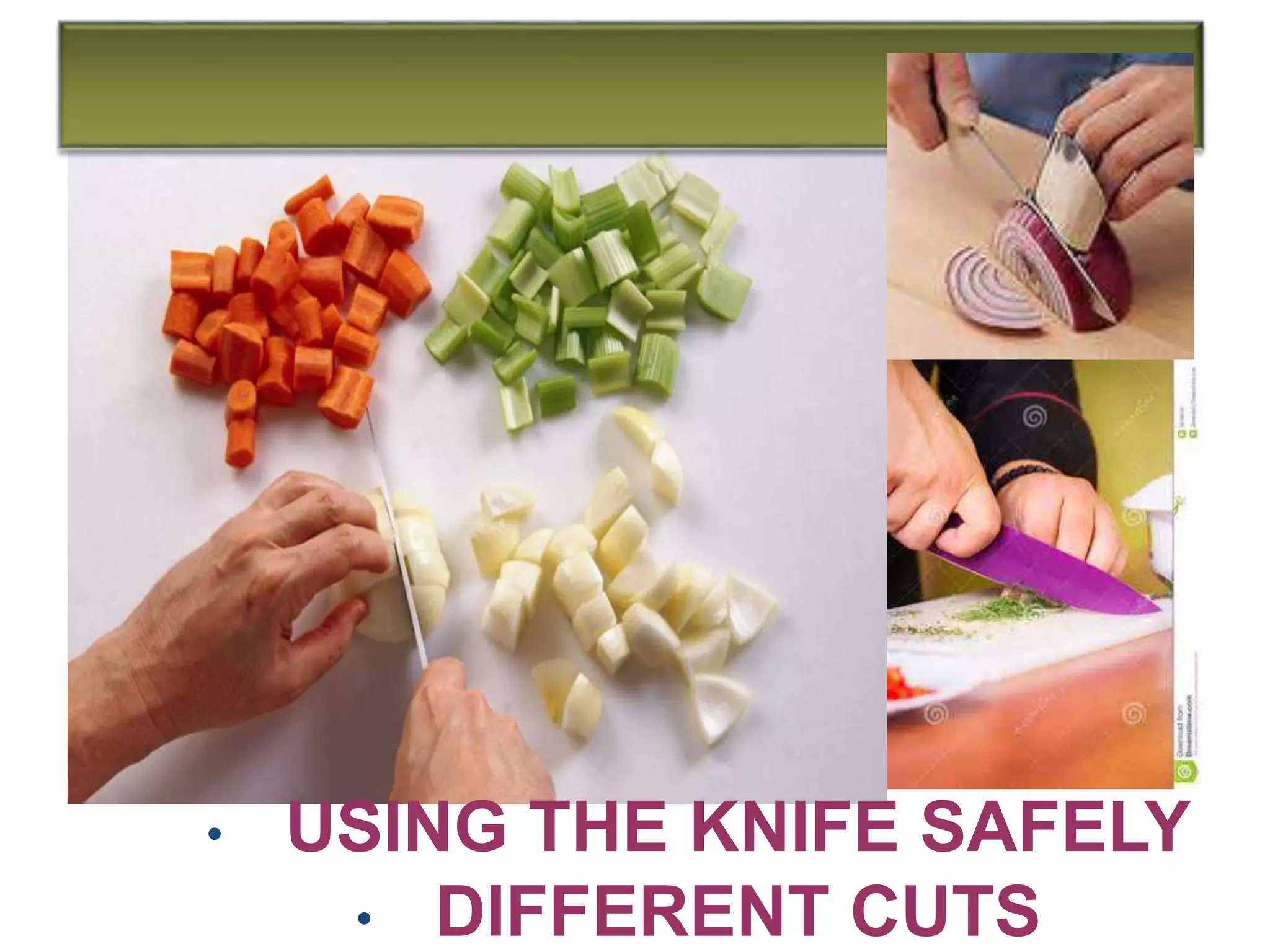
• USING THE KNIFE SAFELY
• DIFFERENT CUTS
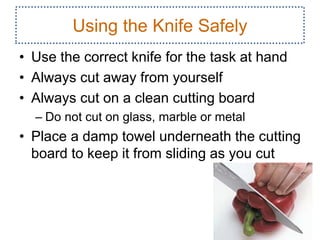
Using the Knife Safely
• Use the correct knife for the task at hand
• Always cut away from yourself
• Always cut on a clean cutting board
– Do not cut on glass, marble or metal
• Place a damp towel underneath the cutting
board to keep it from sliding as you cut
Using a Knife Safely (cont.)
• Keep knives sharp; a dull knife is more dangerous
than a sharp one
• When carrying a knife, hold it pointed down, parallel
and close to your leg as you walk
• A falling knife has no handle. Do not attempt to
catch a falling knife; step back and allow it to fall
• Never leave a knife in a sink of water; anyone
reaching into the sink could be injured or the knife
could be dented by pots or other utensils
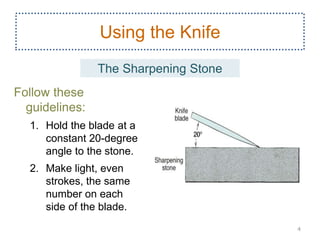
Follow these
guidelines:
1. Hold the blade at a
constant 20-degree
angle to the stone.
2. Make light, even
strokes, the same
number on each
side of the blade.
4
Using the Knife
The Sharpening Stone
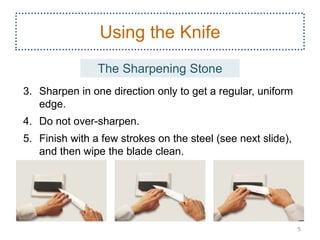
3. Sharpen in one direction only to get a regular, uniform
edge.
4. Do not over-sharpen.
5. Finish with a few strokes on the steel (see next slide),
and then wipe the blade clean.
5
Using the Knife
The Sharpening Stone
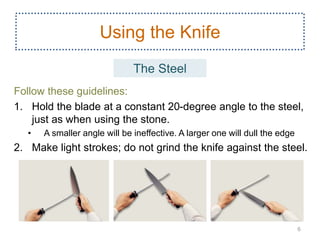
Follow these guidelines:
1. Hold the blade at a constant 20-degree angle to the steel,
just as when using the stone.
• A smaller angle will be ineffective. A larger one will dull the edge
2. Make light strokes; do not grind the knife against the steel.
6
Using the Knife
The Steel
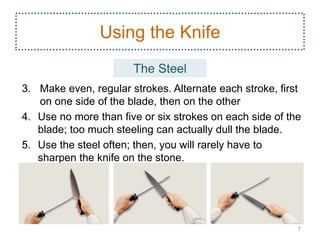
3. Make even, regular strokes. Alternate each stroke, first
on one side of the blade, then on the other
4. Use no more than five or six strokes on each side of the
blade; too much steeling can actually dull the blade.
5. Use the steel often; then, you will rarely have to
sharpen the knife on the stone.
7
Using the Knife
The Steel
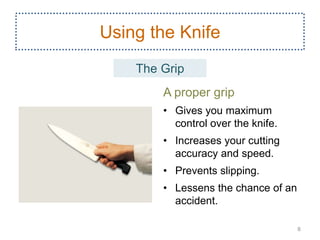
A proper grip
• Gives you maximum
control over the knife.
• Increases your cutting
accuracy and speed.
• Prevents slipping.
• Lessens the chance of an
accident.
8
Using the Knife
The Grip
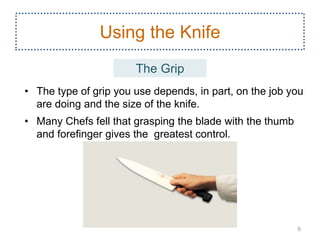
• The type of grip you use depends, in part, on the job you
are doing and the size of the knife.
• Many Chefs fell that grasping the blade with the thumb
and forefinger gives the greatest control.
9
Using the Knife
The Grip
Proper positioning of the hand achieves three goals
1. Hold the item being cut.
2. Guide the knife.
3. Protect the hand from cuts.
10
Using the Knife
The Guiding Hand
Knife Sanitizing
• Wash in hot soapy water after each task
• Sanitize after each use to prevent cross
contamination and the spread of
microorganism
11
Knife Storage
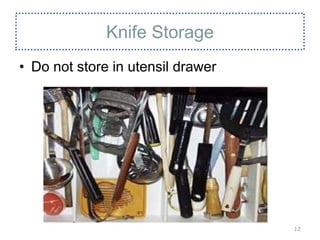
• Do not store in utensil drawer
12
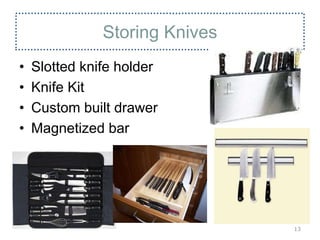
Storing Knives
• Slotted knife holder
• Knife Kit
• Custom built drawer
• Magnetized bar
13
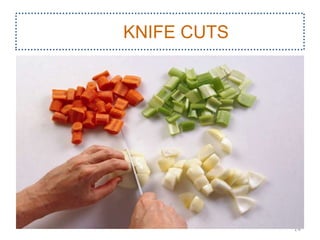
KNIFE CUTS
14
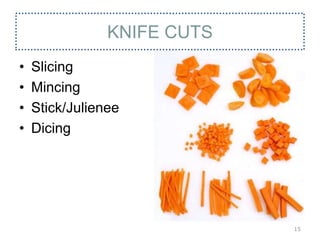
KNIFE CUTS
• Slicing
• Mincing
• Stick/Julienee
• Dicing
15
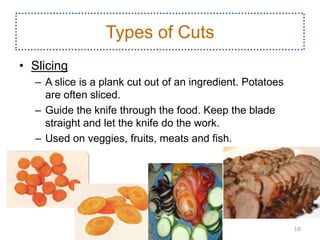
Types of Cuts
• Slicing
– A slice is a plank cut out of an ingredient. Potatoes
are often sliced.
– Guide the knife through the food. Keep the blade
straight and let the knife do the work.
– Used on veggies, fruits, meats and fish.
16
Types of Cuts
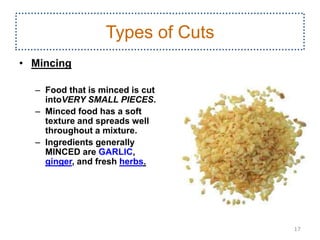
• Mincing
– Food that is minced is cut
intoVERY SMALL PIECES.
– Minced food has a soft
texture and spreads well
throughout a mixture.
– Ingredients generally
MINCED are GARLIC,
ginger, and fresh herbs.
17
Types of Cuts
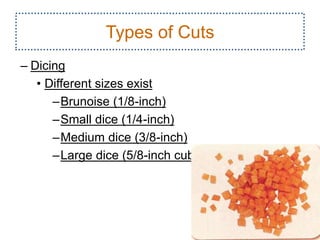
– Dicing
• Different sizes exist
–Brunoise (1/8-inch)
–Small dice (1/4-inch)
–Medium dice (3/8-inch)
–Large dice (5/8-inch cube)
18
Types of Cuts
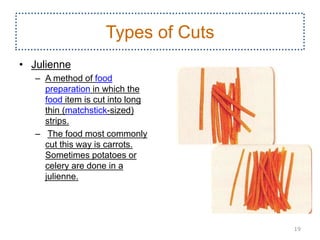
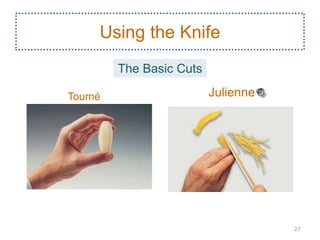
• Julienne
– A method of food
preparation in which the
food item is cut into long
thin (matchstick-sized)
strips.
– The food most commonly
cut this way is carrots.
Sometimes potatoes or
celery are done in a
julienne.
19
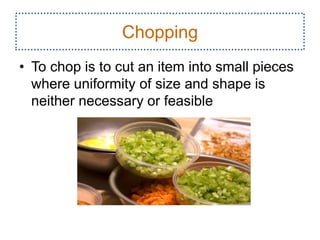
Chopping
• To chop is to cut an item into small pieces
where uniformity of size and shape is
neither necessary or feasible
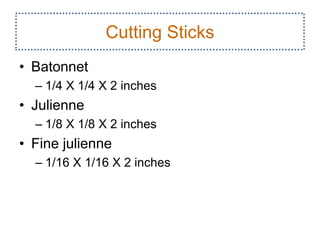
Cutting Sticks
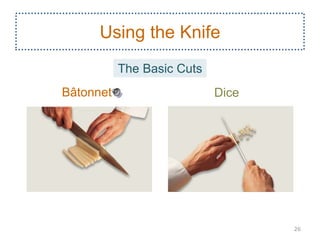
• Batonnet
– 1/4 X 1/4 X 2 inches
• Julienne
– 1/8 X 1/8 X 2 inches
• Fine julienne
– 1/16 X 1/16 X 2 inches
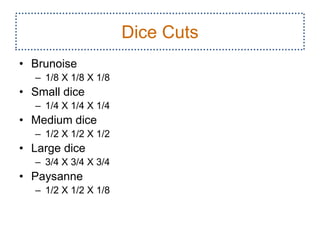
Dice Cuts
• Brunoise
– 1/8 X 1/8 X 1/8
• Small dice
– 1/4 X 1/4 X 1/4
• Medium dice
– 1/2 X 1/2 X 1/2
• Large dice
– 3/4 X 3/4 X 3/4
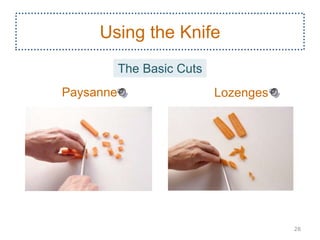
• Paysanne
– 1/2 X 1/2 X 1/8
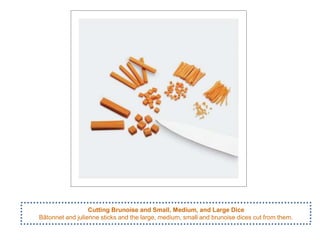
Cutting Brunoise and Small, Medium, and Large Dice
Bâtonnet and julienne sticks and the large, medium, small and brunoise dices cut from them.
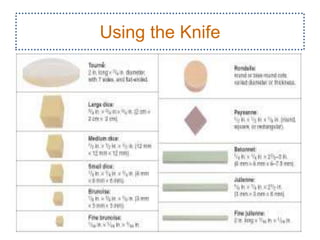
Using the Knife
24
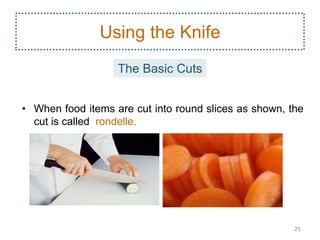
• When food items are cut into round slices as shown, the
cut is called rondelle.
25
Using the Knife
The Basic Cuts
Bâtonnet
26
Using the Knife
The Basic Cuts
Dice
Julienne
27
Using the Knife
The Basic Cuts
Tourné
Paysanne
28
Using the Knife
The Basic Cuts
Lozenges
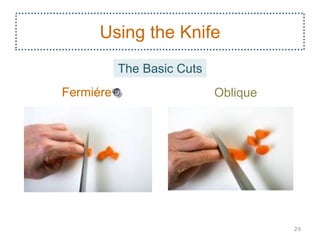
Fermiére
29
Using the Knife
The Basic Cuts
Oblique
Using the Knife
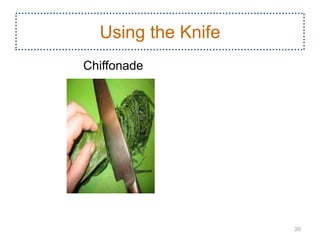
Chiffonade
30
31
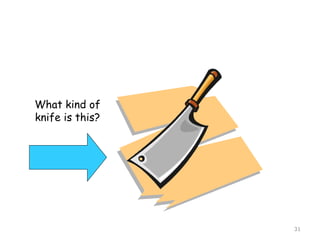
What kind of
knife is this?
THE END!
32

KNIFE PART 2.ppt

  • 1.
    • USING THEKNIFE SAFELY • DIFFERENT CUTS
  • 2.
    Using the KnifeSafely • Use the correct knife for the task at hand • Always cut away from yourself • Always cut on a clean cutting board – Do not cut on glass, marble or metal • Place a damp towel underneath the cutting board to keep it from sliding as you cut
  • 3.
    Using a KnifeSafely (cont.) • Keep knives sharp; a dull knife is more dangerous than a sharp one • When carrying a knife, hold it pointed down, parallel and close to your leg as you walk • A falling knife has no handle. Do not attempt to catch a falling knife; step back and allow it to fall • Never leave a knife in a sink of water; anyone reaching into the sink could be injured or the knife could be dented by pots or other utensils
  • 4.
    Follow these guidelines: 1. Holdthe blade at a constant 20-degree angle to the stone. 2. Make light, even strokes, the same number on each side of the blade. 4 Using the Knife The Sharpening Stone
  • 5.
    3. Sharpen inone direction only to get a regular, uniform edge. 4. Do not over-sharpen. 5. Finish with a few strokes on the steel (see next slide), and then wipe the blade clean. 5 Using the Knife The Sharpening Stone
  • 6.
    Follow these guidelines: 1.Hold the blade at a constant 20-degree angle to the steel, just as when using the stone. • A smaller angle will be ineffective. A larger one will dull the edge 2. Make light strokes; do not grind the knife against the steel. 6 Using the Knife The Steel
  • 7.
    3. Make even,regular strokes. Alternate each stroke, first on one side of the blade, then on the other 4. Use no more than five or six strokes on each side of the blade; too much steeling can actually dull the blade. 5. Use the steel often; then, you will rarely have to sharpen the knife on the stone. 7 Using the Knife The Steel
  • 8.
    A proper grip •Gives you maximum control over the knife. • Increases your cutting accuracy and speed. • Prevents slipping. • Lessens the chance of an accident. 8 Using the Knife The Grip
  • 9.
    • The typeof grip you use depends, in part, on the job you are doing and the size of the knife. • Many Chefs fell that grasping the blade with the thumb and forefinger gives the greatest control. 9 Using the Knife The Grip
  • 10.
    Proper positioning ofthe hand achieves three goals 1. Hold the item being cut. 2. Guide the knife. 3. Protect the hand from cuts. 10 Using the Knife The Guiding Hand
  • 11.
    Knife Sanitizing • Washin hot soapy water after each task • Sanitize after each use to prevent cross contamination and the spread of microorganism 11
  • 12.
    Knife Storage • Donot store in utensil drawer 12
  • 13.
    Storing Knives • Slottedknife holder • Knife Kit • Custom built drawer • Magnetized bar 13
  • 14.
  • 15.
    KNIFE CUTS • Slicing •Mincing • Stick/Julienee • Dicing 15
  • 16.
    Types of Cuts •Slicing – A slice is a plank cut out of an ingredient. Potatoes are often sliced. – Guide the knife through the food. Keep the blade straight and let the knife do the work. – Used on veggies, fruits, meats and fish. 16
  • 17.
    Types of Cuts •Mincing – Food that is minced is cut intoVERY SMALL PIECES. – Minced food has a soft texture and spreads well throughout a mixture. – Ingredients generally MINCED are GARLIC, ginger, and fresh herbs. 17
  • 18.
    Types of Cuts –Dicing • Different sizes exist –Brunoise (1/8-inch) –Small dice (1/4-inch) –Medium dice (3/8-inch) –Large dice (5/8-inch cube) 18
  • 19.
    Types of Cuts •Julienne – A method of food preparation in which the food item is cut into long thin (matchstick-sized) strips. – The food most commonly cut this way is carrots. Sometimes potatoes or celery are done in a julienne. 19
  • 20.
    Chopping • To chopis to cut an item into small pieces where uniformity of size and shape is neither necessary or feasible
  • 21.
    Cutting Sticks • Batonnet –1/4 X 1/4 X 2 inches • Julienne – 1/8 X 1/8 X 2 inches • Fine julienne – 1/16 X 1/16 X 2 inches
  • 22.
    Dice Cuts • Brunoise –1/8 X 1/8 X 1/8 • Small dice – 1/4 X 1/4 X 1/4 • Medium dice – 1/2 X 1/2 X 1/2 • Large dice – 3/4 X 3/4 X 3/4 • Paysanne – 1/2 X 1/2 X 1/8
  • 23.
    Cutting Brunoise andSmall, Medium, and Large Dice Bâtonnet and julienne sticks and the large, medium, small and brunoise dices cut from them.
  • 24.
  • 25.
    • When fooditems are cut into round slices as shown, the cut is called rondelle. 25 Using the Knife The Basic Cuts
  • 26.
  • 27.
    Julienne 27 Using the Knife TheBasic Cuts Tourné
  • 28.
  • 29.
  • 30.
  • 31.
  • 32.