

MIRENA IUCD
      Contraception &
      Reproductive health
Dr AHMED ZAKI
MD, MRCOG
   CONSULTANT & HEAD OF OB/GYN
           DEPARTMENT
 CHAIRMAN OF SCIENTIFIC COMMITTEE
BAKHSH HOSPITALS – AL SHARAFYIA.
JEDDAH
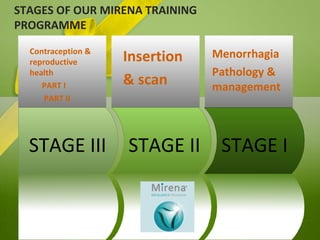
STAGES OF OUR MIRENA TRAINING
PROGRAMME

  Contraception &               Menorrhagia
  reproductive      Insertion
  health                        Pathology &
     PART I         & scan      management
      PART II


  STAGE III         STAGE II STAGE I
DO YOU HAVE ENOUGH INFORMATION TO MAKE A DECISION IN
PARTICULAR SITUATIONS ?
Who is medically eligible to
use the LNG-IUS?


 UK-MEC & WHO -MEC
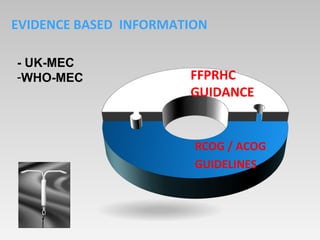
EVIDENCE BASED INFORMATION

- UK-MEC
-WHO-MEC               FFPRHC
                       GUIDANCE


                        RCOG / ACOG
                        GUIDELINES
MENORRHAGIA


                                            CONTRACEPTION


1   HORMONAL   2   REPRODUCTIVE   3   ROLE IN
    CONTENTS       HEALTH             PARTICULAR
                                      SITUATIONS
Contraceptive information given to women using
LNG-IUS

 MODE OF ACTION
 CONTRACEPTIVE EFFICIENCY
 DURATION (beyond liecence)
 PID
 ECTOPIC PREG
 RETURN OF FERTILITY
 EXPULSION
 PERFORATION
 HORMONAL SYMPTOMS
 OVARIAN CYSTS
 BMD
When can the LNG-IUS be inserted?


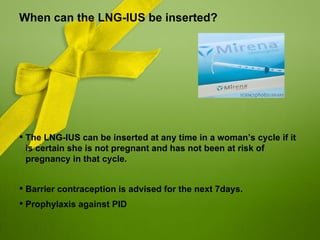
 The LNG-IUS can be inserted at any time in a woman’s cycle if it
  is certain she is not pregnant and has not been at risk of
  pregnancy in that cycle.


 Barrier contraception is advised for the next 7days.
 Prophylaxis against PID
The inserter of the Mirena®: is
• More rigid
• Curved
• thicker
When can the LNG-IUS be removed?


 The LNG-IUS may be removed at any time if the woman wishes
  to conceive;
 Otherwise unprotected sex should be avoided in the 7 days prior
  to removal AND If Mirena exchange
Switching Contraception
 TO PILLS
 When women using the LNG-IUS are amenorrhoeic and wish to
  use alternative contraception, in order to maintain contraceptive
  protection the LNG-IUS can beremoved after seven consecutive
  combined oral pills, or after two consecutive progestogen-only
  pills have been taken.

 TO DMPA
 The LNG-IUS can be removed 7 days after giving the depot
  medroxyprogesterone acetate injection or inserting a subdermal
  progestogen-only implant.
 TO IUD
 An IUD can be inserted immediately following LNG-IUS removal
without the need for any additional contraception
RETURN OF FERTILITY


 Women can be reassured that there is rapid return of fertility
  following LNG-IUS removal (Grade B).


 pregnancy rate of 90 per 100 women in the first year after LNG-IUS
  removal.
 The mean time to pregnancy was 4 months following LNG-IUS
removal and 3 months following IUD removal
ECTOPIC PREGNANCY


 Women can be reassured that the risk of ectopic
pregnancy with the LNG-IUS is low (Grade A).


 WHO-MEC recommends that women with a previous ectopic
  pregnancy may use the LNG-IUS (WHO Category1: unrestricted
  use). the risk of ectopic pregnancy being similar for the LNG-IUS
  and modern IUDs (>250 mm2 copper).
OVARIAN CYSTS


 Women may be reassured that although ovarian cysts occur in
  LNG-IUS users, there is no significant risk compared to IUD
  users
 A randomised trial investigated the occurrence of ovarian cysts
  following LNG-IUS insertion or hysterectomy.
 The incidence of ovarian cysts was higher in the LNG-IUS group at 6
  months (17.5% vs 3%) and at 12 months (21.5% vs 8%). However,
  no correlation was identified between the presence of ovarian cysts
  and age or bleeding pattern.
 The majority of cysts wereasymptomatic and resolved spontaneously
  and no significant increased risk compared to IUD users (Grade
  A).
IF LNG-IUS user C/O ABD.PAIN, OVAIAN CYST MUST
BE IN YOUR DD
CAN MIRENA –IUS BE USED AS EMERGENCY
CONTRACEPTION ?


     NO
DOES LNG-IUS HAS HORMONAL SYMPTOMS?


 Women may be informed that although hormonal symptoms are
  reported by LNG-IUS users, these are not significantly different
  from IUD users(Grade A).
These include acne, headache, breast tenderness, nausea &
 bloating
BREAST FEEDING WOMEN


Does LNG goes to Breast Milk?
How much?
Is it Safe?
 Levels of LNG in breast milk are low with the
LNG-IUS. (1% of daily dose in each 600 mls of milk)
Therefore, women who are breastfeeding and are 6 or
 more weeks postpartum may choose this method
 (Grade B).
Are there any drugs that interact with LNG-IUS?


 Women using the LNG-IUS may be reassured that there is no
  evidence of reduced efficacy with liver enzyme-inducers or other
  drugs (Grade B). WHO –MEC 2


 No drugs are known to interact with the LNG-IUS
EXPULSION / PERFORATION


 Women should be informed that the most likely cause of LNG-
  IUS failure is expulsion. The risk of this happening is around 1 in
  20 (Grade A).


 Women may be informed that uterine perforation occurs in fewer
  than 1 in 1000 LNG-IUS insertions (Grade B).
PREGNANCY ON TOP OF MIRENA-IUS


Incidence
Any teratogencity ?
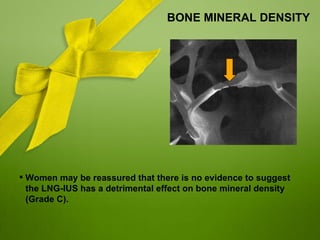
BONE MINERAL DENSITY


 Women may be reassured that there is no evidence to suggest
  the LNG-IUS has a detrimental effect on bone mineral density
  (Grade C).
HANDICAPED
     PID                              DVT                      WOMEN
                                                   3                                 5
                  1


                                                  BREAST
                      HIV                         CANCER
                                  2                                4


THIS PRESENTATION SUMMARIZES EVIDENCE FOR LNG-IUD IN ALL APECTS OF CONTRACEPTION &
REPRODUCTIVE HEALTH
 There are conditions where the risks of LNG-IUS use
outweigh the benefits because of its progestogen
content, rather than its intrauterine site (CATEGORY
 3):


 -Current deep vein thrombosis or pulmonary embolus,
 -Ischaemic heart disease,
 -Active viral hepatitis, severe decompensated cirrhosis,
- Benign or malignant hepatoma
Women at risk of sexually transmitted infections and
human Immunodeficiency virus


   WHOMEC recommends that the risks of using the LNG-IUS
  generally outweigh the benefits for women who are at increased
   risk of sexually transmitted infection (STI) or HIV (catig.3) as well
   for Cupper IUD.
   Data from a randomized trials suggest that women using the LNG-
    IUS are less likely to have pelvic inflammatory disease (PID)
    diagnosed than women using an IUD.
  No differences were found in the incidence of PID between LNG-
   IUS and IUD users. Thus there are insufficient data to support a
  reduction in PID with LNG-IUS use.
WOMEN WITH current or recent PID


 Women should be advised that a small increase in the risk of
  pelvic infection occurs following LNGIUS insertion but thereafter
  the risk of infection is low.


After considering other contraceptive methods, a
 woman may use the LNG-IUS within 3 months of
 treated pelvic infection, provided she has no signs or
 symptoms.
Migraine with focal symptoms


 Women with a history of migraine with focal
  symptoms may use the LNG-IUS. If, however,
  migraine with focal symptoms develops in a LNGI-US
  user, these new symptoms should be investigated
  and other contraceptive options discussed (catig.2).
  i.e. remove it


 No evidence was identified of an association between the
  LNG-IUS, migraine and stroke.
BREST CANCER


 Non-hormonal contraception is most appropriate for a woman
  with a history of breast cancer.


 However, the LNG-IUS may be considered individually, and in
  consultation with the woman’s breast surgeon.(help in
  treatingTamoxifen induced hyperplasia)
 WHO- MEC 4 FOR CURRENT BREAST CA
 WHO- MEC 3 FOR PAST H/O       BR. CA (NO DISEASE FOR 5
 YEARS)
MIRENA IUS AS HRT


 Women using estrogen replacement may choose the LNG-IUS to
  provide protection against hyperplasia and malignancy, but this
  is outside the current license (Grade A).


 The LNG-IUS should not be used routinely as a treatment for
  endometrial hyperplasia or malignancy (Grade B).
CAN LNG-IUS BE USED IN CONTRACEPTION OF
HANDICAPED PATIENT


         ADVANTAGES
         DISADVANTAGES
Is the LNG-IUS effective in the management of
dysmenorrhoea? PMT


 There is insufficient evidence to support the use of the LNG-IUS
  routinely for women with pain OR PMT in the absence of heavy
  bleeding (Grade C).


.
CONCLUSION
 After counseling, the LNG-IUS is a suitable option for most
  women who need contraception and/or treatment for
  menorrhagia (Grade C).


 THE LIMITATIONS OF USE & WHO-MEC CRITERIA MUST BE
  CONSIDERED
SEE YOU
    AGAIN
        IN
    PART II


THANK YOU

Mirena contraception

  • 1.
    MIRENA IUCD Contraception & Reproductive health Dr AHMED ZAKI MD, MRCOG CONSULTANT & HEAD OF OB/GYN DEPARTMENT CHAIRMAN OF SCIENTIFIC COMMITTEE BAKHSH HOSPITALS – AL SHARAFYIA. JEDDAH
  • 2.
    STAGES OF OURMIRENA TRAINING PROGRAMME Contraception & Menorrhagia reproductive Insertion health Pathology & PART I & scan management PART II STAGE III STAGE II STAGE I
  • 3.
    DO YOU HAVEENOUGH INFORMATION TO MAKE A DECISION IN PARTICULAR SITUATIONS ?
  • 4.
    Who is medicallyeligible to use the LNG-IUS? UK-MEC & WHO -MEC
  • 5.
    EVIDENCE BASED INFORMATION -UK-MEC -WHO-MEC FFPRHC GUIDANCE RCOG / ACOG GUIDELINES
  • 6.
    MENORRHAGIA CONTRACEPTION 1 HORMONAL 2 REPRODUCTIVE 3 ROLE IN CONTENTS HEALTH PARTICULAR SITUATIONS
  • 8.
    Contraceptive information givento women using LNG-IUS  MODE OF ACTION  CONTRACEPTIVE EFFICIENCY  DURATION (beyond liecence)  PID  ECTOPIC PREG  RETURN OF FERTILITY  EXPULSION  PERFORATION  HORMONAL SYMPTOMS  OVARIAN CYSTS  BMD
  • 9.
    When can theLNG-IUS be inserted?  The LNG-IUS can be inserted at any time in a woman’s cycle if it is certain she is not pregnant and has not been at risk of pregnancy in that cycle.  Barrier contraception is advised for the next 7days.  Prophylaxis against PID
  • 10.
    The inserter ofthe Mirena®: is • More rigid • Curved • thicker
  • 11.
    When can theLNG-IUS be removed?  The LNG-IUS may be removed at any time if the woman wishes to conceive;  Otherwise unprotected sex should be avoided in the 7 days prior to removal AND If Mirena exchange
  • 12.
    Switching Contraception  TOPILLS  When women using the LNG-IUS are amenorrhoeic and wish to use alternative contraception, in order to maintain contraceptive protection the LNG-IUS can beremoved after seven consecutive combined oral pills, or after two consecutive progestogen-only pills have been taken.  TO DMPA  The LNG-IUS can be removed 7 days after giving the depot medroxyprogesterone acetate injection or inserting a subdermal progestogen-only implant.  TO IUD  An IUD can be inserted immediately following LNG-IUS removal without the need for any additional contraception
  • 13.
    RETURN OF FERTILITY Women can be reassured that there is rapid return of fertility following LNG-IUS removal (Grade B).  pregnancy rate of 90 per 100 women in the first year after LNG-IUS removal.  The mean time to pregnancy was 4 months following LNG-IUS removal and 3 months following IUD removal
  • 14.
    ECTOPIC PREGNANCY  Womencan be reassured that the risk of ectopic pregnancy with the LNG-IUS is low (Grade A).  WHO-MEC recommends that women with a previous ectopic pregnancy may use the LNG-IUS (WHO Category1: unrestricted use). the risk of ectopic pregnancy being similar for the LNG-IUS and modern IUDs (>250 mm2 copper).
  • 15.
    OVARIAN CYSTS  Womenmay be reassured that although ovarian cysts occur in LNG-IUS users, there is no significant risk compared to IUD users  A randomised trial investigated the occurrence of ovarian cysts following LNG-IUS insertion or hysterectomy.  The incidence of ovarian cysts was higher in the LNG-IUS group at 6 months (17.5% vs 3%) and at 12 months (21.5% vs 8%). However, no correlation was identified between the presence of ovarian cysts and age or bleeding pattern.  The majority of cysts wereasymptomatic and resolved spontaneously and no significant increased risk compared to IUD users (Grade A). IF LNG-IUS user C/O ABD.PAIN, OVAIAN CYST MUST BE IN YOUR DD
  • 16.
    CAN MIRENA –IUSBE USED AS EMERGENCY CONTRACEPTION ? NO
  • 17.
    DOES LNG-IUS HASHORMONAL SYMPTOMS?  Women may be informed that although hormonal symptoms are reported by LNG-IUS users, these are not significantly different from IUD users(Grade A). These include acne, headache, breast tenderness, nausea & bloating
  • 18.
    BREAST FEEDING WOMEN DoesLNG goes to Breast Milk? How much? Is it Safe?  Levels of LNG in breast milk are low with the LNG-IUS. (1% of daily dose in each 600 mls of milk) Therefore, women who are breastfeeding and are 6 or more weeks postpartum may choose this method (Grade B).
  • 19.
    Are there anydrugs that interact with LNG-IUS?  Women using the LNG-IUS may be reassured that there is no evidence of reduced efficacy with liver enzyme-inducers or other drugs (Grade B). WHO –MEC 2  No drugs are known to interact with the LNG-IUS
  • 20.
    EXPULSION / PERFORATION Women should be informed that the most likely cause of LNG- IUS failure is expulsion. The risk of this happening is around 1 in 20 (Grade A).  Women may be informed that uterine perforation occurs in fewer than 1 in 1000 LNG-IUS insertions (Grade B).
  • 21.
    PREGNANCY ON TOPOF MIRENA-IUS Incidence Any teratogencity ?
  • 22.
    BONE MINERAL DENSITY Women may be reassured that there is no evidence to suggest the LNG-IUS has a detrimental effect on bone mineral density (Grade C).
  • 23.
    HANDICAPED PID DVT WOMEN 3 5 1 BREAST HIV CANCER 2 4 THIS PRESENTATION SUMMARIZES EVIDENCE FOR LNG-IUD IN ALL APECTS OF CONTRACEPTION & REPRODUCTIVE HEALTH
  • 24.
     There areconditions where the risks of LNG-IUS use outweigh the benefits because of its progestogen content, rather than its intrauterine site (CATEGORY 3): -Current deep vein thrombosis or pulmonary embolus, -Ischaemic heart disease, -Active viral hepatitis, severe decompensated cirrhosis, - Benign or malignant hepatoma
  • 26.
    Women at riskof sexually transmitted infections and human Immunodeficiency virus  WHOMEC recommends that the risks of using the LNG-IUS generally outweigh the benefits for women who are at increased risk of sexually transmitted infection (STI) or HIV (catig.3) as well for Cupper IUD.  Data from a randomized trials suggest that women using the LNG- IUS are less likely to have pelvic inflammatory disease (PID) diagnosed than women using an IUD. No differences were found in the incidence of PID between LNG- IUS and IUD users. Thus there are insufficient data to support a reduction in PID with LNG-IUS use.
  • 27.
    WOMEN WITH currentor recent PID  Women should be advised that a small increase in the risk of pelvic infection occurs following LNGIUS insertion but thereafter the risk of infection is low. After considering other contraceptive methods, a woman may use the LNG-IUS within 3 months of treated pelvic infection, provided she has no signs or symptoms.
  • 28.
    Migraine with focalsymptoms  Women with a history of migraine with focal symptoms may use the LNG-IUS. If, however, migraine with focal symptoms develops in a LNGI-US user, these new symptoms should be investigated and other contraceptive options discussed (catig.2). i.e. remove it  No evidence was identified of an association between the LNG-IUS, migraine and stroke.
  • 29.
    BREST CANCER  Non-hormonalcontraception is most appropriate for a woman with a history of breast cancer.  However, the LNG-IUS may be considered individually, and in consultation with the woman’s breast surgeon.(help in treatingTamoxifen induced hyperplasia)  WHO- MEC 4 FOR CURRENT BREAST CA  WHO- MEC 3 FOR PAST H/O BR. CA (NO DISEASE FOR 5 YEARS)
  • 30.
    MIRENA IUS ASHRT  Women using estrogen replacement may choose the LNG-IUS to provide protection against hyperplasia and malignancy, but this is outside the current license (Grade A).  The LNG-IUS should not be used routinely as a treatment for endometrial hyperplasia or malignancy (Grade B).
  • 31.
    CAN LNG-IUS BEUSED IN CONTRACEPTION OF HANDICAPED PATIENT ADVANTAGES DISADVANTAGES
  • 32.
    Is the LNG-IUSeffective in the management of dysmenorrhoea? PMT  There is insufficient evidence to support the use of the LNG-IUS routinely for women with pain OR PMT in the absence of heavy bleeding (Grade C). .
  • 33.
    CONCLUSION  After counseling,the LNG-IUS is a suitable option for most women who need contraception and/or treatment for menorrhagia (Grade C).  THE LIMITATIONS OF USE & WHO-MEC CRITERIA MUST BE CONSIDERED
  • 34.
    SEE YOU AGAIN IN PART II THANK YOU