Assortment
Expansion Strategies
for Profitable
eCommerce Growth
Mirakl Platform
Justin Samakow
Platform Advisory Director
Kelly Gow
Sr Product Marketing Manager
Takeaways
At the end of this Masterclass,
you’ll know
✓ The key decision factors behind
choosing dropship or marketplace.
✓ How to go through the step by step
decision process at a brand and
category level.
Is there a “best model” when thinking of
dropship and marketplace?
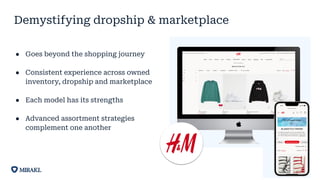
● Goes beyond the shopping journey
● Consistent experience across owned
inventory, dropship and marketplace
● Each model has its strengths
● Advanced assortment strategies
complement one another
Demystifying dropship & marketplace
How do you determine if a product,
category or brand is right for dropship or
marketplace?
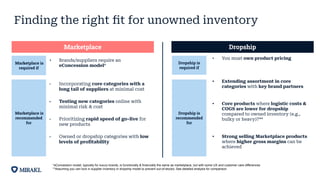
Finding the right fit for unowned inventory
*eConcession model, typically for luxury brands, is functionally & financially the same as marketplace, but with some UX and customer care differences
**Assuming you can lock in supplier inventory in dropship model to prevent out-of-stocks; See detailed analysis for comparison
Dropship
• Extending assortment in core
categories with key brand partners
Dropship is
recommended
for
• Core products where logistic costs &
COGS are lower for dropship
compared to owned inventory (e.g.,
bulky or heavy)?**
Dropship is
required if
• You must own product pricing
• Strong selling Marketplace products
where higher gross margins can be
achieved
Marketplace
• Brands/suppliers require an
eConcession model*
Marketplace is
required if
Marketplace is
recommended
for
• Incorporating core categories with a
long tail of suppliers at minimal cost
• Testing new categories online with
minimal risk & cost
• Owned or dropship categories with low
levels of profitability
• Prioritizing rapid speed of go-live for
new products
What should retailers consider when defining
their assortment strategy?
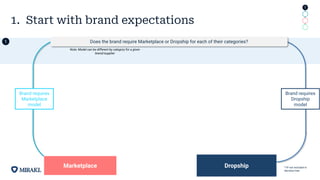
1. Start with brand expectations
Note: Model can be different by category for a given
brand/supplier
Brand requires
Marketplace
model
Marketplace
Brand requires
Dropship
model
*1P not included in
decision tree
Does the brand require Marketplace or Dropship for each of their categories?
Dropship
1
1
2
3
4
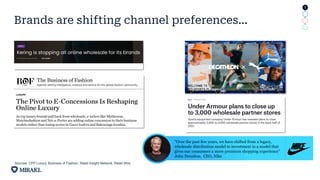
Brands are shifting channel preferences…
“Over the past few years, we have shifted from a legacy,
wholesale distribution model to investment in a model that
gives our consumers a more premium shopping experience”
John Donahoe, CEO, Nike
Sources: CPP Luxury, Business of Fashion, Retail Insight Network, Retail Wire
1
2
3
4
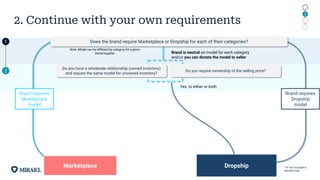
2. Continue with your own requirements
Brand is neutral on model for each category
and/or you can dictate the model to seller
Note: Model can be different by category for a given
brand/supplier
Brand requires
Marketplace
model
Marketplace Dropship
Brand requires
Dropship
model
*1P not included in
decision tree
Do you have a wholesale relationship (owned inventory)
and require the same model for unowned inventory?
Do you require ownership of the selling price?
Yes, to either or both
Does the brand require Marketplace or Dropship for each of their categories?
1
2
1
2
3
4
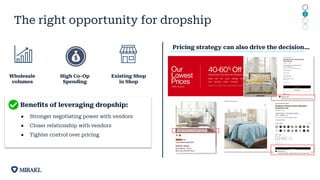
The right opportunity for dropship
Benefits of leveraging dropship:
● Stronger negotiating power with vendors
● Closer relationship with vendors
● Tighter control over pricing
Wholesale
volumes
High Co-Op
Spending
Existing Shop
in Shop
1
2
3
4
Pricing strategy can also drive the decision…
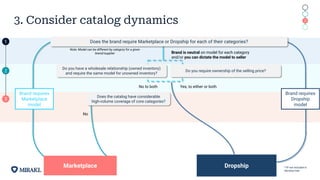
3. Consider catalog dynamics
Brand is neutral on model for each category
and/or you can dictate the model to seller
Note: Model can be different by category for a given
brand/supplier
Brand requires
Marketplace
model
Brand requires
Dropship
model
*1P not included in
decision tree
Do you have a wholesale relationship (owned inventory)
and require the same model for unowned inventory?
Do you require ownership of the selling price?
Yes, to either or both
No to both
3
Dropship
Does the brand require Marketplace or Dropship for each of their categories?
1
2
1
2
3
4
Does the catalog have considerable
high-volume coverage of core categories?
No
Marketplace
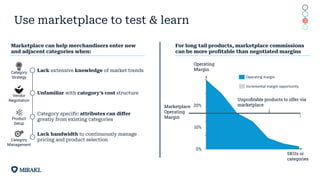
Use marketplace to test & learn
Marketplace can help merchandisers enter new
and adjacent categories when:
For long tail products, marketplace commissions
can be more profitable than negotiated margins
20%
10%
0%
Operating
Margin
Marketplace
Operating
Margin
Unprofitable products to offer via
marketplace
SKUs or
categories
Unfamiliar with category’s cost structure
Lack extensive knowledge of market trends
Lack bandwidth to continuously manage
pricing and product selection
Category specific attributes can differ
greatly from existing categories
Category
Strategy
Vendor
Negotiation
Product
Setup
Category
Management
1
2
3
4
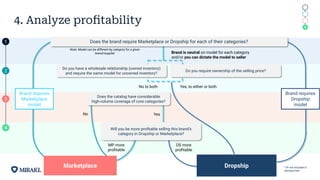
4. Analyze profitability
1
2
3
4
Brand is neutral on model for each category
and/or you can dictate the model to seller
Note: Model can be different by category for a given
brand/supplier
Brand requires
Marketplace
model
Brand requires
Dropship
model
*1P not included in
decision tree
Do you have a wholesale relationship (owned inventory)
and require the same model for unowned inventory?
Do you require ownership of the selling price?
Yes, to either or both
No to both
No
Dropship
Yes
Does the brand require Marketplace or Dropship for each of their categories?
DS more
profitable
MP more
profitable
Marketplace
Will you be more profitable selling this brand’s
category in Dropship or Marketplace?
4
3
1
2
Does the catalog have considerable
high-volume coverage of core categories?
Can you help bring this to life?
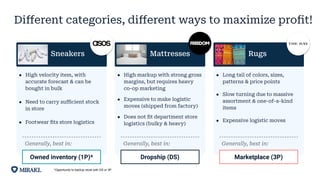
Different categories, different ways to maximize profit!
Sneakers Mattresses Rugs
● High markup with strong gross
margins, but requires heavy
co-op marketing
● Expensive to make logistic
moves (shipped from factory)
● Does not fit department store
logistics (bulky & heavy)
● High velocity item, with
accurate forecast & can be
bought in bulk
● Need to carry sufficient stock
in store
● Footwear fits store logistics
● Long tail of colors, sizes,
patterns & price points
● Slow turning due to massive
assortment & one-of-a-kind
items
● Expensive logistic moves
Owned inventory (1P)* Dropship (DS) Marketplace (3P)
Generally, best in: Generally, best in: Generally, best in:
*Opportunity to backup stock with DS or 3P
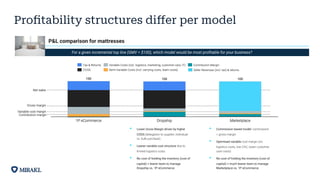
Profitability structures differ per model
P&L comparison for mattresses
For a given incremental top line (GMV = $100), which model would be most profitable for your business?
• Lower Gross Margin driven by higher
COGS (delegation to supplier, individual
vs. bulk purchase)
• Leaner variable cost structure due to
limited logistics costs
• No cost of holding the inventory (cost of
capital) + leaner team to manage
Dropship vs. 1P eCommerce
• Commission based model: commission
= gross margin
• Optimised variable cost margin (no
logistics costs, low CAC, lower customer
care costs)
• No cost of holding the inventory (cost of
capital) + much leaner team to manage
Marketplace vs. 1P eCommerce
How does Mirakl help?
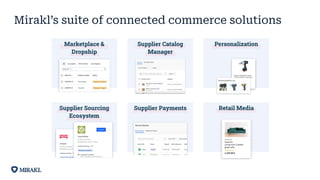
Mirakl’s suite of connected commerce solutions
Before you go!
DOWNLOAD NOW
Thank you!

Mirakl Assortment Strategy Webinar Slides

  • 1.
  • 2.
    Justin Samakow Platform AdvisoryDirector Kelly Gow Sr Product Marketing Manager
  • 3.
    Takeaways At the endof this Masterclass, you’ll know ✓ The key decision factors behind choosing dropship or marketplace. ✓ How to go through the step by step decision process at a brand and category level.
  • 4.
    Is there a“best model” when thinking of dropship and marketplace?
  • 5.
    ● Goes beyondthe shopping journey ● Consistent experience across owned inventory, dropship and marketplace ● Each model has its strengths ● Advanced assortment strategies complement one another Demystifying dropship & marketplace
  • 6.
    How do youdetermine if a product, category or brand is right for dropship or marketplace?
  • 7.
    Finding the rightfit for unowned inventory *eConcession model, typically for luxury brands, is functionally & financially the same as marketplace, but with some UX and customer care differences **Assuming you can lock in supplier inventory in dropship model to prevent out-of-stocks; See detailed analysis for comparison Dropship • Extending assortment in core categories with key brand partners Dropship is recommended for • Core products where logistic costs & COGS are lower for dropship compared to owned inventory (e.g., bulky or heavy)?** Dropship is required if • You must own product pricing • Strong selling Marketplace products where higher gross margins can be achieved Marketplace • Brands/suppliers require an eConcession model* Marketplace is required if Marketplace is recommended for • Incorporating core categories with a long tail of suppliers at minimal cost • Testing new categories online with minimal risk & cost • Owned or dropship categories with low levels of profitability • Prioritizing rapid speed of go-live for new products
  • 8.
    What should retailersconsider when defining their assortment strategy?
  • 9.
    1. Start withbrand expectations Note: Model can be different by category for a given brand/supplier Brand requires Marketplace model Marketplace Brand requires Dropship model *1P not included in decision tree Does the brand require Marketplace or Dropship for each of their categories? Dropship 1 1 2 3 4
  • 10.
    Brands are shiftingchannel preferences… “Over the past few years, we have shifted from a legacy, wholesale distribution model to investment in a model that gives our consumers a more premium shopping experience” John Donahoe, CEO, Nike Sources: CPP Luxury, Business of Fashion, Retail Insight Network, Retail Wire 1 2 3 4
  • 11.
    2. Continue withyour own requirements Brand is neutral on model for each category and/or you can dictate the model to seller Note: Model can be different by category for a given brand/supplier Brand requires Marketplace model Marketplace Dropship Brand requires Dropship model *1P not included in decision tree Do you have a wholesale relationship (owned inventory) and require the same model for unowned inventory? Do you require ownership of the selling price? Yes, to either or both Does the brand require Marketplace or Dropship for each of their categories? 1 2 1 2 3 4
  • 12.
    The right opportunityfor dropship Benefits of leveraging dropship: ● Stronger negotiating power with vendors ● Closer relationship with vendors ● Tighter control over pricing Wholesale volumes High Co-Op Spending Existing Shop in Shop 1 2 3 4 Pricing strategy can also drive the decision…
  • 13.
    3. Consider catalogdynamics Brand is neutral on model for each category and/or you can dictate the model to seller Note: Model can be different by category for a given brand/supplier Brand requires Marketplace model Brand requires Dropship model *1P not included in decision tree Do you have a wholesale relationship (owned inventory) and require the same model for unowned inventory? Do you require ownership of the selling price? Yes, to either or both No to both 3 Dropship Does the brand require Marketplace or Dropship for each of their categories? 1 2 1 2 3 4 Does the catalog have considerable high-volume coverage of core categories? No Marketplace
  • 14.
    Use marketplace totest & learn Marketplace can help merchandisers enter new and adjacent categories when: For long tail products, marketplace commissions can be more profitable than negotiated margins 20% 10% 0% Operating Margin Marketplace Operating Margin Unprofitable products to offer via marketplace SKUs or categories Unfamiliar with category’s cost structure Lack extensive knowledge of market trends Lack bandwidth to continuously manage pricing and product selection Category specific attributes can differ greatly from existing categories Category Strategy Vendor Negotiation Product Setup Category Management 1 2 3 4
  • 15.
    4. Analyze profitability 1 2 3 4 Brandis neutral on model for each category and/or you can dictate the model to seller Note: Model can be different by category for a given brand/supplier Brand requires Marketplace model Brand requires Dropship model *1P not included in decision tree Do you have a wholesale relationship (owned inventory) and require the same model for unowned inventory? Do you require ownership of the selling price? Yes, to either or both No to both No Dropship Yes Does the brand require Marketplace or Dropship for each of their categories? DS more profitable MP more profitable Marketplace Will you be more profitable selling this brand’s category in Dropship or Marketplace? 4 3 1 2 Does the catalog have considerable high-volume coverage of core categories?
  • 16.
    Can you helpbring this to life?
  • 17.
    Different categories, differentways to maximize profit! Sneakers Mattresses Rugs ● High markup with strong gross margins, but requires heavy co-op marketing ● Expensive to make logistic moves (shipped from factory) ● Does not fit department store logistics (bulky & heavy) ● High velocity item, with accurate forecast & can be bought in bulk ● Need to carry sufficient stock in store ● Footwear fits store logistics ● Long tail of colors, sizes, patterns & price points ● Slow turning due to massive assortment & one-of-a-kind items ● Expensive logistic moves Owned inventory (1P)* Dropship (DS) Marketplace (3P) Generally, best in: Generally, best in: Generally, best in: *Opportunity to backup stock with DS or 3P
  • 18.
    Profitability structures differper model P&L comparison for mattresses For a given incremental top line (GMV = $100), which model would be most profitable for your business? • Lower Gross Margin driven by higher COGS (delegation to supplier, individual vs. bulk purchase) • Leaner variable cost structure due to limited logistics costs • No cost of holding the inventory (cost of capital) + leaner team to manage Dropship vs. 1P eCommerce • Commission based model: commission = gross margin • Optimised variable cost margin (no logistics costs, low CAC, lower customer care costs) • No cost of holding the inventory (cost of capital) + much leaner team to manage Marketplace vs. 1P eCommerce
  • 19.
  • 20.
    Mirakl’s suite ofconnected commerce solutions
  • 21.
  • 22.