What is it?
Whatis it?
• Recommender systems are a technological
Recommender systems are a technological
proxy for a social process.
proxy for a social process.
• Recommender systems are a way of
Recommender systems are a way of
suggesting like or similar items and ideas to a
suggesting like or similar items and ideas to a
users specific way of thinking.
users specific way of thinking.
• Recommender systems try to automate
Recommender systems try to automate
aspects of a completely different information
aspects of a completely different information
discovery model where people try to find
discovery model where people try to find
other people with similar tastes and then ask
other people with similar tastes and then ask
them to suggest new things.
them to suggest new things.
4.
Example
Example
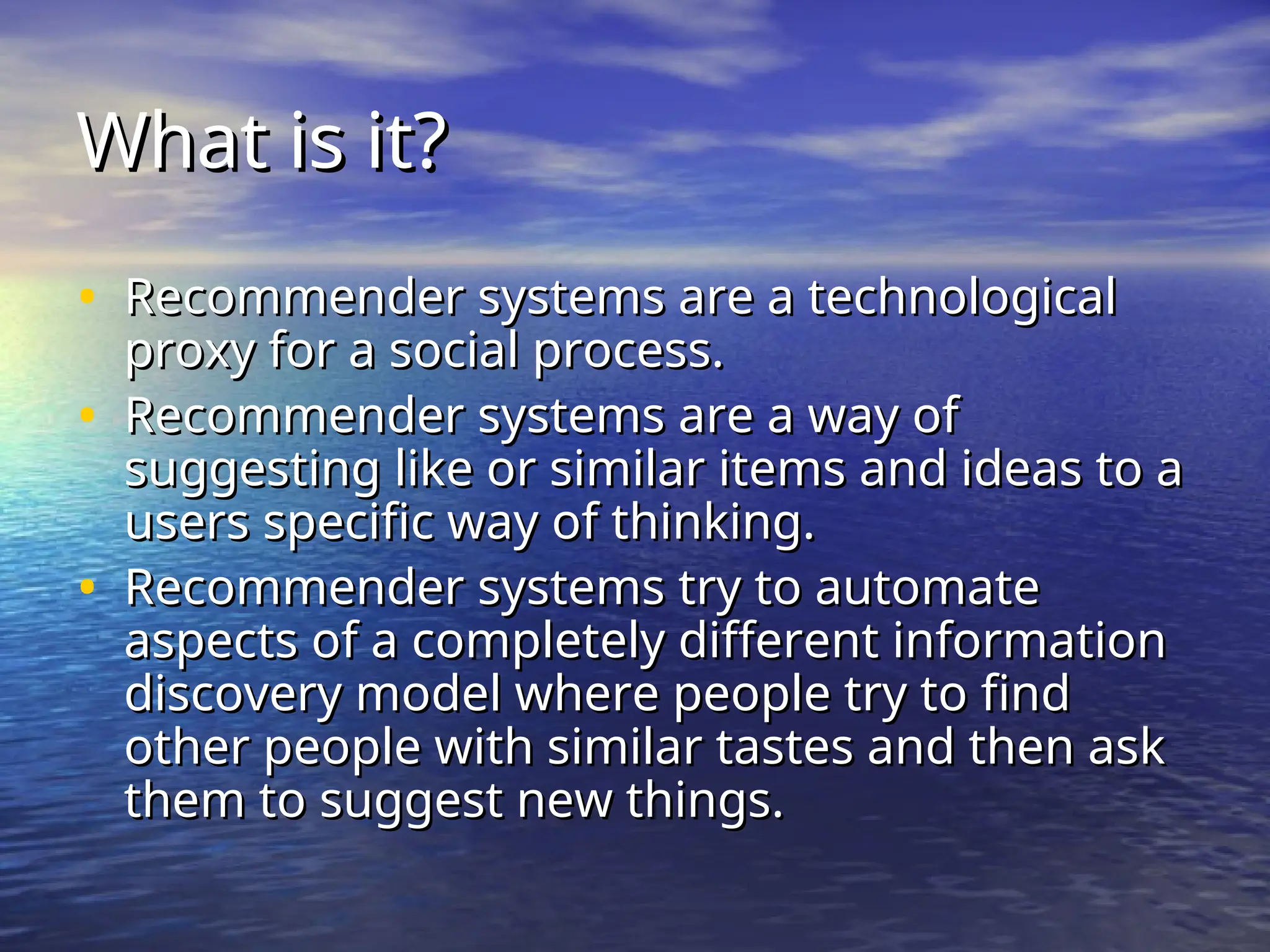
• Customer A
CustomerA
– Buys Metalica CD
Buys Metalica CD
– Buys Megadeth CD
Buys Megadeth CD
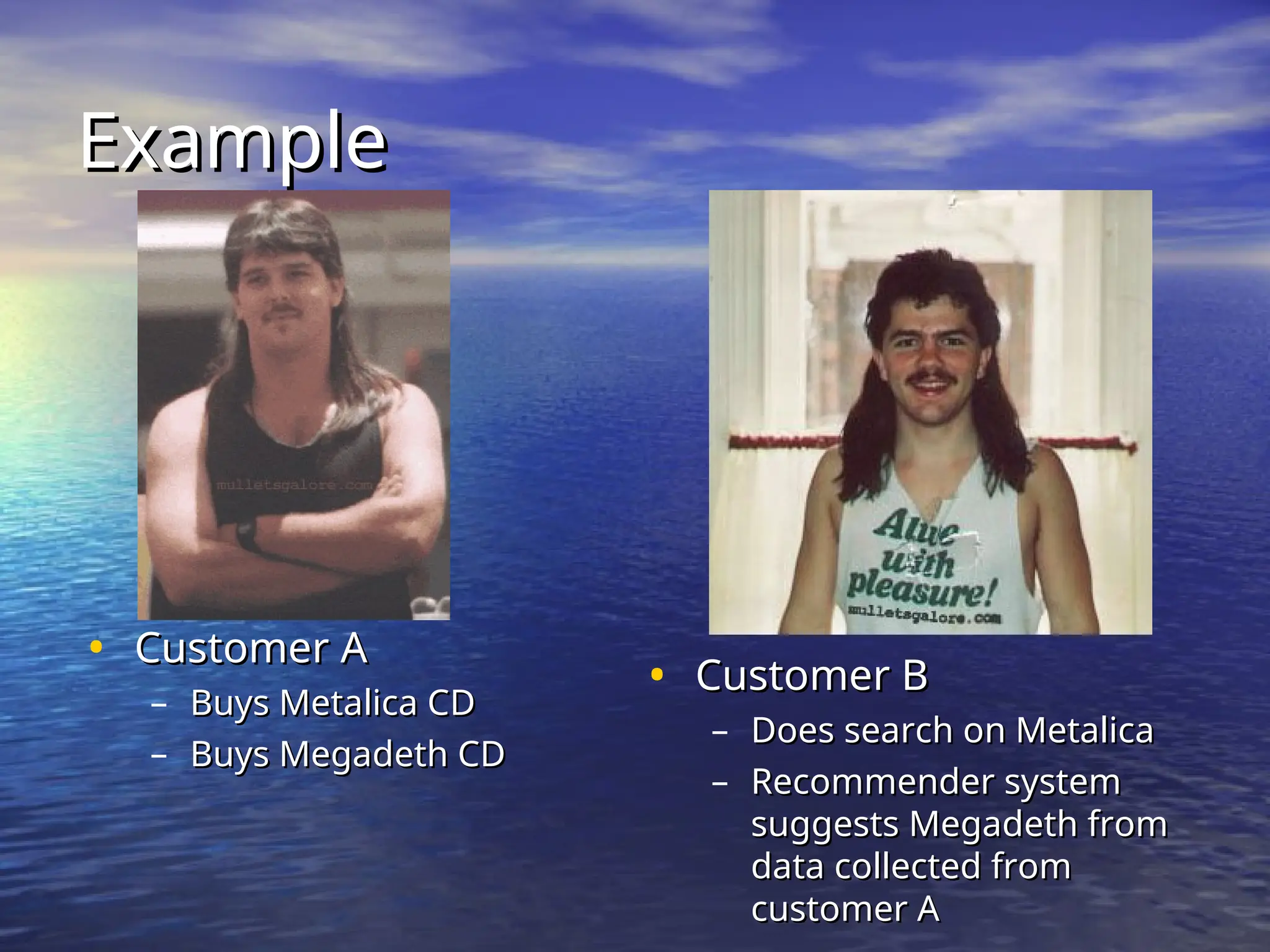
• Customer B
Customer B
– Does search on Metalica
Does search on Metalica
– Recommender system
Recommender system
suggests Megadeth from
suggests Megadeth from
data collected from
data collected from
customer A
customer A
5.
Motivation for Recommender
Motivationfor Recommender
Systems
Systems
• Automates quotes like:
Automates quotes like:
– "I like this book; you might be interested in
"I like this book; you might be interested in
it"
it"
– "I saw this movie, you’ll like it“
"I saw this movie, you’ll like it“
– "Don’t go see that movie!"
"Don’t go see that movie!"
6.
Further Motivation
Further Motivation
•Many of the top commerce sites use
Many of the top commerce sites use
recommender systems to improve sales.
recommender systems to improve sales.
• Users may find new books, music, or
Users may find new books, music, or
movies that was previously unknown to
movies that was previously unknown to
them.
them.
• Also can find the opposite for e.g.:
Also can find the opposite for e.g.:
movies or music that will definitely not
movies or music that will definitely not
be enjoyed.
be enjoyed.
7.
Where is itused?
Where is it used?
• Massive E-commerce sites use this tool
Massive E-commerce sites use this tool
to suggest other items a consumer may
to suggest other items a consumer may
want to purchase
want to purchase
• Web personalization
Web personalization
8.
Ways its used
Waysits used
• Survey’s filled out by past users for the
Survey’s filled out by past users for the
use of new users
use of new users
• Search-style Algorithms
Search-style Algorithms
• Genre matching
Genre matching
• Past purchase querying
Past purchase querying
9.
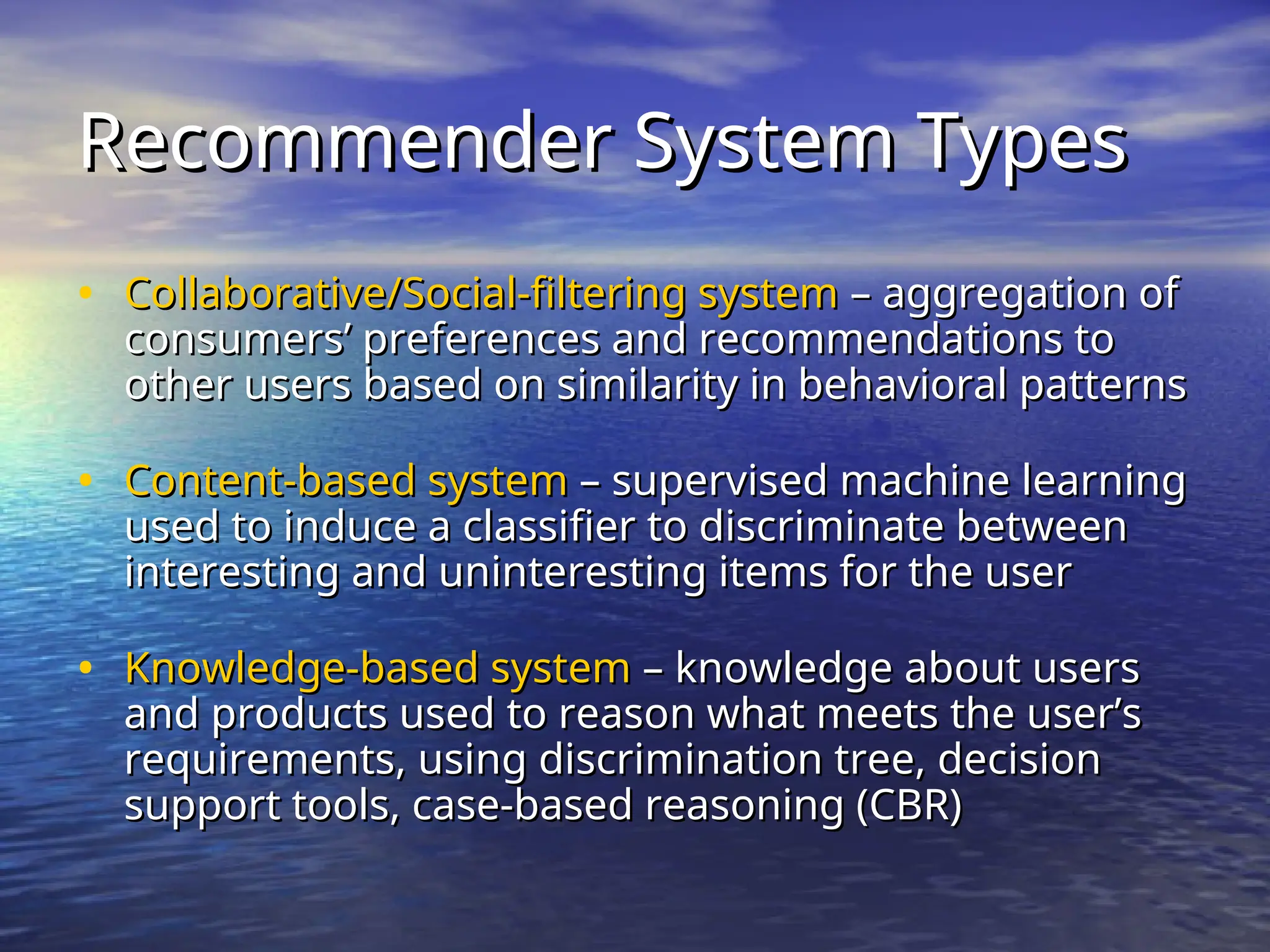
Recommender System Types
RecommenderSystem Types
• Collaborative/Social-filtering system
Collaborative/Social-filtering system – aggregation of
– aggregation of
consumers’ preferences and recommendations to
consumers’ preferences and recommendations to
other users based on similarity in behavioral patterns
other users based on similarity in behavioral patterns
• Content-based system
Content-based system – supervised machine learning
– supervised machine learning
used to induce a classifier to discriminate between
used to induce a classifier to discriminate between
interesting and uninteresting items for the user
interesting and uninteresting items for the user
• Knowledge-based system
Knowledge-based system – knowledge about users
– knowledge about users
and products used to reason what meets the user’s
and products used to reason what meets the user’s
requirements, using discrimination tree, decision
requirements, using discrimination tree, decision
support tools, case-based reasoning (CBR)
support tools, case-based reasoning (CBR)
10.
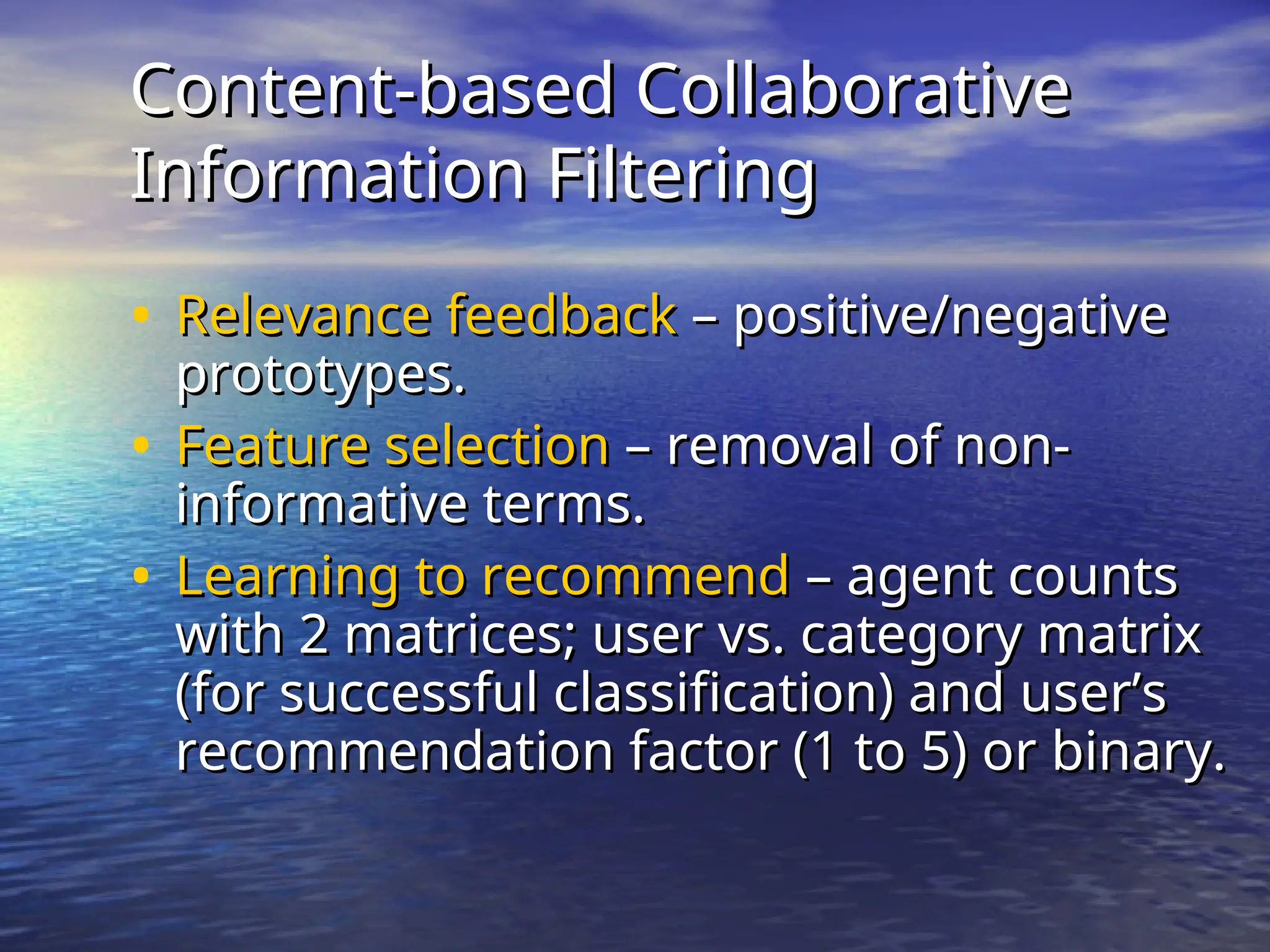
Content-based Collaborative
Content-based Collaborative
InformationFiltering
Information Filtering
• Relevance feedback
Relevance feedback – positive/negative
– positive/negative
prototypes.
prototypes.
• Feature selection
Feature selection – removal of non-
– removal of non-
informative terms.
informative terms.
• Learning to recommend
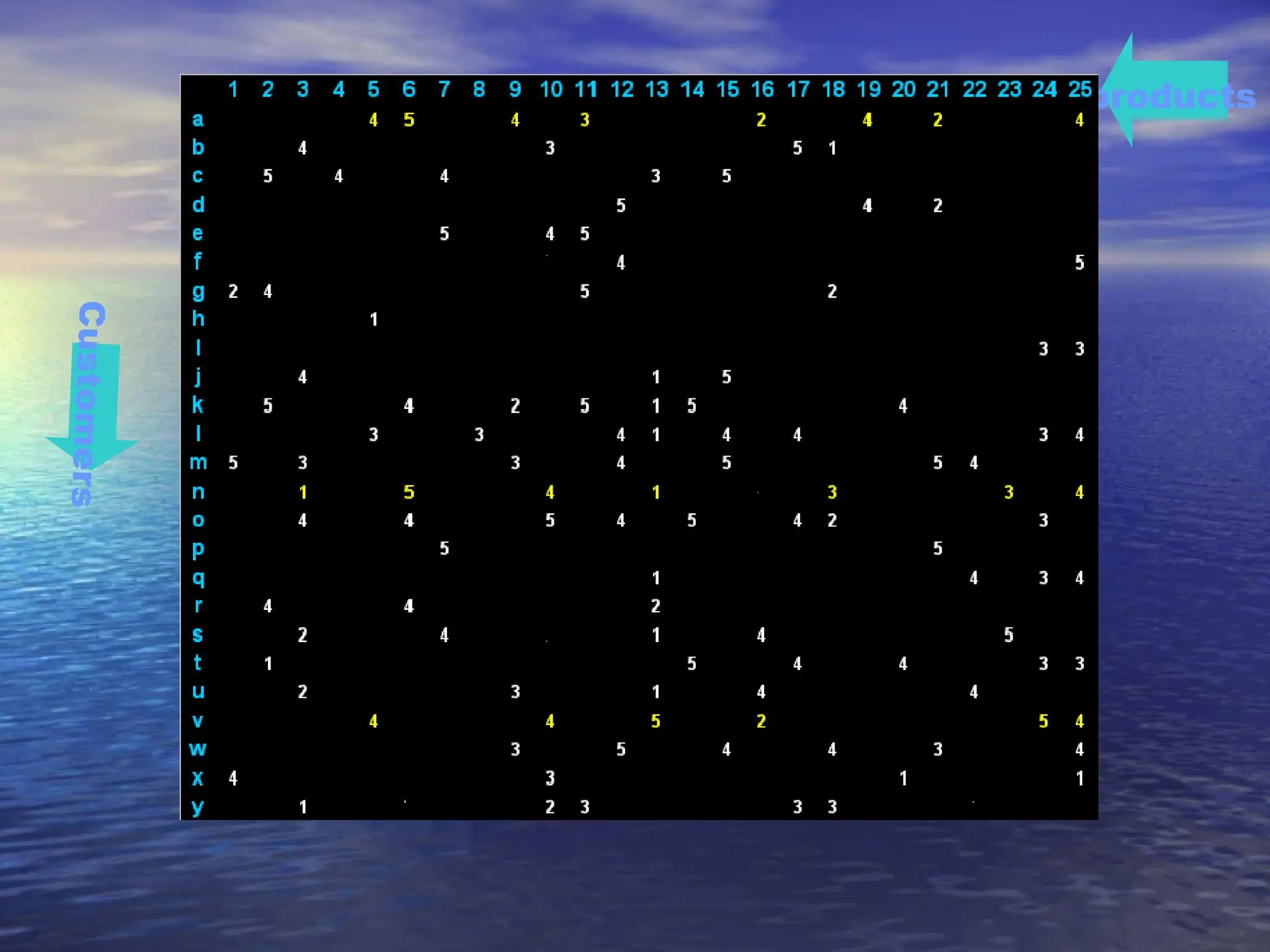
Learning to recommend – agent counts
– agent counts
with 2 matrices; user vs. category matrix
with 2 matrices; user vs. category matrix
(for successful classification) and user’s
(for successful classification) and user’s
recommendation factor (1 to 5) or binary.
recommendation factor (1 to 5) or binary.
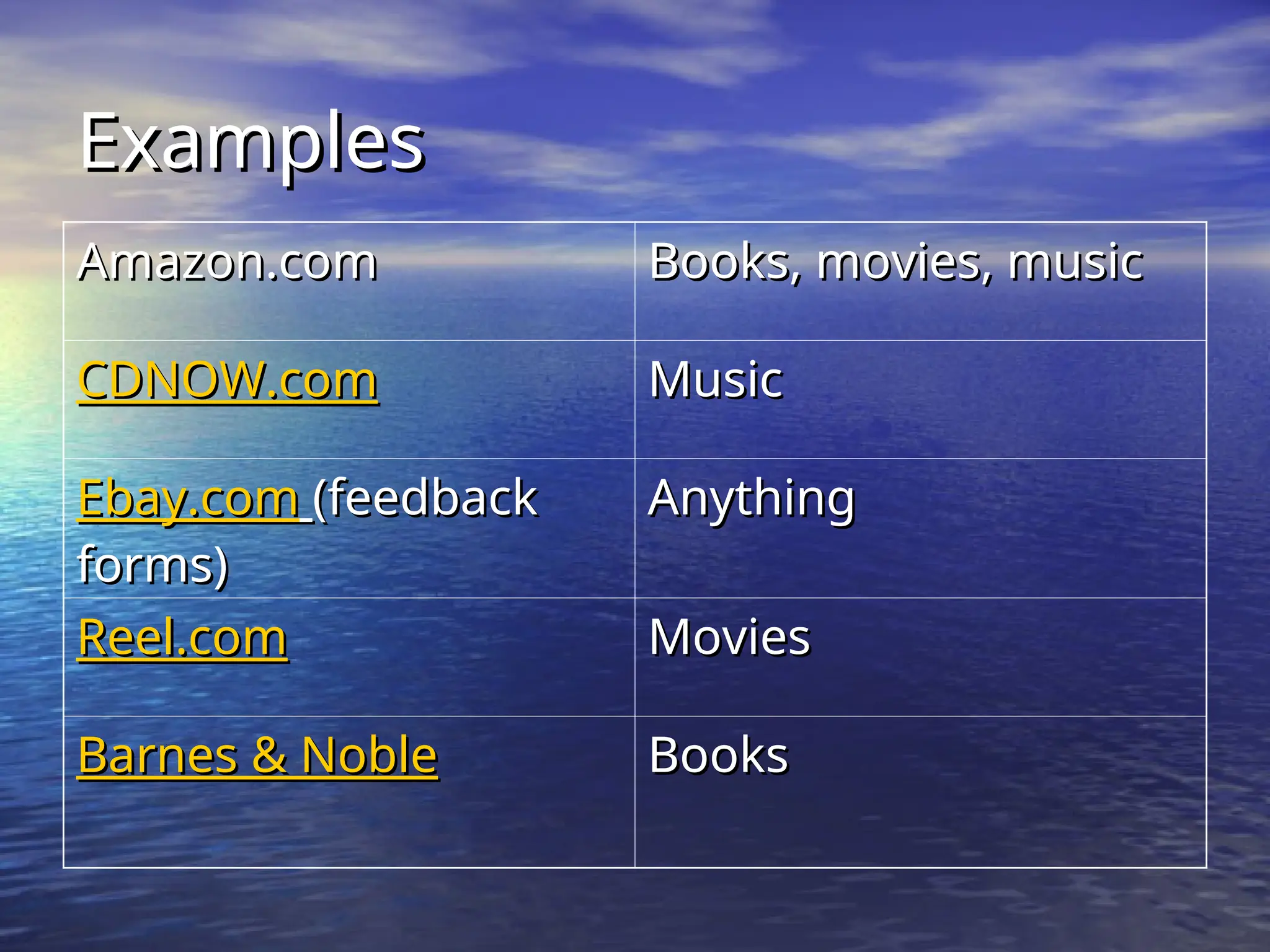
Examples
Examples
Amazon.com
Amazon.com Books, movies,music
Books, movies, music
CDNOW.com
CDNOW.com Music
Music
Ebay.com
Ebay.com (feedback
(feedback
forms)
forms)
Anything
Anything
Reel.com
Reel.com Movies
Movies
Barnes & Noble
Barnes & Noble Books
Books
14.
Problems
Problems
• Inconclusive userfeedback forms
Inconclusive user feedback forms
• Finding users to take the feedback surveys
Finding users to take the feedback surveys
• Weak Algorithms
Weak Algorithms
• Poor results
Poor results
• Poor Data
Poor Data
• Lack of Data
Lack of Data
• Privacy Control (May NOT explicitly
Privacy Control (May NOT explicitly
collaborate with recipients)
collaborate with recipients)
The Future ofRecommender
The Future of Recommender
Systems
Systems
• Extract implicit negative ratings through
Extract implicit negative ratings through
the analysis of returned item.
the analysis of returned item.
• How to integrate community with
recommendations
• Recommender systems will be used in
the future to predict demand for
products, enabling earlier
communication back the supply chain.




![[DSC Europe 25] Kaja Kandare - LLM as a judge.pptx](https://cdn.slidesharecdn.com/ss_thumbnails/arxyccaxsdsd1ba99wjw-7-251212104007-2b4e3f64-thumbnail.jpg?width=640&height=640&fit=bounds)


![[DSC Europe 25] Tatevik Maytesyan - How to actually use AI in marketing: gett...](https://cdn.slidesharecdn.com/ss_thumbnails/tjo626lsqdgfntbgl2mw-4-251216103155-e36cd239-thumbnail.jpg?width=640&height=640&fit=bounds)
![[DSC Europe 25] Danica Soc - The Science Behind Marketing: Experimentation me...](https://cdn.slidesharecdn.com/ss_thumbnails/c0nofsggs9gw5ucmallr-3-251216103155-56bd64d1-thumbnail.jpg?width=640&height=640&fit=bounds)
![[DSC Europe 25] Miodrag Pesovic & Vladislav Radonjic - Federated Data Archite...](https://cdn.slidesharecdn.com/ss_thumbnails/gsbe3y5it5uhndi4e08e-1-251212103249-f1008e0c-thumbnail.jpg?width=640&height=640&fit=bounds)


![[DSC Europe 25] Branko Urosevic -Rethinking Financial Talent: Integrating Cod...](https://cdn.slidesharecdn.com/ss_thumbnails/8jjrus8ttko6qj64f58f-3-251212103250-642c6374-thumbnail.jpg?width=640&height=640&fit=bounds)


![[DSC Europe 25] Jon Dajci - Bridging TradFi and DeFi: Building the Future of ...](https://cdn.slidesharecdn.com/ss_thumbnails/fqmhfvlbqhkihjvqvhmu-7-251211083849-6af7e325-thumbnail.jpg?width=640&height=640&fit=bounds)
![[DSC Europe 25] Dusan Nesic - Securing Tomorrow’s Infrastructure: Why Cyber-P...](https://cdn.slidesharecdn.com/ss_thumbnails/qikbszfftyowjm2q6duw-1-251211083848-8f2ead6b-thumbnail.jpg?width=640&height=640&fit=bounds)
![[DSC Europe 25] Katherine Forrest - AI NOW: Understanding the Velocity of Cha...](https://cdn.slidesharecdn.com/ss_thumbnails/wvvbruqfrci0sfq9xwgb-4-251212104007-e5ad1987-thumbnail.jpg?width=640&height=640&fit=bounds)


