
Group Members: Chung Man Sze, Connie (52218730) Lam Tsz Chung, Jay (52217200) Li Yuen Man, Shurun (52168003) Lung Yan Tung, Olivia (52224459)
Background 5 elements of policy design Civil Engagement Process Decision making models Incrementalism (muddling-through) Models of policy process Stages Model Policy implementation Top-down approach
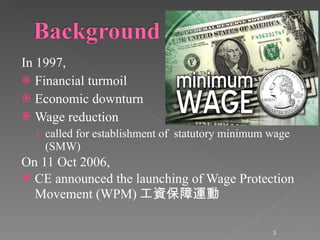
In 1997, Financial turmoil Economic downturn Wage reduction called for establishment of  statutory minimum wage (SMW) On 11 Oct 2006, CE announced the launching of Wage Protection Movement (WPM) 工資保障運動
Wage Protection Movement (WPM) 工資保障運動 Cleaning workers & security guards Voluntary participation Unsatisfactory result only 52% of the relevant workers was benefited In 2008-2009 Policy Address, CE announced across-the-board SMW
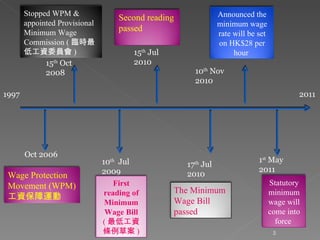
1997 2011 Oct 2006 15 th  Oct 2008 10 th   Jul 2009 15 th  Jul 2010 17 th  Jul 2010 10 th  Nov 2010 1 st  May 2011 S tatutory minimum wage will come into force  Second reading passed Stopped WPM & appointed Provisional Minimum Wage Commission ( 臨時最低工資委員會 ) The Minimum Wage Bill passed  First reading of Minimum Wage Bill ( 最低工資條例草案 ) Wage Protection Movement (WPM) 工資保障運動 Announced the minimum wage rate will be set on HK$28 per hour
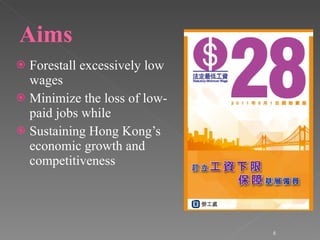
Aims Forestall excessively low wages Minimize the loss of low-paid jobs while Sustaining Hong Kong’s economic growth and competitiveness
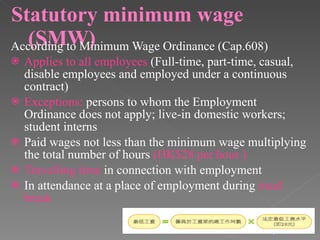
Statutory minimum wage (SMW) According to Minimum Wage Ordinance (Cap.608) Applies to all employees  (Full-time, part-time, casual, disable employees and employed under a continuous contract) Exceptions:  persons to whom the Employment Ordinance does not apply; live-in domestic workers; student interns Paid wages not less than the minimum wage multiplying the total number of hours  (HK$28 per hour ) Travelling time  in connection with employment In attendance at a place of employment during  meal break
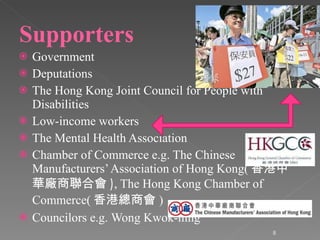
Supporters Government Deputations The Hong Kong Joint Council for People with Disabilities  Low-income workers The Mental Health Association Chamber of Commerce e.g. The Chinese Manufacturers’ Association of Hong Kong( 香港中華廠商聯合會 ) , The Hong Kong Chamber of Commerce( 香港總商會 ) Councilors e.g.  Wong Kwok-hing
Reasons of supporters Protect workers’ wages Maintain workers’ dignity Maintain social stability Enhance domestic demand effectively Eliminate unscrupulous companies Alleviate the problem of poverty
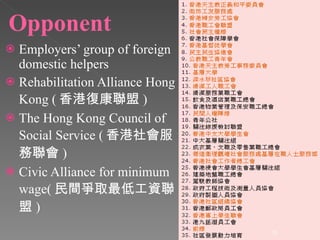
Opponent Employers’ group of foreign domestic helpers Rehabilitation Alliance Hong Kong ( 香港復康聯盟 ) The Hong Kong Council of Social Service ( 香港社會服務聯會 ) Civic Alliance for minimum wage( 民間爭取最低工資聯盟 )
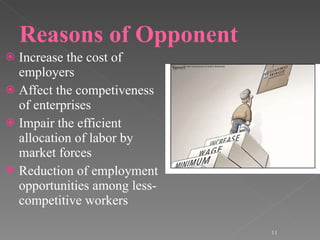
Reasons of Opponent Increase the cost of employers Affect the competiveness of enterprises Impair the efficient allocation of labor by market forces Reduction of employment opportunities among less-competitive workers
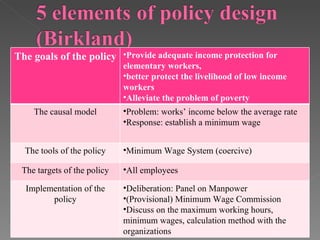
The goals of the policy Provide adequate income protection for elementary workers,  better protect the livelihood of low income workers Alleviate the problem of poverty The causal model Problem: works’ income below the average rate Response: establish a minimum wage The tools of the policy Minimum Wage System (coercive) The targets of the policy All employees Implementation of the policy Deliberation: Panel on Manpower  (Provisional) Minimum Wage Commission Discuss on the maximum working hours, minimum wages, calculation method with the organizations
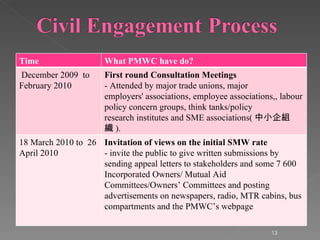
Time  What PMWC have do? December 2009  to  February 2010 First round Consultation Meetings - Attended by major trade unions, major employers' associations, employee associations,, labour policy concern groups, think tanks/policy research institutes and SME associations( 中小企組織 ) . 18 March 2010 to  26 April 2010 Invitation of views on the initial SMW rate - invite the public to give written submissions by sending appeal letters to stakeholders and some 7 600 Incorporated Owners/ Mutual Aid Committees/Owners’ Committees and posting advertisements on newspapers, radio, MTR cabins, bus compartments and the PMWC’s webpage
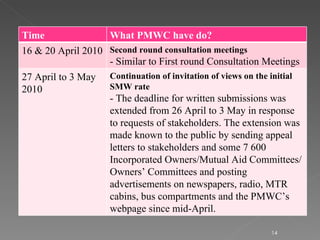
Time  What PMWC have do? 16 & 20 April 2010 Second round consultation meetings - Similar to First round Consultation Meetings 27 April to 3 May 2010 Continuation of invitation of views on the initial SMW rate - The deadline for written submissions was extended from 26 April to 3 May in response to requests of stakeholders. The extension was made known to the public by sending appeal letters to stakeholders and some 7 600 Incorporated Owners/Mutual Aid Committees/Owners’ Committees and posting advertisements on newspapers, radio, MTR cabins, bus compartments and the PMWC’s webpage since mid-April.
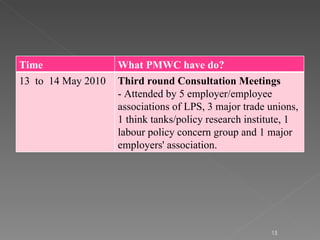
Time  What PMWC have do? 13  to  14 May 2010 Third round Consultation Meetings - Attended by 5 employer/employee associations of LPS, 3 major trade unions, 1 think tanks/policy research institute, 1 labour policy concern group and 1 major employers' association.
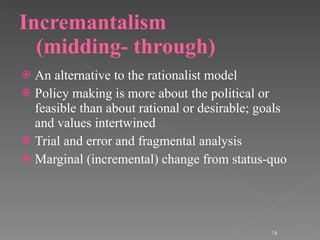
Incremantalism (midding- through) An alternative to the rationalist model Policy making is more about the political or feasible than about rational or desirable; goals and values intertwined Trial and error and fragmental analysis Marginal (incremental) change from status-quo
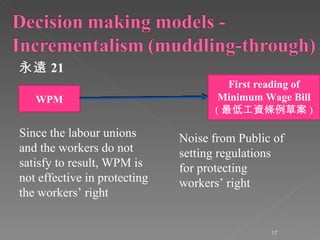
永遠 21 WPM First reading of Minimum Wage Bill ( 最低工資條例草案 ) Since the labour unions and the workers do not satisfy to result, WPM is not effective in protecting the workers’ right Noise from Public of setting regulations for protecting workers’ right
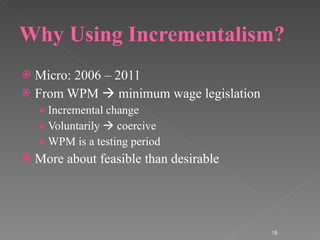
Why Using Incrementalism? Micro: 2006 – 2011 From WPM    minimum wage legislation Incremental change Voluntarily    coercive  WPM is a testing period More about feasible than desirable
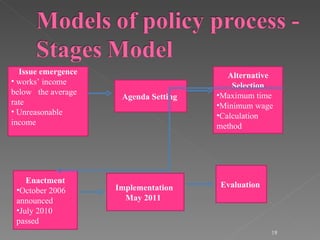
Issue emergence works’ income below  the average rate Unreasonable income Alternative Selection Maximum time Minimum wage Calculation method Evaluation  Implementation  May 2011  Enactment October 2006 announced July 2010 passed Agenda Setting
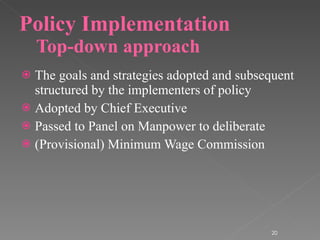
Policy Implementation Top-down approach The goals and strategies adopted and subsequent structured by the implementers of policy Adopted by Chief Executive Passed to Panel on Manpower to deliberate (Provisional) Minimum Wage Commission
Birkland, T. (2001). An Introduction to the Policy Process . NY: M.E. Sharpe. Labour Department.(2011). Reference Guidelines on Statutory Minimum Wage for Employers and Employees . Retrieved March 28, 2011, from  http://www.labour.gov.hk/eng/news/pdf/SMW_Guidelines.pdf. Provisional Minimum Wage Commission. (2010).  Report of the Provisional Minimum Wage Commission . Retrieved March 28, 2011, from  http://www.labour.gov.hk/eng/rbo/PMWC_Report.pdf. Legco paper. CB(2)290/08-09(05) Legco paper. CB(2)290/08-09(04)
Minimum wage

Minimum wage

  • 1.
    Group Members: ChungMan Sze, Connie (52218730) Lam Tsz Chung, Jay (52217200) Li Yuen Man, Shurun (52168003) Lung Yan Tung, Olivia (52224459)
  • 2.
    Background 5 elementsof policy design Civil Engagement Process Decision making models Incrementalism (muddling-through) Models of policy process Stages Model Policy implementation Top-down approach
  • 3.
    In 1997, Financialturmoil Economic downturn Wage reduction called for establishment of statutory minimum wage (SMW) On 11 Oct 2006, CE announced the launching of Wage Protection Movement (WPM) 工資保障運動
  • 4.
    Wage Protection Movement(WPM) 工資保障運動 Cleaning workers & security guards Voluntary participation Unsatisfactory result only 52% of the relevant workers was benefited In 2008-2009 Policy Address, CE announced across-the-board SMW
  • 5.
    1997 2011 Oct2006 15 th Oct 2008 10 th Jul 2009 15 th Jul 2010 17 th Jul 2010 10 th Nov 2010 1 st May 2011 S tatutory minimum wage will come into force Second reading passed Stopped WPM & appointed Provisional Minimum Wage Commission ( 臨時最低工資委員會 ) The Minimum Wage Bill passed First reading of Minimum Wage Bill ( 最低工資條例草案 ) Wage Protection Movement (WPM) 工資保障運動 Announced the minimum wage rate will be set on HK$28 per hour
  • 6.
    Aims Forestall excessivelylow wages Minimize the loss of low-paid jobs while Sustaining Hong Kong’s economic growth and competitiveness
  • 7.
    Statutory minimum wage(SMW) According to Minimum Wage Ordinance (Cap.608) Applies to all employees (Full-time, part-time, casual, disable employees and employed under a continuous contract) Exceptions: persons to whom the Employment Ordinance does not apply; live-in domestic workers; student interns Paid wages not less than the minimum wage multiplying the total number of hours (HK$28 per hour ) Travelling time in connection with employment In attendance at a place of employment during meal break
  • 8.
    Supporters Government DeputationsThe Hong Kong Joint Council for People with Disabilities Low-income workers The Mental Health Association Chamber of Commerce e.g. The Chinese Manufacturers’ Association of Hong Kong( 香港中華廠商聯合會 ) , The Hong Kong Chamber of Commerce( 香港總商會 ) Councilors e.g. Wong Kwok-hing
  • 9.
    Reasons of supportersProtect workers’ wages Maintain workers’ dignity Maintain social stability Enhance domestic demand effectively Eliminate unscrupulous companies Alleviate the problem of poverty
  • 10.
    Opponent Employers’ groupof foreign domestic helpers Rehabilitation Alliance Hong Kong ( 香港復康聯盟 ) The Hong Kong Council of Social Service ( 香港社會服務聯會 ) Civic Alliance for minimum wage( 民間爭取最低工資聯盟 )
  • 11.
    Reasons of OpponentIncrease the cost of employers Affect the competiveness of enterprises Impair the efficient allocation of labor by market forces Reduction of employment opportunities among less-competitive workers
  • 12.
    The goals ofthe policy Provide adequate income protection for elementary workers, better protect the livelihood of low income workers Alleviate the problem of poverty The causal model Problem: works’ income below the average rate Response: establish a minimum wage The tools of the policy Minimum Wage System (coercive) The targets of the policy All employees Implementation of the policy Deliberation: Panel on Manpower (Provisional) Minimum Wage Commission Discuss on the maximum working hours, minimum wages, calculation method with the organizations
  • 13.
    Time WhatPMWC have do? December 2009 to February 2010 First round Consultation Meetings - Attended by major trade unions, major employers' associations, employee associations,, labour policy concern groups, think tanks/policy research institutes and SME associations( 中小企組織 ) . 18 March 2010 to 26 April 2010 Invitation of views on the initial SMW rate - invite the public to give written submissions by sending appeal letters to stakeholders and some 7 600 Incorporated Owners/ Mutual Aid Committees/Owners’ Committees and posting advertisements on newspapers, radio, MTR cabins, bus compartments and the PMWC’s webpage
  • 14.
    Time WhatPMWC have do? 16 & 20 April 2010 Second round consultation meetings - Similar to First round Consultation Meetings 27 April to 3 May 2010 Continuation of invitation of views on the initial SMW rate - The deadline for written submissions was extended from 26 April to 3 May in response to requests of stakeholders. The extension was made known to the public by sending appeal letters to stakeholders and some 7 600 Incorporated Owners/Mutual Aid Committees/Owners’ Committees and posting advertisements on newspapers, radio, MTR cabins, bus compartments and the PMWC’s webpage since mid-April.
  • 15.
    Time WhatPMWC have do? 13 to 14 May 2010 Third round Consultation Meetings - Attended by 5 employer/employee associations of LPS, 3 major trade unions, 1 think tanks/policy research institute, 1 labour policy concern group and 1 major employers' association.
  • 16.
    Incremantalism (midding- through)An alternative to the rationalist model Policy making is more about the political or feasible than about rational or desirable; goals and values intertwined Trial and error and fragmental analysis Marginal (incremental) change from status-quo
  • 17.
    永遠 21 WPMFirst reading of Minimum Wage Bill ( 最低工資條例草案 ) Since the labour unions and the workers do not satisfy to result, WPM is not effective in protecting the workers’ right Noise from Public of setting regulations for protecting workers’ right
  • 18.
    Why Using Incrementalism?Micro: 2006 – 2011 From WPM  minimum wage legislation Incremental change Voluntarily  coercive WPM is a testing period More about feasible than desirable
  • 19.
    Issue emergence works’income below the average rate Unreasonable income Alternative Selection Maximum time Minimum wage Calculation method Evaluation Implementation May 2011 Enactment October 2006 announced July 2010 passed Agenda Setting
  • 20.
    Policy Implementation Top-downapproach The goals and strategies adopted and subsequent structured by the implementers of policy Adopted by Chief Executive Passed to Panel on Manpower to deliberate (Provisional) Minimum Wage Commission
  • 21.
    Birkland, T. (2001).An Introduction to the Policy Process . NY: M.E. Sharpe. Labour Department.(2011). Reference Guidelines on Statutory Minimum Wage for Employers and Employees . Retrieved March 28, 2011, from http://www.labour.gov.hk/eng/news/pdf/SMW_Guidelines.pdf. Provisional Minimum Wage Commission. (2010). Report of the Provisional Minimum Wage Commission . Retrieved March 28, 2011, from http://www.labour.gov.hk/eng/rbo/PMWC_Report.pdf. Legco paper. CB(2)290/08-09(05) Legco paper. CB(2)290/08-09(04)

Editor's Notes