MINIMUM WAGES ACT
By:-
SAMVRANT MISHRA
1. INTRODUCTION
2. HISTORY
3. FIXATION AND REVISION
4. EXCLUSIONS
5. WAGES RATES ACROSS INDIA
6. LIMITATION
7. CONFLICTS
8. CONCLUSION
CONTENTS
The Minimum Wages Act 1948 is an Act of Parliament concerning Indian labour law that
sets the minimum wages that must be paid to skilled and unskilled labours. The Indian
Constitution has defined a 'living wage' that is the level of income for a worker which will ensure
a basic standard of living including good health, dignity, comfort, education and provide for any
contingency. However, to keep in mind an industry's capacity to pay the constitution has defined
a 'fair wage'.[1] Fair wage is that level of wage that not just maintains a level of employment, but
seeks to increase it keeping in perspective the industry’s capacity to pay.
The act is legally non-binding, but statutory. Payment of wages below the minimum
wage rate amounts to forced labour. Wage Boards are set up to review the industry’s capacity to
pay and fix minimum wages such that they at least cover a family of four’s requirements of
calories, shelter, clothing, education, medical assistance, and entertainment. Under the law, wage
rates in scheduled employments differ across states, sectors, skills, regions and occupations
owing to difference in costs of living, regional industries' capacity to pay, consumption patterns,
etc. Hence, there is no single uniform minimum wage rate across the country and the structure
has become overly complex.
INTRODUCTION
 1920: Mr. K.G.R. Choudhary recommended setting up boards for determining minimum wages
for each industry.
 1928: International Labour Conference implemented system to fix wages for different trades.
However, the practice was not put into legislation in India.
 1943: Standing Labour Committee, a Labour Investigation Committee was appointed on the
recommendation of Indian Labour Conference (ILC), 1943 to look into conditions of labour in
terms of their wages, housing, social conditions, and employment.
 1945: The first bill on minimum wages was drafted in ILC.
 1946: A bill on minimum wages was introduced in Central Legislative assembly on the
recommendations of 8th Standing Labour Committee. The 8th meeting of the Standing Labour
Committee, 1946 also recommended that a separate legislation that specified working hours,
minimum wages and paid holidays of unorganised sector be enacted.
 1947: Post-independence representatives of labour, employers, and government attended a
government-organised conference. They defined minimum wages to be such that they should
not only provide for subsistence but should also be enough for education, medical
requirements and other amenities and should sustain efficiency.
 1948: The Minimum Wages Act was eventually passed and was effective from 15 March.
HISTORY
The Minimum Wages Act 1948 generally specifies minimum wage rates on a per day basis, and
extends to the entire country and is revised within a period of not less than five years, however
there is a provision to increase dearness allowance every two years. The norms in fixing and
revision of minimum wages were first recommended by ILC, 1957.
Revision of minimum wage rates is based on a 'cost of living index' and wages can be fixed for
an entire state, part of the state, class or classes and employments pertaining to these
categories. The fixation of wages is based on the norms mentioned and a wage board (different
for different industry).
FIXATION & REVISION
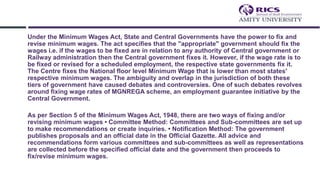
Under the Minimum Wages Act, State and Central Governments have the power to fix and
revise minimum wages. The act specifies that the "appropriate" government should fix the
wages i.e. if the wages to be fixed are in relation to any authority of Central government or
Railway administration then the Central government fixes it. However, if the wage rate is to
be fixed or revised for a scheduled employment, the respective state governments fix it.
The Centre fixes the National floor level Minimum Wage that is lower than most states'
respective minimum wages. The ambiguity and overlap in the jurisdiction of both these
tiers of government have caused debates and controversies. One of such debates revolves
around fixing wage rates of MGNREGA scheme, an employment guarantee initiative by the
Central Government.
As per Section 5 of the Minimum Wages Act, 1948, there are two ways of fixing and/or
revising minimum wages • Committee Method: Committees and Sub-committees are set up
to make recommendations or create inquiries. • Notification Method: The government
publishes proposals and an official date in the Official Gazette. All advice and
recommendations form various committees and sub-committees as well as representations
are collected before the specified official date and the government then proceeds to
fix/revise minimum wages.
• Workers: Wages to disabled people and those payable to a
dependent family member of the employer
• Industries: Un-scheduled industries are generally excluded.
With every revision of minimum wages, a state can add a
minimum wage for an occupation or specify it for a sector.
EXCLUSIONS
WAGES RATES ACROSS INDIA
SL.NO NAME OF STATE / UNION TERRITORY MINIMUM WAGE MAXIMUM WAGE WEF DATE
1 ANDAMAN & NICOBAR ISLANDS 212 322 1/JAN/2012
2 DELHI 270 320 1/APRIL/2012
3 CHANDIGARH 245 285 1/JAN/2012
4 ODISHA 90 180 1/JULY/2009
5 HARYANA 186 211 1/JAN/2012
6 UTTAR PRADESH 100 220 30/SEPT/2012
7 BIHAR 151 234 1/JAN/2012
8 KERELA 120 270 2/AUGUST/2012
9 KARNATAKA 190 210 1/JAN/2012
10 ASSAM 210 210 30/SEPT/2012
11 MAHARASTRA 100 300 1/JAN/2012
12 TRIPURA 38 250 30/SEPT/2012
13 ANDHRA PRADESH 150 280 1/JAN/2012
Some of the important points are :-
 Large Unemployment
 Less protection against inflation
 Exemptions from payment of Minimum Wages
 Lack of awareness
 Delays and inaction
 Old Terminology
LIMITATIONS
 The Mahatma Gandhi National Rural Employment Guarantee Act is an employment guarantee scheme
that guarantees employment for 100 days at a wage rate of INR120 per day (as fixed in 2009). These
benefits can be secured by any household regardless of whether they fall below or above national
poverty line. The central government delinked MGNREGA wage rates from State specific Minimum
wage rates in January 2009 when states like Uttar Pradesh, Rajasthan and Maharashtra revised and
increased their minimum wage rates.
 This had direct implications on Central Government's budget set aside for MGNREGA scheme. The
move of freezing MGNREGA scheme created an upheaval of discontent in various parts and sections of
India as the move was considered to breach Minimum Wages Act, 1948. MGNREGA wage rates were
less than the minimum wage rates of respective states and in 5 states they were even below the
National Floor level of minimum wage.
 Protests broke out throughout India coupled with controversies over corruption, under-payment of
workers, poor quality of infrastructure, ambiguous source of funds and unintended negative effect on
poverty. Recommendations made by National Advisory Council and Centre Employment Guarantee
Council chaired by Jean Drèze that MGNREGA's wage rates should be synced with Minimum Wages
Act were rejected by the Central Government.
 The Central Government stuck to its decision of freezing MGNREGA wages even after an order from
Supreme Court. Eventually, the Prime Minister agreed to accept recommendations and indexed
MGNREGA wages to Minimum wage rates until an expert committee chaired by Pranab Mukherjee
made a satisfactory index. He however maintained a clear distinction between MGNREGA wage rates
and Minimum wage rates to avoid inflating budget on revision of state-wise minimum wages.
CONFLICTS
Minimum wages act

Minimum wages act

  • 1.
  • 2.
    1. INTRODUCTION 2. HISTORY 3.FIXATION AND REVISION 4. EXCLUSIONS 5. WAGES RATES ACROSS INDIA 6. LIMITATION 7. CONFLICTS 8. CONCLUSION CONTENTS
  • 3.
    The Minimum WagesAct 1948 is an Act of Parliament concerning Indian labour law that sets the minimum wages that must be paid to skilled and unskilled labours. The Indian Constitution has defined a 'living wage' that is the level of income for a worker which will ensure a basic standard of living including good health, dignity, comfort, education and provide for any contingency. However, to keep in mind an industry's capacity to pay the constitution has defined a 'fair wage'.[1] Fair wage is that level of wage that not just maintains a level of employment, but seeks to increase it keeping in perspective the industry’s capacity to pay. The act is legally non-binding, but statutory. Payment of wages below the minimum wage rate amounts to forced labour. Wage Boards are set up to review the industry’s capacity to pay and fix minimum wages such that they at least cover a family of four’s requirements of calories, shelter, clothing, education, medical assistance, and entertainment. Under the law, wage rates in scheduled employments differ across states, sectors, skills, regions and occupations owing to difference in costs of living, regional industries' capacity to pay, consumption patterns, etc. Hence, there is no single uniform minimum wage rate across the country and the structure has become overly complex. INTRODUCTION
  • 4.
     1920: Mr.K.G.R. Choudhary recommended setting up boards for determining minimum wages for each industry.  1928: International Labour Conference implemented system to fix wages for different trades. However, the practice was not put into legislation in India.  1943: Standing Labour Committee, a Labour Investigation Committee was appointed on the recommendation of Indian Labour Conference (ILC), 1943 to look into conditions of labour in terms of their wages, housing, social conditions, and employment.  1945: The first bill on minimum wages was drafted in ILC.  1946: A bill on minimum wages was introduced in Central Legislative assembly on the recommendations of 8th Standing Labour Committee. The 8th meeting of the Standing Labour Committee, 1946 also recommended that a separate legislation that specified working hours, minimum wages and paid holidays of unorganised sector be enacted.  1947: Post-independence representatives of labour, employers, and government attended a government-organised conference. They defined minimum wages to be such that they should not only provide for subsistence but should also be enough for education, medical requirements and other amenities and should sustain efficiency.  1948: The Minimum Wages Act was eventually passed and was effective from 15 March. HISTORY
  • 5.
    The Minimum WagesAct 1948 generally specifies minimum wage rates on a per day basis, and extends to the entire country and is revised within a period of not less than five years, however there is a provision to increase dearness allowance every two years. The norms in fixing and revision of minimum wages were first recommended by ILC, 1957. Revision of minimum wage rates is based on a 'cost of living index' and wages can be fixed for an entire state, part of the state, class or classes and employments pertaining to these categories. The fixation of wages is based on the norms mentioned and a wage board (different for different industry). FIXATION & REVISION
  • 6.
    Under the MinimumWages Act, State and Central Governments have the power to fix and revise minimum wages. The act specifies that the "appropriate" government should fix the wages i.e. if the wages to be fixed are in relation to any authority of Central government or Railway administration then the Central government fixes it. However, if the wage rate is to be fixed or revised for a scheduled employment, the respective state governments fix it. The Centre fixes the National floor level Minimum Wage that is lower than most states' respective minimum wages. The ambiguity and overlap in the jurisdiction of both these tiers of government have caused debates and controversies. One of such debates revolves around fixing wage rates of MGNREGA scheme, an employment guarantee initiative by the Central Government. As per Section 5 of the Minimum Wages Act, 1948, there are two ways of fixing and/or revising minimum wages • Committee Method: Committees and Sub-committees are set up to make recommendations or create inquiries. • Notification Method: The government publishes proposals and an official date in the Official Gazette. All advice and recommendations form various committees and sub-committees as well as representations are collected before the specified official date and the government then proceeds to fix/revise minimum wages.
  • 7.
    • Workers: Wagesto disabled people and those payable to a dependent family member of the employer • Industries: Un-scheduled industries are generally excluded. With every revision of minimum wages, a state can add a minimum wage for an occupation or specify it for a sector. EXCLUSIONS
  • 8.
    WAGES RATES ACROSSINDIA SL.NO NAME OF STATE / UNION TERRITORY MINIMUM WAGE MAXIMUM WAGE WEF DATE 1 ANDAMAN & NICOBAR ISLANDS 212 322 1/JAN/2012 2 DELHI 270 320 1/APRIL/2012 3 CHANDIGARH 245 285 1/JAN/2012 4 ODISHA 90 180 1/JULY/2009 5 HARYANA 186 211 1/JAN/2012 6 UTTAR PRADESH 100 220 30/SEPT/2012 7 BIHAR 151 234 1/JAN/2012 8 KERELA 120 270 2/AUGUST/2012 9 KARNATAKA 190 210 1/JAN/2012 10 ASSAM 210 210 30/SEPT/2012 11 MAHARASTRA 100 300 1/JAN/2012 12 TRIPURA 38 250 30/SEPT/2012 13 ANDHRA PRADESH 150 280 1/JAN/2012
  • 9.
    Some of theimportant points are :-  Large Unemployment  Less protection against inflation  Exemptions from payment of Minimum Wages  Lack of awareness  Delays and inaction  Old Terminology LIMITATIONS
  • 10.
     The MahatmaGandhi National Rural Employment Guarantee Act is an employment guarantee scheme that guarantees employment for 100 days at a wage rate of INR120 per day (as fixed in 2009). These benefits can be secured by any household regardless of whether they fall below or above national poverty line. The central government delinked MGNREGA wage rates from State specific Minimum wage rates in January 2009 when states like Uttar Pradesh, Rajasthan and Maharashtra revised and increased their minimum wage rates.  This had direct implications on Central Government's budget set aside for MGNREGA scheme. The move of freezing MGNREGA scheme created an upheaval of discontent in various parts and sections of India as the move was considered to breach Minimum Wages Act, 1948. MGNREGA wage rates were less than the minimum wage rates of respective states and in 5 states they were even below the National Floor level of minimum wage.  Protests broke out throughout India coupled with controversies over corruption, under-payment of workers, poor quality of infrastructure, ambiguous source of funds and unintended negative effect on poverty. Recommendations made by National Advisory Council and Centre Employment Guarantee Council chaired by Jean Drèze that MGNREGA's wage rates should be synced with Minimum Wages Act were rejected by the Central Government.  The Central Government stuck to its decision of freezing MGNREGA wages even after an order from Supreme Court. Eventually, the Prime Minister agreed to accept recommendations and indexed MGNREGA wages to Minimum wage rates until an expert committee chaired by Pranab Mukherjee made a satisfactory index. He however maintained a clear distinction between MGNREGA wage rates and Minimum wage rates to avoid inflating budget on revision of state-wise minimum wages. CONFLICTS