P.D. 442, as amended, Labor Code of the Philippines
WAGES
• Wage is “a remuneration or earnings, however designated,
capable of being expressed in terms of money, whether fixed or
ascertained on a time, task, piece or commission basis, or other
method of calculating the same, which is payable by an
employer to an employee under a written or unwritten contract
of employment for work done or to be done, or for service
rendered or to be rendered.”
• Wage is the term applied to payments given workers performing
manual or physical and work lower positions, including the so-
called blue collar jobs.
Salary
• Salary is “a reward or recompense for services performed.”
(Black’s Law Dictionary, 5th ed.)
• Salary is the consideration paid at regular intervals for the
rendering of services. (Philippine Legal Encyclopedia)
• Basic Salary
• Basic salary includes remunerations or earnings paid by the
employer to employee, but excludes cost-of-living allowances,
profit-sharing payments, and all allowances and monetary
benefits which have been considered as part of the basic salary
of the employee.
Minimum Wage Rates
• Article 99 – Regional Minimum Wages
• Minimum wage rates for agricultural and non-agricultural
employees and workers in each and every region of the country
shall be those prescribed by the Regional Tripartite Wages and
Productivity Boards. (As amended by Section 3, Republic Act
No. 6727, June 9, 1989)
• Republic Act No. 6727 - known as the “Wage Rationalization
Act” issued on July 1, 1989;
• It provides that minimum wage fixing is done on a regional basis
by the Regional Boards, located in each of the 17 regions of the
country instead of the former method that minimum wage is
done via acts Congress, by presidential decrees or executive
orders.
Payment of Wages
• Article 102 – Forms of Payment
• No employer shall pay the wages of an employee by
means of promissory notes, vouchers, coupons, tokens,
tickets, chits, or any object other than legal tender, even
when expressly requested by the employee.
• Payment of wages by check or money order shall be
allowed when such manner of payment is customary on the
date of effectivity of this Code, or is necessary because of
special circumstances as specified in appropriate
regulations to be issued by the Secretary of Labor and
Employment or as stipulated in a collective bargaining
agreement.
• The payment of wages must be paid in legal tender except:
• a. customary on the date of effectivity of the Labor Code;
• b. necessary because of special circumstances as
determined by the Secretary of Labor; and
• c. stipulated in the CBA.
• Legal tender is a currency that cannot legally be refused in
payment of debt or obligations. (Concise Oxford Dictionary)
• A check is not a legal tender, and therefore cannot constitute
valid tender of payment.
Article 103 – Time of Payment
• Wages shall be paid at least once every two (2) weeks or twice a
month at intervals not exceeding sixteen (16) days.
• If on account of force majeure or circumstances beyond the
employer’s control, payment of wages on or within the time herein
provided cannot be made, the employer shall pay the wages
immediately after such force majeure or circumstances have ceased.
• No employer shall make payment with less frequently than once a
month.
• Payment of wages of employees engaged to perform a task which
cannot be completed in two (2) weeks shall be subject to the
following conditions, in the absence of a collective bargaining
agreement or arbitration award:
• (1) That payments are made at intervals not exceeding sixteen (16)
days, in proportion to the amount of work completed;
• (2) That final settlement is made upon completion of the work.
Article 104 – Place of Payment
• Payment of wages shall be made at or near the place of
undertaking, except as otherwise provided by such
regulations as the Secretary of Labor and Employment may
prescribe under conditions to ensure greater protection of
wages.
• The payment of wages shall be made at the work premises or
near the place of work, as a general rule except:
• (a) when payment cannot be effected at or near the place
of work by reason of the deterioration of peace and order
conditions, or by reason of actual or impending emergencies
caused by fire, flood, epidemic or other calamity rendering
payment thereat impossible;
• (b) when the employer provides free transportation to the
employees back and forth;
• (c) Under any other analogous circumstances provided that
the time spent by the employees in collecting their wages
shall be considered as compensable hours worked; and
• (d) No employer shall pay his employees in any bar, night or
day club, drinking, establishment, massage clinic, dance
hall, or other similar places or in places where games are
played with stakes of money or things representing money
except in the case of persons employed in said places.
• (Section 4, Rule VIII, Implementing Rules and Regulations of
Book III of the Labor Code)
Payment Thru Banks
• Payment through banks especially by means of automated
teller machines is allowed by Section 7, Republic Act No.
6727 or the Wage Rationalization Law provided:
• 1. There is a written request by the majority of workers in the
establishment;
• 2. The employer has at least 25 employees;
• 3. The bank’s ATM is located within (1) kilometer radius from
the workplace;
• 4. The bank shall issue a certification of payment upon
request of the worker.
• Direct payment of wages – meaning the payment of wages shall be
made direct to the employee entitled to it, except in the following
cases:
• (a) Where the employer is authorized in writing by the employee to
pay his wages to a member of his family;
• (b) where payment to another person of any part of the
employee’s wages is authorized by existing law, including payments
for the insurance premiums of the employee and union dues where
the right to check-off has been recognized by the employer in
accordance with a collective agreement or authorized in writing by
the individual employees concerned; or
• (c) In case of death of the employee.
• (Section 5, Rule VIII, Implementing Rules and Regulation of the Book III, Labor Code)
Prohibitions Regarding Wages
• Article 112 – Non-interference in Disposal of Wages
• No employer shall limit or otherwise interfere with the freedom of any
employee to dispose of his wages. He shall not in any manner force,
compel, or oblige his employees to purchase merchandise,
commodities or other property from any other person, or otherwise
make use of any store or services of such employer or any other
person.
• No employer shall limit or otherwise interfere with the freedom of any
employee to dispose of his wages and no employer shall in any
manner oblige any of his employees to patronize any store avail of
the services offered by any person.
• (Section 12 Rule VIII, Implementing Rules regulation of the Book III, Labor Code)
Article 113 – Wage Deduction
• No employer, in his own behalf or in behalf of any person, shall
make any deduction from the wages of his employees, except:
• (a) In case where the worker is insured with his consent by the
employer, and the deduction is to recompense the employer for
the amount paid by him as premium on the insurance;
• (b) For union dues, in cases where the right of the worker or his
union to check-off has been recognized by the employer or
authorized in writing by the individual worker concerned; and
• (c) In cases where the employer is authorize by law or regulations
issued by the secretary of Labor and Employment.
Other Allowable Wage Deductions:
• 1. Income taxes;
• 2. SSS payments;
• 3. Philhealth payments;
• 4. Contributions to PAG-IBIG Fund;
• 5. Value of facilities supplied by the employer;
• 6. Deduction for payments of demandable debts due to the
employer;
• 7. Deductions made in case of judgment against the debtor-worker;
• 8. Deduction for absences;
• 9. Worker’s insurance acquired by the employer;
• 10. Union dues, where the right to check-off has been recognized by
the employer;
• Compulsory Purchase of Merchandise and Payment of Wages by
Means of Tokens is punishable by law;
• LABOR STANDARDS, Book 3 – Conditions of Employment
• Article 83 – Normal Hours of Work
• The normal hours of work of any employee shall not exceed
eight (8) hours a day.
• Article 84 – Hours Worked
• Hours worked shall include (Compensable Hours Work):
• (a) all time during which an employee is required to be on duty
or to be at a prescribed workplace; and
• (b) all the during which an employee is suffered or permitted to
work.
• Rest periods of short duration during working hours shall be
counted as hours worked.
• The time spent by employees to get ready for work or to get
ready to leave work is not compensable time.
• When activities are required during the regular working hours,
they are considered hours worked, thus, compensable.
• Sleeping while working
• Sleeping while on duty is compensable if the nature of the
employee’s work allows sleeping without interrupting or
prejudicing work or when there is an agreement between
employee and his employer to that effect.
• Examples:
• Security guard;
• Truck helper may sleep after performing his task and while his
truck is traveling on its way to its assignment.
Waiting Time
• (a) Waiting spent by employee shall be considered as
working time, hence, compensable, if waiting is:
• i. an integral part of his work; or
• ii. employee is required or engaged by the employer to
wait.
• (b) Employee who is required to remain “on call” in
employer’s premises or so close there that he cannot use
the time effectively and gainfully for his own purpose
shall be considered as working while on call.
Travel Time
• A. Travel from home to work – NOT compensable working time;
• Reason: ordinary incident of employment.
• EXCEPTIONS:
• 1. When called to travel during emergency;
• 2. When travel is done through a conveyance furnished by employer;
• 3. When travel is done under the employer’s supervision and control.
• B. Travel that is all in the day’s work – compensable hours worked.
• C. Travel that keeps an employee away from home (overnight) –
• – compensable hours worked.
• Reason: It substitutes for the hours that the employee should have
been in the office.
• Travel away from home is not compensable:
• 1. When done outside regular working hours;
• 2. Attendance is voluntary;
• 3. No productive work was done while in attendance.
Power Interruptions – Brown-outs
• Brown-out is a condition of lower voltage than normal power. This
condition is short-term (minutes to hours) or long term (1/2 day or
more). A power line voltage reduction of 8 - 12% is usually considered
a brown-out.
• Black-out is a complete loss of power.
• Rule of Brown-out
• 1. Brown-outs of short duration not exceeding twenty (20) minutes –
compensable hours worked;
• 2. Brown-outs running for more than twenty (20) minutes may not be
treated as hours worked provided any of the following is present:
• a. Employees can leave their workplace or go elsewhere whether
within or outside the work premises; or
• b. Employees can use the time effectively for their own interest.
• Art. 91. Right to weekly rest day.
• It shall be the duty of every employer, whether operating
for profit or not, to provide each of his employees a rest
period of not less than twenty-four (24) consecutive hours
after every six (6) consecutive normal work days.
Article 86 – Night Shift Differential
• Every employee shall be paid a night shift differential of not less
than ten percent (10%) of his regular wage for each hour of work
performed between ten o'clock in the evening and six o’clock in
the morning.
• Night shift differential is the amount which every employee is
entitled to receive which is equivalent to ten percent (10%) of his
regular wage for every hour he has worked between 10pm to 6am.
• Those who are assigned to work on the so-called graveyard shift are
entitled to night shift differential pay;
• A graveyard shift is a shift of work running through the early hours of
the morning, especially one from midnight until 8 am.
Night Shift Differential Does Not Apply To:
• (a) employees of government-owned and/or controlled corporations;
• (b) those of retail and service establishments regularly employing not
more than (5) workers;
• (c) Domestic helpers and persons in the personal service of another;
• (d) managerial employees;
• (e) field personnel and other employees whose time and performance
is unsupervised by the employer including those who are engaged on
task or contract basis, purely commission basis, or those who are paid a
fixed amount for performing work irrespective of the time (pakyao)
consumed in the performance thereof. (Section 1, Rule II, Implementing
Rules and Regulations, Book III)
Article 87 – Overtime Work
• Work may be performed beyond eight (8) hours a day provided
that the employee is paid for the overtime work, an additional
compensation equivalent to his regular wage plus at least twenty-
five percent (25%) thereof.
• Work performed beyond eight hours on a holiday or rest day shall
be paid an additional compensation equivalent to the rate of the
first eight hours on a holiday or rest day plus at least thirty percent
(30%) thereof.
• It is an additional work, labor or service employed and the adverse
effects of his longer stay in his place of work.
Overtime Pay vs. Premium Pay
• Overtime pay means the additional compensation for work
performed beyond 8 hours.
• Every employee entitled to premium pay is also entitled to benefit
of overtime pay.
• Premium pay means the additional compensation required by law
for work performed within 8 hours on non-working days such as rest
days and special days.
• Undertime work on any particular day shall not be offset by
overtime work on any other day. (Sec. 88)
Rules on Overtime Work and Pay:
• 1. Demandable only if the employer had knowledge and
consented to the overtime work rendered by the employee;
• 2. Compensation for work rendered in excess of the eight (8)
normal working hours in a day;
• 3. For ordinary days, additional 25% of the basic hourly rate;
• 4. For rest day/special day/holiday, additional 30% of the basic
hourly rate;
• 5. Not unless a day is a rest, the given day is considered an
ordinary day.
Article 89 – Emergency Overtime Work
• Any employee may be required by the employer to perform overtime
work in any of the following cases:
• (a) When the country is at war or when any other national or local
emergency has been declared by the National Assembly or the Chief
Executive;
• (b) When it is necessary to prevent loss of life or property or in case of
imminent danger to public safety due to an actual or impending
emergency in the locality caused by serious accidents, fire, flood,
typhoon, earthquake, epidemic, or other disaster or calamity;
• (c) When there is urgent work to be performed on machines,
installations, or equipment, in order to avoid serious loss or damage to
the employer or some other cause of similar nature;
• (d) When the work is necessary to prevent loss or damage to perishable
goods; and
• (e) Where completion or continuation of the work started before the
eighth hour is necessary to prevent serious obstruction or prejudice to
the business or operations of the employer.
Article 91- Right to Weekly Rest Day
• (a) It shall be the duty of every employer, whether operating for
profit or not, to provide each of his employees a rest period of not
less than twenty-four (24) consecutive hours after every six (6)
consecutive normal work days.
• (b) Employer shall determine and schedule the weekly rest day of
his employees subject to collective bargaining agreement and to
such rules and regulations as the Secretary of Labor and
Employment may provide.
• However, the employer shall respect the preference of employees
as to their weekly rest day when such preference is based on
religious grounds.
• Article 92 – When Employer may Required Work on a Rest Day
Rules on Weekly Rest Period
• 1. Rest day of not less than 24 hours (1 day) after six (6) consecutive
days of work;
• 2. No work, no pay policy applies;
• 3. If one works, he gets a premium pay for rest day;
• 4. Premium pay is additional 30% of the basic pay;
• 5. Employer selects the rest day of his employees;
• 6. Employer must consider religious reason for the choice of the rest
days;
• 7. Concessions can be made between the parties.
Articles 93 – Compensation for Rest Day, Sunday or
Holiday Work
• (a) Where an employee is made or permitted to work on his
scheduled rest day, he shall be paid an additional compensation of
at least thirty percent (30%) of his regular wage.
• An employee shall be entitled to such additional compensation for
work performed on Sunday only when it is his established rest day.
• (b) When the nature of the work of the employee is such that he
has no regular workdays and no regular rest days can be
scheduled, he shall be paid an additional compensation of at least
thirty percent (30%) of his regular wage for work performed on
Sundays and holidays.
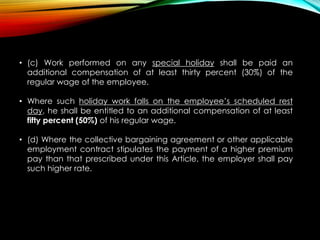
• (c) Work performed on any special holiday shall be paid an
additional compensation of at least thirty percent (30%) of the
regular wage of the employee.
• Where such holiday work falls on the employee’s scheduled rest
day, he shall be entitled to an additional compensation of at least
fifty percent (50%) of his regular wage.
• (d) Where the collective bargaining agreement or other applicable
employment contract stipulates the payment of a higher premium
pay than that prescribed under this Article, the employer shall pay
such higher rate.
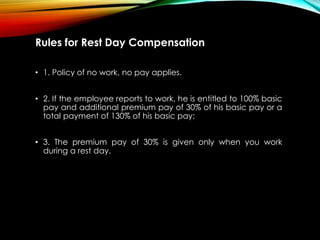
Rules for Rest Day Compensation
• 1. Policy of no work, no pay applies.
• 2. If the employee reports to work, he is entitled to 100% basic
pay and additional premium pay of 30% of his basic pay or a
total payment of 130% of his basic pay;
• 3. The premium pay of 30% is given only when you work
during a rest day.
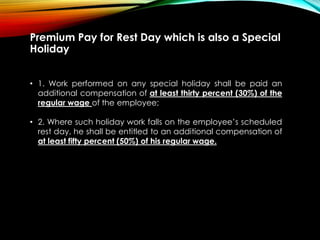
Premium Pay for Rest Day which is also a Special
Holiday
• 1. Work performed on any special holiday shall be paid an
additional compensation of at least thirty percent (30%) of the
regular wage of the employee;
• 2. Where such holiday work falls on the employee’s scheduled
rest day, he shall be entitled to an additional compensation of
at least fifty percent (50%) of his regular wage.
Article 94 – Right to Holiday
• (a) Every worker shall be paid his regular daily wage during regular
holidays, except in retail and service establishments regularly
employing less than ten (10) workers;
• (b) the employer may require an employee to work on any holiday
but such employee shall be paid a compensation equivalent to twice
his regular rate; and
• (c) As used in this Article, “holiday” includes: New Year’s Day, Maundy
Thursday, Good Friday, the ninth of April, the first of May, the twelfth of
June, the fourth of July, the thirtieth of November, the twenty-fifth and
thirtieth of December and the day designated by law for holding a
general election.
Memorandum Circular No. 01, March 8, 2004
• Guidelines to be observed by all employers in the private sector:
• For regular holidays (provided for under E.O. No. 203; incorporated
in E.O. No. 292) as amended by R.A. No. 9177, the following rules
shall apply:
• New Year’s Day – January 1
• Maundy Thursday – Movable Date
• Good Friday – Movable Date
• Araw ng Kagitingan – April 9
• Labor Day – May 1
• Independence Day – June 12
• National heroes Day – Last Sunday of August
• Bonifacio Day – November 30
• Eidul Fitr (RA No. 9177 – Movable Date
• Christmas Day –December 25
• Rizal Day – December 30
Rules on the Payment of Holiday Pay
• 1. If it is an employee’s regular workday
• If – unworked – 100%
• If worked
• 1st 8 hours – 200%
• In excess of 8 hours – plus 30% of hourly
rate on said day
• 2. If it is an employee’s rest day
• If unworked – 100%
• If worked
• 1st 8 hours – plus 30% of 200%
• In excess of 8 hours – plus 30% of
hourly rate on said day
• 3. For declared special days such as:
• Special Non- Working Day,
• Special Public Holiday,
• Special National Holiday, in addition to the two (2) nationwide special
days (November 1 – All Saints Day and December 31 – Last Day of the
Year) listed under E. O. No. 203, as amended, the following rules shall
apply:
• If unworked
• No pay, unless there is a favorable company policy, practice or
collective bargaining agreement (CBC) granting payment of wages on
special days even if unworked.
• If worked
• 1st 8 hours – plus 50% of the daily rate of 100%
• Excess of 8 hours – plus 30% of hourly rate on said day
• If falling on the employee’s rest day and if worked
• 1st 8 hours – plus 50% of the daily rate of 100%
• Excess of 8 hours – plus 30% of hourly rate on said day
• 4. For those declared as special working holidays
• For worked performed, an employee is entitled only to his
basic rate.
• No premium pay is required since work performed on said
days is considered work on ordinary working days.
To be Entitled to Two (2) Days Successive Holidays:
• 1. one must be present on the day immediately preceding the first
holiday; or
• 2. one is on leave with pay.
Monthly Paid Employees are not Entitled To Holiday
Pay
• Monthly paid employees are not entitled to the holiday pay if their
total annual income is divided by 365 days resulting in a wage
which is beyond the minimum wage per day because they are
considered paid everyday of the year including holidays, rest days
and other non-working days. The 365 days are as follows:
• Where 365 days =
• 300 days – Ordinary working day
• 51 days – Rest days
11 days – regular holidays
3 days – Special days
365 days – Total number of days
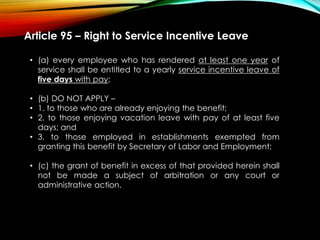
Article 95 – Right to Service Incentive Leave
• (a) every employee who has rendered at least one year of
service shall be entitled to a yearly service incentive leave of
five days with pay;
• (b) DO NOT APPLY –
• 1. to those who are already enjoying the benefit;
• 2. to those enjoying vacation leave with pay of at least five
days; and
• 3. to those employed in establishments exempted from
granting this benefit by Secretary of Labor and Employment;
• (c) the grant of benefit in excess of that provided herein shall
not be made a subject of arbitration or any court or
administrative action.
Requisites for the Enjoyment of Service Incentive
Leave:
• 1. A total of 5 days leave in one year with pay;
• 2. The employee must have been in the service for at least 1
year whether broken or continuous;
• 3. If unused, the 5 days are paid their cash equivalent at the
end of the year;
• 4. It covers all employees except the general exceptions and
establishments already giving sick leaves/vacation leaves with
pay for at least 5 days.
Meaning of “One Year of Service”
• “One year service” of the employee means service within 12 months,
whether continuous or broken, reckoned from the date the employee
started working.
• The period includes authorized absences, unworked weekly rest days,
and paid regular holidays.
• Where by individual or collective agreement, practice or policy, the
period of working days is less than 12 months, said period shall be
considered as one year for the purpose of determining entitlement to
the service incentive leave.
• Under Presidential Decree No. 851, employers from the private
sector in the Philippines are required to pay their rank-and-file
employees a Thirteenth (13th) Month Pay not later than December
24 every year;
• The 13th month pay is equivalent to one twelfth (1/12) of an
employee’s basic annual salary.
• 13th Month Pay should not be confused with the “Christmas bonus”
commonly practiced in the local business setting;
• Christmas bonus is not a demandable and enforceable obligation,
and can only be released upon an employer’s voluntary
discretion;
• Usually granted by employers to show appreciation and gratitude
for the service rendered by their employees within a year.
• The 13th month pay, on the other hand, is required by law and
employers who fail to provide them are liable under the law.
13th Month Pay is Mandatory
• All rank-and-file employees in the private sector who have worked for at
least one (1) month during the calendar year are entitled to receive 13th
month pay regardless of their position, designation or employment
status.
• But by accepted practice, managerial employees are also provided
with an equivalent of the 13th month pay;
• Following are not part in the computation of 13th Month Pay:
• cost-of-living allowances;
• profit-sharing payments;
• cash equivalent of unused vacation and sick leave credits;
• overtime pay;
• premium pay;
• night shift differential;
• holiday pay; and
• other allowances and monetary benefits not considered part of an
employee’s basic salary.
• But if any of the above item/s is/are treated as part of the basic salary,
then it/they shall be included in the final computation.
13th Month Coverage
• Computation
• Computation of the 13th month pay primarily consists of the total
basic monthly salary of an employee for the whole year, divided
by twelve (12) months.
• Those who have worked for less than a year, however, are only
entitled to receive the amount due to them on the number of
months they were employed.
• An employer is given the prerogative to release the 13th month
pay in installments of two (2) to whichever number that is
convenient to satisfy the condition that the mandatory benefit be
given before December 24 every year;
• By practice, many companies maintain two installments: first in
May and then in December, where the first fifty percent (50%) is
given as an aid for employees to prepare for the opening of the
regular school year in June.
• New Tax Obligation Rate under TRAIN Law for 2018 Onwards
• The 13th month pay is generally exempt from taxation;
• Under Section 32 (B)(7)(e) of the National Internal Revenue
Code (NIRC) – which was amended by Republic Act No.
10963 or the TRAIN law on January 2018:
• The 13th month pay and other equivalent benefits shall not be
subject to tax for a maximum of P90,000;
• This new amount is a relative increase from the previous tax
exclusion rate of P82,000.
• Anything beyond the maximum exclusion rate of P90,000 must
be included in the computation of the employee’s gross
income for the applicable taxable year.
- END -

Module 8B (Wages and Other Benefits).pdf

  • 1.
    P.D. 442, asamended, Labor Code of the Philippines WAGES • Wage is “a remuneration or earnings, however designated, capable of being expressed in terms of money, whether fixed or ascertained on a time, task, piece or commission basis, or other method of calculating the same, which is payable by an employer to an employee under a written or unwritten contract of employment for work done or to be done, or for service rendered or to be rendered.” • Wage is the term applied to payments given workers performing manual or physical and work lower positions, including the so- called blue collar jobs.
  • 2.
    Salary • Salary is“a reward or recompense for services performed.” (Black’s Law Dictionary, 5th ed.) • Salary is the consideration paid at regular intervals for the rendering of services. (Philippine Legal Encyclopedia) • Basic Salary • Basic salary includes remunerations or earnings paid by the employer to employee, but excludes cost-of-living allowances, profit-sharing payments, and all allowances and monetary benefits which have been considered as part of the basic salary of the employee.
  • 3.
    Minimum Wage Rates •Article 99 – Regional Minimum Wages • Minimum wage rates for agricultural and non-agricultural employees and workers in each and every region of the country shall be those prescribed by the Regional Tripartite Wages and Productivity Boards. (As amended by Section 3, Republic Act No. 6727, June 9, 1989) • Republic Act No. 6727 - known as the “Wage Rationalization Act” issued on July 1, 1989; • It provides that minimum wage fixing is done on a regional basis by the Regional Boards, located in each of the 17 regions of the country instead of the former method that minimum wage is done via acts Congress, by presidential decrees or executive orders.
  • 4.
    Payment of Wages •Article 102 – Forms of Payment • No employer shall pay the wages of an employee by means of promissory notes, vouchers, coupons, tokens, tickets, chits, or any object other than legal tender, even when expressly requested by the employee. • Payment of wages by check or money order shall be allowed when such manner of payment is customary on the date of effectivity of this Code, or is necessary because of special circumstances as specified in appropriate regulations to be issued by the Secretary of Labor and Employment or as stipulated in a collective bargaining agreement.
  • 5.
    • The paymentof wages must be paid in legal tender except: • a. customary on the date of effectivity of the Labor Code; • b. necessary because of special circumstances as determined by the Secretary of Labor; and • c. stipulated in the CBA. • Legal tender is a currency that cannot legally be refused in payment of debt or obligations. (Concise Oxford Dictionary) • A check is not a legal tender, and therefore cannot constitute valid tender of payment.
  • 6.
    Article 103 –Time of Payment • Wages shall be paid at least once every two (2) weeks or twice a month at intervals not exceeding sixteen (16) days. • If on account of force majeure or circumstances beyond the employer’s control, payment of wages on or within the time herein provided cannot be made, the employer shall pay the wages immediately after such force majeure or circumstances have ceased. • No employer shall make payment with less frequently than once a month. • Payment of wages of employees engaged to perform a task which cannot be completed in two (2) weeks shall be subject to the following conditions, in the absence of a collective bargaining agreement or arbitration award: • (1) That payments are made at intervals not exceeding sixteen (16) days, in proportion to the amount of work completed; • (2) That final settlement is made upon completion of the work.
  • 7.
    Article 104 –Place of Payment • Payment of wages shall be made at or near the place of undertaking, except as otherwise provided by such regulations as the Secretary of Labor and Employment may prescribe under conditions to ensure greater protection of wages. • The payment of wages shall be made at the work premises or near the place of work, as a general rule except: • (a) when payment cannot be effected at or near the place of work by reason of the deterioration of peace and order conditions, or by reason of actual or impending emergencies caused by fire, flood, epidemic or other calamity rendering payment thereat impossible; • (b) when the employer provides free transportation to the employees back and forth;
  • 8.
    • (c) Underany other analogous circumstances provided that the time spent by the employees in collecting their wages shall be considered as compensable hours worked; and • (d) No employer shall pay his employees in any bar, night or day club, drinking, establishment, massage clinic, dance hall, or other similar places or in places where games are played with stakes of money or things representing money except in the case of persons employed in said places. • (Section 4, Rule VIII, Implementing Rules and Regulations of Book III of the Labor Code)
  • 9.
    Payment Thru Banks •Payment through banks especially by means of automated teller machines is allowed by Section 7, Republic Act No. 6727 or the Wage Rationalization Law provided: • 1. There is a written request by the majority of workers in the establishment; • 2. The employer has at least 25 employees; • 3. The bank’s ATM is located within (1) kilometer radius from the workplace; • 4. The bank shall issue a certification of payment upon request of the worker.
  • 10.
    • Direct paymentof wages – meaning the payment of wages shall be made direct to the employee entitled to it, except in the following cases: • (a) Where the employer is authorized in writing by the employee to pay his wages to a member of his family; • (b) where payment to another person of any part of the employee’s wages is authorized by existing law, including payments for the insurance premiums of the employee and union dues where the right to check-off has been recognized by the employer in accordance with a collective agreement or authorized in writing by the individual employees concerned; or • (c) In case of death of the employee. • (Section 5, Rule VIII, Implementing Rules and Regulation of the Book III, Labor Code)
  • 11.
    Prohibitions Regarding Wages •Article 112 – Non-interference in Disposal of Wages • No employer shall limit or otherwise interfere with the freedom of any employee to dispose of his wages. He shall not in any manner force, compel, or oblige his employees to purchase merchandise, commodities or other property from any other person, or otherwise make use of any store or services of such employer or any other person. • No employer shall limit or otherwise interfere with the freedom of any employee to dispose of his wages and no employer shall in any manner oblige any of his employees to patronize any store avail of the services offered by any person. • (Section 12 Rule VIII, Implementing Rules regulation of the Book III, Labor Code)
  • 12.
    Article 113 –Wage Deduction • No employer, in his own behalf or in behalf of any person, shall make any deduction from the wages of his employees, except: • (a) In case where the worker is insured with his consent by the employer, and the deduction is to recompense the employer for the amount paid by him as premium on the insurance; • (b) For union dues, in cases where the right of the worker or his union to check-off has been recognized by the employer or authorized in writing by the individual worker concerned; and • (c) In cases where the employer is authorize by law or regulations issued by the secretary of Labor and Employment.
  • 13.
    Other Allowable WageDeductions: • 1. Income taxes; • 2. SSS payments; • 3. Philhealth payments; • 4. Contributions to PAG-IBIG Fund; • 5. Value of facilities supplied by the employer; • 6. Deduction for payments of demandable debts due to the employer; • 7. Deductions made in case of judgment against the debtor-worker; • 8. Deduction for absences; • 9. Worker’s insurance acquired by the employer; • 10. Union dues, where the right to check-off has been recognized by the employer; • Compulsory Purchase of Merchandise and Payment of Wages by Means of Tokens is punishable by law;
  • 14.
    • LABOR STANDARDS,Book 3 – Conditions of Employment • Article 83 – Normal Hours of Work • The normal hours of work of any employee shall not exceed eight (8) hours a day. • Article 84 – Hours Worked • Hours worked shall include (Compensable Hours Work): • (a) all time during which an employee is required to be on duty or to be at a prescribed workplace; and • (b) all the during which an employee is suffered or permitted to work. • Rest periods of short duration during working hours shall be counted as hours worked.
  • 15.
    • The timespent by employees to get ready for work or to get ready to leave work is not compensable time. • When activities are required during the regular working hours, they are considered hours worked, thus, compensable. • Sleeping while working • Sleeping while on duty is compensable if the nature of the employee’s work allows sleeping without interrupting or prejudicing work or when there is an agreement between employee and his employer to that effect. • Examples: • Security guard; • Truck helper may sleep after performing his task and while his truck is traveling on its way to its assignment.
  • 16.
    Waiting Time • (a)Waiting spent by employee shall be considered as working time, hence, compensable, if waiting is: • i. an integral part of his work; or • ii. employee is required or engaged by the employer to wait. • (b) Employee who is required to remain “on call” in employer’s premises or so close there that he cannot use the time effectively and gainfully for his own purpose shall be considered as working while on call.
  • 17.
    Travel Time • A.Travel from home to work – NOT compensable working time; • Reason: ordinary incident of employment. • EXCEPTIONS: • 1. When called to travel during emergency; • 2. When travel is done through a conveyance furnished by employer; • 3. When travel is done under the employer’s supervision and control. • B. Travel that is all in the day’s work – compensable hours worked. • C. Travel that keeps an employee away from home (overnight) – • – compensable hours worked. • Reason: It substitutes for the hours that the employee should have been in the office. • Travel away from home is not compensable: • 1. When done outside regular working hours; • 2. Attendance is voluntary; • 3. No productive work was done while in attendance.
  • 18.
    Power Interruptions –Brown-outs • Brown-out is a condition of lower voltage than normal power. This condition is short-term (minutes to hours) or long term (1/2 day or more). A power line voltage reduction of 8 - 12% is usually considered a brown-out. • Black-out is a complete loss of power. • Rule of Brown-out • 1. Brown-outs of short duration not exceeding twenty (20) minutes – compensable hours worked; • 2. Brown-outs running for more than twenty (20) minutes may not be treated as hours worked provided any of the following is present: • a. Employees can leave their workplace or go elsewhere whether within or outside the work premises; or • b. Employees can use the time effectively for their own interest.
  • 19.
    • Art. 91.Right to weekly rest day. • It shall be the duty of every employer, whether operating for profit or not, to provide each of his employees a rest period of not less than twenty-four (24) consecutive hours after every six (6) consecutive normal work days.
  • 20.
    Article 86 –Night Shift Differential • Every employee shall be paid a night shift differential of not less than ten percent (10%) of his regular wage for each hour of work performed between ten o'clock in the evening and six o’clock in the morning. • Night shift differential is the amount which every employee is entitled to receive which is equivalent to ten percent (10%) of his regular wage for every hour he has worked between 10pm to 6am. • Those who are assigned to work on the so-called graveyard shift are entitled to night shift differential pay; • A graveyard shift is a shift of work running through the early hours of the morning, especially one from midnight until 8 am.
  • 21.
    Night Shift DifferentialDoes Not Apply To: • (a) employees of government-owned and/or controlled corporations; • (b) those of retail and service establishments regularly employing not more than (5) workers; • (c) Domestic helpers and persons in the personal service of another; • (d) managerial employees; • (e) field personnel and other employees whose time and performance is unsupervised by the employer including those who are engaged on task or contract basis, purely commission basis, or those who are paid a fixed amount for performing work irrespective of the time (pakyao) consumed in the performance thereof. (Section 1, Rule II, Implementing Rules and Regulations, Book III)
  • 22.
    Article 87 –Overtime Work • Work may be performed beyond eight (8) hours a day provided that the employee is paid for the overtime work, an additional compensation equivalent to his regular wage plus at least twenty- five percent (25%) thereof. • Work performed beyond eight hours on a holiday or rest day shall be paid an additional compensation equivalent to the rate of the first eight hours on a holiday or rest day plus at least thirty percent (30%) thereof. • It is an additional work, labor or service employed and the adverse effects of his longer stay in his place of work.
  • 23.
    Overtime Pay vs.Premium Pay • Overtime pay means the additional compensation for work performed beyond 8 hours. • Every employee entitled to premium pay is also entitled to benefit of overtime pay. • Premium pay means the additional compensation required by law for work performed within 8 hours on non-working days such as rest days and special days. • Undertime work on any particular day shall not be offset by overtime work on any other day. (Sec. 88)
  • 24.
    Rules on OvertimeWork and Pay: • 1. Demandable only if the employer had knowledge and consented to the overtime work rendered by the employee; • 2. Compensation for work rendered in excess of the eight (8) normal working hours in a day; • 3. For ordinary days, additional 25% of the basic hourly rate; • 4. For rest day/special day/holiday, additional 30% of the basic hourly rate; • 5. Not unless a day is a rest, the given day is considered an ordinary day.
  • 25.
    Article 89 –Emergency Overtime Work • Any employee may be required by the employer to perform overtime work in any of the following cases: • (a) When the country is at war or when any other national or local emergency has been declared by the National Assembly or the Chief Executive; • (b) When it is necessary to prevent loss of life or property or in case of imminent danger to public safety due to an actual or impending emergency in the locality caused by serious accidents, fire, flood, typhoon, earthquake, epidemic, or other disaster or calamity; • (c) When there is urgent work to be performed on machines, installations, or equipment, in order to avoid serious loss or damage to the employer or some other cause of similar nature; • (d) When the work is necessary to prevent loss or damage to perishable goods; and • (e) Where completion or continuation of the work started before the eighth hour is necessary to prevent serious obstruction or prejudice to the business or operations of the employer.
  • 26.
    Article 91- Rightto Weekly Rest Day • (a) It shall be the duty of every employer, whether operating for profit or not, to provide each of his employees a rest period of not less than twenty-four (24) consecutive hours after every six (6) consecutive normal work days. • (b) Employer shall determine and schedule the weekly rest day of his employees subject to collective bargaining agreement and to such rules and regulations as the Secretary of Labor and Employment may provide. • However, the employer shall respect the preference of employees as to their weekly rest day when such preference is based on religious grounds. • Article 92 – When Employer may Required Work on a Rest Day
  • 27.
    Rules on WeeklyRest Period • 1. Rest day of not less than 24 hours (1 day) after six (6) consecutive days of work; • 2. No work, no pay policy applies; • 3. If one works, he gets a premium pay for rest day; • 4. Premium pay is additional 30% of the basic pay; • 5. Employer selects the rest day of his employees; • 6. Employer must consider religious reason for the choice of the rest days; • 7. Concessions can be made between the parties.
  • 28.
    Articles 93 –Compensation for Rest Day, Sunday or Holiday Work • (a) Where an employee is made or permitted to work on his scheduled rest day, he shall be paid an additional compensation of at least thirty percent (30%) of his regular wage. • An employee shall be entitled to such additional compensation for work performed on Sunday only when it is his established rest day. • (b) When the nature of the work of the employee is such that he has no regular workdays and no regular rest days can be scheduled, he shall be paid an additional compensation of at least thirty percent (30%) of his regular wage for work performed on Sundays and holidays.
  • 29.
    • (c) Workperformed on any special holiday shall be paid an additional compensation of at least thirty percent (30%) of the regular wage of the employee. • Where such holiday work falls on the employee’s scheduled rest day, he shall be entitled to an additional compensation of at least fifty percent (50%) of his regular wage. • (d) Where the collective bargaining agreement or other applicable employment contract stipulates the payment of a higher premium pay than that prescribed under this Article, the employer shall pay such higher rate.
  • 30.
    Rules for RestDay Compensation • 1. Policy of no work, no pay applies. • 2. If the employee reports to work, he is entitled to 100% basic pay and additional premium pay of 30% of his basic pay or a total payment of 130% of his basic pay; • 3. The premium pay of 30% is given only when you work during a rest day.
  • 31.
    Premium Pay forRest Day which is also a Special Holiday • 1. Work performed on any special holiday shall be paid an additional compensation of at least thirty percent (30%) of the regular wage of the employee; • 2. Where such holiday work falls on the employee’s scheduled rest day, he shall be entitled to an additional compensation of at least fifty percent (50%) of his regular wage.
  • 32.
    Article 94 –Right to Holiday • (a) Every worker shall be paid his regular daily wage during regular holidays, except in retail and service establishments regularly employing less than ten (10) workers; • (b) the employer may require an employee to work on any holiday but such employee shall be paid a compensation equivalent to twice his regular rate; and • (c) As used in this Article, “holiday” includes: New Year’s Day, Maundy Thursday, Good Friday, the ninth of April, the first of May, the twelfth of June, the fourth of July, the thirtieth of November, the twenty-fifth and thirtieth of December and the day designated by law for holding a general election.
  • 33.
    Memorandum Circular No.01, March 8, 2004 • Guidelines to be observed by all employers in the private sector: • For regular holidays (provided for under E.O. No. 203; incorporated in E.O. No. 292) as amended by R.A. No. 9177, the following rules shall apply: • New Year’s Day – January 1 • Maundy Thursday – Movable Date • Good Friday – Movable Date • Araw ng Kagitingan – April 9 • Labor Day – May 1 • Independence Day – June 12 • National heroes Day – Last Sunday of August • Bonifacio Day – November 30 • Eidul Fitr (RA No. 9177 – Movable Date • Christmas Day –December 25 • Rizal Day – December 30
  • 34.
    Rules on thePayment of Holiday Pay • 1. If it is an employee’s regular workday • If – unworked – 100% • If worked • 1st 8 hours – 200% • In excess of 8 hours – plus 30% of hourly rate on said day • 2. If it is an employee’s rest day • If unworked – 100% • If worked • 1st 8 hours – plus 30% of 200% • In excess of 8 hours – plus 30% of hourly rate on said day
  • 35.
    • 3. Fordeclared special days such as: • Special Non- Working Day, • Special Public Holiday, • Special National Holiday, in addition to the two (2) nationwide special days (November 1 – All Saints Day and December 31 – Last Day of the Year) listed under E. O. No. 203, as amended, the following rules shall apply: • If unworked • No pay, unless there is a favorable company policy, practice or collective bargaining agreement (CBC) granting payment of wages on special days even if unworked. • If worked • 1st 8 hours – plus 50% of the daily rate of 100% • Excess of 8 hours – plus 30% of hourly rate on said day • If falling on the employee’s rest day and if worked • 1st 8 hours – plus 50% of the daily rate of 100% • Excess of 8 hours – plus 30% of hourly rate on said day
  • 36.
    • 4. Forthose declared as special working holidays • For worked performed, an employee is entitled only to his basic rate. • No premium pay is required since work performed on said days is considered work on ordinary working days.
  • 37.
    To be Entitledto Two (2) Days Successive Holidays: • 1. one must be present on the day immediately preceding the first holiday; or • 2. one is on leave with pay.
  • 38.
    Monthly Paid Employeesare not Entitled To Holiday Pay • Monthly paid employees are not entitled to the holiday pay if their total annual income is divided by 365 days resulting in a wage which is beyond the minimum wage per day because they are considered paid everyday of the year including holidays, rest days and other non-working days. The 365 days are as follows: • Where 365 days = • 300 days – Ordinary working day • 51 days – Rest days 11 days – regular holidays 3 days – Special days 365 days – Total number of days
  • 39.
    Article 95 –Right to Service Incentive Leave • (a) every employee who has rendered at least one year of service shall be entitled to a yearly service incentive leave of five days with pay; • (b) DO NOT APPLY – • 1. to those who are already enjoying the benefit; • 2. to those enjoying vacation leave with pay of at least five days; and • 3. to those employed in establishments exempted from granting this benefit by Secretary of Labor and Employment; • (c) the grant of benefit in excess of that provided herein shall not be made a subject of arbitration or any court or administrative action.
  • 40.
    Requisites for theEnjoyment of Service Incentive Leave: • 1. A total of 5 days leave in one year with pay; • 2. The employee must have been in the service for at least 1 year whether broken or continuous; • 3. If unused, the 5 days are paid their cash equivalent at the end of the year; • 4. It covers all employees except the general exceptions and establishments already giving sick leaves/vacation leaves with pay for at least 5 days.
  • 41.
    Meaning of “OneYear of Service” • “One year service” of the employee means service within 12 months, whether continuous or broken, reckoned from the date the employee started working. • The period includes authorized absences, unworked weekly rest days, and paid regular holidays. • Where by individual or collective agreement, practice or policy, the period of working days is less than 12 months, said period shall be considered as one year for the purpose of determining entitlement to the service incentive leave.
  • 42.
    • Under PresidentialDecree No. 851, employers from the private sector in the Philippines are required to pay their rank-and-file employees a Thirteenth (13th) Month Pay not later than December 24 every year; • The 13th month pay is equivalent to one twelfth (1/12) of an employee’s basic annual salary. • 13th Month Pay should not be confused with the “Christmas bonus” commonly practiced in the local business setting; • Christmas bonus is not a demandable and enforceable obligation, and can only be released upon an employer’s voluntary discretion; • Usually granted by employers to show appreciation and gratitude for the service rendered by their employees within a year. • The 13th month pay, on the other hand, is required by law and employers who fail to provide them are liable under the law. 13th Month Pay is Mandatory
  • 43.
    • All rank-and-fileemployees in the private sector who have worked for at least one (1) month during the calendar year are entitled to receive 13th month pay regardless of their position, designation or employment status. • But by accepted practice, managerial employees are also provided with an equivalent of the 13th month pay; • Following are not part in the computation of 13th Month Pay: • cost-of-living allowances; • profit-sharing payments; • cash equivalent of unused vacation and sick leave credits; • overtime pay; • premium pay; • night shift differential; • holiday pay; and • other allowances and monetary benefits not considered part of an employee’s basic salary. • But if any of the above item/s is/are treated as part of the basic salary, then it/they shall be included in the final computation. 13th Month Coverage
  • 44.
    • Computation • Computationof the 13th month pay primarily consists of the total basic monthly salary of an employee for the whole year, divided by twelve (12) months. • Those who have worked for less than a year, however, are only entitled to receive the amount due to them on the number of months they were employed. • An employer is given the prerogative to release the 13th month pay in installments of two (2) to whichever number that is convenient to satisfy the condition that the mandatory benefit be given before December 24 every year; • By practice, many companies maintain two installments: first in May and then in December, where the first fifty percent (50%) is given as an aid for employees to prepare for the opening of the regular school year in June.
  • 45.
    • New TaxObligation Rate under TRAIN Law for 2018 Onwards • The 13th month pay is generally exempt from taxation; • Under Section 32 (B)(7)(e) of the National Internal Revenue Code (NIRC) – which was amended by Republic Act No. 10963 or the TRAIN law on January 2018: • The 13th month pay and other equivalent benefits shall not be subject to tax for a maximum of P90,000; • This new amount is a relative increase from the previous tax exclusion rate of P82,000. • Anything beyond the maximum exclusion rate of P90,000 must be included in the computation of the employee’s gross income for the applicable taxable year. - END -