Finding the naturalgrouping
• To find the “natural grouping” of a given data set using
MST of data points.
•Clustering techniques aim to extract such “natural groups”
present in a given data set and each such group is termed
as a cluster.
2.
CLUSTERING
Let the setof n patterns S= {x1,x2,….,xn } m
and K
clusters are represented by C1, C2,….,CK then
1. Ci , for i= 1, 2, …..,K
2. Ci Cj = for i j and
3. i=1
K
Ci =S where represents null set.
3.
What is NaturalGrouping?
•For a data set S= {x1,x2,….,xn } m
, what one perceives
to be the groups present in S by viewing the scatter diagram
of S, is termed as natural groups of S.
Widely used Algorithms
•K-Means Algorithm.
• ISODATA Algorithm.
Disadvantage of K-Means Algorithm
• It needs the number of clusters to be known a priori.
• It can find the grouping if clusters exhibit characteristics
pocket and are not placed very close to each other.
•It may stack at a local minima.
•It can not provide proper grouping in case of some data
having typical shape and size.
Finding the NaturalGrouping using
Local Densities of the Data Points
• To find high density regions of a given data set.
• To merge those high density regions “suitably” along with the data
points of other regions to result in clustering.
• To eliminates noise if any from the final clustering.
10.
Scatter Diagram Findingdensity of each data points
Radius for the open disk to compute the density of each data point is
taken to be
n
ln
n
h
r
r
ln → Sum of edge weights of minimal spanning tree of S.
n → Number of data points in S.
The edge weight is taken to be the Euclidean distance.[(x2-x1)^2+(y2-y1)^2]^(1/2)
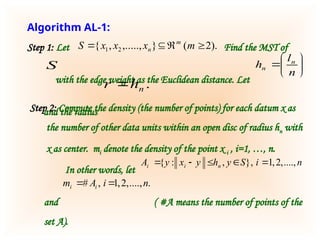
Algorithm AL-1:
Step 1:Let Find the MST of
with the edge weight as the Euclidean distance. Let
and the radius
).
2
(
}
,.....,
,
{ 2
1
m
x
x
x
S m
n
S
n
l
h n
n
.
n
h
r
Step 2: Compute the density (the number of points) for each datum x as
the number of other data units within an open disc of radius hn with
x as center. mi denote the density of the point x i , i=1, …, n.
In other words, let
and ( #A means the number of points of the
set A).
n
i
S
y
h
y
x
y
A n
i
i ....,
,
2
,
1
,
}
,
:
{
.
....,
,
2
,
1
,
# n
i
A
m i
i
14.
Step 3: Rearrangein increasing order. Let the
rearrangement be Let represent
the corresponding cumulative sums of i.e.
n
m
m
m ......,
,
, 2
1
.
,......,
, *
*
2
*
1 n
m
m
m n
j
p j ,....,
2
,
1
,
.
,......,
, *
*
2
*
1 n
m
m
m
.
.....,
,
2
,
1
,
1
*
n
j
m
p
j
i i
j
Step 4: Compute where [a] means integral part of ‘a’
i.e. the largest integer a. Find the value of i for which pi is
nearest to M.
Choose for that i.
If and then choose
We have taken the value of to be 85.
n
w
M
100
*
i
m
k
1
i
i p
M
p M
p
p
M i
i
1 .
*
1
i
m
k
w
15.
1
1 .
}
,
:
{ S
S
S
x
k
m
x
Si
i
i
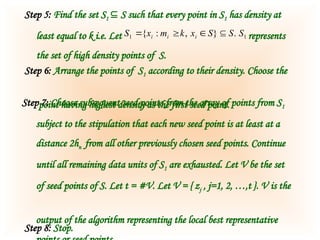
Step 5: Find the set S1 S such that every point in S1 has density at
least equal to k i.e. Let represents
the set of high density points of S.
Step 6: Arrange the points of S1 according to their density. Choose the
point having highest density as the first seed point.
Step 7: Choose subsequent seed points from the array of points from S1
subject to the stipulation that each new seed point is at least at a
distance 2hn from all other previously chosen seed points. Continue
until all remaining data units of S1 are exhausted. Let V be the set
of seed points of S. Let t = #V. Let V = { zj , j=1, 2, …,t }. V is the
output of the algorithm representing the local best representative
Step 8: Stop.
16.
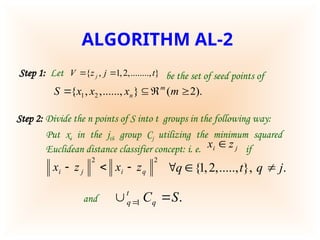
ALGORITHM AL-2
}
........,
,
2
,
1
,
{ t
j
z
Vj
).
2
(
}
......,
,
,
{ 2
1
m
x
x
x
S m
n
Step 1: Let be the set of seed points of
j
i z
x
2
2
q
i
j
i z
x
z
x
.
},
.....,
,
2
,
1
{ j
q
t
q
.
1 S
Cq
t
q
Step 2: Divide the n points of S into t groups in the following way:
Put xi in the jth group Cj utilizing the minimum squared
Euclidean distance classifier concept: i. e. if
and
17.
)},
,
(
{ 2
1 m
m
ijx
x
d
Min
d
.
, 2
1 j
m
i
m C
x
C
x
n
ij h
d
Step 3: For two groups Ci and Cj find dij where
If then merge those two groups
Ci and Cj into one group and name it as Ci .
Step 4: Repeat Step 3 for all possible pairs of i and j.
Step 5: Stop.
18.
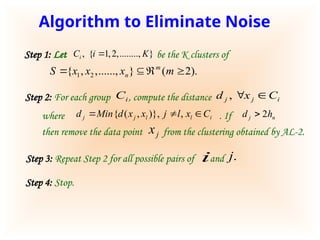
Algorithm to EliminateNoise
Step 1: Let }
........,
,
2
,
1
{
, K
i
Ci be the K clusters of
).
2
(
}
......,
,
,
{ 2
1
m
x
x
x
S m
n
Step 2: For each group i
C , compute the distance i
j
j C
x
d
,
where i
l
l
j
j C
x
l
j
x
x
d
Min
d
,
)},
,
(
{ . If n
j h
d 2
then remove the data point j
x
iand .
j
Step 3: Repeat Step 2 for all possible pairs of
Step 4: Stop.
from the clustering obtained by AL-2.




![Scatter Diagram Finding density of each data points
Radius for the open disk to compute the density of each data point is
taken to be
n
ln
n
h
r
r
ln → Sum of edge weights of minimal spanning tree of S.
n → Number of data points in S.
The edge weight is taken to be the Euclidean distance.[(x2-x1)^2+(y2-y1)^2]^(1/2)](https://image.slidesharecdn.com/ngmst-250915063428-7faa2d1c/85/Minimum-Spanning-Tree-MST-based-Clustering-10-320.jpg)


![Step 3: Rearrange in increasing order. Let the
rearrangement be Let represent
the corresponding cumulative sums of i.e.
n
m
m
m ......,
,
, 2
1
.
,......,
, *
*
2
*
1 n
m
m
m n
j
p j ,....,
2
,
1
,
.
,......,
, *
*
2
*
1 n
m
m
m
.
.....,
,
2
,
1
,
1
*
n
j
m
p
j
i i
j
Step 4: Compute where [a] means integral part of ‘a’
i.e. the largest integer a. Find the value of i for which pi is
nearest to M.
Choose for that i.
If and then choose
We have taken the value of to be 85.
n
w
M
100
*
i
m
k
1
i
i p
M
p M
p
p
M i
i
1 .
*
1
i
m
k
w](https://image.slidesharecdn.com/ngmst-250915063428-7faa2d1c/85/Minimum-Spanning-Tree-MST-based-Clustering-14-320.jpg)