










A mini-guide on Open SpaceDraft in process!
Why a Mini Guide?Perhaps you’ve attended an Open Space event and experienced what was just described.Now you’d like to host or facilitate one of your own with a team who shares your passion on a common theme, topic or issue.Or maybe, you are thinking about it for your company,  organization or community and want to understand more about how Open Space works.This is a user friendly workbook that briefly describes some of the what, why, when and how of Open Space – with some basic  descriptions and a few handy tools that may help you as you plan your own event.  Mini GuideOpen Space
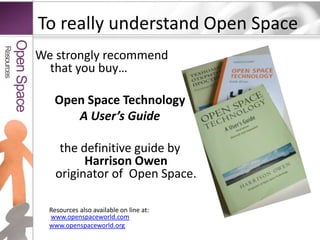
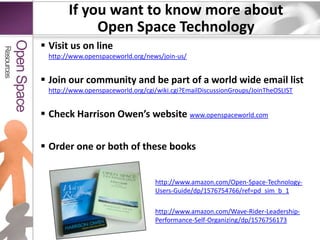
To really understand Open SpaceWe strongly recommend that you buy…Open Space TechnologyA User’s Guidethe definitive guide by Harrison Owenoriginator of  Open Space.Resources also available on line at:  www.openspaceworld.comwww.openspaceworld.orgResourcesOpen Space
Open Space TechnologyWhat is it exactly?
Here’s what some people have said…about what happens in Open SpaceThey felt invigorated by the conversations;  they connected with others quickly in a very focused way.  The intensity of the discussions, the relevance of the topics, the openness of the participants, many of whom they did not know, astounded them. They still can’t quite believe what happened there, so fast and with so many people in the room. It felt entirely different from the traditional meetings, workshops and conferences that they normally attend.The connections between participants from so many sectors with people of all ages, at different levels, and the powerful learning and sharing, that ensued are something they’ve rarely experienced before, if ever.  A lot of listening, a lot of shifting.Ideas and possibilities for action were bubbling to the surface and even now, months later, they’re still ponderingand yes moving to action on many of those ideas, staying connected with people they met. Passion  and Responsibility  seem to sum it up best!Mini GuideOpen Space
A recent event in New Jersey:Participants sharing their experience of Open SpaceTheme: “How can Creativity and Innovation Revitalize New Jersey?”Open Space Event June 14th-15th, 2011Mini GuideOpen Spacehttp://www.youtube.com/watch?v=pm6-czGGqZ0Mayor Chuck ChiarelloMayor, Buena Vista Township http://www.youtube.com/watch?v=p876s9e5vWcElizabeth MurphyExecutive Director, Global Arts Exchange www.globalartsexchange.orgwww.creativenj.org
Open Space TechnologyMore than Just a process
A few Descriptions of Open Space to start Open Space Technology is a method for holding meetings and conferences thatcreates the conditions for dynamic and engaging conversations.Itis a powerful way of bringing people together to search for solutions to complex issues around a central theme.  All participants have the opportunity to express what they consider to be important and to take responsibility on topics that they are passionate about.  In doing so, people discover new ways of connecting and working cooperatively.Open Spacewas created over 25 years ago by Harrison Owen in response to something he noticed at conferences: people seemed most energized and engaged during coffee breaks. So he decided to create a meeting format that would look and feel like “one long coffee break”.  Amazingly, what people discovered is that a lot gets done during Open Space Events especially when people are discussing real issues that they care deeply about. Open Space is a highly interactive meeting processthat invites openness among participants leading to highly dynamic conversations and a “sleeves-up” approach to dealing with complex issues. Open Space has just enough structure to allow meaningful connections and collaborations to emerge. Open Space is hard to describe because it is so different from how we hold typical meetings and conferences.With minimal structure, this methodology invites people to create an agenda of topics around a central theme of strategic importance, to host or join sessions and to connect with others exchanging ideas, discovering new possibilities and exploring avenues for action.Open Space quickly and powerfully ignites people to engage as they unleash their own leadership, individually and collectively. No experts, no panelists, no one leading the process, no agenda and no power point presentations. People unite around a common theme, post their own topics and in a matter of minutes, discussion groups form and dynamic conversation get underway  When that happens, new ideas and possibilities for action emerge. Everything gets documented at the event in real time.Mini GuideOpen Space
Open Space has been used for:With Many Groups, in Many PlacesMultiple Types of MeetingsConferences, SymposiumsBusiness MeetingsPlanning & Strategy SessionsCommunity EventsRetreats, SummitsDepartment & Cross-Functional MeetingsNeighborhood GatheringsReunions and moreProfit & Non-Profit OrganizationsSchools, Colleges and UniversitiesGovernment/Civic groups:local, national and globalCommunity and Volunteer GroupsAssociations,  ActivistsArts, Culture, Science, Technology, Business, Theatre, Political, Finance, Environment, Health Care, etc. Mini GuideOpen SpaceOpen Space started more than 25 years and has been used around the world with groups of 20 and up to 2000 people and more.
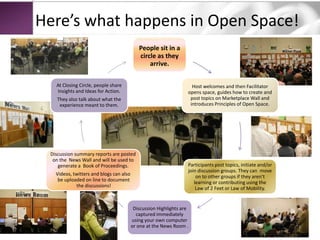
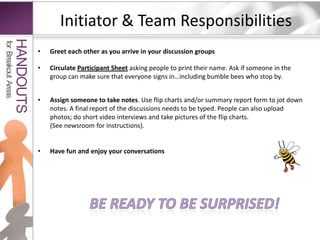
What you should also know about Open SpaceOpen Space is a “self-organizing process” with just enough structure to activate lively and open discussions leading to real possibilities, actions  and results. The role of the leader is to “invite” and “convene” around a compelling theme. People feel the support of leadership to participate, explore and engage without pre-established and pre-defined goals and outcomes, which can limit solutions, creativity and outcome.The role of the facilitator is to assist in the planning and pre-work.  At the event itself, the facilitator initially guides the group, explaining how to write and post topics, describing basic principles of Open Space including the Law of 2 Feet, and how to assign time and place for the sessions.  From then on, it’s a matter of quietly holding the space, and doing small and invisible tasks (picking up coffee cups, replenishing supplies as needed, assuring smooth functioning at the news room and pulling chairs back into the main circle for evening or morning news, and then closing circle at the end).  The success of the meeting is up to the participants. By choosing how and where they want to contribute, engaging in the topics they care most deeply about, sharing passion and connection on a common theme, exploring possibilities and actions to take, individuals unleash their own leadership and take responsibility for the event and follow-up actions.Open Space is very different from your traditional conference, meeting or symposium. It’s different from how we typically lead, facilitate and engage. It invites us to be equals together, bringing the best of who we are and what we know. Open Space assumes everything and everyone we need are in the room. We don’t have to rely on outside leaders, experts or specialists to solve problems or create and invent solutions and possibilities. Open Space will appear chaotic and messy at times.  Creativity is like that, so is innovation and change. Outputs you can expect in Open Space, which are created on-site at the meeting include: an agenda of topics developed by the participants, multiple concurrent group discussions on topics that people feel are most important and for which they have the greatest passion, summary reports of all conversations captured in a book of proceedings at the end, and for longer meetings, priorities , teams and initial action steps. Open Space has been used thousands of times in all kinds of settings.  Interestingly , it always works  though it’s hard to know that until you experience it!  In the meantime, we say: “Trust the process and be prepared to be surprised!”Mini GuideOpen Space
Here’s what happens in Open Space!
Open Space TechnologyWhere and how to start
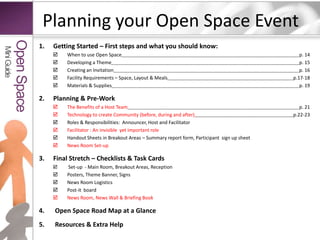
Planning your Open Space EventGetting Started – First steps and what you should know:When to use Open Spacep. 14
Developing a Themep. 15
Creating an Invitationp. 16
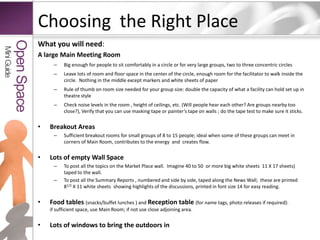
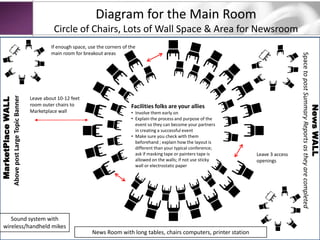
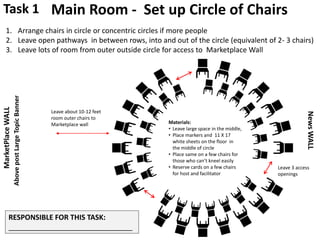
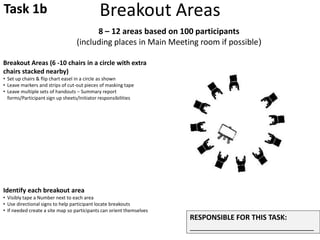
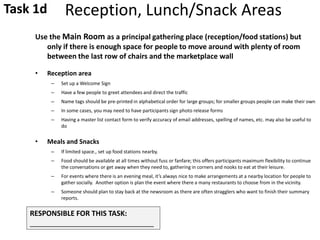
Facility Requirements – Space, Layout & Mealsp.17-18
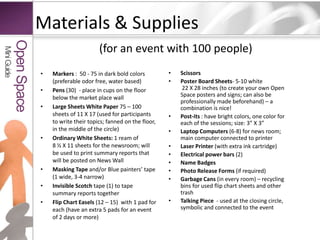
Materials & Suppliesp. 19Planning & Pre-Work The Benefits of a Host Teamp. 21
Technology to create Community (before, during and after)p.22-23
Roles & Responsibilities:  Announcer, Host and Facilitator
Facilitator : An invisible  yet important role
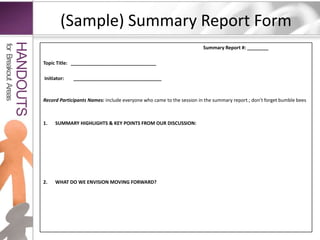
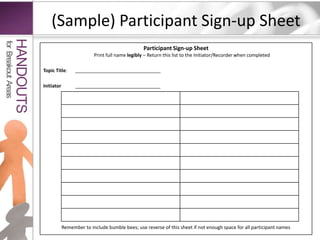
Handout Sheets in Breakout Areas – Summary report form, Participant  sign up sheet
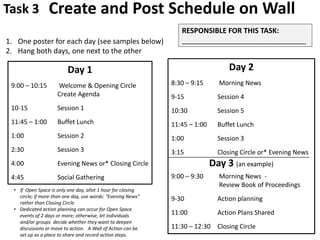
News Room Set-upFinal Stretch – Checklists & Task CardsSet-up  - Main Room, Breakout Areas, Reception
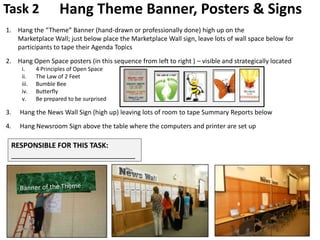
Posters, Theme Banner, Signs
News Room Logistics
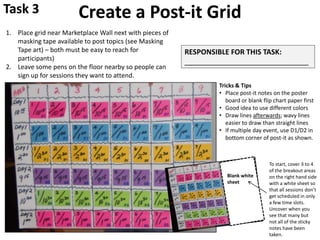
Post-it  board
News Room, News Wall & Briefing BookOpen Space Road Map at a GlanceResources & Extra HelpMini GuideOpen Space
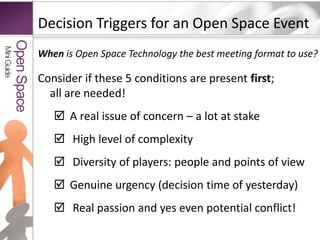
Decision Triggers for an Open Space EventWhen is Open Space Technology the best meeting format to use?Consider if these 5 conditions are present first; all are needed!A real issue of concern – a lot at stake
 High level of complexity
 Diversity of players: people and points of view
Genuine urgency (decision time of yesterday)
 Real passion and yes even potential conflict!Mini GuideOpen Space
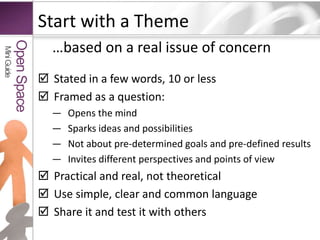
Start with a Theme…based on a real issue of concernMini GuideOpen SpaceStated in a few words, 10 or less
Framed as a question:
Opens the mind
Sparks ideas and possibilities
Not about pre-determined goals and pre-defined results
Invites different perspectives and points of view
Practical and real, not theoretical
Use simple, clear and common language
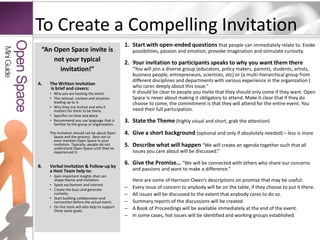
Share it and test it with othersTo Create a Compelling InvitationStart with open-ended questions that people can immediately relate to. Evoke possibilities, passion and emotion; provoke imagination and stimulate curiosity.Your invitation to participants speaks to why you want them there“You will join a diverse group (educators, policy makers, parents, students, artists, business people, entrepreneurs, scientists, etc) or (a multi-hierarchical group from different disciplines and departments with various experience in the organization ) who cares deeply about this issue.”It should be clear to people you invite that they should only come if they want. Open Space is never about making it obligatory to attend. Make it clear that if they do choose to come, the commitment is that they will attend for the entire event. You need their full participation.State the Theme (highly visual and short, grab the attention)Give a short background (optional and only if absolutely needed) – less is moreDescribe what will happen “We will create an agenda together such that all issues you care about will be discussed.”Give the Promise… “We will be connected with others who share our concerns and passions and want to make a difference.” 	Here are some of Harrison Owen’s descriptions on promise that may be useful:Every issue of concern to anybody will be on the table, if they choose to put it there.All issues will be discussed to the extent that anybody cares to do so.Summary reports of the discussions will be created. A Book of Proceedings will be available immediately at the end of the event.In some cases, hot issues will be identified and working groups established.“An Open Space invite is not your typical invitation!”The Written Invitation is brief and covers: Why you are hosting the event.
The rational, context and situation leading up to it.
Why they are invited and why it matters for them to be there.
Specifics on time and place.
Recommend you use language that is familiar to the group or organization.The invitation should not be about Open Space and the process.  Best not to even mention Open Space in your invitation. Typically, people do not understand Open Space until they’ve experienced it.Verbal Invitation & Follow-up by a Host Team help to: Gain important insights that can shape theme and invitation.
Spark excitement and interest.
Create the buzz and generate curiosity.
Start building collaboration and  connection before the actual event.

Mini guide on open space NuFocus_sdaigle

  • 1.
    A mini-guide onOpen SpaceDraft in process!
  • 2.
    Why a MiniGuide?Perhaps you’ve attended an Open Space event and experienced what was just described.Now you’d like to host or facilitate one of your own with a team who shares your passion on a common theme, topic or issue.Or maybe, you are thinking about it for your company, organization or community and want to understand more about how Open Space works.This is a user friendly workbook that briefly describes some of the what, why, when and how of Open Space – with some basic descriptions and a few handy tools that may help you as you plan your own event. Mini GuideOpen Space
  • 3.
    To really understandOpen SpaceWe strongly recommend that you buy…Open Space TechnologyA User’s Guidethe definitive guide by Harrison Owenoriginator of Open Space.Resources also available on line at: www.openspaceworld.comwww.openspaceworld.orgResourcesOpen Space
  • 4.
  • 5.
    Here’s what somepeople have said…about what happens in Open SpaceThey felt invigorated by the conversations; they connected with others quickly in a very focused way. The intensity of the discussions, the relevance of the topics, the openness of the participants, many of whom they did not know, astounded them. They still can’t quite believe what happened there, so fast and with so many people in the room. It felt entirely different from the traditional meetings, workshops and conferences that they normally attend.The connections between participants from so many sectors with people of all ages, at different levels, and the powerful learning and sharing, that ensued are something they’ve rarely experienced before, if ever. A lot of listening, a lot of shifting.Ideas and possibilities for action were bubbling to the surface and even now, months later, they’re still ponderingand yes moving to action on many of those ideas, staying connected with people they met. Passion and Responsibility seem to sum it up best!Mini GuideOpen Space
  • 6.
    A recent eventin New Jersey:Participants sharing their experience of Open SpaceTheme: “How can Creativity and Innovation Revitalize New Jersey?”Open Space Event June 14th-15th, 2011Mini GuideOpen Spacehttp://www.youtube.com/watch?v=pm6-czGGqZ0Mayor Chuck ChiarelloMayor, Buena Vista Township http://www.youtube.com/watch?v=p876s9e5vWcElizabeth MurphyExecutive Director, Global Arts Exchange www.globalartsexchange.orgwww.creativenj.org
  • 7.
    Open Space TechnologyMorethan Just a process
  • 8.
    A few Descriptionsof Open Space to start Open Space Technology is a method for holding meetings and conferences thatcreates the conditions for dynamic and engaging conversations.Itis a powerful way of bringing people together to search for solutions to complex issues around a central theme. All participants have the opportunity to express what they consider to be important and to take responsibility on topics that they are passionate about. In doing so, people discover new ways of connecting and working cooperatively.Open Spacewas created over 25 years ago by Harrison Owen in response to something he noticed at conferences: people seemed most energized and engaged during coffee breaks. So he decided to create a meeting format that would look and feel like “one long coffee break”. Amazingly, what people discovered is that a lot gets done during Open Space Events especially when people are discussing real issues that they care deeply about. Open Space is a highly interactive meeting processthat invites openness among participants leading to highly dynamic conversations and a “sleeves-up” approach to dealing with complex issues. Open Space has just enough structure to allow meaningful connections and collaborations to emerge. Open Space is hard to describe because it is so different from how we hold typical meetings and conferences.With minimal structure, this methodology invites people to create an agenda of topics around a central theme of strategic importance, to host or join sessions and to connect with others exchanging ideas, discovering new possibilities and exploring avenues for action.Open Space quickly and powerfully ignites people to engage as they unleash their own leadership, individually and collectively. No experts, no panelists, no one leading the process, no agenda and no power point presentations. People unite around a common theme, post their own topics and in a matter of minutes, discussion groups form and dynamic conversation get underway When that happens, new ideas and possibilities for action emerge. Everything gets documented at the event in real time.Mini GuideOpen Space
  • 9.
    Open Space hasbeen used for:With Many Groups, in Many PlacesMultiple Types of MeetingsConferences, SymposiumsBusiness MeetingsPlanning & Strategy SessionsCommunity EventsRetreats, SummitsDepartment & Cross-Functional MeetingsNeighborhood GatheringsReunions and moreProfit & Non-Profit OrganizationsSchools, Colleges and UniversitiesGovernment/Civic groups:local, national and globalCommunity and Volunteer GroupsAssociations, ActivistsArts, Culture, Science, Technology, Business, Theatre, Political, Finance, Environment, Health Care, etc. Mini GuideOpen SpaceOpen Space started more than 25 years and has been used around the world with groups of 20 and up to 2000 people and more.
  • 10.
    What you shouldalso know about Open SpaceOpen Space is a “self-organizing process” with just enough structure to activate lively and open discussions leading to real possibilities, actions and results. The role of the leader is to “invite” and “convene” around a compelling theme. People feel the support of leadership to participate, explore and engage without pre-established and pre-defined goals and outcomes, which can limit solutions, creativity and outcome.The role of the facilitator is to assist in the planning and pre-work. At the event itself, the facilitator initially guides the group, explaining how to write and post topics, describing basic principles of Open Space including the Law of 2 Feet, and how to assign time and place for the sessions. From then on, it’s a matter of quietly holding the space, and doing small and invisible tasks (picking up coffee cups, replenishing supplies as needed, assuring smooth functioning at the news room and pulling chairs back into the main circle for evening or morning news, and then closing circle at the end). The success of the meeting is up to the participants. By choosing how and where they want to contribute, engaging in the topics they care most deeply about, sharing passion and connection on a common theme, exploring possibilities and actions to take, individuals unleash their own leadership and take responsibility for the event and follow-up actions.Open Space is very different from your traditional conference, meeting or symposium. It’s different from how we typically lead, facilitate and engage. It invites us to be equals together, bringing the best of who we are and what we know. Open Space assumes everything and everyone we need are in the room. We don’t have to rely on outside leaders, experts or specialists to solve problems or create and invent solutions and possibilities. Open Space will appear chaotic and messy at times. Creativity is like that, so is innovation and change. Outputs you can expect in Open Space, which are created on-site at the meeting include: an agenda of topics developed by the participants, multiple concurrent group discussions on topics that people feel are most important and for which they have the greatest passion, summary reports of all conversations captured in a book of proceedings at the end, and for longer meetings, priorities , teams and initial action steps. Open Space has been used thousands of times in all kinds of settings. Interestingly , it always works though it’s hard to know that until you experience it! In the meantime, we say: “Trust the process and be prepared to be surprised!”Mini GuideOpen Space
  • 11.
    Here’s what happensin Open Space!
  • 12.
  • 13.
    Planning your OpenSpace EventGetting Started – First steps and what you should know:When to use Open Spacep. 14
  • 14.
  • 15.
  • 16.
    Facility Requirements –Space, Layout & Mealsp.17-18
  • 17.
    Materials & Suppliesp.19Planning & Pre-Work The Benefits of a Host Teamp. 21
  • 18.
    Technology to createCommunity (before, during and after)p.22-23
  • 19.
    Roles & Responsibilities: Announcer, Host and Facilitator
  • 20.
    Facilitator : Aninvisible yet important role
  • 21.
    Handout Sheets inBreakout Areas – Summary report form, Participant sign up sheet
  • 22.
    News Room Set-upFinalStretch – Checklists & Task CardsSet-up - Main Room, Breakout Areas, Reception
  • 23.
  • 24.
  • 25.
  • 26.
    News Room, NewsWall & Briefing BookOpen Space Road Map at a GlanceResources & Extra HelpMini GuideOpen Space
  • 27.
    Decision Triggers foran Open Space EventWhen is Open Space Technology the best meeting format to use?Consider if these 5 conditions are present first; all are needed!A real issue of concern – a lot at stake
  • 28.
    High levelof complexity
  • 29.
    Diversity ofplayers: people and points of view
  • 30.
    Genuine urgency (decisiontime of yesterday)
  • 31.
    Real passionand yes even potential conflict!Mini GuideOpen Space
  • 32.
    Start with aTheme…based on a real issue of concernMini GuideOpen SpaceStated in a few words, 10 or less
  • 33.
    Framed as aquestion:
  • 34.
  • 35.
    Sparks ideas andpossibilities
  • 36.
    Not about pre-determinedgoals and pre-defined results
  • 37.
  • 38.
    Practical and real,not theoretical
  • 39.
    Use simple, clearand common language
  • 40.
    Share it andtest it with othersTo Create a Compelling InvitationStart with open-ended questions that people can immediately relate to. Evoke possibilities, passion and emotion; provoke imagination and stimulate curiosity.Your invitation to participants speaks to why you want them there“You will join a diverse group (educators, policy makers, parents, students, artists, business people, entrepreneurs, scientists, etc) or (a multi-hierarchical group from different disciplines and departments with various experience in the organization ) who cares deeply about this issue.”It should be clear to people you invite that they should only come if they want. Open Space is never about making it obligatory to attend. Make it clear that if they do choose to come, the commitment is that they will attend for the entire event. You need their full participation.State the Theme (highly visual and short, grab the attention)Give a short background (optional and only if absolutely needed) – less is moreDescribe what will happen “We will create an agenda together such that all issues you care about will be discussed.”Give the Promise… “We will be connected with others who share our concerns and passions and want to make a difference.” Here are some of Harrison Owen’s descriptions on promise that may be useful:Every issue of concern to anybody will be on the table, if they choose to put it there.All issues will be discussed to the extent that anybody cares to do so.Summary reports of the discussions will be created. A Book of Proceedings will be available immediately at the end of the event.In some cases, hot issues will be identified and working groups established.“An Open Space invite is not your typical invitation!”The Written Invitation is brief and covers: Why you are hosting the event.
  • 41.
    The rational, contextand situation leading up to it.
  • 42.
    Why they areinvited and why it matters for them to be there.
  • 43.
  • 44.
    Recommend you uselanguage that is familiar to the group or organization.The invitation should not be about Open Space and the process. Best not to even mention Open Space in your invitation. Typically, people do not understand Open Space until they’ve experienced it.Verbal Invitation & Follow-up by a Host Team help to: Gain important insights that can shape theme and invitation.
  • 45.
  • 46.
    Create the buzzand generate curiosity.
  • 47.
    Start building collaborationand connection before the actual event.