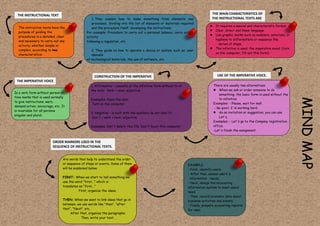
The instructive texts have the
purpose of guiding the
procedures in a detailed, clear
and necessary to carry out any
activity, whether simple or
complex, according to two
characteristics:
THE MAIN CHARACTERISTICS OF
THE INSTRUCTIONAL TEXTS ARE:
THE IMPERATIVE VOICE
 It requires a special and characteristic format
 Clear, direct and linear language.
 Use graphic marks such as numbers, asterisks, or
hyphens to differentiate or sequence the
series of steps.
 The infinitive is used, the imperative mood. (turn
on the computer, fill out this form).
Is a verb form without person or
time marks that is used normally
to give instructions, warn,
demand action, encourage, etc. It
is invariable for all persons
singular and plural.
CONSTRUCTION OF THE IMPERATIVE USE OF THE IMPERATIVE VOICE.
1. Affirmative – consists of the infinitive form without to of
the verb: Verb + noun, adjective
Examples: Open the door.
Turn on the computer.
2. Negative – is built with the auxiliary do not (don't):
Don't + verb + noun, adjective
Examples: Don't delete this file. Don't touch this computer.
There are usually two alternatives:
 When we ask or order someone to do
something, the basic form is used without the
to infinitive.
Examples: - Please, wait for me!!
- Be quiet. I´m working hard.
 As an invitation or suggestion, you can use
Let's.
Examples: - Let's go to the Company registration
office.
-Let's finish the assignment.
Are words that help to understand the order
or sequence of steps or events. Some of them
will be explained below.
FIRST: When we start to tell something we
use the word "first..." which is
translates as "first..."
First, organize the ideas.
THEN: When we want to link ideas that go in
between, we use words like “then”, “after
that”, “Next”, etc.
After that, organize the paragraphs
Then, write your text.
MIND
MAP
EXAMPLE:
• First, identify users.
• After that, assess users´s
information needs.
• Next, design the accounting
information system to meet users’
need.
• Then, record economic data about
business activities and events.
• Finally, prepare accounting reports
for user.
1. They explain how to make something from elements and
processes, dividing into the list of elements or materials required
and the procedure itself, developing the instructions.
For example: Procedure to carry out a personal balance, carry out an
activity
following a regulation, etc.
2. They guide on how to operate a device or system such as: user
manuals
of technological materials, the use of software, etc.

MIND MAP.pdf

  • 1.
    The instructive textshave the purpose of guiding the procedures in a detailed, clear and necessary to carry out any activity, whether simple or complex, according to two characteristics: THE MAIN CHARACTERISTICS OF THE INSTRUCTIONAL TEXTS ARE: THE IMPERATIVE VOICE  It requires a special and characteristic format  Clear, direct and linear language.  Use graphic marks such as numbers, asterisks, or hyphens to differentiate or sequence the series of steps.  The infinitive is used, the imperative mood. (turn on the computer, fill out this form). Is a verb form without person or time marks that is used normally to give instructions, warn, demand action, encourage, etc. It is invariable for all persons singular and plural. CONSTRUCTION OF THE IMPERATIVE USE OF THE IMPERATIVE VOICE. 1. Affirmative – consists of the infinitive form without to of the verb: Verb + noun, adjective Examples: Open the door. Turn on the computer. 2. Negative – is built with the auxiliary do not (don't): Don't + verb + noun, adjective Examples: Don't delete this file. Don't touch this computer. There are usually two alternatives:  When we ask or order someone to do something, the basic form is used without the to infinitive. Examples: - Please, wait for me!! - Be quiet. I´m working hard.  As an invitation or suggestion, you can use Let's. Examples: - Let's go to the Company registration office. -Let's finish the assignment. Are words that help to understand the order or sequence of steps or events. Some of them will be explained below. FIRST: When we start to tell something we use the word "first..." which is translates as "first..." First, organize the ideas. THEN: When we want to link ideas that go in between, we use words like “then”, “after that”, “Next”, etc. After that, organize the paragraphs Then, write your text. MIND MAP EXAMPLE: • First, identify users. • After that, assess users´s information needs. • Next, design the accounting information system to meet users’ need. • Then, record economic data about business activities and events. • Finally, prepare accounting reports for user. 1. They explain how to make something from elements and processes, dividing into the list of elements or materials required and the procedure itself, developing the instructions. For example: Procedure to carry out a personal balance, carry out an activity following a regulation, etc. 2. They guide on how to operate a device or system such as: user manuals of technological materials, the use of software, etc.