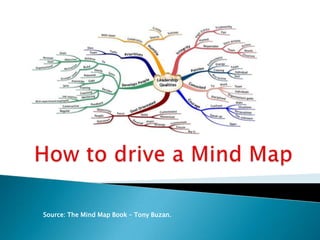
Source: The Mind Map Book – Tony Buzan.
   1º Use Emphasis

   Always use a central Image.
   Use Images throughout your Mind Map.
   Use three or more colours per central Image.
   Use dimension in Images.
   Use synaesthesia (the blending of physical senses).
   Use variations of size of printing, line and image.
   Use organised spacing.
   Use appropiate spacing.
   2º Use association.

   Use arrows when you want to make connections within and
    across the branch pattern.
   Use colours for enhancing memory and creativity.
   Use codes to enable you to make instant connections
    between diferents parts of your mind maps.
   3º Be clear.

   Use only one key word per line.
   Print all words.
   Print key words on lines.
   Make line lenght equal to word lenght.
   Connect lines to other lines.
   Make the central lines ticker.
   Make your boundaries embrace your branch outline.
   Make your images as clear as possible.
   Keep your paper placed horizontally in front of you.
   Keep your printing as upright as possible.
   4. Develop a Personal Style.

   Reflect your unique network and patterns of thoughts.


   1º Use Hierarchy.

   2º Use numerical order.
   Break mental blocks.

   Add blank lines.
   Ask questions.
   Add images.
   Maintain awareness of your infinite associational capacity.


   Reinforce.

   Review your Mind Maps.
   Do quick Mind Map checks.
   Prepare.

   Prepare your mental attitude.
   Develop a positive mental attitude.
   Copy images around you.
   Commit yourself to your Mind Map.
   Commit to the absurd.
   Make your Mind Map as beautiful as posible.

   Prepare your materials.
   Prepare your workspace environment.
   Ensure that you have a moderate temperature in the room.
   Use natural light where possible.
   Ensure that you have plenty of fresh air.
   Furnish the room appropiately.
   Create pleasing surroundings.
   Play appopiate music, or work in silence if your prefer.
   Mind Maps that aren’t really Mind Maps. Avoid structure
    become increasingly random and monotonous, diassociated
    and reduced to the same level.
   The idea that phrases are more meaningful. Using single
    words in your Mind Map enable you to see your internal and
    external enviroment more clearly and realistically.
   The idea that a “messy” Mind Map is no good. This doesn’t
    mean it’s bad. It’s a simply reaction of your state of mind. It
    is simply a reflection of your state of mind at the time, or the
    input your mind is receiving.
   A negative emotional reaction to any Mind Map. If you are
    disappointed or depressed by the standard of your Mind Map
    you should simply remind yourself that it is only a first draft
    wich will require revision before it reaches maturity.

Mind Map Laws and Recommendations

  • 1.
    Source: The MindMap Book – Tony Buzan.
  • 2.
    1º Use Emphasis  Always use a central Image.  Use Images throughout your Mind Map.  Use three or more colours per central Image.  Use dimension in Images.  Use synaesthesia (the blending of physical senses).  Use variations of size of printing, line and image.  Use organised spacing.  Use appropiate spacing.
  • 3.
    2º Use association.  Use arrows when you want to make connections within and across the branch pattern.  Use colours for enhancing memory and creativity.  Use codes to enable you to make instant connections between diferents parts of your mind maps.
  • 4.
    3º Be clear.  Use only one key word per line.  Print all words.  Print key words on lines.  Make line lenght equal to word lenght.  Connect lines to other lines.  Make the central lines ticker.  Make your boundaries embrace your branch outline.  Make your images as clear as possible.  Keep your paper placed horizontally in front of you.  Keep your printing as upright as possible.
  • 5.
    4. Develop a Personal Style.  Reflect your unique network and patterns of thoughts.  1º Use Hierarchy.  2º Use numerical order.
  • 6.
    Break mental blocks.  Add blank lines.  Ask questions.  Add images.  Maintain awareness of your infinite associational capacity.  Reinforce.  Review your Mind Maps.  Do quick Mind Map checks.
  • 7.
    Prepare.  Prepare your mental attitude.  Develop a positive mental attitude.  Copy images around you.  Commit yourself to your Mind Map.  Commit to the absurd.  Make your Mind Map as beautiful as posible.  Prepare your materials.
  • 8.
    Prepare your workspace environment.  Ensure that you have a moderate temperature in the room.  Use natural light where possible.  Ensure that you have plenty of fresh air.  Furnish the room appropiately.  Create pleasing surroundings.  Play appopiate music, or work in silence if your prefer.
  • 9.
    Mind Maps that aren’t really Mind Maps. Avoid structure become increasingly random and monotonous, diassociated and reduced to the same level.  The idea that phrases are more meaningful. Using single words in your Mind Map enable you to see your internal and external enviroment more clearly and realistically.  The idea that a “messy” Mind Map is no good. This doesn’t mean it’s bad. It’s a simply reaction of your state of mind. It is simply a reflection of your state of mind at the time, or the input your mind is receiving.  A negative emotional reaction to any Mind Map. If you are disappointed or depressed by the standard of your Mind Map you should simply remind yourself that it is only a first draft wich will require revision before it reaches maturity.