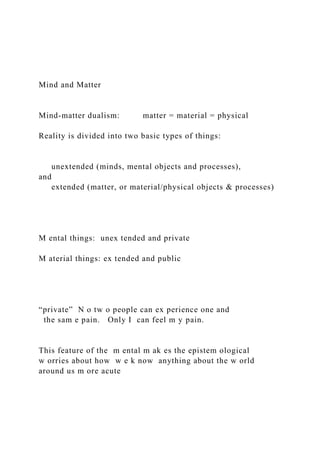
Mind and Matter
Mind-matter dualism: matter = material = physical
Reality is divided into two basic types of things:
unextended (minds, mental objects and processes),
and
extended (matter, or material/physical objects & processes)
M ental things: unex tended and private
M aterial things: ex tended and public
“private” N o tw o people can ex perience one and
the sam e pain. Only I can feel m y pain.
This feature of the m ental m ak es the epistem ological
w orries about how w e k now anything about the w orld
around us m ore acute
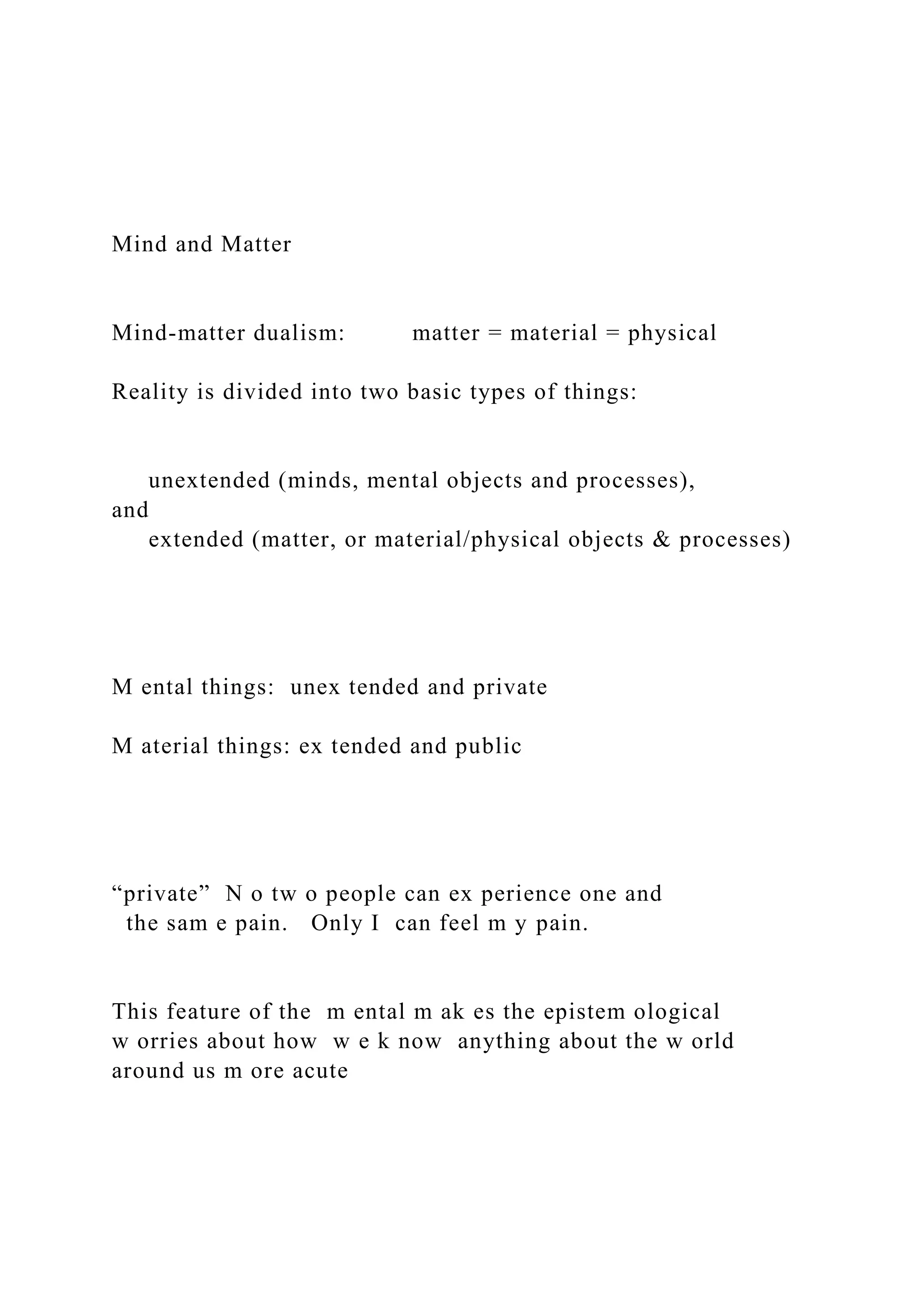
I nteractionism : (Descartes’ view – known as “Cartesian
dualism”):
Extended & unextended things and processes causally interact:
there are material (or physical) causes of mental effects,
and
mental causes of physical effects.
Interactionist account: Example: Deciding to raise your hand
1. The mental decision
– an unextended event in the unextended mind –
causes physical activity in the extended brain and body
(neurons firing, electrical/chemical changes in brain).
2. This physical activity causes activity elsewhere in the
extended body and nervous system, activating muscles
which raise the arm and hand.
3. Information is relayed back via activity in the
extended nervous system and sense organs to the brain,
which, in turn causes the unextended mind to experience
sense-data (unextended mental appearances) of the arm
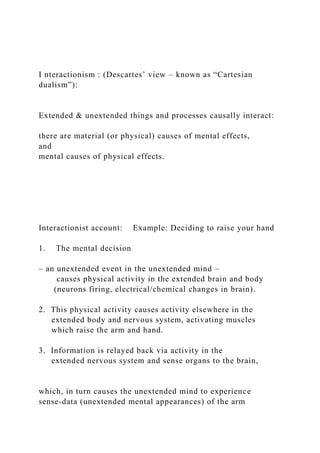
moving.
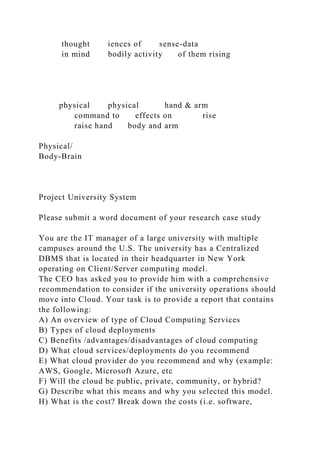
Mental/
Mind “raise hand”- direct exper- visual/felt
thought iences of sense-data
in mind bodily activity of them rising
physical physical hand & arm
command to effects on rise
raise hand body and arm
Physical/
Body-Brain
Epistem ological problem s:
The unextended mind and its contents can only
be directly experienced or known to that mind:
Only I can feel my pains:
two people can feel similar pains,
but they cannot feel one and the same pain.
And only I can know for sure what thoughts I’m having.
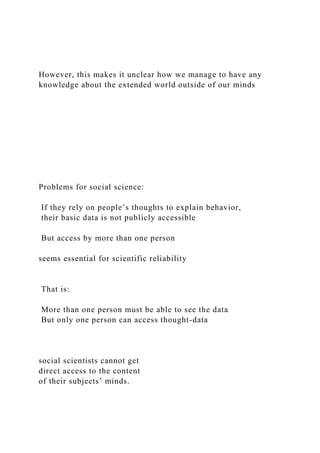
However, this makes it unclear how we manage to have any
knowledge about the extended world outside of our minds
Problems for social science:
If they rely on people’s thoughts to explain behavior,
their basic data is not publicly accessible
But access by more than one person
seems essential for scientific reliability
That is:
More than one person must be able to see the data
But only one person can access thought-data
social scientists cannot get
direct access to the content
of their subjects’ minds.
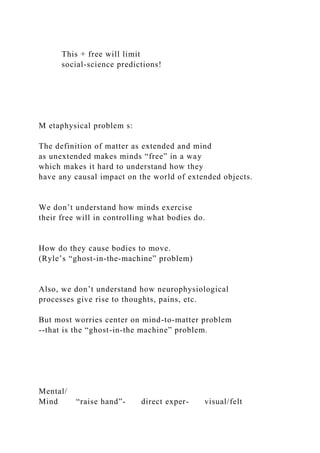
This + free will limit
social-science predictions!
M etaphysical problem s:
The definition of matter as extended and mind
as unextended makes minds “free” in a way
which makes it hard to understand how they
have any causal impact on the world of extended objects.
We don’t understand how minds exercise
their free will in controlling what bodies do.
How do they cause bodies to move.
(Ryle’s “ghost-in-the-machine” problem)
Also, we don’t understand how neurophysiological
processes give rise to thoughts, pains, etc.
But most worries center on mind-to-matter problem
--that is the “ghost-in-the machine” problem.
Mental/
Mind “raise hand”- direct exper- visual/felt
thought iences of sense-data
in mind bodily activity of them rising
physical physical hand & arm
command to effects on rise
raise hand body and arm
Physical/
Body-Brain
Project University System
Please submit a word document of your research case study
You are the IT manager of a large university with multiple
campuses around the U.S. The university has a Centralized
DBMS that is located in their headquarter in New York
operating on Client/Server computing model.
The CEO has asked you to provide him with a comprehensive
recommendation to consider if the university operations should
move into Cloud. Your task is to provide a report that contains
the following:
A) An overview of type of Cloud Computing Services
B) Types of cloud deployments
C) Benefits /advantages/disadvantages of cloud computing
D) What cloud services/deployments do you recommend
E) What cloud provider do you recommend and why (example:
AWS, Google, Microsoft Azure, etc
F) Will the cloud be public, private, community, or hybrid?
G) Describe what this means and why you selected this model.
H) What is the cost? Break down the costs (i.e. software,
resources, accounts, etc.)
Conclude your case with an executive report to justify why are
you proposing the university should adopt cloud computing and
what cloud services do you recommend.?
If you do not recommend cloud you must provide clear and
convincing argument and justification in terms of business
model, costs, resources…etc compared to deployment of cloud.

Mind and Matter Mind-matter dualism .docx

  • 1.
    Mind and Matter Mind-matterdualism: matter = material = physical Reality is divided into two basic types of things: unextended (minds, mental objects and processes), and extended (matter, or material/physical objects & processes) M ental things: unex tended and private M aterial things: ex tended and public “private” N o tw o people can ex perience one and the sam e pain. Only I can feel m y pain. This feature of the m ental m ak es the epistem ological w orries about how w e k now anything about the w orld around us m ore acute
  • 2.
    I nteractionism :(Descartes’ view – known as “Cartesian dualism”): Extended & unextended things and processes causally interact: there are material (or physical) causes of mental effects, and mental causes of physical effects. Interactionist account: Example: Deciding to raise your hand 1. The mental decision – an unextended event in the unextended mind – causes physical activity in the extended brain and body (neurons firing, electrical/chemical changes in brain). 2. This physical activity causes activity elsewhere in the extended body and nervous system, activating muscles which raise the arm and hand. 3. Information is relayed back via activity in the extended nervous system and sense organs to the brain, which, in turn causes the unextended mind to experience sense-data (unextended mental appearances) of the arm
  • 3.
    moving. Mental/ Mind “raise hand”-direct exper- visual/felt thought iences of sense-data in mind bodily activity of them rising physical physical hand & arm command to effects on rise raise hand body and arm Physical/ Body-Brain Epistem ological problem s: The unextended mind and its contents can only be directly experienced or known to that mind: Only I can feel my pains: two people can feel similar pains, but they cannot feel one and the same pain. And only I can know for sure what thoughts I’m having.
  • 4.
    However, this makesit unclear how we manage to have any knowledge about the extended world outside of our minds Problems for social science: If they rely on people’s thoughts to explain behavior, their basic data is not publicly accessible But access by more than one person seems essential for scientific reliability That is: More than one person must be able to see the data But only one person can access thought-data social scientists cannot get direct access to the content of their subjects’ minds.
  • 5.
    This + freewill limit social-science predictions! M etaphysical problem s: The definition of matter as extended and mind as unextended makes minds “free” in a way which makes it hard to understand how they have any causal impact on the world of extended objects. We don’t understand how minds exercise their free will in controlling what bodies do. How do they cause bodies to move. (Ryle’s “ghost-in-the-machine” problem) Also, we don’t understand how neurophysiological processes give rise to thoughts, pains, etc. But most worries center on mind-to-matter problem --that is the “ghost-in-the machine” problem. Mental/ Mind “raise hand”- direct exper- visual/felt
  • 6.
    thought iences ofsense-data in mind bodily activity of them rising physical physical hand & arm command to effects on rise raise hand body and arm Physical/ Body-Brain Project University System Please submit a word document of your research case study You are the IT manager of a large university with multiple campuses around the U.S. The university has a Centralized DBMS that is located in their headquarter in New York operating on Client/Server computing model. The CEO has asked you to provide him with a comprehensive recommendation to consider if the university operations should move into Cloud. Your task is to provide a report that contains the following: A) An overview of type of Cloud Computing Services B) Types of cloud deployments C) Benefits /advantages/disadvantages of cloud computing D) What cloud services/deployments do you recommend E) What cloud provider do you recommend and why (example: AWS, Google, Microsoft Azure, etc F) Will the cloud be public, private, community, or hybrid? G) Describe what this means and why you selected this model. H) What is the cost? Break down the costs (i.e. software,
  • 7.
    resources, accounts, etc.) Concludeyour case with an executive report to justify why are you proposing the university should adopt cloud computing and what cloud services do you recommend.? If you do not recommend cloud you must provide clear and convincing argument and justification in terms of business model, costs, resources…etc compared to deployment of cloud.