Beyond Reform & Rebound:
Frontiers for Rethinking and Redirecting
Health System Performance
Bobby Milstein
Director, ReThink Health
Visiting Scientist, MIT Sloan School of Management
bmilstein@rethinkhealth.org

Columbia University, Mailman School of Public Health,
Grand Rounds on the Future of Public Health
New York, NY
October 9, 2013
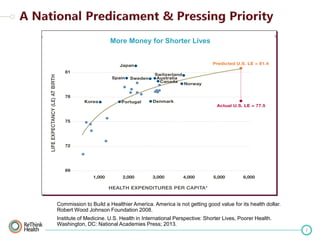
More Money for Shorter Lives

Commission to Build a Healthier America. America is not getting good value for its health dollar.
Robert Wood Johnson Foundation 2008.
Institute of Medicine. U.S. Health in International Perspective: Shorter Lives, Poorer Health.
Washington, DC: National Academies Press; 2013.
2
3
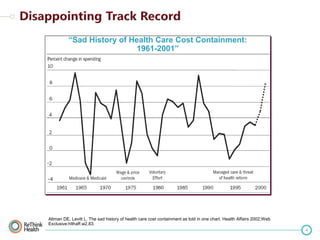
“Sad History of Health Care Cost Containment:
1961-2001”

Altman DE, Levitt L. The sad history of health care cost containment as told in one chart. Health Affairs 2002;Web
Exclusive:hlthaff.w2.83.
4
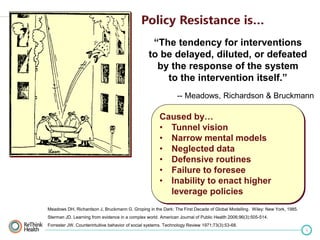
“The tendency for interventions
to be delayed, diluted, or defeated
by the response of the system
to the intervention itself.”
-- Meadows, Richardson & Bruckmann

Caused by…
• Tunnel vision
• Narrow mental models
• Neglected data
• Defensive routines
• Failure to foresee
• Inability to enact higher
leverage policies
Meadows DH, Richardson J, Bruckmann G. Groping in the Dark: The First Decade of Global Modelling. Wiley: New York, 1985.

Sterman JD. Learning from evidence in a complex world. American Journal of Public Health 2006;96(3):505-514.
Forrester JW. Counterintuitive behavior of social systems. Technology Review 1971;73(3):53-68.
5
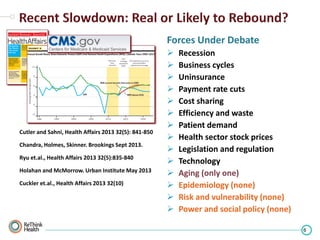
Forces Under Debate

Cutler and Sahni, Health Affairs 2013 32(5): 841-850
Chandra, Holmes, Skinner. Brookings Sept 2013.
Ryu et.al., Health Affairs 2013 32(5):835-840
Holahan and McMorrow. Urban Institute May 2013
Cuckler et.al., Health Affairs 2013 32(10)
















Recession
Business cycles
Uninsurance
Payment rate cuts
Cost sharing
Efficiency and waste
Patient demand
Health sector stock prices
Legislation and regulation
Technology
Aging (only one)
Epidemiology (none)
Risk and vulnerability (none)
Power and social policy (none)
6
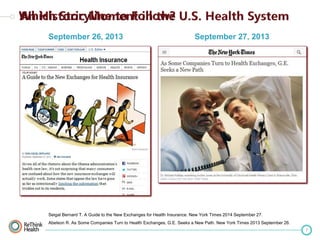
September 26, 2013

September 27, 2013

Seigal Bernard T. A Guide to the New Exchanges for Health Insurance. New York Times 2014 September 27.
Abelson R. As Some Companies Turn to Health Exchanges, G.E. Seeks a New Path. New York Times 2013 September 26.
7
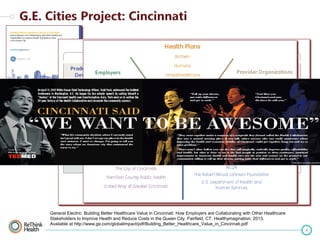
General Electric. Building Better Healthcare Value in Cincinnati: How Employers are Collaborating with Other Healthcare
Stakeholders to Improve Health and Reduce Costs in the Queen City. Fairfield, CT: Healthymagination; 2013.
Available at http://www.ge.com/globalimpact/pdf/Building_Better_Healthcare_Value_in_Cincinnati.pdf
8
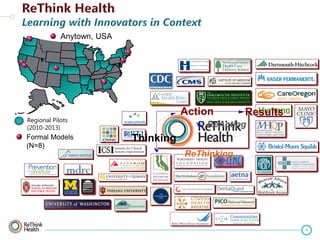
Anytown, USA

Action

Regional Pilots
(2010-2013)

Formal Models
(N=8)

Results

ReActing

Thinking
ReThinking

9
10
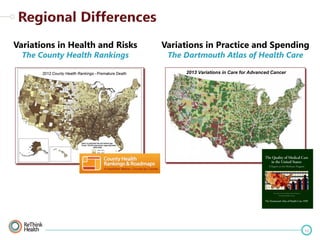
Variations in Health and Risks
The County Health Rankings

Variations in Practice and Spending
The Dartmouth Atlas of Health Care
2013 Variations in Care for Advanced Cancer

11
Nation to Nested
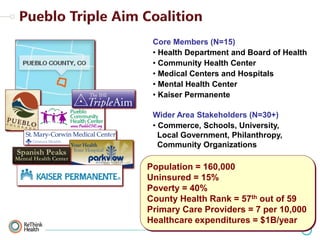
Core Members (N=15)
• Health Department and Board of Health
• Community Health Center
• Medical Centers and Hospitals
• Mental Health Center
• Kaiser Permanente
Wider Area Stakeholders (N=30+)
• Commerce, Schools, University,
Local Government, Philanthropy,
Community Organizations

Population = 160,000
Uninsured = 15%
Poverty = 40%
County Health Rank = 57th out of 59
Primary Care Providers = 7 per 10,000
Healthcare expenditures = $1B/year
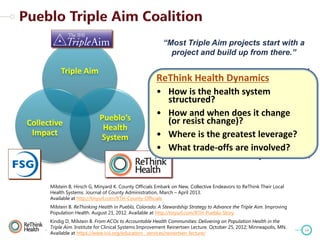
“Most Triple Aim projects start with a
project and build up from there.”

“We have been thinking big picture and
ReThink Healthspecific projects yet.”
haven't selected Dynamics

Triple Aim

Collective
Impact

Pueblo’s
Health
System

• How is the health system
structured?
“We are building governance, structure,
andHow and first becauseit change our
• strategy when does we believe
work will change)?
(or resist be more successful and
sustainable with this approach.”
• Where is the greatest leverage?
-- Donald Moore,
• What trade-offs are involved?
CEO Pueblo Community Health Center

Milstein B, Hirsch G, Minyard K. County Officials Embark on New, Collective Endeavors to ReThink Their Local
Health Systems. Journal of County Administration, March – April 2013.
Available at http://tinyurl.com/RTH-County-Officials
Milstein B. ReThinking Health in Pueblo, Colorado: A Stewardship Strategy to Advance the Triple Aim. Improving
Population Health. August 21, 2012. Available at http://tinyurl.com/RTH-Pueblo-Story
Kindig D, Milstein B. From ACOs to Accountable Health Communities: Delivering on Population Health in the
Triple Aim. Institute for Clinical Systems Improvement Reinertsen Lecture. October 25, 2012; Minneapolis, MN.
Available at https://www.icsi.org/education__services/reinertsen_lecture/

14
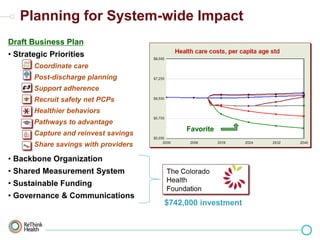
Planning for System-wide Impact
Draft Business Plan
• Strategic Priorities
•

Coordinate care

•

Post-discharge planning

•

Support adherence

•

Recruit safety net PCPs

•

Healthier behaviors

•

Pathways to advantage

•

Capture and reinvest savings

•

Share savings with providers

Favorite

• Backbone Organization
• Shared Measurement System
• Sustainable Funding
• Governance & Communications

$742,000 investment
Sectors to System
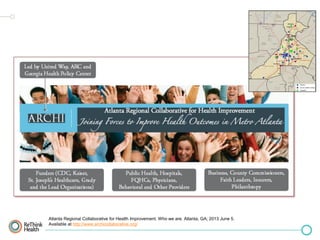
Atlanta Regional Collaborative for Health Improvement. Who we are. Atlanta, GA; 2013 June 5.
Available at http://www.archicollaborative.org/
Form a serious regional collaborative

Gather and assess quantitative data
Gather and assess qualitative data

• Set priorities with diverse
stakeholders?
• Enact high-leverage strategies

• Etc….

18
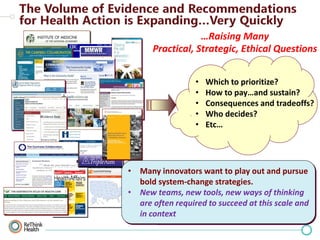
…Raising Many
Practical, Strategic, Ethical Questions
•
•
•
•
•

Which to prioritize?
How to pay…and sustain?
Consequences and tradeoffs?
Who decides?
Etc…

Relevant Methodologies
• Many innovators want to play out and pursue
Decision science
bold• system-change strategies.
• Comparative effectiveness research
• New teams, new tools, new ways of thinking
• Health impact assessment
are often required& implementation scale and
• Integration to succeed at this sciences
in context
• Dynamic policy modeling
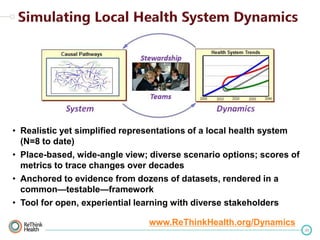
• Realistic yet simplified representations of a local health system
(N=8 to date)
• Place-based, wide-angle view; diverse scenario options; scores of
metrics to trace changes over decades
• Anchored to evidence from dozens of datasets, rendered in a
common—testable—framework
• Tool for open, experiential learning with diverse stakeholders
www.ReThinkHealth.org/Dynamics
20
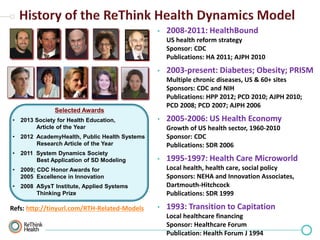
•

2008-2011: HealthBound
US health reform strategy
Sponsor: CDC
Publications: HA 2011; AJPH 2010

•

Multiple chronic diseases, US & 60+ sites
Sponsors: CDC and NIH
Publications: HPP 2012; PCD 2010; AJPH 2010;
PCD 2008; PCD 2007; AJPH 2006

Selected Awards
•

2013 Society for Health Education,
Article of the Year

•

2011 System Dynamics Society
Best Application of SD Modeling

•

2008 ASysT Institute, Applied Systems
Thinking Prize

Refs: http://tinyurl.com/RTH-Related-Models

2005-2006: US Health Economy
Growth of US health sector, 1960-2010
Sponsor: CDC
Publications: SDR 2006

2009; CDC Honor Awards for
2005 Excellence in Innovation

•

•

2012 AcademyHealth, Public Health Systems
Research Article of the Year

•

2003-present: Diabetes; Obesity; PRISM

•

1995-1997: Health Care Microworld
Local health, health care, social policy
Sponsors: NEHA and Innovation Associates,
Dartmouth-Hitchcock
Publications: SDR 1999

•

1993: Transition to Capitation
Local healthcare financing
Sponsor: Healthcare Forum
Publication: Health Forum J 1994
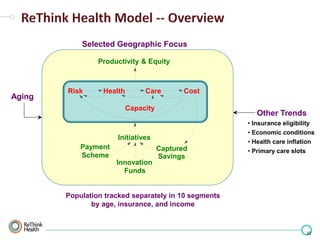
Selected Geographic Focus
Productivity & Equity

Aging

Risk

Health

Care

Cost

Capacity

Other Trends

Initiatives
Payment
Scheme
Innovation
Funds

Captured
Savings

• Insurance eligibility
• Economic conditions
• Health care inflation
• Primary care slots

Population tracked separately in 10 segments
by age, insurance, and income

22
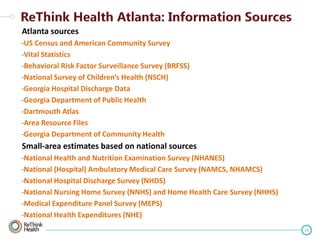
Atlanta sources
•US

Census and American Community Survey
•Vital Statistics
•Behavioral Risk Factor Surveillance Survey (BRFSS)
•National Survey of Children’s Health (NSCH)
•Georgia Hospital Discharge Data
•Georgia Department of Public Health
•Dartmouth Atlas
•Area Resource Files
•Georgia Department of Community Health

Small-area estimates based on national sources
•National Health

and Nutrition Examination Survey (NHANES)
•National (Hospital) Ambulatory Medical Care Survey (NAMCS, NHAMCS)
•National Hospital Discharge Survey (NHDS)
•National Nursing Home Survey (NNHS) and Home Health Care Survey (NHHS)
•Medical Expenditure Panel Survey (MEPS)
•National Health Expenditures (NHE)
23
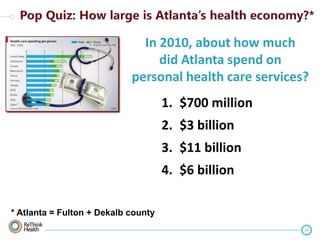
In 2010, about how much
did Atlanta spend on
personal health care services?

1. $700 million
2. $3 billion

3. $11 billion
4. $6 billion
* Atlanta = Fulton + Dekalb county
24
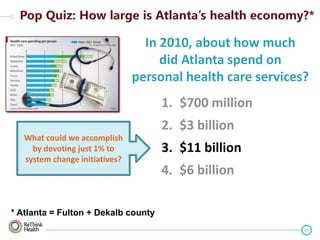
In 2010, about how much
did Atlanta spend on
personal health care services?

1. $700 million
2. $3 billion
What could we accomplish
by devoting just 1% to
system change initiatives?

3. $11 billion
4. $6 billion

* Atlanta = Fulton + Dekalb county
25
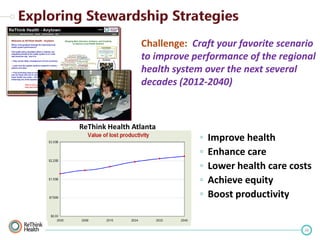
Challenge: Craft your favorite scenario
to improve performance of the regional
health system over the next several
decades (2012-2040)

ReThink Health Atlanta

◦
◦
◦
◦
◦

Improve health
Enhance care
Lower health care costs
Achieve equity
Boost productivity

26
27
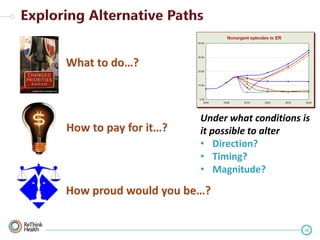
Under what conditions is
it possible to alter
• Direction?
• Timing?
• Magnitude?

28
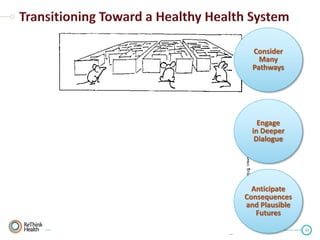
Goals to Pathways
Consider
Many
Pathways

Engage
in Deeper
Dialogue

Anticipate
Consequences
and Plausible
Futures
30
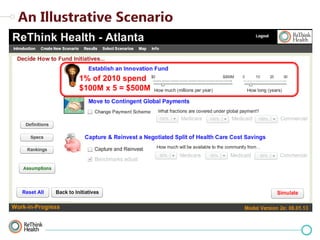
1% of 2010 spend
$100M x 5 = $500M
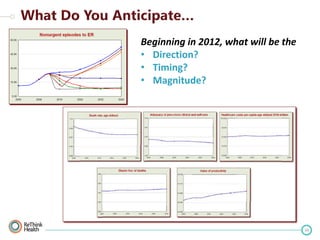
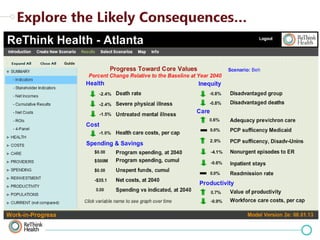
Beginning in 2012, what will be the
• Direction?
• Timing?
• Magnitude?

33
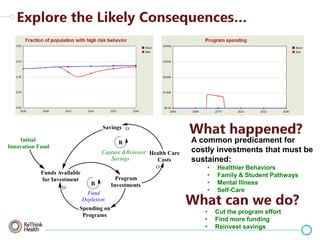
Savings O
Initial
Innovation Fund

R
Capture &Reinvest Health Care
Savings
Costs
O

Funds Available
for Investment
O

B

Fund
Depletion
Spending on
Programs

Program
Investments

A common predicament for
costly investments that must be
sustained:
•
•
•
•
•
•
•

Healthier Behaviors
Family & Student Pathways
Mental Illness
Self-Care

Cut the program effort
Find more funding
Reinvest savings
“Savings generated from improved
[clinical] practice and performance could
also be reinvested in the community,
creating a reinforcing loop.”
-- Sanne Magnan, Elliott Fisher, David Kindig,
George Isham, Doug Wood, Mark Eustis,
Carol Backstrom, Scott Leitz

Magnan S, Fisher E, Kindig D, et al. Achieving Accountability for Health and
Health Care Minneapolis, MN; 2012 July 10. Available at
http://tinyurl.com/icsi-AHC
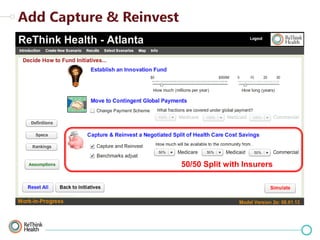
50/50 Split with Insurers
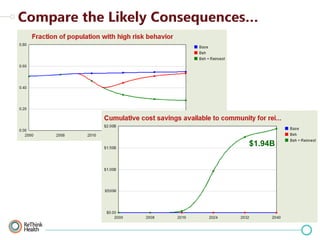
$1.94B
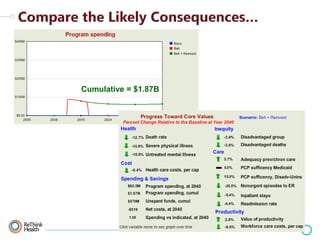
Cumulative = $1.87B
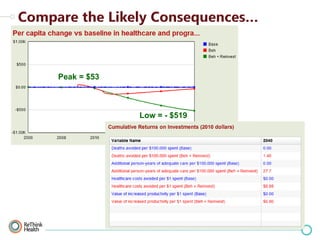
Peak = $53

Low = - $519
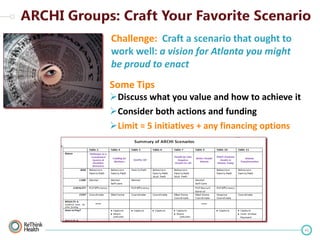
Challenge: Craft a scenario that ought to
work well: a vision for Atlanta you might
be proud to enact
Some Tips
Discuss what you value and how to achieve it
Consider both actions and funding
Limit = 5 initiatives + any financing options

41
42
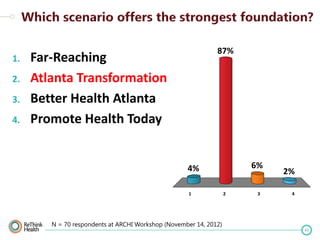
1.
2.
3.

4.

87%

Far-Reaching
Atlanta Transformation
Better Health Atlanta
Promote Health Today

6%

4%
1

2

3

2%
4

N = 70 respondents at ARCHI Workshop (November 14, 2012)
43
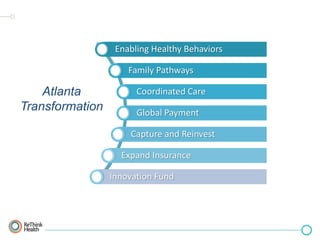
Enabling Healthy Behaviors
Family Pathways

Atlanta
Transformation

Coordinated Care
Global Payment

Capture and Reinvest
Expand Insurance
Innovation Fund
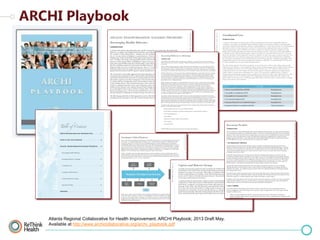
Atlanta Regional Collaborative for Health Improvement. ARCHI Playbook; 2013 Draft May.
Available at http://www.archicollaborative.org/archi_playbook.pdf
Scarcity to Abundance
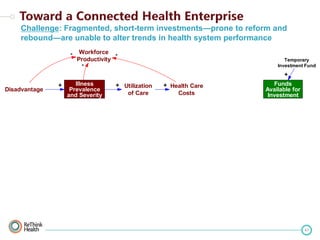
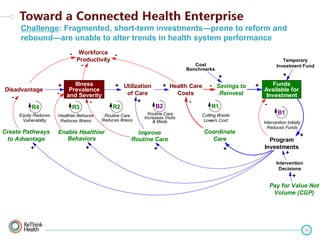
Challenge: Fragmented, short-term investments—prone to reform and
rebound—are unable to alter trends in health system performance
-

Workforce Productivity
-

Temporary
Investment Fund

+
Disadvantage

+

Illness
Prevalence
and Severity

+ Utilization
of Care

+ Health Care
Costs

Funds
Available for
Investment

47
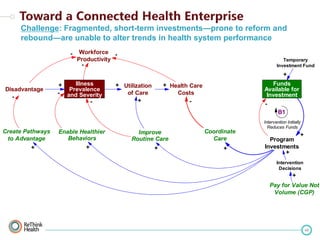
Challenge: Fragmented, short-term investments—prone to reform and
rebound—are unable to alter trends in health system performance
-

Workforce Productivity
-

Temporary
Investment Fund

+
Disadvantage
-

Illness
+
Prevalence
- and Severity
-

+ Utilization
of Care
+

Funds
Available for
Investment

+ Health Care
Costs
-

B1

Create Pathways
to Advantage
+

Enable Healthier
Behaviors
+

Improve
Routine Care
+

Coordinate
Care
+

Intervention Initially
Reduces Funds

Program
Investments
+

+

Intervention
Decisions

+
Pay for Value Not
Volume (CGP)

48
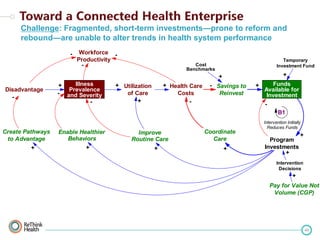
Challenge: Fragmented, short-term investments—prone to reform and
rebound—are unable to alter trends in health system performance
-

Workforce Productivity
-

Temporary
Investment Fund

Cost
Benchmarks

+

+
Disadvantage
-

Illness
+
Prevalence
- and Severity
-

+ Utilization
of Care
+

+ Health Care
Costs
-

- Savings to
Reinvest

+

Funds
Available for
Investment
B1

Create Pathways
to Advantage
+

Enable Healthier
Behaviors
+

Improve
Routine Care
+

Coordinate
Care
+

Intervention Initially
Reduces Funds

Program
Investments
+

+

Intervention
Decisions

+
Pay for Value Not
Volume (CGP)

49
Challenge: Fragmented, short-term investments—prone to reform and
rebound—are unable to alter trends in health system performance
-

Workforce Productivity
-

Temporary
Investment Fund

Cost
Benchmarks

+

+
Disadvantage
R4
Equity Reduces
Vulnerability

Create Pathways
to Advantage
+

Illness
+
Prevalence
- and Severity
R3
Healthier Behavior
Reduces Illness

Routine Care
Reduces Illness

Enable Healthier
Behaviors
+

+ Utilization
+ Health Care
of Care
Costs
+
B2
R2
Routine Care
Increases Visits
& Meds

Improve
Routine Care
+

- Savings to
Reinvest

+

Funds
Available for
Investment
-

R1

Cutting Waste
Lowers Cost

Coordinate
Care
+

B1
Intervention Initially
Reduces Funds

Program
Investments
+

+

Intervention
Decisions

+
Pay for Value Not
Volume (CGP)

50
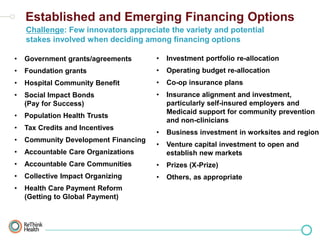
Established and Emerging Financing Options
Challenge: Few innovators appreciate the variety and potential
stakes involved when deciding among financing options
•

Government grants/agreements

•

Investment portfolio re-allocation

•

Foundation grants

•

Operating budget re-allocation

•

Hospital Community Benefit

•

Co-op insurance plans

•

Social Impact Bonds
(Pay for Success)

•

•

Population Health Trusts

•

Insurance alignment and investment,
particularly self-insured employers and
Medicaid support for community prevention
and non-clinicians

Tax Credits and Incentives

•

•

Business investment in worksites and region

Community Development Financing

•

•

Accountable Care Organizations

Venture capital investment to open and
establish new markets

•

Accountable Care Communities

•

Prizes (X-Prize)

•

Collective Impact Organizing

•

Others, as appropriate

•

Health Care Payment Reform
(Getting to Global Payment)
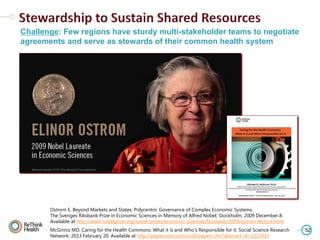
Challenge: Few regions have sturdy multi-stakeholder teams to negotiate
agreements and serve as stewards of their common health system

Ostrom E. Beyond Markets and States: Polycentric Governance of Complex Economic Systems.
The Sveriges Riksbank Prize in Economic Sciences in Memory of Alfred Nobel; Stockholm; 2009 December 8.
Available at http://www.nobelprize.org/nobel_prizes/economic-sciences/laureates/2009/ostrom-lecture.html
McGinnis MD. Caring for the Health Commons: What it is and Who's Responsible for it: Social Science Research
Network; 2013 February 20. Available at http://papers.ssrn.com/sol3/papers.cfm?abstract_id=2221413

52
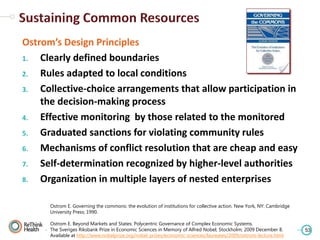
Ostrom’s Design Principles
1.
Clearly defined boundaries
2.
Rules adapted to local conditions
3.
Collective-choice arrangements that allow participation in
the decision-making process
4.
Effective monitoring by those related to the monitored
5.
Graduated sanctions for violating community rules
6.
Mechanisms of conflict resolution that are cheap and easy
7.
Self-determination recognized by higher-level authorities
8.
Organization in multiple layers of nested enterprises
Ostrom E. Governing the commons: the evolution of institutions for collective action. New York, NY: Cambridge
University Press; 1990.
Ostrom E. Beyond Markets and States: Polycentric Governance of Complex Economic Systems.
The Sveriges Riksbank Prize in Economic Sciences in Memory of Alfred Nobel; Stockholm; 2009 December 8.
Available at http://www.nobelprize.org/nobel_prizes/economic-sciences/laureates/2009/ostrom-lecture.html

53
Three Central Challenges
•

Fragmented, short-term investments—prone
to reform and rebound—are unable to alter
trends in health system performance

•

Few innovators appreciate the variety and
potential stakes involved when deciding
among financing options

•

Few regions have multi-stakeholder teams to
negotiate agreements and serve as stewards
of their common health system

54
Learn with leaders in context
• How are innovators devising new ways to
pay for and sustain necessary investments?
• Who decides?
Two-phase, exploratory project
• Refine framing and narrative
• Characterize conditions, opportunities, and
obstacles in different contexts
• Develop tools and guides for groups at different
stages of readiness, with insights from other
countries and sectors
• Craft hypotheses for directed tests
• Expand a learning network
55
More Money for Shorter Lives

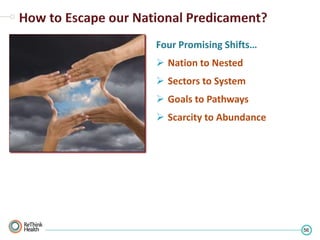
Four Promising Shifts…
 Nation to Nested
 Sectors to System
 Goals to Pathways
 Scarcity to Abundance

56
Dialogue

57
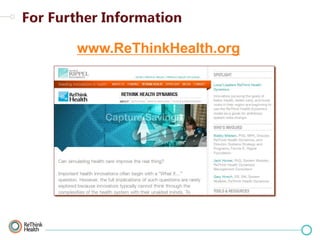
www.ReThinkHealth.org
59

Dr. Bobby Milstein | Beyond Reform and Rebound

  • 1.
    Beyond Reform &Rebound: Frontiers for Rethinking and Redirecting Health System Performance Bobby Milstein Director, ReThink Health Visiting Scientist, MIT Sloan School of Management bmilstein@rethinkhealth.org Columbia University, Mailman School of Public Health, Grand Rounds on the Future of Public Health New York, NY October 9, 2013
  • 2.
    More Money forShorter Lives Commission to Build a Healthier America. America is not getting good value for its health dollar. Robert Wood Johnson Foundation 2008. Institute of Medicine. U.S. Health in International Perspective: Shorter Lives, Poorer Health. Washington, DC: National Academies Press; 2013. 2
  • 3.
  • 4.
    “Sad History ofHealth Care Cost Containment: 1961-2001” Altman DE, Levitt L. The sad history of health care cost containment as told in one chart. Health Affairs 2002;Web Exclusive:hlthaff.w2.83. 4
  • 5.
    “The tendency forinterventions to be delayed, diluted, or defeated by the response of the system to the intervention itself.” -- Meadows, Richardson & Bruckmann Caused by… • Tunnel vision • Narrow mental models • Neglected data • Defensive routines • Failure to foresee • Inability to enact higher leverage policies Meadows DH, Richardson J, Bruckmann G. Groping in the Dark: The First Decade of Global Modelling. Wiley: New York, 1985. Sterman JD. Learning from evidence in a complex world. American Journal of Public Health 2006;96(3):505-514. Forrester JW. Counterintuitive behavior of social systems. Technology Review 1971;73(3):53-68. 5
  • 6.
    Forces Under Debate Cutlerand Sahni, Health Affairs 2013 32(5): 841-850 Chandra, Holmes, Skinner. Brookings Sept 2013. Ryu et.al., Health Affairs 2013 32(5):835-840 Holahan and McMorrow. Urban Institute May 2013 Cuckler et.al., Health Affairs 2013 32(10)               Recession Business cycles Uninsurance Payment rate cuts Cost sharing Efficiency and waste Patient demand Health sector stock prices Legislation and regulation Technology Aging (only one) Epidemiology (none) Risk and vulnerability (none) Power and social policy (none) 6
  • 7.
    September 26, 2013 September27, 2013 Seigal Bernard T. A Guide to the New Exchanges for Health Insurance. New York Times 2014 September 27. Abelson R. As Some Companies Turn to Health Exchanges, G.E. Seeks a New Path. New York Times 2013 September 26. 7
  • 8.
    General Electric. BuildingBetter Healthcare Value in Cincinnati: How Employers are Collaborating with Other Healthcare Stakeholders to Improve Health and Reduce Costs in the Queen City. Fairfield, CT: Healthymagination; 2013. Available at http://www.ge.com/globalimpact/pdf/Building_Better_Healthcare_Value_in_Cincinnati.pdf 8
  • 9.
    Anytown, USA Action Regional Pilots (2010-2013) FormalModels (N=8) Results ReActing Thinking ReThinking 9
  • 10.
  • 11.
    Variations in Healthand Risks The County Health Rankings Variations in Practice and Spending The Dartmouth Atlas of Health Care 2013 Variations in Care for Advanced Cancer 11
  • 12.
  • 13.
    Core Members (N=15) •Health Department and Board of Health • Community Health Center • Medical Centers and Hospitals • Mental Health Center • Kaiser Permanente Wider Area Stakeholders (N=30+) • Commerce, Schools, University, Local Government, Philanthropy, Community Organizations Population = 160,000 Uninsured = 15% Poverty = 40% County Health Rank = 57th out of 59 Primary Care Providers = 7 per 10,000 Healthcare expenditures = $1B/year
  • 14.
    “Most Triple Aimprojects start with a project and build up from there.” “We have been thinking big picture and ReThink Healthspecific projects yet.” haven't selected Dynamics Triple Aim Collective Impact Pueblo’s Health System • How is the health system structured? “We are building governance, structure, andHow and first becauseit change our • strategy when does we believe work will change)? (or resist be more successful and sustainable with this approach.” • Where is the greatest leverage? -- Donald Moore, • What trade-offs are involved? CEO Pueblo Community Health Center Milstein B, Hirsch G, Minyard K. County Officials Embark on New, Collective Endeavors to ReThink Their Local Health Systems. Journal of County Administration, March – April 2013. Available at http://tinyurl.com/RTH-County-Officials Milstein B. ReThinking Health in Pueblo, Colorado: A Stewardship Strategy to Advance the Triple Aim. Improving Population Health. August 21, 2012. Available at http://tinyurl.com/RTH-Pueblo-Story Kindig D, Milstein B. From ACOs to Accountable Health Communities: Delivering on Population Health in the Triple Aim. Institute for Clinical Systems Improvement Reinertsen Lecture. October 25, 2012; Minneapolis, MN. Available at https://www.icsi.org/education__services/reinertsen_lecture/ 14
  • 15.
    Planning for System-wideImpact Draft Business Plan • Strategic Priorities • Coordinate care • Post-discharge planning • Support adherence • Recruit safety net PCPs • Healthier behaviors • Pathways to advantage • Capture and reinvest savings • Share savings with providers Favorite • Backbone Organization • Shared Measurement System • Sustainable Funding • Governance & Communications $742,000 investment
  • 16.
  • 17.
    Atlanta Regional Collaborativefor Health Improvement. Who we are. Atlanta, GA; 2013 June 5. Available at http://www.archicollaborative.org/
  • 18.
    Form a seriousregional collaborative Gather and assess quantitative data Gather and assess qualitative data • Set priorities with diverse stakeholders? • Enact high-leverage strategies • Etc…. 18
  • 19.
    …Raising Many Practical, Strategic,Ethical Questions • • • • • Which to prioritize? How to pay…and sustain? Consequences and tradeoffs? Who decides? Etc… Relevant Methodologies • Many innovators want to play out and pursue Decision science bold• system-change strategies. • Comparative effectiveness research • New teams, new tools, new ways of thinking • Health impact assessment are often required& implementation scale and • Integration to succeed at this sciences in context • Dynamic policy modeling
  • 20.
    • Realistic yetsimplified representations of a local health system (N=8 to date) • Place-based, wide-angle view; diverse scenario options; scores of metrics to trace changes over decades • Anchored to evidence from dozens of datasets, rendered in a common—testable—framework • Tool for open, experiential learning with diverse stakeholders www.ReThinkHealth.org/Dynamics 20
  • 21.
    • 2008-2011: HealthBound US healthreform strategy Sponsor: CDC Publications: HA 2011; AJPH 2010 • Multiple chronic diseases, US & 60+ sites Sponsors: CDC and NIH Publications: HPP 2012; PCD 2010; AJPH 2010; PCD 2008; PCD 2007; AJPH 2006 Selected Awards • 2013 Society for Health Education, Article of the Year • 2011 System Dynamics Society Best Application of SD Modeling • 2008 ASysT Institute, Applied Systems Thinking Prize Refs: http://tinyurl.com/RTH-Related-Models 2005-2006: US Health Economy Growth of US health sector, 1960-2010 Sponsor: CDC Publications: SDR 2006 2009; CDC Honor Awards for 2005 Excellence in Innovation • • 2012 AcademyHealth, Public Health Systems Research Article of the Year • 2003-present: Diabetes; Obesity; PRISM • 1995-1997: Health Care Microworld Local health, health care, social policy Sponsors: NEHA and Innovation Associates, Dartmouth-Hitchcock Publications: SDR 1999 • 1993: Transition to Capitation Local healthcare financing Sponsor: Healthcare Forum Publication: Health Forum J 1994
  • 22.
    Selected Geographic Focus Productivity& Equity Aging Risk Health Care Cost Capacity Other Trends Initiatives Payment Scheme Innovation Funds Captured Savings • Insurance eligibility • Economic conditions • Health care inflation • Primary care slots Population tracked separately in 10 segments by age, insurance, and income 22
  • 23.
    Atlanta sources •US Census andAmerican Community Survey •Vital Statistics •Behavioral Risk Factor Surveillance Survey (BRFSS) •National Survey of Children’s Health (NSCH) •Georgia Hospital Discharge Data •Georgia Department of Public Health •Dartmouth Atlas •Area Resource Files •Georgia Department of Community Health Small-area estimates based on national sources •National Health and Nutrition Examination Survey (NHANES) •National (Hospital) Ambulatory Medical Care Survey (NAMCS, NHAMCS) •National Hospital Discharge Survey (NHDS) •National Nursing Home Survey (NNHS) and Home Health Care Survey (NHHS) •Medical Expenditure Panel Survey (MEPS) •National Health Expenditures (NHE) 23
  • 24.
    In 2010, abouthow much did Atlanta spend on personal health care services? 1. $700 million 2. $3 billion 3. $11 billion 4. $6 billion * Atlanta = Fulton + Dekalb county 24
  • 25.
    In 2010, abouthow much did Atlanta spend on personal health care services? 1. $700 million 2. $3 billion What could we accomplish by devoting just 1% to system change initiatives? 3. $11 billion 4. $6 billion * Atlanta = Fulton + Dekalb county 25
  • 26.
    Challenge: Craft yourfavorite scenario to improve performance of the regional health system over the next several decades (2012-2040) ReThink Health Atlanta ◦ ◦ ◦ ◦ ◦ Improve health Enhance care Lower health care costs Achieve equity Boost productivity 26
  • 27.
  • 28.
    Under what conditionsis it possible to alter • Direction? • Timing? • Magnitude? 28
  • 29.
  • 30.
  • 32.
    1% of 2010spend $100M x 5 = $500M
  • 33.
    Beginning in 2012,what will be the • Direction? • Timing? • Magnitude? 33
  • 35.
    Savings O Initial Innovation Fund R Capture&Reinvest Health Care Savings Costs O Funds Available for Investment O B Fund Depletion Spending on Programs Program Investments A common predicament for costly investments that must be sustained: • • • • • • • Healthier Behaviors Family & Student Pathways Mental Illness Self-Care Cut the program effort Find more funding Reinvest savings
  • 36.
    “Savings generated fromimproved [clinical] practice and performance could also be reinvested in the community, creating a reinforcing loop.” -- Sanne Magnan, Elliott Fisher, David Kindig, George Isham, Doug Wood, Mark Eustis, Carol Backstrom, Scott Leitz Magnan S, Fisher E, Kindig D, et al. Achieving Accountability for Health and Health Care Minneapolis, MN; 2012 July 10. Available at http://tinyurl.com/icsi-AHC
  • 37.
  • 38.
  • 39.
  • 40.
  • 41.
    Challenge: Craft ascenario that ought to work well: a vision for Atlanta you might be proud to enact Some Tips Discuss what you value and how to achieve it Consider both actions and funding Limit = 5 initiatives + any financing options 41
  • 42.
  • 43.
    1. 2. 3. 4. 87% Far-Reaching Atlanta Transformation Better HealthAtlanta Promote Health Today 6% 4% 1 2 3 2% 4 N = 70 respondents at ARCHI Workshop (November 14, 2012) 43
  • 44.
    Enabling Healthy Behaviors FamilyPathways Atlanta Transformation Coordinated Care Global Payment Capture and Reinvest Expand Insurance Innovation Fund
  • 45.
    Atlanta Regional Collaborativefor Health Improvement. ARCHI Playbook; 2013 Draft May. Available at http://www.archicollaborative.org/archi_playbook.pdf
  • 46.
  • 47.
    Challenge: Fragmented, short-terminvestments—prone to reform and rebound—are unable to alter trends in health system performance - Workforce Productivity - Temporary Investment Fund + Disadvantage + Illness Prevalence and Severity + Utilization of Care + Health Care Costs Funds Available for Investment 47
  • 48.
    Challenge: Fragmented, short-terminvestments—prone to reform and rebound—are unable to alter trends in health system performance - Workforce Productivity - Temporary Investment Fund + Disadvantage - Illness + Prevalence - and Severity - + Utilization of Care + Funds Available for Investment + Health Care Costs - B1 Create Pathways to Advantage + Enable Healthier Behaviors + Improve Routine Care + Coordinate Care + Intervention Initially Reduces Funds Program Investments + + Intervention Decisions + Pay for Value Not Volume (CGP) 48
  • 49.
    Challenge: Fragmented, short-terminvestments—prone to reform and rebound—are unable to alter trends in health system performance - Workforce Productivity - Temporary Investment Fund Cost Benchmarks + + Disadvantage - Illness + Prevalence - and Severity - + Utilization of Care + + Health Care Costs - - Savings to Reinvest + Funds Available for Investment B1 Create Pathways to Advantage + Enable Healthier Behaviors + Improve Routine Care + Coordinate Care + Intervention Initially Reduces Funds Program Investments + + Intervention Decisions + Pay for Value Not Volume (CGP) 49
  • 50.
    Challenge: Fragmented, short-terminvestments—prone to reform and rebound—are unable to alter trends in health system performance - Workforce Productivity - Temporary Investment Fund Cost Benchmarks + + Disadvantage R4 Equity Reduces Vulnerability Create Pathways to Advantage + Illness + Prevalence - and Severity R3 Healthier Behavior Reduces Illness Routine Care Reduces Illness Enable Healthier Behaviors + + Utilization + Health Care of Care Costs + B2 R2 Routine Care Increases Visits & Meds Improve Routine Care + - Savings to Reinvest + Funds Available for Investment - R1 Cutting Waste Lowers Cost Coordinate Care + B1 Intervention Initially Reduces Funds Program Investments + + Intervention Decisions + Pay for Value Not Volume (CGP) 50
  • 51.
    Established and EmergingFinancing Options Challenge: Few innovators appreciate the variety and potential stakes involved when deciding among financing options • Government grants/agreements • Investment portfolio re-allocation • Foundation grants • Operating budget re-allocation • Hospital Community Benefit • Co-op insurance plans • Social Impact Bonds (Pay for Success) • • Population Health Trusts • Insurance alignment and investment, particularly self-insured employers and Medicaid support for community prevention and non-clinicians Tax Credits and Incentives • • Business investment in worksites and region Community Development Financing • • Accountable Care Organizations Venture capital investment to open and establish new markets • Accountable Care Communities • Prizes (X-Prize) • Collective Impact Organizing • Others, as appropriate • Health Care Payment Reform (Getting to Global Payment)
  • 52.
    Challenge: Few regionshave sturdy multi-stakeholder teams to negotiate agreements and serve as stewards of their common health system Ostrom E. Beyond Markets and States: Polycentric Governance of Complex Economic Systems. The Sveriges Riksbank Prize in Economic Sciences in Memory of Alfred Nobel; Stockholm; 2009 December 8. Available at http://www.nobelprize.org/nobel_prizes/economic-sciences/laureates/2009/ostrom-lecture.html McGinnis MD. Caring for the Health Commons: What it is and Who's Responsible for it: Social Science Research Network; 2013 February 20. Available at http://papers.ssrn.com/sol3/papers.cfm?abstract_id=2221413 52
  • 53.
    Ostrom’s Design Principles 1. Clearlydefined boundaries 2. Rules adapted to local conditions 3. Collective-choice arrangements that allow participation in the decision-making process 4. Effective monitoring by those related to the monitored 5. Graduated sanctions for violating community rules 6. Mechanisms of conflict resolution that are cheap and easy 7. Self-determination recognized by higher-level authorities 8. Organization in multiple layers of nested enterprises Ostrom E. Governing the commons: the evolution of institutions for collective action. New York, NY: Cambridge University Press; 1990. Ostrom E. Beyond Markets and States: Polycentric Governance of Complex Economic Systems. The Sveriges Riksbank Prize in Economic Sciences in Memory of Alfred Nobel; Stockholm; 2009 December 8. Available at http://www.nobelprize.org/nobel_prizes/economic-sciences/laureates/2009/ostrom-lecture.html 53
  • 54.
    Three Central Challenges • Fragmented,short-term investments—prone to reform and rebound—are unable to alter trends in health system performance • Few innovators appreciate the variety and potential stakes involved when deciding among financing options • Few regions have multi-stakeholder teams to negotiate agreements and serve as stewards of their common health system 54
  • 55.
    Learn with leadersin context • How are innovators devising new ways to pay for and sustain necessary investments? • Who decides? Two-phase, exploratory project • Refine framing and narrative • Characterize conditions, opportunities, and obstacles in different contexts • Develop tools and guides for groups at different stages of readiness, with insights from other countries and sectors • Craft hypotheses for directed tests • Expand a learning network 55
  • 56.
    More Money forShorter Lives Four Promising Shifts…  Nation to Nested  Sectors to System  Goals to Pathways  Scarcity to Abundance 56
  • 57.
  • 58.
  • 59.