35,000 
30,000 
25,000 
20,000 
15,000 
10,000 
www.unmillenniumpr 
2 
The Crisis 
5,000 
10 wealthiest 
countries 
10 poorest 
countries 
GNI Per Capita GNI Per Capita 
US$670 
US$34,134  POVERTY: More than one billion people in the 
world live on less than a dollar a day. Another 
1.8 billion struggle to survive on less than $2 per 
day. 
 EDUCATION: Around the world, a total of 114 
million children do not get even a basic education 
and 584 million women are illiterate. 
 HEALTH: Life expectancy in sub-Saharan Africa 
is less than 55 years – and dropping. 
 WATER AND SANITATION: Four out of 
every ten people in the world don't have access 
even to a simple latrine; and two in ten have no 
source of safe drinking water. 
If the Goals are achieved: 
 More than 500 million people will be lifted out of 
extreme poverty and 250 million will no longer 
suffer from hunger. 
 30 million children will be saved who would 
otherwise die before reaching age 5 and 2 million 
maternal deaths will have been averted. 
 350 million people will have access to safe 
drinking water and 650 million people will have 
access to basic sanitation
www.unmillenniumpr 
3 
The Action 
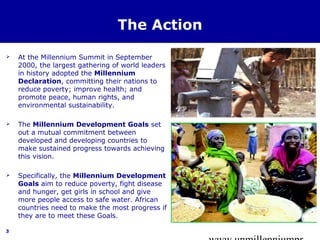
 At the Millennium Summit in September 
2000, the largest gathering of world leaders 
in history adopted the Millennium 
Declaration, committing their nations to 
reduce poverty; improve health; and 
promote peace, human rights, and 
environmental sustainability. 
 The Millennium Development Goals set 
out a mutual commitment between 
developed and developing countries to 
make sustained progress towards achieving 
this vision. 
 Specifically, the Millennium Development 
Goals aim to reduce poverty, fight disease 
and hunger, get girls in school and give 
more people access to safe water. African 
countries need to make the most progress if 
they are to meet these Goals.
www.unmillenniumpr 
4 
The Action 
 2005: The Breakthrough Year 
The Millennium Development Goals can 
be achieved by 2015, even in the poorest 
countries, if swift, strategic action is in 
place in 2005. 
 The world already has affordable tools 
to win this fight, such as: 
– Bed-nets to fight malaria 
– Vaccinations against disease 
– Antiretroviral therapies to treat AIDS 
– Fertilizers and agro-forestry to raise crop 
yields 
– Bore wells to provide drinking water 
– Diesel generators for village electricity.
www.unmillenniumpr 
5 
The Millennium Development 
Goals 
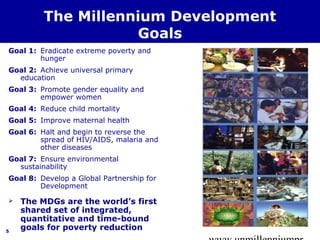
Goal 1: Eradicate extreme poverty and 
hunger 
Goal 2: Achieve universal primary 
education 
Goal 3: Promote gender equality and 
empower women 
Goal 4: Reduce child mortality 
Goal 5: Improve maternal health 
Goal 6: Halt and begin to reverse the 
spread of HIV/AIDS, malaria and 
other diseases 
Goal 7: Ensure environmental 
sustainability 
Goal 8: Develop a Global Partnership for 
Development 
 The MDGs are the world’s first 
shared set of integrated, 
quantitative and time-bound 
goals for poverty reduction
www.unmillenniumpr 
6 
The UN Millennium Project 
How We Work 
Mission: 
To develop a practical plan for rich and poor countries to meet the MDGs by 2015 
Structure: 
 Commissioned by UN Secretary-General and directed by Prof. Jeffrey Sachs 
 Analysis performed by 10 thematically-oriented Task Forces with a total of 265 
global experts, including: researchers and scientists; policymakers; NGO 
representatives, UN agencies, the World Bank, IMF and the private sector. 
 Country level advisory work began in 2004 with eight pilot countries: Ethiopia, 
Cambodia, Dominican Republic, Ghana, Kenya, Senegal, Tajikistan, and Yemen 
 The UN Millennium Project ends on June 30, 2005
www.unmillenniumpr 
7 
The UN Millennium Project 
Task Forces 
Task Force Task Force Coordinators 
1-Poverty and Economic Development Jeffrey D. Sachs, USA 
Mari Pangestu, Indonesia 
2-Hunger Pedro Sanchez, USA 
M.S. Swaminathan, India 
3-Education and Gender Equality Nancy Birdsall, USA 
Amina J. Ibrahim, Nigeria 
Geeta Rao Gupta, India 
4-Child Health and Maternal Health Mushtaque Chowdhury, Bangladesh 
Allan Rosenfield, USA 
5-HIV/AIDS, Malaria, TB, and Access to 
Essential Medicines 
Agnes Binagwaho, Rwanda 
Jaap Broekmans, The Netherlands 
Paula Munderi, Uganda 
Josh Ruxin, USA 
6-Environmental Sustainability Yolanda Kakabadse Navarro, Ecuador 
Jeff McNeely, Canada 
Don Melnick, USA 
7-Water and Sanitation Roberto Lenton, Argentina 
Albert Wright, Ghana 
8-Improving the Lives of Slum Dwellers Pietro Garau, Italy 
Elliot Sclar, USA 
9-Trade Patrick Messerlin, France 
Ernesto Zedillo, Mexico 
10-Science, Technology and Innovation Yee-Lee Cheong, Malaysia 
Calestous Juma, Kenya
www.unmillenniumpr 
8 
The UN Millennium Project 
Recommends: 
 Developing country governments should adopt development strategies bold enough to meet 
the Millennium Development Goal (MDG) targets for 2015. We term such plans MDG-based 
Poverty Reduction Strategies (MDG-based PRSs). In order to meet the targets for 2015, we 
recommend that countries have these strategies in place by the end of 2006. Where Poverty 
Reduction Strategy Papers (PRSPs) already exist, they should be aligned with the MDGs. 
 International donors should identify at least a dozen “MDG fast-track” countries for a 
rapid scale-up of ODA in 2005. Many countries are already capable, due to their good 
governance and absorptive capacity, of a massive scale-up in ODA. 
 Developed and developing countries should jointly launch in 2005, a group of “quick 
win” actions to save and improve millions of lives and to promote economic growth. They 
should also launch a massive effort to build expertise at the community level. 
 High-income countries should increase ODA from 0.25 percent of donor GNP in 2003 to 
around 0.44 percent in 2006 and 0.54 percent in 2015 to support the MDGs. Donors should 
also focus on improving ODA quality (including making aid harmonized, predictable, and largely 
focused on budgetary support). Each donor should reach 0.7 percent of GNP by no later 
than 2015. Debt relief should be more extensive and generous. 
 The UN Secretary-General and the UN Development Group should strengthen the 
coordination of UN agencies, funds and programs in support of the MDGs, both at the 
headquarters and country level. The UN Country Teams should be strengthened and should 
work closely with international financial institutions to support the MDGs.
www.unmillenniumpr 
9 
Priority Interventions 
Some Quick Wins could bring vital gains in well-being to millions of people and start countries on 
the path to the Goals. With adequate resources, the Quick Wins include: 
 Eliminating school and uniform fees to ensure that all children, especially girls, are not out of school because of their 
families’ poverty. 
 Providing impoverished sub-Saharan farmers with affordable replenishment of soil nitrogen and soil nutrients. 
 Providing free school meals for all poor children using locally produced foods with take-home rations. 
 Training large numbers of village workers in health, farming, and infrastructure (in one-year programs), in order to 
ensure basic expertise and services in rural communities. 
 Distributing free long-lasting insecticide-treated bed-nets to all children in malaria-endemic zones. 
 Eliminating user fees for basic health services in all developing countries. 
 Expanding use of proven effective drug combinations for AIDS, TB, and malaria. 
 Setting up funding to finance community-based slum upgrading and earmarking idle public land for low-cost housing. 
 Providing access to electricity, water, sanitation, and the Internet for all hospitals, schools, and other social service 
institutions using off-grid diesel generators, solar panels, or other appropriate technologies. 
 Launching national campaigns to reduce violence against women. 
 Establishing, in each country, an office of science advisor to the president or prime minister.
www.unmillenniumpr 
10 
Key Costing Facts 
The UN Millennium Project has discovered that the cost of meeting the 
MDGs is less than what wealthy nations have already promised to 
contribute in development assistance. 
 At the Monterrey Financing for Development Conference in 2002, world leaders 
pledged “to make concrete efforts towards the target of 0.7%” of their GNP in 
international aid. In today’s dollars, that would amount to almost $200 billion. 
 In 2003, total aid from the 22 richest countries to the world’s developing countries 
was $69 billion—a shortfall of $130 billion dollars from the 0.7% promise. 
 The cost of supporting countries to meet the Goals would require donors to 
increase ODA to 0.44% of GNP by 2006 (or $135 billion) and to plan for a 
scale-up to 0.54% by 2015 (or $195 billion). 
 This means that of the combined rich world GNP of approximately $30 trillion 
dollars, only an average of $150 billion a year would be enough to get the 
world on track to ending extreme poverty throughout the world.
www.unmillenniumpr 
11 
2005: The Breakthrough Year 
LAUNCHING A DECADE OF BOLD AMBITION 
There is still enough time to meet the MDGs – though barely. With a systematic 
approach over the next decade, many countries now dismissed as too poor or too 
far off track could still achieve the Goals, but only if the world moves urgently with 
specific, scaled-up actions. Immediate action is needed to train of enough doctors 
and engineers, strengthen service delivery capacity, and construct improved 
infrastructure. 
To launch the decade of bold ambition towards 2015, several worldwide initiatives 
are needed to translate the Goals from ambition to action: 
 Identify fast-track countries 
 Prepare MDG-based poverty reduction strategies 
 Launch a global human resource training effort 
 Launch the Quick Win initiatives 
 Engage middle-income countries in the challenge of meeting the MDGs

Millennium project PNUD

  • 2.
    35,000 30,000 25,000 20,000 15,000 10,000 www.unmillenniumpr 2 The Crisis 5,000 10 wealthiest countries 10 poorest countries GNI Per Capita GNI Per Capita US$670 US$34,134  POVERTY: More than one billion people in the world live on less than a dollar a day. Another 1.8 billion struggle to survive on less than $2 per day.  EDUCATION: Around the world, a total of 114 million children do not get even a basic education and 584 million women are illiterate.  HEALTH: Life expectancy in sub-Saharan Africa is less than 55 years – and dropping.  WATER AND SANITATION: Four out of every ten people in the world don't have access even to a simple latrine; and two in ten have no source of safe drinking water. If the Goals are achieved:  More than 500 million people will be lifted out of extreme poverty and 250 million will no longer suffer from hunger.  30 million children will be saved who would otherwise die before reaching age 5 and 2 million maternal deaths will have been averted.  350 million people will have access to safe drinking water and 650 million people will have access to basic sanitation
  • 3.
    www.unmillenniumpr 3 TheAction  At the Millennium Summit in September 2000, the largest gathering of world leaders in history adopted the Millennium Declaration, committing their nations to reduce poverty; improve health; and promote peace, human rights, and environmental sustainability.  The Millennium Development Goals set out a mutual commitment between developed and developing countries to make sustained progress towards achieving this vision.  Specifically, the Millennium Development Goals aim to reduce poverty, fight disease and hunger, get girls in school and give more people access to safe water. African countries need to make the most progress if they are to meet these Goals.
  • 4.
    www.unmillenniumpr 4 TheAction  2005: The Breakthrough Year The Millennium Development Goals can be achieved by 2015, even in the poorest countries, if swift, strategic action is in place in 2005.  The world already has affordable tools to win this fight, such as: – Bed-nets to fight malaria – Vaccinations against disease – Antiretroviral therapies to treat AIDS – Fertilizers and agro-forestry to raise crop yields – Bore wells to provide drinking water – Diesel generators for village electricity.
  • 5.
    www.unmillenniumpr 5 TheMillennium Development Goals Goal 1: Eradicate extreme poverty and hunger Goal 2: Achieve universal primary education Goal 3: Promote gender equality and empower women Goal 4: Reduce child mortality Goal 5: Improve maternal health Goal 6: Halt and begin to reverse the spread of HIV/AIDS, malaria and other diseases Goal 7: Ensure environmental sustainability Goal 8: Develop a Global Partnership for Development  The MDGs are the world’s first shared set of integrated, quantitative and time-bound goals for poverty reduction
  • 6.
    www.unmillenniumpr 6 TheUN Millennium Project How We Work Mission: To develop a practical plan for rich and poor countries to meet the MDGs by 2015 Structure:  Commissioned by UN Secretary-General and directed by Prof. Jeffrey Sachs  Analysis performed by 10 thematically-oriented Task Forces with a total of 265 global experts, including: researchers and scientists; policymakers; NGO representatives, UN agencies, the World Bank, IMF and the private sector.  Country level advisory work began in 2004 with eight pilot countries: Ethiopia, Cambodia, Dominican Republic, Ghana, Kenya, Senegal, Tajikistan, and Yemen  The UN Millennium Project ends on June 30, 2005
  • 7.
    www.unmillenniumpr 7 TheUN Millennium Project Task Forces Task Force Task Force Coordinators 1-Poverty and Economic Development Jeffrey D. Sachs, USA Mari Pangestu, Indonesia 2-Hunger Pedro Sanchez, USA M.S. Swaminathan, India 3-Education and Gender Equality Nancy Birdsall, USA Amina J. Ibrahim, Nigeria Geeta Rao Gupta, India 4-Child Health and Maternal Health Mushtaque Chowdhury, Bangladesh Allan Rosenfield, USA 5-HIV/AIDS, Malaria, TB, and Access to Essential Medicines Agnes Binagwaho, Rwanda Jaap Broekmans, The Netherlands Paula Munderi, Uganda Josh Ruxin, USA 6-Environmental Sustainability Yolanda Kakabadse Navarro, Ecuador Jeff McNeely, Canada Don Melnick, USA 7-Water and Sanitation Roberto Lenton, Argentina Albert Wright, Ghana 8-Improving the Lives of Slum Dwellers Pietro Garau, Italy Elliot Sclar, USA 9-Trade Patrick Messerlin, France Ernesto Zedillo, Mexico 10-Science, Technology and Innovation Yee-Lee Cheong, Malaysia Calestous Juma, Kenya
  • 8.
    www.unmillenniumpr 8 TheUN Millennium Project Recommends:  Developing country governments should adopt development strategies bold enough to meet the Millennium Development Goal (MDG) targets for 2015. We term such plans MDG-based Poverty Reduction Strategies (MDG-based PRSs). In order to meet the targets for 2015, we recommend that countries have these strategies in place by the end of 2006. Where Poverty Reduction Strategy Papers (PRSPs) already exist, they should be aligned with the MDGs.  International donors should identify at least a dozen “MDG fast-track” countries for a rapid scale-up of ODA in 2005. Many countries are already capable, due to their good governance and absorptive capacity, of a massive scale-up in ODA.  Developed and developing countries should jointly launch in 2005, a group of “quick win” actions to save and improve millions of lives and to promote economic growth. They should also launch a massive effort to build expertise at the community level.  High-income countries should increase ODA from 0.25 percent of donor GNP in 2003 to around 0.44 percent in 2006 and 0.54 percent in 2015 to support the MDGs. Donors should also focus on improving ODA quality (including making aid harmonized, predictable, and largely focused on budgetary support). Each donor should reach 0.7 percent of GNP by no later than 2015. Debt relief should be more extensive and generous.  The UN Secretary-General and the UN Development Group should strengthen the coordination of UN agencies, funds and programs in support of the MDGs, both at the headquarters and country level. The UN Country Teams should be strengthened and should work closely with international financial institutions to support the MDGs.
  • 9.
    www.unmillenniumpr 9 PriorityInterventions Some Quick Wins could bring vital gains in well-being to millions of people and start countries on the path to the Goals. With adequate resources, the Quick Wins include:  Eliminating school and uniform fees to ensure that all children, especially girls, are not out of school because of their families’ poverty.  Providing impoverished sub-Saharan farmers with affordable replenishment of soil nitrogen and soil nutrients.  Providing free school meals for all poor children using locally produced foods with take-home rations.  Training large numbers of village workers in health, farming, and infrastructure (in one-year programs), in order to ensure basic expertise and services in rural communities.  Distributing free long-lasting insecticide-treated bed-nets to all children in malaria-endemic zones.  Eliminating user fees for basic health services in all developing countries.  Expanding use of proven effective drug combinations for AIDS, TB, and malaria.  Setting up funding to finance community-based slum upgrading and earmarking idle public land for low-cost housing.  Providing access to electricity, water, sanitation, and the Internet for all hospitals, schools, and other social service institutions using off-grid diesel generators, solar panels, or other appropriate technologies.  Launching national campaigns to reduce violence against women.  Establishing, in each country, an office of science advisor to the president or prime minister.
  • 10.
    www.unmillenniumpr 10 KeyCosting Facts The UN Millennium Project has discovered that the cost of meeting the MDGs is less than what wealthy nations have already promised to contribute in development assistance.  At the Monterrey Financing for Development Conference in 2002, world leaders pledged “to make concrete efforts towards the target of 0.7%” of their GNP in international aid. In today’s dollars, that would amount to almost $200 billion.  In 2003, total aid from the 22 richest countries to the world’s developing countries was $69 billion—a shortfall of $130 billion dollars from the 0.7% promise.  The cost of supporting countries to meet the Goals would require donors to increase ODA to 0.44% of GNP by 2006 (or $135 billion) and to plan for a scale-up to 0.54% by 2015 (or $195 billion).  This means that of the combined rich world GNP of approximately $30 trillion dollars, only an average of $150 billion a year would be enough to get the world on track to ending extreme poverty throughout the world.
  • 11.
    www.unmillenniumpr 11 2005:The Breakthrough Year LAUNCHING A DECADE OF BOLD AMBITION There is still enough time to meet the MDGs – though barely. With a systematic approach over the next decade, many countries now dismissed as too poor or too far off track could still achieve the Goals, but only if the world moves urgently with specific, scaled-up actions. Immediate action is needed to train of enough doctors and engineers, strengthen service delivery capacity, and construct improved infrastructure. To launch the decade of bold ambition towards 2015, several worldwide initiatives are needed to translate the Goals from ambition to action:  Identify fast-track countries  Prepare MDG-based poverty reduction strategies  Launch a global human resource training effort  Launch the Quick Win initiatives  Engage middle-income countries in the challenge of meeting the MDGs