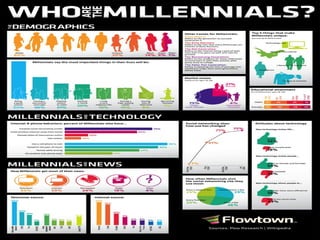
Millennials
Millennials
A question of audience?
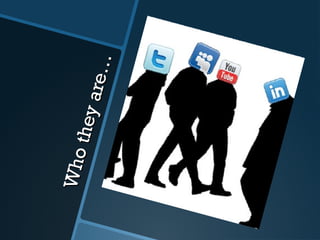
Whotheyare…
Whotheyare…
Generationwhat?
Generationwhat?
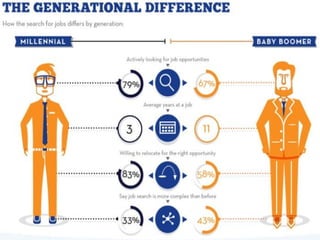
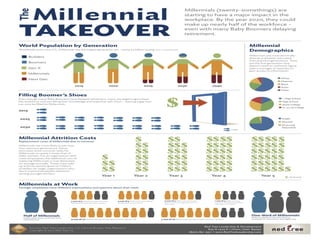
 Baby Boomers: 1945-1964: Older returning to
school for retirement, increase income, and to
do things they didn’t have time for as adults.
 Generation X: 1964-1982: Shut out of
prosperity of the sixties, coming of age in the
Era of Reagan and later. Disgruntled with the
way society responds to problems. Realists.
Familiar with economic collapse (74-82) and
wealth disparity (82-).
 GenerationY (Millennials): 1982-2000: More
thematic. 911, but optimistic. On demand.
Entitled. No sense of need to achieve. On
their own time. Compliant and willing to work
hard for their pleasure (videogames,
cellphones, texting) See education
pragmatically. Less likely to spend as much for
it. Recognize the false promise of
education=better life.
 Next: (2000-)
MethodsofY
MethodsofY
 1.tutoring and personalized
instruction is popular (learning
programs, cms, online tutorials,
youtube how tos, my life lab, DIY)
 2.they don’t need a lecture/they
like to do it. 3.Admissions: matchmaking and
courting students: UP: make them
feel special this is a dating process/they can
choose not to go out with you…
 4.Advising/monitoring and
surveillance: they may not like it
but they are getting used to being
watched and monitored and some
are self-monitoring (facebook: I
just brushed my teeth)
MethodsofY
MethodsofY
 5.multicultural/multiethnic:
accept it/they are not going
to change nor is the world
 6.they have lived their whole
life with internet, texting,
computers, games, online life
 7. they don’t read unless they
like it
 8.they only consider school
important if they like
something or if they want
something (a scholarship, an
internship, a job)….they
don’t have the money to play
around
MethodsofY
MethodsofY
 9.they are poor about half of the public school
students coming to us are low income/most are
in the south or southwest.
 10.They’d rather watch Khan academy than you
 11.Students need competencies to get jobs:
NOT DEGREES
 if you can have A+ competency in computers,
if you know java, if you can pass a medical
coding class, if you have a project
management certificate you can work.Your
degree can be in anything….It’s the
competencies that are hirable.
 12. Portable: Students want mobile services
that follow them.They don’t want to be sent to
a building. Email or text them the answer, the
form, the prescription, the person, the
studyguide.
MethodsofY
MethodsofY
 13. Students are busy.They have jobs, they
have lives, they have other commitments.
Accept it. 14.Cellphones and lots of mobile info is here
to stay. 24/7 world people.They are not going
to ditch the cellphone because you want quite
time.They an turn off ringers but it might help
to give everyone a cellphone break every 45
minutes in class to check incoming calls from
Becky Lou!!!! 15.If you want them to listen to you, you better
be interesting or scary or both. Preferably
both.
 16.Education needs to be tactile/they need to
do to become and to own it.Theory is included
in the doing. 17.Digital: be creative but learn to program
 18. don’t use digital devices: make them
MethodsofY
MethodsofY
 19.Culture is local.Your theatre
students aren’t going to NY they are
making theatre here, your film students
aren’t going to LA they are making it
here; your bankers aren’t going to Wall
Street they are banking here.Think
global and act local.
 20. the world is connected to us.There
are no more international boundaries.
There are producers and consumers.
Everyone is potentially a maker and a
producer and a customer.
 21. MOOCS (massive open online
courses) are changing ed….The price
and time to degree must drop
 22. Adjectives applied to milllennials:
sheltered, achieving, team-oriented,
pressured, conventional, special,
confident
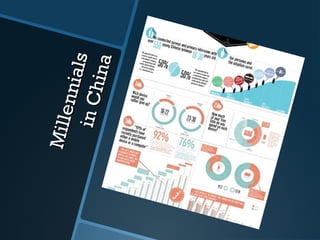
Millennials
MillennialsinChina
inChina
MethodsofY
MethodsofY
 23. Digital humanities are here.
Some digital humanities projects:
 24. More generation me than
generation we.
 25. Study: Journal of
Personality/Social Psychology:
they like money, fame, image
 don’t care about; self acceptance,
affiliation, and community
 26.Reaching them by: rapport,
relevance, relaxed, rationale,
research based methods
 27, Entrepreneurial, narcissistic
and broke
ReadmoreonY
ReadmoreonY
Selingo, Jeffrey: College
Unbound 2013.
Chau, Joanna.
“Millennials are more
Generation Me than
Generation We”
Chronicle. March 15,
2012.Bart, Mary. “The Five Rs
of Engaging Millennial
Students. “FacultyFocus.co

Millennials understanding the emrging new generation Y

  • 1.
    Millennials Millennials A question ofaudience? A question of audience?
  • 2.
  • 3.
    Generationwhat? Generationwhat?  Baby Boomers:1945-1964: Older returning to school for retirement, increase income, and to do things they didn’t have time for as adults.  Generation X: 1964-1982: Shut out of prosperity of the sixties, coming of age in the Era of Reagan and later. Disgruntled with the way society responds to problems. Realists. Familiar with economic collapse (74-82) and wealth disparity (82-).  GenerationY (Millennials): 1982-2000: More thematic. 911, but optimistic. On demand. Entitled. No sense of need to achieve. On their own time. Compliant and willing to work hard for their pleasure (videogames, cellphones, texting) See education pragmatically. Less likely to spend as much for it. Recognize the false promise of education=better life.  Next: (2000-)
  • 5.
    MethodsofY MethodsofY  1.tutoring andpersonalized instruction is popular (learning programs, cms, online tutorials, youtube how tos, my life lab, DIY)  2.they don’t need a lecture/they like to do it. 3.Admissions: matchmaking and courting students: UP: make them feel special this is a dating process/they can choose not to go out with you…  4.Advising/monitoring and surveillance: they may not like it but they are getting used to being watched and monitored and some are self-monitoring (facebook: I just brushed my teeth)
  • 7.
    MethodsofY MethodsofY  5.multicultural/multiethnic: accept it/theyare not going to change nor is the world  6.they have lived their whole life with internet, texting, computers, games, online life  7. they don’t read unless they like it  8.they only consider school important if they like something or if they want something (a scholarship, an internship, a job)….they don’t have the money to play around
  • 9.
    MethodsofY MethodsofY  9.they arepoor about half of the public school students coming to us are low income/most are in the south or southwest.  10.They’d rather watch Khan academy than you  11.Students need competencies to get jobs: NOT DEGREES  if you can have A+ competency in computers, if you know java, if you can pass a medical coding class, if you have a project management certificate you can work.Your degree can be in anything….It’s the competencies that are hirable.  12. Portable: Students want mobile services that follow them.They don’t want to be sent to a building. Email or text them the answer, the form, the prescription, the person, the studyguide.
  • 11.
    MethodsofY MethodsofY  13. Studentsare busy.They have jobs, they have lives, they have other commitments. Accept it. 14.Cellphones and lots of mobile info is here to stay. 24/7 world people.They are not going to ditch the cellphone because you want quite time.They an turn off ringers but it might help to give everyone a cellphone break every 45 minutes in class to check incoming calls from Becky Lou!!!! 15.If you want them to listen to you, you better be interesting or scary or both. Preferably both.  16.Education needs to be tactile/they need to do to become and to own it.Theory is included in the doing. 17.Digital: be creative but learn to program  18. don’t use digital devices: make them
  • 13.
    MethodsofY MethodsofY  19.Culture islocal.Your theatre students aren’t going to NY they are making theatre here, your film students aren’t going to LA they are making it here; your bankers aren’t going to Wall Street they are banking here.Think global and act local.  20. the world is connected to us.There are no more international boundaries. There are producers and consumers. Everyone is potentially a maker and a producer and a customer.  21. MOOCS (massive open online courses) are changing ed….The price and time to degree must drop  22. Adjectives applied to milllennials: sheltered, achieving, team-oriented, pressured, conventional, special, confident
  • 14.
  • 15.
    MethodsofY MethodsofY  23. Digitalhumanities are here. Some digital humanities projects:  24. More generation me than generation we.  25. Study: Journal of Personality/Social Psychology: they like money, fame, image  don’t care about; self acceptance, affiliation, and community  26.Reaching them by: rapport, relevance, relaxed, rationale, research based methods  27, Entrepreneurial, narcissistic and broke
  • 16.
    ReadmoreonY ReadmoreonY Selingo, Jeffrey: College Unbound2013. Chau, Joanna. “Millennials are more Generation Me than Generation We” Chronicle. March 15, 2012.Bart, Mary. “The Five Rs of Engaging Millennial Students. “FacultyFocus.co