Millennials

    ROGERS L. SMITH JR.
AMERICAN INTERCONTINENTAL
       UNIVERSITY
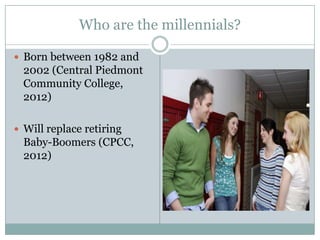
Who are the millennials?

ď‚— Born between 1982 and
  2002 (Central Piedmont
  Community College,
  2012)

ď‚— Will replace retiring
  Baby-Boomers (CPCC,
  2012)
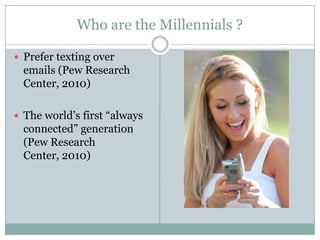
Who are the Millennials ?

ď‚— Prefer texting over
  emails (Pew Research
  Center, 2010)

 The world’s first “always
  connected” generation
  (Pew Research
  Center, 2010)
What makes them different?

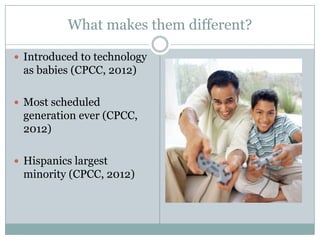
ď‚— Introduced to technology
 as babies (CPCC, 2012)

ď‚— Most scheduled
 generation ever (CPCC,
 2012)

ď‚— Hispanics largest
 minority (CPCC, 2012)
What makes them different?

ď‚— More prone to
  communicate with peers
  via devices rather than
  face to face


ď‚— Team oriented
  (McGee, n.d.)

ď‚— Less self-reliant
  (McGee, n.d.)
Technology used for learning


RSS Feeds
Technology used for learning


Wikis
Technology used for learning


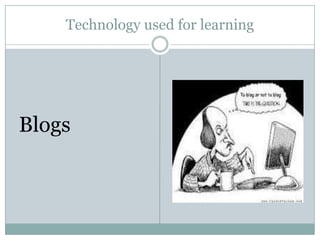
Blogs
Technology used for learning


Social Media
Technology used for learning


Podcasts
Technology used for learning


Video
Conferencing
Technology used for learning


Online
instructional
videos
Technology used for learning


Search
engines
Technology used for learning


The Internet
Technology used for learning


Collaborative
tools
Technology used for learning


Learning
games
Technology used for learning


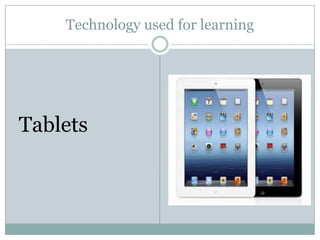
Tablets
Technology used for learning


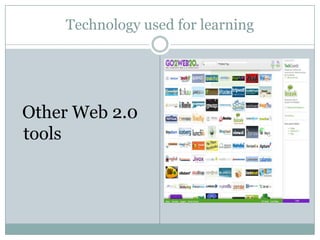
Other Web 2.0
tools
Affect on the learning environment

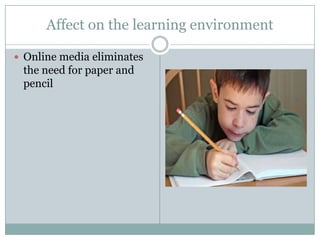
ď‚— Online media eliminates
 the need for paper and
 pencil
Affect on the learning environment

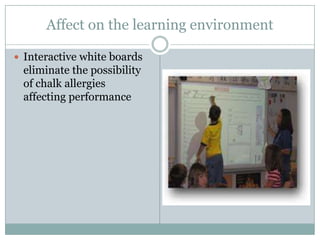
ď‚— Interactive white boards
 eliminate the possibility
 of chalk allergies
 affecting performance
Affect on the learning environment

ď‚— Instructors with the
 ability to teach more
 students via video
 conferencing

ď‚— Online media
 occasionally offers
 immediate scoring
References

ď‚— Central Piedmont Community College. (2012). Who are the
  millenials?. Retrieved October 7, 2012 from
  http://www.cpcc.edu/millennial
ď‚— McGee, J. (n.d.). Teaching millenials. Retrieved October
  7, 2012 from
  http://www.ame.pitt.edu/documents/McGee_Millennials.pdf
ď‚— Pew Research Center. (2010). Millennials- a portrait of
  generation next. Retrieved October 7, 2012 from
  http://www.pewsocialtrends.org/files/2010/10/millennials-
  confident-connected-open-to-change.pdf

ď‚— All images retrieved from Google images and Microsoft clip
  art.

Millennials

  • 1.
    Millennials ROGERS L. SMITH JR. AMERICAN INTERCONTINENTAL UNIVERSITY
  • 2.
    Who are themillennials? ď‚— Born between 1982 and 2002 (Central Piedmont Community College, 2012) ď‚— Will replace retiring Baby-Boomers (CPCC, 2012)
  • 3.
    Who are theMillennials ?  Prefer texting over emails (Pew Research Center, 2010)  The world’s first “always connected” generation (Pew Research Center, 2010)
  • 4.
    What makes themdifferent? ď‚— Introduced to technology as babies (CPCC, 2012) ď‚— Most scheduled generation ever (CPCC, 2012) ď‚— Hispanics largest minority (CPCC, 2012)
  • 5.
    What makes themdifferent? ď‚— More prone to communicate with peers via devices rather than face to face ď‚— Team oriented (McGee, n.d.) ď‚— Less self-reliant (McGee, n.d.)
  • 6.
    Technology used forlearning RSS Feeds
  • 7.
    Technology used forlearning Wikis
  • 8.
    Technology used forlearning Blogs
  • 9.
    Technology used forlearning Social Media
  • 10.
    Technology used forlearning Podcasts
  • 11.
    Technology used forlearning Video Conferencing
  • 12.
    Technology used forlearning Online instructional videos
  • 13.
    Technology used forlearning Search engines
  • 14.
    Technology used forlearning The Internet
  • 15.
    Technology used forlearning Collaborative tools
  • 16.
    Technology used forlearning Learning games
  • 17.
    Technology used forlearning Tablets
  • 18.
    Technology used forlearning Other Web 2.0 tools
  • 19.
    Affect on thelearning environment ď‚— Online media eliminates the need for paper and pencil
  • 20.
    Affect on thelearning environment ď‚— Interactive white boards eliminate the possibility of chalk allergies affecting performance
  • 21.
    Affect on thelearning environment ď‚— Instructors with the ability to teach more students via video conferencing ď‚— Online media occasionally offers immediate scoring
  • 22.
    References ď‚— Central PiedmontCommunity College. (2012). Who are the millenials?. Retrieved October 7, 2012 from http://www.cpcc.edu/millennial ď‚— McGee, J. (n.d.). Teaching millenials. Retrieved October 7, 2012 from http://www.ame.pitt.edu/documents/McGee_Millennials.pdf ď‚— Pew Research Center. (2010). Millennials- a portrait of generation next. Retrieved October 7, 2012 from http://www.pewsocialtrends.org/files/2010/10/millennials- confident-connected-open-to-change.pdf ď‚— All images retrieved from Google images and Microsoft clip art.