NetGen
Learners
AKA “MILLENNIALS”
NetGen

ARE YOU A
LEARNER?
(born between 1982 and 2002)
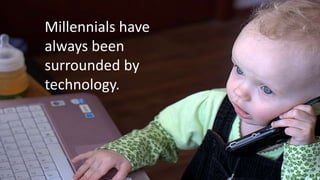
Millennials have
always been
surrounded by
technology.
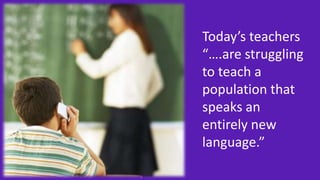
Today’s teachers
“….are struggling
to teach a
population that
speaks an
entirely new
language.”
A different approach must be
taken…
Today’s 21 year old has
spent…
10,000
hours
playing
video
games
20,000 hours watching
TV
10,000
hours
talking
on cell
phones
Sent
250,000
emails
Today’s kids' brains are
wired differently.

The average
attention span of
a NetGen student
is 7 minutes.
Let’s
give the
millennia
ls what
they
need to
learn…
Millennials are team-oriented and
confident, so let them work together
and take charge.
They
multitask
and are
tech-
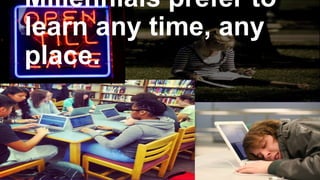
Millennials prefer to
learn any time, any
place.
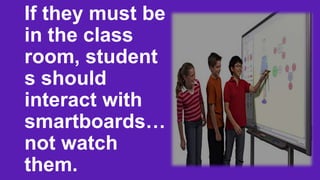
If they must be
in the class
room, student
s should
interact with
smartboards…
not watch
them.
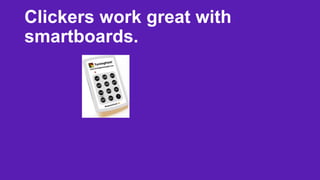
Clickers work great with
smartboards.
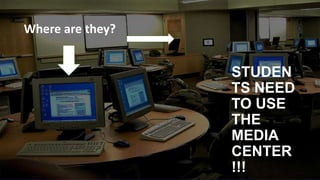
Where are they?

STUDEN
TS NEED
TO USE
THE
MEDIA
CENTER
!!!
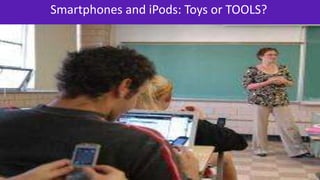
Smartphones and iPods: Toys or TOOLS?
Students can blog or create wikis
on their teacher’s website…

…with their CELL PHONES.
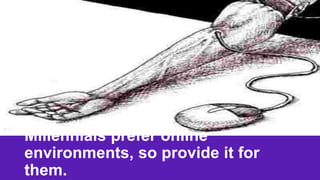
Millennials prefer online
environments, so provide it for
them.
Utilize YouTube, NetFlix, Hulu, and
podcasts…
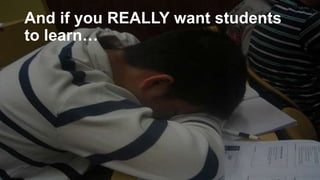
And if you REALLY want students
to learn…
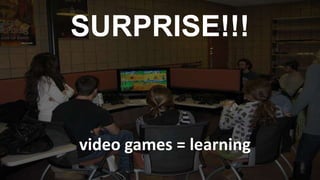
SURPRISE!!!

video games = learning
References
Cox, M. J. (2013). Formal to informal learning with IT: research challenges and issues for e-learning. Journal Of Computer Assisted
, 29(1), 85-105. doi:10.1111/j.1365-2729.2012.00483.x
Creative Commons. (n.d.). All pictures retrieved from a Bing image search within Microsoft PowerPoint and are licensed under
Creative Commons Attribution Share-Alike 3.0 License
Lippincott, J. K. (2010). Information Commons: Meeting Millennials' Needs. Journal Of Library Administration, 50(1), 27-37.
doi:10.1080/01930820903422156
Matulich, E., Papp, R., & Haytko, D. L. (2008). Continuous improvement through teaching innovations: A requirement for today’s
learners. Marketing Education Review, 18(1), 1-7. Retrieved from http://search.ebscohost.com.proxy.cecybrary.com/login.
aspx?direct=true&db=ehh&AN=32739796&site=ehost-live
McAlister, A. (2009). Teaching the millennial generation. American Music Teacher, 59(1), 13- 15. Retrieved from
http://search.ebscohost.com.proxy.cecybrary.com/login.aspx?direct=true&db=ehh&AN=43802552&site=ehost-live
Short, D. (2012). Teaching scientific concepts using a virtual world - Minecraft. Teach Science: The Journal Of The Australian Science
Teachers Association, 58(3), 55-58. Retrieved from http://search.ebscohost.com.proxy.cecybrary.com/login.aspx?
direct=true &db=ehh&AN=83256656&site=ehost-live

Millennial Learners

Editor's Notes

  • #3 A student in today’s classroom may be referred to as a “NetGen” learner or a “Digital Millennial Learner” (Matulich, Papp, & Haytko, 2008). McAlister (2009) claims the Millennial Generation consists of students born between 1982 and 2002.
  • #4 NetGen learners have been constantly surrounded by technology throughout their lives, and their teachers are constantly trying to incorporate technology use into their daily lessons.
  • #5 At home, these students watch television on computers and iPads, play games and listen to music on their (or their parent’s) smartphones, send text messages and instant messages on Facebook, and play video games on devices that can play movies and perform more functions than ever before. Prensky (2001) stated that today’s teachers “…are struggling to teach a population that speaks an entirely new language (as cited in Matulich, Papp, & Haytko, 2008, p. 1).
  • #6 A different approach must be taken to engage and teach today’s learners. “With each generation, pedagogues must take stock of their teaching strategies in terms of effectiveness and relevance” (McAlister, 2009, 0.13).
  • #7 The millennial generation have always had the internet, and they carry cell phones in their pockets that download music (which they listen to via ear buds) and scour the internet (McAlister, 2009). Oblinger (2005) states, “…today’s 21-year old has spent 10,000 hours playing video games, 20,000 hours watching TV, 10,000 hours talking on their cell phone, sent 250,000 emails and spent only 5,000 hours reading” (as cited in Matulich, Papp, & Haytko, 2008, p. 2).
  • #12 Many teachers currently teaching the nation’s children grew up in a time where phones always had cords, computers displayed information in green, and televisions had knobs. Oblinger (2006) claimed that the average attention span of a NetGen student is only seven minutes (as cited in Matulich, Papp, & Haytko, 2008, p. 2). Students learn differently now. Marc Pretensky (2001) claimed the brains of children now function differently because of their large amount of activities involving video games and digital media (as cited in Lippincott, 2010). There is a dilemma present in today’s schools.
  • #14 Millennials have several characteristics that make them seem much different than the children of yesterday. They do not want the teacher to be the sage-on-the-sage; they want their teacher to be a guide-on-the-side. McAlister (2009) reported that millennials seem to possess several of the following characteristics: - Sheltered: Millennials have been sheltered by their parents their whole lives. Their parents are quick to their defense and are often called helicopter parents. -Team oriented: Millennials seem to be highly sociable and prefer working in groups. -Confidence: Millennials are confident from all of the praise they receive from their parents and teachers. They receive awards and trophies for activities whether they get first place or last place.
  • #15  -Achievement oriented and pressured: Millennials want to achieve success in everything they do. -Multitasking: Millenials multitask with everything. They use a variety of technology tools to do homework, and they use technology to communicate to others while they do their homework. -Techno-Savvy: Today’s older adults had troubles working a VCR, and today’s millennials use trial-and-error methods to conquer every piece of technology and/or software they come into contact with.
  • #16 Millennials use technology to learn in a variety of ways. Formal learning takes place in a structured environment such as a classroom in a school. Informal learning, on the other hand, involves learning any time, any place (Matulich, Papp, & Haytko, 2008).
  • #17 Formal learning takes place inside schools and orderly environments. Students are often subjected to the use of a smartboard in these environments. This is a good thing if the teacher is using the smartboard properly. More often than not, the smartboard acts as an oversized projector.
  • #18 Students are also using clickers in their classrooms. Clickers are also termed instant response devices. The students can enter their choice of answer on the clicker, and the data is immediately gathered by the teacher’s computer system. This data can be displayed instantly and in many different forms (i.e. charts, graphs, table, etc.).
  • #19 The use of computers in media centers is also another common site in today’s schools. Laptop and tablet carts are becoming common, but many schools do not have the funding for such things.
  • #20 NetGen students learn primarily at their own pace, and they prefer to experience learning through multimedia devices (Matulich, Papp, & Haytko, 2008). NetGen students commonly use their iPods and cell phones.
  • #21 Not surprisingly, when they search for various things on the internet, they are learning. If their teacher has a blog that the class is supposed to participate in, then this may give the student a reason to get on their phone, check the blog, and learn.
  • #22 Along with cell phones, NetGen learners utilize laptops and iPads in their own homes. These millennial learners prefer online environments for everything (Matulich, Papp, & Haytko, 2008). Therefore, a teacher who utilizes blogs, wikis, etc. to teach will most likely have a larger audience in, and out, of the classroom. “Research into students’ use of IT outside formal settings has shown that many school students use IT outside school even more than in school, and learning outside school is equally important in young peoples’ development” (Cox, 2013, p. 15). Teachers need to teach online – even in the classroom. Pachler (2007) goes on to state, “…the distinction between leisure activity and work is becoming more blurred as teachers make use of Web-based video material or pod-casts to support students’ homework” (as cited in Cox, 2013, p. 15).
  • #23 Watching TV is another form of informal learning outside the classroom. However, today’s technology is slowly replacing TV with things such as YouTube, NetFlix, Hulu, and podcasts. Students (and many other individuals) also have the options to download many films they may desire to see.
  • #25 If burned to a DVD, these films can be played on the same Xbox that the students are playing games like Minecraft on. Minecraft is a video game that contains a virtual world that players can interact in and build carious structures. Minecraft promotes various subjects such as physics and chemistry (Short, 2012). The game also asks that players work together, so it essentially promotes group learning and cooperation.