1 | P a g e
SR
NO. PARTICULAR
PAGE
NO
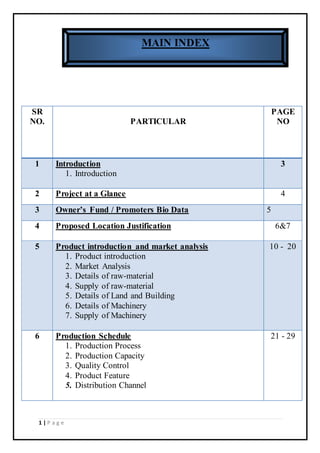
1 Introduction
1. Introduction
3
2 Project at a Glance 4
3 Owner’s Fund / Promoters Bio Data 5
4 Proposed Location Justification 6&7
5 Product introduction and market analysis
1. Product introduction
2. Market Analysis
3. Details of raw-material
4. Supply of raw-material
5. Details of Land and Building
6. Details of Machinery
7. Supply of Machinery
10 - 20
6 Production Schedule
1. Production Process
2. Production Capacity
3. Quality Control
4. Product Feature
5. Distribution Channel
21 - 29
MAIN INDEX
2 | P a g e
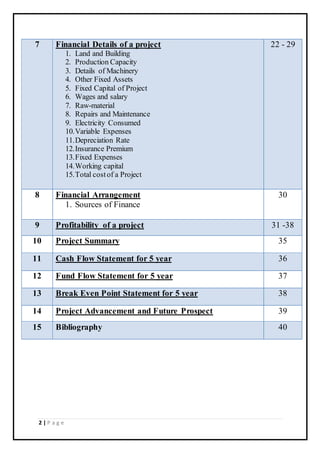
7 Financial Details of a project
1. Land and Building
2. Production Capacity
3. Details of Machinery
4. Other Fixed Assets
5. Fixed Capital of Project
6. Wages and salary
7. Raw-material
8. Repairs and Maintenance
9. Electricity Consumed
10.Variable Expenses
11.Depreciation Rate
12.Insurance Premium
13.Fixed Expenses
14.Working capital
15.Total costof a Project
22 - 29
8 Financial Arrangement
1. Sources of Finance
30
9 Profitability of a project 31 -38
10 Project Summary 35
11 Cash Flow Statement for 5 year 36
12 Fund Flow Statement for 5 year 37
13 Break Even Point Statement for 5 year 38
14 Project Advancement and Future Prospect 39
15 Bibliography 40
3 | P a g e
Cheese in an important dairy product in several countries.
These are about 20 district varieties of cheese contain approximately
the same ingredients but in different quality.
Soya bean is a leguminous crop and is rich in proteins
many value added products are made from it like milk, sauce, paneer
etc. Soya products are increasingly becoming popular specially,
amongst health conscious people. This product has potential in state
like Maharashtra, MP, and Gujarat. But this note considers Madhya
Pradesh as the Preferred location.
Soya paneer is made from soya milk which is a rich source
of high quality proteins and vitamins. Paneer is made by coagulating
soya bean milk. It is white & soft.
Paneer is one popular milk based products. Many
vegetarian preparations are mad from it. Milk paneer is an established
product but it is a costly product soya paneer would be an idea
substitute in terms of price as well as nutritious value.
Introduction
n
4 | P a g e
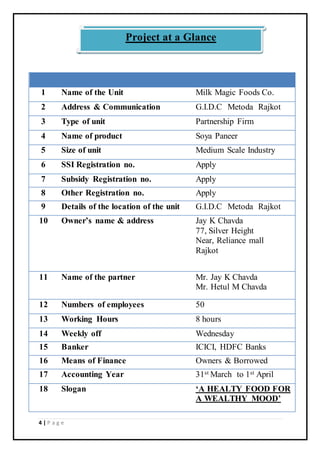
1 Name of the Unit Milk Magic Foods Co.
2 Address & Communication G.I.D.C Metoda Rajkot
3 Type of unit Partnership Firm
4 Name of product Soya Paneer
5 Size of unit Medium Scale Industry
6 SSI Registration no. Apply
7 Subsidy Registration no. Apply
8 Other Registration no. Apply
9 Details of the location of the unit G.I.D.C Metoda Rajkot
10 Owner’s name & address Jay K Chavda
77, Silver Height
Near, Reliance mall
Rajkot
11 Name of the partner Mr. Jay K Chavda
Mr. Hetul M Chavda
12 Numbers of employees 50
13 Working Hours 8 hours
14 Weekly off Wednesday
15 Banker ICICI, HDFC Banks
16 Means of Finance Owners & Borrowed
17 Accounting Year 31st March to 1st April
18 Slogan ‘A HEALTY FOOD FOR
A WEALTHY MOOD’
Project at a Glance
5 | P a g e
Partner-1
Name : Mr. Jay K Chavda
Age : 20 Years
Address : 77, Silver Height
Near, Relience mall
Rajkot
Education Qualification : BBA Final Year (Continue)
Working Responsibility : Management of Marketing
Department & HR Department
Contribution : 50%
Partner-2
Name : Mr. Hetul M Chavda
Age : 25 Years
Address : 55, Alap Twin Tower 5th floor
Nana mava main road
Rajkot
Education Qualification : M Com
Working Responsibility : Management of Production
Department & Finance Department
Contribution : 50%
Owners & Promoters Bio Data
6 | P a g e
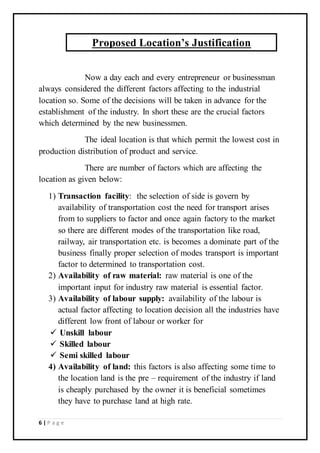
Now a day each and every entrepreneur or businessman
always considered the different factors affecting to the industrial
location so. Some of the decisions will be taken in advance for the
establishment of the industry. In short these are the crucial factors
which determined by the new businessmen.
The ideal location is that which permit the lowest cost in
production distribution of product and service.
There are number of factors which are affecting the
location as given below:
1) Transaction facility: the selection of side is govern by
availability of transportation cost the need for transport arises
from to suppliers to factor and once again factory to the market
so there are different modes of the transportation like road,
railway, air transportation etc. is becomes a dominate part of the
business finally proper selection of modes transport is important
factor to determined to transportation cost.
2) Availability of raw material: raw material is one of the
important input for industry raw material is essential factor.
3) Availability of labour supply: availability of the labour is
actual factor affecting to location decision all the industries have
different low front of labour or worker for
 Unskill labour
 Skilled labour
 Semi skilled labour
4) Availability of land: this factors is also affecting some time to
the location land is the pre – requirement of the industry if land
is cheaply purchased by the owner it is beneficial sometimes
they have to purchase land at high rate.
Proposed Location’s Justification
7 | P a g e
5) Availability of power: in olden time electricity, oil, coal and
natural gas are no so easily available with the growth of
industries the electrical power, oil and gas become most popular
factor. Electrical consumption and it is cost has been gradually
increasing so the development of electric power has to provide
speedy production to the unit.
8 | P a g e
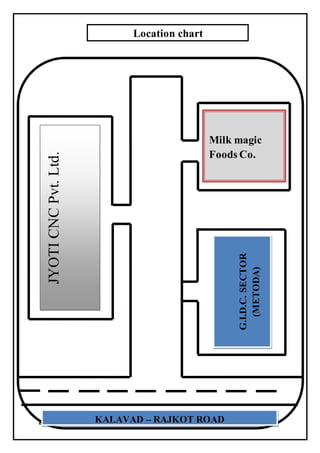
Location chart
Milk magic
Foods Co.
JYOTICNCPvt.Ltd.
KALAVAD – RAJKOT ROAD
G.I.D.C.SECTOR
(METODA)
9 | P a g e
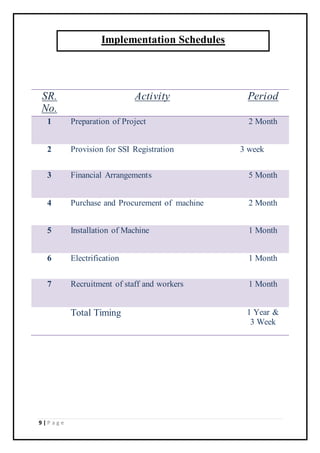
SR.
No.
Activity Period
1 Preparation of Project 2 Month
2 Provision for SSI Registration 3 week
3 Financial Arrangements 5 Month
4 Purchase and Procurement of machine 2 Month
5 Installation of Machine 1 Month
6 Electrification 1 Month
7 Recruitment of staff and workers 1 Month
Total Timing 1 Year &
3 Week
Implementation Schedules
10 | P a g e
The brand name under which “Milk Magic Foods
Company” is going to manufacture the paneer is “BEST” paneer will
be available in white color.
These paneer can be used in marriages, hotels and
restaurant as the wick which will be used is of good quality as the
making of paneer is related to quality consciousness rather than
quality.
The paneer is softer and the best quality product.
Paneer is one of the popular milk based products. Many
vegetarian preparation are made from it. Milk paneer is an established
product but it is a costly product soya paneer would be an ideal
substitute in terms of price as well as nutritious values.
Product Introduction & Market Analysis
11 | P a g e
The raw materials required would be available from the
following suppliers:
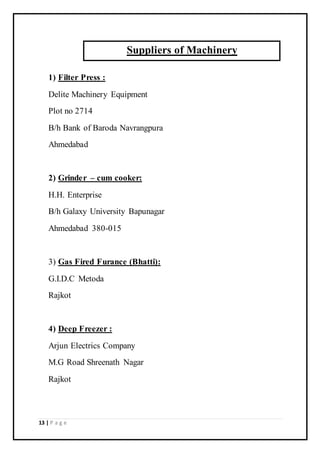
1) Mineral Water:
Raj Minaral Supplier
Plot no. 26055 GIDC
Opp, Atop Frimes Factory Naroda
Ahmedabad 380-015
Ph no: (079) 25262730
2) Milk Suppliers:
Amul Milk Industry
Plot no 332-333
Ajit Industrial Estate
GIDC Rajkot
Ph no: (02812) 387998
3) Chemicals:
Ankit Chemical Industry
C/405, Royal Tower
Near Foutain park,
Satellite Ahmedabad 380-015
Ph no: 98989 59996
Suppliers of Raw material
12 | P a g e
Food tech Engineers offers soya paneer making machine
food tech engineers manufactures a range of food and pharmaceutical
machineries. The soya paneer making machine is a table top plant for
producing soya milk and soya paneer.
The soya paneer making machine require 5-10 Square
meter area with domestic power supply for its installation.
[1 HP single phase 220V]
Details of Machinery
13 | P a g e
1) Filter Press :
Delite Machinery Equipment
Plot no 2714
B/h Bank of Baroda Navrangpura
Ahmedabad
2) Grinder – cum cooker:
H.H. Enterprise
B/h Galaxy University Bapunagar
Ahmedabad 380-015
3) Gas Fired Furance (Bhatti):
G.I.D.C Metoda
Rajkot
4) Deep Freezer :
Arjun Electrics Company
M.G Road Shreenath Nagar
Rajkot
Suppliers of Machinery
14 | P a g e
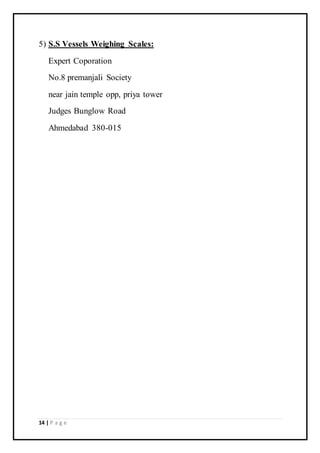
5) S.S Vessels Weighing Scales:
Expert Coporation
No.8 premanjali Society
near jain temple opp, priya tower
Judges Bunglow Road
Ahmedabad 380-015
15 | P a g e
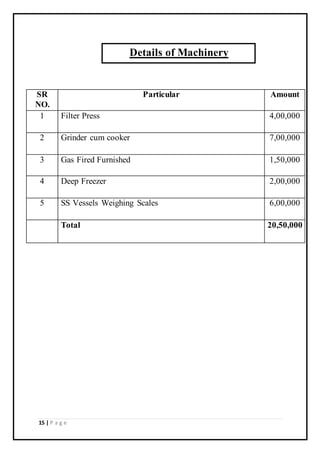
SR
NO.
Particular Amount
1 Filter Press 4,00,000
2 Grinder cum cooker 7,00,000
3 Gas Fired Furnished 1,50,000
4 Deep Freezer 2,00,000
5 SS Vessels Weighing Scales 6,00,000
Total 20,50,000
Details of Machinery
16 | P a g e
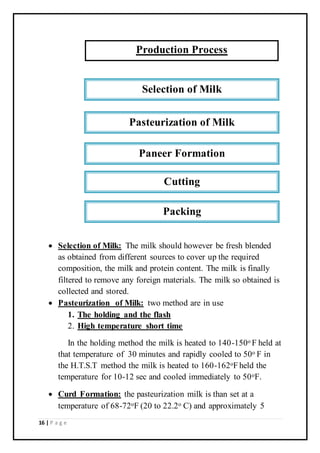
 Selection of Milk: The milk should however be fresh blended
as obtained from different sources to cover up the required
composition, the milk and protein content. The milk is finally
filtered to remove any foreign materials. The milk so obtained is
collected and stored.
 Pasteurization of Milk: two method are in use
1. The holding and the flash
2. High temperature short time
In the holding method the milk is heated to 140-150o F held at
that temperature of 30 minutes and rapidly cooled to 50o F in
the H.T.S.T method the milk is heated to 160-162oF held the
temperature for 10-12 sec and cooled immediately to 50oF.
 Curd Formation: the pasteurization milk is than set at a
temperature of 68-72oF (20 to 22.2o C) and approximately 5
Production Process
Selection of Milk
Pasteurization of Milk
Paneer Formation
…………………………………………
………
Cutting
Packing
17 | P a g e
percent of good starter is added. After 8 to 12 hours the milk
will coagulate and from a firm cured.
 Paneer Formation: the curd may be cut with curd knives as in
the case of cheddar cheese after which it is cooked slowly to 98o
to 110o or 36.7o to 43.3o the whey then removed and the curd
allowed to drain.
 Cutting: the paneer complete in finished good.
 Packing: go to packaging in packing section.
18 | P a g e
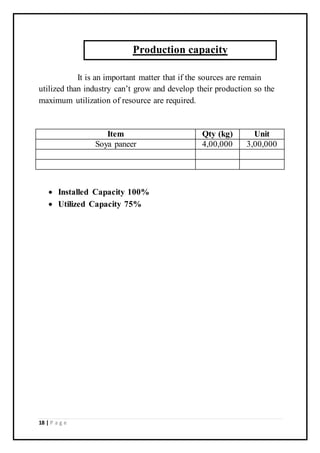
It is an important matter that if the sources are remain
utilized than industry can’t grow and develop their production so the
maximum utilization of resource are required.
Item Qty (kg) Unit
Soya paneer 4,00,000 3,00,000
 Installed Capacity 100%
 Utilized Capacity 75%
Production capacity
19 | P a g e
If any industry quality of product maintain trough many
ways like supervision appreciation to good work and good quality
product to their customers so quality of the product must be control
because if quality of product is good then consumer wants to buy the
product again.
Quality of product can be maintain through many ways
like supervision appreciation to good work etc. quality control is main
aspect for any company.
Quality Control
20 | P a g e
A channel of distribution or marketing channel is a
structure of intra company organization units and intra company
agents and dealers wholesalers and retailers through which a
commodity product or services in market.
After production the next problem faced by a
producer is that of selling and distribution the product is produced by
a company to satisfy the needs of the consumers so it must reach to
the consumer for whom it is made.
Channel of distribution indicates the routes or
pathways through which goods and services flow or move from
producer to consumer.
Channel of Distribution
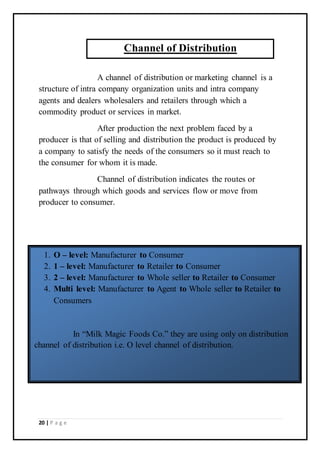
1. O – level: Manufacturer to Consumer
2. 1 – level: Manufacturer to Retailer to Consumer
3. 2 – level: Manufacturer to Whole seller to Retailer to Consumer
4. Multi level: Manufacturer to Agent to Whole seller to Retailer to
Consumers
In “Milk Magic Foods Co.” they are using only on distribution
channel of distribution i.e. O level channel of distribution.
21 | P a g e
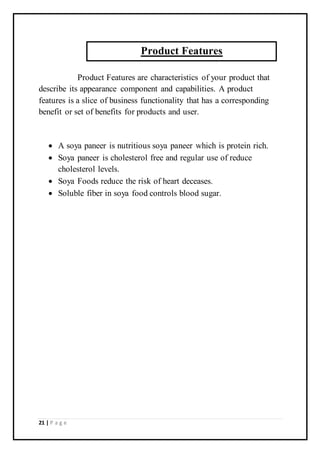
Product Features are characteristics of your product that
describe its appearance component and capabilities. A product
features is a slice of business functionality that has a corresponding
benefit or set of benefits for products and user.
 A soya paneer is nutritious soya paneer which is protein rich.
 Soya paneer is cholesterol free and regular use of reduce
cholesterol levels.
 Soya Foods reduce the risk of heart deceases.
 Soluble fiber in soya food controls blood sugar.
Product Features
22 | P a g e
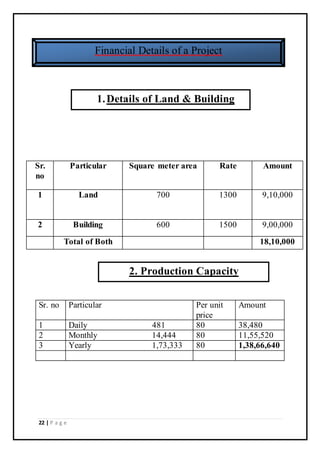
Sr. no Particular Per unit
price
Amount
1 Daily 481 80 38,480
2 Monthly 14,444 80 11,55,520
3 Yearly 1,73,333 80 1,38,66,640
Sr.
no
Particular Square meter area Rate Amount
1 Land 700 1300 9,10,000
2 Building 600 1500 9,00,000
Total of Both 18,10,000
1.Details of Land & Building
Financial Details of a Project
2. Production Capacity
23 | P a g e
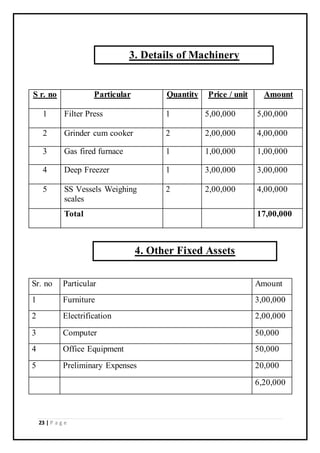
S r. no Particular Quantity Price / unit Amount
1 Filter Press 1 5,00,000 5,00,000
2 Grinder cum cooker 2 2,00,000 4,00,000
3 Gas fired furnace 1 1,00,000 1,00,000
4 Deep Freezer 1 3,00,000 3,00,000
5 SS Vessels Weighing
scales
2 2,00,000 4,00,000
Total 17,00,000
Sr. no Particular Amount
1 Furniture 3,00,000
2 Electrification 2,00,000
3 Computer 50,000
4 Office Equipment 50,000
5 Preliminary Expenses 20,000
6,20,000
3. Details of Machinery
4. Other Fixed Assets
24 | P a g e
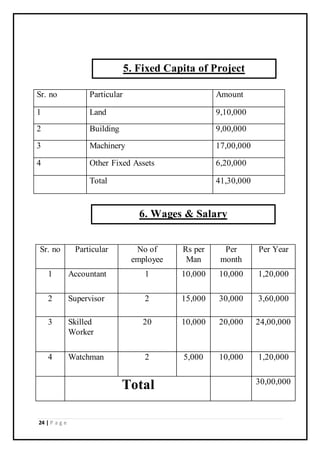
Sr. no Particular Amount
1 Land 9,10,000
2 Building 9,00,000
3 Machinery 17,00,000
4 Other Fixed Assets 6,20,000
Total 41,30,000
Sr. no Particular No of
employee
Rs per
Man
Per
month
Per Year
1 Accountant 1 10,000 10,000 1,20,000
2 Supervisor 2 15,000 30,000 3,60,000
3 Skilled
Worker
20 10,000 20,000 24,00,000
4 Watchman 2 5,000 10,000 1,20,000
Total 30,00,000
5. Fixed Capita of Project
6. Wages & Salary
25 | P a g e
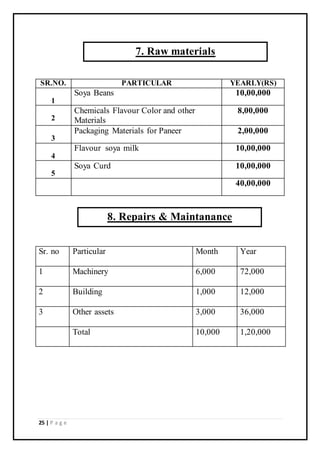
Sr. no Particular Month Year
1 Machinery 6,000 72,000
2 Building 1,000 12,000
3 Other assets 3,000 36,000
Total 10,000 1,20,000
SR.NO. PARTICULAR YEARLY(RS)
1
Soya Beans 10,00,000
2
Chemicals Flavour Color and other
Materials
8,00,000
3
Packaging Materials for Paneer 2,00,000
4
Flavour soya milk 10,00,000
5
Soya Curd 10,00,000
40,00,000
7. Raw materials
8. Repairs & Maintanance
26 | P a g e
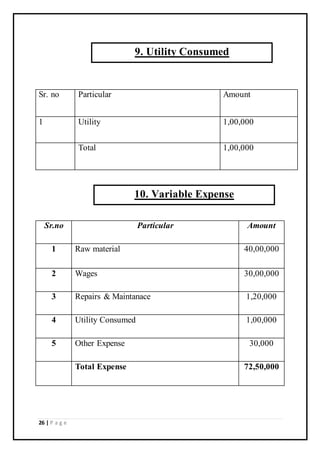
Sr. no Particular Amount
1 Utility 1,00,000
Total 1,00,000
Sr.no Particular Amount
1 Raw material 40,00,000
2 Wages 30,00,000
3 Repairs & Maintanace 1,20,000
4 Utility Consumed 1,00,000
5 Other Expense 30,000
Total Expense 72,50,000
9. Utility Consumed
10. Variable Expense
27 | P a g e
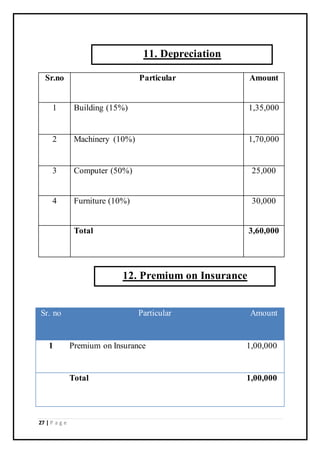
Sr.no Particular Amount
1 Building (15%) 1,35,000
2 Machinery (10%) 1,70,000
3 Computer (50%) 25,000
4 Furniture (10%) 30,000
Total 3,60,000
Sr. no Particular Amount
1 Premium on Insurance 1,00,000
Total 1,00,000
11. Depreciation
12. Premium on Insurance
28 | P a g e
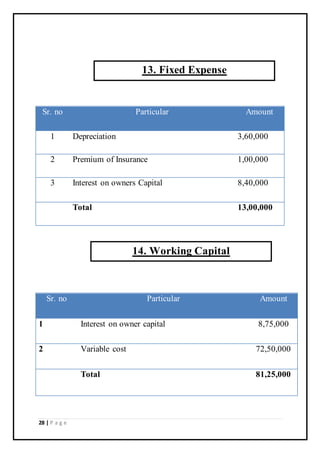
Sr. no Particular Amount
1 Depreciation 3,60,000
2 Premium of Insurance 1,00,000
3 Interest on owners Capital 8,40,000
Total 13,00,000
Sr. no Particular Amount
1 Interest on owner capital 8,75,000
2 Variable cost 72,50,000
Total 81,25,000
13. Fixed Expense
14. Working Capital
29 | P a g e
Sr. no Particular Amount
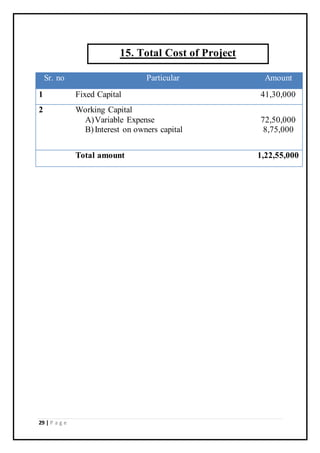
1 Fixed Capital 41,30,000
2 Working Capital
A)Variable Expense
B)Interest on owners capital
72,50,000
8,75,000
Total amount 1,22,55,000
15. Total Cost of Project
30 | P a g e
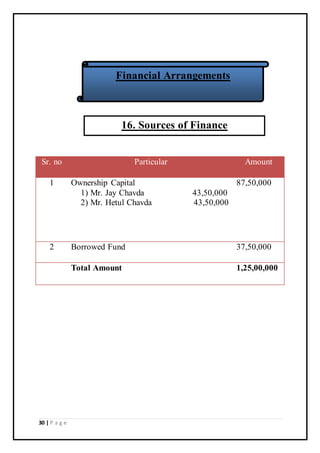
Sr. no Particular Amount
1 Ownership Capital
1) Mr. Jay Chavda 43,50,000
2) Mr. Hetul Chavda 43,50,000
87,50,000
2 Borrowed Fund 37,50,000
Total Amount 1,25,00,000
16. Sources of Finance
Financial Arrangements
31 | P a g e
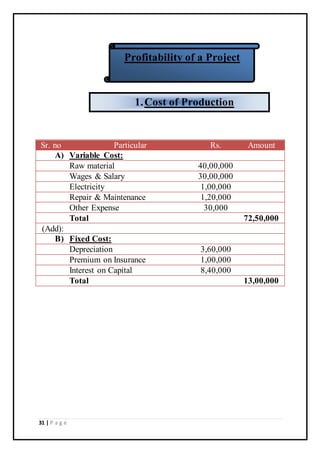
Sr. no Particular Rs. Amount
A) Variable Cost:
Raw material 40,00,000
Wages & Salary 30,00,000
Electricity 1,00,000
Repair & Maintenance 1,20,000
Other Expense 30,000
Total 72,50,000
(Add):
B) Fixed Cost:
Depreciation 3,60,000
Premium on Insurance 1,00,000
Interest on Capital 8,40,000
Total 13,00,000
Profitability of a Project
1.Cost of Production
32 | P a g e
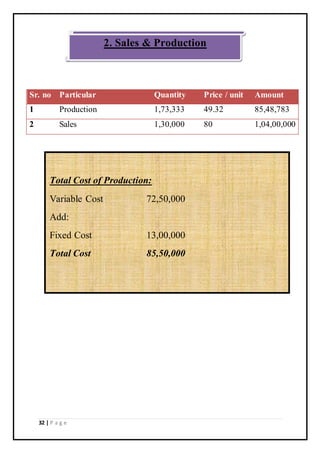
Sr. no Particular Quantity Price / unit Amount
1 Production 1,73,333 49.32 85,48,783
2 Sales 1,30,000 80 1,04,00,000
2. Sales & Production
Total Cost of Production:
Variable Cost 72,50,000
Add:
Fixed Cost 13,00,000
Total Cost 85,50,000
33 | P a g e
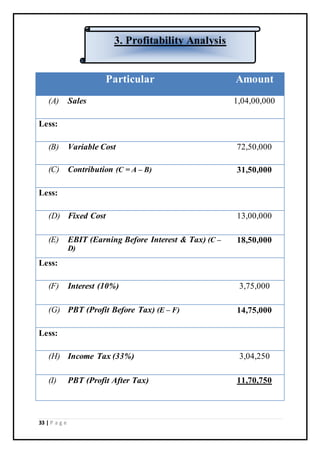
Particular Amount
(A) Sales 1,04,00,000
Less:
(B) Variable Cost 72,50,000
(C) Contribution (C = A – B) 31,50,000
Less:
(D) Fixed Cost 13,00,000
(E) EBIT (Earning Before Interest & Tax) (C –
D)
18,50,000
Less:
(F) Interest (10%) 3,75,000
(G) PBT (Profit Before Tax) (E – F) 14,75,000
Less:
(H) Income Tax (33%) 3,04,250
(I) PBT (Profit After Tax) 11,70,750
3. Profitability Analysis
34 | P a g e
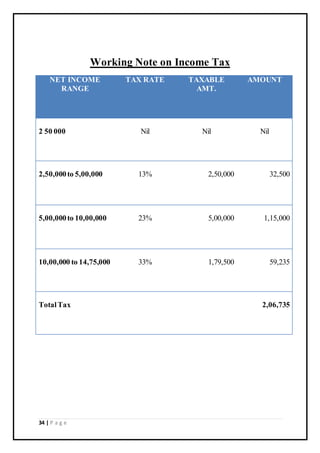
Working Note on Income Tax
NET INCOME
RANGE
TAX RATE TAXABLE
AMT.
AMOUNT
2 50 000 Nil Nil Nil
2,50,000to 5,00,000 13% 2,50,000 32,500
5,00,000to 10,00,000 23% 5,00,000 1,15,000
10,00,000 to 14,75,000 33% 1,79,500 59,235
TotalTax 2,06,735
35 | P a g e
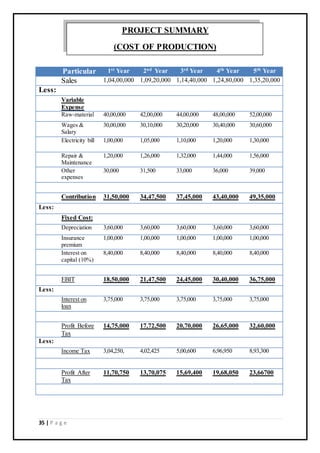
Particular 1st Year 2nd Year 3rd Year 4th Year 5th Year
Sales 1,04,00,000 1,09,20,000 1,14,40,000 1,24,80,000 1,35,20,000
Less:
Variable
Expense
Raw-material 40,00,000 42,00,000 44,00,000 48,00,000 52,00,000
Wages &
Salary
30,00,000 30,10,000 30,20,000 30,40,000 30,60,000
Electricity bill 1,00,000 1,05,000 1,10,000 1,20,000 1,30,000
Repair &
Maintenance
1,20,000 1,26,000 1,32,000 1,44,000 1,56,000
Other
expenses
30,000 31,500 33,000 36,000 39,000
Contribution 31,50,000 34,47,500 37,45,000 43,40,000 49,35,000
Less:
Fixed Cost:
Depreciation 3,60,000 3,60,000 3,60,000 3,60,000 3,60,000
Insurance
premium
1,00,000 1,00,000 1,00,000 1,00,000 1,00,000
Interest on
capital (10%)
8,40,000 8,40,000 8,40,000 8,40,000 8,40,000
EBIT 18,50,000 21,47,500 24,45,000 30,40,000 36,75,000
Less:
Interest on
loan
3,75,000 3,75,000 3,75,000 3,75,000 3,75,000
Profit Before
Tax
14,75,000 17,72,500 20,70,000 26,65,000 32,60,000
Less:
Income Tax 3,04,250, 4,02,425 5,00,600 6,96,950 8,93,300
Profit After
Tax
11,70,750 13,70,075 15,69,400 19,68,050 23,66700
PROJECT SUMMARY
(COST OF PRODUCTION)
36 | P a g e
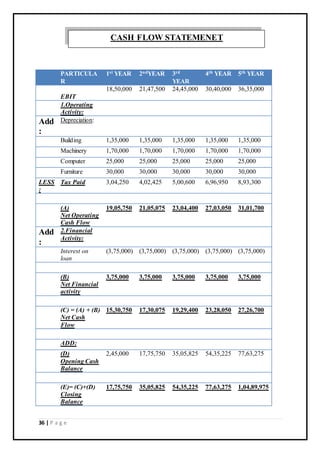
PARTICULA
R
1st YEAR 2ndYEAR 3rd
YEAR
4th YEAR 5th YEAR
EBIT
18,50,000 21,47,500 24,45,000 30,40,000 36,35,000
1.Operating
Activity:
Add
:
Depreciation:
Building 1,35,000 1,35,000 1,35,000 1,35,000 1,35,000
Machinery 1,70,000 1,70,000 1,70,000 1,70,000 1,70,000
Computer 25,000 25,000 25,000 25,000 25,000
Furniture 30,000 30,000 30,000 30,000 30,000
LESS
:
Tax Paid 3,04,250 4,02,425 5,00,600 6,96,950 8,93,300
(A)
Net Operating
Cash Flow
19,05,750 21,05,075 23,04,400 27,03,050 31,01,700
Add
:
2.Financial
Activity:
Interest on
loan
(3,75,000) (3,75,000) (3,75,000) (3,75,000) (3,75,000)
(B)
Net Financial
activity
3,75,000 3,75,000 3,75,000 3,75,000 3,75,000
(C) = (A) + (B)
Net Cash
Flow
15,30,750 17,30,075 19,29,400 23,28,050 27,26,700
ADD:
(D)
Opening Cash
Balance
2,45,000 17,75,750 35,05,825 54,35,225 77,63,275
(E)= (C)+(D)
Closing
Balance
17,75,750 35,05,825 54,35,225 77,63,275 1,04,89,975
CASH FLOW STATEMENET
37 | P a g e
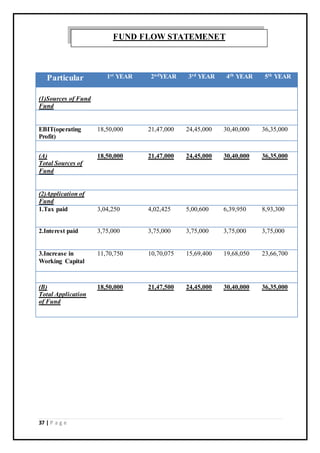
Particular 1st YEAR 2ndYEAR 3rd YEAR 4th YEAR 5th YEAR
(1)Sources of Fund
Fund
EBIT(operating
Profit)
18,50,000 21,47,000 24,45,000 30,40,000 36,35,000
(A)
Total Sources of
Fund
18,50,000 21,47,000 24,45,000 30,40,000 36,35,000
(2)Application of
Fund
1.Tax paid 3,04,250 4,02,425 5,00,600 6,39,950 8,93,300
2.Interest paid 3,75,000 3,75,000 3,75,000 3,75,000 3,75,000
3.Increase in
Working Capital
11,70,750 10,70,075 15,69,400 19,68,050 23,66,700
(B)
Total Application
of Fund
18,50,000 21,47,500 24,45,000 30,40,000 36,35,000
FUND FLOW STATEMENET
38 | P a g e
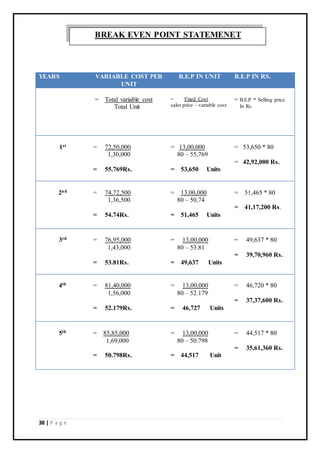
YEARS VARIABLE COST PER
UNIT
B.E.P IN UNIT B.E.P IN RS.
= Total variable cost
Total Unit
= Fixed Cost
sales price – variable cost
= B.E.P * Selling price
In Rs.
1st = 72,50,000
1,30,000
= 55.769Rs.
= 13,00,000
80 – 55,769
= 53,650 Units
= 53,650 * 80
= 42,92,000 Rs.
2nd = 74,72,500
1,36,500
= 54.74Rs.
= 13,00,000
80 – 50,74
= 51,465 Units
= 51,465 * 80
= 41,17,200 Rs.
3rd = 76,95,000
1,43,000
= 53.81Rs.
= 13,00,000
80 – 53.81
= 49,637 Units
= 49,637 * 80
= 39,70,960 Rs.
4th = 81,40,000
1,56,000
= 52.179Rs.
= 13,00,000
80 – 52.179
= 46,727 Units
= 46,720 * 80
= 37,37,600 Rs.
5th = 85,85,000
1,69,000
= 50.798Rs.
= 13,00,000
80 – 50.798
= 44,517 Unit
= 44,517 * 80
= 35,61,360 Rs.
BREAK EVEN POINT STATEMENET
39 | P a g e
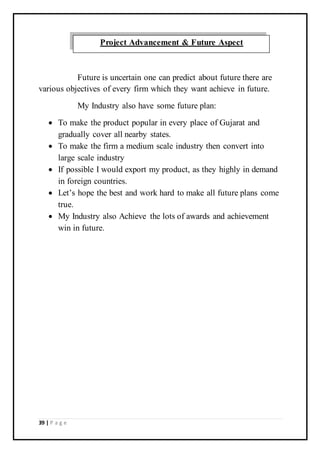
Future is uncertain one can predict about future there are
various objectives of every firm which they want achieve in future.
My Industry also have some future plan:
 To make the product popular in every place of Gujarat and
gradually cover all nearby states.
 To make the firm a medium scale industry then convert into
large scale industry
 If possible I would export my product, as they highly in demand
in foreign countries.
 Let’s hope the best and work hard to make all future plans come
true.
 My Industry also Achieve the lots of awards and achievement
win in future.
Project Advancement & Future Aspect
40 | P a g e
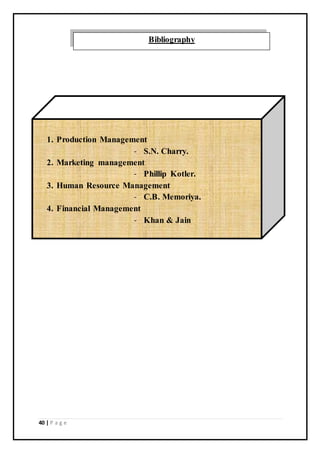
1. Production Management
- S.N. Charry.
2. Marketing management
- Phillip Kotler.
3. Human Resource Management
- C.B. Memoriya.
4. Financial Management
- Khan & Jain
Bibliography
41 | P a g e
42 | P a g e

Milk magic foods co..

  • 1.
    1 | Pa g e SR NO. PARTICULAR PAGE NO 1 Introduction 1. Introduction 3 2 Project at a Glance 4 3 Owner’s Fund / Promoters Bio Data 5 4 Proposed Location Justification 6&7 5 Product introduction and market analysis 1. Product introduction 2. Market Analysis 3. Details of raw-material 4. Supply of raw-material 5. Details of Land and Building 6. Details of Machinery 7. Supply of Machinery 10 - 20 6 Production Schedule 1. Production Process 2. Production Capacity 3. Quality Control 4. Product Feature 5. Distribution Channel 21 - 29 MAIN INDEX
  • 2.
    2 | Pa g e 7 Financial Details of a project 1. Land and Building 2. Production Capacity 3. Details of Machinery 4. Other Fixed Assets 5. Fixed Capital of Project 6. Wages and salary 7. Raw-material 8. Repairs and Maintenance 9. Electricity Consumed 10.Variable Expenses 11.Depreciation Rate 12.Insurance Premium 13.Fixed Expenses 14.Working capital 15.Total costof a Project 22 - 29 8 Financial Arrangement 1. Sources of Finance 30 9 Profitability of a project 31 -38 10 Project Summary 35 11 Cash Flow Statement for 5 year 36 12 Fund Flow Statement for 5 year 37 13 Break Even Point Statement for 5 year 38 14 Project Advancement and Future Prospect 39 15 Bibliography 40
  • 3.
    3 | Pa g e Cheese in an important dairy product in several countries. These are about 20 district varieties of cheese contain approximately the same ingredients but in different quality. Soya bean is a leguminous crop and is rich in proteins many value added products are made from it like milk, sauce, paneer etc. Soya products are increasingly becoming popular specially, amongst health conscious people. This product has potential in state like Maharashtra, MP, and Gujarat. But this note considers Madhya Pradesh as the Preferred location. Soya paneer is made from soya milk which is a rich source of high quality proteins and vitamins. Paneer is made by coagulating soya bean milk. It is white & soft. Paneer is one popular milk based products. Many vegetarian preparations are mad from it. Milk paneer is an established product but it is a costly product soya paneer would be an idea substitute in terms of price as well as nutritious value. Introduction n
  • 4.
    4 | Pa g e 1 Name of the Unit Milk Magic Foods Co. 2 Address & Communication G.I.D.C Metoda Rajkot 3 Type of unit Partnership Firm 4 Name of product Soya Paneer 5 Size of unit Medium Scale Industry 6 SSI Registration no. Apply 7 Subsidy Registration no. Apply 8 Other Registration no. Apply 9 Details of the location of the unit G.I.D.C Metoda Rajkot 10 Owner’s name & address Jay K Chavda 77, Silver Height Near, Reliance mall Rajkot 11 Name of the partner Mr. Jay K Chavda Mr. Hetul M Chavda 12 Numbers of employees 50 13 Working Hours 8 hours 14 Weekly off Wednesday 15 Banker ICICI, HDFC Banks 16 Means of Finance Owners & Borrowed 17 Accounting Year 31st March to 1st April 18 Slogan ‘A HEALTY FOOD FOR A WEALTHY MOOD’ Project at a Glance
  • 5.
    5 | Pa g e Partner-1 Name : Mr. Jay K Chavda Age : 20 Years Address : 77, Silver Height Near, Relience mall Rajkot Education Qualification : BBA Final Year (Continue) Working Responsibility : Management of Marketing Department & HR Department Contribution : 50% Partner-2 Name : Mr. Hetul M Chavda Age : 25 Years Address : 55, Alap Twin Tower 5th floor Nana mava main road Rajkot Education Qualification : M Com Working Responsibility : Management of Production Department & Finance Department Contribution : 50% Owners & Promoters Bio Data
  • 6.
    6 | Pa g e Now a day each and every entrepreneur or businessman always considered the different factors affecting to the industrial location so. Some of the decisions will be taken in advance for the establishment of the industry. In short these are the crucial factors which determined by the new businessmen. The ideal location is that which permit the lowest cost in production distribution of product and service. There are number of factors which are affecting the location as given below: 1) Transaction facility: the selection of side is govern by availability of transportation cost the need for transport arises from to suppliers to factor and once again factory to the market so there are different modes of the transportation like road, railway, air transportation etc. is becomes a dominate part of the business finally proper selection of modes transport is important factor to determined to transportation cost. 2) Availability of raw material: raw material is one of the important input for industry raw material is essential factor. 3) Availability of labour supply: availability of the labour is actual factor affecting to location decision all the industries have different low front of labour or worker for  Unskill labour  Skilled labour  Semi skilled labour 4) Availability of land: this factors is also affecting some time to the location land is the pre – requirement of the industry if land is cheaply purchased by the owner it is beneficial sometimes they have to purchase land at high rate. Proposed Location’s Justification
  • 7.
    7 | Pa g e 5) Availability of power: in olden time electricity, oil, coal and natural gas are no so easily available with the growth of industries the electrical power, oil and gas become most popular factor. Electrical consumption and it is cost has been gradually increasing so the development of electric power has to provide speedy production to the unit.
  • 8.
    8 | Pa g e Location chart Milk magic Foods Co. JYOTICNCPvt.Ltd. KALAVAD – RAJKOT ROAD G.I.D.C.SECTOR (METODA)
  • 9.
    9 | Pa g e SR. No. Activity Period 1 Preparation of Project 2 Month 2 Provision for SSI Registration 3 week 3 Financial Arrangements 5 Month 4 Purchase and Procurement of machine 2 Month 5 Installation of Machine 1 Month 6 Electrification 1 Month 7 Recruitment of staff and workers 1 Month Total Timing 1 Year & 3 Week Implementation Schedules
  • 10.
    10 | Pa g e The brand name under which “Milk Magic Foods Company” is going to manufacture the paneer is “BEST” paneer will be available in white color. These paneer can be used in marriages, hotels and restaurant as the wick which will be used is of good quality as the making of paneer is related to quality consciousness rather than quality. The paneer is softer and the best quality product. Paneer is one of the popular milk based products. Many vegetarian preparation are made from it. Milk paneer is an established product but it is a costly product soya paneer would be an ideal substitute in terms of price as well as nutritious values. Product Introduction & Market Analysis
  • 11.
    11 | Pa g e The raw materials required would be available from the following suppliers: 1) Mineral Water: Raj Minaral Supplier Plot no. 26055 GIDC Opp, Atop Frimes Factory Naroda Ahmedabad 380-015 Ph no: (079) 25262730 2) Milk Suppliers: Amul Milk Industry Plot no 332-333 Ajit Industrial Estate GIDC Rajkot Ph no: (02812) 387998 3) Chemicals: Ankit Chemical Industry C/405, Royal Tower Near Foutain park, Satellite Ahmedabad 380-015 Ph no: 98989 59996 Suppliers of Raw material
  • 12.
    12 | Pa g e Food tech Engineers offers soya paneer making machine food tech engineers manufactures a range of food and pharmaceutical machineries. The soya paneer making machine is a table top plant for producing soya milk and soya paneer. The soya paneer making machine require 5-10 Square meter area with domestic power supply for its installation. [1 HP single phase 220V] Details of Machinery
  • 13.
    13 | Pa g e 1) Filter Press : Delite Machinery Equipment Plot no 2714 B/h Bank of Baroda Navrangpura Ahmedabad 2) Grinder – cum cooker: H.H. Enterprise B/h Galaxy University Bapunagar Ahmedabad 380-015 3) Gas Fired Furance (Bhatti): G.I.D.C Metoda Rajkot 4) Deep Freezer : Arjun Electrics Company M.G Road Shreenath Nagar Rajkot Suppliers of Machinery
  • 14.
    14 | Pa g e 5) S.S Vessels Weighing Scales: Expert Coporation No.8 premanjali Society near jain temple opp, priya tower Judges Bunglow Road Ahmedabad 380-015
  • 15.
    15 | Pa g e SR NO. Particular Amount 1 Filter Press 4,00,000 2 Grinder cum cooker 7,00,000 3 Gas Fired Furnished 1,50,000 4 Deep Freezer 2,00,000 5 SS Vessels Weighing Scales 6,00,000 Total 20,50,000 Details of Machinery
  • 16.
    16 | Pa g e  Selection of Milk: The milk should however be fresh blended as obtained from different sources to cover up the required composition, the milk and protein content. The milk is finally filtered to remove any foreign materials. The milk so obtained is collected and stored.  Pasteurization of Milk: two method are in use 1. The holding and the flash 2. High temperature short time In the holding method the milk is heated to 140-150o F held at that temperature of 30 minutes and rapidly cooled to 50o F in the H.T.S.T method the milk is heated to 160-162oF held the temperature for 10-12 sec and cooled immediately to 50oF.  Curd Formation: the pasteurization milk is than set at a temperature of 68-72oF (20 to 22.2o C) and approximately 5 Production Process Selection of Milk Pasteurization of Milk Paneer Formation ………………………………………… ……… Cutting Packing
  • 17.
    17 | Pa g e percent of good starter is added. After 8 to 12 hours the milk will coagulate and from a firm cured.  Paneer Formation: the curd may be cut with curd knives as in the case of cheddar cheese after which it is cooked slowly to 98o to 110o or 36.7o to 43.3o the whey then removed and the curd allowed to drain.  Cutting: the paneer complete in finished good.  Packing: go to packaging in packing section.
  • 18.
    18 | Pa g e It is an important matter that if the sources are remain utilized than industry can’t grow and develop their production so the maximum utilization of resource are required. Item Qty (kg) Unit Soya paneer 4,00,000 3,00,000  Installed Capacity 100%  Utilized Capacity 75% Production capacity
  • 19.
    19 | Pa g e If any industry quality of product maintain trough many ways like supervision appreciation to good work and good quality product to their customers so quality of the product must be control because if quality of product is good then consumer wants to buy the product again. Quality of product can be maintain through many ways like supervision appreciation to good work etc. quality control is main aspect for any company. Quality Control
  • 20.
    20 | Pa g e A channel of distribution or marketing channel is a structure of intra company organization units and intra company agents and dealers wholesalers and retailers through which a commodity product or services in market. After production the next problem faced by a producer is that of selling and distribution the product is produced by a company to satisfy the needs of the consumers so it must reach to the consumer for whom it is made. Channel of distribution indicates the routes or pathways through which goods and services flow or move from producer to consumer. Channel of Distribution 1. O – level: Manufacturer to Consumer 2. 1 – level: Manufacturer to Retailer to Consumer 3. 2 – level: Manufacturer to Whole seller to Retailer to Consumer 4. Multi level: Manufacturer to Agent to Whole seller to Retailer to Consumers In “Milk Magic Foods Co.” they are using only on distribution channel of distribution i.e. O level channel of distribution.
  • 21.
    21 | Pa g e Product Features are characteristics of your product that describe its appearance component and capabilities. A product features is a slice of business functionality that has a corresponding benefit or set of benefits for products and user.  A soya paneer is nutritious soya paneer which is protein rich.  Soya paneer is cholesterol free and regular use of reduce cholesterol levels.  Soya Foods reduce the risk of heart deceases.  Soluble fiber in soya food controls blood sugar. Product Features
  • 22.
    22 | Pa g e Sr. no Particular Per unit price Amount 1 Daily 481 80 38,480 2 Monthly 14,444 80 11,55,520 3 Yearly 1,73,333 80 1,38,66,640 Sr. no Particular Square meter area Rate Amount 1 Land 700 1300 9,10,000 2 Building 600 1500 9,00,000 Total of Both 18,10,000 1.Details of Land & Building Financial Details of a Project 2. Production Capacity
  • 23.
    23 | Pa g e S r. no Particular Quantity Price / unit Amount 1 Filter Press 1 5,00,000 5,00,000 2 Grinder cum cooker 2 2,00,000 4,00,000 3 Gas fired furnace 1 1,00,000 1,00,000 4 Deep Freezer 1 3,00,000 3,00,000 5 SS Vessels Weighing scales 2 2,00,000 4,00,000 Total 17,00,000 Sr. no Particular Amount 1 Furniture 3,00,000 2 Electrification 2,00,000 3 Computer 50,000 4 Office Equipment 50,000 5 Preliminary Expenses 20,000 6,20,000 3. Details of Machinery 4. Other Fixed Assets
  • 24.
    24 | Pa g e Sr. no Particular Amount 1 Land 9,10,000 2 Building 9,00,000 3 Machinery 17,00,000 4 Other Fixed Assets 6,20,000 Total 41,30,000 Sr. no Particular No of employee Rs per Man Per month Per Year 1 Accountant 1 10,000 10,000 1,20,000 2 Supervisor 2 15,000 30,000 3,60,000 3 Skilled Worker 20 10,000 20,000 24,00,000 4 Watchman 2 5,000 10,000 1,20,000 Total 30,00,000 5. Fixed Capita of Project 6. Wages & Salary
  • 25.
    25 | Pa g e Sr. no Particular Month Year 1 Machinery 6,000 72,000 2 Building 1,000 12,000 3 Other assets 3,000 36,000 Total 10,000 1,20,000 SR.NO. PARTICULAR YEARLY(RS) 1 Soya Beans 10,00,000 2 Chemicals Flavour Color and other Materials 8,00,000 3 Packaging Materials for Paneer 2,00,000 4 Flavour soya milk 10,00,000 5 Soya Curd 10,00,000 40,00,000 7. Raw materials 8. Repairs & Maintanance
  • 26.
    26 | Pa g e Sr. no Particular Amount 1 Utility 1,00,000 Total 1,00,000 Sr.no Particular Amount 1 Raw material 40,00,000 2 Wages 30,00,000 3 Repairs & Maintanace 1,20,000 4 Utility Consumed 1,00,000 5 Other Expense 30,000 Total Expense 72,50,000 9. Utility Consumed 10. Variable Expense
  • 27.
    27 | Pa g e Sr.no Particular Amount 1 Building (15%) 1,35,000 2 Machinery (10%) 1,70,000 3 Computer (50%) 25,000 4 Furniture (10%) 30,000 Total 3,60,000 Sr. no Particular Amount 1 Premium on Insurance 1,00,000 Total 1,00,000 11. Depreciation 12. Premium on Insurance
  • 28.
    28 | Pa g e Sr. no Particular Amount 1 Depreciation 3,60,000 2 Premium of Insurance 1,00,000 3 Interest on owners Capital 8,40,000 Total 13,00,000 Sr. no Particular Amount 1 Interest on owner capital 8,75,000 2 Variable cost 72,50,000 Total 81,25,000 13. Fixed Expense 14. Working Capital
  • 29.
    29 | Pa g e Sr. no Particular Amount 1 Fixed Capital 41,30,000 2 Working Capital A)Variable Expense B)Interest on owners capital 72,50,000 8,75,000 Total amount 1,22,55,000 15. Total Cost of Project
  • 30.
    30 | Pa g e Sr. no Particular Amount 1 Ownership Capital 1) Mr. Jay Chavda 43,50,000 2) Mr. Hetul Chavda 43,50,000 87,50,000 2 Borrowed Fund 37,50,000 Total Amount 1,25,00,000 16. Sources of Finance Financial Arrangements
  • 31.
    31 | Pa g e Sr. no Particular Rs. Amount A) Variable Cost: Raw material 40,00,000 Wages & Salary 30,00,000 Electricity 1,00,000 Repair & Maintenance 1,20,000 Other Expense 30,000 Total 72,50,000 (Add): B) Fixed Cost: Depreciation 3,60,000 Premium on Insurance 1,00,000 Interest on Capital 8,40,000 Total 13,00,000 Profitability of a Project 1.Cost of Production
  • 32.
    32 | Pa g e Sr. no Particular Quantity Price / unit Amount 1 Production 1,73,333 49.32 85,48,783 2 Sales 1,30,000 80 1,04,00,000 2. Sales & Production Total Cost of Production: Variable Cost 72,50,000 Add: Fixed Cost 13,00,000 Total Cost 85,50,000
  • 33.
    33 | Pa g e Particular Amount (A) Sales 1,04,00,000 Less: (B) Variable Cost 72,50,000 (C) Contribution (C = A – B) 31,50,000 Less: (D) Fixed Cost 13,00,000 (E) EBIT (Earning Before Interest & Tax) (C – D) 18,50,000 Less: (F) Interest (10%) 3,75,000 (G) PBT (Profit Before Tax) (E – F) 14,75,000 Less: (H) Income Tax (33%) 3,04,250 (I) PBT (Profit After Tax) 11,70,750 3. Profitability Analysis
  • 34.
    34 | Pa g e Working Note on Income Tax NET INCOME RANGE TAX RATE TAXABLE AMT. AMOUNT 2 50 000 Nil Nil Nil 2,50,000to 5,00,000 13% 2,50,000 32,500 5,00,000to 10,00,000 23% 5,00,000 1,15,000 10,00,000 to 14,75,000 33% 1,79,500 59,235 TotalTax 2,06,735
  • 35.
    35 | Pa g e Particular 1st Year 2nd Year 3rd Year 4th Year 5th Year Sales 1,04,00,000 1,09,20,000 1,14,40,000 1,24,80,000 1,35,20,000 Less: Variable Expense Raw-material 40,00,000 42,00,000 44,00,000 48,00,000 52,00,000 Wages & Salary 30,00,000 30,10,000 30,20,000 30,40,000 30,60,000 Electricity bill 1,00,000 1,05,000 1,10,000 1,20,000 1,30,000 Repair & Maintenance 1,20,000 1,26,000 1,32,000 1,44,000 1,56,000 Other expenses 30,000 31,500 33,000 36,000 39,000 Contribution 31,50,000 34,47,500 37,45,000 43,40,000 49,35,000 Less: Fixed Cost: Depreciation 3,60,000 3,60,000 3,60,000 3,60,000 3,60,000 Insurance premium 1,00,000 1,00,000 1,00,000 1,00,000 1,00,000 Interest on capital (10%) 8,40,000 8,40,000 8,40,000 8,40,000 8,40,000 EBIT 18,50,000 21,47,500 24,45,000 30,40,000 36,75,000 Less: Interest on loan 3,75,000 3,75,000 3,75,000 3,75,000 3,75,000 Profit Before Tax 14,75,000 17,72,500 20,70,000 26,65,000 32,60,000 Less: Income Tax 3,04,250, 4,02,425 5,00,600 6,96,950 8,93,300 Profit After Tax 11,70,750 13,70,075 15,69,400 19,68,050 23,66700 PROJECT SUMMARY (COST OF PRODUCTION)
  • 36.
    36 | Pa g e PARTICULA R 1st YEAR 2ndYEAR 3rd YEAR 4th YEAR 5th YEAR EBIT 18,50,000 21,47,500 24,45,000 30,40,000 36,35,000 1.Operating Activity: Add : Depreciation: Building 1,35,000 1,35,000 1,35,000 1,35,000 1,35,000 Machinery 1,70,000 1,70,000 1,70,000 1,70,000 1,70,000 Computer 25,000 25,000 25,000 25,000 25,000 Furniture 30,000 30,000 30,000 30,000 30,000 LESS : Tax Paid 3,04,250 4,02,425 5,00,600 6,96,950 8,93,300 (A) Net Operating Cash Flow 19,05,750 21,05,075 23,04,400 27,03,050 31,01,700 Add : 2.Financial Activity: Interest on loan (3,75,000) (3,75,000) (3,75,000) (3,75,000) (3,75,000) (B) Net Financial activity 3,75,000 3,75,000 3,75,000 3,75,000 3,75,000 (C) = (A) + (B) Net Cash Flow 15,30,750 17,30,075 19,29,400 23,28,050 27,26,700 ADD: (D) Opening Cash Balance 2,45,000 17,75,750 35,05,825 54,35,225 77,63,275 (E)= (C)+(D) Closing Balance 17,75,750 35,05,825 54,35,225 77,63,275 1,04,89,975 CASH FLOW STATEMENET
  • 37.
    37 | Pa g e Particular 1st YEAR 2ndYEAR 3rd YEAR 4th YEAR 5th YEAR (1)Sources of Fund Fund EBIT(operating Profit) 18,50,000 21,47,000 24,45,000 30,40,000 36,35,000 (A) Total Sources of Fund 18,50,000 21,47,000 24,45,000 30,40,000 36,35,000 (2)Application of Fund 1.Tax paid 3,04,250 4,02,425 5,00,600 6,39,950 8,93,300 2.Interest paid 3,75,000 3,75,000 3,75,000 3,75,000 3,75,000 3.Increase in Working Capital 11,70,750 10,70,075 15,69,400 19,68,050 23,66,700 (B) Total Application of Fund 18,50,000 21,47,500 24,45,000 30,40,000 36,35,000 FUND FLOW STATEMENET
  • 38.
    38 | Pa g e YEARS VARIABLE COST PER UNIT B.E.P IN UNIT B.E.P IN RS. = Total variable cost Total Unit = Fixed Cost sales price – variable cost = B.E.P * Selling price In Rs. 1st = 72,50,000 1,30,000 = 55.769Rs. = 13,00,000 80 – 55,769 = 53,650 Units = 53,650 * 80 = 42,92,000 Rs. 2nd = 74,72,500 1,36,500 = 54.74Rs. = 13,00,000 80 – 50,74 = 51,465 Units = 51,465 * 80 = 41,17,200 Rs. 3rd = 76,95,000 1,43,000 = 53.81Rs. = 13,00,000 80 – 53.81 = 49,637 Units = 49,637 * 80 = 39,70,960 Rs. 4th = 81,40,000 1,56,000 = 52.179Rs. = 13,00,000 80 – 52.179 = 46,727 Units = 46,720 * 80 = 37,37,600 Rs. 5th = 85,85,000 1,69,000 = 50.798Rs. = 13,00,000 80 – 50.798 = 44,517 Unit = 44,517 * 80 = 35,61,360 Rs. BREAK EVEN POINT STATEMENET
  • 39.
    39 | Pa g e Future is uncertain one can predict about future there are various objectives of every firm which they want achieve in future. My Industry also have some future plan:  To make the product popular in every place of Gujarat and gradually cover all nearby states.  To make the firm a medium scale industry then convert into large scale industry  If possible I would export my product, as they highly in demand in foreign countries.  Let’s hope the best and work hard to make all future plans come true.  My Industry also Achieve the lots of awards and achievement win in future. Project Advancement & Future Aspect
  • 40.
    40 | Pa g e 1. Production Management - S.N. Charry. 2. Marketing management - Phillip Kotler. 3. Human Resource Management - C.B. Memoriya. 4. Financial Management - Khan & Jain Bibliography
  • 41.
    41 | Pa g e
  • 42.
    42 | Pa g e