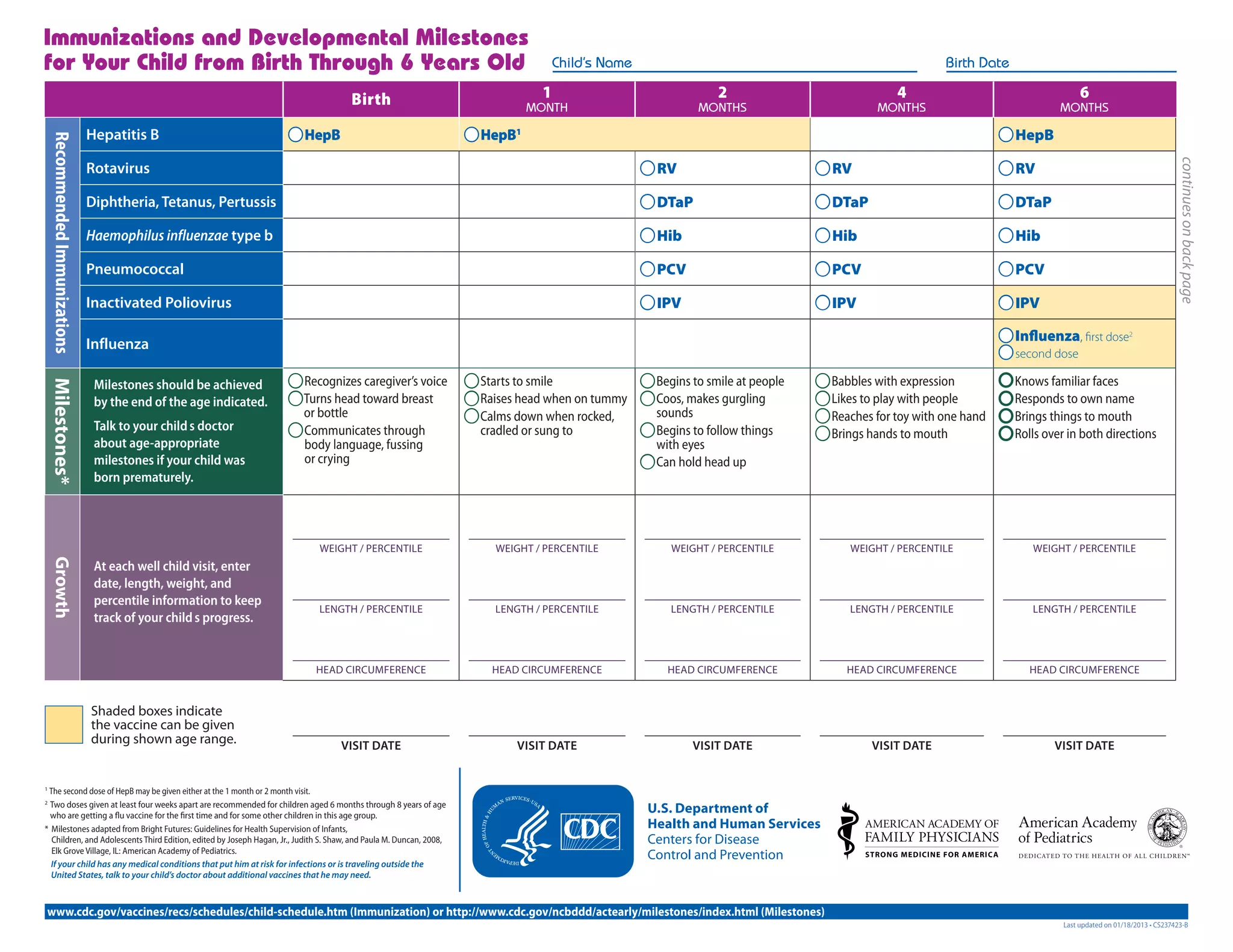
Immunizations and Developmental Milestones
for Your Child from Birth Through 6 Years Old

2

MONTH

4

MONTHS

6

MONTHS

n HepB1

MONTHS

n HepB

Rotavirus

n RV

n RV

n RV

Diphtheria, Tetanus, Pertussis

n DTaP

n DTaP

n DTaP

Haemophilus influenzae type b

n Hib

n Hib

n Hib

Pneumococcal

n PCV

n PCV

n PCV

Inactivated Poliovirus

n IPV

n IPV

continues on back page

Recommended Immunizations

n HepB

Birth Date

1

Birth
Hepatitis B

Child’s Name

n IPV
n Influenza, first dose2
n second dose

Influenza

Milestones*

Milestones should be achieved
by the end of the age indicated.

n Recognizes caregiver’s voice
n Turns head toward breast

Talk to your child’s doctor
about age-appropriate
milestones if your child was
born prematurely.

n Communicates through

Growth

At each well child visit, enter
date, length, weight, and
percentile information to keep
track of your child’s progress.

or bottle

body language, fussing
or crying

n Starts to smile
n Raises head when on tummy
n Calms down when rocked,

cradled or sung to

n Begins to smile at people
n Coos, makes gurgling

sounds

n Begins to follow things

with eyes

n Babbles with expression
n Likes to play with people
n Reaches for toy with one hand
n Brings hands to mouth

n Knows familiar faces
n Responds to own name
n Brings things to mouth
n Rolls over in both directions

n Can hold head up

WEIGHT / PERCENTILE

WEIGHT / PERCENTILE

WEIGHT / PERCENTILE

WEIGHT / PERCENTILE

LENGTH / PERCENTILE

LENGTH / PERCENTILE

LENGTH / PERCENTILE

LENGTH / PERCENTILE

LENGTH / PERCENTILE

HEAD CIRCUMFERENCE

Shaded boxes indicate
the vaccine can be given
during shown age range.

WEIGHT / PERCENTILE

HEAD CIRCUMFERENCE

HEAD CIRCUMFERENCE

HEAD CIRCUMFERENCE

HEAD CIRCUMFERENCE

VISIT DATE

VISIT DATE

VISIT DATE

VISIT DATE

VISIT DATE

1

The second dose of HepB may be given either at the 1 month or 2 month visit.
Two doses given at least four weeks apart are recommended for children aged 6 months through 8 years of age
who are getting a flu vaccine for the first time and for some other children in this age group.
* Milestones adapted from Bright Futures: Guidelines for Health Supervision of Infants,
Children, and Adolescents Third Edition, edited by Joseph Hagan, Jr., Judith S. Shaw, and Paula M. Duncan, 2008,
Elk Grove Village, IL: American Academy of Pediatrics.
If your child has any medical conditions that put him at risk for infections or is traveling outside the
United States, talk to your child’s doctor about additional vaccines that he may need.
2

For more information, call toll free 1-800-CDC-INFO (1-800-232-4636) or visit http://
www.cdc.gov/vaccines/recs/schedules/child-schedule.htm (Immunization) or :
www.cdc.gov/vaccines/recs/schedules/child-schedule.htm (Immunization) or http://www.cdc.gov/ncbddd/actearly/milestones/index.html (Milestones)
Last updated on 01/18/2013 • CS237423-B
Immunizations and Developmental Milestones
for Your Child from Birth Through 6 Years Old
12 MONTHS

Recommended Immunizations

Hepatitis B

Child’s Name

15 MONTHS

18 MONTHS

Birth Date

19 – 23 MONTHS

2–3 YEARS

4–6 YEARS

n HepB (Final dose administered between 6 and 18 months)

Diphtheria, Tetanus, Pertussis

n DTaP

Haemophilus influenzae type b

n Hib

Pneumococcal

n PCV

Inactivated Poliovirus

n IPV

Influenza

n Influenza, first dose2
n second dose (if needed)

Measles, Mumps, Rubella

n MMR

Varicella

n Varicella

Hepatitis A

n DTaP

n n Hep A

n IPV
Age Age

Milestones*

Milestones should be
achieved by the end of the
age indicated.
Talk to your child’s doctor
about age-appropriate
milestones if your child was
born prematurely.

Age Age Age

n n Influenza, first dose2
n n second dose (if needed)

n n n Influenza, first dose2
n n n second dose (if needed)

2 3

4 5 6

n MMR
n Varicella

3

n Cries when mom or dad

leaves
n Says “mama” and “dada”
n Copies gestures (for example, waves “bye bye”)
n May stand alone

n Imitates what you

n Points to show others
are doing
something interesting
n Drinks from a cup
n Says several single
words
n Scribbles on his own
n Points to one body
n Walks well
part
n May walk up steps
and run

n Plays mainly beside

n Can name most familiar
other children
things
n Shows affection for friends
n Follows two-step
commands
without prompting
n Turns book pages one at
n Plays simple makebelieve games
a time
n Throws ball overhand n Kicks a ball

n Speaks very clearly
n Tells stories
n Can print some letters or

numbers

n Hops; may be able to skip

Growth

Shaded boxes indicate
the vaccine can be given
during shown age range.

WEIGHT / PERCENTILE

WEIGHT / PERCENTILE

WEIGHT / PERCENTILE

WEIGHT / PERCENTILE

WEIGHT

WEIGHT

LENGTH / PERCENTILE

LENGTH / PERCENTILE

LENGTH / PERCENTILE

LENGTH / PERCENTILE

HEIGHT

HEIGHT

HEAD CIRCUMFERENCE

At each well child visit, enter
date, length, weight, and
percentile information to
keep track of your child’s
progress.

HEAD CIRCUMFERENCE

HEAD CIRCUMFERENCE

HEAD CIRCUMFERENCE

BMI

BMI

VISIT DATE

VISIT DATE

VISIT DATE

VISIT DATE

VISIT DATE

VISIT DATE

2	

Two doses given at least four weeks apart are recommended for children aged 6 months through 8 years of age who are getting
a flu vaccine for the first time and for some other children in this age group.
Two doses of HepA vaccine are needed for lasting protection. The first dose of HepA vaccine should be given between 12 months
and 23 months of age. The second dose should be given 6 to 18 months later. HepA vaccination may be given to any child
12 months and older to protect against HepA. Children and adolescents who did not receive the HepA vaccine and are at
high-risk, should be vaccinated against HepA.
* Milestones adapted from Bright Futures: Guidelines for Health Supervision of Infants, Children, and Adolescents Third Edition,
edited by Joseph Hagan, Jr., Judith S. Shaw, and Paula M. Duncan, 2008, Elk Grove Village, IL: American Academy of Pediatrics.
If your child has any medical conditions that put him at risk for infections or is traveling outside the United States, 

talk to your child’s doctor about additional vaccines that he may need.

3

For more information, call toll free 1-800-CDC-INFO (1-800-232-4636) or visit http://www.cdc.gov/vaccines/recs/schedules/child-schedule.htm (Immunization) or http://www.cdc.gov/ncbddd/actearly/milestones/index.html (Milestones)

Milestones tracker

  • 1.
    Immunizations and DevelopmentalMilestones for Your Child from Birth Through 6 Years Old 2 MONTH 4 MONTHS 6 MONTHS n HepB1 MONTHS n HepB Rotavirus n RV n RV n RV Diphtheria, Tetanus, Pertussis n DTaP n DTaP n DTaP Haemophilus influenzae type b n Hib n Hib n Hib Pneumococcal n PCV n PCV n PCV Inactivated Poliovirus n IPV n IPV continues on back page Recommended Immunizations n HepB Birth Date 1 Birth Hepatitis B Child’s Name n IPV n Influenza, first dose2 n second dose Influenza Milestones* Milestones should be achieved by the end of the age indicated. n Recognizes caregiver’s voice n Turns head toward breast Talk to your child’s doctor about age-appropriate milestones if your child was born prematurely. n Communicates through Growth At each well child visit, enter date, length, weight, and percentile information to keep track of your child’s progress. or bottle body language, fussing or crying n Starts to smile n Raises head when on tummy n Calms down when rocked, cradled or sung to n Begins to smile at people n Coos, makes gurgling sounds n Begins to follow things with eyes n Babbles with expression n Likes to play with people n Reaches for toy with one hand n Brings hands to mouth n Knows familiar faces n Responds to own name n Brings things to mouth n Rolls over in both directions n Can hold head up WEIGHT / PERCENTILE WEIGHT / PERCENTILE WEIGHT / PERCENTILE WEIGHT / PERCENTILE LENGTH / PERCENTILE LENGTH / PERCENTILE LENGTH / PERCENTILE LENGTH / PERCENTILE LENGTH / PERCENTILE HEAD CIRCUMFERENCE Shaded boxes indicate the vaccine can be given during shown age range. WEIGHT / PERCENTILE HEAD CIRCUMFERENCE HEAD CIRCUMFERENCE HEAD CIRCUMFERENCE HEAD CIRCUMFERENCE VISIT DATE VISIT DATE VISIT DATE VISIT DATE VISIT DATE 1 The second dose of HepB may be given either at the 1 month or 2 month visit. Two doses given at least four weeks apart are recommended for children aged 6 months through 8 years of age who are getting a flu vaccine for the first time and for some other children in this age group. * Milestones adapted from Bright Futures: Guidelines for Health Supervision of Infants, Children, and Adolescents Third Edition, edited by Joseph Hagan, Jr., Judith S. Shaw, and Paula M. Duncan, 2008, Elk Grove Village, IL: American Academy of Pediatrics. If your child has any medical conditions that put him at risk for infections or is traveling outside the United States, talk to your child’s doctor about additional vaccines that he may need. 2 For more information, call toll free 1-800-CDC-INFO (1-800-232-4636) or visit http:// www.cdc.gov/vaccines/recs/schedules/child-schedule.htm (Immunization) or : www.cdc.gov/vaccines/recs/schedules/child-schedule.htm (Immunization) or http://www.cdc.gov/ncbddd/actearly/milestones/index.html (Milestones) Last updated on 01/18/2013 • CS237423-B
  • 2.
    Immunizations and DevelopmentalMilestones for Your Child from Birth Through 6 Years Old 12 MONTHS Recommended Immunizations Hepatitis B Child’s Name 15 MONTHS 18 MONTHS Birth Date 19 – 23 MONTHS 2–3 YEARS 4–6 YEARS n HepB (Final dose administered between 6 and 18 months) Diphtheria, Tetanus, Pertussis n DTaP Haemophilus influenzae type b n Hib Pneumococcal n PCV Inactivated Poliovirus n IPV Influenza n Influenza, first dose2 n second dose (if needed) Measles, Mumps, Rubella n MMR Varicella n Varicella Hepatitis A n DTaP n n Hep A n IPV Age Age Milestones* Milestones should be achieved by the end of the age indicated. Talk to your child’s doctor about age-appropriate milestones if your child was born prematurely. Age Age Age n n Influenza, first dose2 n n second dose (if needed) n n n Influenza, first dose2 n n n second dose (if needed) 2 3 4 5 6 n MMR n Varicella 3 n Cries when mom or dad leaves n Says “mama” and “dada” n Copies gestures (for example, waves “bye bye”) n May stand alone n Imitates what you n Points to show others are doing something interesting n Drinks from a cup n Says several single words n Scribbles on his own n Points to one body n Walks well part n May walk up steps and run n Plays mainly beside n Can name most familiar other children things n Shows affection for friends n Follows two-step commands without prompting n Turns book pages one at n Plays simple makebelieve games a time n Throws ball overhand n Kicks a ball n Speaks very clearly n Tells stories n Can print some letters or numbers n Hops; may be able to skip Growth Shaded boxes indicate the vaccine can be given during shown age range. WEIGHT / PERCENTILE WEIGHT / PERCENTILE WEIGHT / PERCENTILE WEIGHT / PERCENTILE WEIGHT WEIGHT LENGTH / PERCENTILE LENGTH / PERCENTILE LENGTH / PERCENTILE LENGTH / PERCENTILE HEIGHT HEIGHT HEAD CIRCUMFERENCE At each well child visit, enter date, length, weight, and percentile information to keep track of your child’s progress. HEAD CIRCUMFERENCE HEAD CIRCUMFERENCE HEAD CIRCUMFERENCE BMI BMI VISIT DATE VISIT DATE VISIT DATE VISIT DATE VISIT DATE VISIT DATE 2 Two doses given at least four weeks apart are recommended for children aged 6 months through 8 years of age who are getting a flu vaccine for the first time and for some other children in this age group. Two doses of HepA vaccine are needed for lasting protection. The first dose of HepA vaccine should be given between 12 months and 23 months of age. The second dose should be given 6 to 18 months later. HepA vaccination may be given to any child 12 months and older to protect against HepA. Children and adolescents who did not receive the HepA vaccine and are at high-risk, should be vaccinated against HepA. * Milestones adapted from Bright Futures: Guidelines for Health Supervision of Infants, Children, and Adolescents Third Edition, edited by Joseph Hagan, Jr., Judith S. Shaw, and Paula M. Duncan, 2008, Elk Grove Village, IL: American Academy of Pediatrics. If your child has any medical conditions that put him at risk for infections or is traveling outside the United States, talk to your child’s doctor about additional vaccines that he may need. 3 For more information, call toll free 1-800-CDC-INFO (1-800-232-4636) or visit http://www.cdc.gov/vaccines/recs/schedules/child-schedule.htm (Immunization) or http://www.cdc.gov/ncbddd/actearly/milestones/index.html (Milestones)