Teaching ELL Students
Sean Mikels
Facts about ELL Students
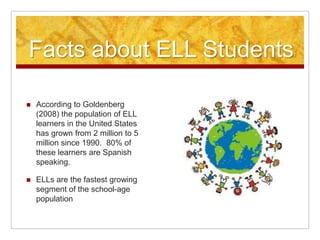
 According to Goldenberg
(2008) the population of ELL
learners in the United States
has grown from 2 million to 5
million since 1990. 80% of
these learners are Spanish
speaking.
 ELLs are the fastest growing
segment of the school-age
population
Facts about ELL Students
Continued…
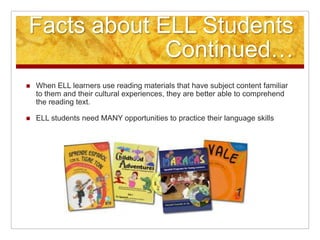
 When ELL learners use reading materials that have subject content familiar
to them and their cultural experiences, they are better able to comprehend
the reading text.
 ELL students need MANY opportunities to practice their language skills
Cultural Discontinuity
 Cultural discontinuity refers to a lack of
congruence of fit between home and school
environments (Nieto, 2004).
 This happens because these students come from
small, rural communities and become
overwhelmed by the stature and resources of
American schools (Nieto, 2004)
 Many things that American children take for
granted (lockers, cafeterias, electronic pencil
sharpeners, etc) are all new to the migrant
student.
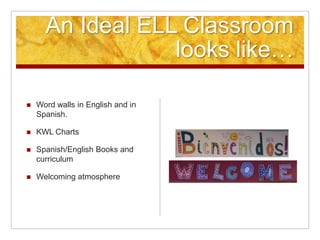
An Ideal ELL Classroom
looks like…
 Word walls in English and in
Spanish.
 KWL Charts
 Spanish/English Books and
curriculum
 Welcoming atmosphere
Successful Classroom
Practices for ELL
Students
 Modeled Reading
 Mini-lessons for explicit instruction
 Vocabulary development is crucial for ELL learners
and this should be done through explicit
vocabulary instruction.
 Also, that giving additional time for ELL learners to
complete a task, even after school time, is
important to improve learning.
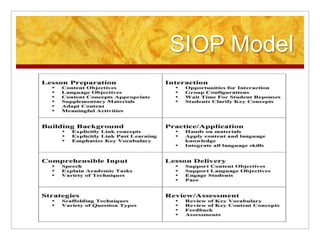
SIOP Model
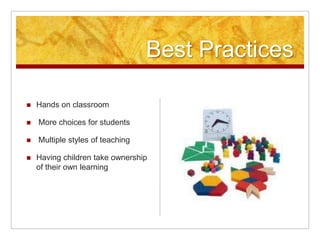
Best Practices
 Hands on classroom
 More choices for students
 Multiple styles of teaching
 Having children take ownership
of their own learning
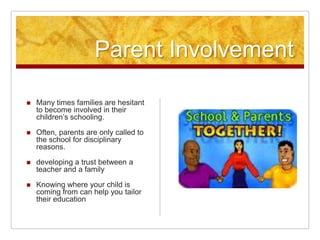
Parent Involvement
 Many times families are hesitant
to become involved in their
children’s schooling.
 Often, parents are only called to
the school for disciplinary
reasons.
 developing a trust between a
teacher and a family
 Knowing where your child is
coming from can help you tailor
their education
References
 Goldenberg, Claude (2008). Teaching English
Language Learners: What Research Does and Does
Not Say. American Educator, Summer, 1-19.
 Denise Cochran
 Bos, C.S. & Reyes, E.I., (1996) Conversations with a
latina teacher about education for language-minority
students. The Elementary School Journal 96(3)
pp.343-351
 Kimberly Warren
 Bruna, K.R., Ceballos, E.M., Chamberlin, E., & Lewis
H., (2007). Teaching science to Students from Rural
Mexico. The Science Teacher, 74 (8), 36-40.
 Sean Mikels

Mikels journal articlereview

  • 1.
  • 2.
    Facts about ELLStudents  According to Goldenberg (2008) the population of ELL learners in the United States has grown from 2 million to 5 million since 1990. 80% of these learners are Spanish speaking.  ELLs are the fastest growing segment of the school-age population
  • 3.
    Facts about ELLStudents Continued…  When ELL learners use reading materials that have subject content familiar to them and their cultural experiences, they are better able to comprehend the reading text.  ELL students need MANY opportunities to practice their language skills
  • 4.
    Cultural Discontinuity  Culturaldiscontinuity refers to a lack of congruence of fit between home and school environments (Nieto, 2004).  This happens because these students come from small, rural communities and become overwhelmed by the stature and resources of American schools (Nieto, 2004)  Many things that American children take for granted (lockers, cafeterias, electronic pencil sharpeners, etc) are all new to the migrant student.
  • 5.
    An Ideal ELLClassroom looks like…  Word walls in English and in Spanish.  KWL Charts  Spanish/English Books and curriculum  Welcoming atmosphere
  • 6.
    Successful Classroom Practices forELL Students  Modeled Reading  Mini-lessons for explicit instruction  Vocabulary development is crucial for ELL learners and this should be done through explicit vocabulary instruction.  Also, that giving additional time for ELL learners to complete a task, even after school time, is important to improve learning.
  • 7.
  • 8.
    Best Practices  Handson classroom  More choices for students  Multiple styles of teaching  Having children take ownership of their own learning
  • 9.
    Parent Involvement  Manytimes families are hesitant to become involved in their children’s schooling.  Often, parents are only called to the school for disciplinary reasons.  developing a trust between a teacher and a family  Knowing where your child is coming from can help you tailor their education
  • 10.
    References  Goldenberg, Claude(2008). Teaching English Language Learners: What Research Does and Does Not Say. American Educator, Summer, 1-19.  Denise Cochran  Bos, C.S. & Reyes, E.I., (1996) Conversations with a latina teacher about education for language-minority students. The Elementary School Journal 96(3) pp.343-351  Kimberly Warren  Bruna, K.R., Ceballos, E.M., Chamberlin, E., & Lewis H., (2007). Teaching science to Students from Rural Mexico. The Science Teacher, 74 (8), 36-40.  Sean Mikels