1
Migrate Your Payments
Platform Without
Disrupting Your Business
2
If your business is growing, you
may be on the way to outgrowing
your payments platform.
3
Switching to a full-featured payments platform can let you:
• Access better reports/analysis
• Receive funds more quickly
So how do you make the
transition smoothly?
• Accept international payments
• Improve security
4
Businesses that map out a migration
plan avoid business interruptions
and customer snafus.
5
HERE’S HOW:
First, lay the groundwork
6
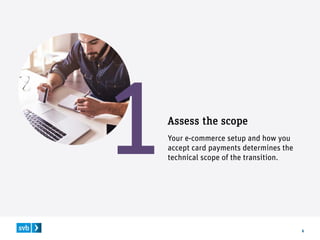
Assess the scope
Your e-commerce setup and how you
accept card payments determines the
technical scope of the transition.
7
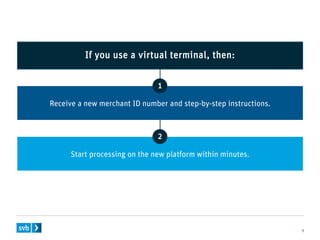
If you use a virtual terminal, then:
Start processing on the new platform within minutes.
2
Receive a new merchant ID number and step-by-step instructions.
1
8
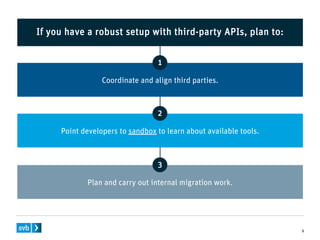
If you have a robust setup with third-party APIs, plan to:
Point developers to sandbox to learn about available tools.
2
Plan and carry out internal migration work.
3
Coordinate and align third parties.
1
9
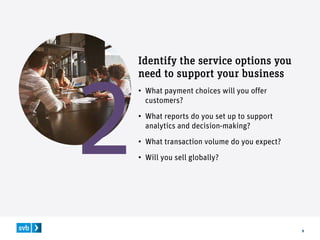
Identify the service options you
need to support your business
• What payment choices will you offer
customers?
• What reports do you set up to support
analytics and decision-making?
• What transaction volume do you expect?
• Will you sell globally?
10
Do your housekeeping to
qualify for a merchant account
• Your e-commerce site discloses terms and
conditions, such as privacy, shipping,
returns and refund policies.
• You’ve compiled the financial statements
and transaction history required by the
new payment processor.
11
NEXT:
Follow this tactical checklist
to guide the migration:
Identify, engage and inform key
stakeholders:
12
• Successful migration requires the support and
involvement of key executives and peers.
• Determine who they are, then educate them on
why the transition is necessary and how it
aligns with goals.

Assemble the right project team
13
• Tap departments across your organization to
provide the expertise needed to carry out the
project.
• Get committed resources from IT, finance and
marketing.
• Keep legal and risk management informed.

Allocate the appropriate hours
and budget
14
To avoid delays, make sure the project has the
necessary team hours and dollars dedicated to it
before kickoff.

Develop a timeline
15
 Set a schedule that identifies milestones for
each phase of the migration:
• Business analysis
• Gathering requirements
• Coding
• System setup
• Testing
• Certification
• Launch
16
Tip: As you set your schedule, keep
these points in mind:
• Review your customers’ buying patterns so you go live
when volumes are the lowest, minimizing the impact of
any potential hiccups.
• Typical migration projects take 1-4 months.
Review your business continuity
plan
17
• Work with your merchant services advisor to
evaluate your plan for handling any payment
processing glitches that arise.
• Make sure your team has a list of partner
contacts who can help resolve issues.
• Keep old systems running in parallel during the
changeover so that a rollback is possible.

Build in the time and resources
needed for testing
18
• Testing at every stage will minimize the risks of
disruption to your business.
• Don’t test only at the end — commit to testing
throughout the transition process.

19
Review: Your checklist for an efficient
payments platform migration
 Identify, engage and inform key stakeholders.
 Assemble the right project team.
 Allocate the appropriate hours and budget.
 Develop a timeline.
 Review your business continuity plan.
 Devote the resources needed for testing.
Get advice from the experts at svb.com/merchant-services/
Related Content
©2016 SVB Financial Group. All rights reserved. Silicon Valley Bank is a member of the FDIC and the Federal Reserve System. Silicon Valley Bank is the California bank subsidiary of SVB
Financial Group (Nasdaq: SIVB). SVB, SVB FINANCIAL GROUP, SILICON VALLEY BANK, MAKE NEXT HAPPEN NOW and the chevron device are trademarks of SVB Financial Group, used under
license. B-16-15095 Rev. 12-13-16.
Want to know more about how to migrate
your payments platform?

Migrate Your Payments Platform Without Disrupting Your Business

  • 1.
    1 Migrate Your Payments PlatformWithout Disrupting Your Business
  • 2.
    2 If your businessis growing, you may be on the way to outgrowing your payments platform.
  • 3.
    3 Switching to afull-featured payments platform can let you: • Access better reports/analysis • Receive funds more quickly So how do you make the transition smoothly? • Accept international payments • Improve security
  • 4.
    4 Businesses that mapout a migration plan avoid business interruptions and customer snafus.
  • 5.
  • 6.
    6 Assess the scope Youre-commerce setup and how you accept card payments determines the technical scope of the transition.
  • 7.
    7 If you usea virtual terminal, then: Start processing on the new platform within minutes. 2 Receive a new merchant ID number and step-by-step instructions. 1
  • 8.
    8 If you havea robust setup with third-party APIs, plan to: Point developers to sandbox to learn about available tools. 2 Plan and carry out internal migration work. 3 Coordinate and align third parties. 1
  • 9.
    9 Identify the serviceoptions you need to support your business • What payment choices will you offer customers? • What reports do you set up to support analytics and decision-making? • What transaction volume do you expect? • Will you sell globally?
  • 10.
    10 Do your housekeepingto qualify for a merchant account • Your e-commerce site discloses terms and conditions, such as privacy, shipping, returns and refund policies. • You’ve compiled the financial statements and transaction history required by the new payment processor.
  • 11.
    11 NEXT: Follow this tacticalchecklist to guide the migration:
  • 12.
    Identify, engage andinform key stakeholders: 12 • Successful migration requires the support and involvement of key executives and peers. • Determine who they are, then educate them on why the transition is necessary and how it aligns with goals. 
  • 13.
    Assemble the rightproject team 13 • Tap departments across your organization to provide the expertise needed to carry out the project. • Get committed resources from IT, finance and marketing. • Keep legal and risk management informed. 
  • 14.
    Allocate the appropriatehours and budget 14 To avoid delays, make sure the project has the necessary team hours and dollars dedicated to it before kickoff. 
  • 15.
    Develop a timeline 15 Set a schedule that identifies milestones for each phase of the migration: • Business analysis • Gathering requirements • Coding • System setup • Testing • Certification • Launch
  • 16.
    16 Tip: As youset your schedule, keep these points in mind: • Review your customers’ buying patterns so you go live when volumes are the lowest, minimizing the impact of any potential hiccups. • Typical migration projects take 1-4 months.
  • 17.
    Review your businesscontinuity plan 17 • Work with your merchant services advisor to evaluate your plan for handling any payment processing glitches that arise. • Make sure your team has a list of partner contacts who can help resolve issues. • Keep old systems running in parallel during the changeover so that a rollback is possible. 
  • 18.
    Build in thetime and resources needed for testing 18 • Testing at every stage will minimize the risks of disruption to your business. • Don’t test only at the end — commit to testing throughout the transition process. 
  • 19.
    19 Review: Your checklistfor an efficient payments platform migration  Identify, engage and inform key stakeholders.  Assemble the right project team.  Allocate the appropriate hours and budget.  Develop a timeline.  Review your business continuity plan.  Devote the resources needed for testing.
  • 20.
    Get advice fromthe experts at svb.com/merchant-services/ Related Content ©2016 SVB Financial Group. All rights reserved. Silicon Valley Bank is a member of the FDIC and the Federal Reserve System. Silicon Valley Bank is the California bank subsidiary of SVB Financial Group (Nasdaq: SIVB). SVB, SVB FINANCIAL GROUP, SILICON VALLEY BANK, MAKE NEXT HAPPEN NOW and the chevron device are trademarks of SVB Financial Group, used under license. B-16-15095 Rev. 12-13-16. Want to know more about how to migrate your payments platform?