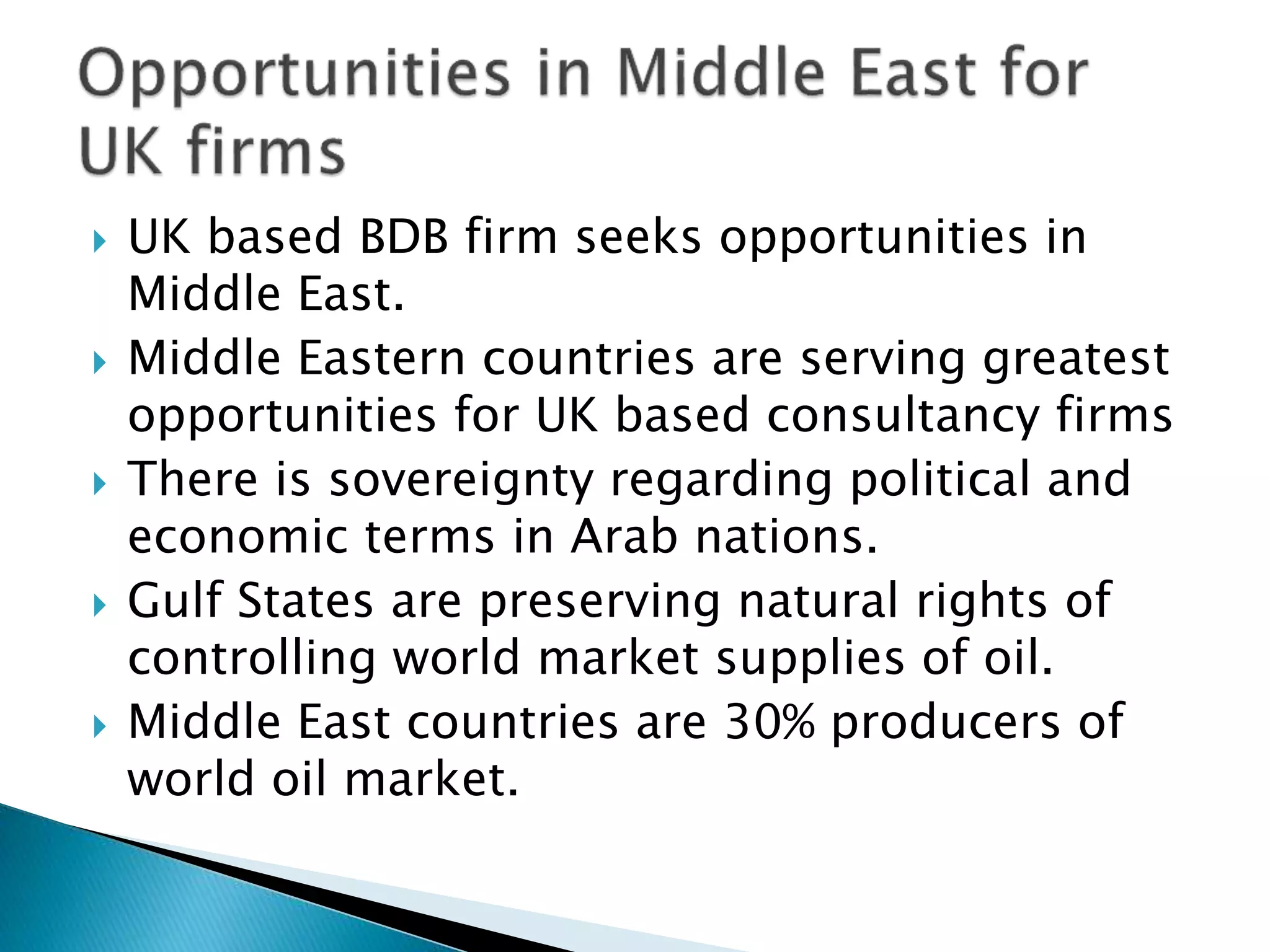
 UK based BDB firm seeks opportunities in
Middle East.
 Middle Eastern countries are serving greatest
opportunities for UK based consultancy firms
 There is sovereignty regarding political and
economic terms in Arab nations.
 Gulf States are preserving natural rights of
controlling world market supplies of oil.
 Middle East countries are 30% producers of
world oil market.
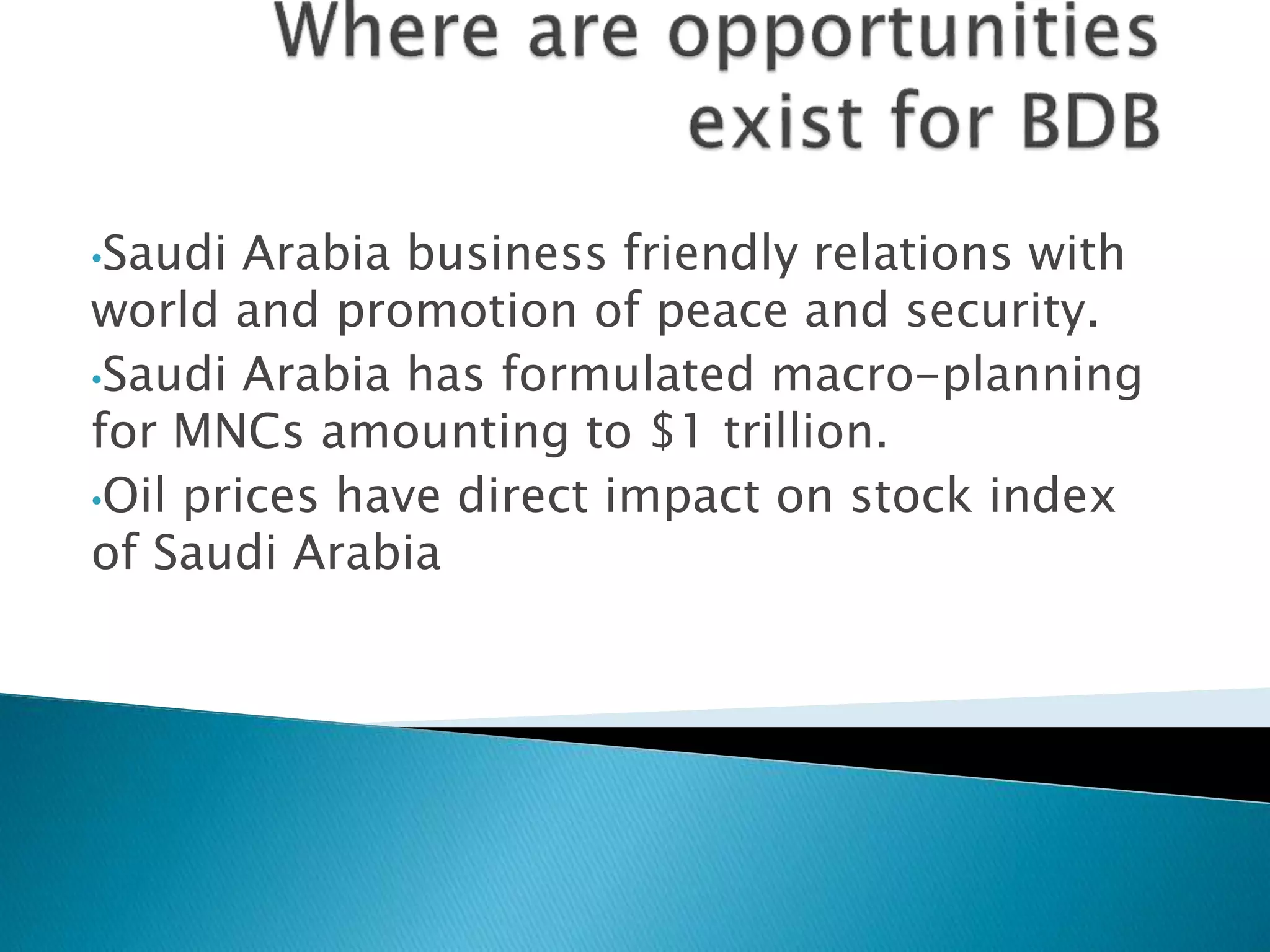
•Saudi Arabia business friendly relations with
world and promotion of peace and security.
•Saudi Arabia has formulated macro-planning
for MNCs amounting to $1 trillion.
•Oil prices have direct impact on stock index
of Saudi Arabia
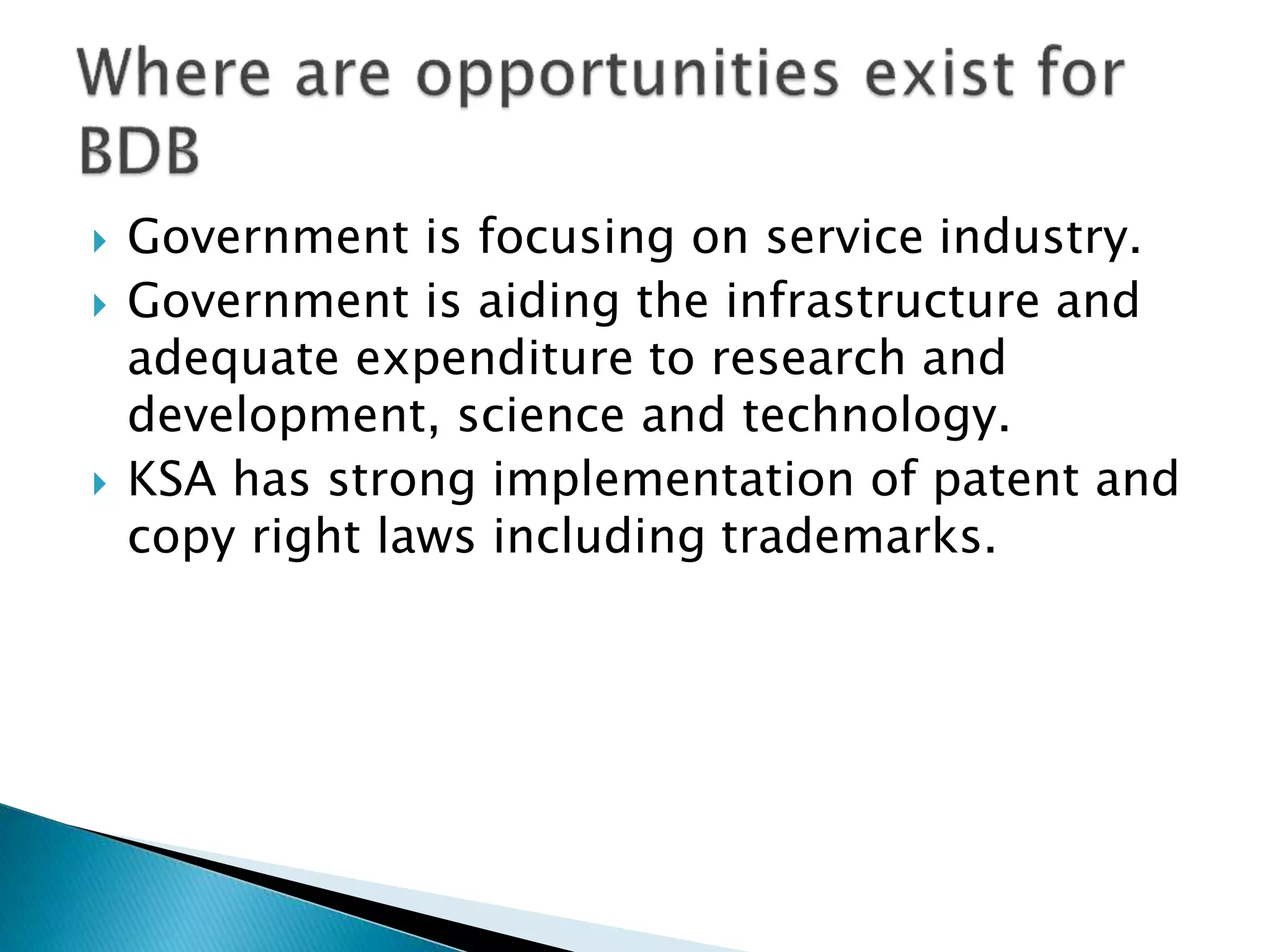
 Government is focusing on service industry.
 Government is aiding the infrastructure and
adequate expenditure to research and
development, science and technology.
 KSA has strong implementation of patent and
copy right laws including trademarks.
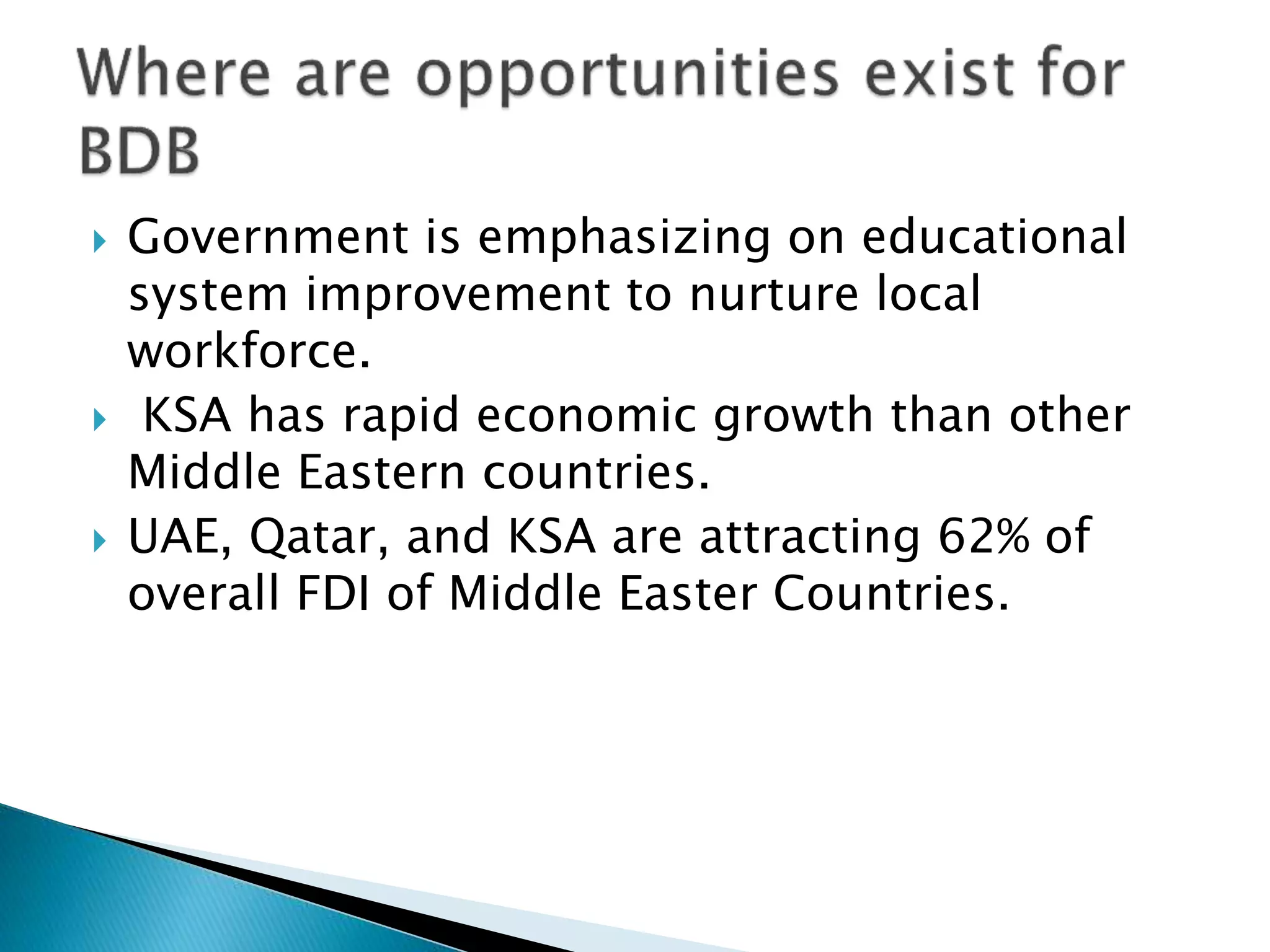
 Government is emphasizing on educational
system improvement to nurture local
workforce.
 KSA has rapid economic growth than other
Middle Eastern countries.
 UAE, Qatar, and KSA are attracting 62% of
overall FDI of Middle Easter Countries.
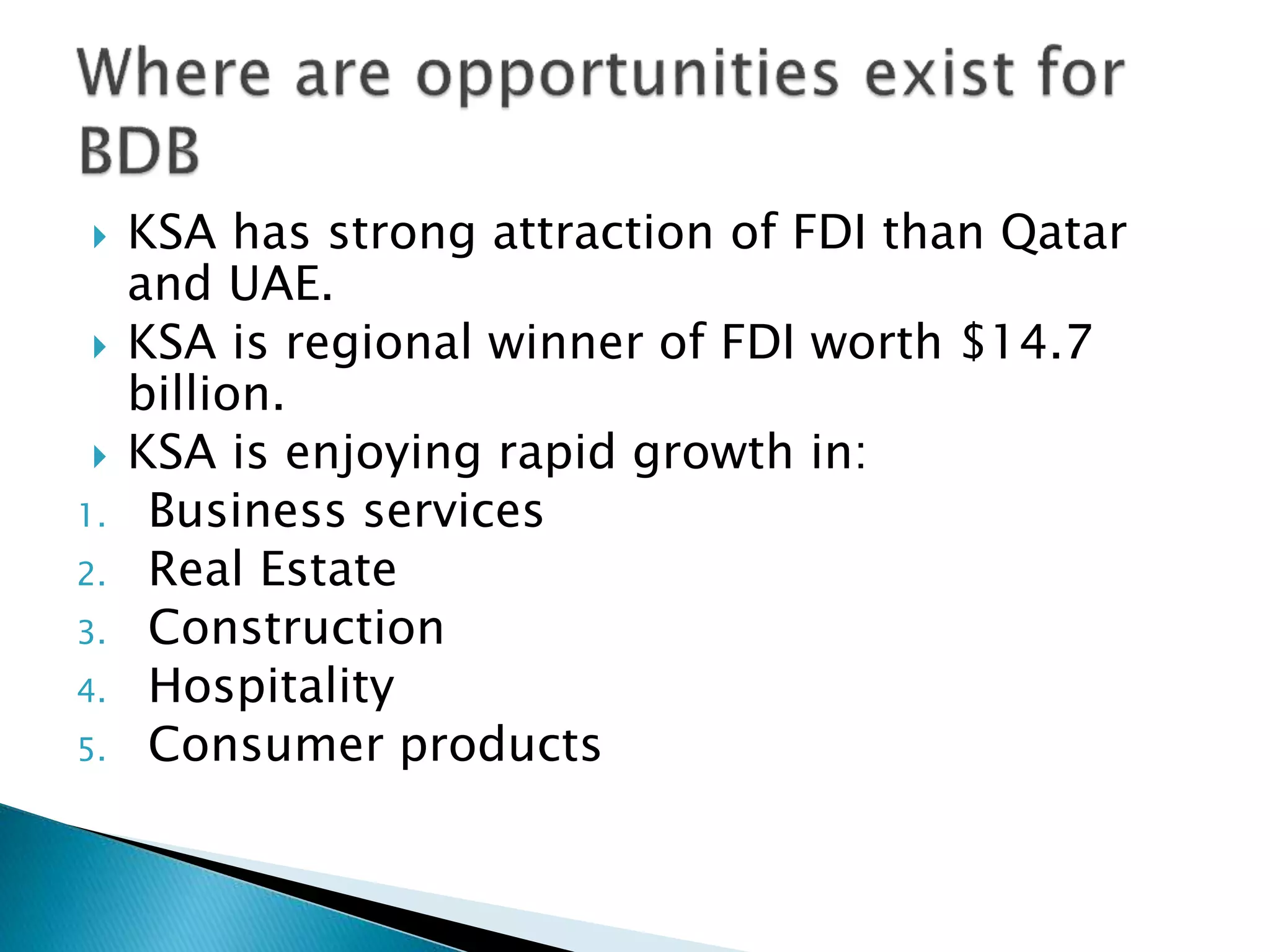
 KSA has strong attraction of FDI than Qatar
and UAE.
 KSA is regional winner of FDI worth $14.7
billion.
 KSA is enjoying rapid growth in:
1. Business services
2. Real Estate
3. Construction
4. Hospitality
5. Consumer products
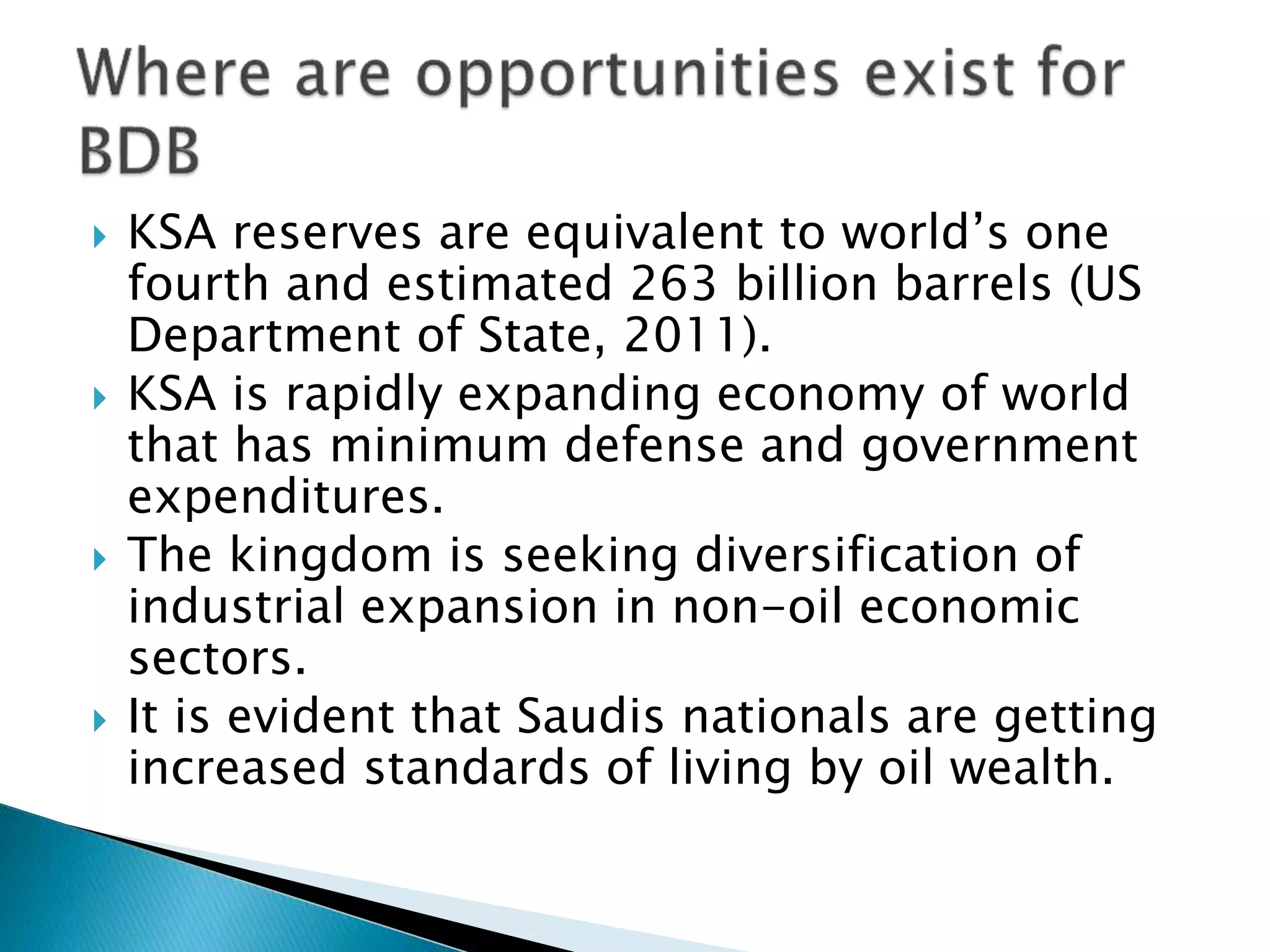
 KSA reserves are equivalent to world’s one
fourth and estimated 263 billion barrels (US
Department of State, 2011).
 KSA is rapidly expanding economy of world
that has minimum defense and government
expenditures.
 The kingdom is seeking diversification of
industrial expansion in non-oil economic
sectors.
 It is evident that Saudis nationals are getting
increased standards of living by oil wealth.
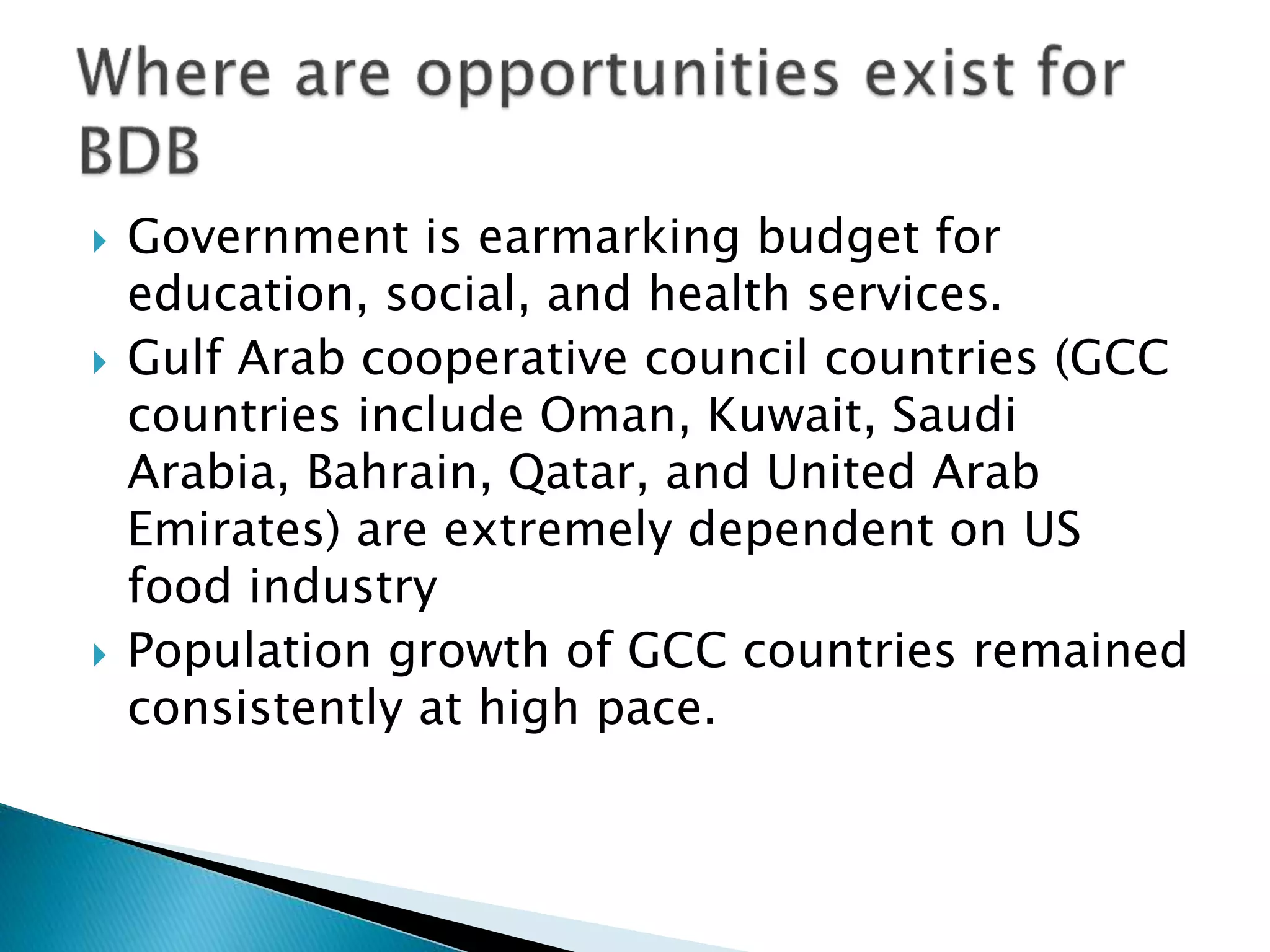
 Government is earmarking budget for
education, social, and health services.
 Gulf Arab cooperative council countries (GCC
countries include Oman, Kuwait, Saudi
Arabia, Bahrain, Qatar, and United Arab
Emirates) are extremely dependent on US
food industry
 Population growth of GCC countries remained
consistently at high pace.
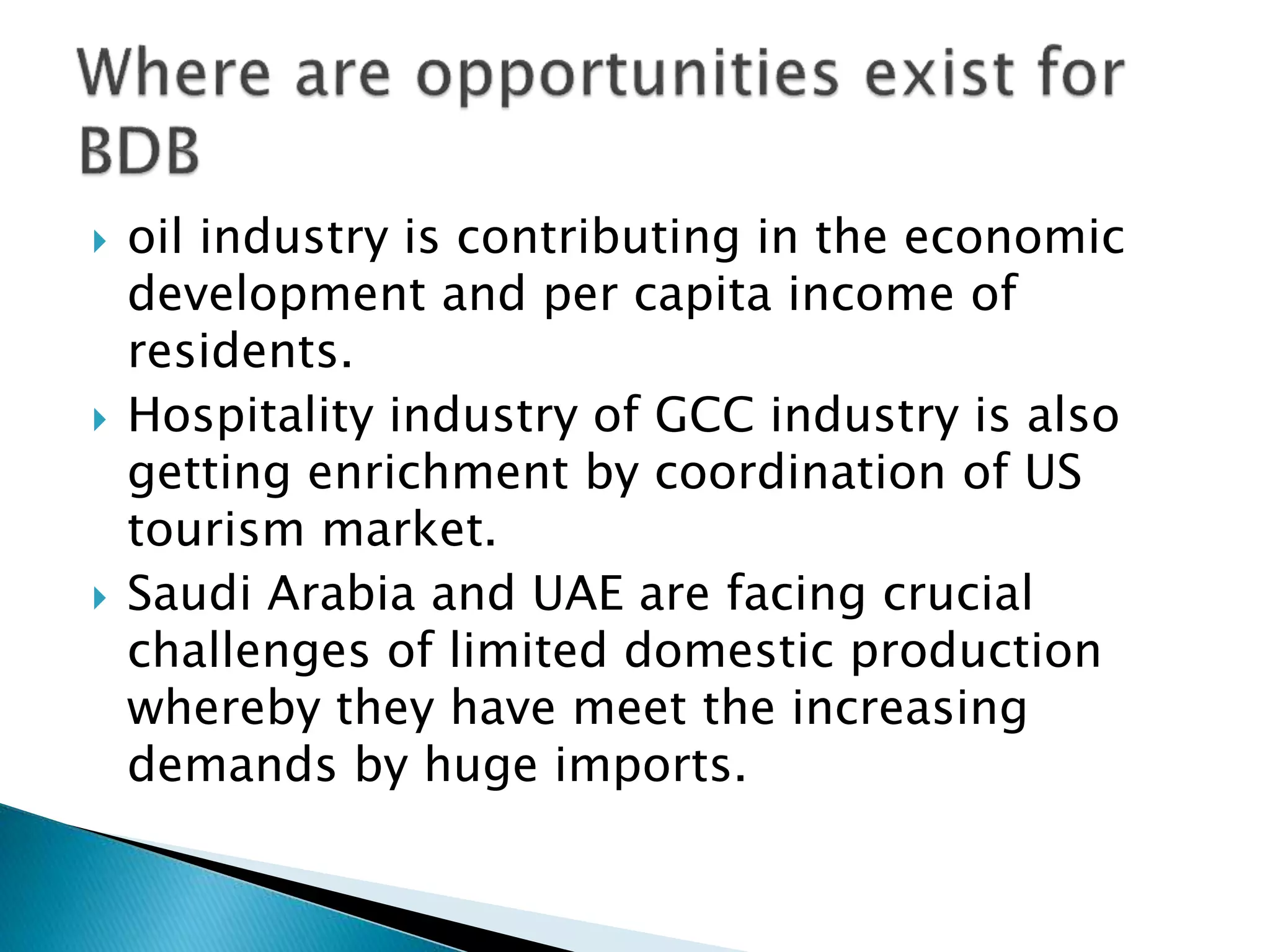
 oil industry is contributing in the economic
development and per capita income of
residents.
 Hospitality industry of GCC industry is also
getting enrichment by coordination of US
tourism market.
 Saudi Arabia and UAE are facing crucial
challenges of limited domestic production
whereby they have meet the increasing
demands by huge imports.
 http://www.arabnews.com/saudi-arabia-leads-middle-east-fdi
 Rahman, M.S., 2010. Variance Analysis of GDP for GCC
Countries. International Review of Business Research Papers,
6(2), pp.253-59.
 New York Times Inc, 2012. Energy & Environment. [Online]
Available at:
http://topics.nytimes.com/top/news/business/energy-
environment/oil-petroleum-and-gasoline/index.html
 Maghyereh, A. & Al-Kandari, A., 2007. Oil prices and stock
markets in GCC countries: new evidence from nonlinear
cointegration analysis. Managerial Finance, 33(7), pp.449-60.
 First Century Beckons. Thunderbird International Business
Review, 49(4), pp.507-33.
 Economist Newspaper Limited, 2011. The price of fear. [Online]
Available at: http://www.economist.com/node/18285768

Where are opportunities exist for bdb

  • 1.
     UK basedBDB firm seeks opportunities in Middle East.  Middle Eastern countries are serving greatest opportunities for UK based consultancy firms  There is sovereignty regarding political and economic terms in Arab nations.  Gulf States are preserving natural rights of controlling world market supplies of oil.  Middle East countries are 30% producers of world oil market.
  • 2.
    •Saudi Arabia businessfriendly relations with world and promotion of peace and security. •Saudi Arabia has formulated macro-planning for MNCs amounting to $1 trillion. •Oil prices have direct impact on stock index of Saudi Arabia
  • 3.
     Government isfocusing on service industry.  Government is aiding the infrastructure and adequate expenditure to research and development, science and technology.  KSA has strong implementation of patent and copy right laws including trademarks.
  • 4.
     Government isemphasizing on educational system improvement to nurture local workforce.  KSA has rapid economic growth than other Middle Eastern countries.  UAE, Qatar, and KSA are attracting 62% of overall FDI of Middle Easter Countries.
  • 5.
     KSA hasstrong attraction of FDI than Qatar and UAE.  KSA is regional winner of FDI worth $14.7 billion.  KSA is enjoying rapid growth in: 1. Business services 2. Real Estate 3. Construction 4. Hospitality 5. Consumer products
  • 6.
     KSA reservesare equivalent to world’s one fourth and estimated 263 billion barrels (US Department of State, 2011).  KSA is rapidly expanding economy of world that has minimum defense and government expenditures.  The kingdom is seeking diversification of industrial expansion in non-oil economic sectors.  It is evident that Saudis nationals are getting increased standards of living by oil wealth.
  • 7.
     Government isearmarking budget for education, social, and health services.  Gulf Arab cooperative council countries (GCC countries include Oman, Kuwait, Saudi Arabia, Bahrain, Qatar, and United Arab Emirates) are extremely dependent on US food industry  Population growth of GCC countries remained consistently at high pace.
  • 8.
     oil industryis contributing in the economic development and per capita income of residents.  Hospitality industry of GCC industry is also getting enrichment by coordination of US tourism market.  Saudi Arabia and UAE are facing crucial challenges of limited domestic production whereby they have meet the increasing demands by huge imports.
  • 9.
     http://www.arabnews.com/saudi-arabia-leads-middle-east-fdi  Rahman,M.S., 2010. Variance Analysis of GDP for GCC Countries. International Review of Business Research Papers, 6(2), pp.253-59.  New York Times Inc, 2012. Energy & Environment. [Online] Available at: http://topics.nytimes.com/top/news/business/energy- environment/oil-petroleum-and-gasoline/index.html  Maghyereh, A. & Al-Kandari, A., 2007. Oil prices and stock markets in GCC countries: new evidence from nonlinear cointegration analysis. Managerial Finance, 33(7), pp.449-60.  First Century Beckons. Thunderbird International Business Review, 49(4), pp.507-33.  Economist Newspaper Limited, 2011. The price of fear. [Online] Available at: http://www.economist.com/node/18285768