ANATOMY OF MIDDLE EAR
DR . RATNESH MEENA
DR . SHUBHAM AGARWAL SIR
• The middle ear cavity is an irregular air-filled
space hollowed out in the center of the
temporal bone between the external auditory
meatus laterally and inner ear medially.
• The tympanic cavity has four walls, a roof and
a floor. Because of the convexity of the medial
and lateral walls, the middle ear cavity is
constricted at its centre.
• The width of the middle
ear cavity is 2mm at
center, 6mm superiorly in
the attic , and 4mm
inferiorly in the
hypotympanum.
• In the sagittal plane, the
middle ear cleft measures
about 15mm in both
vertical and horizontal
directions.
• The middle ear is divided into:
• (i) mesotympanum(lying opposite the pars tensa)
• (ii) epitympanumor the attic(lying above the pars
tensabut medial to Shrapnell’smembrane and the
bony lateral attic wall)
• (iii) hypotympanum(lying below the level of pars
tensa)
• The portion of middle ear around the tympanic orifice
of the eustachiantube is sometimes called
Protympanum.
• It contains the ossicles, muscles and structures, like the
tympanic segment of the facial nerve.
WALLS OF MIDDLE EAR CAVITY
• SIX WALLS:
1. Lateral wall
2. Inferior wall/ floor/ jugular wall
3. Posterior wall/ mastoid wall
4. Superior wall/ roof/ tegmen
5. Anterior wall/ carotid wall
6. Medial wall/ cochlear wall
LATERAL WALL
• It is formed by three structures:
1. tympanic membrane.
2. bony tympanic ring
3. attic outer wall
EMBRYOLOGY OF LATERAL WALL:
By 4th week of IUL, a funnel shaped ectoblastic pouch
grows inwards from the 1st branchial cleft until it
reaches an endoblastic pouch growing laterally from
the first branchial pouch known as the tubotympanic
recess.
At the 7th week the mesoderm contributes to the
formation of the fibrous septum of the tymapnic
membrane.
SCUTUM
The attic outer wall, part of squamous bone, is
the bony lateral wall of the attic.
The scutum is bone above the pars flaccida
lateral to the attic. It is a thin sharp bony spur
formed by the junction of attic outer wall and
the superior wall of EAC.
TYMPANIC RING:
C shaped, in its inner aspect, there is a gutter
k/as the TYMPANIC SULCUS, which houses the
annulus of the tymapnic membrane. The
tympanic ring is deficient superiorly to form
NOTCH OF RIVINUS.
TYMAPNIC SPINES
• Anterior and posterior tymapnic spines at the junction of
attic outer wall and tympanic ring.
TYMPANIC CANALICULI:
Medial surface of the tympanic ring near the tympanic spines
presents three openings:
1. the Petrotympanic Fissure(Glaserian Fissure): receives ant
malleal ligament and transmits ant tympanic artery.
2. Iter Chordae Anterius( Canal Of Huguier): through it
chorda tympani nerve leaves the tympanic cavity toeards
the infratemporal fossa.
3. The Iter chordae posterius: chorda tymapni nerve enters
the tympanic cavity through this.
• Anterior and posterior tympanic
spines.
• Notice the direct insertion of the
tympanic membrane on the
scutum( s ) and the absence of
annulus in this zone.
MEDIAL WALL
• 6 important structures:
A) PROMONTARY: bulge in the centre of the medial wall, produced by the
basal turn of the cochlea. TYMPANIC PLEXUS is present on it.
B) PROCESSUS COCHLEARIFORMIS: hook like structure present on medial
wall. 2 significances:
*The tensor tymapani muscle originates fro, a canal in the anterior
wall of middle ear. It then runs medially where its tendon winds around
the processus cochleariformis and then turns laterally to get attached to
the neck of malleus.
* It acts as a landmark for the first genu of the facial nerve. It lies
above the processus cocleariformis.
The facial nerve enters the inner ear through the iam. After running
through the inner ear it enters the middle ear through its medial
wall. Here it takes a turn called as 1st genu and continues
horizontally backwards towards the posterior wall of middle ear as
the horizontal or tympanic segment.
C) BULGE OF LATERAL SCC: Present on the most postero-
superior portion of the medial wall just above the
horizontal or tympanic segment of the facial nerve.
D) OVAL WINDOW: It lies postero-superiorly on the
medial wall, with footplate of stapes overlying it. It
separates the vestibule from the middle ear. It lies
inferior to the horizontal or tympanic segment of facial
nerve. It measures about 3.25mm long and 1.75mm
wide.
FISSULA ANTE FENESTRAM: It is a strip of periotic
connective tissue extending from the vestibule just
anterior to the oval window through an irregular space
in the bony otic capsule to joim the mucoperiosteum
of the tympanic cavity below the pulley of the tensor
tympani muscle.
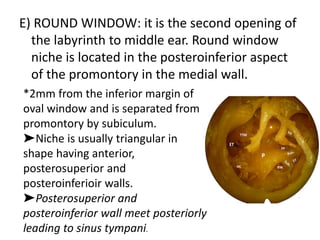
E) ROUND WINDOW: it is the second opening of
the labyrinth to middle ear. Round window
niche is located in the posteroinferior aspect
of the promontory in the medial wall.
*2mm from the inferior margin of
oval window and is separated from
promontory by subiculum.
➤Niche is usually triangular in
shape having anterior,
posterosuperior and
posteroinferioir walls.
➤Posterosuperior and
posteroinferior wall meet posteriorly
leading to sinus tympani.
• Anterior and posteroinferior margin overlies a
crest ( crista fenestra), it must be drilled away
in CI surgery to insure a good exposure to
allow the electrode to pass tangentially along
the basal turn of cochlea.
• Large hypotympanic cells border the niche
inferiorly and must not be mistaken for niche
especially during CI.
• ROUND WINDOW
MEMBRANE:
• 1.35mm horizontal
diameter and 1.79mm
vertical.
• Thickness is 40-60 microns.
• It releases mechanical
energy to the inner ear
fluids associated with
movement of stapedial
footplate.
• #Clinical Application
• >Passage through the membrane is possible for small
molecules by passive diffusion
• >and for larger molecules probably by endocytosis
• >The round window membrane acts as the main
gateway for local therapy of inner ear diseases.
• >Drugs (such as dexamethasoneand gentamicin) or
bacterial exotoxins(in case of acute and chronic
otitismedia) present in the middle ear may pass
through the round window membrane to reach the
inner ear
• Facial nerve canal: Prominence in
upper part of medial wall of
• mesotympanum.
• Runs obliquely in an
anteroposterior direction from
above the cochleariformis
process anteriorly down below
and medial to the dome of LSCC.
• In the medial wall the bony canal
of VII could be dehiscent to leave
the VII only covered with a
submucosaor even
prolapsinglying over the oval
window
• Oval window niche:
• -Located on the posterior part of mesotympanum.
• -Behind and above the promontory and inferior to facial
nerve canal.
• -Limited anteriorly and superiorly by CP and posteriorly by
ponticulus, ST and PE.
• -Kidney shaped opening leading to vestibule.
• -Oval window measures 3.25mm long and 1.75mm wide.
• Fissula ante fenestram -> it is a strip of periotic connective
tissue extending from the vestibule just anterior to the oval
window through an irregular slit-like space in the bony otic
capsule to join the mucoperiosteum of the tympanic cavity
below the pulley of the tensor tympani muscle.
• Inferior wall
• The floor of the middle ear cavity is narrow.
• It consists of a thin plate of bone that separates the middle ear
from the jugular bulb posteriorlyand the internal carotid artery
anteriorly.
• Between the artery and the jugular bulb near the medial wall, a
small canal, the inferior tympanic canaliculustransmits the
Jacobson’s nerve and the inferior tympanic artery.
The surface of this wall show irregularities due to the overlying
pneumatizedcells.
In posterior part of the floor is the root of the styloidprocess which
gives rise to a bony eminence, the styloideminence.
• 1.JUGULAR BULB:
• Connects sigmoid sinus to internal jugular vein.
• Jugular bulb lies in posterior and largest compartment
of jugular foramen.
• Dome lies at the floor below the labyrinth and medial
to the mastoid segment of the facial nerve.
• -Distance from Jugular bulb to posterior SCC 0-10 mm.
• -From bulb to facial nerve laterally 0-12mm
• Clinical Application
• Jugular Bulb Anomalies
• A high jugular bulb (HJB) is a condition in which
the jugular bulb dome rides above the tympanic
annulus.
• A HJB has an intact sigmoid plate which separates
it from the middle ear cavity.
• If the sigmoid plate is deficient, the bulb
protrudes into the middle ear cavity; this
situation is called a dehiscent jugular bulb (JBD)
• Posterior Wall
• Highest wall about 14mm.
• Formed essentially by the petrous bone.
• Divided in 2 parts
• 1.Upper third part: Aditus ad antrum connects
epitympanum to mastoid antrum posteriorly.
• 2.Lower two third part: Houses the vertical segment
of facial nerve.
• The two parts are separated by the incudal buttress, a
compact bone that runs from the tympanic ring
laterally to the lateral semicircular canal medially.
• It houses the incudal fossain its superior surface which
lodges the short process of the incus
• The Upper Part: The Aditus And Antrum
• The aditus and antrum connects the
epitympanum of the middle ear to the
mastoid antrum posteriorly.
• The aditus is of triangular shape with
dimensions of 4 ×4 ×4 mm height, length, and
width
• The Lower Part: The Posterior Wall of the
Tympanum
• The posterior wall of the tympanum is a complete
bony wall and bridges the bony annulus
tympanicusto the bony labyrinth.
• It houses the vertical segment of the facial nerve.
• This wall presents three eminences directed
anteriorly, five bony ridges, and four sinuses
delimiting the retrotympanum spaces
medial view
showing the posterior wall composed of an inferior closed part separating the middle
ear from the mastoid and a superior open part, the aditus and antrum, which
connects the middle ear to the mastoid. Notice that the floor of the aditus houses the
fossa incudis( FI ), which lodges the short process of the incus
• Posterior Wall Eminences
• The posterior wall presents three bony eminences:
• the pyramidal, chordal, and styloideminences.
• • The pyramidal eminence
• The pyramidal eminence is situated at the centerof the posterior wall
immediately behind the oval window.
• It lodges the stapedial muscle and its apex gives passage to the stapedia
ltendon.
• The pyramidal eminence communicates with the facial bony canal by a
minute aperture which transmits the stapedia lbranch of the facial nerve.
• • The chordal eminence
• The chorda leminence is situated lateral to the pyramidal eminence and 1
mm medial to the tympanic membrane.
• • The styloid eminence
• The styloid eminence or Politzer eminence is a recognized smoothed
elevation at the inferior part of the posterior wall.
The chordal ridge of Proctor
The chordal ridge runs laterally and transversally from the pyramidal
eminence to fuse with the chordal eminence.
The pyramidal ridge
The pyramidal ridge is very prominent. It runs inferiorly from the base of the
pyramidal eminence to the styloid eminence..
The styloid ridge
The styloid ridge connects the styloid prominence to the chordal eminence.
• The ponticulus
The ponticulusis a central structure in the retrotympanum.
It is a bony ridge extending from the pyramidal process to the promontory.
• The subiculum
The subiculum is a smooth bony projection that is situated posterior to the
promontory and extends inferiorly from the posterior lip of the round
window niche towards the styloideminence.
Therefore, it intervenes between the sinus tympani superiorly and the round
window inferiorly.
Wall has 3 eminences, 5 bony ridges and 4 sinuses.
• Superior wall (the tegmen)
• Tegmenabove ET is tegmentubari, above tympanic cavity is
tegmentympani and over mastoid istegmenantri.
• Cog is a hard and dense bony crest situated 1-2mm anterior to
malleushead heading vertically towardsprocessuscochleariformis
• Anterior wall (carotid wall)
• Formed entirely from the petrousbone.
• Separates middle ear cavity from petrouscarotid artery canal.
• 1.Lower Portion: -largest.
• anterior wall of hypotympanum.
• Seperates from vertical segment of petrouscarotid A.
• -2 tiny openings transmitting superior and inferior
• caroticotympanicnerve.
• 2. Middle Portion: -corresponds to protympanum
• Upper one for Tensor tympani muscle.
• Lower one for bony part of Eustachian tube.
• 3.Upper Portion: -corresponds to root of zygoma which
represents the
• anterior wall of epitympanum
• CAROTID ARTERY AND THE ANTERIOR WALL:
• Carotid artery enters the temporal bone through carotid foramen.
• It ascends vertically in the anterior wall of hypo tympanum and in the medial
• wall of the bony Eustachian tube at the area just beneath the cochlea
• (the vertical segment); then it turns anteromedially at almost a right angle
• towards the petrous apex, forming the horizontal segment anteroinferiorly
• to the cochlea
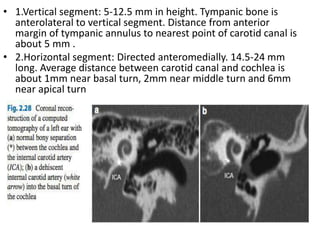
• 1.Vertical segment: 5-12.5 mm in height. Tympanic bone is
anterolateral to vertical segment. Distance from anterior
margin of tympanic annulus to nearest point of carotid canal is
about 5 mm .
• 2.Horizontal segment: Directed anteromedially. 14.5-24 mm
long. Average distance between carotid canal and cochlea is
about 1mm near basal turn, 2mm near middle turn and 6mm
near apical turn
The malleus is the largest of the three ossicles,
measuring up to 9 mm in length.
It comprises a head, neck and handle or manubrium. The
head lies in the epitympanum and is suspended by the
superior ligament, which runs upwardto
the tegmen tympani.
The head of the malleus has a saddle-shaped facet on its
posteromedial surface to articulate with the body of the
incus by a synovial joint.
Below the neck of the malleus, the bone broadens and
gives rise to the lateral process, the anterior process and
the handle.
The lateral process is a prominent landmark on the
tympanic membrane and receives the anterior and
posterior malleolar folds from the tympanic annulus.
The chorda tympani crosses the upper part of the
malleus handle on its medial surface above the insertion
of the tendon of tensor tympani, but below the neck
of the malleus itself.
The neck of the malleus connects the handle with the head
and amputation of the head by cutting through the
neck leaves both chorda tympani and tensor tympani
intact.
A slender anterior ligament arises from the
anteriorprocess to insert into the petrotympanic fissure.
The handle runs downwards, medially and
slightly backwards between the mucosal and fibrous
layers of the tympanic membrane.
The handle is very closely attached to the membrane at its
lower end, there is a fine web of mucosa separating
the membrane from the handle in the upper portion
before it becomes adherent again at the lateral process.
This can be opened surgically to create a slit
withoutperforating the membrane to allow a prosthesis to
be crimped around the malleus handle in certain types
of ossicular reconstruction.
On the deep, medial surface of the handle, near its upper
end, is a small projection into which the tendon of
the tensor tympani muscle inserts.
The incus articulates with themalleus and has a body andtwo processes.
The body lies in the epitympanum and has a cartilage-covered facet
corresponding to that on the malleus. The body of the incus is
suspended by the superior incudal ligament that is attached to the
tegmen tympani.
The short process projects backwards from the body to lie in
the fossa incudis to which it is attached by a short suspensory
ligament.
The long process descends into the mesotympanum behind and
medial to the handle of the malleus, and at its tip is a small medially
directed lentiular process.
It has been called the fourth ossicle because of its incomplete fusion
with the tip of the long process, giving the appearance of a separate
bone or at least a sesamoid bone.
The lenticular process articulates with the head of the stapes.
The stapes is shaped like a stirrup and consists of a head,
neck, the anterior and posterior crura and a footplate.
The head points laterally and has a small cartilage-covered
depression for a synovial articulation with the lenticular
process of the incus.
The stapedius tendon inserts into the posterior part of the neck
and upper portion of the posterior crus.
The two crura arise from the broader lower part of the neck and
the anterior crus is thinner and less curved than the
posterior one.
Both are hollowed out on their concave surfaces, which gives
an optimum combination of strength and lightness.
The two crura join the footplate, which usually has a convex
superior margin, an almost straight inferior margin and
curved anterior and posterior ends.
The average dimensions of the footplate are 3 mm
long- and 1.4 mm wide, and it lies in the oval window
where it is attached to the bony margins by the annular
ligament.
The long axis of the footplate is almost horizontal, with the
posterior end being slightly lower than the anterior.
The stapedius arises from the walls of the conical
cavity within the pyramid as well as from the
downward curved continuation of this canal in front of the
descending portion of the facial nerve.
A slender tendon emerges from the apex of the
pyramid and inserts into the stapes.
The muscle is supplied by a small branch of the facial
nerve.
It arises from the walls of the bony canal lying above the
Eustachian tube. Parts of it also arise from the cartilaginous
portion of the Eustachian tube and the greater wing of
the sphenoid.
The muscle then passes backwards into the tympanic cavity
where it lies on the medial wall, a little below the level of the
facial nerve.
The bony covering of the canal is often deficient in
its tympanic segment where the muscle is replaced by a
slender tendon.
This enters the processus cochleariformis where it is held
down by a transverse tendon as it turns through a right angle
to pass laterally and insert into the medial aspect of the
upper end of the malleus handle.
It is supplied by mandibular nerve from its branch, the
medial pterygoid nerve.
It enters the tympanic cavity from the posterior
canaliculus at the junction of the lateral and posterior
walls.
It runs across the medial surface of the tympanic
membrane between the mucosal and fibrous layers.
Then passes medial to the upper portion of the handle
of the malleus above the tendon of tensor tympani.
Continues forwards and leaves by way of the anterior
canaliculus, which subsequently joins the
petrotympanic fissure.
It is formed by the
– tympanic
branc
h
of the
glossopharyngeal
nerv
e(Jacobson's nerve)
and– caroticotympani
c
nerves, which
arise
from the
sympathetic plexus around the internal
carotid artery.
The nerves form a plexus on the promontory
and provide the branches to the mucous
membrane lining the tympanic cavity, Eustachian
tube and mastoid antrum and air cells.
The plexus also provides branches to join
the greater superficial petrosal nerve and
the lesser superficial petrosal nerve that
contains all the parasympathetic fibres of the
glossopharyngeal nerve.
Mucus-secreting respiratory mucosa bearing cilia.
Three distinct mucocilary pathways can be
identified–
–
–
epitympanic,
promontorial and
hypotympanic,
(largest).Each of these pathways coalesces at the tympanic orifice
of the Eustachian tube.
The mucous membrane lines the bony walls of
the tympanic cavity, and extends to cover the ossicles
and their supporting ligaments.
EAR OSSICLES
MALLEUS
INCUS
STAPES
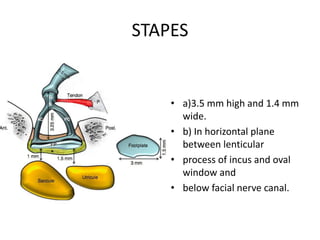
• a)3.5 mm high and 1.4 mm
wide.
• b) In horizontal plane
between lenticular
• process of incus and oval
window and
• below facial nerve canal.
MIDDLE EAR COMPARTMENTS
• Protympanum
• Lies anterior to frontal plane drawn through the anterior margin of
tympanic annulus.
• Lateral wall is thin plate of tympanic bone which separates it from
mandibularfossalaterally.
• Medial wall consists of cochlea posteriorlyand carotid canal anteriorly.
• Roof is composed of the bony canal for the tensor tympani muscle and the
tensor tympani fold separating the protympanumfrom the anterior attic.
HYPOTYMPANUM
Below a horizontal plane starting from the inferior
margin
of the fibrous annulus to the inferior margin of
cochlearpromontory .
• Anterior wall: Carotid canal medially and a dense bone laterally.
• Posterior wall:
• Formed by the inferior part of the styloid complex and the vertical
segment of the facial nerve canal.
• Outer wall: Formed by the tympanic bone.
• Medial wall:
• Formed by the lower part of the promontory and a part of the
petrous bone .
RETROTYMPANUM
• It consists of several separate spaces lying in the
posterior aspect of the tympanic cavity
• •It is the site of highest incidence of middle ear
pathologies especially retraction pockets and
cholesteatoma.
• •It includes four spaces:-
• •Two spaces lie medial to the vertical segment of
the facial nerve and the pyramidal eminence.
• •Two spaces lie lateral to them.
Facial Recess
• The lateral spaces form the facial recess.
• The facial recess is bordered medially by the facial
canal and the pyramidal eminence and laterally by the
chordatympani.
• Superiorly, the facial recess is bounded by the
incudalbuttress, bony boundary of the incudalfossa,
which lodges the short process of the incus.
• Inferiorly limited by chordofacialangle.
• The chordalridge which runs between the pyramidal
eminence and the chordaleminence, divides the facial
recess into
• -facial sinus superiorly
• -lateral tympanic sinus inferiorly
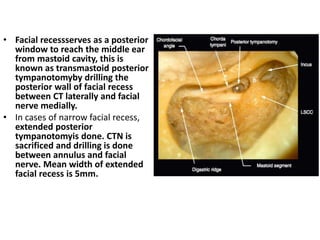
• Facial recessserves as a posterior
window to reach the middle ear
from mastoid cavity, this is
known as transmastoid posterior
tympanotomyby drilling the
posterior wall of facial recess
between CT laterally and facial
nerve medially.
• In cases of narrow facial recess,
extended posterior
tympanotomyis done. CTN is
sacrificed and drilling is done
between annulus and facial
nerve. Mean width of extended
facial recess is 5mm.
• The Medial Spaces
• They are called the tympanic sinus , are the
depressions in the posterior wall of the middle
ear lie between the facial nerve and pyramidal
eminence laterally and the labyrinth medially.
• The ponticulus, which runs from the promontory
to the pyramidal eminence divides it into two
spaces:
• The posterior tympanic sinus superiorly
• The sinus tympani inferiorly.
• Sinus tympani is divided into 3 types based on its
depth.
• Type A: Shallow and does not reach the level of
vertical portion of facial nerve posteriorly.
• Type B: Intermediate depth and lies medial to the
vertical portion of facial nerve but does not extend
posteriorly deeper than the level of the facial nerve.
• Type C: Very deep. Extends posteriorly deeper than
th facial nerve. This type cant be explored through
middle ear, therefore trans mastoid retro facial
approach is used which requires at least a distance of
2mm between facial nerve and PSCC to avoid injury.
• EPITYMPANUM (ATTIC)
• Lateral wall of the attic is formed inferiorly by
Shrapnell’s membrane and superiorly by a bony
wall, called the outer attic wall.
• Medial wall of the attic is a part of the medial
wall situated above the tympanic segment of
the facial nerve and tensor tympani muscle. It
contains the lateral semicircular canal.
• Posterior wall is occupied almost entirely by the
aditus and antrum.
• Inferiorly, the tympanic diaphragm divides the
attic into an upper unit and a lower unit.
• Anterior epitympanic recess in chronic
otitismedia:
• In cases of recurrent otorrheawith central or
anterior perforation.
• Not responding to medical therapy, recurring
despite repetitive myringotomieswith tube
insertion.
• TTF is complete and blocks the aeration of
anterior epitympanumand
anterosuperiormesotympanumcreating a
Dysventilationsyndrome
• Lower unit of the attic
( Prussak’sspace)
• The Prussak’sspace is situated inferior to the tympanic
diaphragm
• The roof is the lateral mallealfold which is a low
portion of the tympanic diaphragm.
• The floor is formed by the neck of the malleus.
• The anterior limit is the anterior mallealfold.
• The lateral wall is formed by the pars flaccidaand the
lower edge of the outer attic wall, the scutum.
• The posterior wall is opened to the posterior pouch of
von Tröltschand then to the mesotympanum.
• Prussak’sspace is ventilated through the posterior
pouch of von Tröltsch.
• Prussak’sspace dysventilation and Attic
cholesteatoma:
• Possibility of closure of posterior pouch of von
troltschfollowing thick mucous secretion formation
during chronic inflammatory otitisis high.
• Selective dysventilation of the space causes
development of pars flaccida retraction pocket with
adhesion to the malleus neck.
• MESOTYMPANUM:
• The mesotympanum acts like a channel,
allowing air coming from the Eustachian tube,
to pass through the tympanic isthmus upward
to provide aeration of the whole attic.
• Limited medially by the promontory and
laterally by the pars tensa of the tympanic
membrane.
• Superiorly it is separated from the attic by the
tympanic diaphragm
Tympanic membrane compartments
:
• Anterior pouch of von
Tröltsch:
• This pouch is situated
between the anterior
malleal fold and the pars
tensa of the eardrum; it
communicates with the
supratubal recess and the
protympanum
• Posterior pouch of von
Tröltsch:
• This pouch is situated
between the posterior
malleal fold and the pars
tensa of the eardrum.
• It is the main route of
ventilation of the Prussak’s
space.
S.No BRANCH PARENT ARTERY REGION SUPPLIED
1 ANT TYMPANIC MAXILLARY TM,MALLEUS,INCUS,ANT
TYMPANIC CAVITY
2 STYLOMASTOI
D
POST AURICULAR POST PART OF TYMPANIC
CAVITY,STAPEDIUS MUSCLE
3 MASTOID STYLOMASTOID MASTOID AIR CELLS
4 PETROSAL MIDDLE MENINGEAL ROOF OF MASTOID AND ROOF
OF EPITYMPANUM
5 SUP
TYMPANIC
MIDDLE
MENINGEAL
MALLEUS ,INCUS, TENSOR
TYMPANI
6 INF TYMPANIC ASCENDING
PHARYNGEAL
MESOTYMPANUM
7 BRANCH ARTERY OF
PTERYGOID CANAL
MESO AND HYPOTYMPANUM
8 TYMPANIC
ARCHES
INTERNAL CAROTID MESO AND HYPOTYMPANUM
It is a dynamic channel that links the middle ear
with the nasopharynx.
Length = 36 mm (reached by the age of 7).
It runs downwards from the middle ear at 45° and is turned
forwards and medially.
Consists of two unequal cones, connected at their apices.
The lateral third is bony and arises from the anterior wall of
the tympanic cavity.
Medial two-thirds cartilaginous part.
Its narrowest portion is called the
isthmus, where the diameter is only 0.5 mm or
less.
It is lined with respiratory mucosa containing goblet cells
and mucous glands, having ciliated epithelium on its floor.
At its nasopharyngeal end, the mucosa is truly respiratory;
but in passing along the tube towards the middle ear,
the number of goblet cells and glands decreases, and
the ciliary carpet becomes less profuse.
It runs through the squamous and petrous portions of
the temporal bone, gradually tapering to the isthmus.
A thin plate of bone forms the roof, separating the
tube from the tensor tympani muscle above.
The carotid canal lies medially and can impinge on the
bony Eustachian tube.
The cartilaginous part of the tube is around 24 mm
long and consists of a fibrocartilaginous skeleton to
which attached the peritubal muscles.
At its upper border, the cartilage is bent over to resemble an
inverted J, forming a longer medial cartilaginous
lamina and shorter lateral cartilaginous lamina.
The cartilage is fixed to the base of the skull in a
groove between the petrous part of the temporal bone
and the greater wing of the sphenoid, which
terminates near the root of the medial pterygoid plate.
Thus, the back (posteromedial) wall is composed of
cartilage and the front (anterolateral) wall
comprises cartilage and fibrous tissue.
The apex of the cartilage is attached to the isthmus of the
bony portion, while the wider medial end protrudes into
the nasopharynx, lying directly under the mucosa to
form the torus tubarius.
In the nasopharynx, the tube opens 1-1.25 cm behind and
below the posterior end of the interior turbinate.
The opening is triangular in shape and is surrounded
above and behind by the torus.
The salpingopharyngeal fold stretches from the lower
part of the torus downwards to the wall of the pharynx.
The levator palati, as it enters the soft palate, results in a
small swelling immediately below the opening of the tube.
Behind the torus is the pharyngeal recess or fossa of
Rosenmuller.
Lymphoid tissue is present around the tubal orifice and in
the fossa of Rosenmuller, and may be prominent
in childhood.
The tensor palati muscle arises from the bony wall
and from along the whole length of the lateral
cartilaginous lamina that forms the upper portion of the
front wall of the cartilaginous tube.
From these broad origins the muscle descends, converges
to a short tendon that turns medially around the pterygoid
hamulus and then spreads out within the soft palate
to meet fibres from the other side in a midline raphe.
The tensor palati separates the tube from the otic
ganglion, the mandibular nerve and its branches,
the chorda tympani nerve and the middle meningeal
artery.
It is supplied by the Mandibular Nerve.
Salpingopharyngeus is attached to the inferior part of the
cartilage of the tube near its pharyngeal opening, and it
descends to blend with the palatopharyngeus.
Levator palati arises from the lower surface of the cartilaginous tube
and from the lower surface of the petrous bone, and from fascia forming
the upper part of the carotid sheath.
It first lies inferior to the tube, then crosses to the medial side
and spreads out into the soft palate.
Salpingopharyngeus and the levator palati are supplied from the
pharyngeal plexus.
The ascending pharyngeal and middle
meningeal arteries
supply the Eustachian tube.
The veins drain into the pharyngeal plexus and the lymphatics pass
to the retropharyngeal nodes.
The nerve supply arises from the pharyngeal branch of the
sphenopalatine ganglion (Vb) for the ostium, the nervus
spinosus (Vc) for the cartilaginous portion and from the
MASTOID ANTRUM
his air-containing space (9 mm height, 14 mm width and 7 mm depth) is
situated in the upper part of mastoid.
Vol – 1ml
BOUNDARIES -
Roof: It is formed by the tegmen antri, which separates mastoid antrum
from the middle cranial fossa.
Lateral wall: It is formed by a 15mm thick plate of squamous part of
temporal bone which is marked on the lateral surface of mastoid by
suprameatal (Mac ewen’s) triangle. It is covered by postaural skin.
Boundaries of Mac ewen’s triangle
Linea temporalis (temporal line): A ridge of bone extending posteriorly
from the zygomatic process (marking the lower margin of temporalis
muscle and approximating the floor of middle cranial fossa)
EAC: Posterosuperior margin of EAC.
Tangent: A tangent to the posterior margin of EAC
At birth its 2mm thick and increases at rate of 1 mm/yr to attain
full thickness of 12-15mm
MAC EWEN’S TRIANGLE
Medial wall: It is formed by the petrous bone and related to the
Posterior semicircular canal
Endolymphatic sac
Dura of posterior cranial fossa
Anterior: Anteriorly mastoid antrum communicates with the attic
through the aditus ad antrum.
Medial to lateral relations are following:
Facial nerve canal
Aditus ad antrum and facial recess lie between tympanum and mastoid
antrum
Deep bony external auditory canal (EAC)
Posterior wall: It is formed by mastoid bone and communicates with
mastoid air cells.
Floor: It is formed by mastoid bone and communicates with mastoid air
TYPES OF MASTOID
The mastoid consists of “honeycomb” air cells, which lie underneath
the bony cortex. Depending on its development, three types of
mastoid are described: cellular, diploeic and acellular.
Cellular (Well-pneumatized): Mastoid cells are well developed with
thin
intervening septa.
Diploeic: Mainly there are marrow spaces with few air cells.
Acellular (Sclerotic): There are neither cells nor marrow spaces.
MASTOID AIR CELLS
• Zygomatic cells: In the root of zygoma.
• Tegmen cells: In the tegmen tympani.
• Perisinus cells: Present over the sinus plate.
• Retrofacial cells: Present round the fallopian canal of facial nerve.
• Perilabyrinthine cells: They are located above, below and behind
the labyrinth.
• Peritubal cells: They are present around the eustachian tube.
• Tip cells: These large cells lie in the tip of mastoid medial and lateral
to the
• digastric ridge.
• Marginal cells: These cells, which lie behind the sinus plate, may
extend into the occipital bone.
• Squamous cells: They lie in the squamous part of temporal bone
AIR CELLS OF TEMPORAL BONE
KORNER’S SEPTUM
Mastoid develops from the squamous and petrous parts of temporal bone.
In some cases petrosquamosal suture persists as a bony plate called Korner’s
septum, which
separates superficial squamosal cells from the deep petrosal cells.
During the mastoid surgery, Korner’s septum causes difficulty in locating the antrum
and the
deeper cells.
If not recognized, Korner’s septum leads to incomplete removal of disease during
mastoidectomy. Mastoid antrum can be entered into only after the removal of
Korner’s septum
THANK YOU

Middle ear__anatom_ytuesday[1]

  • 1.
    ANATOMY OF MIDDLEEAR DR . RATNESH MEENA DR . SHUBHAM AGARWAL SIR
  • 2.
    • The middleear cavity is an irregular air-filled space hollowed out in the center of the temporal bone between the external auditory meatus laterally and inner ear medially. • The tympanic cavity has four walls, a roof and a floor. Because of the convexity of the medial and lateral walls, the middle ear cavity is constricted at its centre.
  • 3.
    • The widthof the middle ear cavity is 2mm at center, 6mm superiorly in the attic , and 4mm inferiorly in the hypotympanum. • In the sagittal plane, the middle ear cleft measures about 15mm in both vertical and horizontal directions.
  • 4.
    • The middleear is divided into: • (i) mesotympanum(lying opposite the pars tensa) • (ii) epitympanumor the attic(lying above the pars tensabut medial to Shrapnell’smembrane and the bony lateral attic wall) • (iii) hypotympanum(lying below the level of pars tensa) • The portion of middle ear around the tympanic orifice of the eustachiantube is sometimes called Protympanum. • It contains the ossicles, muscles and structures, like the tympanic segment of the facial nerve.
  • 6.
    WALLS OF MIDDLEEAR CAVITY • SIX WALLS: 1. Lateral wall 2. Inferior wall/ floor/ jugular wall 3. Posterior wall/ mastoid wall 4. Superior wall/ roof/ tegmen 5. Anterior wall/ carotid wall 6. Medial wall/ cochlear wall
  • 8.
    LATERAL WALL • Itis formed by three structures: 1. tympanic membrane. 2. bony tympanic ring 3. attic outer wall EMBRYOLOGY OF LATERAL WALL: By 4th week of IUL, a funnel shaped ectoblastic pouch grows inwards from the 1st branchial cleft until it reaches an endoblastic pouch growing laterally from the first branchial pouch known as the tubotympanic recess. At the 7th week the mesoderm contributes to the formation of the fibrous septum of the tymapnic membrane.
  • 9.
    SCUTUM The attic outerwall, part of squamous bone, is the bony lateral wall of the attic. The scutum is bone above the pars flaccida lateral to the attic. It is a thin sharp bony spur formed by the junction of attic outer wall and the superior wall of EAC. TYMPANIC RING: C shaped, in its inner aspect, there is a gutter k/as the TYMPANIC SULCUS, which houses the annulus of the tymapnic membrane. The tympanic ring is deficient superiorly to form NOTCH OF RIVINUS.
  • 10.
    TYMAPNIC SPINES • Anteriorand posterior tymapnic spines at the junction of attic outer wall and tympanic ring. TYMPANIC CANALICULI: Medial surface of the tympanic ring near the tympanic spines presents three openings: 1. the Petrotympanic Fissure(Glaserian Fissure): receives ant malleal ligament and transmits ant tympanic artery. 2. Iter Chordae Anterius( Canal Of Huguier): through it chorda tympani nerve leaves the tympanic cavity toeards the infratemporal fossa. 3. The Iter chordae posterius: chorda tymapni nerve enters the tympanic cavity through this.
  • 11.
    • Anterior andposterior tympanic spines. • Notice the direct insertion of the tympanic membrane on the scutum( s ) and the absence of annulus in this zone.
  • 13.
    MEDIAL WALL • 6important structures: A) PROMONTARY: bulge in the centre of the medial wall, produced by the basal turn of the cochlea. TYMPANIC PLEXUS is present on it. B) PROCESSUS COCHLEARIFORMIS: hook like structure present on medial wall. 2 significances: *The tensor tymapani muscle originates fro, a canal in the anterior wall of middle ear. It then runs medially where its tendon winds around the processus cochleariformis and then turns laterally to get attached to the neck of malleus. * It acts as a landmark for the first genu of the facial nerve. It lies above the processus cocleariformis. The facial nerve enters the inner ear through the iam. After running through the inner ear it enters the middle ear through its medial wall. Here it takes a turn called as 1st genu and continues horizontally backwards towards the posterior wall of middle ear as the horizontal or tympanic segment.
  • 14.
    C) BULGE OFLATERAL SCC: Present on the most postero- superior portion of the medial wall just above the horizontal or tympanic segment of the facial nerve. D) OVAL WINDOW: It lies postero-superiorly on the medial wall, with footplate of stapes overlying it. It separates the vestibule from the middle ear. It lies inferior to the horizontal or tympanic segment of facial nerve. It measures about 3.25mm long and 1.75mm wide. FISSULA ANTE FENESTRAM: It is a strip of periotic connective tissue extending from the vestibule just anterior to the oval window through an irregular space in the bony otic capsule to joim the mucoperiosteum of the tympanic cavity below the pulley of the tensor tympani muscle.
  • 15.
    E) ROUND WINDOW:it is the second opening of the labyrinth to middle ear. Round window niche is located in the posteroinferior aspect of the promontory in the medial wall. *2mm from the inferior margin of oval window and is separated from promontory by subiculum. ➤Niche is usually triangular in shape having anterior, posterosuperior and posteroinferioir walls. ➤Posterosuperior and posteroinferior wall meet posteriorly leading to sinus tympani.
  • 16.
    • Anterior andposteroinferior margin overlies a crest ( crista fenestra), it must be drilled away in CI surgery to insure a good exposure to allow the electrode to pass tangentially along the basal turn of cochlea. • Large hypotympanic cells border the niche inferiorly and must not be mistaken for niche especially during CI.
  • 17.
    • ROUND WINDOW MEMBRANE: •1.35mm horizontal diameter and 1.79mm vertical. • Thickness is 40-60 microns. • It releases mechanical energy to the inner ear fluids associated with movement of stapedial footplate.
  • 18.
    • #Clinical Application •>Passage through the membrane is possible for small molecules by passive diffusion • >and for larger molecules probably by endocytosis • >The round window membrane acts as the main gateway for local therapy of inner ear diseases. • >Drugs (such as dexamethasoneand gentamicin) or bacterial exotoxins(in case of acute and chronic otitismedia) present in the middle ear may pass through the round window membrane to reach the inner ear
  • 19.
    • Facial nervecanal: Prominence in upper part of medial wall of • mesotympanum. • Runs obliquely in an anteroposterior direction from above the cochleariformis process anteriorly down below and medial to the dome of LSCC. • In the medial wall the bony canal of VII could be dehiscent to leave the VII only covered with a submucosaor even prolapsinglying over the oval window
  • 20.
    • Oval windowniche: • -Located on the posterior part of mesotympanum. • -Behind and above the promontory and inferior to facial nerve canal. • -Limited anteriorly and superiorly by CP and posteriorly by ponticulus, ST and PE. • -Kidney shaped opening leading to vestibule. • -Oval window measures 3.25mm long and 1.75mm wide. • Fissula ante fenestram -> it is a strip of periotic connective tissue extending from the vestibule just anterior to the oval window through an irregular slit-like space in the bony otic capsule to join the mucoperiosteum of the tympanic cavity below the pulley of the tensor tympani muscle.
  • 21.
    • Inferior wall •The floor of the middle ear cavity is narrow. • It consists of a thin plate of bone that separates the middle ear from the jugular bulb posteriorlyand the internal carotid artery anteriorly. • Between the artery and the jugular bulb near the medial wall, a small canal, the inferior tympanic canaliculustransmits the Jacobson’s nerve and the inferior tympanic artery. The surface of this wall show irregularities due to the overlying pneumatizedcells. In posterior part of the floor is the root of the styloidprocess which gives rise to a bony eminence, the styloideminence.
  • 22.
    • 1.JUGULAR BULB: •Connects sigmoid sinus to internal jugular vein. • Jugular bulb lies in posterior and largest compartment of jugular foramen. • Dome lies at the floor below the labyrinth and medial to the mastoid segment of the facial nerve. • -Distance from Jugular bulb to posterior SCC 0-10 mm. • -From bulb to facial nerve laterally 0-12mm
  • 23.
    • Clinical Application •Jugular Bulb Anomalies • A high jugular bulb (HJB) is a condition in which the jugular bulb dome rides above the tympanic annulus. • A HJB has an intact sigmoid plate which separates it from the middle ear cavity. • If the sigmoid plate is deficient, the bulb protrudes into the middle ear cavity; this situation is called a dehiscent jugular bulb (JBD)
  • 24.
    • Posterior Wall •Highest wall about 14mm. • Formed essentially by the petrous bone. • Divided in 2 parts • 1.Upper third part: Aditus ad antrum connects epitympanum to mastoid antrum posteriorly. • 2.Lower two third part: Houses the vertical segment of facial nerve. • The two parts are separated by the incudal buttress, a compact bone that runs from the tympanic ring laterally to the lateral semicircular canal medially. • It houses the incudal fossain its superior surface which lodges the short process of the incus
  • 25.
    • The UpperPart: The Aditus And Antrum • The aditus and antrum connects the epitympanum of the middle ear to the mastoid antrum posteriorly. • The aditus is of triangular shape with dimensions of 4 ×4 ×4 mm height, length, and width
  • 26.
    • The LowerPart: The Posterior Wall of the Tympanum • The posterior wall of the tympanum is a complete bony wall and bridges the bony annulus tympanicusto the bony labyrinth. • It houses the vertical segment of the facial nerve. • This wall presents three eminences directed anteriorly, five bony ridges, and four sinuses delimiting the retrotympanum spaces
  • 27.
    medial view showing theposterior wall composed of an inferior closed part separating the middle ear from the mastoid and a superior open part, the aditus and antrum, which connects the middle ear to the mastoid. Notice that the floor of the aditus houses the fossa incudis( FI ), which lodges the short process of the incus
  • 28.
    • Posterior WallEminences • The posterior wall presents three bony eminences: • the pyramidal, chordal, and styloideminences. • • The pyramidal eminence • The pyramidal eminence is situated at the centerof the posterior wall immediately behind the oval window. • It lodges the stapedial muscle and its apex gives passage to the stapedia ltendon. • The pyramidal eminence communicates with the facial bony canal by a minute aperture which transmits the stapedia lbranch of the facial nerve. • • The chordal eminence • The chorda leminence is situated lateral to the pyramidal eminence and 1 mm medial to the tympanic membrane. • • The styloid eminence • The styloid eminence or Politzer eminence is a recognized smoothed elevation at the inferior part of the posterior wall.
  • 29.
    The chordal ridgeof Proctor The chordal ridge runs laterally and transversally from the pyramidal eminence to fuse with the chordal eminence. The pyramidal ridge The pyramidal ridge is very prominent. It runs inferiorly from the base of the pyramidal eminence to the styloid eminence.. The styloid ridge The styloid ridge connects the styloid prominence to the chordal eminence. • The ponticulus The ponticulusis a central structure in the retrotympanum. It is a bony ridge extending from the pyramidal process to the promontory. • The subiculum The subiculum is a smooth bony projection that is situated posterior to the promontory and extends inferiorly from the posterior lip of the round window niche towards the styloideminence. Therefore, it intervenes between the sinus tympani superiorly and the round window inferiorly.
  • 30.
    Wall has 3eminences, 5 bony ridges and 4 sinuses.
  • 31.
    • Superior wall(the tegmen) • Tegmenabove ET is tegmentubari, above tympanic cavity is tegmentympani and over mastoid istegmenantri. • Cog is a hard and dense bony crest situated 1-2mm anterior to malleushead heading vertically towardsprocessuscochleariformis
  • 32.
    • Anterior wall(carotid wall) • Formed entirely from the petrousbone. • Separates middle ear cavity from petrouscarotid artery canal. • 1.Lower Portion: -largest. • anterior wall of hypotympanum. • Seperates from vertical segment of petrouscarotid A. • -2 tiny openings transmitting superior and inferior • caroticotympanicnerve. • 2. Middle Portion: -corresponds to protympanum • Upper one for Tensor tympani muscle. • Lower one for bony part of Eustachian tube. • 3.Upper Portion: -corresponds to root of zygoma which represents the • anterior wall of epitympanum
  • 33.
    • CAROTID ARTERYAND THE ANTERIOR WALL: • Carotid artery enters the temporal bone through carotid foramen. • It ascends vertically in the anterior wall of hypo tympanum and in the medial • wall of the bony Eustachian tube at the area just beneath the cochlea • (the vertical segment); then it turns anteromedially at almost a right angle • towards the petrous apex, forming the horizontal segment anteroinferiorly • to the cochlea
  • 34.
    • 1.Vertical segment:5-12.5 mm in height. Tympanic bone is anterolateral to vertical segment. Distance from anterior margin of tympanic annulus to nearest point of carotid canal is about 5 mm . • 2.Horizontal segment: Directed anteromedially. 14.5-24 mm long. Average distance between carotid canal and cochlea is about 1mm near basal turn, 2mm near middle turn and 6mm near apical turn
  • 36.
    The malleus isthe largest of the three ossicles, measuring up to 9 mm in length. It comprises a head, neck and handle or manubrium. The head lies in the epitympanum and is suspended by the superior ligament, which runs upwardto the tegmen tympani. The head of the malleus has a saddle-shaped facet on its posteromedial surface to articulate with the body of the incus by a synovial joint. Below the neck of the malleus, the bone broadens and gives rise to the lateral process, the anterior process and the handle. The lateral process is a prominent landmark on the tympanic membrane and receives the anterior and posterior malleolar folds from the tympanic annulus.
  • 37.
    The chorda tympanicrosses the upper part of the malleus handle on its medial surface above the insertion of the tendon of tensor tympani, but below the neck of the malleus itself. The neck of the malleus connects the handle with the head and amputation of the head by cutting through the neck leaves both chorda tympani and tensor tympani intact. A slender anterior ligament arises from the anteriorprocess to insert into the petrotympanic fissure. The handle runs downwards, medially and slightly backwards between the mucosal and fibrous layers of the tympanic membrane.
  • 38.
    The handle isvery closely attached to the membrane at its lower end, there is a fine web of mucosa separating the membrane from the handle in the upper portion before it becomes adherent again at the lateral process. This can be opened surgically to create a slit withoutperforating the membrane to allow a prosthesis to be crimped around the malleus handle in certain types of ossicular reconstruction. On the deep, medial surface of the handle, near its upper end, is a small projection into which the tendon of the tensor tympani muscle inserts.
  • 39.
    The incus articulateswith themalleus and has a body andtwo processes. The body lies in the epitympanum and has a cartilage-covered facet corresponding to that on the malleus. The body of the incus is suspended by the superior incudal ligament that is attached to the tegmen tympani. The short process projects backwards from the body to lie in the fossa incudis to which it is attached by a short suspensory ligament. The long process descends into the mesotympanum behind and medial to the handle of the malleus, and at its tip is a small medially directed lentiular process. It has been called the fourth ossicle because of its incomplete fusion with the tip of the long process, giving the appearance of a separate bone or at least a sesamoid bone. The lenticular process articulates with the head of the stapes.
  • 40.
    The stapes isshaped like a stirrup and consists of a head, neck, the anterior and posterior crura and a footplate. The head points laterally and has a small cartilage-covered depression for a synovial articulation with the lenticular process of the incus. The stapedius tendon inserts into the posterior part of the neck and upper portion of the posterior crus. The two crura arise from the broader lower part of the neck and the anterior crus is thinner and less curved than the posterior one. Both are hollowed out on their concave surfaces, which gives an optimum combination of strength and lightness. The two crura join the footplate, which usually has a convex superior margin, an almost straight inferior margin and curved anterior and posterior ends.
  • 41.
    The average dimensionsof the footplate are 3 mm long- and 1.4 mm wide, and it lies in the oval window where it is attached to the bony margins by the annular ligament. The long axis of the footplate is almost horizontal, with the posterior end being slightly lower than the anterior.
  • 42.
    The stapedius arisesfrom the walls of the conical cavity within the pyramid as well as from the downward curved continuation of this canal in front of the descending portion of the facial nerve. A slender tendon emerges from the apex of the pyramid and inserts into the stapes. The muscle is supplied by a small branch of the facial nerve.
  • 43.
    It arises fromthe walls of the bony canal lying above the Eustachian tube. Parts of it also arise from the cartilaginous portion of the Eustachian tube and the greater wing of the sphenoid. The muscle then passes backwards into the tympanic cavity where it lies on the medial wall, a little below the level of the facial nerve. The bony covering of the canal is often deficient in its tympanic segment where the muscle is replaced by a slender tendon. This enters the processus cochleariformis where it is held down by a transverse tendon as it turns through a right angle to pass laterally and insert into the medial aspect of the upper end of the malleus handle. It is supplied by mandibular nerve from its branch, the medial pterygoid nerve.
  • 44.
    It enters thetympanic cavity from the posterior canaliculus at the junction of the lateral and posterior walls. It runs across the medial surface of the tympanic membrane between the mucosal and fibrous layers. Then passes medial to the upper portion of the handle of the malleus above the tendon of tensor tympani. Continues forwards and leaves by way of the anterior canaliculus, which subsequently joins the petrotympanic fissure.
  • 45.
    It is formedby the – tympanic branc h of the glossopharyngeal nerv e(Jacobson's nerve) and– caroticotympani c nerves, which arise from the sympathetic plexus around the internal carotid artery. The nerves form a plexus on the promontory and provide the branches to the mucous membrane lining the tympanic cavity, Eustachian tube and mastoid antrum and air cells. The plexus also provides branches to join the greater superficial petrosal nerve and the lesser superficial petrosal nerve that contains all the parasympathetic fibres of the glossopharyngeal nerve.
  • 46.
    Mucus-secreting respiratory mucosabearing cilia. Three distinct mucocilary pathways can be identified– – – epitympanic, promontorial and hypotympanic, (largest).Each of these pathways coalesces at the tympanic orifice of the Eustachian tube. The mucous membrane lines the bony walls of the tympanic cavity, and extends to cover the ossicles and their supporting ligaments.
  • 47.
  • 48.
  • 49.
    STAPES • a)3.5 mmhigh and 1.4 mm wide. • b) In horizontal plane between lenticular • process of incus and oval window and • below facial nerve canal.
  • 50.
  • 51.
    • Protympanum • Liesanterior to frontal plane drawn through the anterior margin of tympanic annulus. • Lateral wall is thin plate of tympanic bone which separates it from mandibularfossalaterally. • Medial wall consists of cochlea posteriorlyand carotid canal anteriorly. • Roof is composed of the bony canal for the tensor tympani muscle and the tensor tympani fold separating the protympanumfrom the anterior attic.
  • 52.
    HYPOTYMPANUM Below a horizontalplane starting from the inferior margin of the fibrous annulus to the inferior margin of cochlearpromontory . • Anterior wall: Carotid canal medially and a dense bone laterally. • Posterior wall: • Formed by the inferior part of the styloid complex and the vertical segment of the facial nerve canal. • Outer wall: Formed by the tympanic bone. • Medial wall: • Formed by the lower part of the promontory and a part of the petrous bone .
  • 53.
    RETROTYMPANUM • It consistsof several separate spaces lying in the posterior aspect of the tympanic cavity • •It is the site of highest incidence of middle ear pathologies especially retraction pockets and cholesteatoma. • •It includes four spaces:- • •Two spaces lie medial to the vertical segment of the facial nerve and the pyramidal eminence. • •Two spaces lie lateral to them.
  • 55.
    Facial Recess • Thelateral spaces form the facial recess. • The facial recess is bordered medially by the facial canal and the pyramidal eminence and laterally by the chordatympani. • Superiorly, the facial recess is bounded by the incudalbuttress, bony boundary of the incudalfossa, which lodges the short process of the incus. • Inferiorly limited by chordofacialangle. • The chordalridge which runs between the pyramidal eminence and the chordaleminence, divides the facial recess into • -facial sinus superiorly • -lateral tympanic sinus inferiorly
  • 56.
    • Facial recessservesas a posterior window to reach the middle ear from mastoid cavity, this is known as transmastoid posterior tympanotomyby drilling the posterior wall of facial recess between CT laterally and facial nerve medially. • In cases of narrow facial recess, extended posterior tympanotomyis done. CTN is sacrificed and drilling is done between annulus and facial nerve. Mean width of extended facial recess is 5mm.
  • 57.
    • The MedialSpaces • They are called the tympanic sinus , are the depressions in the posterior wall of the middle ear lie between the facial nerve and pyramidal eminence laterally and the labyrinth medially. • The ponticulus, which runs from the promontory to the pyramidal eminence divides it into two spaces: • The posterior tympanic sinus superiorly • The sinus tympani inferiorly.
  • 58.
    • Sinus tympaniis divided into 3 types based on its depth. • Type A: Shallow and does not reach the level of vertical portion of facial nerve posteriorly. • Type B: Intermediate depth and lies medial to the vertical portion of facial nerve but does not extend posteriorly deeper than the level of the facial nerve. • Type C: Very deep. Extends posteriorly deeper than th facial nerve. This type cant be explored through middle ear, therefore trans mastoid retro facial approach is used which requires at least a distance of 2mm between facial nerve and PSCC to avoid injury.
  • 59.
    • EPITYMPANUM (ATTIC) •Lateral wall of the attic is formed inferiorly by Shrapnell’s membrane and superiorly by a bony wall, called the outer attic wall. • Medial wall of the attic is a part of the medial wall situated above the tympanic segment of the facial nerve and tensor tympani muscle. It contains the lateral semicircular canal. • Posterior wall is occupied almost entirely by the aditus and antrum. • Inferiorly, the tympanic diaphragm divides the attic into an upper unit and a lower unit.
  • 61.
    • Anterior epitympanicrecess in chronic otitismedia: • In cases of recurrent otorrheawith central or anterior perforation. • Not responding to medical therapy, recurring despite repetitive myringotomieswith tube insertion. • TTF is complete and blocks the aeration of anterior epitympanumand anterosuperiormesotympanumcreating a Dysventilationsyndrome
  • 62.
    • Lower unitof the attic ( Prussak’sspace) • The Prussak’sspace is situated inferior to the tympanic diaphragm • The roof is the lateral mallealfold which is a low portion of the tympanic diaphragm. • The floor is formed by the neck of the malleus. • The anterior limit is the anterior mallealfold. • The lateral wall is formed by the pars flaccidaand the lower edge of the outer attic wall, the scutum. • The posterior wall is opened to the posterior pouch of von Tröltschand then to the mesotympanum. • Prussak’sspace is ventilated through the posterior pouch of von Tröltsch.
  • 63.
    • Prussak’sspace dysventilationand Attic cholesteatoma: • Possibility of closure of posterior pouch of von troltschfollowing thick mucous secretion formation during chronic inflammatory otitisis high. • Selective dysventilation of the space causes development of pars flaccida retraction pocket with adhesion to the malleus neck.
  • 64.
    • MESOTYMPANUM: • Themesotympanum acts like a channel, allowing air coming from the Eustachian tube, to pass through the tympanic isthmus upward to provide aeration of the whole attic. • Limited medially by the promontory and laterally by the pars tensa of the tympanic membrane. • Superiorly it is separated from the attic by the tympanic diaphragm
  • 65.
    Tympanic membrane compartments : •Anterior pouch of von Tröltsch: • This pouch is situated between the anterior malleal fold and the pars tensa of the eardrum; it communicates with the supratubal recess and the protympanum • Posterior pouch of von Tröltsch: • This pouch is situated between the posterior malleal fold and the pars tensa of the eardrum. • It is the main route of ventilation of the Prussak’s space.
  • 66.
    S.No BRANCH PARENTARTERY REGION SUPPLIED 1 ANT TYMPANIC MAXILLARY TM,MALLEUS,INCUS,ANT TYMPANIC CAVITY 2 STYLOMASTOI D POST AURICULAR POST PART OF TYMPANIC CAVITY,STAPEDIUS MUSCLE 3 MASTOID STYLOMASTOID MASTOID AIR CELLS 4 PETROSAL MIDDLE MENINGEAL ROOF OF MASTOID AND ROOF OF EPITYMPANUM 5 SUP TYMPANIC MIDDLE MENINGEAL MALLEUS ,INCUS, TENSOR TYMPANI 6 INF TYMPANIC ASCENDING PHARYNGEAL MESOTYMPANUM 7 BRANCH ARTERY OF PTERYGOID CANAL MESO AND HYPOTYMPANUM 8 TYMPANIC ARCHES INTERNAL CAROTID MESO AND HYPOTYMPANUM
  • 67.
    It is adynamic channel that links the middle ear with the nasopharynx. Length = 36 mm (reached by the age of 7). It runs downwards from the middle ear at 45° and is turned forwards and medially. Consists of two unequal cones, connected at their apices. The lateral third is bony and arises from the anterior wall of the tympanic cavity. Medial two-thirds cartilaginous part. Its narrowest portion is called the isthmus, where the diameter is only 0.5 mm or less.
  • 68.
    It is linedwith respiratory mucosa containing goblet cells and mucous glands, having ciliated epithelium on its floor. At its nasopharyngeal end, the mucosa is truly respiratory; but in passing along the tube towards the middle ear, the number of goblet cells and glands decreases, and the ciliary carpet becomes less profuse. It runs through the squamous and petrous portions of the temporal bone, gradually tapering to the isthmus. A thin plate of bone forms the roof, separating the tube from the tensor tympani muscle above. The carotid canal lies medially and can impinge on the bony Eustachian tube.
  • 69.
    The cartilaginous partof the tube is around 24 mm long and consists of a fibrocartilaginous skeleton to which attached the peritubal muscles. At its upper border, the cartilage is bent over to resemble an inverted J, forming a longer medial cartilaginous lamina and shorter lateral cartilaginous lamina. The cartilage is fixed to the base of the skull in a groove between the petrous part of the temporal bone and the greater wing of the sphenoid, which terminates near the root of the medial pterygoid plate. Thus, the back (posteromedial) wall is composed of cartilage and the front (anterolateral) wall comprises cartilage and fibrous tissue. The apex of the cartilage is attached to the isthmus of the bony portion, while the wider medial end protrudes into the nasopharynx, lying directly under the mucosa to form the torus tubarius.
  • 70.
    In the nasopharynx,the tube opens 1-1.25 cm behind and below the posterior end of the interior turbinate. The opening is triangular in shape and is surrounded above and behind by the torus. The salpingopharyngeal fold stretches from the lower part of the torus downwards to the wall of the pharynx. The levator palati, as it enters the soft palate, results in a small swelling immediately below the opening of the tube. Behind the torus is the pharyngeal recess or fossa of Rosenmuller. Lymphoid tissue is present around the tubal orifice and in the fossa of Rosenmuller, and may be prominent in childhood.
  • 71.
    The tensor palatimuscle arises from the bony wall and from along the whole length of the lateral cartilaginous lamina that forms the upper portion of the front wall of the cartilaginous tube. From these broad origins the muscle descends, converges to a short tendon that turns medially around the pterygoid hamulus and then spreads out within the soft palate to meet fibres from the other side in a midline raphe. The tensor palati separates the tube from the otic ganglion, the mandibular nerve and its branches, the chorda tympani nerve and the middle meningeal artery. It is supplied by the Mandibular Nerve.
  • 72.
    Salpingopharyngeus is attachedto the inferior part of the cartilage of the tube near its pharyngeal opening, and it descends to blend with the palatopharyngeus. Levator palati arises from the lower surface of the cartilaginous tube and from the lower surface of the petrous bone, and from fascia forming the upper part of the carotid sheath. It first lies inferior to the tube, then crosses to the medial side and spreads out into the soft palate. Salpingopharyngeus and the levator palati are supplied from the pharyngeal plexus. The ascending pharyngeal and middle meningeal arteries supply the Eustachian tube. The veins drain into the pharyngeal plexus and the lymphatics pass to the retropharyngeal nodes. The nerve supply arises from the pharyngeal branch of the sphenopalatine ganglion (Vb) for the ostium, the nervus spinosus (Vc) for the cartilaginous portion and from the
  • 73.
    MASTOID ANTRUM his air-containingspace (9 mm height, 14 mm width and 7 mm depth) is situated in the upper part of mastoid. Vol – 1ml BOUNDARIES - Roof: It is formed by the tegmen antri, which separates mastoid antrum from the middle cranial fossa. Lateral wall: It is formed by a 15mm thick plate of squamous part of temporal bone which is marked on the lateral surface of mastoid by suprameatal (Mac ewen’s) triangle. It is covered by postaural skin. Boundaries of Mac ewen’s triangle Linea temporalis (temporal line): A ridge of bone extending posteriorly from the zygomatic process (marking the lower margin of temporalis muscle and approximating the floor of middle cranial fossa) EAC: Posterosuperior margin of EAC. Tangent: A tangent to the posterior margin of EAC At birth its 2mm thick and increases at rate of 1 mm/yr to attain full thickness of 12-15mm
  • 74.
  • 75.
    Medial wall: Itis formed by the petrous bone and related to the Posterior semicircular canal Endolymphatic sac Dura of posterior cranial fossa Anterior: Anteriorly mastoid antrum communicates with the attic through the aditus ad antrum. Medial to lateral relations are following: Facial nerve canal Aditus ad antrum and facial recess lie between tympanum and mastoid antrum Deep bony external auditory canal (EAC) Posterior wall: It is formed by mastoid bone and communicates with mastoid air cells. Floor: It is formed by mastoid bone and communicates with mastoid air
  • 76.
    TYPES OF MASTOID Themastoid consists of “honeycomb” air cells, which lie underneath the bony cortex. Depending on its development, three types of mastoid are described: cellular, diploeic and acellular. Cellular (Well-pneumatized): Mastoid cells are well developed with thin intervening septa. Diploeic: Mainly there are marrow spaces with few air cells. Acellular (Sclerotic): There are neither cells nor marrow spaces.
  • 77.
    MASTOID AIR CELLS •Zygomatic cells: In the root of zygoma. • Tegmen cells: In the tegmen tympani. • Perisinus cells: Present over the sinus plate. • Retrofacial cells: Present round the fallopian canal of facial nerve. • Perilabyrinthine cells: They are located above, below and behind the labyrinth. • Peritubal cells: They are present around the eustachian tube. • Tip cells: These large cells lie in the tip of mastoid medial and lateral to the • digastric ridge. • Marginal cells: These cells, which lie behind the sinus plate, may extend into the occipital bone. • Squamous cells: They lie in the squamous part of temporal bone
  • 78.
    AIR CELLS OFTEMPORAL BONE
  • 79.
    KORNER’S SEPTUM Mastoid developsfrom the squamous and petrous parts of temporal bone. In some cases petrosquamosal suture persists as a bony plate called Korner’s septum, which separates superficial squamosal cells from the deep petrosal cells. During the mastoid surgery, Korner’s septum causes difficulty in locating the antrum and the deeper cells. If not recognized, Korner’s septum leads to incomplete removal of disease during mastoidectomy. Mastoid antrum can be entered into only after the removal of Korner’s septum
  • 80.