MICROWAVE COOKING
Roomani Jain
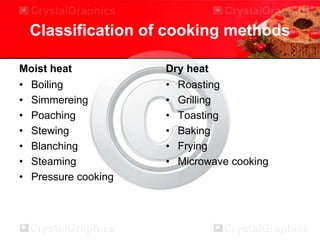
Classification of cooking methods
Moist heat
• Boiling
• Simmereing
• Poaching
• Stewing
• Blanching
• Steaming
• Pressure cooking
Dry heat
• Roasting
• Grilling
• Toasting
• Baking
• Frying
• Microwave cooking
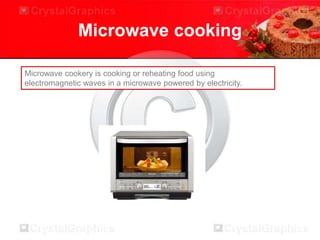
Microwave cooking
Microwave cookery is cooking or reheating food using
electromagnetic waves in a microwave powered by electricity.
PRINCIPLES OF MICROWAVE
COOKING
The heating process - The alternating
electromagnetic field generated inside the
microwave oven lead to excitation,
rotation/collision of polar molecules and ions
inside the food.
• These molecular frictions would generate heat and
subsequently lead to temperature rise
• There are two mechanisms:-
Ionic interaction -ionic
compounds (i.e. dissolved
salts) in food can also be
accelerated by the
electromagnetic field and
collided with other molecules
to produce heat
Dipolar interaction .-The
water molecule is a
“dipole” with one
positively charged end
and one negatively
charged end.
• Similar to the action of
magnet, these “dipoles”
orient themselves when
they are subject to
electromagnetic field.
• The rotation of water
molecules generate heat
for cooking
Nature of microwaves
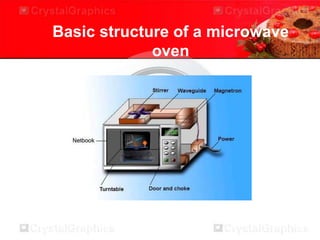
Basic structure of a microwave
oven
NUTRIENT LOSSES ASSOCIATED
WITH MICROWAVE COOKINGProteins _The degradation rates depend on the heating
time and temperature
Lipids - Microwave cooking does not result in
significantly more chemical modifications then
traditional cooking methods
Vitamins - vitamin retention in microwaved foods is
equal or better than conventionally prepared foods
because of the shorter heating time of microwave
cooking
Minerals - comparing microwave and conventional
braised beef found that significantly more phosphorus
and potassium were retained in microwave cooking
CHEMICAL RISKS ASSOCIATED WITH
MICROWAVE COOKING
• Currently there is no scientific evidence
that the production of any carcinogenic
substances would increase upon the
application of microwave heating
• Of the carcinogens, the formation of the
chemicals heterocyclic amines (HCAs),
polyaromatic hydrocarbons (PAHs) and
nitrosamines are of particular concern
Heterocyclic amines (HCAs)-
Polyaromatic hydrocarbons (PAHs)-
Nitrosamines-
MICROBIOLOGICAL RISK ASSOCIATED
WITH MICROWAVE COOKING
• The effectiveness of microwave cooking in
killing microorganisms and spores is
comparable with conventional methods
provided that appropriate temperature and
time are reached
• That raw animal food should be heated to
a temperature of at least 75oC for 15
seconds to kill any foodborne pathogen
that may be present in the food.
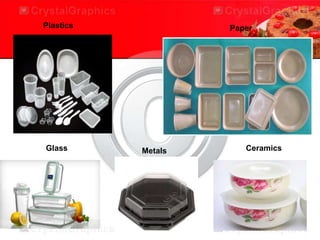
FOOD CONTACT METERIALS FOR
MICROWAVE COOKING
Plastics Paper
Glass CeramicsMetals
General advice – One is advised to take note of the following
handling techniques and cooking practices when using a microwave oven:
• General rules
• • Purchase microwave ovens made by reputable manufacturers.
• • Read the oven manual carefully for recommended handling techniques
and cleaning methods.
• • Do not operate the microwave oven if the door does not close firmly or
the oven is not working properly.
• • Keep the microwave oven clean.
• Cookware and wraps
• • Use cookware and plastic wraps specially manufactured for microwave
cooking.
• • Do not use containers with metallic decoration, plastic storage bags,
plastic grocery bags, foam trays or aluminium foil for microwave cooking.
• • Do not reuse containers that came with microwave convenience foods or
take-away because they might be designed for one-time use only.
• Cooking
• • Observe good hygiene practices such as washing hands before and after
handling food.
• • Cover the food with a microwave safe lid / plastic wrap; however, leave a
small part uncovered to let steam escape. The plastic wrap should not be in
contact with the food during cooking.
• • Cook large pieces of meat at medium power for longer periods. This allows
heat to reach the centre of meats without overcooking the outer portions.
• • For uniform cooking,
• − cut food into smaller pieces and debone larger pieces of meat;
• − put food items evenly on a dish;
• − place larger / thicker portions of food towards the outside of a dish;
• − stir or rotate the food several times during cooking;
• − let the food stand for two minutes after cooking.
• • Cook food thoroughly. Return undercooked food to the microwave oven for
further cooking until it is completely cooked. Poultry and meat should be
cooked until juices run clear and no pink colour remains.
• • Do not over-heat water or liquids as water may be superheated without
appearing to boil.
• • Do not cook an egg within its shell as the steam built-up inside the shell will
explode the egg. Eggs can be cooked in microwave oven when the shell is
removed or cracked and the egg yolk / white is pierced several times
ACCORDING TO WHO,Electromagnetic fields & public health,Microwave
ovens Information sheet February 2005
• To dispel some misconceptions, it is important to realize that food cooked in a
microwave oven does not become "radioactive".
• Nor does any microwave energy remain in the cavity or the food after the
microwave oven is switched off
Health Canada,Health and Safety Concerns Associated With Microwave
Cooking
• Microwaves do not change the chemical components of in food and so the
formation of new compounds, like carcinogens, is not expected.
Nutritional composition of chickpea (Cicer arietinum L.) as affected by
microwave cooking and other traditional cooking methods.
• Based on the results, microwave cooking is recommended for chickpea
preparation, not only for improving nutritional quality , but also for reducing
cooking time..
Effects of microwave cooking/reheating on nutrients and food systems: a review of
recent studies.Hoffman CJ, Zabik MEJournal of the American Dietetic Association
• With the utilization of low-power techniques, studies showed equal or better
retention of nutrients for microwave, as compared with conventional, reheated
foods for thiamin, riboflavin, pyridoxine, folacin, and ascorbic acid
Microwave cooking final ppt

Microwave cooking final ppt

  • 1.
  • 2.
    Classification of cookingmethods Moist heat • Boiling • Simmereing • Poaching • Stewing • Blanching • Steaming • Pressure cooking Dry heat • Roasting • Grilling • Toasting • Baking • Frying • Microwave cooking
  • 3.
    Microwave cooking Microwave cookeryis cooking or reheating food using electromagnetic waves in a microwave powered by electricity.
  • 4.
    PRINCIPLES OF MICROWAVE COOKING Theheating process - The alternating electromagnetic field generated inside the microwave oven lead to excitation, rotation/collision of polar molecules and ions inside the food. • These molecular frictions would generate heat and subsequently lead to temperature rise • There are two mechanisms:-
  • 5.
    Ionic interaction -ionic compounds(i.e. dissolved salts) in food can also be accelerated by the electromagnetic field and collided with other molecules to produce heat Dipolar interaction .-The water molecule is a “dipole” with one positively charged end and one negatively charged end. • Similar to the action of magnet, these “dipoles” orient themselves when they are subject to electromagnetic field. • The rotation of water molecules generate heat for cooking
  • 6.
  • 7.
    Basic structure ofa microwave oven
  • 8.
    NUTRIENT LOSSES ASSOCIATED WITHMICROWAVE COOKINGProteins _The degradation rates depend on the heating time and temperature Lipids - Microwave cooking does not result in significantly more chemical modifications then traditional cooking methods Vitamins - vitamin retention in microwaved foods is equal or better than conventionally prepared foods because of the shorter heating time of microwave cooking Minerals - comparing microwave and conventional braised beef found that significantly more phosphorus and potassium were retained in microwave cooking
  • 9.
    CHEMICAL RISKS ASSOCIATEDWITH MICROWAVE COOKING • Currently there is no scientific evidence that the production of any carcinogenic substances would increase upon the application of microwave heating • Of the carcinogens, the formation of the chemicals heterocyclic amines (HCAs), polyaromatic hydrocarbons (PAHs) and nitrosamines are of particular concern
  • 10.
    Heterocyclic amines (HCAs)- Polyaromatichydrocarbons (PAHs)- Nitrosamines-
  • 11.
    MICROBIOLOGICAL RISK ASSOCIATED WITHMICROWAVE COOKING • The effectiveness of microwave cooking in killing microorganisms and spores is comparable with conventional methods provided that appropriate temperature and time are reached • That raw animal food should be heated to a temperature of at least 75oC for 15 seconds to kill any foodborne pathogen that may be present in the food.
  • 12.
    FOOD CONTACT METERIALSFOR MICROWAVE COOKING
  • 13.
  • 14.
    General advice –One is advised to take note of the following handling techniques and cooking practices when using a microwave oven: • General rules • • Purchase microwave ovens made by reputable manufacturers. • • Read the oven manual carefully for recommended handling techniques and cleaning methods. • • Do not operate the microwave oven if the door does not close firmly or the oven is not working properly. • • Keep the microwave oven clean. • Cookware and wraps • • Use cookware and plastic wraps specially manufactured for microwave cooking. • • Do not use containers with metallic decoration, plastic storage bags, plastic grocery bags, foam trays or aluminium foil for microwave cooking. • • Do not reuse containers that came with microwave convenience foods or take-away because they might be designed for one-time use only.
  • 15.
    • Cooking • •Observe good hygiene practices such as washing hands before and after handling food. • • Cover the food with a microwave safe lid / plastic wrap; however, leave a small part uncovered to let steam escape. The plastic wrap should not be in contact with the food during cooking. • • Cook large pieces of meat at medium power for longer periods. This allows heat to reach the centre of meats without overcooking the outer portions. • • For uniform cooking, • − cut food into smaller pieces and debone larger pieces of meat; • − put food items evenly on a dish; • − place larger / thicker portions of food towards the outside of a dish; • − stir or rotate the food several times during cooking; • − let the food stand for two minutes after cooking. • • Cook food thoroughly. Return undercooked food to the microwave oven for further cooking until it is completely cooked. Poultry and meat should be cooked until juices run clear and no pink colour remains. • • Do not over-heat water or liquids as water may be superheated without appearing to boil. • • Do not cook an egg within its shell as the steam built-up inside the shell will explode the egg. Eggs can be cooked in microwave oven when the shell is removed or cracked and the egg yolk / white is pierced several times
  • 16.
    ACCORDING TO WHO,Electromagneticfields & public health,Microwave ovens Information sheet February 2005 • To dispel some misconceptions, it is important to realize that food cooked in a microwave oven does not become "radioactive". • Nor does any microwave energy remain in the cavity or the food after the microwave oven is switched off Health Canada,Health and Safety Concerns Associated With Microwave Cooking • Microwaves do not change the chemical components of in food and so the formation of new compounds, like carcinogens, is not expected. Nutritional composition of chickpea (Cicer arietinum L.) as affected by microwave cooking and other traditional cooking methods. • Based on the results, microwave cooking is recommended for chickpea preparation, not only for improving nutritional quality , but also for reducing cooking time.. Effects of microwave cooking/reheating on nutrients and food systems: a review of recent studies.Hoffman CJ, Zabik MEJournal of the American Dietetic Association • With the utilization of low-power techniques, studies showed equal or better retention of nutrients for microwave, as compared with conventional, reheated foods for thiamin, riboflavin, pyridoxine, folacin, and ascorbic acid