Prof. Neeraj Bhargava
Pramod Singh Rathore
Department of Computer Science
School of Engineering & System Sciences,
MDS University Ajmer, Rajasthan, India
1
Features of .NET
Features of .NET
 Language Independence
 Support the concept of Object Oriented Programming
 Better Support for Dynamic web pages
 Efficient Data Access
 Code Sharing capabilities
2
Features of .NET
 Improved Security by User Authentication
 Support for web services
 High Scalability
 Greatly increased performance by compile code
 Easy Configuration and Easy Deployment
 Compatibility and Interoperability.
3
Microsoft Intermediate Language-
Meta Data
 MSIL is a (IL) Intermediate Language, also Known as (CIL)
Common Intermediate Language, or popularly the (MSIL)
Microsoft Intermediate Language, is the Core of the .NET
Framework. Microsoft Intermediate Language converts the
source code into intermediate language and then machine
code by JIT Compiler
4
Microsoft Intermediate Language-
Meta Data
 All .NET source codes written in any .net supportive
language (C#, VB.net etc), when compiler are converted to
MSIL. This MSIL at the Runtime, gets converted to
machine code. The Runtime convention of MSIL code to
the machine code is handled by a component called as the
Just In Time (JIT) Compiler.
5
Microsoft Intermediate Language-
Meta Data
6
Microsoft Intermediate Language-
Meta Data
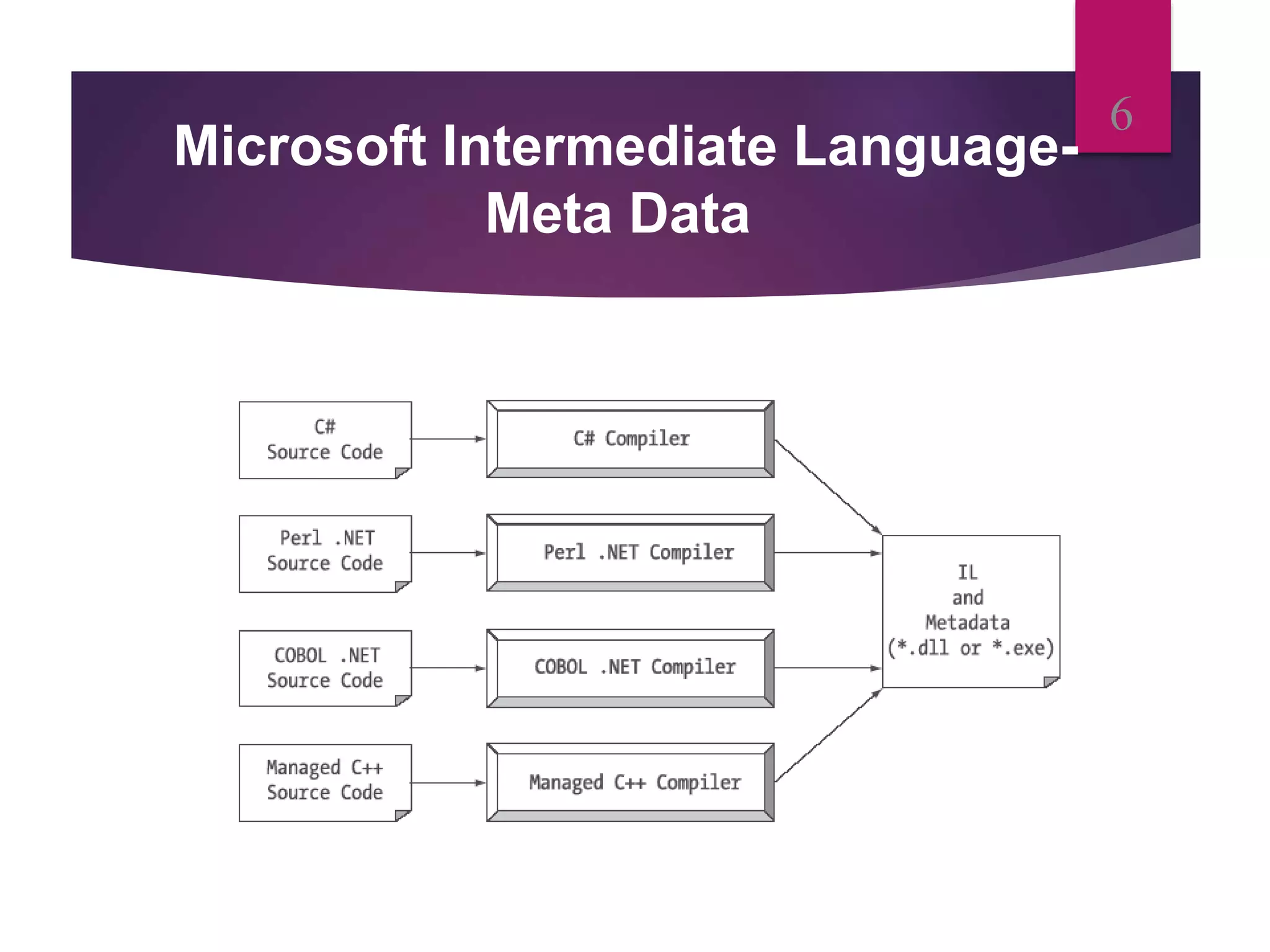
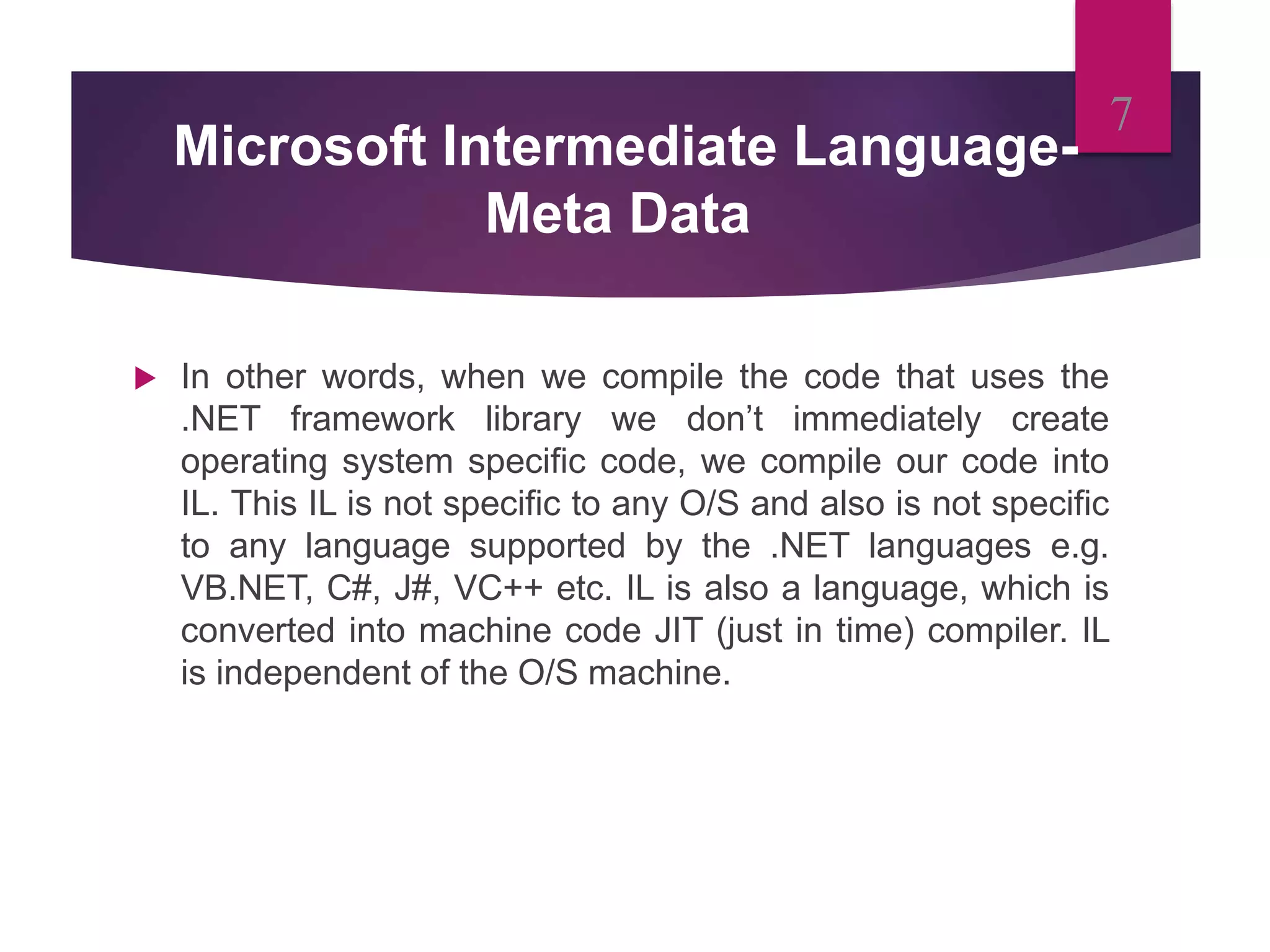
 In other words, when we compile the code that uses the
.NET framework library we don’t immediately create
operating system specific code, we compile our code into
IL. This IL is not specific to any O/S and also is not specific
to any language supported by the .NET languages e.g.
VB.NET, C#, J#, VC++ etc. IL is also a language, which is
converted into machine code JIT (just in time) compiler. IL
is independent of the O/S machine.
7
META DATA
8
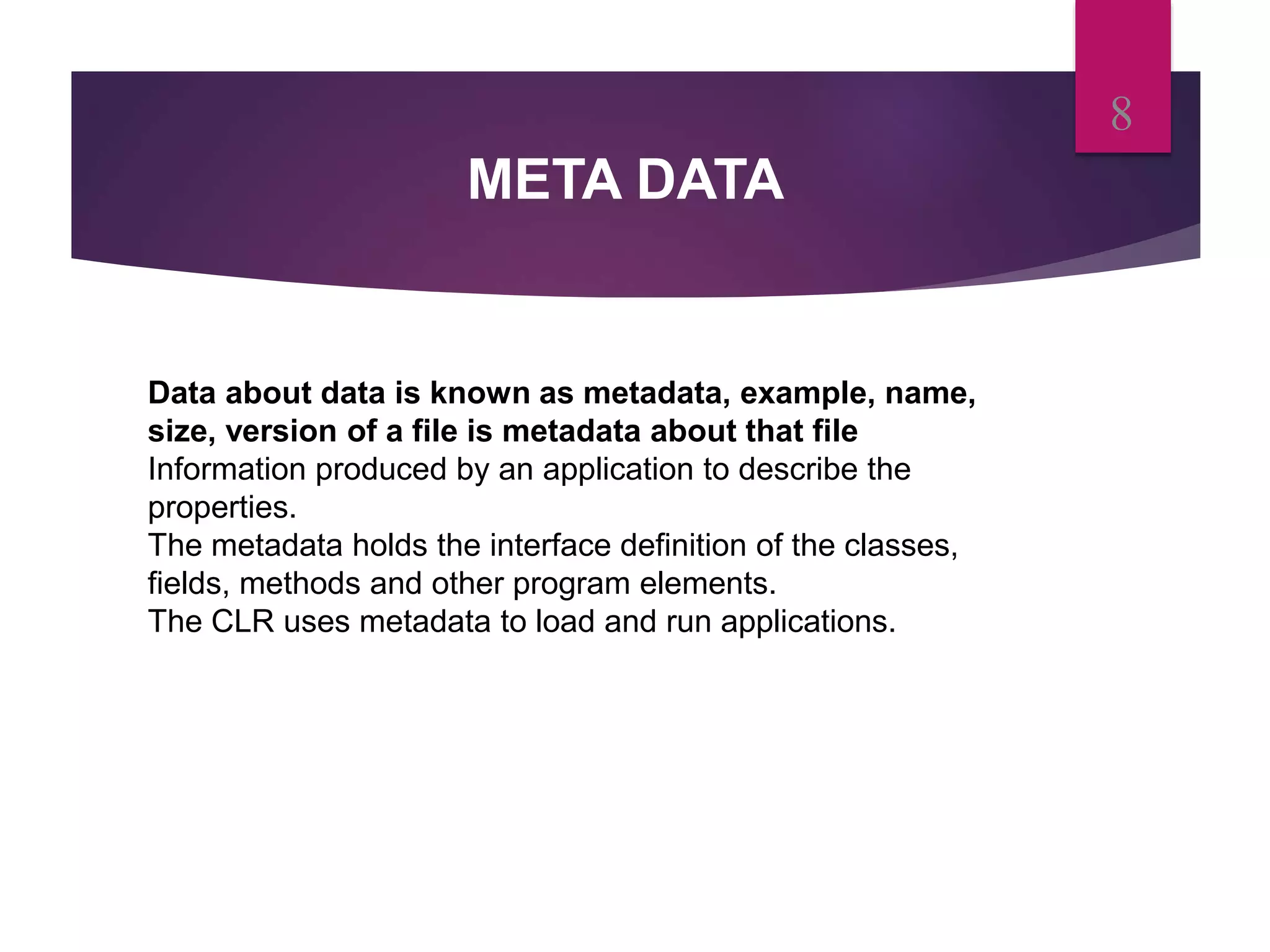
Data about data is known as metadata, example, name,
size, version of a file is metadata about that file
Information produced by an application to describe the
properties.
The metadata holds the interface definition of the classes,
fields, methods and other program elements.
The CLR uses metadata to load and run applications.
Microsoft Intermediate Language-
Meta Data
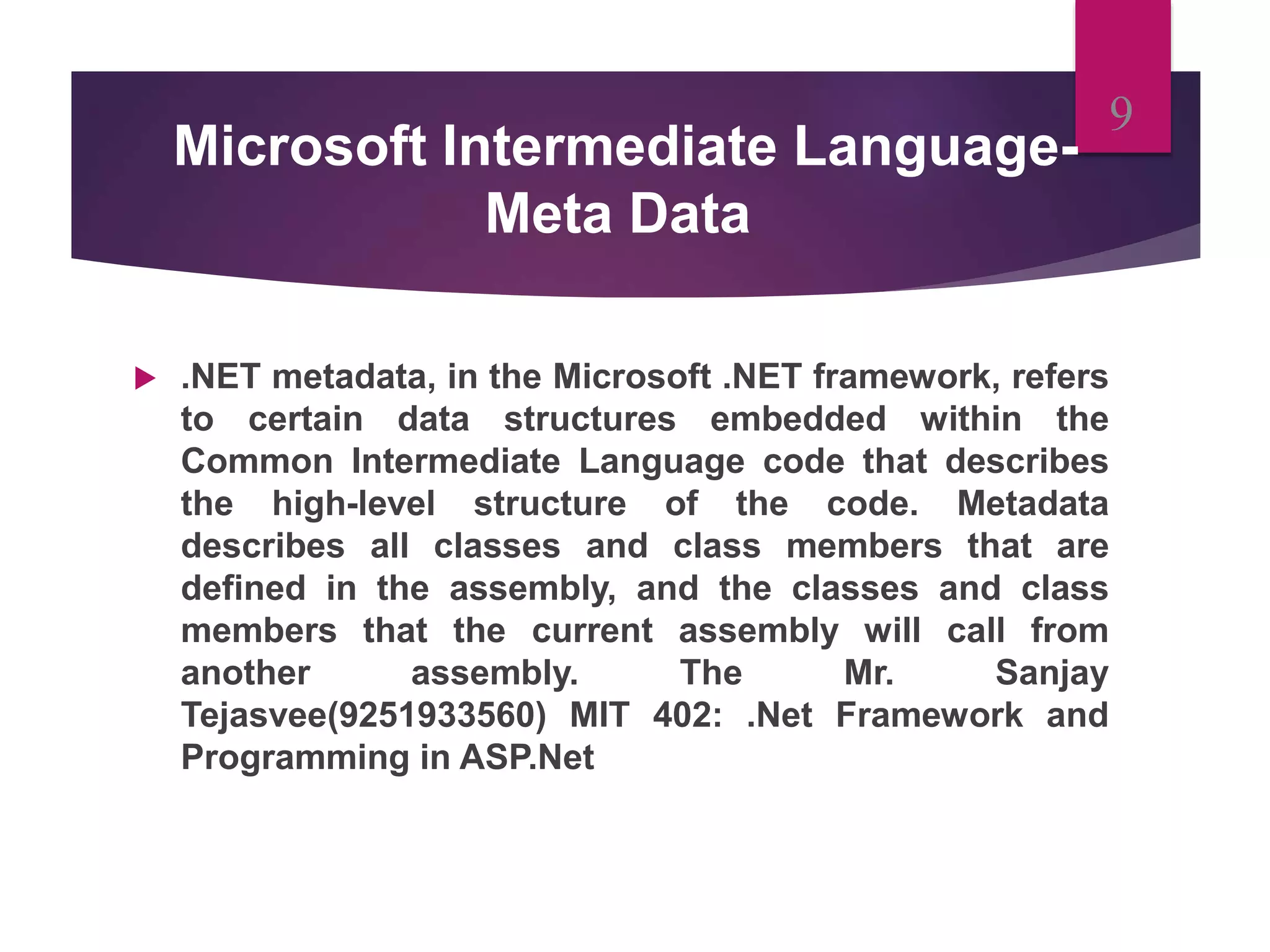
 .NET metadata, in the Microsoft .NET framework, refers
to certain data structures embedded within the
Common Intermediate Language code that describes
the high-level structure of the code. Metadata
describes all classes and class members that are
defined in the assembly, and the classes and class
members that the current assembly will call from
another assembly. The Mr. Sanjay
Tejasvee(9251933560) MIT 402: .Net Framework and
Programming in ASP.Net
9
Microsoft Intermediate Language-
Meta Data
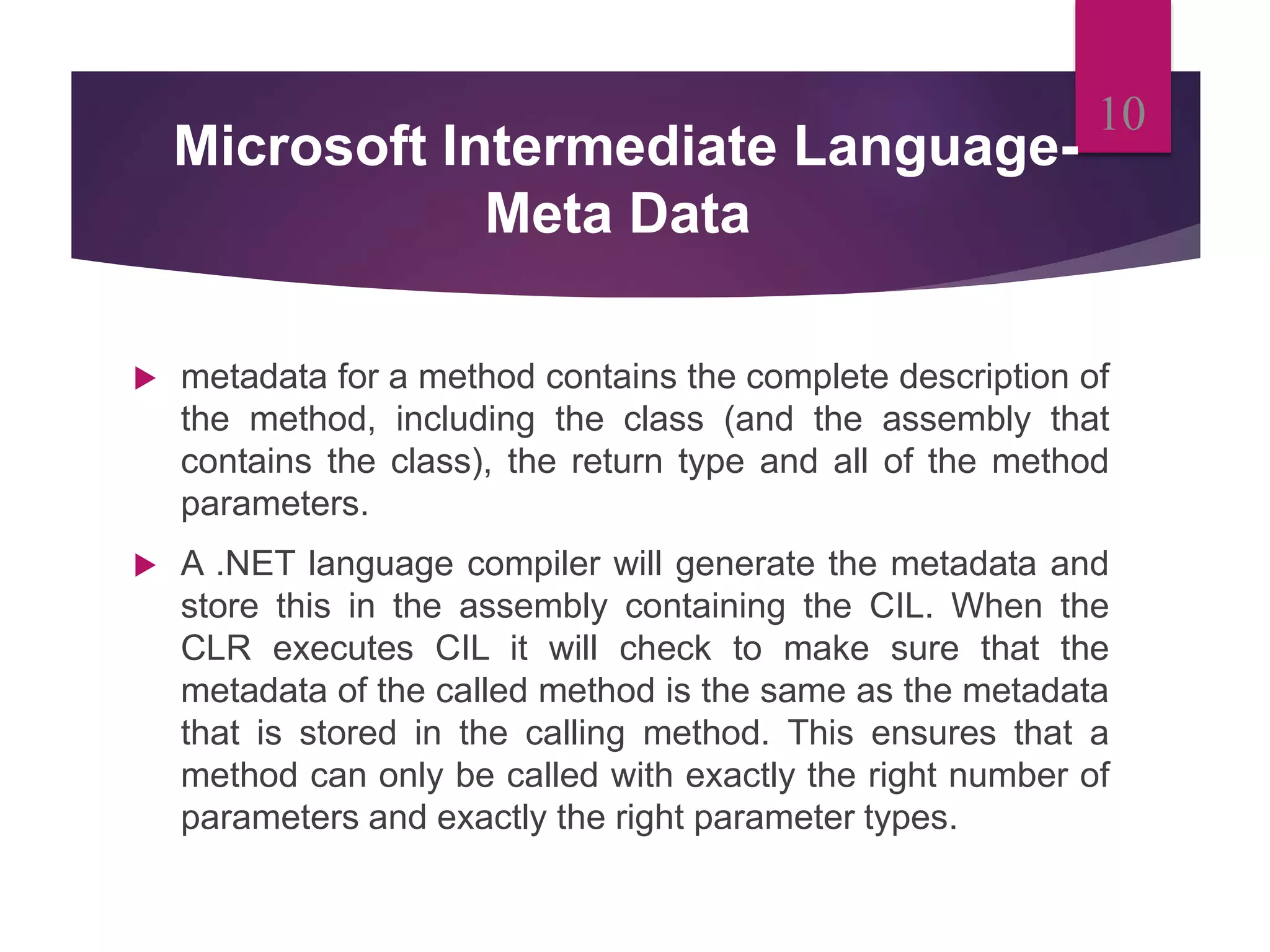
 metadata for a method contains the complete description of
the method, including the class (and the assembly that
contains the class), the return type and all of the method
parameters.
 A .NET language compiler will generate the metadata and
store this in the assembly containing the CIL. When the
CLR executes CIL it will check to make sure that the
metadata of the called method is the same as the metadata
that is stored in the calling method. This ensures that a
method can only be called with exactly the right number of
parameters and exactly the right parameter types.
10
Queries ????
11
12

4. features of .net

  • 1.
    Prof. Neeraj Bhargava PramodSingh Rathore Department of Computer Science School of Engineering & System Sciences, MDS University Ajmer, Rajasthan, India 1 Features of .NET
  • 2.
    Features of .NET Language Independence  Support the concept of Object Oriented Programming  Better Support for Dynamic web pages  Efficient Data Access  Code Sharing capabilities 2
  • 3.
    Features of .NET Improved Security by User Authentication  Support for web services  High Scalability  Greatly increased performance by compile code  Easy Configuration and Easy Deployment  Compatibility and Interoperability. 3
  • 4.
    Microsoft Intermediate Language- MetaData  MSIL is a (IL) Intermediate Language, also Known as (CIL) Common Intermediate Language, or popularly the (MSIL) Microsoft Intermediate Language, is the Core of the .NET Framework. Microsoft Intermediate Language converts the source code into intermediate language and then machine code by JIT Compiler 4
  • 5.
    Microsoft Intermediate Language- MetaData  All .NET source codes written in any .net supportive language (C#, VB.net etc), when compiler are converted to MSIL. This MSIL at the Runtime, gets converted to machine code. The Runtime convention of MSIL code to the machine code is handled by a component called as the Just In Time (JIT) Compiler. 5
  • 6.
  • 7.
    Microsoft Intermediate Language- MetaData  In other words, when we compile the code that uses the .NET framework library we don’t immediately create operating system specific code, we compile our code into IL. This IL is not specific to any O/S and also is not specific to any language supported by the .NET languages e.g. VB.NET, C#, J#, VC++ etc. IL is also a language, which is converted into machine code JIT (just in time) compiler. IL is independent of the O/S machine. 7
  • 8.
    META DATA 8 Data aboutdata is known as metadata, example, name, size, version of a file is metadata about that file Information produced by an application to describe the properties. The metadata holds the interface definition of the classes, fields, methods and other program elements. The CLR uses metadata to load and run applications.
  • 9.
    Microsoft Intermediate Language- MetaData  .NET metadata, in the Microsoft .NET framework, refers to certain data structures embedded within the Common Intermediate Language code that describes the high-level structure of the code. Metadata describes all classes and class members that are defined in the assembly, and the classes and class members that the current assembly will call from another assembly. The Mr. Sanjay Tejasvee(9251933560) MIT 402: .Net Framework and Programming in ASP.Net 9
  • 10.
    Microsoft Intermediate Language- MetaData  metadata for a method contains the complete description of the method, including the class (and the assembly that contains the class), the return type and all of the method parameters.  A .NET language compiler will generate the metadata and store this in the assembly containing the CIL. When the CLR executes CIL it will check to make sure that the metadata of the called method is the same as the metadata that is stored in the calling method. This ensures that a method can only be called with exactly the right number of parameters and exactly the right parameter types. 10
  • 11.
  • 12.