MMC
• UNIT-I
DEPT
OF BIOTECHNOLOGY
• MICROBIOLOGY
BY
Dr. S. HIMALINI
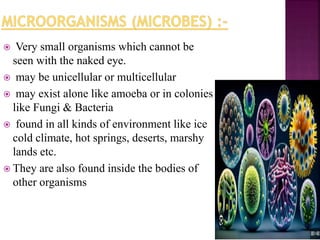
 Very small organisms which cannot be
seen with the naked eye.
 may be unicellular or multicellular
 may exist alone like amoeba or in colonies
like Fungi & Bacteria
 found in all kinds of environment like ice
cold climate, hot springs, deserts, marshy
lands etc.
 They are also found inside the bodies of
other organisms
They are different from other
microorganisms as they reproduce
only in the body of host organisms
like bacteria, plants or animals.
Virus
a)Making curd from milk :-
The bacterium called Lactobacillus reproduces in milk and
helps to convert milk into curd.
b) Making bread :-
The fungus called yeast reproduces in flour dough and
produces carbon dioxide during respiration which makes the
dough soft and helps in making bread, cakes, biscuits, pastries
etc.
c) Making alcohol :-
Yeast is used for commercial production of alcohol & wine.
The fungus called yeast reproduces in sugar solution and
converts it into alcohol. This process is called fermentation.
• Louis Pasteur discovered fermentation in 1857.
 Some Bacteria and Blue Green Algae are able to fix
nitrogen from the atmosphere to enrich soil with
nitrogen and increase its fertility.
 These microbes are called Biological Nitrogen
Fixers.
d) Making medicines :-
Some bacteria and fungi are used to make medicines which kill
or stops the growth of disease causing microrganisms. Such
medicines are called antibiotics.
Eg :- streptomycin, tetracycline, erythromycin etc.
 Micro organisms decompose dead organic waste
of plants and animals and convert them into simple
substances which are again used by other plants
and animals.
i) Some micro organisms cause diseases in plants and
animals. Such disease causing microorganisms are
called pathogens.
ii) ii) Some micro organisms grow in food substances
and produce toxic substances and makes the food
poisonous. Food poisoning causes illness and even
death.
iii) iii) Some microorganisms spoil materials like
clothing, leather, wood etc.
 Disease causing microorganisms.
 Enter our body through air, water, food, contact or
insects.
 Diseases which can spread from an infected person to a
healthy person are called communicable diseases.
Eg :- cholera, common cold, chicken pox, tuberculosis
etc.
 Some insects and animals act as carriers of disease
causing microbes.
Eg :- House fly, Female anopheles mosquito (malaria),
Female aedes mosquito (dengue fever) etc.
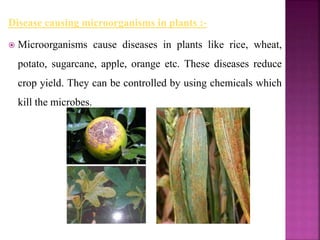
Disease causing microorganisms in plants :-
 Microorganisms cause diseases in plants like rice, wheat,
potato, sugarcane, apple, orange etc. These diseases reduce
crop yield. They can be controlled by using chemicals which
kill the microbes.
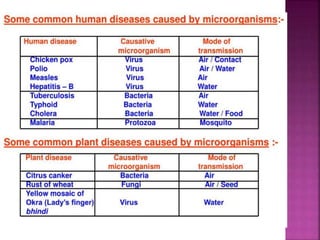
 Human disease Causative Mode of microorganism
transmission Chicken pox Virus Air / Contact Polio Virus Air /
Water Measles Virus Air Hepatitis – B Virus Water
Tuberculosis Bacteria Air Typhoid Bacteria Water Cholera
Bacteria Water / Food Malaria Protozoa Mosquito Some
common plant diseases caused by microorganisms :- Plant
disease Causative Mode of microorganism transmission Citrus
canker Bacteria Air Rust of wheat Fungi Air / Seed Yellow
mosaic of Okra (Lady’s finger) Virus Water bhindi

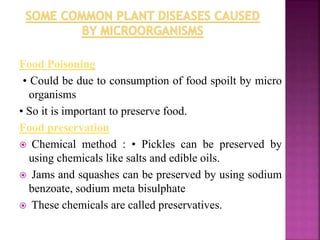
Food Poisoning
• Could be due to consumption of food spoilt by micro
organisms
• So it is important to preserve food.
Food preservation
 Chemical method : • Pickles can be preserved by
using chemicals like salts and edible oils.
 Jams and squashes can be preserved by using sodium
benzoate, sodium meta bisulphate
 These chemicals are called preservatives.
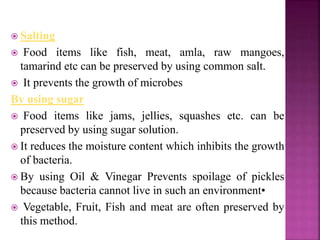
 Salting
 Food items like fish, meat, amla, raw mangoes,
tamarind etc can be preserved by using common salt.
 It prevents the growth of microbes
By using sugar
 Food items like jams, jellies, squashes etc. can be
preserved by using sugar solution.
 It reduces the moisture content which inhibits the growth
of bacteria.
 By using Oil & Vinegar Prevents spoilage of pickles
because bacteria cannot live in such an environment•
 Vegetable, Fruit, Fish and meat are often preserved by
this method.
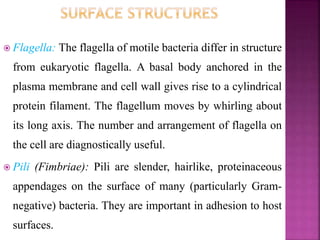
 Flagella: The flagella of motile bacteria differ in structure
from eukaryotic flagella. A basal body anchored in the
plasma membrane and cell wall gives rise to a cylindrical
protein filament. The flagellum moves by whirling about
its long axis. The number and arrangement of flagella on
the cell are diagnostically useful.
 Pili (Fimbriae): Pili are slender, hairlike, proteinaceous
appendages on the surface of many (particularly Gram-
negative) bacteria. They are important in adhesion to host
surfaces.
 Capsules: Some bacteria form a thick outer capsule
of high-molecular-weight, viscous polysaccharide
gel; others have more amorphous slime layers.
Capsules confer resistance to phagocytosis.
Plasma Membrane: The bacterial plasma membrane
is composed primarily of protein and phospholipid
(about 3:1). It performs many functions, including
transport, biosynthesis, and energy transduction.
 Organelles: The bacterial cytoplasm is densely packed
with 70S ribosomes. Other granules represent metabolic
reserves (e.g., poly-β-hydroxybutyrate, polysaccharide,
polymetaphosphate, and metachromatic granules).
 Endospores: Bacillus and Clostridium species can
produce endospores: heat-resistant, dehydrated resting
cells that are formed intracellularly and contain a genome
and all essential metabolic machinery. The endospore is
encased in a complex protective spore coat.
 Fungi are eukaryotic cells, which contains similar organelles to human
cells, these include:
 Ribosomes – the same function are prokaryotic ribosomes but differ in size
and structure.
 Mitochondria – produce energy molecules for use in the metabolism.
 Endoplasmic reticulum – involved in protein synthesis and protein
transport.
 Nucleus – a membrane-bound structure that encloses the genetic material
of the cell.
 Nucleolus – an area in the nucleus where ribosomes are assembled.
 Cell wall – contains chitin and provides strength and structure to the cell.
 Cell membrane – this is significantly different to the human cell
membrane. It lies under the cell wall and encases the membrane.
 Golgi apparatus – an organelle involved in targeting newly synthesized
substances and proteins.
 Storage vacuole – membrane-covered spaces within cells that store
nutrients and waste products.
 Centrioles – has a role in organizing the skeletal system of the cell.
 Protozoa are eukaryotes which possess many
of the organelles similar to fungi. However,
unlike fungi, protozoa do not have cell walls.
Protozoa have a pellicle, which is a very thin
protein layer that protects the cell membrane.
 Viral structures are the most different to other microbe
structures. Viruses can be naked and composed of the
capsid and genetic material or be enclosed by an
envelope. The particular virus structures are:
 Capsid – a protein coat that encapsulates the nucleic acid
of the virus.
 Nucleic acid – the genetic material of the virus, can
either be RNA or DNA and can also be single or double-
stranded.
 Envelope – external membrane which is typically a
phospholipid bilayer and contains glycoproteins.
 Spike – proteins on the outer surface of the envelope
which can have multiple functions including adhering to
surfaces.
Cell Wall Peptidoglycans:
 Both Gram-positive and Gram-negative bacteria possess
cell wall peptidoglycans, which confer the characteristic
cell shape and provide the cell with mechanical
protection.
 Peptidoglycans are unique to prokaryotic organisms and
consist of a glycan backbone of muramic acid and
glucosamine (both N-acetylated), and peptide chains
highly cross-linked with bridges in Gram-positive
bacteria (e.g., Staphylococcus aureus) or partially cross-
linked in Gram-negative bacteria (e.g., Escherichia coli).
The cross-linking transpeptidase enzymes are some of
the targets for b-lactam antibiotics.
 Teichoic acids are polyol phosphate polymers bearing
a strong negative charge. They are covalently linked to
the peptidoglycan in some Gram-positive bacteria.
They are strongly antigenic, but are generally absent in
Gram-negative bacteria.
Lipoteichoic Acids:
 Lipoteichoic acids as membrane teichoic acids are
polymers of amphiphitic glycophosphates with the
lipophilic glycolipid and anchoAred in the cytoplasmic
membrane.
 They are antigenic, cytotoxic and adhesins
(e.g., Streptococcus pyogenes).
Lipopolysaccharides:
 One of the major components of the outer membrane of
Gram-negative bacteria is lipopolysaccharide
(endotoxin), a complex molecule consisting of a lipid A
anchor, a polysaccharide core, and chains of
carbohydrates.
 Sugars in the polysaccharide chains confer serologic
specificity.
Wall-Less Forms: Two groups of bacteria devoid of
cell wall peptidoglycans are the Mycoplasma species,
which possess a surface membrane structure, and the L-
forms that arise from either Gram-positive or Gram-
negative bacterial cells that have lost their ability to
produce the peptidoglycan structures.
THANK YOU

microorganism/microbiology/pathogens.pptx

  • 1.
    MMC • UNIT-I DEPT OF BIOTECHNOLOGY •MICROBIOLOGY BY Dr. S. HIMALINI
  • 2.
     Very smallorganisms which cannot be seen with the naked eye.  may be unicellular or multicellular  may exist alone like amoeba or in colonies like Fungi & Bacteria  found in all kinds of environment like ice cold climate, hot springs, deserts, marshy lands etc.  They are also found inside the bodies of other organisms
  • 5.
    They are differentfrom other microorganisms as they reproduce only in the body of host organisms like bacteria, plants or animals. Virus
  • 6.
    a)Making curd frommilk :- The bacterium called Lactobacillus reproduces in milk and helps to convert milk into curd. b) Making bread :- The fungus called yeast reproduces in flour dough and produces carbon dioxide during respiration which makes the dough soft and helps in making bread, cakes, biscuits, pastries etc. c) Making alcohol :- Yeast is used for commercial production of alcohol & wine. The fungus called yeast reproduces in sugar solution and converts it into alcohol. This process is called fermentation. • Louis Pasteur discovered fermentation in 1857.
  • 7.
     Some Bacteriaand Blue Green Algae are able to fix nitrogen from the atmosphere to enrich soil with nitrogen and increase its fertility.  These microbes are called Biological Nitrogen Fixers. d) Making medicines :- Some bacteria and fungi are used to make medicines which kill or stops the growth of disease causing microrganisms. Such medicines are called antibiotics. Eg :- streptomycin, tetracycline, erythromycin etc.
  • 8.
     Micro organismsdecompose dead organic waste of plants and animals and convert them into simple substances which are again used by other plants and animals.
  • 9.
    i) Some microorganisms cause diseases in plants and animals. Such disease causing microorganisms are called pathogens. ii) ii) Some micro organisms grow in food substances and produce toxic substances and makes the food poisonous. Food poisoning causes illness and even death. iii) iii) Some microorganisms spoil materials like clothing, leather, wood etc.
  • 10.
     Disease causingmicroorganisms.  Enter our body through air, water, food, contact or insects.  Diseases which can spread from an infected person to a healthy person are called communicable diseases. Eg :- cholera, common cold, chicken pox, tuberculosis etc.  Some insects and animals act as carriers of disease causing microbes. Eg :- House fly, Female anopheles mosquito (malaria), Female aedes mosquito (dengue fever) etc.
  • 11.
    Disease causing microorganismsin plants :-  Microorganisms cause diseases in plants like rice, wheat, potato, sugarcane, apple, orange etc. These diseases reduce crop yield. They can be controlled by using chemicals which kill the microbes.
  • 12.
     Human diseaseCausative Mode of microorganism transmission Chicken pox Virus Air / Contact Polio Virus Air / Water Measles Virus Air Hepatitis – B Virus Water Tuberculosis Bacteria Air Typhoid Bacteria Water Cholera Bacteria Water / Food Malaria Protozoa Mosquito Some common plant diseases caused by microorganisms :- Plant disease Causative Mode of microorganism transmission Citrus canker Bacteria Air Rust of wheat Fungi Air / Seed Yellow mosaic of Okra (Lady’s finger) Virus Water bhindi 
  • 14.
    Food Poisoning • Couldbe due to consumption of food spoilt by micro organisms • So it is important to preserve food. Food preservation  Chemical method : • Pickles can be preserved by using chemicals like salts and edible oils.  Jams and squashes can be preserved by using sodium benzoate, sodium meta bisulphate  These chemicals are called preservatives.
  • 15.
     Salting  Fooditems like fish, meat, amla, raw mangoes, tamarind etc can be preserved by using common salt.  It prevents the growth of microbes By using sugar  Food items like jams, jellies, squashes etc. can be preserved by using sugar solution.  It reduces the moisture content which inhibits the growth of bacteria.  By using Oil & Vinegar Prevents spoilage of pickles because bacteria cannot live in such an environment•  Vegetable, Fruit, Fish and meat are often preserved by this method.
  • 16.
     Flagella: Theflagella of motile bacteria differ in structure from eukaryotic flagella. A basal body anchored in the plasma membrane and cell wall gives rise to a cylindrical protein filament. The flagellum moves by whirling about its long axis. The number and arrangement of flagella on the cell are diagnostically useful.  Pili (Fimbriae): Pili are slender, hairlike, proteinaceous appendages on the surface of many (particularly Gram- negative) bacteria. They are important in adhesion to host surfaces.
  • 17.
     Capsules: Somebacteria form a thick outer capsule of high-molecular-weight, viscous polysaccharide gel; others have more amorphous slime layers. Capsules confer resistance to phagocytosis. Plasma Membrane: The bacterial plasma membrane is composed primarily of protein and phospholipid (about 3:1). It performs many functions, including transport, biosynthesis, and energy transduction.
  • 18.
     Organelles: Thebacterial cytoplasm is densely packed with 70S ribosomes. Other granules represent metabolic reserves (e.g., poly-β-hydroxybutyrate, polysaccharide, polymetaphosphate, and metachromatic granules).  Endospores: Bacillus and Clostridium species can produce endospores: heat-resistant, dehydrated resting cells that are formed intracellularly and contain a genome and all essential metabolic machinery. The endospore is encased in a complex protective spore coat.
  • 19.
     Fungi areeukaryotic cells, which contains similar organelles to human cells, these include:  Ribosomes – the same function are prokaryotic ribosomes but differ in size and structure.  Mitochondria – produce energy molecules for use in the metabolism.  Endoplasmic reticulum – involved in protein synthesis and protein transport.  Nucleus – a membrane-bound structure that encloses the genetic material of the cell.  Nucleolus – an area in the nucleus where ribosomes are assembled.  Cell wall – contains chitin and provides strength and structure to the cell.  Cell membrane – this is significantly different to the human cell membrane. It lies under the cell wall and encases the membrane.  Golgi apparatus – an organelle involved in targeting newly synthesized substances and proteins.  Storage vacuole – membrane-covered spaces within cells that store nutrients and waste products.  Centrioles – has a role in organizing the skeletal system of the cell.
  • 20.
     Protozoa areeukaryotes which possess many of the organelles similar to fungi. However, unlike fungi, protozoa do not have cell walls. Protozoa have a pellicle, which is a very thin protein layer that protects the cell membrane.
  • 21.
     Viral structuresare the most different to other microbe structures. Viruses can be naked and composed of the capsid and genetic material or be enclosed by an envelope. The particular virus structures are:  Capsid – a protein coat that encapsulates the nucleic acid of the virus.  Nucleic acid – the genetic material of the virus, can either be RNA or DNA and can also be single or double- stranded.  Envelope – external membrane which is typically a phospholipid bilayer and contains glycoproteins.  Spike – proteins on the outer surface of the envelope which can have multiple functions including adhering to surfaces.
  • 22.
    Cell Wall Peptidoglycans: Both Gram-positive and Gram-negative bacteria possess cell wall peptidoglycans, which confer the characteristic cell shape and provide the cell with mechanical protection.  Peptidoglycans are unique to prokaryotic organisms and consist of a glycan backbone of muramic acid and glucosamine (both N-acetylated), and peptide chains highly cross-linked with bridges in Gram-positive bacteria (e.g., Staphylococcus aureus) or partially cross- linked in Gram-negative bacteria (e.g., Escherichia coli). The cross-linking transpeptidase enzymes are some of the targets for b-lactam antibiotics.
  • 23.
     Teichoic acidsare polyol phosphate polymers bearing a strong negative charge. They are covalently linked to the peptidoglycan in some Gram-positive bacteria. They are strongly antigenic, but are generally absent in Gram-negative bacteria. Lipoteichoic Acids:  Lipoteichoic acids as membrane teichoic acids are polymers of amphiphitic glycophosphates with the lipophilic glycolipid and anchoAred in the cytoplasmic membrane.  They are antigenic, cytotoxic and adhesins (e.g., Streptococcus pyogenes).
  • 24.
    Lipopolysaccharides:  One ofthe major components of the outer membrane of Gram-negative bacteria is lipopolysaccharide (endotoxin), a complex molecule consisting of a lipid A anchor, a polysaccharide core, and chains of carbohydrates.  Sugars in the polysaccharide chains confer serologic specificity. Wall-Less Forms: Two groups of bacteria devoid of cell wall peptidoglycans are the Mycoplasma species, which possess a surface membrane structure, and the L- forms that arise from either Gram-positive or Gram- negative bacterial cells that have lost their ability to produce the peptidoglycan structures.
  • 25.