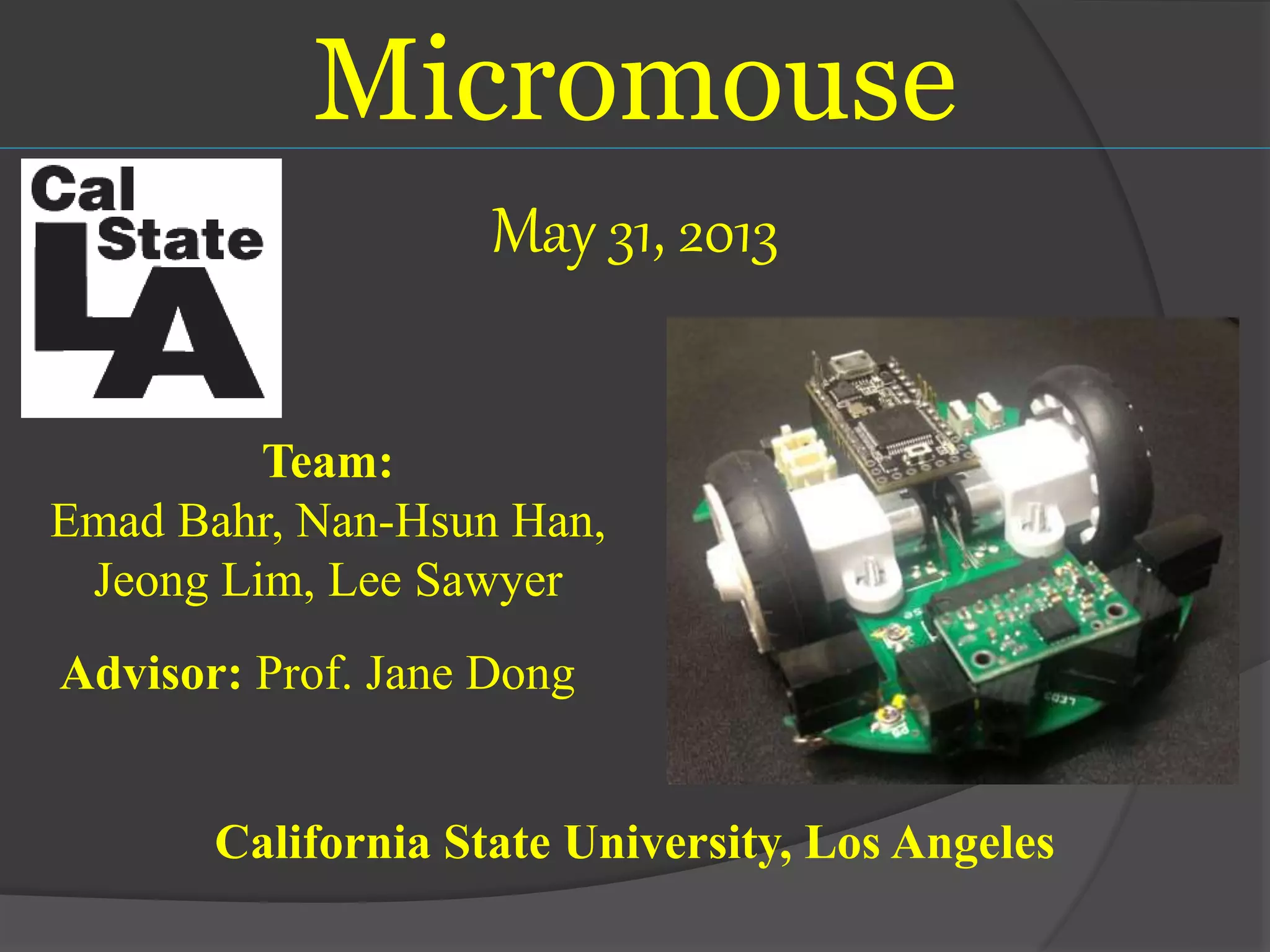
The document describes a micromouse robot project undertaken by a student team. The team designed and built an autonomous robot to navigate a maze and reach the center in the shortest time possible, for under $500. Key components included a microcontroller to process sensor data and control motors, encoders to track position, and IR sensors to detect walls. The team implemented a PD control system and maze solving algorithm using arrays to navigate. Their micromouse placed 4th out of 20 teams and 3rd out of 15 teams in competitions, completing most of a 256 block maze in under 8 minutes.
In this document
Powered by AI
Introduction of the Micromouse project team, agenda, and presentation outline.
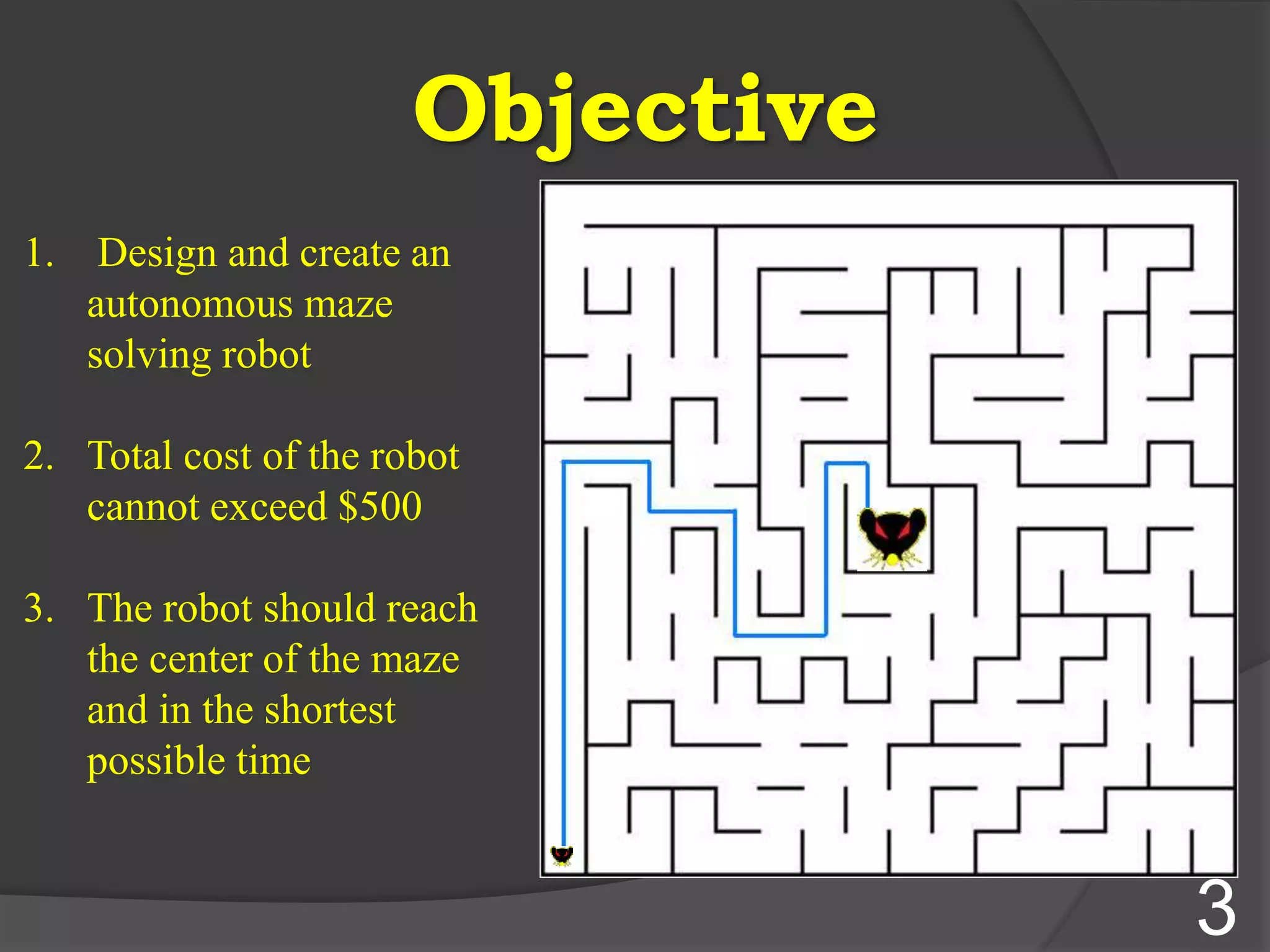
Goals to design an autonomous maze-solving robot with a budget of $500.
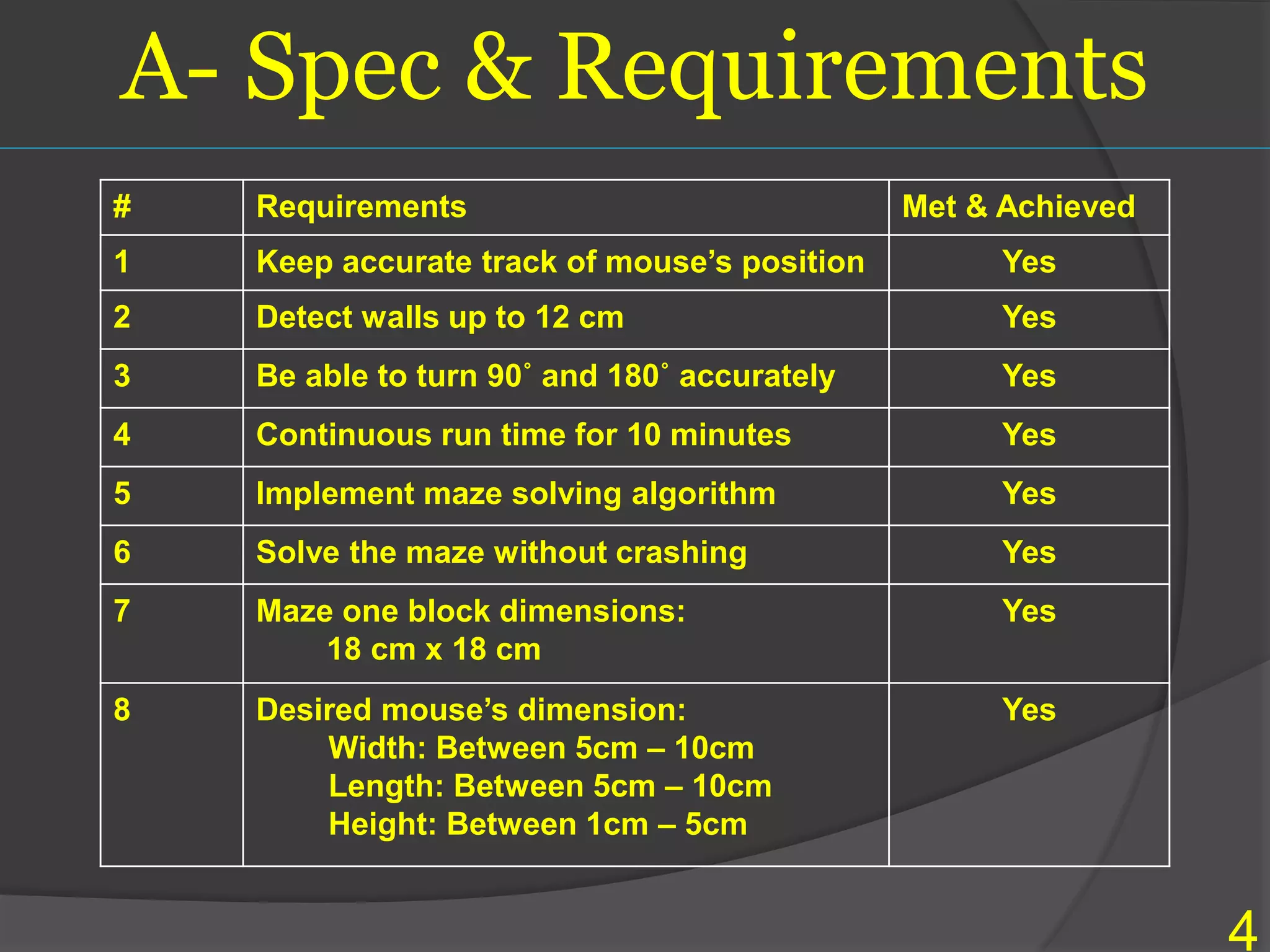
Detailed specifications met by the robot, dimensions, wall detection, and runtime capabilities.
Overview of critical components including microcontroller, motors, gyroscope, and PCB.
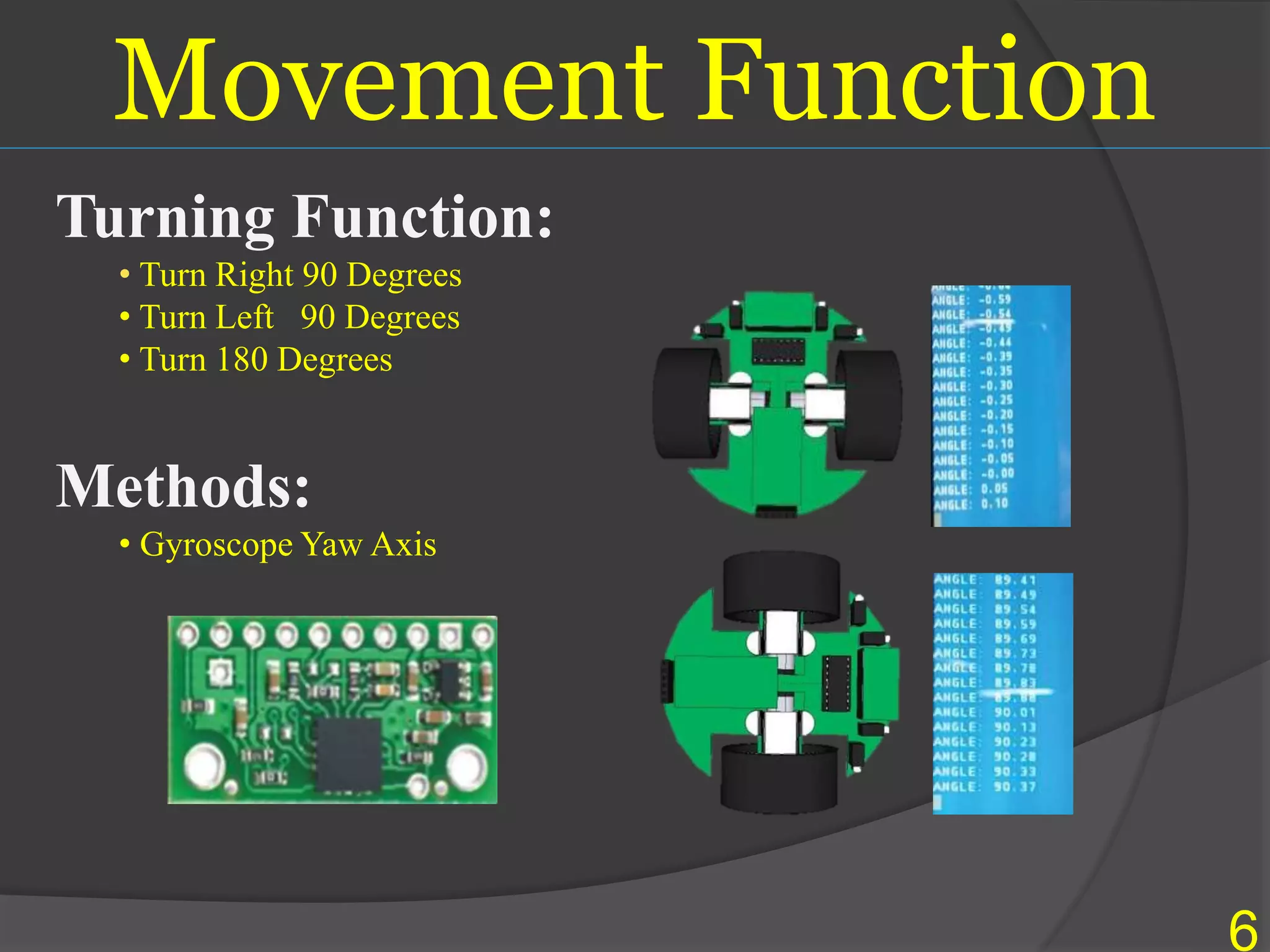
Functions for turning and moving forward using gyroscope and encoders.
Proportional-Derivative (PD) control methodology for motor speed and wall detection.
Different conditions handled by the control system for navigating walls.
Descriptions of arrays needed for maze solving and tracking paths.
Financial overview showing total budget and expenses under $500.
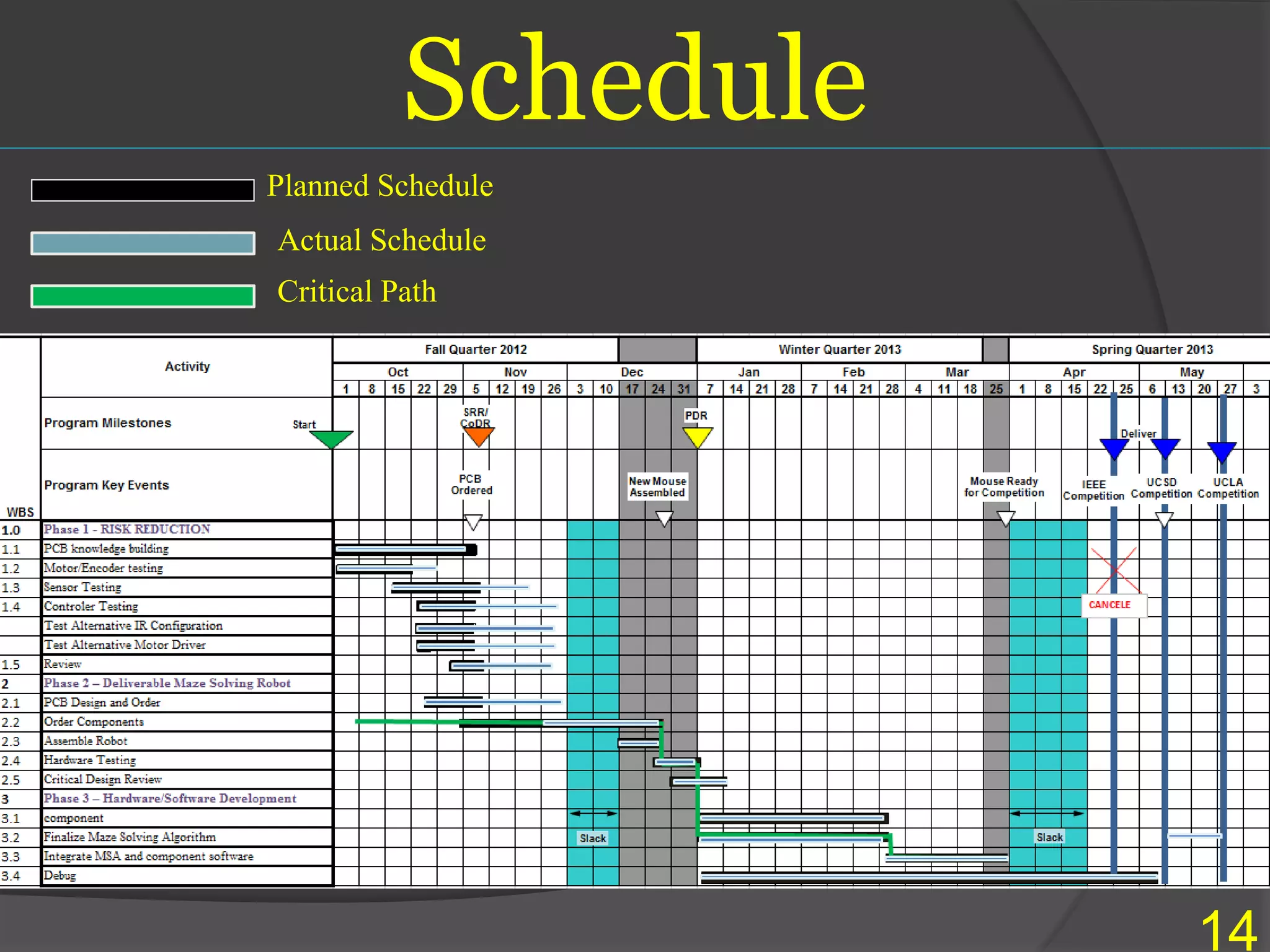
Comparison of planned versus actual schedules, highlighting critical paths.
Performance results including placement in competitions and maze-block completion.
Summary of project successes and potential applications in various fields.
An invitation for questions on the Micromouse project.
Micromouse
May 31, 2013
Team:
EmadBahr, Nan-Hsun Han,
Jeong Lim, Lee Sawyer
Advisor: Prof. Jane Dong
California State University, Los Angeles
2.
Agenda
2
Introduction / Overview…….... Emad Bahr
Hardware………………………. Nan Han
Software……………………….. Jeong Lim
Control System………………… Lee Sawyer
Conclusion…………………….. Emad Bahr
3.
Objective
3
1. Design andcreate an
autonomous maze
solving robot
2. Total cost of the robot
cannot exceed $500
3. The robot should reach
the center of the maze
and in the shortest
possible time
4.
A- Spec &Requirements
4
# Requirements Met & Achieved
1 Keep accurate track of mouse’s position Yes
2 Detect walls up to 12 cm Yes
3 Be able to turn 90˚ and 180˚ accurately Yes
4 Continuous run time for 10 minutes Yes
5 Implement maze solving algorithm Yes
6 Solve the maze without crashing Yes
7 Maze one block dimensions:
18 cm x 18 cm
Yes
8 Desired mouse’s dimension:
Width: Between 5cm – 10cm
Length: Between 5cm – 10cm
Height: Between 1cm – 5cm
Yes
5.
Key Components
5
Microcontroller
• Usedto process sensor data
to compute and implement
programs on our mouse
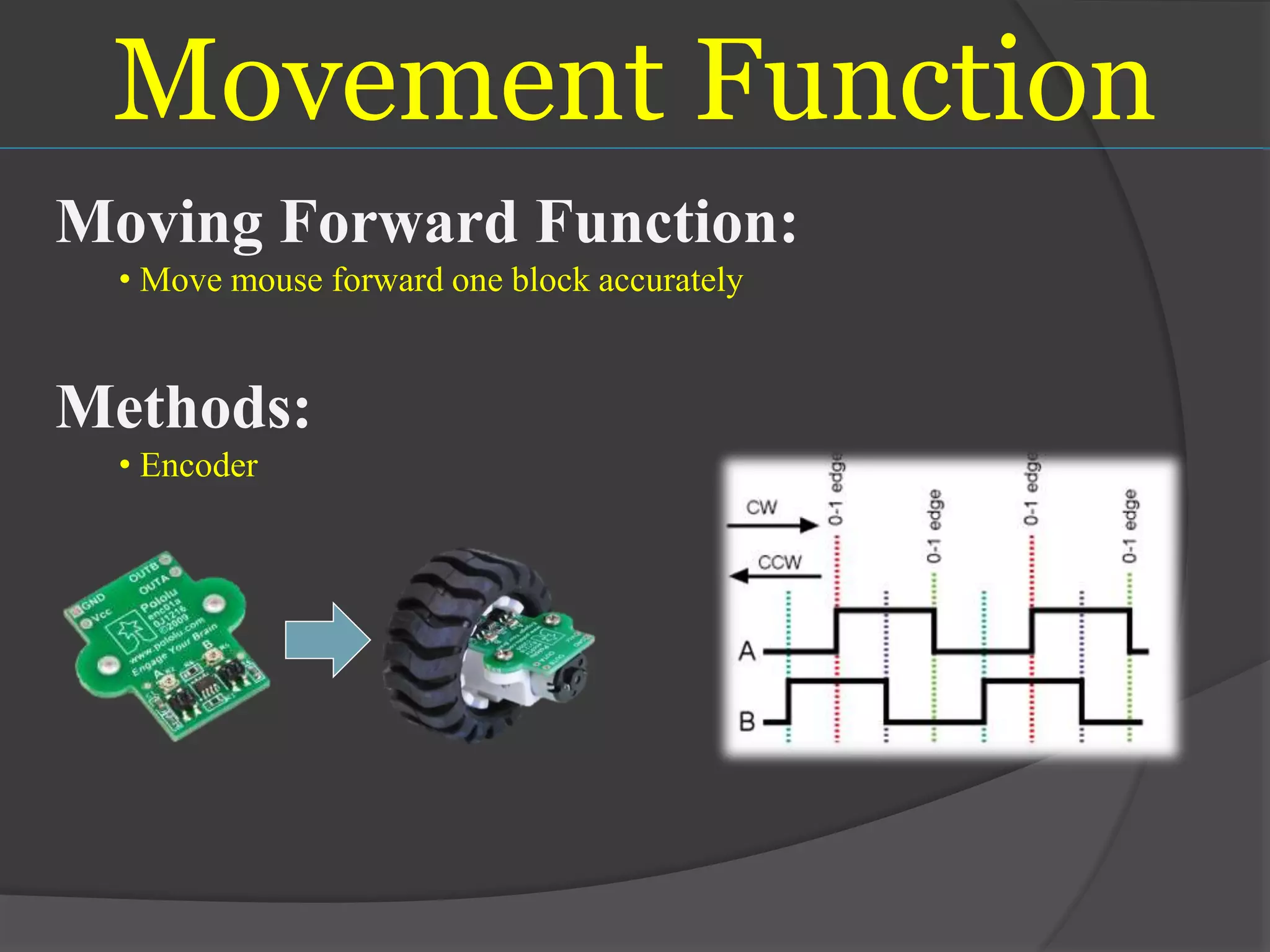
Motor & Encoder Set
• Used to keep accurate track
of position within the maze
Gyroscope
• Used to accurately turn 90
and 180 degrees
IR LED & Transistor
• Used to accurately detect
walls up to 12cm
IR Transistor
IR LED
3cm7.5cm
9cm
Printed Circuit Board (PCB)
• Used to keep mouse within
the desired dimensions:
• Width: 5cm – 10cm
• Length: 5cm – 10cm
Proportional (P):
• Itchanges the output proportionally to the error
• Very high proportional value cause unstable system
Derivative (D):
• It is determined by the slope of the error
• The derivative term slows the rate of change of the
controller output.
• It reduce the over shoot.
Control
Proportional, Derivative
controller
9
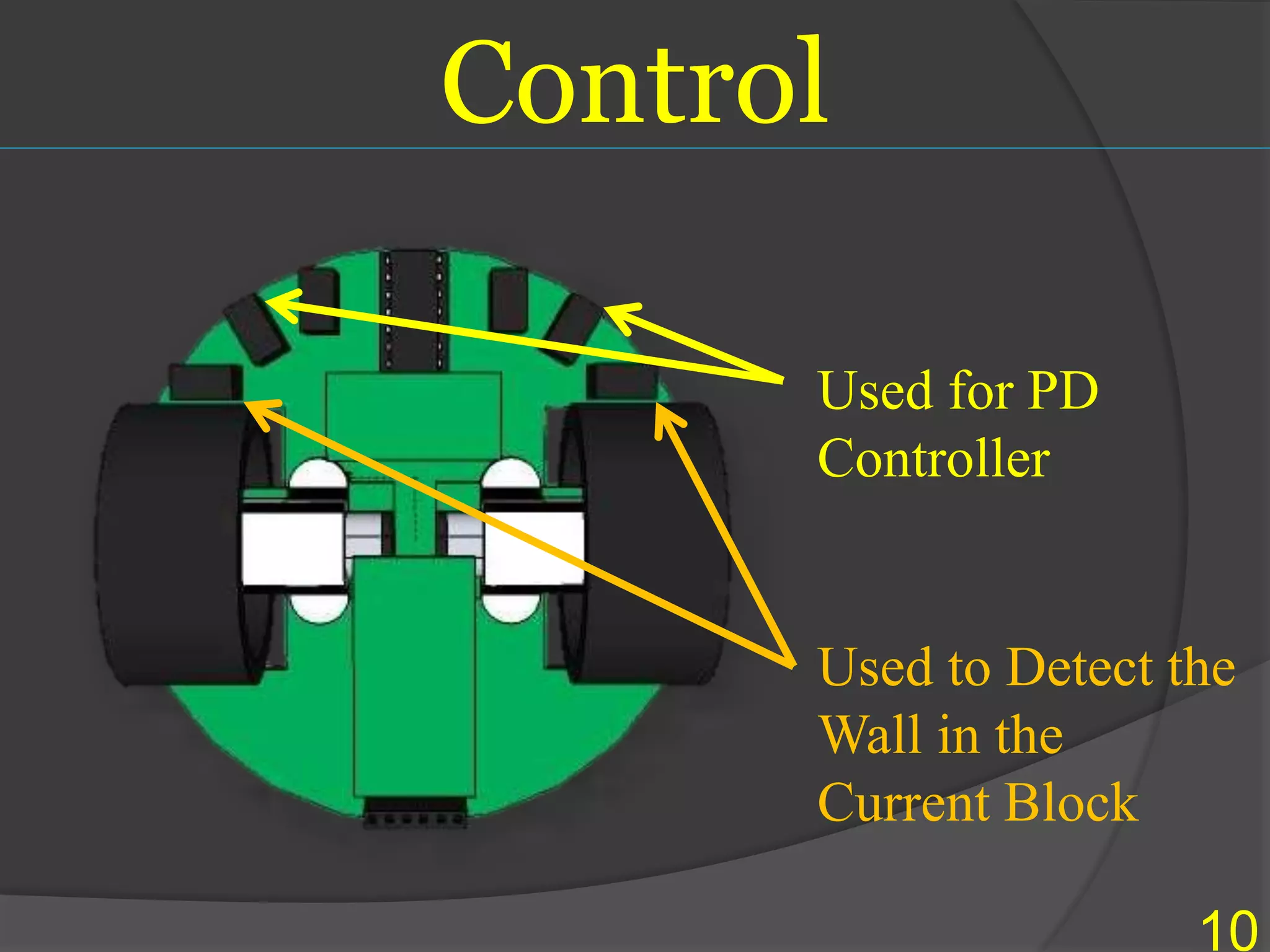
Control
3 Main BoundaryCondition
1) There were walls in both side:
Used angle sensors to adjust the motor
speed to go straight
2) There is only one wall:
Used angle sensors to adjust the motor
speed to go straight
3) There are no walls:
Used encoder to move straight
11
12.
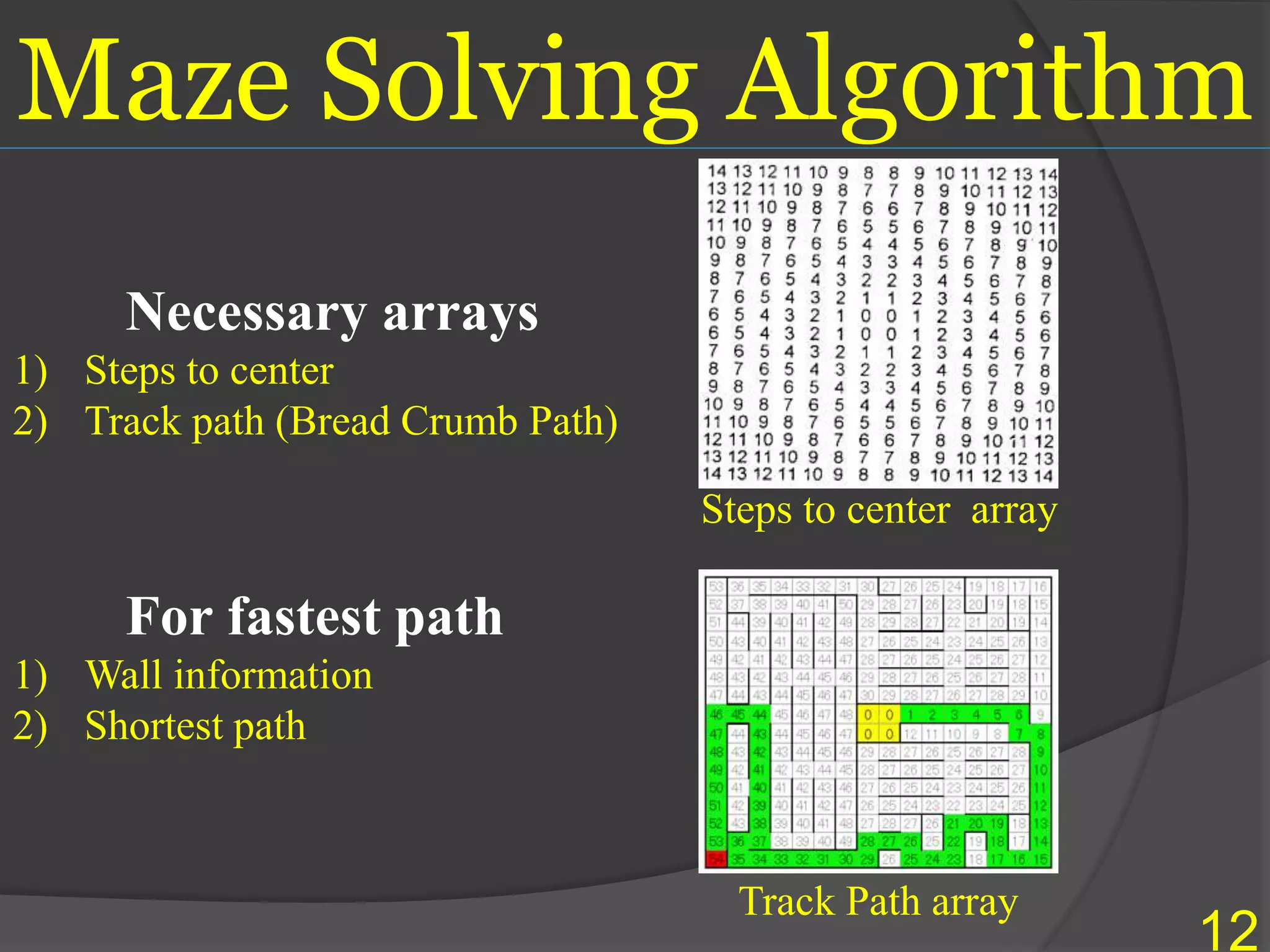
Maze Solving Algorithm
Necessaryarrays
1) Steps to center
2) Track path (Bread Crumb Path)
For fastest path
1) Wall information
2) Shortest path
Steps to center array
Track Path array
12
Achievement
15
• 4th Placeamong 20 in CAMM
• Completed 170 out of 256
blocks within eight minutes
• Fastest run of 1:02
• 3rd Place among 15 in AAMC
16.
Conclusion
• Designed andbuilt a Micromouse that successfully
found the shortest path to the center of maze in both
competition
• Customized PCB minimize the size
• Control System for straight movement
• Capability to solve maze
• Learned to solve complex challenge with realistic
constrains working as a team
• Broader impact of the design solution: applicable in
many areas including aerospace, automation, medical
fields, education, etc.
16