University of allahabad
Departmentof Botany
Submitted to-
Dr.Pradeep Kumar Yadav
Dr.Ritu Mishra.
Submitted by-
Neetu Dubey
M.Sc III Semester
2.
DNA Transformation
• Transformationwas the first horizontal gene - transfer
discovered in bacteria.
• It was discoverd by Fred Griffith in 1928.
• Transformation is the uptake of a naked DNA molecule or
fragment from the surrounding environment by a cell and the
incorporation of this molecule into the chromosome of the
recipient.
3.
Type of Transformation
1.Natural
2. Artificial.
• Natural transformation is very rare event and has been observed
in both gram- positive(e.g.,Streptococcus pneumoniae, Bacillus
subtilis) as well as gram – negative bacteria ( e.g.,Haemophilus
influenzae).
• Transformation in Haemophilus influenzae (the first gram –
negative bacterium in which natural competance was found) and
some other gram- negative bacteria are different from that in
gram- positive bacteria like Streptococcus.
4.
Competence
• The abilityof recipient bacterium to take up DNA molecules from
the surrounding environment and become transformed is known
as competence.
• Competence is an inheritable characteristics.
• Competent bacteria that can take up DNA, encode proteins
called competence factors.
• These protein facilitate the binding of DNA fragments to the cell
surface and uptake of DNA into the cytoplasm.
5.
Gram – positive
Bacteria
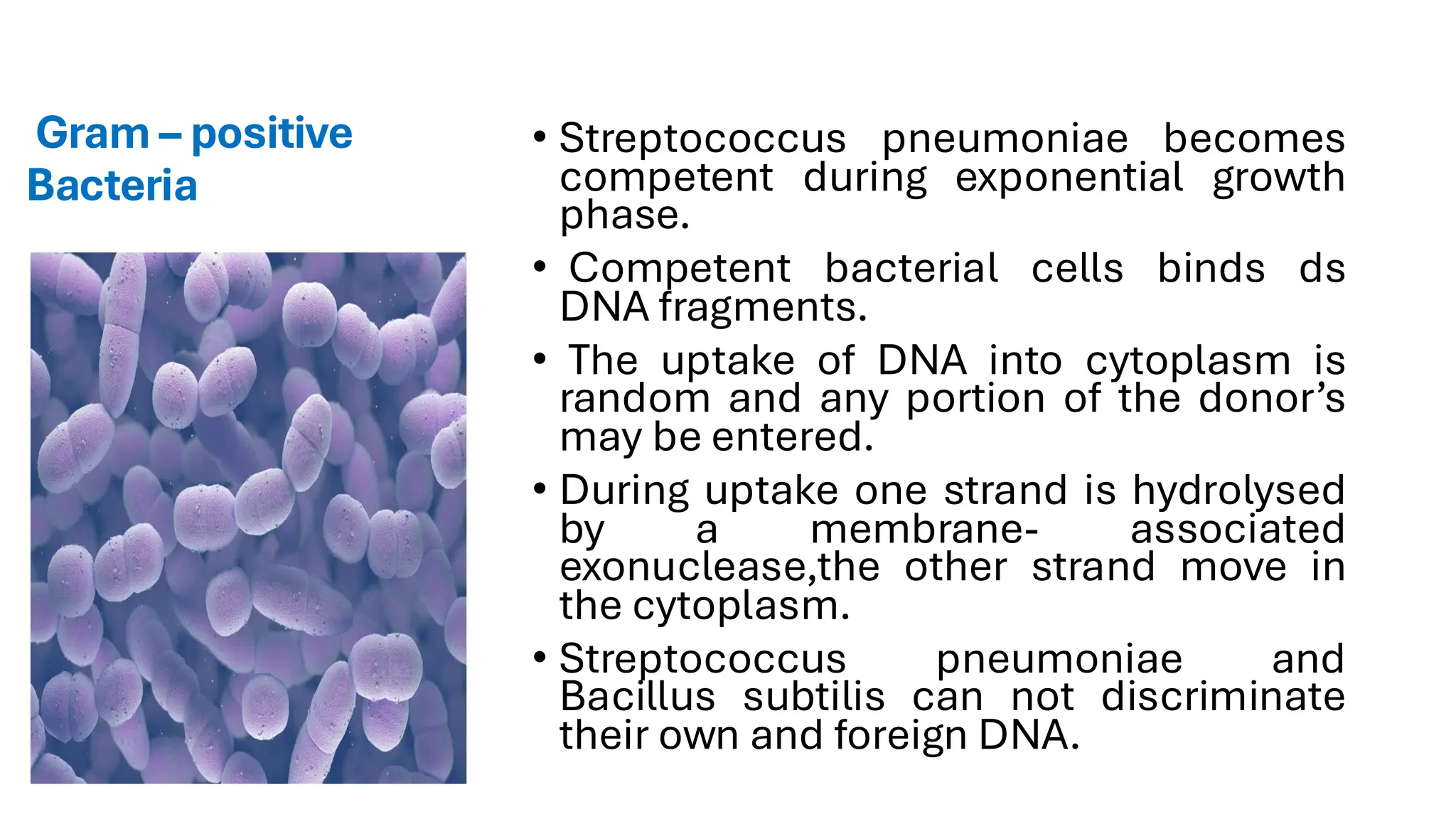
•Streptococcus pneumoniae becomes
competent during exponential growth
phase.
• Competent bacterial cells binds ds
DNA fragments.
• The uptake of DNA into cytoplasm is
random and any portion of the donor’s
may be entered.
• During uptake one strand is hydrolysed
by a membrane- associated
exonuclease,the other strand move in
the cytoplasm.
• Streptococcus pneumoniae and
Bacillus subtilis can not discriminate
their own and foreign DNA.
6.
Gram - negative
bacteria
•In Haemophilus influenzae, DNA
uptake is associated with the
formation of small membranous
structures,called
transformasomes,which protrude
outside the cell.
• The transforming DNA is taken into
these vesicles where is then
internalized into the cell .
• DNA from only closely related species
can enter into the cytoplasm.
• DNA isreleased into the environment by bacterial cell lysis.
• Naturally competent bacteria pull DNA fragments.
• One strand enter into the cytoplasm with its 3’ end.
• Recipient cells that undergo this process and acquire a new
phenotype as are said to be transformed.
• dsDNA Passed to the DNA receptor ComEA before transfer to
EndA nuclease.
• EndA degrades one strand.
• ssDNA transferred via ComEC pore.





![Biochemistry__Presentation__(Group_-05)_(3)[1].pptx Final.pptx](https://cdn.slidesharecdn.com/ss_thumbnails/biochemistrygrouppresentationgroup-0531-241023124133-a9edf147-thumbnail.jpg?width=640&height=640&fit=bounds)


