Learning Objectives 
By the end of the lesson, you will be able to: 
• Identify the four factors of a SWOT 
• Explain their different features 
• Understand how they relate to each other 
• Give an example of each factor 
• Construct a simple SWOT
What is a SWOT Analysis? 
• Planning 
• Matching 
• Dynamic
Strengths 
•Well known brand name 
• Innovative products 
• Excellent customer service 
• Quality manufacturing 
• Niche market
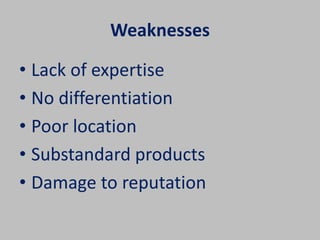
Weaknesses 
• Lack of expertise 
• No differentiation 
• Poor location 
• Substandard products 
• Damage to reputation
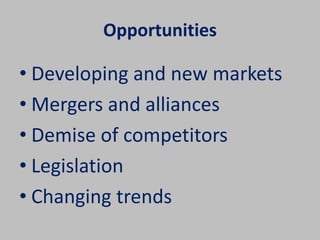
Opportunities 
• Developing and new markets 
• Mergers and alliances 
• Demise of competitors 
• Legislation 
• Changing trends
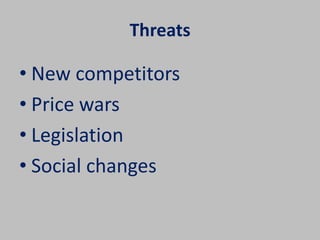
Threats 
• New competitors 
• Price wars 
• Legislation 
• Social changes
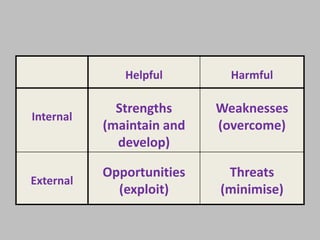
Helpful Harmful 
Internal 
Strengths 
(maintain and 
develop) 
Weaknesses 
(overcome) 
External 
Opportunities 
(exploit) 
Threats 
(minimise)
Source - www.strategicmanagementinsight.com
Now it’s your turn!
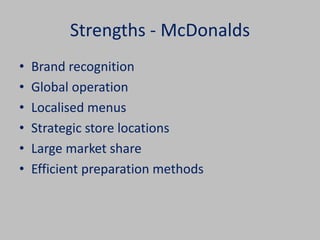
Strengths - McDonalds 
• Brand recognition 
• Global operation 
• Localised menus 
• Strategic store locations 
• Large market share 
• Efficient preparation methods
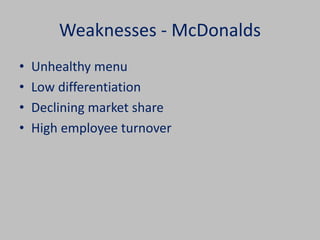
Weaknesses - McDonalds 
• Unhealthy menu 
• Low differentiation 
• Declining market share 
• High employee turnover
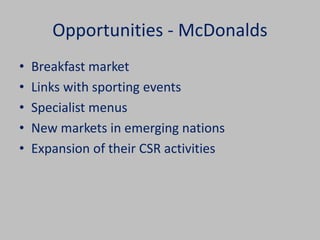
Opportunities - McDonalds 
• Breakfast market 
• Links with sporting events 
• Specialist menus 
• New markets in emerging nations 
• Expansion of their CSR activities
Threats - McDonalds 
• Negative publicity 
• Legal action over additives 
• Competition 
• Changing social attitudes 
• Legislation 
• Economic downturn
What have we learnt? 
• What? 
• Why? 
• Apply.
For next week…… 
• PEST Analysis

Micro teach - SWOT analysis

  • 2.
    Learning Objectives Bythe end of the lesson, you will be able to: • Identify the four factors of a SWOT • Explain their different features • Understand how they relate to each other • Give an example of each factor • Construct a simple SWOT
  • 3.
    What is aSWOT Analysis? • Planning • Matching • Dynamic
  • 4.
    Strengths •Well knownbrand name • Innovative products • Excellent customer service • Quality manufacturing • Niche market
  • 5.
    Weaknesses • Lackof expertise • No differentiation • Poor location • Substandard products • Damage to reputation
  • 6.
    Opportunities • Developingand new markets • Mergers and alliances • Demise of competitors • Legislation • Changing trends
  • 7.
    Threats • Newcompetitors • Price wars • Legislation • Social changes
  • 8.
    Helpful Harmful Internal Strengths (maintain and develop) Weaknesses (overcome) External Opportunities (exploit) Threats (minimise)
  • 9.
  • 10.
  • 11.
    Strengths - McDonalds • Brand recognition • Global operation • Localised menus • Strategic store locations • Large market share • Efficient preparation methods
  • 12.
    Weaknesses - McDonalds • Unhealthy menu • Low differentiation • Declining market share • High employee turnover
  • 13.
    Opportunities - McDonalds • Breakfast market • Links with sporting events • Specialist menus • New markets in emerging nations • Expansion of their CSR activities
  • 14.
    Threats - McDonalds • Negative publicity • Legal action over additives • Competition • Changing social attitudes • Legislation • Economic downturn
  • 15.
    What have welearnt? • What? • Why? • Apply.
  • 16.
    For next week…… • PEST Analysis

Editor's Notes

  • #2 Hello everyone. Today’s lesson is a brief introduction to the SWOT Analysis. I’m going to talk to you about what it is, what it stands for, and what it is used for. We will look at the different factors, and how they relate to each other, and then we’ll have a go at creating a simple SWOT ourselves.
  • #3 The learning objectives for this lesson are as follows: To know what the letters stand for To be able to describe their different features To understand how they relate to each other To be able give at least one example of each factor To apply this knowledge and create a simple SWOT Let’s begin by looking at what a SWOT Analysis is.
  • #4 You’re probably thinking, “What is a SWOT Analysis?” Put simply, it is a planning tool which is used to identify and prioritise internal and external factors faced by a business. It matches the existing resources and capabilities to the environment in which the business operates, and helps to shape the future plans of the business. It’s not static, and should be seen as a dynamic part of the development of a business.
  • #5 In order to be able to use a SWOT successfully, we need to know what the factors are and how they relate to each other. The first factor is? Strengths. Strengths are internal factors which are helpful to the organisation. They can be things like a strong brand name – think Apple, Coke, Microsoft, Nike, Ford, all instantly recognisable on a global level. It could be an innovative product, something which no one else has made or designed yet. Maybe your R&D is a world leader in its field – pharmaceutical companies, for example. Customer service – in a world where service industries are on the increase, this can be a powerful strength. In an industry where the product is very similar across most operators, such as airlines, customer service can be crucial. You may have a reputation for quality manufacturing – often seen as a strength in the car industry. Niche market – if your product caters for a very specific market with little or no competition, this could give you an advantage.
  • #6 The flipside to strengths is of course….. Weaknesses are also internal factors, but are harmful to the organisation. They can often be the opposite of strengths (Poor customer service, not well known, etc.) and need to be eliminated, or at least minimised. Lack of expertise – can refer to marketing, manufacturing, distribution etc etc Common for newly established businesses, or small organisations. No differentiation – remember how we talked about innovation? This is the opposite, where your product doesn’t stand out from your competitors – has no unique features. Couple this with the other weakness we have just talked about (lack of expertise in marketing, say), and you’re going to have an uphill struggle to be successful. Poor location – a bad decision made on where to locate stores or factories can have a huge impact on the success of your business. Badly located factories can increase costs and limit the potential for the recruitment of suitably qualified staff. Substandard products – whether it is because it is poorly made (see above), poorly designed (R&D not up to scratch) or just not fit for purpose 9poor market research), if it doesn’t sell, that is a major weakness for the business. Damage to reputation – Tesco horsemeat anyone? Conditions in Foxconn, one of Apple’s component suppliers in China? Hoover’s holiday debacle? All good examples of how a company’s reputation can be damaged, and cause a change of strategy to restore public opinion. Honesty is key here.
  • #7 Opportunities – external factors which can help the organisation, and if successfully exploited, can turn into strengths. Developing markets can provide massive opportunities for businesses today, particularly where domestic markets are saturated. Mobile phone companies going into SE Asia is a good example of this. The Asian market is the fastest growing and most lucrative for many products, and businesses that understand this and capitalise on it have the potential to become highly successful. On a smaller scale, a developing market could be a different demographic, such as the increase in the use of tablets in the over 60 age group – apps etc. Mergers and alliances – sometimes, the only way to crack a new market is to join forces with someone bigger, or someone who has experience in your target market. Sometimes, it may be to buy up a competitor. Either way, mergers and alliances can provide opportunities to enter new markets and expand your business. The demise of a competitor may sound a little harsh, but if one of your competitors goes out of business, it opens up opportunities for your business to take their customers, or fill their niche. Changes in legislation can provide opportunities for a business to expand. Relaxation of trade barriers, changes to taxation, lifting of export restrictions. A business which identifies changing trends earlier than their competitors will allow them to corner new markets or technology first. Competitive advantage.
  • #8 Threats are external factors which are harmful to the business. Perhaps the most worrying, as there is no way of controlling or minimising them. Competitors will provide the biggest threat for many businesses. Think Apple/Samsung, Coke/Pepsi Price wars – if you are already operating on a very small margin, a competitor cutting prices and forcing you to follow suit can be extremely hazardous. Price wars can often end with one or more competitors severely damaged or even out of business. Supermarkets. Just as we mentioned legislation in opportunities, it can also be a threat. The impact of any changes cannot be avoided. Taxes on fuel for airlines, taxes on fast food. Legislation around pub opening hours? Social changes – shifting attitudes towards smoking, drinking, fuel consumption, healthy eating, awareness of working conditions?
  • #9 This summarises what we have just discussed
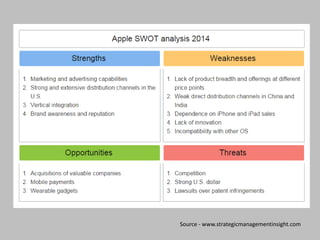
  • #10 This is an example of a very simple SWOT for Apple. As you can see, many of the points we have just discussed are in here. Brand awareness, vertical integration (buying up suppliers) They don’t actually sell a range of products – but is that their strength? Lack of innovation – is it just a triumph of marketing getting people to buy the new iPhone with very few truly innovative features? Acquisition (mergers point) mobile payments – changing trends
  • #11 There should be enough food for thought now for you to have a go a doing something similar for…… Get into three groups and see if you can come up with at least two examples for each factor.
  • #16 So what have we learnt? Plenary questions   SWOT stands for Strengths Weakness Opportunity Threats SWOT looks at Both internal and External Factors SW looks at The Internal factors affecting a business. Can be controlled. Factors out of control of the business which may affect it are Opportunity and Threats. Cannot be controlled. Aims turn opportunities into strengths, eliminate weaknesses, and minimise threats. Which of the SWOT factors do the following statements refer to? Loyal Customer Base S New market opened up O Poor Staff training W Minimum wage so higher wages have to be paid T Overseas demand for product O/T Falling number of customers within specific age group T Making a profit S Poor quality goods W Expansion of business to overseas S Negative Publicity T Good financial situation S New competition T