Micro-Presentation &
Impromptu Speaking
BY: ARUSHI BHARTI COURSE: COMMUNICATION SKILLS & PERSONALITY DEVELOPMENT
[EXT-112]
Definitions
Format & Structure
Differences and Comparison
SUBMITTED TO- DR. PRAMOD KUMAR PRAJAPATI
{B.SC(Hons.) AG. 1ST
YEAR}
[BHU RGSC]
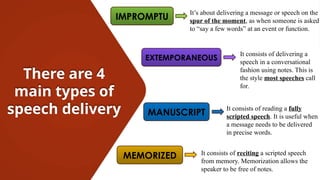
There are 4
main types of
speech delivery
IMPROMPTU
It’s about delivering a message or speech on the
spur of the moment, as when someone is asked
to “say a few words” at an event or function.
EXTEMPORANEOUS
It consists of delivering a
speech in a conversational
fashion using notes. This is
the style most speeches call
for.
MANUSCRIPT
It consists of reading a fully
scripted speech. It is useful when
a message needs to be delivered
in precise words.
MEMORIZED It consists of reciting a scripted speech
from memory. Memorization allows the
speaker to be free of notes.
MICRO-PRESENTATION
 Micro-presentations are brief presentations that typically last between five to ten
minutes, focusing on the most critical and relevant information.
 Micro-presentations are precise and engaging, helping you save time, increase
engagement, and deliver your message more effectively during business pitches,
breakout sessions, project updates, and speaker introductions.
 A micro presentation may be simply a brief speech or may use visual aids such as
slides, computer graphics, or whiteboards with diagrams or lists.
 The key is distilling information down to its essence, wasting not a word, while
maintaining the core elements of any presentation or speech.
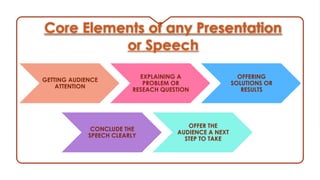
Core Elements of any Presentation
or Speech
GETTING AUDIENCE
ATTENTION
EXPLAINING A
PROBLEM OR
RESEACH QUESTION
OFFERING
SOLUTIONS OR
RESULTS
CONCLUDE THE
SPEECH CLEARLY
OFFER THE
AUDIENCE A NEXT
STEP TO TAKE
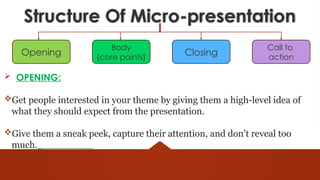
Structure Of Micro-presentation
Opening
Body
{core points}
Call to
action
Closing
 OPENING:
Get people interested in your theme by giving them a high-level idea of
what they should expect from the presentation.
Give them a sneak peek, capture their attention, and don’t reveal too
much.
 BODY{CORE POINTS}:
Try to answer from the Why, What, Where, How and Who based
on your presentation’s relevance.
 There are 2 STRUCTURES which can be followed
1.The Chronological Structure
 Discuss the core points via the reference of time-
PAST
PRESEN
T
FUTURE
How it is How it was How it will be
At each step define the reasons for it.
2.The Macro To Micro Structure
MACRO
MICRO
Go about discussing the
core points from top to
bottom.
 CLOSING: i) One should know when to stop so that the ending is not abrupt.
ii) Audience should be aware that the end has come, and it is done.
iii) In the ending remind the audience of the core points again to make sure it is the thing they take
away from the presentation.
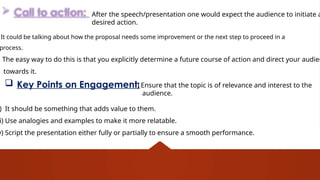
 Call to action: After the speech/presentation one would expect the audience to initiate a
desired action.
It could be talking about how the proposal needs some improvement or the next step to proceed in a
process.
The easy way to do this is that you explicitly determine a future course of action and direct your audien
towards it.
 Key Points on Engagement:
i) Ensure that the topic is of relevance and interest to the
audience.
) It should be something that adds value to them.
i) Use analogies and examples to make it more relatable.
v) Script the presentation either fully or partially to ensure a smooth performance.
IMPROMPTU SPEAKING
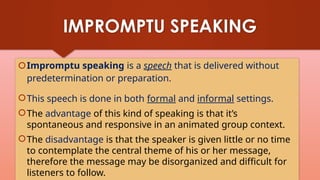
Impromptu speaking is a speech that is delivered without
predetermination or preparation.
This speech is done in both formal and informal settings.
The advantage of this kind of speaking is that it’s
spontaneous and responsive in an animated group context.
The disadvantage is that the speaker is given little or no time
to contemplate the central theme of his or her message,
therefore the message may be disorganized and difficult for
listeners to follow.
Structure Of The Speech
OPENING BODY
CONCLUSIO
N
i) Open by addressing
your respected seniors
and authorities.
ii) Brief introduction/opening
to get attention.
i) Cover the main speaking
points.
ii) Use clearly worded simple
sentences.
iii) Try to find one or two
central themes.
iv) Try to link the themes and
ideas.
i) Be brief & look for an
elegant closing that links
back to the opening.
ii) End speech by acknowledg-
ing the respected audience.
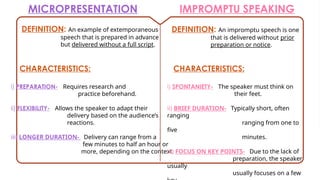
MICROPRESENTATION IMPROMPTU SPEAKING
DEFINITION: An example of extemporaneous
speech that is prepared in advance
but delivered without a full script.
DEFINITION: An impromptu speech is one
that is delivered without prior
preparation or notice.
CHARACTERISTICS:
i) PREPARATION- Requires research and
practice beforehand.
ii) FLEXIBILITY- Allows the speaker to adapt their
delivery based on the audience’s
reactions.
iii) LONGER DURATION- Delivery can range from a
few minutes to half an hour or
more, depending on the context.
CHARACTERISTICS:
i) SPONTANIETY- The speaker must think on
their feet.
ii) BRIEF DURATION- Typically short, often
ranging
ranging from one to
five
minutes.
iii) FOCUS ON KEY POINTS- Due to the lack of
preparation, the speaker
usually
usually focuses on a few
FACTORS FOR EFFECTIVE DELIVERY:
i) THROUGH PREPARATION- Research your topic
well and create an outline with key
points.
ii) PRACTICE- Rehearse your speech multiple
times
to gain confidence and
familiarity with
the material.
iii) USE NOTES WISELY- Create a concise outline or
bullet points to refer to, rather
than a
full script, to keep delivery
natural.
iv) ENGAGE WITH THE AUDIENCE- Use eye
contact and gestures to create
a
connection and maintain
FACTORS FOR EFFECTIVE DELIVERY:
i) STAY CALM- Take a deep breath to manage
anxiety and think clearly.
ii)STRUCTURE YOUR THOUGHTS- Use a simple
structure like the “Point, Reason,
Example” format to organize your
speech quickly.
iii)BE RELATABLE- Use personal anecdotes or
relatable examples to connect
with the audience.
iv)PRACTICE ACTIVE LISTENING- If given a topic in
a group setting, listen carefully to
others before speaking .
v)MAINTAIN EYE CONTACT- Engage your audience
by looking at them while speaking.
SOURCES:
 https://courses.lumenlearning.com/wm-publicspeaking/chapter/methods-of-speech-delivery/#:~:text
=There%20are%20four%20basic%20methods,advantages%20and%20disadvantages%20of%20each
 https://open.lib.umn.edu/publicspeaking/chapter/14-1-four-methods-of-delivery/#:~:text=Impromptu%
20speaking%20is%20the%20presentation,times%20in%20informal%2C%20conversational%20settings
 https://etqadkhan23.medium.com/micro-presentations-saying-more-in-less-time-17afa73c12f6
 https://www.theclassroom.com/micro-presentation-11368711.html
 http://ecoursesonline.iasri.res.in/mod/resource/view.php?id=88024
 https://dcyf.worldpossible.org/rachel/modules/en-boundless-static/www.boundless.com/
 https://www.shiksha.com/bba/articles/christ-university-admissions-trend-of-micro-presentation-blogId
-23821#:~:text=Micro%20presentation%2C%20in%20simple%20words,of%20the%20CUET%20selection%
20process

Micro-Presentation vs Impromptu Presentation.pptx

  • 1.
    Micro-Presentation & Impromptu Speaking BY:ARUSHI BHARTI COURSE: COMMUNICATION SKILLS & PERSONALITY DEVELOPMENT [EXT-112] Definitions Format & Structure Differences and Comparison SUBMITTED TO- DR. PRAMOD KUMAR PRAJAPATI {B.SC(Hons.) AG. 1ST YEAR} [BHU RGSC]
  • 2.
    There are 4 maintypes of speech delivery IMPROMPTU It’s about delivering a message or speech on the spur of the moment, as when someone is asked to “say a few words” at an event or function. EXTEMPORANEOUS It consists of delivering a speech in a conversational fashion using notes. This is the style most speeches call for. MANUSCRIPT It consists of reading a fully scripted speech. It is useful when a message needs to be delivered in precise words. MEMORIZED It consists of reciting a scripted speech from memory. Memorization allows the speaker to be free of notes.
  • 3.
    MICRO-PRESENTATION  Micro-presentations arebrief presentations that typically last between five to ten minutes, focusing on the most critical and relevant information.  Micro-presentations are precise and engaging, helping you save time, increase engagement, and deliver your message more effectively during business pitches, breakout sessions, project updates, and speaker introductions.  A micro presentation may be simply a brief speech or may use visual aids such as slides, computer graphics, or whiteboards with diagrams or lists.  The key is distilling information down to its essence, wasting not a word, while maintaining the core elements of any presentation or speech.
  • 4.
    Core Elements ofany Presentation or Speech GETTING AUDIENCE ATTENTION EXPLAINING A PROBLEM OR RESEACH QUESTION OFFERING SOLUTIONS OR RESULTS CONCLUDE THE SPEECH CLEARLY OFFER THE AUDIENCE A NEXT STEP TO TAKE
  • 5.
    Structure Of Micro-presentation Opening Body {corepoints} Call to action Closing  OPENING: Get people interested in your theme by giving them a high-level idea of what they should expect from the presentation. Give them a sneak peek, capture their attention, and don’t reveal too much.
  • 6.
     BODY{CORE POINTS}: Tryto answer from the Why, What, Where, How and Who based on your presentation’s relevance.  There are 2 STRUCTURES which can be followed 1.The Chronological Structure  Discuss the core points via the reference of time- PAST PRESEN T FUTURE How it is How it was How it will be At each step define the reasons for it. 2.The Macro To Micro Structure MACRO MICRO Go about discussing the core points from top to bottom.  CLOSING: i) One should know when to stop so that the ending is not abrupt. ii) Audience should be aware that the end has come, and it is done. iii) In the ending remind the audience of the core points again to make sure it is the thing they take away from the presentation.
  • 7.
     Call toaction: After the speech/presentation one would expect the audience to initiate a desired action. It could be talking about how the proposal needs some improvement or the next step to proceed in a process. The easy way to do this is that you explicitly determine a future course of action and direct your audien towards it.  Key Points on Engagement: i) Ensure that the topic is of relevance and interest to the audience. ) It should be something that adds value to them. i) Use analogies and examples to make it more relatable. v) Script the presentation either fully or partially to ensure a smooth performance.
  • 8.
    IMPROMPTU SPEAKING Impromptu speakingis a speech that is delivered without predetermination or preparation. This speech is done in both formal and informal settings. The advantage of this kind of speaking is that it’s spontaneous and responsive in an animated group context. The disadvantage is that the speaker is given little or no time to contemplate the central theme of his or her message, therefore the message may be disorganized and difficult for listeners to follow.
  • 9.
    Structure Of TheSpeech OPENING BODY CONCLUSIO N i) Open by addressing your respected seniors and authorities. ii) Brief introduction/opening to get attention. i) Cover the main speaking points. ii) Use clearly worded simple sentences. iii) Try to find one or two central themes. iv) Try to link the themes and ideas. i) Be brief & look for an elegant closing that links back to the opening. ii) End speech by acknowledg- ing the respected audience.
  • 10.
    MICROPRESENTATION IMPROMPTU SPEAKING DEFINITION:An example of extemporaneous speech that is prepared in advance but delivered without a full script. DEFINITION: An impromptu speech is one that is delivered without prior preparation or notice. CHARACTERISTICS: i) PREPARATION- Requires research and practice beforehand. ii) FLEXIBILITY- Allows the speaker to adapt their delivery based on the audience’s reactions. iii) LONGER DURATION- Delivery can range from a few minutes to half an hour or more, depending on the context. CHARACTERISTICS: i) SPONTANIETY- The speaker must think on their feet. ii) BRIEF DURATION- Typically short, often ranging ranging from one to five minutes. iii) FOCUS ON KEY POINTS- Due to the lack of preparation, the speaker usually usually focuses on a few
  • 11.
    FACTORS FOR EFFECTIVEDELIVERY: i) THROUGH PREPARATION- Research your topic well and create an outline with key points. ii) PRACTICE- Rehearse your speech multiple times to gain confidence and familiarity with the material. iii) USE NOTES WISELY- Create a concise outline or bullet points to refer to, rather than a full script, to keep delivery natural. iv) ENGAGE WITH THE AUDIENCE- Use eye contact and gestures to create a connection and maintain FACTORS FOR EFFECTIVE DELIVERY: i) STAY CALM- Take a deep breath to manage anxiety and think clearly. ii)STRUCTURE YOUR THOUGHTS- Use a simple structure like the “Point, Reason, Example” format to organize your speech quickly. iii)BE RELATABLE- Use personal anecdotes or relatable examples to connect with the audience. iv)PRACTICE ACTIVE LISTENING- If given a topic in a group setting, listen carefully to others before speaking . v)MAINTAIN EYE CONTACT- Engage your audience by looking at them while speaking.
  • 12.
    SOURCES:  https://courses.lumenlearning.com/wm-publicspeaking/chapter/methods-of-speech-delivery/#:~:text =There%20are%20four%20basic%20methods,advantages%20and%20disadvantages%20of%20each  https://open.lib.umn.edu/publicspeaking/chapter/14-1-four-methods-of-delivery/#:~:text=Impromptu% 20speaking%20is%20the%20presentation,times%20in%20informal%2C%20conversational%20settings https://etqadkhan23.medium.com/micro-presentations-saying-more-in-less-time-17afa73c12f6  https://www.theclassroom.com/micro-presentation-11368711.html  http://ecoursesonline.iasri.res.in/mod/resource/view.php?id=88024  https://dcyf.worldpossible.org/rachel/modules/en-boundless-static/www.boundless.com/  https://www.shiksha.com/bba/articles/christ-university-admissions-trend-of-micro-presentation-blogId -23821#:~:text=Micro%20presentation%2C%20in%20simple%20words,of%20the%20CUET%20selection% 20process