University of Stavanger
The Norwegian School of Hotel Management
MHR 175 - Psychology
“What will happen to people's'/ tourists' worries and risk judgments following the Paris terror
on Nov 13 2015?”
November 24, 2015
Naiwen Ji - 234909
Larikka, Lisa Marie -206274
Denise Roxanne Nabong - 234901
Rasoalandy Edmondia -234924
Number of words: 2000
Abstract The aim of this paper is to present and discuss two hypothesizes about what will
happen for tourists' worries and risk judgments following the Paris terror on Nov 13 2015. The
first one considers that there will be a sharp increase in tourists’ worries and risk judgments in
short-term. The second proposes that in long-term, tourists’ perspectives (both local and
international) will remain within expected margins.
Key Words: Risk judgements, worries, terrorism
Introduction
In light of the recent terrorist attack in Paris which killed nearly 120 people , a fear of an
economic impact brought about by a possible decline in tourist arrivals has spread among those
working in the tourism and hospitality industry. According to recent data, Travel and Tourism in
France are shown to have contributed a massive 77 billion euros which covers 3.6% of the total
GDP in 2014 (WTTC, 2015). The importance of understanding tourists’ risk perception in this
context is crucial to the aforementioned industries given that Paris has been one of the top visited
cities around the world and accounts for a huge number of local employment. To support this,
(Sonmez, Graefe, 1998) provided evidence that risk perception directly influenced tourists’
choice of international destination which could either mean a decline or steadiness in France’s
tourism and hospitality industry depending on how people’s risk perception changed as an
aftermath of the November 13, 2015 terrorist attack.
This paper will discuss worries and risk judgments from two different perspectives, that of
the local tourists, and of those from outside France.
Literature Review
Terrorism is political violence in an asymmetrical conflict which aims to induce terror
and psychic fear (Bockstette,2008). On the basis of previous studies, there is a unique
relationship between terrorism and tourism (SÖnmez & Graefe, 1998). Due to the events of 9/11,
Slovic (2002) suggested terrorism as a new species of hazard (Larsen, Brun, øgaard & Selstad,
2011).
Worry and risk judgment are two terminologies that are confused with one another and
are often used interchangeably. Worry refers to the feelings and thoughts of an ambiguous nature
in which mental attempts are made to avoid involving into potential threats (Borkovec,2002).
Meanwhile, risk is recognized as a result of action taken despite the unpredictable and
uncontrollable outcomes (Antunes & Gonzalez, 2015).
In addition to this, worry is defined as “a cognitive activity used to deal with anxiety
resulting from uncertain negative events”. Risk on the other hand is “the probability of certain
negative outcomes weighted by the magnitude of these outcomes” (Wolff, K., & Larsen, S.,
2014, p.202). Although the two concepts are closely linked, one is clearly distinct from the other.
Risk perception is the subjective judgment people make about the probability of a risk and can be
different according to personal characteristics (Hansson & Zalta, 2014). Risk perception has been
effected by a wide variation such as external factors, internal factors and demographic factors
(Engel, Kollat & Blackwell 1968; Howard,1977; Mansfeld, 1992; Um & Crompton, 1990;
Vanraaij & Francken, 1984).
Due to the development of mass media, the terrorist attack in Paris has been spread rapidly and
transparently. What cannot be denied is that nearly every industry in France has been influenced
including the tourism industry.
However, what will happen for tourists' worries and risk judgments following the Paris terror on
Nov 13 2015 is still in discussion. After sorting and analyzing prior studies, there are two
hypothesizes presented as follows:
1. In the short term: both the worries and risk judgments will increase.
2. In the long term: both of them will decrease to the level before the terrorist attack and
sometimes even lower slightly than before.
There are several reasons to explain the hypotheses referred earlier.
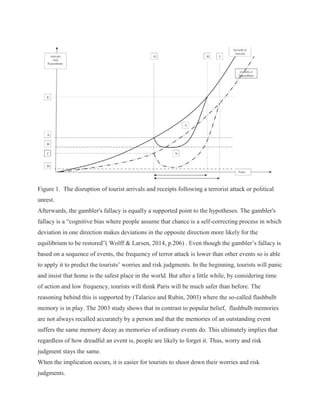
First of all, when exposed in a terror event, a country’s tourism industry is likely to go through
three distinctive phases which are established in Figure 1 (Fletcher & Monrakabali, 2008). At the
‘G’ point, a one-off event occurs and causes a sharp decrease in arrivals from ‘A’ to ‘B’. It is
clear that the loss of arrivals in area ‘Y’ caused by tourists’ raised worries and risk judgments.
But after a period of time, the number of visitors comes back reaching to ‘E’ which can reflect
that then drops of tourists’ raised worries and risk judgments. Fletcher & Monrakabali (2008)
indicates that the time period between G and H averages around 24 months.
Figure 1. The disruption of tourist arrivals and receipts following a terrorist attack or political
unrest.
Afterwards, the gambler's fallacy is equally a supported point to the hypotheses. The gambler's
fallacy is a “cognitive bias where people assume that chance is a self-correcting process in which
deviation in one direction makes deviations in the opposite direction more likely for the
equilibrium to be restored”( Wolff & Larsen, 2014, p.206) . Even though the gambler’s fallacy is
based on a sequence of events, the frequency of terror attack is lower than other events so is able
to apply it to predict the tourists’ worries and risk judgments. In the beginning, tourists will panic
and insist that home is the safest place in the world. But after a little while, by considering time
of action and low frequency, tourists will think Paris will be much safer than before. The
reasoning behind this is supported by (Talarico and Rubin, 2003) where the so-called flashbulb
memory is in play. The 2003 study shows that in contrast to popular belief, flashbulb memories
are not always recalled accurately by a person and that the memories of an outstanding event
suffers the same memory decay as memories of ordinary events do. This ultimately implies that
regardless of how dreadful an event is, people are likely to forget it. Thus, worry and risk
judgment stays the same.
When the implication occurs, it is easier for tourists to shoot down their worries and risk
judgments.
Last but not least, as mentioned before, numerous elements have marked impacts on the risk
judgment. This essay focuses on the influence of external factors and the uncontrolled parts
(internal factors and demographic factors) will not be discussed. The external elements are
divided into three ingredients: Media converge. Government issued travel advisors and Social
interaction. The physiological fear of terrorism is definitely resulting in enhancement of worries
and risk judgments, whereas, after a period time, the intellectual sensitivity will replace to
control. At this time, the external factors will play a critical role in tourism decision-making. If
mass media report more transparent information and the government chooses a proper way to
deal with terrorism such as doing risk assessment and cooperating with the state power , it will
lead to a constructive social integration. When judging the risks, all of the elements will help to
reduce tourists’ worries and risk judgments. However, what cannot be ignored that the change
takes time.
Conclusion
In conclusion, there will be no significant changes in people’s worries and risk judgments in the
aftermath of this year’s November 13 Paris terror. Although an increase in worry and risk
judgment is expectable immediately after the attacks which can be reflected by the flight tickets
cancellation rate. short and long term changes on tourists’ perspectives (both local and
international) will remain within expected margins. Moreover, the fact that “people expect
negative emotions from traveling, and that they expect the destinations to be risky, have not yet
prevented people from experiencing the desire to travel” ((Larsen, Brun, øgaard & Selstad, 2011,
p.283). Meanwhile, what should be underlined that this is simply a rough prediction due to the
lack of enough information and several reactions are in progress. Therefore, to make a precise
prediction, there are still more researches have to be done.
Reference List
Antunes, R., & Gonzalez, V. (2015). A Production Model for Construction: A Theoretical
Framework. Buildings 5 (1): 209–228.
Bockstette, C. (2008). Jihadist Terrorist Use of Strategic Communication Management
Techniques. George C. Marshall Center Occasional Paper Series.
Borkovec,TD. (2002). Life in the future versus life in the present. Clinical Psychology:
Science and Practice 9, 76–80.
Brewer, N. T., Weinstein, N. D., Cuite, C. L., & Herrington, J. E., Jr. (2004). Risk
perceptions and their relations to risk behavior. Annals of Behavioral Medicine, 27, 125–
130. doi:10.1207/ s15324796abm2702 7
Eiser, J. R., & Arnold, B. W. A. (1999). Out in the midday sun: Risk behavior and
optimistic beliefs among residents and visitors on Tenerife. Psychology and Health, 14,
529–544. doi:10.1080/ 08870449908407345
Engel, J. F., Kollat, D. T., & Blackwell, D. (1968) Consumer Behavior. New York: Holt.
Fletcher, J., & Morakabati, Y. (2008). Tourism activity, terrorism and political instability
within the Commonwealth: The cases of Fiji and Kenya. International Journal of Tourism
Research 10,537–556. doi:10.1002/jtr.699
Floyd, D. L., Prentice-Dunn, S., & Rogers, R. W. (2000). A meta-analysis of research on
protection motivation theory. Journal of Applied Social Psychology, 30, 407–429.
doi:10.1111/j. 1559- 1816. 2000.tb02323.x
Hansson, S.O., & Zalta, E.N. (2014). Risk. The Stanford Encyclopedia of Philosophy.
Howard, J. A. (1977). Consumer Behavior: Application of Theory. New York: McGraw-
Hill.
Larsen, S., Brun, W., øgaard, T., & Selstad, L. (2011). Effects of Sudden and Dramatic
Events on Travel Desire and Risk Judgments, Scandinavian Journal of Hospitality and
Tourism, 11:3, 268-285, DOI: 10.1080/15022250.2011.593360
Mansfeld, Y. (1992). From Motivation to Actual Travel. Annals of Tourism Research
19,399-419.
Mokdad, A. H., Marks, J. S., Stoup, D. F., & Gerberding, J. L. (2004). Actual causes of
death in the United States, 2000. Journal of the American Medical Association, 291, 1238–
1245. doi:10.1001/jama.291.10.1238
Sönmez, S.F., & Graefe, A.G. (1998). Influence of terrorism risk on foreign tourism
decisions. Annals of Tourism Research, 25(1), 112-144.
Talarico, J. M., & Rubin, D. C. (2003). Confidence, not consistency, characterizes
flashbulb memories. Psychological Science, 14(5), 455-461.
Urn, S. & Crompton, J. L. (1990). Attitude Determinants in Tourism Destination Choice.
Annals of Tourism Research 17,432-448.
Vanraaij, W. F. & Francken, D. A. (1984). Vacation Decisions, Activities and Satisfactions.
Annals of Tourism Research11,101-112.
Wolff, K., & Larsen, S. (2014). Can terrorism make us feel safer? Risk perceptions and
worries before and after the July 22nd attacks. Annals of Tourism Research, 44, 202.
Wolff, K., & Larsen, S. (2014). Can terrorism make us feel safer? Risk perceptions and
worries before and after the July 22nd attacks. Annals of Tourism Research, 44, 206.
WTTC. (2015). Economic Impact 2015 France. from http://www.wttc.org/-
/media/files/reports/economic%20impact%20research/countries%202015/france2015.pdf

MHR175-GroupPaperready

  • 1.
    University of Stavanger TheNorwegian School of Hotel Management MHR 175 - Psychology “What will happen to people's'/ tourists' worries and risk judgments following the Paris terror on Nov 13 2015?” November 24, 2015 Naiwen Ji - 234909 Larikka, Lisa Marie -206274 Denise Roxanne Nabong - 234901 Rasoalandy Edmondia -234924 Number of words: 2000
  • 2.
    Abstract The aimof this paper is to present and discuss two hypothesizes about what will happen for tourists' worries and risk judgments following the Paris terror on Nov 13 2015. The first one considers that there will be a sharp increase in tourists’ worries and risk judgments in short-term. The second proposes that in long-term, tourists’ perspectives (both local and international) will remain within expected margins. Key Words: Risk judgements, worries, terrorism Introduction In light of the recent terrorist attack in Paris which killed nearly 120 people , a fear of an economic impact brought about by a possible decline in tourist arrivals has spread among those working in the tourism and hospitality industry. According to recent data, Travel and Tourism in France are shown to have contributed a massive 77 billion euros which covers 3.6% of the total GDP in 2014 (WTTC, 2015). The importance of understanding tourists’ risk perception in this context is crucial to the aforementioned industries given that Paris has been one of the top visited cities around the world and accounts for a huge number of local employment. To support this, (Sonmez, Graefe, 1998) provided evidence that risk perception directly influenced tourists’ choice of international destination which could either mean a decline or steadiness in France’s tourism and hospitality industry depending on how people’s risk perception changed as an aftermath of the November 13, 2015 terrorist attack. This paper will discuss worries and risk judgments from two different perspectives, that of the local tourists, and of those from outside France. Literature Review Terrorism is political violence in an asymmetrical conflict which aims to induce terror and psychic fear (Bockstette,2008). On the basis of previous studies, there is a unique relationship between terrorism and tourism (SÖnmez & Graefe, 1998). Due to the events of 9/11, Slovic (2002) suggested terrorism as a new species of hazard (Larsen, Brun, øgaard & Selstad, 2011). Worry and risk judgment are two terminologies that are confused with one another and are often used interchangeably. Worry refers to the feelings and thoughts of an ambiguous nature in which mental attempts are made to avoid involving into potential threats (Borkovec,2002). Meanwhile, risk is recognized as a result of action taken despite the unpredictable and uncontrollable outcomes (Antunes & Gonzalez, 2015).
  • 3.
    In addition tothis, worry is defined as “a cognitive activity used to deal with anxiety resulting from uncertain negative events”. Risk on the other hand is “the probability of certain negative outcomes weighted by the magnitude of these outcomes” (Wolff, K., & Larsen, S., 2014, p.202). Although the two concepts are closely linked, one is clearly distinct from the other. Risk perception is the subjective judgment people make about the probability of a risk and can be different according to personal characteristics (Hansson & Zalta, 2014). Risk perception has been effected by a wide variation such as external factors, internal factors and demographic factors (Engel, Kollat & Blackwell 1968; Howard,1977; Mansfeld, 1992; Um & Crompton, 1990; Vanraaij & Francken, 1984). Due to the development of mass media, the terrorist attack in Paris has been spread rapidly and transparently. What cannot be denied is that nearly every industry in France has been influenced including the tourism industry. However, what will happen for tourists' worries and risk judgments following the Paris terror on Nov 13 2015 is still in discussion. After sorting and analyzing prior studies, there are two hypothesizes presented as follows: 1. In the short term: both the worries and risk judgments will increase. 2. In the long term: both of them will decrease to the level before the terrorist attack and sometimes even lower slightly than before. There are several reasons to explain the hypotheses referred earlier. First of all, when exposed in a terror event, a country’s tourism industry is likely to go through three distinctive phases which are established in Figure 1 (Fletcher & Monrakabali, 2008). At the ‘G’ point, a one-off event occurs and causes a sharp decrease in arrivals from ‘A’ to ‘B’. It is clear that the loss of arrivals in area ‘Y’ caused by tourists’ raised worries and risk judgments. But after a period of time, the number of visitors comes back reaching to ‘E’ which can reflect that then drops of tourists’ raised worries and risk judgments. Fletcher & Monrakabali (2008) indicates that the time period between G and H averages around 24 months.
  • 4.
    Figure 1. Thedisruption of tourist arrivals and receipts following a terrorist attack or political unrest. Afterwards, the gambler's fallacy is equally a supported point to the hypotheses. The gambler's fallacy is a “cognitive bias where people assume that chance is a self-correcting process in which deviation in one direction makes deviations in the opposite direction more likely for the equilibrium to be restored”( Wolff & Larsen, 2014, p.206) . Even though the gambler’s fallacy is based on a sequence of events, the frequency of terror attack is lower than other events so is able to apply it to predict the tourists’ worries and risk judgments. In the beginning, tourists will panic and insist that home is the safest place in the world. But after a little while, by considering time of action and low frequency, tourists will think Paris will be much safer than before. The reasoning behind this is supported by (Talarico and Rubin, 2003) where the so-called flashbulb memory is in play. The 2003 study shows that in contrast to popular belief, flashbulb memories are not always recalled accurately by a person and that the memories of an outstanding event suffers the same memory decay as memories of ordinary events do. This ultimately implies that regardless of how dreadful an event is, people are likely to forget it. Thus, worry and risk judgment stays the same. When the implication occurs, it is easier for tourists to shoot down their worries and risk judgments.
  • 5.
    Last but notleast, as mentioned before, numerous elements have marked impacts on the risk judgment. This essay focuses on the influence of external factors and the uncontrolled parts (internal factors and demographic factors) will not be discussed. The external elements are divided into three ingredients: Media converge. Government issued travel advisors and Social interaction. The physiological fear of terrorism is definitely resulting in enhancement of worries and risk judgments, whereas, after a period time, the intellectual sensitivity will replace to control. At this time, the external factors will play a critical role in tourism decision-making. If mass media report more transparent information and the government chooses a proper way to deal with terrorism such as doing risk assessment and cooperating with the state power , it will lead to a constructive social integration. When judging the risks, all of the elements will help to reduce tourists’ worries and risk judgments. However, what cannot be ignored that the change takes time. Conclusion In conclusion, there will be no significant changes in people’s worries and risk judgments in the aftermath of this year’s November 13 Paris terror. Although an increase in worry and risk judgment is expectable immediately after the attacks which can be reflected by the flight tickets cancellation rate. short and long term changes on tourists’ perspectives (both local and international) will remain within expected margins. Moreover, the fact that “people expect negative emotions from traveling, and that they expect the destinations to be risky, have not yet prevented people from experiencing the desire to travel” ((Larsen, Brun, øgaard & Selstad, 2011, p.283). Meanwhile, what should be underlined that this is simply a rough prediction due to the lack of enough information and several reactions are in progress. Therefore, to make a precise prediction, there are still more researches have to be done.
  • 6.
    Reference List Antunes, R.,& Gonzalez, V. (2015). A Production Model for Construction: A Theoretical Framework. Buildings 5 (1): 209–228. Bockstette, C. (2008). Jihadist Terrorist Use of Strategic Communication Management Techniques. George C. Marshall Center Occasional Paper Series. Borkovec,TD. (2002). Life in the future versus life in the present. Clinical Psychology: Science and Practice 9, 76–80. Brewer, N. T., Weinstein, N. D., Cuite, C. L., & Herrington, J. E., Jr. (2004). Risk perceptions and their relations to risk behavior. Annals of Behavioral Medicine, 27, 125– 130. doi:10.1207/ s15324796abm2702 7 Eiser, J. R., & Arnold, B. W. A. (1999). Out in the midday sun: Risk behavior and optimistic beliefs among residents and visitors on Tenerife. Psychology and Health, 14, 529–544. doi:10.1080/ 08870449908407345 Engel, J. F., Kollat, D. T., & Blackwell, D. (1968) Consumer Behavior. New York: Holt. Fletcher, J., & Morakabati, Y. (2008). Tourism activity, terrorism and political instability within the Commonwealth: The cases of Fiji and Kenya. International Journal of Tourism Research 10,537–556. doi:10.1002/jtr.699 Floyd, D. L., Prentice-Dunn, S., & Rogers, R. W. (2000). A meta-analysis of research on protection motivation theory. Journal of Applied Social Psychology, 30, 407–429. doi:10.1111/j. 1559- 1816. 2000.tb02323.x Hansson, S.O., & Zalta, E.N. (2014). Risk. The Stanford Encyclopedia of Philosophy. Howard, J. A. (1977). Consumer Behavior: Application of Theory. New York: McGraw- Hill. Larsen, S., Brun, W., øgaard, T., & Selstad, L. (2011). Effects of Sudden and Dramatic Events on Travel Desire and Risk Judgments, Scandinavian Journal of Hospitality and Tourism, 11:3, 268-285, DOI: 10.1080/15022250.2011.593360 Mansfeld, Y. (1992). From Motivation to Actual Travel. Annals of Tourism Research 19,399-419.
  • 7.
    Mokdad, A. H.,Marks, J. S., Stoup, D. F., & Gerberding, J. L. (2004). Actual causes of death in the United States, 2000. Journal of the American Medical Association, 291, 1238– 1245. doi:10.1001/jama.291.10.1238 Sönmez, S.F., & Graefe, A.G. (1998). Influence of terrorism risk on foreign tourism decisions. Annals of Tourism Research, 25(1), 112-144. Talarico, J. M., & Rubin, D. C. (2003). Confidence, not consistency, characterizes flashbulb memories. Psychological Science, 14(5), 455-461. Urn, S. & Crompton, J. L. (1990). Attitude Determinants in Tourism Destination Choice. Annals of Tourism Research 17,432-448. Vanraaij, W. F. & Francken, D. A. (1984). Vacation Decisions, Activities and Satisfactions. Annals of Tourism Research11,101-112. Wolff, K., & Larsen, S. (2014). Can terrorism make us feel safer? Risk perceptions and worries before and after the July 22nd attacks. Annals of Tourism Research, 44, 202. Wolff, K., & Larsen, S. (2014). Can terrorism make us feel safer? Risk perceptions and worries before and after the July 22nd attacks. Annals of Tourism Research, 44, 206. WTTC. (2015). Economic Impact 2015 France. from http://www.wttc.org/- /media/files/reports/economic%20impact%20research/countries%202015/france2015.pdf