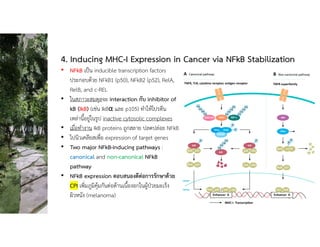
4. Inducing MHC-I Expression in Cancer via NFkB Stabilization
• NFkB เปน inducible transcription factors
ประกอบดวย NFkB1 (p50), NFkB2 (p52), RelA,
RelB, and c-REL
• ในสภาวะสมดุลจะ interaction กับ inhibitor of
kB (IkB) (เชน IkBα และ p105) ทําใหโปรตีน
เหลานี้อยูในรูป inactive cytosolic complexes
• เมื่อทํางาน IkB proteins ถูกสลาย ปลดปลอย NFkB
• ไปนิวเคลียสเพื่อ expression of target genes
• Two major NFkB-inducing pathways :
canonical and non-canonical NFkB
pathway
• NFkB expression ตอบสนองดีตอการรักษาดวย
CPI เพิ่มภูมิคุมกันตอตานเนื้องอกในผูปวยมะเร็ง
ผิวหนัง (melanoma)
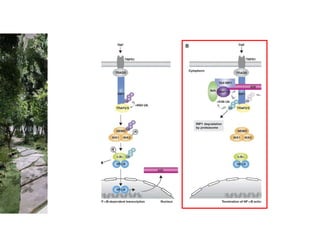
• TNFα Receptor (TNFR), Toll-like receptors (TLR), and cytokines receptors, by their ligands (e.g.,
TNFα, IL-1 หรือ LPS) กระตุน canonical NFkB pathway
• มีการกระตุน TRAF2/6 และ receptor-interacting protein 1 (RIP-1) ที่ถูกเลือก ไดเปน TRAF2/6
polyubiquitinates และ RIP-1
• TGF-β-activated kinase 1 (TAK1) is ubiquitinated และถูกกระตุน
• TAK1 กระตุน phosphorylate และ IkB kinase (IKK) complex (ประกอบดวย IKKα, IKKβ และ NF-
kappa-B essential modulator (NEMO) (หรือเรียกวา IKKγ)
• IKK ตองถูกเลือกเพื่อไปกระตุน receptor กอน phosphorylated (ซึ่งถูกกระตุนโดยปฏิกิริยาระหวาง NEMO-
mediated interaction of IKK กับ polyubiquitinated RIP-1)
• จากนั้น IKK phosphorylates IkB proteins จึงกําหนดเปาหมายสําหรับ ubiquitination และ degradation
ดังนั้น RelA-p50 และ c-REL-p50 จึงถูกปลดปลอย
• เกิดการเคลื่อนไปยังนิวเคลียส เกิด transcription ของ MHC-I heavy chain และ APM-encoding genes โดย
จับกับ kB enhancers ใน promotors
NFkB-mediated upregulation of MHC-I
• non-canonical NFkB pathway เริ่มตนโดยการจับของ ligand (เชน TNFα, CD40L, or B-cell activating
factor (BAFF)) กับ TNFR superfamily members
• NFkB-inducing kinase (NIK) ถูกกระตุน เกิด phosphorylate และกระตุน IKKα ซึ่งเปนหนวยยอยของ IKK
complex
• IKKα เกิด phosphorylates ที่ carboxy-terminal serine residues ของ p100 คลายกับ IkB ที่แยก NFkB
transcription factor RelB ในไซโตซอล
• สงผลใหเกิด ubiquitination and degradation of the C-terminus of p100
• ผลที่ตามมาคือ p52 ถูกสรางขึ้น สราง heterodimer with RelB ยายไปยังนิวเคลียส เกิดการเหนี่ยวนํา
transcription ของ target genes
NFkB-mediated upregulation of MHC-I
• TNF α ชวยกระตุนการสงสัญญาณ NFkB และการแสดงออก MHC-I แตมีความเปนพิษรุนแรง
• retinoids increase MHC-I expression ผานการเพิ่มการแสดงออกของ NFkB p50 และ RelA
• upregulation of proteasome subunits (Latent Membrane Protein (LMP)-2, -7 และ -10) และเพิ่ม
half-life of MHC-I complexes จะชวยเพิ่ม MHC-I expression in neuroblastoma cell lines
• Retinoids รักษาโรค neuroblastoma ,promyelocytic leukemia, induce differentiation, apoptosis, และ
inhibition of proliferation of tumor cells
• betulinic acid, and calcium/calcineurin รวมกับ protein kinase C (PKC) antagonists
• Betulinic acid upregulates canonical pathway activity สงเสริม IKK as well as phosphorylation และ
degradation of IkBα in multiple cancer cell lines, including neuroblastoma, glioblastoma, and
melanoma
• inhibits topoisomerase I activity induces apoptosis และยับยั้งการสรางหลอดเลือดในมะเร็ง
(angiogenesis)
4.1 Positive Regulators of NFkB expression
• HIV infections in CD4+ T-cells รวมกับ calcium/calcineurin และ protein kinase C (PKC)
antagonist prostatin เสริมฤทธิ์การกระตุน NFkB (a similar mechanism as betulinic acid)
• เพิ่ม expression of the E3 ubiquitin ligase Nedd4 กระตุนการเกิด polyubiquitination และ
proteasomal degradation of N4BP1 , กดการทํางาน NFkB
• in B-cells Nedd4 เหนี่ยวนํา ubiquitination และ degradation ของ TNF receptor-associated factor
(TRAF) 3 ผานทาง TNFR CD40 ดังนั้นกระตุนทั้ง canonical และ non-canonical NFkB pathway
4.1 Positive Regulators of NFkB expression
1. Nedd4 Binding Protein 1 (N4BP1) สงผลตอ canonical และ non-canonical activation
• N4BP1 ทําปฏิกิริยากับโปรตีนหลายชนิดที่เกี่ยวของกับ (de)ubiquitination, including NEDD4, Cezanne-1,
A20 และ Itch และ binds to polyubiquitin itself.
• Polyubiquitin จับกับโปรตีน เชนเดียวกับ N4BP1: สามารถแขงกับ NEMO เพื่อยับยั้งการกระตุน canonical
NFkB
• N4BP1 interacts with the deubiquitinase (DUB) Cezanne-1 ซึ่งทําหนาที่ deubiquitination และ
stabilization of TRAF3 และกระตุนทั้ง canonical และ non-canonical NFkB โดยสงผลตอการสลาย NIK และ
IkB และการเหนี่ยวนํา c-REL ubiquitination และ proteasome-mediated degradation
4.2 Negative Regulators of NFkB Expression
2. TNFα-induced protein 3 interacting protein 1 (TNIP1) กระตุน canonical NFkB
TNIP1 (หรือ A20-binding inhibitor of NF-kB (ABIN)-1)
• ยับยั้ง DUB A20 และ TNF-induced apoptosis ,ยับยั้ง NFkB โดยทําใหการเคลื่อน NEMO-mediated ของ IKK
ไปยัง receptor site ลดลง ผานการ competing with NEMO binding to RIP-1
• ปองกันการเปลี่ยน IkB p105 ไปเปน p50 และ interact with the NFkB inhibiting DUB A20
• กระตุน deubiquitination ของ NEMO ซึ่งสงผลใหการกระตุน IKK และ canonical NFkB บกพรอง
• IL-17 treatment induce proteasome-dependent downregulation of TNIP1 -> NFkB activation ->
เพิ่ม MHC-I expression.
• แต IL-17 สงเสริม tumor progression by inducing chronic inflammation, tumor cell proliferation,
angiogenesis, and metastasis ทําใหลด cytokine ในการเหนี่ยวนําการแสดงออกของ MHC-I ในมะเร็ง
4.2 Negative Regulators of NFkB Expression
2. TNFα-induced protein 3 interacting protein 1 (TNIP1) กระตุน canonical NFkB
TNIP1 (หรือ A20-binding inhibitor of NF-kB (ABIN)-1)
• targeting N4BP1 or TNIP1 จะสงผล strong activation of NFkB signaling -> ชวยเพิ่มการแสดงออกของ
MHC-I
• microRNA (miR) 28-5p is an inhibitor of N4BP1 and tumor suppressor (colorectal cancer, renal
cell carcinoma, and hepatocellular carcinoma)
• MiR-1180 และ miR-486 เหนี่ยวนํา NFkB activation ผานการยับยั้ง Cezanne, A20 และ TNIP1-3
• แต miRs มีสัมพันธกับการเติบโตของเซลลมะเร็ง การอยูรอด การอพยพ และการลุกลาม
• NFkB inhibiting DUB A20 เกี่ยวของกับ TNIP-independent regulation ของ NFkB signaling
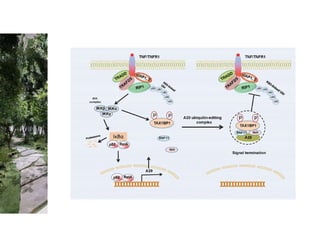
• A20 สามารถสราง ubiquitin-editing complex รวมกับ the ubiquitin binding protein TAX1 Binding
Protein 1 (TAX1BP1) และ the E3 ubiquitin-protein ligase Itch.
4.2 Negative Regulators of NFkB Expression
2. TNFα-induced protein 3 interacting protein 1 (TNIP1) สงผลตอ canonical NFkB activation
TNIP1 (หรือ A20-binding inhibitor of NF-kB (ABIN)-1)
• complex นี้สามารถ deubiquitinate RIP-1 และ TRAF6 ซึ่งชวยยับยั้งการกระตุน TAK1 ตลอดจนการหา
NEMO-mediated และการกระตุน IKK
• A20 induce K48-polyubiquitination of RIP-1 ซึ่งเปนตัวกําหนดสําหรับ proteasomal degradation
TAX1BP1
• TAX1BP1 ทําหนาที่หา Itch ใหกับ A20
• Itch ควบคุมการทํางานรวมกันระหวาง A20 และ its substrates RIP-1 และ TRAF6 หยุดการทํางานของ
substrates
• Knockout proteins ขาดไมไดเพราะใช functioning of this ubiquitin-editing complex
• Itch ถูกแสดงในมะเร็งหลายชนิด เชน breast cancer และ neuroblastoma มีบทบาทสําคัญในการลุกลามของ
มะเร็ง
4.2 Negative Regulators of NFkB Expression
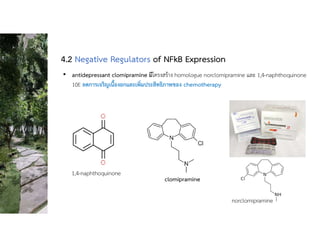
• antidepressant clomipramine มีโครงสราง homologue norclomipramine และ 1,4-naphthoquinone
10E ลดการเจริญเนื้องอกและเพิ่มประสิทธิภาพของ chemotherapy
4.2 Negative Regulators of NFkB Expression
1,4-naphthoquinone
clomipramine
norclomipramine
• clomipramine has been shown to induce MHC-I expression ในหนูทดลองที่เปนโรคประสาทอักเสบจาก
ภูมิแพ
• N4BP1 has also been described to negatively regulate Itch by blocking the binding of Itch to its
substrates
• However, as both N4BP1 and Itch play an important role in suppressing NFkB signaling, the
potential for therapeutic inhibition of Itch
4.2 Negative Regulators of NFkB Expression
• Another DUB enzyme, cylindromatosis (CYLD) มีบทบาทในการยับยั้งการสงสัญญาณ NFkB ผานการ
กําจัด polyubiquitin motifs ออกจาก NEMO และเปนโปรตีนเริ่มตนใน the NFkB signaling pathway called
TRAF2
• Several miRs (miR-1288, -196, and -372-5p) มีเปาหมายตอ CYLD
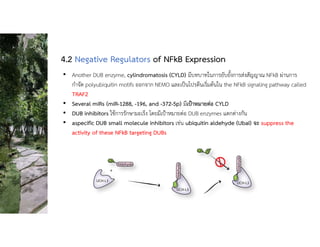
• DUB inhibitors ใชการรักษามะเร็ง โดยมีเปาหมายตอ DUB enzymes แตกตางกัน
• aspecific DUB small molecule inhibitors เชน ubiquitin aldehyde (UbaI) จะ suppress the
activity of these NFkB targeting DUBs
4.2 Negative Regulators of NFkB Expression
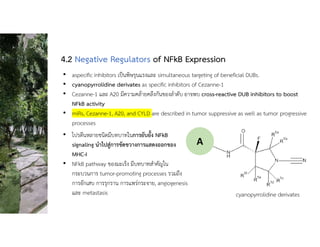
• aspecific inhibitors เปนพิษรุนแรงและ simultaneous targeting of beneficial DUBs.
• cyanopyrrolidine derivates as specific inhibitors of Cezanne-1
• Cezanne-1 และ A20 มีความคลายคลึงกันของลําดับ อาจพบ cross-reactive DUB inhibitors to boost
NFkB activity
• miRs, Cezanne-1, A20, and CYLD are described in tumor suppressive as well as tumor progressive
processes
4.2 Negative Regulators of NFkB Expression
cyanopyrrolidine derivates
A
• โปรตีนหลายชนิดมีบทบาทในการยับยั้ง NFkB
signaling นําไปสูการขัดขวางการแสดงออกของ
MHC-I
• NFkB pathway ของมะเร็ง มีบทบาทสําคัญใน
กระบวนการ tumor-promoting processes รวมถึง
การอักเสบ การรุกราน การแพรกระจาย, angiogenesis
และ metastasis
• dual effect of most described proteins , miRs, and therapeutic interventions ทําใหเกิด NFkB
pathway induction on tumor-suppressing and tumor-promoting processes.
• hypothesized that NF-kB inhibits tumor growth in cancers with a low mutational burden (early
stages of cancer และ potentially pediatric tumors)
• การกลายพันธุนําไปสูการสูญเสีย tumor suppressive function และลักษณะการกอมะเร็งแสดงออกมากขึ้น
• ผลของการเหนี่ยวนํา NFkB pathway ในการ NFkB-downregulated tumors สงผลใหเปลี่ยนความสมดุลจาก
immune evasion ไปสู tumor progression ดังนั้นอาจขัดขวางประสิทธิภาพของการรักษาดวย
immunotherapy
4.2 Negative Regulators of NFkB Expression
• Interferons (IFN) -> เหนี่ยวนําการแสดงออกของ MHC-I
• During homeostasis, signal transducer and activator of transcription (STAT) proteins are present
in the cytosol in their inactive form
• STATs become phosphorylated and dimerize -> migrate to the nucleus to affect expression of
target genes
• Both type I and type II interferon pathways are able to induce dimerization of STATs, thereby
upregulating MHC-I expression using different signaling pathways
• IFNs play an important role in the regulation of antigen processing and presentation และอธิบายถึง
ผลกระทบ pro- and anti-tumorigenic effects in various types of cancer
• การลดลงของ type I and II IFN-mediated เกี่ยวของกับการตานทานตอ CPI- และ adoptive cell therapy in
melanoma and lung cancer
• การรบกวน pathways เหลานี้ จะเพิ่มภูมิคุมกันตอตานเนื้องอก
5. Inducing MHC-I Expression in Cancer via Restored IFN Signaling
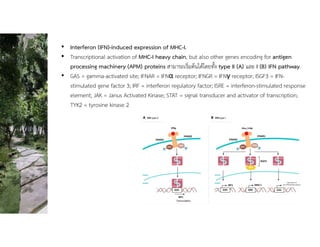
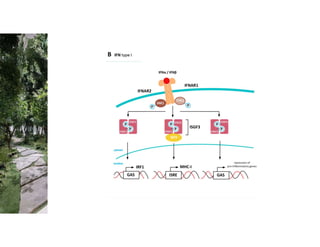
• Interferon (IFN)-induced expression of MHC-I.
• Transcriptional activation of MHC-I heavy chain, but also other genes encoding for antigen
processing machinery (APM) proteins สามารถเริ่มตนไดโดยทั้ง type II (A) และ I (B) IFN pathway.
• GAS = gamma-activated site; IFNAR = IFNα receptor; IFNGR = IFNγ receptor; ISGF3 = IFN-
stimulated gene factor 3; IRF = interferon regulatory factor; ISRE = interferon-stimulated response
element; JAK = Janus Activated Kinase; STAT = signal transducer and activator of transcription;
TYK2 = tyrosine kinase 2
Interferon-mediated upregulation of MHC-I
• type II IFN pathway ถูกกระตุนโดยการกระตุน IFNG
receptor (consisting of IFNGR1 and IFNGR2) โดย IFNγ
• เกิดการจับ, phosphorylation และกระตุน Janus Activated
Kinase (JAK) 1 และ JAK2
• The intracellular domain of IFNGR1 ถูก phosphorylated
สราง docking site for signal transducer และตัวกระตุน
transcription (STAT)1 ซึ่งถูก phosphorylated โดย JAK1/2
สรางโฮโมไดเมอร และยายไปยัง นิวเคลียสเพื่อกระตุนการ
แสดงออกของยีนเปาหมายผานการจับกับ gamma-activated
site (GAS) ในบริเวณโปรโมเตอรของ IFN-stimulated genes
(ISG)
• One of the genes induced by STAT1 signaling is the
transcription factor IRF1 ซึ่งจะสามารถจับกับ ISRE site
present in the MHC-I promoter
Interferon-mediated upregulation of MHC-I
• Activation of the type I IFN pathway เริ่มตนโดยการจับ type I IFNs (เชน IFNα และ IFNβ) กับ IFNA
• receptor (consisting of IFNAR1 and IFNAR2) ทําใหเกิดการจับ, phosphorylation, และการกระตุน JAK1 และ
tyrosine kinase 2 (TYK2).
• cytoplasmic tail of IFNAR ถูก phosphorylated สราง docking site for STAT1-3 ซึ่ง JAK1 ถูกphosphorylated
อีกครั้ง เพื่อสราง homo และ heterodimers
• STAT1 homodimers สามารถกระตุนการแสดงออกของ IRF1
• นอกจากนี้ STAT1/STAT2 ยังสรางสารเชิงซอนกับ IRF9 (called IFN-stimulated gene factor 3 (ISGF3)) ซึ่ง
สามารถจับกับ the ISRE element in the MHC-I promotor.
• STAT3 homodimerization จึงเกิดขึ้นเชนกัน
• อยางไรก็ตาม does not lead to MHC-I upregulation แตจะทําหนาที่เปน negative feedback loop to
inhibit expression of pro-inflammatory genes
5.1. Positive Regulators of IFN Signalling
• IFN signaling เหนี่ยวนําผานการ treatment with IFN-inducing ligands, such as IFNα, IFNβ, and IFNγ.
• นอกจากนี้ การกระตุน PRRs สงผลผลิตตอ downstream type I IFN ซึ่งสงเสริมการแสดงออกของ MHC-I โดยออม
• IFNγ มีศักยภาพมากที่สุด effect on the expression levels of APM genes, including MHC-I, TAP, and ERAP,
ซึ่งบงบอกถึงการหลบภูมิคุมกัน สอดคลองกับ NFkB-inducing ligands
• IFNs and PRR stimulation initiates a broad range of biological activities จํากัดการใชในการรักษามะเร็ง
เนื่องจากความเปนพิษที่รุนแรง
• เพื่อหลีกเลี่ยงความเปนพิษ targeted delivery of IFNγ to the tumor site may be of interest เชน การรวมกับ
แอนติบอดีที่จําเพาะสําหรับ tumor-associated antigen
5.1. Positive Regulators of IFN Signalling
• cellular NK-cell therapy strategy เนื่องจาก NK-cell สามารถฆาหรือ ควบคุมการแสดงออกของ MHC-I บน
MHC-I-lacking cells (via IFNγ secretion)
• NK-cell therapy พิสูจนไดโดยความสัมพันธระหวางจํานวน NK-cells and checkpoint inhibition efficacy in
non-small cell lung cancer (NSCLC)
• anti-inflammatory responses within the tumor microenvironment (TME) ทําให NK-cell ทํางานบกพรองและ
TME infiltration เชนเดียวกับ ex vivo expansion to generate sufficient NK-cell numbers, and in vivo
persistence
5.1. Positive Regulators of IFN Signalling
• เนื้องอกหลบหลีก NK- and T-cell mediated cytotoxicity via plasticity in MHC-I expression เปนหนึ่งในกลไก
ตานการอักเสบที่ลดประสิทธิภาพของ NK-cell therapy
• inhibitory KIR genotype with lacking HLA-ligands (the ‘missing ligand’ genotype) undergoing
• cancer immunotherapy , as inhibitory KIRs without matching HLA-ligands ไมสามารถยับยั้ง NK-cell
cytotoxicity.
• This led to the rationale of allogeneic, KIR genotype-mismatched NK-cell therapy strategies เพื่อปรับ
NK-cell cytotoxicity โดย decreasing HLA-dependent inhibition of NK-cells
• นอกจากนี้ immune checkpoint programmed cell death-ligand 1 (PD-L1) ยังถูกควบคุมโดย IFNγ
• เปนผลให IFNγ กระตุนการควบคุม MHC-I และ T-cell suppression ดังนั้น potentially creating a vicious
circle of T-cell activation and inhibition.
5.2. Negative Regulators of IFN Signaling
• embryonic transcription factor double homeobox 4 (DUX4) ในมะเร็งสงผลตอการลดลงของ JAK1/2
และ STAT1 ดังนั้นยับยั้ง IFN target gene transcription รวมถึง MHC-I และยีน APM อื่นๆ
• DUX4 ในผูที่ไมตอบสนองตอ CPI บงชี้วา DUX4-induced reduction in MHC-I expression สงผลลด T-cell
cytotoxicity in patients
• ใชในการรักษาโรค facioscapulohumeral dystrophy (FSHD)
• การยับยั้ง p300 ซึ่งเปน histone acetyltransferase ของ DUX4 สงผลตอการแสดงออกของยีน โดย specific
inhibitor ตัวยบั ยงัf เฉพาะ ตอตานผลของ DUX-4 ที่แสดงออกมากเกินไปใน in vitro and in vivo
• การยับยั้ง p300 ในมะเร็ง นําไปสูการยับยั้งการแพรกระจาย
• การลดลงของ DUX4 เมื่อรับการรักษาดวยสารยับยั้ง p38 ใน inhibitors in vitro and in vivo in FSHD
models
• การยับยั้ง P38 มีผลดีในการรักษามะเร็ง
5.2. Negative Regulators of IFN Signaling
• Lymphocyte adapter protein (LNK) สามารถควบคุมการสงสัญญาณ IFN ในเชิงลบผานการเหนี่ยวนําของ
dephosphorylation ของ STAT1
• LNK แสดงใหเห็นวามีการแสดงออกมากเกินไปในเนื้องอกที่เปนของแข็ง (solid tumors) หลายชนิด รวมถึงมะเร็ง
ผิวหนังและมะเร็งรังไข (melanoma and ovarian cancer) และพบวาเพิ่มขึ้นอยางมีนัยสําคัญในผูปวยที่ไม
ตอบสนองตอการรักษาดวย CPI
• มีรายงานวา LNK เปนเปาหมายของ miR-29b, miR-30-5p, miR-98, miR-181a-5p จนถึงปจจุบันยังไมมี
รายงานถึงสารยับยั้ง LNK ในการรักษาอื่นๆ
5.2. Negative Regulators of IFN Signaling
• มีรายงานวา peptidyl-prolyl isomerase Pin1 กระตุนการแพรหลาย (ubiquitination) และการยอยสลายของ
IFN ชนิดที่ 1 ที่ทําใหเกิดปจจัยการถอดความ (transcription) IRF3 ซึ่งโดยปกติจะกระตุน positive feedback
loop ตาม type I IFN pathway stimulation
• Pin1 ไดรับการพิสูจนแลววาสูงขึ้นในมะเร็งหลายชนิด โดยมีบทบาทในการกระตุนกระบวนการขับเคลื่อนมะเร็ง
หลายชนิด เนื่องจาก Pin1 เกี่ยวของกับการลดการควบคุมการสงสัญญาณ IFN ประเภท I
• การยับยั้งอาจนําไปสูการแสดงออกของ MHC-I ที่ไดรับการปรับปรุง ซึ่งสงผลใหความเปนพิษตอเซลลของ T-cell-
mediated cytotoxicity สูงขึ้น
• ปจจุบันไดมีการพัฒนาตัวยับยั้ง Pin1 หลายตัวเชน miR-200b, miR-200c, and miR296-5p ซึ่งเปนโมเลกุล
ขนาดเล็กของ all-trans retinoic acid (ATRA) และ KPT-6566 และสารประกอบธรรมชาติ Juglone ซึ่ง
ทั้งหมดแสดงฤทธิ์ตานมะเร็งในมะเร็งชนิดตางๆ
5.2. Negative Regulators of IFN Signaling
• มีรายงานวา peptidyl-prolyl isomerase Pin1 กระตุนการแพรหลาย (ubiquitination) และการยอยสลายของ IFN ชนิดที่ 1
ที่ทําใหเกิดปจจัยการถอดความ (transcription) IRF3 ซึ่งโดยปกติจะกระตุน positive feedback loop ตาม type I IFN
pathway stimulation
• Pin1 ไดรับการพิสูจนแลววาสูงขึ้นในมะเร็งหลายชนิด โดยมีบทบาทในการกระตุนกระบวนการขับเคลื่อนมะเร็งหลายชนิด
เนื่องจาก Pin1 เกี่ยวของกับการลดการควบคุมการสงสัญญาณ IFN ประเภท I
• การยับยั้งอาจนําไปสูการแสดงออกของ MHC-I ที่ไดรับการปรับปรุง ซึ่งสงผลใหความเปนพิษตอเซลลของ T-cell-mediated
cytotoxicity สูงขึ้น
• ปจจุบันไดมีการพัฒนาตัวยับยั้ง Pin1 หลายตัวเชน miR-200b, miR-200c, and miR296-5p ซึ่งเปนโมเลกุลขนาดเล็กของ
all-trans retinoic acid (ATRA) และ KPT-6566 และสารประกอบธรรมชาติ Juglone ซึ่งทั้งหมดแสดงฤทธิ์ตานมะเร็งใน
มะเร็งชนิดตางๆ
Pharmacy CMU
5.2. Negative Regulators of IFN Signaling
• โปรตีนไทโรซีนฟอสฟาเตส (PTPs) หลายชนิดลดการควบคุมไทโรซีนฟอสโฟรีเลชั่นใน JAK/STAT pathway ดังนั้นจึง
รบกวนการเหนี่ยวนําสัญญาณ IFN ทั้งชนิด I และ II ตัวอยางเชน PTPN1 dephosphorylates TYK2 and JAK2
• PTPN2 dephosphorylates JAK1 และ PTPN11 (SHP2) ไดรับการพิสูจนแลววายับยั้ง phosphorylation ของ JAK1, STAT1
และ STAT2
• Tyrosine phosphatases ในมะเร็งหลายชนิดเชน เตานม รังไข มะเร็งกระเพาะอาหาร และไกลโอมา (glioma) ซึ่งสงเสริม
การเจริญเติบโตของเนื้องอก การอยูรอด และการแพรกระจายของเนื้องอก (metastases)
• จนถึงปจจุบัน มีความพยายามหลายอยางในการพัฒนาตัวยับยั้ง tyrosine phosphatase รวมถึงตัวยับยั้ง PTPN11
sodium stibogluconate และตัวยับยั้ง PTP1B MSI-1436C ซึ่งขณะนี้ไดทดสอบในการทดลองทางคลินิกสําหรับมะเร็งชนิด
ตางๆ อยู
Pharmacy CMU
5.2. Negative Regulators of IFN Signaling
• โปรตีนไทโรซีนฟอสฟาเตส (PTPs) หลายชนิดลดการควบคุมไทโรซีนฟอสโฟรีเลชั่นใน JAK/STAT pathway ดังนั้นจึง
รบกวนการเหนี่ยวนําสัญญาณ IFN ทั้งชนิด I และ II ตัวอยางเชน PTPN1 dephosphorylates TYK2 and JAK2
• PTPN2 dephosphorylates JAK1 และ PTPN11 (SHP2) ไดรับการพิสูจนแลววายับยั้ง phosphorylation ของ JAK1, STAT1
และ STAT2
• Tyrosine phosphatases ในมะเร็งหลายชนิดเชน เตานม รังไข มะเร็งกระเพาะอาหาร และไกลโอมา (glioma) ซึ่งสงเสริม
การเจริญเติบโตของเนื้องอก การอยูรอด และการแพรกระจายของเนื้องอก (metastases)
• จนถึงปจจุบัน มีความพยายามหลายอยางในการพัฒนาตัวยับยั้ง tyrosine phosphatase รวมถึงตัวยับยั้ง PTPN11
sodium stibogluconate และตัวยับยั้ง PTP1B MSI-1436C ซึ่งขณะนี้ไดทดสอบในการทดลองทางคลินิกสําหรับมะเร็งชนิด
ตางๆ อยู
Pharmacy CMU
5.2. Negative Regulators of IFN Signaling
• ubiquitin ligases RING finger protein 2 (RNF2) and Smad ubiquitination regulatory factor-1 (Smurf1)
และ protein inhibitor of activated STAT (PIAS) ทํางานทั้งหมดผานการยับยั้งการเปดใชงานการถอดรหัส
(transcription) ของ STAT1
• โปรตีนเหลานี้แสดงใหเห็นวามีการแสดงออกมากเกินไปในมะเร็งหลายชนิด รวมถึงเมลาโนมา เนื้องอกในทางเดินอาหาร มะเร็ง
ตอมน้ําเหลือง และมะเร็งตับออน ดังนั้นจึงมีบทบาทสําคัญในการสงเสริมมะเร็ง
• ubiquitin ligase DCST1 สามารถกระตุนการแพรกระจาย (ubiquitination) และการสลายตัวของ STAT2 ซึ่งสงผลใหการสง
สัญญาณ IFN ชนิดที่ I ถูกขัดขวาง และมีระดับสูงขึ้นในมะเร็งหลายชนิด
• สารยับยั้งโมเลกุลขนาดเล็ก PRT4165 และ A01 สามารถยับยั้ง RNF2 และ Smurf1 ในหลอดทดลอง ตามลําดับ
Pharmacy CMU

การลดลงของ MHC Class I ในมะเร็ง ตอนที่ 2.pdf

  • 1.
    4. Inducing MHC-IExpression in Cancer via NFkB Stabilization • NFkB เปน inducible transcription factors ประกอบดวย NFkB1 (p50), NFkB2 (p52), RelA, RelB, and c-REL • ในสภาวะสมดุลจะ interaction กับ inhibitor of kB (IkB) (เชน IkBα และ p105) ทําใหโปรตีน เหลานี้อยูในรูป inactive cytosolic complexes • เมื่อทํางาน IkB proteins ถูกสลาย ปลดปลอย NFkB • ไปนิวเคลียสเพื่อ expression of target genes • Two major NFkB-inducing pathways : canonical and non-canonical NFkB pathway • NFkB expression ตอบสนองดีตอการรักษาดวย CPI เพิ่มภูมิคุมกันตอตานเนื้องอกในผูปวยมะเร็ง ผิวหนัง (melanoma)
  • 2.
    • TNFα Receptor(TNFR), Toll-like receptors (TLR), and cytokines receptors, by their ligands (e.g., TNFα, IL-1 หรือ LPS) กระตุน canonical NFkB pathway • มีการกระตุน TRAF2/6 และ receptor-interacting protein 1 (RIP-1) ที่ถูกเลือก ไดเปน TRAF2/6 polyubiquitinates และ RIP-1 • TGF-β-activated kinase 1 (TAK1) is ubiquitinated และถูกกระตุน • TAK1 กระตุน phosphorylate และ IkB kinase (IKK) complex (ประกอบดวย IKKα, IKKβ และ NF- kappa-B essential modulator (NEMO) (หรือเรียกวา IKKγ) • IKK ตองถูกเลือกเพื่อไปกระตุน receptor กอน phosphorylated (ซึ่งถูกกระตุนโดยปฏิกิริยาระหวาง NEMO- mediated interaction of IKK กับ polyubiquitinated RIP-1) • จากนั้น IKK phosphorylates IkB proteins จึงกําหนดเปาหมายสําหรับ ubiquitination และ degradation ดังนั้น RelA-p50 และ c-REL-p50 จึงถูกปลดปลอย • เกิดการเคลื่อนไปยังนิวเคลียส เกิด transcription ของ MHC-I heavy chain และ APM-encoding genes โดย จับกับ kB enhancers ใน promotors NFkB-mediated upregulation of MHC-I
  • 3.
    • non-canonical NFkBpathway เริ่มตนโดยการจับของ ligand (เชน TNFα, CD40L, or B-cell activating factor (BAFF)) กับ TNFR superfamily members • NFkB-inducing kinase (NIK) ถูกกระตุน เกิด phosphorylate และกระตุน IKKα ซึ่งเปนหนวยยอยของ IKK complex • IKKα เกิด phosphorylates ที่ carboxy-terminal serine residues ของ p100 คลายกับ IkB ที่แยก NFkB transcription factor RelB ในไซโตซอล • สงผลใหเกิด ubiquitination and degradation of the C-terminus of p100 • ผลที่ตามมาคือ p52 ถูกสรางขึ้น สราง heterodimer with RelB ยายไปยังนิวเคลียส เกิดการเหนี่ยวนํา transcription ของ target genes NFkB-mediated upregulation of MHC-I
  • 4.
    • TNF αชวยกระตุนการสงสัญญาณ NFkB และการแสดงออก MHC-I แตมีความเปนพิษรุนแรง • retinoids increase MHC-I expression ผานการเพิ่มการแสดงออกของ NFkB p50 และ RelA • upregulation of proteasome subunits (Latent Membrane Protein (LMP)-2, -7 และ -10) และเพิ่ม half-life of MHC-I complexes จะชวยเพิ่ม MHC-I expression in neuroblastoma cell lines • Retinoids รักษาโรค neuroblastoma ,promyelocytic leukemia, induce differentiation, apoptosis, และ inhibition of proliferation of tumor cells • betulinic acid, and calcium/calcineurin รวมกับ protein kinase C (PKC) antagonists • Betulinic acid upregulates canonical pathway activity สงเสริม IKK as well as phosphorylation และ degradation of IkBα in multiple cancer cell lines, including neuroblastoma, glioblastoma, and melanoma • inhibits topoisomerase I activity induces apoptosis และยับยั้งการสรางหลอดเลือดในมะเร็ง (angiogenesis) 4.1 Positive Regulators of NFkB expression
  • 5.
    • HIV infectionsin CD4+ T-cells รวมกับ calcium/calcineurin และ protein kinase C (PKC) antagonist prostatin เสริมฤทธิ์การกระตุน NFkB (a similar mechanism as betulinic acid) • เพิ่ม expression of the E3 ubiquitin ligase Nedd4 กระตุนการเกิด polyubiquitination และ proteasomal degradation of N4BP1 , กดการทํางาน NFkB • in B-cells Nedd4 เหนี่ยวนํา ubiquitination และ degradation ของ TNF receptor-associated factor (TRAF) 3 ผานทาง TNFR CD40 ดังนั้นกระตุนทั้ง canonical และ non-canonical NFkB pathway 4.1 Positive Regulators of NFkB expression
  • 6.
    1. Nedd4 BindingProtein 1 (N4BP1) สงผลตอ canonical และ non-canonical activation • N4BP1 ทําปฏิกิริยากับโปรตีนหลายชนิดที่เกี่ยวของกับ (de)ubiquitination, including NEDD4, Cezanne-1, A20 และ Itch และ binds to polyubiquitin itself. • Polyubiquitin จับกับโปรตีน เชนเดียวกับ N4BP1: สามารถแขงกับ NEMO เพื่อยับยั้งการกระตุน canonical NFkB • N4BP1 interacts with the deubiquitinase (DUB) Cezanne-1 ซึ่งทําหนาที่ deubiquitination และ stabilization of TRAF3 และกระตุนทั้ง canonical และ non-canonical NFkB โดยสงผลตอการสลาย NIK และ IkB และการเหนี่ยวนํา c-REL ubiquitination และ proteasome-mediated degradation 4.2 Negative Regulators of NFkB Expression
  • 7.
    2. TNFα-induced protein3 interacting protein 1 (TNIP1) กระตุน canonical NFkB TNIP1 (หรือ A20-binding inhibitor of NF-kB (ABIN)-1) • ยับยั้ง DUB A20 และ TNF-induced apoptosis ,ยับยั้ง NFkB โดยทําใหการเคลื่อน NEMO-mediated ของ IKK ไปยัง receptor site ลดลง ผานการ competing with NEMO binding to RIP-1 • ปองกันการเปลี่ยน IkB p105 ไปเปน p50 และ interact with the NFkB inhibiting DUB A20 • กระตุน deubiquitination ของ NEMO ซึ่งสงผลใหการกระตุน IKK และ canonical NFkB บกพรอง • IL-17 treatment induce proteasome-dependent downregulation of TNIP1 -> NFkB activation -> เพิ่ม MHC-I expression. • แต IL-17 สงเสริม tumor progression by inducing chronic inflammation, tumor cell proliferation, angiogenesis, and metastasis ทําใหลด cytokine ในการเหนี่ยวนําการแสดงออกของ MHC-I ในมะเร็ง 4.2 Negative Regulators of NFkB Expression
  • 8.
    2. TNFα-induced protein3 interacting protein 1 (TNIP1) กระตุน canonical NFkB TNIP1 (หรือ A20-binding inhibitor of NF-kB (ABIN)-1) • targeting N4BP1 or TNIP1 จะสงผล strong activation of NFkB signaling -> ชวยเพิ่มการแสดงออกของ MHC-I • microRNA (miR) 28-5p is an inhibitor of N4BP1 and tumor suppressor (colorectal cancer, renal cell carcinoma, and hepatocellular carcinoma) • MiR-1180 และ miR-486 เหนี่ยวนํา NFkB activation ผานการยับยั้ง Cezanne, A20 และ TNIP1-3 • แต miRs มีสัมพันธกับการเติบโตของเซลลมะเร็ง การอยูรอด การอพยพ และการลุกลาม • NFkB inhibiting DUB A20 เกี่ยวของกับ TNIP-independent regulation ของ NFkB signaling • A20 สามารถสราง ubiquitin-editing complex รวมกับ the ubiquitin binding protein TAX1 Binding Protein 1 (TAX1BP1) และ the E3 ubiquitin-protein ligase Itch. 4.2 Negative Regulators of NFkB Expression
  • 10.
    2. TNFα-induced protein3 interacting protein 1 (TNIP1) สงผลตอ canonical NFkB activation TNIP1 (หรือ A20-binding inhibitor of NF-kB (ABIN)-1) • complex นี้สามารถ deubiquitinate RIP-1 และ TRAF6 ซึ่งชวยยับยั้งการกระตุน TAK1 ตลอดจนการหา NEMO-mediated และการกระตุน IKK • A20 induce K48-polyubiquitination of RIP-1 ซึ่งเปนตัวกําหนดสําหรับ proteasomal degradation TAX1BP1 • TAX1BP1 ทําหนาที่หา Itch ใหกับ A20 • Itch ควบคุมการทํางานรวมกันระหวาง A20 และ its substrates RIP-1 และ TRAF6 หยุดการทํางานของ substrates • Knockout proteins ขาดไมไดเพราะใช functioning of this ubiquitin-editing complex • Itch ถูกแสดงในมะเร็งหลายชนิด เชน breast cancer และ neuroblastoma มีบทบาทสําคัญในการลุกลามของ มะเร็ง 4.2 Negative Regulators of NFkB Expression
  • 12.
    • antidepressant clomipramineมีโครงสราง homologue norclomipramine และ 1,4-naphthoquinone 10E ลดการเจริญเนื้องอกและเพิ่มประสิทธิภาพของ chemotherapy 4.2 Negative Regulators of NFkB Expression 1,4-naphthoquinone clomipramine norclomipramine
  • 13.
    • clomipramine hasbeen shown to induce MHC-I expression ในหนูทดลองที่เปนโรคประสาทอักเสบจาก ภูมิแพ • N4BP1 has also been described to negatively regulate Itch by blocking the binding of Itch to its substrates • However, as both N4BP1 and Itch play an important role in suppressing NFkB signaling, the potential for therapeutic inhibition of Itch 4.2 Negative Regulators of NFkB Expression
  • 14.
    • Another DUBenzyme, cylindromatosis (CYLD) มีบทบาทในการยับยั้งการสงสัญญาณ NFkB ผานการ กําจัด polyubiquitin motifs ออกจาก NEMO และเปนโปรตีนเริ่มตนใน the NFkB signaling pathway called TRAF2 • Several miRs (miR-1288, -196, and -372-5p) มีเปาหมายตอ CYLD • DUB inhibitors ใชการรักษามะเร็ง โดยมีเปาหมายตอ DUB enzymes แตกตางกัน • aspecific DUB small molecule inhibitors เชน ubiquitin aldehyde (UbaI) จะ suppress the activity of these NFkB targeting DUBs 4.2 Negative Regulators of NFkB Expression
  • 15.
    • aspecific inhibitorsเปนพิษรุนแรงและ simultaneous targeting of beneficial DUBs. • cyanopyrrolidine derivates as specific inhibitors of Cezanne-1 • Cezanne-1 และ A20 มีความคลายคลึงกันของลําดับ อาจพบ cross-reactive DUB inhibitors to boost NFkB activity • miRs, Cezanne-1, A20, and CYLD are described in tumor suppressive as well as tumor progressive processes 4.2 Negative Regulators of NFkB Expression cyanopyrrolidine derivates A • โปรตีนหลายชนิดมีบทบาทในการยับยั้ง NFkB signaling นําไปสูการขัดขวางการแสดงออกของ MHC-I • NFkB pathway ของมะเร็ง มีบทบาทสําคัญใน กระบวนการ tumor-promoting processes รวมถึง การอักเสบ การรุกราน การแพรกระจาย, angiogenesis และ metastasis
  • 16.
    • dual effectof most described proteins , miRs, and therapeutic interventions ทําใหเกิด NFkB pathway induction on tumor-suppressing and tumor-promoting processes. • hypothesized that NF-kB inhibits tumor growth in cancers with a low mutational burden (early stages of cancer และ potentially pediatric tumors) • การกลายพันธุนําไปสูการสูญเสีย tumor suppressive function และลักษณะการกอมะเร็งแสดงออกมากขึ้น • ผลของการเหนี่ยวนํา NFkB pathway ในการ NFkB-downregulated tumors สงผลใหเปลี่ยนความสมดุลจาก immune evasion ไปสู tumor progression ดังนั้นอาจขัดขวางประสิทธิภาพของการรักษาดวย immunotherapy 4.2 Negative Regulators of NFkB Expression
  • 17.
    • Interferons (IFN)-> เหนี่ยวนําการแสดงออกของ MHC-I • During homeostasis, signal transducer and activator of transcription (STAT) proteins are present in the cytosol in their inactive form • STATs become phosphorylated and dimerize -> migrate to the nucleus to affect expression of target genes • Both type I and type II interferon pathways are able to induce dimerization of STATs, thereby upregulating MHC-I expression using different signaling pathways • IFNs play an important role in the regulation of antigen processing and presentation และอธิบายถึง ผลกระทบ pro- and anti-tumorigenic effects in various types of cancer • การลดลงของ type I and II IFN-mediated เกี่ยวของกับการตานทานตอ CPI- และ adoptive cell therapy in melanoma and lung cancer • การรบกวน pathways เหลานี้ จะเพิ่มภูมิคุมกันตอตานเนื้องอก 5. Inducing MHC-I Expression in Cancer via Restored IFN Signaling
  • 18.
    • Interferon (IFN)-inducedexpression of MHC-I. • Transcriptional activation of MHC-I heavy chain, but also other genes encoding for antigen processing machinery (APM) proteins สามารถเริ่มตนไดโดยทั้ง type II (A) และ I (B) IFN pathway. • GAS = gamma-activated site; IFNAR = IFNα receptor; IFNGR = IFNγ receptor; ISGF3 = IFN- stimulated gene factor 3; IRF = interferon regulatory factor; ISRE = interferon-stimulated response element; JAK = Janus Activated Kinase; STAT = signal transducer and activator of transcription; TYK2 = tyrosine kinase 2
  • 19.
    Interferon-mediated upregulation ofMHC-I • type II IFN pathway ถูกกระตุนโดยการกระตุน IFNG receptor (consisting of IFNGR1 and IFNGR2) โดย IFNγ • เกิดการจับ, phosphorylation และกระตุน Janus Activated Kinase (JAK) 1 และ JAK2 • The intracellular domain of IFNGR1 ถูก phosphorylated สราง docking site for signal transducer และตัวกระตุน transcription (STAT)1 ซึ่งถูก phosphorylated โดย JAK1/2 สรางโฮโมไดเมอร และยายไปยัง นิวเคลียสเพื่อกระตุนการ แสดงออกของยีนเปาหมายผานการจับกับ gamma-activated site (GAS) ในบริเวณโปรโมเตอรของ IFN-stimulated genes (ISG) • One of the genes induced by STAT1 signaling is the transcription factor IRF1 ซึ่งจะสามารถจับกับ ISRE site present in the MHC-I promoter
  • 20.
    Interferon-mediated upregulation ofMHC-I • Activation of the type I IFN pathway เริ่มตนโดยการจับ type I IFNs (เชน IFNα และ IFNβ) กับ IFNA • receptor (consisting of IFNAR1 and IFNAR2) ทําใหเกิดการจับ, phosphorylation, และการกระตุน JAK1 และ tyrosine kinase 2 (TYK2). • cytoplasmic tail of IFNAR ถูก phosphorylated สราง docking site for STAT1-3 ซึ่ง JAK1 ถูกphosphorylated อีกครั้ง เพื่อสราง homo และ heterodimers • STAT1 homodimers สามารถกระตุนการแสดงออกของ IRF1 • นอกจากนี้ STAT1/STAT2 ยังสรางสารเชิงซอนกับ IRF9 (called IFN-stimulated gene factor 3 (ISGF3)) ซึ่ง สามารถจับกับ the ISRE element in the MHC-I promotor. • STAT3 homodimerization จึงเกิดขึ้นเชนกัน • อยางไรก็ตาม does not lead to MHC-I upregulation แตจะทําหนาที่เปน negative feedback loop to inhibit expression of pro-inflammatory genes
  • 22.
    5.1. Positive Regulatorsof IFN Signalling • IFN signaling เหนี่ยวนําผานการ treatment with IFN-inducing ligands, such as IFNα, IFNβ, and IFNγ. • นอกจากนี้ การกระตุน PRRs สงผลผลิตตอ downstream type I IFN ซึ่งสงเสริมการแสดงออกของ MHC-I โดยออม • IFNγ มีศักยภาพมากที่สุด effect on the expression levels of APM genes, including MHC-I, TAP, and ERAP, ซึ่งบงบอกถึงการหลบภูมิคุมกัน สอดคลองกับ NFkB-inducing ligands • IFNs and PRR stimulation initiates a broad range of biological activities จํากัดการใชในการรักษามะเร็ง เนื่องจากความเปนพิษที่รุนแรง • เพื่อหลีกเลี่ยงความเปนพิษ targeted delivery of IFNγ to the tumor site may be of interest เชน การรวมกับ แอนติบอดีที่จําเพาะสําหรับ tumor-associated antigen
  • 23.
    5.1. Positive Regulatorsof IFN Signalling • cellular NK-cell therapy strategy เนื่องจาก NK-cell สามารถฆาหรือ ควบคุมการแสดงออกของ MHC-I บน MHC-I-lacking cells (via IFNγ secretion) • NK-cell therapy พิสูจนไดโดยความสัมพันธระหวางจํานวน NK-cells and checkpoint inhibition efficacy in non-small cell lung cancer (NSCLC) • anti-inflammatory responses within the tumor microenvironment (TME) ทําให NK-cell ทํางานบกพรองและ TME infiltration เชนเดียวกับ ex vivo expansion to generate sufficient NK-cell numbers, and in vivo persistence
  • 24.
    5.1. Positive Regulatorsof IFN Signalling • เนื้องอกหลบหลีก NK- and T-cell mediated cytotoxicity via plasticity in MHC-I expression เปนหนึ่งในกลไก ตานการอักเสบที่ลดประสิทธิภาพของ NK-cell therapy • inhibitory KIR genotype with lacking HLA-ligands (the ‘missing ligand’ genotype) undergoing • cancer immunotherapy , as inhibitory KIRs without matching HLA-ligands ไมสามารถยับยั้ง NK-cell cytotoxicity. • This led to the rationale of allogeneic, KIR genotype-mismatched NK-cell therapy strategies เพื่อปรับ NK-cell cytotoxicity โดย decreasing HLA-dependent inhibition of NK-cells • นอกจากนี้ immune checkpoint programmed cell death-ligand 1 (PD-L1) ยังถูกควบคุมโดย IFNγ • เปนผลให IFNγ กระตุนการควบคุม MHC-I และ T-cell suppression ดังนั้น potentially creating a vicious circle of T-cell activation and inhibition.
  • 25.
    5.2. Negative Regulatorsof IFN Signaling • embryonic transcription factor double homeobox 4 (DUX4) ในมะเร็งสงผลตอการลดลงของ JAK1/2 และ STAT1 ดังนั้นยับยั้ง IFN target gene transcription รวมถึง MHC-I และยีน APM อื่นๆ • DUX4 ในผูที่ไมตอบสนองตอ CPI บงชี้วา DUX4-induced reduction in MHC-I expression สงผลลด T-cell cytotoxicity in patients • ใชในการรักษาโรค facioscapulohumeral dystrophy (FSHD) • การยับยั้ง p300 ซึ่งเปน histone acetyltransferase ของ DUX4 สงผลตอการแสดงออกของยีน โดย specific inhibitor ตัวยบั ยงัf เฉพาะ ตอตานผลของ DUX-4 ที่แสดงออกมากเกินไปใน in vitro and in vivo • การยับยั้ง p300 ในมะเร็ง นําไปสูการยับยั้งการแพรกระจาย • การลดลงของ DUX4 เมื่อรับการรักษาดวยสารยับยั้ง p38 ใน inhibitors in vitro and in vivo in FSHD models • การยับยั้ง P38 มีผลดีในการรักษามะเร็ง
  • 26.
    5.2. Negative Regulatorsof IFN Signaling • Lymphocyte adapter protein (LNK) สามารถควบคุมการสงสัญญาณ IFN ในเชิงลบผานการเหนี่ยวนําของ dephosphorylation ของ STAT1 • LNK แสดงใหเห็นวามีการแสดงออกมากเกินไปในเนื้องอกที่เปนของแข็ง (solid tumors) หลายชนิด รวมถึงมะเร็ง ผิวหนังและมะเร็งรังไข (melanoma and ovarian cancer) และพบวาเพิ่มขึ้นอยางมีนัยสําคัญในผูปวยที่ไม ตอบสนองตอการรักษาดวย CPI • มีรายงานวา LNK เปนเปาหมายของ miR-29b, miR-30-5p, miR-98, miR-181a-5p จนถึงปจจุบันยังไมมี รายงานถึงสารยับยั้ง LNK ในการรักษาอื่นๆ
  • 27.
    5.2. Negative Regulatorsof IFN Signaling • มีรายงานวา peptidyl-prolyl isomerase Pin1 กระตุนการแพรหลาย (ubiquitination) และการยอยสลายของ IFN ชนิดที่ 1 ที่ทําใหเกิดปจจัยการถอดความ (transcription) IRF3 ซึ่งโดยปกติจะกระตุน positive feedback loop ตาม type I IFN pathway stimulation • Pin1 ไดรับการพิสูจนแลววาสูงขึ้นในมะเร็งหลายชนิด โดยมีบทบาทในการกระตุนกระบวนการขับเคลื่อนมะเร็ง หลายชนิด เนื่องจาก Pin1 เกี่ยวของกับการลดการควบคุมการสงสัญญาณ IFN ประเภท I • การยับยั้งอาจนําไปสูการแสดงออกของ MHC-I ที่ไดรับการปรับปรุง ซึ่งสงผลใหความเปนพิษตอเซลลของ T-cell- mediated cytotoxicity สูงขึ้น • ปจจุบันไดมีการพัฒนาตัวยับยั้ง Pin1 หลายตัวเชน miR-200b, miR-200c, and miR296-5p ซึ่งเปนโมเลกุล ขนาดเล็กของ all-trans retinoic acid (ATRA) และ KPT-6566 และสารประกอบธรรมชาติ Juglone ซึ่ง ทั้งหมดแสดงฤทธิ์ตานมะเร็งในมะเร็งชนิดตางๆ
  • 28.
    5.2. Negative Regulatorsof IFN Signaling • มีรายงานวา peptidyl-prolyl isomerase Pin1 กระตุนการแพรหลาย (ubiquitination) และการยอยสลายของ IFN ชนิดที่ 1 ที่ทําใหเกิดปจจัยการถอดความ (transcription) IRF3 ซึ่งโดยปกติจะกระตุน positive feedback loop ตาม type I IFN pathway stimulation • Pin1 ไดรับการพิสูจนแลววาสูงขึ้นในมะเร็งหลายชนิด โดยมีบทบาทในการกระตุนกระบวนการขับเคลื่อนมะเร็งหลายชนิด เนื่องจาก Pin1 เกี่ยวของกับการลดการควบคุมการสงสัญญาณ IFN ประเภท I • การยับยั้งอาจนําไปสูการแสดงออกของ MHC-I ที่ไดรับการปรับปรุง ซึ่งสงผลใหความเปนพิษตอเซลลของ T-cell-mediated cytotoxicity สูงขึ้น • ปจจุบันไดมีการพัฒนาตัวยับยั้ง Pin1 หลายตัวเชน miR-200b, miR-200c, and miR296-5p ซึ่งเปนโมเลกุลขนาดเล็กของ all-trans retinoic acid (ATRA) และ KPT-6566 และสารประกอบธรรมชาติ Juglone ซึ่งทั้งหมดแสดงฤทธิ์ตานมะเร็งใน มะเร็งชนิดตางๆ Pharmacy CMU
  • 29.
    5.2. Negative Regulatorsof IFN Signaling • โปรตีนไทโรซีนฟอสฟาเตส (PTPs) หลายชนิดลดการควบคุมไทโรซีนฟอสโฟรีเลชั่นใน JAK/STAT pathway ดังนั้นจึง รบกวนการเหนี่ยวนําสัญญาณ IFN ทั้งชนิด I และ II ตัวอยางเชน PTPN1 dephosphorylates TYK2 and JAK2 • PTPN2 dephosphorylates JAK1 และ PTPN11 (SHP2) ไดรับการพิสูจนแลววายับยั้ง phosphorylation ของ JAK1, STAT1 และ STAT2 • Tyrosine phosphatases ในมะเร็งหลายชนิดเชน เตานม รังไข มะเร็งกระเพาะอาหาร และไกลโอมา (glioma) ซึ่งสงเสริม การเจริญเติบโตของเนื้องอก การอยูรอด และการแพรกระจายของเนื้องอก (metastases) • จนถึงปจจุบัน มีความพยายามหลายอยางในการพัฒนาตัวยับยั้ง tyrosine phosphatase รวมถึงตัวยับยั้ง PTPN11 sodium stibogluconate และตัวยับยั้ง PTP1B MSI-1436C ซึ่งขณะนี้ไดทดสอบในการทดลองทางคลินิกสําหรับมะเร็งชนิด ตางๆ อยู Pharmacy CMU
  • 30.
    5.2. Negative Regulatorsof IFN Signaling • โปรตีนไทโรซีนฟอสฟาเตส (PTPs) หลายชนิดลดการควบคุมไทโรซีนฟอสโฟรีเลชั่นใน JAK/STAT pathway ดังนั้นจึง รบกวนการเหนี่ยวนําสัญญาณ IFN ทั้งชนิด I และ II ตัวอยางเชน PTPN1 dephosphorylates TYK2 and JAK2 • PTPN2 dephosphorylates JAK1 และ PTPN11 (SHP2) ไดรับการพิสูจนแลววายับยั้ง phosphorylation ของ JAK1, STAT1 และ STAT2 • Tyrosine phosphatases ในมะเร็งหลายชนิดเชน เตานม รังไข มะเร็งกระเพาะอาหาร และไกลโอมา (glioma) ซึ่งสงเสริม การเจริญเติบโตของเนื้องอก การอยูรอด และการแพรกระจายของเนื้องอก (metastases) • จนถึงปจจุบัน มีความพยายามหลายอยางในการพัฒนาตัวยับยั้ง tyrosine phosphatase รวมถึงตัวยับยั้ง PTPN11 sodium stibogluconate และตัวยับยั้ง PTP1B MSI-1436C ซึ่งขณะนี้ไดทดสอบในการทดลองทางคลินิกสําหรับมะเร็งชนิด ตางๆ อยู Pharmacy CMU
  • 31.
    5.2. Negative Regulatorsof IFN Signaling • ubiquitin ligases RING finger protein 2 (RNF2) and Smad ubiquitination regulatory factor-1 (Smurf1) และ protein inhibitor of activated STAT (PIAS) ทํางานทั้งหมดผานการยับยั้งการเปดใชงานการถอดรหัส (transcription) ของ STAT1 • โปรตีนเหลานี้แสดงใหเห็นวามีการแสดงออกมากเกินไปในมะเร็งหลายชนิด รวมถึงเมลาโนมา เนื้องอกในทางเดินอาหาร มะเร็ง ตอมน้ําเหลือง และมะเร็งตับออน ดังนั้นจึงมีบทบาทสําคัญในการสงเสริมมะเร็ง • ubiquitin ligase DCST1 สามารถกระตุนการแพรกระจาย (ubiquitination) และการสลายตัวของ STAT2 ซึ่งสงผลใหการสง สัญญาณ IFN ชนิดที่ I ถูกขัดขวาง และมีระดับสูงขึ้นในมะเร็งหลายชนิด • สารยับยั้งโมเลกุลขนาดเล็ก PRT4165 และ A01 สามารถยับยั้ง RNF2 และ Smurf1 ในหลอดทดลอง ตามลําดับ Pharmacy CMU