Human Resource
Management
Chapter 1 – The Challenge of Human
Resource and Management
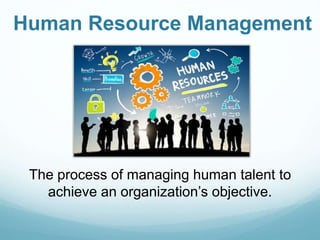
Human Resource Management
The process of managing human talent to
achieve an organization’s objective.
Why Study HRM?
• Opportunity to
manage people
• Have a good
understanding
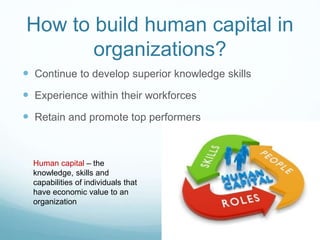
How to build human capital in
organizations?
 Continue to develop superior knowledge skills
 Experience within their workforces
 Retain and promote top performers
Human capital – the
knowledge, skills and
capabilities of individuals that
have economic value to an
organization
Challenge #1: Responding Strategically to
Changes in the Marketplace
 What is our entry strategy?
 Who should we send first?
 Where should we locate our sales,
production and other personnel?
 How do we manage a crisis?
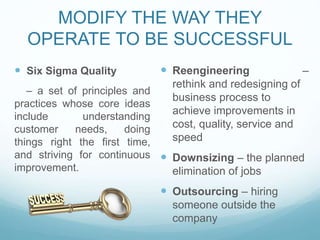
MODIFY THE WAY THEY
OPERATE TO BE SUCCESSFUL
 Six Sigma Quality
– a set of principles and
practices whose core ideas
include understanding
customer needs, doing
things right the first time,
and striving for continuous
improvement.
 Reengineering –
rethink and redesigning of
business process to
achieve improvements in
cost, quality, service and
speed
 Downsizing – the planned
elimination of jobs
 Outsourcing – hiring
someone outside the
company
Change Management
- A systematic way
of bringing about
and managing both
organization
changes and
changes on the
individual level
 Envision the future
 Communicate this
vision to employees
 Set clear expectations
for performance
 Develop the capability
to execute by
recognizing people
and relocating assets
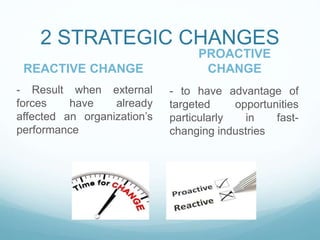
2 STRATEGIC CHANGES
REACTIVE CHANGE
- Result when external
forces have already
affected an organization’s
performance
PROACTIVE
CHANGE
- to have advantage of
targeted opportunities
particularly in fast-
changing industries
Keep in mind…
 HR’s role is not all about providing advice to
CEO’s and supervisors
 HR managers are also responsible for listening
to and advocating on behalf of employees to
make sure their interests are aligned with those
of the firm and vice versa

Introduction to Human Resource Management

  • 1.
    Human Resource Management Chapter 1– The Challenge of Human Resource and Management
  • 2.
    Human Resource Management Theprocess of managing human talent to achieve an organization’s objective.
  • 3.
    Why Study HRM? •Opportunity to manage people • Have a good understanding
  • 4.
    How to buildhuman capital in organizations?  Continue to develop superior knowledge skills  Experience within their workforces  Retain and promote top performers Human capital – the knowledge, skills and capabilities of individuals that have economic value to an organization
  • 5.
    Challenge #1: RespondingStrategically to Changes in the Marketplace  What is our entry strategy?  Who should we send first?  Where should we locate our sales, production and other personnel?  How do we manage a crisis?
  • 6.
    MODIFY THE WAYTHEY OPERATE TO BE SUCCESSFUL  Six Sigma Quality – a set of principles and practices whose core ideas include understanding customer needs, doing things right the first time, and striving for continuous improvement.  Reengineering – rethink and redesigning of business process to achieve improvements in cost, quality, service and speed  Downsizing – the planned elimination of jobs  Outsourcing – hiring someone outside the company
  • 7.
    Change Management - Asystematic way of bringing about and managing both organization changes and changes on the individual level  Envision the future  Communicate this vision to employees  Set clear expectations for performance  Develop the capability to execute by recognizing people and relocating assets
  • 8.
    2 STRATEGIC CHANGES REACTIVECHANGE - Result when external forces have already affected an organization’s performance PROACTIVE CHANGE - to have advantage of targeted opportunities particularly in fast- changing industries
  • 9.
    Keep in mind… HR’s role is not all about providing advice to CEO’s and supervisors  HR managers are also responsible for listening to and advocating on behalf of employees to make sure their interests are aligned with those of the firm and vice versa