
UPDATE TO THE
PROPOSED MINING POLICY


                 LEO L. JASARENO
                      Director
          Mines and Geosciences Bureau
  Department of Environment and Natural Resources
MINING STUDY GROUP
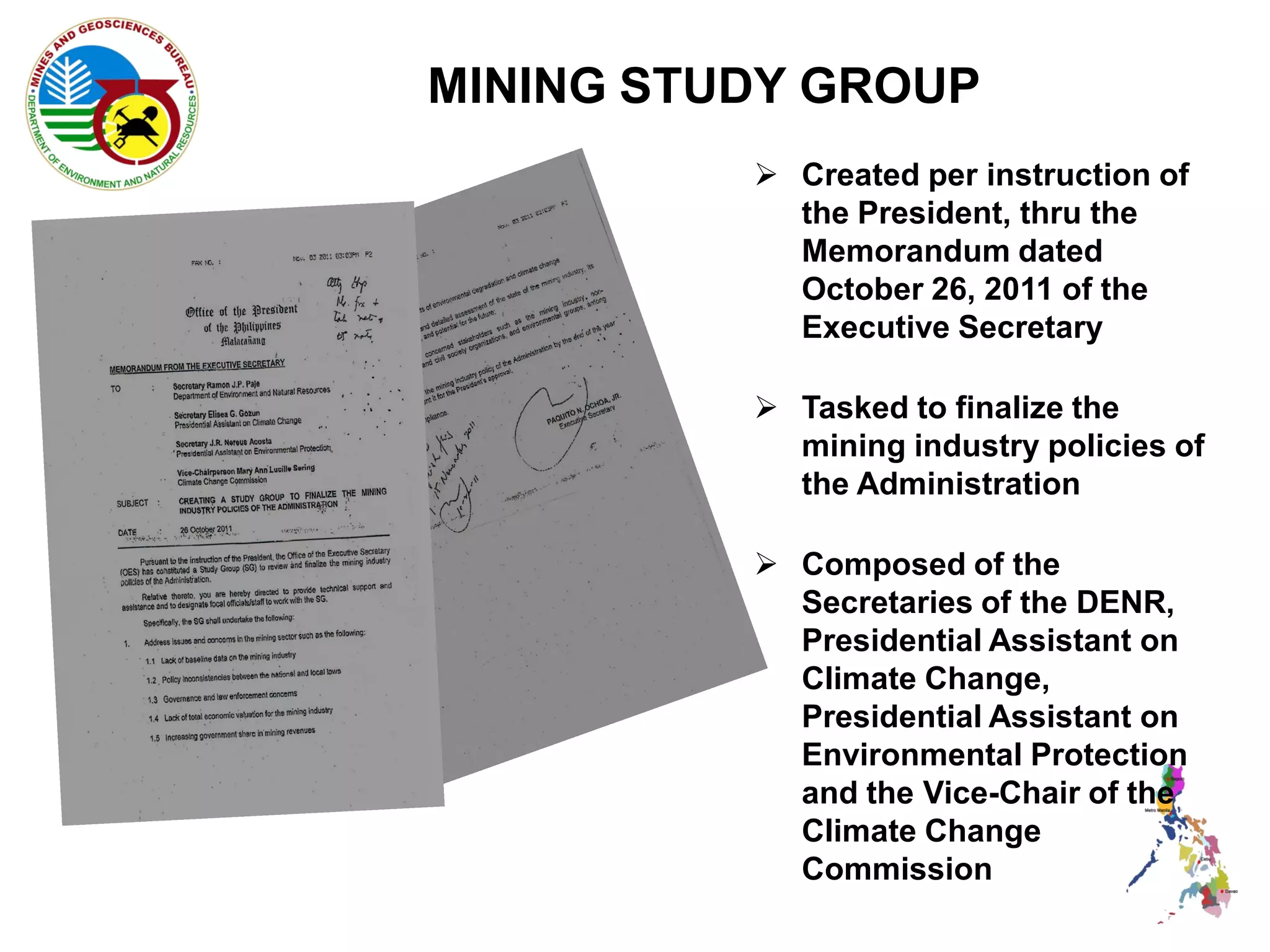
           Created per instruction of
            the President, thru the
            Memorandum dated
            October 26, 2011 of the
            Executive Secretary

           Tasked to finalize the
            mining industry policies of
            the Administration

           Composed of the
            Secretaries of the DENR,
            Presidential Assistant on
            Climate Change,
            Presidential Assistant on
            Environmental Protection
            and the Vice-Chair of the
            Climate Change
            Commission
THE MINING STUDY GROUP’S
              SPECIFIC TASKS:
1. Address issues and concerns in the mineral
   sector-
      Lack of baseline data
      Policy inconsistencies between national
       and local laws
      Governance and law enforcement
      Lack of total economic valuation
      Increasing government share in mining
       revenues
      Adverse effects of environmental
       degradation and climate change
THE MINING STUDY GROUP’S
               SPECIFIC TASKS:

2. Provide a clear and detailed assessment of
   the state of the mining industry, its impacts,
   effects and potential for the future.
3. Consult with the concerned stakeholders
   such as the mining industry, non-
   government and civil society organizations,
   and environmental groups, among others;
   and
4. Formulate the mining industry policy by the
   end of the year and present it to the
   President’s approval.
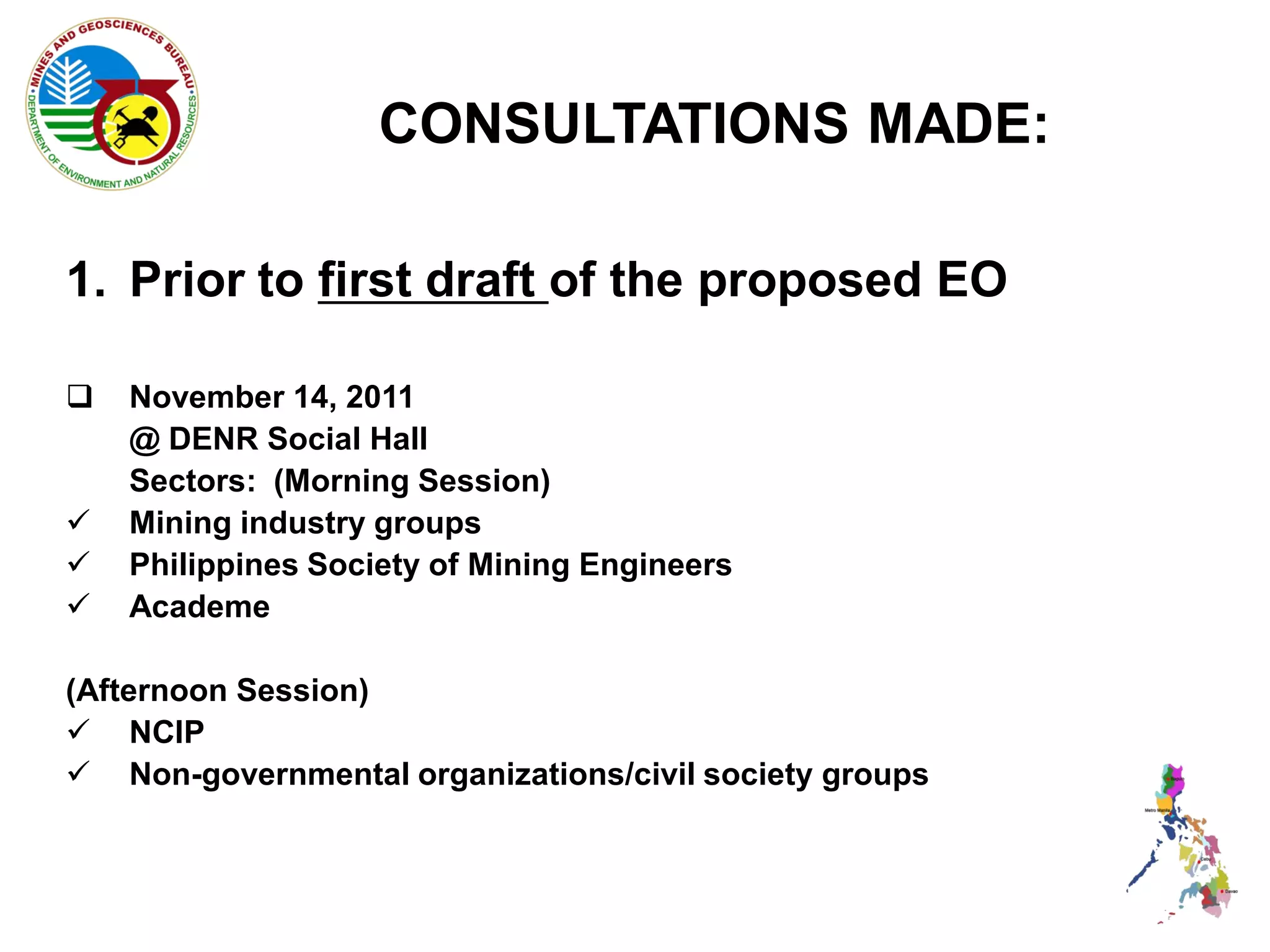
CONSULTATIONS MADE:

1. Prior to first draft of the proposed EO

   November 14, 2011
    @ DENR Social Hall
    Sectors: (Morning Session)
   Mining industry groups
   Philippines Society of Mining Engineers
   Academe

(Afternoon Session)
 NCIP
 Non-governmental organizations/civil society groups
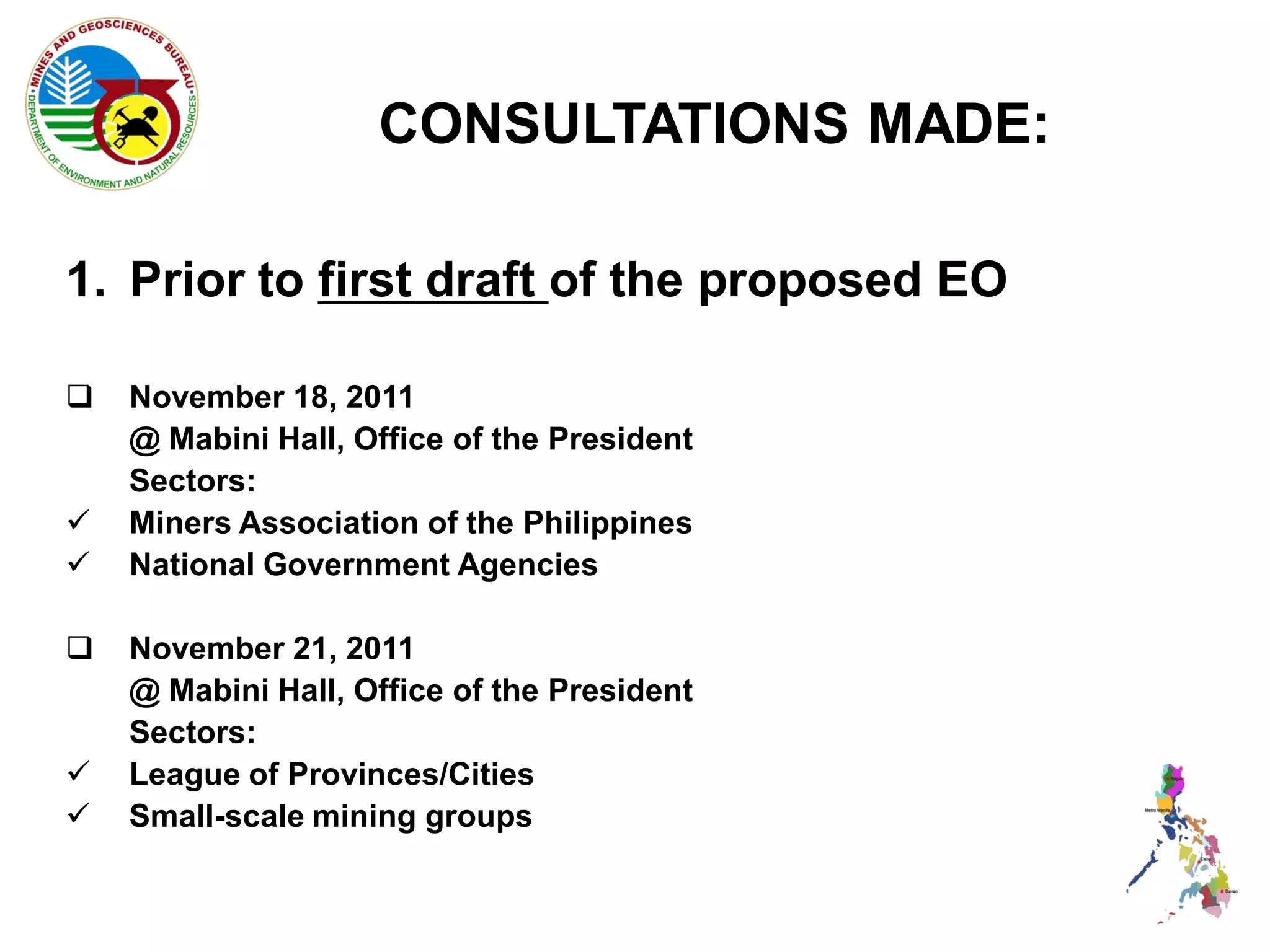
CONSULTATIONS MADE:

1. Prior to first draft of the proposed EO

   November 18, 2011
    @ Mabini Hall, Office of the President
    Sectors:
   Miners Association of the Philippines
   National Government Agencies

   November 21, 2011
    @ Mabini Hall, Office of the President
    Sectors:
   League of Provinces/Cities
   Small-scale mining groups
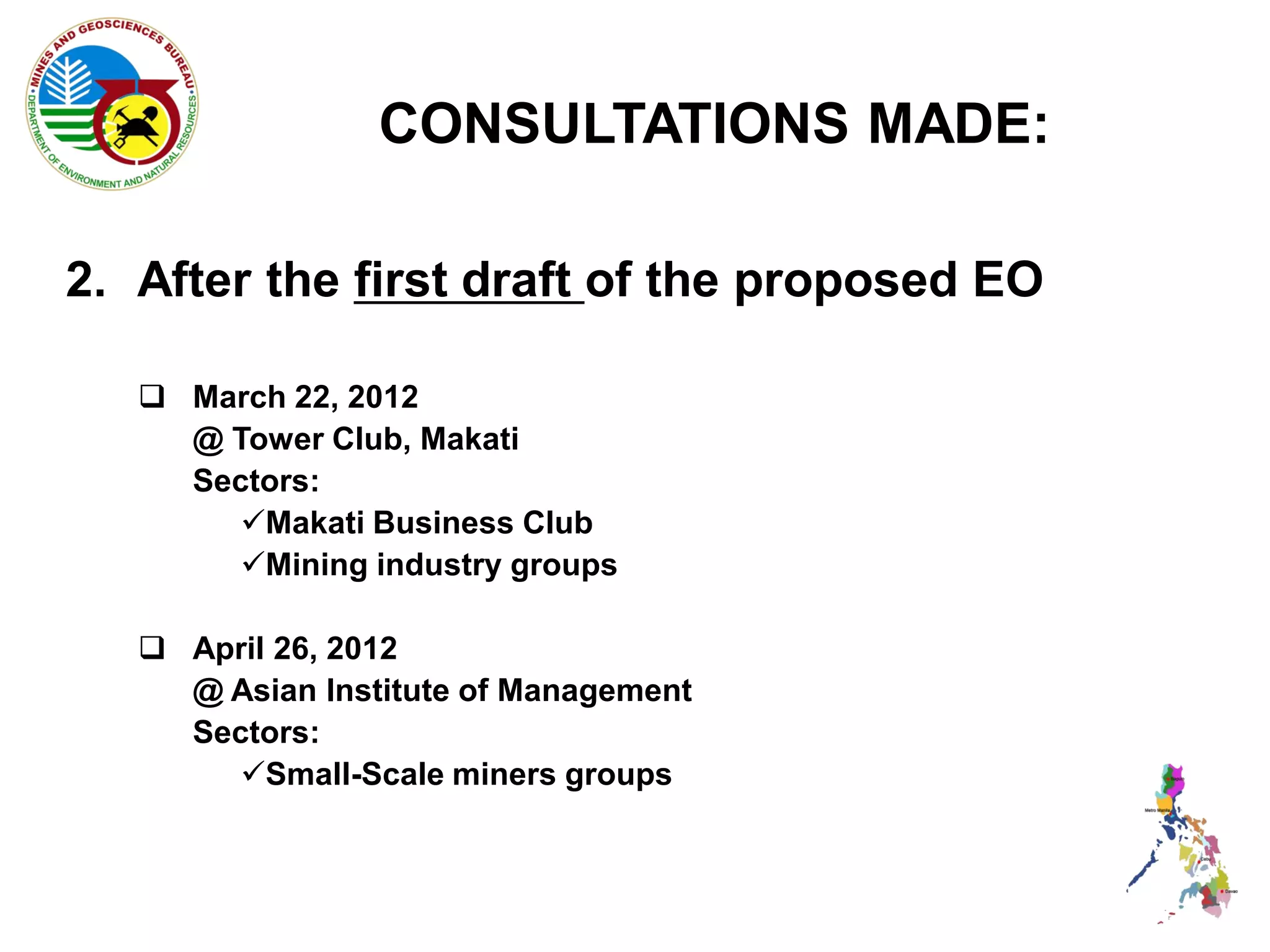
CONSULTATIONS MADE:

2. After the first draft of the proposed EO

    March 22, 2012
     @ Tower Club, Makati
     Sectors:
        Makati Business Club
        Mining industry groups

    April 26, 2012
     @ Asian Institute of Management
     Sectors:
        Small-Scale miners groups
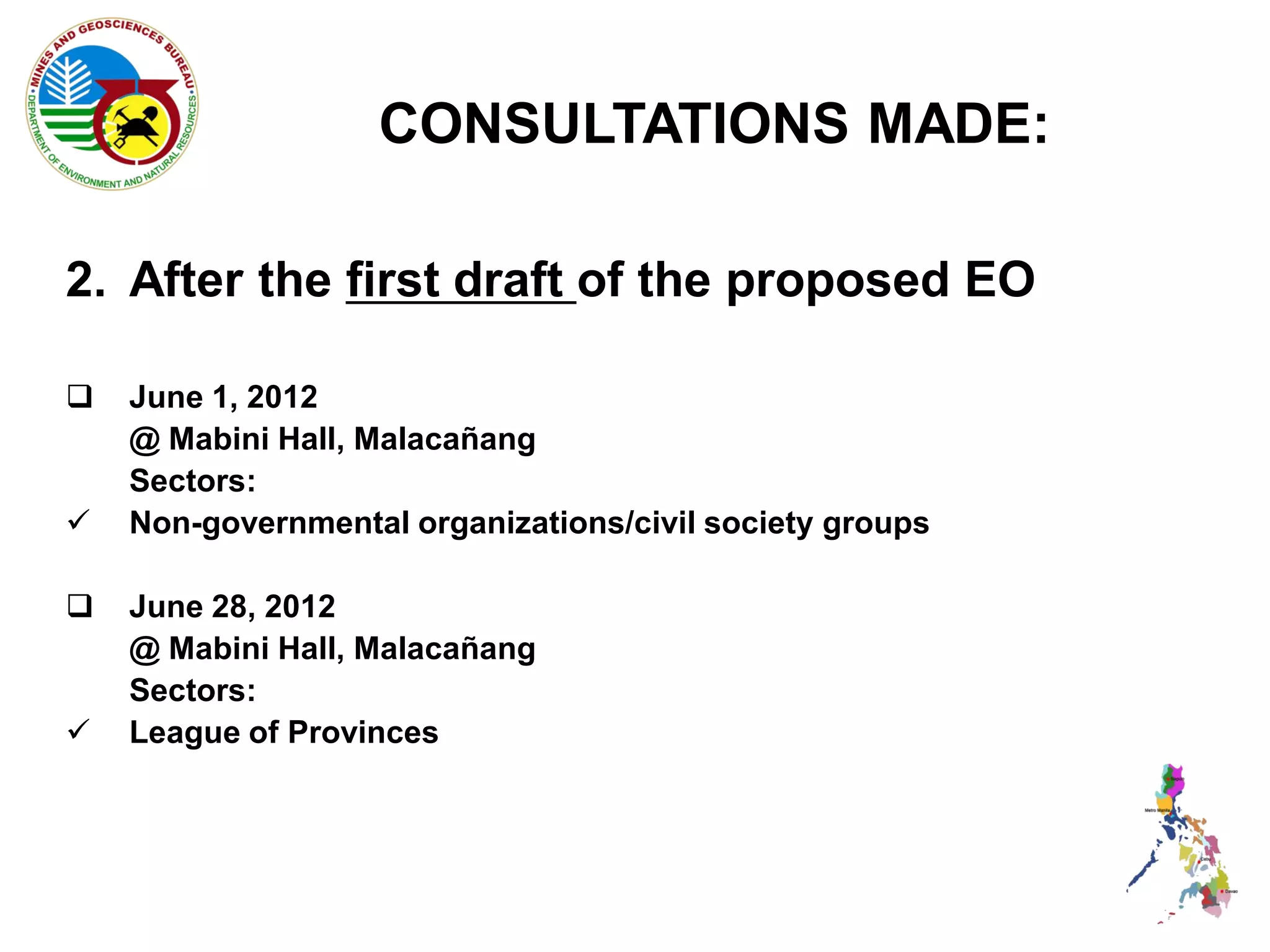
CONSULTATIONS MADE:

2. After the first draft of the proposed EO

   June 1, 2012
    @ Mabini Hall, Malacañang
    Sectors:
   Non-governmental organizations/civil society groups

   June 28, 2012
    @ Mabini Hall, Malacañang
    Sectors:
   League of Provinces
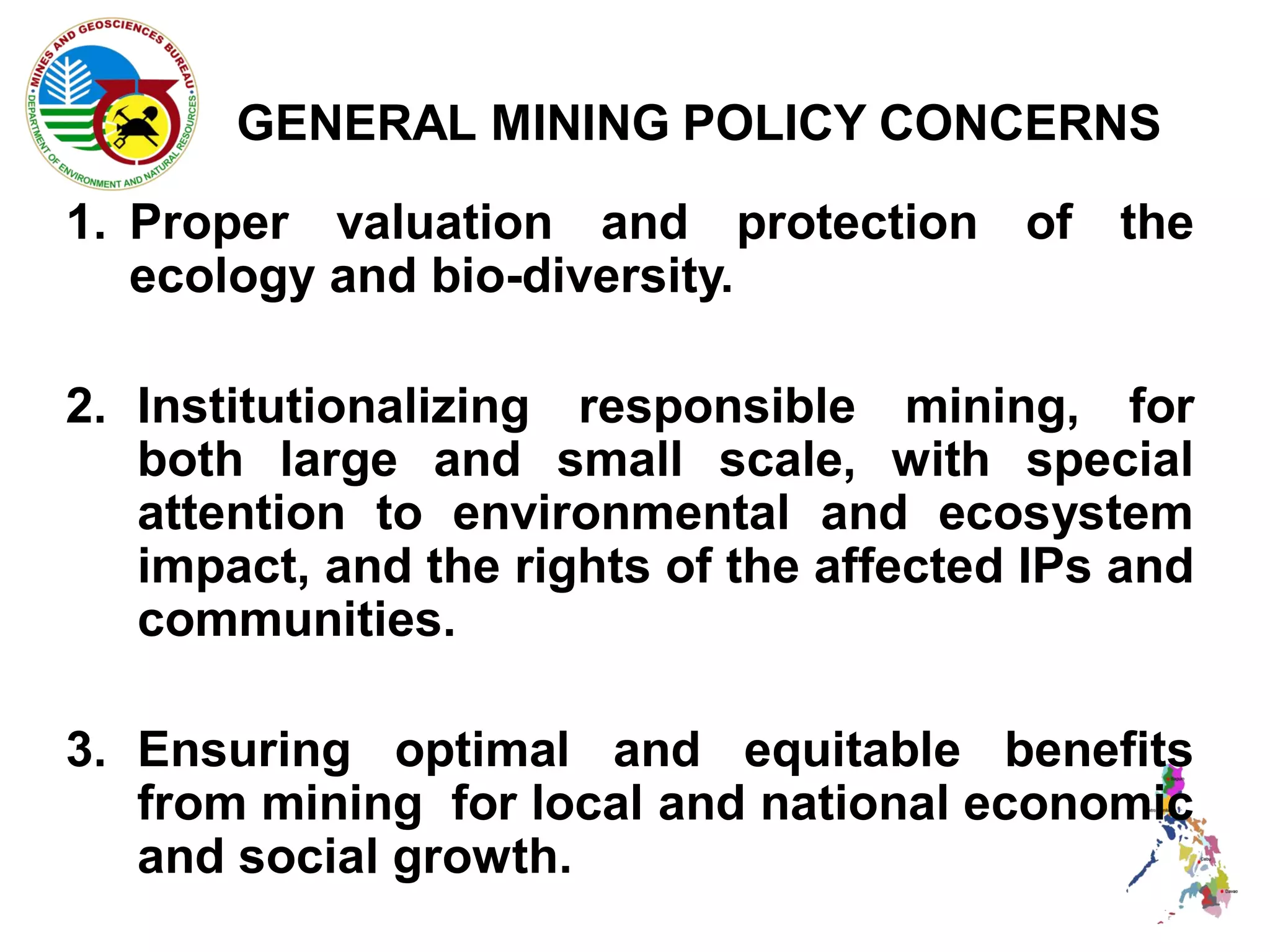
GENERAL MINING POLICY CONCERNS
1. Proper valuation and protection of the
   ecology and bio-diversity.

2. Institutionalizing responsible mining, for
   both large and small scale, with special
   attention to environmental and ecosystem
   impact, and the rights of the affected IPs and
   communities.

3. Ensuring optimal and equitable benefits
   from mining for local and national economic
   and social growth.
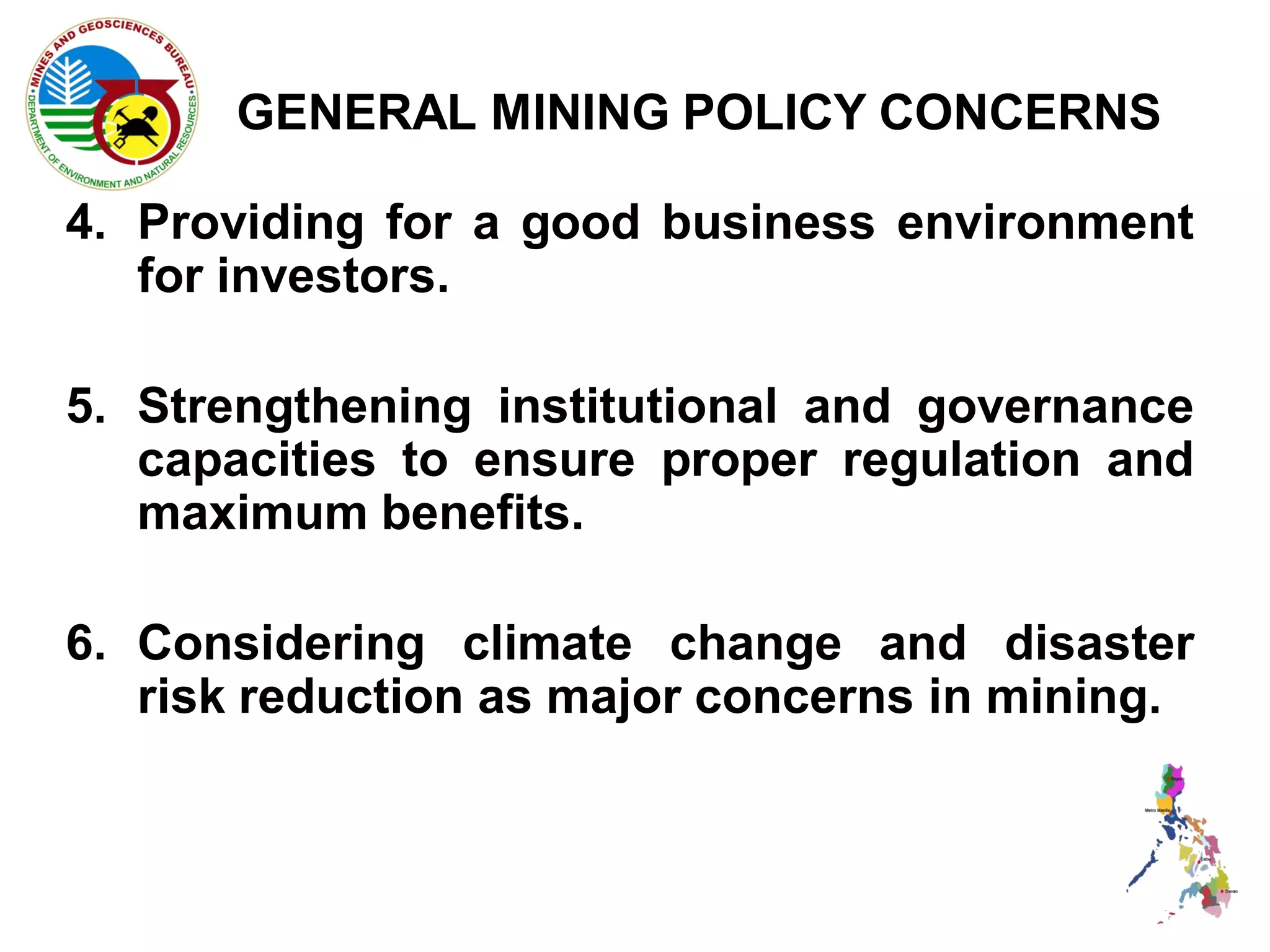
GENERAL MINING POLICY CONCERNS

4. Providing for a good business environment
   for investors.

5. Strengthening institutional and governance
   capacities to ensure proper regulation and
   maximum benefits.

6. Considering climate change and disaster
   risk reduction as major concerns in mining.
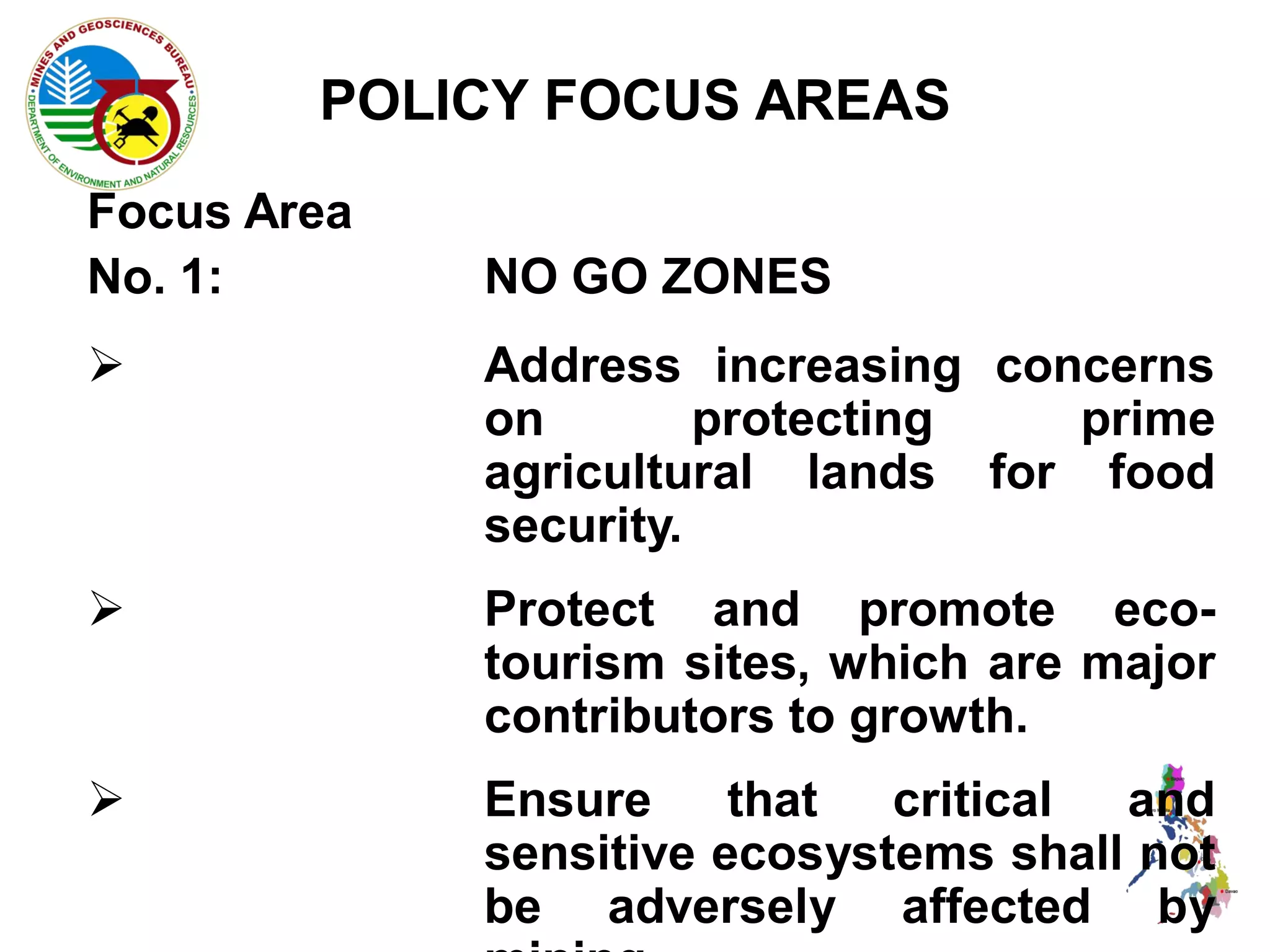
POLICY FOCUS AREAS
Focus Area
No. 1:       NO GO ZONES
            Address increasing concerns
             on        protecting  prime
             agricultural lands for food
             security.
            Protect and promote eco-
             tourism sites, which are major
             contributors to growth.
            Ensure     that  critical and
             sensitive ecosystems shall not
             be adversely affected by
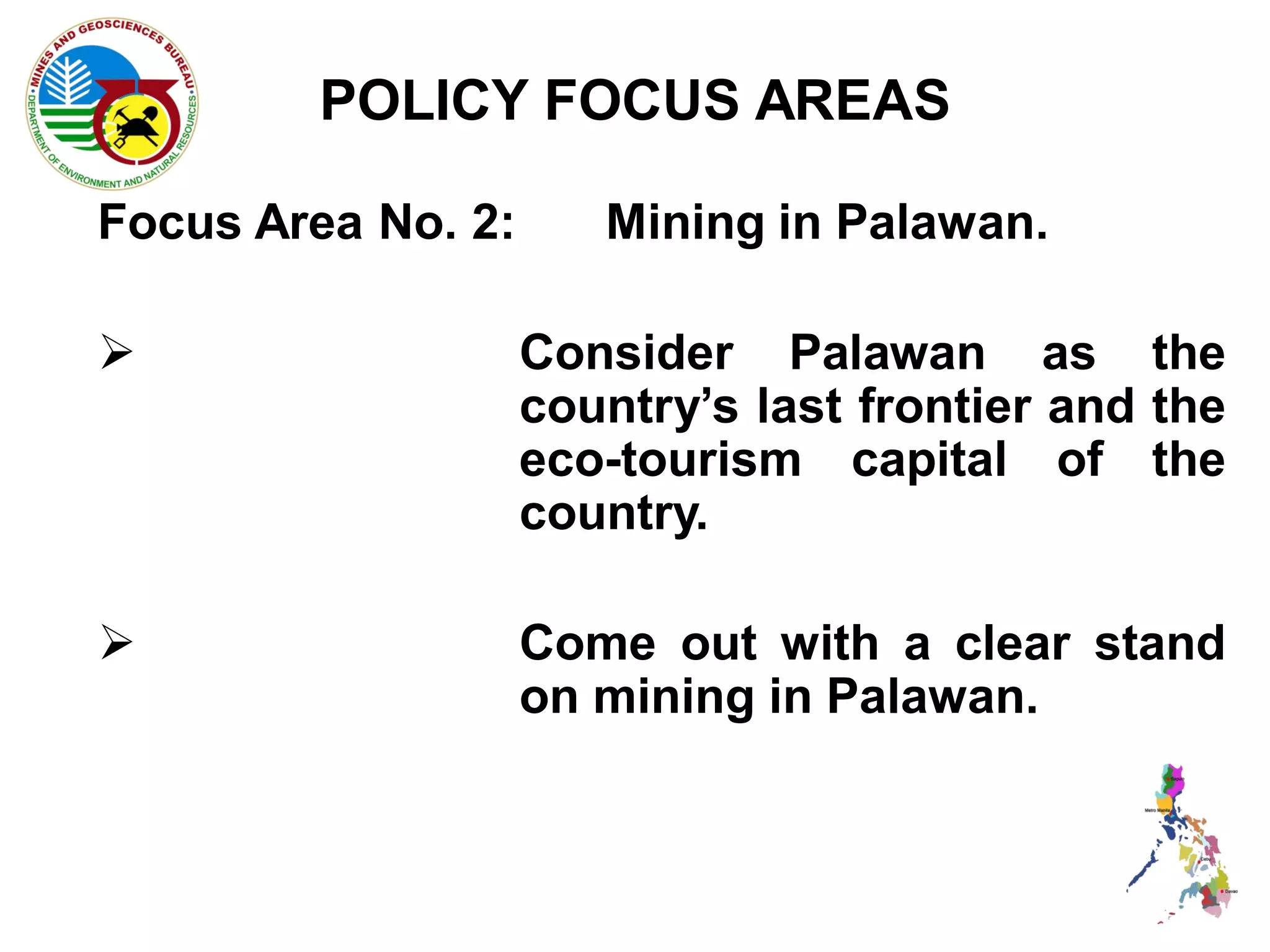
POLICY FOCUS AREAS

Focus Area No. 2:      Mining in Palawan.

                   Consider Palawan as the
                    country’s last frontier and the
                    eco-tourism capital of the
                    country.

                   Come out with a clear stand
                    on mining in Palawan.
POLICY FOCUS AREAS
Focus Area
No. 3:   Review of Performance of Mining
         Operations

         Ensure compliance with law.

         Rationalize mineral development
          and utilization in line with the
          principle      of      sustainable
          development.
POLICY FOCUS AREAS

Focus Area
No. 4:       Auctioning of Areas     with
             Known Reserves.

              Allow the collection of
               additional   share     for
               Government        through
               negotiation.

              Weed out speculators and
               provide for a level playing
               field.
POLICY FOCUS AREAS

Focus Area
No. 5:   Creation of an Inter-Agency Council
         on Mining .

          Facilitate      dialogue   and
           coordination among the growing
           number of stakeholders in the
           minerals industry.

          Review mining and related laws,
           guidelines and agreements.
POLICY FOCUS AREAS

Focus Area
No. 6:   Study of Equitable Benefit Sharing
         Schemes.

          Look into terms for equitable
           benefit   sharing    among    the
           government, LGUs concerned and
           local communities, existing taxes
           and fees and incentives.
POLICY FOCUS AREAS
Focus Area
No. 7:    Imposition of Higher   Regulatory
          Fees and Charges.

          Adopt a fair and reasonable
           increase of fees on mine wastes
           and tailings, occupation and
           processing,       after    due
           consultation.
POLICY FOCUS AREAS

Focus Area
No. 8:    Disposition of Abandoned Ore and
          Mine Wastes and/or Mill Tailings as
          Assets of the State.

           Generate additional Government
            revenue.
POLICY FOCUS AREAS

Focus Area
No. 9:     Development of a Downstream
           Industry for the Mineral Sector.

            Formulate a national program for
             the development of value-adding
             activities for metallic ores.
POLICY FOCUS AREAS
Focus Area No. 10: Mineral Reservations.

                  Establish more mineral
                   reservations for potential
                   strategic minerals.

                  Support the development
                   of strategic industries .
POLICY FOCUS AREAS
Focus
Area No. 11:          Government Capacity
                      Enhancement

 Strengthen capability of government
  agencies concerned in carrying out their
  mandates and functions.
POLICY FOCUS AREAS

Focus Area No. 12: Creation of a Task Force
                   Against Illegal Mining


 Institutionalize a stronger force of
  Government to counter the growing illegal
  mining operations.
MINING POLICY FOCUS

Focus Area
No. 13:    Streamlining and Rationalizing Small-Scale
           Mining Operations.
            Strictly implement provisions of RA No.
             7076 and the EIS System.
            Totally prohibit use of mercury.
            Operationalize all Provincial and City
             Mining Regulatory Boards.
            Provide training and capacity building for
             small-scale miners.
POLICY FOCUS AREAS

Focus Area
No. 14:      Demilitarization of Mining Areas.

                Strictly disallow
                 unreasonable deployment
                 of military and police
                 personnel in mining areas.
POLICY FOCUS AREAS
Focus Area
No. 15:             Integration and Streamlining of
                    Procedures and Processes
             Create   a    one-stop   shop     for
              processing of mining applications, to
              include other government agencies
              concerned.
             Establish central database system for
              the minerals industry, to include from
              Wealth Accounting and Valuation.
             Integrate mapping system;        unify
              maps.
POLICY FOCUS AREAS

Focus Area
No. 16:      Extractive Industries
             Transparency Initiative

              Enrol in and implement the
               EITI.
POLICY FOCUS AREAS

Focus Area
No. 17:      Providing for Clear and
             Responsive
             Environmental Standards.

              Address and effectively
               respond to environmental
               incidents related to mining.
POLICY FOCUS AREAS

Focus Area
No. 18:      Programmatic Environmental
             Impact Assessment

              Instituting a programmatic
               approach in the EIS system
               involving mining projects.
EXPECTED OUTCOME
1. Lifting of the moratorium.
2. Resolving MRs and Appeals.
3. Address the issues and concerns
   that hamper the growth of
   responsible mining.
MARAMING SALAMAT!
       www.mgb.gov.ph

MGB Presentation Update on Mining Policy 7.6.2012

  • 1.
    UPDATE TO THE PROPOSEDMINING POLICY LEO L. JASARENO Director Mines and Geosciences Bureau Department of Environment and Natural Resources
  • 2.
    MINING STUDY GROUP  Created per instruction of the President, thru the Memorandum dated October 26, 2011 of the Executive Secretary  Tasked to finalize the mining industry policies of the Administration  Composed of the Secretaries of the DENR, Presidential Assistant on Climate Change, Presidential Assistant on Environmental Protection and the Vice-Chair of the Climate Change Commission
  • 3.
    THE MINING STUDYGROUP’S SPECIFIC TASKS: 1. Address issues and concerns in the mineral sector-  Lack of baseline data  Policy inconsistencies between national and local laws  Governance and law enforcement  Lack of total economic valuation  Increasing government share in mining revenues  Adverse effects of environmental degradation and climate change
  • 4.
    THE MINING STUDYGROUP’S SPECIFIC TASKS: 2. Provide a clear and detailed assessment of the state of the mining industry, its impacts, effects and potential for the future. 3. Consult with the concerned stakeholders such as the mining industry, non- government and civil society organizations, and environmental groups, among others; and 4. Formulate the mining industry policy by the end of the year and present it to the President’s approval.
  • 5.
    CONSULTATIONS MADE: 1. Priorto first draft of the proposed EO  November 14, 2011 @ DENR Social Hall Sectors: (Morning Session)  Mining industry groups  Philippines Society of Mining Engineers  Academe (Afternoon Session)  NCIP  Non-governmental organizations/civil society groups
  • 6.
    CONSULTATIONS MADE: 1. Priorto first draft of the proposed EO  November 18, 2011 @ Mabini Hall, Office of the President Sectors:  Miners Association of the Philippines  National Government Agencies  November 21, 2011 @ Mabini Hall, Office of the President Sectors:  League of Provinces/Cities  Small-scale mining groups
  • 7.
    CONSULTATIONS MADE: 2. Afterthe first draft of the proposed EO  March 22, 2012 @ Tower Club, Makati Sectors: Makati Business Club Mining industry groups  April 26, 2012 @ Asian Institute of Management Sectors: Small-Scale miners groups
  • 8.
    CONSULTATIONS MADE: 2. Afterthe first draft of the proposed EO  June 1, 2012 @ Mabini Hall, Malacañang Sectors:  Non-governmental organizations/civil society groups  June 28, 2012 @ Mabini Hall, Malacañang Sectors:  League of Provinces
  • 9.
    GENERAL MINING POLICYCONCERNS 1. Proper valuation and protection of the ecology and bio-diversity. 2. Institutionalizing responsible mining, for both large and small scale, with special attention to environmental and ecosystem impact, and the rights of the affected IPs and communities. 3. Ensuring optimal and equitable benefits from mining for local and national economic and social growth.
  • 10.
    GENERAL MINING POLICYCONCERNS 4. Providing for a good business environment for investors. 5. Strengthening institutional and governance capacities to ensure proper regulation and maximum benefits. 6. Considering climate change and disaster risk reduction as major concerns in mining.
  • 11.
    POLICY FOCUS AREAS FocusArea No. 1: NO GO ZONES  Address increasing concerns on protecting prime agricultural lands for food security.  Protect and promote eco- tourism sites, which are major contributors to growth.  Ensure that critical and sensitive ecosystems shall not be adversely affected by
  • 12.
    POLICY FOCUS AREAS FocusArea No. 2: Mining in Palawan.  Consider Palawan as the country’s last frontier and the eco-tourism capital of the country.  Come out with a clear stand on mining in Palawan.
  • 13.
    POLICY FOCUS AREAS FocusArea No. 3: Review of Performance of Mining Operations  Ensure compliance with law.  Rationalize mineral development and utilization in line with the principle of sustainable development.
  • 14.
    POLICY FOCUS AREAS FocusArea No. 4: Auctioning of Areas with Known Reserves.  Allow the collection of additional share for Government through negotiation.  Weed out speculators and provide for a level playing field.
  • 15.
    POLICY FOCUS AREAS FocusArea No. 5: Creation of an Inter-Agency Council on Mining .  Facilitate dialogue and coordination among the growing number of stakeholders in the minerals industry.  Review mining and related laws, guidelines and agreements.
  • 16.
    POLICY FOCUS AREAS FocusArea No. 6: Study of Equitable Benefit Sharing Schemes.  Look into terms for equitable benefit sharing among the government, LGUs concerned and local communities, existing taxes and fees and incentives.
  • 17.
    POLICY FOCUS AREAS FocusArea No. 7: Imposition of Higher Regulatory Fees and Charges.  Adopt a fair and reasonable increase of fees on mine wastes and tailings, occupation and processing, after due consultation.
  • 18.
    POLICY FOCUS AREAS FocusArea No. 8: Disposition of Abandoned Ore and Mine Wastes and/or Mill Tailings as Assets of the State.  Generate additional Government revenue.
  • 19.
    POLICY FOCUS AREAS FocusArea No. 9: Development of a Downstream Industry for the Mineral Sector.  Formulate a national program for the development of value-adding activities for metallic ores.
  • 20.
    POLICY FOCUS AREAS FocusArea No. 10: Mineral Reservations.  Establish more mineral reservations for potential strategic minerals.  Support the development of strategic industries .
  • 21.
    POLICY FOCUS AREAS Focus AreaNo. 11: Government Capacity Enhancement  Strengthen capability of government agencies concerned in carrying out their mandates and functions.
  • 22.
    POLICY FOCUS AREAS FocusArea No. 12: Creation of a Task Force Against Illegal Mining  Institutionalize a stronger force of Government to counter the growing illegal mining operations.
  • 23.
    MINING POLICY FOCUS FocusArea No. 13: Streamlining and Rationalizing Small-Scale Mining Operations.  Strictly implement provisions of RA No. 7076 and the EIS System.  Totally prohibit use of mercury.  Operationalize all Provincial and City Mining Regulatory Boards.  Provide training and capacity building for small-scale miners.
  • 24.
    POLICY FOCUS AREAS FocusArea No. 14: Demilitarization of Mining Areas.  Strictly disallow unreasonable deployment of military and police personnel in mining areas.
  • 25.
    POLICY FOCUS AREAS FocusArea No. 15: Integration and Streamlining of Procedures and Processes Create a one-stop shop for processing of mining applications, to include other government agencies concerned. Establish central database system for the minerals industry, to include from Wealth Accounting and Valuation. Integrate mapping system; unify maps.
  • 26.
    POLICY FOCUS AREAS FocusArea No. 16: Extractive Industries Transparency Initiative  Enrol in and implement the EITI.
  • 27.
    POLICY FOCUS AREAS FocusArea No. 17: Providing for Clear and Responsive Environmental Standards.  Address and effectively respond to environmental incidents related to mining.
  • 28.
    POLICY FOCUS AREAS FocusArea No. 18: Programmatic Environmental Impact Assessment  Instituting a programmatic approach in the EIS system involving mining projects.
  • 29.
    EXPECTED OUTCOME 1. Liftingof the moratorium. 2. Resolving MRs and Appeals. 3. Address the issues and concerns that hamper the growth of responsible mining.
  • 30.
    MARAMING SALAMAT! www.mgb.gov.ph