
Philippine Misereor Partnership, Inc.
                 National Secretariat
                 2nd Floor # 8 Cordillera Street Brgy. Doña Aurora,
                 Galas, 1113 Quezon City
                 Telephone: (632) 353-4287Fax: (632) 353-439
                 E-mail: pmpsecretariat@yahoo.comWebsite: http://www.2003pmp.org


PROMULGATE A NEW MINING POLICY
EACH ONE CAN CALL “mine ”
( A PMPI Statement on the proposed Executive Order on Mining
during its 4th General Assembly composed of 229 delegates
representing 159 of its 284 member civil society organizations from
the 15 regional clusters all over the Philippines, held at Teacher’s
Camp, Baguio City, last February 27-March 1, 2012 )


      Promulgate a new mining policy now!
       We have an unsettling anticipation for the new mining policy to be issued by
PNoy administration. Of late there has been a round of media releases from different
groups as to the content of the new mining policy. The development of the mining
industry among others is one of the drivers for the present administration to rethink
the mining policy that it inherited from the GMA administration which is the
aggressive promotion of mining. For us the, the new mining policy in relation to the
development of the mining industry should consider the following:

1.    Mine only what we need for our national development

       Time and again, we have repeatedly stressed that the economic argument for
the aggressive promotion of mining is misplaced given its dismal contribution to our
economy. We should identify strategic metals for our national development
anchored on our agricultural development. Ever since, he minerals that have been
mined and still being mined today      are simply extracted by companies mostly
foreign owned and shipped to home countries of such companies. We are left with
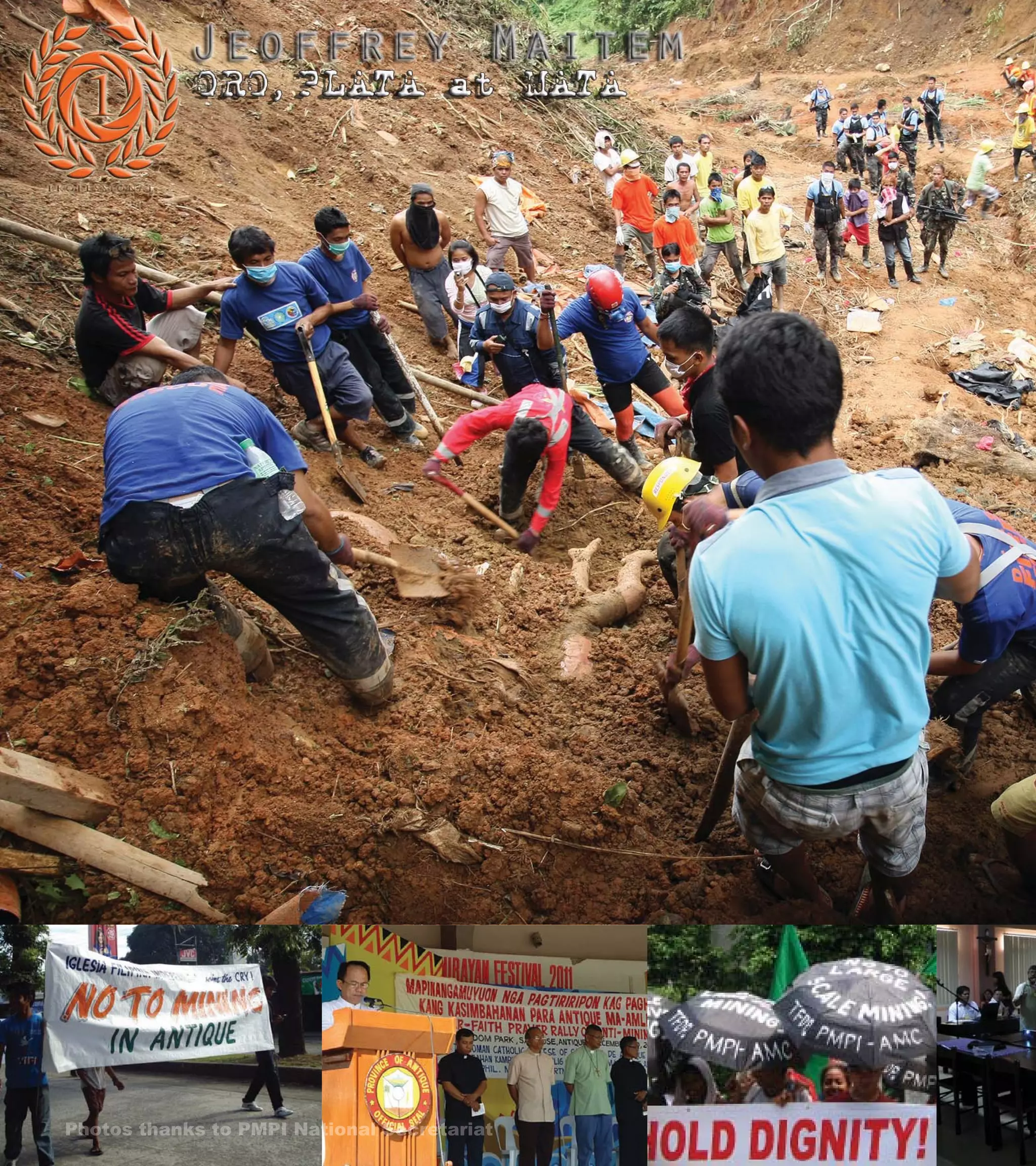
damaged environment and toxic legacies like the Mariduque and Rapu-Rapu mining
disasters. Our national patrimony should be defended and secured for our benefit.
Agricultural development should be pursued and this should inform the strategic
minerals that our country should produce.

2. Respect and protect “No-go-zones”

       Aside from the areas where mining should not be done under existing laws,
no-go-zones for all forms of mining should also include the conflict areas, key-
biodiversity areas, small-island ecosystem, and prime agricultural lands. And even
in areas where mining would be allowed, the FPIC process should be the minimum
standard for its acceptance particularly for ancestral domain. Capacity-building of
DENR and re-orientation of the MGB as a research agency and repository of
information should be one of the directions in the changes in our mining policy.


3. Institutionalize and strengthen accountability of mining corporations and
access to justice of victims of corporate abuses

       Mining corporations should transact its business in accordance with the
international principle of Business and Human Rights to which our country is one of
the signatories. The business sector which include mining is mandated by the UN
Protect, Respect and Remedy Framework to undertake due diligence before
proceeding with its business operation and it should assume the responsibility of
respecting the rights of people who will be potentially and will be actually affected by
its operation. We think that a concrete operational mechanism of this duty is to shift
the burden of proof to mining companies whenever any rights abuses or damage to
the environment occurs. The extraction of minerals is undoubtedly imbued with
public interest as it affect the lives of people and the environment. Given the
asymmetry of information between corporations and communities affected by its
operation and the great imbalance in resources and capacity by which information
can be accessed, the shifting of the burden of proof to the corporations is by itself a
concrete application of capacitating the victims of HR abuses committed by or as a
consequence of business operations.

      We support the rationalization of tax incentives and other freebies given to
mining companies and exaction of transparency on all dealings of mining companies
in generating and disposing its income including any benefits material or financial
extended to LGUs and government agencies.


4. Uphold stewardship over mineral resources through peoples’ participation
in management and decision-making

      We are caretakers or stewards of the Creation. Large-scale mining as it is
being done in the present context of regulatory capture, foreign ownership of
mineral extraction, gross disregard for the FPIC process for the IPs, unchecked
environmental crimes and disrespect for the socio-economic, cultural and political
rights of mining-affected communities among others go against the very core of
being a responsible steward. We have always risked of being accused as anti-
development but we think the responsible mining being peddled by big mining
companies borders only on stakeholdership- that is a claim based on interest or
stake. Stewardship goes beyond interest. It is a duty and recognition that we are
caretakers of the Creation for the present and future generation.


5. Explore and promote policies on Urban Mining or Metals Recycling.

        Pressure to mine our mineral resources will be reduced if we consider urban
mining. Reuse and recycling of minerals like copper, gold, aluminum among others
will help reduce opening up new mines and thereby reduce also the release of other
toxic waste to the environment. This will require a policy environment that will
provide incentive and support to metal recycling. The Solid waste Management Act
and the Basel Convention has laid the groundwork for waste management but a
focused policy on metals recycling will have to formulated in order to support our
claim for stewardship and management of our mineral resources.


6. Recognize and respect local autonomy

       The open-pit ban contained in the Environment Code of the Sangguniang
Panlalawigan of South Cotabato and Zamboanga del Norte are just two examples of
how local government units resist and defend the destructive impact of open-pit
mining. The new mining policy should recognize the constitutional and statutory
grant to LGUs to determine its development processes within the framework of
national development. Section 26 and 27 of the Local Government Code should
inform the new mining policy as these upholds the will of the communities and the
LGUs in relation to any undertaking that will directly affect, mining operations
included.

      We reiterate our call for:

      The repeal of the Mining Act of 1995 and the passage of the Philippine
Mineral Resources Bill;

       Cancellation of all burdensome mining contracts after appropriate review and
inventory;

     Moratorium on all approval of new mining permits pending the issuance of the
new mining policy.
Pending the repeal of the Mining Act 1995, promulgate a mining policy that
protects our ownership and control over our mineral resources that will ensure the
participation of the people and communities directly and indirectly affected by mining.


                                -------------o 0 o--------------

PMPI 4th GA Statement E.O Mining

  • 2.
    Philippine Misereor Partnership,Inc. National Secretariat 2nd Floor # 8 Cordillera Street Brgy. Doña Aurora, Galas, 1113 Quezon City Telephone: (632) 353-4287Fax: (632) 353-439 E-mail: pmpsecretariat@yahoo.comWebsite: http://www.2003pmp.org PROMULGATE A NEW MINING POLICY EACH ONE CAN CALL “mine ” ( A PMPI Statement on the proposed Executive Order on Mining during its 4th General Assembly composed of 229 delegates representing 159 of its 284 member civil society organizations from the 15 regional clusters all over the Philippines, held at Teacher’s Camp, Baguio City, last February 27-March 1, 2012 ) Promulgate a new mining policy now! We have an unsettling anticipation for the new mining policy to be issued by PNoy administration. Of late there has been a round of media releases from different groups as to the content of the new mining policy. The development of the mining industry among others is one of the drivers for the present administration to rethink the mining policy that it inherited from the GMA administration which is the aggressive promotion of mining. For us the, the new mining policy in relation to the development of the mining industry should consider the following: 1. Mine only what we need for our national development Time and again, we have repeatedly stressed that the economic argument for the aggressive promotion of mining is misplaced given its dismal contribution to our economy. We should identify strategic metals for our national development anchored on our agricultural development. Ever since, he minerals that have been mined and still being mined today are simply extracted by companies mostly foreign owned and shipped to home countries of such companies. We are left with damaged environment and toxic legacies like the Mariduque and Rapu-Rapu mining disasters. Our national patrimony should be defended and secured for our benefit.
  • 3.
    Agricultural development shouldbe pursued and this should inform the strategic minerals that our country should produce. 2. Respect and protect “No-go-zones” Aside from the areas where mining should not be done under existing laws, no-go-zones for all forms of mining should also include the conflict areas, key- biodiversity areas, small-island ecosystem, and prime agricultural lands. And even in areas where mining would be allowed, the FPIC process should be the minimum standard for its acceptance particularly for ancestral domain. Capacity-building of DENR and re-orientation of the MGB as a research agency and repository of information should be one of the directions in the changes in our mining policy. 3. Institutionalize and strengthen accountability of mining corporations and access to justice of victims of corporate abuses Mining corporations should transact its business in accordance with the international principle of Business and Human Rights to which our country is one of the signatories. The business sector which include mining is mandated by the UN Protect, Respect and Remedy Framework to undertake due diligence before proceeding with its business operation and it should assume the responsibility of respecting the rights of people who will be potentially and will be actually affected by its operation. We think that a concrete operational mechanism of this duty is to shift the burden of proof to mining companies whenever any rights abuses or damage to the environment occurs. The extraction of minerals is undoubtedly imbued with public interest as it affect the lives of people and the environment. Given the asymmetry of information between corporations and communities affected by its operation and the great imbalance in resources and capacity by which information can be accessed, the shifting of the burden of proof to the corporations is by itself a concrete application of capacitating the victims of HR abuses committed by or as a consequence of business operations. We support the rationalization of tax incentives and other freebies given to mining companies and exaction of transparency on all dealings of mining companies in generating and disposing its income including any benefits material or financial extended to LGUs and government agencies. 4. Uphold stewardship over mineral resources through peoples’ participation in management and decision-making We are caretakers or stewards of the Creation. Large-scale mining as it is being done in the present context of regulatory capture, foreign ownership of mineral extraction, gross disregard for the FPIC process for the IPs, unchecked
  • 4.
    environmental crimes anddisrespect for the socio-economic, cultural and political rights of mining-affected communities among others go against the very core of being a responsible steward. We have always risked of being accused as anti- development but we think the responsible mining being peddled by big mining companies borders only on stakeholdership- that is a claim based on interest or stake. Stewardship goes beyond interest. It is a duty and recognition that we are caretakers of the Creation for the present and future generation. 5. Explore and promote policies on Urban Mining or Metals Recycling. Pressure to mine our mineral resources will be reduced if we consider urban mining. Reuse and recycling of minerals like copper, gold, aluminum among others will help reduce opening up new mines and thereby reduce also the release of other toxic waste to the environment. This will require a policy environment that will provide incentive and support to metal recycling. The Solid waste Management Act and the Basel Convention has laid the groundwork for waste management but a focused policy on metals recycling will have to formulated in order to support our claim for stewardship and management of our mineral resources. 6. Recognize and respect local autonomy The open-pit ban contained in the Environment Code of the Sangguniang Panlalawigan of South Cotabato and Zamboanga del Norte are just two examples of how local government units resist and defend the destructive impact of open-pit mining. The new mining policy should recognize the constitutional and statutory grant to LGUs to determine its development processes within the framework of national development. Section 26 and 27 of the Local Government Code should inform the new mining policy as these upholds the will of the communities and the LGUs in relation to any undertaking that will directly affect, mining operations included. We reiterate our call for: The repeal of the Mining Act of 1995 and the passage of the Philippine Mineral Resources Bill; Cancellation of all burdensome mining contracts after appropriate review and inventory; Moratorium on all approval of new mining permits pending the issuance of the new mining policy.
  • 5.
    Pending the repealof the Mining Act 1995, promulgate a mining policy that protects our ownership and control over our mineral resources that will ensure the participation of the people and communities directly and indirectly affected by mining. -------------o 0 o--------------