METRICS FOR
SECURITY EFFORT
PRIORITIZATION
Christopher Theisen
AGENDA
◦ Motivate Security Metrics
◦ Solution: Attack Surfaces
◦ Results
◦ Undergraduate Contributions
◦ Future Work
Motivation | Solution | Results | Undergraduates | Future Work
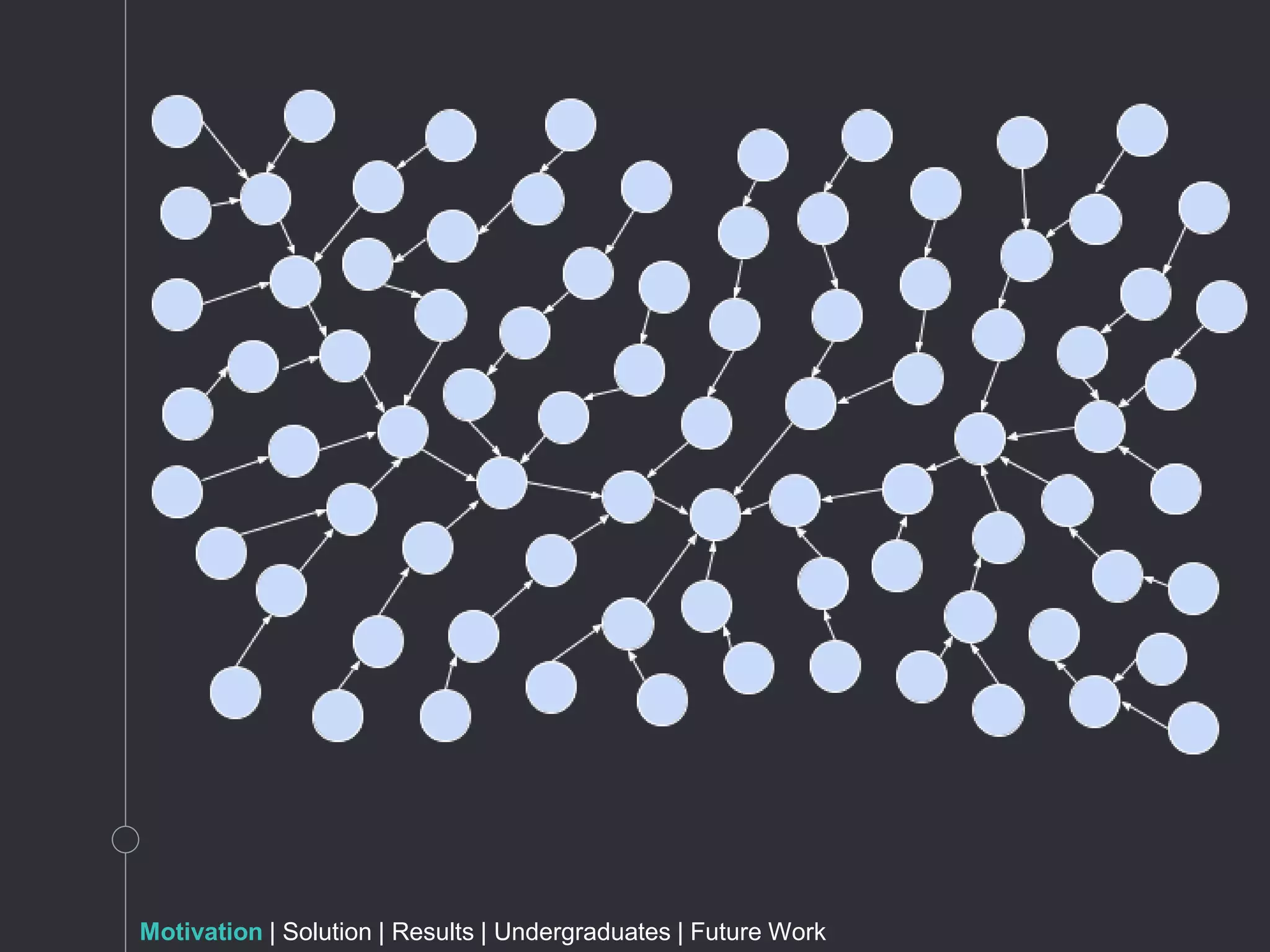
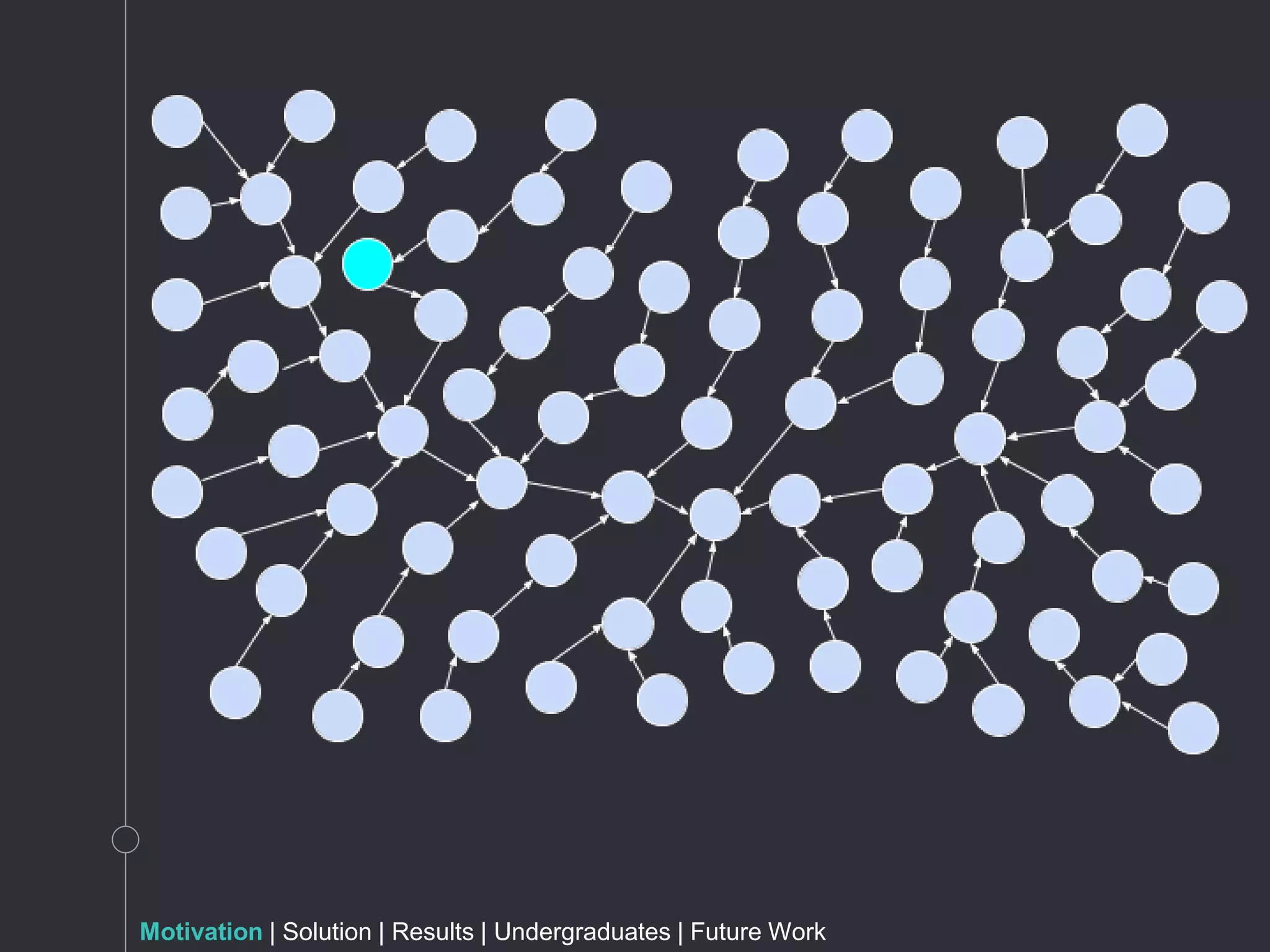
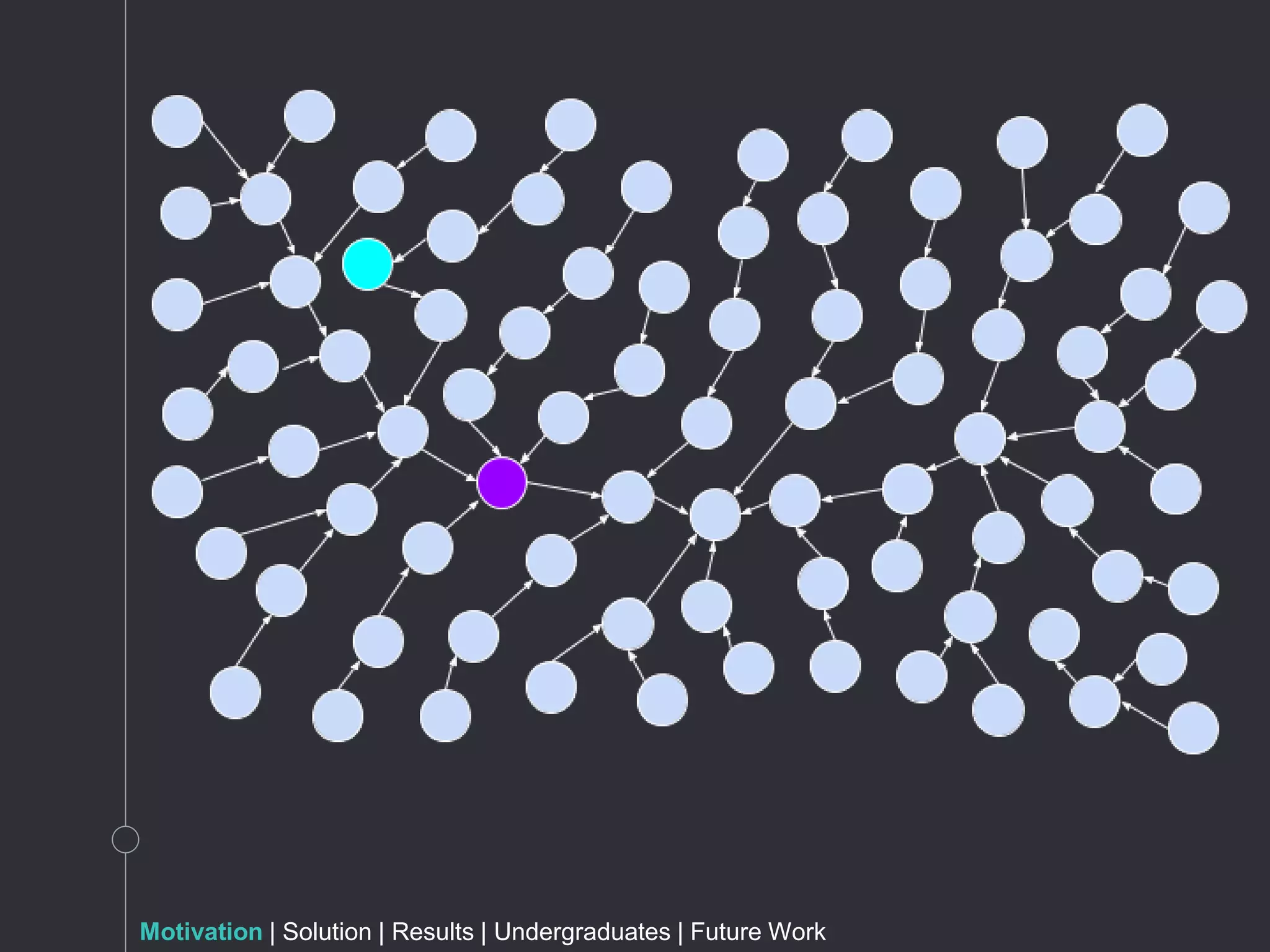
Where are the
vulnerabilities?
Motivation | Solution | Results | Undergraduates | Future Work
[2] https://arstechnica.com/information-technology/2017/02/microsoft-hosts-the-windows-source-in-a-monstrous-300gb-git-repository/
Windows: 300GB repository, millions of source code files
Motivation | Solution | Results | Undergraduates | Future Work
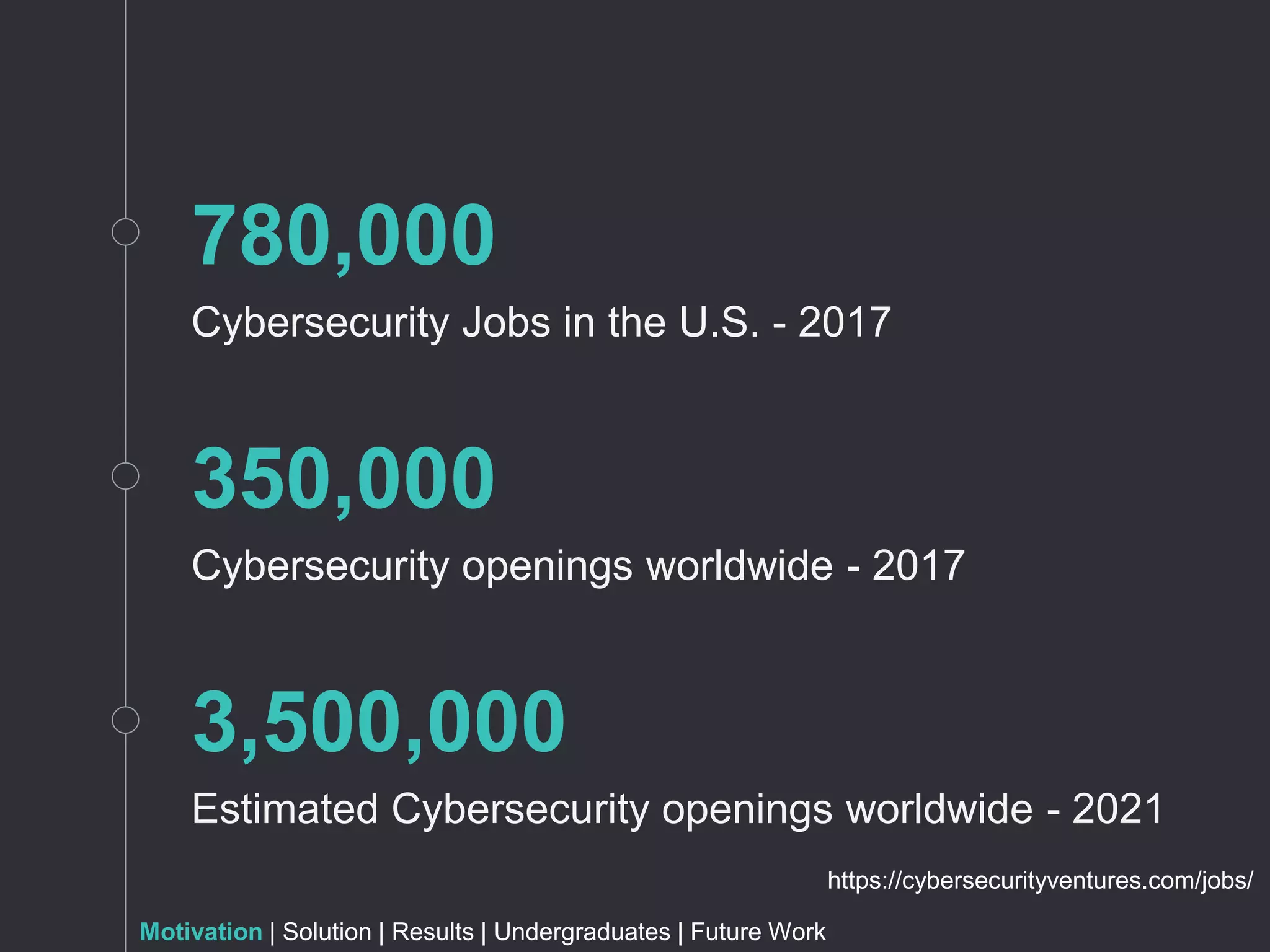
780,000
Cybersecurity Jobs in the U.S. - 2017
3,500,000
Estimated Cybersecurity openings worldwide - 2021
350,000
Cybersecurity openings worldwide - 2017
https://cybersecurityventures.com/jobs/
Motivation | Solution | Results | Undergraduates | Future Work
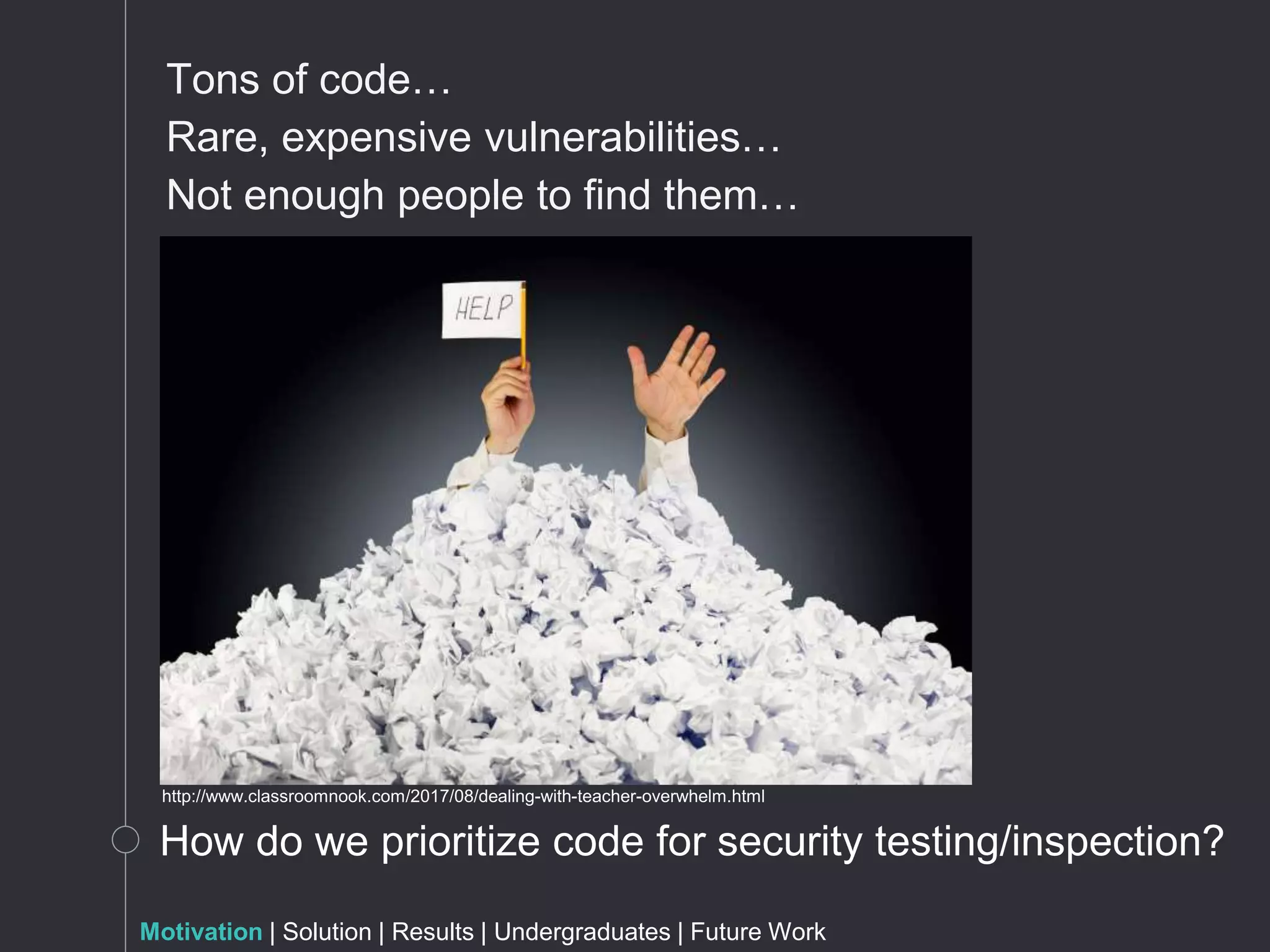
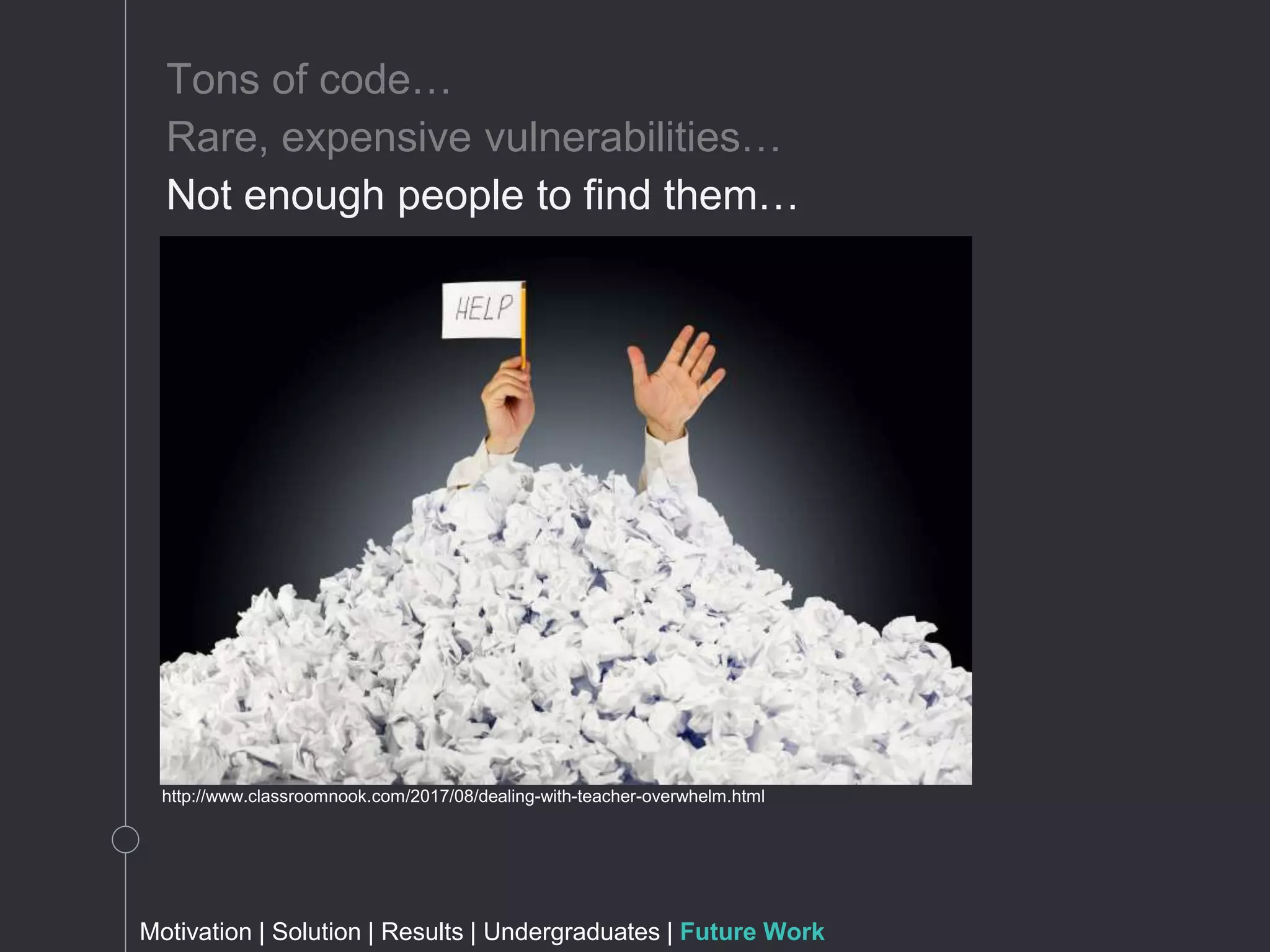
Tons of code…
Rare, expensive vulnerabilities…
Not enough people to find them…
How do we prioritize code for security testing/inspection?
http://www.classroomnook.com/2017/08/dealing-with-teacher-overwhelm.html
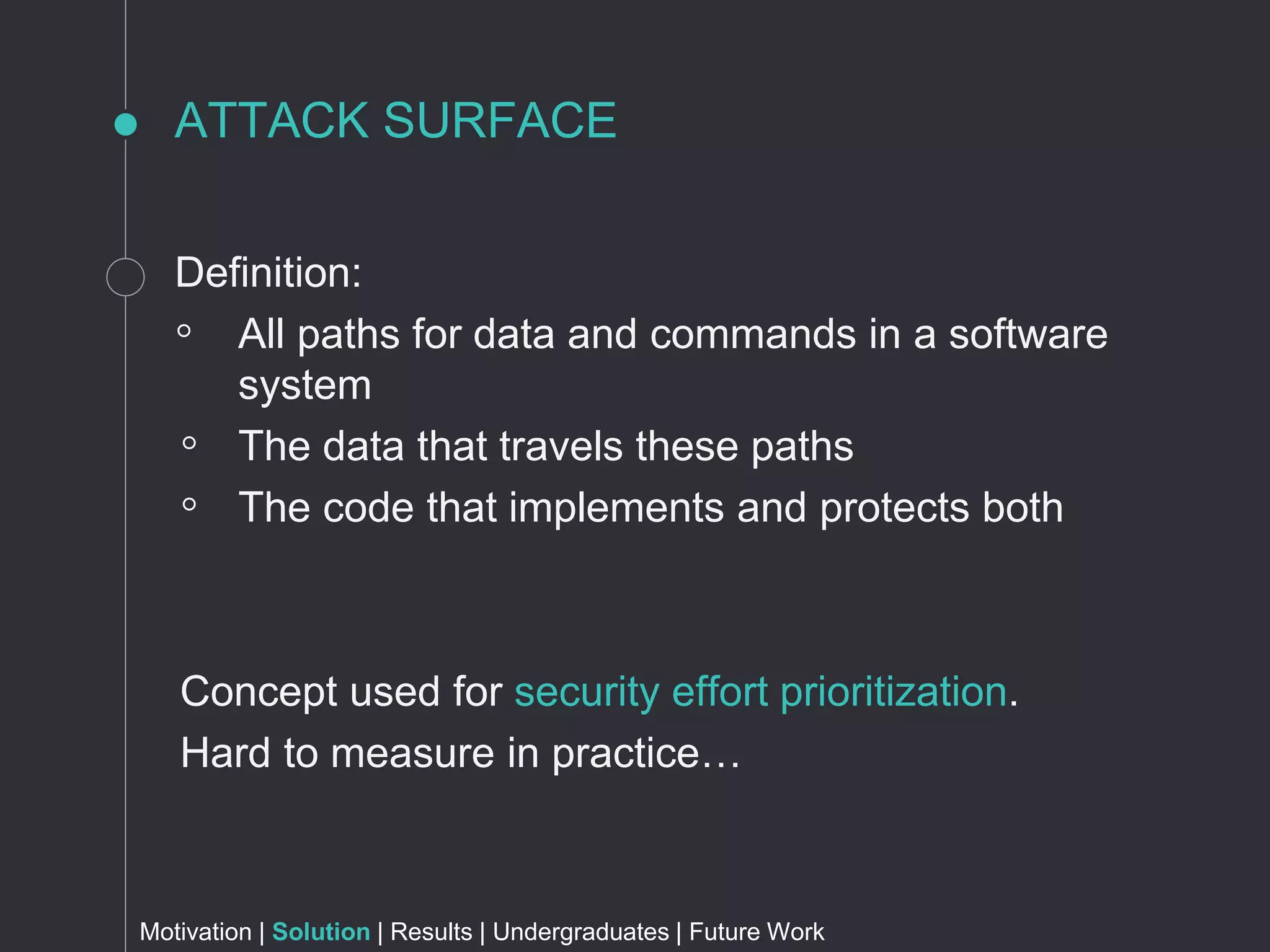
ATTACK SURFACE
Definition:
◦ All paths for data and commands in a software
system
◦ The data that travels these paths
◦ The code that implements and protects both
Concept used for security effort prioritization.
Hard to measure in practice…
Motivation | Solution | Results | Undergraduates | Future Work
RISK-BASED ATTACK SURFACE APPROXIMATION
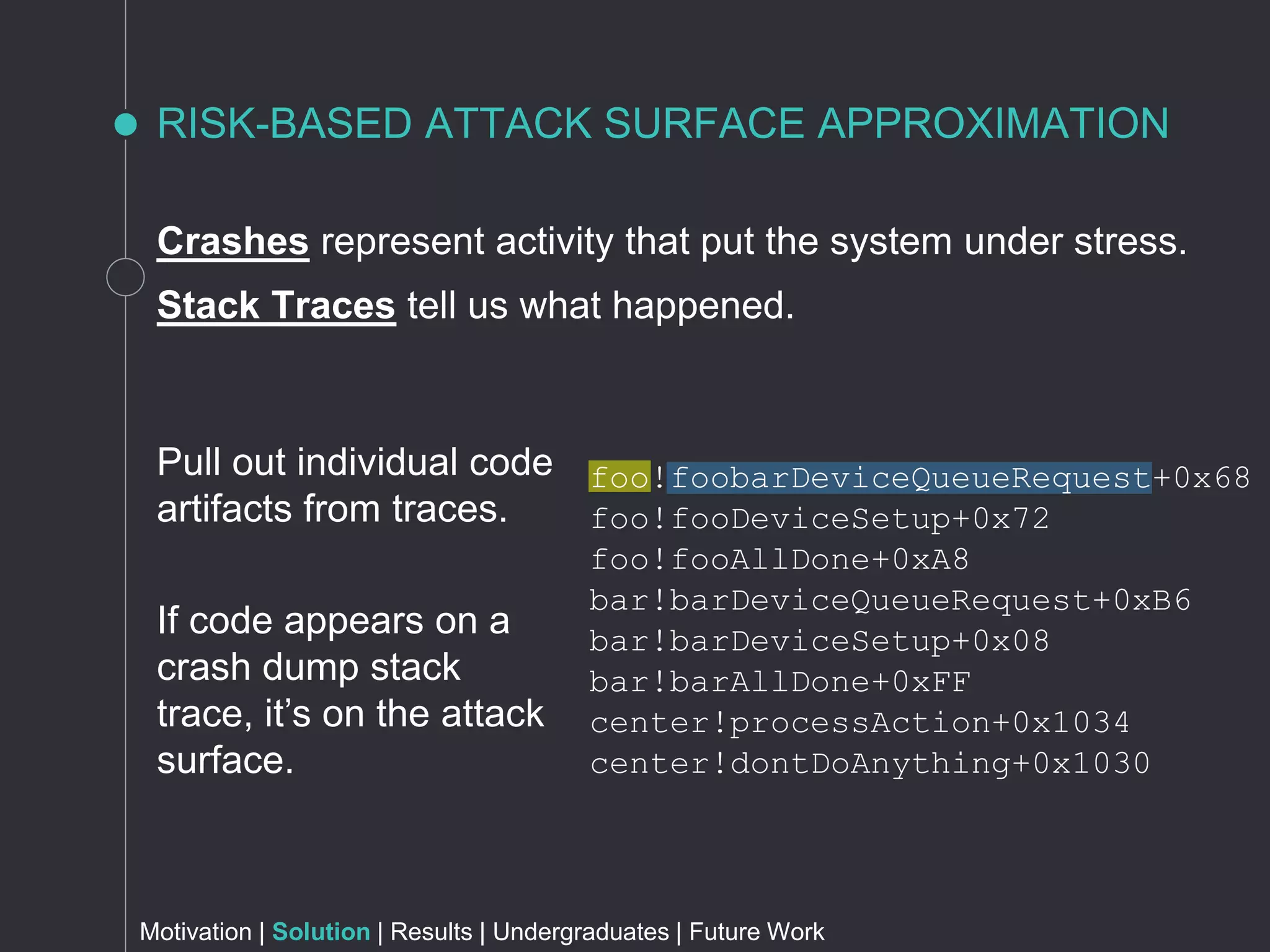
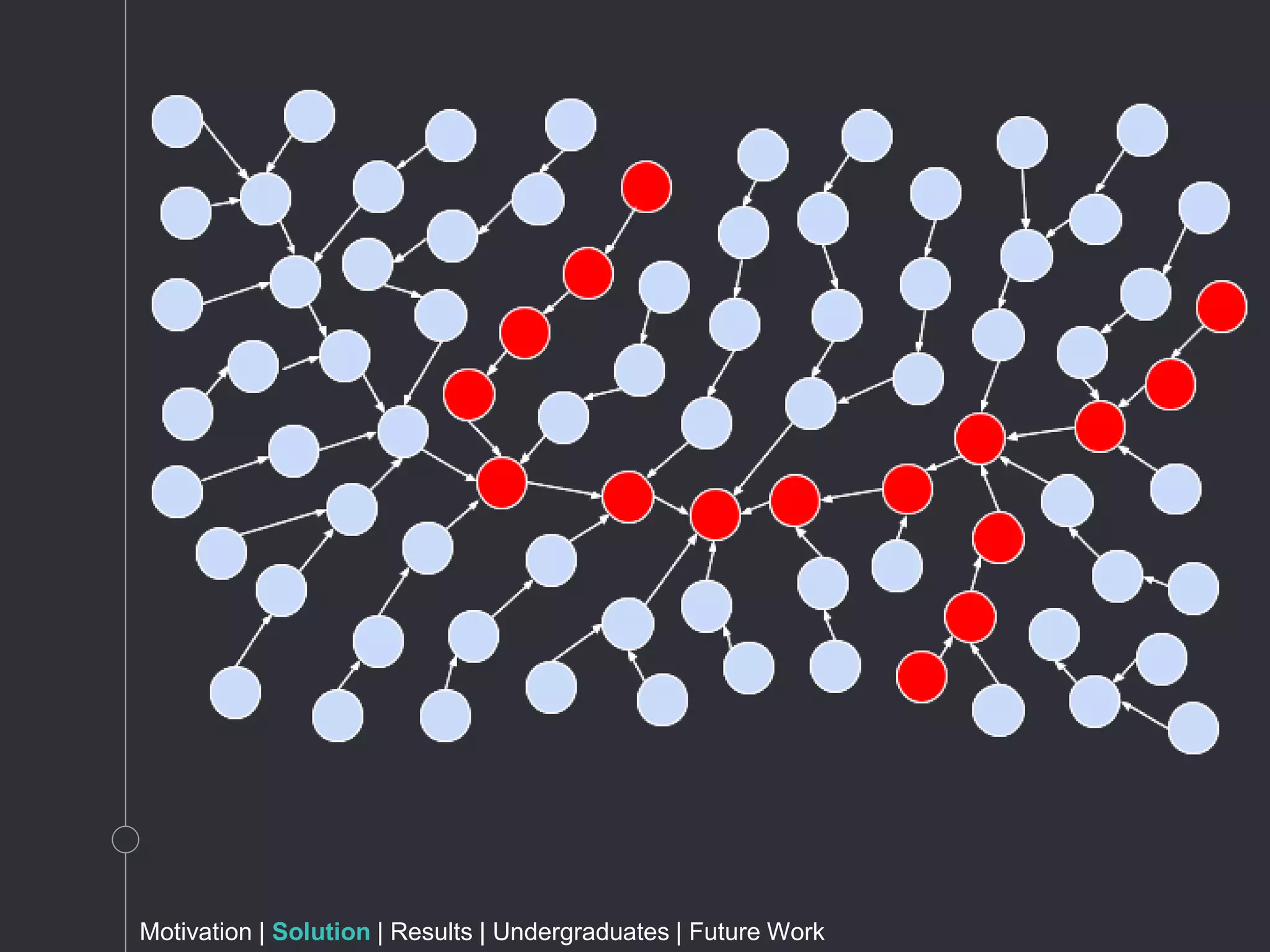
Crashes represent activity that put the system under stress.
Stack Traces tell us what happened.
foo!foobarDeviceQueueRequest+0x68
foo!fooDeviceSetup+0x72
foo!fooAllDone+0xA8
bar!barDeviceQueueRequest+0xB6
bar!barDeviceSetup+0x08
bar!barAllDone+0xFF
center!processAction+0x1034
center!dontDoAnything+0x1030
Pull out individual code
artifacts from traces.
If code appears on a
crash dump stack
trace, it’s on the attack
surface.
Motivation | Solution | Results | Undergraduates | Future Work
Crashes are used by attackers!
Great source of forensic data.
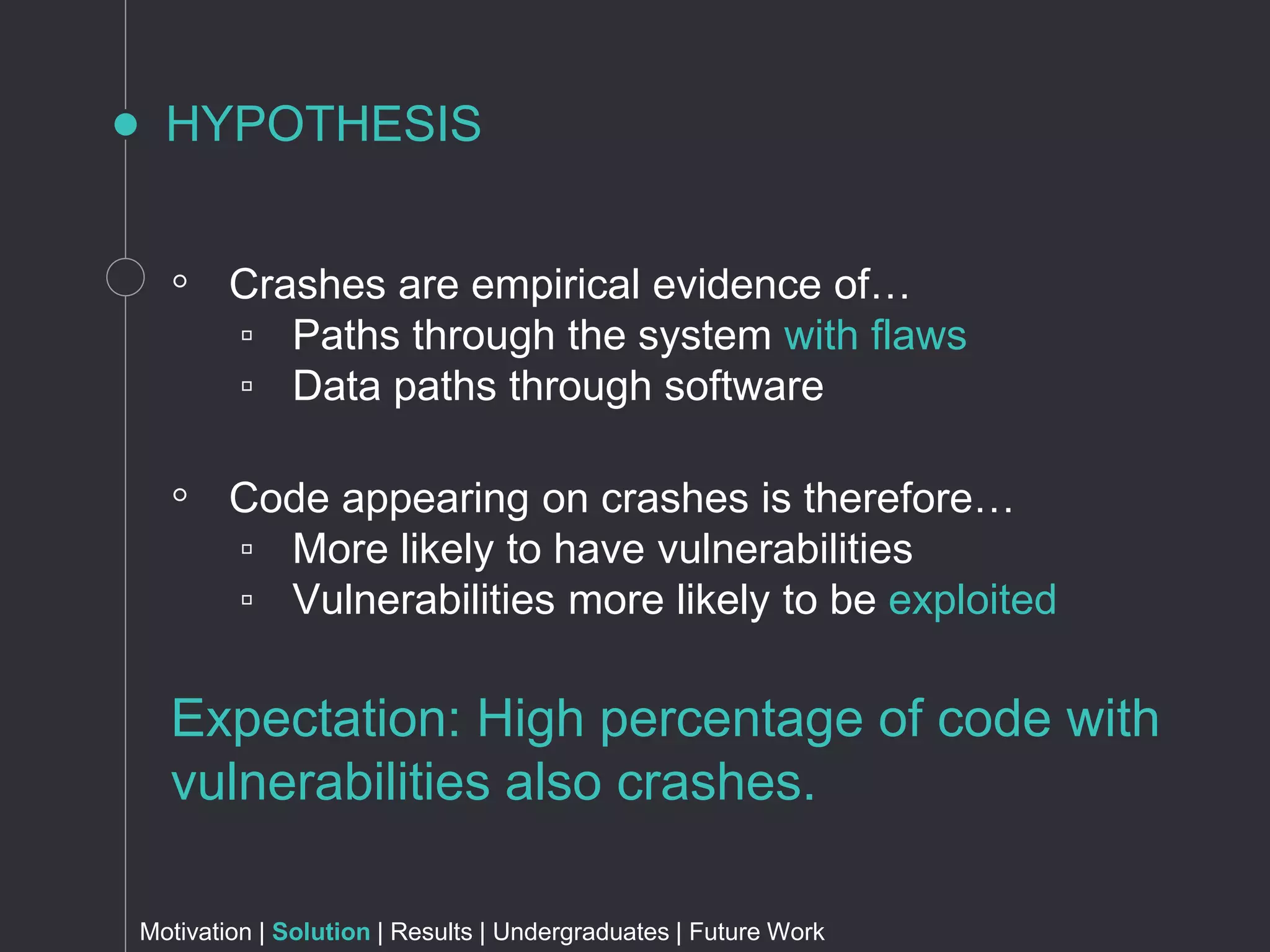
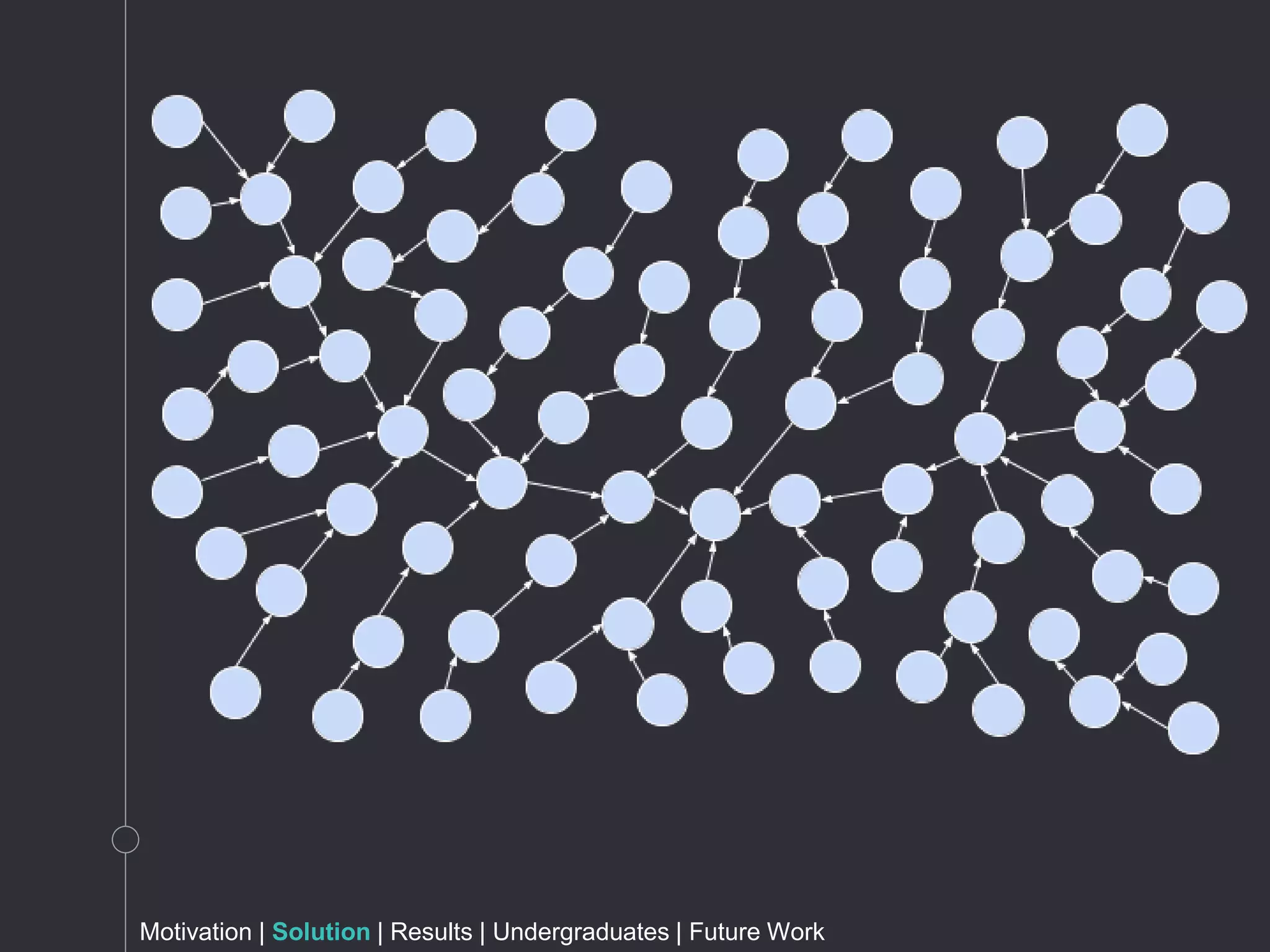
HYPOTHESIS
◦ Crashes are empirical evidence of…
▫ Paths through the system with flaws
▫ Data paths through software
◦ Code appearing on crashes is therefore…
▫ More likely to have vulnerabilities
▫ Vulnerabilities more likely to be exploited
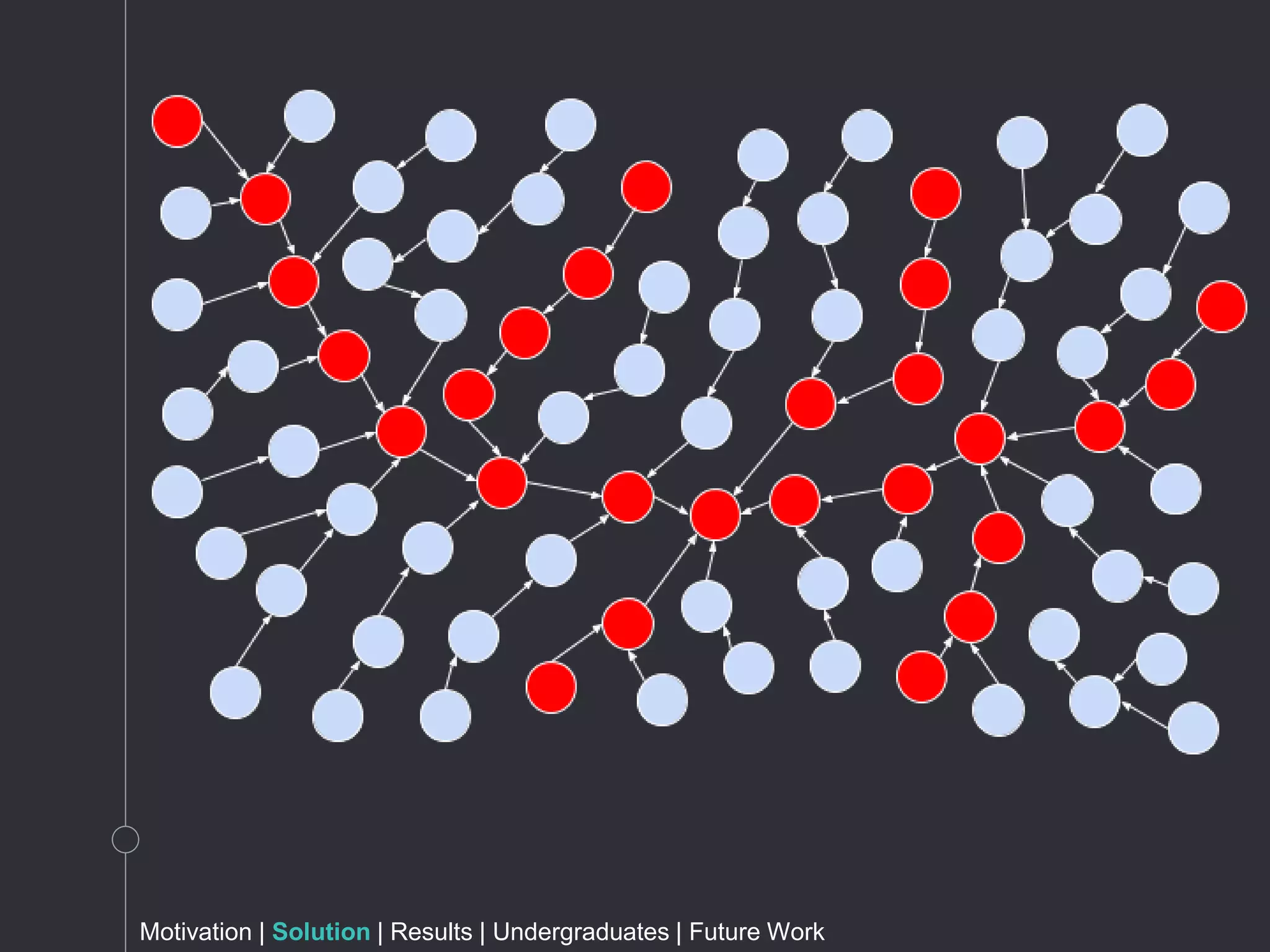
Expectation: High percentage of code with
vulnerabilities also crashes.
Motivation | Solution | Results | Undergraduates | Future Work
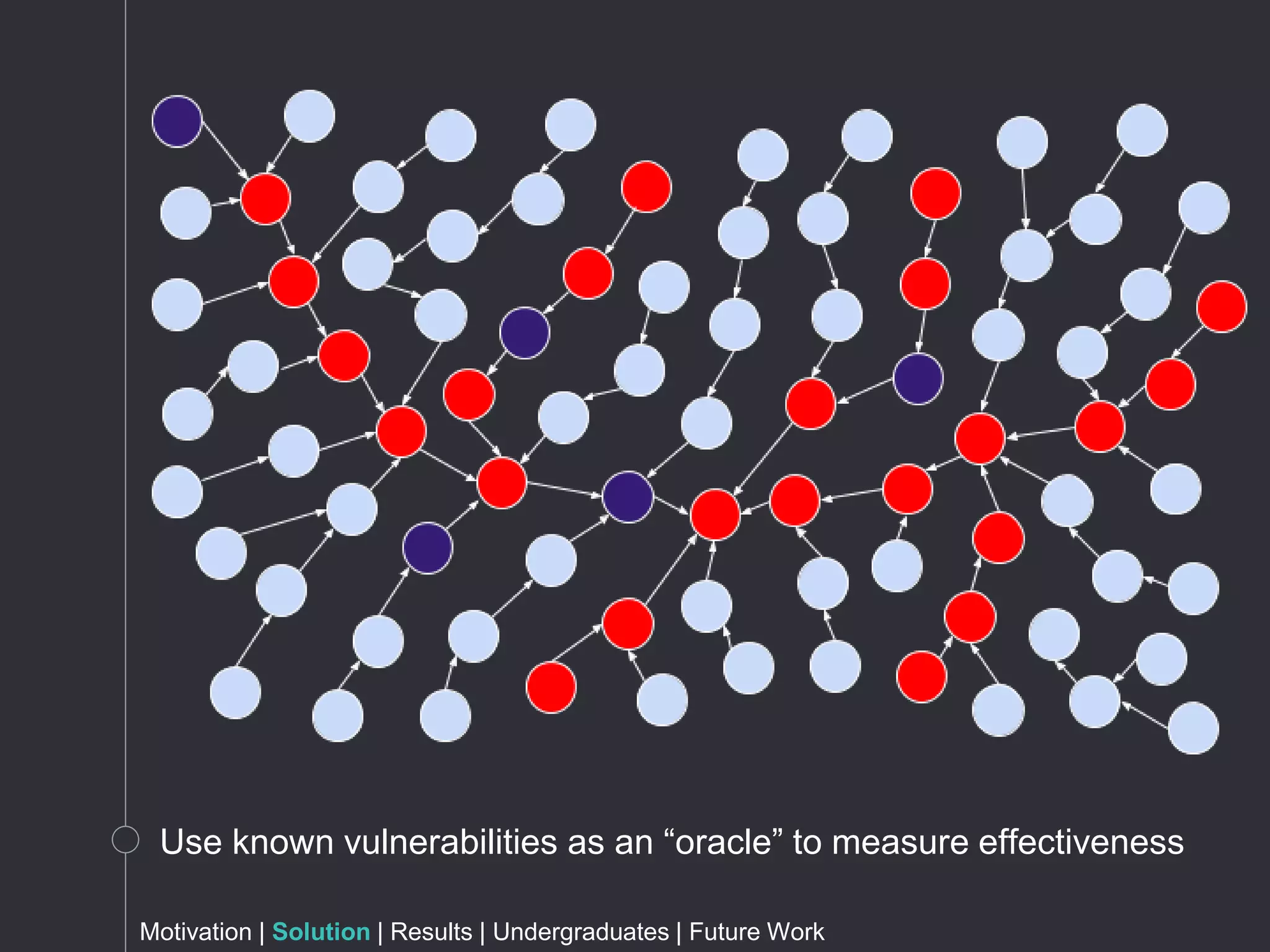
Use known vulnerabilities as an “oracle” to measure effectiveness
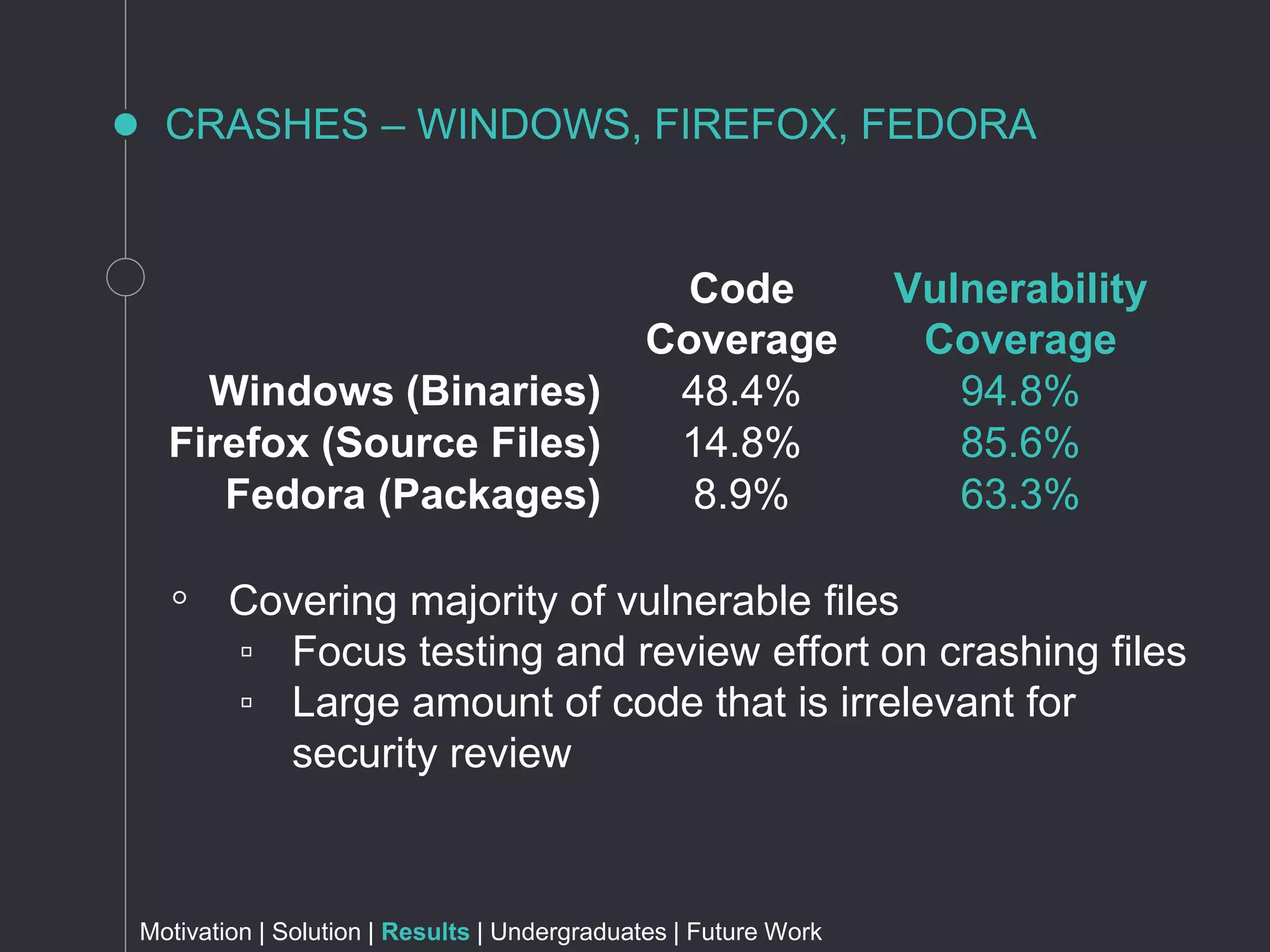
CRASHES – WINDOWS, FIREFOX, FEDORA
◦ Covering majority of vulnerable files
▫ Focus testing and review effort on crashing files
▫ Large amount of code that is irrelevant for
security review
Code
Coverage
Vulnerability
Coverage
Windows (Binaries) 48.4% 94.8%
Firefox (Source Files) 14.8% 85.6%
Fedora (Packages) 8.9% 63.3%
Motivation | Solution | Results | Undergraduates | Future Work
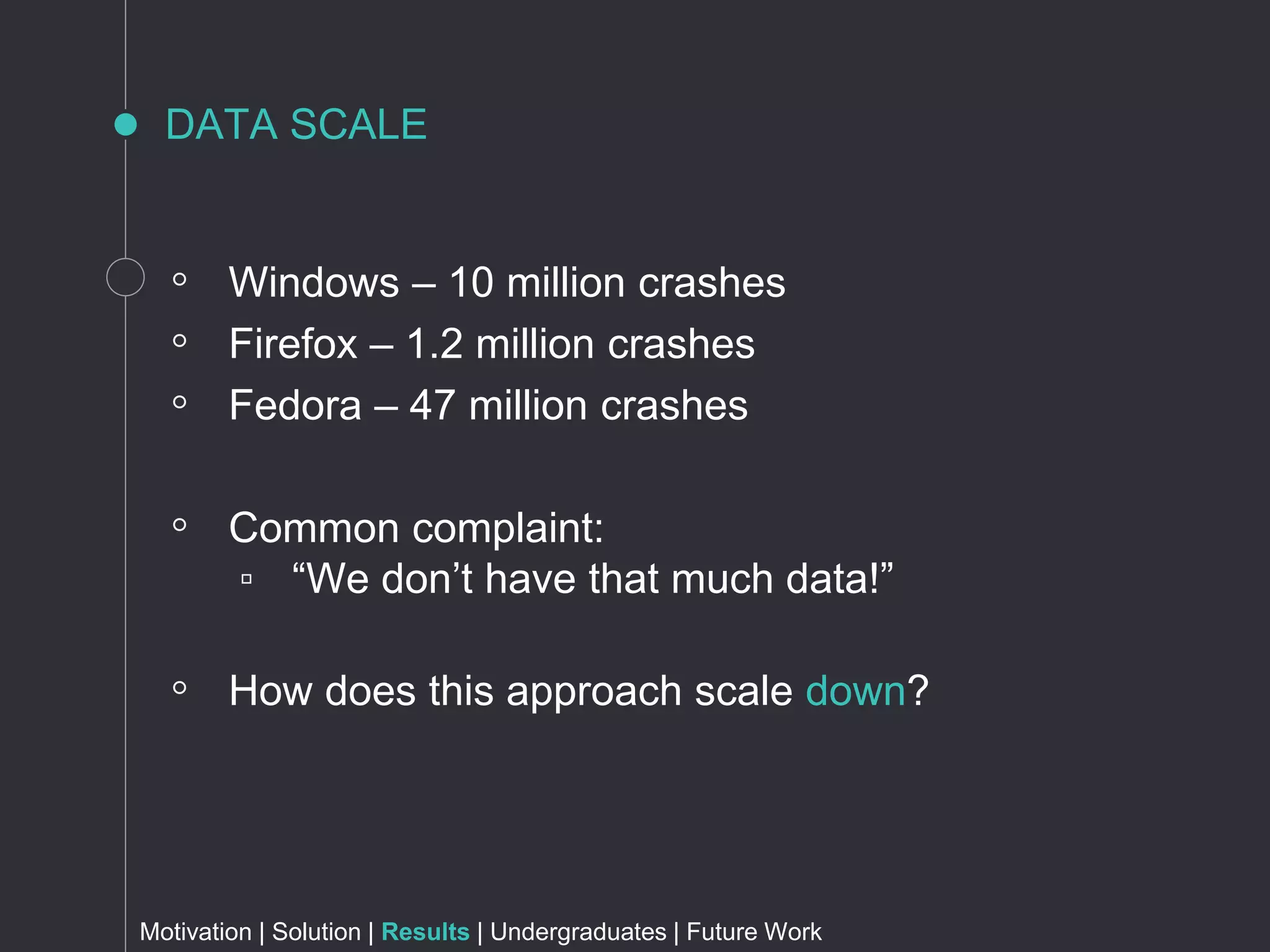
DATA SCALE
◦ Windows – 10 million crashes
◦ Firefox – 1.2 million crashes
◦ Fedora – 47 million crashes
◦ Common complaint:
▫ “We don’t have that much data!”
◦ How does this approach scale down?
Motivation | Solution | Results | Undergraduates | Future Work
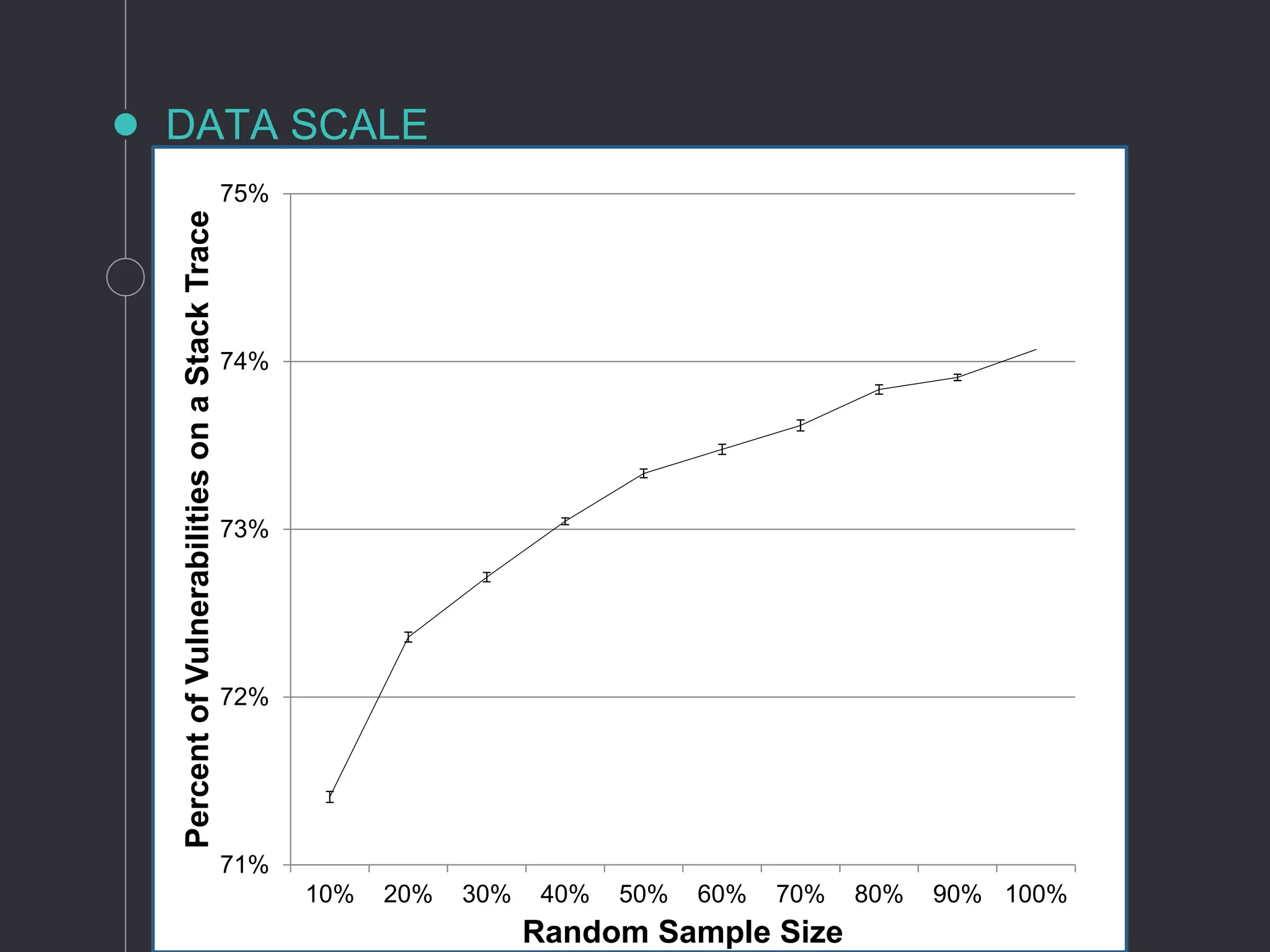
DATA SCALE
71%
72%
73%
74%
75%
10% 20% 30% 40% 50% 60% 70% 80% 90% 100%
PercentofVulnerabilitiesonaStackTrace
Random Sample Size
COMPARING VULNERABILITY PREDICTION MODELS
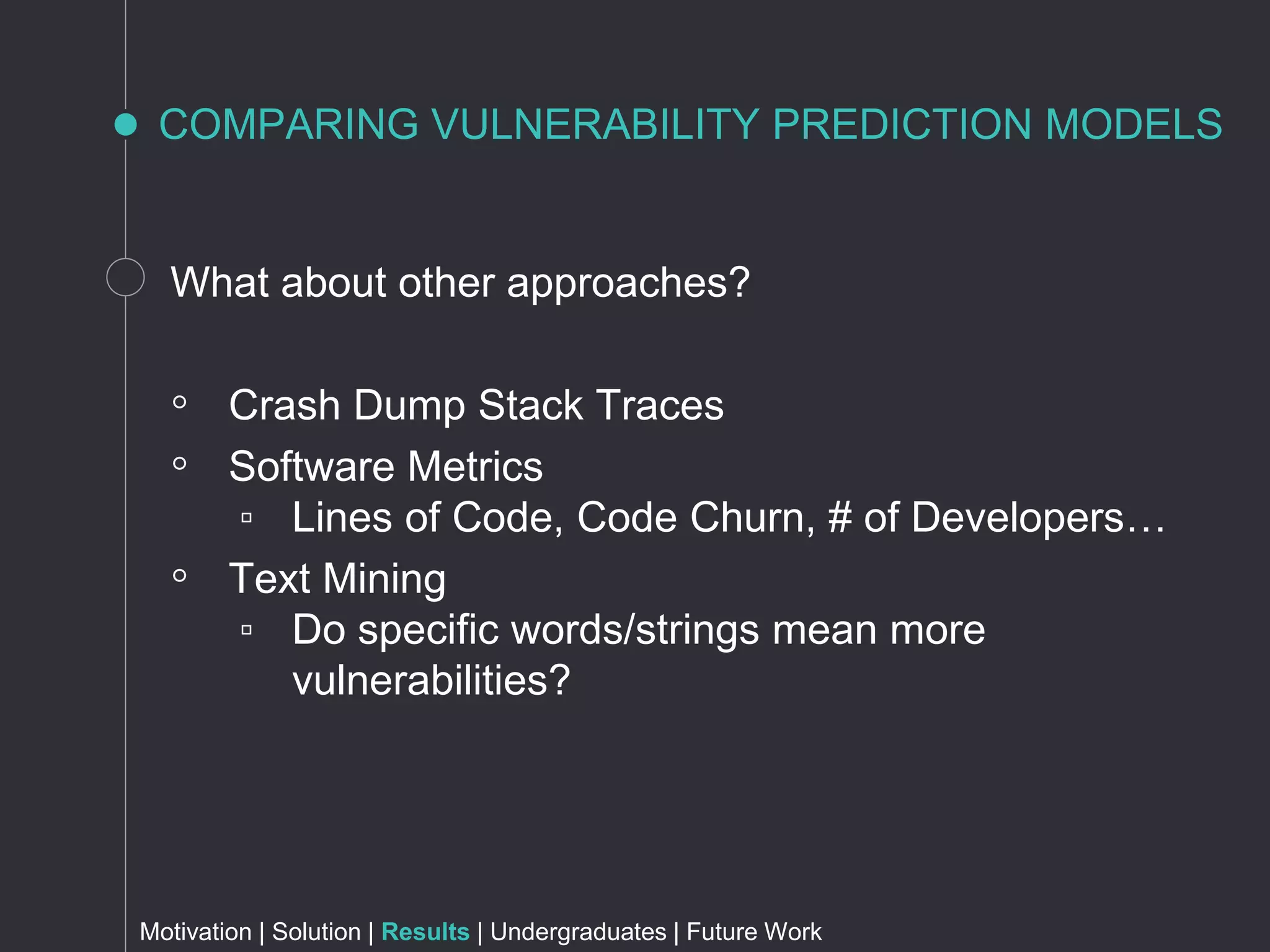
What about other approaches?
◦ Crash Dump Stack Traces
◦ Software Metrics
▫ Lines of Code, Code Churn, # of Developers…
◦ Text Mining
▫ Do specific words/strings mean more
vulnerabilities?
Motivation | Solution | Results | Undergraduates | Future Work
COMPARING VULNERABILITY PREDICTION MODELS
True
Positives
Vulnerability
Coverage
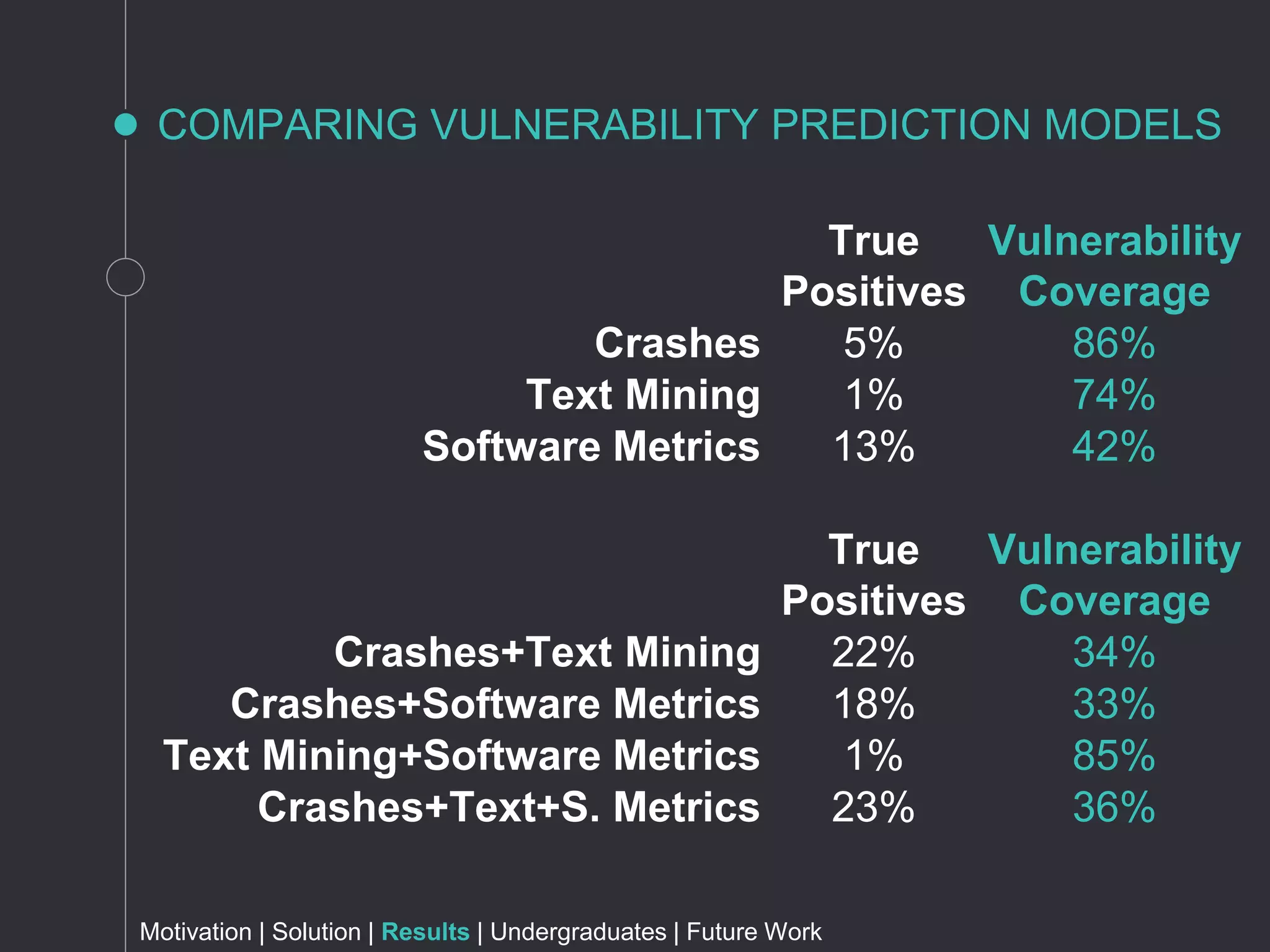
Crashes 5% 86%
Text Mining 1% 74%
Software Metrics 13% 42%
True
Positives
Vulnerability
Coverage
Crashes+Text Mining 22% 34%
Crashes+Software Metrics 18% 33%
Text Mining+Software Metrics 1% 85%
Crashes+Text+S. Metrics 23% 36%
Motivation | Solution | Results | Undergraduates | Future Work
CONCLUSIONS
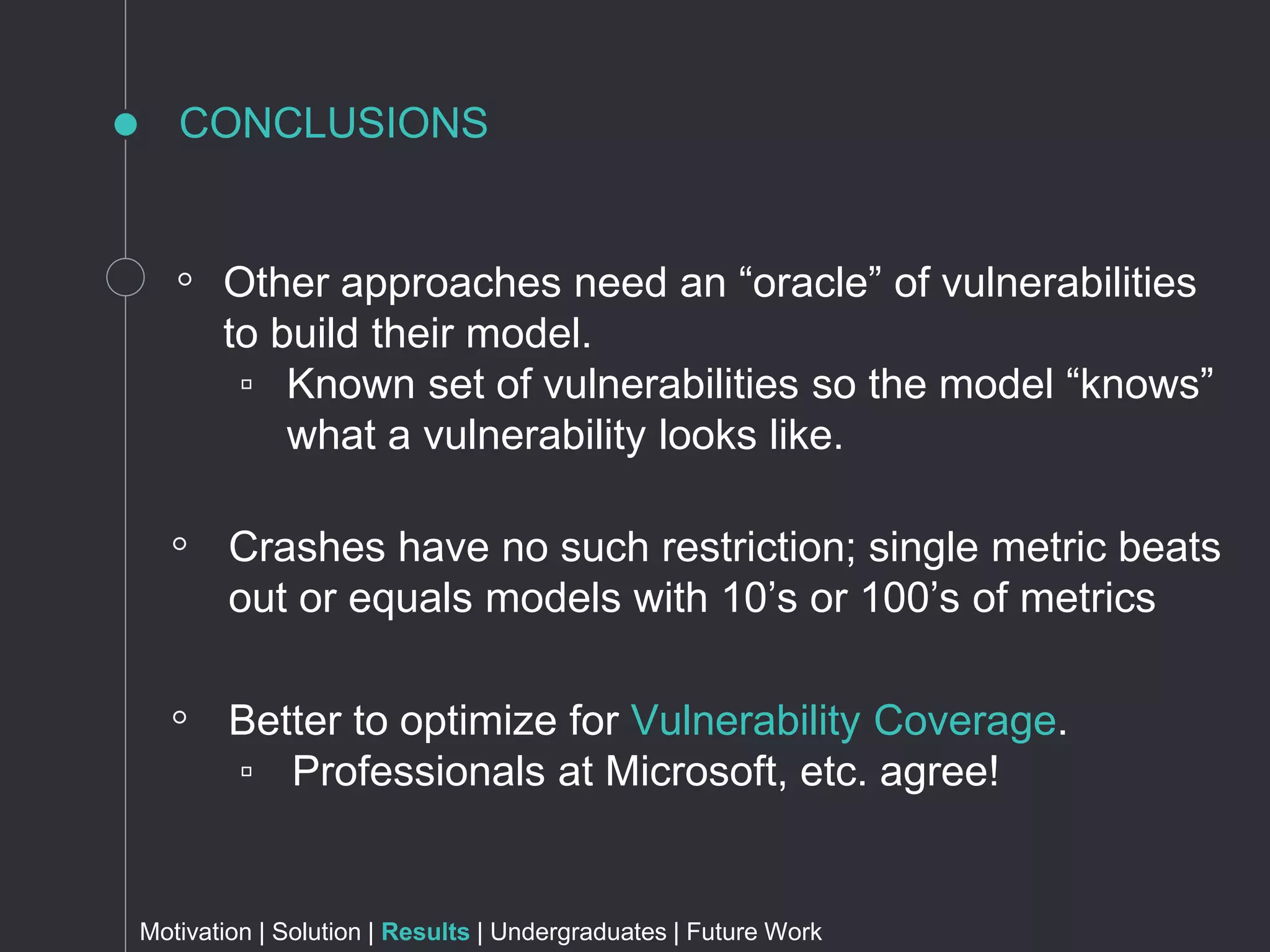
◦ Other approaches need an “oracle” of vulnerabilities
to build their model.
▫ Known set of vulnerabilities so the model “knows”
what a vulnerability looks like.
◦ Crashes have no such restriction; single metric beats
out or equals models with 10’s or 100’s of metrics
◦ Better to optimize for Vulnerability Coverage.
▫ Professionals at Microsoft, etc. agree!
Motivation | Solution | Results | Undergraduates | Future Work
UNDERGRADUATE RESEARCH
Motivation | Solution | Results | Undergraduates | Future Work
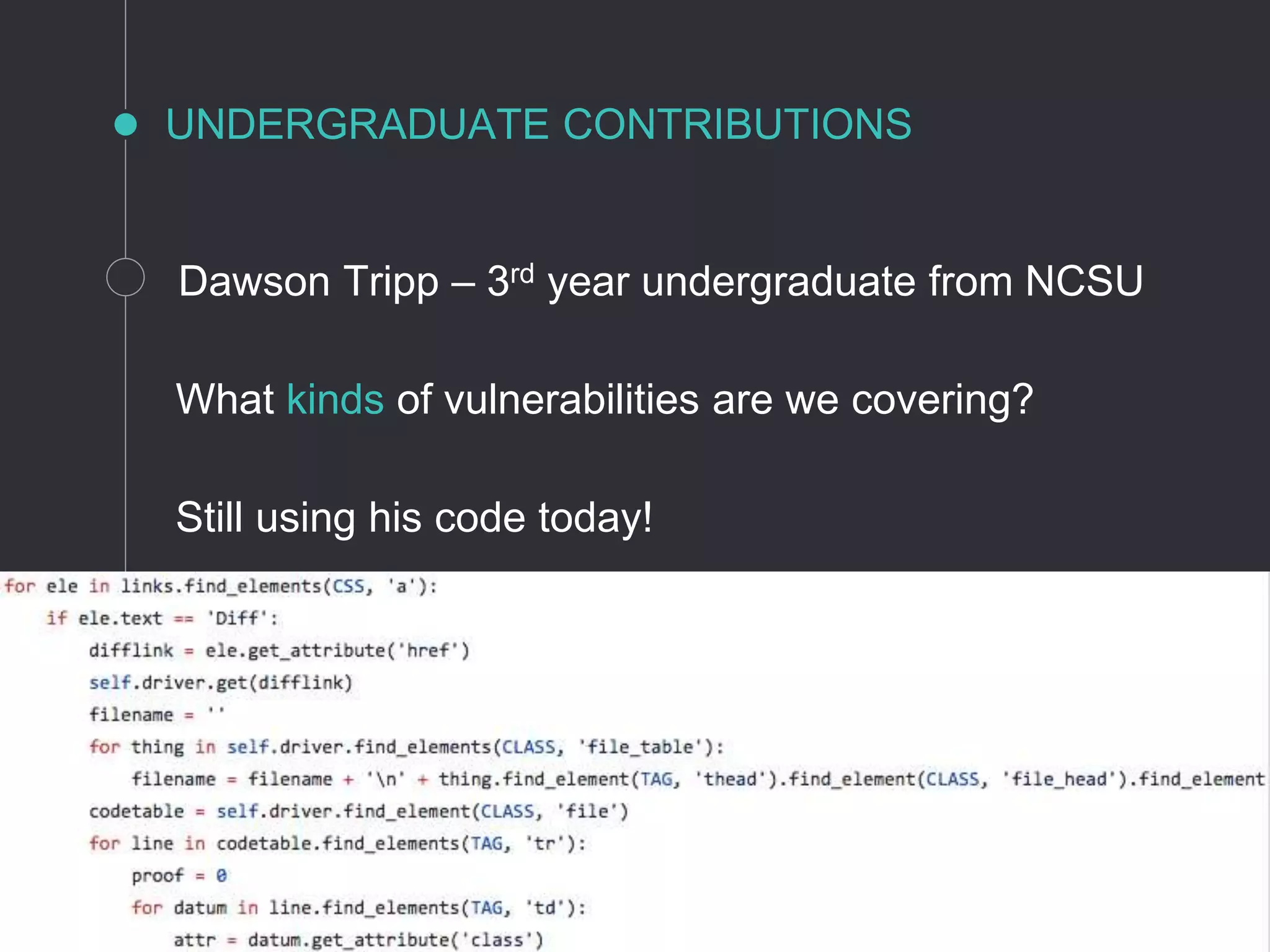
What kinds of vulnerabilities are we covering?
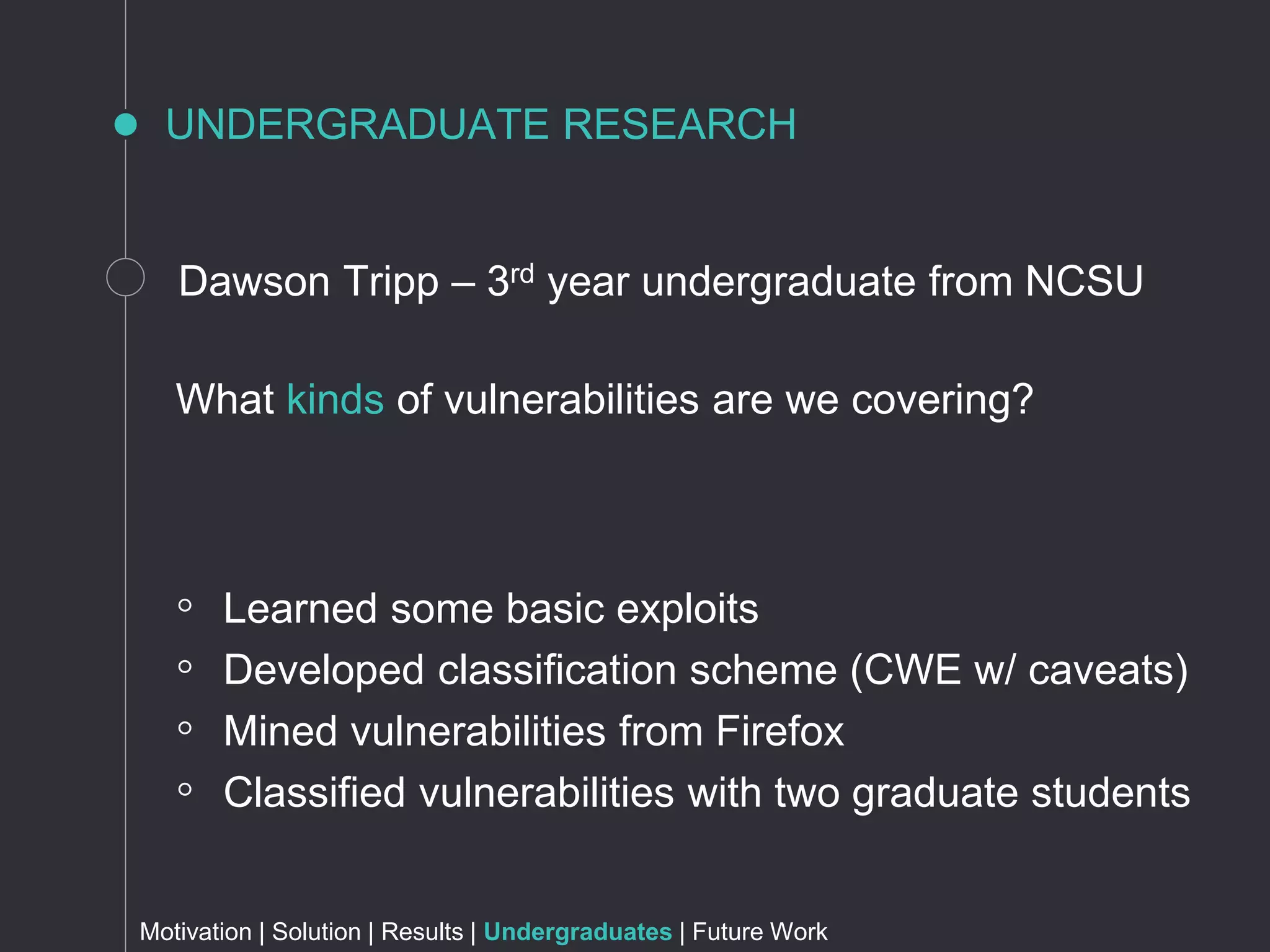
Dawson Tripp – 3rd year undergraduate from NCSU
◦ Learned some basic exploits
◦ Developed classification scheme (CWE w/ caveats)
◦ Mined vulnerabilities from Firefox
◦ Classified vulnerabilities with two graduate students
UNDERGRADUATE CONTRIBUTIONS
Motivation | Solution | Results | Undergraduates | Future Work
What kinds of vulnerabilities are we covering?
Dawson Tripp – 3rd year undergraduate from NCSU
Still using his code today!
UNDERGRADUATE CONTRIBUTIONS
Motivation | Solution | Results | Undergraduates | Future Work
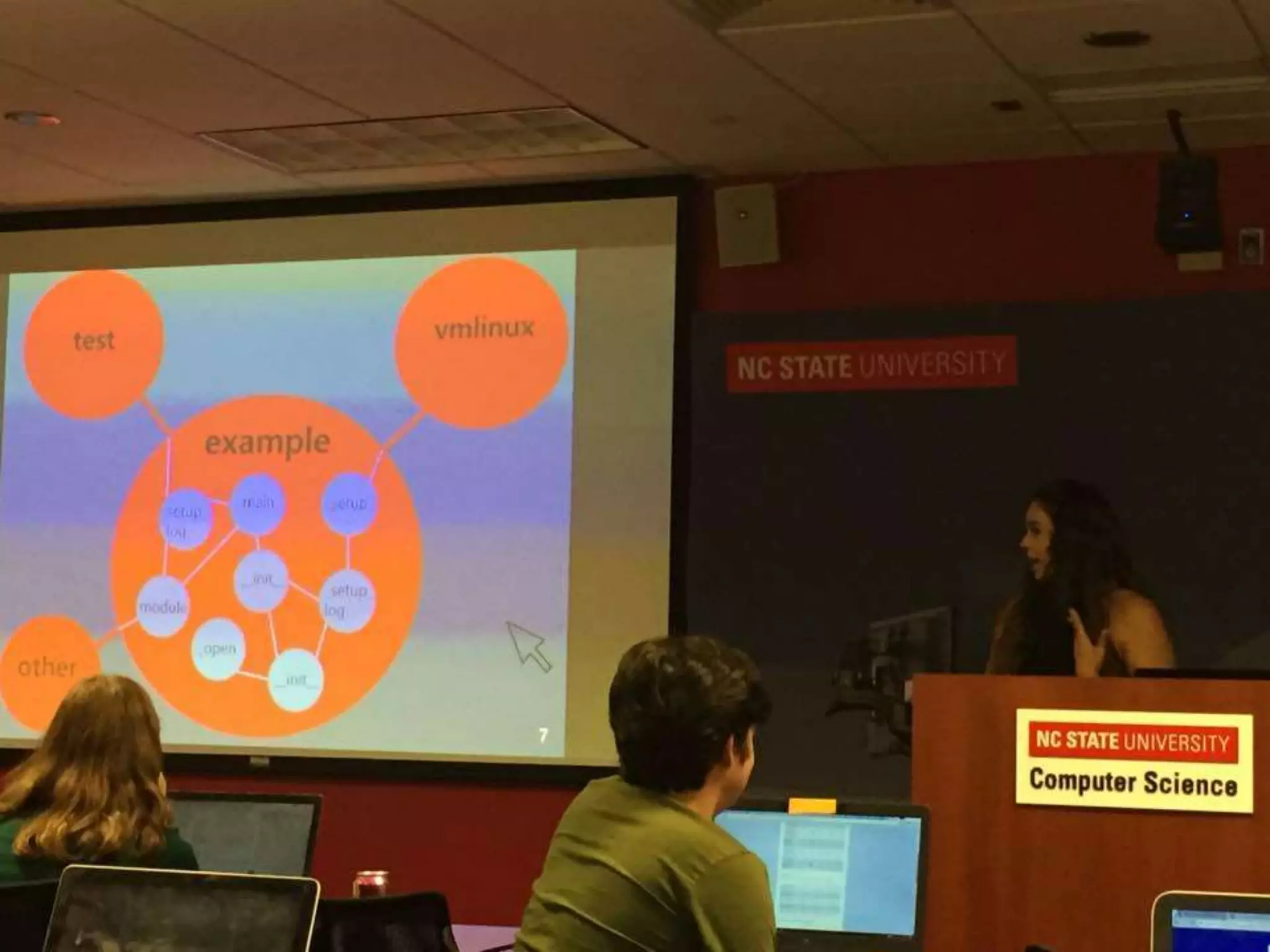
Practical application: visualize the data
Dalisha Rodriguez – 2nd year undergraduate from
Hanover (now Fayetteville State)
Motivation | Solution | Results | Undergraduates | Future Work
NEXT STEPS
Motivation | Solution | Results | Undergraduates | Future Work
◦ More public vulnerability datasets
◦ We need metrics that model attacker behavior
◦ Dynamic (runtime) metrics!
▫ Think of crashes as dynamic: generated at
runtime
▫ Count “messages” to/from/between objects
(AspectJ)
▫ Combine with techniques like fuzzing
◦ Chamoli et al. – dynamic metrics for defect prediction
▫ Better on vulnerabilities…?
Motivation | Solution | Results | Undergraduates | Future Work
Tons of code…
Rare, expensive vulnerabilities…
Not enough people to find them…
http://www.classroomnook.com/2017/08/dealing-with-teacher-overwhelm.html
MASSIVELY OPEN ONLINE COURSES
◦ “Flipped” NCSU’s Software Security course
▫ Iteration 1: ~400 students
▫ Iteration 2: ~1100 students
◦ Lessons Learned:
▫ Amplifies gulf between veterans and newbies
▫ Assume no more than 2-3 hours of work/week
▫ Important to “seed” discussions
Motivation | Solution | Results | Undergraduates | Future Work
MASSIVELY OPEN ONLINE COURSES
◦ “Flipped” NCSU’s Software Security course
▫ Iteration 1: ~400 students
▫ Iteration 2: ~1100 students
◦ Lessons Learned:
▫ Amplifies gulf between veterans and newbies
▫ Assume no more than 2-3 hours of work/week
▫ Important to “seed” discussions
Motivation | Solution | Results | Undergraduates | Future Work
SoftSec Materials publicly available!
https://tinyurl.com/ncsu-softsec
SoftSec Materials publicly available!
https://tinyurl.com/ncsu-softsec
theisen.cr@gmail.com
theisencr.github.io
RELATED WORK
Data in this talk:
In Submission: [SECDEV ‘18] Chris Theisen, Hyunwoo Song, Dawson Tripp, Laurie Williams,
“What Are We Missing? Vulnerability Coverage by Type”
In Submission: [FSE ‘18] Chris Theisen, Hyunwoo Song, Dalisha Rodriguez, Laurie Williams,
“Better Together: Comparing Vulnerability Prediction Models”
[ICSE – SEIP ‘17] Chris Theisen, Kim Herzig, Laurie Williams, “Risk-Based Attack Surface
Approximation: How Much Data is Enough?”
[ICSE - SEIP ‘15] Chris Theisen, Kim Herzig, Pat Morrison, Brendan Murphy, and Laurie
Williams, “Approximating Attack Surfaces with Stack Traces”, in Companion Proceedings of the
37th International Conference on Software Engineering
Other works:
Revising: [IST] Chris Theisen, Nuthan Munaiah, Mahran Al-Zyoud, Jeffery C. Carver, Laurie
Williams, “Attack Surface Definitions”
[HotSoS ’17] Chris Theisen and Laurie Williams, “Advanced Metrics for Risk-Based Attack
Surface Approximation”, Proceedings of the Symposium and Bootcamp on the Science of Security.
[FSE – SRC ’15 – 1st Place] Chris Theisen, “Automated Attack Surface Approximation”, in the
23rd ACM SIGSOFT International Symposium on the Foundations of Software Engineering -
Student Research Competition, 2015
[SRC Grand Finals ’15 – 3rd Place] Chris Theisen, “Automated Attack Surface Approximation”, in
the 23rd ACM SIGSOFT International Symposium on the Foundations of Software Engineering -
Student Research Competition, 2015
IDENTIFYING VULNERABLE CODE
#include <stdio.h>
int main(int argc, char **argv)
{
char buf[8]; // buffer for eight characters
gets(buf); // read from stdio (sensitive!)
printf("%sn", buf); // print out data in buf
return 0; // 0 as return value
}
https://www.owasp.org/index.php/Buffer_overflow_attack
Motivation | Solution | Results | Undergraduates | Future Work

Metrics for Security Effort Prioritization

  • 1.
  • 2.
    AGENDA ◦ Motivate SecurityMetrics ◦ Solution: Attack Surfaces ◦ Results ◦ Undergraduate Contributions ◦ Future Work
  • 4.
    Motivation | Solution| Results | Undergraduates | Future Work
  • 5.
    Where are the vulnerabilities? Motivation| Solution | Results | Undergraduates | Future Work
  • 6.
    Motivation | Solution| Results | Undergraduates | Future Work
  • 7.
    Motivation | Solution| Results | Undergraduates | Future Work
  • 8.
    Motivation | Solution| Results | Undergraduates | Future Work
  • 9.
    [2] https://arstechnica.com/information-technology/2017/02/microsoft-hosts-the-windows-source-in-a-monstrous-300gb-git-repository/ Windows: 300GBrepository, millions of source code files Motivation | Solution | Results | Undergraduates | Future Work
  • 10.
    780,000 Cybersecurity Jobs inthe U.S. - 2017 3,500,000 Estimated Cybersecurity openings worldwide - 2021 350,000 Cybersecurity openings worldwide - 2017 https://cybersecurityventures.com/jobs/ Motivation | Solution | Results | Undergraduates | Future Work
  • 11.
    Motivation | Solution| Results | Undergraduates | Future Work Tons of code… Rare, expensive vulnerabilities… Not enough people to find them… How do we prioritize code for security testing/inspection? http://www.classroomnook.com/2017/08/dealing-with-teacher-overwhelm.html
  • 12.
    ATTACK SURFACE Definition: ◦ Allpaths for data and commands in a software system ◦ The data that travels these paths ◦ The code that implements and protects both Concept used for security effort prioritization. Hard to measure in practice… Motivation | Solution | Results | Undergraduates | Future Work
  • 13.
    RISK-BASED ATTACK SURFACEAPPROXIMATION Crashes represent activity that put the system under stress. Stack Traces tell us what happened. foo!foobarDeviceQueueRequest+0x68 foo!fooDeviceSetup+0x72 foo!fooAllDone+0xA8 bar!barDeviceQueueRequest+0xB6 bar!barDeviceSetup+0x08 bar!barAllDone+0xFF center!processAction+0x1034 center!dontDoAnything+0x1030 Pull out individual code artifacts from traces. If code appears on a crash dump stack trace, it’s on the attack surface. Motivation | Solution | Results | Undergraduates | Future Work
  • 14.
    Motivation | Solution| Results | Undergraduates | Future Work Crashes are used by attackers! Great source of forensic data.
  • 15.
    HYPOTHESIS ◦ Crashes areempirical evidence of… ▫ Paths through the system with flaws ▫ Data paths through software ◦ Code appearing on crashes is therefore… ▫ More likely to have vulnerabilities ▫ Vulnerabilities more likely to be exploited Expectation: High percentage of code with vulnerabilities also crashes. Motivation | Solution | Results | Undergraduates | Future Work
  • 16.
    Motivation | Solution| Results | Undergraduates | Future Work
  • 17.
    Motivation | Solution| Results | Undergraduates | Future Work
  • 18.
    Motivation | Solution| Results | Undergraduates | Future Work
  • 19.
    Motivation | Solution| Results | Undergraduates | Future Work Use known vulnerabilities as an “oracle” to measure effectiveness
  • 20.
    CRASHES – WINDOWS,FIREFOX, FEDORA ◦ Covering majority of vulnerable files ▫ Focus testing and review effort on crashing files ▫ Large amount of code that is irrelevant for security review Code Coverage Vulnerability Coverage Windows (Binaries) 48.4% 94.8% Firefox (Source Files) 14.8% 85.6% Fedora (Packages) 8.9% 63.3% Motivation | Solution | Results | Undergraduates | Future Work
  • 21.
    DATA SCALE ◦ Windows– 10 million crashes ◦ Firefox – 1.2 million crashes ◦ Fedora – 47 million crashes ◦ Common complaint: ▫ “We don’t have that much data!” ◦ How does this approach scale down? Motivation | Solution | Results | Undergraduates | Future Work
  • 22.
    DATA SCALE 71% 72% 73% 74% 75% 10% 20%30% 40% 50% 60% 70% 80% 90% 100% PercentofVulnerabilitiesonaStackTrace Random Sample Size
  • 23.
    COMPARING VULNERABILITY PREDICTIONMODELS What about other approaches? ◦ Crash Dump Stack Traces ◦ Software Metrics ▫ Lines of Code, Code Churn, # of Developers… ◦ Text Mining ▫ Do specific words/strings mean more vulnerabilities? Motivation | Solution | Results | Undergraduates | Future Work
  • 24.
    COMPARING VULNERABILITY PREDICTIONMODELS True Positives Vulnerability Coverage Crashes 5% 86% Text Mining 1% 74% Software Metrics 13% 42% True Positives Vulnerability Coverage Crashes+Text Mining 22% 34% Crashes+Software Metrics 18% 33% Text Mining+Software Metrics 1% 85% Crashes+Text+S. Metrics 23% 36% Motivation | Solution | Results | Undergraduates | Future Work
  • 25.
    CONCLUSIONS ◦ Other approachesneed an “oracle” of vulnerabilities to build their model. ▫ Known set of vulnerabilities so the model “knows” what a vulnerability looks like. ◦ Crashes have no such restriction; single metric beats out or equals models with 10’s or 100’s of metrics ◦ Better to optimize for Vulnerability Coverage. ▫ Professionals at Microsoft, etc. agree! Motivation | Solution | Results | Undergraduates | Future Work
  • 26.
  • 27.
    UNDERGRADUATE RESEARCH Motivation |Solution | Results | Undergraduates | Future Work What kinds of vulnerabilities are we covering? Dawson Tripp – 3rd year undergraduate from NCSU ◦ Learned some basic exploits ◦ Developed classification scheme (CWE w/ caveats) ◦ Mined vulnerabilities from Firefox ◦ Classified vulnerabilities with two graduate students
  • 28.
    UNDERGRADUATE CONTRIBUTIONS Motivation |Solution | Results | Undergraduates | Future Work What kinds of vulnerabilities are we covering? Dawson Tripp – 3rd year undergraduate from NCSU Still using his code today!
  • 29.
    UNDERGRADUATE CONTRIBUTIONS Motivation |Solution | Results | Undergraduates | Future Work Practical application: visualize the data Dalisha Rodriguez – 2nd year undergraduate from Hanover (now Fayetteville State)
  • 30.
    Motivation | Solution| Results | Undergraduates | Future Work
  • 31.
    NEXT STEPS Motivation |Solution | Results | Undergraduates | Future Work ◦ More public vulnerability datasets ◦ We need metrics that model attacker behavior ◦ Dynamic (runtime) metrics! ▫ Think of crashes as dynamic: generated at runtime ▫ Count “messages” to/from/between objects (AspectJ) ▫ Combine with techniques like fuzzing ◦ Chamoli et al. – dynamic metrics for defect prediction ▫ Better on vulnerabilities…?
  • 32.
    Motivation | Solution| Results | Undergraduates | Future Work Tons of code… Rare, expensive vulnerabilities… Not enough people to find them… http://www.classroomnook.com/2017/08/dealing-with-teacher-overwhelm.html
  • 33.
    MASSIVELY OPEN ONLINECOURSES ◦ “Flipped” NCSU’s Software Security course ▫ Iteration 1: ~400 students ▫ Iteration 2: ~1100 students ◦ Lessons Learned: ▫ Amplifies gulf between veterans and newbies ▫ Assume no more than 2-3 hours of work/week ▫ Important to “seed” discussions Motivation | Solution | Results | Undergraduates | Future Work
  • 34.
    MASSIVELY OPEN ONLINECOURSES ◦ “Flipped” NCSU’s Software Security course ▫ Iteration 1: ~400 students ▫ Iteration 2: ~1100 students ◦ Lessons Learned: ▫ Amplifies gulf between veterans and newbies ▫ Assume no more than 2-3 hours of work/week ▫ Important to “seed” discussions Motivation | Solution | Results | Undergraduates | Future Work
  • 35.
    SoftSec Materials publiclyavailable! https://tinyurl.com/ncsu-softsec
  • 36.
    SoftSec Materials publiclyavailable! https://tinyurl.com/ncsu-softsec theisen.cr@gmail.com theisencr.github.io
  • 37.
    RELATED WORK Data inthis talk: In Submission: [SECDEV ‘18] Chris Theisen, Hyunwoo Song, Dawson Tripp, Laurie Williams, “What Are We Missing? Vulnerability Coverage by Type” In Submission: [FSE ‘18] Chris Theisen, Hyunwoo Song, Dalisha Rodriguez, Laurie Williams, “Better Together: Comparing Vulnerability Prediction Models” [ICSE – SEIP ‘17] Chris Theisen, Kim Herzig, Laurie Williams, “Risk-Based Attack Surface Approximation: How Much Data is Enough?” [ICSE - SEIP ‘15] Chris Theisen, Kim Herzig, Pat Morrison, Brendan Murphy, and Laurie Williams, “Approximating Attack Surfaces with Stack Traces”, in Companion Proceedings of the 37th International Conference on Software Engineering Other works: Revising: [IST] Chris Theisen, Nuthan Munaiah, Mahran Al-Zyoud, Jeffery C. Carver, Laurie Williams, “Attack Surface Definitions” [HotSoS ’17] Chris Theisen and Laurie Williams, “Advanced Metrics for Risk-Based Attack Surface Approximation”, Proceedings of the Symposium and Bootcamp on the Science of Security. [FSE – SRC ’15 – 1st Place] Chris Theisen, “Automated Attack Surface Approximation”, in the 23rd ACM SIGSOFT International Symposium on the Foundations of Software Engineering - Student Research Competition, 2015 [SRC Grand Finals ’15 – 3rd Place] Chris Theisen, “Automated Attack Surface Approximation”, in the 23rd ACM SIGSOFT International Symposium on the Foundations of Software Engineering - Student Research Competition, 2015
  • 38.
    IDENTIFYING VULNERABLE CODE #include<stdio.h> int main(int argc, char **argv) { char buf[8]; // buffer for eight characters gets(buf); // read from stdio (sensitive!) printf("%sn", buf); // print out data in buf return 0; // 0 as return value } https://www.owasp.org/index.php/Buffer_overflow_attack Motivation | Solution | Results | Undergraduates | Future Work

Editor's Notes

  • #10 Change Cyan to Another Color
  • #12 Change Cyan to Another Color
  • #33 Change Cyan to Another Color
  • #38 Move this to the end