METHODS OF TRAINING A SALES PERSONAL
SALES
MANAGEMENT
SYNOPSIS
*Definition
*Methods
*Conclusion
Definition
According to the Business Dictionary
“An individual who sells goods and
services to other entities. The success of a
sales person is usually measured by the
amount of sales he/she is able to make during a
given period of time.”
Methods
*The Lecture
*The personal conference
*Demonstration
*Role Play
*Case discussion
*Impromptu Discussion
*Gaming
*On- the-job Training
*Programmed learning
*Correspondence Courses
*Group vs. Individual Training Methods
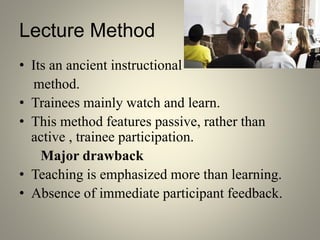
Lecture Method
• Its an ancient instructional
method.
• Trainees mainly watch and learn.
• This method features passive, rather than
active , trainee participation.
Major drawback
• Teaching is emphasized more than learning.
• Absence of immediate participant feedback.
Personal Conference
• The trainer and trainee jointly analyze
problems.
• It is an unstructured and informal method.
• It varies with the personalities of the trainer,
trainee and the topics discussed
Demonstration
• It is appropriate for conveying information on
such topics as new product and selling
techniques.
• Demonstrating how a new product works and
its uses is much more effective than lecturing
about the same.
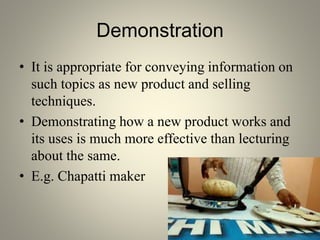
• E.g. Chapatti maker
Role playing
• This method has trainees acting
out parts in contrived problem situation.
• The trainer describes the situation and the
different personalities involved.
• Each plays his/her role and afterward, together
with other group members appraise each
players effectiveness and suggest how each
players performance might have been
improved.
Case Discussion
• In this method different cases are given to the
trainees and are asked to solve them.
• Each case study either describes a real selling
problem or is developed around a situation
sufficiently real to stimulate emotional
involvement by the trainees.
Impromptu Discussion
• The trainer makes a brief oral presentation on
an everyday problem.
• Group members gain an understanding of
many problems acquired only through long
personal experience.
• General give and take discussion follows.
• Active participation of members is possible
here unlike lecture method.
• It is widely used method
Gaming
• Also known as simulation, somewhat resembles role playing.
• It uses highly structured contrived situations, based on reality.
Advantages
• Players can learn easily because they involve themselves in
game play.
• Develop skills in indentifying key factors influencing
decisions.
Disadvantages
• Improper game design.
• Some minimum time is required for playing ,usually 3 to 4 hrs.
, to generate sufficient decision “rounds” to provide desired
learning experience.
On-the-job training
• Also known as coach-and-pupil method.
• It combines telling, showing, practicing and
evaluating.
• It is the most effective way for learning a job.
• This method is appropriate for developing
trainee’s skill in making sales presentation,
answering objections and closing sales.
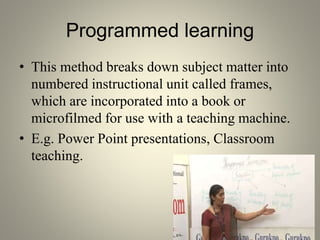
Programmed learning
• This method breaks down subject matter into
numbered instructional unit called frames,
which are incorporated into a book or
microfilmed for use with a teaching machine.
• E.g. Power Point presentations, Classroom
teaching.
Correspondence Courses
• It is most appropriate when trainees are scattered
geographically but are assembled periodically for
lectures, seminars, role playing.
• This method is used in initial and continuing sales
training.
• It is also used to train non company personal such
as distributor’s sales personal to improve their
knowledge of the manufactures product line and
selling techniques.
Group Vs. Individual training
methods
• Of the 10 discussed , 5are group methods, 4 are individual and
1 can be either of the two.
Group Individual
• Lecturing *Personal conference
• Role playing *On-the-job
• Case discussion *Programmed learning
• Impromptu discussion *Correspondence course
• Gaming
Demonstration can either be individual or a group method
depending on whether the audience is a group or an individual.
Methods of training sales personal

Methods of training sales personal

  • 1.
    METHODS OF TRAININGA SALES PERSONAL SALES MANAGEMENT
  • 2.
  • 3.
    Definition According to theBusiness Dictionary “An individual who sells goods and services to other entities. The success of a sales person is usually measured by the amount of sales he/she is able to make during a given period of time.”
  • 4.
    Methods *The Lecture *The personalconference *Demonstration *Role Play *Case discussion *Impromptu Discussion *Gaming *On- the-job Training *Programmed learning *Correspondence Courses *Group vs. Individual Training Methods
  • 5.
    Lecture Method • Itsan ancient instructional method. • Trainees mainly watch and learn. • This method features passive, rather than active , trainee participation. Major drawback • Teaching is emphasized more than learning. • Absence of immediate participant feedback.
  • 6.
    Personal Conference • Thetrainer and trainee jointly analyze problems. • It is an unstructured and informal method. • It varies with the personalities of the trainer, trainee and the topics discussed
  • 7.
    Demonstration • It isappropriate for conveying information on such topics as new product and selling techniques. • Demonstrating how a new product works and its uses is much more effective than lecturing about the same. • E.g. Chapatti maker
  • 8.
    Role playing • Thismethod has trainees acting out parts in contrived problem situation. • The trainer describes the situation and the different personalities involved. • Each plays his/her role and afterward, together with other group members appraise each players effectiveness and suggest how each players performance might have been improved.
  • 9.
    Case Discussion • Inthis method different cases are given to the trainees and are asked to solve them. • Each case study either describes a real selling problem or is developed around a situation sufficiently real to stimulate emotional involvement by the trainees.
  • 10.
    Impromptu Discussion • Thetrainer makes a brief oral presentation on an everyday problem. • Group members gain an understanding of many problems acquired only through long personal experience. • General give and take discussion follows. • Active participation of members is possible here unlike lecture method. • It is widely used method
  • 11.
    Gaming • Also knownas simulation, somewhat resembles role playing. • It uses highly structured contrived situations, based on reality. Advantages • Players can learn easily because they involve themselves in game play. • Develop skills in indentifying key factors influencing decisions. Disadvantages • Improper game design. • Some minimum time is required for playing ,usually 3 to 4 hrs. , to generate sufficient decision “rounds” to provide desired learning experience.
  • 12.
    On-the-job training • Alsoknown as coach-and-pupil method. • It combines telling, showing, practicing and evaluating. • It is the most effective way for learning a job. • This method is appropriate for developing trainee’s skill in making sales presentation, answering objections and closing sales.
  • 13.
    Programmed learning • Thismethod breaks down subject matter into numbered instructional unit called frames, which are incorporated into a book or microfilmed for use with a teaching machine. • E.g. Power Point presentations, Classroom teaching.
  • 14.
    Correspondence Courses • Itis most appropriate when trainees are scattered geographically but are assembled periodically for lectures, seminars, role playing. • This method is used in initial and continuing sales training. • It is also used to train non company personal such as distributor’s sales personal to improve their knowledge of the manufactures product line and selling techniques.
  • 15.
    Group Vs. Individualtraining methods • Of the 10 discussed , 5are group methods, 4 are individual and 1 can be either of the two. Group Individual • Lecturing *Personal conference • Role playing *On-the-job • Case discussion *Programmed learning • Impromptu discussion *Correspondence course • Gaming Demonstration can either be individual or a group method depending on whether the audience is a group or an individual.