Chapter 14
Methodology -
Conceptual Database Design
Transparencies
2
Chapter 14 - Objectives
 Purpose of a design methodology.
 Database design has three main phases:
conceptual, logical, and physical design.
 How to decompose the scope of the design into
specific users’ views of the enterprise.
 How to use ER modeling to build a local
conceptual data model based on information
given in a view of the enterprise.
3
Chapter 14 - Objectives
 How to validate resultant conceptual model to
ensure it is a true and accurate representation
of a view of the enterprise.
 How to document process of conceptual
database design.
 End-users play an integral role throughout
process of conceptual database design.
4
Design Methodology
 Structured approach that uses procedures,
techniques, tools, and documentation aids to
support and facilitate the process of design.
 Database design methodology has 3 main
phases:
– Conceptual database design;
– Logical database design;
– Physical database design.
5
Conceptual/Logical Database Design
 Conceptual database design
– Process of constructing a model of information used
in an enterprise, independent of all physical
considerations.
 Logical database design
– Process of constructing a model of information used
in an enterprise based on a specific data model (e.g.
relational), but independent of a particular DBMS
and other physical considerations.
6
Physical Database Design
 Process of producing a description of the
implementation of the database on secondary
storage; it describes the base relations, file
organizations, and indexes design used to
achieve efficient access to the data, and any
associated integrity constraints and security
measures.
7
Critical Success Factors in Database Design
 Work interactively with users as much as possible.
 Follow a structured methodology throughout the
data modeling process.
 Employ a data-driven approach.
 Incorporate structural and integrity considerations
into the data models.
 Combine conceptualization, normalization, and
transaction validation techniques into the data
modeling methodology.
8
Critical Success Factors in Database Design
 Use diagrams to represent as much of the data
models as possible.
 Use a Database Design Language (DBDL) to
represent additional data semantics.
 Build a data dictionary to supplement the data
model diagrams.
 Be willing to repeat steps.
9
Methodology Overview - Conceptual
Database Design
 Step 1 Build local conceptual data model for each
user view
– Step 1.1 Identify entity types
– Step 1.2 Identify relationship types
– Step 1.3 Identify and associate attributes with entity or relationship
types
– Step 1.4 Determine attribute domains
– Step 1.5 Determine candidate and primary key attributes
– Step 1.6 Consider use of enhanced modeling concepts (optional step)
– Step 1.7 Check model for redundancy
– Step 1.8 Validate local conceptual model against user transactions
– Step 1.9 Review local conceptual data model with user
10
Methodology Overview - Logical Database
Design for Relational Model
 Step 2 Build and validate local logical data model
for each view
– Step 2.1 Remove features not compatible with the
relational model (optional step)
– Step 2.2 Derive relations for local logical data model
– Step 2.3 Validate relations using normalization
– Step 2.4 Validate relations against user transactions
– Step 2.5 Define integrity constraints
– Step 2.6 Review local logical data model with user
11
Methodology Overview - Logical Database
Design for Relational Model
 Step 3 Build and validate global logical data model
– Step 3.1 Merge local logical data models into global
model
– Step 3.2 Validate global logical data model
– Step 3.3 Check for future growth
– Step 3.4 Review global logical data model with users
12
Methodology Overview - Physical Database
Design for Relational Databases
 Step 4 Translate global logical data model for
target DBMS
– Step 4.1 Design base relations
– Step 4.2 Design representation of derived data
– Step 4.3 Design enterprise constraints
 Step 5 Design physical representation
– Step 5.1 Analyze transactions
– Step 5.2 Choose file organization
– Step 5.3 Choose indexes
– Step 5.4 Estimate disk space requirements
13
Methodology Overview - Physical Database
Design for Relational Databases
 Step 6 Design user views
 Step 7 Design security mechanisms
 Step 8 Consider the introduction of controlled
redundancy
 Step 9 Monitor and tune the operational
system
14
Step 1 Build Local Conceptual Data Model
for Each View
To build a local conceptual data model of an
enterprise for each specific view.
 Step 1.1 Identify entity types
– To identify the main entity types that are required
by the view.
 Step 1.2 Identify relationship types
– To identify the important relationships that exist
between the entity types that have been identified.
15
Step 1 Build Local Conceptual Data Model
for Each View
 Step 1.3 Identify and associate attributes with
entity or relationship types
– To identify and associate attributes with the
appropriate entity or relationship types and
document the details of each attribute.
 Step 1.4 Determine attribute domains
– To determine domains for the attributes in the local
conceptual model and document the details of each
domain.
16
Step 1 Build Local Conceptual Data Model
for Each View
 Step 1.5 Determine candidate and primary key
attributes
– To identify the candidate key(s) for each entity and
if there is more than one candidate key, to choose
one to be the primary key.
 Step 1.6 Consider use of enhanced modeling
concepts (optional step)
– To consider the use of enhanced modeling concepts,
such as specialization / generalization, aggregation,
and composition.
17
Step 1 Build Local Conceptual Data Model
for Each View
 Step 1.7 Check model for redundancy
– To check for the presence of any redundancy in the
model.
 Step 1.8 Validate local conceptual model
against user transactions
– To ensure that the local conceptual model supports
the transactions required by the view.
 Step1.9 Review local conceptual data model
with user
– To review the local conceptual data model with the
user to ensure that the model is a ‘true’
representation of the user’s view of the enterprise.
18
Extract from Data Dictionary for Staff View of
DreamHome Showing Description of Entities
19
First-cut ER diagram for Staff View of
DreamHome
20
Extract from Data Dictionary for Staff View of
DreamHome Showing Description of Relationships
21
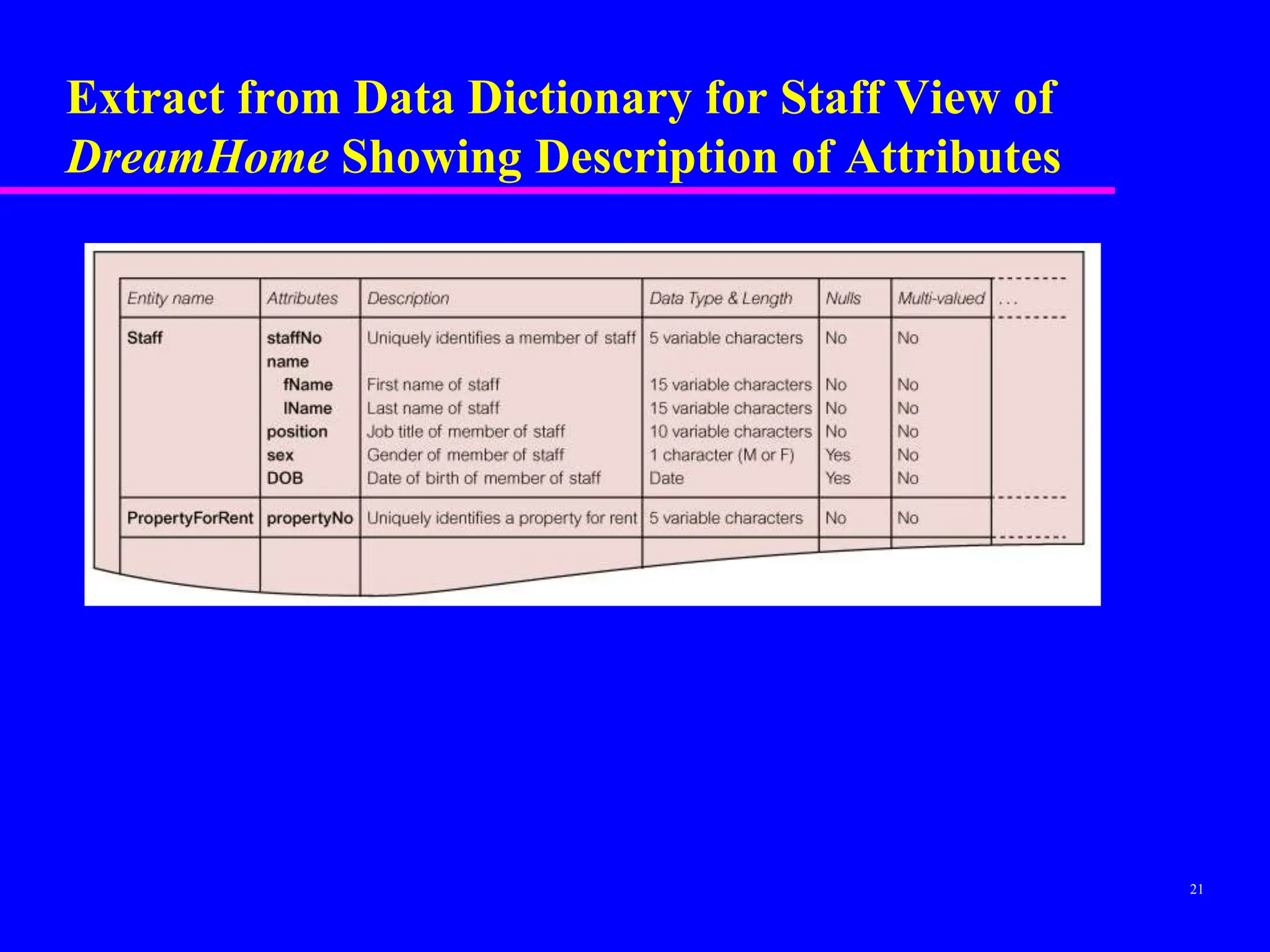
Extract from Data Dictionary for Staff View of
DreamHome Showing Description of Attributes
22
ER Diagram for Staff View of DreamHome
with Primary Keys Added
23
Revised ER Diagram for Staff View of
DreamHome with Specialization / Generalization
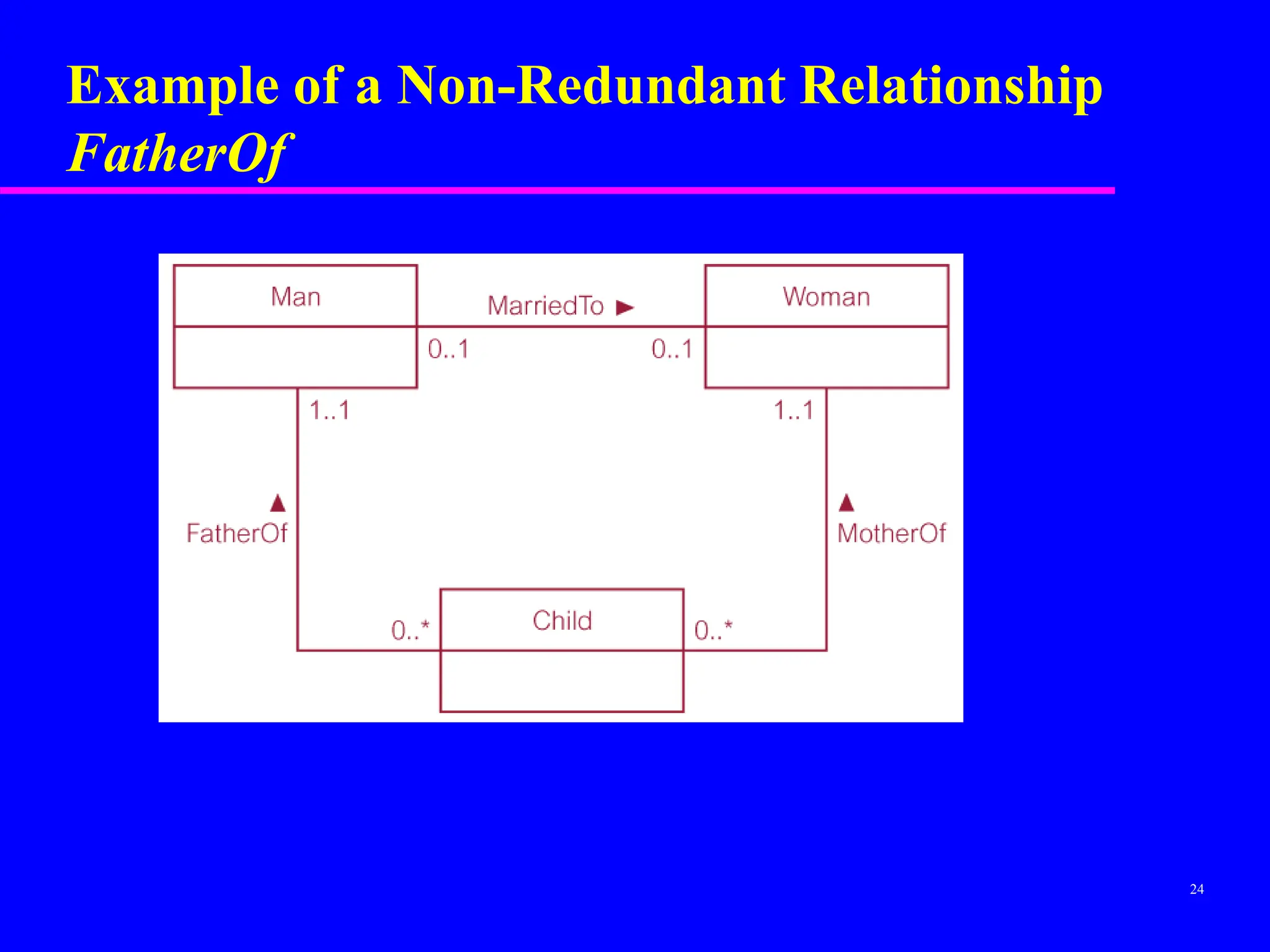
24
Example of a Non-Redundant Relationship
FatherOf
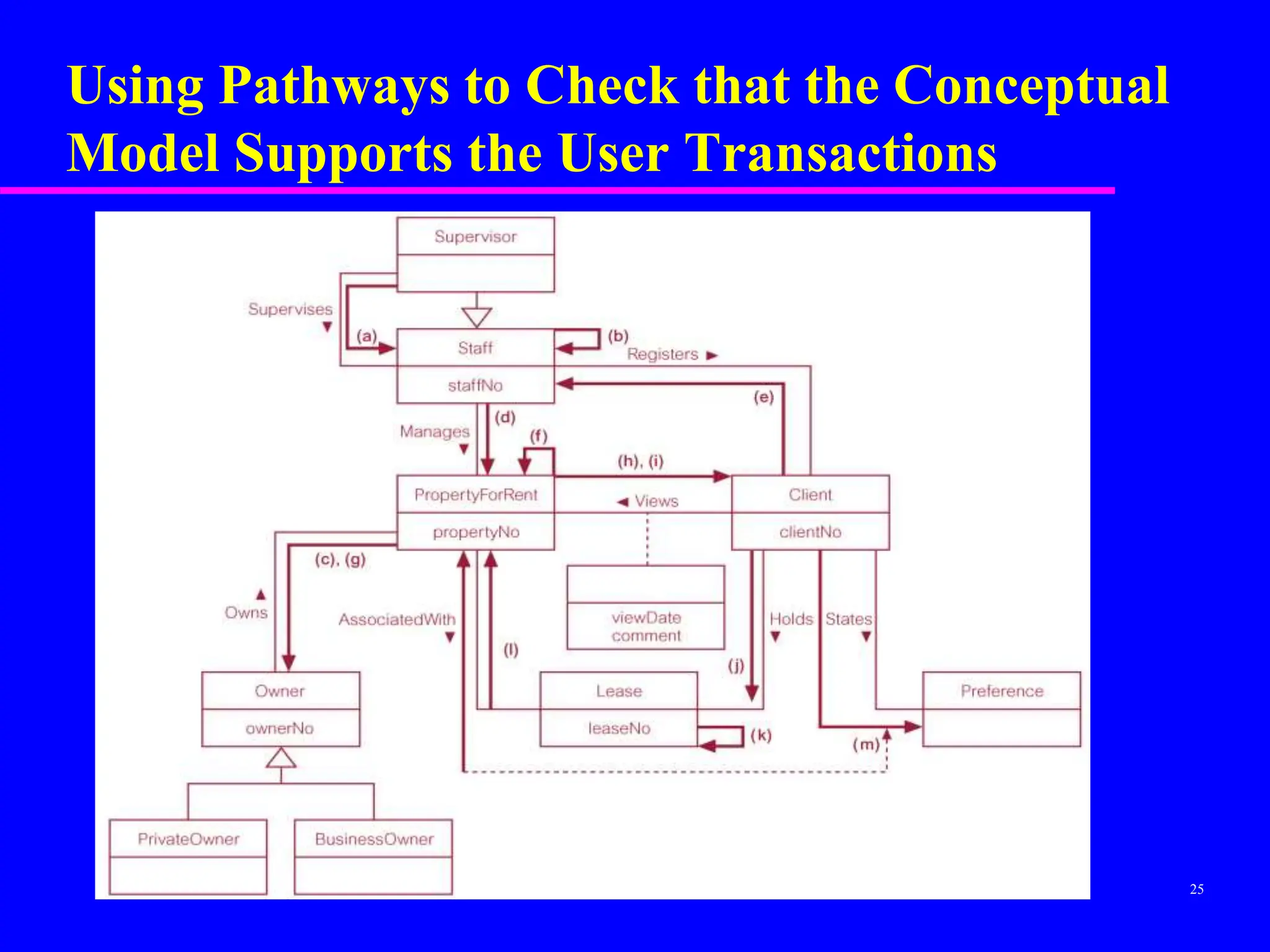
25
Using Pathways to Check that the Conceptual
Model Supports the User Transactions

Methodology - Conceptual Database Design Transparencies .pptx

  • 1.
    Chapter 14 Methodology - ConceptualDatabase Design Transparencies
  • 2.
    2 Chapter 14 -Objectives  Purpose of a design methodology.  Database design has three main phases: conceptual, logical, and physical design.  How to decompose the scope of the design into specific users’ views of the enterprise.  How to use ER modeling to build a local conceptual data model based on information given in a view of the enterprise.
  • 3.
    3 Chapter 14 -Objectives  How to validate resultant conceptual model to ensure it is a true and accurate representation of a view of the enterprise.  How to document process of conceptual database design.  End-users play an integral role throughout process of conceptual database design.
  • 4.
    4 Design Methodology  Structuredapproach that uses procedures, techniques, tools, and documentation aids to support and facilitate the process of design.  Database design methodology has 3 main phases: – Conceptual database design; – Logical database design; – Physical database design.
  • 5.
    5 Conceptual/Logical Database Design Conceptual database design – Process of constructing a model of information used in an enterprise, independent of all physical considerations.  Logical database design – Process of constructing a model of information used in an enterprise based on a specific data model (e.g. relational), but independent of a particular DBMS and other physical considerations.
  • 6.
    6 Physical Database Design Process of producing a description of the implementation of the database on secondary storage; it describes the base relations, file organizations, and indexes design used to achieve efficient access to the data, and any associated integrity constraints and security measures.
  • 7.
    7 Critical Success Factorsin Database Design  Work interactively with users as much as possible.  Follow a structured methodology throughout the data modeling process.  Employ a data-driven approach.  Incorporate structural and integrity considerations into the data models.  Combine conceptualization, normalization, and transaction validation techniques into the data modeling methodology.
  • 8.
    8 Critical Success Factorsin Database Design  Use diagrams to represent as much of the data models as possible.  Use a Database Design Language (DBDL) to represent additional data semantics.  Build a data dictionary to supplement the data model diagrams.  Be willing to repeat steps.
  • 9.
    9 Methodology Overview -Conceptual Database Design  Step 1 Build local conceptual data model for each user view – Step 1.1 Identify entity types – Step 1.2 Identify relationship types – Step 1.3 Identify and associate attributes with entity or relationship types – Step 1.4 Determine attribute domains – Step 1.5 Determine candidate and primary key attributes – Step 1.6 Consider use of enhanced modeling concepts (optional step) – Step 1.7 Check model for redundancy – Step 1.8 Validate local conceptual model against user transactions – Step 1.9 Review local conceptual data model with user
  • 10.
    10 Methodology Overview -Logical Database Design for Relational Model  Step 2 Build and validate local logical data model for each view – Step 2.1 Remove features not compatible with the relational model (optional step) – Step 2.2 Derive relations for local logical data model – Step 2.3 Validate relations using normalization – Step 2.4 Validate relations against user transactions – Step 2.5 Define integrity constraints – Step 2.6 Review local logical data model with user
  • 11.
    11 Methodology Overview -Logical Database Design for Relational Model  Step 3 Build and validate global logical data model – Step 3.1 Merge local logical data models into global model – Step 3.2 Validate global logical data model – Step 3.3 Check for future growth – Step 3.4 Review global logical data model with users
  • 12.
    12 Methodology Overview -Physical Database Design for Relational Databases  Step 4 Translate global logical data model for target DBMS – Step 4.1 Design base relations – Step 4.2 Design representation of derived data – Step 4.3 Design enterprise constraints  Step 5 Design physical representation – Step 5.1 Analyze transactions – Step 5.2 Choose file organization – Step 5.3 Choose indexes – Step 5.4 Estimate disk space requirements
  • 13.
    13 Methodology Overview -Physical Database Design for Relational Databases  Step 6 Design user views  Step 7 Design security mechanisms  Step 8 Consider the introduction of controlled redundancy  Step 9 Monitor and tune the operational system
  • 14.
    14 Step 1 BuildLocal Conceptual Data Model for Each View To build a local conceptual data model of an enterprise for each specific view.  Step 1.1 Identify entity types – To identify the main entity types that are required by the view.  Step 1.2 Identify relationship types – To identify the important relationships that exist between the entity types that have been identified.
  • 15.
    15 Step 1 BuildLocal Conceptual Data Model for Each View  Step 1.3 Identify and associate attributes with entity or relationship types – To identify and associate attributes with the appropriate entity or relationship types and document the details of each attribute.  Step 1.4 Determine attribute domains – To determine domains for the attributes in the local conceptual model and document the details of each domain.
  • 16.
    16 Step 1 BuildLocal Conceptual Data Model for Each View  Step 1.5 Determine candidate and primary key attributes – To identify the candidate key(s) for each entity and if there is more than one candidate key, to choose one to be the primary key.  Step 1.6 Consider use of enhanced modeling concepts (optional step) – To consider the use of enhanced modeling concepts, such as specialization / generalization, aggregation, and composition.
  • 17.
    17 Step 1 BuildLocal Conceptual Data Model for Each View  Step 1.7 Check model for redundancy – To check for the presence of any redundancy in the model.  Step 1.8 Validate local conceptual model against user transactions – To ensure that the local conceptual model supports the transactions required by the view.  Step1.9 Review local conceptual data model with user – To review the local conceptual data model with the user to ensure that the model is a ‘true’ representation of the user’s view of the enterprise.
  • 18.
    18 Extract from DataDictionary for Staff View of DreamHome Showing Description of Entities
  • 19.
    19 First-cut ER diagramfor Staff View of DreamHome
  • 20.
    20 Extract from DataDictionary for Staff View of DreamHome Showing Description of Relationships
  • 21.
    21 Extract from DataDictionary for Staff View of DreamHome Showing Description of Attributes
  • 22.
    22 ER Diagram forStaff View of DreamHome with Primary Keys Added
  • 23.
    23 Revised ER Diagramfor Staff View of DreamHome with Specialization / Generalization
  • 24.
    24 Example of aNon-Redundant Relationship FatherOf
  • 25.
    25 Using Pathways toCheck that the Conceptual Model Supports the User Transactions