Method and Methodology
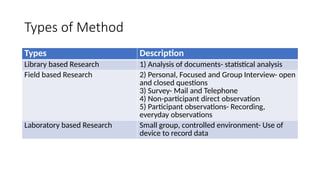
Types of Method
Types Description
Library based Research 1) Analysis of documents- statistical analysis
Field based Research 2) Personal, Focused and Group Interview- open
and closed questions
3) Survey- Mail and Telephone
4) Non-participant direct observation
5) Participant observations- Recording,
everyday observations
Laboratory based Research Small group, controlled environment- Use of
device to record data
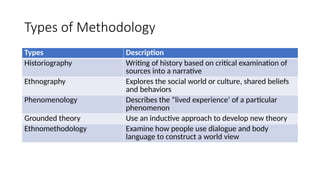
Types of Methodology
Types Description
Historiography Writing of history based on critical examination of
sources into a narrative
Ethnography Explores the social world or culture, shared beliefs
and behaviors
Phenomenology Describes the “lived experience’ of a particular
phenomenon
Grounded theory Use an inductive approach to develop new theory
Ethnomethodology Examine how people use dialogue and body
language to construct a world view
Participants
• Who was in the study?
• How many participants?
• Sample size
• Any important characteristics?
• Both men and women?
• Race/Ethnicity?
• Age group?
Participants
Inclusion characteristics
• Studies must clearly state if
participants had to have any
characteristics or meet certain
requirements
• Must have a diagnosis
• Must be a parent-child pair
• Must be married
• Must be of a certain income range
• Must be African American
Exclusion characteristics
• Studies need to state clearly any
exclusion characteristics or
things that would mean that
someone should not be in the
study
• Must not have a serious alcohol or
drug problem
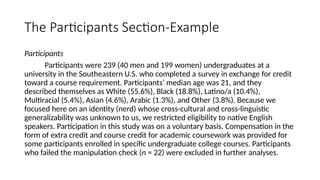
The Participants Section-Example
Participants
Participants were 239 (40 men and 199 women) undergraduates at a
university in the Southeastern U.S. who completed a survey in exchange for credit
toward a course requirement. Participants’ median age was 21, and they
described themselves as White (55.6%), Black (18.8%), Latino/a (10.4%),
Multiracial (5.4%), Asian (4.6%), Arabic (1.3%), and Other (3.8%). Because we
focused here on an identity (nerd) whose cross-cultural and cross-linguistic
generalizability was unknown to us, we restricted eligibility to native English
speakers. Participation in this study was on a voluntary basis. Compensation in the
form of extra credit and course credit for academic coursework was provided for
some participants enrolled in specific undergraduate college courses. Participants
who failed the manipulation check (n = 22) were excluded in further analyses.
The Participants-Example
Participants
Participants were 239 (40 men and 199 women) undergraduates at
a university in the Southeastern U.S. who completed a survey in exchange
for credit toward a course requirement. Participants’ median age was 21,
and they described themselves as White (55.6%), Black (18.8%), Latino/a
(10.4%), Multiracial (5.4%), Asian (4.6%), Arabic (1.3%), and Other (3.8%).
Because we focused on an identity whose cross-cultural and cross-
linguistic generalizability was unknown to us, we restricted eligibility to
native English speakers. Participation in this study was on a voluntary
basis. Compensation in the form of extra credit and course credit for
academic coursework was provided for some participants enrolled in
specific undergraduate college courses. Participants who failed the
manipulation check (n = 22) were excluded in further analyses.
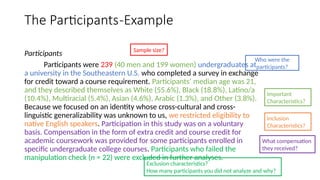
Sample size?
Important
Characteristics?
Who were the
participants?
Exclusion characteristics?
How many participants you did not analyze and why?
Inclusion
Characteristics?
What compensation
they received?
Study Area
• Location detail
• Google Earth/Map
• GPS coordinates
Materials
• All materials utilized for the study
• Which ones were used? Why was it chosen?
• testing instruments, books, images, database or other materials used in the
course of research
• Measures (Surveys/Interviews/observations) used for the study
• must provide details about the measures, scale, interpretation of scores
• When using a pre-existing published measure: Include full name of measure
followed by abbreviation and citation of original author
• Ex: Occupational Stress Indicator (OSI; Cooper, 1997) After that, you can call it
the OSI
Materials
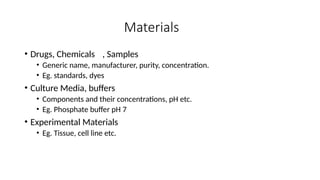
• Drugs, Chemicals , Samples
• Generic name, manufacturer, purity, concentration.
• Eg. standards, dyes
• Culture Media, buffers
• Components and their concentrations, pH etc.
• Eg. Phosphate buffer pH 7
• Experimental Materials
• Eg. Tissue, cell line etc.
Materials
• Animals/Plants/Bacteria
• State the species, weight, strain, sex, and age etc.
• Handling and care
• Details of sedation: agent used, amount, route, administration (single,
continuous) etc.
Procedures
• Sequences of procedures that make up an experiment (Tell a story)
• Arrange them in sub headings
Experimental design
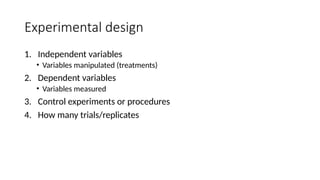
1. Independent variables
• Variables manipulated (treatments)
2. Dependent variables
• Variables measured
3. Control experiments or procedures
4. How many trials/replicates
Experimental Design Example
Design
The data were collected in four experimental
conditions for 2 x 2 mixed-model ANOVA. Gender (male,
female) was the between-subjects factor and Body type (thin,
heavy) was the within-subjects factor. The rejection level for
all analyses was set at p = 0.05.
Describes the
experimental
design, with
factors, levels, and
type of factor.
Data Analysis
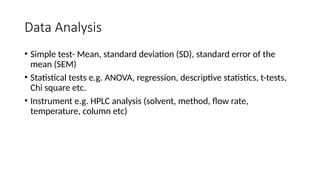
• Simple test- Mean, standard deviation (SD), standard error of the
mean (SEM)
• Statistical tests e.g. ANOVA, regression, descriptive statistics, t-tests,
Chi square etc.
• Instrument e.g. HPLC analysis (solvent, method, flow rate,
temperature, column etc)
Data Analysis Example
All qPCR and transfection data were subjected to one-way ANOVA, and
differences between individual means were tested by a Tukey multiple-
range test using Prism version 4.0 software (GraphPad). Tests of
significance were performed using the appropriate error terms
according to the expectation of the mean squares for error. A P value of
0.05 or less was considered significant. Data are presented as least-
square means ± SEM.

Method and methodology : In Research Area

  • 1.
  • 2.
    Types of Method TypesDescription Library based Research 1) Analysis of documents- statistical analysis Field based Research 2) Personal, Focused and Group Interview- open and closed questions 3) Survey- Mail and Telephone 4) Non-participant direct observation 5) Participant observations- Recording, everyday observations Laboratory based Research Small group, controlled environment- Use of device to record data
  • 3.
    Types of Methodology TypesDescription Historiography Writing of history based on critical examination of sources into a narrative Ethnography Explores the social world or culture, shared beliefs and behaviors Phenomenology Describes the “lived experience’ of a particular phenomenon Grounded theory Use an inductive approach to develop new theory Ethnomethodology Examine how people use dialogue and body language to construct a world view
  • 4.
    Participants • Who wasin the study? • How many participants? • Sample size • Any important characteristics? • Both men and women? • Race/Ethnicity? • Age group?
  • 5.
    Participants Inclusion characteristics • Studiesmust clearly state if participants had to have any characteristics or meet certain requirements • Must have a diagnosis • Must be a parent-child pair • Must be married • Must be of a certain income range • Must be African American Exclusion characteristics • Studies need to state clearly any exclusion characteristics or things that would mean that someone should not be in the study • Must not have a serious alcohol or drug problem
  • 6.
    The Participants Section-Example Participants Participantswere 239 (40 men and 199 women) undergraduates at a university in the Southeastern U.S. who completed a survey in exchange for credit toward a course requirement. Participants’ median age was 21, and they described themselves as White (55.6%), Black (18.8%), Latino/a (10.4%), Multiracial (5.4%), Asian (4.6%), Arabic (1.3%), and Other (3.8%). Because we focused here on an identity (nerd) whose cross-cultural and cross-linguistic generalizability was unknown to us, we restricted eligibility to native English speakers. Participation in this study was on a voluntary basis. Compensation in the form of extra credit and course credit for academic coursework was provided for some participants enrolled in specific undergraduate college courses. Participants who failed the manipulation check (n = 22) were excluded in further analyses.
  • 7.
    The Participants-Example Participants Participants were239 (40 men and 199 women) undergraduates at a university in the Southeastern U.S. who completed a survey in exchange for credit toward a course requirement. Participants’ median age was 21, and they described themselves as White (55.6%), Black (18.8%), Latino/a (10.4%), Multiracial (5.4%), Asian (4.6%), Arabic (1.3%), and Other (3.8%). Because we focused on an identity whose cross-cultural and cross- linguistic generalizability was unknown to us, we restricted eligibility to native English speakers. Participation in this study was on a voluntary basis. Compensation in the form of extra credit and course credit for academic coursework was provided for some participants enrolled in specific undergraduate college courses. Participants who failed the manipulation check (n = 22) were excluded in further analyses. Sample size? Important Characteristics? Who were the participants? Exclusion characteristics? How many participants you did not analyze and why? Inclusion Characteristics? What compensation they received?
  • 8.
    Study Area • Locationdetail • Google Earth/Map • GPS coordinates
  • 9.
    Materials • All materialsutilized for the study • Which ones were used? Why was it chosen? • testing instruments, books, images, database or other materials used in the course of research • Measures (Surveys/Interviews/observations) used for the study • must provide details about the measures, scale, interpretation of scores • When using a pre-existing published measure: Include full name of measure followed by abbreviation and citation of original author • Ex: Occupational Stress Indicator (OSI; Cooper, 1997) After that, you can call it the OSI
  • 10.
    Materials • Drugs, Chemicals, Samples • Generic name, manufacturer, purity, concentration. • Eg. standards, dyes • Culture Media, buffers • Components and their concentrations, pH etc. • Eg. Phosphate buffer pH 7 • Experimental Materials • Eg. Tissue, cell line etc.
  • 11.
    Materials • Animals/Plants/Bacteria • Statethe species, weight, strain, sex, and age etc. • Handling and care • Details of sedation: agent used, amount, route, administration (single, continuous) etc.
  • 12.
    Procedures • Sequences ofprocedures that make up an experiment (Tell a story) • Arrange them in sub headings
  • 13.
    Experimental design 1. Independentvariables • Variables manipulated (treatments) 2. Dependent variables • Variables measured 3. Control experiments or procedures 4. How many trials/replicates
  • 14.
    Experimental Design Example Design Thedata were collected in four experimental conditions for 2 x 2 mixed-model ANOVA. Gender (male, female) was the between-subjects factor and Body type (thin, heavy) was the within-subjects factor. The rejection level for all analyses was set at p = 0.05. Describes the experimental design, with factors, levels, and type of factor.
  • 15.
    Data Analysis • Simpletest- Mean, standard deviation (SD), standard error of the mean (SEM) • Statistical tests e.g. ANOVA, regression, descriptive statistics, t-tests, Chi square etc. • Instrument e.g. HPLC analysis (solvent, method, flow rate, temperature, column etc)
  • 16.
    Data Analysis Example AllqPCR and transfection data were subjected to one-way ANOVA, and differences between individual means were tested by a Tukey multiple- range test using Prism version 4.0 software (GraphPad). Tests of significance were performed using the appropriate error terms according to the expectation of the mean squares for error. A P value of 0.05 or less was considered significant. Data are presented as least- square means ± SEM.

Editor's Notes

  • #4 Observation and theories. Inductive = Gather Data- Look for Patterns- Develop
  • #10 What is the survey-short description as to what it is measuring measuring, scale, what would high scores mean