Meteora - Geography
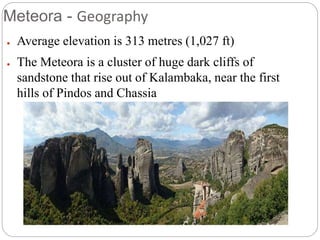
● Average elevation is 313 metres (1,027 ft)
● The Meteora is a cluster of huge dark cliffs of
sandstone that rise out of Kalambaka, near the first
hills of Pindos and Chassia
METEORA
● The Metéora (Greek: Μετέωρα, pronounced [mɛˈtɛoɾɐ], lit.
"middle of the sky", "suspended in the air" or "in the
heavens above" — etymologically related to "Meteorite")
is one of the largest and most important complexes of
Greek Orthodox monasteries in Greece, second only to
Mount Athos The six monasteries are built on natural
sandstone rock pillars, at the northwestern edge of the
Plain of Thessaly near the Pineios river and Pindus
Mountains, in central Greece. The nearest town is
Kalambaka. The Metéora is included on the UNESCO
World Heritage.
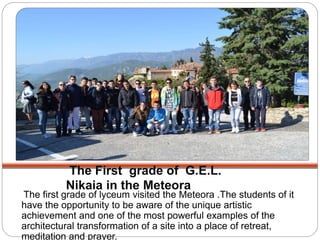
The First grade of G.E.L.
Nikaia in the Meteora
The first grade of lyceum visited the Meteora .The students of it
have the opportunity to be aware of the unique artistic
achievement and one of the most powerful examples of the
architectural transformation of a site into a place of retreat,
meditation and prayer.
.
GEOLOGY
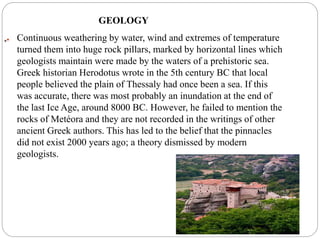
● Continuous weathering by water, wind and extremes of temperature
turned them into huge rock pillars, marked by horizontal lines which
geologists maintain were made by the waters of a prehistoric sea.
Greek historian Herodotus wrote in the 5th century BC that local
people believed the plain of Thessaly had once been a sea. If this
was accurate, there was most probably an inundation at the end of
the last Ice Age, around 8000 BC. However, he failed to mention the
rocks of Metéora and they are not recorded in the writings of other
ancient Greek authors. This has led to the belief that the pinnacles
did not exist 2000 years ago; a theory dismissed by modern
geologists.
GEOLOGY
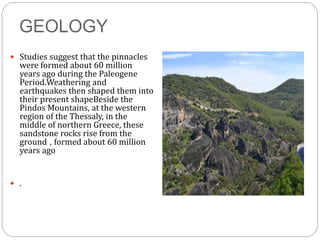
 Studies suggest that the pinnacles
were formed about 60 million
years ago during the Paleogene
Period.Weathering and
earthquakes then shaped them into
their present shapeBeside the
Pindos Mountains, at the western
region of the Thessaly, in the
middle of northern Greece, these
sandstone rocks rise from the
ground , formed about 60 million
years ago
 .
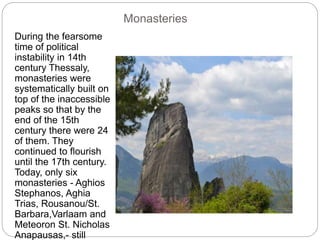
Monasteries
During the fearsome
time of political
instability in 14th
century Thessaly,
monasteries were
systematically built on
top of the inaccessible
peaks so that by the
end of the 15th
century there were 24
of them. They
continued to flourish
until the 17th century.
Today, only six
monasteries - Aghios
Stephanos, Aghia
Trias, Rousanou/St.
Barbara,Varlaam and
Meteoron St. Nicholas
Anapausas,- still

meteora geography

  • 1.
    Meteora - Geography ●Average elevation is 313 metres (1,027 ft) ● The Meteora is a cluster of huge dark cliffs of sandstone that rise out of Kalambaka, near the first hills of Pindos and Chassia
  • 2.
    METEORA ● The Metéora(Greek: Μετέωρα, pronounced [mɛˈtɛoɾɐ], lit. "middle of the sky", "suspended in the air" or "in the heavens above" — etymologically related to "Meteorite") is one of the largest and most important complexes of Greek Orthodox monasteries in Greece, second only to Mount Athos The six monasteries are built on natural sandstone rock pillars, at the northwestern edge of the Plain of Thessaly near the Pineios river and Pindus Mountains, in central Greece. The nearest town is Kalambaka. The Metéora is included on the UNESCO World Heritage.
  • 3.
    The First gradeof G.E.L. Nikaia in the Meteora The first grade of lyceum visited the Meteora .The students of it have the opportunity to be aware of the unique artistic achievement and one of the most powerful examples of the architectural transformation of a site into a place of retreat, meditation and prayer.
  • 4.
    . GEOLOGY ● Continuous weatheringby water, wind and extremes of temperature turned them into huge rock pillars, marked by horizontal lines which geologists maintain were made by the waters of a prehistoric sea. Greek historian Herodotus wrote in the 5th century BC that local people believed the plain of Thessaly had once been a sea. If this was accurate, there was most probably an inundation at the end of the last Ice Age, around 8000 BC. However, he failed to mention the rocks of Metéora and they are not recorded in the writings of other ancient Greek authors. This has led to the belief that the pinnacles did not exist 2000 years ago; a theory dismissed by modern geologists.
  • 5.
    GEOLOGY  Studies suggestthat the pinnacles were formed about 60 million years ago during the Paleogene Period.Weathering and earthquakes then shaped them into their present shapeBeside the Pindos Mountains, at the western region of the Thessaly, in the middle of northern Greece, these sandstone rocks rise from the ground , formed about 60 million years ago  .
  • 6.
    Monasteries During the fearsome timeof political instability in 14th century Thessaly, monasteries were systematically built on top of the inaccessible peaks so that by the end of the 15th century there were 24 of them. They continued to flourish until the 17th century. Today, only six monasteries - Aghios Stephanos, Aghia Trias, Rousanou/St. Barbara,Varlaam and Meteoron St. Nicholas Anapausas,- still