M0.0 METEOR EXPLOSION - RUSSIA
          Friday, February 15, 2013 at 03:20:26 UTC


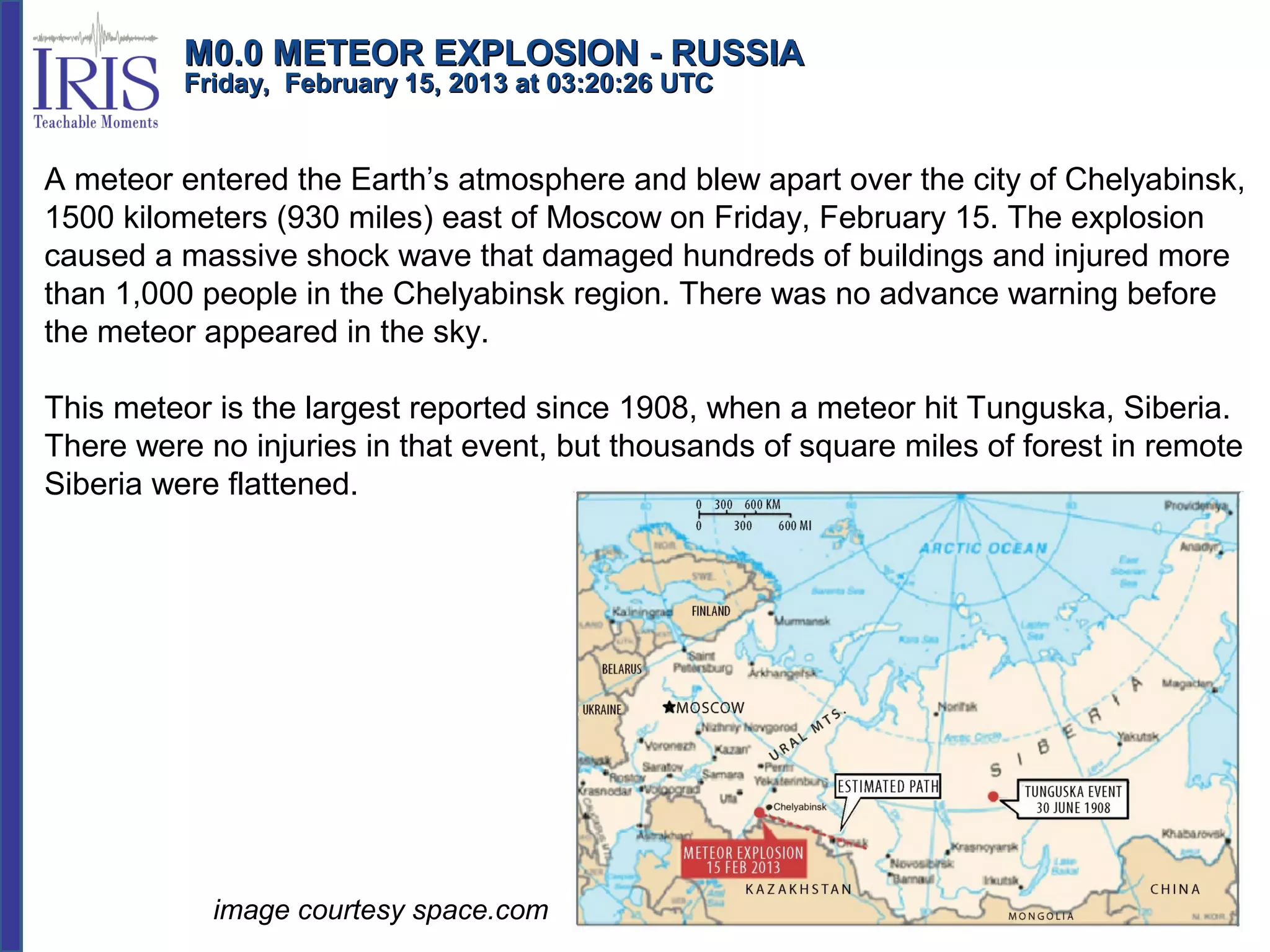
A meteor entered the Earth’s atmosphere and blew apart over the city of Chelyabinsk,
1500 kilometers (930 miles) east of Moscow on Friday, February 15. The explosion
caused a massive shock wave that damaged hundreds of buildings and injured more
than 1,000 people in the Chelyabinsk region. There was no advance warning before
the meteor appeared in the sky.

This meteor is the largest reported since 1908, when a meteor hit Tunguska, Siberia.
There were no injuries in that event, but thousands of square miles of forest in remote
Siberia were flattened.


            image courtesy space.com
M0.0 METEOR EXPLOSION - RUSSIA
          Friday, February 15, 2013 at 03:20:26 UTC


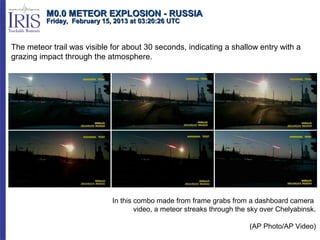
The meteor trail was visible for about 30 seconds, indicating a shallow entry with a
grazing impact through the atmosphere.


                              In this combo made from frame grabs from a dashboard camera
                                      video, a meteor streaks through the sky over Chelyabinsk.

                                                                         (AP Photo/AP Video)
M0.0 METEOR EXPLOSION - RUSSIA
          Friday, February 15, 2013 at 03:20:26 UTC


A meteroid is a sand- to boulder- sized
particle of debris in the Solar System.
When a meteroid enters the Earth’s
atmosphere, often it is burned up by
friction and the heat of the atmosphere.
When it is heated in the planet’s
atmosphere and is visible, it is called a
meteor (shooting star).

Objects larger than several meters can
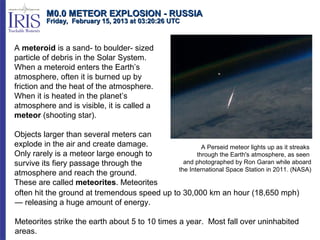
explode in the air and create damage.                  A Perseid meteor lights up as it streaks
Only rarely is a meteor large enough to              through the Earth's atmosphere, as seen
survive its fiery passage through the           and photographed by Ron Garan while aboard
                                              the International Space Station in 2011. (NASA)
atmosphere and reach the ground.
These are called meteorites. Meteorites
often hit the ground at tremendous speed up to 30,000 km an hour (18,650 mph)
— releasing a huge amount of energy.

Meteorites strike the earth about 5 to 10 times a year. Most fall over uninhabited
areas.
M0.0 METEOR EXPLOSION - RUSSIA
         Friday, February 15, 2013 at 03:20:26 UTC


The meteor entered the atmosphere at about
40,000 mph (18 kilometers per second).

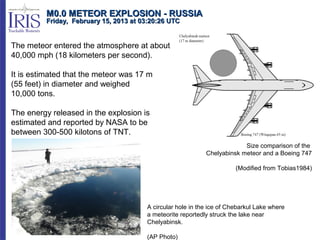
It is estimated that the meteor was 17 m
(55 feet) in diameter and weighed
10,000 tons.

The energy released in the explosion is
estimated and reported by NASA to be
between 300-500 kilotons of TNT.
                                                                         Size comparison of the
                                                            Chelyabinsk meteor and a Boeing 747

                                                                       (Modified from Tobias1984)


                                       A circular hole in the ice of Chebarkul Lake where
                                       a meteorite reportedly struck the lake near
                                       Chelyabinsk.

                                       (AP Photo)
M0.0 METEOR EXPLOSION - RUSSIA
         Friday, February 15, 2013 at 03:20:26 UTC


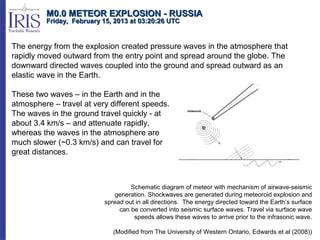
The energy from the explosion created pressure waves in the atmosphere that
rapidly moved outward from the entry point and spread around the globe. The
downward directed waves coupled into the ground and spread outward as an
elastic wave in the Earth.

These two waves – in the Earth and in the
atmosphere – travel at very different speeds.
The waves in the ground travel quickly - at
about 3.4 km/s – and attenuate rapidly,
whereas the waves in the atmosphere are
much slower (~0.3 km/s) and can travel for
great distances.


                                   Schematic diagram of meteor with mechanism of airwave-seismic
                             generation. Shockwaves are generated during meteoroid explosion and
                          spread out in all directions. The energy directed toward the Earth’s surface
                               can be converted into seismic surface waves. Travel via surface wave
                                    speeds allows these waves to arrive prior to the infrasonic wave.

                             (Modified from The University of Western Ontario, Edwards et al (2008))
M0.0 METEOR EXPLOSION - RUSSIA
         Friday, February 15, 2013 at 03:20:26 UTC


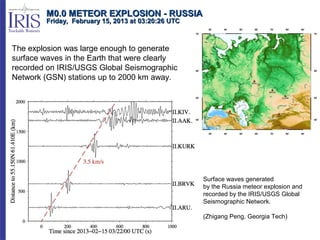
The explosion was large enough to generate
surface waves in the Earth that were clearly
recorded on IRIS/USGS Global Seismographic
Network (GSN) stations up to 2000 km away.


                                                     Surface waves generated
                                                     by the Russia meteor explosion and
                                                     recorded by the IRIS/USGS Global
                                                     Seismographic Network.

                                                     (Zhigang Peng, Georgia Tech)
M0.0 METEOR EXPLOSION - RUSSIA
        Friday, February 15, 2013 at 03:20:26 UTC


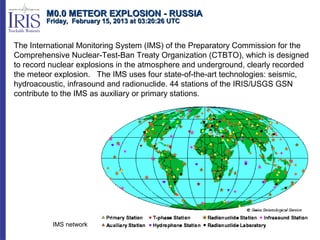
The International Monitoring System (IMS) of the Preparatory Commission for the
Comprehensive Nuclear-Test-Ban Treaty Organization (CTBTO), which is designed
to record nuclear explosions in the atmosphere and underground, clearly recorded
the meteor explosion. The IMS uses four state-of-the-art technologies: seismic,
hydroacoustic, infrasound and radionuclide. 44 stations of the IRIS/USGS GSN
contribute to the IMS as auxiliary or primary stations.


          IMS network
M0.0 METEOR EXPLOSION - RUSSIA
          Friday, February 15, 2013 at 03:20:26 UTC


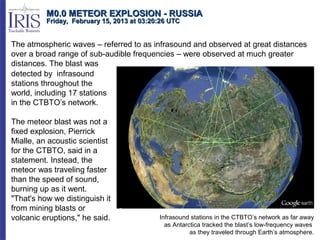
The atmospheric waves – referred to as infrasound and observed at great distances
over a broad range of sub-audible frequencies – were observed at much greater
distances. The blast was
detected by infrasound
stations throughout the
world, including 17 stations
in the CTBTO’s network.

The meteor blast was not a
fixed explosion, Pierrick
Mialle, an acoustic scientist
for the CTBTO, said in a
statement. Instead, the
meteor was traveling faster
than the speed of sound,
burning up as it went.
"That's how we distinguish it
from mining blasts or
volcanic eruptions," he said.               Infrasound stations in the CTBTO’s network as far away
                                              as Antarctica tracked the blast’s low-frequency waves
                                                       as they traveled through Earth’s atmosphere.
M0.0 METEOR EXPLOSION - RUSSIA
        Friday, February 15, 2013 at 03:20:26 UTC


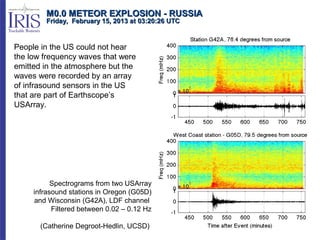
People in the US could not hear
the low frequency waves that were
emitted in the atmosphere but the
waves were recorded by an array
of infrasound sensors in the US
that are part of Earthscope’s
USArray.


           Spectrograms from two USArray
     infrasound stations in Oregon (G05D)
     and Wisconsin (G42A), LDF channel
           Filtered between 0.02 – 0.12 Hz

       (Catherine Degroot-Hedlin, UCSD)
M0.0 METEOR EXPLOSION - RUSSIA
            Friday, February 15, 2013 at 03:20:26 UTC


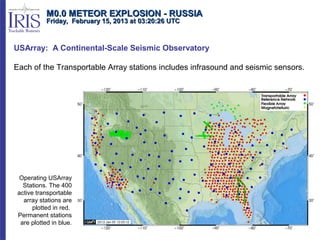
USArray: A Continental-Scale Seismic Observatory

Each of the Transportable Array stations includes infrasound and seismic sensors.


  Operating USArray
   Stations. The 400
 active transportable
   array stations are
       plotted in red.
 Permanent stations
  are plotted in blue.
M0.0 METEOR EXPLOSION - RUSSIA
         Friday, February 15, 2013 at 03:20:26 UTC


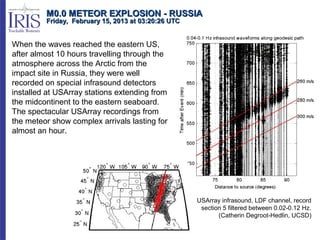
When the waves reached the eastern US,
after almost 10 hours travelling through the
atmosphere across the Arctic from the
impact site in Russia, they were well
recorded on special infrasound detectors
installed at USArray stations extending from
the midcontinent to the eastern seaboard.
The spectacular USArray recordings from
the meteor show complex arrivals lasting for
almost an hour.


                                                     USArray infrasound, LDF channel, record
                                                      section 5 filtered between 0.02-0.12 Hz.
                                                            (Catherin Degroot-Hedlin, UCSD)
M0.0 METEOR EXPLOSION - RUSSIA
          Friday, February 15, 2013 at 03:20:26 UTC


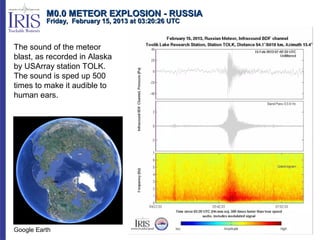
The sound of the meteor
blast, as recorded in Alaska
by USArray station TOLK.
The sound is sped up 500
times to make it audible to
human ears.


Google Earth
M0.0 METEOR EXPLOSION - RUSSIA
         Friday, February 15, 2013 at 03:20:26 UTC


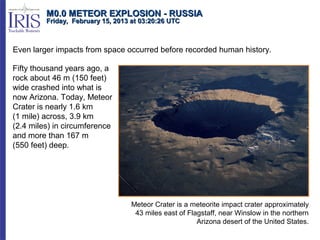
Even larger impacts from space occurred before recorded human history.

Fifty thousand years ago, a
rock about 46 m (150 feet)
wide crashed into what is
now Arizona. Today, Meteor
Crater is nearly 1.6 km
(1 mile) across, 3.9 km
(2.4 miles) in circumference
and more than 167 m
(550 feet) deep.


                                   Meteor Crater is a meteorite impact crater approximately
                                    43 miles east of Flagstaff, near Winslow in the northern
                                                        Arizona desert of the United States.

Meteor explosion

  • 1.
    M0.0 METEOR EXPLOSION- RUSSIA Friday, February 15, 2013 at 03:20:26 UTC A meteor entered the Earth’s atmosphere and blew apart over the city of Chelyabinsk, 1500 kilometers (930 miles) east of Moscow on Friday, February 15. The explosion caused a massive shock wave that damaged hundreds of buildings and injured more than 1,000 people in the Chelyabinsk region. There was no advance warning before the meteor appeared in the sky. This meteor is the largest reported since 1908, when a meteor hit Tunguska, Siberia. There were no injuries in that event, but thousands of square miles of forest in remote Siberia were flattened. image courtesy space.com
  • 2.
    M0.0 METEOR EXPLOSION- RUSSIA Friday, February 15, 2013 at 03:20:26 UTC The meteor trail was visible for about 30 seconds, indicating a shallow entry with a grazing impact through the atmosphere. In this combo made from frame grabs from a dashboard camera video, a meteor streaks through the sky over Chelyabinsk. (AP Photo/AP Video)
  • 3.
    M0.0 METEOR EXPLOSION- RUSSIA Friday, February 15, 2013 at 03:20:26 UTC A meteroid is a sand- to boulder- sized particle of debris in the Solar System. When a meteroid enters the Earth’s atmosphere, often it is burned up by friction and the heat of the atmosphere. When it is heated in the planet’s atmosphere and is visible, it is called a meteor (shooting star). Objects larger than several meters can explode in the air and create damage. A Perseid meteor lights up as it streaks Only rarely is a meteor large enough to through the Earth's atmosphere, as seen survive its fiery passage through the and photographed by Ron Garan while aboard the International Space Station in 2011. (NASA) atmosphere and reach the ground. These are called meteorites. Meteorites often hit the ground at tremendous speed up to 30,000 km an hour (18,650 mph) — releasing a huge amount of energy. Meteorites strike the earth about 5 to 10 times a year. Most fall over uninhabited areas.
  • 4.
    M0.0 METEOR EXPLOSION- RUSSIA Friday, February 15, 2013 at 03:20:26 UTC The meteor entered the atmosphere at about 40,000 mph (18 kilometers per second). It is estimated that the meteor was 17 m (55 feet) in diameter and weighed 10,000 tons. The energy released in the explosion is estimated and reported by NASA to be between 300-500 kilotons of TNT. Size comparison of the Chelyabinsk meteor and a Boeing 747 (Modified from Tobias1984) A circular hole in the ice of Chebarkul Lake where a meteorite reportedly struck the lake near Chelyabinsk. (AP Photo)
  • 5.
    M0.0 METEOR EXPLOSION- RUSSIA Friday, February 15, 2013 at 03:20:26 UTC The energy from the explosion created pressure waves in the atmosphere that rapidly moved outward from the entry point and spread around the globe. The downward directed waves coupled into the ground and spread outward as an elastic wave in the Earth. These two waves – in the Earth and in the atmosphere – travel at very different speeds. The waves in the ground travel quickly - at about 3.4 km/s – and attenuate rapidly, whereas the waves in the atmosphere are much slower (~0.3 km/s) and can travel for great distances. Schematic diagram of meteor with mechanism of airwave-seismic generation. Shockwaves are generated during meteoroid explosion and spread out in all directions. The energy directed toward the Earth’s surface can be converted into seismic surface waves. Travel via surface wave speeds allows these waves to arrive prior to the infrasonic wave. (Modified from The University of Western Ontario, Edwards et al (2008))
  • 6.
    M0.0 METEOR EXPLOSION- RUSSIA Friday, February 15, 2013 at 03:20:26 UTC The explosion was large enough to generate surface waves in the Earth that were clearly recorded on IRIS/USGS Global Seismographic Network (GSN) stations up to 2000 km away. Surface waves generated by the Russia meteor explosion and recorded by the IRIS/USGS Global Seismographic Network. (Zhigang Peng, Georgia Tech)
  • 7.
    M0.0 METEOR EXPLOSION- RUSSIA Friday, February 15, 2013 at 03:20:26 UTC The International Monitoring System (IMS) of the Preparatory Commission for the Comprehensive Nuclear-Test-Ban Treaty Organization (CTBTO), which is designed to record nuclear explosions in the atmosphere and underground, clearly recorded the meteor explosion. The IMS uses four state-of-the-art technologies: seismic, hydroacoustic, infrasound and radionuclide. 44 stations of the IRIS/USGS GSN contribute to the IMS as auxiliary or primary stations. IMS network
  • 8.
    M0.0 METEOR EXPLOSION- RUSSIA Friday, February 15, 2013 at 03:20:26 UTC The atmospheric waves – referred to as infrasound and observed at great distances over a broad range of sub-audible frequencies – were observed at much greater distances. The blast was detected by infrasound stations throughout the world, including 17 stations in the CTBTO’s network. The meteor blast was not a fixed explosion, Pierrick Mialle, an acoustic scientist for the CTBTO, said in a statement. Instead, the meteor was traveling faster than the speed of sound, burning up as it went. "That's how we distinguish it from mining blasts or volcanic eruptions," he said. Infrasound stations in the CTBTO’s network as far away as Antarctica tracked the blast’s low-frequency waves as they traveled through Earth’s atmosphere.
  • 9.
    M0.0 METEOR EXPLOSION- RUSSIA Friday, February 15, 2013 at 03:20:26 UTC People in the US could not hear the low frequency waves that were emitted in the atmosphere but the waves were recorded by an array of infrasound sensors in the US that are part of Earthscope’s USArray. Spectrograms from two USArray infrasound stations in Oregon (G05D) and Wisconsin (G42A), LDF channel Filtered between 0.02 – 0.12 Hz (Catherine Degroot-Hedlin, UCSD)
  • 10.
    M0.0 METEOR EXPLOSION- RUSSIA Friday, February 15, 2013 at 03:20:26 UTC USArray: A Continental-Scale Seismic Observatory Each of the Transportable Array stations includes infrasound and seismic sensors. Operating USArray Stations. The 400 active transportable array stations are plotted in red. Permanent stations are plotted in blue.
  • 11.
    M0.0 METEOR EXPLOSION- RUSSIA Friday, February 15, 2013 at 03:20:26 UTC When the waves reached the eastern US, after almost 10 hours travelling through the atmosphere across the Arctic from the impact site in Russia, they were well recorded on special infrasound detectors installed at USArray stations extending from the midcontinent to the eastern seaboard. The spectacular USArray recordings from the meteor show complex arrivals lasting for almost an hour. USArray infrasound, LDF channel, record section 5 filtered between 0.02-0.12 Hz. (Catherin Degroot-Hedlin, UCSD)
  • 12.
    M0.0 METEOR EXPLOSION- RUSSIA Friday, February 15, 2013 at 03:20:26 UTC The sound of the meteor blast, as recorded in Alaska by USArray station TOLK. The sound is sped up 500 times to make it audible to human ears. Google Earth
  • 13.
    M0.0 METEOR EXPLOSION- RUSSIA Friday, February 15, 2013 at 03:20:26 UTC Even larger impacts from space occurred before recorded human history. Fifty thousand years ago, a rock about 46 m (150 feet) wide crashed into what is now Arizona. Today, Meteor Crater is nearly 1.6 km (1 mile) across, 3.9 km (2.4 miles) in circumference and more than 167 m (550 feet) deep. Meteor Crater is a meteorite impact crater approximately 43 miles east of Flagstaff, near Winslow in the northern Arizona desert of the United States.

Editor's Notes

  • #8 Seismic: 50 primary and 120 auxiliary seismic stations monitor shockwaves in the Earth. The vast majority of these shockwaves – many thousands every year – are caused by earthquakes. Hydroacoustic: 11 hydroacoustic stations “listen” for sound waves in the oceans. Sound waves from explosions can travel extremely far underwater. Infrasound: 60 stations on the surface can detect ultra-low frequency sound waves (inaudible to the human ear) that are emitted by large explosions. Radionuclide: 80 stations measure the atmosphere for radioactive particles; 40 of them also pick up noble gas. Only these measurements can give a clear indication as to whether an explosion detected by the other methods was actually nuclear or not. They are supported by 16 radionuclide laboratories.
  • #10 Infrasound is low frequency sound with a range of less than 10 Hz.
  • #11 USArray’s transportable array is a network of 400 high-quality broadband seismographs that are moving (every two years) across the United States from west to east, and Alaska, in a regular grid pattern. These data are being used to answer questions about the North American continent and underlying mantle.