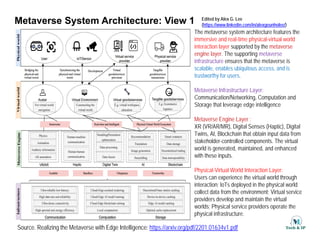
The metaverse system architecture features the
immersive and real-time physical-virtual world
interaction layer supported by the metaverse
Metaverse System Architecture: View 1 Edited by Alex G. Lee
(https://www.linkedin.com/in/alexgeunholee/)
interaction layer supported by the metaverse
engine layer. The supporting metaverse
infrastructure ensures that the metaverse is
scalable, enables ubiquitous access, and is
trustworthy for users
trustworthy for users.
Metaverse Infrastructure Layer:
Communication/Networking, Computation and
Storage that leverage edge intelligence
g g g g
Metaverse Engine Layer :
XR (VR/AR/MR), Digital Senses (Haptic), Digital
Twins, AI, Blockchain that obtain input data from
t k h ld t ll d t Th i t l
stakeholder-controlled components. The virtual
world is generated, maintained, and enhanced
with these inputs.
Physical Virtual World Interaction Layer:
Physical-Virtual World Interaction Layer:
Users can experience the virtual world through
interaction; IoTs deployed in the physical world
collect data from the environment; Virtual service
providers develop and maintain the virtual
p s p
worlds; Physical service providers operate the
physical infrastructure.
Source. Realizing the Metaverse with Edge Intelligence: https://arxiv.org/pdf/2201.01634v1.pdf
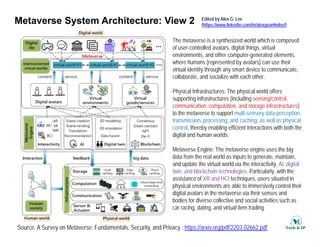
The metaverse is a synthesized world which is composed
f t ll d t di it l thi i t l
Metaverse System Architecture: View 2 Edited by Alex G. Lee
(https://www.linkedin.com/in/alexgeunholee/)
of user-controlled avatars, digital things, virtual
environments, and other computer-generated elements,
where humans (represented by avatars) can use their
virtual identity through any smart device to communicate,
collaborate and socialize with each other
collaborate, and socialize with each other.
Physical Infrastructures: The physical world offers
supporting infrastructures (including sensing/control,
communication, computation, and storage infrastructures)
co u cat o , co putat o , a d sto age ast uctu es)
to the metaverse to support multi-sensory data perception,
transmission, processing, and caching, as well as physical
control, thereby enabling efficient interactions with both the
digital and human worlds.
Metaverse Engine: The metaverse engine uses the big
data from the real world as inputs to generate, maintain,
and update the virtual world via the interactivity, AI, digital
twin and blockchain technologies Particularly with the
twin, and blockchain technologies. Particularly, with the
assistance of XR and HCI techniques, users situated in
physical environments are able to immersively control their
digital avatars in the metaverse via their senses and
bodies for diverse collective and social activities such as
car racing, dating, and virtual item trading.
Source. A Survey on Metaverse: Fundamentals, Security, and Privacy : https://arxiv.org/pdf/2203.02662.pdf
Metaverse System Architecture: View 3 Edited by Alex G. Lee
(https://www.linkedin.com/in/alexgeunholee/)
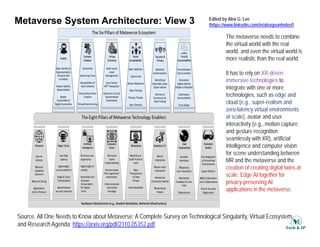
The metaverse needs to combine
the virtual world with the real
world, and even the virtual world is
more realistic than the real world.
It has to rely on XR-driven
immersive technologies to
integrate with one or more
technologies, such as edge and
cloud (e.g., super-realism and
l t i t l i t
zero-latency virtual environments
at scale), avatar and user
interactivity (e.g., motion capture
and gesture recognition
seamlessly with XR) artificial
seamlessly with XR), artificial
intelligence and computer vision
for scene understanding between
MR and the metaverse and the
creation of creating digital twins at
g g
scale, Edge AI together for
privacy-preserving AI
applications in the metaverse.
Source. All One Needs to Know about Metaverse: A Complete Survey on Technological Singularity, Virtual Ecosystem,
and Research Agenda: https://arxiv.org/pdf/2110.05352.pdf

Metaverse System Architectures

  • 1.
    The metaverse systemarchitecture features the immersive and real-time physical-virtual world interaction layer supported by the metaverse Metaverse System Architecture: View 1 Edited by Alex G. Lee (https://www.linkedin.com/in/alexgeunholee/) interaction layer supported by the metaverse engine layer. The supporting metaverse infrastructure ensures that the metaverse is scalable, enables ubiquitous access, and is trustworthy for users trustworthy for users. Metaverse Infrastructure Layer: Communication/Networking, Computation and Storage that leverage edge intelligence g g g g Metaverse Engine Layer : XR (VR/AR/MR), Digital Senses (Haptic), Digital Twins, AI, Blockchain that obtain input data from t k h ld t ll d t Th i t l stakeholder-controlled components. The virtual world is generated, maintained, and enhanced with these inputs. Physical Virtual World Interaction Layer: Physical-Virtual World Interaction Layer: Users can experience the virtual world through interaction; IoTs deployed in the physical world collect data from the environment; Virtual service providers develop and maintain the virtual p s p worlds; Physical service providers operate the physical infrastructure. Source. Realizing the Metaverse with Edge Intelligence: https://arxiv.org/pdf/2201.01634v1.pdf
  • 2.
    The metaverse isa synthesized world which is composed f t ll d t di it l thi i t l Metaverse System Architecture: View 2 Edited by Alex G. Lee (https://www.linkedin.com/in/alexgeunholee/) of user-controlled avatars, digital things, virtual environments, and other computer-generated elements, where humans (represented by avatars) can use their virtual identity through any smart device to communicate, collaborate and socialize with each other collaborate, and socialize with each other. Physical Infrastructures: The physical world offers supporting infrastructures (including sensing/control, communication, computation, and storage infrastructures) co u cat o , co putat o , a d sto age ast uctu es) to the metaverse to support multi-sensory data perception, transmission, processing, and caching, as well as physical control, thereby enabling efficient interactions with both the digital and human worlds. Metaverse Engine: The metaverse engine uses the big data from the real world as inputs to generate, maintain, and update the virtual world via the interactivity, AI, digital twin and blockchain technologies Particularly with the twin, and blockchain technologies. Particularly, with the assistance of XR and HCI techniques, users situated in physical environments are able to immersively control their digital avatars in the metaverse via their senses and bodies for diverse collective and social activities such as bodies for diverse collective and social activities such as car racing, dating, and virtual item trading. Source. A Survey on Metaverse: Fundamentals, Security, and Privacy : https://arxiv.org/pdf/2203.02662.pdf
  • 3.
    Metaverse System Architecture:View 3 Edited by Alex G. Lee (https://www.linkedin.com/in/alexgeunholee/) The metaverse needs to combine the virtual world with the real the virtual world with the real world, and even the virtual world is more realistic than the real world. It has to rely on XR-driven immersive technologies to integrate with one or more technologies, such as edge and cloud (e.g., super-realism and l t i t l i t zero-latency virtual environments at scale), avatar and user interactivity (e.g., motion capture and gesture recognition seamlessly with XR) artificial seamlessly with XR), artificial intelligence and computer vision for scene understanding between MR and the metaverse and the creation of creating digital twins at g g scale, Edge AI together for privacy-preserving AI applications in the metaverse. Source. All One Needs to Know about Metaverse: A Complete Survey on Technological Singularity, Virtual Ecosystem, and Research Agenda: https://arxiv.org/pdf/2110.05352.pdf