Additive Manufacturing of
Metals/Superalloys
Prepared by:Dr. Rahimah bintiAbdulHamid
BMMI 3174 RAPID MACHINING
https://www.youtube.com/watch?v=NYDzsPvywPc
Learning Outcomes
• T
o learn some techniques for Additive
Manufacturing of metals/superalloys.
• T
o explore the most common materials used in
metalAM.
RAH
https://www.youtube.com/watch?v=fzBRYsiyxjI
METAL ADDITIVEMANUFACTURING RAH
Introduction
• This lecture reviews the use of additive manufacturing
in fabrication of high performance superalloys (Ti-6Al-
4V,or Nickel basedsuperalloy).
• The advantages of additive manufacturing processes
include reduced time for the component
manufacturing/ development, little to no waste,
flexibility in manufacturing parts with directional
solidification, control of the porosity of the part and
the ability to produce finer microstructures due to
rapid heating and cooling cycles which is usually difficult
by the conventional manufacturing methods.
• Most of the metal additivemanufacturingtechnologies
use feedstock which is then melted by a concentrated
heat source such as laser or electron beam up to a
certain depth to fuse it layer by layer and cooled
afterwards to build asolid part.The feedstock used may
be in the form of wire or powder.
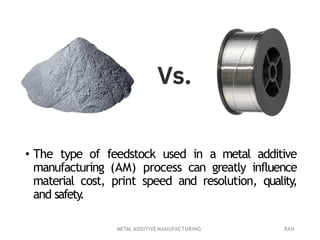
• The type of feedstock used in a metal additive
manufacturing (AM) process can greatly influence
material cost, print speed and resolution, quality
,
and safety
.
METAL ADDITIVEMANUFACTURING RAH
Classification of AM for
Manufacturing Metallic Components
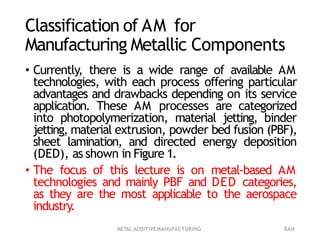
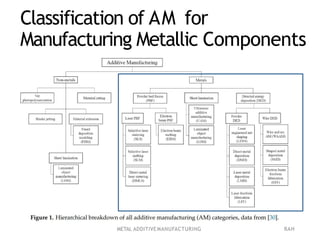
• Currently, there is a wide range of available AM
technologies, with each process offering particular
advantages and drawbacks depending on its service
application. These AM processes are categorized
into photopolymerization, material jetting, binder
jetting, material extrusion, powder bed fusion (PBF),
sheet lamination, and directed energy deposition
(DED), as shown in Figure 1.
• The focus of this lecture is on metal-based AM
technologies and mainly PBF and DED categories,
as they are the most applicable to the aerospace
industry.
Classification of AM for
Manufacturing Metallic Components
METAL ADDITIVEMANUFACTURING RAH
Nomenclatures for AM ofMetals
METAL ADDITIVEMANUFACTURING RAH
MostApplicable Techniques for
AM ofMetals
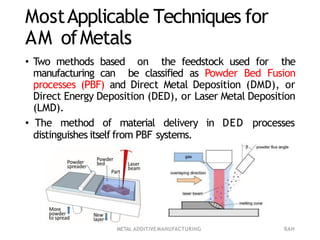
• Two methods based on the feedstock used for the
manufacturing can be classified as Powder Bed Fusion
processes (PBF) and Direct Metal Deposition (DMD), or
Direct Energy Deposition (DED), or Laser Metal Deposition
(LMD).
• The method of material delivery in DED processes
distinguishes itself from PBF systems.
METAL ADDITIVEMANUFACTURING RAH
Powder Bed Fusion (PBF)
Aglance
• More methods are developed based on the basic
PBF process such as Laser Beam Melting (LBM),
Electron Beam Melting (EBM), Direct Metal Laser
Sintering (DMLS), Laser Metal Fusion (LMF).
• PBF is among some of the first commercial
processes ofAM.
• PBF process uses thermal source to fuse the
powder particles layer by layer (either laser or
electron beam) – see nextslide.
• SLM and EBM, for example take place in a vacuum
to prevent unwanted oxidation.
Powder Bed Fusion (PBF)
Heat source
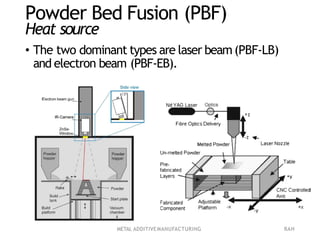
• The two dominant types are laser beam(PBF-LB)
and electron beam (PBF-EB).
METAL ADDITIVEMANUFACTURING RAH
Powder Bed Fusion (PBF)
Spread Mechanism
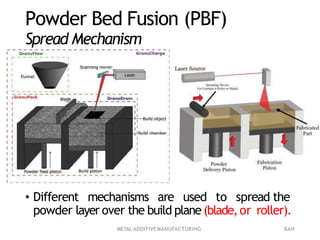
• Different mechanisms are used to spread the
powder layer over the build plane(blade,or roller).
METAL ADDITIVEMANUFACTURING RAH
Powder Bed Fusion (PBF)
Process
Step by Step
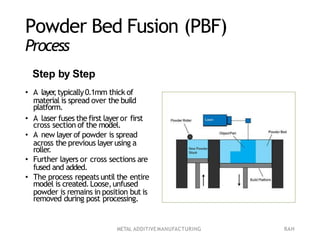
• A layer
,typically0.1mm thick of
material is spread over the build
platform.
• A laser fuses the first layeror first
cross section of the model.
• A new layerof powder is spread
across the previous layerusing a
roller
.
• Further layers or cross sections are
fused and added.
• The process repeats until the entire
model is created.Loose,unfused
powder is remains in position but is
removed during post processing.
METAL ADDITIVEMANUFACTURING RAH
Direct Energy Deposition (DED)
Aglance
• DED process manufactures parts by melting the
metal simultaneously as it is deposited.
• These methods use amore focused heat source.
• DED is increasingly used in hybrid manufacturing
where even the substrate bed is moved to create
complex shapes.
• Several types of additional processes havebeen
developed with this method such as Laser Metal
Deposition (LMD), Direct Metal Deposition
(DMD), Laser Engineered Net Shaping (LENS),etc.
Direct Energy Deposition (DED)
Process
Step by Step
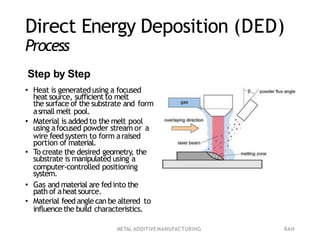
• Heat is generated using a focused
heat source, sufficient to melt
the surface of the substrate and form
asmall melt pool.
• Material is added to the melt pool
using afocused powder stream or a
wire feedsystem to form araised
portion of material.
• To create the desired geometry, the
substrate is manipulated using a
computer-controlled positioning
system.
• Gas and material are fedinto the
path of aheatsource.
• Material feed anglecan be altered to
influencethe build characteristics.
METAL ADDITIVEMANUFACTURING RAH
Direct Energy Deposition (DED)
Heat source
• There are three main heat sources used for direct
metaldeposition: Lasers are the most common, providing a
focused heat source down to fractions of amillimetre.They
require shielding from oxidation but do not require
a vacuum.
• Electron beamsystems are less common, providing the
smallest spot size and best beamdefinition. However, due to
the high attenuationof electrons by gases,
the process needs to be encapsulatedin a vacuum.
• Plasma arc techniques provide opportunities for much
greater deposition rates compared to laser and electron
beams.The heat source is analogous to a
GTAW welding system, melting the substrate with a plasma
arc.With high depositions rates and relatively large spot
sizes comes low precision, surface quality and feature
definition.
BMFR 4613 15
Direct Energy Deposition (DED)
Nozzle
• The usual mechanism
contains two types of
nozzles, one houses the
metal delivery system which
maybe powder or wire.
• The other type of nozzle
houses the energy sources
which immediatelymelts the
metal thatis coming out of
the nozzle while following
the building path/trajectory
fedby the CAD model.
• Both the energy source and
the material feednozzle are
manipulated using agantry
system or robotic arm.
METALADDITIVE MANUF
ACTURING RAH
Direct Energy Deposition (DED)
Application
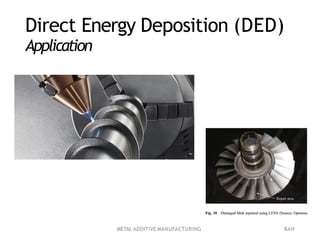
• Although it’spossible to create parts from scratch, due
to the nature of how the DED technology works,
currently its predominately used for repairing by adding
material to an existing part such as turbine blade repair
.
• DED was developed by Sandia National Laboratories in
1995 under the name of LENS (Laser Engineering Net
Shape) and then was commercialized by Optomec
Design Company.
• Due to the variations in the energy source and final
use, DED is sometimes referred to as laser metal
deposition (LMD), 3D laser cladding or direct
light fabrication.
BMFR 4613 17
Direct Energy Deposition (DED)
Application
METAL ADDITIVE MANUFACTURING RAH
The two widely used processes used for
manufacturing of metal alloy components are the
Laser Beam Melting (LBM) or SelectiveLaser Melting
(SLM) and Electron Beam Melting (EBM).
RAH
End of lecture.
Thank you.

Metal Additive Manufacturing notes ().pdf

  • 1.
    Additive Manufacturing of Metals/Superalloys Preparedby:Dr. Rahimah bintiAbdulHamid BMMI 3174 RAPID MACHINING https://www.youtube.com/watch?v=NYDzsPvywPc
  • 2.
    Learning Outcomes • T olearn some techniques for Additive Manufacturing of metals/superalloys. • T o explore the most common materials used in metalAM. RAH https://www.youtube.com/watch?v=fzBRYsiyxjI
  • 3.
    METAL ADDITIVEMANUFACTURING RAH Introduction •This lecture reviews the use of additive manufacturing in fabrication of high performance superalloys (Ti-6Al- 4V,or Nickel basedsuperalloy). • The advantages of additive manufacturing processes include reduced time for the component manufacturing/ development, little to no waste, flexibility in manufacturing parts with directional solidification, control of the porosity of the part and the ability to produce finer microstructures due to rapid heating and cooling cycles which is usually difficult by the conventional manufacturing methods. • Most of the metal additivemanufacturingtechnologies use feedstock which is then melted by a concentrated heat source such as laser or electron beam up to a certain depth to fuse it layer by layer and cooled afterwards to build asolid part.The feedstock used may be in the form of wire or powder.
  • 4.
    • The typeof feedstock used in a metal additive manufacturing (AM) process can greatly influence material cost, print speed and resolution, quality , and safety . METAL ADDITIVEMANUFACTURING RAH
  • 5.
    METAL ADDITIVEMANUFACTURING RAH Classificationof AM for Manufacturing Metallic Components • Currently, there is a wide range of available AM technologies, with each process offering particular advantages and drawbacks depending on its service application. These AM processes are categorized into photopolymerization, material jetting, binder jetting, material extrusion, powder bed fusion (PBF), sheet lamination, and directed energy deposition (DED), as shown in Figure 1. • The focus of this lecture is on metal-based AM technologies and mainly PBF and DED categories, as they are the most applicable to the aerospace industry.
  • 6.
    Classification of AMfor Manufacturing Metallic Components METAL ADDITIVEMANUFACTURING RAH
  • 7.
    Nomenclatures for AMofMetals METAL ADDITIVEMANUFACTURING RAH
  • 8.
    MostApplicable Techniques for AMofMetals • Two methods based on the feedstock used for the manufacturing can be classified as Powder Bed Fusion processes (PBF) and Direct Metal Deposition (DMD), or Direct Energy Deposition (DED), or Laser Metal Deposition (LMD). • The method of material delivery in DED processes distinguishes itself from PBF systems. METAL ADDITIVEMANUFACTURING RAH
  • 9.
    METAL ADDITIVEMANUFACTURING RAH PowderBed Fusion (PBF) Aglance • More methods are developed based on the basic PBF process such as Laser Beam Melting (LBM), Electron Beam Melting (EBM), Direct Metal Laser Sintering (DMLS), Laser Metal Fusion (LMF). • PBF is among some of the first commercial processes ofAM. • PBF process uses thermal source to fuse the powder particles layer by layer (either laser or electron beam) – see nextslide. • SLM and EBM, for example take place in a vacuum to prevent unwanted oxidation.
  • 10.
    Powder Bed Fusion(PBF) Heat source • The two dominant types are laser beam(PBF-LB) and electron beam (PBF-EB). METAL ADDITIVEMANUFACTURING RAH
  • 11.
    Powder Bed Fusion(PBF) Spread Mechanism • Different mechanisms are used to spread the powder layer over the build plane(blade,or roller). METAL ADDITIVEMANUFACTURING RAH
  • 12.
    Powder Bed Fusion(PBF) Process Step by Step • A layer ,typically0.1mm thick of material is spread over the build platform. • A laser fuses the first layeror first cross section of the model. • A new layerof powder is spread across the previous layerusing a roller . • Further layers or cross sections are fused and added. • The process repeats until the entire model is created.Loose,unfused powder is remains in position but is removed during post processing. METAL ADDITIVEMANUFACTURING RAH
  • 13.
    METAL ADDITIVEMANUFACTURING RAH DirectEnergy Deposition (DED) Aglance • DED process manufactures parts by melting the metal simultaneously as it is deposited. • These methods use amore focused heat source. • DED is increasingly used in hybrid manufacturing where even the substrate bed is moved to create complex shapes. • Several types of additional processes havebeen developed with this method such as Laser Metal Deposition (LMD), Direct Metal Deposition (DMD), Laser Engineered Net Shaping (LENS),etc.
  • 14.
    Direct Energy Deposition(DED) Process Step by Step • Heat is generated using a focused heat source, sufficient to melt the surface of the substrate and form asmall melt pool. • Material is added to the melt pool using afocused powder stream or a wire feedsystem to form araised portion of material. • To create the desired geometry, the substrate is manipulated using a computer-controlled positioning system. • Gas and material are fedinto the path of aheatsource. • Material feed anglecan be altered to influencethe build characteristics. METAL ADDITIVEMANUFACTURING RAH
  • 15.
    Direct Energy Deposition(DED) Heat source • There are three main heat sources used for direct metaldeposition: Lasers are the most common, providing a focused heat source down to fractions of amillimetre.They require shielding from oxidation but do not require a vacuum. • Electron beamsystems are less common, providing the smallest spot size and best beamdefinition. However, due to the high attenuationof electrons by gases, the process needs to be encapsulatedin a vacuum. • Plasma arc techniques provide opportunities for much greater deposition rates compared to laser and electron beams.The heat source is analogous to a GTAW welding system, melting the substrate with a plasma arc.With high depositions rates and relatively large spot sizes comes low precision, surface quality and feature definition. BMFR 4613 15
  • 16.
    Direct Energy Deposition(DED) Nozzle • The usual mechanism contains two types of nozzles, one houses the metal delivery system which maybe powder or wire. • The other type of nozzle houses the energy sources which immediatelymelts the metal thatis coming out of the nozzle while following the building path/trajectory fedby the CAD model. • Both the energy source and the material feednozzle are manipulated using agantry system or robotic arm. METALADDITIVE MANUF ACTURING RAH
  • 17.
    Direct Energy Deposition(DED) Application • Although it’spossible to create parts from scratch, due to the nature of how the DED technology works, currently its predominately used for repairing by adding material to an existing part such as turbine blade repair . • DED was developed by Sandia National Laboratories in 1995 under the name of LENS (Laser Engineering Net Shape) and then was commercialized by Optomec Design Company. • Due to the variations in the energy source and final use, DED is sometimes referred to as laser metal deposition (LMD), 3D laser cladding or direct light fabrication. BMFR 4613 17
  • 18.
    Direct Energy Deposition(DED) Application METAL ADDITIVE MANUFACTURING RAH
  • 19.
  • 20.
    METAL ADDITIVE MANUFACTURINGRAH The two widely used processes used for manufacturing of metal alloy components are the Laser Beam Melting (LBM) or SelectiveLaser Melting (SLM) and Electron Beam Melting (EBM).
  • 21.