The Metabolic Syndrome
The Lifestyle Disease
Dr Dharmendra Kumar
Dept of Physiology
AFMC, Pune
“... good health is more than just exercise and diet. It’s really a point of
view and a mental attitude you have about yourself.”
....Albert Schweitzer
Scope
• Introduction
• History
• Pathophysiology
• Recent advances
• Summary & conclusion
• Take home message
2
Metabolic syndrome is also known as:
• Metabolic syndrome X
• Insulin resistance syndrome
• Visceral fat syndrome
• Multiple risk factor clustering syndrome
• Cardiometabolic syndrome
• Obesity dyslipidemia syndrome
• Reaven's syndrome (named for Dr. Gerald Reaven)
3
Introduction
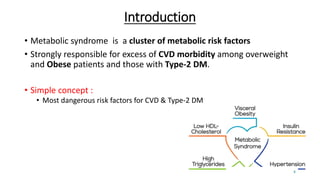
• Metabolic syndrome is a cluster of metabolic risk factors
• Strongly responsible for excess of CVD morbidity among overweight
and Obese patients and those with Type-2 DM.
• Simple concept :
• Most dangerous risk factors for CVD & Type-2 DM
4
Introduction
Globally:
• The NHANES 1999-2002 database shows Overall prevalence 34.5%
• Risk
- 2 times mortality
- 3 times- CVD or stroke
- 5-7 times- diabetes type 2
• Prevalence increases with weight.
• 5% of normal weight, 22% of overweight, and 60% of obese
• Gained significant importance recently
• NCEP-ATP III
• An independent risk factor for CVD
5
History
• 250 ys ago , Morgagni : visceral fat and HTN, Atherosclerosis
• First World War- metabolic abnormalities, relation b/w DM &HTN
• 1920- word clustering, risk factors associated with diabetes
• 1930-1950- non-communicable disease era
• 1947: French Jean Vague-. Central obesity, excess fat--metabolic complications
• Various term:
• 1950 : Term Metabolic syndrome
• 1960 : Plurimetabolic Syndrome
• 1980 : Syndrome X : glucose & insulin metab + obesity
• 1988: Dr Gerald Reaven’s - Insulin sensitivity - risk CHD - insulin resistance
• Various definition
• 1998, 2001, 2005/6, 2009
6
Definitions of the Metabolic Syndrome
• According to clinical outcomes
• According to underlying causes
• Insulin resistance-WHO definition
• Lifestyle: especially obesity- NCEP ATP III
• According to metabolic components
• According to clinical criteria
7
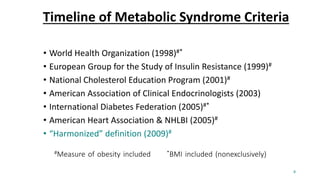
Timeline of Metabolic Syndrome Criteria
• World Health Organization (1998)#*
• European Group for the Study of Insulin Resistance (1999)#
• National Cholesterol Education Program (2001)#
• American Association of Clinical Endocrinologists (2003)
• International Diabetes Federation (2005)#*
• American Heart Association & NHLBI (2005)#
• “Harmonized” definition (2009)#
#Measure of obesity included *BMI included (nonexclusively)
8
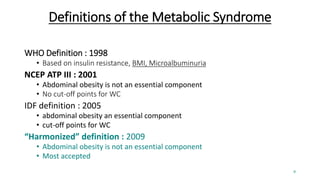
Definitions of the Metabolic Syndrome
WHO Definition : 1998
• Based on insulin resistance, BMI, Microalbuminuria
NCEP ATP III : 2001
• Abdominal obesity is not an essential component
• No cut-off points for WC
IDF definition : 2005
• abdominal obesity an essential component
• cut-off points for WC
“Harmonized” definition : 2009
• Abdominal obesity is not an essential component
• Most accepted
9
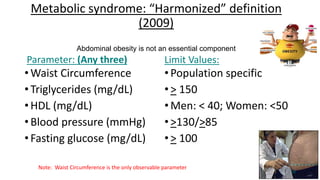
Metabolic syndrome: “Harmonized” definition
(2009)
Abdominal obesity is not an essential component
Parameter: (Any three)
•Waist Circumference
•Triglycerides (mg/dL)
•HDL (mg/dL)
•Blood pressure (mmHg)
•Fasting glucose (mg/dL)
Limit Values:
•Population specific
•> 150
•Men: < 40; Women: <50
•>130/>85
•> 100
Note: Waist Circumference is the only observable parameter
10
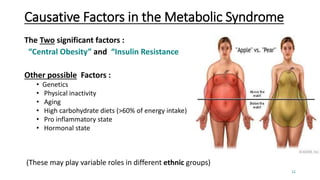
Causative Factors in the Metabolic Syndrome
The Two significant factors :
“Central Obesity” and “Insulin Resistance
Other possible Factors :
• Genetics
• Physical inactivity
• Aging
• High carbohydrate diets (>60% of energy intake)
• Pro inflammatory state
• Hormonal state
(These may play variable roles in different ethnic groups)
11
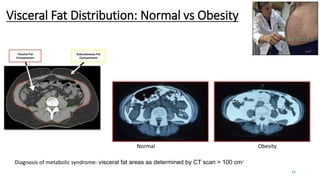
Normal Obesity
Visceral Fat Distribution: Normal vs Obesity
Diagnosis of metabolic syndrome- visceral fat areas as determined by CT scan > 100 cm2
12
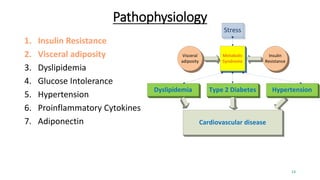
Pathophysiology
1. Insulin Resistance
2. Visceral adiposity
3. Dyslipidemia
4. Glucose Intolerance
5. Hypertension
6. Proinflammatory Cytokines
7. Adiponectin
Metabolic
Syndrome
Visceral
adiposity
Insulin
Resistance
Cardiovascular disease
Dyslipidemia Type 2 Diabetes Hypertension
Stress
13
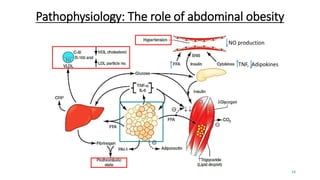
TNF, Adipokines
NO production
Pathophysiology: The role of abdominal obesity
14
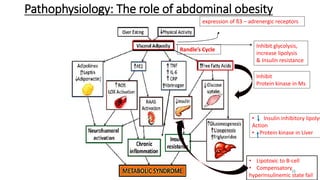
Inhibit
Protein kinase in Ms
• Insulin inhibitory lipolys
Action
• Protein kinase in Liver
expression of ß3 – adrenergic receptors
Randle’s Cycle
Inhibit glycolysis,
increase lipolysis
& Insulin resistance
Pathophysiology: The role of abdominal obesity
15
• Lipotoxic to B-cell
• Compensatory
hyperinsulinemic state fail
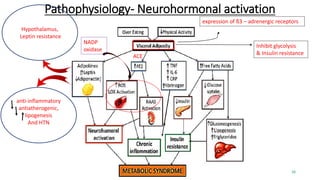
Pathophysiology- Neurohormonal activation
expression of ß3 – adrenergic receptors
Inhibit glycolysis
& Insulin resistance
anti-inflammatory
antiatherogenic,
lipogenesis
And HTN
Hypothalamus,
Leptin resistance
NADP
oxidase
ACE
16
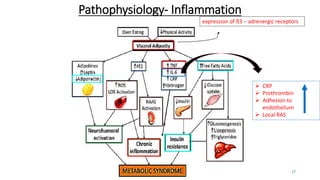
Pathophysiology- Inflammation
expression of ß3 – adrenergic receptors
17
 CRP
 Prothrombin
 Adhesion to
endothelium
 Local RAS
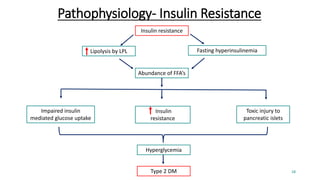
Pathophysiology- Insulin Resistance
Fasting hyperinsulinemia
Insulin resistance
Lipolysis by LPL
Toxic injury to
pancreatic islets
Insulin
resistance
Type 2 DM
Impaired insulin
mediated glucose uptake
Hyperglycemia
Abundance of FFA’s
18
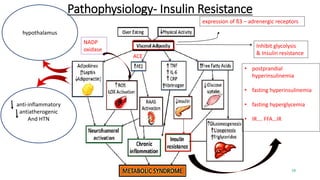
Pathophysiology- Insulin Resistance
expression of ß3 – adrenergic receptors
Inhibit glycolysis
& Insulin resistance
anti-inflammatory
antiatherogenic
And HTN
hypothalamus
NADP
oxidase
ACE
• postprandial
hyperinsulinemia
• fasting hyperinsulinemia
• fasting hyperglycemia
• IR…. FFA…IR
19
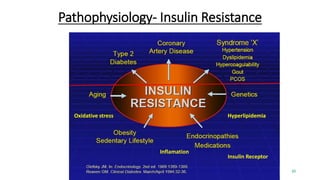
Pathophysiology- Insulin Resistance
20
Hyperlipidemia
Inflamation
Oxidative stress
Insulin Receptor
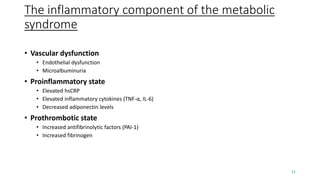
The inflammatory component of the metabolic
syndrome
• Vascular dysfunction
• Endothelial dysfunction
• Microalbuminuria
• Proinflammatory state
• Elevated hsCRP
• Elevated inflammatory cytokines (TNF-α, IL-6)
• Decreased adiponectin levels
• Prothrombotic state
• Increased antifibrinolytic factors (PAI-1)
• Increased fibrinogen
21
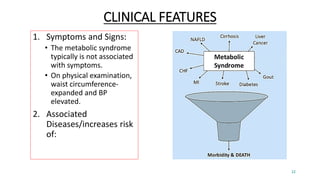
CLINICAL FEATURES
1. Symptoms and Signs:
• The metabolic syndrome
typically is not associated
with symptoms.
• On physical examination,
waist circumference-
expanded and BP
elevated.
2. Associated
Diseases/increases risk
of:
22
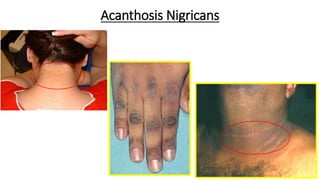
Acanthosis Nigricans
23
DIAGNOSIS
• Purpose:
• Reduce the multiple risk factors
• Lifestyle modification
• History/examination
• Bedside and laboratory test
• fasting lipids and glucose
• biomarkers associated with insulin resistance
• ApoB, hsCRP, fibrinogen, urinary microalbumin, and liver function.
• sleep study
24
Therapeutic Goals for Management
LIFESTYLE
Diet
Physical Activity
Behavior Modification
Obesity
Drugs:
• LDL cholesterol
• Triglycerides
• HDL cholesterol
• Blood pressure
• Impaired fasting glucose
• Insulin resistance
25
Applied aspects
• Insulin resistance
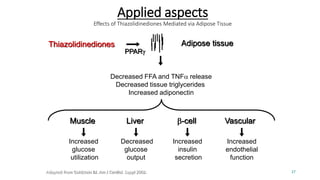
• Thiazolidinediones (rosiglitazone, insulin sensitizing drug)
• Leptin resistance
• Congenital leptin deficiency
• Lifestyle disorders
26
Thiazolidinediones Adipose tissue
Muscle Liver
Decreased FFA and TNFa release
Decreased tissue triglycerides
Increased adiponectin
Decreased
glucose
output
Increased
glucose
utilization
b-cell
Increased
insulin
secretion
Vascular
Increased
endothelial
function
PPARg
Adapted from Goldstein BJ. Am J Cardiol. Suppl 2002.
Applied aspects
Effects of Thiazolidinediones Mediated via Adipose Tissue
27
Recent advances
• New generation of PPAR agonists,
• Interact with both PPARα and γ-receptors, thereby combining lipid and
glycaemic effects.
• Protein tyrosine phosphatase 1B inhibitors (PTP1B)
• Act as a negative regulator of insulin and leptin receptor signalling pathways.
• Leptin receptor antagonists and offer potential as future therapies
28
Summary & Conclusions
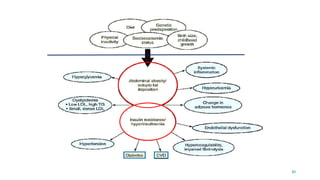
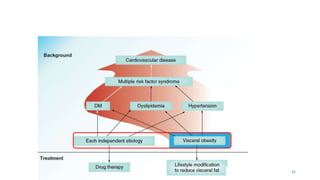
• Global epidemic
• Variations exist in the diagnostic criteria and definition
• The concept of metabolic syndrome
• Based on visceral fat accumulation & Insulin resistance
• Major target for the prevention of cardiovascular disease
• Lifestyle modification
29
30
31
Takeaway message
• Hidden volcano
• Screening >3 yrs
• Evaluation ≥25 yrs
• We should not wait till
these killers develop
Thank
You
32
"The doctor of the future will give no medicine,
but will interest his patients in the care of the
human body, in diet, and in the cause and
prevention of disease." .... Thomas Edison
So, what can you do?
The Lifestyle Disease
33

Metabolic syndrome

  • 1.
    The Metabolic Syndrome TheLifestyle Disease Dr Dharmendra Kumar Dept of Physiology AFMC, Pune “... good health is more than just exercise and diet. It’s really a point of view and a mental attitude you have about yourself.” ....Albert Schweitzer
  • 2.
    Scope • Introduction • History •Pathophysiology • Recent advances • Summary & conclusion • Take home message 2
  • 3.
    Metabolic syndrome isalso known as: • Metabolic syndrome X • Insulin resistance syndrome • Visceral fat syndrome • Multiple risk factor clustering syndrome • Cardiometabolic syndrome • Obesity dyslipidemia syndrome • Reaven's syndrome (named for Dr. Gerald Reaven) 3
  • 4.
    Introduction • Metabolic syndromeis a cluster of metabolic risk factors • Strongly responsible for excess of CVD morbidity among overweight and Obese patients and those with Type-2 DM. • Simple concept : • Most dangerous risk factors for CVD & Type-2 DM 4
  • 5.
    Introduction Globally: • The NHANES1999-2002 database shows Overall prevalence 34.5% • Risk - 2 times mortality - 3 times- CVD or stroke - 5-7 times- diabetes type 2 • Prevalence increases with weight. • 5% of normal weight, 22% of overweight, and 60% of obese • Gained significant importance recently • NCEP-ATP III • An independent risk factor for CVD 5
  • 6.
    History • 250 ysago , Morgagni : visceral fat and HTN, Atherosclerosis • First World War- metabolic abnormalities, relation b/w DM &HTN • 1920- word clustering, risk factors associated with diabetes • 1930-1950- non-communicable disease era • 1947: French Jean Vague-. Central obesity, excess fat--metabolic complications • Various term: • 1950 : Term Metabolic syndrome • 1960 : Plurimetabolic Syndrome • 1980 : Syndrome X : glucose & insulin metab + obesity • 1988: Dr Gerald Reaven’s - Insulin sensitivity - risk CHD - insulin resistance • Various definition • 1998, 2001, 2005/6, 2009 6
  • 7.
    Definitions of theMetabolic Syndrome • According to clinical outcomes • According to underlying causes • Insulin resistance-WHO definition • Lifestyle: especially obesity- NCEP ATP III • According to metabolic components • According to clinical criteria 7
  • 8.
    Timeline of MetabolicSyndrome Criteria • World Health Organization (1998)#* • European Group for the Study of Insulin Resistance (1999)# • National Cholesterol Education Program (2001)# • American Association of Clinical Endocrinologists (2003) • International Diabetes Federation (2005)#* • American Heart Association & NHLBI (2005)# • “Harmonized” definition (2009)# #Measure of obesity included *BMI included (nonexclusively) 8
  • 9.
    Definitions of theMetabolic Syndrome WHO Definition : 1998 • Based on insulin resistance, BMI, Microalbuminuria NCEP ATP III : 2001 • Abdominal obesity is not an essential component • No cut-off points for WC IDF definition : 2005 • abdominal obesity an essential component • cut-off points for WC “Harmonized” definition : 2009 • Abdominal obesity is not an essential component • Most accepted 9
  • 10.
    Metabolic syndrome: “Harmonized”definition (2009) Abdominal obesity is not an essential component Parameter: (Any three) •Waist Circumference •Triglycerides (mg/dL) •HDL (mg/dL) •Blood pressure (mmHg) •Fasting glucose (mg/dL) Limit Values: •Population specific •> 150 •Men: < 40; Women: <50 •>130/>85 •> 100 Note: Waist Circumference is the only observable parameter 10
  • 11.
    Causative Factors inthe Metabolic Syndrome The Two significant factors : “Central Obesity” and “Insulin Resistance Other possible Factors : • Genetics • Physical inactivity • Aging • High carbohydrate diets (>60% of energy intake) • Pro inflammatory state • Hormonal state (These may play variable roles in different ethnic groups) 11
  • 12.
    Normal Obesity Visceral FatDistribution: Normal vs Obesity Diagnosis of metabolic syndrome- visceral fat areas as determined by CT scan > 100 cm2 12
  • 13.
    Pathophysiology 1. Insulin Resistance 2.Visceral adiposity 3. Dyslipidemia 4. Glucose Intolerance 5. Hypertension 6. Proinflammatory Cytokines 7. Adiponectin Metabolic Syndrome Visceral adiposity Insulin Resistance Cardiovascular disease Dyslipidemia Type 2 Diabetes Hypertension Stress 13
  • 14.
    TNF, Adipokines NO production Pathophysiology:The role of abdominal obesity 14
  • 15.
    Inhibit Protein kinase inMs • Insulin inhibitory lipolys Action • Protein kinase in Liver expression of ß3 – adrenergic receptors Randle’s Cycle Inhibit glycolysis, increase lipolysis & Insulin resistance Pathophysiology: The role of abdominal obesity 15 • Lipotoxic to B-cell • Compensatory hyperinsulinemic state fail
  • 16.
    Pathophysiology- Neurohormonal activation expressionof ß3 – adrenergic receptors Inhibit glycolysis & Insulin resistance anti-inflammatory antiatherogenic, lipogenesis And HTN Hypothalamus, Leptin resistance NADP oxidase ACE 16
  • 17.
    Pathophysiology- Inflammation expression ofß3 – adrenergic receptors 17  CRP  Prothrombin  Adhesion to endothelium  Local RAS
  • 18.
    Pathophysiology- Insulin Resistance Fastinghyperinsulinemia Insulin resistance Lipolysis by LPL Toxic injury to pancreatic islets Insulin resistance Type 2 DM Impaired insulin mediated glucose uptake Hyperglycemia Abundance of FFA’s 18
  • 19.
    Pathophysiology- Insulin Resistance expressionof ß3 – adrenergic receptors Inhibit glycolysis & Insulin resistance anti-inflammatory antiatherogenic And HTN hypothalamus NADP oxidase ACE • postprandial hyperinsulinemia • fasting hyperinsulinemia • fasting hyperglycemia • IR…. FFA…IR 19
  • 20.
  • 21.
    The inflammatory componentof the metabolic syndrome • Vascular dysfunction • Endothelial dysfunction • Microalbuminuria • Proinflammatory state • Elevated hsCRP • Elevated inflammatory cytokines (TNF-α, IL-6) • Decreased adiponectin levels • Prothrombotic state • Increased antifibrinolytic factors (PAI-1) • Increased fibrinogen 21
  • 22.
    CLINICAL FEATURES 1. Symptomsand Signs: • The metabolic syndrome typically is not associated with symptoms. • On physical examination, waist circumference- expanded and BP elevated. 2. Associated Diseases/increases risk of: 22
  • 23.
  • 24.
    DIAGNOSIS • Purpose: • Reducethe multiple risk factors • Lifestyle modification • History/examination • Bedside and laboratory test • fasting lipids and glucose • biomarkers associated with insulin resistance • ApoB, hsCRP, fibrinogen, urinary microalbumin, and liver function. • sleep study 24
  • 25.
    Therapeutic Goals forManagement LIFESTYLE Diet Physical Activity Behavior Modification Obesity Drugs: • LDL cholesterol • Triglycerides • HDL cholesterol • Blood pressure • Impaired fasting glucose • Insulin resistance 25
  • 26.
    Applied aspects • Insulinresistance • Thiazolidinediones (rosiglitazone, insulin sensitizing drug) • Leptin resistance • Congenital leptin deficiency • Lifestyle disorders 26
  • 27.
    Thiazolidinediones Adipose tissue MuscleLiver Decreased FFA and TNFa release Decreased tissue triglycerides Increased adiponectin Decreased glucose output Increased glucose utilization b-cell Increased insulin secretion Vascular Increased endothelial function PPARg Adapted from Goldstein BJ. Am J Cardiol. Suppl 2002. Applied aspects Effects of Thiazolidinediones Mediated via Adipose Tissue 27
  • 28.
    Recent advances • Newgeneration of PPAR agonists, • Interact with both PPARα and γ-receptors, thereby combining lipid and glycaemic effects. • Protein tyrosine phosphatase 1B inhibitors (PTP1B) • Act as a negative regulator of insulin and leptin receptor signalling pathways. • Leptin receptor antagonists and offer potential as future therapies 28
  • 29.
    Summary & Conclusions •Global epidemic • Variations exist in the diagnostic criteria and definition • The concept of metabolic syndrome • Based on visceral fat accumulation & Insulin resistance • Major target for the prevention of cardiovascular disease • Lifestyle modification 29
  • 30.
  • 31.
  • 32.
    Takeaway message • Hiddenvolcano • Screening >3 yrs • Evaluation ≥25 yrs • We should not wait till these killers develop Thank You 32
  • 33.
    "The doctor ofthe future will give no medicine, but will interest his patients in the care of the human body, in diet, and in the cause and prevention of disease." .... Thomas Edison So, what can you do? The Lifestyle Disease 33