METABOLIC SYNDROME
Dr. Erwin D. Torres
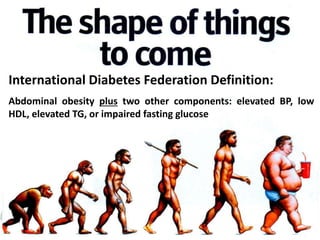
International Diabetes Federation Definition:
Abdominal obesity plus two other components: elevated BP, low
HDL, elevated TG, or impaired fasting glucose
Definition
Constellation of metabolic
abnormalities that confer increased
risk of cardiovascular disease(CVD) and
diabetes mellitus.
Alternative names
• Metabolic syndrome
• Syndrome X
• Insulin resistance syndrome
• Deadly quartet
• Reaven’s syndrome
The major features of metabolic syndrome include
Central obesity
Hypertrilgyceridemia
Low high density lipoprotein (HDL)
Hyperglycemia
hypertension
EPIDEMIOLOGY
• Prevalence increases with age
• Greater industrialization and urbanization
• Increase in waist circumference is found predominantly
in women.
• Fasting TG>150 mg/dl and hypertension more likely in
men.
Risk factors
• Overweight/ obesity- central (key feature)
• Sedentary lifestyle
 Predictor of CVd events and associted mortality
 Associated with central obesity, TG’s, HDL, BP, glucose
intolerance
• Aging- prevalence increases with age
• Diabetes mellitus- approx. 75% of T2DM or IGT have metabolic syndrome
• Coronary heart disease- 50% of CHD patients have metabolic syndrome
•
• About 1/3rd of MS patients have premature CAD
• Lipodystrophy- both genetic or acquired have severe insulin resistance
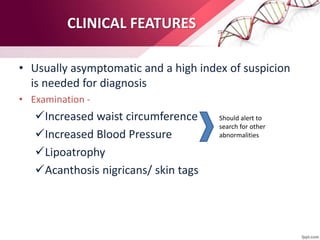
CLINICAL FEATURES
• Usually asymptomatic and a high index of suspicion
is needed for diagnosis
• Examination -
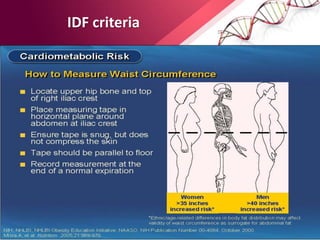
Increased waist circumference
Increased Blood Pressure
Lipoatrophy
Acanthosis nigricans/ skin tags
Should alert to
search for other
abnormalities
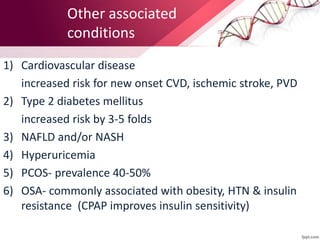
Other associated
conditions
1) Cardiovascular disease
increased risk for new onset CVD, ischemic stroke, PVD
2) Type 2 diabetes mellitus
increased risk by 3-5 folds
3) NAFLD and/or NASH
4) Hyperuricemia
5) PCOS- prevalence 40-50%
6) OSA- commonly associated with obesity, HTN & insulin
resistance (CPAP improves insulin sensitivity)
IDF criteria
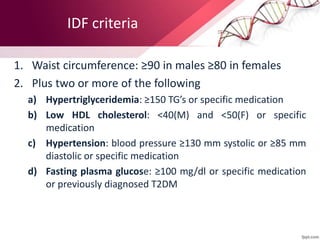
1. Waist circumference: ≥90 in males ≥80 in females
2. Plus two or more of the following
a) Hypertriglyceridemia: ≥150 TG’s or specific medication
b) Low HDL cholesterol: <40(M) and <50(F) or specific
medication
c) Hypertension: blood pressure ≥130 mm systolic or ≥85 mm
diastolic or specific medication
d) Fasting plasma glucose: ≥100 mg/dl or specific medication
or previously diagnosed T2DM
IDF criteria
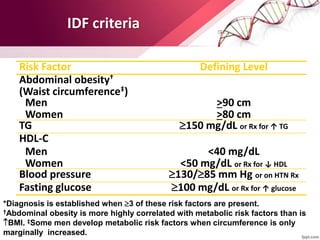
*Diagnosis is established when 3 of these risk factors are present.
†Abdominal obesity is more highly correlated with metabolic risk factors than is
BMI. ‡Some men develop metabolic risk factors when circumference is only
marginally increased.
<40 mg/dL
<50 mg/dL or Rx for ↓ HDL
Men
Women
>90 cm
>80 cm
Men
Women
100 mg/dL or Rx for ↑ glucose
Fasting glucose
130/85 mm Hg or on HTN Rx
Blood pressure
HDL-C
150 mg/dL or Rx for ↑ TG
TG
Abdominal obesity†
(Waist circumference‡)
Defining Level
Risk Factor
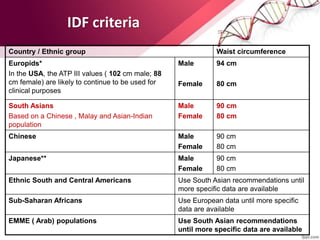
Waist circumference
Country / Ethnic group
94 cm
80 cm
Male
Female
Europids*
In the USA, the ATP III values ( 102 cm male; 88
cm female) are likely to continue to be used for
clinical purposes
90 cm
80 cm
Male
Female
South Asians
Based on a Chinese , Malay and Asian-Indian
population
90 cm
80 cm
Male
Female
Chinese
90 cm
80 cm
Male
Female
Japanese**
Use South Asian recommendations until
more specific data are available
Ethnic South and Central Americans
Use European data until more specific
data are available
Sub-Saharan Africans
Use South Asian recommendations
until more specific data are available
EMME ( Arab) populations
IDF criteria
IDF criteria
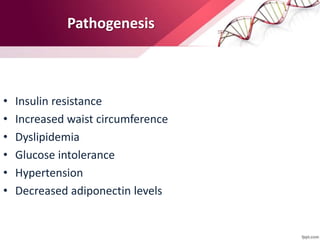
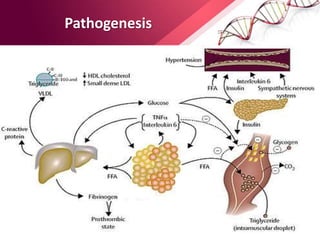
Pathogenesis
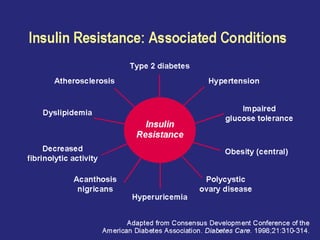
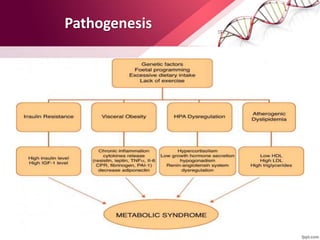
• Insulin resistance
• Increased waist circumference
• Dyslipidemia
• Glucose intolerance
• Hypertension
• Decreased adiponectin levels
Pathogenesis
Pathogenesis
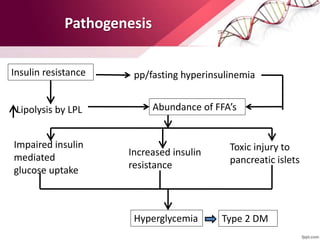
Impaired insulin
mediated
glucose uptake
Toxic injury to
pancreatic islets
Increased insulin
resistance
Hyperglycemia Type 2 DM
Insulin resistance pp/fasting hyperinsulinemia
Lipolysis by LPL Abundance of FFA’s
Pathogenesis
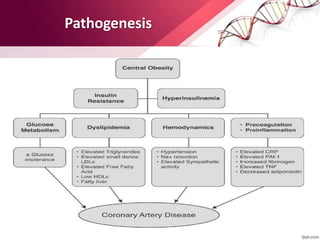
Pathogenesis
TREATMENT
LIFESTYLE
MODIFICATIONS
• Weight reduction- include a combination of caloric restriction,
increased physical activity, and behavior modification.
• ~500 kcal restriction daily equates to weight reduction of 1 lb per
week.
• Diets restricted in carbohydrate typically provide a rapid initial
weight loss.
• Adherence to the diet is more important than which diet is
chosen.
• A high-quality diet— i.e., enriched in fruits, vegetables, whole
grains, lean poultry, and fish—should be encouraged to provide
the maximum overall health benefit.
DIET---
What to do..?
PHYSICAL ACTIVITY-
• 60–90 min of daily activity (At least 30 min.) Gradual increases in
physical activity should be encouraged to enhance adherence and
avoid injury.
• Some high-risk patients should undergo formal cardiovascular
evaluation before initiating an exercise program.
• Physical activity could be formal exercise such as jogging,
swimming, or tennis or routine activities, such as gardening,
walking, and housecleaning.
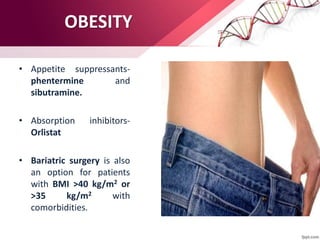
• Appetite suppressants-
phentermine and
sibutramine.
• Absorption inhibitors-
Orlistat
• Bariatric surgery is also
an option for patients
with BMI >40 kg/m2 or
>35 kg/m2 with
comorbidities.
OBESITY
TRIGLYCERIDES
• A fasting triglyceride value of <150 mg/dL is
recommended. A weight reduction of >10% is necessary
to lower fasting triglycerides.
• A fibrate (gemfibrozil or fenofibrate) is the drug of
choice to lower fasting triglycerides and typically achieve
a 35–50% reduction.
• Other drugs that lower triglycerides include statins,
nicotinic acid, and high doses of omega-3 fatty acids.
HDL Cholesterol
• For rise in HDL cholesterol, weight reduction is an important
strategy.
• Nicotinic acid is the only currently available drug with
predictable HDL cholesterol-raising properties.
• Statins, fibrates, and bile acid sequestrants have modest
effects (5–10%), and there is no effect on HDL cholesterol
with ezetimibe or omega-3 fatty acids.
LDL Cholesterol
For patients with the metabolic syndrome and diabetes, LDL
cholesterol should be reduced to <100 mg/dL.
BLOOD PRESSURE
• The direct relationship between blood pressure and all-cause
mortality rate has been well established.
• Best choice for the first antihypertensive should usually be an
angiotensin-converting enzyme (ACE) inhibitor or an angiotensin II
receptor blocker.
• In all patients with hypertension, a sodium-restricted diet enriched
in fruits and vegetables and low-fat dairy products should be
advocated.
INSULIN RESISTANCE
• Insulin resistance is the primary Patho-physiologic mechanism for the
metabolic syndrome.
• Several drug classes [biguanides, thiazolidinediones (TZDs)] increase insulin
sensitivity.
• Both metformin and TZDs enhance insulin action in the liver and suppress
endogenous glucose production. TZDs, but not metformin, also improve
insulin-mediated glucose uptake in muscle and adipose tissue.
• Benefits of both drugs have also been seen in patients with NAFLD and PCOS,
and the drugs have been shown to reduce markers of inflammation and small
dense LDL.
GLYCEMIC CONTROL
• In patients with the metabolic syndrome and Type 2 diabetes,
aggressive glycemic control decreases cardiovascular risk..
• In patients with IFG without a diagnosis of diabetes, a lifestyle
intervention has been shown to reduce the incidence of Type 2
diabetes.
• Metformin has also been shown to reduce the incidence of diabetes,
although the effect was less than that seen with lifestyle intervention.
PROTHROMBOTIC &
PROINFLAMMATORY STATE
• Most patients with metabolic syndrome exhibit a prothrombotic state
characterized by elevations of plasminogen activator inhibitor-1 and
fibrinogen.
• Use of low dose aspirin can be recommended for patients with
metabolic syndrome, who have a high CV risk, those with overt type 2
diabetes mellitus, or atherosclerotic cardiovascular diseases.
• Metabolic syndrome frequently is accompanied by a pro-inflammatory
state, characterized by increased CRP levels. No specific treatment
available.
Meta X
• Diabetes Control Complex formula
• Blend of essential nutrients proven effective in
normalizing sugar metabolism, cholesterol,
triglycerides and blood fat.
• Formulated to prevent or to slow down the
progression of insulin resistance and Diabetes
Gymnema sylvestre
• Herb endemic in India
• Contains gymnemic acid that blocks the sugar
receptors in our taste buds
• Reduce the ability to taste sweetness thus make
sweet foods less appealing – less sugar cravings
• Indian name is GURMAR, which in HINDI for
“destroyer of sugar”
Gymnema sylvestre
• Similar to its effects on our taste buds, it can also
block receptors in our intestines and thus sugar
absorption, lowering post meal blood sugar levels
• It stimulate insulin production in the pancreas,
promoting the regeneration of insulin-producing islet
cells, help to increase insulin sensitivity to lower
blood sugar
Gymnema sylvestre
• Research supports that Gymnema can play a role in
lovering “bad” LDL cholesterol and triglyceride levels,
which can decrease our risk of heart disease
• Helps in weight loss and prevent weight gain
• The tannins and saponins component have anti-
inflammatory properties that help fight inflammation
Niacin (Vitamin B3)
• The key role in our body is to synthesize the
coenzymes nicotinamide adenine dinucleotide (NAD)
and nicotinamaide adenine dinucleotide phosphate
(NADP), which are involved in over 400 biochemical
reactions in our body – mainly related to obtaining
energy from the food we eat
Niacin (Vitamin B3)
• Improves blood fat levels by increasing HDL and
reducing LDL and triglycerides
• Help to release prostaglandins that helps our blood
vessels widen – improving blood flow and reducing
blood pressure
• Helps protect the insulin – creating cells in our
pancreas
• Helps balance blood sugar levels
Pyridoxine (Vitamin B6)
• Plays an important role in mode regulation
• Necessary for creating neurotransmitters that
regulate emotions, including serotonin, dopamine
and gamma-aminobutyric acid (GABA)
• help decrease level of homocysteine, which have
been linked to depression and other psychiatric
issues
Chromium picolinate
• May help increase muscle mass by improving muscle
growth or a decrease in fat mass
• Help to control blood sugar spike
Vanadium
• Mimics insulin thus helps lower blood sugar
• The effectiveness of vanadium in diabetes treatment
is confirmed with clinical trials
• Vanadium as protein phosphatase inhibitors for
diabetes and may also be useful for potential
applications as an anticancer agents
metax1 diabetes supplement  presentation

metax1 diabetes supplement presentation

  • 1.
  • 2.
    International Diabetes FederationDefinition: Abdominal obesity plus two other components: elevated BP, low HDL, elevated TG, or impaired fasting glucose
  • 3.
    Definition Constellation of metabolic abnormalitiesthat confer increased risk of cardiovascular disease(CVD) and diabetes mellitus.
  • 4.
    Alternative names • Metabolicsyndrome • Syndrome X • Insulin resistance syndrome • Deadly quartet • Reaven’s syndrome
  • 5.
    The major featuresof metabolic syndrome include Central obesity Hypertrilgyceridemia Low high density lipoprotein (HDL) Hyperglycemia hypertension
  • 6.
    EPIDEMIOLOGY • Prevalence increaseswith age • Greater industrialization and urbanization • Increase in waist circumference is found predominantly in women. • Fasting TG>150 mg/dl and hypertension more likely in men.
  • 7.
    Risk factors • Overweight/obesity- central (key feature) • Sedentary lifestyle  Predictor of CVd events and associted mortality  Associated with central obesity, TG’s, HDL, BP, glucose intolerance • Aging- prevalence increases with age • Diabetes mellitus- approx. 75% of T2DM or IGT have metabolic syndrome • Coronary heart disease- 50% of CHD patients have metabolic syndrome • • About 1/3rd of MS patients have premature CAD • Lipodystrophy- both genetic or acquired have severe insulin resistance
  • 8.
    CLINICAL FEATURES • Usuallyasymptomatic and a high index of suspicion is needed for diagnosis • Examination - Increased waist circumference Increased Blood Pressure Lipoatrophy Acanthosis nigricans/ skin tags Should alert to search for other abnormalities
  • 10.
    Other associated conditions 1) Cardiovasculardisease increased risk for new onset CVD, ischemic stroke, PVD 2) Type 2 diabetes mellitus increased risk by 3-5 folds 3) NAFLD and/or NASH 4) Hyperuricemia 5) PCOS- prevalence 40-50% 6) OSA- commonly associated with obesity, HTN & insulin resistance (CPAP improves insulin sensitivity)
  • 13.
    IDF criteria 1. Waistcircumference: ≥90 in males ≥80 in females 2. Plus two or more of the following a) Hypertriglyceridemia: ≥150 TG’s or specific medication b) Low HDL cholesterol: <40(M) and <50(F) or specific medication c) Hypertension: blood pressure ≥130 mm systolic or ≥85 mm diastolic or specific medication d) Fasting plasma glucose: ≥100 mg/dl or specific medication or previously diagnosed T2DM
  • 14.
    IDF criteria *Diagnosis isestablished when 3 of these risk factors are present. †Abdominal obesity is more highly correlated with metabolic risk factors than is BMI. ‡Some men develop metabolic risk factors when circumference is only marginally increased. <40 mg/dL <50 mg/dL or Rx for ↓ HDL Men Women >90 cm >80 cm Men Women 100 mg/dL or Rx for ↑ glucose Fasting glucose 130/85 mm Hg or on HTN Rx Blood pressure HDL-C 150 mg/dL or Rx for ↑ TG TG Abdominal obesity† (Waist circumference‡) Defining Level Risk Factor
  • 15.
    Waist circumference Country /Ethnic group 94 cm 80 cm Male Female Europids* In the USA, the ATP III values ( 102 cm male; 88 cm female) are likely to continue to be used for clinical purposes 90 cm 80 cm Male Female South Asians Based on a Chinese , Malay and Asian-Indian population 90 cm 80 cm Male Female Chinese 90 cm 80 cm Male Female Japanese** Use South Asian recommendations until more specific data are available Ethnic South and Central Americans Use European data until more specific data are available Sub-Saharan Africans Use South Asian recommendations until more specific data are available EMME ( Arab) populations IDF criteria
  • 16.
  • 17.
    Pathogenesis • Insulin resistance •Increased waist circumference • Dyslipidemia • Glucose intolerance • Hypertension • Decreased adiponectin levels
  • 18.
  • 19.
    Pathogenesis Impaired insulin mediated glucose uptake Toxicinjury to pancreatic islets Increased insulin resistance Hyperglycemia Type 2 DM Insulin resistance pp/fasting hyperinsulinemia Lipolysis by LPL Abundance of FFA’s
  • 20.
  • 21.
  • 22.
  • 23.
    LIFESTYLE MODIFICATIONS • Weight reduction-include a combination of caloric restriction, increased physical activity, and behavior modification.
  • 24.
    • ~500 kcalrestriction daily equates to weight reduction of 1 lb per week. • Diets restricted in carbohydrate typically provide a rapid initial weight loss. • Adherence to the diet is more important than which diet is chosen. • A high-quality diet— i.e., enriched in fruits, vegetables, whole grains, lean poultry, and fish—should be encouraged to provide the maximum overall health benefit. DIET---
  • 25.
  • 26.
    PHYSICAL ACTIVITY- • 60–90min of daily activity (At least 30 min.) Gradual increases in physical activity should be encouraged to enhance adherence and avoid injury. • Some high-risk patients should undergo formal cardiovascular evaluation before initiating an exercise program. • Physical activity could be formal exercise such as jogging, swimming, or tennis or routine activities, such as gardening, walking, and housecleaning.
  • 27.
    • Appetite suppressants- phentermineand sibutramine. • Absorption inhibitors- Orlistat • Bariatric surgery is also an option for patients with BMI >40 kg/m2 or >35 kg/m2 with comorbidities. OBESITY
  • 28.
    TRIGLYCERIDES • A fastingtriglyceride value of <150 mg/dL is recommended. A weight reduction of >10% is necessary to lower fasting triglycerides. • A fibrate (gemfibrozil or fenofibrate) is the drug of choice to lower fasting triglycerides and typically achieve a 35–50% reduction. • Other drugs that lower triglycerides include statins, nicotinic acid, and high doses of omega-3 fatty acids.
  • 29.
    HDL Cholesterol • Forrise in HDL cholesterol, weight reduction is an important strategy. • Nicotinic acid is the only currently available drug with predictable HDL cholesterol-raising properties. • Statins, fibrates, and bile acid sequestrants have modest effects (5–10%), and there is no effect on HDL cholesterol with ezetimibe or omega-3 fatty acids.
  • 30.
    LDL Cholesterol For patientswith the metabolic syndrome and diabetes, LDL cholesterol should be reduced to <100 mg/dL.
  • 31.
    BLOOD PRESSURE • Thedirect relationship between blood pressure and all-cause mortality rate has been well established. • Best choice for the first antihypertensive should usually be an angiotensin-converting enzyme (ACE) inhibitor or an angiotensin II receptor blocker. • In all patients with hypertension, a sodium-restricted diet enriched in fruits and vegetables and low-fat dairy products should be advocated.
  • 32.
    INSULIN RESISTANCE • Insulinresistance is the primary Patho-physiologic mechanism for the metabolic syndrome. • Several drug classes [biguanides, thiazolidinediones (TZDs)] increase insulin sensitivity. • Both metformin and TZDs enhance insulin action in the liver and suppress endogenous glucose production. TZDs, but not metformin, also improve insulin-mediated glucose uptake in muscle and adipose tissue. • Benefits of both drugs have also been seen in patients with NAFLD and PCOS, and the drugs have been shown to reduce markers of inflammation and small dense LDL.
  • 33.
    GLYCEMIC CONTROL • Inpatients with the metabolic syndrome and Type 2 diabetes, aggressive glycemic control decreases cardiovascular risk.. • In patients with IFG without a diagnosis of diabetes, a lifestyle intervention has been shown to reduce the incidence of Type 2 diabetes. • Metformin has also been shown to reduce the incidence of diabetes, although the effect was less than that seen with lifestyle intervention.
  • 34.
    PROTHROMBOTIC & PROINFLAMMATORY STATE •Most patients with metabolic syndrome exhibit a prothrombotic state characterized by elevations of plasminogen activator inhibitor-1 and fibrinogen. • Use of low dose aspirin can be recommended for patients with metabolic syndrome, who have a high CV risk, those with overt type 2 diabetes mellitus, or atherosclerotic cardiovascular diseases. • Metabolic syndrome frequently is accompanied by a pro-inflammatory state, characterized by increased CRP levels. No specific treatment available.
  • 36.
    Meta X • DiabetesControl Complex formula • Blend of essential nutrients proven effective in normalizing sugar metabolism, cholesterol, triglycerides and blood fat. • Formulated to prevent or to slow down the progression of insulin resistance and Diabetes
  • 37.
    Gymnema sylvestre • Herbendemic in India • Contains gymnemic acid that blocks the sugar receptors in our taste buds • Reduce the ability to taste sweetness thus make sweet foods less appealing – less sugar cravings • Indian name is GURMAR, which in HINDI for “destroyer of sugar”
  • 38.
    Gymnema sylvestre • Similarto its effects on our taste buds, it can also block receptors in our intestines and thus sugar absorption, lowering post meal blood sugar levels • It stimulate insulin production in the pancreas, promoting the regeneration of insulin-producing islet cells, help to increase insulin sensitivity to lower blood sugar
  • 39.
    Gymnema sylvestre • Researchsupports that Gymnema can play a role in lovering “bad” LDL cholesterol and triglyceride levels, which can decrease our risk of heart disease • Helps in weight loss and prevent weight gain • The tannins and saponins component have anti- inflammatory properties that help fight inflammation
  • 40.
    Niacin (Vitamin B3) •The key role in our body is to synthesize the coenzymes nicotinamide adenine dinucleotide (NAD) and nicotinamaide adenine dinucleotide phosphate (NADP), which are involved in over 400 biochemical reactions in our body – mainly related to obtaining energy from the food we eat
  • 41.
    Niacin (Vitamin B3) •Improves blood fat levels by increasing HDL and reducing LDL and triglycerides • Help to release prostaglandins that helps our blood vessels widen – improving blood flow and reducing blood pressure • Helps protect the insulin – creating cells in our pancreas • Helps balance blood sugar levels
  • 42.
    Pyridoxine (Vitamin B6) •Plays an important role in mode regulation • Necessary for creating neurotransmitters that regulate emotions, including serotonin, dopamine and gamma-aminobutyric acid (GABA) • help decrease level of homocysteine, which have been linked to depression and other psychiatric issues
  • 43.
    Chromium picolinate • Mayhelp increase muscle mass by improving muscle growth or a decrease in fat mass • Help to control blood sugar spike
  • 44.
    Vanadium • Mimics insulinthus helps lower blood sugar • The effectiveness of vanadium in diabetes treatment is confirmed with clinical trials • Vanadium as protein phosphatase inhibitors for diabetes and may also be useful for potential applications as an anticancer agents