The Legal Framework of Elections and 
Recommendations for Reform 
Fidelis Edge Kanyongolo, PhD 
Associate Professor of Law, 
University of Malawi 
Presented to MESN Postelection Conference 
26-27 June 2014
Outline 
• Overview of the Malawian legal and judicial 
system 
• The Franchise 
• Candidate qualifications and disqualifications 
• Voter registration 
• Campaign 
• Polling and Counting 
• Dispute settlement 
• Other areas of concern
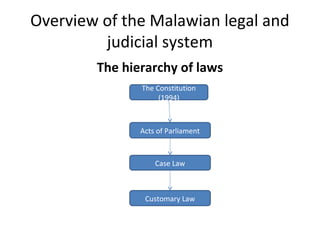
Overview of the Malawian legal and 
judicial system 
The hierarchy of laws 
The Constitution 
(1994) 
Acts of Parliament 
Case Law 
Customary Law
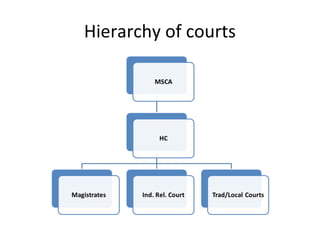
Hierarchy of courts
The human right to vote 
• Every person shall have the right: 
– to vote, 
– to do so in secret and 
– to stand for election for any elective office 
[Section 40(3), Constitution] 
The right is limited by franchise and 
qualifications/disqualifications provisions of the 
law
The Franchise 
[Section 77, Constitution] 
• Every person shall be eligible to vote in any general 
election, by-election, presidential election, local 
government election or referendum, and be qualified to 
be registered as a voter in a constituency if, on the date 
of the application for registration, that person— 
– is a citizen of Malawi or, if not a citizen, has been 
ordinarily resident in the Republic for seven years; 
– has attained the age of eighteen years; and 
– is ordinarily resident in that constituency or was born 
there or is employed or carries on a business there.
• No person shall be eligible to vote in any general 
election, by-election, presidential election, local 
government election or referendum or be qualified to 
be registered as a voter in a constituency if, on the date 
of the application for registration, that person- 
– is adjudged or otherwise declared to be mentally 
incompetent; 
– is under sentence of death; or 
– was convicted of any violation of any law relating to 
elections in relation to the immediate past elections
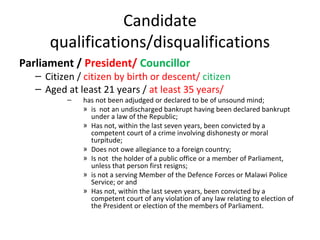
Candidate 
qualifications/disqualifications 
Parliament / President/ Councillor 
– Citizen / citizen by birth or descent/ citizen 
– Aged at least 21 years / at least 35 years/ 
– has not been adjudged or declared to be of unsound mind; 
» is not an undischarged bankrupt having been declared bankrupt 
under a law of the Republic; 
» Has not, within the last seven years, been convicted by a 
competent court of a crime involving dishonesty or moral 
turpitude; 
» Does not owe allegiance to a foreign country; 
» Is not the holder of a public office or a member of Parliament, 
unless that person first resigns; 
» is not a serving Member of the Defence Forces or Malawi Police 
Service; or and 
» Has not, within the last seven years, been convicted by a 
competent court of any violation of any law relating to election of 
the President or election of the members of Parliament.
Recommendation: 
Harmonise the eligibility qualifications to 
require the same type of citizenship for all three 
elections.
Election Administration 
• Mandate to run elections vested by the 
Constitution in EC 
• EC members appointed by the President after 
consulting parties in Parliament. 
• Chairperson- judge appointed by the 
President 
• EC members may be removed from office by 
the President
Election Administration 
Recommendation: 
The 2007 Law Commission report recommended 
that the chairmanship of the EC should not be 
restricted to judges. To achieve this requires the 
amendment of section 75(1) of the Constitution
Voter registration and candidate 
nomination 
• Registration done by Electoral Commission 
(EC)- period specified by law- at least 14 days 
and must expire on a date which is at least 14 
days before the first day of polling 
• Every voter is entitled to verify registration at 
a time designated by the EC.
Voter registration and candidate 
nomination 
Recommendation: 
•the PPEA and the LGEA should be amended to vest 
the EC with the discretion to extend the period for 
registration of voters according to circumstances 
prevailing at the time. 
•The period for verification should be extended by 
amending the PPEA and the LGEA . This 
recommendation is based on experience especially 
in 1999 and 2014 and the critical importance of 
verification in instilling confidence in the process.
Campaign 
• Campaigning is a human right. Section 40(3) of 
the Constitution provides that [every person 
has a right] “to campaign for a political party 
or cause”. 
• Electoral laws regulate election campaigns re: 
– Period (section 57 PPE and - 2 months preceding 
polling date) 
– Use of public places 
– Etc
Campaign 
Recommendation: 
the official campaign period should be 
extended to give the EC authority to regulate 
campaigns (which take place anyway) at an 
earlier stage of the election cycle. There is no 
logical reason for aligning the official campaign 
period to the dissolution of parliament-the 
President is not required to vacate office during 
the official campaign period-.
Polling 
• Venues determined by EC (PPE and LGE Acts) 
• Time: 6am to 6pm (PPE and LGE Acts) 
• Procedures 
• Monitors 
• Observers
Polling 
• Recommendation: The law which prescribes 
the hours of voting should be amended to 
provide for the extension of time beyond 6pm 
if the polling started later than 6am. The 
length of the extension should be the same as 
that by which the opening of the polling 
station was delayed.
Counting 
• Venue 
• Authorised personnel 
• Procedures 
• Monitors 
• Observers 
• Publication and transmission of count results
Determination and announcement of 
results 
• First past the post 
• EC mandate to announce. Obliged to do so 
with 8 days. 
• Disputes 
– EC has “primary” jurisdiction 
– Courts have original and appellate jurisdiction
Determination and announcement of 
results 
• Recommendations: 
• Law Comm recommended in 2007 that the winner of 
the Presidential race should have won more than 50% 
of all votes cast. If this is agreed to, PPEA and LGEA 
should be amended to provide for second-round 
voting. 
• The PPEA and the LGEA should be amended to prohibit 
the publication of any results- including “unofficial 
results” until all polling stations are closed. This 
prevents undue influence of voters’ choices by the 
announcement of results, even if these are 
“unofficial”.
Determination and announcement of 
results 
• Recommendation: 
PPEA and LGEA should be amended to extend 
the deadline for the EC to announce results 
from 8 days to 14 days (?)
Other areas of concern 
• Appointment of commissioners vis a vis 
institutional memory 
• Harmonisation of the electoral law 
• Handover and inauguration of the President 
elect 
• Withdrawal of running mates 
• Tie 
• Clarification of roles between Councillors & 
MPs
Conclusion 
• The legal framework is fundamentally sound 
and is similar to those that govern elections in 
other AU countries. Based on various reviews 
and experiences in previous elections, 
however, some amendments are essential to 
improve the extent to which elections can be 
free, fair and credible. This presentation has 
highlighted only some of the most significant 
of such proposed amendments, mainly due to 
time constraints.

Mesn postelection draft for mandala

  • 1.
    The Legal Frameworkof Elections and Recommendations for Reform Fidelis Edge Kanyongolo, PhD Associate Professor of Law, University of Malawi Presented to MESN Postelection Conference 26-27 June 2014
  • 2.
    Outline • Overviewof the Malawian legal and judicial system • The Franchise • Candidate qualifications and disqualifications • Voter registration • Campaign • Polling and Counting • Dispute settlement • Other areas of concern
  • 3.
    Overview of theMalawian legal and judicial system The hierarchy of laws The Constitution (1994) Acts of Parliament Case Law Customary Law
  • 4.
  • 5.
    The human rightto vote • Every person shall have the right: – to vote, – to do so in secret and – to stand for election for any elective office [Section 40(3), Constitution] The right is limited by franchise and qualifications/disqualifications provisions of the law
  • 6.
    The Franchise [Section77, Constitution] • Every person shall be eligible to vote in any general election, by-election, presidential election, local government election or referendum, and be qualified to be registered as a voter in a constituency if, on the date of the application for registration, that person— – is a citizen of Malawi or, if not a citizen, has been ordinarily resident in the Republic for seven years; – has attained the age of eighteen years; and – is ordinarily resident in that constituency or was born there or is employed or carries on a business there.
  • 7.
    • No personshall be eligible to vote in any general election, by-election, presidential election, local government election or referendum or be qualified to be registered as a voter in a constituency if, on the date of the application for registration, that person- – is adjudged or otherwise declared to be mentally incompetent; – is under sentence of death; or – was convicted of any violation of any law relating to elections in relation to the immediate past elections
  • 8.
    Candidate qualifications/disqualifications Parliament/ President/ Councillor – Citizen / citizen by birth or descent/ citizen – Aged at least 21 years / at least 35 years/ – has not been adjudged or declared to be of unsound mind; » is not an undischarged bankrupt having been declared bankrupt under a law of the Republic; » Has not, within the last seven years, been convicted by a competent court of a crime involving dishonesty or moral turpitude; » Does not owe allegiance to a foreign country; » Is not the holder of a public office or a member of Parliament, unless that person first resigns; » is not a serving Member of the Defence Forces or Malawi Police Service; or and » Has not, within the last seven years, been convicted by a competent court of any violation of any law relating to election of the President or election of the members of Parliament.
  • 9.
    Recommendation: Harmonise theeligibility qualifications to require the same type of citizenship for all three elections.
  • 10.
    Election Administration •Mandate to run elections vested by the Constitution in EC • EC members appointed by the President after consulting parties in Parliament. • Chairperson- judge appointed by the President • EC members may be removed from office by the President
  • 11.
    Election Administration Recommendation: The 2007 Law Commission report recommended that the chairmanship of the EC should not be restricted to judges. To achieve this requires the amendment of section 75(1) of the Constitution
  • 12.
    Voter registration andcandidate nomination • Registration done by Electoral Commission (EC)- period specified by law- at least 14 days and must expire on a date which is at least 14 days before the first day of polling • Every voter is entitled to verify registration at a time designated by the EC.
  • 13.
    Voter registration andcandidate nomination Recommendation: •the PPEA and the LGEA should be amended to vest the EC with the discretion to extend the period for registration of voters according to circumstances prevailing at the time. •The period for verification should be extended by amending the PPEA and the LGEA . This recommendation is based on experience especially in 1999 and 2014 and the critical importance of verification in instilling confidence in the process.
  • 14.
    Campaign • Campaigningis a human right. Section 40(3) of the Constitution provides that [every person has a right] “to campaign for a political party or cause”. • Electoral laws regulate election campaigns re: – Period (section 57 PPE and - 2 months preceding polling date) – Use of public places – Etc
  • 15.
    Campaign Recommendation: theofficial campaign period should be extended to give the EC authority to regulate campaigns (which take place anyway) at an earlier stage of the election cycle. There is no logical reason for aligning the official campaign period to the dissolution of parliament-the President is not required to vacate office during the official campaign period-.
  • 16.
    Polling • Venuesdetermined by EC (PPE and LGE Acts) • Time: 6am to 6pm (PPE and LGE Acts) • Procedures • Monitors • Observers
  • 17.
    Polling • Recommendation:The law which prescribes the hours of voting should be amended to provide for the extension of time beyond 6pm if the polling started later than 6am. The length of the extension should be the same as that by which the opening of the polling station was delayed.
  • 18.
    Counting • Venue • Authorised personnel • Procedures • Monitors • Observers • Publication and transmission of count results
  • 19.
    Determination and announcementof results • First past the post • EC mandate to announce. Obliged to do so with 8 days. • Disputes – EC has “primary” jurisdiction – Courts have original and appellate jurisdiction
  • 20.
    Determination and announcementof results • Recommendations: • Law Comm recommended in 2007 that the winner of the Presidential race should have won more than 50% of all votes cast. If this is agreed to, PPEA and LGEA should be amended to provide for second-round voting. • The PPEA and the LGEA should be amended to prohibit the publication of any results- including “unofficial results” until all polling stations are closed. This prevents undue influence of voters’ choices by the announcement of results, even if these are “unofficial”.
  • 21.
    Determination and announcementof results • Recommendation: PPEA and LGEA should be amended to extend the deadline for the EC to announce results from 8 days to 14 days (?)
  • 22.
    Other areas ofconcern • Appointment of commissioners vis a vis institutional memory • Harmonisation of the electoral law • Handover and inauguration of the President elect • Withdrawal of running mates • Tie • Clarification of roles between Councillors & MPs
  • 23.
    Conclusion • Thelegal framework is fundamentally sound and is similar to those that govern elections in other AU countries. Based on various reviews and experiences in previous elections, however, some amendments are essential to improve the extent to which elections can be free, fair and credible. This presentation has highlighted only some of the most significant of such proposed amendments, mainly due to time constraints.