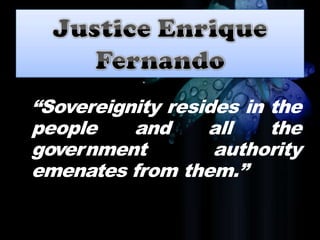
“Sovereignity resides in the
people and all the
government authority
emenates from them.”
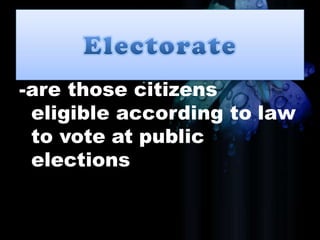
-are those citizens
eligible according to law
to vote at public
elections
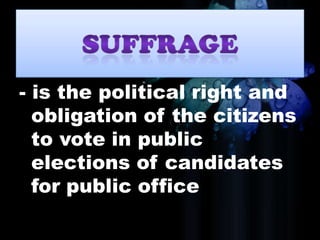
- is the political right and
obligation of the citizens
to vote in public
elections of candidates
for public office
- is the selection of public
official by the citizens of
the state, or other
political bodies
- is the right of citizens to
propose bills to be
enacted by the
legislature on which
electors may vote
- is a method of removing a
public official from office
by submitting to a popular
vote the issue of whether
the official should either
continue in office/not
- a popular vote of the
people for or against a
proposed law/
enactment for their
judgements
-passes on to the voters
the legislative acts for
their final approval/
rejection
- A natural right.
- Inherent and characteristics
of citizenship.
- A vested privilege.
- A government task.
- An ethical duty.
Qualifications of Electorate
- Citizenship
- Age
- Not disqualified by law
- Residence
- Domicile (is that to which the law
of the land refers when it speaks
of residence for the purpose of
election)
“Citizens unfitted to
vote”
“Suffrage Required
by Rule”
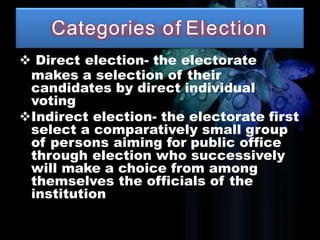
Categories of Election
 Direct election- the electorate
makes a selection of their
candidates by direct individual
voting
Indirect election- the electorate first
select a comparatively small group
of persons aiming for public office
through election who successively
will make a choice from among
themselves the officials of the
institution
Is a formed group of person
going after the same
ideology, political
ideas/platform of
government
and have as a part its branches
and divisions.
“Election Period and
Election Campaign
Distinguished”
As the rules and regulations
governing how citizens vote in any
society with an organized
government.
District System
Each electoral district
prefer one
representative to
Congress. Whoever
obtains the most votes
is elected.
A final election to
resolve an earlier
election that did not
produce a winner
Choosing of one person to be the
chosen for office or as a candidate.
Through primary Election.
Through Convention.
Through Petition.
Through Local Committee of
a Political Party.
Through one-self alone.
suffrage
suffrage

suffrage

  • 2.
    “Sovereignity resides inthe people and all the government authority emenates from them.”
  • 3.
    -are those citizens eligibleaccording to law to vote at public elections
  • 4.
    - is thepolitical right and obligation of the citizens to vote in public elections of candidates for public office
  • 5.
    - is theselection of public official by the citizens of the state, or other political bodies
  • 6.
    - is theright of citizens to propose bills to be enacted by the legislature on which electors may vote
  • 7.
    - is amethod of removing a public official from office by submitting to a popular vote the issue of whether the official should either continue in office/not
  • 8.
    - a popularvote of the people for or against a proposed law/ enactment for their judgements
  • 9.
    -passes on tothe voters the legislative acts for their final approval/ rejection
  • 10.
    - A naturalright. - Inherent and characteristics of citizenship. - A vested privilege. - A government task. - An ethical duty.
  • 11.
    Qualifications of Electorate -Citizenship - Age - Not disqualified by law - Residence - Domicile (is that to which the law of the land refers when it speaks of residence for the purpose of election)
  • 12.
  • 13.
    Categories of Election Direct election- the electorate makes a selection of their candidates by direct individual voting Indirect election- the electorate first select a comparatively small group of persons aiming for public office through election who successively will make a choice from among themselves the officials of the institution
  • 14.
    Is a formedgroup of person going after the same ideology, political ideas/platform of government and have as a part its branches and divisions.
  • 15.
    “Election Period and ElectionCampaign Distinguished”
  • 16.
    As the rulesand regulations governing how citizens vote in any society with an organized government.
  • 17.
    District System Each electoraldistrict prefer one representative to Congress. Whoever obtains the most votes is elected.
  • 18.
    A final electionto resolve an earlier election that did not produce a winner
  • 19.
    Choosing of oneperson to be the chosen for office or as a candidate. Through primary Election. Through Convention. Through Petition. Through Local Committee of a Political Party. Through one-self alone.