University of South Florida
Scholar Commons
Graduate Theses and Dissertations Graduate School
11-15-2010
Comparative Study of Intentional Communities
Jessica Merrick
University of South Florida
Follow this and additional works at: http://scholarcommons.usf.edu/etd
Part of the American Studies Commons
This Thesis is brought to you for free and open access by the Graduate School at Scholar Commons. It has been accepted for inclusion in Graduate
Theses and Dissertations by an authorized administrator of Scholar Commons. For more information, please contact scholarcommons@usf.edu.
Scholar Commons Citation
Merrick, Jessica, "Comparative Study of Intentional Communities" (2010). Graduate Theses and Dissertations.
http://scholarcommons.usf.edu/etd/3628
Comparative Study of Intentional Communities
by
Jessica Merrick
A thesis submitted in partial fulfillment
of the requirements for the degree of
Master of Arts
Department of Sociology
College of Arts and Sciences
University of South Florida
Major Professor: Sara L. Crawley, Ph.D.
Donileen R. Loseke, Ph.D.
Maralee Mayberry, Ph.D.
Date of Approval:
November 15, 2010
Keywords: lesbian, gay, retirement, whiteness, suburban, privilege
Copyright © 2010, Jessica Merrick
ACKNOWLEDGEMENTS
I gratefully acknowledge the Florida Studies Center and Special Collections of the
University of South Florida Libraries for funding a portion of this research. I am fortunate to have
found financial assistance, sophisticated training, and a home in the Department of Sociology at
the University of South Florida. In particular, it has been a privilege and a delight to learn from an
expert committee. Donileen R. Loseke, Maralee Mayberry, and Sara L. Crawley challenged and
supported me while I often clumsily came into my own. I am especially indebted to Sara for her
steadfast intellectual guidance and belief in me—thank you for convincing me I am capable. I
could not have come this far without my Dad, who put my education before everything—know
that you gave me the world. I‘m so thankful for the love and encouragement I find in Jess, who
makes our life beautiful even while I am ―thesis-ing.‖ Finally, I am profoundly touched by the
people who participated in this study. Thank you for sharing your lives with me. I hope you can
forgive my critical analysis, which does not imply individual culpability but instead aims to
interrogate relations of power embedded in our culture.
i
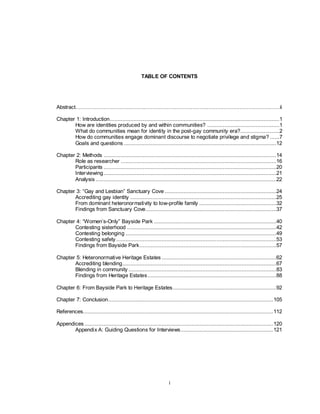
TABLE OF CONTENTS
Abstract………………………………………………………………………………………………………ii
Chapter 1: Introduction............................................................................................................1
How are identities produced by and within communities? ..............................................1
What do communities mean for identity in the post-gay community era?.........................2
How do communities engage dominant discourse to negotiate privilege and stigma? ......7
Goals and questions .................................................................................................12
Chapter 2: Methods ..............................................................................................................14
Role as researcher ...................................................................................................16
Participants ..............................................................................................................20
Interviewing..............................................................................................................21
Analysis ...................................................................................................................22
Chapter 3: ―Gay and Lesbian‖ Sanctuary Cove .......................................................................24
Accrediting gay identity .............................................................................................25
From dominant heteronormativity to low-profile family .................................................32
Findings from Sanctuary Cove...................................................................................37
Chapter 4: ―Women‘s-Only‖ Bayside Park ..............................................................................40
Contesting sisterhood ...............................................................................................42
Contesting belonging ................................................................................................49
Contesting safety ......................................................................................................53
Findings from Bayside Park.......................................................................................57
Chapter 5: Heteronormative Heritage Estates .........................................................................62
Accrediting blending..................................................................................................67
Blending in community ..............................................................................................83
Findings from Heritage Estates..................................................................................88
Chapter 6: From Bayside Park to Heritage Estates..................................................................92
Chapter 7: Conclusion.........................................................................................................105
References.........................................................................................................................112
Appendices ........................................................................................................................120
Appendix A: Guiding Questions for Interviews...........................................................121
ii
ABSTRACT
Moving to Florida to retire has become commonplace among American elders, though we
have seldom addressed how lesbians and gay men navigate sexual identity in retirement. I
undertake ethnography of three suburban, retirement-aged residential communities in Florida in
which lesbians and gay men make community in order to understand how identities are produced
by and within communities, the significance of suburban gay communities in the post-gay
community era, and how residents from each community engage dominant discourse. Sanctuary
Cove1
is a ―gay and lesbian‖ retirement community; Bayside Park is a ―women‘s-only‖ (lesbian)
community; and Heritage Estates is a heteronormative retirement community with a growing
lesbian ―network.‖ Drawing from conversations with thirty lesbians and four gay men, I compare
community practices to support my argument that these are respective settings for accrediting,
contesting, and privileging identities. By exploring how participants collectively construct and
present sexual selves in disparate communities, I attempt to uncover the co-constitutive
interaction between community and identity; while attention to the ruling relations of sexuality,
sex, gender, race, and class engages the politics of privilege and stigma.
1
All names and locations have been changed.
1
CHAPTER 1: INTRODUCTION
Some suggest that ―gay assimilation‖ and queer-friendly spaces reduce the need for
lesbian and gay culture and community (Loftus 2001; Gorman-Murray and Waitt 2009).
Functioning more as a sexual minority than a physical community, lesbians and gay men appear
well-integrated into mainstream society (Rosser, West, and Weinmeyer 2008). As the ―baby
boomer‖ generation retires, 45-64 year-old women comprise the largest number of ―out‖ lesbians
ever (Adelman 2000:xvi cited in Barker 2004:35). Yet in the face of discrimination from elders in
retirement communities and ageism within LGBT communities, lesbians and gay men have
created approximately eight LGBT-targeted elder housing communities in the U.S (Grant
2010:95-102). In this thesis, I examine two of these communities as well as one heteronormative
community respondents moved to from the ―women‘s-only‖ community. My basic question is:
What do these communities mean to the people who live there? More specifically, I focus on
members‘ meanings in order to understand how identities are produced by and within
communities, the significance of suburban communities in the post-gay community era, and how
communities reject or employ dominant discourse to avoid stigma.
How are identities produced by and within communities?
Scholars have theorized lesbian and gay migration as an expression of ardent or waning
commitment to identity. Either commitment to lesbian and gay identities in suburban settings
indicates a highly salient sexual identity (Forsyth 2001), or lesbians and gay men move to the
suburbs as sexual identities lose salience (Loftus 2001). Identity persists or abates but remains
basically unchanged by its engagement with setting. I contend that we should consider the ways
in which settings likewise compel identities. A Goffmanian (1959) approach would begin with the
―settings, commitments, and understandings which allow agents and social structures to have a
2
social presence in the first place‖ (Rawls 1987:139 quoted in Brewster and Bell 2010) so that the
self is a product of a scene rather than a cause of it (Goffman 1959:252). Correspondingly,
Lefebvre stresses that we imagine the ―concrete abstractions‖ which produce and govern spaces
(1991:73). Since social representations construct how we engage with space, while spaces
likewise produce selves, how are identities produced by and within ―gay and lesbian,‖ ―women‘s-
only,‖ and heteronormative retirement communities? Brekhus‘ (2003) study is instructive because
it explores how gay men play up different facets of themselves to match their suburban
surroundings, illustrating how contexts prompt selves. Using the metaphoric examples of
peacocks, chameleons, and centaurs to typify identity duration, density, and dominance, he finds
that unlike gay enclaves and neighborhoods, the suburbs do not elicit conspicuous displays of
―marked‖ sexual identities. Because who one is depends on where and when one is, Brekhus
regards spaces as ―identity settings‖ for how to feel, act, and ultimately, who to be (emphasis in
original 2003:17).
Using narrative data, this study is first and foremost grounded in respondents‘ personal
meanings. While I attempt to uncover the interaction between space and identity by engaging
Brekhus‘ (2003) concept, ―identity settings,‖ this study is fundamentally different because
respondents‘ ―marked‖ communities exist within the suburbs. Instead of driving to a city take up a
part-time gay identity (what Brekhus terms a ―satellite self‖), or abandoning gay identity for a
―suburban identity‖ (Baumgartner 1988 cited in Brekhus 2003), participants form lesbian and gay
communities in suburban Florida—an environment many consider to be hostile. I therefore take
seriously residents‘ collective and personal presentation of self throughout my analysis,
contributing empirical insight to how identities are produced interactionally and contextually.
What do communities mean for identity in the post-gay community era?
As the notion of lesbian and gay community loses prominence in the literature, I take up a
discordant line of inquiry by examining how people make meaning in communities. By asking
what it means to live in an identity-based or heteronormative community, I implicitly assume that
lesbian and gay community is real and meaningful to residents. But the validity of my premise has
3
been duly challenged: scholars dispute the notion of an identifiable gay community, suggest that
it is becoming obsolete in liberalizing societies, or consider ―the gay community‖ to be an idea
produced primarily in discourse. In this section, I briefly outline how sociologists have studied gay
communities before introducing their critiques. I note epistemic shifts from structuralist studies of
spaces to interactionist studies of relationships; from attention to urban enclaves, to a call for
inclusion of rural and suburban communities, towards the dissolution of gay community.
When sociologists initially theorized people living in communities, they focused
exclusively on cities. For Simmel (1903), cities provided an arena for the struggle to define an
individual‘s role in society, offering the possibility of emancipation from primary group control. By
the 1920s, emerging Chicago school sociologists theorized the city as a microcosm of social life.
While Wirth (1938) considered urbanism harmful to culture, he also found that cities offered
freedom and toleratance for Jewish immigrants in the U.S. which prompted him to suggest that
critical mass affects subcultures. Fischer (1976) extended Wirth‘s argument by adding that cities
provide a creative site for resisting cultural hegemony. Here minorities can take up alternative
practices and organize communities. Adding to Fischer‘s contact hypothesis, Lofland (1998)
argues that cities emancipate people from their status by providing space to experiment with new
identities and generate cosmopolitanism among people. It is not surprising, then, that sociologists
first looked to cities to find lesbians and gay communities.
In the 1950s, lesbian and gay stores, services and public events began to emerge. The
first gay male residential neighborhoods became visible in many major cities by the 1970s
(Forsyth 2001:343). Some of the first sociological research on lesbian and gay space focused on
enclaves in cities like San Francisco (Loyd and Rowntree 1978; Wolf 1979), Los Angeles (Levine
1979), and London (Ettorre 1978). Sometimes called gay ghettos, these spaces were
characterized by gay populations, institutions, and subcultures (Levine 1979). Although lesbian
and gay populations are generally dispersed, studies from this decade focused on geographic
areas and emphasized territorial boundaries. One early model used to analyze lesbian and gay
communities was the quasi-ethnic community model, which borrowed from the residential and
4
commercial structures of immigrant enclaves (Kahan and Mulryan 1995). Stage models were
later employed to predict gentrification and urban redevelopment.
Early studies have been critiqued for understanding community as an entity rather than a
process (Forsyth 2001:344), thereby overlooking culture and identities (Woolwine 2000). Newer
models for lesbian and gay communities have challenged structural-functionalist and spatially-
bound approaches to community to include meaning and self-concept (e.g. Abrahamson 2006;
Murray 1992). Along these lines, scholars have advanced understandings of how lesbian and gay
neighborhoods foster support and solidarity (Weston 1991) and validate identities (Rabin and
Slater 2005). In their ethnography of a butch-fem community in New York, Kennedy and Davis
(1993:5) find that ―although securing space was indeed important, it was strongly motivated by
the need to find a setting for the formation of intimate relationships.‖ Thus, community is
produced less in space than through relationships.
Next, there is a gap in the literature on lesbian and gay suburbanization. Modern studies
of lesbian and gay communities continue to focus almost exclusively on urban enclaves in cities
like Cape Town (Visser 2003), New York (Chauncey 1994), San Francisco (Rosenfeld 2003;
Murray 1992), West Hollywood (Levay and Nonas 1995), and New Orleans (Knopp 1990). Too
few studies document lesbian and gay populations in rural areas (for exceptions see Gray 2009;
Valentine 2000, 1997; Krieger 1983). Even less attention has been paid to lesbians and gay men
in suburban settings (for a strong exception see Brekhus 2003). Attempting to de-center the city
as the reference point for contemporary queer life, Herring (2010) argues that non-urban queers
are dismissed, fetishized, marginalized, antagonized; and constructed as ignorant, shameful, and
isolated. His ―queer anti-urbanism‖ critiques white, male, metronormative, public sex culture, and
argues for including non-urban queers.
There is a notable gendered gap since suburbanization reflects different processes for
lesbians than gay men. Forsyth (2001:437) argues that gay men are starting to move to suburban
areas in greater numbers, and lesbians have always been less urban but are just now becoming
more visible. Historically, gay spaces have been marked by male ghettoisation and
5
territorialisation, while lesbian separatists form countercultural enclaves. Gender informs the way
gay men and lesbians choose or are restricted to certain places and helps explain how the space
is used after appropriation (Ingram, Bouthillette, and Retter 1997:215). Since women may be
more constrained by finances, family responsibilities, public safety, and political effectiveness, it is
easier for men with class and race privilege—traditionally middle-class, white men—to identify
and live as openly gay (Knopp 1990:338). For these reasons, white, middle-class gay men have
the most visibility and representation, while lesbians have been less represented in urban
communities.
Studies of suburban communities are gaining relevance as populations of lesbians and
especially gay men shift from urban to suburban areas. Market trends suggest that when lesbians
and gay men cannot afford to live in urban gay enclaves, they are pushed out to the suburbs
(Markowitz 1993). Other studies show that heterosexuals are integrating into historically gay
urban neighborhoods, while lesbians and gay men are moving into the suburbs (Rosser et al.
2008). Whether lesbians and gay men are pushed from cities or chose to move is an interesting
point of contention. On one hand, suburban and rural lesbian and gay communities demonstrate
commitment to lesbian and gay identities in various situations (Forsyth 2001:347). But at the
same time, suburban migration may signal the dissolving salience of lesbian and gay identities,
as liberalizing attitudes towards homosexuality in the U.S. enable ―gay assimilation‖ (Loftus
2001). This prompts consideration of the final shift in the literature: towards the dissolution of gay
community.
There is debate about whether or not we can describe a distinctly lesbian and gay
population. Most studies involving lesbians and gay men are conducted through lesbian and gay
bars, gay-identified events like pride parades, and gay magazines; but research from these
locations is not representative (Forsyth 2001). Bellah et al. (1985) argue that lesbian and gay
spaces lack the institutional characteristics necessary for community since being gay or lesbian
does not necessarily facilitate similarities in values and beliefs or produce civic commitment or
consistent discourse about the public good. Murray (1992) challenges their claim by arguing that
6
there are many ways one can be a part of the gay community: by having a gay identity, having
friendships with gay people, being involved in gay politics, or living in a gay neighborhood. But the
assumption that enclaves and neighborhoods foster shared meanings has been critiqued.
Despite research suggesting that lesbian and gay communities influence self-concept, the decline
of urban gay neighborhoods and enclaves raises questions about their role in lesbian and gay
community-building. Scholars are beginning to suggest that the ―gayborhood‖ (Black et al. 2000)
is becoming a ―past-tense idea‖ (Reuter 2007 quoted in Brown 2007). For example, an
international study of 17 urban lesbian and gay communities found that despite stable or growing
lesbian and gay populations, attendance at gay events, volunteerism in gay organizations, and
the number of gay bars are decreasing (Rosser et al. 2008).
Loftus (2001) suggests that lesbian and gay identities are becoming less meaningful as
liberalizing attitudes towards homosexuality enable ―gay assimilation.‖ Gates comments, ―Twenty
years ago if you were gay and lived in rural Kansas, you went to San Francisco or New York.
Now you can just go to Kansas City‖ (Gates 2007 quoted in Brown 2007). Statements like these
are gathering empirical support as less tolerant generations of Americans are being replaced by
younger and more tolerant Americans, and all age groups in the U.S. are becoming more tolerant
(Keleher and Smith 2008). Scholars indicate a shift from lesbian and gay ghettos or enclaves into
socially cohesive spaces. Gorman-Murray and Waitt (2009) describe ―queer-friendly
neighborhoods‖ in Australia which embrace diversity and difference. Rosser and colleagues
attribute decreasing gay identification, visibility, and infrastructure to gay neighborhood
gentrification, the achievement of civil rights, less discrimination, a vibrant virtual community and
changes in drug use—harkening what they call the ―post-gay community era‖ (2008).
Others have shifted to studying ―the gay community‖ as a discursive construction. For
example, Woolwine finds that the lesbian and gay community is conceived of as having a deeply
united presence despite inequalities:
For some the term ―community‖ means simply gay people… and organizations… for
others it is more general and more vague; perhaps only a place filler, a word used with
little sense of a specific meaning. Some, however, when using the term ―community‖
7
seemed to have in mind a ―national‖ or ―global‖ community of all gay men and lesbians,
and one with which they strongly identified (2001:8).
Lacking geography, homogeneous class, race, language, or ideology, ―the gay community‖ is
difficult to theorize (Botnick 2000). A postmodern interpretation of the lesbian and gay community
would consider community to be produced in discourse. But ―to others, the notion of ‗community‘
has a gut-level attraction in that it is viewed as a microcosm of the social movement itself. In this
respect, the community is the movement, and the personal is the political‖ (Botnick 2000:2). As
such, lesbian and gay community is a mutually informative idea and practice.
I concede the merit of critiques of community as real and meaningful, but hold that this
study is valuable nonetheless. Especially in the ―post-gay community era,‖ examination of
meaningful intentional lesbian and gay communities is timely and appropriate. In fact by including
a heteronormative community, my analysis addresses the core claim that gay community and
identity are losing salience. Next, I do not attempt to identify or categorize ―the gay community.‖
Instead, I focus on the personal meanings members make of the communities they reside in. This
study is local rather broad; so while it is not comprehensive or representative, it does offer rich
detail of how a small set of participants ―do‖ community and gay or lesbian identity in three
distinct social spaces. By using the concept of ―identity settings,‖ I am able to describe both how
identity is practiced in communities, as well as the role of expectations for residents moving to
each community.
How do communities engage dominant discourse to negotiate privilege and stigma?
While lesbian and gay communities may disengage with heteronormative expectations to
achieve their goals, some of their members are privileged within the institutions of hegemonic
racism, classism, and gender-normativity. In this section, I consider some of the possible
problems and benefits of engaging dominant discourses in identity-based and heteronormative
communities.
Bouvard characterizes the intentional community movement by its ―complete apoliticism‖
(1975:6). Living together to pursue a particular lifestyle or a common vision, communalists form
8
ecovillages, farming collectives, residential land trusts, communes, student co-ops, urban housing
cooperatives, land co-ops, monasteries and ashrams, or other alternative communities (Kozeny
1995). For Kanter (1968), the only common feature of communal groups is commitment. Although
many intentional communities suggest their purpose is family, only a small minority of
communalists rank family as the most important communal goal or purpose (Smith 1999).
Instead, the top priority for most communalists is living with people who share similar values and
beliefs.
By contrast, lesbian separatist communities are ideologically, materially, and politically
motivated; so that separatists seek out means of supporting themselves in ways that are
compatible with their politics (Shugar 1995). For example, Landdykes put ecofeminist and lesbian
feminist politics into practice by living in separatist settlements which celebrate emotional and
spiritual connections to land, personal liberation and transformation, and bodily freedoms
(Anahita 2009). Following the public reading of Radicalesbian‘s (1973) ―Woman-Identified
Woman‖, a group called The Furies lived and worked together in a white, lesbian feminist
commune. Interacting with non-white women and men in a ―limited, but not necessarily
antagonistic fashion… the Furies distanced themselves from what they perceived as a hostile
world in order to analyze their experiences as women, question their own principles and
assumptions, and subsequently develop a base from which they could mobilize other women for
social change‖ (Valk 2002:303).
Historically more vital for lesbians than the Stonewall riots (Faderman 1991), lesbian
separatism relieves the pressure to conform to dominant groups and the burden of expending
women‘s energy and knowledge for men. For radical feminist Adrienne Rich (1980), male power
is maintained by suppressing female sexuality and controlling women. Challenging the taken-for-
granted assumption that most women are heterosexual, Rich reveals how female heterosexuality
is in fact imposed, managed, organized, propagandized, and maintained by force within
9
patriarchal societies (1980:648). By contrast, lesbian existence recognizes the ―primary intensity‖2
between women and resists patriarchal male sexual rights to women. Following Rich, Marilyn
Frye (1983:657) defines lesbian separatism as ceasing to be loyal to androcentric institutions. In
response to parasitic masculinist demands, lesbian separatists remove their resources from
male-defined and male-dominated institutions, relationships, roles, and activities. In Freeman‘s
(2000:152) account of Cincinnati in the 1970s, lesbians preferred to organize in lesbian-focused
feminist groups, and only socialized with gay men because there were so few lesbian events or it
was useful for achieving political change.
Given lesbian feminist interest in separating from men and masculinity, how did ―the gay
and lesbian community‖ come into being? One important reason is that the crucial and
overwhelming support lesbians gave gay men during the AIDS epidemic in San Francisco in the
1980s created a lasting bond between the two communities (Faderman 1991; Jagose 1996;
Buchanan 2006). Given political and personal preferences for women-only spaces, the existence
of a retirement community for lesbians and gay men is somewhat unusual. Although a separatist
space which includes men does not follow from lesbian separatist politics, it may offer similar
advantages:
In the case of lesbians and gay men who withdraw from heterosexual society, separatism
means they will no longer be surrounded by expectations that they shore up
heterosexuality by playing their traditional role of self-effacing witness to heterosexuality
and listener to and care-taker of heterosexuals. Lesbian and gay men no longer feel the
need to expend their resources reassuring, stroking, and protecting heterosexual egos
(Barnard 1998:619).
Lesbian and gay communities follow a similar logic as lesbian separatist communities by denying
access, removing resources, and disengaging from dominant expectations.
Separatism engages a critical act of resistance which directs attention away from
dominant groups (Shogan 2003). Yet whether or not lesbian separatist communities improve
social conditions is contestable. One critique of lesbian separatism is that it ―begins and ends with
2
Rich does not imply a need to have sex with women, nor does ―lesbian‖ separatism indicate
physical lesbian desire: ―for radical feminism, lesbianism was less a sexual identity than a political
position which refused to engage with patriarchy‖ (Crawley and Broad 2008:552-3).
10
an unproblematized notion of lesbian identity‖ (Martindale and Saunders 1992:160). Feminists
have both criticized identity as the basis of oppression and social hierarchies and used identity as
a basis for mobilizing subordinated groups. Because separatism emphasizes difference, it
paradoxically depends on marginalized and binarized identities, serving to reinscribe the
differences that help to generate oppression in the first place (Fernandez 2003). But for Barnard
(1998), this paradoxical engagement with identity can be productive. The dominant group
generates the oppressed by naming, pathologizing, and prohibiting (Foucault 1978 cited in
Barnard 1998), while the marginality of the oppressed likewise construct the dominants (Mohanty
1984 cited in Barnard 1998). However for Barnard, ―separatist philosophy circumvents this
double-bind by constructing an alternative to the center/margin relationship‖ (1998:614).
Despite their liberatory potential, studies of identity-based communities reveal conflict
surrounding conformity. In the Midwestern lesbian community in Krieger‘s (1983) study, belonging
is depicted as deeply important even as member‘s attempts at likeness produce conflict:
Individual women‘s views of the community were closely tied to views of themselves.
One‘s sense of one‘s own identity was very linked to ideas one had about other lesbians
who made up this loose social group called a community. Feelings about being accepted,
and fears of being rejected because a woman might be different from others, were key to
everything. The women in the study articulated a general sense that one had to conform
in order to belong, as might be so in any social group, but for this group, a feeling of
belonging mattered far more (Krieger 2005:4).
More recently, Heath and Mulligan (2008) find that sexuality is a source of social capital, but
resources (e.g. support and acceptance) in the lesbian community are contingent upon
compliance with community norms:
The very existence of the close ties which enabled the lesbian community to provide
benefits to women who participated in it also generated a sense of binding community
norms which lesbians were expected to adopt (Heath and Mulligan 2008:294).
Participants in their study report frustration about pressure to change their appearance or sexual
conduct, or adopt feminism. Heath and Mulligan therefore understand lesbian community as a
potential risk for well-being, especially for bisexual women who are profoundly less accepted by
the lesbian community. In light of these studies, I consider how conformity operates in the
11
communities I examine, and if it varies between the identity-based and heteronormative
communities.
Given the possibilities and constraints of disengaging from dominant expectations, it is
important to consider the ways in which identity-based communities produce, maintain, or resist
social conditions. Jo (2005) attributes changes in the lesbian community to class privilege,
femininity, and trans-women. Reflecting back on her experience in the San Francisco lesbian
community in the 1970s, she holds that the community became segregated by class when
lesbians who wanted to ―be accepted, feel less queer, have careers, and make money‖
abandoned feminist politics to return to the privilege they grew up with (2005:137). Jo
distinguishes between middle-class women who have the ability to assimilate and oppressed
women who need the lesbian community. Because she believes that femininity is defined by
patriarchy, Jo suggests that ―it makes sense to be wary of someone who looks heterosexual‖
(2005:141). She also takes issue with male-to-female transsexuals, who she depicts as male-
identified heterosexuals eager to dominate lesbian communities. Her account points to
community divisions surrounding the rejection or use of dominant forms of privilege, and calls
analytic attention to the presentation of class and gender within and between identity-based
communities. Because all of the respondents in my study are white, this study examines racial
privilege—even as respondents lack the tools for speaking coherently about how they are
protected and advantaged by whiteness (McIntosh 1988). Suburban migration might be
understood as politically conservative ―white flight‖ for white, middle class gay men (Warner
1999:188 cited in Herring 2010:11), since gated suburban communities may appeal to the white,
middle-class fear of ethnic diversity (Low 2003). We should therefore attend to how race, class,
and gender privileges are employed within and between communities.
By contrast, the literature on lesbian and gay elders living in heteronormative retirement
communities does not focus on privilege, and lesbian and gay elders are portrayed as uniquely
stigmatized by dominant discourse. LGBT elders face invisibility, economic hardship, and
discrimination or abuse (Grant 2010:6). An unseen minority within both the LGBT community and
the aging community, there is little research on LGBT elders, and their needs remain
12
unaddressed. Social Security and Medicaid define partnership in ways that exclude LGBT
families, creating economic hardship. This exacerbates income disparities for LGBT wage-
earners unprotected from workplace discrimination. Further, LGBT elders report fear,
discrimination, and barriers to care. Retirement housing programs are not mandated to provide
culturally competent services to LGBT people, so elders experience neglect and abuse by
bigoted services providers. In light of the ―legacy of harassment and discrimination that many
LGBT elders have endured, and their associated need for a safe home,‖ LGBT-targeted housing
is an important but scarce option (DeVries 2004:8).
Goals and questions
This study explores what ―gay and lesbian,‖ ―women‘s-only,‖ and heteronormative
communities mean to the people who live there. My goals are threefold. First, I attempt to
uncover the co-constitutive interaction between spaces and identities (Goffman 1959; Lefebvre
2001) using the concept, ―identity settings‖ (Brekhus 2003). To this end, I focus on members‘
expectations and collective practices of community to describe how settings produce certain
kinds of identities. I describe how selves are presented in varying spaces and to varying
audiences in order to convey how identity is produced interactionally and contextually. The
question I endeavor to answer is: How are identities produced by and within ―gay and lesbian,‖
―women‘s-only,‖ and heteronormative retirement communities?
Next, I attempt to contribute to gaps in our understanding of suburbanization among gay
men and especially lesbians. The existence of suburban lesbian and gay retirement communities
defies the logic that gay communities are both urban and disappearing (Gorman-Murray and
Waitt 2009; Keleher and Smith 2008; Rosser et al. 2008). Rather than focusing on lesbian and
gay neighborhoods within cities (e.g. Visser 2003; Rosenfeld 2003; Levay and Nonas 1995;
Chauncey 1994), rural areas (Valentine 2000, 1997; Gray 2009; Krieger 1983), or dispersed and
unmarked populations throughout suburbs, I examine a gap in the literature: lesbian and gay
communities situated within suburbs. The suburbs have been theorized as a place where gay
identity dissipates (Loftus 2001) or is replaced by suburban identity (Brekhus 2003); some even
13
study travel outside of the suburbs to take up part-time gay identities in cities (Brekhus 2003).
Especially because scholars suggest that gay community and identity are diminishing, the
existence of suburban lesbian and gay communities prompts consideration of what community
means for identity. Here I seek to answer the question: What does it mean to live in a suburban
community based on identity in the post-gay community era?
Finally, because my respondents are white and middle-to-upper class, this study is
implicitly about whiteness and class privilege, just as it is about managing stigma in a
homophobic society. In order to understand how lesbian and gay elders negotiate both privilege
and stigma, I ask how communities reject or employ dominant discourse. Aiming to contribute
empirical weight to consideration of how race, class, and gender constitute privilege within
stigmatized populations pursuing identity-based communities, I break this task into two questions:
How do communities utilize dominant discourse to negotiate privilege and stigma? How do
identity-based communities produce, maintain, or resist social conditions through their practices
and politics; and, does it differ from how elders ―do‖ lesbian or gay identity in a heteronormative
retirement community?
14
CHAPTER 2: METHODS
In this chapter, I disclose my epistemic commitment to interpretivism and feminism and
explain how this shaped my methodological choices and situated my research. I discuss how my
sexuality, age, class, and gender-presentation positioned me in the field, and reflect on the
feminist dilemma of friendship. I finally describe my process of open-ended active interviewing
before concluding with a discussion of how I analyzed the data and approached the writing
process.
Methodologies are theories of how research should be done based theories of knowledge
(Harding 1986:2). I address methodology before describing methods because my approach to
knowledge informs how I attempt to contribute to it. Naples asserts a ―politics of method‖ in which
our epistemological stance shapes how we understand our role as researchers, employ methods,
and identify, analyze, and report data (2003:3-4). Indeed, my standpoint is bound up in every step
of the project, making disclosure about myself, interactions, and power relations imperative. In
this section, I discuss how an interpretive, feminist stance to knowledge called for open-ended
active interviewing and the analysis of narrative data.
Departing from a positivist, objectivist view of science, I take an interpretive, feminist
stance to knowledge. I understand that I cannot objectively evaluate participants‘ narratives,
community interactions, or even myself. Haraway (1991) critiques approaches to science for
achieving epistemological and social power by assuming objectivity. In pretending to merely
witness the world, objectivist scholarship performs a ―god-trick‖ which assumes ―vision from
everywhere and nowhere‖ (Haraway 1991:191). In an effort to combat patriarchal claims to
knowledge, I attempt to engage in feminist research and writing. Kleinman (2007:5) charges
researchers to be clear about what we mean by ―feminist‖ research. The way I pursue feminist
research is by paying attention to inequalities throughout the research process. I therefore
15
attempt to address issues of power: power exerted during the research process, power
differences between the researcher and the researched, and power exerted during writing and
representing (Wolf 1996:2). I also reflect on my emotions as they pertain to sense-making in the
fieldwork experience (Naples 2003:199; Ibarra and Kusenbach 2001). I confine my reflexivity
mostly to this chapter because ―as a textual strategy, self-reflexivity gives voice to the already-
speaking author‖ (Lal 1996:200).
Following an interpretive, feminist stance to knowledge and research, I take up inductive
methods. Because I understand facts to be fluid and embedded within social understandings, it
makes sense to ask and observe before moving towards concepts and theories. As I became
interested in intentional retirement communities, my basic question was: what do communities
mean to the people who live there? Open-ended interviewing provides a method for answering
that question because it allows participants the greatest opportunity to discuss how they give
meaning to their lives (Reinharz 1992:18). Open-ended interviews provide ―a site for the
production of data and an opportunity to explore the meaning of the research topic for the
respondent‖ (Elliot 2005:22). Yet the role of researcher in the construction of narratives should
also be taken into account. Holstein and Gubrium stress that narratives are constructed as a
product of interaction between the researcher and participants (2003:67). As such, interviews are
―dynamic, meaning-making occasion[s]‖:
While interest in the content of answers persists, it is primarily in how and what the
subject/respondent, in collaboration with an equally active interviewer, produces and
conveys about the subject/respondent‘s experience under the interpretive circumstances
at hand (Holstein and Gubrium 2003:71).
Given this attention to how narratives are constructed interactionally between social actors
embedded in power relations, it is perhaps not surprising that open-ended interviewing has
―become the principal means by which feminists have sought to achieve the active involvement of
their respondents in the construction of data about their lives‖ (Graham 1984:112). I also find that
analyzing narratives as data serves my project in important ways.
16
A growing body of scholarship calls for the examination of how individuals construct a
sense of ―groupness‖ in community, and scholars of social movements explore the strategies and
knowledges employed to build and maintain community identities (Stein 2001; Zuo and Benford
1995). Although community narratives can be constructed by individuals, shared histories create
solidarity (Weston 1991) and are more powerful with the interpretation and affirmation of the
collective (Mason-Schrock 1996). It is likewise important to consider how individual identities are
constructed within community, since phenomenologically ―true selves‖ are brought into being
through the collective creation of stories (Gergen and Gergen 1983:266 cited in Mason-Schrock
1996). While much research is devoted to exploring the construction of collective identity as well
as the construction of personal identity through collective identity, we could benefit from more
work focused on the interactive, co-creative process in which these projects engage (Loseke
2007).
Not only does narrative suit the methodological task of conveying multi-level
constructions of identity for gay and lesbian elders, but gay and lesbian elders are uniquely
situated to exemplify the utility of examining identities through narrative. Telling stories becomes
a way of interpreting the past in the context of the present, thereby establishing meaningful
continuity with current identities (Beilby and Kully 1989). Elders may struggle to convey multiple
identities beyond what they project, but telling a story allows multiple identities to be presented,
including the ―now me‖ and the ―then me‖ (Norrick 2009). Moreover, discovering identities through
narrative combats the problem of categorizing and essentializing multiple, fluid selves. Because
they historicize time, space, and relationships (Somers 1994; Calhoun 1994), narrative
approaches to identity engage the queer theoretical project of unfixing and destabilizing identity
categories—which may be useful for people with stigmatized identities. Therefore narrative
analysis serves as a strategically instrumental method from which to analyze the construction of
gay and lesbian identities. Narrative analyses illuminate the multiple, reflexive character of lived
identities which are ―always a project‖ rather than settled accomplishments (Calhoun 1994:27).
Role as researcher
17
Although I cannot fully situate my analysis, I attempt to break down exploitative
hierarchies between myself and participants in the field and in my writing through a discussion of
process. For me, this means being diligently reflexive and transparent about my assumptions and
―that brash, awkward, hit-and-run encounter‖ that is fieldwork (Kumar 1991:1 quoted in Wolf
1996:6). As a researcher, I hold power because I make decisions about how to conduct the
project and represent participants in my analysis. In a society which privileges youth and ignores
elders, I hold social and cultural power because I am 25. Yet age was not constructed this
simplistically in my interactions with participants. I consider myself a young person who has a lot
to learn from elder participants. Perhaps because I am an insider (as a lesbian) and an outsider
(as a young person), participants were forthcoming about points of difference because of age.
From my perspective, this enhanced our conversations more often than it detracted from them.
Some expressed frustration about youth today having no sense of history or obligation to making
change. I think I was positively evaluated as a young person interested in LGBT research. Yet it
is possible that they might have felt more comfortable talking with someone closer in age.
I shared with my participants white privilege, educational privilege, and Western,
American privilege. In terms of class, though, I was studying ―up.‖ Especially in Heritage Estates,
participants were professional athletes, doctors, lawyers, and entrepreneurs. They lived in big
houses and drove expensive cars. By contrast, my educational socialization enables me to
present as upwardly mobile and betrays my background as first generation college student. In
terms of class, participants hold more power than me. While studying up has been suggested as
way to relieve power imbalances in research, the problem of friendship resists resolution. Wolf
writes:
By naming these power differentials and possibly exploitative interactions and bringing
them into feminist discourse, feminists shattered the original tenets of early feminist work.
What was previously seen as natural and easy has been problematized as one of the
greatest dilemmas of feminist field research (2006:19).
By reflecting on my experiences with self presentation and disclosure, ―insiderness,‖ and
friendship in the field, I challenge the objectification of knowledge (Haraway 1991) and the notion
of experiential distance between myself and participants (Gorelick 1991).
18
Being a lesbian was requisite though not sufficient to gaining access in all sites. Upon
shaking Shirley‘s hand, she promptly asked, ―So are you gay or what?‖ In most cases,
participants were often interesting in hearing about my ―coming-out story‖ or my partner.
However, I did not want to insult people by acting as though this implied a salient commonality or
would be enough to earn their trust. This produced an awkward moment in Sanctuary Cove,
where I entered with no connections and gained access by driving there and talking to residents.
After knocking on Sandra and Katherine‘s door, I introduced myself and the project and, because
self-disclosure seemed too forward in the doorway of their house, resigned to telling them that I
cared about LGBT rights. Sandra was skeptical: ―What do you mean, like human rights?‖ I joked
that human rights were alright with me but really I was just being selfish. My bad joke broke the
tension and assured them that I was not an outsider. We talked for about an hour after that; and a
few weeks later when I attended a party at their neighbors‘ house they helped me gain access:
Right away Katherine came up and said hi and introduced herself to [my partner]…
Sandra would sometimes interrupt the conversation to play PR rep. I realized that they
had been contacted by a few people doing research recently. A few people asked me if I
was ―the one with the survey,‖ another person asked if I was studying ―geriatric lesbians.‖
A couple of men wondered if they could be a part of it too, because they heard it was only
about women. It made me feel bad for being yet another researcher. But at the same
time, they hadn‘t invited any of the other researchers. And when Rebecca confused me
for a different researcher, Sandra came over to correct her in a loud stage whisper to let
everyone know that, ―This is our homegirl. We really want to talk to her!‖ (Field notes
February 28, 2009).
Attending this party opened doors for me to meet people and schedule interviews, but I would not
have been nearly as successful doing so had I not met Sandra and Katherine first. To them, I was
not just another researcher— I was their ―homegirl.‖
I later came to understand that bringing my partner was an ideal form of self-disclosure in
Sanctuary Cove because of their positive evaluation of monogamy and gender-normative
presentations. Embodying ―respectable‖ gender-normative presentations likely influenced the
kinds of people who were willing to interview with me and the kinds of things we talked about.
Some participants conveyed approval of my gender presentation. While I had an easier time
gaining access in these communities than a straight researcher would have, it was also important
that I did not appear to deviate from gender norms.
19
I connected with participants in a way that often felt like friendship. In Heritage Estates,
Glenda was enthusiastic about ―rounding up a gaggle of gals‖ or ―recruiting some unsuspecting
lesbians.‖ She took a clipboard to a party to sign people up, and offered to let me stay in their
guest bedroom during the project. In this respect, I received privileges based on Glenda‘s
goodwill and an ―epistemology of insiderness‖ (Reinharz 1992:260). Feminist standpoint theorists
have argued that being a woman is crucial to understanding women due to our position within the
sexual division of labor and sexist oppression. For Smith, the only way to understand the world is
to know it from within (1987:107 cited in Wolf 1996). Yet insiderness has been critiqued for
essentializing and assuming epistemic privileges. I had these critiques in mind as I gained access
to communities, which meant that I thought of self-disclosure in terms of participants‘ comfort,
rather than instrumental gain. Yet ―in the field,‖ my intention did not matter because I was
privileged regardless.
I found that interviews with women felt different than interviews with men. The four men I
interviewed at Sanctuary Cove took part because they valued the project. On the other hand, the
majority of women I interviewed seemed to participate because they liked me. Overall, I felt more
connected to the women and sensed that access and disclosure was linked with friendship. For
example, I did not ―succeed‖ in being likeable to one couple, and this changed the tone of the
interview. My conversation with Joyce and Kathleen was going well until I hit a bump in the road:
Joyce: We‘re not radicals. We wouldn‘t—we‘d march in the street for equal rights. We‘d
march in the street—I don‘t know what you‘re—if you‘re a Democrat, Republican?
Jessica: Oh I‘ve got my Obama sticker out on my car.
Joyce: We‘d march in the street against Obama.
Kathleen: Let me go get that paint can. That‘s alright, I‘m a capitalist.
Joyce: Because we‘re capitalists, that‘s why. You know? We think that he‘s the worst
thing that‘s happened in this country in quite some time. So we would march in the street
to say, ―Let‘s take back America.‖
After this, Joyce and Kathleen became somewhat reserved and less congenial. Later Joyce
asked:
20
So your goal is to report the facts? You don‘t have to believe them? Or think they don‘t
measure up to your beliefs and standards? Even if you didn‘t like what they said, you‘d
still report the facts?
I told her that I was committed to grounded theory, and that I was primarily interested in what it
was like living in Heritage Estates. But I was disheartened because her question confirmed my
fear that I had lost our connection. This situation made clear how much I relied on friendship as a
means of relating to participants. Feminists have critiqued ―friendships‖ with participants as
problematic because the relationships are not egalitarian (Reinharz 1992). Despite my desire not
to capitalize on insiderness, my success gaining access was contingent upon women liking me,
and this one rocky interaction felt agonizing in light of previous ―successes.‖ Similarly, my inability
to obtain interviews with men in Heritage Estates likely reflects both the absence of gay men and
the problematic utility of ―insider‖ friendships in the field.
Participants
All participants in this study are white, and could be considered middle-to-upper class
though I did not ask about their income. Most attended university, and many hold advanced
degrees like a MA, JD, or PhD. A few had past careers which did not require a degree—for
example one participant was a nun and another was an athlete. While residents of Sanctuary
Cove talked more about education than residents in other communities, advanced degrees are
well-represented among participants from all communities. Participants report that many
residents of Bayside Park served in the military, though none of my participants enlisted
themselves. In Sanctuary Cove, participants above the average age are Ernest (74) and Max
(79), Beatrice (72) and Josephine (74), Allison (71), and Abigail (71), Rebecca (68), and Marge
and Pat (both 67). Below the average are Juliana and Katherine (both 59), Max (53) and Rock
(62), and Evelyn (60). In Bayside Park, Betty (75) and Sue (73) are the eldest participants. By
contrast, Lisa (54) and Donna (66) consider themselves a part of the ―young crowd,‖ along with
Linda (60), and Toni (43) and Louie (57). In Heritage Estates, Kate (80) is the eldest participant,
while her partner, Bobby, is 68. Doris and Shirley (both 77), Cara (70), and Laura (74) and Judy
21
(69) are above the community average age of 68. Under this average are couples Glenda (59)
and Lee (63), Chris (65) and Valerie (58), and Betty (65) and Kathleen (60).
Interviewing
From February to December 2009, I conducted interviews in three communities. I spoke
with a total of 34 people in 20 recorded interviews. The 35 hours of recorded interviews amounted
to 641 single-spaced pages of narrative data. From the 20 trips I made to these communities, I
wrote 25 pages of notes and observations. I also reviewed community websites and other
documents I had been given, such as brochures. Of the 30 women and 4 men who participated,
five interviewed individually, and the remaining 28 interviewed with their partner, or in one case, a
roommate. Interviews lasted from almost an hour to more than four hours.
The average length for interviews was about an hour and a half, which was near the
community average at Sanctuary Cove and Heritage Estates. Interviews at Bayside Park lasted
about half an hour longer on average. Participants ranged in age from 43 to 80, with an average
age of 66. Participants at Sanctuary Cove and Heritages Estates were on average just 1-2 years
older than the overall average. Perhaps participants from Bayside Park were 5 years younger on
average because, unlike Heritage Estates and Sanctuary Cove, Bayside Park is not designated
as a ―retirement community.‖ While these age differences are slight, many participants describe
themselves as different according to age (a subject I will address in upcoming chapters).
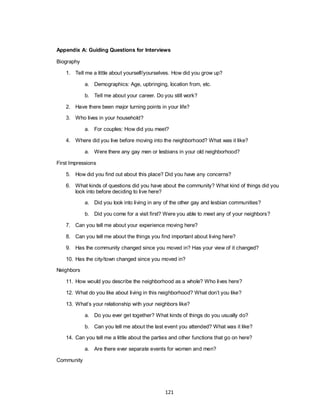
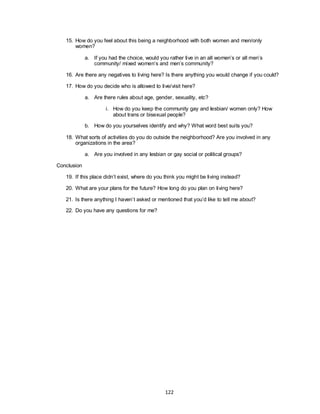
Oakley (1981) holds that feminist research requires openness and engagement, which
can be facilitated through intimacy, self-disclosure, and believing respondents. While I referred to
the guiding questions in Appendix A, I emphasized that they were not necessarily comprehensive
or useful, and encouraged participants to lead the conversation by telling the stories they
considered relevant. In Yeandle‘s experience, this approach serves interpretivism:
The opportunity was given for women to discuss the progress and decision of their
employment careers in all their complexity, and this helped to eliminate the danger that
the framework of my questions might impose external meanings and interpretations on
the events which constituted a respondent‘s individual history (1984:47).
22
Occasionally participants asked me if it was alright to talk about something ―off-topic.‖ I used
opportunities like this to reiterate I am interested in what is important to them, so nothing that they
consider relevant is off-topic.
Interviewing participants in their homes was useful. Interviews here felt relaxed and
allowed me to observe residents‘ families and lives in the neighborhood. Especially in Sanctuary
Cove, where pets play an important role in constructing families and facilitating community among
residents, it was useful to meet participants‘ pets. I was sometimes conferred approval through
what Tannen (2004) calls ―talking the dog.‖ In these moments, pets, framed as interactional
resources in participants‘ families, ―barked‖ things like, ―We like her!‖ Interviewing in participants‘
homes also enabled me to observe how communities interact. In Sanctuary Cove, neighbors
dropped by each other‘s homes to say hello, and relayed messages to me through each other. In
Heritage Estates and Bayside Park, participants walked me to their friends‘ homes. Friendships
between participants facilitated my ability to conduct interviews. For example, Rebecca declined
to interview with me when I met her at the party, but later contacted me because her neighbors
encouraged her to participate. Finally, interviewing in participants‘ homes allowed for extended
informal interactions. I brought participants cookies to thank them for interviewing with me, which
often occasioned talking over coffee before the interview. There were also a few times that I was
invited to stay for lunch or dinner after an interview. These extensions of our time together
allowed for participants to say things ―off the record‖ which they would otherwise not discuss.
While I do not repeat ―off the record‖ statements in my writing, having this information enhances
my understanding of their communities.
Analysis
Grounded theory offers systematic yet flexible guidelines for analyzing qualitative data
and constructing theories ―grounded‖ in the data themselves (Charmaz 2006:3), so ―the fit
between symbolic interactionism and grounded theory is extremely strong‖ (Bryant and Charmaz
2007:21). I first looked at individual interview transcripts looking for generalities, recurring
23
patterns, missing concepts, and meanings associated with generalities.3
I compared individual
transcripts to others in the same setting, coding and memoing (Charmaz 2006) and writing ―text-
reader conversations‖ (Smith 1990). I then grouped themes which did not necessarily relate to my
literature review but instead addressed what came up in each community. I compiled lists of
quotes and reference points within themes and looked for patterns in who was discussing what,
how, and when, repeating the process until I gained confidence and clarity. While interpretive
analysis will be partial rather than generalizable, I hope that it might be ―contextual… socially
relevant… complete but not necessarily replicable‖ (Nielson 1990:6).
Assuming an appropriately critical stance has been an onerous process. Because I like
and care about many participants, it has been somewhat difficult to report findings which they
might be unhappy to read. To assume distance would be disingenuous, because as I write I am
often drawn back into the moment of sitting on someone‘s couch, sharing an intimate story.
Kleinman (2007:23) discusses her difficulty taking a critical stance about people she admired:
I discovered that everyone… spoke in ways that emphasized solidarity and the language
of equality: ―We all care about each other. We‘re trying to do something different, and
that‘s difficult.‖ How could I dare write an analysis that would criticize such well-meaning
statements?
I reconcile my difficulty assuming a critical stance by paying attention to what Kleinman (2007)
calls the ―rhetoric of the dominants.‖ She explains how rhetoric like ―fairness‖ can justify
dominance and construct oppression as honorable and heroic (Kleinman 2007:16). I therefore
looked for systematic and patterned absences in the data by asking questions of myself, the
analyst, like: What are the powerful leaving out? Who uses the language of personal choice and
when? Whose account is legitimated by others and whose is not? Do groups in the setting share
a language or is the language of the powerful different from the language of the less powerful
(Kleinman 2007:19-31)? I was better able to analyze data not through ―objective‖ distancing but
through a desire not to reinscribe systems of oppression.
3
Loseke, Donileen R. 2009. ―Methodological Techniques for Examining Narratives of Identity.‖
Unpublished course notes, University of South Florida.
24
CHAPTER 3: “GAY AND LESBIAN” SANCTUARY COVE
Sanctuary Cove markets itself as America‘s first gay and lesbian retirement community,
though one straight couple lived in the community a few years ago, and another lives there
currently. Although the community is not gated, lush tropical plants enclose the neighborhood and
seem to protect residents‘ privacy. There is no indication that the neighborhood is a gay and
lesbian community except for one small rainbow flag protruding from the porch of a display
property in the back. The community is located in what sociologists might describe as a suburban
location in Florida, though William describes it as rural: ―Coming from the Midwest, this is like
home for me… you see the cows, it‘s got that rural feel.‖ Sanctuary Cove does not impose age
requirements, but residents range in age from their fifties to their eighties. Since people began
moving into the neighborhood in 1998, 21 homes and 18 villas have been built, available from
$180,000 to $230,000. Some homes have gone under foreclosure in the global financial crisis.
Participants say that older men live in the homes, while the duplexes and triplexes are populated
with younger and more active women. All residents are white and highly educated.
I arrived to Sanctuary Cove on a weekday afternoon and walked around the block. I
waved at two men in a car pulling into their driveway and they waved back, so I decided to try to
talk to them. I introduced myself as a student interested in what it was like living there, and they
encouraged me to talk to their neighbors, Sandra and Katherine. Even though I felt strange
knocking on their door without an invitation, Katherine later assured me that it was ―a nice way to
lay the groundwork for what you wanted to do.‖ We talked for about an hour before they directed
me to Josephine, whose party I attended a few weeks later. I collected contact information of
people interested in participating at the party, and later interviewed participants in their homes in
February and March 2009. Our conversations generally centered around the question, ―What is it
like to live here?‖ Conversations lasted between under an hour to almost three hours, and
averaged about an hour and a half. Nine households participated, including ten women and four
25
men. I estimate that these 14 participants represent about a quarter of the residents in the
neighborhood. Ten participants interviewed with their partner, two were single, and the remaining
two lived with their partner but interviewed individually. Participants range in age from 53 to 74,
with an average age of 67.
In this chapter, I argue that Sanctuary Cove is a setting for accrediting4
gay identities. To
support this argument, I describe how residents ―do‖ Family in Sanctuary Cove, focusing on the
important roles of care-taking, involvement, and gay identity. I consider how pets construct
nuclear family and community Family, and communicate relationships before addressing how
participants engage with discourse which positions gay identity against family. Community
practices of Family and low-profile accredit identities as lesbians and gay men and offer the
residential community itself as the ―out‖ self for residents. Affirmed by unmarked identity,
residents protect Sanctuary Cove through a strategic high profile, utilizing the community as
collective presentation to protect the personal self. In the second section, I describe residents‘
association of ―the gay community‖ with overt sexuality, non-normative gender presentations, and
promiscuity, before arguing that they collectively counter this identity by asserting a low-profile.
To conclude, I situate my findings back into questions about how identities are produced within
communities, the significance of gay communities, and how communities engage dominant
discourse to negotiate privilege and stigma.
Accrediting gay identity
Before moving to Sanctuary Cove, residents explain that there was ―no way to feel good
about being open.‖ They tell stories about being harassed, gossiped about, or ignored in
heterosexual neighborhoods. By contrast, the existence of a ―gay and lesbian‖ retirement
community supports accrediting gay identities since ―that which frames the collective‘s identity
defines their existence as right and good‖ (Taylor 1989 cited in Cerulo 1997:394). Abigail says:
4
Rosenfeld describes accrediting discourse as ―gay-positive,‖ and I use the term in the same way
(2003:6).
26
Let me talk about first of all how I felt about coming to this type of a community… The
very fact that someone had the wherewithal to establish—to come right out and say, ―We
are going to establish a retirement community for gays and lesbians,‖ was a wonderful
thing as far as I‘m concerned.
Most residents, especially the older among them, were not ―out‖ before moving to Sanctuary
Cove. Sandra and Katherine, both 59, contextualize their experience historically:
Katherine: We grew up in the 60s. We were working our first jobs in the 70s. And nobody
was out. It was just not cool to be out.
Sandra: It wasn‘t that it wasn‘t cool—it wasn‘t accepted to be out.
Katherine: Right. And so we did what we had to do. Whether it was in the neighborhood
or wherever it was… a lot of us, and I‘m including myself—you wouldn‘t know unless you
asked or had the conversation. Because we just—and that was our generation—just try
to fit in.
Moving to Sanctuary Cove was not an extension of an accredited gay lifestyle, but instead the
construction of a new possibility. Here Ernest ―doesn‘t have to pretend anything‖:
It‘s the sense of community, really. Just being in a place where your next door neighbor
understands. When you want to talk about your partner you can talk about the male
partner that you have, and don‘t have to pretend anything at all.
Similarly, Evelyn says, ―I‘m so grateful we‘re here instead of up North, because I know even
though people would [say], ‗Oh I‘m so sorry to hear about your friend.‘ You know? It‘s a different
support.‖ Even the idea of living without stigma is powerful, as Sandra explains.
Just the thought that you could hold hands if you wanted to. Or hug. Or like when she
leaves on her trips, I can go out to the car and give her a kiss when she‘s leaving. Or the
little things that are everyday life for people across the street in [Eastern State]. We don‘t
have that option. So we have that option here.
As a ―gay and lesbian‖ retirement community, Sanctuary Cove is an identity setting which
provides a toolkit for how to feel, act, and who to be because residents come to Sanctuary Cove
with ideas and expectations which influence their experience of the place (Brekhus 2003:17).
Free from the burden of managing stigma in a heteronormative neighborhood, Rebecca says, ―I
don‘t think I‘ve ever lived in a community that was as open and accepting. Well, ‗cause we‘re all
in the same situation. We‘re all gay.‖ Importantly, while residents understand gay identity as a
resource within Sanctuary Cove, they do not identify with the cultural narrative of ―the gay
community.‖ I will attend to this in the next section.
27
In the context of a ―gay and lesbian‖ community, participants ―do‖ Family. ―We didn‘t buy
a house—we bought a community,‖ says Pat. Ernest gushes over how helpful his neighbors are,
saying that shows up ―when you really need it… people really look out for each other here, it‘s
just amazing.‖ ―All I can say is the people,‖ Evelyn states, ―They mean everything. They are an
extended family.‖ She offers some examples of how Family is produced through interactions:
When Carme got sick you realized how the community just surrounds you with love.
They‘re so helpful. Everybody wants to help. I‘ve gotten food, people bring over—without
me saying a word—they just bring over food, or people are always asking me, ―Can I
walk [your dog] while you‘re at the hospital?‖ Or, I don‘t drive at night, so people drove
me over to the hospital at night and picked me up a couple of hours later… Another
neighbor over here, she made Carme two hats that she can wear since she has no hair
now from the chemo…
Our next-door neighbors Robert and William over here bring flowers and send a card
every week… Marge is a really great photographer and she took all of these
photographs… because I said …we didn‘t have any photographs of us... Marge‘s partner
had some operation… So people made up a schedule and every two days they brought a
casserole to Marge so she wouldn‘t have to cook… Katherine, one of the girls on the
other side, decided she‘d start making a schedule… and sent out…―Who would like to
sign up for casseroles?‖ So people do things for each other all the time.
―That‘s part of community. Everybody pitches in and helps,‖ Allison says, ―That‘s part of the way
we‘ve done it.‖
Along with caretaking, involvement in events is a Family practice. The social committee
schedules a full calendar of parties, but ―most of what happens is pretty informal,‖ William says,
―people just decide, ‗Hey, let‘s all go to a movie.‘ And the next thing you know, there are ten of us
going to a movie.‖ For Pat, building a lesbian and gay community requires effort: ―They can go
anywhere—the straight people. That‘s my point. They can go anywhere. We can‘t. They can go
anywhere and make community. We have to really work at making community.‖ Since active
participation is central to Family, Katherine considers lack of involvement problematic:
We want to belong. We came here because we wanted to be part of community… The
other people here who just keep to themselves, I have to ask myself, ―If all you wanted to
do was sit inside your house and not associate with anyone, why did you bother to move
here? What was the point?‖
Likewise, Evelyn mentions that one neighbor ―just wants to live here‖ and is not involved in social
events. Their statements suggest an expectation of conformity to Family practices.
28
Although participants describe some pressure to conform to Family ideals, it is apparent
that their shared expectation for Family alleviates conflict surrounding conformity. Supporting
Lefebvre‘s (2001) understanding of place, Family in Sanctuary Cove is not produced solely by the
setting because residents imagine Sanctuary Cove as a place for Family even before they move
there. William recalls:
It was just very obvious the kind of community that—if you come into here, you‘re buying
into the notion that if somebody‘s sick you‘re going to help them out. Anything anybody
needs, we all kind of jump in and do that… It was clear that everybody was there to help
out too. That‘s what sold me... While a lot of the people in the community do have
children, we don‘t, and a number of us don‘t. And we wanted to be in a community where
if something happened as we got older, there would be other folks around to help.
Like many residents, he bought into the community with the intention of doing Family. Conflict
about identity is minimized because the community engages in the self-sustaining project of
attracting people with shared sensibilities, as William explains:
Kind of a self-fulfilling prophecy I think, because when people come to look at the units,
they see how we all are. And if they want that kind of a community they‘ll buy. If that isn‘t
what they‘re looking for then they don‘t buy… So we just keep bringing in more and more
of the same kind of people.
Conformity to Family appears to function more as a resource for avoiding conflict, rather than a
source of conflict. Because involvement is a Family practice, mentioning events emphasizes
unity. Evelyn ends a statement about differences between residents who live in homes and villas
by saying, ―Although we‘re sort of separate, we‘re still one community, so most of our parties are
together. We just have lots… at the drop of a hat!‖ Similarly, Ernest vents frustration about what
he is allowed to put in his yard, but then adds: ―Otherwise the community works very well. It really
does. Socially we all tend to get along, and lots of parties.‖ A straight couple living in Sanctuary
Cove is a valued part of the community because they are involved. When I ask Marge how she
feels about them living there, she responds, ―They come to parties. They gave a barbeque a
couple of years ago.‖ Talking about events functions as shorthand for Family cohesion.
Pets help construct the Sanctuary Cove Family by facilitating community interactions and
shared meanings. Sandra and Katherine explain that they walk down to the villas during their dog
walks so that they can visit with those residents. Josephine says that even people who don‘t have
29
dogs buy dog biscuits so they can go out and socialize with their neighbors on dog walks. Dog
walks afford opportunities for daily socialization for those able to participate. Allison has health
problems that prevent her from walking; she laments, ―If I was out walking a dog… I would see
more of my neighbors… more often.‖ Sanctuary Cove has a pet directory and Mary gives me her
cats‘ ―business cards.‖ For Pat:
It‘s interesting because usually straight couples are talking about their kids all the time.
Well animals are so important to gay couples because the majority don‘t have their own
kids… you find it more in gay and lesbian communities, I think. And this is such an animal
friendly place.
As Marge puts it, ―The dogs—these are our children. We don‘t have kids. These are our kids…
They‘re just accepted because they‘re a part of our lives.‖ Collectively sharing an understanding
that pets are kin is a Family practice.
Residents embrace an idealized model for family including commitment and/or marriage,
kin, and enduring solidarity, which invokes a white, middle-class, romanticized notion of family
(Coontz 1992). Couples at Sanctuary Cove are clear to express that they are always
monogamous and often married; their pets function as kin solidifying and demonstrating family
both nuclear families and the Sanctuary Cove Family. While this suggests race and class-based
privileges and demonstrates commitment to dominant discourse, it is important to remember that
the prevailing discourse situates gay identity as oppositional to monogamy, kinship, and ―the
family‖ (Weston 1991). This concept is produced and maintained by representations which
exclude lesbians and gay men from ―the family,‖ thereby reducing them to a sexual identity, and
sexual identity to sex alone. Max says, ―I‘m very happy that I was able to have a family and things
like that, and I just don‘t know what would have happened if I would‘ve known [that I was gay]
when I was young.‖ Fatherhood was unavailable for men in gay relationships in the 1950s, so gay
men equate ―their sexual identities with the renunciation of access to kinship‖ (Weston 1991:145).
The idea that claiming a lesbian or gay identity rejects family and kinship relies on two
assumptions: ―the belief that gay men and lesbians do not have children or establish lasting
relationships, and the belief that they invariably alienate adoptive and blood kin once their sexual
identities are known‖ (Weston 1991:143). The antagonistic relationship between lesbian or gay
30
identity and family within discourse is reflected in respondents‘ stories envisioning family and
parenting only in the context of heterosexual marriage (Weston 1991:146). Therefore participants‘
relationship to dominant discourse is complex. While their vision of family conveys privilege, it
also rejects stigmatizing discourse.
Along with doing Family, Sanctuary Cove is characterized by doing what they call ―low-
profile.‖ Doing low-profile refers to an unmarked lesbian or gay self-presentation, and is
accrediting because it suspends the salience of lesbian and gay identities—making the burden of
coming out in everyday life less frequent. When I ask Marge what kinds of words she uses to
describe herself she answers, ―Um—you know it‘s kind of hard to say. I‘m not usually in that
situation.‖ Living in Sanctuary Cove means that residents can have low-profile self-presentations.
―I like just being a person,‖ Sandra declares, laughing, ―It just so happens that I happen to be
[gay].‖ Participants are not set apart as gay and lesbian people because living in Sanctuary Cove
conveys identity for them.
Although doing low-profile is accrediting, it is sometimes useful to employ a strategic
high-profile. Pat and Marge take a high-profile when talking with outsiders:
Pat: Whenever I see anybody looking around, I always let them know, if they look like a
straight couple or anything else, and make it clear that this is a very involved community.
This is not just someplace you live. So if you want to be here, you need to be part of the
community and this is a gay community… You can‘t keep them out if they really want to
move in but, you know—
Marge: But you don‘t have to make it attractive.
Yet the strategy of asserting a high-profile must be carefully considered, since residents consider
the local suburban area unwelcoming:
Robert: Some people put the big flag out front and other people don‘t want anybody to
know that they live there…
William: The more attention we draw to the community, the more likely it is that
something could go wrong. Somebody could come in and be malicious or whatever. So I
think there was much more concern with some of the folks up front about that whole
thing... It‘s not very liberal.
Robert and William suggest that the older ―folks up front‖ have more conservative values and
prefer to do low-profile. Also, suburban Florida is not liberal or welcoming.
31
Interestingly, presentation of community as self is not spatially-bound for residents. For
example, William recalls a community dinner outside of the residential neighborhood:
On Valentine‘s Day we decided we wanted to go out to dinner. We thought we‘d invite a
few couples. Well! Because once you start inviting somebody here, you never know when
you‘re going to stop! …So we ended up with 25 or 26 of us going to Valentine‘s Day
dinner. And then it‘s like, ―Well where can we go with that size group?‖ We ended up
going to the Amish restaurant in [a small town]! …So we all go in there. And I don‘t think
anything was noticeable with us as a group because we are pretty split between lesbians
and gay men. So if you looked at how we looked, we looked like straight couples! But
then when we divvied up the checks, you know, the waitresses went around and said,
―Who‘s on which check?‖ It was like the two of us, and then the two women next to us,
and the two guys next to them, and so forth.
Although residents individually present a low-profile, when the checks come, they are evidently a
community of lesbians and gay men. Using community meanings as a resource, Sandra and
Katherine frame their dogs as kin-substitutes to convey their relationship to outsiders:
Sandra: We were in dog training the other day and they said, ―So you have two dogs, and
do you train them together?‖ And I said, ―Well yes they‘re both my dogs and they‘re her
dogs too because she‘s my partner‖…
Katherine: Yeah, what do you say? They live together, because we live together. (laughs)
Residents utilize shared community meanings of pets as kin to present sexual identity and family
relationships to others. William speaks for his cat when he says, ―This is my daddy,‖ rendering the
cat kin within their nuclear family. When Sandra‘s mother tells her she wants grandchildren,
Katherine jokes, ―we kept presenting her with her grand-dogs.‖
Sanctuary Cove is significant for enabling and producing accrediting gay identities,
demonstrating the salience of community, and shedding light on how identities are made both
salient and not salient in the context of community. Insofar as residents live in the suburbs and do
low-profile, some might consider Sanctuary Cove an example of ―gay assimilation.‖ But where
gay assimilation is theorized to dismantle gay community and identity (Kilhefner 2007), Sanctuary
Cove as a ―gay and lesbian‖ community brings residents together, facilitates Family, and enables
openness about sexual identity for the first time in many respondents‘ lives. Living here
simultaneously facilitates and relinquishes sexual identity: as a setting for ―gay and lesbian‖
retirement, the community enables sexual identity; while in the context of lessened oppression,
32
the stigmatized identity loses salience. While residents do not embody evident sexual identity,
they utilize community and community meanings as a proxy for outness.
Yet it is not possible to remove their community and identity practices outside of race and
class-based privileges. For example, Marge serves on the board of a conservative religious
center and makes gains through respectability:
Marge: I was the only lesbian on their board, the only gay person. And as a matter of fact,
I never let it not be known. From the beginning, this was it. So here I was in this religious
capacity … I mean it became a major thing. And it was never, ―This is Marge [last name].‖
[Instead it was:] ―Marge and Pat, Marge and Pat, Marge and Pat.‖ So if we do anything
we feel very strongly that we can educate, and that‘s what we want to do.
Pat: I really think that. Even though movements are important, sometimes movements
can be turn-offs. Depending on how they approach a situation.
Marge is recognized as a lesbian in her role, extending respectability to include a lesbian family.
This is a politically useful for lesbians and gay men, but does not challenge how respectability is
conferred to those with racial and class privilege. I previously addressed how doing Family was at
once a privileging endeavor and a rejection of dominant discourse which construct lesbians and
gay men as outside of the family. Even as these examples run counter to dominant privilege,
there is no escaping the reality that in order for residents to assume accrediting gay identities in
Sanctuary Cove, they must be able to afford to buy a home there. Josephine laments that there
are no ―Spanish speakers‖ at Sanctuary Cove (a euphemism for ethnic diversity) but lacks the
vocabulary ―to talk about, let alone evaluate, compromises imposed by resource constraints‖
(Piore 1995:27). To answer the question, ―How do race, class, and gender constitute privilege
within stigmatized populations pursuing identity-based communities?‖ I suggest that it is not
possible to dissociate Sanctuary Cove residents‘ accrediting gay identities from race and class-
based privileges.
From dominant heteronormativity to low-profile family
Even though Sanctuary Cove is an intentional ―gay and lesbian‖ retirement community,
residents rely on heteronormative precepts and do not identify as separatists. They are involved
in local, heteronormative churches, volunteer groups, and organizations like Big Brothers/Big
33
Sisters, Meals on Wheels, Guide Dogs, Silver Threads, and a university fraternity. Max is
involved at church because, ―I‘ve always felt that I wanted to be associated with other than just
the gay community.‖ Residents distance themselves from separatists at Bayside Park (the
women‘s-only community I discuss in the next chapter) by emphasizing unity when they talk
about gender:
Max: The women tend to do things together much more than the men do I think.
Jessica: Do you have parties with all men?
Ernest: We‘re going to start that! …We decided that. We had two male couples over for
dinner this week and we learned more about them in one night of a nice, intimate
dinner… [and] we all enjoyed it… But I hope it doesn‘t— I like things where the whole
community gets together, male and female and so on.
They prefer doing things together, Alison says, ―So why would I put myself in a lesbian-only
community that is a separatist place?‖ Evelyn describes gendered relationships similarly:
We have um, a little bit of a separation between the male community and the female
community… But on the whole, we get along pretty well together, and we‘re… really
friends with everybody.
Viewing separatism as a failure to accomplish normalcy, residents stress that they are just like
everybody else.
In this respect, residents of Sanctuary Cove rely on heteronormative precepts. For
example, when residents discuss straight couples living in Sanctuary Cove, Allison frames the
story from a heteronormative perspective:
They were—it‘s fine… if someone‘s uncomfortable in this environment, they‘re not going
to move here. When there [are] houses for sale, the first thing the realtor needs to do is to
tell them that they will be moving into a gay community. So if they‘re comfortable with it,
it‘s fine… I don‘t have any—I‘m not a separatist. Or I‘m not someone that‘s— as long as
I‘m living here and I can be comfortable here, is the most important thing.
Most agree that the straight couples are comfortable, though Evelyn says one neighbor was
homophobic: ―Even though they thought they would be able to fit in the community… the husband
was really not very comfortable. He would say things like, ‗Well I know all about you folks.‘‖
Centering on how straight people feel in Sanctuary Cove, participants‘ frame is heteronormative.
Marge and Pat singularly challenge the community‘s accountability to heteronormativity. Marge
says:
34
[The realtor] supposedly always said that he would ask them but, I‘m not so sure he did.
He might have said, ―This is a gay and lesbian community.‖ And he might have said,
―How do you feel about living here, knowing that?‖ But I don‘t think it went any further
because one of the statements I made at the meeting wasn‘t, ―How do they feel?‖ …How
do we feel?
Suggesting their frame was backwards, Marge asked residents to think about how they felt about
straight couples moving in. Other residents misunderstood her efforts, though, and instead said
that ―one couple that had a problem‖ with having straight neighbors.
Were heteronormative precepts not contextualized by age, collective narration of ―the gay
community‖ might be considered homophobic. It is important to remember that lesbian and gay
elders came out in an era ―driven by the language of stigma‖ (Rosenfeld 2003:2). At 74, Ernest
demonstrates:
I didn‘t know anything about a gay community. My first exposure to something called a
―gay community‖ was the movie Advise and Consent. There was a senator being
blackmailed… and he went to find the guy who was trying to blackmail him and he went
into a gay bar in New York City. And it was a very unattractive atmosphere. It was about
as unattractive as you can make a gay bar look! And that was my whole experience of
what they called a ―gay community.‖ So I was not in any hurry to go join the gay
community!
Ernest‘s first exposure to gay community prevented him from wanting to be a part of it. As
currently idealized, ―the gay community‖ celebrates pride, diversity, individuality, and sexuality,
but this is a historically recent modification to a narrative evolving from negativity. Before gay
liberation in the late 1960s, ―cultural depictions of homosexuality as anything other than a
shameful pathological condition leading to isolation and misery were censored and hard to come
by‖ (Rosenfeld 2003:1).
By doing low-profile, participants distance themselves and Sanctuary Cove from ―the gay
community‖ which they associate with overt displays of sexuality and gender deviance. Katherine
comments that when her nephew ―came out, he had a t-shirt [that read] ‗I‘m here, I‘m queer, get
used to it!‘ Oh my god, I would never have done that.‖ Max describes his discomfort with ―overt‖
sexuality:
We have never been comfortable with a good portion of the gay community because they
are so busy being gay! And in all the gay organizations I belonged to, they were always a
cadre there that was busy being gay. You couldn‘t have a conversation with them,
because they had to make some gay joke out of it… So we‘ve had some bit of a problem
with that… Being into all the stuff gay people are supposed to be into… This
35
neighborhood is a lot less like that. The men don‘t seem to be into that sort of thing at all
here.
Participants avoid appearing gay to avoid stigma. Max‘s story shifts from describing ―the gay
community‖ to describing the community at Sanctuary Cove. His narrative defines the cultural
narrative (―they are so busy being gay‖) which he distances himself from through personal
narrative (―we‘ve had some bit of a problem‖) in order to convey a collective narrative
differentiated from the cultural one (―this neighborhood is a lot less like that‖). Following dominant
discourse, participants prefer gender-normative presentations. Abigail confides: ―You know, I see
kids running around with real butch number acts going on… females being very male in their
activities.‖ Katherine confides, ―I don‘t understand what‘s in their head that makes them feel they
have to do that, you know?‖ Rosenfeld explains: ―In a social world that accepts the visibility of
‗unrespectable‘ homosexuals and the invisibility of ‗respectable‘ ones, the presumption of
heterosexuality becomes the presumption of respectability itself‖ (2003:632-3).
Participants also associate ―the gay community‖ with youth and promiscuity. Although
William is the youngest man living at Sanctuary Cove, he says that he felt relatively ―old‖ in the Ft.
Lauderdale gay community. He suggests that Sanctuary Cove is not ―the typical community‖:
People are well-read. They stay up on current events. They‘re engaged politically. It‘s not
the typical community where people just want to go and hang out at the bar. I think that‘s
the reputation a lot of gays get—that we just hang out at the bar. In Ft. Lauderdale that
was probably true. Here, it‘s not the case.
The dominant cultural narrative about ―the gay community‖ involves hanging out at bars, and
William draws from this narrative to describe his experiences both in Ft. Lauderdale and
Sanctuary Cove. Similarly, Katherine recalls that in a different city, ―Two couples absolutely
traded partners. That just freaked me out. But none of that goes on [here]. We‘re past that… So
that‘s another nice part about the community. Everyone‘s settled and calm.‖ While she does not
explicitly refer to stereotypes about ―the gay community‖ as William did, she distances Sanctuary
Cove from implied promiscuity. Katherine constructs a collective Sanctuary Cove narrative in
opposition to the cultural ―gay community‖ narrative: rather than describing residents as practicing
monogamy, she explains that they are not promiscuous. To describe dominant cultural narratives,
then, is not to imply falsity. To the contrary, ―effective stories at the cultural level of social life
36
ignore—but do not erase—real life complexities‖ (Loseke 2007:666). That there may be examples
which exemplify stereotypes does not render the cultural narrative of ―the gay community‖ less
powerful or threatening, since its existence ―define[s] the possibilities of utterance in a cultural
universe‖ (Swidler 1995:32 quoted in Loseke 2007:665).
Residents distance themselves from what they consider to be an overtly sexual, gender-
deviant, and promiscuous ―gay community,‖ by collectively doing low-profile in Sanctuary Cove.
Max suggests that residents do not fit stereotypes: ―There aren‘t any gay men here I ever thought
of as being… the one that you think of being as typically gay, the stereotype.‖ Evelyn conveys the
purpose of doing low-profile:
We stay fairly low-profile. Although we have a big rainbow flag, it‘s in the back now. And
we‘re not flying it from a big pole… And nobody is walking around like Wigstock, you
know. I really think that‘s what they expected. They think we‘re really weird, and we‘re
not. We‘re just—I like to call us ―picket fence lesbians‖ you know? (laughs) …You know
how everybody wants the suburbia with the white picket fence sitting around? …We‘re
just like everybody else, paying our taxes and everything.
Setting herself apart from the dominant understanding of ―the gay community,‖ Evelyn stresses
that residents of Sanctuary Cove are ―just like everybody else.‖ She does not reject a lesbian
identity, but instead articulates a more desirable version: ―picket fence lesbian.‖ Although he is
uncomfortable with ―the gay community,‖ Ernest enjoys low-profile openness at Sanctuary Cove.
Ernest was attracted by ―the community spirit and the way people just seem so natural to be gay
and open around here.‖ This is a dramatic shift considering their new gay friends and neighbors
are not gay incidentally. Instead, Sandra argues that the community functions this way because it
is a gay community:
Here, because we have the most important facet of our lives that‘s been closeted for so
long, there‘s an instant open space that seems like it allows you to become friends and
neighbors and everything that can go along with that.
Especially as members of an older cohort, the available script of ―the gay community‖ is
undesirable. By doing low-profile, residents construct identities in ways that are validating for
them. Answering the question, ―How do communities produce, maintain, or resist social
conditions?‖ I argue that Sanctuary Cove enables residents to reclaim gay identity from dominant
discourse and take up accrediting gay identities. Even as they rely on heteronormative precepts,
37
respondents distance themselves from the dominant narrative (Max says they are not the
stereotype); reclaim it (Evelyn is a ―picket fence lesbian‖); and ignore it because they can (Marge
doesn‘t need to come out).
Findings from Sanctuary Cove
This chapter introduces the ―gay and lesbian‖ retirement community, Sanctuary Cove, as
a setting for accrediting gay and lesbian identities. Care-taking, involvement, and gay identity
construct community ―Family,‖ even as heteronormative discourse positions family against gay
identity. Although Family is embedded in gay identity, residents paradoxically resist identifying
with ―the gay community‖ which they associate with overt sexuality, non-normative gender
presentations, and promiscuity. Elders collectively counter negative associations by asserting a
―low-profile,‖ which constructs the neighborhood itself as a proxy for ―out‖ presentation. Living in
Sanctuary Cove conveys sexual identity for residents, so that they do not have to feel set apart as
gay and lesbian people or individually manage stigma. Free to construct identity in ways that are
validating for them, participants assuming accrediting identities in Sanctuary Cove through the
joint construction of low-profile and Family.
How are identities produced by and within Sanctuary Cove? I argue that community
practices of ―Family‖ and ―low-profile‖ accredit gay identities in Sanctuary Cove. I portray how
accrediting identities are produced by and within Sanctuary Cove by describing both expectations
for community before moving in as well as collective practices in the setting. Demonstrating that
the community is produced in part by expectation, residents explain that just the thought of a ―gay
and lesbian‖ community enabled them to imagine an accrediting lifestyle. Expectations and
practices are congruent: visitors come to Sanctuary Cove imagining Family and subsequently
engage in doing Family as residents. There is little conflict since like-minded people move in to
pursue the same goal. Unlike identity-based communities where conformity produces conflict,
conformity is a resource for emphasizing unity and Family in Sanctuary Cove. Addressing how
accrediting identity is produced interactionally and contextually, I discuss the interactions which
produce Family (i.e. caretaking, being involved in events, sharing meanings about pets as kin)
38
and describe how identities are presented in different contexts (i.e. low-profile and strategic high-
profile). Doing low-profile is accrediting both as a presentation which alleviates the burden of
coming out and as a counter-construction to the stigmatizing dominant cultural narrative of ―the
gay community.‖ The community conveys sexual identity for residents, but presentation of
community as self is not bound to Sanctuary Cove as a setting. Rather, community (and
presentation of self through community) should be conceived of as operating through
relationships.
What does it mean for identity to live in Sanctuary Cove in the post-gay community era?
Sanctuary Cove demonstrates the salience of community by revealing how identities are made
both salient and not salient in the context of community. Insofar as residents live in the suburbs
and do low-profile, some might consider Sanctuary Cove to be an example of ―gay assimilation.‖
But where gay assimilation is theorized as dismantling gay community and identity (Kilhefner
2007), Sanctuary Cove brings a community together, facilitates Family, and enables openness
about sexual identity for the first time in many respondents‘ lives. Living here simultaneously
accredits and diminishes sexual identity: as a setting for ―gay and lesbian‖ retirement, the
community enables sexual identity; while in the context of a gay majority, their gay identity is
unmarked. In this safe context, sexuality loses salience as a source of stigma. Finally, while
residents do not embody evident sexual identity, they utilize community and community meanings
as a proxy for outness.
How do residents in Sanctuary Cove utilize dominant discourse to negotiate privilege and
stigma? I answer this question in two parts by addressing the privileges granted to participants as
individuals, and then considering their collective engagement with dominant discourse. First, it is
not possible to dissociate Sanctuary Cove residents‘ accreditation from race and class-based
privileges. In order for residents to assume accrediting gay identities in Sanctuary Cove, they
must be able to afford to buy a home there. While some note a lack of ethnic diversity as a
problem, they are nonetheless an entirely white community and receive privilege on account of
their whiteness. Especially as white, middle-to-upper class people, residents are able to make
39
gains through privileged presentations of respectability (i.e. doing Family and volunteerism).
Second, their collective engagement with dominant discourse is pragmatic: residents engage
dominant discourse in ways that secure privilege (i.e. doing Family) and reject stigma (i.e. doing
low-profile). Doing Family is at once a privileging endeavor which confers respectability to white,
middle-class people, and a rejection of heteronormative dominant discourse which construct
lesbians and gay men as oppositional to family. Even more complex is residents‘ collective
treatment of dominant cultural narrative of ―the gay community.‖ While they undoubtedly rely on
heteronormative precepts, residents collectively assert an accrediting gay identity by doing low-
profile. This answers the question, ―How do communities produce, maintain, or resist social
conditions?‖ Sanctuary Cove maintains race and class-based privileges but enables social
change for residents who are accredited through reclaiming gay identity from stigmatizing
dominant constructions and settings.
40
CHAPTER 4: “WOMEN’S-ONLY” BAYSIDE PARK
Bayside Park is a gated ―women‘s community‖ started in 1997 by a lesbian couple.
Located in a suburban Florida, the community spans 50 acres with almost 300 lots for
manufactured homes (from $140,000 to $350,000) and recreational vehicles (henceforth RVs,
priced $55,000 to $95,000).There are about 130 full-time residents, but ―snow birds‖ come down
in the winter until as many as 500 women populate the community. Ranging from 40 to 85,
residents work full-time, part-time, or are retired. The community restricts male residents through
private clubhouse memberships available for women. Although visitors of any sex may use the
clubhouse with a temporary member pass from 11am to 1pm, women are informally sanctioned
for bringing male visitors. Members of the clubhouse pay a quarterly fee to use amenities (e.g.
swimming pool, pickle ball courts) and attend events (e.g. dances, comedy shows). The
community has its own television channel which announces events continuously.
I arrived at Bayside Park around 10:00am on a Saturday morning. Unable to reach the
clubhouse using the buzzer, I parked my car on the shoulder of the road and waited a few
moments before someone exited the gate. A woman hopped out of her car to heave a trash bag
into the dumpster. I walked over and introduced myself and the project. She said she had a quick
errand to run and would be back in a few minutes to talk to me. Soon after she left, another car
exited the gate. As the driver parked and walked towards me, she began telling me to leave. I
introduced myself and explained that I was waiting to talk to someone who just left, but she said
that woman did not have the right to invite me in and threatened to call the police. I apologized for
upsetting her and said that I didn‘t mean any harm. ―That‘s what they all say,‖ she snorted. I left
that encounter feeling shook up. I did not expect to find a way to return, nor was I certain I should.
Surprisingly, my access to Bayside Park was participant-driven. Most of the women I met
in Heritage Estates had moved there from Bayside Park. They took interest in the project and
41
were concerned that their narratives could not represent the women in Bayside Park. They
assured me that my presence was unlikely to create community conflict and encouraged me to go
back. Soon after a few of these conversations, I received an email from Toni who said that friends
from Heritage Estates told her about my thesis and she would interview with me. A respected and
visible gatekeeper, Toni arranged all of my interviews at Bayside Park. Interviews took place in
women‘s homes in November, 2009, and lasted just over an hour to four and a half hours, for an
average of about two hours. Four households participated, with a total of seven women. I
estimate that these seven women represent less than ten percent of the total population,
irrespective of season. Of the seven participants, one was single, and the remaining three
couples interviewed together. Participants range in age from 43 to 75, with an average age of 61.
A windy, private road leads to two wrought iron gates separating Bayside Park from the
outside world. A short-haired woman cruises by in truck with a kayak strapped on top and dog
wagging excitedly in the back. I punch in the code for Toni‘s home, followed by the pound key.
Moments later the gate opens and I pull onto Susan B. Anthony Street, just past Rosa Parks
Boulevard. I don‘t hold back my excitement as I pass a large rainbow flag rippling in the breeze. A
woman glances up from her garden patch to give a warm nod, rendering me an instant admirer of
this place. Most participants described a moment like this one. For Louie, ―it was an immediate,
‗This place is great!‘‖ Like the women I interviewed, I was excited by the idea of a ―women‘s
community.‖ Toni reminisces about her ―feeling driving in,‖ saying, ―I mean from the minute I got
here I knew I didn‘t want to leave. And so within a week I was already trying to find permanent
staying arrangements.‖ As a ―women‘s community,‖ Bayside Park is an identity setting which
provides a toolkit for how to feel, act, and who to be because women come to Bayside Park with
ideas and expectations which influence their experience of the place (Brekhus 2003:17). They
may notice things which confirm their ideas— as I did in noticing the historical women‘s street
names, rainbow flags, and warmth. I find that ideas about the meaning of ―women‘s community‖
influence perception even before women move in; and residents continue to engage with these
ideas in meaningful ways throughout their time in Bayside Park.
42
While their reasons for coming to Bayside Park are varied and personal, I find three
primary themes for how women engage with the idea of ―women‘s community,‖ including as a
place for sisterhood, belonging, and/or safety. These engagements are highly contested. While
some see Bayside Park as a place for sisterhood, others assert that it is a place for friends who
happen to be lesbians. While many think of the community as a place for belonging, residents
disagree about whether they belong to a ―women‘s community‖ or a ―lesbian community.‖ Finally,
while many live in Bayside Park for safety, others argue that the imperative for safety creates
fear, restriction, and extremism. I consider how these contested approaches to engaging with
Bayside Park as a ―women‘s community‖ produce accrediting identities for some women and
stigmatizing identities for others, ultimately rendering the community a setting for contesting
identity. To conclude, I consider these findings in light of my research questions asking how
identities are produced by and within Bayside Park, what Bayside Park means for identity in the
post-gay community era, and how residents engage dominant discourse to negotiate privilege
and stigma.
Contesting sisterhood
Some respondents understand ―women‘s community‖ as an identity setting for
―sisterhood.‖ Now 60, Linda moved to the community after retiring 5 years ago because she
wanted to live somewhere warm, and was also interested in sisterhood:
Linda: And again that‘s what still keeps me here. First and foremost, this is Florida. I
mean that has to be said that that‘s why I‘m here. If this place were in Illinois, I wouldn‘t
be here. And the idea of community and sisterhood was extremely important to me.
Jessica: Was that expressed? How did you come to those ideas?
Linda: Well see I thought there was going to be drumming circles here! (laughs) I had
kind of gone to the Nth— way over here about what sisterhood meant. Not really knowing
that women here would be… um. I don‘t know what else I thought. I‘m sure it was not
realistic. But anyway—that‘s kind of what I thought…
To be honest maybe it was, ―Maybe I‘ll come down to this land of the women and I‘ll meet
someone.‖ I think I got together with Tracy as much for loving Bayside Park as for loving
her. I loved this place. I thought it was really— even when I found out they didn‘t drum,
which I had never drummed but it was the idea of drumming. I‘ve never been to the
Michigan‘s Womyn‘s Festival. Even though they don‘t hold hands and sing Feelings—
even though there are some really hateful, dysfunctional people here— nevertheless, it is
a wonderful place.
43
Here Linda rounds out her idea of sisterhood, mentioning drumming, holding hands and singing,
and the lesbian feminist Michigan‘s Womyn‘s Music Festival. Loving relationships are fore-
grounded in Linda‘s ideas about sisterhood. Even though the community falls short of her
expectations, Linda produces ―sisterhood‖ through her relationship with an ex-partner which blurs
the line between loving Tracy and loving the Bayside Park.
By contrast, moving to Bayside Park was an extension of feminist politics for 75 year old
Betty and 73 year old Sue. As founders of Women‘s Studies programs, they didn‘t just study the
women‘s movement— they were involved in its creation. Betty and Sue found out about Bayside
Park through the Lesbian Connection when it was still being printed with a mimeograph machine.
After living in Bayside Park for a decade, and they say that the community is evolving in a way
that parallels the women‘s movement. Sue attributes problems in Bayside Park to ―organizational
intimacies, like when somebody proves untrustworthy—it‘s identity politics.‖ Valuing Bayside Park
as a political endeavor, Betty and Sue heard about my difficulty gaining access and wanted to
show me a better side of the community. ―It‘s our responsibility to articulate what it is that we‘re
about,‖ Sue explains. While Sue praises women who demonstrate ―a real commitment to the
community,‖ Linda is ambivalent about serving Bayside Park, confiding:
Linda: I don‘t want to be on a Board. They keep asking.
Jessica: How come?
Linda: I could see why they want me. I have a Master‘s degree. But I see what these
boards go through. I don‘t want to do it. I feel some guilt at times that I‘m not in the
forefront saying, ―I need to serve my community.‖ I‘m not sure if I have a place here in
that yet. I‘m not sure if I have to. I‘m on the Education committee. I haven‘t made up my
mind if being in a community means I have to serve.
Jessica: Is that idea suggested?
Linda: I think there are some people who probably, yeah. …I‘m 60 years old. I don‘t want
to sit in a meeting. That‘s a part that I haven‘t really come to terms with. Like, should I be
in the kitchen offering to clean up? Is that a part of living here? I don‘t know.
Participants do not share a clear idea of what commitment entails.
Whereas conformity is constructed as a resource in Sanctuary Cove, it is a difficult
imperative in Bayside Park. In Sanctuary Cove, participants imagined the same goal (i.e. Family)
44
and attracted like-minded residents. But as I will demonstrate in Bayside Park, members imagine
and pursue different and often conflicting goals (i.e. sisterhood, belonging, and/or safety), so that
conformity produces tension. Respondents agree that conflict should not detract from their
meaningful connections with each other, and must be overlooked for the greater good. Sue
admits, laughing, that, ―living here feels like a family you need a vacation from sometimes.‖ Betty
pauses and leans back in her chair:
I see a pattern: everything is lovey dovey and then people get bristly. You can‘t predict
what is going to blow but there will always be something. The things we deal with in
paradise! It never fulfills anybody‘s anticipation about how it should be. It‘s a matter of
having enough warm fuzzies.
Negotiating residents‘ utopian expectations for ―paradise,‖ Betty says that loving relationships
exist despite consistent conflict. Sue reports that women overlook conflict by staying friends with
ex-partners: ―relationships just build and build and people continue to be friends no matter how
old you get.‖ Linda recalls how she and Tracy ended their relationship in Bayside Park:
It would be like a breakup anywhere I suppose but it‘s different in the sense that we are a
small microcosm here. Everybody knows everybody here… Last fall when I broke up, I
wanted my friends who were friends to shun her and support me, which is totally
immature and that can‘t happen here.
Bayside Park is not an environment that would support one resident by shunning another, an
imperative Linda finds frustrating: ―I‘ve always heard lesbians talk about you know, ‗you have to
be friends with exes because we‘re a tight knit community and that‘s just the way it is.‘ And I‘m
like, ‗Oh bullshit!‘ You know?‖ This requirement of sisterhood ―makes it hard for people to heal,‖
but ultimately Linda concludes that conflict in the community must be accepted:
But you know, the needs of the many outweigh the needs of the few. That‘s what you
have to do to stay here. You cannot be a person who wants to come down here and run
this place or have your feelings hurt or look to be in conflict with other people. This is not
the place. You have to. This is a community with a big ―C.‖ It is a place where women
have decided that they want to be together… I think you have to be hearty to live here. I
don‘t think it‘s for the faint of heart… You have to say, ―Oh that Sally Sue, she acts like
that.‖ Whoever was mean to you at the gate— ―Oh we have some mean people here.‖ All
that has to be accepted.
For those who engage with Bayside Park as a setting for sisterhood, it is important to accept
problems and overlook conflict because communal needs exceed individual ones. Betty, Sue,
and Linda engage with Bayside Park as a setting for ―sisterhood,‖ even though their perceptions
45
of it vary. By contrast, Lisa, Donna, Toni, and Louie do resist sisterhood. Lisa and Donna feel that
sisterhood is irrelevant, and situate the discrepancy as an age cohort effect. More critically, Toni
and Louie take issues with the premises and implications of sisterhood.
Although lesbian separatism is theorized to be a radical feminist rejection of patriarchy by
separating from men, residents of Bayside Park do not coherently articulate their community as a
feminist pursuit. Rather, they loosely connect their goal of sisterhood with feminism, and suggest
that, because of their age (as either older or younger women), they are not doing feminism. For
Lisa and Donna, divisions within the community can be explained by age, including varying
constructions of sisterhood. At 66, Donna is twelve years older than her 54 year old partner, Lisa.
They consider themselves a part of the young crowd in Bayside Park, and do not see feminism as
a concern for women their age. Older women are feminists ―because that‘s the generation they
came from,‖ suggests Donna. Lisa adds:
A lot of women in their forties are clueless about the struggles of the generation before
them, and were very interested in this— the fourth wave feminists. There were the
suffragettes, and then the women in the 60s, I guess the 70s, and there was just this lull
where there was no push for feminist ideas until your generation.
As younger women in the community, they are more interested in enjoying retirement than taking
up feminist politics:
Lisa: I‘m not sure if we have a feminist agenda here or not. I‘m not sure. There‘s some
women here that are very politically-minded. But I think most people here are just into like
a second childhood and being silly. They don‘t particularly seek out serious
conversation… But it‘s not up for—it‘s generally not up for—
Donna: Right. No. There are plenty of us who just want to be silly.
The couple does not take issue with the notion of sisterhood; they just do not consider it relevant.
Their opinions are not necessarily shared by younger women. At 43, Toni is the youngest woman
in Bayside Park. She attributes differences within the community to age, but has a different
opinion on its effect:
I took a fair number of women‘s studies classes you know when I was going through
college, but there are probably not many people here older than I am who had the option
of taking women‘s studies courses.
46
Donna and Lisa hold that feminism is a concern for older women, whereas Toni suggests that she
had greater exposure to feminist ideas because she is young. While age is felt to divide women, it
does not necessarily relate to how women are divided. Instead, it is interesting to note that they
feel a division by age.
Some women meet the idea of sisterhood with resistance, articulating a desire for more
privacy, acknowledgement of difference, and better business. Louie is 57 and has lived in
Bayside Park for a decade. She is now in a relationship with Toni who has lived in Bayside Park
for three years. They feel that sisterhood invades their privacy:
Louie: I like my privacy and I don‘t think everybody has the right to know everything I‘m
doing—what time I go to bed, what time I get up, those kinds of things. And you lose a
little bit of that here, you know.
Toni: ―Oh I saw you had your TV on last night at 9:30,‖ kind of thing… people tend to
want to know about everybody‘s business … part of that is that whole sort of sense of
sisterhood kind of thing where we have a— where, ―I have a right to know what‘s going
on in your life.‖
For Louie and Toni, the expectation that Bayside Park should embrace sisterhood impedes on
privacy because women feel entitled to know what is going on in each other‘s lives. Residents of
Heritage Estates (the next community I introduce), Glenda and Lee, stayed at Bayside Park for a
weekend but ―didn‘t particularly care for that environment.‖ One reason why they moved to
Heritage Estates instead of Bayside Park was because they perceived a lack of privacy at
Bayside Park. Glenda attributed this to the small size of the community and lack of space
between homes, but also felt that lesbian communities are characterized by a lack of privacy:
I hate to say this about the lesbian community, but if you get too many lesbians too close
together, they start getting in one another‘s business in ways that just aren‘t reasonable.
(laughs) And it leads to all kinds of negative things. So I think having a little distance and
a little separation is very, very helpful to us. Because we can be our own worst enemy.
We really can.
Also currently residents of Heritage Estates, Doris and Shirley lived in Bayside Park for seven
years before moving to Heritage Estates and identify the lack of privacy as one reason they left:
Doris: Bayside Park was too small. That was too— they knew too much of what was
going on.
Shirley: It was too inbred. Like if you had a party and didn‘t invite someone you‘d feel bad
about it and they would feel bad too.
47
Doris: Yeah. And then you have an enemy. And they didn‘t— if we wanted to go out into
the community and maybe join a group—we had a bridge group that we liked very much,
and we would play bridge with these two straight women. See they did not really like that,
and they did not understand it. They expected you to stay within the community.
Doris and Shirley resist the expectation for sisterhood and the pressure they felt to socialize
exclusively within the community. Sisterhood presents the hope and dilemma of intimacy and
unity.
Taking issue with the sisterhood effort of unity, Louie articulates another form of
resistance. She repositions the women in Bayside Park as neighbors:
To me it‘s not about, ―oh sisterhood‖ and all that. These are not my sisters. These are my
neighbors who happen to be lesbians. And that‘s wonderful because I can feel part of the
whole— but it‘s still neighbors, you know. So I think some people that did come here—
maybe came here and left— were disillusioned because they wanted ―the sisterhood:
We‘re all going to be best friends. We‘re all going to be sisters.‖ We‘re all from different—
just like anywhere else, some of us are friends and some of us aren‘t.
In the face of pressure to be part of the sisterhood, Louie stresses that a united sisterhood
ignores difference. She explains:
You know in the beginning everybody participated, and if you didn‘t you weren‘t
supporting the clubhouse, you know, ―blah blah blah‖…In the first maybe 4 or 5 years it
was a much more of, the whole place did things together. And as it got larger— you sort
of had people— you know there‘s the ―poker group‖ and then the ―bridge group‖ and the
―artists‖ and the ―athletic‖ people. And so there‘s all really kinds of, just like anywhere
else, people who sort of migrate toward each other.
Over time, Louie has seen the community evolve from ―the sisterhood‖ to neighbors migrating into
interest-based groups. Shifting attention to mundane diversity, Louie resists the unity required of
―the sisterhood‖ by asserting that friendships with neighbors are ―just like anywhere else.‖ Her
appeal to difference is interesting in light of the community‘s lack of diversity by age, gender,
sexuality, education, race or ethnicity. Lisa and Donna are moving away to find a place where
they will not be ―disturbed by everything being the same‖:
Lisa: The lack of diversity really bothered me, and still does bother me. That everybody
looks the same. Everybody‘s white, everybody‘s got the same kind of education, very
similar backgrounds. It just seems—
Donna: It‘s not diverse.
48
While Louie draws on ―diversity‖ to resist sisterly unity, the community lacks demographic
diversity. Respondents from Bayside Park discuss this as a problem more than participants in the
other two communities.
Finally, sisterhood is resisted as an impractical business endeavor. Betty and Sue talked
enthusiastically about women supporting each other by taking part-time jobs watching, fixing, and
cleaning each other‘s houses or catering for community events. Community businesses enable
women to support themselves and the community, and saves Sue from having to ―find handymen
who aren‘t nauseated or titillated by a lesbian community.‖ Employing each other for services
signifies support and safety. But for the clubhouse manager, sisterhood hurts business. Toni
shares her professional opinion on the problem:
Originally I guess there was a strong feeling that people should be hired from within the
community, members of the clubhouse, period. Now I‘ll tell you from private club
management outside of here, almost all private clubs have employment rules of you can
be an employee or you can be a member, but you cannot be both. Originally it was in
order to work here you were pretty much— not 100% but close, right? So that makes it
tough…
Now we hire from outside. Now it‘s a strike against you if you live in here, as it should
be… I mean if you have a problem employee and they‘re still living next door to you—
that‘s not great management. But early on, from what I‘ve heard, it was not run so much
like a business as it was more like ―the sisterhood,‖ you know. And now we‘re moving
more towards a sustainable business model. And a sustainable business model in
professional management, you don‘t hire your next door neighbor. You don‘t hire your
sister. You just don‘t. So I think those things have entered into the picture more.
In her role as property manager, Toni is phasing it out ―the sisterhood‖ in favor of a sustainable
business model.
Some engage with Bayside Park as a place for ―sisterhood,‖ but it is not uniformly
conceptualized or practiced. I have identified three ways women engage with sisterhood,
including through loving relationships with women, by accepting conflict in the interest of the
greater community, and through serving the community. Others suggest that sisterhood is less
important for younger women or resist the concept entirely. These residents argue that intimacy
invades privacy and unity ignores difference, so they emphasize similarities with other
communities and position their neighbors as friends. Participants‘ descriptions of sisterhood are
wrought with tensions I wish to illuminate rather than resolve. Even as women engage with
sisterhood, they uncover the challenges in their constructions. Sisterhood is not a clear or easy
49
objective, and the resulting frustration can be felt in their accounts of struggling to achieve an
abstract and personal ideal of sisterhood in a women‘s community. I now consider Bayside Park
as an identity setting for belonging.
Contesting belonging
Unlike participants who understand ―women‘s community‖ as a place for sisterhood,
Louie thinks of Bayside Park as a place where she can be herself:
People, I guess, were drawn here through… the advertisement of you know, ―Where You
Can Be You,‖ which is really the original theme. That‘s what got me here. I was traveling
around the country in my 5th
wheel… And on the trip we found this RVing women‘s
magazine and in the back of it was an ad for Bayside Park. It was you know, ―Where You
Could Be You‖ and there‘s a picture of Cindy and Joan, and so you know immediately we
figured, ―Uh-oh, definitely this is women‘s.‖
Louie understood that Bayside Park was a women‘s community, and this combined with the
slogan and picture conveyed sexuality too, so Louie‘s use of the word ―women‘s‖ implies, or at
least does not deny, sexuality. But the terms ―women‘s‖ and ―lesbian‖ are not interchangeable
among all residents. For some, belonging is distinctly gendered rather than sexualized. For those
who think of the community in gendered terms, it is a unique place which fosters belonging. For
those who think of the community as lesbian, sameness renders them unremarkable so that they
need not be defined by sexuality. The tension is problematic: one form of belonging relies on
uniqueness while the other seeks to undo uniqueness. I will first explore belonging as lesbians
and belonging and women, and then consider tension between them.
For some, Bayside Park is the first place they felt they belonged. Others appreciate that
the community allows them to maintain a lesbian identity in the face of homophobic retirement
options. Toni argues:
There were a lot of people who were afraid that they‘d been out all their life, and then
when they went to a retirement home or assisted living they would have to go back in the
closet and they couldn‘t do that. And that was a huge concern to a lot of older gays and
lesbians… That‘s not a concern of mine but— it was just nice, for the first time in my life,
to belong. Truly belong. I mean I definitely felt that as soon as I got here.
Bayside Park compelled Toni‘s transformative presentation of self:
50
It‘s probably helped me in a lot of ways because now I don‘t see a big difference when I
drive outside the gate. Like I probably never would have worn by hair so short… I mean
we shaved it in the spring. And I probably wouldn‘t have done that and tried to live out in
the real world… it probably would have been tough. Here, yeah everybody teased me
about having a bald head, but it was accepted.
When I went home the first time and my hair was like this… my family really was just
appalled… because I come from… a Country Club setting, so they have a lot of
expectations. And not necessarily that everybody else doesn‘t, but they tend to force ‗em
down your throat a little bit more maybe… Not many people here really give a shit… it‘s
made me go outside of the gates… with less guard up, because I don‘t have my guard up
in here.
Likewise, living in Bayside Park enables Louie freedom unavailable anywhere else:
I think— you can‘t get that kind of freedom anywhere else… I‘m from New York, I was in
the city… I was always at the Gay Day Parade… being out there wasn‘t a big deal… I
couldn‘t be out in my job, but that wasn‘t a big deal. But here it‘s not just being able to be
out, it‘s belonging to the majority.
Interestingly, all of the women I spoke to at Bayside Park were out as lesbians before moving
there, and consider themselves unique in this way. Although she feels belonging as a lesbian,
Louie is not comfortable with how other residents present lesbian gender:
Louie: One of the things that Toni and I experience that I have actually not experienced in
my history of being gay, that is more so here, is this, ―Your side of the dance floor‖ thing.
This butch/fem thing. There‘s a lot more of that then I‘ve ever experienced… And so for
me that was a new experience here. There‘s a lot more in this role definition. You know
and what I consider heterosexual role definition…
Toni: I don‘t know if I‘d say you see more butch/fem, I just think you do see it, whereas
maybe we‘re not used to seeing it. We‘re not used to people identifying as it.
Louie‘s criticism of butch/fem relationships suggests varying engagements among women who
engage with the community as a setting for belonging as lesbians.
Participants assume that residents of Bayside Park are lesbians (though Linda knows
one woman who ―comes here every year but identifies as straight‖). Yet she refers to Bayside
Park as a ―women‘s community‖:
Someone said, ―Well this is a gay community.‖ ―No it‘s not! This is a ‗women’s
community‘!‖ I thought, now wait a minute, come on! This is new I‘ve never heard people
say that before. I‘ve always thought of it as a ―women‘s community.‖
Especially for people of their generation, the word ―lesbian‖ carries stigma, so participants may
feel uncomfortable identifying Bayside Park as a ―lesbian community.‖ Louie remembers:
51
I mean I only came out when I was 32 but—at that point it took me a while to adjust to the
term ―lesbian.‖ Having grown up with this [idea that] ―lesbian‖ was some woman in the
army who had a mustache. And so—so it took me a while.
―It was tough for me to start using the word lesbian, and I don‘t use it very often,‖ Toni says,
explaining that she prefers the word ―gay‖ over ―lesbian‖ because ―it sounds much more succinct,
much stronger, both of those fit my personality better than—‗lesbian‘ feels longer, more frou-frou.
I don‘t know, it‘s not who I am.‖ Linda avoids sexualizing language:
Linda: I guess I don‘t talk in terms of butch and fem. I talk about people being on different
sides of the dance floor.
Jessica: Which sort of refers to—?
Linda: Butch and fem.
Jessica: So why not say those words?
Linda: I don‘t know. Those aren‘t words that are part of my vocabulary. I guess I don‘t use
the word ―dyke‖… it‘s a pejorative term if straight people use it. Um ―lezzie‖ would be the
same thing. I guess I refer to us as ―women.‖
Words that can be considered pejorative are absent from Linda‘s vocabulary; so calling Bayside
Park a ―women‘s‖ community may reflect a desire to avoid relying on stigmatizing language. This
might be understood as rejecting or disengaging from dominant, homophobic language.
On the other hand, some resist identifying Bayside Park as a lesbian community because
of what Betty calls ―internalized homophobia.‖ Because people struggle to afford to live in Bayside
Park, ―we end up having well-paid military people,‖ who earn enough money to live here, she
says. Since being out could compromise military pensions, some ―people here scrub themselves
up to appear as not lesbian.‖ Linda says that rainbow sails have started a controversy in Bayside
Park:
There are three or four rainbow sails. There‘s some controversy about that because
these two women are not out to their family. They‘ve been together for over 30 years.
They lived in their own house in [Northern State] together. They live in their own house
here.
Their relatives have come here. When they drive in the gate, they rush them into the
house because they don‘t want their relatives to know… So I just asked them… ―Well
what do you guys think about this rainbow sail?‖ ―Oh we don‘t like it because it
announces to people‘s families— if you‘re not out— it announces who we are.‖ What are
you going to do? Go dance together in the clubhouse and then all pretend? Go back to
our houses in a community of all women to be ashamed? I don‘t get this! ―But any of our
52
workmen who come in, we really could pretend that we‘re not a women‘s community—or
gay. But if we have those sails!‖ Most of these workmen don‘t give a damn. I could be
wrong, but I don‘t think they do...
There probably will be a complaint. Because in reality they probably need permission to
put that up. It would be a junk pile if you allowed anybody to do anything they want to
outside… all those kitschy ridiculous things… So I‘m guessing that this will become an
issue… It wasn‘t a thing for me! I mean, she has the American flag up across the street. I
mean, I‘m an anti-Vietnam war chick. Sometimes when people have a flag, I‘m like,
―ugh.‖
Although Linda thinks of Bayside Park as a ―women‘s‖ community, she finds her neighbors
complaints about rainbow sails hypocritical. Similarly, Lisa explains that there is a rule of ―no
holding hands here‖:
Donna: Not in public. But retired people are always holding hands.
Lisa: Really? Really?
Donna: Claudia and Debbie used to all the time.
Lisa: Yeah but I think as a rule, people don‘t. And when we first moved here, I got the
feeling that it wasn‘t really acceptable. Public displays of affection were not quite—
people are not really comfortable. There are a lot of retired military— who have since
deceased or gone to Heritage Estates— who were not comfortable. And not comfortable
with the ―L‖ word.
Donna: There was some internalized homophobia.
Lisa: Yeah and there still is.
Donna: I would say that‘s the 75-and-ups.
Jessica: Even inside the community you don‘t hold hands?
Donna: No, we don‘t.
Lisa: I‘m not sure we do anyway, but yeah I get that feeling. You just know.
Donna: It‘s not the etiquette.
Even though they say this interactional rule is only important to older women, they still ―get the
feeling‖ that they should not hold hands. These narratives convey not only surveillance to
conformity but also conflict over evidently lesbian self-presentations. While Toni felt she could
shave her head in Bayside Park, Lisa and Donna feel they cannot hold hands.
Alongside resistance to belonging as lesbians, there also exists a narrative of belonging
as women. Reflecting on how residents cared for Lisa after her surgery, Donna says, ―I‘ve never
experienced that in any other community… it‘s just a different level‖:
53
Because it‘s just this unique place. We‘re all women. And I think women just have a
higher level of nurturing and caretaking and care giving. That‘s just the nature of women.
I know even when we lived up North, I knew most of the housewives on our street. You
know, they were like giving recipes or send over cookies, but I didn‘t know many of the
men. I would say ―hi‖ and be cordial. But women by nature are just—
For Donna, the community is special because of women‘s essential ―nature.‖ Care-taking
characterizes all three communities, but Donna understands it as gendered in Bayside Park.
In this section, I argued that participants contest belonging as lesbians and women. For
some, the community allows freedom of gender and sexuality, though women contest appropriate
ways to be a lesbian. Yet some may prefer not to identify Bayside Park as a ―lesbian community‖
in an effort to avoid sexualizing or stigmatizing language. Others are motivated by ―internalized
homophobia,‖ which produces struggles over community representations (rainbow flags) and
interactions (holding hands). Finally, Donna does not contest belonging as lesbians, but instead
asserts belonging as women— evidenced by ―natural‖ caretaking. Finally, some women engage
with Bayside Park as a setting for safety.
Contesting safety
Though she does not identify as feminist, Donna offers a feminist critique to patriarchal
entitlement to women:
Men annoy me anyways, general men... I just don‘t like the maleness of them. It‘s just
bothersome to me. Their assumption that they‘re superior to you and they run the world…
Get the fuck out. Even if I was straight I wouldn‘t be with you. I mean, really.
Separation from men removes women from acts of male dominance. While Nancy and Lisa joke
that most of the dogs in Bayside Park are female, the threat of violence concerns Linda:
I don‘t believe that women become gay because they‘ve been abused… But I think it is
unfortunately very sad that women in general have been abused. I don‘t think they make
sexual choices because of it. But yes there are quite a few women here who have been
abused. Who have done a lot of work about it… it comes up.
As a result of abuse, Betty says, ―we do have people who have been damaged by men and can‘t
get over it.‖ Bayside Park provides Linda solace from men:
No men. I have to speak for me. I have a dominant father. I‘m not interested in having
men for neighbors. I‘ve done that. I‘m not interested in seeing men on the street… so my
need is to be with women. Dysfunctional though some of them may be—my need is to be
54
with women… I do not want to live with gay men. (laughs) Gay men take over just like
real men! All men! …All men take over, be they gay or straight. So no, oh gosh no. I
wouldn‘t want to be in a community of gay men.
Linda declares a need to be with women and not men, even gay men who she does not consider
to be ―real‖ men. While respondents feel that they are not doing feminism, their pursuit of safety in
some ways invokes a lesbian separatist ethic similar to Rich (1980) or Frye‘s (1983). Perhaps
respondents think of securing safety as more of a practical concern than a political endeavor, or
perhaps this reflects that women do not define their practices in terms of feminist theories.
Situated on the outskirts of a small, culturally Southern town, Bayside Park provides
safety from an area which is perceived to be unsafe. Nancy says, ―It‘s sort of a ghetto, an oasis.
Florida is abhorrent. It‘s not hospitable.‖ For Lisa and Donna:
Lisa: This is the South. We were very fearful of being without a support group and—
Donna: Not knowing anyone.
Lisa: Encountering homophobia. And that‘s a real fear. Especially because this isn‘t really
a city. I wouldn‘t feel that way if we lived in Miami or Tampa… and we had the bajeebies
scared out of us a couple of times with you know, toothless wonders with confederate
flag shirts and their unneutered Rottweilers walking around! (laughs) It was just weird.
We‘re in the South.
Although she doesn‘t know of anyone experiencing ―outright violence,‖ Linda says women do
experience discrimination here, so ―we have a lot of armed women here with guns‖:
Age makes a difference and also a lot of these people are RVers. They would not feel
comfortable traveling the highways of America without a gun, because they‘re women…
My former partner has 3 guns and I‘ve heard that almost everybody here has guns… If
we ever were in a situation where we were besieged or nuclear war broke out, we‘re left
to fend for ourselves against [this town], we have serious women here. I would feel
comforted in that. They would handle it.
Some participants perceive Bayside Park to be an oasis of safety in a hostile environment:
Donna: Everyone we met here was really nice to us. You know, very helpful and, ―If you
buy here, let us help you out.‖ It felt very safe.
Lisa: That I do like. It feels very safe here to me.
Donna: You know you can walk the dog in your bathrobe here (laughs) which I do! And
other people as well.
Jessica: Something you wouldn‘t do in [the city you previously lived in]?
Lisa: No, no. Especially—our condo was in the hood. It‘s like polar opposites.
55
Although Lisa does not feel safe among Southern ―toothless wonders,‖ she feels safe from
patriarchal and homophobic violence in the context of gated, suburban whiteness— the ―polar
opposite‖ of the ―the hood.‖
While guns and gates contribute to the perception of safety in Bayside Park, the most
meaningful safety precaution is the rule that restricts men from the clubhouse. This rule is what
legally keeps Bayside Park a ―women‘s only‖ community, and is source of many conflicts. For
some, restricting males from the clubhouse enables the freedom to publicly present lesbian
selves:
Donna: There were two women… and they were together 40 years and were never out to
anyone ‗til they moved here. It was huge to them to be able to—
Lisa: I mean, they slow dance together at our dances, but that clubhouse is very
protected. There‘s no men. No men or children are allowed in the clubhouse at all.
Except for during the hours of eleven to one and they have to be accompanied by a
resident. So at the dances they can feel very comfortable, and they‘re like uber-crazy
about, ―You must have your nametag on.‖ You can‘t maintain the private club status
unless you have a nametag on.
Because excluding men is so important to residents‘ feelings of safety, clubhouse rules are
strictly enforced— even in the case of male children. Betty ―got in trouble‖ for bringing her 18
month old grandson to the clubhouse at the wrong time. Linda tells a story about a resident who
wanted to bring her grandsons to the clubhouse:
Bayside Park said to her, ―Oh no you‘re not. If you choose to come here with children,
who are boys, that‘s great. We‘ll accept you with open arms. But those boys will never be
a member of the clubhouse. The clubhouse is women only. And they can only be on
clubhouse property with a member only between the hours of 11-2. And that is it.‖ And
she was like, ―I don‘t understand why they can‘t come to Thanksgiving dinner. Can‘t that
make an exception?‖ And they said, ―No, we can‘t.‖ So once she finally accepted that and
saw that people were not going to rally around her, then she settled down. I feel sorry for
the boys… this must be kind of hard for them.
―Power struggles‖ about rules produce anxiety in the community. According to Sue, the Board can
be ―power hungry, bitchy, and crabby.‖ Lisa says that even though she dislikes them, the rules
are ―not up for discussion‖:
That‘s just the way it is. And you‘re given a convenance when you move in… and some
people are real surprised because they try to do something outside of that… It‘s, ―Oh no
you can‘t do that.‖ And they get all bent out of shape. But they‘re like, ―Well you knew
what the rules were before you moved here so.‖ …They commit some infraction or some
56
rule has been broken. They take offense to it. They end up being a cohort. It‘s really
bizarre. It‘s like this force that we have to contend with. We try not to give it too much
power.
The rules in Bayside Park are not negotiable. Even though they sometimes create division in the
community, rules are assumed to be a necessity to make Bayside Park a safe space for women. I
recall how Betty reconciled her frustrations with being ―scolded‖ for bringing her grandson to the
clubhouse:
Betty defends herself to me, insisting that she was only stopping by to pick something up,
since she knew it wasn‘t the time to have him there. She appears humiliated and hurt by
the incident. Sue waits for Betty to finish her story and then says she believes in adhering
to the rules. She admits that the result is sad, but insists on following the rules. Betty
nods and concludes that her baby grandson was not accepted because of racism
(Fieldnotes November 20).
Though Betty did not explain how the incident demonstrated racism, I interpret her response as
fitting into a communal pattern of justification. For example, Linda thinks the rainbow flags should
be permitted but resigns: ―It would be a junk pile if you allowed anybody to do anything they want
to outside.‖ A self-described, ―rule-breaker,‖ Donna defends the community being ―rigid about
some things‖:
I was a product of the 60s so I‘m not rigid about anything. I like to break rules— that‘s my
hobby. And Lisa was right behind, she‘s a rule-breaker by nature too. So it was a little bit
of adjustment for us. But you know now I‘m like, ―If they weren‘t rigid about everything, it
probably wouldn‘t look this nice. It wouldn‘t be kept up like this. Who knows?‖
Because restrictive clubhouse rules make ―women‘s community‖ at Bayside Park possible,
participants find ways of coming to terms with them. ―If you don‘t like rules, this is not the place to
be,‖ Toni decides, adding that the women‘s-only clubhouse is usually more important to older
women:
It does create more cost: it creates more burden, it is harder to maintain, harder to
sustain— without question. I‘m the Clubhouse manager so I mean— absolutely it does.
And it is what makes us unique from any other place in the country… but— I mean it‘s
just, I like that factor.
Linda also suggests that commitment to rules is stratified by age:
I think there‘s a certain segment of people who don‘t like rules at all. No matter what the
rule is, they‘re going to say, ―I don‘t like it. I don‘t like people telling me what to do.‖ And
then there‘s a segment who like the world very orderly. Age has a lot to do with it I think.
57
Among participants, opinions did not differ by age. Women who supported or reconciled rules
ranged from their forties to their seventies. At 60, Linda is perhaps the strongest supporter of
rules. Louie is only three years younger and offers the strongest critique:
There‘s a fear factor in people who are just afraid of losing what they had… It‘s a fear that
somehow the men will take over… I think that‘s partly an age thing… It‘s pre-women‘s
rights, where women have played so much of a secondary role, you know in the 40s, the
50s, and into the 60s… fear of not having a say… I don‘t have that same fear. You know I
just think we can all work. [My fear] primarily is simply that I feel exclusiveness creates a
little bit of a negative atmosphere in that— sort of fear, fear of the outside. It sort of— it
carries over into other things… I like it here, I‘m happy… the only thing is… it‘s sort of a
fear of others. It‘s very— it‘s very white middle-class, really... I come from such a melting
pot. That‘s been the hardest thing for me to adjust to here, is just the vanilla, you know?
Sexuality, gender, age, race, class, and the emphasis on safety intersect to create an
atmosphere of fear for some residents. This creates problems developing and marketing the
community. Louie explains why the developers ―said they‘ll never do another women‘s only‖
community:
There is a small group of women who are just anti-men. Anti-men period. Anti-straight
men, anti-gay men, anti-men… I think that‘s just part of the exclusive—when you have an
exclusive you‘re always going to attract some of the extremes. What bothered [the
developers] is that it seemed to— they were afraid it would affect them in selling… If they
opened it up you‘ve got a much bigger market to sell to, you know? Selling to gay men
and gay women certainly doubles your market.
The needs of ex-military, closeted, and anti-rainbow flag women require conformity for the
community to be a safe haven. Safety is protected through external policing (i.e. guns and gates)
and internal surveillance (i.e. clubhouse rules and etiquette preventing holding hands). Residents
face the difficult task of reconciling different approaches to engaging with community: for
sisterhood, belonging, and/or safety within the context of the financial crisis, with material
concerns about marketing and development.
Findings from Bayside Park
In this chapter, I describe participants‘ contested engagements with ―women‘s
community‖ in Bayside Park including as a place for sisterhood, belonging, and/or safety. While
some see Bayside Park as a place for sisterhood, others assert that it is a place for friends who
happen to be lesbians. While many think of the community as a place for belonging, residents
58
disagree about whether they belong to a ―women‘s community‖ or a ―lesbian community.‖ Finally,
while many live in Bayside Park for safety, others argue that the imperative for safety creates
fear, restriction, and extremism. I consider how these contested approaches to engaging with
Bayside Park as a ―women‘s community‖ create conflict and produce Bayside park as a setting
for contesting identities. I speculate that conformity to safety is successful because it can be
enacted systematically, while residents lack consistent frameworks (i.e. feminism, essentialism,
or sexuality) or strategic actions from which to practice the abstract concepts of sisterhood and/or
belonging.
How are identities produced by and within Bayside Park? Varying approaches to
engaging with ‖women‘s-only‖ community as an identity setting for sisterhood, belonging, and/or
safety create conflict and render the community a place for contesting5
identities. While some see
Bayside Park as a place for sisterhood based on feminism or essential bonds between women,
others assert that it is a place for friends who happen to be lesbians. While many think of the
community as a place of belonging, there is conflict about whether they belong to a ―women‘s‖
community or a ―lesbian‖ community. Though some live in Bayside Park for safety, others
suggest that this emphasis on safety creates fear. Though varying and idealized conceptions of
sisterhood may not fulfill ―anybody‘s anticipation about how it should be,‖ sisterhood, belonging,
and safety nonetheless exist as meaningful practices women engage with in Bayside Park. Like
the lesbian community in Krieger‘s study, the community does not live up to residents‘ utopian
hopes:
The community I studied seemed to me a magical fiction– a hope for lesbian unity, a
hope for a better world of women, a solution to all needs, a lesbian love celebration, an
enactment of all that might be good about mothering. Of course, disappointment when
the reality did not live up to an ideal was often severe (Krieger 2005:5).
Next, whereas conformity is constructed as a resource in Sanctuary Cove because members
imagine and produce Family, it is a difficult imperative in Bayside Park because members
imagine different and conflicting goals. The needs of ex-military, closeted, and anti-rainbow flag
5
I use the active word ―contest-ing‖ to emphasize that identity is continuously produced in
interactions rather than static, as ―contested‖ might convey.
59
women require conformity for the community to be a safe haven. Safety is protected through
external policing (i.e. guns and gates) and internal surveillance (i.e. clubhouse rules and etiquette
preventing holding hands). Conformity is enforced over sisterhood and/or belonging, not because
safety garners more ideological support, but because it can be enacted systematically. By
contrast, residents lack consistent frameworks (i.e. feminism, essentialism, or sexuality) or
strategic actions from which to practice the abstract concepts of sisterhood and/or belonging. In
short, safety is an easier goal to pursue, so women support the community by reconciling their
frustrations with rules. If residents could both reconcile rules and foster sisterhood and/or
belonging, the community might feel accrediting to more participants. But as it currently exists,
Bayside Park is accrediting for some and stigmatizing for others because identities are contested.
Finally, evidently lesbian self-presentations are contested. Bayside Park enables participants to
publicly present lesbian selves in some ways (i.e. Toni shaves her head, an otherwise closeted
couple dances in the clubhouse), but restricts self-presentation in others (i.e. Lisa and Donna
cannot hold hands, rainbow sails are considered inappropriate by some).
What does it mean for identity to live in Bayside Park in the post-gay community era?
Lesbian identities are salient, and lesbian community is salient as a place for identity, safety, and
care-taking. Although lesbian identities and self-presentations are contested in Bayside Park,
lesbian identity seems salient. Regardless of whether or not residents use the word ―lesbian‖ to
describe themselves, put rainbow sails on their RV, or wear their hair short, I believe that they all
understood that ―women‘s-only‖ meant that the community had lesbian residents. Even as
―women‘s-only‖ is contested, their community exists and has not become less meaningful for
residents. While Loftus (2001) holds that gay identity loses meaning as society becomes more
liberal, respondents from Bayside Park illuminate that liberal discourse is not pervasive. In fact,
respondents from all communities described suburban Florida as especially inhospitable and
homophobic, but feel safe within their communities. Residents like Louie left big cities where
lesbian identity was accepted to live in Bayside Park, where she could ―belong.‖ Situated on the
outskirts of a small, culturally Southern town, Bayside Park provides safety from an area which is
60
perceived to be dangerous. Finally, all communities are characterized by care-taking, but it is
understood as distinctly gendered in Bayside Park.
How does Bayside Park utilize dominant discourse to negotiate privilege and stigma? I
first consider how privilege is granted to individual residents, and then address Bayside Park‘s
collective engagement with dominant discourse. Of all three communities, respondents from
Bayside Park articulate the greatest awareness of their race and class-based privileges. Lisa and
Donna plan to move away because they are so ―disturbed‖ by the lack of diversity in the
community. Admitting that she feels safe from Southern ―toothless wonders‖ and positioning
Bayside Park as the ―polar opposite‖ of ―the hood,‖ Lisa‘s statements reflect middle-class and
whiteness-privileging discourses which depict gated communities as safe. Supporting Low‘s
(2003) work on gated communities, Louie worries that living in a gated community creates a
white, middle-class fear of others. While she cannot individually change the racial or classed
make-up of Bayside Park, Louie attempts to counter white, middle-class fears by resisting the
community as an identity setting for safety. Next, respondents reject dominant patriarchal control
and may attempt to disengage from homophobic language. Lesbian separatism is theorized to be
a radical feminist rejection of patriarchy by separating from men, but residents of Bayside Park do
not conceive of their community as a feminist pursuit. Rather, they loosely connect their goal of
sisterhood with feminism, and suggest that, because of their age (as either older or younger
women), they are not doing feminism. Though they relate feminism to sisterhood, feminist rhetoric
is more apparent in their discussions of safety. Donna challenges male entitlement to women,
while Linda expresses safety from patriarchal violence, invoking Rich‘s (1980) critiques of male
power and control of women and Frye‘s (1983) call for female control of patriarchal access to
women. Perhaps respondents think of securing safety as more of a practical concern than a
political endeavor, or perhaps this reflects that women do not define their practices in terms of
feminist theories. Relatedly, resisting words that can be considered pejorative and/or calling
Bayside Park a ―women‘s‖ community may reflect a desire to reject stigmatizing language. Yet for
others, it appears to uphold homophobic discourse by invoking surveillance over evident lesbian
self-presentations. Finally, ―How does Bayside Park produce, maintain, or resist social
61
conditions?‖ Residents resist race and class-based privileges, but it is unclear whether or not this
results in social change. By disengaging with men, Bayside Park changes conditions so that
residents are less subject to patriarchal violence and control. It is less clear whether or not
disengaging with heterosexuals enables accrediting or stigmatizing community practices. I would
argue that this varies according to how well community practices align with individuals‘ hopes for
Bayside Park.
62
CHAPTER 5: HETERONORMATIVE HERITAGE ESTATES
Heritage Estates is a gated master-planned retirement community spanning three
counties in Florida. Though the community was first developed in the 1960s, it was not until the
early nineties that it took its current form as a sprawling upscale development featuring well-
maintained amenities like golf courses, tennis courts, and recreation centers. One of the fastest
growing areas in the U.S., about 80,000 people lived in Heritage Estates (U.S. Census Bureau
2000). The community is age-restricted, meaning that homes must be occupied by at least one
person 50 years of age or older. No one under 19 can live in Heritage Estates, though they can
visit for up to 30 days per year. In the year 2000, the community was 98% white, with a median
age of 66 (U.S. Census Bureau 2000). The average income per household was $93,000 per year,
more than double that of the U.S. average ($42,228) and Florida average ($36,421). In 2008, the
average price for a home in Heritage Estates was $225,000.
When I began my research, I had not planned to interview women at Heritage Estates
because it is not an intentional community for lesbians or gay men. I learned about Heritage
Estates in my interview with Josephine and Beatrice. When I asked them where they would live if
Sanctuary Cove did not exist, Josephine suggests Heritage Estates. Beatrice cuts her off saying,
―Maybe so—oh, god, no. We couldn‘t live there.‖ Though I did not discuss Heritage Estates with
any other participants from Sanctuary Cove, participants from Bayside Park echoed Beatrice‘s
comments. Aside from Heritage Estates residents, there were no positive reviews of the
community. Beatrice does not elaborate on why she could not live in Heritage Estates, but
Josephine considers it because she has ―dear friends‖ who live there. Also, ―there‘s quite a
network of lesbians… they all know each other, and they have different kinds of clubs. Play golf
and go canoeing, kayaking.‖ After I was unable to gain access at Bayside Park, Josephine put me
in touch with her friends in Heritage Estates. Soon thereafter, I met Glenda and Lee, who
63
involved their friends. I later connected with women who were not in Glenda and Lee‘s immediate
social circle through ―snowball sampling‖ (Goodman 1961). Interviews in Heritage Estates took
place in women‘s homes in October and December 2009, and ranged between about an hour to
over two hours, averaging almost two hours. Seven households participated, with a total of 13
women. These 13 women represent a statistically insignificant portion of the total population of
this multi-county community. One single woman interviewed alone. Two roommates interviewed
together. Though they felt that others likely perceived them as a couple, one was clear to express
that she does not identify as a lesbian. The remaining ten interviewed as five couples. They range
in age from 59 to 77, with an average age of 68.
In this chapter, I argue that conservatism and heteronormativity do not prevent
participants from enjoying living in Heritage Estates because residents ―blend.‖ Negotiating
homophobic stigma through blending, residents are able to take up privileging6
identities in
upscale Heritage Estates. I describe how blending is constructed as an accrediting identity
practice and convey interactional strategies for blending, focusing on gender, age, and class.
Heritage Estates is an apt setting for gendered blending because of the gender-bending
presentations of straight, active older women, and because of participants‘ self-presentations of
femininity. Discursive norms about aging women and reduced sexuality enable participants to
blend in the retirement community though gay men cannot. I describe participants‘ contradictory
claims about age and homophobia, interpreting ―acceptance‖ as a classed practice; and suggest
that participants utilize classed norms of privacy and politeness to manage discrediting
information. Finally, I explain that although lesbians blend in community by ―networking,‖ they are
accountable to heteronormativity and subject to surveillance from the group. To conclude, I
situate these findings by revisiting my initial questions. I address how identities are produced by
and within Heritage Estates, the significance of Heritage Estates for identity in the post-gay
community era, and how residents engage dominant discourse to negotiate privilege and stigma
in Heritage Estates.
6
I use the grammatically incorrect active tense to connote that identity is actively conferred
through interactions, rather than static and given as its past tense, ―privileged,‖ might suggest.
64
Unlike Sanctuary Cove where doing Family and low-profile produce accrediting gay
identities or Bayside Park, where the pursuit of varying goals produce contesting identities,
respondents come to Heritage Estates for its beautiful homes and upscale amenities, producing
privileging identities. Residents of Heritage Estates enjoy the activities and social opportunities
available to them in Heritage Estates. Characterized by an easy and active lifestyle, Lee says ―the
attraction is the living‖:
They made this place a utopia. Its nickname is Disneyland for Adults because it‘s so
perfect. I mean you look at a rock and you go, ―Is that real, or did they make that rock?‖
(laughs) There‘s no trash on the roads. There‘s no graffiti anywhere. The average age is
60. It‘s a very young, active community.
Residents discuss the importance of convenience and safety in their retirement years. Heritage
Estates an ideal home for 74 year-old Laura:
It‘s so beautiful and easy to get around, and it‘s very safe which is very important when
you get older. For us it‘s a subconscious security. When you go to a regular city and you
see elderly people… walking around and it‘s not safe, it‘s not good. They‘re lonelier. Their
lives are much more alone. Here everything‘s outside. Whether you want to weave
baskets or make a quilt or you name it, it‘s here! People can find companionship… You
go on a golf cart, you go with your friends. Even as far as health. You don‘t have to put a
quarter in the meter at the doctor‘s. It‘s so natural for us we don‘t think about it. When I
go to a regular community, I see the hassle. Probably even in [mid-sized city] you have to
face that. ―Where am I gonna park?‖ …All of that you take for granted here but it makes a
huge difference.
After her health was unexpectedly diminished, Glenda felt unsafe in a big city. Heritage Estates
offers her security:
There‘s not this big threat or danger or anything… Being here in a more relaxed setting,
and that I can go out and do things and not have to worry about getting lost and not
having to worry about the boogeyman or anything… It just—it makes a huge difference…
There‘s not the danger and this awareness that my skills are compromised. And if I
appear lost or upset or whatever that I could become easily a victim. I mean people prey
on people who are more defenseless, and you know I don‘t have that problem here.
While residents of Bayside Park and Sanctuary Cove discussed safety from homophobic
violence, respondents from Heritage Estates also discuss safety from violence towards elders.
Rather than describing the suburbs as dangerous for lesbians, they construct the suburbs as safe
for elders. Convenience and safety appeal to many residents, and convey information about
privilege which I will focus on in the next section.
65
Despite the convenience and safety the community offers elders, most participants are
uncomfortable with the conservative beliefs held by residents of Heritage Estates. Doris describes
the community as a ―hotbed of Republicans,‖ and Judy ―obsessed‖ for year about whether to
move to Heritage Estates, recalling of her decision, ―I knew that it was a Republican area and I
thought I could tolerate it.‖ When asked if she would change anything about the community
Bobby quips, ―Other than the political views of ninety percent of the people?‖ The founder of
Heritage Estates ―gave more [money] than anybody else in the whole country‖ to George Bush
during his last campaign, Shirley says. Joyce and Kathleen were the only participants who did not
share this concern. ―We‘d march in the street against Obama,‖ Joyce remarked, ―…we would
march in the street to say, ‗Let‘s take back America.‘‖
Given participants‘ perceptions of the political climate of Heritage Estates, the community
news is frustrating for most. Shirley says that meetings for the gay and lesbian ―Lambda Club‖ are
―very often‖ not listed in the Heritage Estates newspaper, while Judy and Laura say they have
been ―blacklisted‖ by editorial staff who will not publish their progressive letters. Participants like
Glenda and Lee negotiate conservative media:
Glenda: This is a Republican stronghold, and we are bombarded with conservative news
in the newspaper, and on the radio station, and all over the place… so I think if I waved
the magic wand what I would do is at least have equal voice. Not necessarily change
people‘s opinion but at least to have—
Lee: Both sides represented and people can make their own choices. It doesn‘t
necessarily bother me that for the most part it‘s a very conservative area, but what
bothers me is the only news that comes across our local radio station is Fox News. I go
to the gym and there are six TVs and three or four of them are on Fox News… and so I
have to go up and …get ‗em to change it. And they did— I mean they assigned each TV
a station… And it‘s a big joke about, ―Oh geez, Lee‘s in front of the Fox News station
now. Oh geez Lee are you gonna turn green?‖ you know. But it‘s good natured fun. It‘s
not harassment in any way.
Because the problem of conservative news in a community gym can be managed, it is not
problematic enough to make Glenda and Lee unhappy in Heritage Estates. The benefits out of
the upscale retirement lifestyle outweigh this problem for Judy too, who suggests, ―it‘s a love-hate
relationship—hate how they operate [politically] but love what they‘ve provided.‖
66
In terms of homophobia, living here is ―almost like stepping back in time thirty years‖
Glenda decides, after recalling an encounter with a local preacher. Shirley tells a story in which a
friend who works for the conservative community newspaper was ―afraid of losing her job‖
because she was a lesbian. After being fired, she asked if it was ―because of [her] lifestyle‖ but
―they wouldn‘t answer.‖ While not all residents imply a relationship between conservative politics
and homophobia, some initially felt that Heritage Estates might be unwelcoming because ―there‘s
so many hetero couples. Hetero, hetero, hetero,‖ Shirley counts. Recalling her reaction to a
Heritage Estates promotional video, she says:
Before we came up here we saw a DVD of this place and it was all men and women
dancing, and going to the restaurants, and doing everything. Man and woman, man and
woman. No two women ever… And most of the women who are up here said, ―I‘ll never
go there,‖ meaning here. Because they‘d seen the DVD too, it‘s all men and women.
Whereas respondents from Bayside Park and Sanctuary Cove imagined utopian communities
before moving there, residents who moved to Heritage Estates from Bayside Park were surprised
that the community exceeded their negative expectations. Reflecting on her happiness in
Heritage Estates, Bobby says:
It‘s shocking… we just didn‘t want to come here. Because I thought, ―Very, very
Republican. Very, very straight. Very, very conservative.‖ I thought, ―I‘m not moving to a
community like that.‖
Despite first impressions, Cara maintains that moving to Heritage Estates ―was the best thing I‘ve
ever done for myself. Really. I just can‘t imagine living in a community that‘s better for me.‖
Although residents are frustrated with conservative attitudes and sometimes relate this to
homophobia, they do not feel scrutinized as lesbians. Instead, they feel scrutinized for their
political or religious beliefs:
Judy: That‘s the thing here is that our political views are so much in the minority. They‘re
so different from most of the people, that that becomes the dividing line more than
anything else.
Laura: They‘re much more against us as Democrats than the gay community.
Similarly, being an atheist is ―worse than being gay,‖ for Doris, ―because this is a Sarah Palin
world down here. So yes, I‘d rather be gay than atheist.‖ Doris reflects on her experience of
stigma:
67
So it‘s not just being gay. It‘s being different than what you in your mind would say, ―What
is a Republican? A white, Protestant male.‖ If you‘re different than that you have a little
problem here.
Although the community is perceived as hostile to difference, participants do not feel like
outsiders on the basis of sexuality. Referring to perceived hostility towards difference, Doris
concludes, ―but you know, you can live with it.‖ Glenda offers, ―it‘s getting better,‖ and Bobby
surmises, ―but it doesn‘t impact our lives.‖
Conservatism and heteronormativity do not prevent participants from enjoying living in
Heritage Estates because they negotiate politics interactionally (for example, by participating in
the Democrat club or changing the channel in the gym); and, more importantly, because their
sexuality is not evidently embodied. In the following section, I consider Heritage Estates as an
identity setting for ―blending,‖ a local term characterizing participants‘ practice of passing. I first
describe how blending is constructed as an accrediting identity practice, compared to
disrespectable ―merging‖ (also a local term) with heterosexuals. I then describe interactional
strategies for blending before examining the factors which help lesbian elders blend in Heritage
Estates, including class, age, and gender. Following those descriptions, I consider how
participants ―network,‖ or blend in community. To conclude, I situate my findings back into the
literature in order to answer how identities are produced by and within Heritage Estates, the
significance of Heritage Estates for identity in the post-gay community era, and how residents
utilize dominant discourse to negotiate privilege and stigma in Heritage Estates.
Accrediting blending
Many of the women I spoke with shared stories of stigma involving being fired from jobs,
called names, and various other forms of harassment. At times it was necessary to lie about
relationships to prevent harassment. Lee says that during college, she tried to rent an apartment
with a lover but ―they would not rent to two women.‖ To obtain a lease, Lee said, ―‘We‘re sisters.‘
And we always—everybody said, ‗Well she‘s my sister. She was adopted. She has a different last
name because she was married once.‘ You do what you have to do.‖ Her story provides context
for misrepresenting relationships, a strategy which might be useful in the heteronormative
68
retirement community, Heritage Estates. Although participants can likely sympathize with Lee
―doing what she had to do,‖ they explain that they no longer mislead, and distance themselves
from women who take up these strategies today. Judy met a woman in Heritage Estates who was
―very interested‖ in her, but was ―so closeted that she had never even heard of the rainbow flag
as a symbol of the gay and lesbian movement… I just couldn‘t go back there because I came
from [Northern City] and I was out there and everything was—I was out. I just couldn‘t go to that
kind of relationship.‖ Participants‘ aversion to ―merging‖ is articulated through expressions of
distaste for people who actively pass for heterosexual. For Cara:
We have a choice: we can either continue our lesbian inclinations or we can parade as
heterosexuals. And I have found many lesbians do that. I went to a meeting recently of
the Single Women‘s Sports and Social Club of Heritage Estates and I met a woman there
who I had actually dated in [Bayside Park-Town] several years ago. And no one there
knows she‘s gay or was ever gay, and effectively she‘s not anymore. So she does the
heterosexual talk simply because it‘s easier for her, and this is a woman who was still gay
when she was in her 50s and had been gay since childhood. But suddenly she found
herself lost in the gay community and merged with the straight community…
There are gay women among them who are very carefully cloaking their identity as
having been gay because—I suppose they‘re concerned with the attitude of the others.
And I did hear one woman complain that she had been hit on by a woman, within this
group. So I imagine that hushed the others. Now I attended perhaps two or three
meetings of the group and decided it really wasn‘t for me. But it was interesting to see
gay women merging and cloaking their sexuality.
The women Cara describes manage their self-presentation in ways that decrease negative
interactions with homophobic residents; but because they present misinformation, they pass
disrespectably, or merge. By comparison, Cara prefers to be ―under the radar‖— explaining, ―I
just don‘t deal with it [coming out]. I mean I just do my own thing. And that‘s fine.‖ Cara considers
herself to ―blend‖ (and not merge) because her management of information is passive while
merging is active.
Whereas merging describes passing by intent, ―blending‖ is passing in effect. Residents
of Heritage Estates don‘t ―think there [are] any gays or lesbians here, probably,‖ Valerie says,
―Because I think we blend in pretty well. Not that we really try to. I mean we really don‘t. You
know nobody hides anything, but we‘re not flamboyant.‖ Blending is respectable because it is
constructed as honest and incidental. For Chris, 65, blending is unintentional and ―under the
69
radar.‖ Intention is what marks the difference between disrespectable and respectable passing.
Blending requires competent management of impressions in varying contexts. Lee explains that
in order to blend, ―you have to judge the social temperature wherever you are.‖ My conversation
with Glenda and Lee is informative:
Glenda: One of the big things for me, is that I don‘t have to tell ‗em right off the bat that
I‘m gay, or we don‘t have to discuss it, but I am not going to lie about who we are. I‘m not
going to try and disguise it. I‘m not going to tell people that Lee‘s my sister-in-law or some
crazy thing like that. We are what we are. We‘re not going to necessarily broadcast it but
I‘m not going to back down from—
Lee: ―We‘re here. We‘re queer. Get over it.‖ (laughs)
I interpret Lee likening blending to Queer Nation‘s radical slogan, ―we‘re here, we‘re queer, get
used to it,‖ to mean that blending is an accrediting identity practice. Judy plays golf with a group
of straight women who ―don‘t know about Laura but since they know me I don‘t think they would
have a problem. It‘s just that it hasn‘t come up.‖ Reflecting on how blending accredits, Judy says:
I think if you know somebody and assuming that they‘re straight, and then you find out, it
makes a big difference. But if you hear if someone‘s gay and then meet them, then you
always identify them as being, you know, gay.
She would feel better about the group ―finding out‖ after they get to know her than if she was
labeled upon meeting them. Joyce says she is not a ―token lesbian‖ on her softball team because
―we just happen to be lesbians amongst the group. You know? Just happen to be.‖
Blending compels interactional strategies which neither proclaim nor deny lesbian
identity. One way participants blend is to refer to themselves and their partner as ―we.‖ Glenda
argues:
I mean we don‘t make any pretense about who and what we are. We don‘t necessarily
wear a great big ―L‖ on the front of our shirt, or it‘s not the first thing we tell people. But
we never try and disguise what we are and we‘re upfront about, ―Oh yeah we lived
together in [City].‖ ―We moved across the country.‖ ―Here we are.‖ ―We‘ve been here this
long,‖ and people get—they get it.
Bobby and Kate also refer to themselves as a unit when talking about where they are from, while
noting that this is different from explicitly disclosing the nature of their relationship:
Bobby: There are times like when Kate and I‘ll just go out and play golf, we‘ll just sign up
for just the two of us, and we‘ll be hooked up with straight people. Now then we‘ll just
introduce ourselves as ―Kate and Bobby.‖ I‘m not sure that we volunteer ―partner.‖ And
70
those are people that you‘ll see for two or three hours and that‘s it. You‘ll never see them
again and if they said anything fine. If they asked anything fine.
Kate: Yeah. We don‘t lie.
Bobby: Right. “We used to live in [Southeastern City].‖ ―Where are you from?‖
―[Southeastern City].‖ ―Oh we used to live in [Southeastern City].‖ We‘re from [Midwestern
City]‖ ―We used to live in [Midwestern City].‖ I mean no hiding of anything. But—no, ―Well
my boyfriend is still in [Midwestern City],‖ you know. None of that. We‘ve had no rough
time and I haven‘t heard of anyone that‘s uncomfortable. Everyone is comfortable here, in
terms of being gay.
Bobby and Kate do not lie, but they do not ―volunteer‖ information either. Blending exemplifies
competence negotiating identity since they do not need to lie about or call attention to lesbian
identity.
Participants utilize a hidden language to network with lesbians in Heritage Estates,
referring to people and places likely to be meaningful to lesbians but not ―mixed contacts‖
(Goffman 1963:12). Bayside Park and the town it is located in are useful markers of lesbian
identity among women who blend. Shirley and Doris discuss making lesbian friends in Heritage
Estates:
Shirley: It was easy because Sharon… came from Bayside Park and there was—
Doris: You knew automatically.
Shirley: We just assumed that she was. You would have been shocked had she not
been.
Doris: Well I can tell you one person, how they did it… [Judy had] never met us before—
she said, ―Do you know Bayside Park?‖ And that was how she does it. How she—
Shirley: And we said, ―Well we used to live there,‖ and she of course knew we were gay.
And so then we became friends with Judy that way.
If someone lived in Bayside Park or knows of the community, women can assume they are
lesbians. Importantly, this way of networking enables everyone to blend. As Judy tells it:
I would never pick Doris out. And I did—we went to a Democratic meeting… and they
signed in at the same address. So I thought, ―This is strange.‖ And they were from
[Bayside Park-Town]. So Shirley came up after the meeting and wanted to talk to me
about an issue. It wasn‘t anything to do with that. And I said, ―Aren‘t you from [Bayside
Park Town]?‖ And she said, ―Yes.‖ I said, ―Have you heard of Bayside Park?‖ Well,
Bayside Park was the magic word and I knew that if they knew of Bayside Park—that
they wouldn‘t know about it if they were straight, and they would if they—and of course
that‘s where they were from. So I pick up things like that. …She did kind of get nervous.
But then I said—I came out right away. So then they felt more comfortable.
71
Judy skillfully ―picks up‖ on signifiers like the ―magic word‖ and knows that asking these questions
requires her to come out. Whereas women who merge do not network, women who blend can
network and come out skillfully in certain situations. Here Judy describes networking with another
woman:
We pulled up in the parking lot. We both had identical [vehicles]. So we started talking
about that and then I found that she was into [shared interest]… So I will say something if
I‘m sure. Or if I can find a way to say it in a way that leaves them an out and me an out.
Because she was sure that the woman was a lesbian, Judy found a way to ―say it‖ so that both
people had an ―out.‖ For Chris, ―you‘re judicious about who you tell and why you tell.‖ Networking
is risky because the other person may be merging, as Helen learned in this account:
I turned around to her and I said to her, ―I know you,‖ and she looked at me and I said, ―I
know you from [Bayside Park-Town],‖ and she looked at me and I said, ―Do you know
Trudy?‖ I can‘t think of Trudy‘s last name right now but I gave Trudy‘s full name, and
Trudy‘s a real [Bayside Park-Town] character everybody knows, who of course is a gay
woman, and she goes to gay dances and dances by herself. And I said to her, ―You know
Trudy blah blah?‖ and she said, ―Yes, yes I do,‖ and I said, ―Marilyn this is Cara, Cara?‖
and suddenly it hit her who I was.
Despite Cara‘s competent management of information, the woman conveys that she is
uninterested in networking because she is merging:
We met for lunch some time after that… and she told me at lunch that she belongs to this
club, nobody knows her sexuality, and you know this is something she‘s comfortable with.
So it was just kind of sad—the sad realization that, ―What do we do when we get old?‖
Her account highlights the construction of ethical difference between merging and blending.
Although both are forms of passing, participants understand merging to be fraudulent and ―sad‖
while blending is respectable and accrediting.
These descriptions of the ethics of blending contribute to Rosenfeld‘s (2009) work on how
lesbian and gay elders employ ―assimilationist homonormativity‖ as a strategic and moral
resource for succeeding in heterosexual society. Located in a historical context, assimilationist
homonormativity secures privilege for gender-normative elders (Rosenfeld 2009:622) by
condemning people who disclose their sexuality, fail to pass, or reproduce stereotypes of
homosexuals as licentious, gender-transgressive, and disrespectable (629). By describing moral
differentiation between people who assimilate, this study extends Rosenfeld‘s work and suggests
72
that lesbian and gay elders negotiate the assimilationist precept of passing with the post-1960s
gay liberationist mandate to live openly by distinguishing between merging and blending.
So far I have presented the ethical construction of blending, uncovered how and with
whom blending is produced interactionally, and addressed its relevance in the literature. Blending
is constructed as an authentic lesbian identity against fraudulent merging with heterosexuals.
Striking a balance of fitting in but not trying too hard is accrediting for participants. These findings
challenge the assimilationist/gay liberationist binary by describing an identity practice which
engages with both: blending. I will now consider how the convergence of gender, age, and class
render Heritage Estates an ideal identity setting for blending, beginning with gender.
Participants blend because they accomplish feminine gender presentations (West and
Zimmerman 1987). For Valerie and Chris, lesbian gender presentations are related to age and
the political era in which they came out:
Valerie: I always say we‘re just kind of neutered, you know.
Chris: Maybe at this age.
Valerie: But I do see younger— like when I‘ve been at Disney or Epcot—I‘ll see younger
couples and you know definitely there‘s the butch/fem. And I think that‘s great if that‘s the
way that they want to identify. I think we probably became more central because we
wouldn‘t be identified. You know, because we were just so used to hiding. Or I was used
to hiding much more that you were.
Unlike younger lesbians, Valerie says that elders at Heritage Estates have a ―neutered‖ or ―more
central‖ gender presentation. At 58, she says she was ―used to hiding much more‖ than young
people do, and relies on femininity to pass. ―You‘re fortunate,‖ Judy tells me, ―you‘re young and
it‘s accepted‖:
Coming from my age group, I thought of myself as being homophobic in many ways
sometimes. I think my friends in [Northern State] were mainly what you would call ―lipstick
lesbians.‖ And that‘s the kind of person that I feel comfortable with.
At 69, Judy has been mistaken for straight in gay bars. She ―can pass easily‖ and is most
comfortable around women who present femininity and also pass. Chris describes herself as ―real
feminine looking‖ and says that people are often surprised that she is a lesbian. Doris identifies
as feminine:
Shirley: No one person in this whole word would call you a dyke.
73
Doris: Probably not. (laughs)
Shirley: Well Doris, you like to be thought of as feminine, don‘t you?
Doris: But I am feminine… It‘s not, ―Do I like to be thought of?‖ I can‘t help it! …There‘s
no way I can be masculine.
Participants blend in Heritage Estates because they present femininity. In the following chapter, I
will argue that femininity is constructed as a prestige symbol in Heritage Estates, especially
among participants who moved there from Bayside Park.
Participants suggest that another factor enabling them to blend is that straight women
relax feminine gender presentations as they get older. Overwhelmingly, they insist that as they
age, ―the straight women all look gay.‖ For Valerie, ―gaydar‖ becomes ―very confusing‖ as women
get older. Shirley says that ―it‘s hard to know, because everybody has short hair. Everybody
nearly has short hair. They all look alike— all the women.‖ Chris concurs: ―It‘s hard to tell who‘s
gay and who‘s not… there are a lot of really sporty golfers and tennis players. Short hair—you
know, they look masculine.‖ Valerie says that the straight women are ―dressed like we are… you
just don‘t know.‖ For Judy, ―You would swear they were lesbians. You can hardly tell as they get
older. It‘s very difficult... I can‘t distinguish. They all look like lesbians to me.‖ Participants
maintain that as women get older, they wear short hair and less feminine clothing. As gendered
markers shift, participants are less able to discern sexuality, further enabling them to blend in a
retirement community.
Women‘s softball is an especially salient site for ―confusing‖ gender presentations in
Heritage Estates. For Joyce, ―We go out and we play softball, and there‘s so many women that
you assume but they‘re not.‖ ―If you‘d go to a women‘s softball game here…you‘d think they‘re all
gay,‖ Valerie says, ―They‘re not— it‘s really hard to tell… We always think they‘re wanna-bes.‖
Nodding, Chris adds, ―I have a friend who says, ‗Everybody‘s gay until proven otherwise.‘‖ Lee
says the softball women ―all have short hair— they all look like they‘re dykes.‖ Joyce says, ―I
know straight women here that act like my connotation of that word [dyke].‖ Most participants
speculate that maybe these women ―haven‘t figured it out yet.‖ Departing from others who
connected gender solely to aging, Chris says:
74
I don‘t know if it‘s about retirement. It‘s about this community. Because people who come
here, are here because they‘re attracted to mostly the sports and the activity here.
Consequently, you know they‘re very active. You don‘t see as many people—I mean you
see people who are stocky but you don‘t see really, really heavy people like you do in the
rest of the world. And they honestly are much more active and consequently it‘s easier for
them not to have to have long hair, and not to have it curled, and have it straight, and not
to worry about fussy dresses. You‘ll see it but—honestly if you go in the Publix over here
and you‘re walking around you‘d say the majority of those women are gay because of the
way they look and they‘re not. You know, it‘s pretty amazing. It‘s amazing to me. And you
see the women out working in the yards and you think, ―Oh my god there‘s another
lesbian.‖ But it‘s ―John and Mary‖ on the sign and you know that they‘re—it‘s just really
amazing.
Chris says that straight women in Heritage Estates look like lesbians because the community
attracts athletes with its array of sports and activities. People who do not embody normative
gender have their sexuality and sex called into question; and because normative femininity is
constructed as inactive, sport is a pervasive site for lesbian-baiting (Crawley, Foley, and Shehan
2007:138). Further, thin (or not ―heavy‖) bodies are high-class bodies. Especially since residents
pay fees to enjoy an array of upscale amenities, Chris‘ comment invites consideration of how
elders with socioeconomic privilege present gender, a subject I will return to in greater detail in
the next chapter.
Lesbian elders ―can blend pretty easy in any community,‖ Valerie says, ―They can be
sisters living together.‖ Because participants blend as women, Glenda blends while dancing in
public:
Lee and I have always danced together on the square— fast. We‘ve never slow-danced.
And we‘ve had a couple of times that people have gone ahead—women have gone
ahead and done that, and it kind of raises some eyebrows definitely. But as far as
dancing fast—I mean women have danced together forever…
Bobby and Kate can also dance in fast styles together and still blend:
Bobby: There would be no slow dancing. Definitely fast dancing. And in fact, the straight
people—well women, not men.
Kate: They do a lot of line dancing here… That all came about because in the early 20s
and 30s. Men didn‘t like to dance and that‘s why the women started dancing with each
other because the guys didn‘t want to dance. When I went to high school the guys never
danced… It was always the girls up dancing. So yeah that‘s a great cover for us.
Bobby: Yeah and today—you‘re right. No way could two men get up in the square and
dance… And women do it all the time as I‘ve said, straight and gay. Yeah they [gay men]
do have a harder time, don‘t they?
75
While lesbians who present femininity can dance together, this option is unavailable for gay men
who cannot dance and blend; and participants agree that lesbians blend more easily and
encounter less homophobia than gay men. Doris and Shirley discuss:
Doris: Don‘t think we‘ve ever felt animosity here towards us as lesbians. Although the
boys have a much— I think it‘s much more difficult with them because everyone knows.
To the people on the street and people that meet us we‘re just two retired school
teachers. But the boys— two men do not live together usually that are straight. So they‘re
outed almost immediately. And it‘s been very hard for some of them I think.
Shirley: Well we had dinner with two of them at [a nearby] restaurant and the boys sat on
one side and we sat on the other side. I said, ―Doris, wait they‘re gonna sit on one side
and we‘re gonna sit on the other. You watch the people there.‖ Well— I would turn this
way to look at Doris and across the way these women were going—ooh just giving us
awful glares. And when we got up to walk out, the boys walked out first and we followed.
And this woman was looking at one of the boys like, ―eww‖— just like that! Because he
was overweight and he was not handsome, as you would say. Although he‘s very, very
intelligent, but he didn‘t look like the prototype man.
Doris and Shirley‘s gay male friend does not blend because he does not present ―handsome‖
(normative hetero-masculine) gender. Few participants know any gay men in the community.
Joyce says:
One of the things we miss in our life here is men. We had so many male couples who
were our dear, dear friends through the church. And we don‘t here. We don‘t personally
know—to say we know—any men here. Any gay couples.
Similarly, Kate is sad that there are ―not too many gay guys here.‖ Through the Lambda Club, Lee
has ―identified probably 40 or 50 gay men‖ that live in Heritage Estates:
This is such an active community for the softball, and the bowling, and the golf, and all
that stuff, and men don‘t generally, you know they‘re not generally drawn to that. They
like to go sit on the beach and be beautiful. (laughs) You know, even in their retirement
years. So they‘re down in Fort Lauderdale or wherever, you know, they‘re not generally
up here. The guys that are here, are in committed relationships and have been together
for 30, 40 years. So that‘s the kind of guys that are here.
Participants suggest that gay men have different interests than lesbians, invoking stereotypes
about gay men. Judy theorizes, ―I think maybe [Heritage Estates] appeals to golfers. And
generally gay men are not into golf. Maybe they want to go to the coast.‖ For Bobby, ―My only
conclusion is that gay men are different than gay women. The gay women are the jocks.‖
Interestingly, only Laura relates the absence of gay men to homophobia: ―Straight men… really
76
find them offensive. I don‘t think they find gay women as offensive, much more acceptable I
think.‖ Bobby speculates that gay men do not encounter homophobia in Heritage Estates:
The gay men to the best of my knowledge—and we‘re not close with any of them, but
from what little I‘ve heard—are as accepted by their neighbors as the gay women are.
That‘s what I‘ve grown to understand. And they‘re as close to their neighbors as the gay
women are to theirs.
I attempted to convey that participants take up feminine gender presentations, and
relayed their beliefs that lesbian gender presentations are shifting. Femininity undoubtedly
enables participants to blend; and they are further assisted by the gender-bending presentations
of straight older women which participants attribute to age and an active lifestyle. As a resort-style
retirement community, Heritage Estates provides an apt identity setting for gendered blending.
Finally, I described how participants blend as women, enabling them to fast-dance (but not dance
intimately). I contrasted their experiences with those of gay men, who are notably absent from the
community. Their absence suggests that evident gay identities are not accepted in the
community, further constructing Heritage Estates as an identity setting for blending. I will now
consider how age enables and produces blending in Heritage Estates.
For Joyce, the community is ―extremely accepting‖ because of ―the age of people and
where they are in their life.‖ Participants say people relax in retirement. Glenda characterizes the
community by a ―live and let live lifestyle‖ and Shirley reports that the community is ―fun—these
people, it‘s like being teenagers.‖ Joyce argues that ―people who are retired and older it‘s like,
‗live and let live‘— as opposed to the working world where people are so competitive.‖ She and
Kathleen explicate:
Joyce: We call ourselves frogs— we‘re here until we croak! (laughs) It just puts life in a
whole different perspective… We live in paradise as far as I‘m concerned. And we don‘t
care. We don‘t care! You know? That‘s behind us. That‘s for people who care and want to
see bad in other and judge. And I think the people are just extremely accepting.
Kathleen: I think Oprah uses the term, ―an ah-ha moment.‖ When you get it. When you‘re
there. I think that‘s where the majority of people in Heritage Estates are. They‘ve had
their ―ah-ha moment.‖ And I believe that where people feel safe and comfortable with
where they are, they become safe and comfortable with who they are. And therefore
become more accepting because there isn‘t a suspicion about, ―What are you gonna do
to me?‖ or, ―What can you do to me?‖ Watching your back? I don‘t think people watch
their back around here… And they‘re very, very accepting.
77
Living in an upscale retirement ―paradise‖ helps residents feel safe and comfortable. Joyce and
Kathleen allege that growing older puts life into perspective so that people become more
accepting. Indeed, participants find the world more accepting now and refer to liberalizing public
attitudes. Referencing the television show The L Word and celebrities like Rachel Maddow and
Suzy Orman, participants say that conditions are better for lesbians today. Lee says, ―I mean you
can‘t turn a TV show on without finding somebody gay in it or whatever, it‘s just more accepted.‖
By contrast, Glenda jokes that she came out when ―dinosaurs [were] still roaming the Earth.‖
While older generations were more homophobic, she relates with relief, ―they‘re becoming
extinct.‖ Lee agrees:
I think they‘re more open here because they‘re younger, the average age being 60. What
we find is people that are our parent‘s age, in their 80s, they‘re really hard to change. Not
only for gay and lesbians, but also for the Blacks, and the whites. I mean they‘re really
very hard to change because that‘s how they were raised, that‘s how they grew up.
Although for Doris, ―the older ones might be a problem,‖ participants feel that the majority of
residents in Heritage Estates are ―accepting.‖ Their accounts contradict: while some argue that
attitudes relax with age, others suggest that the eldest among them are the most homophobic.
Interestingly, participants view age as a bigger indicator of homophobia than conservative
perspectives.
Elders‘ attitudes and bodies are material to blending. Regardless of where participants
live, Glenda says, ―walking around the street holding hands is not something that we do.‖ Bobby
attributes her modesty about public affection to age:
Now this is an over-55 community… Most of the gay people that are here are therefore in
their 50s, 60s, 70s and so still we come out of an era where we wouldn‘t have held hands
anyway. You know if this was a 20s community, might some of the gays hold hands in
spite of the fact that it‘s a straight community? I don‘t know… We spent our whole lives,
as most people do even today, not being able to be affectionate in public so this is no
different.
Although Joyce would ―kind of like to‖ hold hands, she finds public affection inappropriate:
The way we act is the way we‘ve always acted. We do not go down the street holding
hands. We don‘t show affection in public. But then we don‘t particularly want to see the
heterosexuals out there hugging and necking and sucking. But we don‘t hold hands. We
would kind of like to but we don’t. And there‘s no reason to throw it in anybody‘s face.
78
Joyce expresses distaste for ―throw[ing]‖ her sexuality ―in anybody‘s face,‖ and also finds
heterosexual public affection distasteful, indicating modesty about her sexual identity and
sexuality in general. Although she attributes not holding hands solely to age, her account is also
embedded in a history of managing discrediting information (Goffman 1962:12).
Further, sexuality is not evidently embodied by elders; and the presumption that older
women are not sexuality active enables participants to blend. ―Maybe they think we don‘t have
sex,‖ Donna laughs. Laura suggests that as she‘s gotten older, sex has become less important to
her and ―isn‘t the driving force‖ in relationships. She describes her relationship with Judy:
The truth of the matter is that I found that I‘ve been married, I have children, I have
pursued the companionship of men most of my life. And it‘s always been kind of
disappointing to tell you the truth. You know? It just has. I didn‘t have a good marriage at
all. I got divorced after 19 years. And I got married when I was 18. I was in the singles
world for a long time dating men, never considering dating women.
But when I came here and met Judy, I had never met anybody who I respected as much.
And whose personality matched mine so well, whose interests jived with mine, and we
just got along so well. We‘re just easy with each other. And we‘ve been living together
almost 2 years now. And it‘s just easy. We share everything. The responsibilities, the
animals, whatever.
I have a relationship with Judy like I always wanted to have—like I was supposed to have
with a man and never did. At this point in my life, I‘m not governed by my hormones. And
I just value her and our relationship more than anything. And I wouldn‘t even consider—
for a man to fulfill me. I don‘t think they can, frankly. What‘s the big deal? At 75, what kind
of sex am I looking for with some old cocker? Some old guy. I think it‘s much more
important to be able to communicate with each other on the rest of life, which is much
more [than sex].
Sex is less important for Laura now than it was when she was younger, allowing an intimate
relationship with Judy to be possible. She describes ―one girlfriend who is like a black widow
spider. At 69, she‘s still on the make for men… We look at her like, ‗What is she looking to find?‘‖
Linda also suggests that sex means less to her now; she says of a previous relationship: ―The
sex was good. But that‘s not enough to sustain a relationship. Maybe if I was younger.‖ For Doris,
―by the time you‘re in your 70s, sexuality is not a big part of your life anymore.‖ Discursive norms
about women, aging, and reduced sexuality enable participants to blend in the retirement
community.
Their experiences of retirement are privileged. Participants‘ contradictory claims that
people become more accepting as they get older, and elders are not accepting but society is
79
liberalizing demonstrate that they feel acceptance in Heritage Estates even as they do not agree
on why this may be. In the next subsection, I argue that ―acceptance‖ is produced in middle-to-
upper class interactions. Especially because Heritage Estates is not liberal, ―acceptance‖ denotes
the classed practices of privacy and politeness which produce blending in Heritage Estates.
The middle class expect a right to privacy (Arluke and Killeen 2009:218). Privacy and
politeness seem to distinctively reflect class norms in Heritage Estates. Privacy plays such an
important role for managing information that it extends even to interactions between lesbians who
―don‘t ask us much of anything,‖ Shirley says. Doris adds, ―I think they‘re so used to being in the
closet that they never get too personal with you. It‘s very different from I think the way—maybe it
isn‘t— but the way heterosexuals interact with each other.‖ Kathleen explains why she
―intentionally [does] not choose to go to that level‖:
Kathleen: There have been several people during the course of my career that have
approached me because they’re a lesbian, or they’re gay—
Jessica: Wanting to be friends with you on that level?
Kathleen: Yes, yes, yes.
Joyce: But you didn‘t let on that you were.
Kathleen: Well, no! Because I‘m very protective of my private life.
Privacy is instrumental to managing identity because it allows participants to not owe information
to anyone—even lesbians. Goffman theorizes that being present among ―normals‖ can invade
privacy (1963:16); so ―in order to handle [her] personal identity, it will be necessary for the
[discreditable] individual to know to whom [s]he owes much information and to whom [s]he owes
very little‖ (64). The norm of protecting privacy is upheld to the extent that relationships are
implicitly assumed, sometimes incorrectly:
Anonymous: I don‘t know whether they think I [am a lesbian] or not, and I kind of feel like
I‘m fooling them. You know like, I‘m not really telling it. But I don‘t feel like I have to stand
up and make an announcement. You know, our relationship works for us… At first I
wasn‘t accepted. Then when I moved in, ―Oh now she‘s one of us!‖ And because I‘m not
really one of them… I feel like that‘s my secret now with them, because I‘m really not. So
I have kind of a guilt feeling thinking that, ―[My friends] really think I‘m gay but I‘m not.‖
But I don‘t want to tell them and upset them because I don‘t think it‘s important to talk
about. It‘s not critical in my life.
Although this participant does not identify as a lesbian, she has been granted what Goffman calls
a ―courtesy stigma‖ from the lesbian network (1963:31). In a setting where privacy and non-
80
disclosure are normative, it would be unusual for others to ask about, or for these two to
contextualize, their relationship.
Assumptions that straight neighbors know participants are lesbians also enable blending.
Glenda has a good rapport with neighbors who ―have had some exposure in the past to someone
who was gay.‖ Because of this, her neighbors ―recognize [them] as a couple and they don‘t bat an
eye.‖ Her partner, Lee, says, ―everybody knows that we‘re a couple and so we don‘t really have to
say anything about it.‖ Under the logic of blending, Glenda and Lee are respectably justified not
communicating that they are a couple because they assume it is evident. Bobby feels accepted
by her straight neighbors because there is another gay couple on their street. She says of her
straight neighbors:
We like them very much. And they knew we were gay from day one because we have
some gay friends that live across— over on the next block. On the next street, who they
already knew. They had already moved there.
The presence of other lesbians in Heritage Estates helps women to feel comfortable because
they can assume that their neighbors know and accept that they are also gay, without having to
directly come out. With a lesbian couple across the street, Valerie‘s neighbors understood that
she was a lesbian:
There were two women that lived across the street and everybody knew they were a
couple and referred to them as a couple. And I was at a neighborhood picnic and
somebody said, ―Well now how long have you two been partners?‖ So that‘s pretty neat
when straight people can come out and ask you. So that‘s opening the door…
Valerie is the only participant who tells a story in which residents ask about a relationship. In all
other accounts, privacy and politeness prevent this kind of interaction. Even though she had a
different experience, Heritage Estates can nonetheless be understood as an identity setting for
classed blending. Valerie blended even as her neighbors violated the privacy norm, and her
positive evaluation of the situation is not surprising given that blending is not about keeping gay
identity a secret, but rather, not ―flaunting‖ it. Participants‘ assumption that lesbian identities are
evident does not need to be correct to be useful. Doris assumes that her neighbors know that she
and Shirley are not straight:
81
Our neighbors on both sides know that we are obviously not straight, and there has been
no real problem with it. I mean they‘re not—they‘re pleasant to us and we ask for help
sometimes and they ask us for help sometimes. So I don‘t feel that there‘s a great deal of
negative response to us here on this street.
Doris and Shirley are neither ―obvious‖ nor evident because they accomplish gender-normative
presentations. Regardless, privacy and politeness support Doris‘ assumption that they are
evidently lesbians. The couple‘s interactions with neighbors are occasional and pleasant, so that
privacy and politeness collude to result in Doris feeling accepted by her neighbors.
With privacy and politeness as community norms, Doris explains that residents of
Heritage Estates ―[are not] going to ask. And as long as you don‘t do anything peculiar they‘ll
never really know.‖ Shirley says, ―I don‘t force it down anybody‘s throat… I‘m not gonna test
anybody. And if they asked me I‘d guess say, ‗Yeah Doris is my partner.‘ But I don‘t know.‖ Judy
says, ―In the community, nobody—unless I tell somebody or exhibit the behavior of whatever,
people don‘t necessarily know.‖ For Joyce:
If I fill out a survey and it asks what I am, I will put that I have a domestic partner. I don‘t
deny that. Or if it just says, ―Are you divorced?‖ Then I put that. I tell it like it is when I
answer those questions. If anybody asked, I would say, ―Absolutely, we‘re in a
relationship.‖ And they wouldn‘t care.
Privacy and politeness norms mean that Joyce is not asked to disclose personal information. She
passes respectably, or blends, because she does not deny her sexuality. Because ―no one
ever… has questioned our relationship, why we‘re in this relationship,‖ Kathleen says, ―we get a
greater sense of acceptance here than I‘ve ever experienced out in the real world.‖ This excerpt
from my conversation with Kathleen and Joyce reveals how privacy and politeness enable them
to blend in Heritage Estates:
Kathleen: For some of the neighbors, we‘re probably the first lesbian group that they‘ve
ever met. That they‘ve ever— I‘m not gonna say been intimate with— but at least been
social with. So it‘s a learning experience for them. But within a relatively short period of
time, it‘s a friendship. And we don‘t overstep our boundaries with anybody, either.
Jessica: What do you mean by that?
Kathleen: Well we‘re not in their face. We‘re not in their house every morning. Or, ―let‘s
do this, let‘s do that.‖
Joyce: We just respect each other. Our physical and time boundaries… I think the people
are just extremely accepting. People know about us. Some we‘ve talked to personally.
82
Some of our neighbors— 85 years old next door, doesn‘t officially know, I don‘t believe.
But couldn‘t care less. Couldn‘t care less!
They feel comfortable with their straight neighbors because of the privacy norm which allows
them to feel that people ―know about‖ and accept them in a context of non-disclosure. Joyce
suggests that if they do not know, they would not care anyway.
―The community itself,‖ Judy states, ―is pretty much just fine, you know, about gays. All of
the people that we know here talk about their neighbors. I‘ve never heard anyone say that a
neighbor was negative about the fact that they were gay.‖ Regardless of how people feel about
same sex relationships, the community is governed by the norms of politeness. Glenda says:
I have never run into anyone that works for Heritage Estates or is associated with
Heritage Estates who has been anything but—they‘ve all been just welcoming, and
encouraging, and no one has batted an eye. Now after I leave maybe there‘s a little
whispering that goes on between people, I don‘t know but I don‘t care. To my face they
have been polite, they have been professional, they have been helpful.
Politeness enables people to feel accepted, even when they acknowledge that it might only
extend ―to their face.‖ Laura and Judy share:
Laura: And I think that in general—not the gay community—but the community here,
when they get to know you, they accept you for who you are. There‘s another gay couple
living here and they‘re—they physically appear more jock-y looking than we do. But
they‘ve been accepted. They go golfing with everybody.
Jessica: So you think your neighbors know they‘re a couple—and what about you?
Laura: I have no idea what they think is going on.
Judy: What they say—yeah I know. What they may say behind our backs we don‘t know.
But at least to our face they‘re very friendly and inclusive, so—yeah, I don‘t know what
they think.
It does not matter if their neighbors know that Judy is a lesbian or talk ―behind their backs,‖
because ―at least to their face‖ they‘re polite. Shirley suggests that politeness might conceal less
accepting viewpoints in Heritage Estates ―because it‘s big here. But I think there is meanness
here. I don‘t want to scratch below the surface too much.‖ Reflecting on an uncommon example
of negativity, Joyce and Kathleen say:
Joyce: The only negative things I‘ve heard are towards the transsexual here in Heritage
Estates. She plays softball with us and people will say, ―That‘s a man.‖ And they‘ll get a
little nasty sometimes—people who knew Virginia when she was Bob. That‘s the only
negative thing I‘ve ever heard.
Kathleen: They‘re only negative to the point where it‘s a subdued negative.
83
Although people ―get a little nasty‖ about Virginia, it is only ―a subdued negative‖ because
residents‘ interactions exist within the middle-to-upper class norms of privacy and politeness.
Blending must be located within the context of class. I made two claims in this section: first,
privacy is a valuable resource for managing discreditable information; and second, privacy and
politeness norms are embedded in the class culture of Heritage Estates. Thus Heritage Estates is
an ideal setting to blend and interact with heterosexuals without stigma. In the next section, I
discuss how respondents blend in the context of lesbian community, or ―network,‖ in Heritage
Estates.
Blending in community
Since the lesbian community is not is described as a coherent group, I borrow Kathleen‘s
term, ―networking,‖ to describe their community practices:
It‘s like that‘s really your networking base. Because that‘s where you‘re gonna meet
everybody. You‘re going to meet the majority of people at the formal functions. And then
from there, you form friendships or you have the tendency to—it usually starts out
because you do a sport together. Golf or softball. But that‘s really your networking base.
Estimating that ―there are between 800 and 1,000 lesbians‖ in Heritage Estates, Glenda
characterizes the network by its golf leagues, softball teams, and businesses; ―just stuff like that
and the gay gals get together.‖ There is also an attorney, financial planner, ―and we‘re looking for
a CPA.‖ The people that ask Shirley to play golf ―are gay, and they know other people that are
gay here. And so you kind of meet people second and third hand, but that you would have never
met them otherwise.‖ For Joyce:
I went down and took a beginner [pickleball] class and I made a friend, Carol. Who talked
about, ―she and her partner of 33 years, her partner had passed away.‖ And I‘m like,
―ooh, she‘s gay.‖ We started talkin‘. And I just started to learn more because she‘s a
golfer and she had been here like a year and so she‘d been having parties and stuff with
you know, family. She introduced us to stuff like that.
There is also a formal network, the ―Lambda Club,‖ which hosts monthly meetings and events in
community spaces for ―family and friends‖ who live in Heritage Estates. The club has a website
with notices of social events, news updates about same sex equality legislation, a gay business
84
directory, and answers to frequently asked questions like ―Is Heritage Estates gay-friendly?‖ For
Glenda, the Lambda Club builds a gay-positive, or accrediting, identity for the gay community:
People were so isolated that our idea was to simply bring people together so that they
could recognize that there is a gay community here, you just don‘t know it. And to work
on building an identity for that gay community. You know, just to develop a positive image
and give people a positive place for them to go to be gay, so they‘d stop all this business
about worrying about what somebody else thinks.
Health is also a concern as participants get older. Glenda says that if they needed ―support… in
[their] time of need,‖ they would rely on the lesbian network:
I think the one issue for me, that is scary for me, is what‘s gonna happen— I mean Lee‘s
63 I‘m 59, obviously I in many ways have compromised health, and what‘s gonna happen
if we reach a point that we need to be in a nursing home? I just can‘t imagine being
submerged in Hetero-ville. You know, I just can‘t, at this stage in my life, you know, to be
forced to live in a place that is—I mean, you know, it‘s not gay…
The lesbian network carves out a gay space in ―Hetero-ville‖ and can be relied on in poor health.
Lee adds that when Glenda had an operation recently, ―gay people that live all over Heritage
Estates, they were signing up to come take care of her.‖
But the formation of the Lambda Club was contentious. Glenda and Lee ―waited five or
six years‖ before starting the Lambda Club to ―build support for [the] idea.‖ The challenge of
building the network is to do so while blending, without marking difference; ―because I don‘t feel
any different from the rest of the population,‖ Doris says. Glenda recalls how the club has ―gone
from absolute, total resistance to the idea of being visible‖:
When Lee and I moved here… we‘d met a bunch of lesbians, and a couple of gay men…
and we… said, ―Why don‘t we start a gay club?‖ and you should have seen the look on
people‘s faces. Their mouth is hanging open and they‘re sneering at us… They were
really upset because they didn‘t—most of the women here came from smaller
Midwestern and Southern towns. They were 60 years old and up… And they had lived
very closeted lives where they got together with very small groups, they went to each
other‘s homes, they— as they put it, ―flew beneath the radar.‖ That‘s how they lived their
life. And here Lee and I come along and say, ―Hey come out, come out, wherever you
are,‖ and people were really, really resistant. I mean adamant.
So we waited a while and then what we did was we started sponsoring parties… we
never called it anything gay. So we had some parties that we had probably a hundred
people at or whatever, and then we stepped up to a larger facility, and we had a larger
party with live entertainment and a catered dinner. And there were a lot of people who
were just aghast at the idea that there were gonna be people there that could see that we
were gay… What we were doing was taking little baby steps… leading people towards
being more comfortable… and never asking anyone in particular to step up and say, ―I‘m
85
gay,‖ or anything but trying to get a large group of people together… to enjoy each
other‘s company. To recognize that there‘s more gay people here then what we
thought… [Now] there‘s a large group of people who are very, very comfortable being gay
and being in Heritage Estates and not worrying about it.
Reflecting back on their efforts to create the Lambda Club, Glenda says, ―We had to nurture
along this sense that we can be visible and be okay… and I think that‘s what we‘ve
accomplished.‖ Glenda learned that networking has the potential to compromise the ―unspoken
rule‖ of blending:
We‘ve never talked about it at the meetings, you know, but I think there is unspoken kind
of thing. And obviously Lee and I when we first moved here and said, ―Let‘s start a club,‖
we were in violation of that unspoken rule of ―stay below the radar.‖ Obviously we put a
kink in that.
In order to gain support for the Lambda Club, Glenda and Lee had to convince people that they
could participate in the club and still blend. Glenda explains:
It will happen from time to time in meetings, where all of the sudden people will start
talking about, ―They.‖ ―Well they don‘t like us,‖ and, ―they this,‖ and, ―they that,‖ and all
this mysterious ―they‖ that is going to come down on the gay community and frowns on
the gay community. And I challenge that every time it happens because I believe that all
of that business of they is in people‘s heads… People believe that everyone sees us as
second class citizens at best. And I just really don‘t want to put up with that, and I
challenge people and tell them over, and over, and over again, ―Heritage Estates is not
our enemy,‖ you know, ―our enemy is in our own heads.‖
Glenda suggests that fear is often unfounded in Heritage Estates and encourages people to
combat ―internalized homophobia.‖ But it is unclear the extent this kind of repositioning has been
successful since some participants still consider blending and networking to be counterintuitive.
One participant confesses, ―we had really integrated… I don‘t see how it‘s changed having this
group, except, we know a few more people.‖ Others do not participate with the Lambda Club at
all, and some do not mention it in conversation.
Although the club has been active for three years, participants still negotiate the issue of
its visibility in the community. For instance, Lee ―would like for someone else to step up and take
over, but no one has volunteered to do that.‖ Glenda reasons that it is because ―people don‘t
want to make the commitment. They want to be able to do whatever they want to do when they
want to do it.‖ Some view participation as activism which they are unwilling to identify with. The
majority of participants have founded clubs based on their interests and politics, but will not play a
leading role in the Lambda Club. ―You have to get people that will stand up, and I think that will be
86
very difficult to find. Because most of us are retired and we don‘t want a cause,‖ says Doris, who
does not want to be identified as a lesbian. Shirley explains, ―I don‘t force it down anybody‘s
throat. Glenda and Lee are more out and out than I am. But I don‘t do it— I‘m not gonna test
anybody.‖ For these two, leading the Lambda Club would be like standing up and announcing gay
identity. Although they participate in clubs and events for Democrats, environmentalists, atheists,
and ―liberal points of view,‖ they do not want to take on ―a cause‖ which reveals gay identity. Even
though the club is social, they view participation in the club as political since it requires being
forthcoming about lesbian identity.
Participants experience heavy surveillance from the network to blend. Surveillance
controls appearances and behaviors; so that in order to maintain privilege, participants must
submit to heightened accountability to heteronormativity (Crawley et al. 2007; West and
Zimmerman 1987). Valerie tells a story which demonstrates accountability to heteronormativity at
Heritage Estates. While at a private Heritage Estates club with lesbian friends, she recalls:
My girlfriend and I… decided to slow dance. It wasn‘t cheek to cheek, but we were just
slow dancing and then a couple of other gals at the table got up and were slow dancing.
And I‘m looking around, I‘m keeping my eyes open— nobody looked at us. Honest to
god, nobody cared. It was just no big thing. But the next day I heard about it on the phone
from a friend of mine that lives over here… and she said, ―I heard what you did last
night.‖ And I went, ―What do you mean? What did I do last night?‖ ―Dancing at [the club]. I
can‘t believe you‘d be causing a scene like that.‖ And she‘s ex-military. She‘s so afraid of
being associated with me then that she might lose her pension. I mean talk about blowing
things out of proportion!
And then at— it was actually Lee‘s birthday party and it was over at [a Heritage Estates]
country club. And I happened to sit across from the woman who reported me to this other
person. And we actually got in a pretty heated discussion about that dance at [the club].
And she thought we had no business dancing out in public together. And we said, ―Why?
We weren‘t doing anything wrong.‖ And she said, ―Because somebody could have been
[there] with their grandchildren.‖
Lesbians in Heritage Estates disagree on what constitutes blending. For Valerie, slow dancing
was ―no big thing,‖ but her critic suggested it caused ―a scene.‖ More than just an individual
assessment of the setting, blending is a social activity that implicates other lesbians in the
community who ―report‖ and police her behavior. Glenda and Lee also provide a useful example
of identity contests in the community:
Glenda: We have an interesting thing going on right now where there‘s a new guy in town
and he‘s partnered with somebody but he is quite sexually active, quite aggressive, and
makes no bones about wherever he is— looking at men. And he‘s showing up at the pool
87
that I swim at and I kind of stay away from him just because— I mean he‘s just ogling the
men, very blatantly. So I‘ve just kind of stayed away from him and apparently the heteros
have been talking among themselves and then finally one of them felt comfortable talking
to me about it and saying, ―What‘s with this guy?‖ you know.
Jessica: Like you‘re supposed to be accountable for him?
Lee: Well yeah, you know and I said, ―You know I‘m really sorry it‘s happening.‖ When
men get out of the pool and go in the locker room he‘ll jump out of the pool and go in
there too, and I don‘t know what‘s going on in there but, you know, it‘s just very
uncomfortable. And, you know, so I told this woman who brought it up to me I said, ―You
know, it‘s a sad truth that every group has their bozos, has their jerks, and he‘s one of
ours unfortunately.‖ And she was really cool about it.
Glenda distances herself from the gay man at the pool because he takes up a ―blatant‖ gay
identity, breaching the expectation for blending in Heritage Estates. The ―heteros‖ call upon
Glenda and Lee to be responsible for him, and Lee apologizes for the ―bozo‖ in her ―group‖. Since
discrediting information conveyed by one person can ―contaminate anyone [they] are seen with,‖
participants are morally implicated by the behavior of other lesbians and gay men (Goffman
1963:47).
Identity contests demonstrate that blending is constructed as a moral pursuit. ―I don‘t
think there‘s anything queer about me, or you, or our relationship,‖ Joyce states, ―We are as
normal as you could imagine.‖ She and Kathleen want straight people to know that they are not
―threatening‖:
Kathleen: One couple… have had a tremendously difficult, tumultuous relationship with
one of their daughters, who is gay. And she‘s very dykey. And the husband hates it. And
the wife tolerates it. But it‘s a tough relationship. And she came over one time and she
told us that because of who we are and we interact with them and her husband, in
particular, her husband now sees that she could be gay—you could be in a permanent
relationship and you don’t have to—
Joyce: You‘re not threatening.
Kathleen: You‘re not threatening anybody. So we—but that‘s a big—
Joyce: But their daughter tends to flaunt—I mean, she has her hair like buzzed. She
wears black. She wears the chains. She wears leather. And every time she‘s with them,
it‘s just there is some thing... and she throws it in their face. And they‘re like—
[exasperated expression]
As monogamous lesbians who blend, Joyce and Kathleen answer to heteronormativity and
extend surveillance to their neighbors‘ daughter. Chris describes the lesbians and gay men in
88
Heritage Estates as ―mainstream.‖ Valerie thinks that straight people ―need to know that we‘re like
they are‖:
I get upset at— I don‘t get upset but at— say a gay pride parade up in [Northern city],
where it‘s big, you know 250,000 people there. It‘s just— it‘s really a powerful event. But
then some of the gay guys get a little carried away and really flamboyant and I guess that
bothers me a little bit when they do that with all the straight people because that‘s what
scares the straight people. They really—and I don‘t mean to say that to judge them, but
just that that‘s what frightens straight people. They just need to know that we‘re like they
are… If there was somebody here associated with Lambda that came in to one of our
events that would be pretty— I don‘t even know what words to use—I don‘t know it just
wouldn‘t go over well in the rec centers let‘s just put it that way. That could cause a little
stir… within the club, yeah.
To be a part of the lesbian network, people must be accountable to heteronormativity; so ―it
wouldn‘t go over well‖ if a ―flamboyant‖ person wanted to be a part of the Lambda Club.
Participants share an ethic of blending, even if they dispute what constitutes it.
These accounts not only demonstrate that participants feel implicated by the behavior of
other lesbians and gay men, but also that identity contests are moral endeavors. Lee pursues a
positive media image for the Lambda Club when the club gives proceeds to charities: ―In our
newspaper they will take a picture of you giving the big check to the charity. So we‘ve been in the
newspaper several times as the Lambda Club.‖ Glenda adds:
Recently we‘ve done a lot with the food pantry. And the idea is twofold. One is that we‘re
a generous loving people and we want to give back to the community and want to help
the community in whatever way we can. That‘s one reason. But we also do it for the
benefit of the positive PR. We want people to know we are here. We don‘t have to get in
their face and, ―Look I‘m gay, I‘m gay,‖ but what we want to do is make sure that people
know that we are here, we‘re responsible adults, we‘re contributing to the overall— to the
larger community. And, this is who we are.
To be a part of the lesbian network, people must be accountable to heteronormativity; so ―it
wouldn‘t go over well‖ if a ―flamboyant‖ person wanted to be a part of the Lambda Club.
Participants share an ethic of blending, even if they dispute what constitutes it. Blending prevents
stigma, enabling residents to take up privileging identities in the upscale retirement community,
Heritage Estates.
Findings from Heritage Estates
In this chapter, I argue that because respondents blend, they have the option to afford
less salience to lesbian identity and instead take up privileging identities. I analyze ―blending,‖ or
89
passing for heterosexual, in the conservative and heteronormative context. I describe how
blending is constructed as an accrediting identity practice and uncover how and with whom it is
produced interactionally. Situating blending as a gendered practice, I find that doing femininity
enables participants to blend among elderly women who ―look gay.‖ Further, norms surrounding
aging and sexuality enable lesbians to blend in the retirement community though gay men
cannot. Locating blending in the context of class, I discuss participants‘ contradictory claims
about age and homophobia, holding that ―acceptance‖ is a classed interpretation of privacy and
politeness norms. Because these norms are embedded in the middle-to-upper class culture of the
community, Heritage Estates is an ideal setting to blend and interact with ―mixed contacts‖
without stigma. Although lesbians ―network,‖ they are accountable to heteronormativity and
subject to surveillance from the group. Blending prevents stigma, enabling residents to take up
privileging identities in the upscale retirement community, Heritage Estates.
How are identities produced by and within Heritage Estates? I argue that ―blending‖ is
constructed as an accrediting presentation of lesbian identity in Heritage Estates, enabling
respondents to take up a privileging identity. Following Goffman (1959), I demonstrate how the
setting compels and produces privileging selves by considering how gender, age, and class
intersect to enable blending. Lefebvre‘s (1991) suggestion that ―concrete abstractions‖ likewise
produce spaces is less notable in analysis of Heritage Estates than in Sanctuary Cove and
Bayside Park where residents imagined utopian ―gay and lesbian‖ or ―women‘s-only‖ communities
before moving there. In fact, residents who moved to Heritage Estates from Bayside Park held
negative expectations for a heteronormative community, but were nonetheless pleased by
everything available to them in Heritage Estates. Conformity is expressed through heavy
surveillance from the lesbian network to blend. Because residents are morally implicated by the
behavior of other lesbians and gay men, participants experience heightened accountability to
heteronormativity within the lesbian network. Addressing how identity is produced through
interactions in various contexts, I discuss the interactions which produce ―blending.‖ Among
mixed contacts respondents refer to themselves as ―we‖ but do not ―volunteer‖ information; while
among lesbians, respondents refer to people and places that are likely to be meaningful to
90
lesbians but not mixed contacts (e.g. Bayside Park). Age, gender, and class converge to enable
limited public affection so that participants can fast-dance together in public, but not slow-dance
or hold hands. Respondents uphold privacy both among mixed contacts as well as other lesbians,
thereby preventing the exchange of discrediting information. I have foreground blending self-
presentation through the chapter.
What does Heritage Estates mean for gay identity in the post-gay community era?
Supporting Keleher and Smith‘s (2008) findings that the U.S. is becoming more tolerant,
participants find the world more accepting now and refer to liberalizing public attitudes (e.g.
Rachel Maddow and The L Word). But Heritage Estates itself is very conservative, so liberalizing
attitudes cannot solely explain respondents‘ choice for a home, as Loftus (2001) might suggest.
Whereas residents of Bayside Park and Sanctuary Cove are concerned with safety from
homophobic violence in suburban Florida, residents of Heritage Estates construct the suburbs as
safe for them as elders (rather than as lesbians). I argue that this is because privilege enables
their ―assimilation‖ in the heteronormative retirement community. Further, participants view age
as a bigger indicator of homophobia than conservative perspectives, although they disagree on
its effect. Discussion of the Lambda Club illuminates tensions between gay identity and blending
in a heteronormative community. Glenda nurtures a sense that they ―can be visible and okay,‖ but
it is clear that many resist the club because they hold that participation requires revealing gay
identity. Lesbian identity is not as useful as privileging identities as white, middle-to-upper class
people. Whereas lesbian identity can discredit and stigmatize, privileging identity is accrediting in
Heritage Estates. Respondents have the ability to opt out of lesbian identity and community. In
this way, Heritage Estates demonstrates what Jo (2005) argues when she differentiates between
middle-class women who have the option to assimilate and oppressed women who need the
lesbian community. Residents have the ability to assimilate but also want to be a part of the
lesbian community. Their assimilation does not diminish lesbian identity, since respondents
distinguish between accrediting blending and disrespectable merging. Hence, unlike mergers who
give up or mask lesbian identity, they still engage in doing lesbian identity.
91
How do respondents from Heritage Estates engage dominant discourse to negotiate
privilege and stigma? Residents are accountable to heteronormativity in Heritage Estates, and
experience surveillance from the lesbian network. Describing themselves as ―normal‖ rather than
―threatening,‖ respondents are conferred white, middle-class respectability. They do not reject
dominant discourse, and benefit from dominant presumptions about aging, gender, and sexuality.
Overwhelmingly, participants benefit from race and class-based privileges. They can afford to
own homes in upscale Heritage Estates and blend in middle-to-upper class interactions.
Embedded in the class culture of Heritage Estates, privacy and politeness are shown to be
valuable resources for managing discreditable information. How do residents of Heritage Estates
produce, maintain, or resist social conditions? Heritage Estates utilizes dominant privileges to
secure well-being for residents.
92
CHAPTER 6: FROM BAYSIDE PARK TO HERITAGE ESTATES
Especially for lesbian elders who left Bayside Park to live in Heritage Estates,
engagement with the community provides a useful example of how ―our spatial world is divided
into different regions according to the contingencies embedded in them for the management of
social and personal identity‖ (Goffman 1963:83). Participants say they left Bayside Park because
of struggles over power or privacy, or because it was not the nirvana they hoped for. But why did
participants choose to move to Heritage Estates, a drastically different kind of community? This
chapter describes how residents of Bayside Park make sense of women who move away to
Heritage Estates before addressing the perspectives of the women who moved there. I argue that
participants want lesbian community in an upscale setting. I also describe how participants
construct blending as accrediting compared to separatism, which supports their construction of
femininity as a prestige symbol.
Participants from Bayside Park do not see Heritage Estates as a ―perfect‖ retirement
―paradise.‖ Lisa and Donna reflect on the pattern of residents moving there from Bayside Park:
Lisa: We had a running show. We‘d see couples break up and one of them would go to
Heritage Estates.
Donna: Right, with their new girlfriend.
Lisa: ―Well I‘m going to Heritage Estates!‖ (laughs)
Donna: They‘re very different.
Lisa: It‘s so Republican. It‘s really gross.
Donna: We went out there just to see what the hell it was.
Lisa: It was very Christian-Right, wouldn‘t you say?
Donna: Well Sarah Palin‘s going there on her book tour.
Lisa: Yeah, creepy. And that kind of— In a nutshell, she was wearing a Cuba t-shirt and
this man walked by her and he said, ―Communist.‖ I would not want to live there… So the
women in the Heritage Estates say, ―Oh we‘ve got this big gay community here.‖
93
Women in Bayside Park construct Heritage Estates as homophobic, conservative, hyper-
heterosexual, and male-dominated. When she moved to Florida, Toni was warned that Heritage
Estates had a reputation for transmitting sexually transmitted diseases, and Lisa is disgusted by
the thought of straight men ―taking their Viagra… they‘d be on me! You know? …They‘d be out
sniffin‘ me. Gross.‖ Donna says, ―Heritage Estates would be hell for me. A bunch of Republican
men run Heritage Estates. Why would I want to do that?‖ For Linda, ―Women could never ―get on
the golf course because the men have all the good times.‖ She thinks that the women who move
to Heritage Estates choose to return to the straight world:
The people that leave here and rush to Heritage Estates… they worked in a man‘s world
and they function best when there are some men around. And I think these are the
women who have gone to Heritage Estates. Something pissed them off about here. So
they‘ve got to go somewhere. So, ―Oh! There‘s a fledging little gang of women at
Heritage Estates!‖ But I think there‘s a certain segment of them who want to go back to
the straight world, who tried this and didn‘t like it.
Lisa says that women who moved are closeted, and others feel that Heritage Estates is a
homophobic environment. Linda says of the lesbian network in Heritage Estates, ―I‘m guessing
that they have to bond together because they‘re a smaller group, so you have to hang with
people that you may not necessarily like.‖ Louie misses her friends who moved there, but prefers
living in Bayside Park:
The good things here still outweigh the things that piss us off. And see now, like I‘ve gone
up to Heritage Estates, and Kate and Bobby, and Leslie and Eunice… they‘ve been after
me now since they‘ve been there. And they‘re always after us… to think about buying up
there. I could not live there… that‘s definitely not for me. If I‘m going to live in a gated
community this is going to be the one I live in. So— or I‘m not going to live in a gated
community.
Louie associates gated communities with fear of the outside and a lack of racial diversity—
undesirable qualities she is willing to tolerate in order to live in Bayside Park, where she feels she
belongs as a lesbian:
Yeah it‘s not just being able to be out, it‘s belonging… You‘re not just, you know the ten
percent in your neighborhood… I‘ve heard other friends of ours that have gone elsewhere
and they say, ―Oh well our neighbors are fine, we‘re accepted.‖ Well yeah, but I don‘t
want to be accepted.
94
Compared to heteronormative communities like Heritage Estates, Bayside Park offers Louie and
Toni a rare opportunity to belong. Reflecting on the women who have left Bayside Park for
Heritage Estates, Linda says, ―I can‘t imagine going up there. Where they‘re tolerated? Oh you
know there‘s toleration going on up there. I wouldn‘t want to live there. Not on a bet.‖ Whereas
participants from Bayside Park view ―acceptance‖ or ―toleration‖ as inferior to ―belonging,‖ women
who moved to Heritage Estates actually construct ―blending‖ to be accrediting.
Especially after living in Bayside Park, blending is accrediting for Valerie: ―I was kind of
lonely because I kind of longed for the outside world a little bit because I felt it wasn‘t as normal
as I thought it would be.‖ She is not ―open‖ as a lesbian, explaining, ―I‘ve just always pretty much
hidden— I mean if somebody were to ask me, I‘d be fine with that… but I grew up and I just felt
like it was a really shame-based place that I came from.‖ However blending in Heritage Estates is
accrediting for her: ―We want equality, we want to be married, we just want everybody to accept
us so that we can fit into society just—like we have here.‖ By living in Heritage Estates, Valerie
accomplishes ―fully-normal achievement‖ (Goffman 1963:25). For Bobby, ―It wouldn‘t have been
so bad [in Bayside Park] if— at some point we felt that, ‗No maybe we should get out into the real
world.‘‖ Blending in a heteronormative community is accrediting for Lee, who says:
It‘s really nice and relaxing, and people are very appreciative of having this kind of a
retirement lifestyle ,where they‘re not just in a gay or a lesbian retirement community
they‘re in a community— just like we‘re a subset of society.
Networking with lesbians in Heritage Estates is affirming because participants view the setting as
more ―normal‖ or ―real.‖ They might agree where Goffman suggests that those who ―break with
reality‖ (1963:10) by organizing life according to stigma resign themselves to a ―half-world‖ (21).
Succeeding in Heritage Estates produces the achievement of privileged ―normalcy,‖ thereby
accrediting identity. Compared to Bayside Park, Heritage Estates is constructed as ―diverse‖
because there are both women and men. ―As much as I don‘t necessarily interact with men,‖
Glenda says, ―I‘m kind of glad that they are here. You know what I want is diversity.‖ Heritage
Estates is more or less homogenous by race, age, and class; so I interpret her desire for
―diversity‖ here as a stance against separatism in Bayside Park.
95
Although blending is accrediting, interactions with heterosexuals are limited. Valerie
confides: ―I can‘t sit and talk to the straight neighbors. We‘ll have an entirely different
conversation then we will with our gay friends. We just would. Even if we were talking about golf,
we‘re just different.‖ ―I don‘t associate with any straights really,‖ Cara states, ―I found
conversations stilted, you know, I just didn‘t enjoy it.‖ Even though Bobby and Kate feel welcome
and accepted by their neighbors and the broader community, they do not have straight friends:
Jessica: So you have a lot of lesbian friends [in Heritage Estates]. Do you have straight
friends that you hang out with too?
Bobby: Here? No.
Kate: Can‘t think of one.
Bobby: No. I mean the—
Kate: Well we did play golf once with the two guys.
Bobby: Yeah… we don‘t socialize very much with them much for no particular reason.
Many participants who moved to Heritage Estates from Bayside Park do not have straight friends
and prefer to network with lesbians. Shirley and Doris‘ friendships with heterosexuals are more
limited than with lesbians:
Shirley: I want to—my social time I want to be with lesbians if I can. Sometimes I wander
off. But I find these heteros very charming— a lot of them, very charming. I love them,
they‘re very interesting. But there‘s an end to it. For instance they can talk about their
husband how awful he is and what‘s going on, their children, and I can‘t talk about my
spouse… my partner, and what fun we have…
Doris: Yeah that is—I think that‘s true of every lesbian and gay… That they can‘t go out—
when they‘re with a heterosexual group— and talk about their partner too easily. I mean
you could talk about, ―I have this friend that has this wonderful whatever it is,‖ but you
can‘t say, ―my partner‖ has this…
Shirley: They try to be friends with us. But I don‘t want to—I just fall in love with people so
I don‘t want to do that. I don‘t want to start something because I know the conversation is
going to come to a dead end with us. We can‘t talk about us. They talk about themselves.
So I don‘t want to—I don‘t want to do it.
Though Shirley‘s ―hetero‖ friends are ―charming,‖ conversations inevitably come ―to a dead end‖
because living in Heritage Estates is like playing a game of ―don‘t tell‖:
Shirley: Well it means a lot to be with [lesbians] who realize that, ―Yes I understand you,‖
and you can say anything you want to say, and it‘s just a wonderful feeling. I feel very
comfortable. Whereas in a social gathering with heteros—
96
Doris: It‘s different. Yes it is.
Shirley: I like them and they‘re fun. And we laugh and cut up and carry on but—
Doris: But you‘re not part of them.
Shirley: You‘re not part of them. And they don‘t want you to be part of them. (laughs)
Doris: They don‘t want you to say anything. ―Don‘t tell‖ is really the game.
Paradoxically, Doris and Shirley ―love‖ Heritage Estates and are ―much happier‖ here than they
were in Bayside Park. Interacting with ―heteros‖ presents challenges, especially in the company
of straight men:
Shirley: When they get together, the men want another man to be there. So if our
neighbor and her husband invite us then that‘s three women and one man. So he
doesn‘t— that‘s not too comfortable for him, I don‘t think. They‘re so used to being able to
go out together I think that that is the only thing here. And for me, I‘d just as soon have it
all women.
Doris: After Bayside Park you‘d say a thing like that, I don‘t think so. (laughs)
Shirley would rather ―have it all women‖—a contradiction not lost on Doris. Likewise, Valerie
prefers to associate with lesbians in Heritage Estates:
I find it interesting though— who you choose to associate with. I mean I personally would
rather do everything with all of our gay friends. I mean I like my neighbors but I don‘t
really feel that we have that much in common. Whereas Esther and Blanche tend to… do
90% of everything with their straight neighbors. And they just love doing that. And I just—
I don‘t. I mean— I feel that women are different when they‘re around their husbands. All
of the sudden when the husbands are there, the husbands are more of the focus. I just
do. And they‘re the center— men are the center of the universe and they think they are,
and… when their wives think they are it really— so I just prefer being around women…
I‘ve been to neighbors‘ houses for dinner. I haven‘t had them back. I keep thinking about
it but I haven‘t. I mean we had a nice time… it‘s just different.
Valerie does not have much in common with straight women who make their husbands ―the
center of the universe.‖ Like Doris and Shirley, Valerie does not enjoy socializing with straight
men, and prefers socializing with lesbians. Participants who moved from Bayside Park want the
comfort and convenience of an upscale lifestyle and lesbian community, a compromise they find
in the lesbian network at Heritage Estates
The established lesbian network ―absolutely‖ mattered to Cara who says, ―If Sharon didn‘t
live here, I probably never would have come here at all.‖ Because of the network, Shirley says:
97
More and more people came… so it‘s just more to do. It‘s you could live in this world and
be happy… I have never admitted to anybody that I was a lesbian, my family, my friends.
My friends when I was growing up were all hetero except one or two exceptions. But—
no. And that to me— I missed that. Now I‘m used to being with Glenda and Lee and I can
talk about Doris. And funny little stories… We‘ve always been the minority. So knowing
that there are hundreds of us gives us a little more pride, you know. And it gives us a little
fiscal pride because I think Heritage Estates realizes that there are hundreds of us and
that means money to them. So they‘re not going to step on us too much.
Valerie suggests that ―it would be a pretty lonely existence here if you didn‘t know any community
members.‖ ―Now, because of Glenda and Lee,‖ Shirley says, ―we have our community and we
know we are alright here.‖ Having lesbian friends remains important to participants who moved
from Bayside Park to Heritage Estates. Their preference to network privately rather than live in
Bayside Park reflects class conflict.
Although I didn‘t ask about income in interviews, participants from Heritage Estates
convey class privilege through markers of status in descriptions of their lifestyles. They have held
careers as professional athletes, entrepreneurs, lawyers, doctors, or professors. They grew up in
the wealthy end of their city with a stay-at-home mom assuming they would go to college. They
have visited 80 countries, didn‘t realize until adulthood that they grew up during the Great
Depression, or retired a decade early. They take advantage of the gyms, restaurants, hospitals,
golf courses, and social clubs available to them at Heritage Estates, and consider these activities
inexpensive. Some admit that they are ―very fortunate.‖ Whereas participants in Bayside Park do
not discuss money, some participants from Heritage Estates refer to their salaries as a measure
of success:
Kathleen: I tell people, ―Hey my salary stays the same whether I catch the ball or hit a
home run. And your salary stays the same too.‖
Joyce: Our pay doesn‘t change.
While these experiences do not necessarily indicate wealth, participants confer meaning to
experiences in ways that produce and confer privilege.
Participants‘ classed preferences were not met in Bayside Park. Kate grew tired of doing
―the same thing at all the parties… year after year,‖ and Bobby says that ―the things that were
great fun in the beginning‖ became ―monotonous.‖ By comparison, the activities at Heritage
Estates far exceed those at Bayside Park. Glenda says:
98
I think one of the things that drew us to Heritage Estates so much was the breadth of
things that are available to us here. And Bayside Park, I think is doing a wonderful job for
any number of women who live there… I‘m really glad that they‘re trying to keep it all
women. You know, there is a market for that and I‘m glad that it‘s there. But I just was
interested in something with more diversity. Not only in terms of types of people, but also
in terms of activities.
Heritage Estates offers a ―diversity‖ of activities, conveniences and comforts. While some women
use this word to describe Heritage Estates, Bobby acknowledges that the community is not
ethnically diverse:
Why [Heritage Estates]? One woman moved here. Then another. Then another. And then
people from Bayside Park moved here from Bayside Park. And people from Bayside Park
just started hearing about it. And it was sort of a good compromise. Because you had a
large community. You had more diversity sort of, you know at least there were men. I
mean there‘s really very little ethnic diversity—no racial diversity, I‘ll say. I mean very few
Blacks, very few Asians. Some, you know—but pretty much it‘s white here. But at least
for us coming from an all lesbian community, at least there were men. And a lot of
shopping and conveniences nearby. Tons of golf courses for the golfers, pickleball,
tennis. You know, any sport that you want. A learning center if you want to take classes.
Judy finds the activities available in Heritage Estates superior to those in Bayside Park:
It was just the feeling that, okay there‘s only one pool, one club. You know, there‘s this
incestuous feeling. And I know that that was true, but I could just feel it. And such a
limited group of people to do anything with. I can‘t remember what the population is, but
here if you don‘t like one person, you just go find somebody else. It‘s like infinite choices
of things to do and people to do it with. It was too small.
All of the women who left Bayside Park were unsatisfied with the community‘s lack of privacy.
Doris attributes this to the layout of the community:―you were squished together.‖ Women equally
feel that lack of privacy was a component of ―sisterhood.‖ Here, though, Judy indicates the
classed significance of privacy: ―if you don‘t like one person, just go find somebody else.‖
Likewise, Doris says that Heritage Estates is ―large enough we can find people that fit us, and so
that was a great improvement over Bayside Park.‖ Heritage Estates offers Bobby and Kate the
lesbian network, lots of activities, and nicer home:
Kate: [Heritage Estates] is a great place… You can have anything you want here. It‘s
unbelievable what they have here.
Bobby: This is another big factor which I just thought of: the houses are not
manufactured. And we had just suffered a few years ago Hurricane Charlie which hit
[near] Bayside Park. And our insurance was going up… We could not insure them—
because they were manufactured homes— for as much as they were worth, or to replace
them. So it was sort of dangerous financially. That was a decent piece of it. And so for us
now, we had good friends here. We were going to get a stick-built house. We were going
99
to have as many activities as we wanted nearby. And there was a good gay community,
not just our few friends.
Heritage Estates strikes the balance of attributes they want because these conveniences are
more important than recognition as lesbians. For example, after Kate admits that they were
―probably were more affectionate at Bayside Park,‖ Bobby counters:
Outwardly… The novelty really wore off and that piece of it wore off at Bayside Park. I
think… I mean we‘d see two women walking down the street at Bayside Park holding
hands and we‘d say, ―Oh they must be renters...‖ We‘re just as comfortable here really
because— oh not just as comfortable [because] everyone knew at Bayside Park— but
we‘re very comfortable.
Although they enjoyed the ―novelty‖ of showing affection in Bayside Park, their comfort does not
rely on public recognition of lesbian identity. A big factor for many was that they did not want to
live in a manufactured home. For Lee:
The living facilities were modular homes, trailers or whatever. I don‘t know what those
were… they weren‘t site-built homes like we have here. And so we, number one didn‘t
think we‘d want to live the rest of our life in that kind of a home.
Doris felt the same way: ―A lot of us came down and didn‘t RV and really wanted to have a house.
And we had a manufactured home.‖ This sentiment is echoed by many:
Bobby: I remember calling and saying, ―Well what‘s a manufactured home?‖
Kate: We didn‘t know what a manufactured home was.
Bobby: I said, ―Is it a trailer?‖ I mean I just had no clue.
Kate: On wheels? (laughs)
Residents of Heritage Estates are not merely conveying aesthetic preferences when they
discuss homes— they are marking privilege. Doris is aware that living in a site-built home is a
privilege:
At Bayside Park everyone was in a manufactured home. So most I‘d say almost
everyone there were pretty similar in their economic level. There were a few people that
had really a lot of money. But the average person was pretty much— could make it there
in that community. Here you have million dollar homes… The people with money— and
we‘ve been lucky we‘re comfortable— it‘s a wonderful place to live. You can afford to go
out and go to wherever you want to go.
Kathleen knows that she has an ―optimistic outlook‖ because she can afford to live in Heritage
Estates:
100
It‘d be interesting to find out the economic influence. Because obviously you‘d have a
pretty optimistic outlook. If we were both not in this environment, and sitting in a walk up
flat, with 66 bucks a week or whatever— I think that what plays into that is choices that
each and every one of us made at some point in our lives.
Congruent with capitalist discourse, Kathleen implies that economic privilege is related to choice.
Because she has the money to make choices, her statement is at once an observation and
justification of privilege. Imbued in some of these comments, then, is an evaluation of the women
living in manufactured homes as inferior. As such, descriptions of homes also suggest something
about the ―kinds‖ of people who live in them. For example, Chris and Valerie are surprised that
residents of Bayside Park are ―highly educated‖:
Chris: How about educational levels? What kind of people were over there?
Valerie: Oh highly educated women.
Chris: Really?
Valerie: Highly educated. That‘s what surprised me. There were many, many women
there with Masters degrees. Many of them that taught in different colleges and
universities.
On the basis of occupation or income, residents of Heritage Estates see themselves as different
kinds of people than residents of Bayside Park. Doris states: ―I would say most of the people in
Bayside Park were blue collar except for a few. A handful— I mean like Betty. They did factory
jobs.‖ Descriptions of Bayside Park are inconsistent: Valerie says that many taught in universities,
while Doris says most were blue collar. Yet respondents consistently construct Bayside Park as
inferior in terms of class. Shirley ―loves to travel,‖ but when she lived in Bayside Park, she could
not ―find anyone to travel‖ with them:
For some strange reason we both like classical music. We both love the arts. I love
painting, and the history of art, and the appreciation… They don‘t feel comfortable I
guess outside of their own small world.
By stating her preference for middle-to-upper class activities, Doris constructs Bayside Park as
low-class.
Participants who moved to Heritage Estates position themselves as outsiders in Bayside
Park. ―It was the RVing community that really ran the place. So I would say that most of the
101
people that were in power have been RVers,‖ Doris says. Cara observes that the homes in
Bayside Park correspond with economically-divided ―cliques‖:
The socioeconomics was a division. Also we had RV people, people who RVed… and
they tended to be close to one another, because they caravanned. So it was sort of like
the RV people and the rest of us. Very cliquish. Very cliquish.
Cara offers useful insight into class conflict:
You had people there who had worked as telephone operators and were struggling just to
pay for their small RV, and then you had people who were retired lawyers, and retired
veterinarians. That would have been fine if Bayside Park was, you know, a few thousand
people. But it was only two hundred and fifty. So the socioeconomics really came into
play… I think everybody was aware of the differences in the economic classes. New
Years Eve, you know, they would sell tickets and have big New Years Eve dances. Well
there was a group that wanted tickets for ten dollars a person, and there was a group that
wanted the hundred dollars with a full dinner. So it was a conflict. You know, it became a
regular conflict… and people resented other people. Because they couldn‘t afford it, or
because they could. And the people who were struggling wanted to be at Bayside Park
so badly because of the lesbian community, that they were willing to really struggle to
support it. So yeah I think the differences in socioeconomics doomed it, you know, from
the beginning.
While Cara thinks that ―everybody was aware‖ of class difference, Doris suggests that ―everyone
there were pretty similar in their economic level.‖ Perhaps Doris felt so marginalized as a middle-
to-upper class woman that it seemed like everyone else was ―blue collar.‖ Yet to say that
participants moved away from Bayside Park because of class conflict is reductive given that they
could have moved anywhere. I argue that they moved to Heritage Estates to take up identities
which validate privilege— here I specifically consider how participants ―class‖ lesbian gender
presentation.
Residents of Bayside Park say that most women in their community are butch. Donna
says that everybody in Bayside Park is ―butch/fem… or they‘re mostly butches, or they look like
butches but they‘re not… Half of the women here look like women-to-men trannies.‖ Linda says,
―There are not a lot of obviously feminine women here. I could count on my hand the number.‖
Because she feels less restricted, Toni presents more butch in Bayside Park: ―Out in the world
how often are you going to see a woman dressed in a tux? I mean I wouldn‘t have done it before I
came here. Now I would.‖ Toni‘s account is useful for illustrating that how she presents gender
depends on where she is. Whereas Toni can now embody butchness (an evident lesbian
102
presentation) because she lives in Bayside Park, participants who later moved to Heritage
Estates are accredited by blending and take pride in presenting femininity.
―Looking here at Heritage Estates, I don‘t think there‘s a lot of butch/fem here,‖ Valerie
notes, ―Hardly any.‖ Chris tells a story about going to gay bars wearing ―long hair and the whole
deal and fur coats.‖ She says, ―I was a very feminine looking woman and, you know, they were
always very nice to me. Never had an issue with these folks. But they‘d hand me a bottle and I‘d
say, ‗I‘m sorry I need a glass.‘‖ Chris constructs herself as both feminine and high-class by asking
to drink out a glass instead of a bottle. By mentioning that there was no conflict between her and
butch women, she implies that she might have felt distanced by her difference as a feminine-
presenting lesbian. Judy, a self-proclaimed ―lipstick lesbian,‖ offers a useful account where
classed gender performances do construct difference:
Judy: I‘m not an athlete, so I don‘t feel comfortable with the jock crowd. And there are a
lot of them. But there are a lot of people who are very interesting too. Doris and Shirley
and all of them, we share an interest in books and other things.
Laura: Democracy and liberal points of view.
Judy: The arts.
Laura: And we used to play more golf with the ladies, too. I think it‘s— I shouldn‘t
speak— but it feels like because you‘re not really a good, good golfer, that you kind of
feel that you don‘t fit in with the jocks.
Likewise, Doris also constructs interest in classical music apart from interest in sports:
I love classical music, it‘s almost as important as science was to me. There were no
people [in Bayside Park] that really liked classical music. I don‘t like sports… so there
was no one to talk to. It was really hard.
Judy and Doris position ―the jock crowd‖ as different from people who share an interest in books,
politics, and the arts. By relaying these quotes, I am not supporting their correlation between
interests and class or prestige. Plenty of professional athletes, for example, are in the upper
class, and plenty of activists engage in politics but do not have class privilege. So while the
implied correlations are not necessarily accurate, participants refer to these specific interests as
way of marking status and laying claim to privilege. Interestingly, even though most participants
play sports in Heritage Estates, Doris does not see sports as a source of isolation in that setting. I
103
suggest that this is because her feminine presentation is marked as prestigious in Heritage
Estates.
Participants from Heritage Estates construct femininity as a “prestige symbol‖ which
positions them as different from women in Bayside Park. Prestige symbols establish a claim to
prestige, honor, or desirable class position that might not otherwise be granted (Goffman
1963:43). Although femininity is always performed rather than given, it does not automatically
confer prestige or honor to women because it is a ―gendered expectation‖ (Crawley et. al 2007).
Yet among lesbian elders in this study, femininity is contrasted with butch ―stigma symbols‖
(Goffman 1963:43). Doris and Shirley recall their first trip to Heritage Estates:
Shirley: I said, ―Let‘s stop at Heritage Estates and have lunch with Sharon.‖ So we did.
Well lord we drove in here and it was so beautiful, you know? And the women were all
dressed up at this [Heritage Estates] Country Club.
Doris: Yeah that‘s another thing. Blue jeans was the only thing they would wear [in
Bayside Park]. They would go to a New Year‘s Eve party in blue jeans and a sweat shirt.
That just upset me no end. And so they looked down on people that would dress up. Well
I like to dress up!
Femininity is a prestige symbol because it allows participants to blend, marking competent ―fully-
normal achievement‖ among middle-to-upper class lesbians (Goffman 1963:25). By contrast,
butchness is constructed as a restrictive stigma symbol (43). In another example, Valerie is held
accountable for failing to blend by slow-dancing in the square and feels unjustly assessed
because her critic is butch:
The woman that reported me is— she‘s not real dykey, but she‘s a dyke. You‘d pick her
out in a crowd. And she‘s a real loud mouth and just kind of out there person. And so I
was— I was shocked.
Valerie implies that this woman was hypocritical because she does not blend. Because the
―dykey‖ woman presents a stigma symbol, more lenient accountability rules apply to Valerie in
Heritage Estates. Chris tells a story:
[They] were playing and golf and they happened to be matched up with another couple of
women. And they— they‘re the stereotypical idea of what a lesbian is— and these other
women wouldn‘t talk to them. They wouldn‘t even shake hands. Because they assumed
they were lesbians— and they were.
104
Chris thinks this is unfair, but not surprising. Participants present ―mainstream‖ gender and
express distaste for evidently gay self-presentations. This logic implies that if someone is
harassed it is their fault, thereby constructing butchness as a stigma symbol and femininity as a
prestige symbol. As women who blend, residents of Heritage did not utilize living in Bayside Park
as a resource for managing stigma. Confounded by women who live to Bayside Park, Kathleen
says, ―there‘s no real need to.‖ Instead, she lives in the best place she can afford.
This chapter focuses specifically on participants who moved from Bayside Park to
Heritage Estates. Because many lesbian elders left Bayside Park to live in Heritage Estates, their
narratives illuminate how these communities are settings for taking up disparate identities. I
describe Heritage Estates participants‘ negative evaluation of the activities and homes in Bayside
Park, suggesting that their classed constructions extend to typifying ―kinds‖ of people. Heritage
Estates residents construct Bayside Park residents as low-class because they do not share
interests. Moreover, Heritage Estates women felt like outsiders in Bayside Park. But residents of
Heritage Estates positively evaluate their gendered impressions, producing femininity as a
prestige symbol. Residents of Heritage Estates focus on the privileging aspects of identity. By
virtue of their gender, age, and class, women have the ability to blend and are accredited for
doing so. They have the option to afford little salience to lesbian identity. Middle-to-upper class
identities as consumers of ―valuable‖ culture, travelers, or intellectuals are more positively valued
in their world than lesbian identity (though some respondents accredit both). Although lesbian
identity is contested terrain in both Bayside Park and Heritage Estates, it is not emphasized in
Heritage Estates. Residents do not uniformly conceive of a ―gay community,‖ even though it plays
a meaningful and perhaps essential role in their lives. These findings suggest that emphasizing
privilege is a classed alternative to taking up lesbian identity.
105
CHAPTER 7: CONCLUSION
This study is about what ―gay and lesbian,‖ ―women‘s-only,‖ and heteronormative
retirement communities mean to the people who live there. I analyze members‘ meanings to
consider the relationship between identity and community, the significance of lesbian and gay
communities, and how privilege operates within a stigmatized population. In the first chapter, I
frame these questions and goals in the literature. Chapter 2 addresses my methodological
commitments and choices, position as researcher, and approach to interviewing and analysis.
Chapter 3 describes how Family and low-profile produce accrediting gay identities in Sanctuary
Cove. Chapter 4 considers how varying approaches to ―women‘s-only‖ community produce
contesting identities in Bayside Park. Chapter 5 reveals how blending allows residents to assume
privileging identities in Heritage Estates. Chapter 6 focuses on residents who left Bayside Park for
Heritage Estates, suggesting that emphasizing privilege is a classed alternative to taking up
lesbian identity.
In light of concerns that the gay community is immaterial, I do not attempt to identify or
categorize ―the gay community.‖ Instead, I focus on the personal meanings members make in
Sanctuary Cove, Bayside Park, and Heritage Estates. While this study is not comprehensive or
representative, it does offer rich detail of how 34 respondents ―do‖ community and gay or lesbian
identity in three distinct social spaces. I attend to the co-construction of gay community as both
discursive idea and material practice by reporting how participants construct Sanctuary Cove
counter to the dominant narrative of ―the gay community‖—peculiarly enabling an accrediting
collective practice of gay community and identity. By using the concept, ―identity settings,‖ I
describe both how identity is practiced in communities, as well as the role of expectations for
residents moving to each community. Indeed, the idea of living in a ―women‘s-only,‖ ―gay and
lesbian,‖ or upscale heteronormative community influences participants even before they arrive;
106
so I address how ideas and practices of community produce identities that are accrediting,
contesting, or privileging.
My first goal is to learn how identities are produced by and within communities. To this
end, I consider both expectations for and collective practices of community. Lefebvre‘s (1991)
assertion that how we imagine a place produces and governs it is especially useful for
understanding Sanctuary Cove and Bayside Park, where utopian ideas of ―gay and lesbian‖ and
―women‘s-only‖ communities produce accrediting and contesting identities. Respondents from
Heritage Estates express mixed feelings about their expectations for the community as
conservative and straight, but also safe, active, and generally ―perfect.‖ Despite this ―love-hate
relationship,‖ respondents are ultimately happy there and can take up privileging identities
because they blend. Rather than undermining the usefulness of Lefebvre‘s theory, findings from
Heritage Estates suggest that expectations are not deterministic, but rather, negotiated
interactionally within settings (e.g. changing a community gym‘s TV channel to something other
than Fox News). I attend to Goffman‘s (1959) corresponding theory that settings compel selves
by describing how communities‘ collective practices (i.e. Family and low-profile; sisterhood,
belonging and/or safety; and blending) produce identities (accrediting gay; contesting; and
privileging). Echoing Goffman, Brekhus‘ (2003:17) assertion that ―who one is depends on where
and when one is,‖ is likewise useful, though I will later explain my arrival to different conclusions
about gay identity in suburbia.
This study addresses how selves can be constructed by and within communities by
attending to contexts, interactions, and self-presentations. By considering self-presentation to
produce identity, I purposefully engage the performative aspects of identity so that it is less
categorical than open and contestable. Sanctuary Cove‘s low-profile presents unmarked selves
among insiders, while a strategic high-profile protects the community from outsiders. Gates and
guns protect residents from outsiders in Bayside Park, while restricted clubhouse access enables
lesbian interactions. Respondents manage discrediting information among both lesbians and
mixed contacts in Heritage Estates through coded language and privacy norms. Produced less in
107
space than through relationships (e.g. Kennedy and Davis 1993), communities enable self-
presentation of identity outside of residential neighborhoods. For example, Sanctuary Cove
conveys identity for residents in an Amish restaurant, while Toni goes out into the local
community with shorter hair and ―less guard up‖ because she feels belonging in Bayside Park.
Conformity to community norms for self-presentation and interaction has been shown to
compromise well-being and produce conflict (e.g. Heath and Mulligan 2008; Krieger 1983). This
problem is evident in Bayside Park, where members lack consistent frameworks or strategic
actions from which to practice their abstract and often conflicting goals. Here, conformity to safety
both enables (e.g. dancing in the clubhouse) and restricts (e.g. holding hands, displaying rainbow
sails) evidently lesbian interactions and self-presentations. In Heritage Estates, respondents
experience surveillance from the lesbian network which requires heightened accountability to
heteronormativity. By contrast, conformity is utilized as a resource for emphasizing unity and
Family in Sanctuary Cove. Here there is little conflict since residents share a consistent vision for
community.
My next aim is to understand what it means for identity to live in these suburban gay
communities in the post-gay community era. Unlike like respondents in Markowitz‘s (1993) study,
my participants were not financially pushed out into the suburbs from gay enclaves. They have
chosen to move for retirement and can all afford to own their homes, from at least $55,000 in
Bayside Park to about $225,000 in Heritage Estates. Loftus‘ (2001) claim that liberalizing
attitudes towards homosexuality enable gay assimilation cannot account for assimilation in
heteronormative Heritage Estates. This overwhelmingly conservative community cannot be
described as ―liberalizing,‖ yet half of my respondents relocated there after living in women‘s-only
Bayside Park. Findings from Heritage Estates suggest that lesbian identity is not as useful as
privileging identities as white, middle-to-upper class people, supporting Jo‘s (2005) argument that
class-privileged lesbians have the option to assimilate. But rather than exemplifying the loss of
salient community or identity, participants seek to build a lesbian network in Heritage Estates. I
108
find that their assimilation, or ―blending,‖ does not signal the abandonment of lesbian community,
but rather, the classed pursuit of both privileging identity and lesbian community.
Though some suggest that gay community is losing importance in the post-gay
community era (e.g. Rosser et al. 2008; Brown 2007), participants in my study engage
meaningfully with the communities they live in. Through their practices of low-profile Family at
Sanctuary Cove, residents shift from distancing themselves from dominant notions of ―the gay
community‖ to accrediting gay community and identity. Community is undoubtedly meaningful in
Bayside Park, where residents take up the difficult work of striving for utopia despite conflict.
Although residents of Heritage Estates have the option to abandon community, they pursue
lesbian networking and distance themselves from those who ―merge‖ with heterosexuals.
Supporting Rabin and Slater‘s (2005) suggestion that lesbian community validates
lesbian identity, I find meaningful relationships between community and identity. Lesbian identity
is salient at Bayside Park (though it is contested) and Heritage Estates (though it is optional). In
Sanctuary Cove, lesbian and gay identities are made both salient and not salient in the context of
community, so that gay identity builds Family, while unmarked gay identity diminishes sexuality
as a source of stigma. Where Brekhus‘ (2003) data suggest that the suburbs do not elicit marked
lesbian or gay identities, respondents‘ self-presentations in suburban Bayside Park and
Sanctuary Cove are at least sometimes marked. While respondents from these two communities
construct suburban Florida to be hostile to lesbians and gay men, residents of Heritage Estates
feel safe in the suburbs as elders. This demonstrates that age, gender presentation, and class
constitute different conditions for lesbian and gay elders than middle-aged gay men. For example,
care-taking and safety are shown to be pervasive concerns. While I do not wish to undermine the
unique challenges aging presents for LGBT people, my findings uncommonly suggest that age
can be utilized as a resource which enables feminine-presenting lesbians to ―blend‖ among
heterosexual elders.
Moraga and Anzaldúa (1981) hold that the notion that gay identity builds community
reflects a white, middle-class experience. My data affirms this criticism of gay community
109
implicitly since it brought my white, middle-class respondents together. This study demonstrates
that privilege enables gay community and identity, since all of my respondents enjoy white
privilege and can afford to live in a resort-style, gated, or upscale retirement community. But it
also draws out differences between privileged lesbians. Whereas Knopp (1990) finds that those
with the most privilege have the greatest opportunity to live as openly gay, my study
problematizes the correlation between privilege and gay identity since residents of Heritage
Estates employ privilege as an alternative to living as openly gay. Among the privileged residents
of Heritage Estates, gay identity can be a stigmatizing option among more privileging identities as
travelers, intellects, or art enthusiasts. So while privilege enables gay identity, gay identity is
merely optional for those with the most privilege.
My third goal is to consider how communities reject or employ dominant discourse in
order to avoid stigma. Participants in all communities benefit from race and class-based
privileges. Some respondents from Heritage Estates and Sanctuary Cove note the lack of ethnic
diversity as a problem, while residents of Bayside Park take a more critical stance against racism
and classism by resisting what they consider to be a fear-driven imperative for safety. Supporting
Low‘s (2003) study of gated communities, some residents of Bayside Park hold that gates create
a white, middle-class fear of others. As white, middle-to-upper class people, residents of
Sanctuary Cove and Heritage Estates make gains through privileged presentations of
respectability. Residents of Sanctuary Cove uniquely emphasize monogamy. Along with Heritage
Estates, residents confer respectability to lesbians and gay men through volunteering which is
pervasive in Sanctuary Cove, and deliberately used to convey ―a positive media image‖ for the
Lambda Club in Heritage Estates. Residents in both communities are conferred respectability
through gender-normative presentations.
In Sanctuary Cove, residents‘ collective engagement with dominant discourse is
pragmatic: residents engage dominant discourse in ways that secure privilege (i.e. doing Family)
and reject stigma (i.e. doing low-profile). Doing Family is at once a privileging endeavor which
confers respectability to white, middle-class people, and a rejection of heteronormative discourse
110
which construct homosexuality as oppositional to family. While residents‘ treatment of ―the gay
community‖ relies on heteronormative precepts, they collectively assert an accrediting gay
identity counter to the dominant narrative by doing low-profile. Residents of Bayside Park reject
dominant patriarchal control and attempt to disengage from homophobic language. Challenging
patriarchal entitlement to women and securing safety from male violence (e.g. Frye 1983; Rich
1980), participants might be described as lesbian separatists, though many do not identify as
feminists. However for some, Bayside Park upholds homophobic discourse by invoking
surveillance over evident lesbian self-presentations. Residents of Heritage Estates are held
accountable to heteronormativity but also benefit from its resourcefulness.
My study supports Rosenfeld‘s (2009) discussion of lesbian and gay elders‘ strategic use
of heteronormativity as a resource for succeeding in heterosexual society. For her respondents,
the presumption of heterosexuality is a baseline from which to approach all public interactions; so
they strategically conform to gender norms, condemn gender transgressions, and maintain
friendships with other people who pass. Like Rosenfeld‘s participants, Sanctuary Cove residents
associate ―the gay community‖ with overt sexuality and non-normative gender presentations,
holding that those who ―flaunt‖ sexuality deprive others from acceptance and respect. But unlike
her participants, they also engage in reconstructing gay community and identity to be accrediting
through their collective practices of Family and low-profile in Sanctuary Cove. Thus,
heteronormativity remains a resource—but in this case, it is used as a standpoint from which to
reconstruct and accredit gay identity—rather than pass for heterosexual. In Heritage Estates,
participants do use heteronormativity as a resource for passing, yet are clear to distance
themselves from those who pass disrespectably, or ―merge.‖ This finding extends Rosenfeld‘s
(2009) work by suggesting that lesbian and gay elders negotiate the assimilationist precept of
passing with the post-1960s gay liberationist mandate to live openly.
Moreover, respondents‘ identity work must be located within the context of middle-to-
upper class interactions which render Heritage Estates an ideal location for heteronormativity‘s
resourcefulness. Although the middle-to-upper class is usually portrayed as homogenous, I find
class conflict between resort-style and upscale communities; and consider how ―high-class‖
111
interactions and bodies are utilized as resources for managing discrediting information and taking
up privileging identities. My hope is that by paying attention to the role of privilege, I lend
empirical support to our understanding of identity as produced by and within settings and
relationships that are located in the context of race, class, and gender.
In sum, this study addresses how communities produce, maintain, or resist social
conditions. Race and class-based privileges maintain privilege in all communities, though some
residents resist whiteness and classism in Bayside Park. Sanctuary Cove produces social change
by enabling accrediting gay identities for residents. Bayside Park resists social conditions by
disengaging from patriarchal control and violence; while disengaging from heterosexuals is seen
as useful by some and problematic for others. Residents of Heritage Estates maintain social
conditions by blending in a heteronormative retirement community.
112
REFERENCES
Abrahamson, Mark. 2006. Urban Enclaves: Identity and Place in the World. New York, NY: Worth
Publishers.
Adelman, Marcy R. 2000. Midlife Lesbian Relationships: Friends, Lovers, Children, and Parents.
Binghamton, NY: Harrington Park Press.
Alexander, Jeffrey C. 1992. ―Citizen and Enemy as Symbolic Classification: On the Polarizing
Discourse of Civil Society.‖ Pp. 289–308 in Cultivating Differences: Symbolic Boundaries
and the Making of Inequality, edited by Michèle Lamont and Marcel Fournier. Chicago, IL:
University of Chicago Press.
Anahita, Sine. 2009. ―Nestled into Niches: Prefigurative Communities on Lesbian Land.‖ Journal
of Homosexuality 56(6):719-737.
Anderson, Benedict.1991. Imagined Communities: Reflections on the Origin and Spread of
Nationalism. London, England: Verso.
Arluke, Arnold and Celeste Killeen. 2009. Inside Animal Hoarding: The Case of Barbara Erickson
and Her 552 Dogs. West Lafayette, IN: Purdue University Press.
Barker, Judith C. 2004. ―Lesbian Aging: an Agenda for Social Research.‖ Pp. 29-72 in Gay and
Lesbian Aging: Research and Future Directions, edited by Gilbert Herdt and Brian de
Vries. New York, NY: Springer Publishing Company.
Barnard, Ian. 1998. ―Toward a Postmodern Understanding of Separatism.‖ Women’s Studies 27:
613-639.
Baumgartner, Mary P. 1988. The Moral Order of a Suburb. New York, NY: Oxford University
Press.
Bellah, Robert N., Richard Madsen, William M. Sullivan, Ann Swidler and Steven M. Tipton. 1985.
Habits of the Heart: Individualism and Commitment in American Life. Berkeley, CA:
University of California Press.
Bielby, Denise D. and Hannah S. Kully. 1989. ―Social Construction of the Past: Autobiography
and the Theory of Mead.‖ Current Perspectives on Aging and the Life Cycle 3(1):1–24.
Black, Dan, Gary J. Gates, Seth G. Sanders, and Lowell Taylor. 2000. ―Demographics of the Gay
and Lesbian Population in the United States: Evidence from Available Systematic Data
Sources.‖ Demography 37(2):139-54.
Brekhus, Wayne H. 2003. Peacocks, Chameleons, Centaurs: Gay Suburbia and the Grammar of
Social Identity. Chicago, IL: University of Chicago Press.
113
Botnick, Michael R. 2000. Gay Community Survival in the New Millennium. New York, NY:
Haworth Press, Inc.
Bouvard, Marguerite. 1975. The Intentional Community Movement: Building a New Moral World.
New York, NY: Kennikat Press.
Brewster, Bradley H and Michael Mayerfeld Bell. 2010. ―The Environmental Goffman: Toward an
Environmental Sociology of Everyday Life.‖ Society and Natural Resources 23(1):45-57.
Brown, Patricia Leigh. 2007. ―Gay Enclaves Face Prospect of Being Passé.‖
TheNewYorkTimes.com. Retrieved June 20, 2010 (http://www.nytimes.com/2007/10/30/
us/30gay.html).
Brown-Saracino, Japonica. 2009. A Neighborhood That Never Changes: Gentrification, Social
Preservation, and the Search for Authenticity. Chicago, IL: University of Chicago Press.
Bryant, Antony and Kathy Charmaz. 2007. ―Grounded Theory in Historical Perspective: An
Epistemological Account.‖ Pp. 31-57 in The Sage Handbook of Grounded Theory, edited
by Antony Bryant and Kathy Charmaz. London, England: Sage Publications, Ltd.
Buchanan, Wyatt. 2006. ―How AIDS Changed Us.‖ SFGate.com. Retrieved September 1, 2010
(http://articles.sfgate.com/2006-06-04/opinion/17298344_1_gay-men-eric-rofes-san-
francisco-aids).Calhoun, Craig. 1994. Social Theory and the Politics of Identity.
Cambridge, England: Blackwell Publishing.
Cerulo, Karen A. 1997. ―Identity Construction: New Issues, New Directions.‖ Annual Review of
Sociology 23:385-409.
Charmaz, Kathy. 2006. Constructing Grounded Theory: A Practical Guide Through Qualitative
Analysis. London, England: Sage Publications, Ltd.
Chauncey, George. 1994. Gay New York: Gender, Urban Culture, and the Making of the Gay
Male World, 1890-1940. New York, NY: Basic Books.
Coles, Roberta L. 2002. ―War and the Contest over National Identity.‖ The Sociological Review
50(4):586-609.
Coontz, Stephanie. 1992. The Way We Never Were: American Families and the Nostalgia Trap.
New York, NY: Basic Books.
Crawley, Sara L and Kendal. L. Broad. 2008. ―The Construction of Sex and Sexualities.‖ Pp. 545-
566 in The Handbook of Constructionist Research, edited by James A. Holstein and
Jaber F. Gubrium. New York, NY: The Guilford Press.
Crawley, Sara L., Lara J. Foley, and Constance L. Shehan. 2007. Gendering Bodies. Lanham,
Maryland: Rowman and Littlefield Publishers, Inc.
DeVries, Brian. 2004. ―There‘s No Place Like Home: Needs Assessment Look at Housing
Services for LGBT Elders.‖ OutWord 11(2):4-8.
Elliot, Jane. 2005. Using Narrative in Social Research: Qualitative and Quantitative Approaches.
London, England: Sage Publications, Ltd.
114
Ettorre, Elizabeth M. 1978. ―Women, Urban Social Movements and the Lesbian Ghetto.‖
International Journal of Urban and Regional Research 2(1-4):499-520.
Faderman, Lillian. 1991. Odd Girls and Twilight Lovers: a History of Lesbian life in Twentieth-
Century America. New York, NY: Columbia University Press.
Fernandez, Leela. 2003. Transforming Feminist Practice: Non-Violence, Social Justice, and the
Possibilities of a Spiritualized Feminism. San Francisco, CA: Aunt Lute Books.
Fischer, Claude. 1976. The Urban Experience. New York, NY: Harper Brace Jovanovich.
Forsyth, Ann. 2001. ―Sexuality and Space: Nonconformist Populations and Planning Practice.‖
Journal of Planning Literature 15(3):339-358.
Freeman, Susan K. 2000. ―From Lesbian Nation to the Cincinnati Lesbian Community: Moving
Toward a Politics of Location.‖ Journal of the History of Sexuality. 9(1/2):137-175.
Friedman, Debra and Doug McAdam. 1992. ―Collective Identity and Activism: Networks, Choices,
and the Life of a Social Movement.‖ Pp. 273-297 in Frontiers in Social Movement Theory,
edited by Morris Mueller and McClurg Mueller. New Haven, CT: Yale University Press.
Frye, Marilyn. 1983. ―Some Reflections on Separatism and Power.‖ In The Politics of Reality:
Essays in Feminist Theory, edited by Marilyn Frye. Berkeley, CA: Crossing Press.
Gergen, Kenneth J. and Mary M. Gergen. 1983. ―Narratives of the Self.‖ Pp. 254–73 in Studies in
Social Identity, edited by Theodore R. Sarbin and Karl E. Scheibe. New York, NY:
Praeger.
Goffman, Erving. 1959. The Presentation of Self in Everyday Life. New York, NY: Doubleday.
------. 1963. Stigma: Notes on the Management of Spoiled Identity. New York, NY: Simon and
Schuster, Inc.
Goodman, Leo A. 1961. ―Snowball Sampling.‖ Annals of Mathematical Statistics 32(1):148-170.
Gorelick, Sherry. 1991. ―Contradictions of Feminist Methodology.‖ Gender and Society 5(4):459-
477.
Gorman-Murray, Andrew and Gordon Waitt. 2009. ―Queer-Friendly Neighborhoods: Interrogating
Social Cohesion Across Sexual Difference in Two Australian Neighborhoods.‖
Environment and Planning 41(12):2855-2873.
Graham, Hilary. 1984. ―Surveying through Stories.‖ Pp. 104-124 in Social Researching: Politics,
Problems, Practice, edited by Colin Bell and Helen Roberts. London, England: Routledge
and Kegan Paul.
Grant, Jaime M. 2010. ―Outing Age: Public Policy Issues Affecting Gay, Lesbian, Bisexual and
Transgender Elders.‖ TheTaskForce.org. Retrieved February 4, 2010
(http://www.thetaskforce.org/reports_ and_research/outing_age_2010).
Gray, Mary L. 2009. Out in the Country: Youth, Media, and Queer Visibility in Rural America. New
York, NY: New York University Press.
115
Haraway, Donna J. 1991. ―Situated Knowledges: The Science Question in Feminism and the
Privilege of Partial Perspective.‖ Pp. 183-201 in Simians, Cyborgs, and Women: the
Reinvention of Nature. New York, NY: Routledge.
Harding, Sandra. 1986. The Science Question in Feminism. Ithaca, NY: Cornell University Press.
Heath, Mary and Ea Mulligan. 2008. ―‘Shiny Happy Same-Sex Attracted Woman Seeking Same‘:
How Communities Contribute to Bisexual and Lesbian Women‘s Well-Being.‖ Health
Sociology Review 17(3):290-302.
Herring, Scott. 2010. Another Country: Queer Anti-Urbanism. New York, NY: New York University
Press.
Holstein, James A. and Jaber F. Gubrium. 2003. ―Active Interviewing.‖ Pp. 67-80 in Postmodern
Interviewing, edited by Jaber F. Gubrium and James A. Holstein. Thousand Oaks, CA:
Sage Publications.
Ibarra, Peter R. and Margarethe Kusenbach. 2001. ―Feeling the Field: Tracking Shifts in
Ethnographic Research.‖ Studies in Symbolic Interaction 24:193-219.
Ingram, Gordon Brent, Anne-Marie Bouthillette, and Yolanda Retter. 1997. Queers in Space:
Communities, Public Places, Sites of Resistance. Seattle, WA: Bay Press.
Jagose, Annamarie. 1996. Queer Theory: an Introduction. New York, NY: New York University
Press.
Jo, Bev. 2005. ―Lesbian Community: From Sisterhood to Segregation.‖ Journal of Lesbian
Studies 9(1/2):135-143.
Kanter, Rosabeth Moss. 1968. ―Commitment and Social Organization: A Study of Commitment
Mechanisms in Utopian Communities.‖ American Sociological Review 33(4):499-517.
Kahan, Hazel and David Mulryan. 1995. ―Out of the Closet.‖ American Demographics 17(5):40.
Keleher, Alison G. and Eric R. A. N. Smith. 2008. ―Explaining the Growing Support for Gay and
Lesbian Equality Since 1990.‖ PoliSci.UCSB.edu. Retrieved November 6, 2009
(http://www.polsci.ucsb.edu/faculty/smith/equality.pdf).
Kennedy, Elizabeth Lapovsky and Madeline D. Davis. 1993. Boots of Leather, Slippers of Gold:
the History of a Lesbian Community. New York, NY: Routledge.
Kenney, Moira Rachel. 1998. ―Remember, Stonewall was a Riot: Understanding Gay and Lesbian
Experience in the City.‖ Pp. 120-132 in Making the Invisible Visible: A Multicultural
Planning History, edited by Leonie Sandercock. Berkeley, CA: University of California
Press.
Kilhefener, Don. 2007. ―Gay—the New Straight?—I Don‘t Think So!‖ TheLosAngelesTimes.com.
Retrieved December 5, 2010 (http://www.latimes.com/news/opinion/la-oew-
kilhefner5dec05,0,2467579.story).
Kleinman, Sherryl. 2007. Feminist Fieldwork Analysis: Qualitative Research Methods, Volume 51.
Los Angeles, CA: Sage Publications.
116
Knopp, Lawrence. 1990. ―Gentrification and Gay Neighborhood Formation in New Orleans: A
Case Study.‖ Political Geography 9:337-352.
Kozeny, Geoph. 1995. "Intentional Communities: Lifestyles Based on Ideals." In Communities
Directory: A Guide to Cooperative Living. Langley, WA: Fellowship for Intentional
Community.
Krieger, Susan. 1983. The Mirror Dance: Identity in aWomen's Community. Philadelphia, PA:
Temple University Press.
------. 2005. ―The Mirror Dance in Retrospect.‖ Journal of Lesbian Studies 9(1/2):1-9.
Lal, Jayati. 1996. ―Situating Locations: The Politics of Self, Identity, and ‗Other‘ in Living and
Writing the Text.‖ Pp. 185-214 in Feminist Dilemmas in Fieldwork, edited by Diane L.
Wolf. Boulder, CO: Westview Press, Inc.
Lefebvre, Henri. 1991. The Production of Space. Cambridge, England: Blackwell.
LeVay, Simon and Elisabeth Nonas. 1995. City of Friends: A Portrait of the Gay and Lesbian
Community in America. Cambridge, England: MIT Press.
Levine, Martin P. 1979. Gay Men: The Sociology of Male Homosexuality. New York, NY: Harper
and Row.
Lofland, Lyn. 1998. The Public Realm: Exploring the City’s Quintessential Social Territory. Aldine,
TX: De Gruyter.
Loftus, Jeni. 2001. ―America's Liberalization in Attitudes toward Homosexuality: 1973 to 1998.‖
American Sociological Review 66:762-82.
Loseke, Donileen R. 2007. ―The Study of Identity as Cultural, Institutional, Organizational, and
Personal Narratives: Theoretical and Empirical Integrations.‖ The Sociological Quarterly
48:661-688.
Low, Setha. 2003. Behind the Gates: Life, Security, and the Pursuit of Happiness in Fortress
America. New York, NY: Routledge.
Loyd, Bonnie and Lester Rowntree. 1978. ―Radical Feminists and Gay Men in San Francisco:
Social Space in Dispersed Communities.‖ Pp. 78-88 in An Invitation to Geography, edited
by David A. Laneg and Risa Palm. New York, NY: McGraw Hill Book Co.
Markowitz, Fran. 1993. A Community in Spite of Itself: Soviet Jewish Emigres in New York.
Washington, DC: Smithsonian Institute Press.
Martindale, Kathleen and Martha Saunders. 1992. ―Realizing Love and Justice: Lesbian Ethics in
the Upper and Lower Case.‖ Hypatia 3:148-171.
Mason-Schrock, Douglas. 1996. ―Transsexuals‘ Narrative Construction of the ‗True Self.‘‖ Social
Psychology Quarterly 59(3):176-192.
117
McIntosh, Peggy. 1988 [2004]. ―Unpacking the Invisible Knapsack,‖ Pp. 177-182 in Race, Class,
and Gender in the United States: An Integrated Study, edited by Paula S. Rosenberg.
New York, NY: Worth Publishers.
Melucci, Alberto. 1989. Nomads of the Present: Social Movements and Individual Needs in
Contemporary Society. Philadelphia, PA: Temple University Press.
Mohanty, Chandra Talpade. 1984. ―Under Western Eyes: Feminist Scholarship and Colonial
Discourses.‖ Boundary 2(12/13):333-358.
Moraga, Cherríe and Gloria Anzaldúa, eds. 1981. This Bridge Called My Back: Writings by
Radical Women of Color. Watertown, MA: Persephone Press.
Murray, Stephan O. 1992. ―Components of Gay Community in San Francisco.‖ Pp. 107-146 in
Gay Culture in America: Essays from the Field, edited by Gilbert Herdt. Boston, MA:
Beacon Press.
------. 1996. American Gay. Chicago, IL: University of Chicago Press.
Naples, Nancy A. 2003. Feminism and Method: Ethnography, Discourse Analysis, and Activist
Research. New York, NY: Routledge.
Nielson, Joyce M. 1990. Feminist Research Methods: Exemplary Readings in the Social
Sciences. Boulder, CO: Westview Press, Inc.
Norrick, Neal R. 2009. ―The Construction of Multiple Identities in Elderly Narrator‘s Stories.‖ Aging
and Society 29:903-927.
Piore, Michael J. 1995. Beyond Individualism: How Social Demands of the New Identity Groups
Challenge American Political and Economic Life. Cambridge, MA: Harvard University
Press.
Rabin, Joan S. and Barbara R. Slater. 2005. ―Lesbian Communities across the United States.‖
Journal of Lesbian Studies 9(1/2):169-182.
Radicalesbians. 1973. "The Woman-Identified Woman." Pp. 240-241 in Radical Feminism, edited
by Anne Koedt, Ellen Levine, and Anita Rapone. New York, NY: Times Books.
Rawls, Anne Warfield. 1987. ―Language, Self, and Social Order: a Reformulation of Goffman and
Sacks.‖ Human Studies 12:147-172.
Reinharz, Shulamit. 1992. Feminist Methods in Social Research. New York, NY: Oxford
University Press.
Rich, Adrienne. 1980. "Compulsory Heterosexuality and Lesbian Existence.‖ Journal of Women’s
History 15(3):11-48.
Rosenfeld, Dana. 2003. The Changing of the Guard: Lesbian and Gay Elders, Identity, and Social
Change. Philadelphia, PA: Temple University Press.
------. 2009. ―Heteronormativity and Homonormativity as Practical and Moral Resources.‖ Gender
and Society 23(5):617-638.
118
Rosser, Simon B.R., William West, and Richard Weinmeyer. 2008. ―Are Gay Communities Dying
or Just in Transition? An International Consultation from the Eighth AIDS Impact
Conference Examining Structural Change in Gay Communities.‖ AIDS Care 20(5):588-
595.
Shogan, Debra. 1993. ―In Defense of a Worldly Separatism.‖ Hypatia 8(4):129-133.
Shugar, Dana R. 1995. Separatism and Women's Community. Lincoln, NE: University of
Nebraska Press.
Signorile, Michelangelo. 1997. Life Outside: The Signorile Report on Gay Men, Sex, Drugs,
Muscles, and the Passages of Life. New York, NY: Harper Collins Publishers.
Simmel, Georg. 1950. ―The Metropolis and Mental Life.‖ Pp. 409-424 in The Sociology of Georg
Simmel, edited by Kurt H. Wolff. Glencoe, IL: The Free Press.
Smith, Dorothy E. 1987. ―Women‘s Perspective as a Radical Critique of Sociology.‖ Pp. 84-96 in
Feminism and Methodology: Social Science Issues, edited by Sandra Harding.
Bloomington, IN: Indiana University Press.
Smith, W. L. 1999. Families and Communes: An Examination of Nontraditional Lifestyles.
Thousand Oaks, CA: Sage Publications.
Somers, Margaret R. 1994. ―The Narrative Constitution of Identity: A Relational and Network
Approach.‖ Theory and Society 23(5):605-649
Stein, Arlene. 2001. The Stranger Next Door: The Story of a Small Community’s Battle Over Sex,
Faith, and Civil Rights. Boston, MA: Beacon Press.
Swidler, Ann. 1995. ―Cultural Power and Social Movements.‖ Pp. 25–40 in Social Movements and
Culture, edited by Hank Johnston and Bert Klandermans. Minneapolis, MN: University of
Minnesota Press.
Tannen, Deborah. 2004. "Talking the Dog: Framing Pets as Interactional Resources in Family
Discourse." Research on Language and Social Interaction 37(4):399-420.
Taylor, Charles. 1989. Sources of the Self: The Making of the Modern Identity. Cambridge, MA:
Harvard University Press.
Taylor, Verta and Nancy Whittier. 1992. ―Collective Identity in Social Movement Communities:
Lesbian Feminist Mobilization.‖ Pp. 349-365 in Social Perspectives in Lesbian and Gay
Studies, edited by Peter M. Nardi and Beth E. Schneider. New York, NY: Routledge.
―United States Census Bureau.‖ 2010. Retrieved June 8, 2010 (http://www.census.gov/).
Valentine, Gill. 1997. ―Making Space: Lesbian Separatist Communities in the United States.‖ Pp.
109- 122 in Contested Countryside Cultures: Otherness, Marginalization and Rurality,
edited by Paul Cloke and Jo Little. London, England: Routledge.
------. 2000. From Nowhere to Everywhere: Lesbian Geographies. New York, NY: Harrington Park
Press.
119
Valk, Anne M. 2002. ―Living a Feminist Lifestyle: The Intersection of Theory and Action in a
Lesbian Feminist Collective.‖ Feminist Studies 28(2):303-333.
Visser, Gustav. 2003. ―Gay Men, Leisure Space and South African Cities: the Case of Cape
Town.‖ Geoforum 34(1):123-137.
Warner, Michael. 1999. The Trouble with Normal: Sex, Politics, and the Ethics of Queer Life. New
York, NY: The Free Press.
West, Candace and Don H. Zimmerman. 1987. ―Doing Gender.‖ Gender and Society 1(2):125-
151.
Weston, Kath. 1991. ―Is ‗Straight‘ to ‗Gay‘ as ‗Family‘ is to ‗No Family‘?‖ Pp. 22-29 in Families We
Choose: Lesbians, Gays, Kinship. New York, NY: Columbia University Press.
Wirth, Louis. 1938. ―Urbanism as a Way of Life.‖ The American Journal of Sociology 44(1):1-24.
Wolf, Diane. 1996. Feminist Dilemmas in Fieldwork. Boulder, CO: Westview Press, Inc.
Woolwine, David. 2000. ―Community in Gay Male Experience and Moral Discourse.‖ Pp. 5-28 in
Gay Community Survival in the New Millennium, edited by Michael R. Botnick. New York,
NY: Haworth Press, Inc.
Yeandle, Susan. 1984. Women’s Working Lives: Patterns and Strategies. New York, NY:
Tavistock Publications.
Zuo, Jiping and Robert D. Benford. 1995. ―Mobilization Processes and the 1989 Chinese
Democracy Movement.‖ The Sociological Quarterly 36:131-56.
120
APPENDICES
121
Appendix A: Guiding Questions for Interviews
Biography
1. Tell me a little about yourself/yourselves. How did you grow up?
a. Demographics: Age, upbringing, location from, etc.
b. Tell me about your career. Do you still work?
2. Have there been major turning points in your life?
3. Who lives in your household?
a. For couples: How did you meet?
4. Where did you live before moving into the neighborhood? What was it like?
a. Were there any gay men or lesbians in your old neighborhood?
First Impressions
5. How did you find out about this place? Did you have any concerns?
6. What kinds of questions did you have about the community? What kind of things did you
look into before deciding to live here?
a. Did you look into living in any of the other gay and lesbian communities?
b. Did you come for a visit first? Were you able to meet any of your neighbors?
7. Can you tell me about your experience moving here?
8. Can you tell me about the things you find important about living here?
9. Has the community changed since you moved in? Has your view of it changed?
10. Has the city/town changed since you moved in?
Neighbors
11. How would you describe the neighborhood as a whole? Who lives here?
12. What do you like about living in this neighborhood? What don‘t you like?
13. What‘s your relationship with your neighbors like?
a. Do you ever get together? What kinds of things do you usually do?
b. Can you tell me about the last event you attended? What was it like?
14. Can you tell me a little about the parties and other functions that go on here?
a. Are there ever separate events for women and men?
Community
122
15. How do you feel about this being a neighborhood with both women and men/only
women?
a. If you had the choice, would you rather live in an all women‘s or all men‘s
community/ mixed women‘s and men‘s community?
16. Are there any negatives to living here? Is there anything you would change if you could?
17. How do you decide who is allowed to live/visit here?
a. Are there rules about age, gender, sexuality, etc?
i. How do you keep the community gay and lesbian/ women only? How
about trans or bisexual people?
b. How do you yourselves identify and why? What word best suits you?
18. What sorts of activities do you do outside the neighborhood? Are you involved in any
organizations in the area?
a. Are you involved in any lesbian or gay social or political groups?
Conclusion
19. If this place didn‘t exist, where do you think you might be living instead?
20. What are your plans for the future? How long do you plan on living here?
21. Is there anything I haven‘t asked or mentioned that you‘d like to tell me about?
22. Do you have any questions for me?

Merrick MA Thesis

  • 1.
    University of SouthFlorida Scholar Commons Graduate Theses and Dissertations Graduate School 11-15-2010 Comparative Study of Intentional Communities Jessica Merrick University of South Florida Follow this and additional works at: http://scholarcommons.usf.edu/etd Part of the American Studies Commons This Thesis is brought to you for free and open access by the Graduate School at Scholar Commons. It has been accepted for inclusion in Graduate Theses and Dissertations by an authorized administrator of Scholar Commons. For more information, please contact scholarcommons@usf.edu. Scholar Commons Citation Merrick, Jessica, "Comparative Study of Intentional Communities" (2010). Graduate Theses and Dissertations. http://scholarcommons.usf.edu/etd/3628
  • 2.
    Comparative Study ofIntentional Communities by Jessica Merrick A thesis submitted in partial fulfillment of the requirements for the degree of Master of Arts Department of Sociology College of Arts and Sciences University of South Florida Major Professor: Sara L. Crawley, Ph.D. Donileen R. Loseke, Ph.D. Maralee Mayberry, Ph.D. Date of Approval: November 15, 2010 Keywords: lesbian, gay, retirement, whiteness, suburban, privilege Copyright © 2010, Jessica Merrick
  • 3.
    ACKNOWLEDGEMENTS I gratefully acknowledgethe Florida Studies Center and Special Collections of the University of South Florida Libraries for funding a portion of this research. I am fortunate to have found financial assistance, sophisticated training, and a home in the Department of Sociology at the University of South Florida. In particular, it has been a privilege and a delight to learn from an expert committee. Donileen R. Loseke, Maralee Mayberry, and Sara L. Crawley challenged and supported me while I often clumsily came into my own. I am especially indebted to Sara for her steadfast intellectual guidance and belief in me—thank you for convincing me I am capable. I could not have come this far without my Dad, who put my education before everything—know that you gave me the world. I‘m so thankful for the love and encouragement I find in Jess, who makes our life beautiful even while I am ―thesis-ing.‖ Finally, I am profoundly touched by the people who participated in this study. Thank you for sharing your lives with me. I hope you can forgive my critical analysis, which does not imply individual culpability but instead aims to interrogate relations of power embedded in our culture.
  • 4.
    i TABLE OF CONTENTS Abstract………………………………………………………………………………………………………ii Chapter1: Introduction............................................................................................................1 How are identities produced by and within communities? ..............................................1 What do communities mean for identity in the post-gay community era?.........................2 How do communities engage dominant discourse to negotiate privilege and stigma? ......7 Goals and questions .................................................................................................12 Chapter 2: Methods ..............................................................................................................14 Role as researcher ...................................................................................................16 Participants ..............................................................................................................20 Interviewing..............................................................................................................21 Analysis ...................................................................................................................22 Chapter 3: ―Gay and Lesbian‖ Sanctuary Cove .......................................................................24 Accrediting gay identity .............................................................................................25 From dominant heteronormativity to low-profile family .................................................32 Findings from Sanctuary Cove...................................................................................37 Chapter 4: ―Women‘s-Only‖ Bayside Park ..............................................................................40 Contesting sisterhood ...............................................................................................42 Contesting belonging ................................................................................................49 Contesting safety ......................................................................................................53 Findings from Bayside Park.......................................................................................57 Chapter 5: Heteronormative Heritage Estates .........................................................................62 Accrediting blending..................................................................................................67 Blending in community ..............................................................................................83 Findings from Heritage Estates..................................................................................88 Chapter 6: From Bayside Park to Heritage Estates..................................................................92 Chapter 7: Conclusion.........................................................................................................105 References.........................................................................................................................112 Appendices ........................................................................................................................120 Appendix A: Guiding Questions for Interviews...........................................................121
  • 5.
    ii ABSTRACT Moving to Floridato retire has become commonplace among American elders, though we have seldom addressed how lesbians and gay men navigate sexual identity in retirement. I undertake ethnography of three suburban, retirement-aged residential communities in Florida in which lesbians and gay men make community in order to understand how identities are produced by and within communities, the significance of suburban gay communities in the post-gay community era, and how residents from each community engage dominant discourse. Sanctuary Cove1 is a ―gay and lesbian‖ retirement community; Bayside Park is a ―women‘s-only‖ (lesbian) community; and Heritage Estates is a heteronormative retirement community with a growing lesbian ―network.‖ Drawing from conversations with thirty lesbians and four gay men, I compare community practices to support my argument that these are respective settings for accrediting, contesting, and privileging identities. By exploring how participants collectively construct and present sexual selves in disparate communities, I attempt to uncover the co-constitutive interaction between community and identity; while attention to the ruling relations of sexuality, sex, gender, race, and class engages the politics of privilege and stigma. 1 All names and locations have been changed.
  • 6.
    1 CHAPTER 1: INTRODUCTION Somesuggest that ―gay assimilation‖ and queer-friendly spaces reduce the need for lesbian and gay culture and community (Loftus 2001; Gorman-Murray and Waitt 2009). Functioning more as a sexual minority than a physical community, lesbians and gay men appear well-integrated into mainstream society (Rosser, West, and Weinmeyer 2008). As the ―baby boomer‖ generation retires, 45-64 year-old women comprise the largest number of ―out‖ lesbians ever (Adelman 2000:xvi cited in Barker 2004:35). Yet in the face of discrimination from elders in retirement communities and ageism within LGBT communities, lesbians and gay men have created approximately eight LGBT-targeted elder housing communities in the U.S (Grant 2010:95-102). In this thesis, I examine two of these communities as well as one heteronormative community respondents moved to from the ―women‘s-only‖ community. My basic question is: What do these communities mean to the people who live there? More specifically, I focus on members‘ meanings in order to understand how identities are produced by and within communities, the significance of suburban communities in the post-gay community era, and how communities reject or employ dominant discourse to avoid stigma. How are identities produced by and within communities? Scholars have theorized lesbian and gay migration as an expression of ardent or waning commitment to identity. Either commitment to lesbian and gay identities in suburban settings indicates a highly salient sexual identity (Forsyth 2001), or lesbians and gay men move to the suburbs as sexual identities lose salience (Loftus 2001). Identity persists or abates but remains basically unchanged by its engagement with setting. I contend that we should consider the ways in which settings likewise compel identities. A Goffmanian (1959) approach would begin with the ―settings, commitments, and understandings which allow agents and social structures to have a
  • 7.
    2 social presence inthe first place‖ (Rawls 1987:139 quoted in Brewster and Bell 2010) so that the self is a product of a scene rather than a cause of it (Goffman 1959:252). Correspondingly, Lefebvre stresses that we imagine the ―concrete abstractions‖ which produce and govern spaces (1991:73). Since social representations construct how we engage with space, while spaces likewise produce selves, how are identities produced by and within ―gay and lesbian,‖ ―women‘s- only,‖ and heteronormative retirement communities? Brekhus‘ (2003) study is instructive because it explores how gay men play up different facets of themselves to match their suburban surroundings, illustrating how contexts prompt selves. Using the metaphoric examples of peacocks, chameleons, and centaurs to typify identity duration, density, and dominance, he finds that unlike gay enclaves and neighborhoods, the suburbs do not elicit conspicuous displays of ―marked‖ sexual identities. Because who one is depends on where and when one is, Brekhus regards spaces as ―identity settings‖ for how to feel, act, and ultimately, who to be (emphasis in original 2003:17). Using narrative data, this study is first and foremost grounded in respondents‘ personal meanings. While I attempt to uncover the interaction between space and identity by engaging Brekhus‘ (2003) concept, ―identity settings,‖ this study is fundamentally different because respondents‘ ―marked‖ communities exist within the suburbs. Instead of driving to a city take up a part-time gay identity (what Brekhus terms a ―satellite self‖), or abandoning gay identity for a ―suburban identity‖ (Baumgartner 1988 cited in Brekhus 2003), participants form lesbian and gay communities in suburban Florida—an environment many consider to be hostile. I therefore take seriously residents‘ collective and personal presentation of self throughout my analysis, contributing empirical insight to how identities are produced interactionally and contextually. What do communities mean for identity in the post-gay community era? As the notion of lesbian and gay community loses prominence in the literature, I take up a discordant line of inquiry by examining how people make meaning in communities. By asking what it means to live in an identity-based or heteronormative community, I implicitly assume that lesbian and gay community is real and meaningful to residents. But the validity of my premise has
  • 8.
    3 been duly challenged:scholars dispute the notion of an identifiable gay community, suggest that it is becoming obsolete in liberalizing societies, or consider ―the gay community‖ to be an idea produced primarily in discourse. In this section, I briefly outline how sociologists have studied gay communities before introducing their critiques. I note epistemic shifts from structuralist studies of spaces to interactionist studies of relationships; from attention to urban enclaves, to a call for inclusion of rural and suburban communities, towards the dissolution of gay community. When sociologists initially theorized people living in communities, they focused exclusively on cities. For Simmel (1903), cities provided an arena for the struggle to define an individual‘s role in society, offering the possibility of emancipation from primary group control. By the 1920s, emerging Chicago school sociologists theorized the city as a microcosm of social life. While Wirth (1938) considered urbanism harmful to culture, he also found that cities offered freedom and toleratance for Jewish immigrants in the U.S. which prompted him to suggest that critical mass affects subcultures. Fischer (1976) extended Wirth‘s argument by adding that cities provide a creative site for resisting cultural hegemony. Here minorities can take up alternative practices and organize communities. Adding to Fischer‘s contact hypothesis, Lofland (1998) argues that cities emancipate people from their status by providing space to experiment with new identities and generate cosmopolitanism among people. It is not surprising, then, that sociologists first looked to cities to find lesbians and gay communities. In the 1950s, lesbian and gay stores, services and public events began to emerge. The first gay male residential neighborhoods became visible in many major cities by the 1970s (Forsyth 2001:343). Some of the first sociological research on lesbian and gay space focused on enclaves in cities like San Francisco (Loyd and Rowntree 1978; Wolf 1979), Los Angeles (Levine 1979), and London (Ettorre 1978). Sometimes called gay ghettos, these spaces were characterized by gay populations, institutions, and subcultures (Levine 1979). Although lesbian and gay populations are generally dispersed, studies from this decade focused on geographic areas and emphasized territorial boundaries. One early model used to analyze lesbian and gay communities was the quasi-ethnic community model, which borrowed from the residential and
  • 9.
    4 commercial structures ofimmigrant enclaves (Kahan and Mulryan 1995). Stage models were later employed to predict gentrification and urban redevelopment. Early studies have been critiqued for understanding community as an entity rather than a process (Forsyth 2001:344), thereby overlooking culture and identities (Woolwine 2000). Newer models for lesbian and gay communities have challenged structural-functionalist and spatially- bound approaches to community to include meaning and self-concept (e.g. Abrahamson 2006; Murray 1992). Along these lines, scholars have advanced understandings of how lesbian and gay neighborhoods foster support and solidarity (Weston 1991) and validate identities (Rabin and Slater 2005). In their ethnography of a butch-fem community in New York, Kennedy and Davis (1993:5) find that ―although securing space was indeed important, it was strongly motivated by the need to find a setting for the formation of intimate relationships.‖ Thus, community is produced less in space than through relationships. Next, there is a gap in the literature on lesbian and gay suburbanization. Modern studies of lesbian and gay communities continue to focus almost exclusively on urban enclaves in cities like Cape Town (Visser 2003), New York (Chauncey 1994), San Francisco (Rosenfeld 2003; Murray 1992), West Hollywood (Levay and Nonas 1995), and New Orleans (Knopp 1990). Too few studies document lesbian and gay populations in rural areas (for exceptions see Gray 2009; Valentine 2000, 1997; Krieger 1983). Even less attention has been paid to lesbians and gay men in suburban settings (for a strong exception see Brekhus 2003). Attempting to de-center the city as the reference point for contemporary queer life, Herring (2010) argues that non-urban queers are dismissed, fetishized, marginalized, antagonized; and constructed as ignorant, shameful, and isolated. His ―queer anti-urbanism‖ critiques white, male, metronormative, public sex culture, and argues for including non-urban queers. There is a notable gendered gap since suburbanization reflects different processes for lesbians than gay men. Forsyth (2001:437) argues that gay men are starting to move to suburban areas in greater numbers, and lesbians have always been less urban but are just now becoming more visible. Historically, gay spaces have been marked by male ghettoisation and
  • 10.
    5 territorialisation, while lesbianseparatists form countercultural enclaves. Gender informs the way gay men and lesbians choose or are restricted to certain places and helps explain how the space is used after appropriation (Ingram, Bouthillette, and Retter 1997:215). Since women may be more constrained by finances, family responsibilities, public safety, and political effectiveness, it is easier for men with class and race privilege—traditionally middle-class, white men—to identify and live as openly gay (Knopp 1990:338). For these reasons, white, middle-class gay men have the most visibility and representation, while lesbians have been less represented in urban communities. Studies of suburban communities are gaining relevance as populations of lesbians and especially gay men shift from urban to suburban areas. Market trends suggest that when lesbians and gay men cannot afford to live in urban gay enclaves, they are pushed out to the suburbs (Markowitz 1993). Other studies show that heterosexuals are integrating into historically gay urban neighborhoods, while lesbians and gay men are moving into the suburbs (Rosser et al. 2008). Whether lesbians and gay men are pushed from cities or chose to move is an interesting point of contention. On one hand, suburban and rural lesbian and gay communities demonstrate commitment to lesbian and gay identities in various situations (Forsyth 2001:347). But at the same time, suburban migration may signal the dissolving salience of lesbian and gay identities, as liberalizing attitudes towards homosexuality in the U.S. enable ―gay assimilation‖ (Loftus 2001). This prompts consideration of the final shift in the literature: towards the dissolution of gay community. There is debate about whether or not we can describe a distinctly lesbian and gay population. Most studies involving lesbians and gay men are conducted through lesbian and gay bars, gay-identified events like pride parades, and gay magazines; but research from these locations is not representative (Forsyth 2001). Bellah et al. (1985) argue that lesbian and gay spaces lack the institutional characteristics necessary for community since being gay or lesbian does not necessarily facilitate similarities in values and beliefs or produce civic commitment or consistent discourse about the public good. Murray (1992) challenges their claim by arguing that
  • 11.
    6 there are manyways one can be a part of the gay community: by having a gay identity, having friendships with gay people, being involved in gay politics, or living in a gay neighborhood. But the assumption that enclaves and neighborhoods foster shared meanings has been critiqued. Despite research suggesting that lesbian and gay communities influence self-concept, the decline of urban gay neighborhoods and enclaves raises questions about their role in lesbian and gay community-building. Scholars are beginning to suggest that the ―gayborhood‖ (Black et al. 2000) is becoming a ―past-tense idea‖ (Reuter 2007 quoted in Brown 2007). For example, an international study of 17 urban lesbian and gay communities found that despite stable or growing lesbian and gay populations, attendance at gay events, volunteerism in gay organizations, and the number of gay bars are decreasing (Rosser et al. 2008). Loftus (2001) suggests that lesbian and gay identities are becoming less meaningful as liberalizing attitudes towards homosexuality enable ―gay assimilation.‖ Gates comments, ―Twenty years ago if you were gay and lived in rural Kansas, you went to San Francisco or New York. Now you can just go to Kansas City‖ (Gates 2007 quoted in Brown 2007). Statements like these are gathering empirical support as less tolerant generations of Americans are being replaced by younger and more tolerant Americans, and all age groups in the U.S. are becoming more tolerant (Keleher and Smith 2008). Scholars indicate a shift from lesbian and gay ghettos or enclaves into socially cohesive spaces. Gorman-Murray and Waitt (2009) describe ―queer-friendly neighborhoods‖ in Australia which embrace diversity and difference. Rosser and colleagues attribute decreasing gay identification, visibility, and infrastructure to gay neighborhood gentrification, the achievement of civil rights, less discrimination, a vibrant virtual community and changes in drug use—harkening what they call the ―post-gay community era‖ (2008). Others have shifted to studying ―the gay community‖ as a discursive construction. For example, Woolwine finds that the lesbian and gay community is conceived of as having a deeply united presence despite inequalities: For some the term ―community‖ means simply gay people… and organizations… for others it is more general and more vague; perhaps only a place filler, a word used with little sense of a specific meaning. Some, however, when using the term ―community‖
  • 12.
    7 seemed to havein mind a ―national‖ or ―global‖ community of all gay men and lesbians, and one with which they strongly identified (2001:8). Lacking geography, homogeneous class, race, language, or ideology, ―the gay community‖ is difficult to theorize (Botnick 2000). A postmodern interpretation of the lesbian and gay community would consider community to be produced in discourse. But ―to others, the notion of ‗community‘ has a gut-level attraction in that it is viewed as a microcosm of the social movement itself. In this respect, the community is the movement, and the personal is the political‖ (Botnick 2000:2). As such, lesbian and gay community is a mutually informative idea and practice. I concede the merit of critiques of community as real and meaningful, but hold that this study is valuable nonetheless. Especially in the ―post-gay community era,‖ examination of meaningful intentional lesbian and gay communities is timely and appropriate. In fact by including a heteronormative community, my analysis addresses the core claim that gay community and identity are losing salience. Next, I do not attempt to identify or categorize ―the gay community.‖ Instead, I focus on the personal meanings members make of the communities they reside in. This study is local rather broad; so while it is not comprehensive or representative, it does offer rich detail of how a small set of participants ―do‖ community and gay or lesbian identity in three distinct social spaces. By using the concept of ―identity settings,‖ I am able to describe both how identity is practiced in communities, as well as the role of expectations for residents moving to each community. How do communities engage dominant discourse to negotiate privilege and stigma? While lesbian and gay communities may disengage with heteronormative expectations to achieve their goals, some of their members are privileged within the institutions of hegemonic racism, classism, and gender-normativity. In this section, I consider some of the possible problems and benefits of engaging dominant discourses in identity-based and heteronormative communities. Bouvard characterizes the intentional community movement by its ―complete apoliticism‖ (1975:6). Living together to pursue a particular lifestyle or a common vision, communalists form
  • 13.
    8 ecovillages, farming collectives,residential land trusts, communes, student co-ops, urban housing cooperatives, land co-ops, monasteries and ashrams, or other alternative communities (Kozeny 1995). For Kanter (1968), the only common feature of communal groups is commitment. Although many intentional communities suggest their purpose is family, only a small minority of communalists rank family as the most important communal goal or purpose (Smith 1999). Instead, the top priority for most communalists is living with people who share similar values and beliefs. By contrast, lesbian separatist communities are ideologically, materially, and politically motivated; so that separatists seek out means of supporting themselves in ways that are compatible with their politics (Shugar 1995). For example, Landdykes put ecofeminist and lesbian feminist politics into practice by living in separatist settlements which celebrate emotional and spiritual connections to land, personal liberation and transformation, and bodily freedoms (Anahita 2009). Following the public reading of Radicalesbian‘s (1973) ―Woman-Identified Woman‖, a group called The Furies lived and worked together in a white, lesbian feminist commune. Interacting with non-white women and men in a ―limited, but not necessarily antagonistic fashion… the Furies distanced themselves from what they perceived as a hostile world in order to analyze their experiences as women, question their own principles and assumptions, and subsequently develop a base from which they could mobilize other women for social change‖ (Valk 2002:303). Historically more vital for lesbians than the Stonewall riots (Faderman 1991), lesbian separatism relieves the pressure to conform to dominant groups and the burden of expending women‘s energy and knowledge for men. For radical feminist Adrienne Rich (1980), male power is maintained by suppressing female sexuality and controlling women. Challenging the taken-for- granted assumption that most women are heterosexual, Rich reveals how female heterosexuality is in fact imposed, managed, organized, propagandized, and maintained by force within
  • 14.
    9 patriarchal societies (1980:648).By contrast, lesbian existence recognizes the ―primary intensity‖2 between women and resists patriarchal male sexual rights to women. Following Rich, Marilyn Frye (1983:657) defines lesbian separatism as ceasing to be loyal to androcentric institutions. In response to parasitic masculinist demands, lesbian separatists remove their resources from male-defined and male-dominated institutions, relationships, roles, and activities. In Freeman‘s (2000:152) account of Cincinnati in the 1970s, lesbians preferred to organize in lesbian-focused feminist groups, and only socialized with gay men because there were so few lesbian events or it was useful for achieving political change. Given lesbian feminist interest in separating from men and masculinity, how did ―the gay and lesbian community‖ come into being? One important reason is that the crucial and overwhelming support lesbians gave gay men during the AIDS epidemic in San Francisco in the 1980s created a lasting bond between the two communities (Faderman 1991; Jagose 1996; Buchanan 2006). Given political and personal preferences for women-only spaces, the existence of a retirement community for lesbians and gay men is somewhat unusual. Although a separatist space which includes men does not follow from lesbian separatist politics, it may offer similar advantages: In the case of lesbians and gay men who withdraw from heterosexual society, separatism means they will no longer be surrounded by expectations that they shore up heterosexuality by playing their traditional role of self-effacing witness to heterosexuality and listener to and care-taker of heterosexuals. Lesbian and gay men no longer feel the need to expend their resources reassuring, stroking, and protecting heterosexual egos (Barnard 1998:619). Lesbian and gay communities follow a similar logic as lesbian separatist communities by denying access, removing resources, and disengaging from dominant expectations. Separatism engages a critical act of resistance which directs attention away from dominant groups (Shogan 2003). Yet whether or not lesbian separatist communities improve social conditions is contestable. One critique of lesbian separatism is that it ―begins and ends with 2 Rich does not imply a need to have sex with women, nor does ―lesbian‖ separatism indicate physical lesbian desire: ―for radical feminism, lesbianism was less a sexual identity than a political position which refused to engage with patriarchy‖ (Crawley and Broad 2008:552-3).
  • 15.
    10 an unproblematized notionof lesbian identity‖ (Martindale and Saunders 1992:160). Feminists have both criticized identity as the basis of oppression and social hierarchies and used identity as a basis for mobilizing subordinated groups. Because separatism emphasizes difference, it paradoxically depends on marginalized and binarized identities, serving to reinscribe the differences that help to generate oppression in the first place (Fernandez 2003). But for Barnard (1998), this paradoxical engagement with identity can be productive. The dominant group generates the oppressed by naming, pathologizing, and prohibiting (Foucault 1978 cited in Barnard 1998), while the marginality of the oppressed likewise construct the dominants (Mohanty 1984 cited in Barnard 1998). However for Barnard, ―separatist philosophy circumvents this double-bind by constructing an alternative to the center/margin relationship‖ (1998:614). Despite their liberatory potential, studies of identity-based communities reveal conflict surrounding conformity. In the Midwestern lesbian community in Krieger‘s (1983) study, belonging is depicted as deeply important even as member‘s attempts at likeness produce conflict: Individual women‘s views of the community were closely tied to views of themselves. One‘s sense of one‘s own identity was very linked to ideas one had about other lesbians who made up this loose social group called a community. Feelings about being accepted, and fears of being rejected because a woman might be different from others, were key to everything. The women in the study articulated a general sense that one had to conform in order to belong, as might be so in any social group, but for this group, a feeling of belonging mattered far more (Krieger 2005:4). More recently, Heath and Mulligan (2008) find that sexuality is a source of social capital, but resources (e.g. support and acceptance) in the lesbian community are contingent upon compliance with community norms: The very existence of the close ties which enabled the lesbian community to provide benefits to women who participated in it also generated a sense of binding community norms which lesbians were expected to adopt (Heath and Mulligan 2008:294). Participants in their study report frustration about pressure to change their appearance or sexual conduct, or adopt feminism. Heath and Mulligan therefore understand lesbian community as a potential risk for well-being, especially for bisexual women who are profoundly less accepted by the lesbian community. In light of these studies, I consider how conformity operates in the
  • 16.
    11 communities I examine,and if it varies between the identity-based and heteronormative communities. Given the possibilities and constraints of disengaging from dominant expectations, it is important to consider the ways in which identity-based communities produce, maintain, or resist social conditions. Jo (2005) attributes changes in the lesbian community to class privilege, femininity, and trans-women. Reflecting back on her experience in the San Francisco lesbian community in the 1970s, she holds that the community became segregated by class when lesbians who wanted to ―be accepted, feel less queer, have careers, and make money‖ abandoned feminist politics to return to the privilege they grew up with (2005:137). Jo distinguishes between middle-class women who have the ability to assimilate and oppressed women who need the lesbian community. Because she believes that femininity is defined by patriarchy, Jo suggests that ―it makes sense to be wary of someone who looks heterosexual‖ (2005:141). She also takes issue with male-to-female transsexuals, who she depicts as male- identified heterosexuals eager to dominate lesbian communities. Her account points to community divisions surrounding the rejection or use of dominant forms of privilege, and calls analytic attention to the presentation of class and gender within and between identity-based communities. Because all of the respondents in my study are white, this study examines racial privilege—even as respondents lack the tools for speaking coherently about how they are protected and advantaged by whiteness (McIntosh 1988). Suburban migration might be understood as politically conservative ―white flight‖ for white, middle class gay men (Warner 1999:188 cited in Herring 2010:11), since gated suburban communities may appeal to the white, middle-class fear of ethnic diversity (Low 2003). We should therefore attend to how race, class, and gender privileges are employed within and between communities. By contrast, the literature on lesbian and gay elders living in heteronormative retirement communities does not focus on privilege, and lesbian and gay elders are portrayed as uniquely stigmatized by dominant discourse. LGBT elders face invisibility, economic hardship, and discrimination or abuse (Grant 2010:6). An unseen minority within both the LGBT community and the aging community, there is little research on LGBT elders, and their needs remain
  • 17.
    12 unaddressed. Social Securityand Medicaid define partnership in ways that exclude LGBT families, creating economic hardship. This exacerbates income disparities for LGBT wage- earners unprotected from workplace discrimination. Further, LGBT elders report fear, discrimination, and barriers to care. Retirement housing programs are not mandated to provide culturally competent services to LGBT people, so elders experience neglect and abuse by bigoted services providers. In light of the ―legacy of harassment and discrimination that many LGBT elders have endured, and their associated need for a safe home,‖ LGBT-targeted housing is an important but scarce option (DeVries 2004:8). Goals and questions This study explores what ―gay and lesbian,‖ ―women‘s-only,‖ and heteronormative communities mean to the people who live there. My goals are threefold. First, I attempt to uncover the co-constitutive interaction between spaces and identities (Goffman 1959; Lefebvre 2001) using the concept, ―identity settings‖ (Brekhus 2003). To this end, I focus on members‘ expectations and collective practices of community to describe how settings produce certain kinds of identities. I describe how selves are presented in varying spaces and to varying audiences in order to convey how identity is produced interactionally and contextually. The question I endeavor to answer is: How are identities produced by and within ―gay and lesbian,‖ ―women‘s-only,‖ and heteronormative retirement communities? Next, I attempt to contribute to gaps in our understanding of suburbanization among gay men and especially lesbians. The existence of suburban lesbian and gay retirement communities defies the logic that gay communities are both urban and disappearing (Gorman-Murray and Waitt 2009; Keleher and Smith 2008; Rosser et al. 2008). Rather than focusing on lesbian and gay neighborhoods within cities (e.g. Visser 2003; Rosenfeld 2003; Levay and Nonas 1995; Chauncey 1994), rural areas (Valentine 2000, 1997; Gray 2009; Krieger 1983), or dispersed and unmarked populations throughout suburbs, I examine a gap in the literature: lesbian and gay communities situated within suburbs. The suburbs have been theorized as a place where gay identity dissipates (Loftus 2001) or is replaced by suburban identity (Brekhus 2003); some even
  • 18.
    13 study travel outsideof the suburbs to take up part-time gay identities in cities (Brekhus 2003). Especially because scholars suggest that gay community and identity are diminishing, the existence of suburban lesbian and gay communities prompts consideration of what community means for identity. Here I seek to answer the question: What does it mean to live in a suburban community based on identity in the post-gay community era? Finally, because my respondents are white and middle-to-upper class, this study is implicitly about whiteness and class privilege, just as it is about managing stigma in a homophobic society. In order to understand how lesbian and gay elders negotiate both privilege and stigma, I ask how communities reject or employ dominant discourse. Aiming to contribute empirical weight to consideration of how race, class, and gender constitute privilege within stigmatized populations pursuing identity-based communities, I break this task into two questions: How do communities utilize dominant discourse to negotiate privilege and stigma? How do identity-based communities produce, maintain, or resist social conditions through their practices and politics; and, does it differ from how elders ―do‖ lesbian or gay identity in a heteronormative retirement community?
  • 19.
    14 CHAPTER 2: METHODS Inthis chapter, I disclose my epistemic commitment to interpretivism and feminism and explain how this shaped my methodological choices and situated my research. I discuss how my sexuality, age, class, and gender-presentation positioned me in the field, and reflect on the feminist dilemma of friendship. I finally describe my process of open-ended active interviewing before concluding with a discussion of how I analyzed the data and approached the writing process. Methodologies are theories of how research should be done based theories of knowledge (Harding 1986:2). I address methodology before describing methods because my approach to knowledge informs how I attempt to contribute to it. Naples asserts a ―politics of method‖ in which our epistemological stance shapes how we understand our role as researchers, employ methods, and identify, analyze, and report data (2003:3-4). Indeed, my standpoint is bound up in every step of the project, making disclosure about myself, interactions, and power relations imperative. In this section, I discuss how an interpretive, feminist stance to knowledge called for open-ended active interviewing and the analysis of narrative data. Departing from a positivist, objectivist view of science, I take an interpretive, feminist stance to knowledge. I understand that I cannot objectively evaluate participants‘ narratives, community interactions, or even myself. Haraway (1991) critiques approaches to science for achieving epistemological and social power by assuming objectivity. In pretending to merely witness the world, objectivist scholarship performs a ―god-trick‖ which assumes ―vision from everywhere and nowhere‖ (Haraway 1991:191). In an effort to combat patriarchal claims to knowledge, I attempt to engage in feminist research and writing. Kleinman (2007:5) charges researchers to be clear about what we mean by ―feminist‖ research. The way I pursue feminist research is by paying attention to inequalities throughout the research process. I therefore
  • 20.
    15 attempt to addressissues of power: power exerted during the research process, power differences between the researcher and the researched, and power exerted during writing and representing (Wolf 1996:2). I also reflect on my emotions as they pertain to sense-making in the fieldwork experience (Naples 2003:199; Ibarra and Kusenbach 2001). I confine my reflexivity mostly to this chapter because ―as a textual strategy, self-reflexivity gives voice to the already- speaking author‖ (Lal 1996:200). Following an interpretive, feminist stance to knowledge and research, I take up inductive methods. Because I understand facts to be fluid and embedded within social understandings, it makes sense to ask and observe before moving towards concepts and theories. As I became interested in intentional retirement communities, my basic question was: what do communities mean to the people who live there? Open-ended interviewing provides a method for answering that question because it allows participants the greatest opportunity to discuss how they give meaning to their lives (Reinharz 1992:18). Open-ended interviews provide ―a site for the production of data and an opportunity to explore the meaning of the research topic for the respondent‖ (Elliot 2005:22). Yet the role of researcher in the construction of narratives should also be taken into account. Holstein and Gubrium stress that narratives are constructed as a product of interaction between the researcher and participants (2003:67). As such, interviews are ―dynamic, meaning-making occasion[s]‖: While interest in the content of answers persists, it is primarily in how and what the subject/respondent, in collaboration with an equally active interviewer, produces and conveys about the subject/respondent‘s experience under the interpretive circumstances at hand (Holstein and Gubrium 2003:71). Given this attention to how narratives are constructed interactionally between social actors embedded in power relations, it is perhaps not surprising that open-ended interviewing has ―become the principal means by which feminists have sought to achieve the active involvement of their respondents in the construction of data about their lives‖ (Graham 1984:112). I also find that analyzing narratives as data serves my project in important ways.
  • 21.
    16 A growing bodyof scholarship calls for the examination of how individuals construct a sense of ―groupness‖ in community, and scholars of social movements explore the strategies and knowledges employed to build and maintain community identities (Stein 2001; Zuo and Benford 1995). Although community narratives can be constructed by individuals, shared histories create solidarity (Weston 1991) and are more powerful with the interpretation and affirmation of the collective (Mason-Schrock 1996). It is likewise important to consider how individual identities are constructed within community, since phenomenologically ―true selves‖ are brought into being through the collective creation of stories (Gergen and Gergen 1983:266 cited in Mason-Schrock 1996). While much research is devoted to exploring the construction of collective identity as well as the construction of personal identity through collective identity, we could benefit from more work focused on the interactive, co-creative process in which these projects engage (Loseke 2007). Not only does narrative suit the methodological task of conveying multi-level constructions of identity for gay and lesbian elders, but gay and lesbian elders are uniquely situated to exemplify the utility of examining identities through narrative. Telling stories becomes a way of interpreting the past in the context of the present, thereby establishing meaningful continuity with current identities (Beilby and Kully 1989). Elders may struggle to convey multiple identities beyond what they project, but telling a story allows multiple identities to be presented, including the ―now me‖ and the ―then me‖ (Norrick 2009). Moreover, discovering identities through narrative combats the problem of categorizing and essentializing multiple, fluid selves. Because they historicize time, space, and relationships (Somers 1994; Calhoun 1994), narrative approaches to identity engage the queer theoretical project of unfixing and destabilizing identity categories—which may be useful for people with stigmatized identities. Therefore narrative analysis serves as a strategically instrumental method from which to analyze the construction of gay and lesbian identities. Narrative analyses illuminate the multiple, reflexive character of lived identities which are ―always a project‖ rather than settled accomplishments (Calhoun 1994:27). Role as researcher
  • 22.
    17 Although I cannotfully situate my analysis, I attempt to break down exploitative hierarchies between myself and participants in the field and in my writing through a discussion of process. For me, this means being diligently reflexive and transparent about my assumptions and ―that brash, awkward, hit-and-run encounter‖ that is fieldwork (Kumar 1991:1 quoted in Wolf 1996:6). As a researcher, I hold power because I make decisions about how to conduct the project and represent participants in my analysis. In a society which privileges youth and ignores elders, I hold social and cultural power because I am 25. Yet age was not constructed this simplistically in my interactions with participants. I consider myself a young person who has a lot to learn from elder participants. Perhaps because I am an insider (as a lesbian) and an outsider (as a young person), participants were forthcoming about points of difference because of age. From my perspective, this enhanced our conversations more often than it detracted from them. Some expressed frustration about youth today having no sense of history or obligation to making change. I think I was positively evaluated as a young person interested in LGBT research. Yet it is possible that they might have felt more comfortable talking with someone closer in age. I shared with my participants white privilege, educational privilege, and Western, American privilege. In terms of class, though, I was studying ―up.‖ Especially in Heritage Estates, participants were professional athletes, doctors, lawyers, and entrepreneurs. They lived in big houses and drove expensive cars. By contrast, my educational socialization enables me to present as upwardly mobile and betrays my background as first generation college student. In terms of class, participants hold more power than me. While studying up has been suggested as way to relieve power imbalances in research, the problem of friendship resists resolution. Wolf writes: By naming these power differentials and possibly exploitative interactions and bringing them into feminist discourse, feminists shattered the original tenets of early feminist work. What was previously seen as natural and easy has been problematized as one of the greatest dilemmas of feminist field research (2006:19). By reflecting on my experiences with self presentation and disclosure, ―insiderness,‖ and friendship in the field, I challenge the objectification of knowledge (Haraway 1991) and the notion of experiential distance between myself and participants (Gorelick 1991).
  • 23.
    18 Being a lesbianwas requisite though not sufficient to gaining access in all sites. Upon shaking Shirley‘s hand, she promptly asked, ―So are you gay or what?‖ In most cases, participants were often interesting in hearing about my ―coming-out story‖ or my partner. However, I did not want to insult people by acting as though this implied a salient commonality or would be enough to earn their trust. This produced an awkward moment in Sanctuary Cove, where I entered with no connections and gained access by driving there and talking to residents. After knocking on Sandra and Katherine‘s door, I introduced myself and the project and, because self-disclosure seemed too forward in the doorway of their house, resigned to telling them that I cared about LGBT rights. Sandra was skeptical: ―What do you mean, like human rights?‖ I joked that human rights were alright with me but really I was just being selfish. My bad joke broke the tension and assured them that I was not an outsider. We talked for about an hour after that; and a few weeks later when I attended a party at their neighbors‘ house they helped me gain access: Right away Katherine came up and said hi and introduced herself to [my partner]… Sandra would sometimes interrupt the conversation to play PR rep. I realized that they had been contacted by a few people doing research recently. A few people asked me if I was ―the one with the survey,‖ another person asked if I was studying ―geriatric lesbians.‖ A couple of men wondered if they could be a part of it too, because they heard it was only about women. It made me feel bad for being yet another researcher. But at the same time, they hadn‘t invited any of the other researchers. And when Rebecca confused me for a different researcher, Sandra came over to correct her in a loud stage whisper to let everyone know that, ―This is our homegirl. We really want to talk to her!‖ (Field notes February 28, 2009). Attending this party opened doors for me to meet people and schedule interviews, but I would not have been nearly as successful doing so had I not met Sandra and Katherine first. To them, I was not just another researcher— I was their ―homegirl.‖ I later came to understand that bringing my partner was an ideal form of self-disclosure in Sanctuary Cove because of their positive evaluation of monogamy and gender-normative presentations. Embodying ―respectable‖ gender-normative presentations likely influenced the kinds of people who were willing to interview with me and the kinds of things we talked about. Some participants conveyed approval of my gender presentation. While I had an easier time gaining access in these communities than a straight researcher would have, it was also important that I did not appear to deviate from gender norms.
  • 24.
    19 I connected withparticipants in a way that often felt like friendship. In Heritage Estates, Glenda was enthusiastic about ―rounding up a gaggle of gals‖ or ―recruiting some unsuspecting lesbians.‖ She took a clipboard to a party to sign people up, and offered to let me stay in their guest bedroom during the project. In this respect, I received privileges based on Glenda‘s goodwill and an ―epistemology of insiderness‖ (Reinharz 1992:260). Feminist standpoint theorists have argued that being a woman is crucial to understanding women due to our position within the sexual division of labor and sexist oppression. For Smith, the only way to understand the world is to know it from within (1987:107 cited in Wolf 1996). Yet insiderness has been critiqued for essentializing and assuming epistemic privileges. I had these critiques in mind as I gained access to communities, which meant that I thought of self-disclosure in terms of participants‘ comfort, rather than instrumental gain. Yet ―in the field,‖ my intention did not matter because I was privileged regardless. I found that interviews with women felt different than interviews with men. The four men I interviewed at Sanctuary Cove took part because they valued the project. On the other hand, the majority of women I interviewed seemed to participate because they liked me. Overall, I felt more connected to the women and sensed that access and disclosure was linked with friendship. For example, I did not ―succeed‖ in being likeable to one couple, and this changed the tone of the interview. My conversation with Joyce and Kathleen was going well until I hit a bump in the road: Joyce: We‘re not radicals. We wouldn‘t—we‘d march in the street for equal rights. We‘d march in the street—I don‘t know what you‘re—if you‘re a Democrat, Republican? Jessica: Oh I‘ve got my Obama sticker out on my car. Joyce: We‘d march in the street against Obama. Kathleen: Let me go get that paint can. That‘s alright, I‘m a capitalist. Joyce: Because we‘re capitalists, that‘s why. You know? We think that he‘s the worst thing that‘s happened in this country in quite some time. So we would march in the street to say, ―Let‘s take back America.‖ After this, Joyce and Kathleen became somewhat reserved and less congenial. Later Joyce asked:
  • 25.
    20 So your goalis to report the facts? You don‘t have to believe them? Or think they don‘t measure up to your beliefs and standards? Even if you didn‘t like what they said, you‘d still report the facts? I told her that I was committed to grounded theory, and that I was primarily interested in what it was like living in Heritage Estates. But I was disheartened because her question confirmed my fear that I had lost our connection. This situation made clear how much I relied on friendship as a means of relating to participants. Feminists have critiqued ―friendships‖ with participants as problematic because the relationships are not egalitarian (Reinharz 1992). Despite my desire not to capitalize on insiderness, my success gaining access was contingent upon women liking me, and this one rocky interaction felt agonizing in light of previous ―successes.‖ Similarly, my inability to obtain interviews with men in Heritage Estates likely reflects both the absence of gay men and the problematic utility of ―insider‖ friendships in the field. Participants All participants in this study are white, and could be considered middle-to-upper class though I did not ask about their income. Most attended university, and many hold advanced degrees like a MA, JD, or PhD. A few had past careers which did not require a degree—for example one participant was a nun and another was an athlete. While residents of Sanctuary Cove talked more about education than residents in other communities, advanced degrees are well-represented among participants from all communities. Participants report that many residents of Bayside Park served in the military, though none of my participants enlisted themselves. In Sanctuary Cove, participants above the average age are Ernest (74) and Max (79), Beatrice (72) and Josephine (74), Allison (71), and Abigail (71), Rebecca (68), and Marge and Pat (both 67). Below the average are Juliana and Katherine (both 59), Max (53) and Rock (62), and Evelyn (60). In Bayside Park, Betty (75) and Sue (73) are the eldest participants. By contrast, Lisa (54) and Donna (66) consider themselves a part of the ―young crowd,‖ along with Linda (60), and Toni (43) and Louie (57). In Heritage Estates, Kate (80) is the eldest participant, while her partner, Bobby, is 68. Doris and Shirley (both 77), Cara (70), and Laura (74) and Judy
  • 26.
    21 (69) are abovethe community average age of 68. Under this average are couples Glenda (59) and Lee (63), Chris (65) and Valerie (58), and Betty (65) and Kathleen (60). Interviewing From February to December 2009, I conducted interviews in three communities. I spoke with a total of 34 people in 20 recorded interviews. The 35 hours of recorded interviews amounted to 641 single-spaced pages of narrative data. From the 20 trips I made to these communities, I wrote 25 pages of notes and observations. I also reviewed community websites and other documents I had been given, such as brochures. Of the 30 women and 4 men who participated, five interviewed individually, and the remaining 28 interviewed with their partner, or in one case, a roommate. Interviews lasted from almost an hour to more than four hours. The average length for interviews was about an hour and a half, which was near the community average at Sanctuary Cove and Heritage Estates. Interviews at Bayside Park lasted about half an hour longer on average. Participants ranged in age from 43 to 80, with an average age of 66. Participants at Sanctuary Cove and Heritages Estates were on average just 1-2 years older than the overall average. Perhaps participants from Bayside Park were 5 years younger on average because, unlike Heritage Estates and Sanctuary Cove, Bayside Park is not designated as a ―retirement community.‖ While these age differences are slight, many participants describe themselves as different according to age (a subject I will address in upcoming chapters). Oakley (1981) holds that feminist research requires openness and engagement, which can be facilitated through intimacy, self-disclosure, and believing respondents. While I referred to the guiding questions in Appendix A, I emphasized that they were not necessarily comprehensive or useful, and encouraged participants to lead the conversation by telling the stories they considered relevant. In Yeandle‘s experience, this approach serves interpretivism: The opportunity was given for women to discuss the progress and decision of their employment careers in all their complexity, and this helped to eliminate the danger that the framework of my questions might impose external meanings and interpretations on the events which constituted a respondent‘s individual history (1984:47).
  • 27.
    22 Occasionally participants askedme if it was alright to talk about something ―off-topic.‖ I used opportunities like this to reiterate I am interested in what is important to them, so nothing that they consider relevant is off-topic. Interviewing participants in their homes was useful. Interviews here felt relaxed and allowed me to observe residents‘ families and lives in the neighborhood. Especially in Sanctuary Cove, where pets play an important role in constructing families and facilitating community among residents, it was useful to meet participants‘ pets. I was sometimes conferred approval through what Tannen (2004) calls ―talking the dog.‖ In these moments, pets, framed as interactional resources in participants‘ families, ―barked‖ things like, ―We like her!‖ Interviewing in participants‘ homes also enabled me to observe how communities interact. In Sanctuary Cove, neighbors dropped by each other‘s homes to say hello, and relayed messages to me through each other. In Heritage Estates and Bayside Park, participants walked me to their friends‘ homes. Friendships between participants facilitated my ability to conduct interviews. For example, Rebecca declined to interview with me when I met her at the party, but later contacted me because her neighbors encouraged her to participate. Finally, interviewing in participants‘ homes allowed for extended informal interactions. I brought participants cookies to thank them for interviewing with me, which often occasioned talking over coffee before the interview. There were also a few times that I was invited to stay for lunch or dinner after an interview. These extensions of our time together allowed for participants to say things ―off the record‖ which they would otherwise not discuss. While I do not repeat ―off the record‖ statements in my writing, having this information enhances my understanding of their communities. Analysis Grounded theory offers systematic yet flexible guidelines for analyzing qualitative data and constructing theories ―grounded‖ in the data themselves (Charmaz 2006:3), so ―the fit between symbolic interactionism and grounded theory is extremely strong‖ (Bryant and Charmaz 2007:21). I first looked at individual interview transcripts looking for generalities, recurring
  • 28.
    23 patterns, missing concepts,and meanings associated with generalities.3 I compared individual transcripts to others in the same setting, coding and memoing (Charmaz 2006) and writing ―text- reader conversations‖ (Smith 1990). I then grouped themes which did not necessarily relate to my literature review but instead addressed what came up in each community. I compiled lists of quotes and reference points within themes and looked for patterns in who was discussing what, how, and when, repeating the process until I gained confidence and clarity. While interpretive analysis will be partial rather than generalizable, I hope that it might be ―contextual… socially relevant… complete but not necessarily replicable‖ (Nielson 1990:6). Assuming an appropriately critical stance has been an onerous process. Because I like and care about many participants, it has been somewhat difficult to report findings which they might be unhappy to read. To assume distance would be disingenuous, because as I write I am often drawn back into the moment of sitting on someone‘s couch, sharing an intimate story. Kleinman (2007:23) discusses her difficulty taking a critical stance about people she admired: I discovered that everyone… spoke in ways that emphasized solidarity and the language of equality: ―We all care about each other. We‘re trying to do something different, and that‘s difficult.‖ How could I dare write an analysis that would criticize such well-meaning statements? I reconcile my difficulty assuming a critical stance by paying attention to what Kleinman (2007) calls the ―rhetoric of the dominants.‖ She explains how rhetoric like ―fairness‖ can justify dominance and construct oppression as honorable and heroic (Kleinman 2007:16). I therefore looked for systematic and patterned absences in the data by asking questions of myself, the analyst, like: What are the powerful leaving out? Who uses the language of personal choice and when? Whose account is legitimated by others and whose is not? Do groups in the setting share a language or is the language of the powerful different from the language of the less powerful (Kleinman 2007:19-31)? I was better able to analyze data not through ―objective‖ distancing but through a desire not to reinscribe systems of oppression. 3 Loseke, Donileen R. 2009. ―Methodological Techniques for Examining Narratives of Identity.‖ Unpublished course notes, University of South Florida.
  • 29.
    24 CHAPTER 3: “GAYAND LESBIAN” SANCTUARY COVE Sanctuary Cove markets itself as America‘s first gay and lesbian retirement community, though one straight couple lived in the community a few years ago, and another lives there currently. Although the community is not gated, lush tropical plants enclose the neighborhood and seem to protect residents‘ privacy. There is no indication that the neighborhood is a gay and lesbian community except for one small rainbow flag protruding from the porch of a display property in the back. The community is located in what sociologists might describe as a suburban location in Florida, though William describes it as rural: ―Coming from the Midwest, this is like home for me… you see the cows, it‘s got that rural feel.‖ Sanctuary Cove does not impose age requirements, but residents range in age from their fifties to their eighties. Since people began moving into the neighborhood in 1998, 21 homes and 18 villas have been built, available from $180,000 to $230,000. Some homes have gone under foreclosure in the global financial crisis. Participants say that older men live in the homes, while the duplexes and triplexes are populated with younger and more active women. All residents are white and highly educated. I arrived to Sanctuary Cove on a weekday afternoon and walked around the block. I waved at two men in a car pulling into their driveway and they waved back, so I decided to try to talk to them. I introduced myself as a student interested in what it was like living there, and they encouraged me to talk to their neighbors, Sandra and Katherine. Even though I felt strange knocking on their door without an invitation, Katherine later assured me that it was ―a nice way to lay the groundwork for what you wanted to do.‖ We talked for about an hour before they directed me to Josephine, whose party I attended a few weeks later. I collected contact information of people interested in participating at the party, and later interviewed participants in their homes in February and March 2009. Our conversations generally centered around the question, ―What is it like to live here?‖ Conversations lasted between under an hour to almost three hours, and averaged about an hour and a half. Nine households participated, including ten women and four
  • 30.
    25 men. I estimatethat these 14 participants represent about a quarter of the residents in the neighborhood. Ten participants interviewed with their partner, two were single, and the remaining two lived with their partner but interviewed individually. Participants range in age from 53 to 74, with an average age of 67. In this chapter, I argue that Sanctuary Cove is a setting for accrediting4 gay identities. To support this argument, I describe how residents ―do‖ Family in Sanctuary Cove, focusing on the important roles of care-taking, involvement, and gay identity. I consider how pets construct nuclear family and community Family, and communicate relationships before addressing how participants engage with discourse which positions gay identity against family. Community practices of Family and low-profile accredit identities as lesbians and gay men and offer the residential community itself as the ―out‖ self for residents. Affirmed by unmarked identity, residents protect Sanctuary Cove through a strategic high profile, utilizing the community as collective presentation to protect the personal self. In the second section, I describe residents‘ association of ―the gay community‖ with overt sexuality, non-normative gender presentations, and promiscuity, before arguing that they collectively counter this identity by asserting a low-profile. To conclude, I situate my findings back into questions about how identities are produced within communities, the significance of gay communities, and how communities engage dominant discourse to negotiate privilege and stigma. Accrediting gay identity Before moving to Sanctuary Cove, residents explain that there was ―no way to feel good about being open.‖ They tell stories about being harassed, gossiped about, or ignored in heterosexual neighborhoods. By contrast, the existence of a ―gay and lesbian‖ retirement community supports accrediting gay identities since ―that which frames the collective‘s identity defines their existence as right and good‖ (Taylor 1989 cited in Cerulo 1997:394). Abigail says: 4 Rosenfeld describes accrediting discourse as ―gay-positive,‖ and I use the term in the same way (2003:6).
  • 31.
    26 Let me talkabout first of all how I felt about coming to this type of a community… The very fact that someone had the wherewithal to establish—to come right out and say, ―We are going to establish a retirement community for gays and lesbians,‖ was a wonderful thing as far as I‘m concerned. Most residents, especially the older among them, were not ―out‖ before moving to Sanctuary Cove. Sandra and Katherine, both 59, contextualize their experience historically: Katherine: We grew up in the 60s. We were working our first jobs in the 70s. And nobody was out. It was just not cool to be out. Sandra: It wasn‘t that it wasn‘t cool—it wasn‘t accepted to be out. Katherine: Right. And so we did what we had to do. Whether it was in the neighborhood or wherever it was… a lot of us, and I‘m including myself—you wouldn‘t know unless you asked or had the conversation. Because we just—and that was our generation—just try to fit in. Moving to Sanctuary Cove was not an extension of an accredited gay lifestyle, but instead the construction of a new possibility. Here Ernest ―doesn‘t have to pretend anything‖: It‘s the sense of community, really. Just being in a place where your next door neighbor understands. When you want to talk about your partner you can talk about the male partner that you have, and don‘t have to pretend anything at all. Similarly, Evelyn says, ―I‘m so grateful we‘re here instead of up North, because I know even though people would [say], ‗Oh I‘m so sorry to hear about your friend.‘ You know? It‘s a different support.‖ Even the idea of living without stigma is powerful, as Sandra explains. Just the thought that you could hold hands if you wanted to. Or hug. Or like when she leaves on her trips, I can go out to the car and give her a kiss when she‘s leaving. Or the little things that are everyday life for people across the street in [Eastern State]. We don‘t have that option. So we have that option here. As a ―gay and lesbian‖ retirement community, Sanctuary Cove is an identity setting which provides a toolkit for how to feel, act, and who to be because residents come to Sanctuary Cove with ideas and expectations which influence their experience of the place (Brekhus 2003:17). Free from the burden of managing stigma in a heteronormative neighborhood, Rebecca says, ―I don‘t think I‘ve ever lived in a community that was as open and accepting. Well, ‗cause we‘re all in the same situation. We‘re all gay.‖ Importantly, while residents understand gay identity as a resource within Sanctuary Cove, they do not identify with the cultural narrative of ―the gay community.‖ I will attend to this in the next section.
  • 32.
    27 In the contextof a ―gay and lesbian‖ community, participants ―do‖ Family. ―We didn‘t buy a house—we bought a community,‖ says Pat. Ernest gushes over how helpful his neighbors are, saying that shows up ―when you really need it… people really look out for each other here, it‘s just amazing.‖ ―All I can say is the people,‖ Evelyn states, ―They mean everything. They are an extended family.‖ She offers some examples of how Family is produced through interactions: When Carme got sick you realized how the community just surrounds you with love. They‘re so helpful. Everybody wants to help. I‘ve gotten food, people bring over—without me saying a word—they just bring over food, or people are always asking me, ―Can I walk [your dog] while you‘re at the hospital?‖ Or, I don‘t drive at night, so people drove me over to the hospital at night and picked me up a couple of hours later… Another neighbor over here, she made Carme two hats that she can wear since she has no hair now from the chemo… Our next-door neighbors Robert and William over here bring flowers and send a card every week… Marge is a really great photographer and she took all of these photographs… because I said …we didn‘t have any photographs of us... Marge‘s partner had some operation… So people made up a schedule and every two days they brought a casserole to Marge so she wouldn‘t have to cook… Katherine, one of the girls on the other side, decided she‘d start making a schedule… and sent out…―Who would like to sign up for casseroles?‖ So people do things for each other all the time. ―That‘s part of community. Everybody pitches in and helps,‖ Allison says, ―That‘s part of the way we‘ve done it.‖ Along with caretaking, involvement in events is a Family practice. The social committee schedules a full calendar of parties, but ―most of what happens is pretty informal,‖ William says, ―people just decide, ‗Hey, let‘s all go to a movie.‘ And the next thing you know, there are ten of us going to a movie.‖ For Pat, building a lesbian and gay community requires effort: ―They can go anywhere—the straight people. That‘s my point. They can go anywhere. We can‘t. They can go anywhere and make community. We have to really work at making community.‖ Since active participation is central to Family, Katherine considers lack of involvement problematic: We want to belong. We came here because we wanted to be part of community… The other people here who just keep to themselves, I have to ask myself, ―If all you wanted to do was sit inside your house and not associate with anyone, why did you bother to move here? What was the point?‖ Likewise, Evelyn mentions that one neighbor ―just wants to live here‖ and is not involved in social events. Their statements suggest an expectation of conformity to Family practices.
  • 33.
    28 Although participants describesome pressure to conform to Family ideals, it is apparent that their shared expectation for Family alleviates conflict surrounding conformity. Supporting Lefebvre‘s (2001) understanding of place, Family in Sanctuary Cove is not produced solely by the setting because residents imagine Sanctuary Cove as a place for Family even before they move there. William recalls: It was just very obvious the kind of community that—if you come into here, you‘re buying into the notion that if somebody‘s sick you‘re going to help them out. Anything anybody needs, we all kind of jump in and do that… It was clear that everybody was there to help out too. That‘s what sold me... While a lot of the people in the community do have children, we don‘t, and a number of us don‘t. And we wanted to be in a community where if something happened as we got older, there would be other folks around to help. Like many residents, he bought into the community with the intention of doing Family. Conflict about identity is minimized because the community engages in the self-sustaining project of attracting people with shared sensibilities, as William explains: Kind of a self-fulfilling prophecy I think, because when people come to look at the units, they see how we all are. And if they want that kind of a community they‘ll buy. If that isn‘t what they‘re looking for then they don‘t buy… So we just keep bringing in more and more of the same kind of people. Conformity to Family appears to function more as a resource for avoiding conflict, rather than a source of conflict. Because involvement is a Family practice, mentioning events emphasizes unity. Evelyn ends a statement about differences between residents who live in homes and villas by saying, ―Although we‘re sort of separate, we‘re still one community, so most of our parties are together. We just have lots… at the drop of a hat!‖ Similarly, Ernest vents frustration about what he is allowed to put in his yard, but then adds: ―Otherwise the community works very well. It really does. Socially we all tend to get along, and lots of parties.‖ A straight couple living in Sanctuary Cove is a valued part of the community because they are involved. When I ask Marge how she feels about them living there, she responds, ―They come to parties. They gave a barbeque a couple of years ago.‖ Talking about events functions as shorthand for Family cohesion. Pets help construct the Sanctuary Cove Family by facilitating community interactions and shared meanings. Sandra and Katherine explain that they walk down to the villas during their dog walks so that they can visit with those residents. Josephine says that even people who don‘t have
  • 34.
    29 dogs buy dogbiscuits so they can go out and socialize with their neighbors on dog walks. Dog walks afford opportunities for daily socialization for those able to participate. Allison has health problems that prevent her from walking; she laments, ―If I was out walking a dog… I would see more of my neighbors… more often.‖ Sanctuary Cove has a pet directory and Mary gives me her cats‘ ―business cards.‖ For Pat: It‘s interesting because usually straight couples are talking about their kids all the time. Well animals are so important to gay couples because the majority don‘t have their own kids… you find it more in gay and lesbian communities, I think. And this is such an animal friendly place. As Marge puts it, ―The dogs—these are our children. We don‘t have kids. These are our kids… They‘re just accepted because they‘re a part of our lives.‖ Collectively sharing an understanding that pets are kin is a Family practice. Residents embrace an idealized model for family including commitment and/or marriage, kin, and enduring solidarity, which invokes a white, middle-class, romanticized notion of family (Coontz 1992). Couples at Sanctuary Cove are clear to express that they are always monogamous and often married; their pets function as kin solidifying and demonstrating family both nuclear families and the Sanctuary Cove Family. While this suggests race and class-based privileges and demonstrates commitment to dominant discourse, it is important to remember that the prevailing discourse situates gay identity as oppositional to monogamy, kinship, and ―the family‖ (Weston 1991). This concept is produced and maintained by representations which exclude lesbians and gay men from ―the family,‖ thereby reducing them to a sexual identity, and sexual identity to sex alone. Max says, ―I‘m very happy that I was able to have a family and things like that, and I just don‘t know what would have happened if I would‘ve known [that I was gay] when I was young.‖ Fatherhood was unavailable for men in gay relationships in the 1950s, so gay men equate ―their sexual identities with the renunciation of access to kinship‖ (Weston 1991:145). The idea that claiming a lesbian or gay identity rejects family and kinship relies on two assumptions: ―the belief that gay men and lesbians do not have children or establish lasting relationships, and the belief that they invariably alienate adoptive and blood kin once their sexual identities are known‖ (Weston 1991:143). The antagonistic relationship between lesbian or gay
  • 35.
    30 identity and familywithin discourse is reflected in respondents‘ stories envisioning family and parenting only in the context of heterosexual marriage (Weston 1991:146). Therefore participants‘ relationship to dominant discourse is complex. While their vision of family conveys privilege, it also rejects stigmatizing discourse. Along with doing Family, Sanctuary Cove is characterized by doing what they call ―low- profile.‖ Doing low-profile refers to an unmarked lesbian or gay self-presentation, and is accrediting because it suspends the salience of lesbian and gay identities—making the burden of coming out in everyday life less frequent. When I ask Marge what kinds of words she uses to describe herself she answers, ―Um—you know it‘s kind of hard to say. I‘m not usually in that situation.‖ Living in Sanctuary Cove means that residents can have low-profile self-presentations. ―I like just being a person,‖ Sandra declares, laughing, ―It just so happens that I happen to be [gay].‖ Participants are not set apart as gay and lesbian people because living in Sanctuary Cove conveys identity for them. Although doing low-profile is accrediting, it is sometimes useful to employ a strategic high-profile. Pat and Marge take a high-profile when talking with outsiders: Pat: Whenever I see anybody looking around, I always let them know, if they look like a straight couple or anything else, and make it clear that this is a very involved community. This is not just someplace you live. So if you want to be here, you need to be part of the community and this is a gay community… You can‘t keep them out if they really want to move in but, you know— Marge: But you don‘t have to make it attractive. Yet the strategy of asserting a high-profile must be carefully considered, since residents consider the local suburban area unwelcoming: Robert: Some people put the big flag out front and other people don‘t want anybody to know that they live there… William: The more attention we draw to the community, the more likely it is that something could go wrong. Somebody could come in and be malicious or whatever. So I think there was much more concern with some of the folks up front about that whole thing... It‘s not very liberal. Robert and William suggest that the older ―folks up front‖ have more conservative values and prefer to do low-profile. Also, suburban Florida is not liberal or welcoming.
  • 36.
    31 Interestingly, presentation ofcommunity as self is not spatially-bound for residents. For example, William recalls a community dinner outside of the residential neighborhood: On Valentine‘s Day we decided we wanted to go out to dinner. We thought we‘d invite a few couples. Well! Because once you start inviting somebody here, you never know when you‘re going to stop! …So we ended up with 25 or 26 of us going to Valentine‘s Day dinner. And then it‘s like, ―Well where can we go with that size group?‖ We ended up going to the Amish restaurant in [a small town]! …So we all go in there. And I don‘t think anything was noticeable with us as a group because we are pretty split between lesbians and gay men. So if you looked at how we looked, we looked like straight couples! But then when we divvied up the checks, you know, the waitresses went around and said, ―Who‘s on which check?‖ It was like the two of us, and then the two women next to us, and the two guys next to them, and so forth. Although residents individually present a low-profile, when the checks come, they are evidently a community of lesbians and gay men. Using community meanings as a resource, Sandra and Katherine frame their dogs as kin-substitutes to convey their relationship to outsiders: Sandra: We were in dog training the other day and they said, ―So you have two dogs, and do you train them together?‖ And I said, ―Well yes they‘re both my dogs and they‘re her dogs too because she‘s my partner‖… Katherine: Yeah, what do you say? They live together, because we live together. (laughs) Residents utilize shared community meanings of pets as kin to present sexual identity and family relationships to others. William speaks for his cat when he says, ―This is my daddy,‖ rendering the cat kin within their nuclear family. When Sandra‘s mother tells her she wants grandchildren, Katherine jokes, ―we kept presenting her with her grand-dogs.‖ Sanctuary Cove is significant for enabling and producing accrediting gay identities, demonstrating the salience of community, and shedding light on how identities are made both salient and not salient in the context of community. Insofar as residents live in the suburbs and do low-profile, some might consider Sanctuary Cove an example of ―gay assimilation.‖ But where gay assimilation is theorized to dismantle gay community and identity (Kilhefner 2007), Sanctuary Cove as a ―gay and lesbian‖ community brings residents together, facilitates Family, and enables openness about sexual identity for the first time in many respondents‘ lives. Living here simultaneously facilitates and relinquishes sexual identity: as a setting for ―gay and lesbian‖ retirement, the community enables sexual identity; while in the context of lessened oppression,
  • 37.
    32 the stigmatized identityloses salience. While residents do not embody evident sexual identity, they utilize community and community meanings as a proxy for outness. Yet it is not possible to remove their community and identity practices outside of race and class-based privileges. For example, Marge serves on the board of a conservative religious center and makes gains through respectability: Marge: I was the only lesbian on their board, the only gay person. And as a matter of fact, I never let it not be known. From the beginning, this was it. So here I was in this religious capacity … I mean it became a major thing. And it was never, ―This is Marge [last name].‖ [Instead it was:] ―Marge and Pat, Marge and Pat, Marge and Pat.‖ So if we do anything we feel very strongly that we can educate, and that‘s what we want to do. Pat: I really think that. Even though movements are important, sometimes movements can be turn-offs. Depending on how they approach a situation. Marge is recognized as a lesbian in her role, extending respectability to include a lesbian family. This is a politically useful for lesbians and gay men, but does not challenge how respectability is conferred to those with racial and class privilege. I previously addressed how doing Family was at once a privileging endeavor and a rejection of dominant discourse which construct lesbians and gay men as outside of the family. Even as these examples run counter to dominant privilege, there is no escaping the reality that in order for residents to assume accrediting gay identities in Sanctuary Cove, they must be able to afford to buy a home there. Josephine laments that there are no ―Spanish speakers‖ at Sanctuary Cove (a euphemism for ethnic diversity) but lacks the vocabulary ―to talk about, let alone evaluate, compromises imposed by resource constraints‖ (Piore 1995:27). To answer the question, ―How do race, class, and gender constitute privilege within stigmatized populations pursuing identity-based communities?‖ I suggest that it is not possible to dissociate Sanctuary Cove residents‘ accrediting gay identities from race and class- based privileges. From dominant heteronormativity to low-profile family Even though Sanctuary Cove is an intentional ―gay and lesbian‖ retirement community, residents rely on heteronormative precepts and do not identify as separatists. They are involved in local, heteronormative churches, volunteer groups, and organizations like Big Brothers/Big
  • 38.
    33 Sisters, Meals onWheels, Guide Dogs, Silver Threads, and a university fraternity. Max is involved at church because, ―I‘ve always felt that I wanted to be associated with other than just the gay community.‖ Residents distance themselves from separatists at Bayside Park (the women‘s-only community I discuss in the next chapter) by emphasizing unity when they talk about gender: Max: The women tend to do things together much more than the men do I think. Jessica: Do you have parties with all men? Ernest: We‘re going to start that! …We decided that. We had two male couples over for dinner this week and we learned more about them in one night of a nice, intimate dinner… [and] we all enjoyed it… But I hope it doesn‘t— I like things where the whole community gets together, male and female and so on. They prefer doing things together, Alison says, ―So why would I put myself in a lesbian-only community that is a separatist place?‖ Evelyn describes gendered relationships similarly: We have um, a little bit of a separation between the male community and the female community… But on the whole, we get along pretty well together, and we‘re… really friends with everybody. Viewing separatism as a failure to accomplish normalcy, residents stress that they are just like everybody else. In this respect, residents of Sanctuary Cove rely on heteronormative precepts. For example, when residents discuss straight couples living in Sanctuary Cove, Allison frames the story from a heteronormative perspective: They were—it‘s fine… if someone‘s uncomfortable in this environment, they‘re not going to move here. When there [are] houses for sale, the first thing the realtor needs to do is to tell them that they will be moving into a gay community. So if they‘re comfortable with it, it‘s fine… I don‘t have any—I‘m not a separatist. Or I‘m not someone that‘s— as long as I‘m living here and I can be comfortable here, is the most important thing. Most agree that the straight couples are comfortable, though Evelyn says one neighbor was homophobic: ―Even though they thought they would be able to fit in the community… the husband was really not very comfortable. He would say things like, ‗Well I know all about you folks.‘‖ Centering on how straight people feel in Sanctuary Cove, participants‘ frame is heteronormative. Marge and Pat singularly challenge the community‘s accountability to heteronormativity. Marge says:
  • 39.
    34 [The realtor] supposedlyalways said that he would ask them but, I‘m not so sure he did. He might have said, ―This is a gay and lesbian community.‖ And he might have said, ―How do you feel about living here, knowing that?‖ But I don‘t think it went any further because one of the statements I made at the meeting wasn‘t, ―How do they feel?‖ …How do we feel? Suggesting their frame was backwards, Marge asked residents to think about how they felt about straight couples moving in. Other residents misunderstood her efforts, though, and instead said that ―one couple that had a problem‖ with having straight neighbors. Were heteronormative precepts not contextualized by age, collective narration of ―the gay community‖ might be considered homophobic. It is important to remember that lesbian and gay elders came out in an era ―driven by the language of stigma‖ (Rosenfeld 2003:2). At 74, Ernest demonstrates: I didn‘t know anything about a gay community. My first exposure to something called a ―gay community‖ was the movie Advise and Consent. There was a senator being blackmailed… and he went to find the guy who was trying to blackmail him and he went into a gay bar in New York City. And it was a very unattractive atmosphere. It was about as unattractive as you can make a gay bar look! And that was my whole experience of what they called a ―gay community.‖ So I was not in any hurry to go join the gay community! Ernest‘s first exposure to gay community prevented him from wanting to be a part of it. As currently idealized, ―the gay community‖ celebrates pride, diversity, individuality, and sexuality, but this is a historically recent modification to a narrative evolving from negativity. Before gay liberation in the late 1960s, ―cultural depictions of homosexuality as anything other than a shameful pathological condition leading to isolation and misery were censored and hard to come by‖ (Rosenfeld 2003:1). By doing low-profile, participants distance themselves and Sanctuary Cove from ―the gay community‖ which they associate with overt displays of sexuality and gender deviance. Katherine comments that when her nephew ―came out, he had a t-shirt [that read] ‗I‘m here, I‘m queer, get used to it!‘ Oh my god, I would never have done that.‖ Max describes his discomfort with ―overt‖ sexuality: We have never been comfortable with a good portion of the gay community because they are so busy being gay! And in all the gay organizations I belonged to, they were always a cadre there that was busy being gay. You couldn‘t have a conversation with them, because they had to make some gay joke out of it… So we‘ve had some bit of a problem with that… Being into all the stuff gay people are supposed to be into… This
  • 40.
    35 neighborhood is alot less like that. The men don‘t seem to be into that sort of thing at all here. Participants avoid appearing gay to avoid stigma. Max‘s story shifts from describing ―the gay community‖ to describing the community at Sanctuary Cove. His narrative defines the cultural narrative (―they are so busy being gay‖) which he distances himself from through personal narrative (―we‘ve had some bit of a problem‖) in order to convey a collective narrative differentiated from the cultural one (―this neighborhood is a lot less like that‖). Following dominant discourse, participants prefer gender-normative presentations. Abigail confides: ―You know, I see kids running around with real butch number acts going on… females being very male in their activities.‖ Katherine confides, ―I don‘t understand what‘s in their head that makes them feel they have to do that, you know?‖ Rosenfeld explains: ―In a social world that accepts the visibility of ‗unrespectable‘ homosexuals and the invisibility of ‗respectable‘ ones, the presumption of heterosexuality becomes the presumption of respectability itself‖ (2003:632-3). Participants also associate ―the gay community‖ with youth and promiscuity. Although William is the youngest man living at Sanctuary Cove, he says that he felt relatively ―old‖ in the Ft. Lauderdale gay community. He suggests that Sanctuary Cove is not ―the typical community‖: People are well-read. They stay up on current events. They‘re engaged politically. It‘s not the typical community where people just want to go and hang out at the bar. I think that‘s the reputation a lot of gays get—that we just hang out at the bar. In Ft. Lauderdale that was probably true. Here, it‘s not the case. The dominant cultural narrative about ―the gay community‖ involves hanging out at bars, and William draws from this narrative to describe his experiences both in Ft. Lauderdale and Sanctuary Cove. Similarly, Katherine recalls that in a different city, ―Two couples absolutely traded partners. That just freaked me out. But none of that goes on [here]. We‘re past that… So that‘s another nice part about the community. Everyone‘s settled and calm.‖ While she does not explicitly refer to stereotypes about ―the gay community‖ as William did, she distances Sanctuary Cove from implied promiscuity. Katherine constructs a collective Sanctuary Cove narrative in opposition to the cultural ―gay community‖ narrative: rather than describing residents as practicing monogamy, she explains that they are not promiscuous. To describe dominant cultural narratives, then, is not to imply falsity. To the contrary, ―effective stories at the cultural level of social life
  • 41.
    36 ignore—but do noterase—real life complexities‖ (Loseke 2007:666). That there may be examples which exemplify stereotypes does not render the cultural narrative of ―the gay community‖ less powerful or threatening, since its existence ―define[s] the possibilities of utterance in a cultural universe‖ (Swidler 1995:32 quoted in Loseke 2007:665). Residents distance themselves from what they consider to be an overtly sexual, gender- deviant, and promiscuous ―gay community,‖ by collectively doing low-profile in Sanctuary Cove. Max suggests that residents do not fit stereotypes: ―There aren‘t any gay men here I ever thought of as being… the one that you think of being as typically gay, the stereotype.‖ Evelyn conveys the purpose of doing low-profile: We stay fairly low-profile. Although we have a big rainbow flag, it‘s in the back now. And we‘re not flying it from a big pole… And nobody is walking around like Wigstock, you know. I really think that‘s what they expected. They think we‘re really weird, and we‘re not. We‘re just—I like to call us ―picket fence lesbians‖ you know? (laughs) …You know how everybody wants the suburbia with the white picket fence sitting around? …We‘re just like everybody else, paying our taxes and everything. Setting herself apart from the dominant understanding of ―the gay community,‖ Evelyn stresses that residents of Sanctuary Cove are ―just like everybody else.‖ She does not reject a lesbian identity, but instead articulates a more desirable version: ―picket fence lesbian.‖ Although he is uncomfortable with ―the gay community,‖ Ernest enjoys low-profile openness at Sanctuary Cove. Ernest was attracted by ―the community spirit and the way people just seem so natural to be gay and open around here.‖ This is a dramatic shift considering their new gay friends and neighbors are not gay incidentally. Instead, Sandra argues that the community functions this way because it is a gay community: Here, because we have the most important facet of our lives that‘s been closeted for so long, there‘s an instant open space that seems like it allows you to become friends and neighbors and everything that can go along with that. Especially as members of an older cohort, the available script of ―the gay community‖ is undesirable. By doing low-profile, residents construct identities in ways that are validating for them. Answering the question, ―How do communities produce, maintain, or resist social conditions?‖ I argue that Sanctuary Cove enables residents to reclaim gay identity from dominant discourse and take up accrediting gay identities. Even as they rely on heteronormative precepts,
  • 42.
    37 respondents distance themselvesfrom the dominant narrative (Max says they are not the stereotype); reclaim it (Evelyn is a ―picket fence lesbian‖); and ignore it because they can (Marge doesn‘t need to come out). Findings from Sanctuary Cove This chapter introduces the ―gay and lesbian‖ retirement community, Sanctuary Cove, as a setting for accrediting gay and lesbian identities. Care-taking, involvement, and gay identity construct community ―Family,‖ even as heteronormative discourse positions family against gay identity. Although Family is embedded in gay identity, residents paradoxically resist identifying with ―the gay community‖ which they associate with overt sexuality, non-normative gender presentations, and promiscuity. Elders collectively counter negative associations by asserting a ―low-profile,‖ which constructs the neighborhood itself as a proxy for ―out‖ presentation. Living in Sanctuary Cove conveys sexual identity for residents, so that they do not have to feel set apart as gay and lesbian people or individually manage stigma. Free to construct identity in ways that are validating for them, participants assuming accrediting identities in Sanctuary Cove through the joint construction of low-profile and Family. How are identities produced by and within Sanctuary Cove? I argue that community practices of ―Family‖ and ―low-profile‖ accredit gay identities in Sanctuary Cove. I portray how accrediting identities are produced by and within Sanctuary Cove by describing both expectations for community before moving in as well as collective practices in the setting. Demonstrating that the community is produced in part by expectation, residents explain that just the thought of a ―gay and lesbian‖ community enabled them to imagine an accrediting lifestyle. Expectations and practices are congruent: visitors come to Sanctuary Cove imagining Family and subsequently engage in doing Family as residents. There is little conflict since like-minded people move in to pursue the same goal. Unlike identity-based communities where conformity produces conflict, conformity is a resource for emphasizing unity and Family in Sanctuary Cove. Addressing how accrediting identity is produced interactionally and contextually, I discuss the interactions which produce Family (i.e. caretaking, being involved in events, sharing meanings about pets as kin)
  • 43.
    38 and describe howidentities are presented in different contexts (i.e. low-profile and strategic high- profile). Doing low-profile is accrediting both as a presentation which alleviates the burden of coming out and as a counter-construction to the stigmatizing dominant cultural narrative of ―the gay community.‖ The community conveys sexual identity for residents, but presentation of community as self is not bound to Sanctuary Cove as a setting. Rather, community (and presentation of self through community) should be conceived of as operating through relationships. What does it mean for identity to live in Sanctuary Cove in the post-gay community era? Sanctuary Cove demonstrates the salience of community by revealing how identities are made both salient and not salient in the context of community. Insofar as residents live in the suburbs and do low-profile, some might consider Sanctuary Cove to be an example of ―gay assimilation.‖ But where gay assimilation is theorized as dismantling gay community and identity (Kilhefner 2007), Sanctuary Cove brings a community together, facilitates Family, and enables openness about sexual identity for the first time in many respondents‘ lives. Living here simultaneously accredits and diminishes sexual identity: as a setting for ―gay and lesbian‖ retirement, the community enables sexual identity; while in the context of a gay majority, their gay identity is unmarked. In this safe context, sexuality loses salience as a source of stigma. Finally, while residents do not embody evident sexual identity, they utilize community and community meanings as a proxy for outness. How do residents in Sanctuary Cove utilize dominant discourse to negotiate privilege and stigma? I answer this question in two parts by addressing the privileges granted to participants as individuals, and then considering their collective engagement with dominant discourse. First, it is not possible to dissociate Sanctuary Cove residents‘ accreditation from race and class-based privileges. In order for residents to assume accrediting gay identities in Sanctuary Cove, they must be able to afford to buy a home there. While some note a lack of ethnic diversity as a problem, they are nonetheless an entirely white community and receive privilege on account of their whiteness. Especially as white, middle-to-upper class people, residents are able to make
  • 44.
    39 gains through privilegedpresentations of respectability (i.e. doing Family and volunteerism). Second, their collective engagement with dominant discourse is pragmatic: residents engage dominant discourse in ways that secure privilege (i.e. doing Family) and reject stigma (i.e. doing low-profile). Doing Family is at once a privileging endeavor which confers respectability to white, middle-class people, and a rejection of heteronormative dominant discourse which construct lesbians and gay men as oppositional to family. Even more complex is residents‘ collective treatment of dominant cultural narrative of ―the gay community.‖ While they undoubtedly rely on heteronormative precepts, residents collectively assert an accrediting gay identity by doing low- profile. This answers the question, ―How do communities produce, maintain, or resist social conditions?‖ Sanctuary Cove maintains race and class-based privileges but enables social change for residents who are accredited through reclaiming gay identity from stigmatizing dominant constructions and settings.
  • 45.
    40 CHAPTER 4: “WOMEN’S-ONLY”BAYSIDE PARK Bayside Park is a gated ―women‘s community‖ started in 1997 by a lesbian couple. Located in a suburban Florida, the community spans 50 acres with almost 300 lots for manufactured homes (from $140,000 to $350,000) and recreational vehicles (henceforth RVs, priced $55,000 to $95,000).There are about 130 full-time residents, but ―snow birds‖ come down in the winter until as many as 500 women populate the community. Ranging from 40 to 85, residents work full-time, part-time, or are retired. The community restricts male residents through private clubhouse memberships available for women. Although visitors of any sex may use the clubhouse with a temporary member pass from 11am to 1pm, women are informally sanctioned for bringing male visitors. Members of the clubhouse pay a quarterly fee to use amenities (e.g. swimming pool, pickle ball courts) and attend events (e.g. dances, comedy shows). The community has its own television channel which announces events continuously. I arrived at Bayside Park around 10:00am on a Saturday morning. Unable to reach the clubhouse using the buzzer, I parked my car on the shoulder of the road and waited a few moments before someone exited the gate. A woman hopped out of her car to heave a trash bag into the dumpster. I walked over and introduced myself and the project. She said she had a quick errand to run and would be back in a few minutes to talk to me. Soon after she left, another car exited the gate. As the driver parked and walked towards me, she began telling me to leave. I introduced myself and explained that I was waiting to talk to someone who just left, but she said that woman did not have the right to invite me in and threatened to call the police. I apologized for upsetting her and said that I didn‘t mean any harm. ―That‘s what they all say,‖ she snorted. I left that encounter feeling shook up. I did not expect to find a way to return, nor was I certain I should. Surprisingly, my access to Bayside Park was participant-driven. Most of the women I met in Heritage Estates had moved there from Bayside Park. They took interest in the project and
  • 46.
    41 were concerned thattheir narratives could not represent the women in Bayside Park. They assured me that my presence was unlikely to create community conflict and encouraged me to go back. Soon after a few of these conversations, I received an email from Toni who said that friends from Heritage Estates told her about my thesis and she would interview with me. A respected and visible gatekeeper, Toni arranged all of my interviews at Bayside Park. Interviews took place in women‘s homes in November, 2009, and lasted just over an hour to four and a half hours, for an average of about two hours. Four households participated, with a total of seven women. I estimate that these seven women represent less than ten percent of the total population, irrespective of season. Of the seven participants, one was single, and the remaining three couples interviewed together. Participants range in age from 43 to 75, with an average age of 61. A windy, private road leads to two wrought iron gates separating Bayside Park from the outside world. A short-haired woman cruises by in truck with a kayak strapped on top and dog wagging excitedly in the back. I punch in the code for Toni‘s home, followed by the pound key. Moments later the gate opens and I pull onto Susan B. Anthony Street, just past Rosa Parks Boulevard. I don‘t hold back my excitement as I pass a large rainbow flag rippling in the breeze. A woman glances up from her garden patch to give a warm nod, rendering me an instant admirer of this place. Most participants described a moment like this one. For Louie, ―it was an immediate, ‗This place is great!‘‖ Like the women I interviewed, I was excited by the idea of a ―women‘s community.‖ Toni reminisces about her ―feeling driving in,‖ saying, ―I mean from the minute I got here I knew I didn‘t want to leave. And so within a week I was already trying to find permanent staying arrangements.‖ As a ―women‘s community,‖ Bayside Park is an identity setting which provides a toolkit for how to feel, act, and who to be because women come to Bayside Park with ideas and expectations which influence their experience of the place (Brekhus 2003:17). They may notice things which confirm their ideas— as I did in noticing the historical women‘s street names, rainbow flags, and warmth. I find that ideas about the meaning of ―women‘s community‖ influence perception even before women move in; and residents continue to engage with these ideas in meaningful ways throughout their time in Bayside Park.
  • 47.
    42 While their reasonsfor coming to Bayside Park are varied and personal, I find three primary themes for how women engage with the idea of ―women‘s community,‖ including as a place for sisterhood, belonging, and/or safety. These engagements are highly contested. While some see Bayside Park as a place for sisterhood, others assert that it is a place for friends who happen to be lesbians. While many think of the community as a place for belonging, residents disagree about whether they belong to a ―women‘s community‖ or a ―lesbian community.‖ Finally, while many live in Bayside Park for safety, others argue that the imperative for safety creates fear, restriction, and extremism. I consider how these contested approaches to engaging with Bayside Park as a ―women‘s community‖ produce accrediting identities for some women and stigmatizing identities for others, ultimately rendering the community a setting for contesting identity. To conclude, I consider these findings in light of my research questions asking how identities are produced by and within Bayside Park, what Bayside Park means for identity in the post-gay community era, and how residents engage dominant discourse to negotiate privilege and stigma. Contesting sisterhood Some respondents understand ―women‘s community‖ as an identity setting for ―sisterhood.‖ Now 60, Linda moved to the community after retiring 5 years ago because she wanted to live somewhere warm, and was also interested in sisterhood: Linda: And again that‘s what still keeps me here. First and foremost, this is Florida. I mean that has to be said that that‘s why I‘m here. If this place were in Illinois, I wouldn‘t be here. And the idea of community and sisterhood was extremely important to me. Jessica: Was that expressed? How did you come to those ideas? Linda: Well see I thought there was going to be drumming circles here! (laughs) I had kind of gone to the Nth— way over here about what sisterhood meant. Not really knowing that women here would be… um. I don‘t know what else I thought. I‘m sure it was not realistic. But anyway—that‘s kind of what I thought… To be honest maybe it was, ―Maybe I‘ll come down to this land of the women and I‘ll meet someone.‖ I think I got together with Tracy as much for loving Bayside Park as for loving her. I loved this place. I thought it was really— even when I found out they didn‘t drum, which I had never drummed but it was the idea of drumming. I‘ve never been to the Michigan‘s Womyn‘s Festival. Even though they don‘t hold hands and sing Feelings— even though there are some really hateful, dysfunctional people here— nevertheless, it is a wonderful place.
  • 48.
    43 Here Linda roundsout her idea of sisterhood, mentioning drumming, holding hands and singing, and the lesbian feminist Michigan‘s Womyn‘s Music Festival. Loving relationships are fore- grounded in Linda‘s ideas about sisterhood. Even though the community falls short of her expectations, Linda produces ―sisterhood‖ through her relationship with an ex-partner which blurs the line between loving Tracy and loving the Bayside Park. By contrast, moving to Bayside Park was an extension of feminist politics for 75 year old Betty and 73 year old Sue. As founders of Women‘s Studies programs, they didn‘t just study the women‘s movement— they were involved in its creation. Betty and Sue found out about Bayside Park through the Lesbian Connection when it was still being printed with a mimeograph machine. After living in Bayside Park for a decade, and they say that the community is evolving in a way that parallels the women‘s movement. Sue attributes problems in Bayside Park to ―organizational intimacies, like when somebody proves untrustworthy—it‘s identity politics.‖ Valuing Bayside Park as a political endeavor, Betty and Sue heard about my difficulty gaining access and wanted to show me a better side of the community. ―It‘s our responsibility to articulate what it is that we‘re about,‖ Sue explains. While Sue praises women who demonstrate ―a real commitment to the community,‖ Linda is ambivalent about serving Bayside Park, confiding: Linda: I don‘t want to be on a Board. They keep asking. Jessica: How come? Linda: I could see why they want me. I have a Master‘s degree. But I see what these boards go through. I don‘t want to do it. I feel some guilt at times that I‘m not in the forefront saying, ―I need to serve my community.‖ I‘m not sure if I have a place here in that yet. I‘m not sure if I have to. I‘m on the Education committee. I haven‘t made up my mind if being in a community means I have to serve. Jessica: Is that idea suggested? Linda: I think there are some people who probably, yeah. …I‘m 60 years old. I don‘t want to sit in a meeting. That‘s a part that I haven‘t really come to terms with. Like, should I be in the kitchen offering to clean up? Is that a part of living here? I don‘t know. Participants do not share a clear idea of what commitment entails. Whereas conformity is constructed as a resource in Sanctuary Cove, it is a difficult imperative in Bayside Park. In Sanctuary Cove, participants imagined the same goal (i.e. Family)
  • 49.
    44 and attracted like-mindedresidents. But as I will demonstrate in Bayside Park, members imagine and pursue different and often conflicting goals (i.e. sisterhood, belonging, and/or safety), so that conformity produces tension. Respondents agree that conflict should not detract from their meaningful connections with each other, and must be overlooked for the greater good. Sue admits, laughing, that, ―living here feels like a family you need a vacation from sometimes.‖ Betty pauses and leans back in her chair: I see a pattern: everything is lovey dovey and then people get bristly. You can‘t predict what is going to blow but there will always be something. The things we deal with in paradise! It never fulfills anybody‘s anticipation about how it should be. It‘s a matter of having enough warm fuzzies. Negotiating residents‘ utopian expectations for ―paradise,‖ Betty says that loving relationships exist despite consistent conflict. Sue reports that women overlook conflict by staying friends with ex-partners: ―relationships just build and build and people continue to be friends no matter how old you get.‖ Linda recalls how she and Tracy ended their relationship in Bayside Park: It would be like a breakup anywhere I suppose but it‘s different in the sense that we are a small microcosm here. Everybody knows everybody here… Last fall when I broke up, I wanted my friends who were friends to shun her and support me, which is totally immature and that can‘t happen here. Bayside Park is not an environment that would support one resident by shunning another, an imperative Linda finds frustrating: ―I‘ve always heard lesbians talk about you know, ‗you have to be friends with exes because we‘re a tight knit community and that‘s just the way it is.‘ And I‘m like, ‗Oh bullshit!‘ You know?‖ This requirement of sisterhood ―makes it hard for people to heal,‖ but ultimately Linda concludes that conflict in the community must be accepted: But you know, the needs of the many outweigh the needs of the few. That‘s what you have to do to stay here. You cannot be a person who wants to come down here and run this place or have your feelings hurt or look to be in conflict with other people. This is not the place. You have to. This is a community with a big ―C.‖ It is a place where women have decided that they want to be together… I think you have to be hearty to live here. I don‘t think it‘s for the faint of heart… You have to say, ―Oh that Sally Sue, she acts like that.‖ Whoever was mean to you at the gate— ―Oh we have some mean people here.‖ All that has to be accepted. For those who engage with Bayside Park as a setting for sisterhood, it is important to accept problems and overlook conflict because communal needs exceed individual ones. Betty, Sue, and Linda engage with Bayside Park as a setting for ―sisterhood,‖ even though their perceptions
  • 50.
    45 of it vary.By contrast, Lisa, Donna, Toni, and Louie do resist sisterhood. Lisa and Donna feel that sisterhood is irrelevant, and situate the discrepancy as an age cohort effect. More critically, Toni and Louie take issues with the premises and implications of sisterhood. Although lesbian separatism is theorized to be a radical feminist rejection of patriarchy by separating from men, residents of Bayside Park do not coherently articulate their community as a feminist pursuit. Rather, they loosely connect their goal of sisterhood with feminism, and suggest that, because of their age (as either older or younger women), they are not doing feminism. For Lisa and Donna, divisions within the community can be explained by age, including varying constructions of sisterhood. At 66, Donna is twelve years older than her 54 year old partner, Lisa. They consider themselves a part of the young crowd in Bayside Park, and do not see feminism as a concern for women their age. Older women are feminists ―because that‘s the generation they came from,‖ suggests Donna. Lisa adds: A lot of women in their forties are clueless about the struggles of the generation before them, and were very interested in this— the fourth wave feminists. There were the suffragettes, and then the women in the 60s, I guess the 70s, and there was just this lull where there was no push for feminist ideas until your generation. As younger women in the community, they are more interested in enjoying retirement than taking up feminist politics: Lisa: I‘m not sure if we have a feminist agenda here or not. I‘m not sure. There‘s some women here that are very politically-minded. But I think most people here are just into like a second childhood and being silly. They don‘t particularly seek out serious conversation… But it‘s not up for—it‘s generally not up for— Donna: Right. No. There are plenty of us who just want to be silly. The couple does not take issue with the notion of sisterhood; they just do not consider it relevant. Their opinions are not necessarily shared by younger women. At 43, Toni is the youngest woman in Bayside Park. She attributes differences within the community to age, but has a different opinion on its effect: I took a fair number of women‘s studies classes you know when I was going through college, but there are probably not many people here older than I am who had the option of taking women‘s studies courses.
  • 51.
    46 Donna and Lisahold that feminism is a concern for older women, whereas Toni suggests that she had greater exposure to feminist ideas because she is young. While age is felt to divide women, it does not necessarily relate to how women are divided. Instead, it is interesting to note that they feel a division by age. Some women meet the idea of sisterhood with resistance, articulating a desire for more privacy, acknowledgement of difference, and better business. Louie is 57 and has lived in Bayside Park for a decade. She is now in a relationship with Toni who has lived in Bayside Park for three years. They feel that sisterhood invades their privacy: Louie: I like my privacy and I don‘t think everybody has the right to know everything I‘m doing—what time I go to bed, what time I get up, those kinds of things. And you lose a little bit of that here, you know. Toni: ―Oh I saw you had your TV on last night at 9:30,‖ kind of thing… people tend to want to know about everybody‘s business … part of that is that whole sort of sense of sisterhood kind of thing where we have a— where, ―I have a right to know what‘s going on in your life.‖ For Louie and Toni, the expectation that Bayside Park should embrace sisterhood impedes on privacy because women feel entitled to know what is going on in each other‘s lives. Residents of Heritage Estates (the next community I introduce), Glenda and Lee, stayed at Bayside Park for a weekend but ―didn‘t particularly care for that environment.‖ One reason why they moved to Heritage Estates instead of Bayside Park was because they perceived a lack of privacy at Bayside Park. Glenda attributed this to the small size of the community and lack of space between homes, but also felt that lesbian communities are characterized by a lack of privacy: I hate to say this about the lesbian community, but if you get too many lesbians too close together, they start getting in one another‘s business in ways that just aren‘t reasonable. (laughs) And it leads to all kinds of negative things. So I think having a little distance and a little separation is very, very helpful to us. Because we can be our own worst enemy. We really can. Also currently residents of Heritage Estates, Doris and Shirley lived in Bayside Park for seven years before moving to Heritage Estates and identify the lack of privacy as one reason they left: Doris: Bayside Park was too small. That was too— they knew too much of what was going on. Shirley: It was too inbred. Like if you had a party and didn‘t invite someone you‘d feel bad about it and they would feel bad too.
  • 52.
    47 Doris: Yeah. Andthen you have an enemy. And they didn‘t— if we wanted to go out into the community and maybe join a group—we had a bridge group that we liked very much, and we would play bridge with these two straight women. See they did not really like that, and they did not understand it. They expected you to stay within the community. Doris and Shirley resist the expectation for sisterhood and the pressure they felt to socialize exclusively within the community. Sisterhood presents the hope and dilemma of intimacy and unity. Taking issue with the sisterhood effort of unity, Louie articulates another form of resistance. She repositions the women in Bayside Park as neighbors: To me it‘s not about, ―oh sisterhood‖ and all that. These are not my sisters. These are my neighbors who happen to be lesbians. And that‘s wonderful because I can feel part of the whole— but it‘s still neighbors, you know. So I think some people that did come here— maybe came here and left— were disillusioned because they wanted ―the sisterhood: We‘re all going to be best friends. We‘re all going to be sisters.‖ We‘re all from different— just like anywhere else, some of us are friends and some of us aren‘t. In the face of pressure to be part of the sisterhood, Louie stresses that a united sisterhood ignores difference. She explains: You know in the beginning everybody participated, and if you didn‘t you weren‘t supporting the clubhouse, you know, ―blah blah blah‖…In the first maybe 4 or 5 years it was a much more of, the whole place did things together. And as it got larger— you sort of had people— you know there‘s the ―poker group‖ and then the ―bridge group‖ and the ―artists‖ and the ―athletic‖ people. And so there‘s all really kinds of, just like anywhere else, people who sort of migrate toward each other. Over time, Louie has seen the community evolve from ―the sisterhood‖ to neighbors migrating into interest-based groups. Shifting attention to mundane diversity, Louie resists the unity required of ―the sisterhood‖ by asserting that friendships with neighbors are ―just like anywhere else.‖ Her appeal to difference is interesting in light of the community‘s lack of diversity by age, gender, sexuality, education, race or ethnicity. Lisa and Donna are moving away to find a place where they will not be ―disturbed by everything being the same‖: Lisa: The lack of diversity really bothered me, and still does bother me. That everybody looks the same. Everybody‘s white, everybody‘s got the same kind of education, very similar backgrounds. It just seems— Donna: It‘s not diverse.
  • 53.
    48 While Louie drawson ―diversity‖ to resist sisterly unity, the community lacks demographic diversity. Respondents from Bayside Park discuss this as a problem more than participants in the other two communities. Finally, sisterhood is resisted as an impractical business endeavor. Betty and Sue talked enthusiastically about women supporting each other by taking part-time jobs watching, fixing, and cleaning each other‘s houses or catering for community events. Community businesses enable women to support themselves and the community, and saves Sue from having to ―find handymen who aren‘t nauseated or titillated by a lesbian community.‖ Employing each other for services signifies support and safety. But for the clubhouse manager, sisterhood hurts business. Toni shares her professional opinion on the problem: Originally I guess there was a strong feeling that people should be hired from within the community, members of the clubhouse, period. Now I‘ll tell you from private club management outside of here, almost all private clubs have employment rules of you can be an employee or you can be a member, but you cannot be both. Originally it was in order to work here you were pretty much— not 100% but close, right? So that makes it tough… Now we hire from outside. Now it‘s a strike against you if you live in here, as it should be… I mean if you have a problem employee and they‘re still living next door to you— that‘s not great management. But early on, from what I‘ve heard, it was not run so much like a business as it was more like ―the sisterhood,‖ you know. And now we‘re moving more towards a sustainable business model. And a sustainable business model in professional management, you don‘t hire your next door neighbor. You don‘t hire your sister. You just don‘t. So I think those things have entered into the picture more. In her role as property manager, Toni is phasing it out ―the sisterhood‖ in favor of a sustainable business model. Some engage with Bayside Park as a place for ―sisterhood,‖ but it is not uniformly conceptualized or practiced. I have identified three ways women engage with sisterhood, including through loving relationships with women, by accepting conflict in the interest of the greater community, and through serving the community. Others suggest that sisterhood is less important for younger women or resist the concept entirely. These residents argue that intimacy invades privacy and unity ignores difference, so they emphasize similarities with other communities and position their neighbors as friends. Participants‘ descriptions of sisterhood are wrought with tensions I wish to illuminate rather than resolve. Even as women engage with sisterhood, they uncover the challenges in their constructions. Sisterhood is not a clear or easy
  • 54.
    49 objective, and theresulting frustration can be felt in their accounts of struggling to achieve an abstract and personal ideal of sisterhood in a women‘s community. I now consider Bayside Park as an identity setting for belonging. Contesting belonging Unlike participants who understand ―women‘s community‖ as a place for sisterhood, Louie thinks of Bayside Park as a place where she can be herself: People, I guess, were drawn here through… the advertisement of you know, ―Where You Can Be You,‖ which is really the original theme. That‘s what got me here. I was traveling around the country in my 5th wheel… And on the trip we found this RVing women‘s magazine and in the back of it was an ad for Bayside Park. It was you know, ―Where You Could Be You‖ and there‘s a picture of Cindy and Joan, and so you know immediately we figured, ―Uh-oh, definitely this is women‘s.‖ Louie understood that Bayside Park was a women‘s community, and this combined with the slogan and picture conveyed sexuality too, so Louie‘s use of the word ―women‘s‖ implies, or at least does not deny, sexuality. But the terms ―women‘s‖ and ―lesbian‖ are not interchangeable among all residents. For some, belonging is distinctly gendered rather than sexualized. For those who think of the community in gendered terms, it is a unique place which fosters belonging. For those who think of the community as lesbian, sameness renders them unremarkable so that they need not be defined by sexuality. The tension is problematic: one form of belonging relies on uniqueness while the other seeks to undo uniqueness. I will first explore belonging as lesbians and belonging and women, and then consider tension between them. For some, Bayside Park is the first place they felt they belonged. Others appreciate that the community allows them to maintain a lesbian identity in the face of homophobic retirement options. Toni argues: There were a lot of people who were afraid that they‘d been out all their life, and then when they went to a retirement home or assisted living they would have to go back in the closet and they couldn‘t do that. And that was a huge concern to a lot of older gays and lesbians… That‘s not a concern of mine but— it was just nice, for the first time in my life, to belong. Truly belong. I mean I definitely felt that as soon as I got here. Bayside Park compelled Toni‘s transformative presentation of self:
  • 55.
    50 It‘s probably helpedme in a lot of ways because now I don‘t see a big difference when I drive outside the gate. Like I probably never would have worn by hair so short… I mean we shaved it in the spring. And I probably wouldn‘t have done that and tried to live out in the real world… it probably would have been tough. Here, yeah everybody teased me about having a bald head, but it was accepted. When I went home the first time and my hair was like this… my family really was just appalled… because I come from… a Country Club setting, so they have a lot of expectations. And not necessarily that everybody else doesn‘t, but they tend to force ‗em down your throat a little bit more maybe… Not many people here really give a shit… it‘s made me go outside of the gates… with less guard up, because I don‘t have my guard up in here. Likewise, living in Bayside Park enables Louie freedom unavailable anywhere else: I think— you can‘t get that kind of freedom anywhere else… I‘m from New York, I was in the city… I was always at the Gay Day Parade… being out there wasn‘t a big deal… I couldn‘t be out in my job, but that wasn‘t a big deal. But here it‘s not just being able to be out, it‘s belonging to the majority. Interestingly, all of the women I spoke to at Bayside Park were out as lesbians before moving there, and consider themselves unique in this way. Although she feels belonging as a lesbian, Louie is not comfortable with how other residents present lesbian gender: Louie: One of the things that Toni and I experience that I have actually not experienced in my history of being gay, that is more so here, is this, ―Your side of the dance floor‖ thing. This butch/fem thing. There‘s a lot more of that then I‘ve ever experienced… And so for me that was a new experience here. There‘s a lot more in this role definition. You know and what I consider heterosexual role definition… Toni: I don‘t know if I‘d say you see more butch/fem, I just think you do see it, whereas maybe we‘re not used to seeing it. We‘re not used to people identifying as it. Louie‘s criticism of butch/fem relationships suggests varying engagements among women who engage with the community as a setting for belonging as lesbians. Participants assume that residents of Bayside Park are lesbians (though Linda knows one woman who ―comes here every year but identifies as straight‖). Yet she refers to Bayside Park as a ―women‘s community‖: Someone said, ―Well this is a gay community.‖ ―No it‘s not! This is a ‗women’s community‘!‖ I thought, now wait a minute, come on! This is new I‘ve never heard people say that before. I‘ve always thought of it as a ―women‘s community.‖ Especially for people of their generation, the word ―lesbian‖ carries stigma, so participants may feel uncomfortable identifying Bayside Park as a ―lesbian community.‖ Louie remembers:
  • 56.
    51 I mean Ionly came out when I was 32 but—at that point it took me a while to adjust to the term ―lesbian.‖ Having grown up with this [idea that] ―lesbian‖ was some woman in the army who had a mustache. And so—so it took me a while. ―It was tough for me to start using the word lesbian, and I don‘t use it very often,‖ Toni says, explaining that she prefers the word ―gay‖ over ―lesbian‖ because ―it sounds much more succinct, much stronger, both of those fit my personality better than—‗lesbian‘ feels longer, more frou-frou. I don‘t know, it‘s not who I am.‖ Linda avoids sexualizing language: Linda: I guess I don‘t talk in terms of butch and fem. I talk about people being on different sides of the dance floor. Jessica: Which sort of refers to—? Linda: Butch and fem. Jessica: So why not say those words? Linda: I don‘t know. Those aren‘t words that are part of my vocabulary. I guess I don‘t use the word ―dyke‖… it‘s a pejorative term if straight people use it. Um ―lezzie‖ would be the same thing. I guess I refer to us as ―women.‖ Words that can be considered pejorative are absent from Linda‘s vocabulary; so calling Bayside Park a ―women‘s‖ community may reflect a desire to avoid relying on stigmatizing language. This might be understood as rejecting or disengaging from dominant, homophobic language. On the other hand, some resist identifying Bayside Park as a lesbian community because of what Betty calls ―internalized homophobia.‖ Because people struggle to afford to live in Bayside Park, ―we end up having well-paid military people,‖ who earn enough money to live here, she says. Since being out could compromise military pensions, some ―people here scrub themselves up to appear as not lesbian.‖ Linda says that rainbow sails have started a controversy in Bayside Park: There are three or four rainbow sails. There‘s some controversy about that because these two women are not out to their family. They‘ve been together for over 30 years. They lived in their own house in [Northern State] together. They live in their own house here. Their relatives have come here. When they drive in the gate, they rush them into the house because they don‘t want their relatives to know… So I just asked them… ―Well what do you guys think about this rainbow sail?‖ ―Oh we don‘t like it because it announces to people‘s families— if you‘re not out— it announces who we are.‖ What are you going to do? Go dance together in the clubhouse and then all pretend? Go back to our houses in a community of all women to be ashamed? I don‘t get this! ―But any of our
  • 57.
    52 workmen who comein, we really could pretend that we‘re not a women‘s community—or gay. But if we have those sails!‖ Most of these workmen don‘t give a damn. I could be wrong, but I don‘t think they do... There probably will be a complaint. Because in reality they probably need permission to put that up. It would be a junk pile if you allowed anybody to do anything they want to outside… all those kitschy ridiculous things… So I‘m guessing that this will become an issue… It wasn‘t a thing for me! I mean, she has the American flag up across the street. I mean, I‘m an anti-Vietnam war chick. Sometimes when people have a flag, I‘m like, ―ugh.‖ Although Linda thinks of Bayside Park as a ―women‘s‖ community, she finds her neighbors complaints about rainbow sails hypocritical. Similarly, Lisa explains that there is a rule of ―no holding hands here‖: Donna: Not in public. But retired people are always holding hands. Lisa: Really? Really? Donna: Claudia and Debbie used to all the time. Lisa: Yeah but I think as a rule, people don‘t. And when we first moved here, I got the feeling that it wasn‘t really acceptable. Public displays of affection were not quite— people are not really comfortable. There are a lot of retired military— who have since deceased or gone to Heritage Estates— who were not comfortable. And not comfortable with the ―L‖ word. Donna: There was some internalized homophobia. Lisa: Yeah and there still is. Donna: I would say that‘s the 75-and-ups. Jessica: Even inside the community you don‘t hold hands? Donna: No, we don‘t. Lisa: I‘m not sure we do anyway, but yeah I get that feeling. You just know. Donna: It‘s not the etiquette. Even though they say this interactional rule is only important to older women, they still ―get the feeling‖ that they should not hold hands. These narratives convey not only surveillance to conformity but also conflict over evidently lesbian self-presentations. While Toni felt she could shave her head in Bayside Park, Lisa and Donna feel they cannot hold hands. Alongside resistance to belonging as lesbians, there also exists a narrative of belonging as women. Reflecting on how residents cared for Lisa after her surgery, Donna says, ―I‘ve never experienced that in any other community… it‘s just a different level‖:
  • 58.
    53 Because it‘s justthis unique place. We‘re all women. And I think women just have a higher level of nurturing and caretaking and care giving. That‘s just the nature of women. I know even when we lived up North, I knew most of the housewives on our street. You know, they were like giving recipes or send over cookies, but I didn‘t know many of the men. I would say ―hi‖ and be cordial. But women by nature are just— For Donna, the community is special because of women‘s essential ―nature.‖ Care-taking characterizes all three communities, but Donna understands it as gendered in Bayside Park. In this section, I argued that participants contest belonging as lesbians and women. For some, the community allows freedom of gender and sexuality, though women contest appropriate ways to be a lesbian. Yet some may prefer not to identify Bayside Park as a ―lesbian community‖ in an effort to avoid sexualizing or stigmatizing language. Others are motivated by ―internalized homophobia,‖ which produces struggles over community representations (rainbow flags) and interactions (holding hands). Finally, Donna does not contest belonging as lesbians, but instead asserts belonging as women— evidenced by ―natural‖ caretaking. Finally, some women engage with Bayside Park as a setting for safety. Contesting safety Though she does not identify as feminist, Donna offers a feminist critique to patriarchal entitlement to women: Men annoy me anyways, general men... I just don‘t like the maleness of them. It‘s just bothersome to me. Their assumption that they‘re superior to you and they run the world… Get the fuck out. Even if I was straight I wouldn‘t be with you. I mean, really. Separation from men removes women from acts of male dominance. While Nancy and Lisa joke that most of the dogs in Bayside Park are female, the threat of violence concerns Linda: I don‘t believe that women become gay because they‘ve been abused… But I think it is unfortunately very sad that women in general have been abused. I don‘t think they make sexual choices because of it. But yes there are quite a few women here who have been abused. Who have done a lot of work about it… it comes up. As a result of abuse, Betty says, ―we do have people who have been damaged by men and can‘t get over it.‖ Bayside Park provides Linda solace from men: No men. I have to speak for me. I have a dominant father. I‘m not interested in having men for neighbors. I‘ve done that. I‘m not interested in seeing men on the street… so my need is to be with women. Dysfunctional though some of them may be—my need is to be
  • 59.
    54 with women… Ido not want to live with gay men. (laughs) Gay men take over just like real men! All men! …All men take over, be they gay or straight. So no, oh gosh no. I wouldn‘t want to be in a community of gay men. Linda declares a need to be with women and not men, even gay men who she does not consider to be ―real‖ men. While respondents feel that they are not doing feminism, their pursuit of safety in some ways invokes a lesbian separatist ethic similar to Rich (1980) or Frye‘s (1983). Perhaps respondents think of securing safety as more of a practical concern than a political endeavor, or perhaps this reflects that women do not define their practices in terms of feminist theories. Situated on the outskirts of a small, culturally Southern town, Bayside Park provides safety from an area which is perceived to be unsafe. Nancy says, ―It‘s sort of a ghetto, an oasis. Florida is abhorrent. It‘s not hospitable.‖ For Lisa and Donna: Lisa: This is the South. We were very fearful of being without a support group and— Donna: Not knowing anyone. Lisa: Encountering homophobia. And that‘s a real fear. Especially because this isn‘t really a city. I wouldn‘t feel that way if we lived in Miami or Tampa… and we had the bajeebies scared out of us a couple of times with you know, toothless wonders with confederate flag shirts and their unneutered Rottweilers walking around! (laughs) It was just weird. We‘re in the South. Although she doesn‘t know of anyone experiencing ―outright violence,‖ Linda says women do experience discrimination here, so ―we have a lot of armed women here with guns‖: Age makes a difference and also a lot of these people are RVers. They would not feel comfortable traveling the highways of America without a gun, because they‘re women… My former partner has 3 guns and I‘ve heard that almost everybody here has guns… If we ever were in a situation where we were besieged or nuclear war broke out, we‘re left to fend for ourselves against [this town], we have serious women here. I would feel comforted in that. They would handle it. Some participants perceive Bayside Park to be an oasis of safety in a hostile environment: Donna: Everyone we met here was really nice to us. You know, very helpful and, ―If you buy here, let us help you out.‖ It felt very safe. Lisa: That I do like. It feels very safe here to me. Donna: You know you can walk the dog in your bathrobe here (laughs) which I do! And other people as well. Jessica: Something you wouldn‘t do in [the city you previously lived in]? Lisa: No, no. Especially—our condo was in the hood. It‘s like polar opposites.
  • 60.
    55 Although Lisa doesnot feel safe among Southern ―toothless wonders,‖ she feels safe from patriarchal and homophobic violence in the context of gated, suburban whiteness— the ―polar opposite‖ of the ―the hood.‖ While guns and gates contribute to the perception of safety in Bayside Park, the most meaningful safety precaution is the rule that restricts men from the clubhouse. This rule is what legally keeps Bayside Park a ―women‘s only‖ community, and is source of many conflicts. For some, restricting males from the clubhouse enables the freedom to publicly present lesbian selves: Donna: There were two women… and they were together 40 years and were never out to anyone ‗til they moved here. It was huge to them to be able to— Lisa: I mean, they slow dance together at our dances, but that clubhouse is very protected. There‘s no men. No men or children are allowed in the clubhouse at all. Except for during the hours of eleven to one and they have to be accompanied by a resident. So at the dances they can feel very comfortable, and they‘re like uber-crazy about, ―You must have your nametag on.‖ You can‘t maintain the private club status unless you have a nametag on. Because excluding men is so important to residents‘ feelings of safety, clubhouse rules are strictly enforced— even in the case of male children. Betty ―got in trouble‖ for bringing her 18 month old grandson to the clubhouse at the wrong time. Linda tells a story about a resident who wanted to bring her grandsons to the clubhouse: Bayside Park said to her, ―Oh no you‘re not. If you choose to come here with children, who are boys, that‘s great. We‘ll accept you with open arms. But those boys will never be a member of the clubhouse. The clubhouse is women only. And they can only be on clubhouse property with a member only between the hours of 11-2. And that is it.‖ And she was like, ―I don‘t understand why they can‘t come to Thanksgiving dinner. Can‘t that make an exception?‖ And they said, ―No, we can‘t.‖ So once she finally accepted that and saw that people were not going to rally around her, then she settled down. I feel sorry for the boys… this must be kind of hard for them. ―Power struggles‖ about rules produce anxiety in the community. According to Sue, the Board can be ―power hungry, bitchy, and crabby.‖ Lisa says that even though she dislikes them, the rules are ―not up for discussion‖: That‘s just the way it is. And you‘re given a convenance when you move in… and some people are real surprised because they try to do something outside of that… It‘s, ―Oh no you can‘t do that.‖ And they get all bent out of shape. But they‘re like, ―Well you knew what the rules were before you moved here so.‖ …They commit some infraction or some
  • 61.
    56 rule has beenbroken. They take offense to it. They end up being a cohort. It‘s really bizarre. It‘s like this force that we have to contend with. We try not to give it too much power. The rules in Bayside Park are not negotiable. Even though they sometimes create division in the community, rules are assumed to be a necessity to make Bayside Park a safe space for women. I recall how Betty reconciled her frustrations with being ―scolded‖ for bringing her grandson to the clubhouse: Betty defends herself to me, insisting that she was only stopping by to pick something up, since she knew it wasn‘t the time to have him there. She appears humiliated and hurt by the incident. Sue waits for Betty to finish her story and then says she believes in adhering to the rules. She admits that the result is sad, but insists on following the rules. Betty nods and concludes that her baby grandson was not accepted because of racism (Fieldnotes November 20). Though Betty did not explain how the incident demonstrated racism, I interpret her response as fitting into a communal pattern of justification. For example, Linda thinks the rainbow flags should be permitted but resigns: ―It would be a junk pile if you allowed anybody to do anything they want to outside.‖ A self-described, ―rule-breaker,‖ Donna defends the community being ―rigid about some things‖: I was a product of the 60s so I‘m not rigid about anything. I like to break rules— that‘s my hobby. And Lisa was right behind, she‘s a rule-breaker by nature too. So it was a little bit of adjustment for us. But you know now I‘m like, ―If they weren‘t rigid about everything, it probably wouldn‘t look this nice. It wouldn‘t be kept up like this. Who knows?‖ Because restrictive clubhouse rules make ―women‘s community‖ at Bayside Park possible, participants find ways of coming to terms with them. ―If you don‘t like rules, this is not the place to be,‖ Toni decides, adding that the women‘s-only clubhouse is usually more important to older women: It does create more cost: it creates more burden, it is harder to maintain, harder to sustain— without question. I‘m the Clubhouse manager so I mean— absolutely it does. And it is what makes us unique from any other place in the country… but— I mean it‘s just, I like that factor. Linda also suggests that commitment to rules is stratified by age: I think there‘s a certain segment of people who don‘t like rules at all. No matter what the rule is, they‘re going to say, ―I don‘t like it. I don‘t like people telling me what to do.‖ And then there‘s a segment who like the world very orderly. Age has a lot to do with it I think.
  • 62.
    57 Among participants, opinionsdid not differ by age. Women who supported or reconciled rules ranged from their forties to their seventies. At 60, Linda is perhaps the strongest supporter of rules. Louie is only three years younger and offers the strongest critique: There‘s a fear factor in people who are just afraid of losing what they had… It‘s a fear that somehow the men will take over… I think that‘s partly an age thing… It‘s pre-women‘s rights, where women have played so much of a secondary role, you know in the 40s, the 50s, and into the 60s… fear of not having a say… I don‘t have that same fear. You know I just think we can all work. [My fear] primarily is simply that I feel exclusiveness creates a little bit of a negative atmosphere in that— sort of fear, fear of the outside. It sort of— it carries over into other things… I like it here, I‘m happy… the only thing is… it‘s sort of a fear of others. It‘s very— it‘s very white middle-class, really... I come from such a melting pot. That‘s been the hardest thing for me to adjust to here, is just the vanilla, you know? Sexuality, gender, age, race, class, and the emphasis on safety intersect to create an atmosphere of fear for some residents. This creates problems developing and marketing the community. Louie explains why the developers ―said they‘ll never do another women‘s only‖ community: There is a small group of women who are just anti-men. Anti-men period. Anti-straight men, anti-gay men, anti-men… I think that‘s just part of the exclusive—when you have an exclusive you‘re always going to attract some of the extremes. What bothered [the developers] is that it seemed to— they were afraid it would affect them in selling… If they opened it up you‘ve got a much bigger market to sell to, you know? Selling to gay men and gay women certainly doubles your market. The needs of ex-military, closeted, and anti-rainbow flag women require conformity for the community to be a safe haven. Safety is protected through external policing (i.e. guns and gates) and internal surveillance (i.e. clubhouse rules and etiquette preventing holding hands). Residents face the difficult task of reconciling different approaches to engaging with community: for sisterhood, belonging, and/or safety within the context of the financial crisis, with material concerns about marketing and development. Findings from Bayside Park In this chapter, I describe participants‘ contested engagements with ―women‘s community‖ in Bayside Park including as a place for sisterhood, belonging, and/or safety. While some see Bayside Park as a place for sisterhood, others assert that it is a place for friends who happen to be lesbians. While many think of the community as a place for belonging, residents
  • 63.
    58 disagree about whetherthey belong to a ―women‘s community‖ or a ―lesbian community.‖ Finally, while many live in Bayside Park for safety, others argue that the imperative for safety creates fear, restriction, and extremism. I consider how these contested approaches to engaging with Bayside Park as a ―women‘s community‖ create conflict and produce Bayside park as a setting for contesting identities. I speculate that conformity to safety is successful because it can be enacted systematically, while residents lack consistent frameworks (i.e. feminism, essentialism, or sexuality) or strategic actions from which to practice the abstract concepts of sisterhood and/or belonging. How are identities produced by and within Bayside Park? Varying approaches to engaging with ‖women‘s-only‖ community as an identity setting for sisterhood, belonging, and/or safety create conflict and render the community a place for contesting5 identities. While some see Bayside Park as a place for sisterhood based on feminism or essential bonds between women, others assert that it is a place for friends who happen to be lesbians. While many think of the community as a place of belonging, there is conflict about whether they belong to a ―women‘s‖ community or a ―lesbian‖ community. Though some live in Bayside Park for safety, others suggest that this emphasis on safety creates fear. Though varying and idealized conceptions of sisterhood may not fulfill ―anybody‘s anticipation about how it should be,‖ sisterhood, belonging, and safety nonetheless exist as meaningful practices women engage with in Bayside Park. Like the lesbian community in Krieger‘s study, the community does not live up to residents‘ utopian hopes: The community I studied seemed to me a magical fiction– a hope for lesbian unity, a hope for a better world of women, a solution to all needs, a lesbian love celebration, an enactment of all that might be good about mothering. Of course, disappointment when the reality did not live up to an ideal was often severe (Krieger 2005:5). Next, whereas conformity is constructed as a resource in Sanctuary Cove because members imagine and produce Family, it is a difficult imperative in Bayside Park because members imagine different and conflicting goals. The needs of ex-military, closeted, and anti-rainbow flag 5 I use the active word ―contest-ing‖ to emphasize that identity is continuously produced in interactions rather than static, as ―contested‖ might convey.
  • 64.
    59 women require conformityfor the community to be a safe haven. Safety is protected through external policing (i.e. guns and gates) and internal surveillance (i.e. clubhouse rules and etiquette preventing holding hands). Conformity is enforced over sisterhood and/or belonging, not because safety garners more ideological support, but because it can be enacted systematically. By contrast, residents lack consistent frameworks (i.e. feminism, essentialism, or sexuality) or strategic actions from which to practice the abstract concepts of sisterhood and/or belonging. In short, safety is an easier goal to pursue, so women support the community by reconciling their frustrations with rules. If residents could both reconcile rules and foster sisterhood and/or belonging, the community might feel accrediting to more participants. But as it currently exists, Bayside Park is accrediting for some and stigmatizing for others because identities are contested. Finally, evidently lesbian self-presentations are contested. Bayside Park enables participants to publicly present lesbian selves in some ways (i.e. Toni shaves her head, an otherwise closeted couple dances in the clubhouse), but restricts self-presentation in others (i.e. Lisa and Donna cannot hold hands, rainbow sails are considered inappropriate by some). What does it mean for identity to live in Bayside Park in the post-gay community era? Lesbian identities are salient, and lesbian community is salient as a place for identity, safety, and care-taking. Although lesbian identities and self-presentations are contested in Bayside Park, lesbian identity seems salient. Regardless of whether or not residents use the word ―lesbian‖ to describe themselves, put rainbow sails on their RV, or wear their hair short, I believe that they all understood that ―women‘s-only‖ meant that the community had lesbian residents. Even as ―women‘s-only‖ is contested, their community exists and has not become less meaningful for residents. While Loftus (2001) holds that gay identity loses meaning as society becomes more liberal, respondents from Bayside Park illuminate that liberal discourse is not pervasive. In fact, respondents from all communities described suburban Florida as especially inhospitable and homophobic, but feel safe within their communities. Residents like Louie left big cities where lesbian identity was accepted to live in Bayside Park, where she could ―belong.‖ Situated on the outskirts of a small, culturally Southern town, Bayside Park provides safety from an area which is
  • 65.
    60 perceived to bedangerous. Finally, all communities are characterized by care-taking, but it is understood as distinctly gendered in Bayside Park. How does Bayside Park utilize dominant discourse to negotiate privilege and stigma? I first consider how privilege is granted to individual residents, and then address Bayside Park‘s collective engagement with dominant discourse. Of all three communities, respondents from Bayside Park articulate the greatest awareness of their race and class-based privileges. Lisa and Donna plan to move away because they are so ―disturbed‖ by the lack of diversity in the community. Admitting that she feels safe from Southern ―toothless wonders‖ and positioning Bayside Park as the ―polar opposite‖ of ―the hood,‖ Lisa‘s statements reflect middle-class and whiteness-privileging discourses which depict gated communities as safe. Supporting Low‘s (2003) work on gated communities, Louie worries that living in a gated community creates a white, middle-class fear of others. While she cannot individually change the racial or classed make-up of Bayside Park, Louie attempts to counter white, middle-class fears by resisting the community as an identity setting for safety. Next, respondents reject dominant patriarchal control and may attempt to disengage from homophobic language. Lesbian separatism is theorized to be a radical feminist rejection of patriarchy by separating from men, but residents of Bayside Park do not conceive of their community as a feminist pursuit. Rather, they loosely connect their goal of sisterhood with feminism, and suggest that, because of their age (as either older or younger women), they are not doing feminism. Though they relate feminism to sisterhood, feminist rhetoric is more apparent in their discussions of safety. Donna challenges male entitlement to women, while Linda expresses safety from patriarchal violence, invoking Rich‘s (1980) critiques of male power and control of women and Frye‘s (1983) call for female control of patriarchal access to women. Perhaps respondents think of securing safety as more of a practical concern than a political endeavor, or perhaps this reflects that women do not define their practices in terms of feminist theories. Relatedly, resisting words that can be considered pejorative and/or calling Bayside Park a ―women‘s‖ community may reflect a desire to reject stigmatizing language. Yet for others, it appears to uphold homophobic discourse by invoking surveillance over evident lesbian self-presentations. Finally, ―How does Bayside Park produce, maintain, or resist social
  • 66.
    61 conditions?‖ Residents resistrace and class-based privileges, but it is unclear whether or not this results in social change. By disengaging with men, Bayside Park changes conditions so that residents are less subject to patriarchal violence and control. It is less clear whether or not disengaging with heterosexuals enables accrediting or stigmatizing community practices. I would argue that this varies according to how well community practices align with individuals‘ hopes for Bayside Park.
  • 67.
    62 CHAPTER 5: HETERONORMATIVEHERITAGE ESTATES Heritage Estates is a gated master-planned retirement community spanning three counties in Florida. Though the community was first developed in the 1960s, it was not until the early nineties that it took its current form as a sprawling upscale development featuring well- maintained amenities like golf courses, tennis courts, and recreation centers. One of the fastest growing areas in the U.S., about 80,000 people lived in Heritage Estates (U.S. Census Bureau 2000). The community is age-restricted, meaning that homes must be occupied by at least one person 50 years of age or older. No one under 19 can live in Heritage Estates, though they can visit for up to 30 days per year. In the year 2000, the community was 98% white, with a median age of 66 (U.S. Census Bureau 2000). The average income per household was $93,000 per year, more than double that of the U.S. average ($42,228) and Florida average ($36,421). In 2008, the average price for a home in Heritage Estates was $225,000. When I began my research, I had not planned to interview women at Heritage Estates because it is not an intentional community for lesbians or gay men. I learned about Heritage Estates in my interview with Josephine and Beatrice. When I asked them where they would live if Sanctuary Cove did not exist, Josephine suggests Heritage Estates. Beatrice cuts her off saying, ―Maybe so—oh, god, no. We couldn‘t live there.‖ Though I did not discuss Heritage Estates with any other participants from Sanctuary Cove, participants from Bayside Park echoed Beatrice‘s comments. Aside from Heritage Estates residents, there were no positive reviews of the community. Beatrice does not elaborate on why she could not live in Heritage Estates, but Josephine considers it because she has ―dear friends‖ who live there. Also, ―there‘s quite a network of lesbians… they all know each other, and they have different kinds of clubs. Play golf and go canoeing, kayaking.‖ After I was unable to gain access at Bayside Park, Josephine put me in touch with her friends in Heritage Estates. Soon thereafter, I met Glenda and Lee, who
  • 68.
    63 involved their friends.I later connected with women who were not in Glenda and Lee‘s immediate social circle through ―snowball sampling‖ (Goodman 1961). Interviews in Heritage Estates took place in women‘s homes in October and December 2009, and ranged between about an hour to over two hours, averaging almost two hours. Seven households participated, with a total of 13 women. These 13 women represent a statistically insignificant portion of the total population of this multi-county community. One single woman interviewed alone. Two roommates interviewed together. Though they felt that others likely perceived them as a couple, one was clear to express that she does not identify as a lesbian. The remaining ten interviewed as five couples. They range in age from 59 to 77, with an average age of 68. In this chapter, I argue that conservatism and heteronormativity do not prevent participants from enjoying living in Heritage Estates because residents ―blend.‖ Negotiating homophobic stigma through blending, residents are able to take up privileging6 identities in upscale Heritage Estates. I describe how blending is constructed as an accrediting identity practice and convey interactional strategies for blending, focusing on gender, age, and class. Heritage Estates is an apt setting for gendered blending because of the gender-bending presentations of straight, active older women, and because of participants‘ self-presentations of femininity. Discursive norms about aging women and reduced sexuality enable participants to blend in the retirement community though gay men cannot. I describe participants‘ contradictory claims about age and homophobia, interpreting ―acceptance‖ as a classed practice; and suggest that participants utilize classed norms of privacy and politeness to manage discrediting information. Finally, I explain that although lesbians blend in community by ―networking,‖ they are accountable to heteronormativity and subject to surveillance from the group. To conclude, I situate these findings by revisiting my initial questions. I address how identities are produced by and within Heritage Estates, the significance of Heritage Estates for identity in the post-gay community era, and how residents engage dominant discourse to negotiate privilege and stigma in Heritage Estates. 6 I use the grammatically incorrect active tense to connote that identity is actively conferred through interactions, rather than static and given as its past tense, ―privileged,‖ might suggest.
  • 69.
    64 Unlike Sanctuary Covewhere doing Family and low-profile produce accrediting gay identities or Bayside Park, where the pursuit of varying goals produce contesting identities, respondents come to Heritage Estates for its beautiful homes and upscale amenities, producing privileging identities. Residents of Heritage Estates enjoy the activities and social opportunities available to them in Heritage Estates. Characterized by an easy and active lifestyle, Lee says ―the attraction is the living‖: They made this place a utopia. Its nickname is Disneyland for Adults because it‘s so perfect. I mean you look at a rock and you go, ―Is that real, or did they make that rock?‖ (laughs) There‘s no trash on the roads. There‘s no graffiti anywhere. The average age is 60. It‘s a very young, active community. Residents discuss the importance of convenience and safety in their retirement years. Heritage Estates an ideal home for 74 year-old Laura: It‘s so beautiful and easy to get around, and it‘s very safe which is very important when you get older. For us it‘s a subconscious security. When you go to a regular city and you see elderly people… walking around and it‘s not safe, it‘s not good. They‘re lonelier. Their lives are much more alone. Here everything‘s outside. Whether you want to weave baskets or make a quilt or you name it, it‘s here! People can find companionship… You go on a golf cart, you go with your friends. Even as far as health. You don‘t have to put a quarter in the meter at the doctor‘s. It‘s so natural for us we don‘t think about it. When I go to a regular community, I see the hassle. Probably even in [mid-sized city] you have to face that. ―Where am I gonna park?‖ …All of that you take for granted here but it makes a huge difference. After her health was unexpectedly diminished, Glenda felt unsafe in a big city. Heritage Estates offers her security: There‘s not this big threat or danger or anything… Being here in a more relaxed setting, and that I can go out and do things and not have to worry about getting lost and not having to worry about the boogeyman or anything… It just—it makes a huge difference… There‘s not the danger and this awareness that my skills are compromised. And if I appear lost or upset or whatever that I could become easily a victim. I mean people prey on people who are more defenseless, and you know I don‘t have that problem here. While residents of Bayside Park and Sanctuary Cove discussed safety from homophobic violence, respondents from Heritage Estates also discuss safety from violence towards elders. Rather than describing the suburbs as dangerous for lesbians, they construct the suburbs as safe for elders. Convenience and safety appeal to many residents, and convey information about privilege which I will focus on in the next section.
  • 70.
    65 Despite the convenienceand safety the community offers elders, most participants are uncomfortable with the conservative beliefs held by residents of Heritage Estates. Doris describes the community as a ―hotbed of Republicans,‖ and Judy ―obsessed‖ for year about whether to move to Heritage Estates, recalling of her decision, ―I knew that it was a Republican area and I thought I could tolerate it.‖ When asked if she would change anything about the community Bobby quips, ―Other than the political views of ninety percent of the people?‖ The founder of Heritage Estates ―gave more [money] than anybody else in the whole country‖ to George Bush during his last campaign, Shirley says. Joyce and Kathleen were the only participants who did not share this concern. ―We‘d march in the street against Obama,‖ Joyce remarked, ―…we would march in the street to say, ‗Let‘s take back America.‘‖ Given participants‘ perceptions of the political climate of Heritage Estates, the community news is frustrating for most. Shirley says that meetings for the gay and lesbian ―Lambda Club‖ are ―very often‖ not listed in the Heritage Estates newspaper, while Judy and Laura say they have been ―blacklisted‖ by editorial staff who will not publish their progressive letters. Participants like Glenda and Lee negotiate conservative media: Glenda: This is a Republican stronghold, and we are bombarded with conservative news in the newspaper, and on the radio station, and all over the place… so I think if I waved the magic wand what I would do is at least have equal voice. Not necessarily change people‘s opinion but at least to have— Lee: Both sides represented and people can make their own choices. It doesn‘t necessarily bother me that for the most part it‘s a very conservative area, but what bothers me is the only news that comes across our local radio station is Fox News. I go to the gym and there are six TVs and three or four of them are on Fox News… and so I have to go up and …get ‗em to change it. And they did— I mean they assigned each TV a station… And it‘s a big joke about, ―Oh geez, Lee‘s in front of the Fox News station now. Oh geez Lee are you gonna turn green?‖ you know. But it‘s good natured fun. It‘s not harassment in any way. Because the problem of conservative news in a community gym can be managed, it is not problematic enough to make Glenda and Lee unhappy in Heritage Estates. The benefits out of the upscale retirement lifestyle outweigh this problem for Judy too, who suggests, ―it‘s a love-hate relationship—hate how they operate [politically] but love what they‘ve provided.‖
  • 71.
    66 In terms ofhomophobia, living here is ―almost like stepping back in time thirty years‖ Glenda decides, after recalling an encounter with a local preacher. Shirley tells a story in which a friend who works for the conservative community newspaper was ―afraid of losing her job‖ because she was a lesbian. After being fired, she asked if it was ―because of [her] lifestyle‖ but ―they wouldn‘t answer.‖ While not all residents imply a relationship between conservative politics and homophobia, some initially felt that Heritage Estates might be unwelcoming because ―there‘s so many hetero couples. Hetero, hetero, hetero,‖ Shirley counts. Recalling her reaction to a Heritage Estates promotional video, she says: Before we came up here we saw a DVD of this place and it was all men and women dancing, and going to the restaurants, and doing everything. Man and woman, man and woman. No two women ever… And most of the women who are up here said, ―I‘ll never go there,‖ meaning here. Because they‘d seen the DVD too, it‘s all men and women. Whereas respondents from Bayside Park and Sanctuary Cove imagined utopian communities before moving there, residents who moved to Heritage Estates from Bayside Park were surprised that the community exceeded their negative expectations. Reflecting on her happiness in Heritage Estates, Bobby says: It‘s shocking… we just didn‘t want to come here. Because I thought, ―Very, very Republican. Very, very straight. Very, very conservative.‖ I thought, ―I‘m not moving to a community like that.‖ Despite first impressions, Cara maintains that moving to Heritage Estates ―was the best thing I‘ve ever done for myself. Really. I just can‘t imagine living in a community that‘s better for me.‖ Although residents are frustrated with conservative attitudes and sometimes relate this to homophobia, they do not feel scrutinized as lesbians. Instead, they feel scrutinized for their political or religious beliefs: Judy: That‘s the thing here is that our political views are so much in the minority. They‘re so different from most of the people, that that becomes the dividing line more than anything else. Laura: They‘re much more against us as Democrats than the gay community. Similarly, being an atheist is ―worse than being gay,‖ for Doris, ―because this is a Sarah Palin world down here. So yes, I‘d rather be gay than atheist.‖ Doris reflects on her experience of stigma:
  • 72.
    67 So it‘s notjust being gay. It‘s being different than what you in your mind would say, ―What is a Republican? A white, Protestant male.‖ If you‘re different than that you have a little problem here. Although the community is perceived as hostile to difference, participants do not feel like outsiders on the basis of sexuality. Referring to perceived hostility towards difference, Doris concludes, ―but you know, you can live with it.‖ Glenda offers, ―it‘s getting better,‖ and Bobby surmises, ―but it doesn‘t impact our lives.‖ Conservatism and heteronormativity do not prevent participants from enjoying living in Heritage Estates because they negotiate politics interactionally (for example, by participating in the Democrat club or changing the channel in the gym); and, more importantly, because their sexuality is not evidently embodied. In the following section, I consider Heritage Estates as an identity setting for ―blending,‖ a local term characterizing participants‘ practice of passing. I first describe how blending is constructed as an accrediting identity practice, compared to disrespectable ―merging‖ (also a local term) with heterosexuals. I then describe interactional strategies for blending before examining the factors which help lesbian elders blend in Heritage Estates, including class, age, and gender. Following those descriptions, I consider how participants ―network,‖ or blend in community. To conclude, I situate my findings back into the literature in order to answer how identities are produced by and within Heritage Estates, the significance of Heritage Estates for identity in the post-gay community era, and how residents utilize dominant discourse to negotiate privilege and stigma in Heritage Estates. Accrediting blending Many of the women I spoke with shared stories of stigma involving being fired from jobs, called names, and various other forms of harassment. At times it was necessary to lie about relationships to prevent harassment. Lee says that during college, she tried to rent an apartment with a lover but ―they would not rent to two women.‖ To obtain a lease, Lee said, ―‘We‘re sisters.‘ And we always—everybody said, ‗Well she‘s my sister. She was adopted. She has a different last name because she was married once.‘ You do what you have to do.‖ Her story provides context for misrepresenting relationships, a strategy which might be useful in the heteronormative
  • 73.
    68 retirement community, HeritageEstates. Although participants can likely sympathize with Lee ―doing what she had to do,‖ they explain that they no longer mislead, and distance themselves from women who take up these strategies today. Judy met a woman in Heritage Estates who was ―very interested‖ in her, but was ―so closeted that she had never even heard of the rainbow flag as a symbol of the gay and lesbian movement… I just couldn‘t go back there because I came from [Northern City] and I was out there and everything was—I was out. I just couldn‘t go to that kind of relationship.‖ Participants‘ aversion to ―merging‖ is articulated through expressions of distaste for people who actively pass for heterosexual. For Cara: We have a choice: we can either continue our lesbian inclinations or we can parade as heterosexuals. And I have found many lesbians do that. I went to a meeting recently of the Single Women‘s Sports and Social Club of Heritage Estates and I met a woman there who I had actually dated in [Bayside Park-Town] several years ago. And no one there knows she‘s gay or was ever gay, and effectively she‘s not anymore. So she does the heterosexual talk simply because it‘s easier for her, and this is a woman who was still gay when she was in her 50s and had been gay since childhood. But suddenly she found herself lost in the gay community and merged with the straight community… There are gay women among them who are very carefully cloaking their identity as having been gay because—I suppose they‘re concerned with the attitude of the others. And I did hear one woman complain that she had been hit on by a woman, within this group. So I imagine that hushed the others. Now I attended perhaps two or three meetings of the group and decided it really wasn‘t for me. But it was interesting to see gay women merging and cloaking their sexuality. The women Cara describes manage their self-presentation in ways that decrease negative interactions with homophobic residents; but because they present misinformation, they pass disrespectably, or merge. By comparison, Cara prefers to be ―under the radar‖— explaining, ―I just don‘t deal with it [coming out]. I mean I just do my own thing. And that‘s fine.‖ Cara considers herself to ―blend‖ (and not merge) because her management of information is passive while merging is active. Whereas merging describes passing by intent, ―blending‖ is passing in effect. Residents of Heritage Estates don‘t ―think there [are] any gays or lesbians here, probably,‖ Valerie says, ―Because I think we blend in pretty well. Not that we really try to. I mean we really don‘t. You know nobody hides anything, but we‘re not flamboyant.‖ Blending is respectable because it is constructed as honest and incidental. For Chris, 65, blending is unintentional and ―under the
  • 74.
    69 radar.‖ Intention iswhat marks the difference between disrespectable and respectable passing. Blending requires competent management of impressions in varying contexts. Lee explains that in order to blend, ―you have to judge the social temperature wherever you are.‖ My conversation with Glenda and Lee is informative: Glenda: One of the big things for me, is that I don‘t have to tell ‗em right off the bat that I‘m gay, or we don‘t have to discuss it, but I am not going to lie about who we are. I‘m not going to try and disguise it. I‘m not going to tell people that Lee‘s my sister-in-law or some crazy thing like that. We are what we are. We‘re not going to necessarily broadcast it but I‘m not going to back down from— Lee: ―We‘re here. We‘re queer. Get over it.‖ (laughs) I interpret Lee likening blending to Queer Nation‘s radical slogan, ―we‘re here, we‘re queer, get used to it,‖ to mean that blending is an accrediting identity practice. Judy plays golf with a group of straight women who ―don‘t know about Laura but since they know me I don‘t think they would have a problem. It‘s just that it hasn‘t come up.‖ Reflecting on how blending accredits, Judy says: I think if you know somebody and assuming that they‘re straight, and then you find out, it makes a big difference. But if you hear if someone‘s gay and then meet them, then you always identify them as being, you know, gay. She would feel better about the group ―finding out‖ after they get to know her than if she was labeled upon meeting them. Joyce says she is not a ―token lesbian‖ on her softball team because ―we just happen to be lesbians amongst the group. You know? Just happen to be.‖ Blending compels interactional strategies which neither proclaim nor deny lesbian identity. One way participants blend is to refer to themselves and their partner as ―we.‖ Glenda argues: I mean we don‘t make any pretense about who and what we are. We don‘t necessarily wear a great big ―L‖ on the front of our shirt, or it‘s not the first thing we tell people. But we never try and disguise what we are and we‘re upfront about, ―Oh yeah we lived together in [City].‖ ―We moved across the country.‖ ―Here we are.‖ ―We‘ve been here this long,‖ and people get—they get it. Bobby and Kate also refer to themselves as a unit when talking about where they are from, while noting that this is different from explicitly disclosing the nature of their relationship: Bobby: There are times like when Kate and I‘ll just go out and play golf, we‘ll just sign up for just the two of us, and we‘ll be hooked up with straight people. Now then we‘ll just introduce ourselves as ―Kate and Bobby.‖ I‘m not sure that we volunteer ―partner.‖ And
  • 75.
    70 those are peoplethat you‘ll see for two or three hours and that‘s it. You‘ll never see them again and if they said anything fine. If they asked anything fine. Kate: Yeah. We don‘t lie. Bobby: Right. “We used to live in [Southeastern City].‖ ―Where are you from?‖ ―[Southeastern City].‖ ―Oh we used to live in [Southeastern City].‖ We‘re from [Midwestern City]‖ ―We used to live in [Midwestern City].‖ I mean no hiding of anything. But—no, ―Well my boyfriend is still in [Midwestern City],‖ you know. None of that. We‘ve had no rough time and I haven‘t heard of anyone that‘s uncomfortable. Everyone is comfortable here, in terms of being gay. Bobby and Kate do not lie, but they do not ―volunteer‖ information either. Blending exemplifies competence negotiating identity since they do not need to lie about or call attention to lesbian identity. Participants utilize a hidden language to network with lesbians in Heritage Estates, referring to people and places likely to be meaningful to lesbians but not ―mixed contacts‖ (Goffman 1963:12). Bayside Park and the town it is located in are useful markers of lesbian identity among women who blend. Shirley and Doris discuss making lesbian friends in Heritage Estates: Shirley: It was easy because Sharon… came from Bayside Park and there was— Doris: You knew automatically. Shirley: We just assumed that she was. You would have been shocked had she not been. Doris: Well I can tell you one person, how they did it… [Judy had] never met us before— she said, ―Do you know Bayside Park?‖ And that was how she does it. How she— Shirley: And we said, ―Well we used to live there,‖ and she of course knew we were gay. And so then we became friends with Judy that way. If someone lived in Bayside Park or knows of the community, women can assume they are lesbians. Importantly, this way of networking enables everyone to blend. As Judy tells it: I would never pick Doris out. And I did—we went to a Democratic meeting… and they signed in at the same address. So I thought, ―This is strange.‖ And they were from [Bayside Park-Town]. So Shirley came up after the meeting and wanted to talk to me about an issue. It wasn‘t anything to do with that. And I said, ―Aren‘t you from [Bayside Park Town]?‖ And she said, ―Yes.‖ I said, ―Have you heard of Bayside Park?‖ Well, Bayside Park was the magic word and I knew that if they knew of Bayside Park—that they wouldn‘t know about it if they were straight, and they would if they—and of course that‘s where they were from. So I pick up things like that. …She did kind of get nervous. But then I said—I came out right away. So then they felt more comfortable.
  • 76.
    71 Judy skillfully ―picksup‖ on signifiers like the ―magic word‖ and knows that asking these questions requires her to come out. Whereas women who merge do not network, women who blend can network and come out skillfully in certain situations. Here Judy describes networking with another woman: We pulled up in the parking lot. We both had identical [vehicles]. So we started talking about that and then I found that she was into [shared interest]… So I will say something if I‘m sure. Or if I can find a way to say it in a way that leaves them an out and me an out. Because she was sure that the woman was a lesbian, Judy found a way to ―say it‖ so that both people had an ―out.‖ For Chris, ―you‘re judicious about who you tell and why you tell.‖ Networking is risky because the other person may be merging, as Helen learned in this account: I turned around to her and I said to her, ―I know you,‖ and she looked at me and I said, ―I know you from [Bayside Park-Town],‖ and she looked at me and I said, ―Do you know Trudy?‖ I can‘t think of Trudy‘s last name right now but I gave Trudy‘s full name, and Trudy‘s a real [Bayside Park-Town] character everybody knows, who of course is a gay woman, and she goes to gay dances and dances by herself. And I said to her, ―You know Trudy blah blah?‖ and she said, ―Yes, yes I do,‖ and I said, ―Marilyn this is Cara, Cara?‖ and suddenly it hit her who I was. Despite Cara‘s competent management of information, the woman conveys that she is uninterested in networking because she is merging: We met for lunch some time after that… and she told me at lunch that she belongs to this club, nobody knows her sexuality, and you know this is something she‘s comfortable with. So it was just kind of sad—the sad realization that, ―What do we do when we get old?‖ Her account highlights the construction of ethical difference between merging and blending. Although both are forms of passing, participants understand merging to be fraudulent and ―sad‖ while blending is respectable and accrediting. These descriptions of the ethics of blending contribute to Rosenfeld‘s (2009) work on how lesbian and gay elders employ ―assimilationist homonormativity‖ as a strategic and moral resource for succeeding in heterosexual society. Located in a historical context, assimilationist homonormativity secures privilege for gender-normative elders (Rosenfeld 2009:622) by condemning people who disclose their sexuality, fail to pass, or reproduce stereotypes of homosexuals as licentious, gender-transgressive, and disrespectable (629). By describing moral differentiation between people who assimilate, this study extends Rosenfeld‘s work and suggests
  • 77.
    72 that lesbian andgay elders negotiate the assimilationist precept of passing with the post-1960s gay liberationist mandate to live openly by distinguishing between merging and blending. So far I have presented the ethical construction of blending, uncovered how and with whom blending is produced interactionally, and addressed its relevance in the literature. Blending is constructed as an authentic lesbian identity against fraudulent merging with heterosexuals. Striking a balance of fitting in but not trying too hard is accrediting for participants. These findings challenge the assimilationist/gay liberationist binary by describing an identity practice which engages with both: blending. I will now consider how the convergence of gender, age, and class render Heritage Estates an ideal identity setting for blending, beginning with gender. Participants blend because they accomplish feminine gender presentations (West and Zimmerman 1987). For Valerie and Chris, lesbian gender presentations are related to age and the political era in which they came out: Valerie: I always say we‘re just kind of neutered, you know. Chris: Maybe at this age. Valerie: But I do see younger— like when I‘ve been at Disney or Epcot—I‘ll see younger couples and you know definitely there‘s the butch/fem. And I think that‘s great if that‘s the way that they want to identify. I think we probably became more central because we wouldn‘t be identified. You know, because we were just so used to hiding. Or I was used to hiding much more that you were. Unlike younger lesbians, Valerie says that elders at Heritage Estates have a ―neutered‖ or ―more central‖ gender presentation. At 58, she says she was ―used to hiding much more‖ than young people do, and relies on femininity to pass. ―You‘re fortunate,‖ Judy tells me, ―you‘re young and it‘s accepted‖: Coming from my age group, I thought of myself as being homophobic in many ways sometimes. I think my friends in [Northern State] were mainly what you would call ―lipstick lesbians.‖ And that‘s the kind of person that I feel comfortable with. At 69, Judy has been mistaken for straight in gay bars. She ―can pass easily‖ and is most comfortable around women who present femininity and also pass. Chris describes herself as ―real feminine looking‖ and says that people are often surprised that she is a lesbian. Doris identifies as feminine: Shirley: No one person in this whole word would call you a dyke.
  • 78.
    73 Doris: Probably not.(laughs) Shirley: Well Doris, you like to be thought of as feminine, don‘t you? Doris: But I am feminine… It‘s not, ―Do I like to be thought of?‖ I can‘t help it! …There‘s no way I can be masculine. Participants blend in Heritage Estates because they present femininity. In the following chapter, I will argue that femininity is constructed as a prestige symbol in Heritage Estates, especially among participants who moved there from Bayside Park. Participants suggest that another factor enabling them to blend is that straight women relax feminine gender presentations as they get older. Overwhelmingly, they insist that as they age, ―the straight women all look gay.‖ For Valerie, ―gaydar‖ becomes ―very confusing‖ as women get older. Shirley says that ―it‘s hard to know, because everybody has short hair. Everybody nearly has short hair. They all look alike— all the women.‖ Chris concurs: ―It‘s hard to tell who‘s gay and who‘s not… there are a lot of really sporty golfers and tennis players. Short hair—you know, they look masculine.‖ Valerie says that the straight women are ―dressed like we are… you just don‘t know.‖ For Judy, ―You would swear they were lesbians. You can hardly tell as they get older. It‘s very difficult... I can‘t distinguish. They all look like lesbians to me.‖ Participants maintain that as women get older, they wear short hair and less feminine clothing. As gendered markers shift, participants are less able to discern sexuality, further enabling them to blend in a retirement community. Women‘s softball is an especially salient site for ―confusing‖ gender presentations in Heritage Estates. For Joyce, ―We go out and we play softball, and there‘s so many women that you assume but they‘re not.‖ ―If you‘d go to a women‘s softball game here…you‘d think they‘re all gay,‖ Valerie says, ―They‘re not— it‘s really hard to tell… We always think they‘re wanna-bes.‖ Nodding, Chris adds, ―I have a friend who says, ‗Everybody‘s gay until proven otherwise.‘‖ Lee says the softball women ―all have short hair— they all look like they‘re dykes.‖ Joyce says, ―I know straight women here that act like my connotation of that word [dyke].‖ Most participants speculate that maybe these women ―haven‘t figured it out yet.‖ Departing from others who connected gender solely to aging, Chris says:
  • 79.
    74 I don‘t knowif it‘s about retirement. It‘s about this community. Because people who come here, are here because they‘re attracted to mostly the sports and the activity here. Consequently, you know they‘re very active. You don‘t see as many people—I mean you see people who are stocky but you don‘t see really, really heavy people like you do in the rest of the world. And they honestly are much more active and consequently it‘s easier for them not to have to have long hair, and not to have it curled, and have it straight, and not to worry about fussy dresses. You‘ll see it but—honestly if you go in the Publix over here and you‘re walking around you‘d say the majority of those women are gay because of the way they look and they‘re not. You know, it‘s pretty amazing. It‘s amazing to me. And you see the women out working in the yards and you think, ―Oh my god there‘s another lesbian.‖ But it‘s ―John and Mary‖ on the sign and you know that they‘re—it‘s just really amazing. Chris says that straight women in Heritage Estates look like lesbians because the community attracts athletes with its array of sports and activities. People who do not embody normative gender have their sexuality and sex called into question; and because normative femininity is constructed as inactive, sport is a pervasive site for lesbian-baiting (Crawley, Foley, and Shehan 2007:138). Further, thin (or not ―heavy‖) bodies are high-class bodies. Especially since residents pay fees to enjoy an array of upscale amenities, Chris‘ comment invites consideration of how elders with socioeconomic privilege present gender, a subject I will return to in greater detail in the next chapter. Lesbian elders ―can blend pretty easy in any community,‖ Valerie says, ―They can be sisters living together.‖ Because participants blend as women, Glenda blends while dancing in public: Lee and I have always danced together on the square— fast. We‘ve never slow-danced. And we‘ve had a couple of times that people have gone ahead—women have gone ahead and done that, and it kind of raises some eyebrows definitely. But as far as dancing fast—I mean women have danced together forever… Bobby and Kate can also dance in fast styles together and still blend: Bobby: There would be no slow dancing. Definitely fast dancing. And in fact, the straight people—well women, not men. Kate: They do a lot of line dancing here… That all came about because in the early 20s and 30s. Men didn‘t like to dance and that‘s why the women started dancing with each other because the guys didn‘t want to dance. When I went to high school the guys never danced… It was always the girls up dancing. So yeah that‘s a great cover for us. Bobby: Yeah and today—you‘re right. No way could two men get up in the square and dance… And women do it all the time as I‘ve said, straight and gay. Yeah they [gay men] do have a harder time, don‘t they?
  • 80.
    75 While lesbians whopresent femininity can dance together, this option is unavailable for gay men who cannot dance and blend; and participants agree that lesbians blend more easily and encounter less homophobia than gay men. Doris and Shirley discuss: Doris: Don‘t think we‘ve ever felt animosity here towards us as lesbians. Although the boys have a much— I think it‘s much more difficult with them because everyone knows. To the people on the street and people that meet us we‘re just two retired school teachers. But the boys— two men do not live together usually that are straight. So they‘re outed almost immediately. And it‘s been very hard for some of them I think. Shirley: Well we had dinner with two of them at [a nearby] restaurant and the boys sat on one side and we sat on the other side. I said, ―Doris, wait they‘re gonna sit on one side and we‘re gonna sit on the other. You watch the people there.‖ Well— I would turn this way to look at Doris and across the way these women were going—ooh just giving us awful glares. And when we got up to walk out, the boys walked out first and we followed. And this woman was looking at one of the boys like, ―eww‖— just like that! Because he was overweight and he was not handsome, as you would say. Although he‘s very, very intelligent, but he didn‘t look like the prototype man. Doris and Shirley‘s gay male friend does not blend because he does not present ―handsome‖ (normative hetero-masculine) gender. Few participants know any gay men in the community. Joyce says: One of the things we miss in our life here is men. We had so many male couples who were our dear, dear friends through the church. And we don‘t here. We don‘t personally know—to say we know—any men here. Any gay couples. Similarly, Kate is sad that there are ―not too many gay guys here.‖ Through the Lambda Club, Lee has ―identified probably 40 or 50 gay men‖ that live in Heritage Estates: This is such an active community for the softball, and the bowling, and the golf, and all that stuff, and men don‘t generally, you know they‘re not generally drawn to that. They like to go sit on the beach and be beautiful. (laughs) You know, even in their retirement years. So they‘re down in Fort Lauderdale or wherever, you know, they‘re not generally up here. The guys that are here, are in committed relationships and have been together for 30, 40 years. So that‘s the kind of guys that are here. Participants suggest that gay men have different interests than lesbians, invoking stereotypes about gay men. Judy theorizes, ―I think maybe [Heritage Estates] appeals to golfers. And generally gay men are not into golf. Maybe they want to go to the coast.‖ For Bobby, ―My only conclusion is that gay men are different than gay women. The gay women are the jocks.‖ Interestingly, only Laura relates the absence of gay men to homophobia: ―Straight men… really
  • 81.
    76 find them offensive.I don‘t think they find gay women as offensive, much more acceptable I think.‖ Bobby speculates that gay men do not encounter homophobia in Heritage Estates: The gay men to the best of my knowledge—and we‘re not close with any of them, but from what little I‘ve heard—are as accepted by their neighbors as the gay women are. That‘s what I‘ve grown to understand. And they‘re as close to their neighbors as the gay women are to theirs. I attempted to convey that participants take up feminine gender presentations, and relayed their beliefs that lesbian gender presentations are shifting. Femininity undoubtedly enables participants to blend; and they are further assisted by the gender-bending presentations of straight older women which participants attribute to age and an active lifestyle. As a resort-style retirement community, Heritage Estates provides an apt identity setting for gendered blending. Finally, I described how participants blend as women, enabling them to fast-dance (but not dance intimately). I contrasted their experiences with those of gay men, who are notably absent from the community. Their absence suggests that evident gay identities are not accepted in the community, further constructing Heritage Estates as an identity setting for blending. I will now consider how age enables and produces blending in Heritage Estates. For Joyce, the community is ―extremely accepting‖ because of ―the age of people and where they are in their life.‖ Participants say people relax in retirement. Glenda characterizes the community by a ―live and let live lifestyle‖ and Shirley reports that the community is ―fun—these people, it‘s like being teenagers.‖ Joyce argues that ―people who are retired and older it‘s like, ‗live and let live‘— as opposed to the working world where people are so competitive.‖ She and Kathleen explicate: Joyce: We call ourselves frogs— we‘re here until we croak! (laughs) It just puts life in a whole different perspective… We live in paradise as far as I‘m concerned. And we don‘t care. We don‘t care! You know? That‘s behind us. That‘s for people who care and want to see bad in other and judge. And I think the people are just extremely accepting. Kathleen: I think Oprah uses the term, ―an ah-ha moment.‖ When you get it. When you‘re there. I think that‘s where the majority of people in Heritage Estates are. They‘ve had their ―ah-ha moment.‖ And I believe that where people feel safe and comfortable with where they are, they become safe and comfortable with who they are. And therefore become more accepting because there isn‘t a suspicion about, ―What are you gonna do to me?‖ or, ―What can you do to me?‖ Watching your back? I don‘t think people watch their back around here… And they‘re very, very accepting.
  • 82.
    77 Living in anupscale retirement ―paradise‖ helps residents feel safe and comfortable. Joyce and Kathleen allege that growing older puts life into perspective so that people become more accepting. Indeed, participants find the world more accepting now and refer to liberalizing public attitudes. Referencing the television show The L Word and celebrities like Rachel Maddow and Suzy Orman, participants say that conditions are better for lesbians today. Lee says, ―I mean you can‘t turn a TV show on without finding somebody gay in it or whatever, it‘s just more accepted.‖ By contrast, Glenda jokes that she came out when ―dinosaurs [were] still roaming the Earth.‖ While older generations were more homophobic, she relates with relief, ―they‘re becoming extinct.‖ Lee agrees: I think they‘re more open here because they‘re younger, the average age being 60. What we find is people that are our parent‘s age, in their 80s, they‘re really hard to change. Not only for gay and lesbians, but also for the Blacks, and the whites. I mean they‘re really very hard to change because that‘s how they were raised, that‘s how they grew up. Although for Doris, ―the older ones might be a problem,‖ participants feel that the majority of residents in Heritage Estates are ―accepting.‖ Their accounts contradict: while some argue that attitudes relax with age, others suggest that the eldest among them are the most homophobic. Interestingly, participants view age as a bigger indicator of homophobia than conservative perspectives. Elders‘ attitudes and bodies are material to blending. Regardless of where participants live, Glenda says, ―walking around the street holding hands is not something that we do.‖ Bobby attributes her modesty about public affection to age: Now this is an over-55 community… Most of the gay people that are here are therefore in their 50s, 60s, 70s and so still we come out of an era where we wouldn‘t have held hands anyway. You know if this was a 20s community, might some of the gays hold hands in spite of the fact that it‘s a straight community? I don‘t know… We spent our whole lives, as most people do even today, not being able to be affectionate in public so this is no different. Although Joyce would ―kind of like to‖ hold hands, she finds public affection inappropriate: The way we act is the way we‘ve always acted. We do not go down the street holding hands. We don‘t show affection in public. But then we don‘t particularly want to see the heterosexuals out there hugging and necking and sucking. But we don‘t hold hands. We would kind of like to but we don’t. And there‘s no reason to throw it in anybody‘s face.
  • 83.
    78 Joyce expresses distastefor ―throw[ing]‖ her sexuality ―in anybody‘s face,‖ and also finds heterosexual public affection distasteful, indicating modesty about her sexual identity and sexuality in general. Although she attributes not holding hands solely to age, her account is also embedded in a history of managing discrediting information (Goffman 1962:12). Further, sexuality is not evidently embodied by elders; and the presumption that older women are not sexuality active enables participants to blend. ―Maybe they think we don‘t have sex,‖ Donna laughs. Laura suggests that as she‘s gotten older, sex has become less important to her and ―isn‘t the driving force‖ in relationships. She describes her relationship with Judy: The truth of the matter is that I found that I‘ve been married, I have children, I have pursued the companionship of men most of my life. And it‘s always been kind of disappointing to tell you the truth. You know? It just has. I didn‘t have a good marriage at all. I got divorced after 19 years. And I got married when I was 18. I was in the singles world for a long time dating men, never considering dating women. But when I came here and met Judy, I had never met anybody who I respected as much. And whose personality matched mine so well, whose interests jived with mine, and we just got along so well. We‘re just easy with each other. And we‘ve been living together almost 2 years now. And it‘s just easy. We share everything. The responsibilities, the animals, whatever. I have a relationship with Judy like I always wanted to have—like I was supposed to have with a man and never did. At this point in my life, I‘m not governed by my hormones. And I just value her and our relationship more than anything. And I wouldn‘t even consider— for a man to fulfill me. I don‘t think they can, frankly. What‘s the big deal? At 75, what kind of sex am I looking for with some old cocker? Some old guy. I think it‘s much more important to be able to communicate with each other on the rest of life, which is much more [than sex]. Sex is less important for Laura now than it was when she was younger, allowing an intimate relationship with Judy to be possible. She describes ―one girlfriend who is like a black widow spider. At 69, she‘s still on the make for men… We look at her like, ‗What is she looking to find?‘‖ Linda also suggests that sex means less to her now; she says of a previous relationship: ―The sex was good. But that‘s not enough to sustain a relationship. Maybe if I was younger.‖ For Doris, ―by the time you‘re in your 70s, sexuality is not a big part of your life anymore.‖ Discursive norms about women, aging, and reduced sexuality enable participants to blend in the retirement community. Their experiences of retirement are privileged. Participants‘ contradictory claims that people become more accepting as they get older, and elders are not accepting but society is
  • 84.
    79 liberalizing demonstrate thatthey feel acceptance in Heritage Estates even as they do not agree on why this may be. In the next subsection, I argue that ―acceptance‖ is produced in middle-to- upper class interactions. Especially because Heritage Estates is not liberal, ―acceptance‖ denotes the classed practices of privacy and politeness which produce blending in Heritage Estates. The middle class expect a right to privacy (Arluke and Killeen 2009:218). Privacy and politeness seem to distinctively reflect class norms in Heritage Estates. Privacy plays such an important role for managing information that it extends even to interactions between lesbians who ―don‘t ask us much of anything,‖ Shirley says. Doris adds, ―I think they‘re so used to being in the closet that they never get too personal with you. It‘s very different from I think the way—maybe it isn‘t— but the way heterosexuals interact with each other.‖ Kathleen explains why she ―intentionally [does] not choose to go to that level‖: Kathleen: There have been several people during the course of my career that have approached me because they’re a lesbian, or they’re gay— Jessica: Wanting to be friends with you on that level? Kathleen: Yes, yes, yes. Joyce: But you didn‘t let on that you were. Kathleen: Well, no! Because I‘m very protective of my private life. Privacy is instrumental to managing identity because it allows participants to not owe information to anyone—even lesbians. Goffman theorizes that being present among ―normals‖ can invade privacy (1963:16); so ―in order to handle [her] personal identity, it will be necessary for the [discreditable] individual to know to whom [s]he owes much information and to whom [s]he owes very little‖ (64). The norm of protecting privacy is upheld to the extent that relationships are implicitly assumed, sometimes incorrectly: Anonymous: I don‘t know whether they think I [am a lesbian] or not, and I kind of feel like I‘m fooling them. You know like, I‘m not really telling it. But I don‘t feel like I have to stand up and make an announcement. You know, our relationship works for us… At first I wasn‘t accepted. Then when I moved in, ―Oh now she‘s one of us!‖ And because I‘m not really one of them… I feel like that‘s my secret now with them, because I‘m really not. So I have kind of a guilt feeling thinking that, ―[My friends] really think I‘m gay but I‘m not.‖ But I don‘t want to tell them and upset them because I don‘t think it‘s important to talk about. It‘s not critical in my life. Although this participant does not identify as a lesbian, she has been granted what Goffman calls a ―courtesy stigma‖ from the lesbian network (1963:31). In a setting where privacy and non-
  • 85.
    80 disclosure are normative,it would be unusual for others to ask about, or for these two to contextualize, their relationship. Assumptions that straight neighbors know participants are lesbians also enable blending. Glenda has a good rapport with neighbors who ―have had some exposure in the past to someone who was gay.‖ Because of this, her neighbors ―recognize [them] as a couple and they don‘t bat an eye.‖ Her partner, Lee, says, ―everybody knows that we‘re a couple and so we don‘t really have to say anything about it.‖ Under the logic of blending, Glenda and Lee are respectably justified not communicating that they are a couple because they assume it is evident. Bobby feels accepted by her straight neighbors because there is another gay couple on their street. She says of her straight neighbors: We like them very much. And they knew we were gay from day one because we have some gay friends that live across— over on the next block. On the next street, who they already knew. They had already moved there. The presence of other lesbians in Heritage Estates helps women to feel comfortable because they can assume that their neighbors know and accept that they are also gay, without having to directly come out. With a lesbian couple across the street, Valerie‘s neighbors understood that she was a lesbian: There were two women that lived across the street and everybody knew they were a couple and referred to them as a couple. And I was at a neighborhood picnic and somebody said, ―Well now how long have you two been partners?‖ So that‘s pretty neat when straight people can come out and ask you. So that‘s opening the door… Valerie is the only participant who tells a story in which residents ask about a relationship. In all other accounts, privacy and politeness prevent this kind of interaction. Even though she had a different experience, Heritage Estates can nonetheless be understood as an identity setting for classed blending. Valerie blended even as her neighbors violated the privacy norm, and her positive evaluation of the situation is not surprising given that blending is not about keeping gay identity a secret, but rather, not ―flaunting‖ it. Participants‘ assumption that lesbian identities are evident does not need to be correct to be useful. Doris assumes that her neighbors know that she and Shirley are not straight:
  • 86.
    81 Our neighbors onboth sides know that we are obviously not straight, and there has been no real problem with it. I mean they‘re not—they‘re pleasant to us and we ask for help sometimes and they ask us for help sometimes. So I don‘t feel that there‘s a great deal of negative response to us here on this street. Doris and Shirley are neither ―obvious‖ nor evident because they accomplish gender-normative presentations. Regardless, privacy and politeness support Doris‘ assumption that they are evidently lesbians. The couple‘s interactions with neighbors are occasional and pleasant, so that privacy and politeness collude to result in Doris feeling accepted by her neighbors. With privacy and politeness as community norms, Doris explains that residents of Heritage Estates ―[are not] going to ask. And as long as you don‘t do anything peculiar they‘ll never really know.‖ Shirley says, ―I don‘t force it down anybody‘s throat… I‘m not gonna test anybody. And if they asked me I‘d guess say, ‗Yeah Doris is my partner.‘ But I don‘t know.‖ Judy says, ―In the community, nobody—unless I tell somebody or exhibit the behavior of whatever, people don‘t necessarily know.‖ For Joyce: If I fill out a survey and it asks what I am, I will put that I have a domestic partner. I don‘t deny that. Or if it just says, ―Are you divorced?‖ Then I put that. I tell it like it is when I answer those questions. If anybody asked, I would say, ―Absolutely, we‘re in a relationship.‖ And they wouldn‘t care. Privacy and politeness norms mean that Joyce is not asked to disclose personal information. She passes respectably, or blends, because she does not deny her sexuality. Because ―no one ever… has questioned our relationship, why we‘re in this relationship,‖ Kathleen says, ―we get a greater sense of acceptance here than I‘ve ever experienced out in the real world.‖ This excerpt from my conversation with Kathleen and Joyce reveals how privacy and politeness enable them to blend in Heritage Estates: Kathleen: For some of the neighbors, we‘re probably the first lesbian group that they‘ve ever met. That they‘ve ever— I‘m not gonna say been intimate with— but at least been social with. So it‘s a learning experience for them. But within a relatively short period of time, it‘s a friendship. And we don‘t overstep our boundaries with anybody, either. Jessica: What do you mean by that? Kathleen: Well we‘re not in their face. We‘re not in their house every morning. Or, ―let‘s do this, let‘s do that.‖ Joyce: We just respect each other. Our physical and time boundaries… I think the people are just extremely accepting. People know about us. Some we‘ve talked to personally.
  • 87.
    82 Some of ourneighbors— 85 years old next door, doesn‘t officially know, I don‘t believe. But couldn‘t care less. Couldn‘t care less! They feel comfortable with their straight neighbors because of the privacy norm which allows them to feel that people ―know about‖ and accept them in a context of non-disclosure. Joyce suggests that if they do not know, they would not care anyway. ―The community itself,‖ Judy states, ―is pretty much just fine, you know, about gays. All of the people that we know here talk about their neighbors. I‘ve never heard anyone say that a neighbor was negative about the fact that they were gay.‖ Regardless of how people feel about same sex relationships, the community is governed by the norms of politeness. Glenda says: I have never run into anyone that works for Heritage Estates or is associated with Heritage Estates who has been anything but—they‘ve all been just welcoming, and encouraging, and no one has batted an eye. Now after I leave maybe there‘s a little whispering that goes on between people, I don‘t know but I don‘t care. To my face they have been polite, they have been professional, they have been helpful. Politeness enables people to feel accepted, even when they acknowledge that it might only extend ―to their face.‖ Laura and Judy share: Laura: And I think that in general—not the gay community—but the community here, when they get to know you, they accept you for who you are. There‘s another gay couple living here and they‘re—they physically appear more jock-y looking than we do. But they‘ve been accepted. They go golfing with everybody. Jessica: So you think your neighbors know they‘re a couple—and what about you? Laura: I have no idea what they think is going on. Judy: What they say—yeah I know. What they may say behind our backs we don‘t know. But at least to our face they‘re very friendly and inclusive, so—yeah, I don‘t know what they think. It does not matter if their neighbors know that Judy is a lesbian or talk ―behind their backs,‖ because ―at least to their face‖ they‘re polite. Shirley suggests that politeness might conceal less accepting viewpoints in Heritage Estates ―because it‘s big here. But I think there is meanness here. I don‘t want to scratch below the surface too much.‖ Reflecting on an uncommon example of negativity, Joyce and Kathleen say: Joyce: The only negative things I‘ve heard are towards the transsexual here in Heritage Estates. She plays softball with us and people will say, ―That‘s a man.‖ And they‘ll get a little nasty sometimes—people who knew Virginia when she was Bob. That‘s the only negative thing I‘ve ever heard. Kathleen: They‘re only negative to the point where it‘s a subdued negative.
  • 88.
    83 Although people ―geta little nasty‖ about Virginia, it is only ―a subdued negative‖ because residents‘ interactions exist within the middle-to-upper class norms of privacy and politeness. Blending must be located within the context of class. I made two claims in this section: first, privacy is a valuable resource for managing discreditable information; and second, privacy and politeness norms are embedded in the class culture of Heritage Estates. Thus Heritage Estates is an ideal setting to blend and interact with heterosexuals without stigma. In the next section, I discuss how respondents blend in the context of lesbian community, or ―network,‖ in Heritage Estates. Blending in community Since the lesbian community is not is described as a coherent group, I borrow Kathleen‘s term, ―networking,‖ to describe their community practices: It‘s like that‘s really your networking base. Because that‘s where you‘re gonna meet everybody. You‘re going to meet the majority of people at the formal functions. And then from there, you form friendships or you have the tendency to—it usually starts out because you do a sport together. Golf or softball. But that‘s really your networking base. Estimating that ―there are between 800 and 1,000 lesbians‖ in Heritage Estates, Glenda characterizes the network by its golf leagues, softball teams, and businesses; ―just stuff like that and the gay gals get together.‖ There is also an attorney, financial planner, ―and we‘re looking for a CPA.‖ The people that ask Shirley to play golf ―are gay, and they know other people that are gay here. And so you kind of meet people second and third hand, but that you would have never met them otherwise.‖ For Joyce: I went down and took a beginner [pickleball] class and I made a friend, Carol. Who talked about, ―she and her partner of 33 years, her partner had passed away.‖ And I‘m like, ―ooh, she‘s gay.‖ We started talkin‘. And I just started to learn more because she‘s a golfer and she had been here like a year and so she‘d been having parties and stuff with you know, family. She introduced us to stuff like that. There is also a formal network, the ―Lambda Club,‖ which hosts monthly meetings and events in community spaces for ―family and friends‖ who live in Heritage Estates. The club has a website with notices of social events, news updates about same sex equality legislation, a gay business
  • 89.
    84 directory, and answersto frequently asked questions like ―Is Heritage Estates gay-friendly?‖ For Glenda, the Lambda Club builds a gay-positive, or accrediting, identity for the gay community: People were so isolated that our idea was to simply bring people together so that they could recognize that there is a gay community here, you just don‘t know it. And to work on building an identity for that gay community. You know, just to develop a positive image and give people a positive place for them to go to be gay, so they‘d stop all this business about worrying about what somebody else thinks. Health is also a concern as participants get older. Glenda says that if they needed ―support… in [their] time of need,‖ they would rely on the lesbian network: I think the one issue for me, that is scary for me, is what‘s gonna happen— I mean Lee‘s 63 I‘m 59, obviously I in many ways have compromised health, and what‘s gonna happen if we reach a point that we need to be in a nursing home? I just can‘t imagine being submerged in Hetero-ville. You know, I just can‘t, at this stage in my life, you know, to be forced to live in a place that is—I mean, you know, it‘s not gay… The lesbian network carves out a gay space in ―Hetero-ville‖ and can be relied on in poor health. Lee adds that when Glenda had an operation recently, ―gay people that live all over Heritage Estates, they were signing up to come take care of her.‖ But the formation of the Lambda Club was contentious. Glenda and Lee ―waited five or six years‖ before starting the Lambda Club to ―build support for [the] idea.‖ The challenge of building the network is to do so while blending, without marking difference; ―because I don‘t feel any different from the rest of the population,‖ Doris says. Glenda recalls how the club has ―gone from absolute, total resistance to the idea of being visible‖: When Lee and I moved here… we‘d met a bunch of lesbians, and a couple of gay men… and we… said, ―Why don‘t we start a gay club?‖ and you should have seen the look on people‘s faces. Their mouth is hanging open and they‘re sneering at us… They were really upset because they didn‘t—most of the women here came from smaller Midwestern and Southern towns. They were 60 years old and up… And they had lived very closeted lives where they got together with very small groups, they went to each other‘s homes, they— as they put it, ―flew beneath the radar.‖ That‘s how they lived their life. And here Lee and I come along and say, ―Hey come out, come out, wherever you are,‖ and people were really, really resistant. I mean adamant. So we waited a while and then what we did was we started sponsoring parties… we never called it anything gay. So we had some parties that we had probably a hundred people at or whatever, and then we stepped up to a larger facility, and we had a larger party with live entertainment and a catered dinner. And there were a lot of people who were just aghast at the idea that there were gonna be people there that could see that we were gay… What we were doing was taking little baby steps… leading people towards being more comfortable… and never asking anyone in particular to step up and say, ―I‘m
  • 90.
    85 gay,‖ or anythingbut trying to get a large group of people together… to enjoy each other‘s company. To recognize that there‘s more gay people here then what we thought… [Now] there‘s a large group of people who are very, very comfortable being gay and being in Heritage Estates and not worrying about it. Reflecting back on their efforts to create the Lambda Club, Glenda says, ―We had to nurture along this sense that we can be visible and be okay… and I think that‘s what we‘ve accomplished.‖ Glenda learned that networking has the potential to compromise the ―unspoken rule‖ of blending: We‘ve never talked about it at the meetings, you know, but I think there is unspoken kind of thing. And obviously Lee and I when we first moved here and said, ―Let‘s start a club,‖ we were in violation of that unspoken rule of ―stay below the radar.‖ Obviously we put a kink in that. In order to gain support for the Lambda Club, Glenda and Lee had to convince people that they could participate in the club and still blend. Glenda explains: It will happen from time to time in meetings, where all of the sudden people will start talking about, ―They.‖ ―Well they don‘t like us,‖ and, ―they this,‖ and, ―they that,‖ and all this mysterious ―they‖ that is going to come down on the gay community and frowns on the gay community. And I challenge that every time it happens because I believe that all of that business of they is in people‘s heads… People believe that everyone sees us as second class citizens at best. And I just really don‘t want to put up with that, and I challenge people and tell them over, and over, and over again, ―Heritage Estates is not our enemy,‖ you know, ―our enemy is in our own heads.‖ Glenda suggests that fear is often unfounded in Heritage Estates and encourages people to combat ―internalized homophobia.‖ But it is unclear the extent this kind of repositioning has been successful since some participants still consider blending and networking to be counterintuitive. One participant confesses, ―we had really integrated… I don‘t see how it‘s changed having this group, except, we know a few more people.‖ Others do not participate with the Lambda Club at all, and some do not mention it in conversation. Although the club has been active for three years, participants still negotiate the issue of its visibility in the community. For instance, Lee ―would like for someone else to step up and take over, but no one has volunteered to do that.‖ Glenda reasons that it is because ―people don‘t want to make the commitment. They want to be able to do whatever they want to do when they want to do it.‖ Some view participation as activism which they are unwilling to identify with. The majority of participants have founded clubs based on their interests and politics, but will not play a leading role in the Lambda Club. ―You have to get people that will stand up, and I think that will be
  • 91.
    86 very difficult tofind. Because most of us are retired and we don‘t want a cause,‖ says Doris, who does not want to be identified as a lesbian. Shirley explains, ―I don‘t force it down anybody‘s throat. Glenda and Lee are more out and out than I am. But I don‘t do it— I‘m not gonna test anybody.‖ For these two, leading the Lambda Club would be like standing up and announcing gay identity. Although they participate in clubs and events for Democrats, environmentalists, atheists, and ―liberal points of view,‖ they do not want to take on ―a cause‖ which reveals gay identity. Even though the club is social, they view participation in the club as political since it requires being forthcoming about lesbian identity. Participants experience heavy surveillance from the network to blend. Surveillance controls appearances and behaviors; so that in order to maintain privilege, participants must submit to heightened accountability to heteronormativity (Crawley et al. 2007; West and Zimmerman 1987). Valerie tells a story which demonstrates accountability to heteronormativity at Heritage Estates. While at a private Heritage Estates club with lesbian friends, she recalls: My girlfriend and I… decided to slow dance. It wasn‘t cheek to cheek, but we were just slow dancing and then a couple of other gals at the table got up and were slow dancing. And I‘m looking around, I‘m keeping my eyes open— nobody looked at us. Honest to god, nobody cared. It was just no big thing. But the next day I heard about it on the phone from a friend of mine that lives over here… and she said, ―I heard what you did last night.‖ And I went, ―What do you mean? What did I do last night?‖ ―Dancing at [the club]. I can‘t believe you‘d be causing a scene like that.‖ And she‘s ex-military. She‘s so afraid of being associated with me then that she might lose her pension. I mean talk about blowing things out of proportion! And then at— it was actually Lee‘s birthday party and it was over at [a Heritage Estates] country club. And I happened to sit across from the woman who reported me to this other person. And we actually got in a pretty heated discussion about that dance at [the club]. And she thought we had no business dancing out in public together. And we said, ―Why? We weren‘t doing anything wrong.‖ And she said, ―Because somebody could have been [there] with their grandchildren.‖ Lesbians in Heritage Estates disagree on what constitutes blending. For Valerie, slow dancing was ―no big thing,‖ but her critic suggested it caused ―a scene.‖ More than just an individual assessment of the setting, blending is a social activity that implicates other lesbians in the community who ―report‖ and police her behavior. Glenda and Lee also provide a useful example of identity contests in the community: Glenda: We have an interesting thing going on right now where there‘s a new guy in town and he‘s partnered with somebody but he is quite sexually active, quite aggressive, and makes no bones about wherever he is— looking at men. And he‘s showing up at the pool
  • 92.
    87 that I swimat and I kind of stay away from him just because— I mean he‘s just ogling the men, very blatantly. So I‘ve just kind of stayed away from him and apparently the heteros have been talking among themselves and then finally one of them felt comfortable talking to me about it and saying, ―What‘s with this guy?‖ you know. Jessica: Like you‘re supposed to be accountable for him? Lee: Well yeah, you know and I said, ―You know I‘m really sorry it‘s happening.‖ When men get out of the pool and go in the locker room he‘ll jump out of the pool and go in there too, and I don‘t know what‘s going on in there but, you know, it‘s just very uncomfortable. And, you know, so I told this woman who brought it up to me I said, ―You know, it‘s a sad truth that every group has their bozos, has their jerks, and he‘s one of ours unfortunately.‖ And she was really cool about it. Glenda distances herself from the gay man at the pool because he takes up a ―blatant‖ gay identity, breaching the expectation for blending in Heritage Estates. The ―heteros‖ call upon Glenda and Lee to be responsible for him, and Lee apologizes for the ―bozo‖ in her ―group‖. Since discrediting information conveyed by one person can ―contaminate anyone [they] are seen with,‖ participants are morally implicated by the behavior of other lesbians and gay men (Goffman 1963:47). Identity contests demonstrate that blending is constructed as a moral pursuit. ―I don‘t think there‘s anything queer about me, or you, or our relationship,‖ Joyce states, ―We are as normal as you could imagine.‖ She and Kathleen want straight people to know that they are not ―threatening‖: Kathleen: One couple… have had a tremendously difficult, tumultuous relationship with one of their daughters, who is gay. And she‘s very dykey. And the husband hates it. And the wife tolerates it. But it‘s a tough relationship. And she came over one time and she told us that because of who we are and we interact with them and her husband, in particular, her husband now sees that she could be gay—you could be in a permanent relationship and you don’t have to— Joyce: You‘re not threatening. Kathleen: You‘re not threatening anybody. So we—but that‘s a big— Joyce: But their daughter tends to flaunt—I mean, she has her hair like buzzed. She wears black. She wears the chains. She wears leather. And every time she‘s with them, it‘s just there is some thing... and she throws it in their face. And they‘re like— [exasperated expression] As monogamous lesbians who blend, Joyce and Kathleen answer to heteronormativity and extend surveillance to their neighbors‘ daughter. Chris describes the lesbians and gay men in
  • 93.
    88 Heritage Estates as―mainstream.‖ Valerie thinks that straight people ―need to know that we‘re like they are‖: I get upset at— I don‘t get upset but at— say a gay pride parade up in [Northern city], where it‘s big, you know 250,000 people there. It‘s just— it‘s really a powerful event. But then some of the gay guys get a little carried away and really flamboyant and I guess that bothers me a little bit when they do that with all the straight people because that‘s what scares the straight people. They really—and I don‘t mean to say that to judge them, but just that that‘s what frightens straight people. They just need to know that we‘re like they are… If there was somebody here associated with Lambda that came in to one of our events that would be pretty— I don‘t even know what words to use—I don‘t know it just wouldn‘t go over well in the rec centers let‘s just put it that way. That could cause a little stir… within the club, yeah. To be a part of the lesbian network, people must be accountable to heteronormativity; so ―it wouldn‘t go over well‖ if a ―flamboyant‖ person wanted to be a part of the Lambda Club. Participants share an ethic of blending, even if they dispute what constitutes it. These accounts not only demonstrate that participants feel implicated by the behavior of other lesbians and gay men, but also that identity contests are moral endeavors. Lee pursues a positive media image for the Lambda Club when the club gives proceeds to charities: ―In our newspaper they will take a picture of you giving the big check to the charity. So we‘ve been in the newspaper several times as the Lambda Club.‖ Glenda adds: Recently we‘ve done a lot with the food pantry. And the idea is twofold. One is that we‘re a generous loving people and we want to give back to the community and want to help the community in whatever way we can. That‘s one reason. But we also do it for the benefit of the positive PR. We want people to know we are here. We don‘t have to get in their face and, ―Look I‘m gay, I‘m gay,‖ but what we want to do is make sure that people know that we are here, we‘re responsible adults, we‘re contributing to the overall— to the larger community. And, this is who we are. To be a part of the lesbian network, people must be accountable to heteronormativity; so ―it wouldn‘t go over well‖ if a ―flamboyant‖ person wanted to be a part of the Lambda Club. Participants share an ethic of blending, even if they dispute what constitutes it. Blending prevents stigma, enabling residents to take up privileging identities in the upscale retirement community, Heritage Estates. Findings from Heritage Estates In this chapter, I argue that because respondents blend, they have the option to afford less salience to lesbian identity and instead take up privileging identities. I analyze ―blending,‖ or
  • 94.
    89 passing for heterosexual,in the conservative and heteronormative context. I describe how blending is constructed as an accrediting identity practice and uncover how and with whom it is produced interactionally. Situating blending as a gendered practice, I find that doing femininity enables participants to blend among elderly women who ―look gay.‖ Further, norms surrounding aging and sexuality enable lesbians to blend in the retirement community though gay men cannot. Locating blending in the context of class, I discuss participants‘ contradictory claims about age and homophobia, holding that ―acceptance‖ is a classed interpretation of privacy and politeness norms. Because these norms are embedded in the middle-to-upper class culture of the community, Heritage Estates is an ideal setting to blend and interact with ―mixed contacts‖ without stigma. Although lesbians ―network,‖ they are accountable to heteronormativity and subject to surveillance from the group. Blending prevents stigma, enabling residents to take up privileging identities in the upscale retirement community, Heritage Estates. How are identities produced by and within Heritage Estates? I argue that ―blending‖ is constructed as an accrediting presentation of lesbian identity in Heritage Estates, enabling respondents to take up a privileging identity. Following Goffman (1959), I demonstrate how the setting compels and produces privileging selves by considering how gender, age, and class intersect to enable blending. Lefebvre‘s (1991) suggestion that ―concrete abstractions‖ likewise produce spaces is less notable in analysis of Heritage Estates than in Sanctuary Cove and Bayside Park where residents imagined utopian ―gay and lesbian‖ or ―women‘s-only‖ communities before moving there. In fact, residents who moved to Heritage Estates from Bayside Park held negative expectations for a heteronormative community, but were nonetheless pleased by everything available to them in Heritage Estates. Conformity is expressed through heavy surveillance from the lesbian network to blend. Because residents are morally implicated by the behavior of other lesbians and gay men, participants experience heightened accountability to heteronormativity within the lesbian network. Addressing how identity is produced through interactions in various contexts, I discuss the interactions which produce ―blending.‖ Among mixed contacts respondents refer to themselves as ―we‖ but do not ―volunteer‖ information; while among lesbians, respondents refer to people and places that are likely to be meaningful to
  • 95.
    90 lesbians but notmixed contacts (e.g. Bayside Park). Age, gender, and class converge to enable limited public affection so that participants can fast-dance together in public, but not slow-dance or hold hands. Respondents uphold privacy both among mixed contacts as well as other lesbians, thereby preventing the exchange of discrediting information. I have foreground blending self- presentation through the chapter. What does Heritage Estates mean for gay identity in the post-gay community era? Supporting Keleher and Smith‘s (2008) findings that the U.S. is becoming more tolerant, participants find the world more accepting now and refer to liberalizing public attitudes (e.g. Rachel Maddow and The L Word). But Heritage Estates itself is very conservative, so liberalizing attitudes cannot solely explain respondents‘ choice for a home, as Loftus (2001) might suggest. Whereas residents of Bayside Park and Sanctuary Cove are concerned with safety from homophobic violence in suburban Florida, residents of Heritage Estates construct the suburbs as safe for them as elders (rather than as lesbians). I argue that this is because privilege enables their ―assimilation‖ in the heteronormative retirement community. Further, participants view age as a bigger indicator of homophobia than conservative perspectives, although they disagree on its effect. Discussion of the Lambda Club illuminates tensions between gay identity and blending in a heteronormative community. Glenda nurtures a sense that they ―can be visible and okay,‖ but it is clear that many resist the club because they hold that participation requires revealing gay identity. Lesbian identity is not as useful as privileging identities as white, middle-to-upper class people. Whereas lesbian identity can discredit and stigmatize, privileging identity is accrediting in Heritage Estates. Respondents have the ability to opt out of lesbian identity and community. In this way, Heritage Estates demonstrates what Jo (2005) argues when she differentiates between middle-class women who have the option to assimilate and oppressed women who need the lesbian community. Residents have the ability to assimilate but also want to be a part of the lesbian community. Their assimilation does not diminish lesbian identity, since respondents distinguish between accrediting blending and disrespectable merging. Hence, unlike mergers who give up or mask lesbian identity, they still engage in doing lesbian identity.
  • 96.
    91 How do respondentsfrom Heritage Estates engage dominant discourse to negotiate privilege and stigma? Residents are accountable to heteronormativity in Heritage Estates, and experience surveillance from the lesbian network. Describing themselves as ―normal‖ rather than ―threatening,‖ respondents are conferred white, middle-class respectability. They do not reject dominant discourse, and benefit from dominant presumptions about aging, gender, and sexuality. Overwhelmingly, participants benefit from race and class-based privileges. They can afford to own homes in upscale Heritage Estates and blend in middle-to-upper class interactions. Embedded in the class culture of Heritage Estates, privacy and politeness are shown to be valuable resources for managing discreditable information. How do residents of Heritage Estates produce, maintain, or resist social conditions? Heritage Estates utilizes dominant privileges to secure well-being for residents.
  • 97.
    92 CHAPTER 6: FROMBAYSIDE PARK TO HERITAGE ESTATES Especially for lesbian elders who left Bayside Park to live in Heritage Estates, engagement with the community provides a useful example of how ―our spatial world is divided into different regions according to the contingencies embedded in them for the management of social and personal identity‖ (Goffman 1963:83). Participants say they left Bayside Park because of struggles over power or privacy, or because it was not the nirvana they hoped for. But why did participants choose to move to Heritage Estates, a drastically different kind of community? This chapter describes how residents of Bayside Park make sense of women who move away to Heritage Estates before addressing the perspectives of the women who moved there. I argue that participants want lesbian community in an upscale setting. I also describe how participants construct blending as accrediting compared to separatism, which supports their construction of femininity as a prestige symbol. Participants from Bayside Park do not see Heritage Estates as a ―perfect‖ retirement ―paradise.‖ Lisa and Donna reflect on the pattern of residents moving there from Bayside Park: Lisa: We had a running show. We‘d see couples break up and one of them would go to Heritage Estates. Donna: Right, with their new girlfriend. Lisa: ―Well I‘m going to Heritage Estates!‖ (laughs) Donna: They‘re very different. Lisa: It‘s so Republican. It‘s really gross. Donna: We went out there just to see what the hell it was. Lisa: It was very Christian-Right, wouldn‘t you say? Donna: Well Sarah Palin‘s going there on her book tour. Lisa: Yeah, creepy. And that kind of— In a nutshell, she was wearing a Cuba t-shirt and this man walked by her and he said, ―Communist.‖ I would not want to live there… So the women in the Heritage Estates say, ―Oh we‘ve got this big gay community here.‖
  • 98.
    93 Women in BaysidePark construct Heritage Estates as homophobic, conservative, hyper- heterosexual, and male-dominated. When she moved to Florida, Toni was warned that Heritage Estates had a reputation for transmitting sexually transmitted diseases, and Lisa is disgusted by the thought of straight men ―taking their Viagra… they‘d be on me! You know? …They‘d be out sniffin‘ me. Gross.‖ Donna says, ―Heritage Estates would be hell for me. A bunch of Republican men run Heritage Estates. Why would I want to do that?‖ For Linda, ―Women could never ―get on the golf course because the men have all the good times.‖ She thinks that the women who move to Heritage Estates choose to return to the straight world: The people that leave here and rush to Heritage Estates… they worked in a man‘s world and they function best when there are some men around. And I think these are the women who have gone to Heritage Estates. Something pissed them off about here. So they‘ve got to go somewhere. So, ―Oh! There‘s a fledging little gang of women at Heritage Estates!‖ But I think there‘s a certain segment of them who want to go back to the straight world, who tried this and didn‘t like it. Lisa says that women who moved are closeted, and others feel that Heritage Estates is a homophobic environment. Linda says of the lesbian network in Heritage Estates, ―I‘m guessing that they have to bond together because they‘re a smaller group, so you have to hang with people that you may not necessarily like.‖ Louie misses her friends who moved there, but prefers living in Bayside Park: The good things here still outweigh the things that piss us off. And see now, like I‘ve gone up to Heritage Estates, and Kate and Bobby, and Leslie and Eunice… they‘ve been after me now since they‘ve been there. And they‘re always after us… to think about buying up there. I could not live there… that‘s definitely not for me. If I‘m going to live in a gated community this is going to be the one I live in. So— or I‘m not going to live in a gated community. Louie associates gated communities with fear of the outside and a lack of racial diversity— undesirable qualities she is willing to tolerate in order to live in Bayside Park, where she feels she belongs as a lesbian: Yeah it‘s not just being able to be out, it‘s belonging… You‘re not just, you know the ten percent in your neighborhood… I‘ve heard other friends of ours that have gone elsewhere and they say, ―Oh well our neighbors are fine, we‘re accepted.‖ Well yeah, but I don‘t want to be accepted.
  • 99.
    94 Compared to heteronormativecommunities like Heritage Estates, Bayside Park offers Louie and Toni a rare opportunity to belong. Reflecting on the women who have left Bayside Park for Heritage Estates, Linda says, ―I can‘t imagine going up there. Where they‘re tolerated? Oh you know there‘s toleration going on up there. I wouldn‘t want to live there. Not on a bet.‖ Whereas participants from Bayside Park view ―acceptance‖ or ―toleration‖ as inferior to ―belonging,‖ women who moved to Heritage Estates actually construct ―blending‖ to be accrediting. Especially after living in Bayside Park, blending is accrediting for Valerie: ―I was kind of lonely because I kind of longed for the outside world a little bit because I felt it wasn‘t as normal as I thought it would be.‖ She is not ―open‖ as a lesbian, explaining, ―I‘ve just always pretty much hidden— I mean if somebody were to ask me, I‘d be fine with that… but I grew up and I just felt like it was a really shame-based place that I came from.‖ However blending in Heritage Estates is accrediting for her: ―We want equality, we want to be married, we just want everybody to accept us so that we can fit into society just—like we have here.‖ By living in Heritage Estates, Valerie accomplishes ―fully-normal achievement‖ (Goffman 1963:25). For Bobby, ―It wouldn‘t have been so bad [in Bayside Park] if— at some point we felt that, ‗No maybe we should get out into the real world.‘‖ Blending in a heteronormative community is accrediting for Lee, who says: It‘s really nice and relaxing, and people are very appreciative of having this kind of a retirement lifestyle ,where they‘re not just in a gay or a lesbian retirement community they‘re in a community— just like we‘re a subset of society. Networking with lesbians in Heritage Estates is affirming because participants view the setting as more ―normal‖ or ―real.‖ They might agree where Goffman suggests that those who ―break with reality‖ (1963:10) by organizing life according to stigma resign themselves to a ―half-world‖ (21). Succeeding in Heritage Estates produces the achievement of privileged ―normalcy,‖ thereby accrediting identity. Compared to Bayside Park, Heritage Estates is constructed as ―diverse‖ because there are both women and men. ―As much as I don‘t necessarily interact with men,‖ Glenda says, ―I‘m kind of glad that they are here. You know what I want is diversity.‖ Heritage Estates is more or less homogenous by race, age, and class; so I interpret her desire for ―diversity‖ here as a stance against separatism in Bayside Park.
  • 100.
    95 Although blending isaccrediting, interactions with heterosexuals are limited. Valerie confides: ―I can‘t sit and talk to the straight neighbors. We‘ll have an entirely different conversation then we will with our gay friends. We just would. Even if we were talking about golf, we‘re just different.‖ ―I don‘t associate with any straights really,‖ Cara states, ―I found conversations stilted, you know, I just didn‘t enjoy it.‖ Even though Bobby and Kate feel welcome and accepted by their neighbors and the broader community, they do not have straight friends: Jessica: So you have a lot of lesbian friends [in Heritage Estates]. Do you have straight friends that you hang out with too? Bobby: Here? No. Kate: Can‘t think of one. Bobby: No. I mean the— Kate: Well we did play golf once with the two guys. Bobby: Yeah… we don‘t socialize very much with them much for no particular reason. Many participants who moved to Heritage Estates from Bayside Park do not have straight friends and prefer to network with lesbians. Shirley and Doris‘ friendships with heterosexuals are more limited than with lesbians: Shirley: I want to—my social time I want to be with lesbians if I can. Sometimes I wander off. But I find these heteros very charming— a lot of them, very charming. I love them, they‘re very interesting. But there‘s an end to it. For instance they can talk about their husband how awful he is and what‘s going on, their children, and I can‘t talk about my spouse… my partner, and what fun we have… Doris: Yeah that is—I think that‘s true of every lesbian and gay… That they can‘t go out— when they‘re with a heterosexual group— and talk about their partner too easily. I mean you could talk about, ―I have this friend that has this wonderful whatever it is,‖ but you can‘t say, ―my partner‖ has this… Shirley: They try to be friends with us. But I don‘t want to—I just fall in love with people so I don‘t want to do that. I don‘t want to start something because I know the conversation is going to come to a dead end with us. We can‘t talk about us. They talk about themselves. So I don‘t want to—I don‘t want to do it. Though Shirley‘s ―hetero‖ friends are ―charming,‖ conversations inevitably come ―to a dead end‖ because living in Heritage Estates is like playing a game of ―don‘t tell‖: Shirley: Well it means a lot to be with [lesbians] who realize that, ―Yes I understand you,‖ and you can say anything you want to say, and it‘s just a wonderful feeling. I feel very comfortable. Whereas in a social gathering with heteros—
  • 101.
    96 Doris: It‘s different.Yes it is. Shirley: I like them and they‘re fun. And we laugh and cut up and carry on but— Doris: But you‘re not part of them. Shirley: You‘re not part of them. And they don‘t want you to be part of them. (laughs) Doris: They don‘t want you to say anything. ―Don‘t tell‖ is really the game. Paradoxically, Doris and Shirley ―love‖ Heritage Estates and are ―much happier‖ here than they were in Bayside Park. Interacting with ―heteros‖ presents challenges, especially in the company of straight men: Shirley: When they get together, the men want another man to be there. So if our neighbor and her husband invite us then that‘s three women and one man. So he doesn‘t— that‘s not too comfortable for him, I don‘t think. They‘re so used to being able to go out together I think that that is the only thing here. And for me, I‘d just as soon have it all women. Doris: After Bayside Park you‘d say a thing like that, I don‘t think so. (laughs) Shirley would rather ―have it all women‖—a contradiction not lost on Doris. Likewise, Valerie prefers to associate with lesbians in Heritage Estates: I find it interesting though— who you choose to associate with. I mean I personally would rather do everything with all of our gay friends. I mean I like my neighbors but I don‘t really feel that we have that much in common. Whereas Esther and Blanche tend to… do 90% of everything with their straight neighbors. And they just love doing that. And I just— I don‘t. I mean— I feel that women are different when they‘re around their husbands. All of the sudden when the husbands are there, the husbands are more of the focus. I just do. And they‘re the center— men are the center of the universe and they think they are, and… when their wives think they are it really— so I just prefer being around women… I‘ve been to neighbors‘ houses for dinner. I haven‘t had them back. I keep thinking about it but I haven‘t. I mean we had a nice time… it‘s just different. Valerie does not have much in common with straight women who make their husbands ―the center of the universe.‖ Like Doris and Shirley, Valerie does not enjoy socializing with straight men, and prefers socializing with lesbians. Participants who moved from Bayside Park want the comfort and convenience of an upscale lifestyle and lesbian community, a compromise they find in the lesbian network at Heritage Estates The established lesbian network ―absolutely‖ mattered to Cara who says, ―If Sharon didn‘t live here, I probably never would have come here at all.‖ Because of the network, Shirley says:
  • 102.
    97 More and morepeople came… so it‘s just more to do. It‘s you could live in this world and be happy… I have never admitted to anybody that I was a lesbian, my family, my friends. My friends when I was growing up were all hetero except one or two exceptions. But— no. And that to me— I missed that. Now I‘m used to being with Glenda and Lee and I can talk about Doris. And funny little stories… We‘ve always been the minority. So knowing that there are hundreds of us gives us a little more pride, you know. And it gives us a little fiscal pride because I think Heritage Estates realizes that there are hundreds of us and that means money to them. So they‘re not going to step on us too much. Valerie suggests that ―it would be a pretty lonely existence here if you didn‘t know any community members.‖ ―Now, because of Glenda and Lee,‖ Shirley says, ―we have our community and we know we are alright here.‖ Having lesbian friends remains important to participants who moved from Bayside Park to Heritage Estates. Their preference to network privately rather than live in Bayside Park reflects class conflict. Although I didn‘t ask about income in interviews, participants from Heritage Estates convey class privilege through markers of status in descriptions of their lifestyles. They have held careers as professional athletes, entrepreneurs, lawyers, doctors, or professors. They grew up in the wealthy end of their city with a stay-at-home mom assuming they would go to college. They have visited 80 countries, didn‘t realize until adulthood that they grew up during the Great Depression, or retired a decade early. They take advantage of the gyms, restaurants, hospitals, golf courses, and social clubs available to them at Heritage Estates, and consider these activities inexpensive. Some admit that they are ―very fortunate.‖ Whereas participants in Bayside Park do not discuss money, some participants from Heritage Estates refer to their salaries as a measure of success: Kathleen: I tell people, ―Hey my salary stays the same whether I catch the ball or hit a home run. And your salary stays the same too.‖ Joyce: Our pay doesn‘t change. While these experiences do not necessarily indicate wealth, participants confer meaning to experiences in ways that produce and confer privilege. Participants‘ classed preferences were not met in Bayside Park. Kate grew tired of doing ―the same thing at all the parties… year after year,‖ and Bobby says that ―the things that were great fun in the beginning‖ became ―monotonous.‖ By comparison, the activities at Heritage Estates far exceed those at Bayside Park. Glenda says:
  • 103.
    98 I think oneof the things that drew us to Heritage Estates so much was the breadth of things that are available to us here. And Bayside Park, I think is doing a wonderful job for any number of women who live there… I‘m really glad that they‘re trying to keep it all women. You know, there is a market for that and I‘m glad that it‘s there. But I just was interested in something with more diversity. Not only in terms of types of people, but also in terms of activities. Heritage Estates offers a ―diversity‖ of activities, conveniences and comforts. While some women use this word to describe Heritage Estates, Bobby acknowledges that the community is not ethnically diverse: Why [Heritage Estates]? One woman moved here. Then another. Then another. And then people from Bayside Park moved here from Bayside Park. And people from Bayside Park just started hearing about it. And it was sort of a good compromise. Because you had a large community. You had more diversity sort of, you know at least there were men. I mean there‘s really very little ethnic diversity—no racial diversity, I‘ll say. I mean very few Blacks, very few Asians. Some, you know—but pretty much it‘s white here. But at least for us coming from an all lesbian community, at least there were men. And a lot of shopping and conveniences nearby. Tons of golf courses for the golfers, pickleball, tennis. You know, any sport that you want. A learning center if you want to take classes. Judy finds the activities available in Heritage Estates superior to those in Bayside Park: It was just the feeling that, okay there‘s only one pool, one club. You know, there‘s this incestuous feeling. And I know that that was true, but I could just feel it. And such a limited group of people to do anything with. I can‘t remember what the population is, but here if you don‘t like one person, you just go find somebody else. It‘s like infinite choices of things to do and people to do it with. It was too small. All of the women who left Bayside Park were unsatisfied with the community‘s lack of privacy. Doris attributes this to the layout of the community:―you were squished together.‖ Women equally feel that lack of privacy was a component of ―sisterhood.‖ Here, though, Judy indicates the classed significance of privacy: ―if you don‘t like one person, just go find somebody else.‖ Likewise, Doris says that Heritage Estates is ―large enough we can find people that fit us, and so that was a great improvement over Bayside Park.‖ Heritage Estates offers Bobby and Kate the lesbian network, lots of activities, and nicer home: Kate: [Heritage Estates] is a great place… You can have anything you want here. It‘s unbelievable what they have here. Bobby: This is another big factor which I just thought of: the houses are not manufactured. And we had just suffered a few years ago Hurricane Charlie which hit [near] Bayside Park. And our insurance was going up… We could not insure them— because they were manufactured homes— for as much as they were worth, or to replace them. So it was sort of dangerous financially. That was a decent piece of it. And so for us now, we had good friends here. We were going to get a stick-built house. We were going
  • 104.
    99 to have asmany activities as we wanted nearby. And there was a good gay community, not just our few friends. Heritage Estates strikes the balance of attributes they want because these conveniences are more important than recognition as lesbians. For example, after Kate admits that they were ―probably were more affectionate at Bayside Park,‖ Bobby counters: Outwardly… The novelty really wore off and that piece of it wore off at Bayside Park. I think… I mean we‘d see two women walking down the street at Bayside Park holding hands and we‘d say, ―Oh they must be renters...‖ We‘re just as comfortable here really because— oh not just as comfortable [because] everyone knew at Bayside Park— but we‘re very comfortable. Although they enjoyed the ―novelty‖ of showing affection in Bayside Park, their comfort does not rely on public recognition of lesbian identity. A big factor for many was that they did not want to live in a manufactured home. For Lee: The living facilities were modular homes, trailers or whatever. I don‘t know what those were… they weren‘t site-built homes like we have here. And so we, number one didn‘t think we‘d want to live the rest of our life in that kind of a home. Doris felt the same way: ―A lot of us came down and didn‘t RV and really wanted to have a house. And we had a manufactured home.‖ This sentiment is echoed by many: Bobby: I remember calling and saying, ―Well what‘s a manufactured home?‖ Kate: We didn‘t know what a manufactured home was. Bobby: I said, ―Is it a trailer?‖ I mean I just had no clue. Kate: On wheels? (laughs) Residents of Heritage Estates are not merely conveying aesthetic preferences when they discuss homes— they are marking privilege. Doris is aware that living in a site-built home is a privilege: At Bayside Park everyone was in a manufactured home. So most I‘d say almost everyone there were pretty similar in their economic level. There were a few people that had really a lot of money. But the average person was pretty much— could make it there in that community. Here you have million dollar homes… The people with money— and we‘ve been lucky we‘re comfortable— it‘s a wonderful place to live. You can afford to go out and go to wherever you want to go. Kathleen knows that she has an ―optimistic outlook‖ because she can afford to live in Heritage Estates:
  • 105.
    100 It‘d be interestingto find out the economic influence. Because obviously you‘d have a pretty optimistic outlook. If we were both not in this environment, and sitting in a walk up flat, with 66 bucks a week or whatever— I think that what plays into that is choices that each and every one of us made at some point in our lives. Congruent with capitalist discourse, Kathleen implies that economic privilege is related to choice. Because she has the money to make choices, her statement is at once an observation and justification of privilege. Imbued in some of these comments, then, is an evaluation of the women living in manufactured homes as inferior. As such, descriptions of homes also suggest something about the ―kinds‖ of people who live in them. For example, Chris and Valerie are surprised that residents of Bayside Park are ―highly educated‖: Chris: How about educational levels? What kind of people were over there? Valerie: Oh highly educated women. Chris: Really? Valerie: Highly educated. That‘s what surprised me. There were many, many women there with Masters degrees. Many of them that taught in different colleges and universities. On the basis of occupation or income, residents of Heritage Estates see themselves as different kinds of people than residents of Bayside Park. Doris states: ―I would say most of the people in Bayside Park were blue collar except for a few. A handful— I mean like Betty. They did factory jobs.‖ Descriptions of Bayside Park are inconsistent: Valerie says that many taught in universities, while Doris says most were blue collar. Yet respondents consistently construct Bayside Park as inferior in terms of class. Shirley ―loves to travel,‖ but when she lived in Bayside Park, she could not ―find anyone to travel‖ with them: For some strange reason we both like classical music. We both love the arts. I love painting, and the history of art, and the appreciation… They don‘t feel comfortable I guess outside of their own small world. By stating her preference for middle-to-upper class activities, Doris constructs Bayside Park as low-class. Participants who moved to Heritage Estates position themselves as outsiders in Bayside Park. ―It was the RVing community that really ran the place. So I would say that most of the
  • 106.
    101 people that werein power have been RVers,‖ Doris says. Cara observes that the homes in Bayside Park correspond with economically-divided ―cliques‖: The socioeconomics was a division. Also we had RV people, people who RVed… and they tended to be close to one another, because they caravanned. So it was sort of like the RV people and the rest of us. Very cliquish. Very cliquish. Cara offers useful insight into class conflict: You had people there who had worked as telephone operators and were struggling just to pay for their small RV, and then you had people who were retired lawyers, and retired veterinarians. That would have been fine if Bayside Park was, you know, a few thousand people. But it was only two hundred and fifty. So the socioeconomics really came into play… I think everybody was aware of the differences in the economic classes. New Years Eve, you know, they would sell tickets and have big New Years Eve dances. Well there was a group that wanted tickets for ten dollars a person, and there was a group that wanted the hundred dollars with a full dinner. So it was a conflict. You know, it became a regular conflict… and people resented other people. Because they couldn‘t afford it, or because they could. And the people who were struggling wanted to be at Bayside Park so badly because of the lesbian community, that they were willing to really struggle to support it. So yeah I think the differences in socioeconomics doomed it, you know, from the beginning. While Cara thinks that ―everybody was aware‖ of class difference, Doris suggests that ―everyone there were pretty similar in their economic level.‖ Perhaps Doris felt so marginalized as a middle- to-upper class woman that it seemed like everyone else was ―blue collar.‖ Yet to say that participants moved away from Bayside Park because of class conflict is reductive given that they could have moved anywhere. I argue that they moved to Heritage Estates to take up identities which validate privilege— here I specifically consider how participants ―class‖ lesbian gender presentation. Residents of Bayside Park say that most women in their community are butch. Donna says that everybody in Bayside Park is ―butch/fem… or they‘re mostly butches, or they look like butches but they‘re not… Half of the women here look like women-to-men trannies.‖ Linda says, ―There are not a lot of obviously feminine women here. I could count on my hand the number.‖ Because she feels less restricted, Toni presents more butch in Bayside Park: ―Out in the world how often are you going to see a woman dressed in a tux? I mean I wouldn‘t have done it before I came here. Now I would.‖ Toni‘s account is useful for illustrating that how she presents gender depends on where she is. Whereas Toni can now embody butchness (an evident lesbian
  • 107.
    102 presentation) because shelives in Bayside Park, participants who later moved to Heritage Estates are accredited by blending and take pride in presenting femininity. ―Looking here at Heritage Estates, I don‘t think there‘s a lot of butch/fem here,‖ Valerie notes, ―Hardly any.‖ Chris tells a story about going to gay bars wearing ―long hair and the whole deal and fur coats.‖ She says, ―I was a very feminine looking woman and, you know, they were always very nice to me. Never had an issue with these folks. But they‘d hand me a bottle and I‘d say, ‗I‘m sorry I need a glass.‘‖ Chris constructs herself as both feminine and high-class by asking to drink out a glass instead of a bottle. By mentioning that there was no conflict between her and butch women, she implies that she might have felt distanced by her difference as a feminine- presenting lesbian. Judy, a self-proclaimed ―lipstick lesbian,‖ offers a useful account where classed gender performances do construct difference: Judy: I‘m not an athlete, so I don‘t feel comfortable with the jock crowd. And there are a lot of them. But there are a lot of people who are very interesting too. Doris and Shirley and all of them, we share an interest in books and other things. Laura: Democracy and liberal points of view. Judy: The arts. Laura: And we used to play more golf with the ladies, too. I think it‘s— I shouldn‘t speak— but it feels like because you‘re not really a good, good golfer, that you kind of feel that you don‘t fit in with the jocks. Likewise, Doris also constructs interest in classical music apart from interest in sports: I love classical music, it‘s almost as important as science was to me. There were no people [in Bayside Park] that really liked classical music. I don‘t like sports… so there was no one to talk to. It was really hard. Judy and Doris position ―the jock crowd‖ as different from people who share an interest in books, politics, and the arts. By relaying these quotes, I am not supporting their correlation between interests and class or prestige. Plenty of professional athletes, for example, are in the upper class, and plenty of activists engage in politics but do not have class privilege. So while the implied correlations are not necessarily accurate, participants refer to these specific interests as way of marking status and laying claim to privilege. Interestingly, even though most participants play sports in Heritage Estates, Doris does not see sports as a source of isolation in that setting. I
  • 108.
    103 suggest that thisis because her feminine presentation is marked as prestigious in Heritage Estates. Participants from Heritage Estates construct femininity as a “prestige symbol‖ which positions them as different from women in Bayside Park. Prestige symbols establish a claim to prestige, honor, or desirable class position that might not otherwise be granted (Goffman 1963:43). Although femininity is always performed rather than given, it does not automatically confer prestige or honor to women because it is a ―gendered expectation‖ (Crawley et. al 2007). Yet among lesbian elders in this study, femininity is contrasted with butch ―stigma symbols‖ (Goffman 1963:43). Doris and Shirley recall their first trip to Heritage Estates: Shirley: I said, ―Let‘s stop at Heritage Estates and have lunch with Sharon.‖ So we did. Well lord we drove in here and it was so beautiful, you know? And the women were all dressed up at this [Heritage Estates] Country Club. Doris: Yeah that‘s another thing. Blue jeans was the only thing they would wear [in Bayside Park]. They would go to a New Year‘s Eve party in blue jeans and a sweat shirt. That just upset me no end. And so they looked down on people that would dress up. Well I like to dress up! Femininity is a prestige symbol because it allows participants to blend, marking competent ―fully- normal achievement‖ among middle-to-upper class lesbians (Goffman 1963:25). By contrast, butchness is constructed as a restrictive stigma symbol (43). In another example, Valerie is held accountable for failing to blend by slow-dancing in the square and feels unjustly assessed because her critic is butch: The woman that reported me is— she‘s not real dykey, but she‘s a dyke. You‘d pick her out in a crowd. And she‘s a real loud mouth and just kind of out there person. And so I was— I was shocked. Valerie implies that this woman was hypocritical because she does not blend. Because the ―dykey‖ woman presents a stigma symbol, more lenient accountability rules apply to Valerie in Heritage Estates. Chris tells a story: [They] were playing and golf and they happened to be matched up with another couple of women. And they— they‘re the stereotypical idea of what a lesbian is— and these other women wouldn‘t talk to them. They wouldn‘t even shake hands. Because they assumed they were lesbians— and they were.
  • 109.
    104 Chris thinks thisis unfair, but not surprising. Participants present ―mainstream‖ gender and express distaste for evidently gay self-presentations. This logic implies that if someone is harassed it is their fault, thereby constructing butchness as a stigma symbol and femininity as a prestige symbol. As women who blend, residents of Heritage did not utilize living in Bayside Park as a resource for managing stigma. Confounded by women who live to Bayside Park, Kathleen says, ―there‘s no real need to.‖ Instead, she lives in the best place she can afford. This chapter focuses specifically on participants who moved from Bayside Park to Heritage Estates. Because many lesbian elders left Bayside Park to live in Heritage Estates, their narratives illuminate how these communities are settings for taking up disparate identities. I describe Heritage Estates participants‘ negative evaluation of the activities and homes in Bayside Park, suggesting that their classed constructions extend to typifying ―kinds‖ of people. Heritage Estates residents construct Bayside Park residents as low-class because they do not share interests. Moreover, Heritage Estates women felt like outsiders in Bayside Park. But residents of Heritage Estates positively evaluate their gendered impressions, producing femininity as a prestige symbol. Residents of Heritage Estates focus on the privileging aspects of identity. By virtue of their gender, age, and class, women have the ability to blend and are accredited for doing so. They have the option to afford little salience to lesbian identity. Middle-to-upper class identities as consumers of ―valuable‖ culture, travelers, or intellectuals are more positively valued in their world than lesbian identity (though some respondents accredit both). Although lesbian identity is contested terrain in both Bayside Park and Heritage Estates, it is not emphasized in Heritage Estates. Residents do not uniformly conceive of a ―gay community,‖ even though it plays a meaningful and perhaps essential role in their lives. These findings suggest that emphasizing privilege is a classed alternative to taking up lesbian identity.
  • 110.
    105 CHAPTER 7: CONCLUSION Thisstudy is about what ―gay and lesbian,‖ ―women‘s-only,‖ and heteronormative retirement communities mean to the people who live there. I analyze members‘ meanings to consider the relationship between identity and community, the significance of lesbian and gay communities, and how privilege operates within a stigmatized population. In the first chapter, I frame these questions and goals in the literature. Chapter 2 addresses my methodological commitments and choices, position as researcher, and approach to interviewing and analysis. Chapter 3 describes how Family and low-profile produce accrediting gay identities in Sanctuary Cove. Chapter 4 considers how varying approaches to ―women‘s-only‖ community produce contesting identities in Bayside Park. Chapter 5 reveals how blending allows residents to assume privileging identities in Heritage Estates. Chapter 6 focuses on residents who left Bayside Park for Heritage Estates, suggesting that emphasizing privilege is a classed alternative to taking up lesbian identity. In light of concerns that the gay community is immaterial, I do not attempt to identify or categorize ―the gay community.‖ Instead, I focus on the personal meanings members make in Sanctuary Cove, Bayside Park, and Heritage Estates. While this study is not comprehensive or representative, it does offer rich detail of how 34 respondents ―do‖ community and gay or lesbian identity in three distinct social spaces. I attend to the co-construction of gay community as both discursive idea and material practice by reporting how participants construct Sanctuary Cove counter to the dominant narrative of ―the gay community‖—peculiarly enabling an accrediting collective practice of gay community and identity. By using the concept, ―identity settings,‖ I describe both how identity is practiced in communities, as well as the role of expectations for residents moving to each community. Indeed, the idea of living in a ―women‘s-only,‖ ―gay and lesbian,‖ or upscale heteronormative community influences participants even before they arrive;
  • 111.
    106 so I addresshow ideas and practices of community produce identities that are accrediting, contesting, or privileging. My first goal is to learn how identities are produced by and within communities. To this end, I consider both expectations for and collective practices of community. Lefebvre‘s (1991) assertion that how we imagine a place produces and governs it is especially useful for understanding Sanctuary Cove and Bayside Park, where utopian ideas of ―gay and lesbian‖ and ―women‘s-only‖ communities produce accrediting and contesting identities. Respondents from Heritage Estates express mixed feelings about their expectations for the community as conservative and straight, but also safe, active, and generally ―perfect.‖ Despite this ―love-hate relationship,‖ respondents are ultimately happy there and can take up privileging identities because they blend. Rather than undermining the usefulness of Lefebvre‘s theory, findings from Heritage Estates suggest that expectations are not deterministic, but rather, negotiated interactionally within settings (e.g. changing a community gym‘s TV channel to something other than Fox News). I attend to Goffman‘s (1959) corresponding theory that settings compel selves by describing how communities‘ collective practices (i.e. Family and low-profile; sisterhood, belonging and/or safety; and blending) produce identities (accrediting gay; contesting; and privileging). Echoing Goffman, Brekhus‘ (2003:17) assertion that ―who one is depends on where and when one is,‖ is likewise useful, though I will later explain my arrival to different conclusions about gay identity in suburbia. This study addresses how selves can be constructed by and within communities by attending to contexts, interactions, and self-presentations. By considering self-presentation to produce identity, I purposefully engage the performative aspects of identity so that it is less categorical than open and contestable. Sanctuary Cove‘s low-profile presents unmarked selves among insiders, while a strategic high-profile protects the community from outsiders. Gates and guns protect residents from outsiders in Bayside Park, while restricted clubhouse access enables lesbian interactions. Respondents manage discrediting information among both lesbians and mixed contacts in Heritage Estates through coded language and privacy norms. Produced less in
  • 112.
    107 space than throughrelationships (e.g. Kennedy and Davis 1993), communities enable self- presentation of identity outside of residential neighborhoods. For example, Sanctuary Cove conveys identity for residents in an Amish restaurant, while Toni goes out into the local community with shorter hair and ―less guard up‖ because she feels belonging in Bayside Park. Conformity to community norms for self-presentation and interaction has been shown to compromise well-being and produce conflict (e.g. Heath and Mulligan 2008; Krieger 1983). This problem is evident in Bayside Park, where members lack consistent frameworks or strategic actions from which to practice their abstract and often conflicting goals. Here, conformity to safety both enables (e.g. dancing in the clubhouse) and restricts (e.g. holding hands, displaying rainbow sails) evidently lesbian interactions and self-presentations. In Heritage Estates, respondents experience surveillance from the lesbian network which requires heightened accountability to heteronormativity. By contrast, conformity is utilized as a resource for emphasizing unity and Family in Sanctuary Cove. Here there is little conflict since residents share a consistent vision for community. My next aim is to understand what it means for identity to live in these suburban gay communities in the post-gay community era. Unlike like respondents in Markowitz‘s (1993) study, my participants were not financially pushed out into the suburbs from gay enclaves. They have chosen to move for retirement and can all afford to own their homes, from at least $55,000 in Bayside Park to about $225,000 in Heritage Estates. Loftus‘ (2001) claim that liberalizing attitudes towards homosexuality enable gay assimilation cannot account for assimilation in heteronormative Heritage Estates. This overwhelmingly conservative community cannot be described as ―liberalizing,‖ yet half of my respondents relocated there after living in women‘s-only Bayside Park. Findings from Heritage Estates suggest that lesbian identity is not as useful as privileging identities as white, middle-to-upper class people, supporting Jo‘s (2005) argument that class-privileged lesbians have the option to assimilate. But rather than exemplifying the loss of salient community or identity, participants seek to build a lesbian network in Heritage Estates. I
  • 113.
    108 find that theirassimilation, or ―blending,‖ does not signal the abandonment of lesbian community, but rather, the classed pursuit of both privileging identity and lesbian community. Though some suggest that gay community is losing importance in the post-gay community era (e.g. Rosser et al. 2008; Brown 2007), participants in my study engage meaningfully with the communities they live in. Through their practices of low-profile Family at Sanctuary Cove, residents shift from distancing themselves from dominant notions of ―the gay community‖ to accrediting gay community and identity. Community is undoubtedly meaningful in Bayside Park, where residents take up the difficult work of striving for utopia despite conflict. Although residents of Heritage Estates have the option to abandon community, they pursue lesbian networking and distance themselves from those who ―merge‖ with heterosexuals. Supporting Rabin and Slater‘s (2005) suggestion that lesbian community validates lesbian identity, I find meaningful relationships between community and identity. Lesbian identity is salient at Bayside Park (though it is contested) and Heritage Estates (though it is optional). In Sanctuary Cove, lesbian and gay identities are made both salient and not salient in the context of community, so that gay identity builds Family, while unmarked gay identity diminishes sexuality as a source of stigma. Where Brekhus‘ (2003) data suggest that the suburbs do not elicit marked lesbian or gay identities, respondents‘ self-presentations in suburban Bayside Park and Sanctuary Cove are at least sometimes marked. While respondents from these two communities construct suburban Florida to be hostile to lesbians and gay men, residents of Heritage Estates feel safe in the suburbs as elders. This demonstrates that age, gender presentation, and class constitute different conditions for lesbian and gay elders than middle-aged gay men. For example, care-taking and safety are shown to be pervasive concerns. While I do not wish to undermine the unique challenges aging presents for LGBT people, my findings uncommonly suggest that age can be utilized as a resource which enables feminine-presenting lesbians to ―blend‖ among heterosexual elders. Moraga and Anzaldúa (1981) hold that the notion that gay identity builds community reflects a white, middle-class experience. My data affirms this criticism of gay community
  • 114.
    109 implicitly since itbrought my white, middle-class respondents together. This study demonstrates that privilege enables gay community and identity, since all of my respondents enjoy white privilege and can afford to live in a resort-style, gated, or upscale retirement community. But it also draws out differences between privileged lesbians. Whereas Knopp (1990) finds that those with the most privilege have the greatest opportunity to live as openly gay, my study problematizes the correlation between privilege and gay identity since residents of Heritage Estates employ privilege as an alternative to living as openly gay. Among the privileged residents of Heritage Estates, gay identity can be a stigmatizing option among more privileging identities as travelers, intellects, or art enthusiasts. So while privilege enables gay identity, gay identity is merely optional for those with the most privilege. My third goal is to consider how communities reject or employ dominant discourse in order to avoid stigma. Participants in all communities benefit from race and class-based privileges. Some respondents from Heritage Estates and Sanctuary Cove note the lack of ethnic diversity as a problem, while residents of Bayside Park take a more critical stance against racism and classism by resisting what they consider to be a fear-driven imperative for safety. Supporting Low‘s (2003) study of gated communities, some residents of Bayside Park hold that gates create a white, middle-class fear of others. As white, middle-to-upper class people, residents of Sanctuary Cove and Heritage Estates make gains through privileged presentations of respectability. Residents of Sanctuary Cove uniquely emphasize monogamy. Along with Heritage Estates, residents confer respectability to lesbians and gay men through volunteering which is pervasive in Sanctuary Cove, and deliberately used to convey ―a positive media image‖ for the Lambda Club in Heritage Estates. Residents in both communities are conferred respectability through gender-normative presentations. In Sanctuary Cove, residents‘ collective engagement with dominant discourse is pragmatic: residents engage dominant discourse in ways that secure privilege (i.e. doing Family) and reject stigma (i.e. doing low-profile). Doing Family is at once a privileging endeavor which confers respectability to white, middle-class people, and a rejection of heteronormative discourse
  • 115.
    110 which construct homosexualityas oppositional to family. While residents‘ treatment of ―the gay community‖ relies on heteronormative precepts, they collectively assert an accrediting gay identity counter to the dominant narrative by doing low-profile. Residents of Bayside Park reject dominant patriarchal control and attempt to disengage from homophobic language. Challenging patriarchal entitlement to women and securing safety from male violence (e.g. Frye 1983; Rich 1980), participants might be described as lesbian separatists, though many do not identify as feminists. However for some, Bayside Park upholds homophobic discourse by invoking surveillance over evident lesbian self-presentations. Residents of Heritage Estates are held accountable to heteronormativity but also benefit from its resourcefulness. My study supports Rosenfeld‘s (2009) discussion of lesbian and gay elders‘ strategic use of heteronormativity as a resource for succeeding in heterosexual society. For her respondents, the presumption of heterosexuality is a baseline from which to approach all public interactions; so they strategically conform to gender norms, condemn gender transgressions, and maintain friendships with other people who pass. Like Rosenfeld‘s participants, Sanctuary Cove residents associate ―the gay community‖ with overt sexuality and non-normative gender presentations, holding that those who ―flaunt‖ sexuality deprive others from acceptance and respect. But unlike her participants, they also engage in reconstructing gay community and identity to be accrediting through their collective practices of Family and low-profile in Sanctuary Cove. Thus, heteronormativity remains a resource—but in this case, it is used as a standpoint from which to reconstruct and accredit gay identity—rather than pass for heterosexual. In Heritage Estates, participants do use heteronormativity as a resource for passing, yet are clear to distance themselves from those who pass disrespectably, or ―merge.‖ This finding extends Rosenfeld‘s (2009) work by suggesting that lesbian and gay elders negotiate the assimilationist precept of passing with the post-1960s gay liberationist mandate to live openly. Moreover, respondents‘ identity work must be located within the context of middle-to- upper class interactions which render Heritage Estates an ideal location for heteronormativity‘s resourcefulness. Although the middle-to-upper class is usually portrayed as homogenous, I find class conflict between resort-style and upscale communities; and consider how ―high-class‖
  • 116.
    111 interactions and bodiesare utilized as resources for managing discrediting information and taking up privileging identities. My hope is that by paying attention to the role of privilege, I lend empirical support to our understanding of identity as produced by and within settings and relationships that are located in the context of race, class, and gender. In sum, this study addresses how communities produce, maintain, or resist social conditions. Race and class-based privileges maintain privilege in all communities, though some residents resist whiteness and classism in Bayside Park. Sanctuary Cove produces social change by enabling accrediting gay identities for residents. Bayside Park resists social conditions by disengaging from patriarchal control and violence; while disengaging from heterosexuals is seen as useful by some and problematic for others. Residents of Heritage Estates maintain social conditions by blending in a heteronormative retirement community.
  • 117.
    112 REFERENCES Abrahamson, Mark. 2006.Urban Enclaves: Identity and Place in the World. New York, NY: Worth Publishers. Adelman, Marcy R. 2000. Midlife Lesbian Relationships: Friends, Lovers, Children, and Parents. Binghamton, NY: Harrington Park Press. Alexander, Jeffrey C. 1992. ―Citizen and Enemy as Symbolic Classification: On the Polarizing Discourse of Civil Society.‖ Pp. 289–308 in Cultivating Differences: Symbolic Boundaries and the Making of Inequality, edited by Michèle Lamont and Marcel Fournier. Chicago, IL: University of Chicago Press. Anahita, Sine. 2009. ―Nestled into Niches: Prefigurative Communities on Lesbian Land.‖ Journal of Homosexuality 56(6):719-737. Anderson, Benedict.1991. Imagined Communities: Reflections on the Origin and Spread of Nationalism. London, England: Verso. Arluke, Arnold and Celeste Killeen. 2009. Inside Animal Hoarding: The Case of Barbara Erickson and Her 552 Dogs. West Lafayette, IN: Purdue University Press. Barker, Judith C. 2004. ―Lesbian Aging: an Agenda for Social Research.‖ Pp. 29-72 in Gay and Lesbian Aging: Research and Future Directions, edited by Gilbert Herdt and Brian de Vries. New York, NY: Springer Publishing Company. Barnard, Ian. 1998. ―Toward a Postmodern Understanding of Separatism.‖ Women’s Studies 27: 613-639. Baumgartner, Mary P. 1988. The Moral Order of a Suburb. New York, NY: Oxford University Press. Bellah, Robert N., Richard Madsen, William M. Sullivan, Ann Swidler and Steven M. Tipton. 1985. Habits of the Heart: Individualism and Commitment in American Life. Berkeley, CA: University of California Press. Bielby, Denise D. and Hannah S. Kully. 1989. ―Social Construction of the Past: Autobiography and the Theory of Mead.‖ Current Perspectives on Aging and the Life Cycle 3(1):1–24. Black, Dan, Gary J. Gates, Seth G. Sanders, and Lowell Taylor. 2000. ―Demographics of the Gay and Lesbian Population in the United States: Evidence from Available Systematic Data Sources.‖ Demography 37(2):139-54. Brekhus, Wayne H. 2003. Peacocks, Chameleons, Centaurs: Gay Suburbia and the Grammar of Social Identity. Chicago, IL: University of Chicago Press.
  • 118.
    113 Botnick, Michael R.2000. Gay Community Survival in the New Millennium. New York, NY: Haworth Press, Inc. Bouvard, Marguerite. 1975. The Intentional Community Movement: Building a New Moral World. New York, NY: Kennikat Press. Brewster, Bradley H and Michael Mayerfeld Bell. 2010. ―The Environmental Goffman: Toward an Environmental Sociology of Everyday Life.‖ Society and Natural Resources 23(1):45-57. Brown, Patricia Leigh. 2007. ―Gay Enclaves Face Prospect of Being Passé.‖ TheNewYorkTimes.com. Retrieved June 20, 2010 (http://www.nytimes.com/2007/10/30/ us/30gay.html). Brown-Saracino, Japonica. 2009. A Neighborhood That Never Changes: Gentrification, Social Preservation, and the Search for Authenticity. Chicago, IL: University of Chicago Press. Bryant, Antony and Kathy Charmaz. 2007. ―Grounded Theory in Historical Perspective: An Epistemological Account.‖ Pp. 31-57 in The Sage Handbook of Grounded Theory, edited by Antony Bryant and Kathy Charmaz. London, England: Sage Publications, Ltd. Buchanan, Wyatt. 2006. ―How AIDS Changed Us.‖ SFGate.com. Retrieved September 1, 2010 (http://articles.sfgate.com/2006-06-04/opinion/17298344_1_gay-men-eric-rofes-san- francisco-aids).Calhoun, Craig. 1994. Social Theory and the Politics of Identity. Cambridge, England: Blackwell Publishing. Cerulo, Karen A. 1997. ―Identity Construction: New Issues, New Directions.‖ Annual Review of Sociology 23:385-409. Charmaz, Kathy. 2006. Constructing Grounded Theory: A Practical Guide Through Qualitative Analysis. London, England: Sage Publications, Ltd. Chauncey, George. 1994. Gay New York: Gender, Urban Culture, and the Making of the Gay Male World, 1890-1940. New York, NY: Basic Books. Coles, Roberta L. 2002. ―War and the Contest over National Identity.‖ The Sociological Review 50(4):586-609. Coontz, Stephanie. 1992. The Way We Never Were: American Families and the Nostalgia Trap. New York, NY: Basic Books. Crawley, Sara L and Kendal. L. Broad. 2008. ―The Construction of Sex and Sexualities.‖ Pp. 545- 566 in The Handbook of Constructionist Research, edited by James A. Holstein and Jaber F. Gubrium. New York, NY: The Guilford Press. Crawley, Sara L., Lara J. Foley, and Constance L. Shehan. 2007. Gendering Bodies. Lanham, Maryland: Rowman and Littlefield Publishers, Inc. DeVries, Brian. 2004. ―There‘s No Place Like Home: Needs Assessment Look at Housing Services for LGBT Elders.‖ OutWord 11(2):4-8. Elliot, Jane. 2005. Using Narrative in Social Research: Qualitative and Quantitative Approaches. London, England: Sage Publications, Ltd.
  • 119.
    114 Ettorre, Elizabeth M.1978. ―Women, Urban Social Movements and the Lesbian Ghetto.‖ International Journal of Urban and Regional Research 2(1-4):499-520. Faderman, Lillian. 1991. Odd Girls and Twilight Lovers: a History of Lesbian life in Twentieth- Century America. New York, NY: Columbia University Press. Fernandez, Leela. 2003. Transforming Feminist Practice: Non-Violence, Social Justice, and the Possibilities of a Spiritualized Feminism. San Francisco, CA: Aunt Lute Books. Fischer, Claude. 1976. The Urban Experience. New York, NY: Harper Brace Jovanovich. Forsyth, Ann. 2001. ―Sexuality and Space: Nonconformist Populations and Planning Practice.‖ Journal of Planning Literature 15(3):339-358. Freeman, Susan K. 2000. ―From Lesbian Nation to the Cincinnati Lesbian Community: Moving Toward a Politics of Location.‖ Journal of the History of Sexuality. 9(1/2):137-175. Friedman, Debra and Doug McAdam. 1992. ―Collective Identity and Activism: Networks, Choices, and the Life of a Social Movement.‖ Pp. 273-297 in Frontiers in Social Movement Theory, edited by Morris Mueller and McClurg Mueller. New Haven, CT: Yale University Press. Frye, Marilyn. 1983. ―Some Reflections on Separatism and Power.‖ In The Politics of Reality: Essays in Feminist Theory, edited by Marilyn Frye. Berkeley, CA: Crossing Press. Gergen, Kenneth J. and Mary M. Gergen. 1983. ―Narratives of the Self.‖ Pp. 254–73 in Studies in Social Identity, edited by Theodore R. Sarbin and Karl E. Scheibe. New York, NY: Praeger. Goffman, Erving. 1959. The Presentation of Self in Everyday Life. New York, NY: Doubleday. ------. 1963. Stigma: Notes on the Management of Spoiled Identity. New York, NY: Simon and Schuster, Inc. Goodman, Leo A. 1961. ―Snowball Sampling.‖ Annals of Mathematical Statistics 32(1):148-170. Gorelick, Sherry. 1991. ―Contradictions of Feminist Methodology.‖ Gender and Society 5(4):459- 477. Gorman-Murray, Andrew and Gordon Waitt. 2009. ―Queer-Friendly Neighborhoods: Interrogating Social Cohesion Across Sexual Difference in Two Australian Neighborhoods.‖ Environment and Planning 41(12):2855-2873. Graham, Hilary. 1984. ―Surveying through Stories.‖ Pp. 104-124 in Social Researching: Politics, Problems, Practice, edited by Colin Bell and Helen Roberts. London, England: Routledge and Kegan Paul. Grant, Jaime M. 2010. ―Outing Age: Public Policy Issues Affecting Gay, Lesbian, Bisexual and Transgender Elders.‖ TheTaskForce.org. Retrieved February 4, 2010 (http://www.thetaskforce.org/reports_ and_research/outing_age_2010). Gray, Mary L. 2009. Out in the Country: Youth, Media, and Queer Visibility in Rural America. New York, NY: New York University Press.
  • 120.
    115 Haraway, Donna J.1991. ―Situated Knowledges: The Science Question in Feminism and the Privilege of Partial Perspective.‖ Pp. 183-201 in Simians, Cyborgs, and Women: the Reinvention of Nature. New York, NY: Routledge. Harding, Sandra. 1986. The Science Question in Feminism. Ithaca, NY: Cornell University Press. Heath, Mary and Ea Mulligan. 2008. ―‘Shiny Happy Same-Sex Attracted Woman Seeking Same‘: How Communities Contribute to Bisexual and Lesbian Women‘s Well-Being.‖ Health Sociology Review 17(3):290-302. Herring, Scott. 2010. Another Country: Queer Anti-Urbanism. New York, NY: New York University Press. Holstein, James A. and Jaber F. Gubrium. 2003. ―Active Interviewing.‖ Pp. 67-80 in Postmodern Interviewing, edited by Jaber F. Gubrium and James A. Holstein. Thousand Oaks, CA: Sage Publications. Ibarra, Peter R. and Margarethe Kusenbach. 2001. ―Feeling the Field: Tracking Shifts in Ethnographic Research.‖ Studies in Symbolic Interaction 24:193-219. Ingram, Gordon Brent, Anne-Marie Bouthillette, and Yolanda Retter. 1997. Queers in Space: Communities, Public Places, Sites of Resistance. Seattle, WA: Bay Press. Jagose, Annamarie. 1996. Queer Theory: an Introduction. New York, NY: New York University Press. Jo, Bev. 2005. ―Lesbian Community: From Sisterhood to Segregation.‖ Journal of Lesbian Studies 9(1/2):135-143. Kanter, Rosabeth Moss. 1968. ―Commitment and Social Organization: A Study of Commitment Mechanisms in Utopian Communities.‖ American Sociological Review 33(4):499-517. Kahan, Hazel and David Mulryan. 1995. ―Out of the Closet.‖ American Demographics 17(5):40. Keleher, Alison G. and Eric R. A. N. Smith. 2008. ―Explaining the Growing Support for Gay and Lesbian Equality Since 1990.‖ PoliSci.UCSB.edu. Retrieved November 6, 2009 (http://www.polsci.ucsb.edu/faculty/smith/equality.pdf). Kennedy, Elizabeth Lapovsky and Madeline D. Davis. 1993. Boots of Leather, Slippers of Gold: the History of a Lesbian Community. New York, NY: Routledge. Kenney, Moira Rachel. 1998. ―Remember, Stonewall was a Riot: Understanding Gay and Lesbian Experience in the City.‖ Pp. 120-132 in Making the Invisible Visible: A Multicultural Planning History, edited by Leonie Sandercock. Berkeley, CA: University of California Press. Kilhefener, Don. 2007. ―Gay—the New Straight?—I Don‘t Think So!‖ TheLosAngelesTimes.com. Retrieved December 5, 2010 (http://www.latimes.com/news/opinion/la-oew- kilhefner5dec05,0,2467579.story). Kleinman, Sherryl. 2007. Feminist Fieldwork Analysis: Qualitative Research Methods, Volume 51. Los Angeles, CA: Sage Publications.
  • 121.
    116 Knopp, Lawrence. 1990.―Gentrification and Gay Neighborhood Formation in New Orleans: A Case Study.‖ Political Geography 9:337-352. Kozeny, Geoph. 1995. "Intentional Communities: Lifestyles Based on Ideals." In Communities Directory: A Guide to Cooperative Living. Langley, WA: Fellowship for Intentional Community. Krieger, Susan. 1983. The Mirror Dance: Identity in aWomen's Community. Philadelphia, PA: Temple University Press. ------. 2005. ―The Mirror Dance in Retrospect.‖ Journal of Lesbian Studies 9(1/2):1-9. Lal, Jayati. 1996. ―Situating Locations: The Politics of Self, Identity, and ‗Other‘ in Living and Writing the Text.‖ Pp. 185-214 in Feminist Dilemmas in Fieldwork, edited by Diane L. Wolf. Boulder, CO: Westview Press, Inc. Lefebvre, Henri. 1991. The Production of Space. Cambridge, England: Blackwell. LeVay, Simon and Elisabeth Nonas. 1995. City of Friends: A Portrait of the Gay and Lesbian Community in America. Cambridge, England: MIT Press. Levine, Martin P. 1979. Gay Men: The Sociology of Male Homosexuality. New York, NY: Harper and Row. Lofland, Lyn. 1998. The Public Realm: Exploring the City’s Quintessential Social Territory. Aldine, TX: De Gruyter. Loftus, Jeni. 2001. ―America's Liberalization in Attitudes toward Homosexuality: 1973 to 1998.‖ American Sociological Review 66:762-82. Loseke, Donileen R. 2007. ―The Study of Identity as Cultural, Institutional, Organizational, and Personal Narratives: Theoretical and Empirical Integrations.‖ The Sociological Quarterly 48:661-688. Low, Setha. 2003. Behind the Gates: Life, Security, and the Pursuit of Happiness in Fortress America. New York, NY: Routledge. Loyd, Bonnie and Lester Rowntree. 1978. ―Radical Feminists and Gay Men in San Francisco: Social Space in Dispersed Communities.‖ Pp. 78-88 in An Invitation to Geography, edited by David A. Laneg and Risa Palm. New York, NY: McGraw Hill Book Co. Markowitz, Fran. 1993. A Community in Spite of Itself: Soviet Jewish Emigres in New York. Washington, DC: Smithsonian Institute Press. Martindale, Kathleen and Martha Saunders. 1992. ―Realizing Love and Justice: Lesbian Ethics in the Upper and Lower Case.‖ Hypatia 3:148-171. Mason-Schrock, Douglas. 1996. ―Transsexuals‘ Narrative Construction of the ‗True Self.‘‖ Social Psychology Quarterly 59(3):176-192.
  • 122.
    117 McIntosh, Peggy. 1988[2004]. ―Unpacking the Invisible Knapsack,‖ Pp. 177-182 in Race, Class, and Gender in the United States: An Integrated Study, edited by Paula S. Rosenberg. New York, NY: Worth Publishers. Melucci, Alberto. 1989. Nomads of the Present: Social Movements and Individual Needs in Contemporary Society. Philadelphia, PA: Temple University Press. Mohanty, Chandra Talpade. 1984. ―Under Western Eyes: Feminist Scholarship and Colonial Discourses.‖ Boundary 2(12/13):333-358. Moraga, Cherríe and Gloria Anzaldúa, eds. 1981. This Bridge Called My Back: Writings by Radical Women of Color. Watertown, MA: Persephone Press. Murray, Stephan O. 1992. ―Components of Gay Community in San Francisco.‖ Pp. 107-146 in Gay Culture in America: Essays from the Field, edited by Gilbert Herdt. Boston, MA: Beacon Press. ------. 1996. American Gay. Chicago, IL: University of Chicago Press. Naples, Nancy A. 2003. Feminism and Method: Ethnography, Discourse Analysis, and Activist Research. New York, NY: Routledge. Nielson, Joyce M. 1990. Feminist Research Methods: Exemplary Readings in the Social Sciences. Boulder, CO: Westview Press, Inc. Norrick, Neal R. 2009. ―The Construction of Multiple Identities in Elderly Narrator‘s Stories.‖ Aging and Society 29:903-927. Piore, Michael J. 1995. Beyond Individualism: How Social Demands of the New Identity Groups Challenge American Political and Economic Life. Cambridge, MA: Harvard University Press. Rabin, Joan S. and Barbara R. Slater. 2005. ―Lesbian Communities across the United States.‖ Journal of Lesbian Studies 9(1/2):169-182. Radicalesbians. 1973. "The Woman-Identified Woman." Pp. 240-241 in Radical Feminism, edited by Anne Koedt, Ellen Levine, and Anita Rapone. New York, NY: Times Books. Rawls, Anne Warfield. 1987. ―Language, Self, and Social Order: a Reformulation of Goffman and Sacks.‖ Human Studies 12:147-172. Reinharz, Shulamit. 1992. Feminist Methods in Social Research. New York, NY: Oxford University Press. Rich, Adrienne. 1980. "Compulsory Heterosexuality and Lesbian Existence.‖ Journal of Women’s History 15(3):11-48. Rosenfeld, Dana. 2003. The Changing of the Guard: Lesbian and Gay Elders, Identity, and Social Change. Philadelphia, PA: Temple University Press. ------. 2009. ―Heteronormativity and Homonormativity as Practical and Moral Resources.‖ Gender and Society 23(5):617-638.
  • 123.
    118 Rosser, Simon B.R.,William West, and Richard Weinmeyer. 2008. ―Are Gay Communities Dying or Just in Transition? An International Consultation from the Eighth AIDS Impact Conference Examining Structural Change in Gay Communities.‖ AIDS Care 20(5):588- 595. Shogan, Debra. 1993. ―In Defense of a Worldly Separatism.‖ Hypatia 8(4):129-133. Shugar, Dana R. 1995. Separatism and Women's Community. Lincoln, NE: University of Nebraska Press. Signorile, Michelangelo. 1997. Life Outside: The Signorile Report on Gay Men, Sex, Drugs, Muscles, and the Passages of Life. New York, NY: Harper Collins Publishers. Simmel, Georg. 1950. ―The Metropolis and Mental Life.‖ Pp. 409-424 in The Sociology of Georg Simmel, edited by Kurt H. Wolff. Glencoe, IL: The Free Press. Smith, Dorothy E. 1987. ―Women‘s Perspective as a Radical Critique of Sociology.‖ Pp. 84-96 in Feminism and Methodology: Social Science Issues, edited by Sandra Harding. Bloomington, IN: Indiana University Press. Smith, W. L. 1999. Families and Communes: An Examination of Nontraditional Lifestyles. Thousand Oaks, CA: Sage Publications. Somers, Margaret R. 1994. ―The Narrative Constitution of Identity: A Relational and Network Approach.‖ Theory and Society 23(5):605-649 Stein, Arlene. 2001. The Stranger Next Door: The Story of a Small Community’s Battle Over Sex, Faith, and Civil Rights. Boston, MA: Beacon Press. Swidler, Ann. 1995. ―Cultural Power and Social Movements.‖ Pp. 25–40 in Social Movements and Culture, edited by Hank Johnston and Bert Klandermans. Minneapolis, MN: University of Minnesota Press. Tannen, Deborah. 2004. "Talking the Dog: Framing Pets as Interactional Resources in Family Discourse." Research on Language and Social Interaction 37(4):399-420. Taylor, Charles. 1989. Sources of the Self: The Making of the Modern Identity. Cambridge, MA: Harvard University Press. Taylor, Verta and Nancy Whittier. 1992. ―Collective Identity in Social Movement Communities: Lesbian Feminist Mobilization.‖ Pp. 349-365 in Social Perspectives in Lesbian and Gay Studies, edited by Peter M. Nardi and Beth E. Schneider. New York, NY: Routledge. ―United States Census Bureau.‖ 2010. Retrieved June 8, 2010 (http://www.census.gov/). Valentine, Gill. 1997. ―Making Space: Lesbian Separatist Communities in the United States.‖ Pp. 109- 122 in Contested Countryside Cultures: Otherness, Marginalization and Rurality, edited by Paul Cloke and Jo Little. London, England: Routledge. ------. 2000. From Nowhere to Everywhere: Lesbian Geographies. New York, NY: Harrington Park Press.
  • 124.
    119 Valk, Anne M.2002. ―Living a Feminist Lifestyle: The Intersection of Theory and Action in a Lesbian Feminist Collective.‖ Feminist Studies 28(2):303-333. Visser, Gustav. 2003. ―Gay Men, Leisure Space and South African Cities: the Case of Cape Town.‖ Geoforum 34(1):123-137. Warner, Michael. 1999. The Trouble with Normal: Sex, Politics, and the Ethics of Queer Life. New York, NY: The Free Press. West, Candace and Don H. Zimmerman. 1987. ―Doing Gender.‖ Gender and Society 1(2):125- 151. Weston, Kath. 1991. ―Is ‗Straight‘ to ‗Gay‘ as ‗Family‘ is to ‗No Family‘?‖ Pp. 22-29 in Families We Choose: Lesbians, Gays, Kinship. New York, NY: Columbia University Press. Wirth, Louis. 1938. ―Urbanism as a Way of Life.‖ The American Journal of Sociology 44(1):1-24. Wolf, Diane. 1996. Feminist Dilemmas in Fieldwork. Boulder, CO: Westview Press, Inc. Woolwine, David. 2000. ―Community in Gay Male Experience and Moral Discourse.‖ Pp. 5-28 in Gay Community Survival in the New Millennium, edited by Michael R. Botnick. New York, NY: Haworth Press, Inc. Yeandle, Susan. 1984. Women’s Working Lives: Patterns and Strategies. New York, NY: Tavistock Publications. Zuo, Jiping and Robert D. Benford. 1995. ―Mobilization Processes and the 1989 Chinese Democracy Movement.‖ The Sociological Quarterly 36:131-56.
  • 125.
  • 126.
    121 Appendix A: GuidingQuestions for Interviews Biography 1. Tell me a little about yourself/yourselves. How did you grow up? a. Demographics: Age, upbringing, location from, etc. b. Tell me about your career. Do you still work? 2. Have there been major turning points in your life? 3. Who lives in your household? a. For couples: How did you meet? 4. Where did you live before moving into the neighborhood? What was it like? a. Were there any gay men or lesbians in your old neighborhood? First Impressions 5. How did you find out about this place? Did you have any concerns? 6. What kinds of questions did you have about the community? What kind of things did you look into before deciding to live here? a. Did you look into living in any of the other gay and lesbian communities? b. Did you come for a visit first? Were you able to meet any of your neighbors? 7. Can you tell me about your experience moving here? 8. Can you tell me about the things you find important about living here? 9. Has the community changed since you moved in? Has your view of it changed? 10. Has the city/town changed since you moved in? Neighbors 11. How would you describe the neighborhood as a whole? Who lives here? 12. What do you like about living in this neighborhood? What don‘t you like? 13. What‘s your relationship with your neighbors like? a. Do you ever get together? What kinds of things do you usually do? b. Can you tell me about the last event you attended? What was it like? 14. Can you tell me a little about the parties and other functions that go on here? a. Are there ever separate events for women and men? Community
  • 127.
    122 15. How doyou feel about this being a neighborhood with both women and men/only women? a. If you had the choice, would you rather live in an all women‘s or all men‘s community/ mixed women‘s and men‘s community? 16. Are there any negatives to living here? Is there anything you would change if you could? 17. How do you decide who is allowed to live/visit here? a. Are there rules about age, gender, sexuality, etc? i. How do you keep the community gay and lesbian/ women only? How about trans or bisexual people? b. How do you yourselves identify and why? What word best suits you? 18. What sorts of activities do you do outside the neighborhood? Are you involved in any organizations in the area? a. Are you involved in any lesbian or gay social or political groups? Conclusion 19. If this place didn‘t exist, where do you think you might be living instead? 20. What are your plans for the future? How long do you plan on living here? 21. Is there anything I haven‘t asked or mentioned that you‘d like to tell me about? 22. Do you have any questions for me?