
Mergers and
Acquisitions
Mergers and Acquisitions
A Merger is an agreement that unites two existing companies into one new company,it’s a combination of two
company to become one.
Mergers and Acquisitions are defined as consolidation of Companies.
Example:-Two car companies who may or may not be competitors, merge to form one larger car company to ma
the
. Vehicle they produce
An actual example would be the merger of Daimler-Benz with Chrysler to form “Daimler-Chrysler”.
*The Merging of Continental Airlines & United Airlines to create United Continental.
*Reliance Communication which merged it’s telecom tower Business will GTL infrastructure ltd.
Acquisitions
Acquisition
An acquisition is the purchase of all or a portion of a corporate asset or target company.
An acquisition is commonly mistaken with a merger which occurs.
For example:- Let’s assume Company XYZ wants to acquire Company ABC. Company XYZ starts to buy ABC
shares on open market, But once company XYZ acquires 5% of ABC it must formally declare to the
Securities & Exchange Commission (SEC) how many shares it owns.Company XYZ must also state whether it
intends to buy ABC or just holds its existing shares as an investment.
If Company XYZ wants to proceed with the acquisition, it will make a “tender of offer” to
ABC’s board of directors, followed by an announcement to the press. The tender offer will
indicate among other things ,how much company XYZ is willing to pay for ABC and how
long ABC shareholders have to accept this offer. Once the tender offer is made ,ABC an
accept the......(1)terms of the offer
(2) Negotiate a different price (3) Find another company,who hopefully will pay as much as
more as XYZ is offering, to buy them.
If ABC accepts the offer, regulatory bodies then review the transactions to ensure the combination
does not create a monopoly or other anti-competetive circumstances within the Industries
involved. If the regulatory bodies approve the transaction the parties exchange funds and the deal
is closed.
Types Of Mergers
& Acquisition
Horizontal Vertical Conglomerate
Product Extension
Merger
Market Extension
Merger
Arm’s Length
Types:
1. Vertical
2. Horizontal
3. Conglomerate
4. Market Extension Merger
5. Product Extension Merger
6. Arms Length
Horizontal Merger:
 A merger occurring between companies in the same industry. Horizontal
merger is a business consolidation that occurs between firms who
operate in the same space, often as competitors offering the same good
or service. Here merger is between companies that are having direct
competition with each other in term of product line and market.
 A merger between Coca-Cola and the Pepsi beverage division, for
example, would be horizontal in nature. The goal of a horizontal merger
is to create a new, larger organization with more market share. Because
the merging companies' business operations may be very similar, there
may be opportunities to join certain operations, such as manufacturing,
and reduce costs.
Arm's length
 An arm's length transaction is one in which the buyers and sellers of a
product act independently and do not have any relationship to each
other. The concept of an arm's length transaction assures that both
parties in the deal are acting in their own self-interest and are not subject
to any pressure or duress from the other party. It also assures third parties
that there is no collusion between the buyer and seller.
https://streamable.com/6icdi
A merger between firms that are involved in totally unrelated business activities. There are
two types of conglomerate mergers: pure and mixed. Pure conglomerate mergers involve
firms with nothing in common, while mixed conglomerate mergers involve firms that are
looking for product extensions or market extensions. The resulting company is faced with
the same competition in each of its two markets after the merger as the individual firms
were before the merger.
Eg :PayPal and eBay-In 2002, eBay paid $1.5 billion to buy PayPal, an online payments company
whose founders include Elon Musk and Peter Thiel. The investment proved successful. After
investors urged eBay to spin off PayPal in 2015, the payment company's market value was
nearly $50 billion. It's now above $100 billion.
Conglomerate
Vertical
A merger between two companies producing different goods or
services for one specific finished product. A vertical merger joins two
companies that may not compete with each other, but exist in the same
supply chain. The logic behind the merger is to increase synergies.
Eg -Apple buys Star Wars motion-capture company Faceshift. Faceshift, a
Zurich based start-up, specialises in software that allows 3D animated
characters to mimic the facial expressions of an actor.
Market Extension Merger
A market extension merger is a type of merger in which two or more companies in the same industry sector
combine in order to expand their market reach.
Typically market extension mergers involve two companies which operate in different geographical regions.
Example: A company has a strong presence in German speaking Switzerland while another company in the same
sector has a strong presence in French speaker switzerland. A market extension merger between two companies
would result in one company or group with a strong country wide presence.
The main purpose of the market extension merger is to make sure that the merging companies can get access to
a bigger market and that ensures a bigger Client base.
Product Extension Mergers
A product extension merger takes place between two business organisations that deal in products that are
related to each other and operate in the same market .
The product extension merger allows the merging companies to group together their products and get
access to a bigger set of consumers. This ensures that they earn higher profits.
For example:- The acquisition of Mobilink Telecom Inc by Broadcom is a proper example of product
extension merger. Broadcom deals in the manufacturing Bluetooth personal area network hardware systems
and chips for IEEE 802.11 b wireless LAN.
Monilink Telecom Inc deals in the manufacturing of product designs meant for headsets that are
equipped with the Global System for mobile Communications technology. It is also in the process of being
certified to produce wireless networking chips that have high speed and General Packet Radio Service
Technology. It is expected that the products Mobilink Telecom Inc would be complementary the wireless
products of Broadcom.
Objectives of
M&A
Objectives
 Economies of scale-This refers to the fact that the combined company can often reduce its
fixed costs by removing duplicate departments or operations. This occurs when a larger
firm with increased output can reduce average costs. Lower average costs enable lower
prices,
Technical economies-if the firm has significant fixed costs then the new larger firm would
have lower average cost. Eg :automobile companies
Bulk buying – A bigger firm can get a discount for buying large quantities of raw materials
Financial – better rate of interest for large company
Organisational – one head office rather than two is more efficiency
 Cross-selling-It is the action or practice of selling an additional product or service to an
existing customer. Cross-selling is a sales strategy where the seller encourages the
customer to spend more by recommending related products that complement what is
being bought already.
 Taxation-A profitable company can buy a loss maker to use the target's loss as their
advantage by reducing their tax liability. In the United States and many other countries,
rules are in place to limit the ability of profitable companies to "shop" for loss making
companies, limiting the tax motive of an acquiring company.
Objectives
 Complementary geographies and customers-Merging two firms with varying
geographies and customers may allow the merged firm to take advantage of the
increased demographic access, producing higher revenue.
 Patents-If the acquirer used to pay the target firm a fee for access to its patent, a
merge may transfer the right of that patent to the acquirer, thus eliminating that
expense. Similarly, to the cost-saving effect of a patent, access to patents or other IP
may allow the merged firm to create more competitive products that produce higher
revenue
 Mergers may allow greater investment in R&D -This is because the new firm will have
more profit which can be used to finance risky investment. This can lead to a better
quality of goods for consumers. This is important for industries such as
pharmaceuticals which require a lot of investment. It is estimated 90% of research by
drug companies never comes to the market. There is a high chance of failure.
Objectives
 Synergy-It is the main objective of M&A which gets covered in all the other objectives of
M&A.
Shared Information Technology -Each company may have proprietary access to information
technology that would allow for operational efficiencies if applied or used in the other firm.
Others-Supply Chain Efficiencies, Improved Sales and Marketing
Challenge of M&A’S
• LACK OF COMMUNICATION
• EMPLOYEE RETENTION
• CULTURAL CHALLENGES
Challenges
 Many time mergers fails and do not boost shareholders return. Normally
organisation loses two thirds lose value no the stock market.
 Merger takes place due to FEAR of globalisation, new technology and the
fast changing economic growth.
 M&A takes place based on Market & Products.
 Employee views are ignored.
Communication challenges
 No proper interaction and coordination between M&As.
 Its a challenge for employees to Adapt the culture of new organization.
 Lack of information is provided to employee.
 Rumour leaves the question mark for employees.
 Lack of trust and uncertainty In employees after M&As.
Employee retention challenges
 At time of M&As there Employees jobs security brings question mark.
 Emplyoee feels betrayed and Manipulated by organisation.
 Employee turnover should be kept low.
 Sudden change in organization beings stress, anxiety, conflict etc. And
employee also feels they are not treated fairly.
 Trust should maintain and keep flow in communication.
Cultural challenges
 Every company have their own culture.
 Companies with same culture, employees easily adapt the M&As.
 Culture always have Values and it Beliefs that it influence the behaviour
And attitude of the employee.
 Difficult for merged company to adapt the new culture of the acquire
company.
 Shift in management practices after M&As.
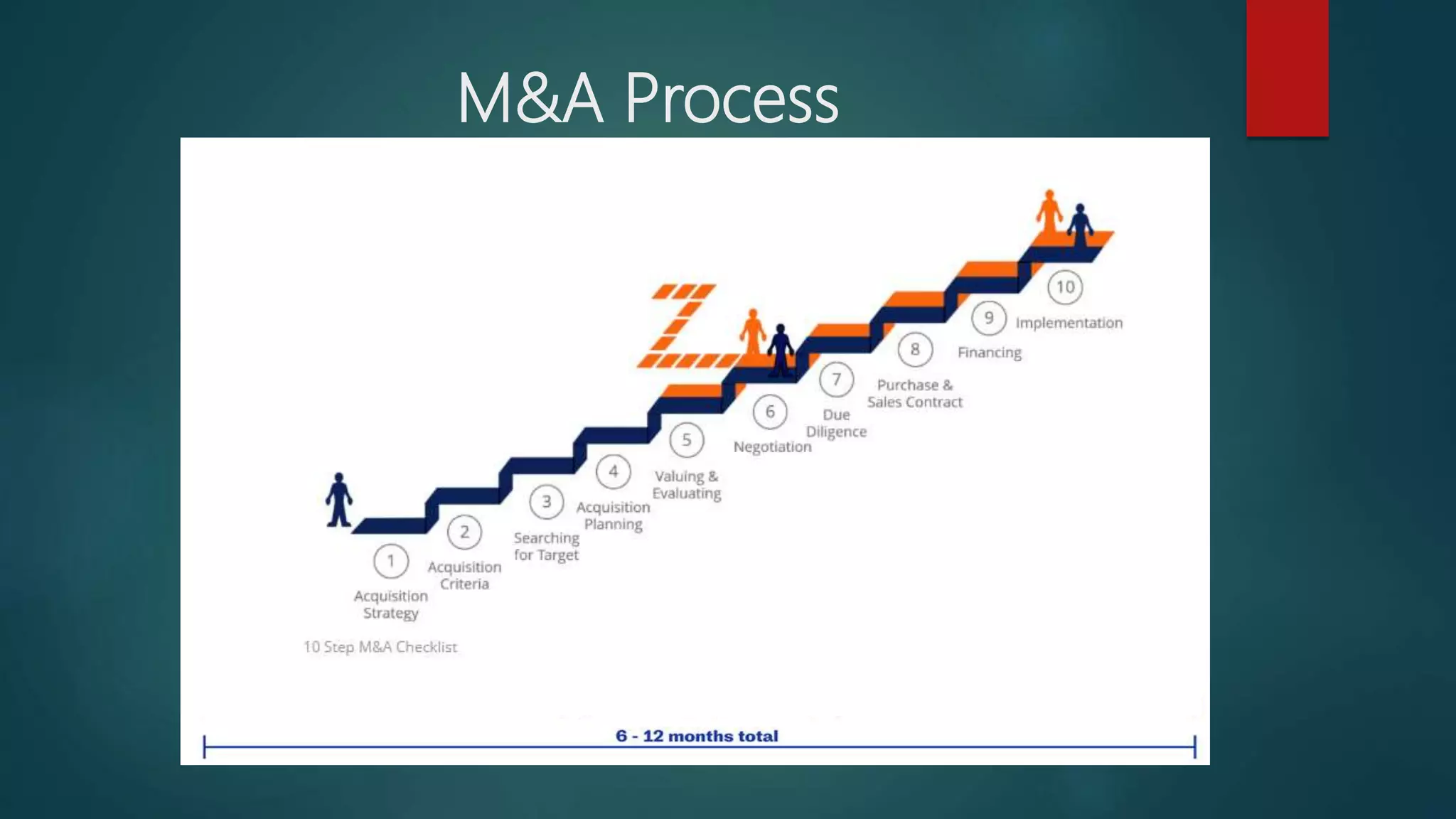
M&A Process
M&A Process
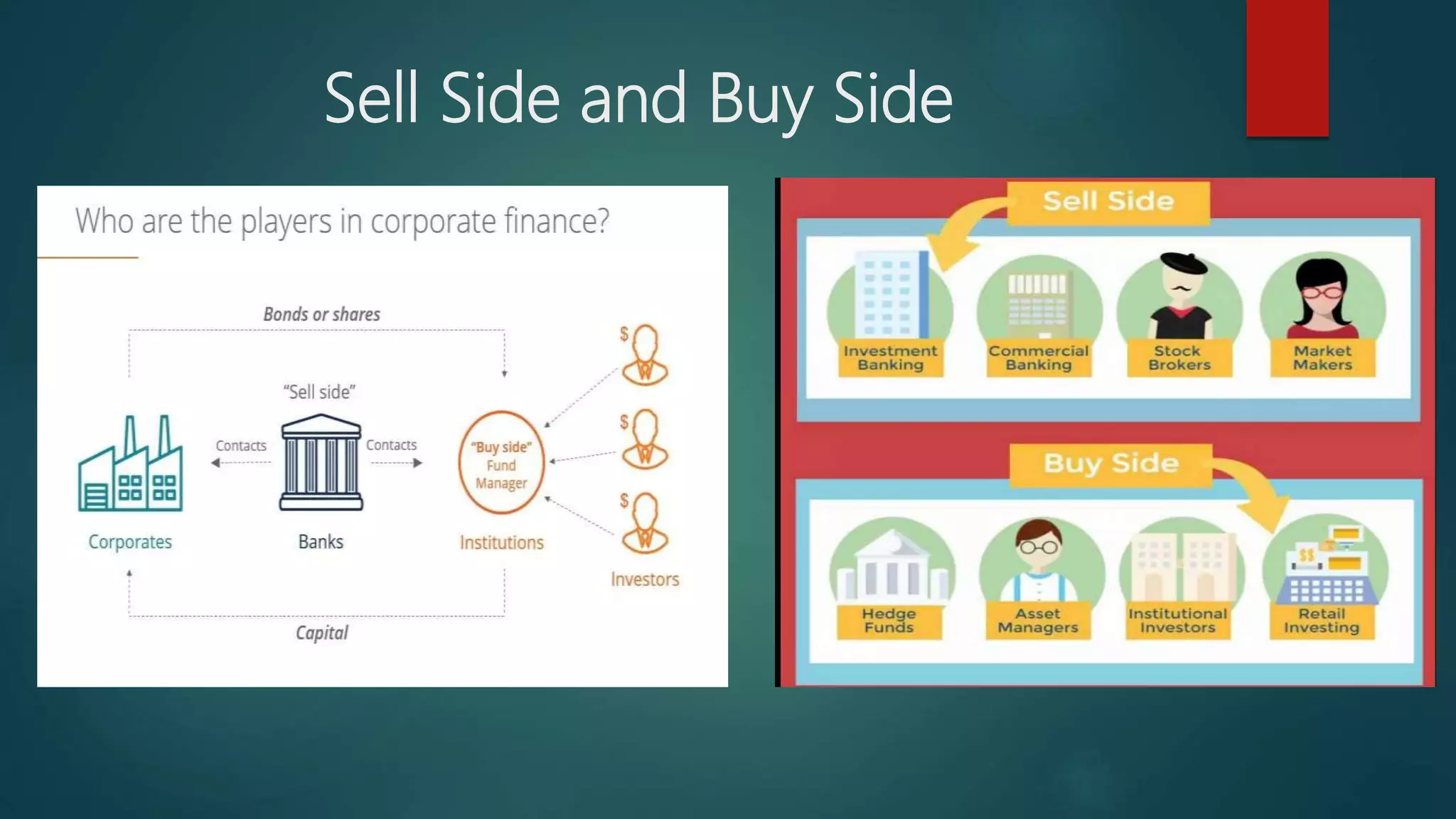
Sell Side and Buy Side
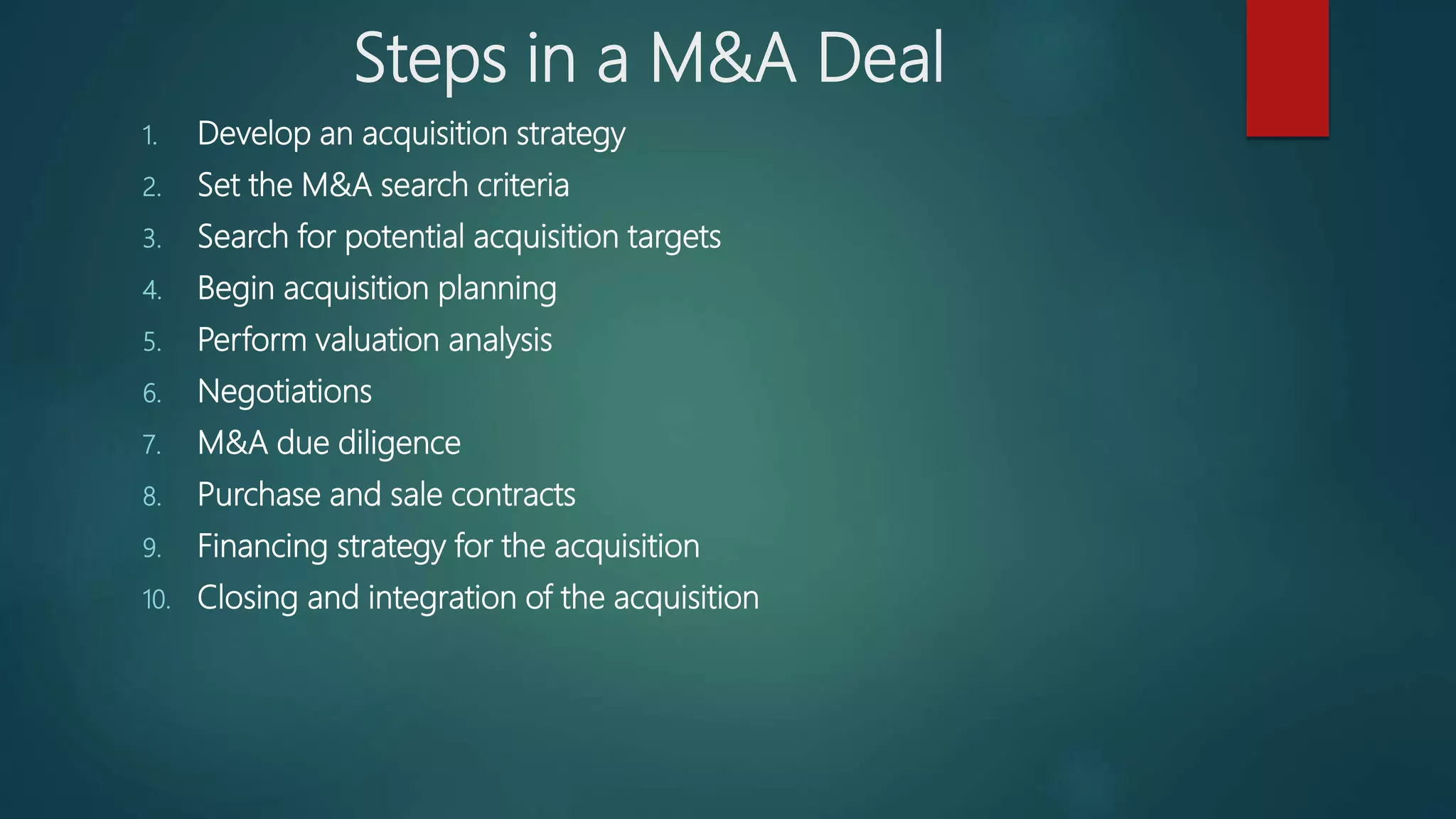
Steps in a M&A Deal
1. Develop an acquisition strategy
2. Set the M&A search criteria
3. Search for potential acquisition targets
4. Begin acquisition planning
5. Perform valuation analysis
6. Negotiations
7. M&A due diligence
8. Purchase and sale contracts
9. Financing strategy for the acquisition
10. Closing and integration of the acquisition
Valuations in a M&A Deal
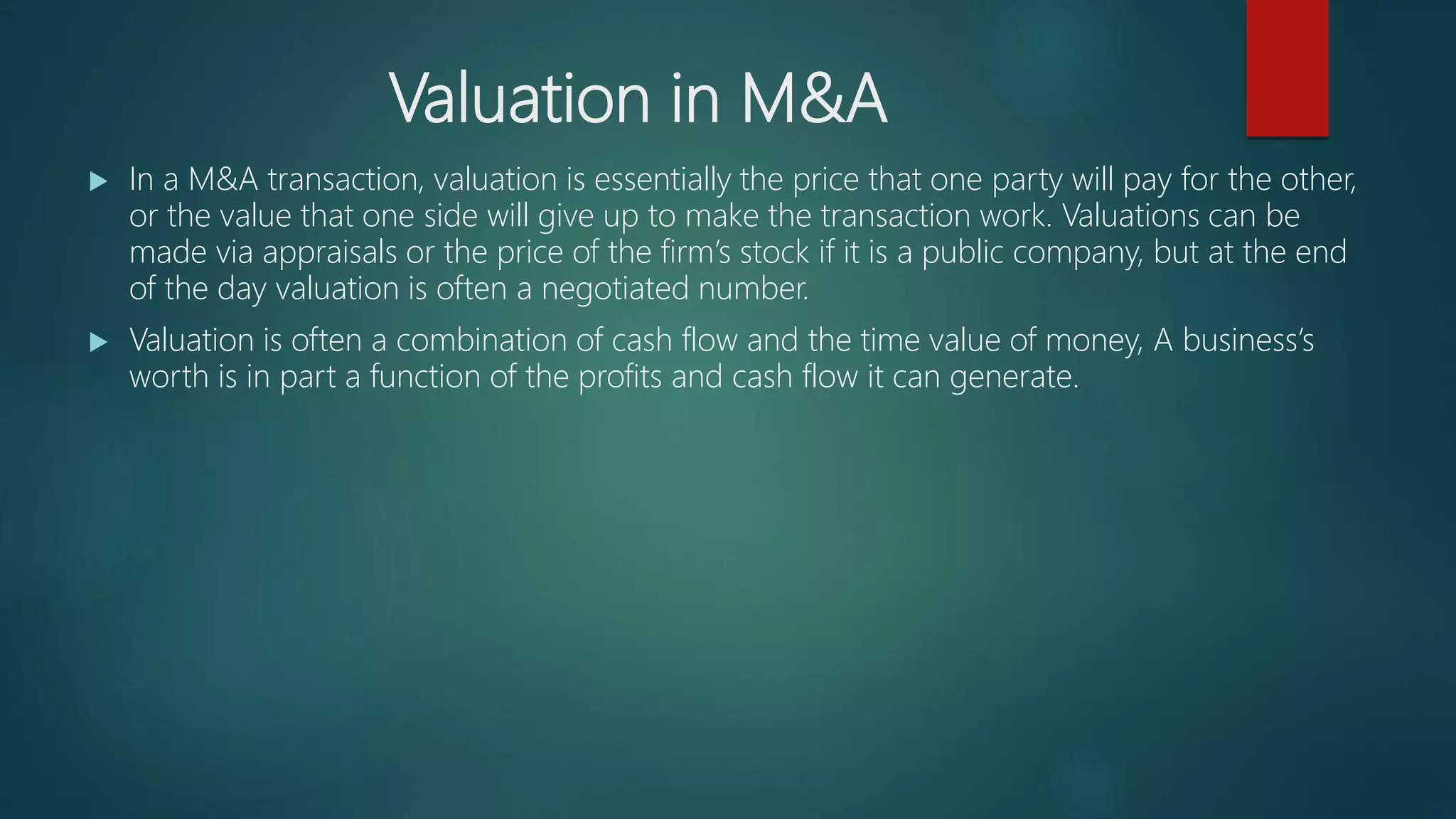
Valuation in M&A
 In a M&A transaction, valuation is essentially the price that one party will pay for the other,
or the value that one side will give up to make the transaction work. Valuations can be
made via appraisals or the price of the firm’s stock if it is a public company, but at the end
of the day valuation is often a negotiated number.
 Valuation is often a combination of cash flow and the time value of money, A business’s
worth is in part a function of the profits and cash flow it can generate.
Types of Valuation:
 Comparable Company Analysis (Public Comps): Evaluating other, similar
companies’ current valuation metrics, determined by market prices, and
applying them to the company being valued.
 Discounted Cash Flow Analysis (DCF): Valuing a company by projecting its
future cash flows and then using the Net Present Value (NPV) method to
value the firm.
 Precedent Transaction Analysis (M&A Comps): Looking at historical prices
for completed M&A transactions involving similar companies to get a
range of valuation multiples. This analysis attempts to arrive at a “control
premium” paid by an acquirer to have control of the business.
 Leverage Buyout/“Ability to Pay” Analysis (LBO): Valuing a company by
assuming the acquisition of the company via a leveraged buyout, which
uses a significant amount of borrowed funds to fund the purchase, and
assuming a required rate of return for the purchasing entity.
Synergies involved in a M&A transaction:
Case Studies:
Mahindra & Mahindra Ltd.
Acquisition of SsangYong Motor
Company in 2011.
Mahindra & Mahindra Ltd.
Oneof the largest vehicle manufacturers by production in India.
Thecompany wasfounded in 1945 by K.C.Mahindra, J.C.Mahindra
and Malik GhulamMohammed.
Thecompanychanged its name to Mahindra & Mahindra in 1948.
It is ranked 21 in the list of top companies.
SsangYongMotor Companyor SsangYongMotor wasthefourth
largest South Korea-basedautomobile manufacturer.
Founded in 1954, it hasbeen manufacturing automobiles for more
than five decades.
A70%share of SsangYongwasacquired by Mahindra & Mahindra
Limited, in February2011.
SSANGYONG MOTOR CO. LTD.
Why the Acquisitions?
Outbreak of Labor crisis in SouthKorea.
SsangYong-Alossmaking Unit.
Soundbackground of M&M.
An opportunity for SsangYongto grow in global markets.
An opportunity for M&M to launch anew portfolio of SUVsin
India.
Terms of the acquisition
SYMCwill continue to function asan independent entity with primarilya
Korean management.
Theacquisition will offer financial stability toSYMC
Thetwo companies will work to further strengthenSsangYong’sproduct
portfolio acrossthe globe.
Thelabor union of SYMC,M&M have also signed aTripartite Agreement
which contains provisions for employment protection, long-terminvestment
and commitment for no labordispute.
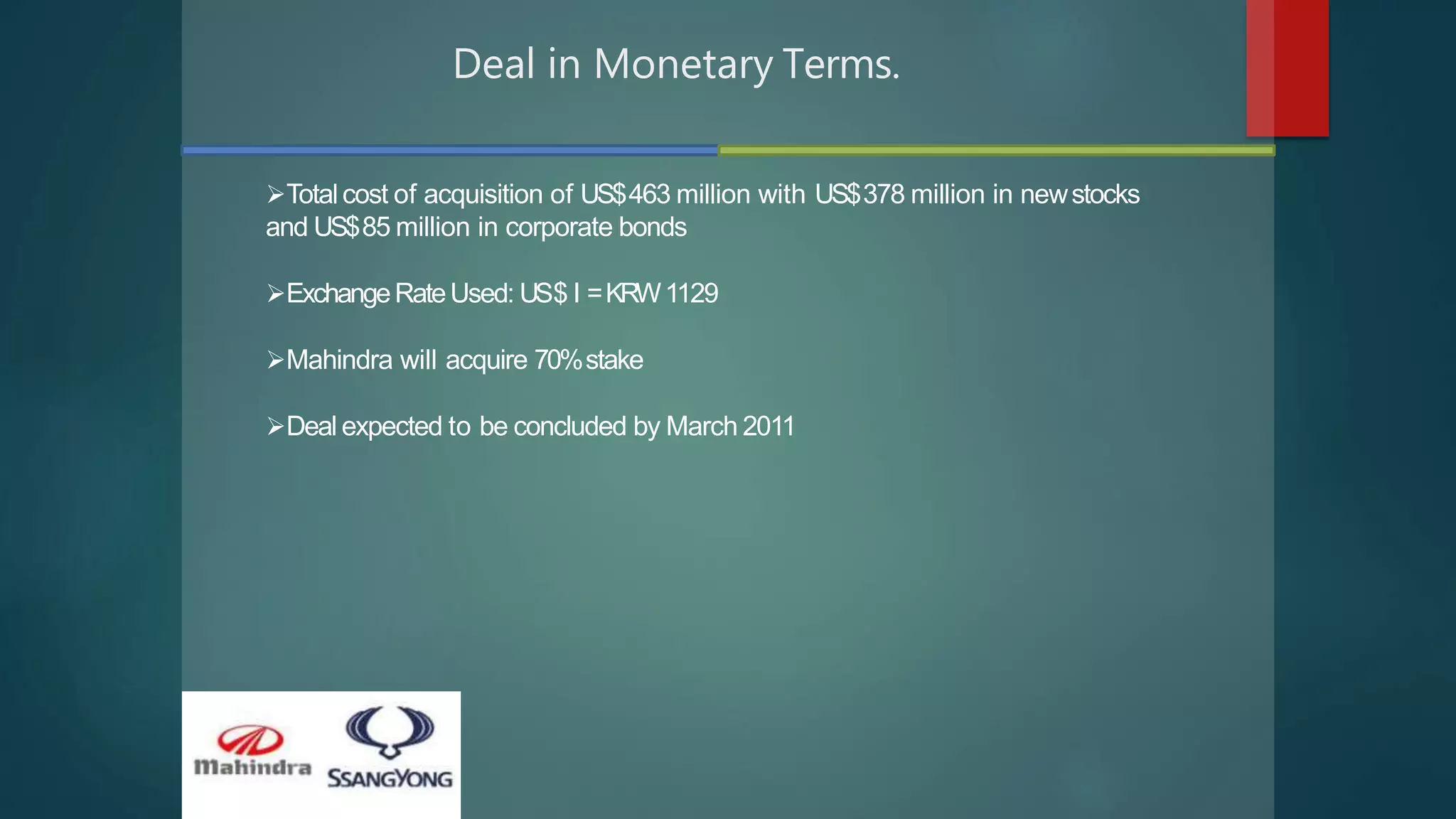
Deal in Monetary Terms.
Total cost of acquisition of US$463 million with US$378 million in newstocks
and US$85 million in corporate bonds
ExchangeRateUsed: US$ I =KRW1129
Mahindra will acquire 70%stake
Deal expected to be concluded by March 2011
Mahindra And Mahindra
Balance Sheet
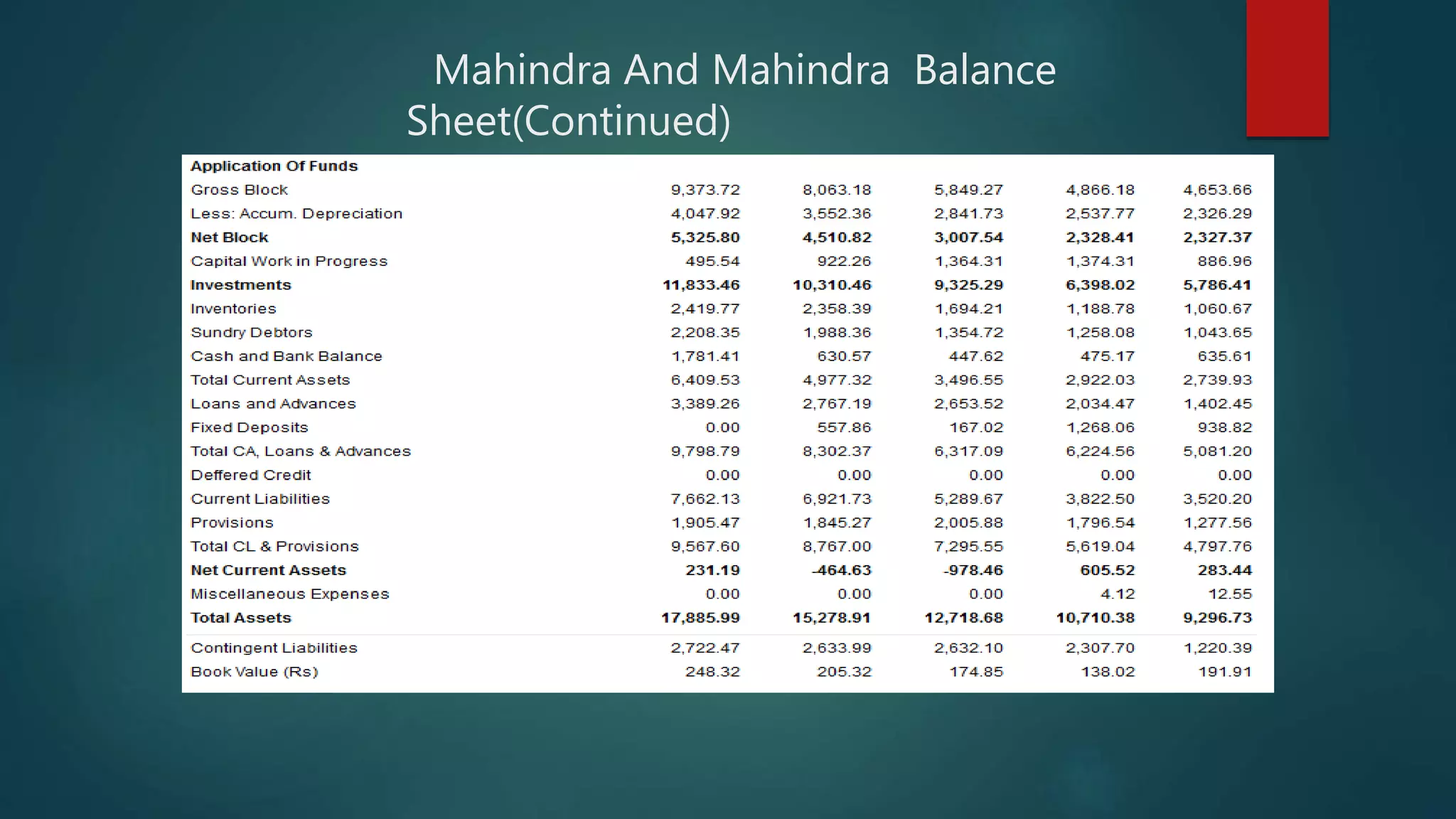
Mahindra And Mahindra Balance
Sheet(Continued)
SSANGYONG MOTORs Balance Sheet
Currencyin Millionsof South Korean
Wons.
As of:
Dec 31,
2009
Dec31,
2010
Dec31,
2011
Dec31,
2012
ASSETS
Cashand Equivalents 13,305.4 85,157.7 208,521.6 203,666.5
Total Cashand short termInvestments 13,305.4 85,157.7 208,521.6 203,666.5
AccountsReceivable 77,371.7 156,607.2 135,575.4 187,457.0
Other Receivables 21,803.0 19,294.1 28,582.0 20,586.0
NotesReceivable 2322.8 - - -
Inventory 216,903.0 220,360.6 262,699.0 269,034.1
PrepaidExpenses 2,752.4 3,034.1 2,765.8 2,622.9
Other CurrentAssets 59,215.0 81,047.6 13,099.6 27,906.4
TotalCurrentAssets 393,673.3 565,501.3 651,243.4 711,272.8
Net property plant andequipment 803,813.2 1,030,655.4 1,038,957.0 1,051,401.8
Long-TermInvestments 34,639.5 560.0 560.0 566.0
Other Intangibles 3,160.5 5,127.7 5,726.7 8,618.7
Other Long-TermAssets 27,660.2 38,851.2 38,182.6 30,539.2
TOTALASSETS 1,379,434.2 1,724,739.0 1,793,567.0 1,850,490.4
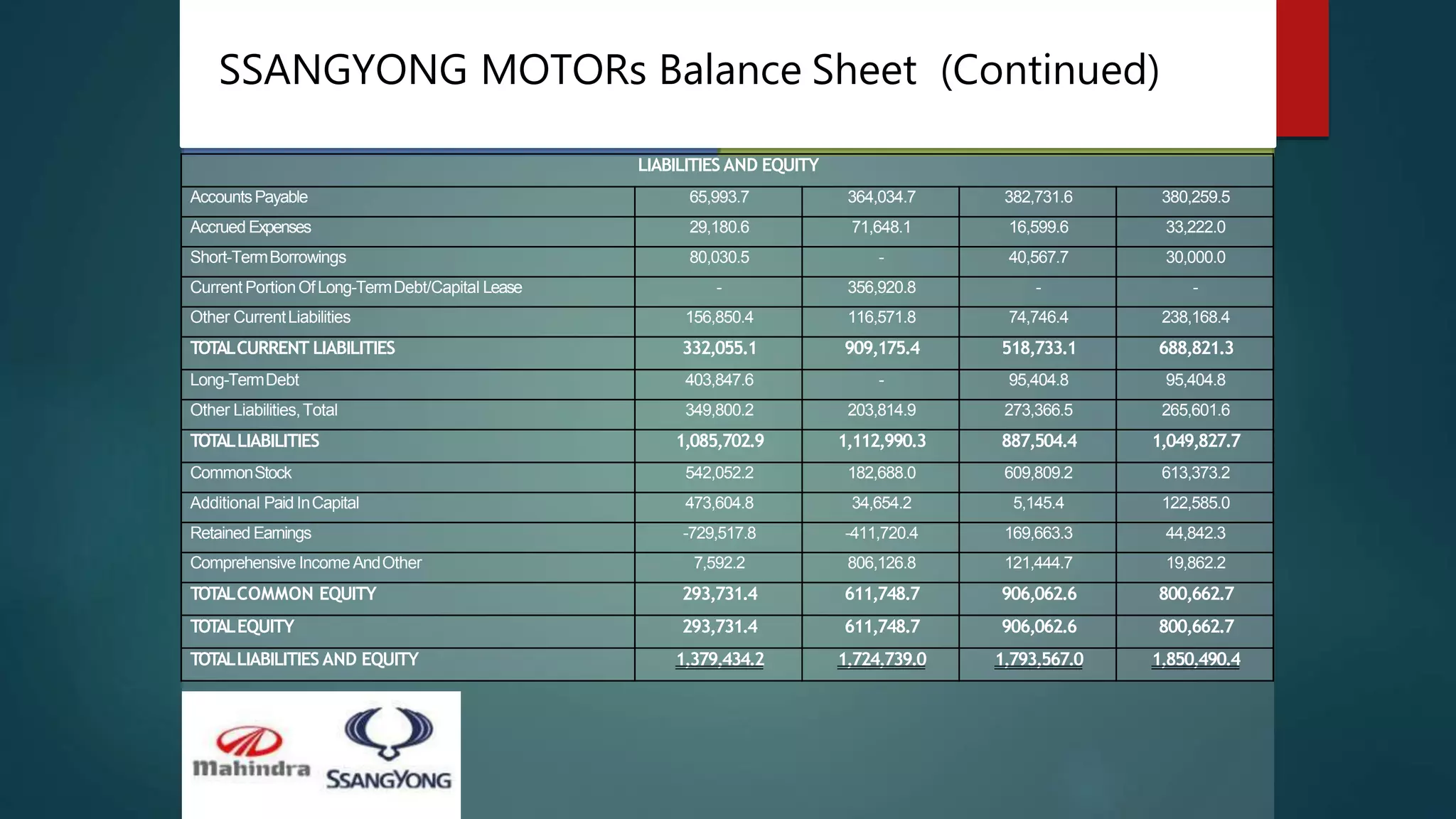
SSANGYONG MOTORs Balance Sheet (Continued)
LIABILITIES AND EQUITY
AccountsPayable 65,993.7 364,034.7 382,731.6 380,259.5
Accrued Expenses 29,180.6 71,648.1 16,599.6 33,222.0
Short-TermBorrowings 80,030.5 - 40,567.7 30,000.0
Current PortionOfLong-TermDebt/Capital Lease - 356,920.8 - -
Other CurrentLiabilities 156,850.4 116,571.8 74,746.4 238,168.4
TOTALCURRENT LIABILITIES 332,055.1 909,175.4 518,733.1 688,821.3
Long-TermDebt 403,847.6 - 95,404.8 95,404.8
Other Liabilities,Total 349,800.2 203,814.9 273,366.5 265,601.6
TOTALLIABILITIES 1,085,702.9 1,112,990.3 887,504.4 1,049,827.7
CommonStock 542,052.2 182,688.0 609,809.2 613,373.2
Additional Paid InCapital 473,604.8 34,654.2 5,145.4 122,585.0
Retained Earnings -729,517.8 -411,720.4 169,663.3 44,842.3
Comprehensive Income AndOther 7,592.2 806,126.8 121,444.7 19,862.2
TOTALCOMMON EQUITY 293,731.4 611,748.7 906,062.6 800,662.7
TOTALEQUITY 293,731.4 611,748.7 906,062.6 800,662.7
TOTALLIABILITIES AND EQUITY 1,379,434.2 1,724,739.0 1,793,567.0 1,850,490.4
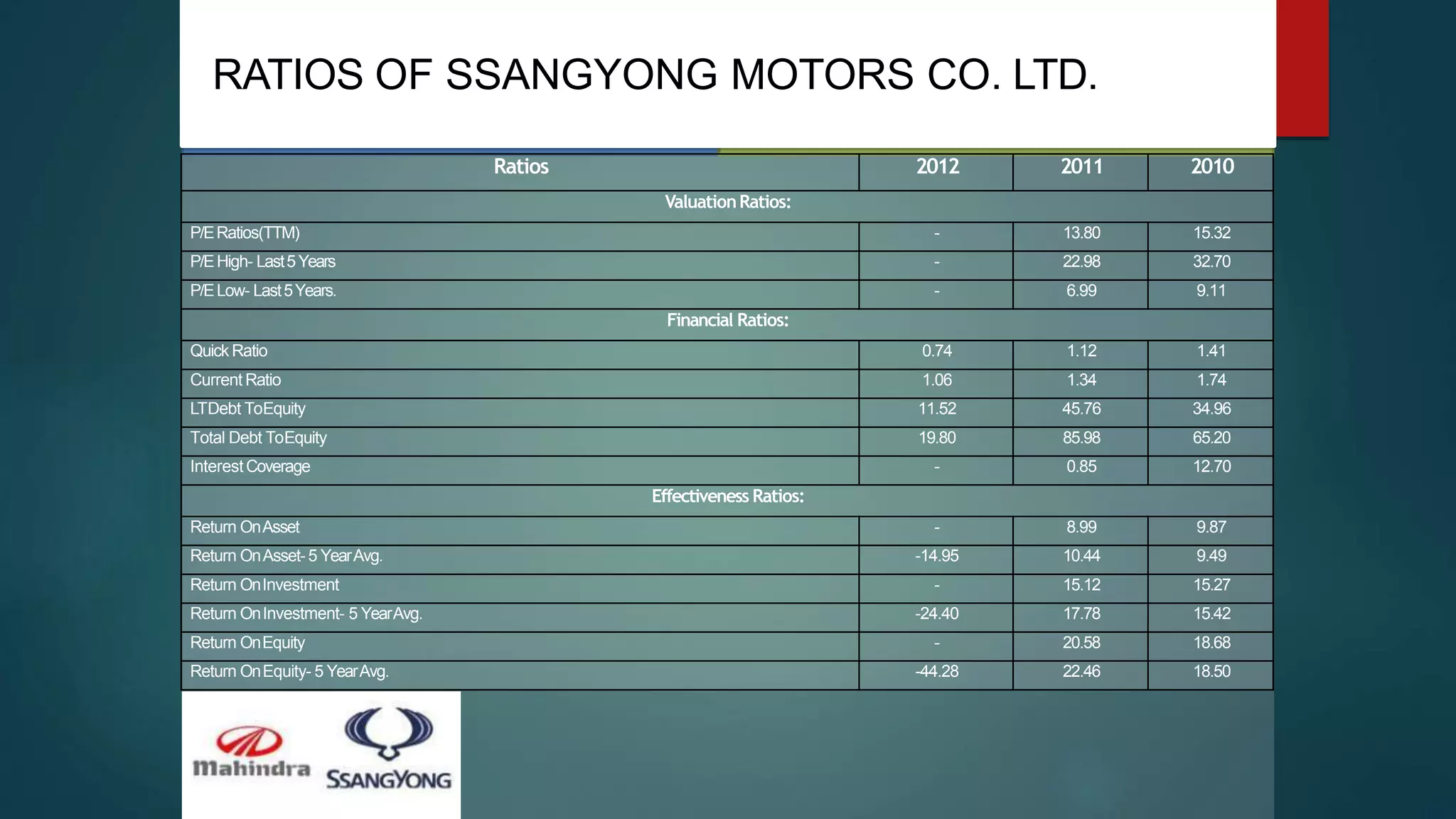
RATIOS OF SSANGYONG MOTORS CO. LTD.
Ratios 2012 2011 2010
ValuationRatios:
P/ERatios(TTM) - 13.80 15.32
P/EHigh- Last5Years - 22.98 32.70
P/ELow- Last5Years. - 6.99 9.11
Financial Ratios:
Quick Ratio 0.74 1.12 1.41
Current Ratio 1.06 1.34 1.74
LTDebt ToEquity 11.52 45.76 34.96
Total Debt ToEquity 19.80 85.98 65.20
InterestCoverage - 0.85 12.70
Effectiveness Ratios:
Return OnAsset - 8.99 9.87
Return OnAsset- 5 YearAvg. -14.95 10.44 9.49
Return OnInvestment - 15.12 15.27
Return OnInvestment- 5 YearAvg. -24.40 17.78 15.42
Return OnEquity - 20.58 18.68
Return OnEquity- 5 YearAvg. -44.28 22.46 18.50
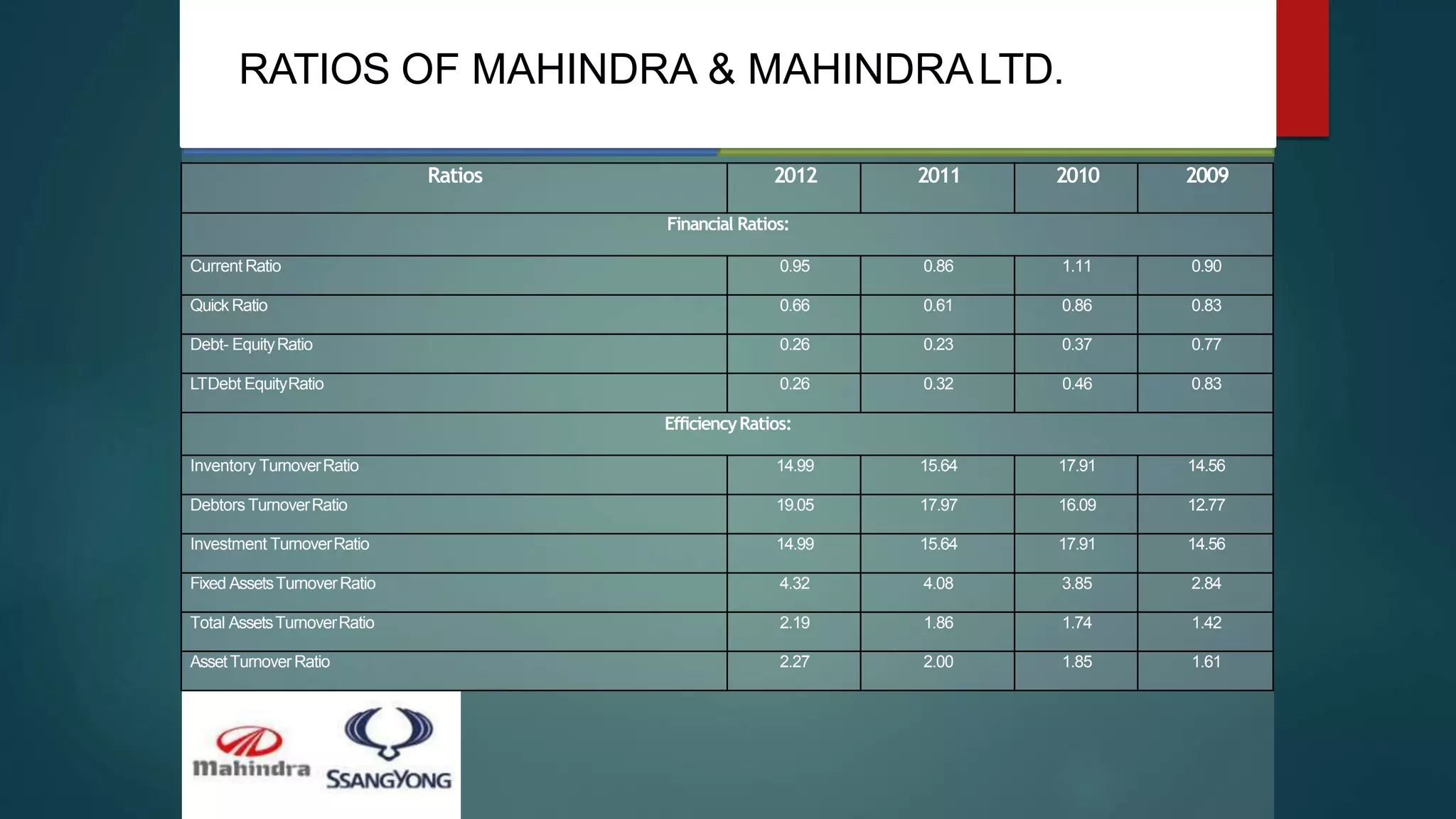
RATIOS OF MAHINDRA & MAHINDRALTD.
Ratios 2012 2011 2010 2009
Financial Ratios:
Current Ratio 0.95 0.86 1.11 0.90
Quick Ratio 0.66 0.61 0.86 0.83
Debt- EquityRatio 0.26 0.23 0.37 0.77
LTDebt EquityRatio 0.26 0.32 0.46 0.83
EfficiencyRatios:
Inventory TurnoverRatio 14.99 15.64 17.91 14.56
Debtors TurnoverRatio 19.05 17.97 16.09 12.77
Investment TurnoverRatio 14.99 15.64 17.91 14.56
Fixed AssetsTurnoverRatio 4.32 4.08 3.85 2.84
Total AssetsTurnoverRatio 2.19 1.86 1.74 1.42
AssetTurnoverRatio 2.27 2.00 1.85 1.61
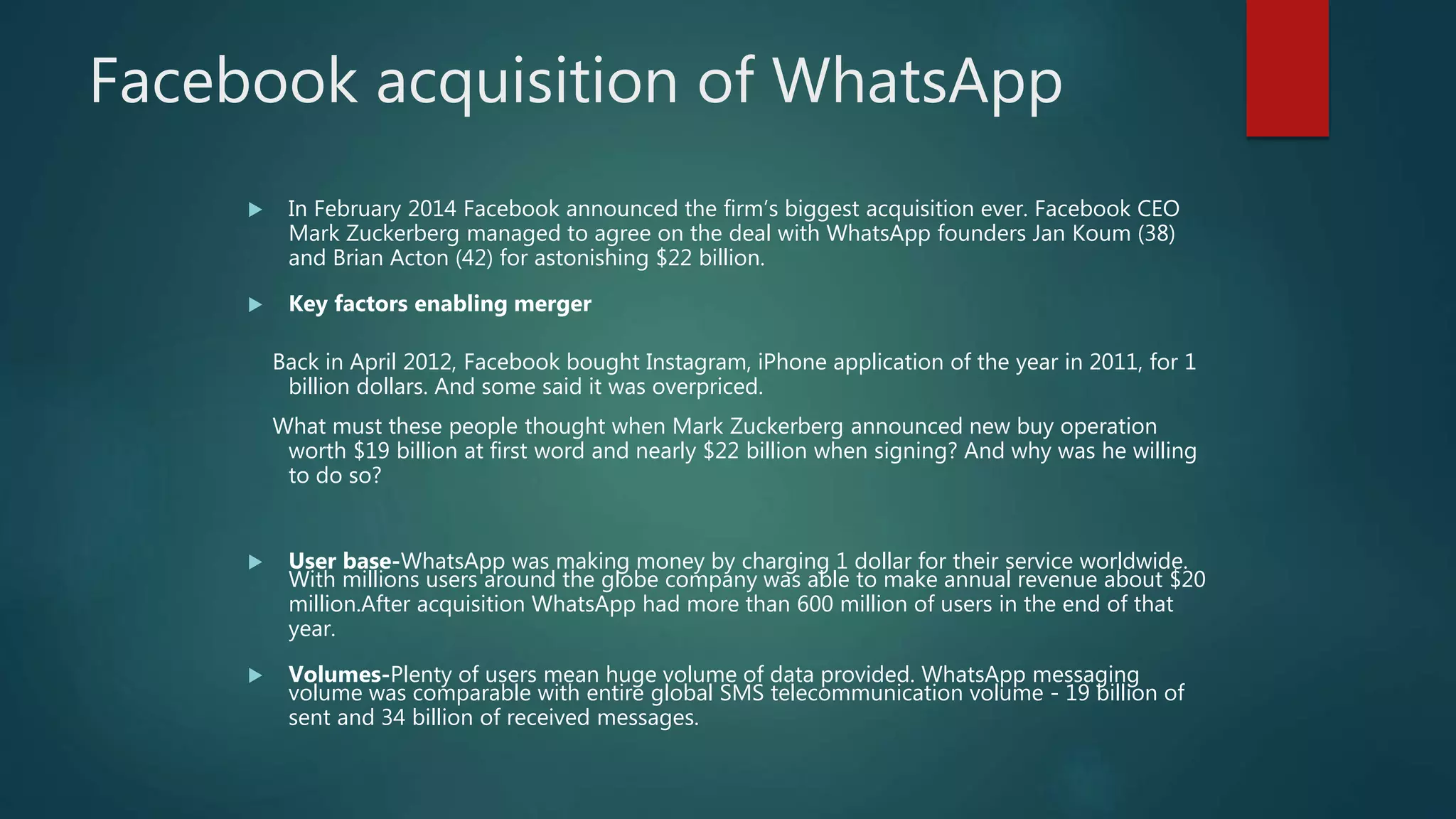
Facebook Acquisition of
WhatsApp in 2014
 In February 2014 Facebook announced the firm’s biggest acquisition ever. Facebook CEO
Mark Zuckerberg managed to agree on the deal with WhatsApp founders Jan Koum (38)
and Brian Acton (42) for astonishing $22 billion.
 Key factors enabling merger
Back in April 2012, Facebook bought Instagram, iPhone application of the year in 2011, for 1
billion dollars. And some said it was overpriced.
What must these people thought when Mark Zuckerberg announced new buy operation
worth $19 billion at first word and nearly $22 billion when signing? And why was he willing
to do so?
 User base-WhatsApp was making money by charging 1 dollar for their service worldwide.
With millions users around the globe company was able to make annual revenue about $20
million.After acquisition WhatsApp had more than 600 million of users in the end of that
year.
 Volumes-Plenty of users mean huge volume of data provided. WhatsApp messaging
volume was comparable with entire global SMS telecommunication volume - 19 billion of
sent and 34 billion of received messages.
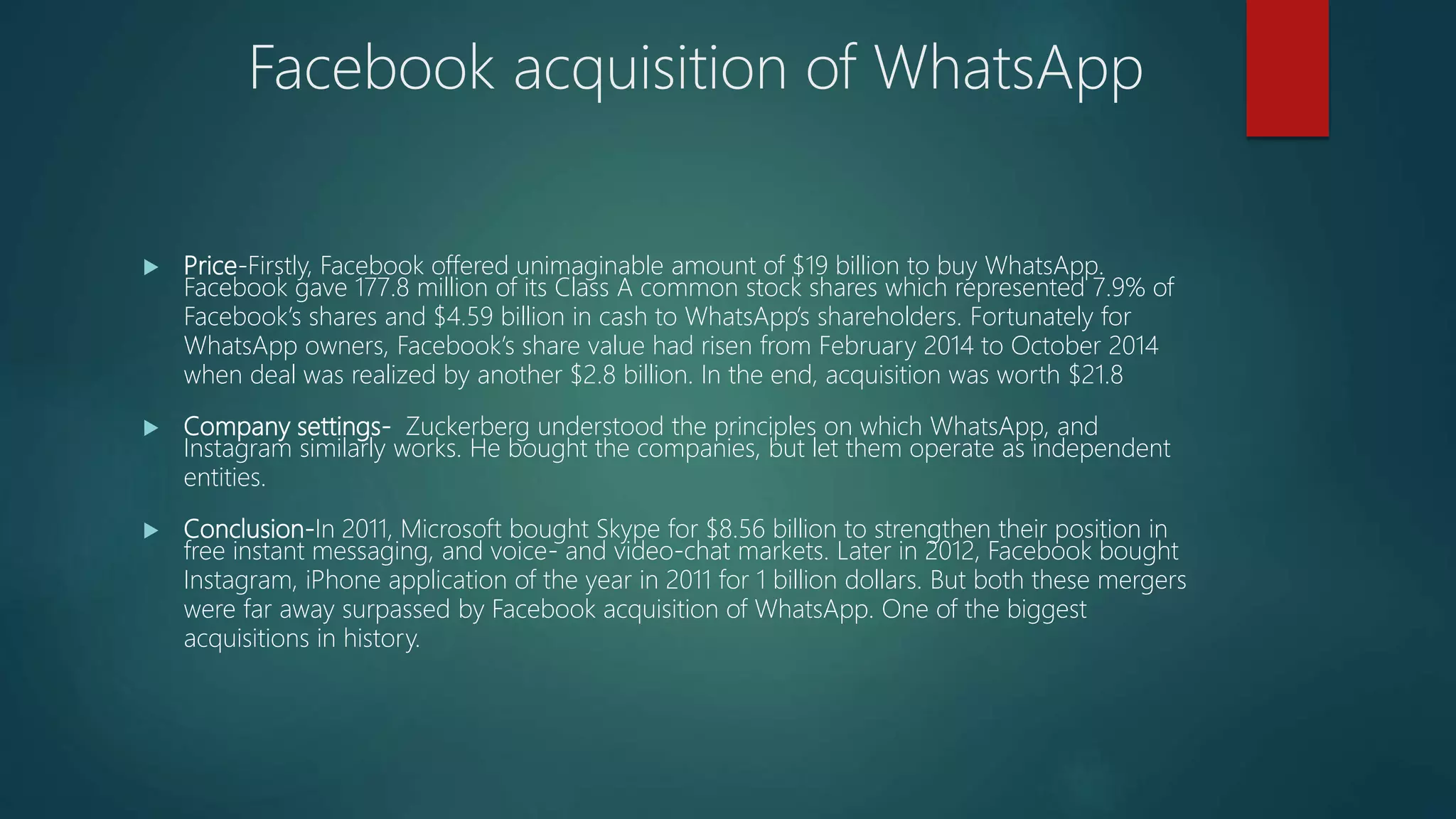
Facebook acquisition of WhatsApp
 Price-Firstly, Facebook offered unimaginable amount of $19 billion to buy WhatsApp.
Facebook gave 177.8 million of its Class A common stock shares which represented 7.9% of
Facebook’s shares and $4.59 billion in cash to WhatsApp’s shareholders. Fortunately for
WhatsApp owners, Facebook’s share value had risen from February 2014 to October 2014
when deal was realized by another $2.8 billion. In the end, acquisition was worth $21.8
 Company settings- Zuckerberg understood the principles on which WhatsApp, and
Instagram similarly works. He bought the companies, but let them operate as independent
entities.
 Conclusion-In 2011, Microsoft bought Skype for $8.56 billion to strengthen their position in
free instant messaging, and voice- and video-chat markets. Later in 2012, Facebook bought
Instagram, iPhone application of the year in 2011 for 1 billion dollars. But both these mergers
were far away surpassed by Facebook acquisition of WhatsApp. One of the biggest
acquisitions in history.
Facebook acquisition of WhatsApp
WhatsApp growth rationale
WhatsApp competes with apps like Line, Viber, and China-based (FXI)
Tencent’s (TCEHY) WeChat in the mobile messaging industry. However,
WhatsApp is the global leader, and it’s quite popular, especially in Europe,
Latin America, and Asia.
Besides, WhatsApp offers several benefits to Facebook, including a large
base in the direct messaging arena, smartphone engagement, and high
international penetration across various demographics.
The rationale that Facebook gave in acquiring WhatsApp at that valuation
was that during the first four years of its operation, the number of users on
WhatsApp grew faster than comparable networks like Facebook, Google’s
(GOOG) Gmail, Twitter (TWTR), and Microsoft’s (MSFT) Skype.
Facebook acquisition of WhatsApp
Thank You.
PROJECT DONE BY:
1. GANESH MENON
2. PANKAJ JETHWA
3. DIVYA PANCHAL
4. MANSI DHAGE

Mergers and acquisions

  • 1.
  • 2.
    Mergers and Acquisitions AMerger is an agreement that unites two existing companies into one new company,it’s a combination of two company to become one. Mergers and Acquisitions are defined as consolidation of Companies. Example:-Two car companies who may or may not be competitors, merge to form one larger car company to ma the . Vehicle they produce An actual example would be the merger of Daimler-Benz with Chrysler to form “Daimler-Chrysler”. *The Merging of Continental Airlines & United Airlines to create United Continental. *Reliance Communication which merged it’s telecom tower Business will GTL infrastructure ltd.
  • 3.
  • 4.
    Acquisition An acquisition isthe purchase of all or a portion of a corporate asset or target company. An acquisition is commonly mistaken with a merger which occurs. For example:- Let’s assume Company XYZ wants to acquire Company ABC. Company XYZ starts to buy ABC shares on open market, But once company XYZ acquires 5% of ABC it must formally declare to the Securities & Exchange Commission (SEC) how many shares it owns.Company XYZ must also state whether it intends to buy ABC or just holds its existing shares as an investment. If Company XYZ wants to proceed with the acquisition, it will make a “tender of offer” to ABC’s board of directors, followed by an announcement to the press. The tender offer will indicate among other things ,how much company XYZ is willing to pay for ABC and how long ABC shareholders have to accept this offer. Once the tender offer is made ,ABC an accept the......(1)terms of the offer (2) Negotiate a different price (3) Find another company,who hopefully will pay as much as more as XYZ is offering, to buy them. If ABC accepts the offer, regulatory bodies then review the transactions to ensure the combination does not create a monopoly or other anti-competetive circumstances within the Industries involved. If the regulatory bodies approve the transaction the parties exchange funds and the deal is closed.
  • 5.
    Types Of Mergers &Acquisition Horizontal Vertical Conglomerate Product Extension Merger Market Extension Merger Arm’s Length
  • 6.
    Types: 1. Vertical 2. Horizontal 3.Conglomerate 4. Market Extension Merger 5. Product Extension Merger 6. Arms Length
  • 7.
    Horizontal Merger:  Amerger occurring between companies in the same industry. Horizontal merger is a business consolidation that occurs between firms who operate in the same space, often as competitors offering the same good or service. Here merger is between companies that are having direct competition with each other in term of product line and market.  A merger between Coca-Cola and the Pepsi beverage division, for example, would be horizontal in nature. The goal of a horizontal merger is to create a new, larger organization with more market share. Because the merging companies' business operations may be very similar, there may be opportunities to join certain operations, such as manufacturing, and reduce costs.
  • 8.
    Arm's length  Anarm's length transaction is one in which the buyers and sellers of a product act independently and do not have any relationship to each other. The concept of an arm's length transaction assures that both parties in the deal are acting in their own self-interest and are not subject to any pressure or duress from the other party. It also assures third parties that there is no collusion between the buyer and seller. https://streamable.com/6icdi
  • 9.
    A merger betweenfirms that are involved in totally unrelated business activities. There are two types of conglomerate mergers: pure and mixed. Pure conglomerate mergers involve firms with nothing in common, while mixed conglomerate mergers involve firms that are looking for product extensions or market extensions. The resulting company is faced with the same competition in each of its two markets after the merger as the individual firms were before the merger. Eg :PayPal and eBay-In 2002, eBay paid $1.5 billion to buy PayPal, an online payments company whose founders include Elon Musk and Peter Thiel. The investment proved successful. After investors urged eBay to spin off PayPal in 2015, the payment company's market value was nearly $50 billion. It's now above $100 billion. Conglomerate
  • 10.
    Vertical A merger betweentwo companies producing different goods or services for one specific finished product. A vertical merger joins two companies that may not compete with each other, but exist in the same supply chain. The logic behind the merger is to increase synergies. Eg -Apple buys Star Wars motion-capture company Faceshift. Faceshift, a Zurich based start-up, specialises in software that allows 3D animated characters to mimic the facial expressions of an actor.
  • 11.
    Market Extension Merger Amarket extension merger is a type of merger in which two or more companies in the same industry sector combine in order to expand their market reach. Typically market extension mergers involve two companies which operate in different geographical regions. Example: A company has a strong presence in German speaking Switzerland while another company in the same sector has a strong presence in French speaker switzerland. A market extension merger between two companies would result in one company or group with a strong country wide presence. The main purpose of the market extension merger is to make sure that the merging companies can get access to a bigger market and that ensures a bigger Client base.
  • 12.
    Product Extension Mergers Aproduct extension merger takes place between two business organisations that deal in products that are related to each other and operate in the same market . The product extension merger allows the merging companies to group together their products and get access to a bigger set of consumers. This ensures that they earn higher profits. For example:- The acquisition of Mobilink Telecom Inc by Broadcom is a proper example of product extension merger. Broadcom deals in the manufacturing Bluetooth personal area network hardware systems and chips for IEEE 802.11 b wireless LAN. Monilink Telecom Inc deals in the manufacturing of product designs meant for headsets that are equipped with the Global System for mobile Communications technology. It is also in the process of being certified to produce wireless networking chips that have high speed and General Packet Radio Service Technology. It is expected that the products Mobilink Telecom Inc would be complementary the wireless products of Broadcom.
  • 13.
  • 14.
    Objectives  Economies ofscale-This refers to the fact that the combined company can often reduce its fixed costs by removing duplicate departments or operations. This occurs when a larger firm with increased output can reduce average costs. Lower average costs enable lower prices, Technical economies-if the firm has significant fixed costs then the new larger firm would have lower average cost. Eg :automobile companies Bulk buying – A bigger firm can get a discount for buying large quantities of raw materials Financial – better rate of interest for large company Organisational – one head office rather than two is more efficiency  Cross-selling-It is the action or practice of selling an additional product or service to an existing customer. Cross-selling is a sales strategy where the seller encourages the customer to spend more by recommending related products that complement what is being bought already.  Taxation-A profitable company can buy a loss maker to use the target's loss as their advantage by reducing their tax liability. In the United States and many other countries, rules are in place to limit the ability of profitable companies to "shop" for loss making companies, limiting the tax motive of an acquiring company.
  • 15.
    Objectives  Complementary geographiesand customers-Merging two firms with varying geographies and customers may allow the merged firm to take advantage of the increased demographic access, producing higher revenue.  Patents-If the acquirer used to pay the target firm a fee for access to its patent, a merge may transfer the right of that patent to the acquirer, thus eliminating that expense. Similarly, to the cost-saving effect of a patent, access to patents or other IP may allow the merged firm to create more competitive products that produce higher revenue  Mergers may allow greater investment in R&D -This is because the new firm will have more profit which can be used to finance risky investment. This can lead to a better quality of goods for consumers. This is important for industries such as pharmaceuticals which require a lot of investment. It is estimated 90% of research by drug companies never comes to the market. There is a high chance of failure.
  • 16.
    Objectives  Synergy-It isthe main objective of M&A which gets covered in all the other objectives of M&A. Shared Information Technology -Each company may have proprietary access to information technology that would allow for operational efficiencies if applied or used in the other firm. Others-Supply Chain Efficiencies, Improved Sales and Marketing
  • 17.
    Challenge of M&A’S •LACK OF COMMUNICATION • EMPLOYEE RETENTION • CULTURAL CHALLENGES
  • 18.
    Challenges  Many timemergers fails and do not boost shareholders return. Normally organisation loses two thirds lose value no the stock market.  Merger takes place due to FEAR of globalisation, new technology and the fast changing economic growth.  M&A takes place based on Market & Products.  Employee views are ignored.
  • 19.
    Communication challenges  Noproper interaction and coordination between M&As.  Its a challenge for employees to Adapt the culture of new organization.  Lack of information is provided to employee.  Rumour leaves the question mark for employees.  Lack of trust and uncertainty In employees after M&As.
  • 20.
    Employee retention challenges At time of M&As there Employees jobs security brings question mark.  Emplyoee feels betrayed and Manipulated by organisation.  Employee turnover should be kept low.  Sudden change in organization beings stress, anxiety, conflict etc. And employee also feels they are not treated fairly.  Trust should maintain and keep flow in communication.
  • 21.
    Cultural challenges  Everycompany have their own culture.  Companies with same culture, employees easily adapt the M&As.  Culture always have Values and it Beliefs that it influence the behaviour And attitude of the employee.  Difficult for merged company to adapt the new culture of the acquire company.  Shift in management practices after M&As.
  • 22.
  • 23.
  • 24.
    Sell Side andBuy Side
  • 25.
    Steps in aM&A Deal 1. Develop an acquisition strategy 2. Set the M&A search criteria 3. Search for potential acquisition targets 4. Begin acquisition planning 5. Perform valuation analysis 6. Negotiations 7. M&A due diligence 8. Purchase and sale contracts 9. Financing strategy for the acquisition 10. Closing and integration of the acquisition
  • 26.
  • 27.
    Valuation in M&A In a M&A transaction, valuation is essentially the price that one party will pay for the other, or the value that one side will give up to make the transaction work. Valuations can be made via appraisals or the price of the firm’s stock if it is a public company, but at the end of the day valuation is often a negotiated number.  Valuation is often a combination of cash flow and the time value of money, A business’s worth is in part a function of the profits and cash flow it can generate.
  • 28.
    Types of Valuation: Comparable Company Analysis (Public Comps): Evaluating other, similar companies’ current valuation metrics, determined by market prices, and applying them to the company being valued.  Discounted Cash Flow Analysis (DCF): Valuing a company by projecting its future cash flows and then using the Net Present Value (NPV) method to value the firm.  Precedent Transaction Analysis (M&A Comps): Looking at historical prices for completed M&A transactions involving similar companies to get a range of valuation multiples. This analysis attempts to arrive at a “control premium” paid by an acquirer to have control of the business.  Leverage Buyout/“Ability to Pay” Analysis (LBO): Valuing a company by assuming the acquisition of the company via a leveraged buyout, which uses a significant amount of borrowed funds to fund the purchase, and assuming a required rate of return for the purchasing entity.
  • 29.
    Synergies involved ina M&A transaction:
  • 30.
  • 31.
    Mahindra & MahindraLtd. Acquisition of SsangYong Motor Company in 2011.
  • 32.
    Mahindra & MahindraLtd. Oneof the largest vehicle manufacturers by production in India. Thecompany wasfounded in 1945 by K.C.Mahindra, J.C.Mahindra and Malik GhulamMohammed. Thecompanychanged its name to Mahindra & Mahindra in 1948. It is ranked 21 in the list of top companies.
  • 33.
    SsangYongMotor Companyor SsangYongMotorwasthefourth largest South Korea-basedautomobile manufacturer. Founded in 1954, it hasbeen manufacturing automobiles for more than five decades. A70%share of SsangYongwasacquired by Mahindra & Mahindra Limited, in February2011. SSANGYONG MOTOR CO. LTD.
  • 34.
    Why the Acquisitions? Outbreakof Labor crisis in SouthKorea. SsangYong-Alossmaking Unit. Soundbackground of M&M. An opportunity for SsangYongto grow in global markets. An opportunity for M&M to launch anew portfolio of SUVsin India.
  • 35.
    Terms of theacquisition SYMCwill continue to function asan independent entity with primarilya Korean management. Theacquisition will offer financial stability toSYMC Thetwo companies will work to further strengthenSsangYong’sproduct portfolio acrossthe globe. Thelabor union of SYMC,M&M have also signed aTripartite Agreement which contains provisions for employment protection, long-terminvestment and commitment for no labordispute.
  • 36.
    Deal in MonetaryTerms. Total cost of acquisition of US$463 million with US$378 million in newstocks and US$85 million in corporate bonds ExchangeRateUsed: US$ I =KRW1129 Mahindra will acquire 70%stake Deal expected to be concluded by March 2011
  • 37.
  • 38.
    Mahindra And MahindraBalance Sheet(Continued)
  • 39.
    SSANGYONG MOTORs BalanceSheet Currencyin Millionsof South Korean Wons. As of: Dec 31, 2009 Dec31, 2010 Dec31, 2011 Dec31, 2012 ASSETS Cashand Equivalents 13,305.4 85,157.7 208,521.6 203,666.5 Total Cashand short termInvestments 13,305.4 85,157.7 208,521.6 203,666.5 AccountsReceivable 77,371.7 156,607.2 135,575.4 187,457.0 Other Receivables 21,803.0 19,294.1 28,582.0 20,586.0 NotesReceivable 2322.8 - - - Inventory 216,903.0 220,360.6 262,699.0 269,034.1 PrepaidExpenses 2,752.4 3,034.1 2,765.8 2,622.9 Other CurrentAssets 59,215.0 81,047.6 13,099.6 27,906.4 TotalCurrentAssets 393,673.3 565,501.3 651,243.4 711,272.8 Net property plant andequipment 803,813.2 1,030,655.4 1,038,957.0 1,051,401.8 Long-TermInvestments 34,639.5 560.0 560.0 566.0 Other Intangibles 3,160.5 5,127.7 5,726.7 8,618.7 Other Long-TermAssets 27,660.2 38,851.2 38,182.6 30,539.2 TOTALASSETS 1,379,434.2 1,724,739.0 1,793,567.0 1,850,490.4
  • 40.
    SSANGYONG MOTORs BalanceSheet (Continued) LIABILITIES AND EQUITY AccountsPayable 65,993.7 364,034.7 382,731.6 380,259.5 Accrued Expenses 29,180.6 71,648.1 16,599.6 33,222.0 Short-TermBorrowings 80,030.5 - 40,567.7 30,000.0 Current PortionOfLong-TermDebt/Capital Lease - 356,920.8 - - Other CurrentLiabilities 156,850.4 116,571.8 74,746.4 238,168.4 TOTALCURRENT LIABILITIES 332,055.1 909,175.4 518,733.1 688,821.3 Long-TermDebt 403,847.6 - 95,404.8 95,404.8 Other Liabilities,Total 349,800.2 203,814.9 273,366.5 265,601.6 TOTALLIABILITIES 1,085,702.9 1,112,990.3 887,504.4 1,049,827.7 CommonStock 542,052.2 182,688.0 609,809.2 613,373.2 Additional Paid InCapital 473,604.8 34,654.2 5,145.4 122,585.0 Retained Earnings -729,517.8 -411,720.4 169,663.3 44,842.3 Comprehensive Income AndOther 7,592.2 806,126.8 121,444.7 19,862.2 TOTALCOMMON EQUITY 293,731.4 611,748.7 906,062.6 800,662.7 TOTALEQUITY 293,731.4 611,748.7 906,062.6 800,662.7 TOTALLIABILITIES AND EQUITY 1,379,434.2 1,724,739.0 1,793,567.0 1,850,490.4
  • 41.
    RATIOS OF SSANGYONGMOTORS CO. LTD. Ratios 2012 2011 2010 ValuationRatios: P/ERatios(TTM) - 13.80 15.32 P/EHigh- Last5Years - 22.98 32.70 P/ELow- Last5Years. - 6.99 9.11 Financial Ratios: Quick Ratio 0.74 1.12 1.41 Current Ratio 1.06 1.34 1.74 LTDebt ToEquity 11.52 45.76 34.96 Total Debt ToEquity 19.80 85.98 65.20 InterestCoverage - 0.85 12.70 Effectiveness Ratios: Return OnAsset - 8.99 9.87 Return OnAsset- 5 YearAvg. -14.95 10.44 9.49 Return OnInvestment - 15.12 15.27 Return OnInvestment- 5 YearAvg. -24.40 17.78 15.42 Return OnEquity - 20.58 18.68 Return OnEquity- 5 YearAvg. -44.28 22.46 18.50
  • 42.
    RATIOS OF MAHINDRA& MAHINDRALTD. Ratios 2012 2011 2010 2009 Financial Ratios: Current Ratio 0.95 0.86 1.11 0.90 Quick Ratio 0.66 0.61 0.86 0.83 Debt- EquityRatio 0.26 0.23 0.37 0.77 LTDebt EquityRatio 0.26 0.32 0.46 0.83 EfficiencyRatios: Inventory TurnoverRatio 14.99 15.64 17.91 14.56 Debtors TurnoverRatio 19.05 17.97 16.09 12.77 Investment TurnoverRatio 14.99 15.64 17.91 14.56 Fixed AssetsTurnoverRatio 4.32 4.08 3.85 2.84 Total AssetsTurnoverRatio 2.19 1.86 1.74 1.42 AssetTurnoverRatio 2.27 2.00 1.85 1.61
  • 43.
  • 44.
     In February2014 Facebook announced the firm’s biggest acquisition ever. Facebook CEO Mark Zuckerberg managed to agree on the deal with WhatsApp founders Jan Koum (38) and Brian Acton (42) for astonishing $22 billion.  Key factors enabling merger Back in April 2012, Facebook bought Instagram, iPhone application of the year in 2011, for 1 billion dollars. And some said it was overpriced. What must these people thought when Mark Zuckerberg announced new buy operation worth $19 billion at first word and nearly $22 billion when signing? And why was he willing to do so?  User base-WhatsApp was making money by charging 1 dollar for their service worldwide. With millions users around the globe company was able to make annual revenue about $20 million.After acquisition WhatsApp had more than 600 million of users in the end of that year.  Volumes-Plenty of users mean huge volume of data provided. WhatsApp messaging volume was comparable with entire global SMS telecommunication volume - 19 billion of sent and 34 billion of received messages. Facebook acquisition of WhatsApp
  • 45.
     Price-Firstly, Facebookoffered unimaginable amount of $19 billion to buy WhatsApp. Facebook gave 177.8 million of its Class A common stock shares which represented 7.9% of Facebook’s shares and $4.59 billion in cash to WhatsApp’s shareholders. Fortunately for WhatsApp owners, Facebook’s share value had risen from February 2014 to October 2014 when deal was realized by another $2.8 billion. In the end, acquisition was worth $21.8  Company settings- Zuckerberg understood the principles on which WhatsApp, and Instagram similarly works. He bought the companies, but let them operate as independent entities.  Conclusion-In 2011, Microsoft bought Skype for $8.56 billion to strengthen their position in free instant messaging, and voice- and video-chat markets. Later in 2012, Facebook bought Instagram, iPhone application of the year in 2011 for 1 billion dollars. But both these mergers were far away surpassed by Facebook acquisition of WhatsApp. One of the biggest acquisitions in history. Facebook acquisition of WhatsApp
  • 46.
    WhatsApp growth rationale WhatsAppcompetes with apps like Line, Viber, and China-based (FXI) Tencent’s (TCEHY) WeChat in the mobile messaging industry. However, WhatsApp is the global leader, and it’s quite popular, especially in Europe, Latin America, and Asia. Besides, WhatsApp offers several benefits to Facebook, including a large base in the direct messaging arena, smartphone engagement, and high international penetration across various demographics. The rationale that Facebook gave in acquiring WhatsApp at that valuation was that during the first four years of its operation, the number of users on WhatsApp grew faster than comparable networks like Facebook, Google’s (GOOG) Gmail, Twitter (TWTR), and Microsoft’s (MSFT) Skype. Facebook acquisition of WhatsApp
  • 47.
    Thank You. PROJECT DONEBY: 1. GANESH MENON 2. PANKAJ JETHWA 3. DIVYA PANCHAL 4. MANSI DHAGE